Search Results: "rul"

16 September 2009

Benjamin Mako Hill: Ubuntu Books

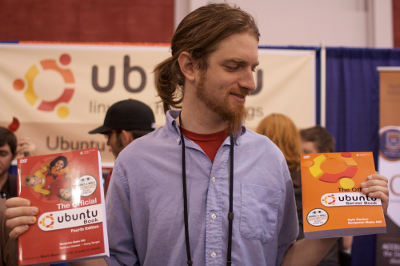
/copyrighteous/images/ubuntu_books_2009.png As I am attempting to focus on writing projects that are more scholarly and academic on the one hand (i.e., work for my day job at MIT) and more geared toward communicating free software principles toward wider audiences on the other (e.g., Revealing Errors), I have little choice but to back away from technical writing. However, this last month has seen the culmination of a bunch of work that I've done previously: two book projects that have been ongoing for the last couple years or more have finally hit the shelves! The first is the fourth edition (!) of the bestselling Official Ubuntu Book. Much to my happiness, the book continues to do extremely well and continues to receive solid reviews. This edition brings the book up to date for Jaunty/9.04 and adds a few pieces here and there. Although I was less active in this update than I have been in the past, Corey Burger continued his great work and Matthew Helmke of Ubuntu Forums fame stepped up to take a leading role. As I plan to retreat into a more purely advisory role for the next edition of this book, I'm thrilled to know that the project will remain in such capable hands. I'm also thrilled that this edition of the book, like all previous editions, is released as a free cultural work under CC BY-SA For years, I have heard people say that although they like the Official Ubuntu Book, it was a little too focused on desktops and on beginners for their tastes. The newly released Official Ubuntu Server Book is designed to address those concerns by providing an expanded guide to more "advanced" topics and is targeted at system administrators trying to get to know Ubuntu. Kyle Rankin planned and produced most of this book but I was thrilled to help poke it in places, chime in during the planning process, and to contribute a few chapters. Kyle is a knowledgeable sysadmin and has done wonderful job with the book. I only wish I could take more credit. The publisher has promised me that, at the very least, my chapters will be distributed under CC BY-SA. Many barriers to the adoption of free software are technical and a good book can, and often does, make a big difference. I enjoy being able to help address that problem. I also truly enjoy technical writing. I find it satisfying to share something I know well with others and it is great to know that I've helped someone with their problems. I'll assure I'll be able to do things here and there, I'll miss technical writing as I attempt "cut back."

Benjamin Mako Hill: Order Without Law

Order Without Law is a fantastic book by Robert Ellickson published in 1991. In a way, the book is an in-depth case study of the irrelevance of law. Subtitled, "how neighbors settle disputes," Ellickson shows how people solve complicated problems in an archetypal area of liability law without knowledge of the law. Ellickson shows that even when people know exactly what the law says, they often ignore it in favor of community norms and, in his examples, models of "neighborliness." Specifically, the book is about how neighbors in northern California settle disputes related to damage caused by roaming cattle, how neighbors construct and share costs of fences, and how, although the law is frequently debated in relation to classifying land as either open or closed to free grazing, the law tends to take a back seat to unwritten norms in the way that problems are actually solved. There is order and a shared understanding of rules in Ellickson's account; it just has very little to do with the law. As part of his description, Ellickson goes into some detail about the types of damage that cattle cause. For example, Ellickson describes how bulls, will often break down barbed wire fences and go on rampages impregnating heifers, eating vast amounts of food, and destroying crops and equipment. When I was on a long bike trip through northern California a few weeks ago, I was sitting under a tree waiting for my cyling partner to catch up. A giant black bull nearby noticed me. Shorting, mooing, and shaking ribbons of slobber from its mouth, it lumbered toward me. Only a rather weak-looking barbed wire fence separated us. All I could think about was Order Without Law.

15 September 2009

Andrew McMillan: DAViCal 0.9.7.2 released

I released a new 0.9.7.2 version of DAViCal yesterday. This reflects quite a lot of stability and small fixes for some subtle problems, and quite a lot of work with the iPhone, adding the possibility of a simpler configuration experience for iPhone users. One long-standing, but less obvious problem (well, less obvious to me) was the handling of usernames with odd characters in them. In the round-trip these needed to be urlencoded, and that wasn't happening correctly in all places, but it hopefully is now. People who want to use e-mail addresses in usernames, or spaces in calendar names, or both, etc., should all work now. One newer problem I've been seeing the effects of a little recently is that PHP 5.3 deprecates call-time pass by reference, which I had used in a few places. That's fixed now, so it should be OK to upgrade to PHP 5.3 without breaking DAViCal or having to explicitly turn those warnings off. The iPhone is a curious beast. Lots of people love them, and it is about the only mobile device that supports CalDAV (though I'm hoping the Nokia N900 also will), so it's important to support it as transparently as possible regardless of my personal loathing for it's horribly locked down state. It was pointed out to me that it is possible for it to be configured by entering three pieces of data (domain name, username, password) so I decided to make DAViCal support that process. In order for it to work for you you will need to have DAViCal running on an SSL server on port 8443, which isn't too big a deal. You can also plain http on 8008 which it will also attempt after prompting when the SSL connection fails. You'll also have to enable mod_rewrite and use some rewriting rules like the example on the wiki. For myself, I use the free SSL certificates from CACert.Org so I had to browse to their root certificate page and load the class 1 and class 3 certs into the iPhone before it would talk happily to my DAViCal server. I'm hoping to continue with reasonably frequent incremental releases of DAViCal for the rest of the year, hopefully with 0.9.7.4 sometime in late October. What will be included there might also depend on how productive my visit to CalConnect XVI is in three weeks too, and I'm looking forward to that.

13 September 2009

Joachim Breitner: The Automatic Rule-Based Time Tracker

A while ago, I thought: I seem to be less productive than I used to be. Why might that be? Do I spend more and more time with e-Mails? Or is it something else? I couldn t tell, so I needed a time tracking tool. There are a few of those for Linux that allow you, while working, specify what you are doing and then generate statistics about it. This approach has a few disadvantages:So I created arbtt, the Automatic Rule-Based Time Tracker. It comes with a background program that is started with your desktop session and will, each minute, record what windows are open, which one is active, what their titles and corresponding programs are. It also checks how long the user has been idle. No interaction required, no distraction possible. This information is stored in a log file. A separate tool allows the user to investigate this data. It is called rule-based because the mapping from the raw data to sensible tags that give information about the time sample is specified by a simple, but hopefully sufficiently powerful language.A simple example for a rule that indicates the currently used program would be:
tag Program:$current.program,
The prefix Program: is a category. Arbtt will ensure that for each time sample and category, at most one tag is specified. A more complex rule is
current window $title =~ m!(?:~ home/jojo)/projekte/(?:programming/(?:haskell/)?)?([^/)]*)!
==> tag Project:$1,
which makes use of the fact that both GVim and gnome-terminal display the full path to the currently edited file resp. to the working directory in the window title. This rule will track all my projects separately, and even automatically pick up new projects when they appear! You can see more rules in the example file.The statistics program then allows you to query the tags with some options:
Usage: arbtt-stats [OPTIONS...]
-h, -? --help show this help
-V --version show the version number
-x TAG --exclude=TAG ignore samples containing this tag
-o TAG --only=TAG only consider samples containing this tag
--also-inactive include samples with the tag "inactive"
-m PERC --min-percentage=PERC do not show tags with a percentage lower than PERC% (default: 1)
-i --information show general statistics about the data
-t --total-time show total time for each tag
-c CATEGORY --category=CATEGORY show statistics about category CATEGORY
For example, if I want to know what folders I have open while using evolution, I can run arbtt-stats -o Program:evolution -c Evo-Folder -m 3 to see this:
Statistics for category Evo-Folder
==================================
Time Percentage
=========================++======================
Evo-Folder:Eingang 22h20m00s 17.0%
Evo-Folder:Bekannte 16h40m00s 12.7%
Evo-Folder:d-haskell 9h40m00s 7.4%
Evo-Folder:Itomig 8h20m00s 6.4%
Evo-Folder:Verschickt 7h40m00s 5.8%
Evo-Folder:pkg-fso-maint 7h00m00s 5.3%
Evo-Folder:Bugs 6h00m00s 4.6%
Evo-Folder:planet debian 4h00m00s 3.0%
(60 entries omitted) 4h49m00s 36.7%
(unmatched time) 8m00s 1.0%
One big advantage of this approach is that you do not need to know in advance what queries you are interested in. Since the rules are applied when you are evaluating your data, and not when recording it, you can add more tags and forgotten special cases later.At this point, a big warning is due: This program will record a lot of very sensitive information about you. Be aware of this before you start using arbtt, and make sure you protect your data. You can get rid of all logs by deleting ~/.arbtt/capture.log.I have published arbtt on hackage. If you have cabal-install installed, you can install it with cabal install arbtt. See the README file for more information about setting it up. Depending on the feedback I get I will also consider packaging it for Debian.If you want to contribute, you are very welcome. The code is available at the darcs repository http://darcs.nomeata.de/arbtt/ (DarcsWeb). See the README for some ideas what to implement and feel free to come up with new ideas.

Joey Hess: debhelper talk

In Spain this summer, I gave a talk about new features in debhelper. It seemed to help a lot of people get started. So if you were not at DebConf, this is your chance to learn about dh, overrides, addons, and mimimal rules files. (low quality higher quality) The audio gets much better half-way through, and slides become visible. (We all also wake up a bit midway through -- it had been a late night!) The full slides are here.

9 September 2009

Isaac Jones: Partition and Solve

The idea of breaking programs into functions was taught to some of us with the metaphor of "divide and conquer." That is, make several smaller problems and solve those instead. This approach is now so deeply ingrained that I can just think "partition and solve" which is of course a much more positive and accurate description. One might think of the "partition your program into functions" principal as "the divide and conquer" principal. But of course, they are both instance of the more general "partition and solve". I dare say that "partition your program into functions" is even a more pure and accurate instance of the principal. Evolution may also be an instance of the principal. Different species evolved to solve different problems, or to solve the same problem (survival) in different ways. Of course, when you partition a program into functions, you also define those functions' relationships to each-other. Just because you're partitioning doesn't mean that the problems are not related. When people see several competing projects in the "free software community" trying to solve the same problem, some might say, "Good. We have divided them, now we will conquer them!" In their marketing material (or more likely press-release ranting) they will say that a house divided against itself will not stand [1]. Such people are probably purposefully ignoring the "partition and solve" principal. They ignore the fact that different projects have chosen different paths to solve different problems. They ignore the relationships between the projects, and that we feed each-other much more often than we actually compete. But no good programmer will ignore the relationships between her functions. Even within the Debian project we have lots of different goals. A truly gifted project leader will hopefully not see Debian as a house divided, but rather a very ripe partitioning looking for someone to define the problem that we solve together. A leader should help to define, create, or encourage the relationships that make that solution happen. peace,
isaac
[1] Oh no, I've contradicted the Bible and praised evolution in the same essay! Well, not really. The fallacy is not with the Bible's assertion about the house divided against itself, it's in the interpretation of "the free software community" as a single house. And also, I believe God created evolution :)

7 September 2009

Joey Hess: look who's packaging

So, Debian is still trying to decide if it likes upstream developers including debian directories in their source. Unlike the rpm world, where including a spec file in the tarball is expected, there has historically been some dislike about this being done on the deb side, mostly because of tool limitations. In the meantime, an interesting thing is happening in the wider world. Developing "apps" for mobile phones is appealing to lots of developers. And in an inversion of the linux distro status quo, part of making such an "app" is packaging it. Typically, for linux-based phones, into a .deb package, or something very close to it. Since N900 apps can fairly easily be ported to/from desktop linux, I won't be suprised if debian directories start popping up in lots more upstream sources. Like it or not.

Russell Coker: Bad but Appealing Copyright Arguments

Some people seem to believe that the problem with copyright law is the inability of people on the free culture side of the debate to compete with the large amounts of money that are being spent but the RIAA et al. I think that a significant part of the problem is that many intelligent and well-meaning people are simply unaware of or unconvinced by the arguments. For example the Reid Report post titled Paul Porter speaks truth to Black radio [1] includes the quote Only the United States, North Korea and Iran don t pay royalties for performers on free AM/FM radio . This point actually sounds quite reasonable and will convince many intelligent and well-meaning people who have an interest in politics such as Ms Reid. Cory Doctorow has written an interesting article titled Internet rapshoot: How Internet Gatekeepers Stifle Progress [2]. He describes how the big entertainment companies are failing to properly represent their customers or the artists who produce the content, and in the process creating monopolies out of companies such as Apple and Google. Cory starts by raising the issue of cultural discourse, monopolies in the distribution of popular art will lead to control over the political process. Ironically the article that Ms Reid cited [3] mentions the issue of pay for play which led to a steady diet of misogyny, violence and drug culture on the airwaves. Brendan Scott has written about a similar issue in Australia where the music copyright holders are trying to get massive increases in license fees from restaurants and other small businesses [4]. The expected result of this is greater use of classical music (which is out of copyright) and more interest in purchasing licenses from small musicians who aren t affiliated with the music cartels. One of his main points is that playing music in public places (including public radio frequencies) is the major form of advertising for musicians. Michael Tiemann writes about a Brazilian band that has been quite profitable by skipping the recording industry, providing the fans what they want, and selling CDs direct to fans [5]. This is one of many examples to illustrate the fact that the current music factory system is not required for musicians to make a profit. Amanda Palmer has written an interesting blog post about how the Warner music group wasn t getting as much money from Youtube as they wanted so they demanded that HER music videos be removed [6] (among many others). So we have a music studio that doesn t even pay the artist (below a certain number of sales the artist gets no payment, selling 30,000 albums is not enough to get a cent) demanding that the music videos be made unavailable to fans when the artist wants them published. This is a travesty and if similar licensing schemes are implemented for radio stations then we can expect that some radio stations will be financially discouraged from playing music even when the artist would be happy to have it played for free! In Australia we have an organisation that secretly taxes all viewing of material that they think is under copyright with a suitable license (they give no detailed information on how they determine the copyright and license status they probably violate my license by taxing universities for copying posts from my blog). Educational institutions and other organisations that sign up get to pay them some money based on what they are deemed to have used. The money is then distributed to the creators in proportion to the amount of use their material received. The distribution rules state that any amount less than $50 per year for an Australian resident or $200 per year for a non-resident will be instead redistributed to other people [7]. Usually analysis of The Long Tail [8] comprises the majority of the sales if users are given enough opportunities to search for a product that is a good match for their requirements. This is the entire basis of businesses such as Amazon.com. The Australian Copyright Agency (Copyright Agency Limited CAL) seems to have a business model of taking all the revenue that might be earned by the creative people in the long tail and give it all to the top performers. If a similar system was implemented for the US music industry then it would be great for Michael Jackson s estate, but bad for the vast majority of musicians. It seems likely to me that the current situation with the music industry is fairly optimal for making a few very popular musicians very rich. The proposed changes for the US will make things even better/worse (depending if you are among the rich few or the majority of the population). One thing we need to ask ourselves is whether we want laws that will make a few people rich or laws that will give many people an adequate income for work they enjoy and which also enriches our culture. This correct decision seems obvious to me. Can anyone think of other good points that should be raised when discussing such issues with people who don t consider copyright to be a big issue?

6 September 2009

Dirk Eddelbuettel: RQuantLib 0.3.0 Windows build snag

Yesterday's upload of RQuantLib 0.3.0 contained one minor oversight: I had failed to update src/Makefile.win to the new and enlarged set of source files. The proper fix (of using wildcards and implicit rules) was simple, and Uwe Ligges kindly rebuilt RQuantLib on the Windows builder for CRAN using an updated Makefile so that binaries for Windows will be available. This fix will also be in the next upload. Should you need it in the meantime, here is a link to the new version directly from SVN.

Frans Pop: debtree 0.7.3 - Oh what tangled webs we weave

It's been quite some time (almost two years) since my previous "release" of debtree, but now version 0.7.3 is available. And it still generates very nice graphs :-) The changes are relatively minor: a few nice fixes for corner cases that were not handled correctly, and an update of the default lists of "skip" and "end" packages which help to limit the size of graphs for a fair number of packages I tried (including konqueror and openoffice.org).
Reason to revisit debtree was a recent nice mail from a debtree user, but also the current discussions about udev and the FHS. I'm on the side of "let's please keep /usr mountable separately". Mostly because I like a (small) encrypted root with a separate (large) unencrypted /usr'. I'm also increasingly unhappy with the default size of Debian's desktop installs, especially now that it looks as if Squeeze will see installation of Recommends by default by tasksel (and thus Debian Installer). For comparison, the size of a default Gnome desktop install for Etch was 1360MB; for Lenny it is 1830MB; for Squeeze it looks like it will be well over 3000MB! Remember that for Sarge we installed both Gnome and KDE from CD1 with both together taking 1390MB? Sure, some of that is real functionality, but a lot is also (IMO) redundant visual effects that only serve to slow the desktop down and junk needed to do stuff automagically. And a heck of a lot is duplicated functionality. One of the main reasons I switched to Linux was because it gave me back control over my systems, but with KDE4 and pervasive stuff like hal and all the various "kits" Linux is on a fast track that's giving priority to flashiness over real functionality and eroding that control. Here's a fairly default dependency graph for hal (click for full image). Looks reasonable, right? hal dependency graph But that's only because most major dependencies, such as dbus, policykit and pm-utils have been pruned. Here's a complete graph, with only libc6 omitted (full image is 1.5MB). Truly a tangled web. Scary. full hal dependency graph One can also look at it from the other side. Today I upgraded my sid chroot and found I suddenly needed to install libavahi-client3, libavahi-common3, libavahi-common-data and libdbus-1-3. Why? Reason turned out to be libcups2, so I checked if I really needed that. And here's why I do. libgtk2.0-0 dependency graph Most of these dependencies of libgtk2.0-0 I can understand, but isn't gtk supposed to be a graphical toolkit library? Couldn't printing support be implemented in some more specialized Gnome printing toolkit library? But I'm probably missing something. Anyway, now that I have a bit more perl experience through my recent work on debmirror, maybe I should finally port debtree from shell script to perl...
See the debtree home page for a full overview of how to read the graphs, but here's a quick intro. Purple arrows are Pre-Depends, blue are Depends and black are Recommends; green connections show Provides. The green packages are currently installed in my sid chroot, while the white ones are not. The diamonds show where the graph has been pruned: dependencies for these packages are not shown.

5 September 2009

Neil Williams: po4a and translating manpages

po4a creates the meta files needed to generate the manpages but the actual generation process is a little awkward and tends to become heavily customised.

For emdebian-rootfs, I've now received the Portuguese translation and I've been improving the genmanpages script. It's now more general and easier to configure for different source packages. There remain a few hidden assumptions which I hope to fix in future.

#!/bin/sh
set -e

# Copyright (C) 2006-2009 Neil Williams
#
# This program is free software; you can redistribute it and/or modify
# it under the terms of the GNU General Public License as published by
# the Free Software Foundation; either version 3 of the License, or
# (at your option) any later version.
#
# This program is distributed in the hope that it will be useful,
# but WITHOUT ANY WARRANTY; without even the implied warranty of
# MERCHANTABILITY or FITNESS FOR A PARTICULAR PURPOSE. See the
# GNU General Public License for more details.
#
# You should have received a copy of the GNU General Public License
# along with this program. If not, see .

# name and location of the config file
# relative to the top level source directory of the translations
# i.e. the directory containing ./po/
CONFIG="doc/po4a.config"
# POTFILE path
POTFILE="po/emdebian-rootfs.pot"
# the binary packages that will contain generated manpages
BINARIES="emdebian-rootfs multistrap"
# the binary packages with manpages in Section 3.
HASMAN3="emdebian-rootfs"
# the binary packages using DocBook XML & xsltproc
XMLPACKAGES="emdebian-rootfs"
# the DocBook XML files (TODO: let this take paths)
XMLFILE="emdebian-rootfs.1.xml"
# the XSL file to use for Docbook XSL
XSLFILE="http://docbook.sourceforge.net/release/xsl/current/manpages/docbook.xsl"
# the POD files (TODO: let this take paths)
PODFILE="em_multistrap"
# the binary packages using POD
PODPACKAGES="multistrap"

# remember to add something to the clean:: rule in debian/rules
# to remove each binary package sub-directory.
# $(RM) -r doc/emdebian-rootfs doc/multistrap

# below this point, no changes should be needed.

wrap_langs ()
if [ -z "$LANGS" ]; then
echo "$1 $2" >> $CONFIG
else
echo "$1 $2 $3" >> $CONFIG
fi


if [ -f po4a.config ]; then
cd ../
fi
if [ -f ../po4a.config ]; then
cd ../../
fi

# calculate the langs, automatically.
LANGS= ls po/*.po 2>/dev/null true
if [ ! -z "$LANGS" ]; then
LANGS= ls po/*.po sed -e 's/.*\/\(.*\)\.po/\1 /' true
fi
if [ ! -z "$LANGS" ]; then
# LANGS should not include the specification, just the root.
LANGS= echo $LANGS sed -e 's/_.*//'
LANGS= echo $LANGS sed -e 's/@.*//'
LANGS= echo $LANGS sed -e 's/\+.*//'
echo "[po4a_langs] $LANGS" > $CONFIG
else
echo > $CONFIG
fi
wrap_langs "[po4a_paths]" "$POTFILE" "\$lang:po/\$lang.po"

for d in $BINARIES; do
for l in $LANGS; do
mkdir -p doc/$d/man/$l/man1/
if [ "$d" = "$HASMAN3" ]; then
mkdir -p doc/$d/man/$l/man3/
fi
done
mkdir -p doc/$d/man/man1/
if [ "$d" = "$HASMAN3" ]; then
mkdir -p doc/$d/man/man3/
fi
mkdir -p doc/pod/$l/
done
mkdir -p doc/html/

for file in ls doc/xml/*.xml ; do
xmllint --format "$file" --output "$file"
LOCAL= basename $file
wrap_langs "[type:docbook]" "$file" "\$lang:doc/xml/\$lang/$LOCAL"
done
# oops, this needs to be configurable
for file in em_multistrap; do
wrap_langs "[type: pod]" "$file" "\$lang:doc/pod/\$lang/$file"
done

# use -k to create all XML even if untranslated or the XSL breaks the build.
po4a -k 0 $CONFIG

for d in $BINARIES; do
for P in $XMLPACKAGES; do
for X in $XMLFILE; do
XML_CATALOG_FILES="/etc/xml/catalog" \
xsltproc -o doc/man/ --nonet $XSLFILE doc/xml/$X
done
if [ "$d" = "$HASMAN3" ]; then
mv doc/man/*.3 doc/$P/man/man3/
fi
mv doc/man/*.1 doc/$P/man/man1/
done
for POD in $PODPACKAGES; do
pod2man $PODFILE > doc/$POD/man/man1/$PODFILE.1
done
for l in $LANGS; do
for P in $XMLPACKAGES; do
for X in $XMLFILE; do
XML_CATALOG_FILES="/etc/xml/catalog" \
xsltproc -o doc/man/ --nonet $XSLFILE doc/xml/$l/$X
done
if [ "$d" = "$HASMAN3" ]; then
mv doc/man/*.3 doc/$P/man/$l/man3/
fi
mv doc/man/*.1 doc/$P/man/$l/man1/
done
for POD in $PODPACKAGES; do
pod2man doc/pod/$l/$PODFILE > doc/$POD/man/$l/man1/$PODFILE.1
done
done
done
for l in $LANGS; do
rm -rf doc/xml/$l
done
rm -rf doc/pod/

# the rest is specific to emdebian-rootfs - ignore.

# HTML versions, not packaged.
xsltproc -o doc/html/ --nonet \
http://docbook.sourceforge.net/release/xsl/current/html/chunk.xsl \
doc/xml/emdebian-rootfs.1.xml

for i in ls doc/html/*.html ; do
iconv -t utf-8 -f iso8859-1 $i > doc/html/tmp
sed < doc/html/tmp > $i -e 's:charset=ISO-8859-1:charset=UTF-8:'
done
rm -f doc/html/tmp


OK, more to be done here but it has a basic idea. The generated files are separated out into directories determined by the binary package name into which the manpages will be installed.

This gives a .install line something like:
doc/emdebian-rootfs/man/* ./usr/share/man/

This is important because it reduces the number of changes needed to add a new translation - in effect, only the $lang.po file itself.

It should at least give some ideas of what can be done.

31 August 2009

Andrew Cater: Madly dysfunctional family barbeque

At Steve's house in Cambridge. First Debian party I'd been to. House full of people I knew only from email, some very old friends. Wires and leads filling the front room floor - laptops _everywhere_ . [My netbook died with nasty ACPI errors - since fixed/worked around - it was practically the one place in the world where I could yell for an ACPI expert and folk knew what I was talking about :) ]

I wish I'd taken a camera - I was there for 1/2 hour before I realised I was only about three feet from a large TV which then became the focus for competitive Wii Fit archery :) Thirty second rule on sofa space - if you left for more than about 30 seconds you had to sit on the floor when you got back (I jammed myself onto a corner of the sofa once I realised I'd barely get through the crush :) )
[Forget students in a mini / UK telephone box - how many DDs can you fit into a very narrow kitchen :) ]

It's a huge, dysfunctional family with its own rules, geeky humour and in-jokes but it's MINE - it's the people I want to hang out with and, as perverse as it sounds, just being there gave me a whole new reaffirmed sense of identity and a large amount of determination to carry on "wasting my time with Linux" and Debian

Thanks to those who signed my key for me (and Noodles who didn't sign but gave a very intelligent rationale as to why he couldn't at the moment :) )
Thanks to Steve for quintessentially being and being the perfect host - and I hope to be back next year. And the food was excellent - chilli popcorn comes highly recommended :)

5 June 2009

Stefano Zacchiroli: turbogears 2 packaging - take 3

TurboGears 2 packaging - (another) status update Brief status update on TG2 packaging. As expected, this week has been very busy and I'm writing the update offline on a train, but nevertheless I've good news to share: ... the last item above would theoretically mean that TG2 is already usable, but it is not the case due to the infamous #507909 which breaks both TG2 and TG1 in unstable (the latter was working in Lenny, and I had to resort to a Lenny chroot for a recent course I've taught about web development). In short, turbojson is in unstable, in spite of the lack of several of its dependencies, making impossible any import of it. ..., stay tuned, keep faith, bear with me, almost there, ... etc.

Joachim Breitner: Third place in AI programming contest

My contribution to the programming contest held by the German FreiesMagazin got a third place out of 13 submissions. This is quite good, considering that I only wrote a small wrapper around the generic game-tree Haskell library by Colin Adams, and hardly gave any serious thought into the problem.All entires are available for download. I have annotated the table containing the results with the line count as given by ohcount:
W D L Points Language Code lines
1. Kroschinsky 904 242 54 2954 Python 589
2. Schulz 858 263 79 2837 Python 544
3. Breitner 837 281 82 2792 Haskell 264
4. Jackermeier 754 306 140 2568 Perl 183
5. Roth 574 338 288 2060 C++ 1731
6. Eitel 567 355 278 2056 Ruby 352
7. Reichel 342 328 530 1354 Python 266
8. Zimmermann 303 400 497 1309 Java 1070
9. Apensiv 190 353 657 923 Perl 410
10. Maraun 150 300 750 750 C++ 690
11. Golemo 131 319 750 712 Python 104
12. Ziegelwanger 120 337 743 697 C++ 868
13. Fuest 32 254 914 350 Python 645
Note that the line count for my haskell program includes the game-tree library, which I bundled in my submission. Without it, it s 156 lines of code I had to write, which is second best in the code golf category.If you look at the timing statistics, you will see that my program took the longest. When the contest was started, the timelimit was one minute per round which I of course tried to use as much as possibly, by increasing the search tree depth. Later into the contest, the rules were changed to limit it to one minute for a whole game, and that long-running programs will get points deducted. I did some minor changes based on a profiling run, but did otherwise not care too much about performance. I would have tried to improve the runtime by using Haskell s good ability for parallelization. But when I asked on what kind of machine the code will be run, but they would not tell me. They said that this is a hobby programmer s contest where allowing for parallelization were not fair, so I did not work in that direction.All in all it was a positive experience, showing of Haskell s qualities as a language that you can quickly get good results with.

4 June 2009

Sam Hartman: Kerberos 1.7

MIT Kerberos 1.7 is released. I think this release really takes MIT Kerberos forward both for end sites and for system integrators. There are a lot of code quality improvements and bug fixes. For sites, this release allows changes to flow from one KDC to another on an ongoing basis rather than waiting for periodic refreshes. In addition, the domain-realm referral project allows information mapping hosts to domains to be configured in one place rather than on each client. I already wrote about Active Directory enhancements. Painless Security was also involved in a project to secure Kerberos against offline dictionary attacks. I m very happy that this project made the 1.7 release. To be truly useful, it will require integration from OS vendors into PAM modules and the like. I ll discuss my plans for doing that in Debian in a future post. Despite a lot of new features, initial signs are that 1.7 is going to be a relatively stable release. It has been in Debian unstable for over a month and at this point is working quite well.

1 June 2009

Cyril Brulebois: Early June update

Random bits: Blender 2.49 - splash screen

31 May 2009

Stefano Zacchiroli: turbogears 2 packaging - take 2

TurboGears 2 packaging - status update Brief status update about my TurboGears 2 packaging efforts, after some evening work of today: Here is my ex-virgin /usr/local/lib/python2.5/site-packages/ as it looks now:
    zack@usha:~$ ls /usr/local/lib/python2.5/site-packages/ -1
    AddOns-0.6-py2.5.egg
    BytecodeAssembler-0.3-py2.5.egg
    Catwalk-2.0.2-py2.5.egg
    easy-install.pth
    Extremes-1.1-py2.5.egg
    PEAK_Rules-0.5a1.dev_r2582-py2.5.egg
    prioritized_methods-0.2.1-py2.5.egg
    sprox-0.5.5-py2.5.egg
    SymbolType-1.0-py2.5.egg
    tg.devtools-2.0-py2.5.egg
    tgext.admin-0.2.4-py2.5.egg
    tgext.crud-0.2.4-py2.5.egg
    TurboGears2-2.0-py2.5.egg
    tw.forms-0.9.3-py2.5.egg
    zope.sqlalchemy-0.4-py2.5.egg

At this point, it should be already possible to install the 2 main eggs composing TurboGears 2 (tg.devtools and TurboGears2 itself) relying only on Debian-package dependencies. ... modulo some "details": This evening's motto: ci siamo quasi. Next week I'll be pretty busy, but I guess some night work (or some of you, fellow readers :-) ) will come to the rescue.

30 May 2009

Stefano Zacchiroli: kick-starting turbogears 2 packaging

TurboGears 2 in debian ... soon ! After a long incubation, a few days ago TurboGears 2 has been released. Historically, I've been preferring TurboGears over Django for being closer to the open source philosophy of reusing existing components. Since the long 2.0 release was marking a gap with Django, I was eager to test the 2.0, and I was delighted to find it in Debian. Unfortunately, it doesn't seem to be in good shape yet. In particular it lacks several dependencies before it can even be used to quickstart a project, in spite of its presence in unstable. To give an idea of the needed work, after having installed it manually (via easy_install), my virgin /usr/local/lib/python2.5/site-packages/ has been polluted by 26 egg-thingies. I decided to spend some week-end time to start closing the gap, because we cannot lack such an important web framework in Debian (and ... erm, yes, also because I need it :-) ). Here is the current status of what has been ITP-ed / packaged already (by yours truly): Where to Considering, foolishly, the last package as being already done, the way to go is still long:
    zack@usha:~$ ls /usr/local/lib/python2.5/site-packages/ grep -v repoze.what
    AddOns-0.6-py2.5.egg
    BytecodeAssembler-0.3-py2.5.egg
    Catwalk-2.0.2-py2.5.egg
    easy-install.pth
    Extremes-1.1-py2.5.egg
    PEAK_Rules-0.5a1.dev_r2582-py2.5.egg
    prioritized_methods-0.2.1-py2.5.egg
    sprox-0.5.5-py2.5.egg
    sqlalchemy_migrate-0.5.2-py2.5.egg
    SymbolType-1.0-py2.5.egg
    tg.devtools-2.0-py2.5.egg
    tgext.admin-0.2.4-py2.5.egg
    tgext.crud-0.2.4-py2.5.egg
    TurboGears2-2.0-py2.5.egg
    tw.forms-0.9.3-py2.5.egg
    WebFlash-0.1a9-py2.5.egg
    zope.sqlalchemy-0.4-py2.5.egg

Possibly, some of them are already in Debian hidden somewhere, but sure there is still work to be done. If you want to help, you are more then welcome. The rules are simple: all packages will be maintained under the umbrella of the Python Modules Team, but you should be willing to take responsibility as the primary maintainer. Please get in touch with if you are interested, as I'm in turn already in touch with some other very kind volunteers (thanks Enrico and Federico2!) to coordinate who-is-doing-what. Preview packages available What has already been packaged, including a temporary workaround for python-transaction, will be available in experimental after NEW processing. The idea is that nothing will go to unstable until TurboGears 2 will be (proven to be) fully functional. In the meantime, packages are available from my personal APT repository (signed by my key), here are the friendly /etc/apt/sources.list :
    deb http://people.debian.org/~zack/debian zack-unstable/
    deb-src http://people.debian.org/~zack/debian zack-unstable/

Versions are tilde-friendly and shouldn't get in your way when the official packages will hit unstable. Packaging multiple-egg / multiple-upstream packages In all this, I've faced an interesting problem with the python-repoze. who,what -plugins packages. They correspond to a handful of plugins, each of which is about 20/30 Kb. I didn't consider appropriate to prepare 5 different packages, due to archive bloat potential. Hence, you get the usual problems of multiple-upstream packages. To counter some of them, as well as some egg-specific packaging annoyances with multiple upstream, I wrote a couple of very simple helpers: I'm no Python-packaging-guru so, lazyweb, if you spot in this choice something I utterly overlooked, or if you have improvements to suggest, please let me know. Repacking eggs An interesting problem will be faced in trying to integrate the above approach with Python modules that are shipped only as .egg files (i.e., no tarballs, ... yes there are such horrifying things out there). To preserve uniformity, we would need uscan to support --repack ing of .egg files as they were simple .zip archives. Since eggs are .zip archives ... why not?

24 May 2009

Bernd Zeimetz: howto set android developer device permissions with udev

As there're several, more or less well working howtos about creating udev rules to allow access to the USB debug devices of Android phones out there in the wild, I decided to write my own one. It works at least for Debian Testing/Squeeze. The udev rules file I provide here works at least for the HTC Dream models (aka T-Mobile G1 and Google Devphone). As a computer may be used by more than one user, I've decided to create a group called androiddev. Members of the group will be allowed to access the debug interface. Running (hint: become root first) addgroup --system androiddev will create the group for you. Add your developers to the group with adduser username androiddev (of course replace username with the user you'd like to add) and we're ready to configure udev. Open /etc/udev/android.rules in an editor and add the following lines:
SUBSYSTEMS=="usb", ATTRS idVendor =="0bb4", ATTRS idProduct =="0c01", MODE="0660", OWNER="root", GROUP="androiddev", SYMLINK+="android%n"
SUBSYSTEMS=="usb", ATTRS idVendor =="0bb4", ATTRS idProduct =="0c02", MODE="0660", OWNER="root", GROUP="androiddev", SYMLINK+="android%n"
Now we need to link the created rules file into /etc/udev/rules.d ln -s ../android.rules /etc/udev/rules.d/90-android.rules and tell udev to reload the rules: /etc/init.d/udev reload That's it. Don't forget to re-login to make sure your new shiny group will show up! Now have fun with adb and fastboot :) Thanks to TauPan from #debian/freenode.net who gave me the idea for this blog post.

22 May 2009

Martin F. Krafft: Django: a beautiful and truly thin web development framework

Take the following URL:
http://my.server.tld/wow/summary/2009/05/21/?style=boxed

and imagine the following Python function:
def summary(request, year, month, day):
    response = HttpResponse()
    // do something
    return response

If you see a relation between the two, then Django is for you. The missing part is a URL mapping, a list of regular expressions, which transforms a URL into a keyword list, and maps it to a function (a HTTP view, as it s called):
(r'^wow/summary/(?P<year>\d 4 )/(?P<month>\d 2 )/(?P<day>\d 2 )/$',
    mysite.wow.summary,  'additional':'information' )

You do not have to use keyword arguments, positional parameters will work as well, and you can do anything you like within the powers of regular expressions, but the result is always along the same lines: When someone visits the above URL, Django calls the above summary( ) function (defined in the modules mysite/wow.py) and passes an object encapsulating the request, along with the components from the URL as parameters:
summary(request, 2009, 05, 21,  'additional':'information' )

It then renders the return value. The function can also throw an exception if it need to communicate e.g. a 404 error. Very clean, and there are even generic views if your data doesn t need any massaging, of if you just want to do standard things like generate PDFs. This is the core idea of Django, which I ve gathered from one talk and four hours of invested time. It s a truly thin layer, and its elegance made me bouncey. The QUERY STRING of the request will be passed in the request object, along with all the other CGI variables you re familiar with. Django provides a large number of helpers and shortcuts to save you from having to do the ugly work, including topics such as internationalisation, syndication, authentication, file uploads, and caching. In addition, Django gives you an object-relational_mapper to map the data into, and manage the data definition within your favourite RDBMS, a templating language designed to fit in with the whole philosophy, and widgets to work with forms. You do not have to use any of those. You are free to use any other Python module for the task, just as you can use all of the other features of and modules written for Python. This is particularly powerful in the context of the middleware layer. There s also a large number of pluggable applications and snippets for re-use. The only concern I have at this point is whether features like tagging are going to find their way into the framework, because tracking numerous external plugins for a site and keeping them working across versions reminds me of the nightmares I had with Zope and Plone (I stopped working with (and on) those before I had a chance to dive into version 3 of each). The fact that Django leaves data storage to other tools (in fact, it s entirely up to you) makes those nightmares seem further distant. All in all, I am excited to have had a chance to take a brief glance at the software, and I am looking forward to doing more with it. Unfortunately, it looks like it will take quite some time to wade through existing plugins and design the rest of an application that can finally replace the horrific dung-pile that is my homepage.

Next.

Previous.