| Editor: | Maya Schenwar |
| Editor: | Joe Macar |
| Editor: | Alana Yu-lan Price |
| Publisher: | Haymarket Books |
| Copyright: | June 2016 |
| ISBN: | 1-60846-684-1 |
| Format: | Kindle |
| Pages: | 250 |
Old laptop I ve been meaning to get a new laptop for a while now. My ThinkPad X250 is now 5 years old and even though it s still adequate in many ways, I tend to run out of memory especially when running a few virtual machines. It only has one memory slot, which I maxed out at 16GB shortly after I got it. Memory has been a problem in considering a new machine. Most new laptops have soldered RAM and local configurations tend to ship with 8GB RAM. Getting a new machine with only a slightly better CPU and even just the same amount of RAM as what I have in the X250 seems a bit wasteful. I was eyeing the Lenovo X13 because it s a super portable that can take up to 32GB of RAM, and it ships with an AMD Ryzen 4000 series chip which has great performance. With Lenovo s discount for Debian Developers it became even more attractive. Unfortunately that s in North America only (at least for now) so that didn t work out this time.
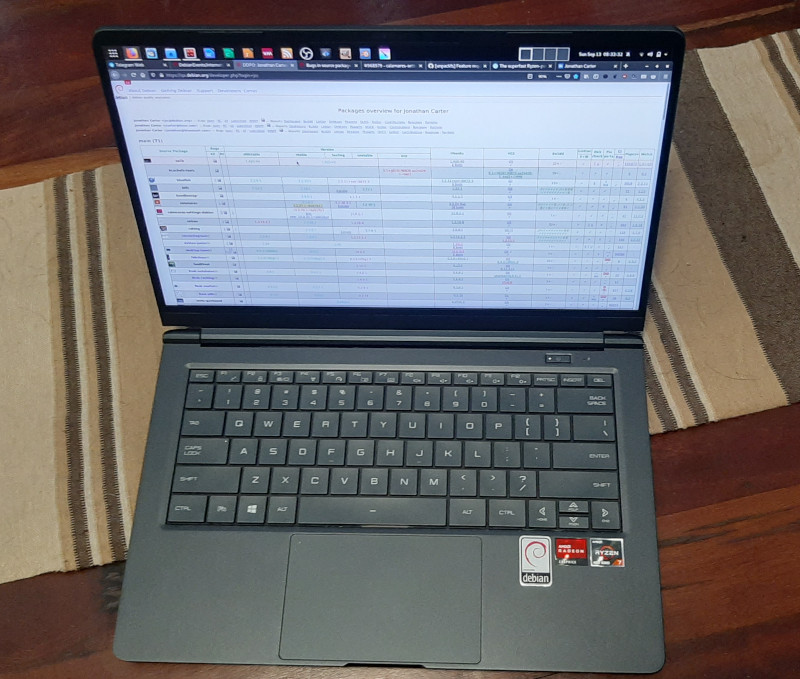
Enter Tongfang I ve been reading a bunch of positive reviews about the Tuxedo Pulse 14 and KDE Slimbook 14. Both look like great AMD laptops, supports up to 64GB of RAM and clearly runs Linux well. I also noticed that they look quite similar, and after some quick searches it turns out that these are made by Tongfang and that its model number is PF4NU1F. I also learned that a local retailer (Wootware) sells them as the Wootbook. I ve seen one of these before although it was an Intel-based one, but it looked like a nice machine and I was already curious about it back then. After struggling for a while to find a local laptop with a Ryzen CPU and that s nice and compact and that breaks the 16GB memory barrier, finding this one that jumped all the way to 64GB sealed the deal for me. This is the specs for the configuration I got:


Overall remarks When maxing out the CPU, the fan is louder than on a ThinkPad, I definitely noticed it while compiling the zfs-dkms module. On the plus side, that happened incredibly fast. Comparing the Wootbook to my X250, the biggest downfall it has is really it s pointing device. It doesn t have a trackpad and the touchpad is ok and completely usable, but not great. I use my laptop on a desk most of the time so using an external mouse will mostly solve that. If money were no object, I would definitely choose a maxed out ThinkPad for its superior keyboard/mouse, but the X13 configured with 32GB of RAM and 128GB of SSD retails for just about double of what I paid for this machine. It doesn t seem like you can really buy the perfect laptop no matter how much money you want to spend, there s some compromise no matter what you end up choosing, but this machine packs quite a punch, especially for its price, and so far I m very happy with my purchase and the incredible performance it provides. I m also very glad that Wootware went with the gray/black colours, I prefer that by far to the white and silver variants. It s also the first laptop I ve had since 2006 that didn t come with Windows on it. The Wootbook is also comfortable/sturdy enough to carry with one hand while open. The ThinkPads are great like this and with many other brands this just feels unsafe. I don t feel as confident carrying it by it s display because it s very thin (I know, I shouldn t be doing that with the ThinkPads either, but I ve been doing that for years without a problem :) ). There s also a post on Reddit that tracks where you can buy these machines from various vendors all over the world.
/admin1-> console com2 console: Serial Device 2 is currently in useSo far the only way I ve discovered to get console access again after that is the command racadm racreset . If anyone knows of a better way please let me know. As an aside having racreset being so close to racresetcfg (which resets the configuration to default and requires a hard reboot to configure it again) seems like a really bad idea. Host Based Management
deb http://linux.dell.com/repo/community/ubuntu xenial openmanageThe above apt sources.list line allows installing Dell management utilities (Xenial is old but they work on Debian/Buster). Probably the packages srvadmin-storageservices-cli and srvadmin-omacore will drag in enough dependencies to get it going. Here are some useful commands:
# show hardware event log omreport system esmlog # show hardware alert log omreport system alertlog # give summary of system information omreport system summary # show versions of firmware that can be updated omreport system version # get chassis temp omreport chassis temps # show physical disk details on controller 0 omreport storage pdisk controller=0RAID Control The RAID controller is known as PERC (PowerEdge Raid Controller), the Dell web site has an rpm package of the perccli tool to manage the RAID from Linux. This is statically linked and appears to have different versions of libraries used to make it. The command perccli show gives an overview of the configuration, but the command perccli /c0 show to give detailed information on controller 0 SEGVs and the kernel logs a vsyscall attempted with vsyscall=none message. Here s an overview of the vsyscall enmulation issue [2]. Basically I could add vsyscall=emulate to the kernel command line and slightly reduce security for the system to allow system calls from perccli that are called from old libc code to work, or I could run code from a dubious source as root. Some versions of IDRAC have a racadm raid command that can be run from a ssh session to perform RAID administration remotely, mine doesn t have that. As an aside the help for the RAC system doesn t list all commands and the Dell documentation is difficult to find so blog posts from other sysadmins is the best source of information. I have configured IDRAC to have all of the BIOS output go to the virtual serial console over ssh so I can see the BIOS prompt me for PERC administration but it didn t accept my key presses when I tried to do so. In any case this requires downtime and I d like to be able to change hard drives without rebooting. I found vsyscall_trace on Github [3], it uses the ptrace interface to emulate vsyscall on a per process basis. You just run vsyscall_trace perccli and it works! Thanks Geoffrey Thomas for writing this! Here are some perccli commands:
# show overview perccli show # help on adding a vd (RAID) perccli /c0 add help # show controller 0 details perccli /c0 show # add a vd (RAID) of level RAID0 (r0) with the drive 32:0 (enclosure:slot from above command) perccli /c0 add vd r0 drives=32:0When a disk is added to a PERC controller about 525MB of space is used at the end for RAID metadata. So when you create a RAID-0 with a single device as in the above example all disk data is preserved by default except for the last 525MB. I have tested this by running a BTRFS scrub on a disk from another system after making it into a RAID-0 on the PERC.
ikectl utility to help you do
so. Before going any further, you might find it useful to edit
/etc/ssl/ikeca.cnf to set some reasonable defaults for your
certificates.
Begin by creating and installing a CA certificate:
# ikectl ca vpn create
# ikectl ca vpn install
# ikectl ca vpn certificate server1.example.org create
# ikectl ca vpn certificate server1.example.org install
# ikectl ca vpn certificate server2.example.org create
# ikectl ca vpn certificate server2.example.org export
# tar -C /etc/iked -xzpvf server2.example.org.tgz
$ cat /etc/ssl/vpn/index.txt
V 210825142056Z 01 unknown /C=US/ST=Pennsylvania/L=Pittsburgh/CN=server1.example.org/emailAddress=rak@example.org
V 210825142208Z 02 unknown /C=US/ST=Pennsylvania/L=Pittsburgh/CN=server2.example.org/emailAddress=rak@example.org
/etc/iked.conf, filling in
the srcid and dstid fields appropriately.
ikev2 'server1_server2_active' active esp from server1.example.org to server2.example.org \
local server1.example.org peer server2.example.org \
srcid '/C=US/ST=Pennsylvania/L=Pittsburgh/CN=server1.example.org/emailAddress=rak@example.org' \
dstid '/C=US/ST=Pennsylvania/L=Pittsburgh/CN=server2.example.org/emailAddress=rak@example.org'
ikev2 'server2_server1_passive' passive esp from server2.example.org to server1.example.org \
local server2.example.org peer server1.example.org \
srcid '/C=US/ST=Pennsylvania/L=Pittsburgh/CN=server2.example.org/emailAddress=rak@example.org' \
dstid '/C=US/ST=Pennsylvania/L=Pittsburgh/CN=server1.example.org/emailAddress=rak@example.org'
'server1_server2_active' and
'server2_server1_passive' in the two stanzas do not matter and
can be omitted. Reload iked on both hosts:
# ikectl reload
# ikectl show sa
/var/log/daemon.
/etc/iked.conf on the remote end:
ikev2 'responder_x509' passive esp \
from 0.0.0.0/0 to 10.0.1.0/24 \
local server1.example.org peer any \
srcid server1.example.org \
config address 10.0.1.0/24 \
config name-server 10.0.1.1 \
tag "ROADW"
iked.conf(5) for details.
Reload iked:
# ikectl reload
/etc/hostname.vether0, again
configuring the address to suit your needs:
inet 10.0.1.1 255.255.255.0
# ifconfig vether0 up
# ikectl ca vpn certificate client.example.org create
# ikectl ca vpn certificate client.example.org export
# tar -C /etc/ipsec.d/ -xzf client.example.org.tgz -- \
./private/client.example.org.key \
./certs/client.example.org.crt ./ca/ca.crt
/etc/ipsec.conf,
configuring appropriately:
ca example.org
cacert=ca.crt
auto=add
conn server1
keyexchange=ikev2
right=server1.example.org
rightid=%server1.example.org
rightsubnet=0.0.0.0/0
rightauth=pubkey
leftsourceip=%config
leftauth=pubkey
leftcert=client.example.org.crt
auto=route
/etc/ipsec.secrets:
# space is important
server1.example.org : RSA client.example.org.key
# ipsec restart
# ipsec up server1
# ipsec status
I'm happy to announce I handed out my Master's Thesis last Monday. I'm not
publishing the final copy just yet1, as it still needs to go through
the approval committee. If everything goes well, I should have my Master of
Economics diploma before Christmas!
It sure hasn't been easy, and although I regret nothing, I'm also happy to be
done with university.
Looking for a job
What an odd time to be looking for a job, right? Turns out for the first time
in 12 years, I don't have an employer. It's oddly freeing, but also a little
scary. I'm certainly not bitter about it though and it's nice to have some time
on my hands to work on various projects and read things other than academic
papers. Look out for my next blog posts on using the NeTV2 as an OSHW HDMI
capture card, on hacking at security tokens and much more!
I'm not looking for anything long term (I'm hoping to teach Economics again next
Winter), but for the next few months, my calendar is wide open.
For the last 6 years, I worked as Linux system administrator, mostly using a
LAMP stack in conjunction with Puppet, Shell and Python. Although I'm most
comfortable with Puppet, I also have decent experience with Ansible, thanks to
my work in the DebConf Videoteam.
I'm not the most seasoned Debian Developer, but I have some experience
packaging Python applications and libraries. Although I'm no expert at it,
lately I've also been working on Clojure packages, as I'm trying to get Puppet
6 in Debian in time for the Bullseye freeze. At the rate it's going though, I
doubt we're going to make it...
If your company depends on Puppet and cares about having a version in Debian 11
that is maintained (Puppet 5 is EOL in November 2020), I'm your guy!
Oh, and I guess I'm a soon-to-be Master of Economics specialising in Free and
Open Source Software business models and incentives theory. Not sure I'll ever
get paid putting that in application, but hey, who knows.
If any of that resonates with you, contact me and let's have a chat! I promise
I don't bite :)
In our monthly reports, we summarise the things that we have been up to over the past month. The motivation behind the Reproducible Builds effort is to ensure no flaws have been introduced from the original free software source code to the pre-compiled binaries we install on our systems. If you re interested in contributing to the project, please visit our main website.
One hiccup we ve encountered in SecureDrop development is that not all Python wheels can be built reproducibly. We ship multiple (Python) projects in Debian packages, with Python dependencies included in those packages as wheels. In order for our Debian packages to be reproducible, we need that wheel build process to also be reproducibleParallel to this, transparencylog.com was also launched, a service that verifies the contents of URLs against a publicly recorded cryptographic log. It keeps an append-only log of the cryptographic digests of all URLs it has seen. (GitHub repo)
On 18th September, Bernhard M. Wiedemann will give a presentation in German, titled Wie reproducible builds Software sicherer machen ( How reproducible builds make software more secure ) at the Internet Security Digital Days 2020 conference.
Holger gave a talk titled Reproducing Bullseye in practice , focusing on independently verifying that the binaries distributed from ftp.debian.org are made from their claimed sources. It also served as a general update on the status of reproducible builds within Debian. The video (145 MB) and slides are available.
There were also a number of other talks that involved Reproducible Builds too. For example, the Malayalam language mini-conference had a talk titled , ? ( I want to join Debian, what should I do? ) presented by Praveen Arimbrathodiyil, the Clojure Packaging Team BoF session led by Elana Hashman, as well as Where is Salsa CI right now? that was on the topic of Salsa, the collaborative development server that Debian uses to provide the necessary tools for package maintainers, packaging teams and so on.
Jonathan Bustillos (Jathan) also gave a talk in Spanish titled Un camino verificable desde el origen hasta el binario ( A verifiable path from source to binary ). (Video, 88MB)
After many years of development work, the compiler for the Rust programming language now generates reproducible binary code. This generated some general discussion on Reddit on the topic of reproducibility in general.
Paul Spooren posted a request for comments to OpenWrt s openwrt-devel mailing list asking for clarification on when to raise the PKG_RELEASE identifier of a package. This is needed in order to successfully perform rebuilds in a reproducible builds context.
In openSUSE, Bernhard M. Wiedemann published his monthly Reproducible Builds status update.
Chris Lamb provided some comments and pointers on an upstream issue regarding the reproducibility of a Snap / SquashFS archive file. [ ]
.buildinfo build certificates have been tainted on the official Debian build servers, as these environments have files underneath the /usr/local/sbin directory [ ]. He also filed against bug for debrebuild after spotting that it can fail to download packages from snapshot.debian.org [ ].
This month, several issues were uncovered (or assisted) due to the efforts of reproducible builds.
For instance, Debian bug #968710 was filed by Simon McVittie, which describes a problem with detached debug symbol files (required to generate a traceback) that is unlikely to have been discovered without reproducible builds. In addition, Jelmer Vernooij called attention that the new Debian Janitor tool is using the property of reproducibility (as well as diffoscope when applying archive-wide changes to Debian:
New merge proposals also include a link to the diffoscope diff between a vanilla build and the build with changes. Unfortunately these can be a bit noisy for packages that are not reproducible yet, due to the difference in build environment between the two builds. [ ]56 reviews of Debian packages were added, 38 were updated and 24 were removed this month adding to our knowledge about identified issues. Specifically, Chris Lamb added and categorised the
nondeterministic_version_generated_by_python_param and the lessc_nondeterministic_keys toolchain issues. [ ][ ]
Holger Levsen sponsored Lukas Puehringer s upload of the python-securesystemslib pacage, which is a dependency of in-toto, a framework to secure the integrity of software supply chains. [ ]
Lastly, Chris Lamb further refined his merge request against the debian-installer component to allow all arguments from sources.list files (such as [check-valid-until=no]) in order that we can test the reproducibility of the installer images on the Reproducible Builds own testing infrastructure and sent a ping to the team that maintains that code.
asymptote (shell/Perl date)getfem (embeds datetime and user, submitted via email)getdp (hostname and user)getdp (user)guix (disable parallelism)httpcomponents-client (Java documentation generator readdir order)kuberlr (date)lal (date and time issue, submitted via email)libmesh (host)OBS (discuss how to track old build prjconf metadata in buildinfo)openblas (disable CPU detection)openfoam-selector (date)perl (toolchain, date)python-blosc (CPU detection)python-eventlet (fails to build far in the future)rna-star (date and hostname)trilinos (date)xz/b4 (workaround CPU count influencing output, reported upstream)json-c (forwarded upstream).nmh.golang-gonum-v1-plot.chirp.pixelmed-codec.debhelper.muroar.serd.pencil2d.tpot.evolution.aflplusplus.plexus-archiver (timezone/DST issue)libjpeg-turbo.jack-audio-connection-kit.glusterfs.155, 156, 157 and 158 to Debian:
<!ENTITY> declarations inside the Document Type Definition (DTD), or when a DTD or entity references an external resource. (#212)pgpdump(1) can successfully parse some binary files, so check that the parsed output contains something sensible before accepting it. [ ]gnumeric from the Debian build-dependencies as it has been removed from the testing distribution. (#968742)fallback_recognises to prevent matching .xsb binary XML files.file(1) returns data . (#211)ppudump version does not match our file header. [ ]repr(object) output in Calling external command messages. [ ].ppu files requires ppudump version 3.2.0 or higher. [ ]setup.py that diffoscope works with Python version 3.8 [ ] and Frazer Clews applied some Pylint suggestions [ ] and removed some deprecated methods [ ].
This month, Chris Lamb updated the main Reproducible Builds website and documentation to:
SOURCE_DATE_EPOCH age. [ ]
The Reproducible Builds project operate a Jenkins-based testing framework to power tests.reproducible-builds.org. This month, Holger Levsen made the following changes:
arm64 architecture. [ ]armhf. [ ][ ][ ]ruby-jekyll-polyglot package to needed for the recently-added internationalisation and translation support on the Reproducible Builds website. [ ]jenkins.debian.net, www.reproducible-builds.org, diffoscope.org, buildinfos.debian.net, etc.). [ ][ ][ ][ ][ ]arm64 architecture anymore. [ ]If you think you know how to spread the word about reproducibility in the context of Bitcoin wallets through WalletScrutiny, your contributions are highly welcome on this PR [ ]Julien Lepiller posted to the list linking to a blog post by Tavis Ormandy titled You don t need reproducible builds. Morten Linderud (foxboron) responded with a clear rebuttal that Tavis was only considering the narrow use-case of proprietary vendors and closed-source software. He additionally noted that the criticism that reproducible builds cannot prevent against backdoors being deliberately introduced into the upstream source ( bugdoors ) are decidedly (and deliberately) outside the scope of reproducible builds to begin with. Chris Lamb included the Reproducible Builds mailing list in a wider discussion regarding a tentative proposal to include
.buildinfo files in .deb packages, adding his remarks regarding requiring a custom tool in order to determine whether generated build artifacts are identical in a reproducible context. [ ]
Jonathan Bustillos (Jathan) posted a quick email to the list requesting whether there was a list of To do tasks in Reproducible Builds.
Lastly, Chris Lamb responded at length to a query regarding the status of reproducible builds for Debian ISO or installation images. He noted that most of the technical work has been performed but there are at least four issues until they can be generally advertised as such . He pointed that the privacy-oriented Tails operation system, which is based directly on Debian, has had reproducible builds for a number of years now. [ ]
#reproducible-builds on irc.oftc.net.
rb-general@lists.reproducible-builds.org
Debconf2020 took place when I was on personal vacations time. But anyway I m lucky enough that my
company, the Wikimedia Foundation, paid the conference registration fee for me and allowed me to
take the time (after my vacations) to watch recordings from the conference.
This is my first time attending (or watching) a full-online conference, and I was curious to see
first hand how it would develop. I was greatly surprised to see it worked pretty nicely, so kudos
to the organization, video team, volunteers, etc!
What follows is my summary of the conference, from the different sessions and talks I watched
(again, none of them live but recordings).
The first thing I saw was the Welcome to Debconf 2020 opening session. It is obvious
the video was made with lots of love, I found it entertaining and useful.
I love it :-)
Then I watched the BoF Can Free Software improve social equality. It was introduced
and moderated by Hong Phuc Dang. Several participants, about 10 people, shared their visions
on the interaction between open source projects and communities. I m pretty much aware of the
interesting social advancement that FLOSS can enable in communities, but sometimes is not so easy,
it may also present challenges and barriers. The BoF was joined by many people from the Asia
Pacific region, and for me, it has been very interesting to take a step back from the usual western
vision of this topic. Anyway, about the session itself, I have the feeling the participants may
have spent too much time on presentations, sharing their local stories (which are interesting,
don t get me wrong), perhaps leaving little room for actual proposal discussions or the like.
Next I watched the Bits from the DPL talk. In the session, Jonathan Carter goes over
several topics affecting the project, both internally and externally. It was interesting to know
more about the status of the project from a high level perspective, as an organization, including
subjects such as money, common project problems, future issues we are anticipating, the social
aspect of the project, etc.
The Lightning Talks session grabbed my attention. It is usually very funny to watch and
not as dense as other talks. I m glad I watched this as it includes some interesting talks, ranging
from HAM radios (I love them!), to personal projects to help in certain tasks, and even some
general reflections about life.
Just when I m writing this very sentence, the video for the
Come and meet your Debian Publicity team! talk has been uploaded. This team does an
incredible work in keeping project information flowing, and social networks up-to-date and alive.
Mind that the work of this team is mostly non-engineering, but still, is a vital part of the
project. The folks in session explain what the team does, and they also discuss how new people can
contribute, the different challenges related to language barriers, etc.
I have to admit I also started watching a couple other sessions that turned out to don t be
interesting to me (and therefore I didn t finish the video). Also, I tried to watch a couple more
sessions that didn t publish their video recording just yet, for example the
When We Virtualize the Whole Internet talk by Sam Hartman. Will check again in a couple of
days.
It is a real pleasure the video recordings from the conference are made available online.
One can join the conference anytime (like I m doing!) and watch the sessions at any pace at any
time. The video archive is big, I won t be able to go over all of it. I won t lie, I still have
some pending videos to watch from last year Debconf2019 :-)
To ensure Dronefly always remains free, the Dronefly project has been relicensed under two copyleft licenses. Read the license change and learn more about copyleft at these links.
I was prompted to make this change after a recent incident in the Red DiscordBot development community that made me reconsider my prior position that the liberal MIT license was best for our project. While on the face of it, making your license as liberal as possible might seem like the most generous and hassle-free way to license any project, I was shocked into the realization that its liberality was also its fatal flaw: all is well and good so long as everyone is being cooperative, but it does not afford any protection to developers or users should things suddenly go sideways in how a project is run. A copyleft license is the best way to avoid such issues.
In this incident a sad story of conflict between developers I respect on both sides of the rift, and owe a debt to for what they ve taught me three cogs we had come to depend on suddenly stopped being viable for us to use due to changes to the license & the code. Effectively, those cogs became unsupported and unsupportable. To avoid any such future disaster with the Dronefly project, I started shopping for a new license that would protect developers and users alike from similarly losing support, or losing control of their contributions. I owe thanks to Dale Floer, a team member who early on advised me the AGPL might be a better fit, and later was helpful in selecting the doc license and encouraging me to follow through. We ran the new licenses by each contributor and arrived at this consensus: the AGPL is best suited for our server-based code, and CC-BY-SA is best suited for our documentation. The relicensing was made official this morning.
On Discord platform alternatives
You might well question what I, a Debian developer steeped in free software culture and otherwise in agreement with its principles, am doing encouraging a community to grow on the proprietary Discord platform! I have no satisfying answer to that. I explained when I introduced my project here some of the backstory, but that s more of an account of its beginnings than justification for it to continue on this platform. Honestly, all I can offer is a rather dissatisfying it seemed like the right thing to do at the time.
Time will tell whether we could successfully move off of it to a freedom-respecting and privacy-respecting alternative chat platform that is both socially and technically viable to migrate to. That platform would ideally:
In August 2020, I have worked on the Debian LTS project for 16 hours (of 8 hours planned, plus another 8 hours that I carried over from July).
For ELTS, I have worked for another 8 hours (of 8 hours planned).
LTS Work
Armadillo is a powerful and expressive C++ template library for linear algebra aiming towards a good balance between speed and ease of use with a syntax deliberately close to a Matlab. RcppArmadillo integrates this library with the R environment and language and is widely used by (currently) 769 other packages on CRAN.
A few days ago, Conrad released a new minor version 9.900.3 of Armadillo which we packaged and tested as usual. Given the incremental release character, we only tested the release and not candidate release. No regressions were found, and, as usual, logs from reverse-depends runs are in the rcpp-logs repo.
All changes in the new release are noted below.
Courtesy of CRANberries, there is a diffstat report relative to previous release. More detailed information is on the RcppArmadillo page. Questions, comments etc should go to the rcpp-devel mailing list off the R-Forge page. If you like this or other open-source work I do, you can now sponsor me at GitHub. For the first year, GitHub will match your contributions.Changes in RcppArmadillo version 0.9.900.3.0 (2020-09-02)
- Upgraded to Armadillo release 9.900.3 (Nocturnal Misbehaviour)
- More efficient code for initialising matrices with
fill::zeros- Fixes for various error messages
This post by Dirk Eddelbuettel originated on his Thinking inside the box blog. Please report excessive re-aggregation in third-party for-profit settings.
Yesterday I have updated my builds of Plasma for Debian to Plasma 5.19.5, which are now available from the usual sources, nothing has changed.
[Update 2020-09-03: KDE Apps 20.08.1 are also now available]
On a different front, there are good news concerning updates in Debian proper: Together with Scarlett Moore and Patrick Franz we are in the process of updating the official Debian packages. The first bunch of packages has been uploaded to experimental, and after NEW processing the next group will go there, too. This is still 5.19.4, but a great step forward. I expect that all of Plasma 5.19.4 will be available in experimental in the next weeks, and soon after also in Debian/unstable.
Again, thanks to Scarlett and Patrick for the good collaboration, this is very much appreciated!
community.mysql collection from Ansible Galaxy
provides a mysql_query module to run arbitrary MySQL queries.
Unfortunately, it does not support check mode nor the --diff flag.
It is also unable to tell if there was a change. Let s write a
specific Ansible module to workaround these issues.
Notice I recommend that you read Writing a custom Ansible module as an introduction.
mysql_sync: sql: DELETE FROM rules WHERE name LIKE 'CMDB:%'; INSERT INTO rules (name, rule) VALUES ('CMDB: check for cats', ':is(object, "CAT")'), ('CMDB: check for dogs', ':is(object, "DOG")'); REPLACE INTO webhooks (name, url) VALUES ('OpsGenie', 'https://opsgenie/something/token'), ('Slack', 'https://slack/something/token'); user: monitoring password: Yooghah5 database: monitoring tables: - rules - webhooks
rules table is deleted and
recreated from scratch while the rows in the webhooks table are
replaced if they already exist.
You need the PyMySQL package.
module_args = dict( sql=dict(type='str', required=True), user=dict(type='str', required=True), password=dict(type='str', required=True, no_log=True), database=dict(type='str', required=True), tables=dict(type='list', required=True, elements='str'), ) result = dict( changed=False ) module = AnsibleModule( argument_spec=module_args, supports_check_mode=True )
no_log to ensure it won t be displayed
or stored, notably when ansible-playbook runs in verbose mode. There
is no host option as the module is executed on the MySQL host.
Strong authentication using certificates is not implemented either.
This matches our goal with custom modules: only implement what you
strictly need.
got dictionary is a mapping from table names to the list of rows
they contain:
got = tables = module.params['tables'] connection = pymysql.connect( user=module.params['user'], password=module.params['password'], db=module.params['database'], charset='utf8mb4', cursorclass=pymysql.cursors.DictCursor ) with connection.cursor() as cursor: for table in tables: cursor.execute("SELECT * FROM ".format(table)) got[table] = cursor.fetchall()
wanted dictionary. The trick is to execute the
SQL statements in a transaction without issuing a final commit. The
changes will be invisible1 to other readers and we can
compare the final rows with the rows collected in got:
wanted = sql = module.params['sql'] statements = [statement.strip() for statement in sql.split(";\n") if statement.strip()] with connection.cursor() as cursor: for statement in statements: try: cursor.execute(statement) except pymysql.OperationalError as err: code, message = err.args result['msg'] = "MySQL error for : ".format( statement, message) module.fail_json(**result) for table in tables: cursor.execute("SELECT * FROM ".format(table)) wanted[table] = cursor.fetchall()
for loop executes each statement. On error, we return a
helpful message containing the faulty one. The second for loop
records the final rows of each table in wanted.
got and wanted when not running with check
mode. The diff object is a bit more elaborate as it is built table
by table. This enables Ansible to display the name of each table
before the diff representation:
if got != wanted: result['changed'] = True result['diff'] = [dict( before_header=table, after_header=table, before=yaml.safe_dump(got[table]), after=yaml.safe_dump(wanted[table])) for table in tables if got[table] != wanted[table]] if module.check_mode or not result['changed']: module.exit_json(**result)
connection.commit()
mysql_query module, this one supports the check mode, signals
correctly if there is a change and displays the differences. However,
it should not be used with huge tables, as it would try to load them
in memory.
cisco.iosxr collection from Ansible Galaxy
provides an iosxr_user module to manage local users,
along with their SSH keys. However, the module is quite slow, do not
display a diff for changed SSH keys, never signal change when a key is
modified, and does not delete obsolete keys. Let s write a custom
Ansible module managing only the SSH keys while fixing these issues.
Notice I recommend that you read Writing a custom Ansible module as an introduction.
$ awk ' print $2 ' id_rsa.pub \ base64 -d \ > publickey_vincent.raw
harddisk:/publickey_vincent.raw
and import it for the current user with the following IOS command:
crypto key import authentication rsa harddisk:/publickey_vincent.b64
root-system group:
username vincent group root-lr group root-system
admin crypto key import authentication rsa username cedric harddisk:/publickey_cedric.b64
iosxr_users: keys: vincent: ssh-rsa AAAAB3NzaC1yc2EAA[ ]ymh+YrVWLZMJR cedric: ssh-rsa AAAAB3NzaC1yc2EAA[ ]RShPA8w/8eC0n
iosxr_user module, our custom module only handles SSH
keys, one per user. Therefore, the user definitions have to already
exist in the running configuration.1 Moreover, the user defined
in ansible_user needs to be in the root-system group. The
cisco.iosxr collection must also be installed as the module relies
on its code.
When running the module, ansible_connection needs to be set to
network_cli and ansible_network_os to iosxr. These variables are
usually defined in the inventory.
module_args = dict( keys=dict(type='dict', elements='str', required=True), ) module = AnsibleModule( argument_spec=module_args, supports_check_mode=True ) result = dict( changed=False )
# show crypto key authentication rsa all Key label: vincent Type : RSA public key authentication Size : 2048 Imported : 16:17:08 UTC Tue Aug 11 2020 Data : 30820122 300D0609 2A864886 F70D0101 01050003 82010F00 3082010A 02820101 00D81E5B A73D82F3 77B1E4B5 949FB245 60FB9167 7CD03AB7 ADDE7AFE A0B83174 A33EC0E6 1C887E02 2338367A 8A1DB0CE 0C3FBC51 15723AEB 07F301A4 B1A9961A 2D00DBBD 2ABFC831 B0B25932 05B3BC30 B9514EA1 3DC22CBD DDCA6F02 026DBBB6 EE3CFADA AFA86F52 CAE7620D 17C3582B 4422D24F D68698A5 52ED1E9E 8E41F062 7DE81015 F33AD486 C14D0BB1 68C65259 F9FD8A37 8DE52ED0 7B36E005 8C58516B 7EA6C29A EEE0833B 42714618 50B3FFAC 15DBE3EF 8DA5D337 68DAECB9 904DE520 2D627CEA 67E6434F E974CF6D 952AB2AB F074FBA3 3FB9B9CC A0CD0ADC 6E0CDB2A 6A1CFEBA E97AF5A9 1FE41F6C 92E1F522 673E1A5F 69C68E11 4A13C0F3 0FFC782D 27020301 0001 [ ]
ansible_collections.cisco.iosxr.plugins.module_utils.network.iosxr.iosxr
contains a run_commands() function we can use:
command = "show crypto key authentication rsa all" out = run_commands(module, command) out = out[0].replace(' \n', '\n')
template = r""" Value Required Label (\w+) Value Required,List Data ([A-F0-9 ]+) Start ^Key label: $ Label ^Data\s+: -> GetData GetData ^ $ Data ^$$ -> Record Start """.lstrip() re_table = textfsm.TextFSM(io.StringIO(template)) got = data[0]: "".join(data[1]).replace(' ', '') for data in re_table.ParseText(out)
got is a dictionary associating key labels, considered as usernames,
with a hexadecimal representation of the public key currently
installed. It looks like this:
>>> pprint(got) 'alfred': '30820122300D0609[ ]6F0203010001', 'cedric': '30820122300D0609[ ]710203010001', 'vincent': '30820122300D0609[ ]270203010001'
wanted dictionary using the same structure. In
module.params['keys'], we have a dictionary associating usernames
to public SSH keys in the OpenSSH format:
>>> pprint(module.params['keys']) 'cedric': 'ssh-rsa AAAAB3NzaC1yc2[ ]', 'vincent': 'ssh-rsa AAAAB3NzaC1yc2[ ]'
ssh-keygen command and some glue can do the
conversion:2
$ ssh-keygen -f id_rsa.pub -e -mPKCS8 \ grep -v '^---' \ base64 -d \ hexdump -e '4/1 "%0.2X"' 30820122300D06092[ ]782D270203010001
ssh2cisco() function doing that, we can build the
wanted dictionary:
wanted = k: ssh2cisco(v) for k, v in module.params['keys'].items()
got and wanted when not running with check
mode. The part comparing got and wanted is taken verbatim from the
skeleton module:
if got != wanted: result['changed'] = True result['diff'] = dict( before=yaml.safe_dump(got), after=yaml.safe_dump(wanted) ) if module.check_mode or not result['changed']: module.exit_json(**result)
get_connection() and
copy_file() functions from
ansible_collections.cisco.iosxr.plugins.module_utils.network.iosxr.iosxr.
conn = get_connection(module) for user in wanted: if user not in got or wanted[user] != got[user]: dst = f"/harddisk:/publickey_ user .raw" with tempfile.NamedTemporaryFile() as src: decoded = base64.b64decode( module.params['keys'][user].split()[1]) src.write(decoded) src.flush() copy_file(module, src.name, dst) command = ("admin crypto key import authentication rsa " f"username user dst ") conn.send_command(command, prompt="yes/no", answer="yes")
for user in got: if user not in wanted: command = ("admin crypto key zeroize authentication rsa " f"username user ") conn.send_command(command, prompt="yes/no", answer="yes")
iosxr_user module, this one displays a diff when
running with --diff, correctly signals a change, is faster,
3 and deletes unwanted SSH keys. However, it is unable to
create users and cannot configure passwords or multiple SSH keys.
ssh-keygen, the format
used by Cisco is not PKCS#8. This is the ASN.1 representation of a
Subject Public Key Info structure, as defined in RFC 2459.
Moreover, PKCS#8 is a format for a private key, not a public one.
| Publisher: | Tor.com |
| Copyright: | January 2020 |
| ISBN: | 1-250-21476-9 |
| Format: | Kindle |
| Pages: | 176 |
Next.