Search Results: "reg"

24 September 2017

Julian Andres Klode: APT 1.5 is out

APT 1.5 is out, after almost 3 months the release of 1.5 alpha 1, and almost six months since the release of 1.4 on April 1st. This release cycle was unusually short, as 1.4 was the stretch release series and the zesty release series, and we waited for the latter of these releases before we started 1.5. In related news, 1.4.8 hit stretch-proposed-updates today, and is waiting in the unapproved queue for zesty. This release series moves https support from apt-transport-https into apt proper, bringing with it support for https:// proxies, and support for autodetectproxy scripts that return http, https, and socks5h proxies for both http and https. Unattended updates and upgrades now work better: The dependency on network-online was removed and we introduced a meta wait-online helper with support for NetworkManager, systemd-networkd, and connman that allows us to wait for network even if we want to run updates directly after a resume (which might or might not have worked before, depending on whether update ran before or after network was back up again). This also improves a boot performance regression for systems with rc.local files: The rc.local.service unit specified After=network-online.target, and login stuff was After=rc.local.service, and apt-daily.timer was Wants=network-online.target, causing network-online.target to be pulled into the boot and the rc.local.service ordering dependency to take effect, significantly slowing down the boot. An earlier less intrusive variant of that fix is in 1.4.8: It just moves the network-online.target Want/After from apt-daily.timer to apt-daily.service so most boots are uncoupled now. I hope we get the full solution into stretch in a later point release, but we should gather some experience first before discussing this with the release time. Balint Reczey also provided a patch to increase the time out before killing the daily upgrade service to 15 minutes, to actually give unattended-upgrades some time to finish an in-progress update. Honestly, I d have though the machine hung up and force rebooted it after 5 seconds already. (this patch is also in 1.4.8) We also made sure that unreadable config files no longer cause an error, but only a warning, as that was sort of a regression from previous releases; and we added documentation for /etc/apt/auth.conf, so people actually know the preferred way to place sensitive data like passwords (and can make their sources.list files world-readable again). We also fixed apt-cdrom to support discs without MD5 hashes for Sources (the Files field), and re-enabled support for udev-based detection of cdrom devices which was accidentally broken for 4 years, as it was trying to load libudev.so.0 at runtime, but that library had an SONAME change to libudev.so.1 we now link against it normally. Furthermore, if certain information in Release files change, like the codename, apt will now request confirmation from the user, avoiding a scenario where a user has stable in their sources.list and accidentally upgrades to the next release when it becomes stable. Paul Wise contributed patches to allow configuring the apt-daily intervals more easily apt-daily is invoked twice a day by systemd but has more fine-grained internal timestamp files. You can now specify the intervals in seconds, minutes, hours, and day units, or specify always to always run (that is, up to twice a day on systemd, once per day on non-systemd platforms). Development for the 1.6 series has started, and I intent to upload a first alpha to unstable in about a week, removing the apt-transport-https package and enabling compressed index files by default (save space, a lot of space, at not much performance cost thanks to lz4). There will also be some small clean ups in there, but I don t expect any life-changing changes for now. I think our new approach of uploading development releases directly to unstable instead of parking them in experimental is working out well. Some people are confused why alpha releases appear in unstable, but let me just say one thing: These labels basically just indicate feature-completeness, and not stability. An alpha is just very likely to get a lot more features, a beta is less likely (all the big stuff is in), and the release candidates just fix bugs. Also, we now have 3 active stable series: The 1.2 LTS series, 1.4 medium LTS, and 1.5. 1.2 receives updates as part of Ubuntu 16.04 (xenial), 1.4 as part of Debian 9.0 (stretch) and Ubuntu 17.04 (zesty); whereas 1.5 will only be supported for 9 months (as part of Ubuntu 17.10). I think the stable release series are working well, although 1.4 is a bit tricky being shared by stretch and zesty right now (but zesty is history soon, so ).
Filed under: Debian, Ubuntu

Dirk Eddelbuettel: RcppGSL 0.3.3

A maintenance update RcppGSL 0.3.3 is now on CRAN. It switched the vignette to the our new pinp package and its two-column pdf default. The RcppGSL package provides an interface from R to the GNU GSL using the Rcpp package. No user-facing new code or features were added. The NEWS file entries follow below:

Changes in version 0.3.3 (2017-09-24)
  • We also check for gsl-config at package load.
  • The vignette now uses the pinp package in two-column mode.
  • Minor other fixes to package and testing infrastructure.

Courtesy of CRANberries, a summary of changes to the most recent release is available. More information is on the RcppGSL page. Questions, comments etc should go to the issue tickets at the GitHub repo.

This post by Dirk Eddelbuettel originated on his Thinking inside the box blog. Please report excessive re-aggregation in third-party for-profit settings.

23 September 2017

Dirk Eddelbuettel: RcppCNPy 0.2.7

A new version of the RcppCNPy package arrived on CRAN yesterday. RcppCNPy provides R with read and write access to NumPy files thanks to the cnpy library by Carl Rogers. This version updates internals for function registration, but otherwise mostly switches the vignette over to the shiny new pinp two-page template and package.

Changes in version 0.2.7 (2017-09-22)
  • Vignette updated to Rmd and use of pinp package
  • File src/init.c added for dynamic registration

CRANberries also provides a diffstat report for the latest release. As always, feedback is welcome and the best place to start a discussion may be the GitHub issue tickets page.

This post by Dirk Eddelbuettel originated on his Thinking inside the box blog. Please report excessive re-aggregation in third-party for-profit settings.

Dirk Eddelbuettel: RcppClassic 0.9.8

A bug-fix release RcppClassic 0.9.8 for the very recent 0.9.7 release which fixes a build issue on macOS introduced in 0.9.7. No other changes. Courtesy of CRANberries, there are changes relative to the previous release. Questions, comments etc should go to the rcpp-devel mailing list off the R-Forge page.

This post by Dirk Eddelbuettel originated on his Thinking inside the box blog. Please report excessive re-aggregation in third-party for-profit settings.

22 September 2017

Enrico Zini: Systemd on the command line

These are the notes of a training course on systemd I gave as part of my work with Truelite. Exploring the state of a system Start and stop services Similar to the System V service command, systemctl provides commands to start/stop/restart/reload units or services: Changing global system state systemctl has halt, poweroff, reboot, suspend, hibernate, and hybrid-sleep commands to tell systemd to reboot, power off, suspend and so on. kexec and switch-root also work. The rescue and emergency commands switch the system to rescue and emergency mode (see man systemd.special. systemctl default switches to the default mode, which also happens when exiting the rescue or emergency shell. Run services at boot systemd does not implement runlevels, and services start at boot based on their dependencies. To start a service at boot, you add to its .service file a WantedBy= dependency on a well-known .target unit. At boot, systemd brings up the whole chain of dependency started from a default unit, and that will eventually activate also your service. See systemctl get-default for what unit is currently the default in your system. You can change it via the systemd.unit= kernel command line, so you can configure multiple entries in the boot loader that boot the system running different services. For example systemd.unit=rescue.target for a rescue mode, systemd.unit=multi-user.target for a non-graphical mode, or add your own .target file to implement new system modes. See systemctl list-units -t target --all for a list of all currently available targets in your system. Notes: systemctl start activates a unit right now, but does not automatically enable it at boot systemctl enable enables a unit at boot, but does not automatically start it right now * a disabled unit can still be activated if another unit depends on it To disable a unit so that it will never get started even if another unit depends on it, use systemctl mask unitname. Use systemctl unmask unitname to undo the masking. Reloading / restarting systemd systemctl daemon-reload tells systemd to reload its configuration. systemctl daemon-reexec tells systemd to restart iself.

20 September 2017

Steve Kemp: Retiring the Debian-Administration.org site

So previously I've documented the setup of the Debian-Administration website, and now I'm going to retire it I'm planning how that will work. There are currently 12 servers powering the site: I've made a bunch of commits recently to drop the event-sending, since no more dynamic actions will be possible. So events can be retired immediately. redis will go when I turn off logins, as there will be no need for sessions/cookies. beta is only used for development, so I'll kill that too. Once logins are gone, and anonymous content is disabled there will be no need to send out emails, so mailer can be shutdown. That leaves a bunch of hosts left: All in all I think we'll just have five hosts left: I think that's sane for the moment. I'm still pondering whether to export the code to static HTML, there's a lot of appeal as the load would drop a log, but equally I have a hell of a lot of mod_rewrite redirections in place, and reworking all of them would be a pain. Suspect this is something that will be done in the future, maybe next year.

Dirk Eddelbuettel: pinp 0.0.2: Onwards

A first update 0.0.2 of the pinp package arrived on CRAN just a few days after the initial release. We added a new vignette for the package (see below), extended a few nice features, and smoothed a few corners.
The NEWS entry for this release follows.

Changes in tint version 0.0.2 (2017-09-20)
  • The YAML segment can be used to select font size, one-or-two column mode, one-or-two side mode, linenumbering and watermarks (#21 and #26 addressing #25)
  • If pinp.cls or jss.bst are not present, they are copied in ((#27 addressing #23)
  • Output is now in shaded framed boxen too (#29 addressing #28)
  • Endmatter material is placed in template.tex (#31 addressing #30)
  • Expanded documentation of YAML options in skeleton.Rmd and clarified available one-column option (#32).
  • Section numbering can now be turned on and off (#34)
  • The default bibliography style was changed to jss.bst.
  • A short explanatory vignette was added.

Courtesy of CRANberries, there is a comparison to the previous release. More information is on the tint page. For questions or comments use the issue tracker off the GitHub repo.

This post by Dirk Eddelbuettel originated on his Thinking inside the box blog. Please report excessive re-aggregation in third-party for-profit settings.

Iain R. Learmonth: Easy APT Repository

The PATHspider software I maintain as part of my work depends on some features in cURL and in PycURL that have only just been mereged or are still awaiting merge. I need to build a docker container that includes these as Debian packages, so I need to quickly build an APT repository. A Debian repository can essentially be seen as a static website and the contents are GPG signed so it doesn t necessarily need to be hosted somewhere trusted (unless availability is critical for your application). I host my blog with Netlify, a static website host, and I figured they would be perfect for this use case. They also support open source projects. There is a CLI tool for netlify which you can install with:
sudo apt install npm
sudo npm install -g netlify-cli
The basic steps for setting up a repository are:
mkdir repository
cp /path/to/*.deb repository/
cd repository
apt-ftparchive packages . > Packages
apt-ftparchive release . > Release
gpg --clearsign -o InRelease Release
netlify deploy
Once you ve followed these steps, and created a new site on Netlify, you ll be able to manage this site also through the web interface. A few things you might want to do are set up a custom domain name for your repository, or enable HTTPS with Let s Encrypt. (Make sure you have apt-transport-https if you re going to enable HTTPS though.) To add this repository to your apt sources:
gpg --export -a YOURKEYID   sudo apt-key add -
echo "deb https://SUBDOMAIN.netlify.com/ /"   sudo tee -a /etc/apt/sources.list
sudo apt update
You ll now find that those packages are installable. Beware of APT pinning as you may find that the newer versions on your repository are not actually the preferred versions according to your policy. Update: If you re wanting a solution that would be more suitable for regular use, take a look at repropro. If you re wanting to have end-users add your apt repository as a third-party repository to their system, please take a look at this page on the Debian wiki which contains advice on how to instruct users to use your repository. Update 2: Another commenter has pointed out aptly, which offers a greater feature set and removes some of the restrictions imposed by repropro. I ve never use aptly myself so can t comment on specifics, but from the website it looks like it might be a nicely polished tool.

18 September 2017

Carl Chenet: The Github threat

Many voices arise now and then against risks linked to the Github use by Free Software projects. Yet the infatuation for the collaborative forge of the Octocat Californian start-ups doesn t seem to fade away.

These recent years, Github and its services take an important role in software engineering as they are seen as easy to use, efficient for a daily workload with interesting functions in enterprise collaborative workflow or amid a Free Software project. What are the arguments against using its services and are they valid? We will list them first, then we ll examine their validity.

1. Critical points

1.1 Centralization

The Github application belongs to a single entity, Github Inc, a US company which manage it alone. So, a unique company under US legislation manages the access to most of Free Software application code sources, which may be a problem with groups using it when a code source is no longer available, for political or technical reason.

The Octocat, the Github mascot

This centralization leads to another trouble: as it obtained critical mass, it becomes more and more difficult not having a Github account. People who don t use Github, by choice or not, are becoming a silent minority. It is now fashionable to use Github, and not doing so is seen as out of date . The same phenomenon is a classic, and even the norm, for proprietary social networks (Facebook, Twitter, Instagram).

1.2 A Proprietary Software

When you interact with Github, you are using a proprietary software, with no access to its source code and which may not work the way you think it is. It is a problem at different levels. First, ideologically, but foremost in practice. In the Github case, we send them code we can control outside of their interface. We also send them personal information (profile, Github interactions). And mostly, Github forces any project which goes through the US platform to use a crucial proprietary tools: its bug tracking system.

Windows, the epitome of proprietary software, even if others took the same path

1.3 The Uniformization

Working with Github interface seems easy and intuitive to most. Lots of companies now use it as a source repository, and many developers leaving a company find the same Github working environment in the next one. This pervasive presence of Github in free software development environment is a part of the uniformization of said developers working space.

Uniforms always bring Army in my mind, here the Clone army

2 Critical points cross-examination

2.1 Regarding the centralization

2.1.1 Service availability rate

As said above, nowadays, Github is the main repository of Free Software source code. As such it is a favorite target for cyberattacks. DDOS hit it in March and August 2015. On December 15, 2015, an outage led to the inaccessibility of 5% of the repositories. The same occurred on November 15. And these are only the incident reported by Github itself. One can imagine that the mean outage rate of the platform is underestimated.
2.1.2 Chain reaction could block Free Software development

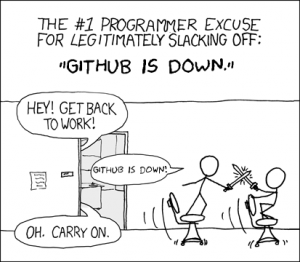
Today many dependency maintenance tools, as npm for javascript, Bundler for Ruby or even pip for Python can access an application source code directly from Github. Free Software projects getting more and more linked and codependents, if one component is down, all the developing process stop.

One of the best examples is the npmgate. Any company could legally demand that Github take down some source code from its repository, which could create a chain reaction and blocking the development of many Free Software projects, as suffered the Node.js community from the decisions of Npm, Inc, the company managing npm.

2.2 A historical precedent: SourceForge

Github didn t appear out of the blue. In his time, its predecessor, SourceForge, was also extremely popular.

Heavily centralized, based on strong interaction with the community, SourceForge is now seen as an aging SAAS (Software As A Service) and sees most of its customers fleeing to Github. Which creates lots of hurdles for those who stayed. The Gimp project suffered from spams and terrible advertising, which led to the departure of the VLC project, then from installers corrupted with adwares instead of the official Gimp installer for Windows. And finally, the Project Gimp s SourceForge account was hacked by SourceForge team itself!

These are very recent examples of what can do a commercial entity when it is under its stakeholders pressure. It is vital to really understand what it means to trust them with data and exchange centralization, where it could have tremendous repercussion on the day-to-day life and the habits of the Free Software and open source community.

2.3. Regarding proprietary software

2.3.1 One community, several opinions on proprietary software

Mostly based on ideology, this point deals with the definition every member of the community gives to Free Software and open source. Mostly about one thing: is it viral or not? Or GPL vs MIT/BSD.

Those on the side of the viral Free Software will have trouble to use a proprietary software as this last one shouldn t even exist. It must be assimilated, to quote Star Trek, as it is a connected black box, endangering privacy, corrupting for profit our uses and restrain our freedom to use as we re pleased what we own, etc.

Those on the side of complete freedom have no qualms using proprietary software as their very existence is a consequence of freedom without restriction. They even agree that code they developed may be a part of proprietary software, which is quite a common occurrence. This part of the Free Software community has no qualm using Github, which is well within their ideology parameters. Just take a look at the Janson amphitheater during Fosdem and check how many Apple laptops running on macOS are around.

FreeBSD, the main BSD project under the BSD license

2.3.2 Data loss and data restrictions linked to proprietary software use

Even without ideological consideration, and just focusing on Github infrastructure, the bug tracking system is a major problem by itself.

Bug report builds the memory of Free Software projects. It is the entrance point for new contributors, the place to find bug reporting, requests for new functions, etc. The project history can t be limited only to the code. It s very common to find bug reports when you copy and paste an error message in a search engine. Not their historical importance is precious for the project itself, but also for its present and future users.

Github gives the ability to extract bug reports through its API. What would happen if Github is down or if the platform doesn t support this feature anymore? In my opinion, not that many projects ever thought of this outcome. How could they move all the data generated by Github into a new bug tracking system? One old example now is Astrid, a TODO list bought by Yahoo a few years ago. Very popular, it grew fast until it was closed overnight, with only a few weeks for its users to extract their data. It was only a to-do list. The same situation with Github would be tremendously difficult to manage for several projects if they even have the ability to deal with it. Code would still be available and could still live somewhere else, but the project memory would be lost. A project like Debian has today more than 800,000 bug reports, which are a data treasure trove about problems solved, function requests and where the development stand on each. The developers of the Cpython project have anticipated the problem and decided not to use Github bug tracking systems.

Issues, the Github proprietary bug tracking system

Another thing we could lose if Github suddenly disappear: all the work currently done regarding the push requests (aka PRs). This Github function gives the ability to clone one project s Github repository, to modify it to fit your needs, then to offer your own modification to the original repository. The original repository s owner will then review said modification, and if he or she agrees with them will fuse them into the original repository. As such, it s one of the main advantages of Github, since it can be done easily through its graphic interface.

However reviewing all the PRs may be quite long, and most of the successful projects have several ongoing PRs. And this PRs and/or the proprietary bug tracking system are commonly used as a platform for comment and discussion between developers.

Code itself is not lost if Github is down (except one specific situation as seen below), but the peer review works materialized in the PRs and the bug tracking system is lost. Let s remember than the PR mechanism let you clone and modify projects and then generate PRs directly from its proprietary web interface without downloading a single code line on your computer. In this particular case, if Github is down, all the code and the work in progress is lost. Some also use Github as a bookmark place. They follow their favorite projects activity through the Watch function. This technological watch style of data collection would also be lost if Github is down.

Debian, one of the main Free Software projects with at least a thousand official contributors

2.4 Uniformization

The Free Software community is walking a thigh rope between normalization needed for an easier interoperability between its products and an attraction for novelty led by a strong need for differentiation from what is already there.

Github popularized the use of Git, a great tool now used through various sectors far away from its original programming field. Step by step, Git is now so prominent it s almost impossible to even think to another source control manager, even if awesome alternate solutions, unfortunately not as popular, exist as Mercurial.

A new Free Software project is now a Git repository on Github with README.md added as a quick description. All the other solutions are ostracized? How? None or very few potential contributors would notice said projects. It seems very difficult now to encourage potential contributors into learning a new source control manager AND a new forge for every project they want to contribute. Which was a basic requirement a few years ago. It s quite sad because Github, offering an original experience to its users, cut them out of a whole possibility realm. Maybe Github is one of the best web versioning control systems. But being the main one doesn t let room for a new competitor to grow. And it let Github initiate development newcomers into a narrow function set, totally unrelated to the strength of the Git tool itself.

3. Centralization, uniformization, proprietary software What s next? Laziness?

Fight against centralization is a main part of the Free Software ideology as centralization strengthens the power of those who manage it and who through it control those who are managed by it. Uniformization allergies born against main software companies and their wishes to impose a closed commercial software world was for a long time the main fuel for innovation thirst and intelligent alternative development. As we said above, part of the Free Software community was built as a reaction to proprietary software and their threat. The other part, without hoping for their disappearance, still chose a development model opposite to proprietary software, at least in the beginning, as now there s more and more bridges between the two.

The Github effect is a morbid one because of its consequences: at least centralization, uniformization, proprietary software usage as their bug tracking system. But some years ago the Dear Github buzz showed one more side effect, one I ve never thought about: laziness. For those who don t know what it is about, this letter is a complaint from several spokespersons from several Free Software projects which demand to Github team to finally implement, after years of polite asking, new functions. Since when Free Software project facing a roadblock request for clemency and don t build themselves the path they need? When Torvalds was involved in the Bitkeeper problem and the Linux kernel development team couldn t use anymore their revision control software, he developed Git. The mere fact of not being able to use one tool or functions lacking is the main motivation to seek alternative solutions and, as such, of the Free Software movement. Every Free Software community member able to code should have this reflex. You don t like what Github offers? Switch to Gitlab. You don t like it Gitlab? Improve it or make your own solution.

The Gitlab logo

Let s be crystal clear. I ve never said that every Free Software developers blocked should code his or her own alternative. We all have our own priorities, and some of us even like their beauty sleep, including me. But, to see that this open letter to Github has 1340 names attached to it, among them some spokespersons for major Free Software project showed me that need, willpower and strength to code a replacement are here. Maybe said replacement will be born from this letter, it would be the best outcome of this buzz.

In the end, Github usage is just another example of Internet usage massification. As Internet users are bound to go to massively centralized social network as Facebook or Twitter, developers are following the same path with Github. Even if a large fraction of developers realize the threat linked this centralized and proprietary organization, the whole community is following this centralization and uniformization trend. Github service is useful, free or with a reasonable price (depending on the functions you need) easy to use and up most of the time. Why would we try something else? Maybe because others are using us while we are savoring the convenience? The Free Software community seems to be quite sleepy to me.

The lion enjoying the hearth warm

About Me Carl Chenet, Free Software Indie Hacker, founder of the French-speaking Hacker News-like Journal du hacker. Follow me on social networks Translated from French by St phanie Chaptal. Original article written in 2015.

Russ Allbery: Consolidation haul

My parents are less fond than I am of filling every available wall in their house with bookshelves and did a pruning of their books. A lot of them duplicated other things that I had, or didn't sound interesting, but I still ended up with two boxes of books (and now have to decide which of my books to prune, since I'm out of shelf space). Also included is the regular accumulation of new ebook purchases. Mitch Albom Tuesdays with Morrie (nonfiction)
Ilona Andrews Clean Sweep (sff)
Catherine Asaro Charmed Sphere (sff)
Isaac Asimov The Caves of Steel (sff)
Isaac Asimov The Naked Sun (sff)
Marie Brennan Dice Tales (nonfiction)
Captain Eric "Winkle" Brown Wings on My Sleeve (nonfiction)
Brian Christian & Tom Griffiths Algorithms to Live By (nonfiction)
Tom Clancy The Cardinal of the Kremlin (thriller)
Tom Clancy The Hunt for the Red October (thriller)
Tom Clancy Red Storm Rising (thriller)
April Daniels Sovereign (sff)
Tom Flynn Galactic Rapture (sff)
Neil Gaiman American Gods (sff)
Gary J. Hudson They Had to Go Out (nonfiction)
Catherine Ryan Hyde Pay It Forward (mainstream)
John Irving A Prayer for Owen Meany (mainstream)
John Irving The Cider House Rules (mainstream)
John Irving The Hotel New Hampshire (mainstream)
Lawrence M. Krauss Beyond Star Trek (nonfiction)
Lawrence M. Krauss The Physics of Star Trek (nonfiction)
Ursula K. Le Guin Four Ways to Forgiveness (sff collection)
Ursula K. Le Guin Words Are My Matter (nonfiction)
Richard Matheson Somewhere in Time (sff)
Larry Niven Limits (sff collection)
Larry Niven The Long ARM of Gil Hamilton (sff collection)
Larry Niven The Magic Goes Away (sff)
Larry Niven Protector (sff)
Larry Niven World of Ptavvs (sff)
Larry Niven & Jerry Pournelle The Gripping Hand (sff)
Larry Niven & Jerry Pournelle Inferno (sff)
Larry Niven & Jerry Pournelle The Mote in God's Eye (sff)
Flann O'Brien The Best of Myles (nonfiction)
Jerry Pournelle Exiles to Glory (sff)
Jerry Pournelle The Mercenary (sff)
Jerry Pournelle Prince of Mercenaries (sff)
Jerry Pournelle West of Honor (sff)
Jerry Pournelle (ed.) Codominium: Revolt on War World (sff anthology)
Jerry Pournelle & S.M. Stirling Go Tell the Spartans (sff)
J.D. Salinger The Catcher in the Rye (mainstream)
Jessica Amanda Salmonson The Swordswoman (sff)
Stanley Schmidt Aliens and Alien Societies (nonfiction)
Cecilia Tan (ed.) Sextopia (sff anthology)
Lavie Tidhar Central Station (sff)
Catherynne Valente Chicks Dig Gaming (nonfiction)
J.E. Zimmerman Dictionary of Classical Mythology (nonfiction) This is an interesting tour of a lot of stuff I read as a teenager (Asimov, Niven, Clancy, and Pournelle, mostly in combination with Niven but sometimes his solo work). I suspect I will no longer consider many of these books to be very good, and some of them will probably go back into used bookstores after I've re-read them for memory's sake, or when I run low on space again. But all those mass market SF novels were a big part of my teenage years, and a few (like Mote In God's Eye) I definitely want to read again. Also included is a random collection of stuff my parents picked up over the years. I don't know what to expect from a lot of it, which makes it fun to anticipate. Fall vacation is coming up, and with it a large amount of uninterrupted reading time.

17 September 2017

Dirk Eddelbuettel: RcppClassic 0.9.7

A rather boring and otherwise uneventful release 0.9.7 of RcppClassic is now at CRAN. This package provides a maintained version of the otherwise deprecated first Rcpp API; no new projects should use it. Once again no changes in user-facing code. But this makes it the first package to use the very new and shiny pinp package as the backend for its vignette, now converted to Markdown---see here for this new version. We also updated three sources files for tabs versus spaces as the current g++ version complained (correctly !!) about misleading indents. Otherwise a file src/init.c was added for dynamic registration, the Travis CI runner script was updated to using run.sh from our r-travis fork, and we now strip the library after they have been built. Again, no user code changes. And no iterate: nobody should use this package. Rcpp is so much better in so many ways---this one is simply available as we (quite strongly) believe that APIs are contracts, and as such we hold up our end of the deal. Courtesy of CRANberries, there are changes relative to the previous release. Questions, comments etc should go to the rcpp-devel mailing list off the R-Forge page.

This post by Dirk Eddelbuettel originated on his Thinking inside the box blog. Please report excessive re-aggregation in third-party for-profit settings.

16 September 2017

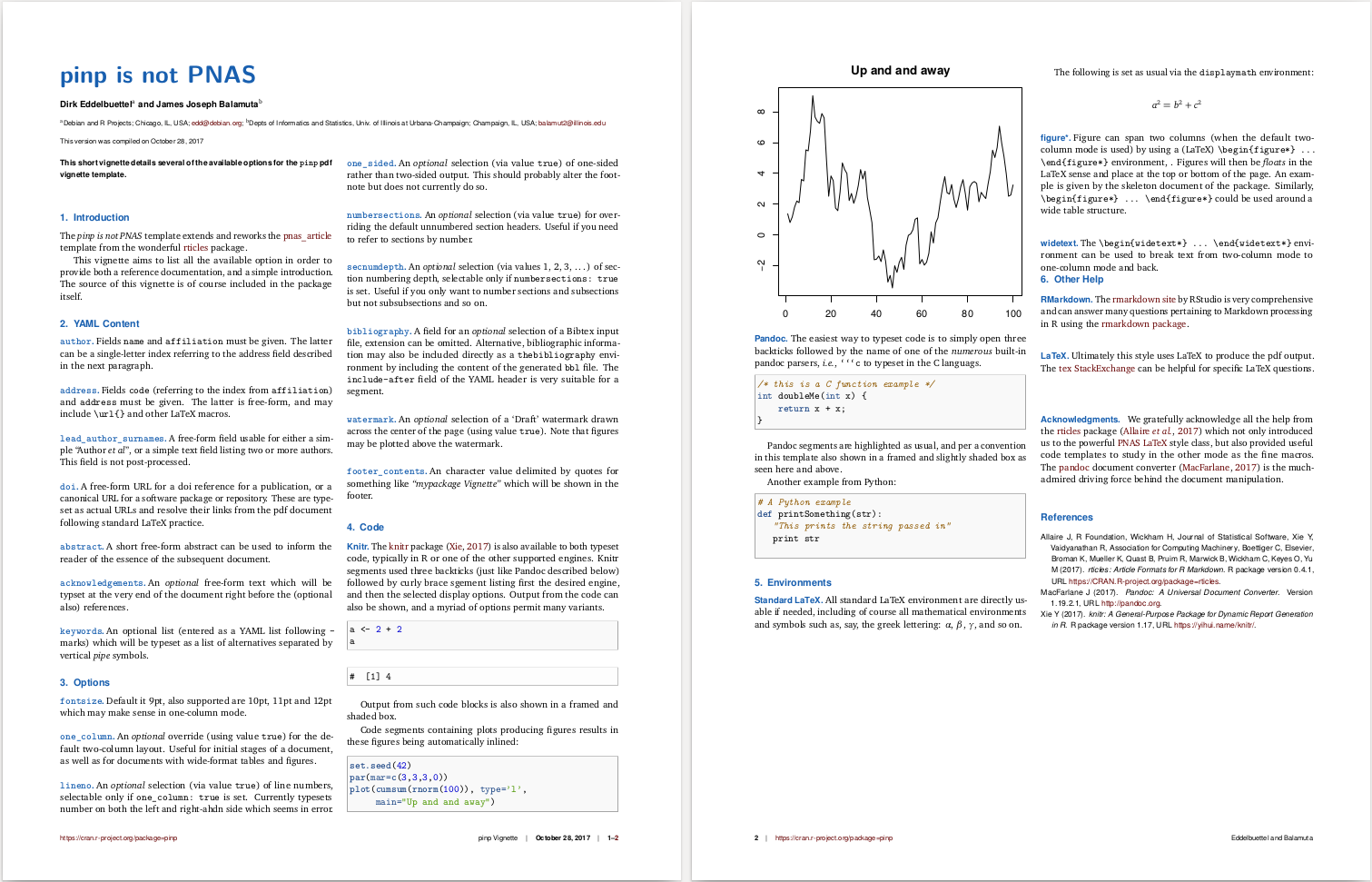
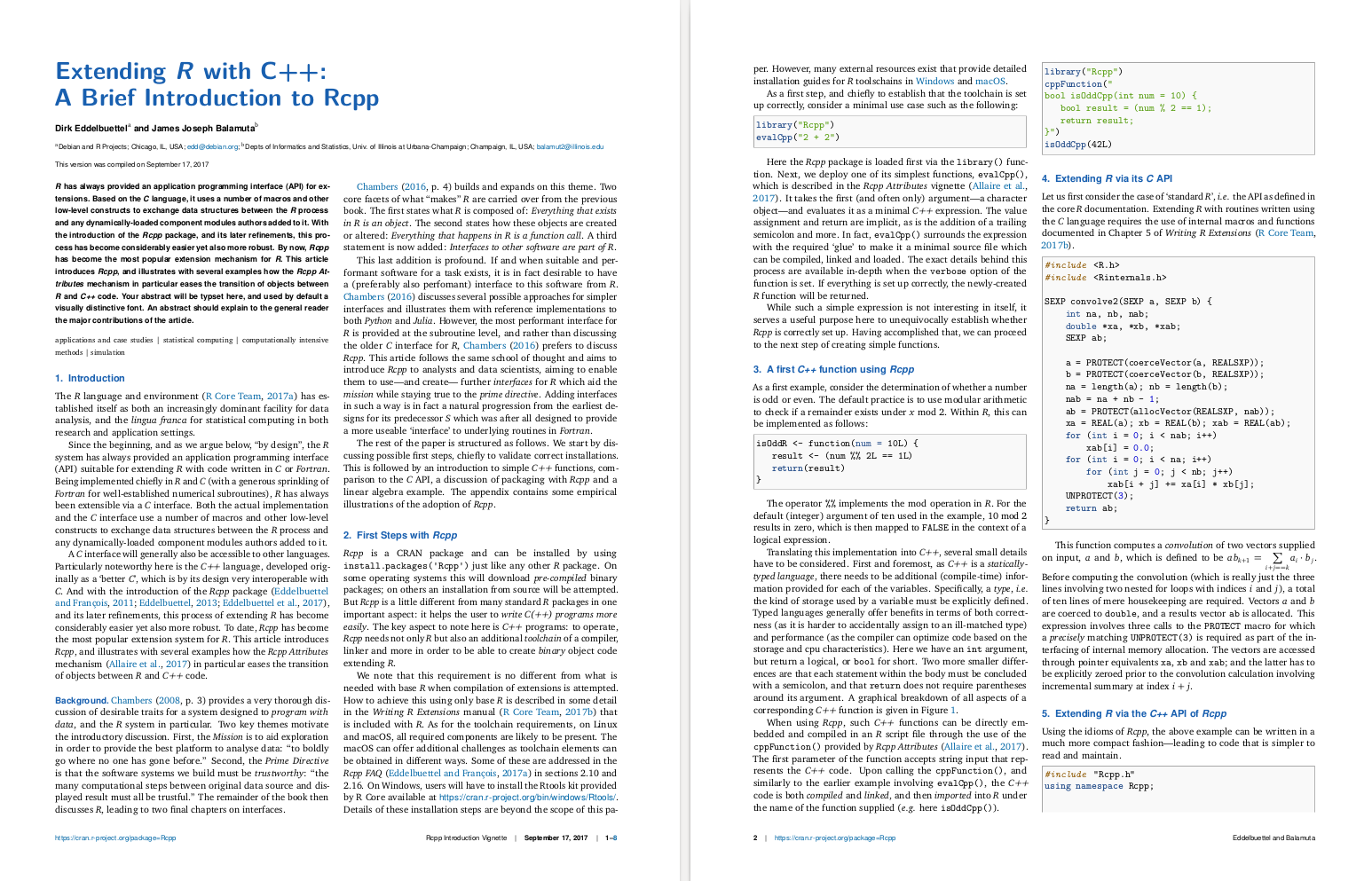
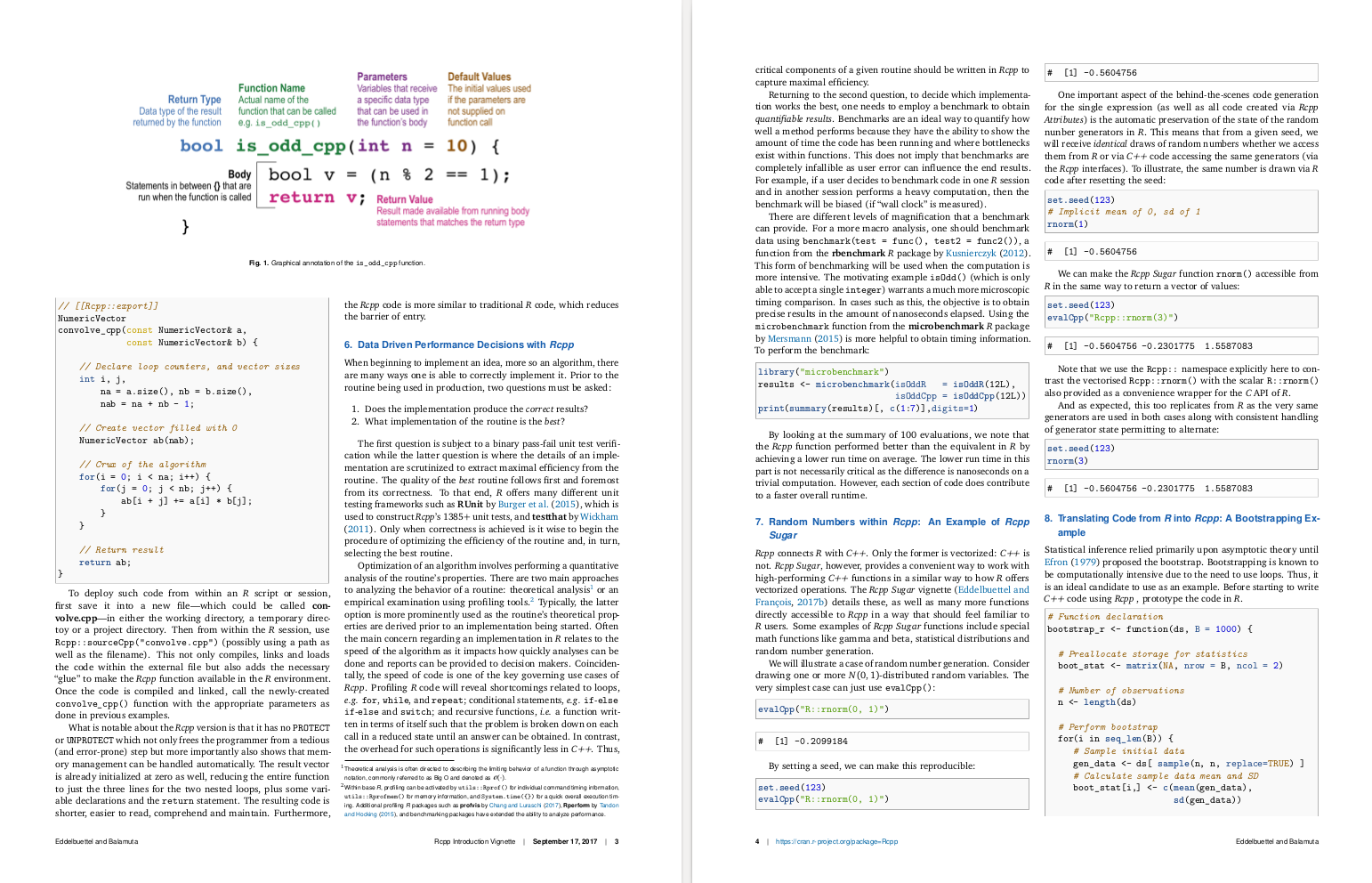
Dirk Eddelbuettel: pinp 0.0.1: pinp is not PNAS

A brandnew and very exciting (to us, at least) package called pinp just arrived on CRAN, following a somewhat unnecessarily long passage out of incoming. It is based on the PNAS LaTeX Style offered by the Proceeding of the National Academy of Sciences of the United States of America, or PNAS for short. And there is already a Markdown version in the wonderful rticles packages. But James Balamuta and I thought we could do one better when we were looking to typeset our recent PeerJ Prepint as an attractive looking vignette for use within the Rcpp package. And so we did by changing a few things (font, color, use of natbib and Chicago.bst for references, removal of a bunch of extra PNAS-specific formalities from the frontpage) and customized a number of other things for easier use by vignettes directly from the YAML header (draft mode watermark, doi or url for packages, easier author naming in footer, bibtex file and more). We are quite pleased with the result which seems ready for the next Rcpp release---see e.g., these two teasers:
and
and the pinp package page or the GitHub repo have the full (four double-)pages of what turned a more dull looking 27 page manuscript into eight crisp two-column pages. We have few more things planned (i.e., switching to single column mode, turning on linenumbers at least in one-column mode). For questions or comments use the issue tracker off the GitHub repo.

This post by Dirk Eddelbuettel originated on his Thinking inside the box blog. Please report excessive re-aggregation in third-party for-profit settings.

Dirk Eddelbuettel: drat 0.1.3

A new version of drat arrived earlier today on CRAN as another no-human-can-delay-this automatic upgrade directly from the CRAN prechecks. It is mostly a maintenance release ensuring PACKAGES.rds is also updated, plus some minor other edits. drat stands for drat R Archive Template, and helps with easy-to-create and easy-to-use repositories for R packages. Since its inception in early 2015 it has found reasonably widespread adoption among R users because repositories with marked releases is the better way to distribute code. The NEWS file summarises the release as follows:

Changes in drat version 0.1.3 (2017-09-16)
  • Ensure PACKAGES.rds, if present, is also inserted in repo
  • Updated 'README.md' removing stale example URLs (#63)
  • Use https to fetch Travis CI script from r-travis

Courtesy of CRANberries, there is a comparison to the previous release. More detailed information is on the drat page.

This post by Dirk Eddelbuettel originated on his Thinking inside the box blog. Please report excessive re-aggregation in third-party for-profit settings.

15 September 2017

Chris Lamb: Which packages on my system are reproducible?

Whilst anyone can inspect the source code of free software for malicious flaws, most software is distributed pre-compiled to end users. The motivation behind the Reproducible Builds effort is to allow verification that no flaws have been introduced either maliciously or accidentally during this compilation process. As part of this project I wrote a script to determine which packages installed on your system are "reproducible" or not:
$ apt install devscripts
[ ]
$ reproducible-check
[ ]
W: subversion (1.9.7-2) is unreproducible (libsvn-perl, libsvn1, subversion) <https://tests.reproducible-builds.org/debian/subversion>
W: taglib (1.11.1+dfsg.1-0.1) is unreproducible (libtag1v5, libtag1v5-vanilla) <https://tests.reproducible-builds.org/debian/taglib>
W: tcltk-defaults (8.6.0+9) is unreproducible (tcl, tk) <https://tests.reproducible-builds.org/debian/tcltk-defaults>
W: tk8.6 (8.6.7-1) is unreproducible (libtk8.6, tk8.6) <https://tests.reproducible-builds.org/debian/tk8.6>
W: valgrind (1:3.13.0-1) is unreproducible <https://tests.reproducible-builds.org/debian/valgrind>
W: wavpack (5.1.0-2) is unreproducible (libwavpack1) <https://tests.reproducible-builds.org/debian/wavpack>
W: x265 (2.5-2) is unreproducible (libx265-130) <https://tests.reproducible-builds.org/debian/x265>
W: xen (4.8.1-1+deb9u1) is unreproducible (libxen-4.8, libxenstore3.0) <https://tests.reproducible-builds.org/debian/xen>
W: xmlstarlet (1.6.1-2) is unreproducible <https://tests.reproducible-builds.org/debian/xmlstarlet>
W: xorg-server (2:1.19.3-2) is unreproducible (xserver-xephyr, xserver-xorg-core) <https://tests.reproducible-builds.org/debian/xorg-server>
282/4494 (6.28%) of installed binary packages are unreproducible.
Whether a package is "reproducible" or not is determined by querying the Debian Reproducible Builds testing framework.


The --raw command-line argument lets you play with the data in more detail. For example, you can see who maintains your unreproducible packages:
$ reproducible-check --raw   dd-list --stdin
Alec Leamas <leamas.alec@gmail.com>
   lirc (U)
Alessandro Ghedini <ghedo@debian.org>
   valgrind
Alessio Treglia <alessio@debian.org>
   fluidsynth (U)
   libsoxr (U)
[ ]


reproducible-check is available in devscripts since version 2.17.10, which landed in Debian unstable on 14th September 2017.

14 September 2017

Dirk Eddelbuettel: RcppMsgPack 0.2.0

A new and much enhanced version of RcppMsgPack arrived on CRAN a couple of days ago. It came together following this email to the r-package-devel list which made it apparent that Travers Ching had been working on MessagePack converters for R which required the very headers I had for use from, inter alia, the RcppRedis package. So we joined our packages. I updated the headers in RcppMsgPack to the current upstream version 2.1.5 of MessagePack, and Travers added his helper functions allow direct packing / unpacking of MessagePack objects at the R level, as well as tests and a draft vignette. Very exciting, and great to have a coauthor! So now RcppMspPack provides R with both MessagePack header files for use via C++ (or C, if you must) packages such as RcppRedis --- and direct conversion routines at the R prompt. MessagePack itself is an efficient binary serialization format. It lets you exchange data among multiple languages like JSON. But it is faster and smaller. Small integers are encoded into a single byte, and typical short strings require only one extra byte in addition to the strings themselves.

Changes in version 0.2.0 (2017-09-07)
  • Added support for building on Windows
  • Upgraded to MsgPack 2.1.5 (#3)
  • New R functions to manipulate MsgPack objects: msgpack_format, msgpack_map, msgpack_pack, msgpack_simplify, mgspack_unpack (#4)
  • New R functions also available as msgpackFormat, msgpackMap, msgpackPack, msgpackSimplify, mgspackUnpack (#4)
  • New vignette (#4)
  • New tests (#4)

Courtesy of CRANberries, there is also a diffstat report for this release. More information is on the RcppRedis page. More information may be on the RcppMsgPack page. Issues and bugreports should go to the GitHub issue tracker.

This post by Dirk Eddelbuettel originated on his Thinking inside the box blog. Please report excessive re-aggregation in third-party for-profit settings.

Dirk Eddelbuettel: RcppRedis 0.1.8

A new minor release of RcppRedis arrived on CRAN last week, following the release 0.2.0 of RcppMsgPack which brought the MsgPack headers forward to release 2.1.5. This required a minor and rather trivial change in the code. When the optional RcppMsgPack package is used, we now require this version 0.2.0 or later. We made a few internal updates to the package as well.

Changes in version 0.1.8 (2017-09-08)
  • A new file init.c was added with calls to R_registerRoutines() and R_useDynamicSymbols()
  • Symbol registration is enabled in useDynLib
  • Travis CI was updated to using run.sh
  • The (optional MessagePack) code was updated for MsgPack 2.*

Courtesy of CRANberries, there is also a diffstat report for this release. More information is on the RcppRedis page.

This post by Dirk Eddelbuettel originated on his Thinking inside the box blog. Please report excessive re-aggregation in third-party for-profit settings.

10 September 2017

Sylvain Beucler: dot-zed archive file format

TL,DR: I reverse-engineered the .zed encrypted archive format.
Following a clean-room design, I'm providing a description that can be implemented by a third-party.
Interested? :) (reference version at: https://www.beuc.net/zed/) .zed archive file format Introduction Archives with the .zed extension are conceptually similar to an encrypted .zip file. In addition to a specific format, .zed files support multiple users: files are encrypted using the archive master key, which itself is encrypted for each user and/or authentication method (password, RSA key through certificate or PKCS#11 token). Metadata such as filenames is partially encrypted. .zed archives are used as stand-alone or attached to e-mails with the help of a MS Outlook plugin. A variant, which is not covered here, can encrypt/decrypt MS Windows folders on the fly like ecryptfs. In the spirit of academic and independent research this document provides a description of the file format and encryption algorithms for this encrypted file archive. See the conventions section for conventions and acronyms used in this document. Structure overview The .zed file format is composed of several layers. Or as a diagram:
+----------------------------------------------------------------------------------------------------+
  .zed archive (MS-CBF)                                                                               
                                                                                                      
   stream #1                         stream #2                       stream #3...                     
  +------------------------------+  +---------------------------+  +---------------------------+      
    metadata (MS-OLEPS)               encryption (AES)               encryption (AES)                 
                                      512-bytes chunks               512-bytes chunks                 
    +--------------------------+                                                                      
      obfuscation (static key)        +-----------------------+      +-----------------------+        
      +----------------------+       -  compression (zlib)     -    -  compression (zlib)     -       
       _ctlfile (TLV)                                                                            ...  
      +----------------------+          +---------------+              +---------------+               
    +--------------------------+          file contents                  file contents                
                                                                                                      
    +--------------------------+     -  +---------------+      -    -  +---------------+      -       
      _catalog (TLV)                                                                                  
    +--------------------------+      +-----------------------+      +-----------------------+        
  +------------------------------+  +---------------------------+  +---------------------------+      
+----------------------------------------------------------------------------------------------------+
Encryption schemes Several AES key sizes are supported, such as 128 and 256 bits. The Cipher Block Chaining (CBC) block cipher mode of operation is used to decrypt multiple AES 16-byte blocks, which means an initialisation vector (IV) is stored in clear along with the ciphertext. All filenames and file contents are encrypted using the same encryption mode, key and IV (e.g. if you remove and re-add a file in the archive, the resulting stream will be identical). No cleartext padding is used during encryption; instead, several end-of-stream handlers are available, so the ciphertext has exactly the size of the cleartext (e.g. the size of the compressed file). The following variants were identified in the 'encryption_mode' field. STREAM This is the end-of-stream handler for: This end-of-stream handler is apparently specific to the .zed format, and applied when the cleartext's does not end on a 16-byte boundary ; in this case special processing is performed on the last partial 16-byte block. The encryption and decryption phases are identical: let's assume the last partial block of cleartext (for encryption) or ciphertext (for decryption) was appended after all the complete 16-byte blocks of ciphertext: In either case, if the full ciphertext is less then one AES block (< 16 bytes), then the IV is used instead of the second-to-last block. CTS CTS or CipherText Stealing is the end-of-stream handler for: It matches the CBC-CS3 variant as described in Recommendation for Block Cipher Modes of Operation: Three Variants of Ciphertext Stealing for CBC Mode. Empty cleartext Since empty filenames or metadata are invalid, and since all files are compressed (resulting in a minimum 8-byte zlib cleartext), no empty cleartext was encrypted in the archive. metadata stream It is named 05356861616161716149656b7a6565636e576a33317a7868304e63 (hexadecimal), i.e. the character with code 5 followed by '5haaaaqaIekzeecnWj31zxh0Nc' (ASCII). The format used is OLE Property Set (MS-OLEPS). It introduces 2 property names "_ctlfile" (index 3) and "_catalog" (index 4), and 2 instances of said properties each containing an application-specific VT_BLOB (type 0x0041). _ctlfile: obfuscated global properties and access list This subpart is stored under index 3 ("_ctlfile") of the MS-OLEPS metadata. It consists of: The ciphertext is encrypted with AES-CBC "STREAM" mode using 128-bit static key 37F13CF81C780AF26B6A52654F794AEF (hexadecimal) and the prepended IV so as to obfuscate the access list. The ciphertext is continuous and not split in chunks (unlike files), even when it is larger than 512 bytes. The decrypted text contain properties in a TLV format as described in _ctlfile TLV: Archives may include "mandatory" users that cannot be removed. They are typically used to add an enterprise wide recovery RSA key to all archives. Extreme care must be taken to protect these key, as it can decrypt all past archives generated from within that company. _catalog: file list This subpart is stored under index 4 ("_catalog") of the MS-OLEPS metadata. It contains a series of 'fileprops' TLV structures, one for each file or directory. The file hierarchy can be reconstructed by checking the 'parent_id' field of each file entry. If 'parent_id' is 0 then the file is located at the top-level of the hierarchy, otherwise it's located under the directory with the matching 'file_id'. TLV format This format is a series of fields : Value semantics depend on its Type. It may contain an uint32be integer, a UTF-16LE string, a character sequence, or an inner TLV structure. Unless otherwise noted, TLV structures appear once. Some fields are optional and may not be present at all (e.g. 'archive_createdwith'). Some fields are unique within a structure (e.g. 'files_iv'), other may be repeated within a structure to form a list (e.g. 'fileprops' and 'passworduser'). The following top-level types that have been identified, and detailed in the next sections: Some additional unidentified types may be present. _ctlfile TLV _catalog TLV Decrypting the archive AES key rsauser The user accessing the archive will be authenticated by comparing his/her X509 certificate with the one stored in the 'certificate' field using DER format. The 'files_key_ciphertext' field is then decrypted using the PKCS#1 v1.5 encryption mechanism, with the private key that matches the user certificate. passworduser An intermediary user key, a user IV and an integrity checksum will be derived from the user password, using the deprecated PKCS#12 method as described at rfc7292 appendix B. Note: this is not PKCS#5 (nor PBKDF1/PBKDF2), this is an incompatible method from PKCS#12 that notably does not use HMAC. The 'pkcs12_hashfunc' field defines the underlying hash function. The following values have been identified: PBA - Password-based authentication The user accessing the archive will be authenticated by deriving an 8-byte sequence from his/her password. The parameters for the derivation function are: The derivation is checked against 'pba_checksum'. PBE - Password-based encryption Once the user is identified, 2 new values are derived from the password with different parameters to produce the IV and the key decryption key, with the same hash function: The parameters specific to user key are: The user key needs to be truncated to a length of 'encryption_strength', as specified in bytes in the archive properties. The parameters specific to user IV are: Once the key decryption key and the IV are derived, 'files_key_ciphertext' is decrypted using AES CBC, with PKCS#7 padding. Identifying file streams The name of the MS-CFB stream is derived by shuffling the bytes from the 'file_id' field and then encoding the result as hexadecimal. The reordering is:
Initial  offset: 0 1 2 3 4 5 6 7 8 9 10 11 12 13 14 15
Shuffled offset: 3 2 1 0 5 4 7 6 8 9 10 11 12 13 14 15
The 16th byte is usually a NUL byte, hence the stream identifier is a 30-character-long string. Decrypting files The compressed stream is split in chunks of 512 bytes, each of them encrypted separately using AES CBS and the global archive encryption scheme. Decryption uses the global AES key (retrieved using the user credentials), and the global IV (retrieved from the deobfuscated archive metadata). The IV for each chunk is computed by: Each chunk is an independent stream and the decryption process involves end-of-stream handling even if this is not the end of the actual file. This is particularly important for the CTS handler. Note: this is not to be confused with CTR block cipher mode of operation with operates differently and requires a nonce. Decompressing files Compressed streams are zlib stream with default compression options and can be decompressed following the zlib format. Test cases Excluded for brevity, cf. https://www.beuc.net/zed/#test-cases. Conventions and references Feedback Feel free to send comments at beuc@beuc.net. If you have .zed files that you think are not covered by this document, please send them as well (replace sensitive files with other ones). The author's GPG key can be found at 8FF1CB6E8D89059F. Copyright (C) 2017 Sylvain Beucler Copying and distribution of this file, with or without modification, are permitted in any medium without royalty provided the copyright notice and this notice are preserved. This file is offered as-is, without any warranty.

9 September 2017

Russell Coker: Observing Reliability

Last year I wrote about how great my latest Thinkpad is [1] in response to a discussion about whether a Thinkpad is still the Rolls Royce of laptops. It was a few months after writing that post that I realised that I omitted an important point. After I had that laptop for about a year the DVD drive broke and made annoying clicking sounds all the time in addition to not working. I removed the DVD drive and the result was that the laptop was lighter and used less power without missing any feature that I desired. As I had installed Debian on that laptop by copying the hard drive from my previous laptop I had never used the DVD drive for any purpose. After a while I got used to my laptop being like that and the gaping hole in the side of the laptop where the DVD drive used to be didn t even register to me. I would prefer it if Lenovo sold Thinkpads in the T series without DVD drives, but it seems that only the laptops with tiny screens are designed to lack DVD drives. For my use of laptops this doesn t change the conclusion of my previous post. Now the T420 has been in service for almost 4 years which makes the cost of ownership about $75 per year. $1.50 per week as a tax deductible business expense is very cheap for such a nice laptop. About a year ago I installed a SSD in that laptop, it cost me about $250 from memory and made it significantly faster while also reducing heat problems. The depreciation on the SSD about doubles the cost of ownership of the laptop, but it s still cheaper than a mobile phone and thus not in the category of things that are expected to last for a long time while also giving longer service than phones usually do. One thing that s interesting to consider is the fact that I forgot about the broken DVD drive when writing about this. I guess every review has an unspoken caveat of this works well for me but might suck badly for your use case . But I wonder how many other things that are noteworthy I m forgetting to put in reviews because they just don t impact my use. I don t think that I am unusual in this regard, so reading multiple reviews is the sensible thing to do.

7 September 2017

Gunnar Wolf: It was thirty years ago today... (and a bit more): My first ever public speech!

I came across a folder with the most unexpected treasure trove: The text for my first ever public speech! (and some related materials)
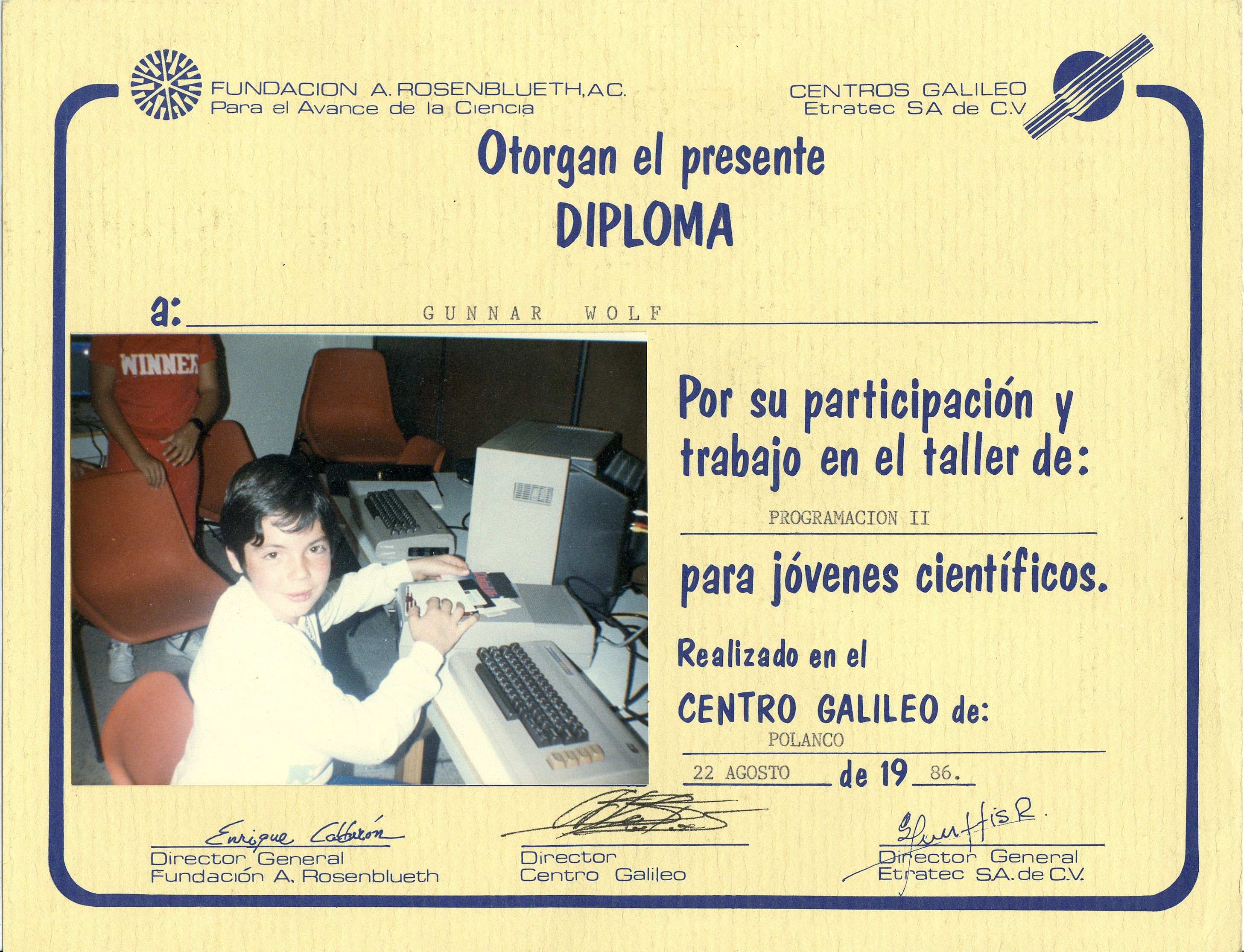
In 1985, being nine years old, I went to the IDESE school, to learn Logo. I found my diploma over ten years ago and blogged about it in this same space. Of course, I don't expect any of you to remember what I wrote twelve years ago about a (then) twenty years old piece of paper! I add to this very old stuff about Gunnar the four pages describing my game, Evitamono ("Avoid the monkey", approximately). I still remember the game quite vividly, including traumatic issues which were quite common back then; I wrote that the sprites were accidentally deleted twice and the game once . I remember several of my peers telling about such experiences. Well, that is good if you account for the second system syndrome! I also found the amazing course material for how to program sound and graphics in the C64 BASIC. That was a course taken by ten year old kids. Kids that understood that you had to write [255,129,165,244,219,165,0,102] (see pages 3-5) into a memory location starting at 53248 to redefine a character so it looked as the graphic element you wanted. Of course, it was done with a set of POKEs, as everything in C64. Or that you could program sound by setting the seven SID registers for each of the three voices containing low frequency, high frequency, low pulse, high pulse, wave control, wave length, wave amplitude in memory locations 54272 through 54292... And so on and on and on... And as a proof that I did take the course: ...I don't think I could make most of my current BSc students make sense out of what is in the manual. But, being a kid in the 1980s, that was the only way to get a computer to do what you wanted. Yay for primitivity! :-D
AttachmentSize
Speech for "Evitamono"1.29 MB
Coursee material for sound and graphics programming in C64 BASIC15.82 MB
Proof that I was there!4.86 MB

Next.

Previous.