Search Results: "nate"

19 November 2016

Dirk Eddelbuettel: BH 1.62.0-1

The BH package on CRAN was updated to version 1.62.0. BH provides a large part of the Boost C++ libraries as a set of template headers for use by R, possibly with Rcpp as well as other packages. This release upgrades the version of Boost to the upstream version Boost 1.62.0, and adds three new libraries as shown in the brief summary of changes from the NEWS file which follows below. Special thanks to Kurt Hornik and Duncan Murdoch for help tracking down one abort() call which was seeping into R package builds, and then (re-)testing the proposed fix. We are now modifying one more file ever so slightly to use ::Rf_error(...) instead.

Changes in version 1.62.0-1 (2016-11-15)
  • Upgraded to Boost 1.62 installed directly from upstream source
  • Added Boost property_tree as requested in #29 by Aydin Demircioglu
  • Added Boost scope_exit as requested in #30 by Kirill Mueller
  • Added Boost atomic which we had informally added since 1.58.0

Courtesy of CRANberries, there is also a diffstat report for the most recent release. Comments and suggestions are welcome via the mailing list or the issue tracker at the GitHubGitHub repo.

This post by Dirk Eddelbuettel originated on his Thinking inside the box blog. Please report excessive re-aggregation in third-party for-profit settings.

18 November 2016

Dirk Eddelbuettel: Rcpp 0.12.8: And more goodies

Yesterday the eighth update in the 0.12.* series of Rcpp made it to the CRAN network for GNU R where the Windows binary has by now been generated too; the Debian package is on its way as well. This 0.12.8 release follows the 0.12.0 release from late July, the 0.12.1 release in September, the 0.12.2 release in November, the 0.12.3 release in January, the 0.12.4 release in March, the 0.12.5 release in May, the 0.12.6 release in July, and the 0.12.7 release in September --- making it the twelveth release at the steady bi-montly release frequency. While we are keeping with the pattern, we have managed to include quite a lot of nice stuff in this release. None of it is a major feauture, though, and so we have not increased the middle number. Among the changes this release are (once again) much improved exception handling (thanks chiefly to Jim Hester), better large vector support (by Qiang), a number of Sugar extensions (mostly Nathan, Qiang and Dan) and beginnings of new DateVector and DatetimeVectors classes, and other changes detailed below. We plan to properly phase in the new date(time) classes. For now, you have to use a #define such as this one in Rcpp.h which remains commented-out for now. We plan to switch this on as the new default no earlier than twelve months from now. Rcpp has become the most popular way of enhancing GNU R with C or C++ code. As of today, 843 packages on CRAN depend on Rcpp for making analytical code go faster and further. That is up by eightyfour packages, or a full ten percent, just since the last release in early September! Again, we are lucky to have such a large group of contributors. Among them, we have invited Nathan Russell to the Rcpp Core team given his consistently excellent pull requests (as well as many outstanding Stackoverflow answers for Rcpp). More details on changes are below.

Changes in Rcpp version 0.12.8 (2016-11-16)
  • Changes in Rcpp API:
    • String and vector elements now use extended R_xlen_t indices (Qiang in PR #560)
    • Hashing functions now return unsigned int (Qiang in PR #561)
    • Added static methods eye(), ones(), and zeros() for select matrix types (Nathan Russell in PR #569)
    • The exception call stack is again correctly reported; print methods and tests added too (Jim Hester in PR #582 fixing #579)
    • Variatic macros no longer use a GNU extensions (Nathan in PR #575)
    • Hash index functions were standardized on returning unsigned integers (Also PR #575)
  • Changes in Rcpp Sugar:
    • Added new Sugar functions rowSums(), colSums(), rowMeans(), colMeans() (PR #551 by Nathan Russell fixing #549)
    • Range Sugar now used R_xlen_t type for start/end (PR #568 by Qiang Kou)
    • Defining RCPP_NO_SUGAR no longer breaks the build. (PR #585 by Daniel C. Dillon)
  • Changes in Rcpp unit tests
    • A test for expression vectors was corrected.
    • The constructor test for datetime vectors reflects the new classes which treats Inf correctly (and still as a non-finite value)
  • Changes in Rcpp Attributes
    • An 'empty' return was corrected (PR #589 fixing issue #588, and with thanks to Duncan Murdoch for the heads-up)
  • Updated Date and Datetime vector classes:
    • The DateVector and DatetimeVector classes were renamed with a prefix old; they are currently typedef'ed to the existing name (#557)
    • New variants newDateVector and newDatetimeVector were added based on NumericVector (also #557, #577, #581, #587)
    • By defining RCPP_NEW_DATE_DATETIME_VECTORS the new classes can activated. We intend to make the new classes the default no sooner than twelve months from this release.
    • The capabilities() function can also be used for presence of this feature

Thanks to CRANberries, you can also look at a diff to the previous release. As always, even fuller details are on the Rcpp Changelog page and the Rcpp page which also leads to the downloads page, the browseable doxygen docs and zip files of doxygen output for the standard formats. A local directory has source and documentation too. Questions, comments etc should go to the rcpp-devel mailing list off the R-Forge page.

This post by Dirk Eddelbuettel originated on his Thinking inside the box blog. Please report excessive re-aggregation in third-party for-profit settings.

17 November 2016

Urvika Gola: Reaching out to Outreachy

The past few weeks have been a whirlwind of work with my application process for Outreachy taking my full attention. When I got to know about Outreachy, I was intrigued as well as dubious. I had many unanswered questions in my mind. Honestly, I had that fear of failure which prevented me from submitting my partially filled application form. I kept contemplating if the application was good enough , if my answers were perfect and had the right balance of du-uh and oh-ah!
In moments of doubt, it is important to surround yourself with people who believe in you more than you believe in yourself. I ve been fortunate enough to have two amazing people, my sister Anjali, who is an engineer at Intel and my friend, Pranav Jain who completed his GSoC 16 with Debian.
They believed in me when I sat staring at my application and encouraged me to click that final button. When I initially applied for Outreachy, I was given a task for building Lumicall and subsequent task was to examine a BASH script which solves the DNS-01 Challenge.
I deployed the DNS-01 challenge in Java and tested my solution against a server.
Within a limited time frame, I figured things out and wrote my solution in Java and then eagerly waited for the results to come out. Going through a full cycle of : lifecycle.JPG I was elated with joy when I got to know I ve been selected for Outreachy to work with Debian. I was excited about open source & found the idea of working on the project open source fun because of the numerous possibilities of contributing towards a voice video and chat communication software.
My project mentor, Daniel Pocock, played a pivotal role in the time after I had submitted my application. Like a true mentor, he replied to my queries promptly and guided me towards finding the solutions to problems on my own. He exemplified how to feel comfortable with developing on open source. I felt inspired and encouraged to move along in my work. Beyond him, The MiniDebConf was when I was finally introduced to the Debian community. It was an overwhelming experience and I felt proud to have come so far.. It was pretty cool to see JitsiMeet being used for this video call. I was also introduced to two of my mentors , Juliana Louback & Bruno Magalh es . I am very excited to learn from them.

I am glad I applied for Outreachy which helped me identify my strengths and I am totally excited to be working with Debian on the project and learn as much as I can throughout the period. I am not a blog person, this is my first blog ever! I would love to share my experience with you all in the hopes of inspiring someone else who is afraid of clicking that final button!

15 November 2016

Keith Packard: AltOS-Lisp

A Tiny Lisp for AltOS I took a bit of a diversion over the last week or so when I wondered how small a lisp interpreter I could write, and whether I could fit that into one of the processors that AltOS runs on. It turns out, you can write a tiny lisp interpreter that fits in about 25kB of ram with a 3kB heap for dynamic data. I decided to target our ChaosKey boards; they're tiny, and I've got a lot of them. That processor offers 28kB of usable flash space (after the 4kB boot loader) and 6kB of ram with the processor running at a steaming 48MHz. I'm not at all sure this is useful, but I always enjoy doing language implementations, and this one presented some 'interesting' challenges: Iterative Compacting Allocator I'm betting someone has built one of these before, but I couldn't find one, so I wrote my own. The basic strategy is to walk the heap to find a subset of the active objects which are allocated sequentially in memory with only unused storage between them. These objects are then compacted in-place, and then the heap is walked again to update all references to the moved objects. Then, the process is restarted to find another subset and move them. By looking for these subsets starting at the bottom of the heap, and working upwards towards the top, the whole heap can be compacted into a contiguous chunk at the bottom of memory. Allocation involves moving a pointer along at the top of active memory; when it gets to the top of the heap, collect and see if there's space now. As always, the hardest part was to make sure all active memory was tied down. The second hardest part was to make sure that all active pointers were updated after any allocation, in case a collect moved the underlying object. That was just bookkeeping, but did consume much of the development time. One additional trick was to terminate the recursion during heap walking by flagging active cons cell locations in a global bitmap and then walking that separately, iterating until that bitmap is empty. Nested lambdas form another recursion which should probably get the same approach, but I haven't done that yet. An unexpected "benefit" of the tiny heap is that the collector gets called a lot, so any referencing bugs will have a good chance of being uncovered in even a short program execution. ROM-able Lisp Instead of implementing all of the language in C, I wanted to be able to implement various pieces in Lisp itself. Because of the complex nature of the evaluation process, adding things like 'let' or even 'defun' turn out to be dramatically simpler in Lisp. However, I didn't want to consume bunches of precious RAM to hold these basic functions. What I did was to create two heaps, one in ROM and the other in RAM. References are be tagged as to which heap they're in. 16-bit Values Lisp programs use a pile of references. Using a full 32 bits for each one would mean having a lot less effective storage. So, instead, I use an offset from the base of the heap. The top bit of the offset is used to distinguish between the ROM heap and the RAM heap. I needed a place to store type information, so I settled on using the bottom two bits of the references. This allows for four direct type values. One of these values is used to indicate an indirect type, where the type is stored in the first byte of the object. The direct types are:
ValueType
0Cons cell
114-bit int
2String
3Other
With 2 tag bits, the allocator needs to work in 32-bit units as the references couldn't point to individual bytes. Finally, I wanted 0 to be nil, so I add four to the offsets within the heaps. The result is that the ROM and RAM heaps can each cover up to 32k - 4 bytes. Note that ints are not stored in the heap; instead they are immediate values stored in 14 bits, providing a range of -8192 to 8191. One can imagine wanting more range in ints at some point. Heap-based Evaluator A simple lisp implementation uses the fact that eval is re-entrant and do the operation on the C stack:
val eval(val exprs)  
    val vals;
    while (exprs)  
        vals = append(vals, eval(car(exprs)));
        exprs = exprs->cdr;
     
    return execute (car(vals), cdr(vals));
 
This makes things really simple and provides for a clean framework for implementing various bits of lisp, including control flow and macros. However, it rapidly consumes all of the available memory for a stack, while also requiring separate bookkeeping for the in-use memory in each frame. I replaced this design with one which keeps the lisp stack on the heap, and then performs eval with a state machine with all state stored in global variables so that the memory manager can reference them directly. Each eval operation is performed in a separate 'stack' context, which holds the entire eval state except for the current value, which lives in a separate global variable and is used to pass values out of one stack frame and into another. When the last stack context is finished, the evaluation terminates and the value is returned to the caller. There are nine states in the state machine, each of which is implemented in a separate function, making the state machine a simple matter of pulling the current state from the top of the stack and invoking the associated function:
while (ao_lisp_stack)  
    if (!(*evals[ao_lisp_stack->state])()   ao_lisp_exception)  
        ao_lisp_stack_clear();
        return AO_LISP_NIL;
     
 
return ao_lisp_v;
Because there's no C recursion involved, catching exceptions is a simple matter of one test at this level. Primitives like progn, while, cond and eval all take special magic in the state machine to handle; getting all of that working took several attempts before I found the simple loop shown above. Lexical Scoping The last time I did a lisp interpreter, I implemented dynamic scoping. Atoms were all global and had values associated directly with them. Evaluating a lambda started by saving all of the existing global values for the parameter atoms and then binding the new values. When finished, the previous values would be restored. This is almost correct, but provides surprising results for things like:
> (setq baz 1)
> (def foo (lambda (bar) (+ baz bar)))
> (def bletch (lambda (baz) (foo baz)))
> (bletch 2)
4
The value that foo gets for 'baz' is 2 instead of 1 under dynamic scoping, which most people find surprising. This time, I was determined to use lexical scoping, and it turned out to be surprisingly easy. The first trick was to separate the atoms from their 'value'; each atom can have a different value in different lexical scopes. So, each lexical scope gets a 'frame' object, those contain the value for each atom defined in that scope. There's a global scope which holds all of the globally defined values (like baz, foo and bletch above). Each frame points to its enclosing scope, so you can search upwards to find the right value. The second trick was to realize that the lexical scope of a lambda is the scope in which the lambda itself is evaluated, and that the evaluation of a lambda expression results in a 'function' object, which contains the lambda and its enclosing scope:
> (def foo (lambda (bar bletch)
       ((lambda (baz)
          (+ baz bar))
        bletch)))
> (foo 2 3)
5
In this case, the inner lambda in foo can 'see' the value of bar from the enclosing lambda. More subtly, even if the inner lambda were executed multiple times, it would see the same baz, and could even change it. This can be used to implement all kinds of craziness, including generators:
> (defun make-inc (add)
  ((lambda (base)
     (lambda ()
       (progn
     (setq base (+ base add))
     base)))
   0)
  )
> (setq plus2 (make-inc 2))
> (plus2)
2
> (plus2)
4
The current implementation of each frame is a simple array of atom/value pairs, with a reference to the parent frame to form the full scope. There are dramatically faster implementations of this same concept, but the goal here was small and simple. A Tiny Allocator Optimization With eval consuming heap space for stacks, frames and argument lists, the interpreter was spending a lot of time in the collector. As a simple optimization, I added some free lists for stack frames and cons cells. Stack frames are never referenced when they're finished, so they can always go on the free list. Cons cells used to construct argument lists for functions are usually free. Builtin functions have a bit which indicates whether they might hold on to a reference to the argument list. Interpreted lambdas can't get the list while nlambdas, lexprs and macros do. Each lambda execution creates a new frame, and while it would be possible to discover if that frame 'escapes' the lambda, I decided to not attempt to cache free ones yet. Save and Restore To make the lisp interpreter more useful in tiny computers, I added the ability to save and restore the entire heap to flash. This requires leaving enough space in the flash to preserve the heap, further constraining the amount of flash available for the application. Code All of this code is in the 'lisp' branch of my AltOS repository: AltOS The lisp interpreter is independent from the rest of AltOS and could be re-purposed for another embedded operating system. It runs fine on ChaosKey hardware, and also on the STM32F042 Nucleo-32 board There's also a test framework which runs on Linux, and is how I developed almost all of the code. That's in the src/test directory in the above repository, and is called 'ao_lisp_test'. Towers of Hanoi Here's an implementation of the classic recursive Towers of Hanoi game; it shows most of the current features of the language.
;
; Towers of Hanoi
;
; Copyright   2016 Keith Packard <keithp@keithp.com>
;
; This program is free software; you can redistribute it and/or modify
; it under the terms of the GNU General Public License as published by
; the Free Software Foundation, either version 2 of the License, or
; (at your option) any later version.
;
; This program is distributed in the hope that it will be useful, but
; WITHOUT ANY WARRANTY; without even the implied warranty of
; MERCHANTABILITY or FITNESS FOR A PARTICULAR PURPOSE.  See the GNU
; General Public License for more details.
;
; ANSI control sequences
(defun move-to (col row)
  (patom "\033[" row ";" col "H" nil)
  )
(defun clear ()
  (patom "\033[2J" nil)
  )
(defun display-string (x y str)
  (move-to x y)
  (patom str)
  )
; Here's the pieces to display
(setq stack '("*" "**" "***" "****" "*****" "******" "*******"))
(setq top (+ (length stack) 3))
;
; Here's all of the stacks of pieces
; This is generated when the program is run
;
(setq stacks nil)
; Display one stack, clearing any
; space above it
(defun display-stack (x y clear stack)
  (cond ((= 0 clear)
     (cond (stack (progn
            (display-string x y (car stack))
            (display-stack x (1+ y) 0 (cdr stack))
            )
              )
           )
     )
    (t (progn
         (display-string x y "          ")
         (display-stack x (1+ y) (1- clear) stack)
         )
       )
    )
  )
; This should probably be included in the rom image...
(defun length (list)
  (cond (list (1+ (length (cdr list))))
    (0)
    )
  )
; Position of the top of the stack on the screen
; Shorter stacks start further down the screen
(defun stack-pos (y stack)
  (- y (length stack))
  )
; Display all of the stacks, spaced 20 columns apart
(defun display-stacks (x y stacks)
  (cond (stacks (progn
          (display-stack x 0 (stack-pos y (car stacks)) (car stacks))
          (display-stacks (+ x 20) y (cdr stacks)))
        )
    )
  )
; Display all of the stacks, then move the cursor
; out of the way and flush the output
(defun display ()
  (display-stacks 0 top stacks)
  (move-to 1 21)
  (flush)
  )
; Reset stacks to the starting state, with
; all of the pieces in the first stack and the
; other two empty
(defun reset-stacks ()
  (setq stacks (list stack nil nil))
  (length stack)
  )
; more functions which could usefully
; be in the rom image
(defun min (a b)
  (cond ((< a b) a)
    (b)
    )
  )
(defun nth (list n)
  (cond ((= n 0) (car list))
    ((nth (cdr list) (1- n)))
    )
  )
; Replace a stack in the list of stacks
; with a new value
(defun replace (list pos member)
  (cond ((= pos 0) (cons member (cdr list)))
    ((cons (car list) (replace (cdr list) (1- pos) member)))
    )
  )
; Move a piece from the top of one stack
; to the top of another
(defun move-piece (from to)
  (let ((from-stack (nth stacks from))
    (to-stack (nth stacks to))
    (piece (car from-stack)))
    (setq from-stack (cdr from-stack))
    (setq to-stack (cons piece to-stack))
    (setq stacks (replace stacks from from-stack))
    (setq stacks (replace stacks to to-stack))
    (display)
    (delay 100)
    )
  )
; The implementation of the game
(defun _hanoi (n from to use)
  (cond ((= 1 n)
     (progn
      (move-piece from to)
      nil)
     )
    (t
     (progn
      (_hanoi (1- n) from use to)
      (_hanoi 1 from to use)
      (_hanoi (1- n) use to from)
      )
     )
    )
  )
; A pretty interface which
; resets the state of the game,
; clears the screen and runs
; the program
(defun hanoi ()
  (setq len (reset-stacks))
  (clear)
  (_hanoi len 0 1 2)
  )

13 November 2016

Dirk Eddelbuettel: pkgKitten 0.1.4: Creating R Packages that purr

kitten A new minor release 0.1.4 of pkgKitten just hit on CRAN this morning. One small change is that the package manual page it creates now makes use of the (still new-ish and under-documented and under-used) Rd macros described at the end of Section 2.13 of Writing R Extensions:
See the system.Rd file in share/Rd/macros for more details and macro definitions, including macros \packageTitle, \packageDescription, \packageAuthor, \packageMaintainer, \packageDESCRIPTION and \packageIndices.
By using these macros, and referencing them from the DESCRIPTION file, we can avoid redundancy, or worse, inconsitency, between both files. Or just be plain lazy and describe things just once in the higher-level file: A good thing! Otherwise we fixed a URL to the manual thanks to a PR, and just added some of the regular polish to some of the corners which R CMD check --as-cran is looking into:

Changes in version 0.1.4 (2016-11-13)
  • Utilize newer R macros in package-default manual page.
  • Repair a link to Wrting R Extensions (PR #7 by Josh O'Brien)

More details about the package are at the pkgKitten webpage and the pkgKitten GitHub repo. Courtesy of CRANberries, there is also a diffstat report for this release

This post by Dirk Eddelbuettel originated on his Thinking inside the box blog. Please report excessive re-aggregation in third-party for-profit settings.

9 November 2016

Russ Allbery: Some thoughts on the US elections

I apparently am not going to get anything done today until I write this. Some thoughts, in no particular order. I don't have any profound conclusions. I'm honestly pretty upset. And pretty scared. But we have to talk to each other. And we have to listen to each other. And we have to persaude each other. And we have to be willing to be persuaded. And please go tell someone this morning that you have their back.

8 November 2016

Dirk Eddelbuettel: anytime 0.1.0: New features, some fixes

A new release of anytime is now on CRAN following the four releases in September and October. anytime aims to convert anything in integer, numeric, character, factor, ordered, ... format to POSIXct (or Date) objects -- and does so without requiring a format string. See the anytime page for a few examples. Release 0.1.0 adds several new features. New functions utctime() and utcdate() parse to coordinated universal time (UTC). Several new formats were added. Digit-only formats like 'YYYYMMDD' with or without 'HHMMSS' (or even with fractional secodns 'HHMMSS.ffffff') are supported more thoroughly. Some examples:
R> library(anytime)
R> anytime("20161107 202122")   ## all digits
[1] "2016-11-07 20:21:22 CST"
R> utctime("2016Nov07 202122")  ## UTC parse example
[1] "2016-11-07 14:21:22 CST"
R> 
The NEWS file summarises the release:

Changes in anytime version 0.1.0 (2016-11-06)
  • New functions utctime() and utcdate() were added to parse input as coordinated universal time; the functionality is also available in anytime() and anydate() via a new argument asUTC (PR #22)
  • New (date)time format for RFC822-alike dates, and expanded existing datetime formats to all support fractional seconds (PR #21)
  • Extended functionality to support not only YYYYMMDD (without a separator, and not covered by Boost) but also with HHMM , HHMMSS and HHMMSS.ffffff (PR #30 fixing issue #29)
  • Extended functionality to support HHMMSS[.ffffff] following other date formats.
  • Documentation and tests have been expanded; typos corrected
  • New (unexported) helper functions setTZ, testOutput, setDebug
  • The testFormat (and testOutput) functions cannot be called under RStudio (PR #27 fixing issue #25).
  • More robust support for non-finite values such as NA, NaN or Inf (Fixing issue #16)

Courtesy of CRANberries, there is a comparison to the previous release. More information is on the anytime page. For questions or comments use the issue tracker off the GitHub repo.

This post by Dirk Eddelbuettel originated on his Thinking inside the box blog. Please report excessive re-aggregation in third-party for-profit settings.

Dirk Eddelbuettel: gettz 0.0.3

A minor release 0.0.3 of gettz arrived on CRAN two days ago. gettz provides a possible fallback in situations where Sys.timezone() fails to determine the system timezone. That can happen when e.g. the file /etc/localtime somehow is not a link into the corresponding file with zoneinfo data in, say, /usr/share/zoneinfo. This release adds a second #ifdef to permit builds on Windows for the previous R release (ie r-oldrel-windows). No new code, or new features. Courtesy of CRANberries, there is a comparison to the previous release. More information is on the gettz page. For questions or comments use the issue tracker off the GitHub repo.

This post by Dirk Eddelbuettel originated on his Thinking inside the box blog. Please report excessive re-aggregation in third-party for-profit settings.

5 November 2016

Russ Allbery: Review: The Just City

Review: The Just City, by Jo Walton
Series: Thessaly #1
Publisher: Tor
Copyright: 2014
Printing: January 2015
ISBN: 0-7653-3266-3
Format: Hardcover
Pages: 368
The premise for The Just City is easy to state: The time-traveling goddess Athene (Athena) decides to organize and aid an attempt to create the society described in Plato's Republic. She chooses Thera (modern Santorini) before the eruption, as a safe place where this experiment wouldn't alter history. The elders of the city are seeded by people throughout history who at some point prayed to Athene, wanting to live in the Republic. The children of the age of ten that Plato suggested starting with are purchased as slaves from various points in history and transported by Athene to the island. Apollo, shaken and confused by Daphne wanting to turn into a tree rather than sleep with him, finds out about this experiment as Athene tries to explain the concept of consent to him. He decides that becoming human for a while might help him learn about volition and equal significance, and that this is the perfect location. He's one of the three viewpoint characters. The others are two women: one (Maia) from Victorian times who prayed to Athene in a moment of longing for the tentative sexual equality of the Republic and was recruited as one of the elders, and another (Simmea) who is bought as a slave and becomes one of the children. I should admit up-front that I've never read Plato's Republic, or indeed much of Plato at all, just small bits for classes. The elders (and of course the gods) all have, and are attempting to stick quite closely to Plato's outline of the ideal city. The children haven't, though, so the book is quite readable for people like me who only remember a few vague aspects of Plato's vision from school. The reader learns the principles alongside Simmea. One of Walton's strengths is taking a science fiction concept, putting real people into it, and letting the quotidian mingle with the fantastic. Simmea is my favorite character here: her journey to the city is deeply traumatic, but the opportunity she gets there is incredible and unforeseen, and she comes to love the city while still understanding, and arguing about, its possible flaws. Maia is nearly as successful; Walton does a good job with committee debates and discussions, avoids coming down too heavily on the drama, and shows a believable picture of people with very different backgrounds and beliefs coming together to flesh out the outlines of something they all agree with, or at least want to try. I found Apollo less engaging as a character, partly because I never quite understood his motives or his weird failure to understand the principles of consent. Walton doesn't portray him as either hopelessly arrogant or hopelessly narcissistic, which would have been easy outs, but in avoiding those two obvious explanations for his failures of empathy, I felt like she left him with an odd and unexplained hole in his personality. He's a weirdly passive half-character for much of the book, although he does develop a bit more towards the end (which was probably the point). Half the fun of this book is working out what the Republic would be like in practice, and what breakdowns and compromises would happen as soon as you put real people in it. Athene obviously has to do a bit of cheating to make a utopia invented as an intellectual exercise work out in practice, plus a bit more for comfort (electricity and indoor plumbing, for instance). The most substantial cheat is robots to replace slaves and do quite a bit that slaves couldn't. Birth control (something Plato obviously never would have thought of) is another notable cheat; it's postulated to be an ancient method since lost, but even if that existed, there's no way it would be this reliable. But otherwise, the society mostly works, and Walton shows enough of the arguing and mechanics to make that believable, while still avoiding infodumps and boring descriptions. It's neatly done, although I'm still a bit dubious that the elders from later eras would have put up with the primitive conditions with this little complaint. The novel needs a plot, of course, and that's the other half of the fun. I can't talk about this in any detail without spoiling the book, since the plot only kicks in about halfway through once the setup and character introductions are complete. That makes it hard to explain why I found this a bit less successful, although parts of it are brilliant. What worked for me is the growth of Simmea and her friends as students and philosophers, the arguments and discussions (and their growing enthusiasm for argument and discussion), and the way Greek mythology is woven subtly and undramatically into the story. It really does feel like sitting in on ancient Greek philosophical arguments and experiments, and by that measure Walton has succeeded admirably in her goal. What didn't work for me was the driving conflict of the story, once it's introduced. I can't describe it without spoilers, but it's an old trope in science fiction and one with little scientific basis. It may seem weird to argue that point in a book with time-traveling Greek gods, a literal Lethe, and a Greek idea of souls, but those are mythological background material. The SF trope is something about which I have personal expertise and which simply doesn't work that way, and I had a harder time getting past that than alternate metaphysical properties. It threw me out of the book a bit. I see why Walton chose the conflict she did, but I felt like she could have gotten to the same place in the plot, admittedly with more difficulty, by using some of the more dubious aspects of Plato's long-term plan plus some other obstacles that were already built into the world. This more direct approach added a bit of SF-style analysis of the unknown that seemed weirdly at odds with the rest of the story (even if the delight of one of the characters is endearing). That complaint aside, I really enjoyed reading this book. Apollo didn't entirely work for me, but all of the other characters are excellent, and Walton keeps the story moving at a comfortable clip. Given the amount of description required, particularly for an audience that may not have read the Republic, a lesser writer could have easily slipped into the infodump trap. Walton never does. Fair warning, though: The Just City does end on a cliffhanger, and is in no way a standalone novel. You will probably want to have the sequel on hand. Followed by The Philosopher Kings. Rating: 7 out of 10

4 November 2016

Michal &#268;iha&#345;: Weblate 2.9

Slightly behind schedule (it should have been released in October), Weblate 2.9 is out today. This release brings Subversion support or improved zen mode. Full list of changes: If you are upgrading from older version, please follow our upgrading instructions. You can find more information about Weblate on https://weblate.org, the code is hosted on Github. If you are curious how it looks, you can try it out on demo server. You can login there with demo account using demo password or register your own user. Weblate is also being used on https://hosted.weblate.org/ as official translating service for phpMyAdmin, OsmAnd, Aptoide, FreedomBox, Weblate itself and many other projects. Should you be looking for hosting of translations for your project, I'm happy to host them for you or help with setting it up on your infrastructure. Further development of Weblate would not be possible without people providing donations, thanks to everybody who have helped so far! The roadmap for next release is just being prepared, you can influence this by expressing support for individual issues either by comments or by providing bounty for them.
Filed under: Debian English phpMyAdmin SUSE Weblate 4 comments

Petter Reinholdtsen: My own self balancing Lego Segway

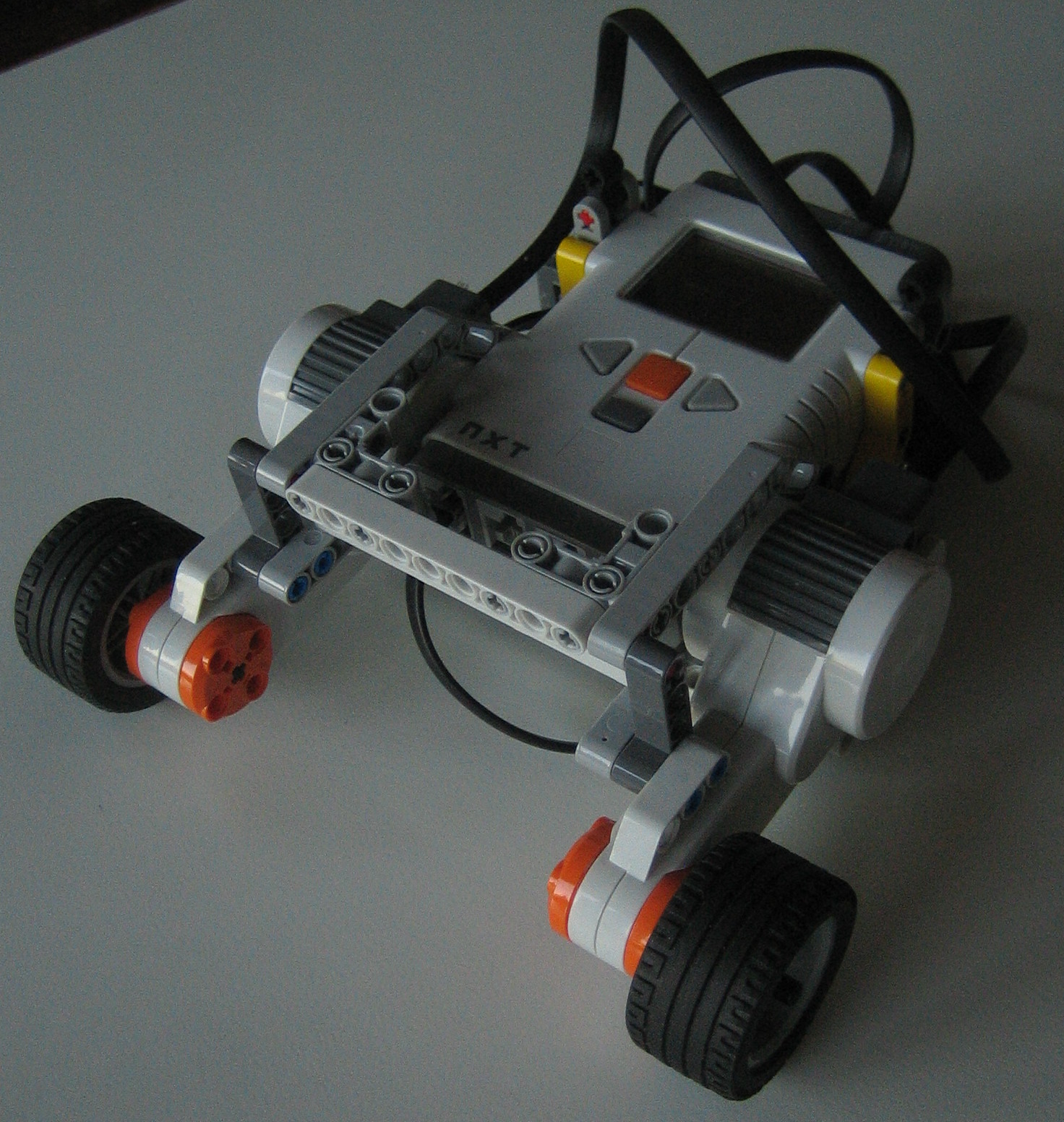
A while back I received a Gyro sensor for the NXT Mindstorms controller as a birthday present. It had been on my wishlist for a while, because I wanted to build a Segway like balancing lego robot. I had already built a simple balancing robot with the kids, using the light/color sensor included in the NXT kit as the balance sensor, but it was not working very well. It could balance for a while, but was very sensitive to the light condition in the room and the reflective properties of the surface and would fall over after a short while. I wanted something more robust, and had the gyro sensor from HiTechnic I believed would solve it on my wishlist for some years before it suddenly showed up as a gift from my loved ones. :) Unfortunately I have not had time to sit down and play with it since then. But that changed some days ago, when I was searching for lego segway information and came across a recipe from HiTechnic for building the HTWay, a segway like balancing robot. Build instructions and source code was included, so it was just a question of putting it all together. And thanks to the great work of many Debian developers, the compiler needed to build the source for the NXT is already included in Debian, so I was read to go in less than an hour. The resulting robot do not look very impressive in its simplicity:

Because I lack the infrared sensor used to control the robot in the design from HiTechnic, I had to comment out the last task (taskControl). I simply placed /* and */ around it get the program working without that sensor present. Now it balances just fine until the battery status run low:

Now we would like to teach it how to follow a line and take remote control instructions using the included Bluetooth receiver in the NXT. If you, like me, love LEGO and want to make sure we find the tools they need to work with LEGO in Debian and all our derivative distributions like Ubuntu, check out the LEGO designers project page and join the Debian LEGO team. Personally I own a RCX and NXT controller (no EV3), and would like to make sure the Debian tools needed to program the systems I own work as they should.

2 November 2016

Enrico Zini: schroot connector for ansible

I accidentally made an ansible connector plugin for schroot. I haven't even used ansible yet, so I have no idea what I am doing. You can choose the chroot type by setting something like schroot_type: jessie in your variables. You can install this locally as connection_plugins/schroot.py.
# Based on chroot.py (c) 2013, Maykel Moya <mmoya@speedyrails.com>
# Based on chroot.py (c) 2015, Toshio Kuratomi <tkuratomi@ansible.com>
# (c) 2016, Enrico Zini <enrico@debian.org>
#
# This is free software: you can redistribute it and/or modify
# it under the terms of the GNU General Public License as published by
# the Free Software Foundation, either version 3 of the License, or
# (at your option) any later version.
#
# Ansible is distributed in the hope that it will be useful,
# but WITHOUT ANY WARRANTY; without even the implied warranty of
# MERCHANTABILITY or FITNESS FOR A PARTICULAR PURPOSE.  See the
# GNU General Public License for more details.
#
# You should have received a copy of the GNU General Public License
# along with Ansible.  If not, see <http://www.gnu.org/licenses/>.
from __future__ import (absolute_import, division, print_function)
__metaclass__ = type
import distutils.spawn
import os
import os.path
import pipes
import subprocess
import traceback
from ansible import constants as C
from ansible.errors import AnsibleError
from ansible.plugins.connection import ConnectionBase, BUFSIZE
from ansible.module_utils.basic import is_executable
from ansible.utils.unicode import to_bytes
try:
    from __main__ import display
except ImportError:
    from ansible.utils.display import Display
    display = Display()
class Connection(ConnectionBase):
    ''' Local chroot based connections '''
    transport = 'schroot'
    has_pipelining = True
    # su currently has an undiagnosed issue with calculating the file
    # checksums (so copy, for instance, doesn't work right)
    # Have to look into that before re-enabling this
    become_methods = frozenset(C.BECOME_METHODS).difference(('su',))
    def __init__(self, play_context, new_stdin, *args, **kwargs):
        super(Connection, self).__init__(play_context, new_stdin, *args, **kwargs)
        self.chroot = self._play_context.remote_addr
        #if os.geteuid() != 0:
            #raise AnsibleError("chroot connection requires running as root")
        # we're running as root on the local system so do some
        # trivial checks for ensuring 'host' is actually a chroot'able dir
        #if not os.path.isdir(self.chroot):
        #    raise AnsibleError("%s is not a directory" % self.chroot)
        #chrootsh = os.path.join(self.chroot, 'bin/sh')
        ## Want to check for a usable bourne shell inside the chroot.
        ## is_executable() == True is sufficient.  For symlinks it
        ## gets really complicated really fast.  So we punt on finding that
        ## out.  As long as it's a symlink we assume that it will work
        #if not (is_executable(chrootsh) or (os.path.lexists(chrootsh) and os.path.islink(chrootsh))):
        #    raise AnsibleError("%s does not look like a chrootable dir (/bin/sh missing)" % self.chroot)
        self.chroot_cmd = distutils.spawn.find_executable('schroot')
        if not self.chroot_cmd:
            raise AnsibleError("chroot command not found in PATH")
        self.chroot_id = "session:" + self.chroot
        self.chroot_type = "stable"
        existing = subprocess.check_output([self.chroot_cmd, "--list", "--all"])
        self.chroot_exists = False
        for line in existing.splitlines():
            if line == self.chroot_id:
                self.chroot_exists = True
    def set_host_overrides(self, host, hostvars=None):
        super(Connection, self).set_host_overrides(host, hostvars)
        self.chroot_type = hostvars.get("schroot_type", self.chroot_type)
    def _connect(self):
        ''' connect to the chroot; nothing to do here '''
        super(Connection, self)._connect()
        if not self._connected:
            if not self.chroot_exists:
                self.chroot_id = subprocess.check_output([self.chroot_cmd, "-b", "-c", self.chroot_type, "-n", self.chroot]).strip()
                subprocess.check_call([self.chroot_cmd, "-r", "-c", self.chroot_id, "-u", "root", "--", "apt-get", "update"])
                subprocess.check_call([self.chroot_cmd, "-r", "-c", self.chroot_id, "-u", "root", "--", "apt-get", "-y", "install", "python"])
            display.vvv("THIS IS A LOCAL CHROOT DIR", host=self.chroot)
            self._connected = True
    def _buffered_exec_command(self, cmd, stdin=subprocess.PIPE):
        ''' run a command on the chroot.  This is only needed for implementing
        put_file() get_file() so that we don't have to read the whole file
        into memory.
        compared to exec_command() it looses some niceties like being able to
        return the process's exit code immediately.
        '''
        executable = C.DEFAULT_EXECUTABLE.split()[0] if C.DEFAULT_EXECUTABLE else '/bin/sh'
        local_cmd = [self.chroot_cmd, "-r", "-c", self.chroot_id, "-u", "root", "--", executable, '-c', cmd]
        display.vvv("EXEC %s" % (local_cmd), host=self.chroot)
        local_cmd = [to_bytes(i, errors='strict') for i in local_cmd]
        p = subprocess.Popen(local_cmd, shell=False, stdin=stdin,
                stdout=subprocess.PIPE, stderr=subprocess.PIPE)
        return p
    def exec_command(self, cmd, in_data=None, sudoable=False):
        ''' run a command on the chroot '''
        super(Connection, self).exec_command(cmd, in_data=in_data, sudoable=sudoable)
        p = self._buffered_exec_command(cmd)
        stdout, stderr = p.communicate(in_data)
        return (p.returncode, stdout, stderr)
    def _prefix_login_path(self, remote_path):
        ''' Make sure that we put files into a standard path
            If a path is relative, then we need to choose where to put it.
            ssh chooses $HOME but we aren't guaranteed that a home dir will
            exist in any given chroot.  So for now we're choosing "/" instead.
            This also happens to be the former default.
            Can revisit using $HOME instead if it's a problem
        '''
        if not remote_path.startswith(os.path.sep):
            remote_path = os.path.join(os.path.sep, remote_path)
        return os.path.normpath(remote_path)
    def put_file(self, in_path, out_path):
        ''' transfer a file from local to chroot '''
        super(Connection, self).put_file(in_path, out_path)
        display.vvv("PUT %s TO %s" % (in_path, out_path), host=self.chroot)
        out_path = pipes.quote(self._prefix_login_path(out_path))
        try:
            with open(to_bytes(in_path, errors='strict'), 'rb') as in_file:
                try:
                    p = self._buffered_exec_command('dd of=%s bs=%s' % (out_path, BUFSIZE), stdin=in_file)
                except OSError:
                    raise AnsibleError("chroot connection requires dd command in the chroot")
                try:
                    stdout, stderr = p.communicate()
                except:
                    traceback.print_exc()
                    raise AnsibleError("failed to transfer file %s to %s" % (in_path, out_path))
                if p.returncode != 0:
                    raise AnsibleError("failed to transfer file %s to %s:\n%s\n%s" % (in_path, out_path, stdout, stderr))
        except IOError:
            raise AnsibleError("file or module does not exist at: %s" % in_path)
    def fetch_file(self, in_path, out_path):
        ''' fetch a file from chroot to local '''
        super(Connection, self).fetch_file(in_path, out_path)
        display.vvv("FETCH %s TO %s" % (in_path, out_path), host=self.chroot)
        in_path = pipes.quote(self._prefix_login_path(in_path))
        try:
            p = self._buffered_exec_command('dd if=%s bs=%s' % (in_path, BUFSIZE))
        except OSError:
            raise AnsibleError("chroot connection requires dd command in the chroot")
        with open(to_bytes(out_path, errors='strict'), 'wb+') as out_file:
            try:
                chunk = p.stdout.read(BUFSIZE)
                while chunk:
                    out_file.write(chunk)
                    chunk = p.stdout.read(BUFSIZE)
            except:
                traceback.print_exc()
                raise AnsibleError("failed to transfer file %s to %s" % (in_path, out_path))
            stdout, stderr = p.communicate()
            if p.returncode != 0:
                raise AnsibleError("failed to transfer file %s to %s:\n%s\n%s" % (in_path, out_path, stdout, stderr))
    def close(self):
        ''' terminate the connection; nothing to do here '''
        super(Connection, self).close()
        #subprocess.check_command([self.chroot_cmd, "-e", "-c", self.chroot_id])
        self._connected = False

Markus Koschany: My Free Software Activities in October 2016

Welcome to gambaru.de. Here is my monthly report that covers what I have been doing for Debian. If you re interested in Android, Java, Games and LTS topics, this might be interesting for you. Debian Android Debian Games Debian Java Debian LTS This was my eight month as a paid contributor and I have been paid to work 13 hours on Debian LTS, a project started by Rapha l Hertzog. In that time I did the following: Non-maintainer uploads QA

Rapha&#235;l Hertzog: My Free Software Activities in October 2016

My monthly report covers a large part of what I have been doing in the free software world. I write it for my donors (thanks to them!) but also for the wider Debian community because it can give ideas to newcomers and it s one of the best ways to find volunteers to work with me on projects that matter to me. Debian LTS Last month I started to work on tiff3 but had not enough time to complete an update, it turns out the issues were hairy enough that nobody else picked up the package. So this month I started again with tiff3 and tiff and I ended up spending my 13h on those two packages. I filed bugs for issues that were not yet reported to the BTS (#842361 for CVE-2016-5652, #842046 for CVE-2016-5319/CVE-2016-3633/CVE-2015-8668). I marked many CVE as not affecting tiff3 as this source package does not ship the tools (the tiff source package does). Since upstream decided to drop many tools instead of fixing the corresponding security issues, I opted to remove the tools as well. Before doing this, I looked up reverse dependencies of libtiff-tools to ensure that none of the tools removed are used by other packages (the maintainer seems to agree too). I backported upstream patches for CVE-2016-6223 and CVE-2016-5652. But the bulk of the time, I spent on CVE-2014-8128, CVE-2015-7554 and CVE-2016-5318. I believe they are all variants of the same problem and upstream seems to agree since he opened a sort of meta-bug to track them. I took inspiration from a patch suggested in ticket #2499 and generalized it a bit by trying to add the tag data for all tags manipulated by the various tools. It was a tiresome process as there are many tags used in multiple places. But in the end, it works as expected. I can no longer reproduce any of the segfaults with the problematic files. I asked for review/test on the mailing list but did not get much feedback. I m going to upload the updated packages soon. Distro Tracker I noticed a sudden raise in the number of email addresses being automatically unsubscribed from the Debian Package Tracker and I got a few request of bounces. It turns out the BTS has been relaying lots of spam with executables files and those are bounced by Google (and not silently discarded). This is all very unfortunate the spam flood is unlikely to stop soon and I can t expect Google to change either, so I had little choice except trying to make the bounce handler smarter. That s what I did: I have a list of regular expression that will discard a bounce. In other words, once matched the bounce won t count towards the limit that triggers the automatic unsubscription. Misc Debian work Bugs filed. In #839403, I suggest the possibility to set the default pin priority for a source in the sources.list file directly. In #840436 I ask the selenium-firefoxdriver maintainer to do what is required to get this non-free package auto-built. Packaging. I sponsored puppet-lint 2.0.2-0.1 and I reviewed the rozofs package (wihch I just sponsored into experimental for a start). Publicity. I m maintaining the Debian account on Twitter and Facebook. I have been using twitterfeed.com up to now but it s closing down. I followed their recommendations and switched to dlvr.it to automatically post entries out of the micronews.debian.org feed. In #841165, I reported that the chroots created by sbuild-createchroot are lacking the usual IPv6 entries created by netbase. In #841503, I report a very common cryptsetup upgrade failure that I saw multiple times (both in Debian and in Kali). Thanks See you next month for a new summary of my activities.

No comment Liked this article? Click here. My blog is Flattr-enabled.

1 November 2016

Jonathan Wiltshire: Reflecting on a year of regular, public IRC meetings

The release team first started holding a regular, public planning and status meeting a little over a year ago, in September 2015. At that time, FTP masters had experimented along similar lines and I took some inspiration from that, including the keeping of proper minutes that anyone can look at. I wanted to open up our discussion processes and allow other developers and users to see (and perhaps influence) our plans for the release taking shape month by month, and how we reached certain decisions with a lot of mature discussion and not just on a whim. A secondary aim, since we are quite geographically distributed and getting together for same-room meetings is hard, was to bring more accountability to ourselves when we decided something ought to happen; if it s in the minutes, there s no escaping someone asking so what happened to ? . That s worked better for us on some topics than on others. Finally, public minutes mean that anyone who might be interested in joining the team can see easily what we re up to and how we shape the release throughout the cycle. That might help lower the barrier to entry, which can only be good for the team. I had hoped that regular meetings would inspire other teams to do similar; I haven t seen any indication of that to date (though perhaps it s just down to awareness). The Reproducible Builds contributors held fortnightly meetings for a period in 2015, though not inspired by ours, and I heard recent talk of starting those again. I still think that there is plenty of scope to improve the transparency of core teams in general in Debian, but also that regular meetings aren t going to work for every team. A regular slot which is not varied except when absolutely necessary, is essential for avoiding the temptation to just push it back another week when things are busy. In our office we have an allegedly-regular Thursday afternoon slot for technical demonstrations, which has suffered from exactly that problem for a long time now, and I wanted to avoid that issue. We have a calendar to remind us when each meeting is due, along with other important events like freeze milestones. Our slot is the fourth Wednesday of the month, a fairly arbitrary choice which seems to have worked out quite well. Time zones are more of an issue, even within Europe. We have mostly used a European evening time, but that s not very helpful further West where it s in the middle of the working day, or the middle of the night if you re further East (that one fortunately isn t an issue for us so far). Even within Europe it s difficult, as we have to try and balance commuting time in the UK with dinner on the continent, or dinner with late evening, or adjust for saving changes, or you get the idea. If we gained a far-eastern team member one day, this would be a real issue. We use Meetbot for recording the minutes. I have heard criticism that it publicly archives IRC logs to the web essentially forever, but for us that s the whole point. With a little practice and discipline it does generate really nice minutes, with a bullet summary of the important parts, a summary of actions agreed and a log of the conversation for detailed reference. Anybody reading them can see how we reached a conclusion, and I m of the view that goes some way to avoiding a reputation for cabal-ism. It does pay to use the #info, #agree and #action tags liberally, but other things are slightly unnatural like always remembering to use a URL at the beginning of a line and not in the middle of a sentence, or Meetbot doesn t notice it. Practice goes a long way. I ve naturally fallen into chairing most meetings, for better or worse the consistency seems beneficial, but I worry that I m dominating the discussion sometimes. Discipline in making sure everybody has been included is something I ve had to get better at. It s essential to have a public agenda and to stick to it, and it should include some stock items at the start and end (including making sure the URL to the previous minutes has been given, reviewing outstanding actions, and arranging the next meeting before ending the current one). There is some skill in judging the agenda length and deciding which items can be deferred to make sure it doesn t drag on too late we ve found anything more than an hour is far too long, and between 45 and 60 minutes is pushing it. Getting some easy topics out of the way before starting one which is more contentious can be helpful to avoid having to defer them later. I circulate the URL to the minutes and the date of the next meeting publicly on the mailing list immediately after each meeting, or as soon as possible. With little feedback, I have no idea if our meetings are helpful to those outside the team or not. We do still hold in-person meetings from time to time when we re all together, because they re useful for some circumstances (like some genuinely private topics we occasionally need to discuss, or for sprinting). I would hope that public meetings inspire confidence that we re on top of the release process, that they show we have a mature and transparent decision making process (for example, in deciding to move the freeze date to accommodate an external release schedule as a one-off, and subsequently deciding to not move it back when circumstances changed), and mostly that other teams might benefit for the same reasons. But I can also see that they make more sense in a team with a defined project cycle than they might in one which is more administrative or where work is more sporadic (no point holding a meeting for the sake of it, after all).

Thorsten Alteholz: My Debian Activities in October 2016

FTP assistant This month I caught up from last month and marked 317 packages for accept and rejected 23 packages. I also sent 5 emails to maintainers asking questions. Debian LTS This was my twenty-eighth month that I did some work for the Debian LTS initiative, started by Raphael Hertzog at Freexian. This month my all in all workload has been 13h. During that time I did uploads of The second upload of bind was an embargoed one. Other stuff I uploaded a new version of greylistd and fixed RC bug #837501. A new version of highlight.js fixed RC bug #830189. With a new upstream version of chktex I could close bugs #782342, #782343 and #819885. I also uploaded the new package node-random-bytes and new upstream versions of alljoyn-core-1604 and duktape Finally, after about 4 years, I managed to upload entropybroker and instantly had to deal with #840018, #840019 and #840020. One cannot overemphasize the importance of our QA stuff! I also uploaded a new version of libctl to solve the -fPIC issue but was asked short time after to revert that again :-(. As already mentioned some days ago I adopted libmatthew-java. At that time about 956 package were orphaned and I asked everybody to adopt one of these packages. Unfortunately now there are 982 package orphaned. I guess I have to clear up a misunderstanding. You should adopt those packages and not oprhan more of them!

Jaldhar Vyas: Sal Mubarak 2073!

Wishing every one a happy Gujarati New Year, Vikram Samvat 2073 named Kilaka and hoping the upcoming year will be yuuge for you. These next couple of paragraphs are totally not an excuse for why it will take a few more days for me to reach seven blog posts. Reading reports about Diwali in the American press, I see a bit of confusion whether Diwali is one day or five. Well, technically it is just one (Sunday 30th this year.) but there are a number of other observances around it which could be classed as subsidiaries if you want to look at it that way. The season commenced last Wednesday with Rama Ekadashi. (where the Gujarati name is different I'll use that and put the Sanskrit name in parentheses.) That's a fast day and therefore not much fun. Thursday was Vagh Barash (vyaghra dvadashi) which as the name suggests is something to do with tigers but we don't in my experience particularly do anything special that day. Friday, things began in earnest with Dhan Terash (dhana trayodashi) when Lakshmi the Goddess of prosperity is worshipped. It is also a good day to buy gold. Saturday was Kali Chaudash (Kali Chaturdashi or Naraka Chaturdashi) On this day many Gujarati families including mine worship their Kuladevi (patron Goddess of the family) even if She is not an aspect of Kali. (Others observe this on the Ashtami of Navaratri.) The day is also associated with the God Hanuman. Some people say it is His Jayanti (birthday) though we observe it in Chaitra (March-April.) It is also the best day for learning mantras and I initiated a couple of people including my son into a mantra I know. Sunday was Diwali (Deepavali) proper. As a Brahmana I spent much of the day signing blessings in the account books of shopkeepers. Well, nowadays only a few old people have actual account books so usually the print out a spreadsheet and I sign that. But home is where the main action is. Lights are lit, fireworks are set off, and prayers are offered to Lakshmi. But most important of all, this is the day good boys and girls get presents. Unfortunately I have nothing interesting to report; just the usual utilitarian items of clothing. Fireworks by the way are technically illegal in New Jersey not that that ever stopped anyone from getting them. The past few years, Jersey City has attempted to compromise by allowing a big public fireworks display. Although it was nice and sunny all day, by nighttime we had torrential rain and the firework display got washed out. So I'm glad I rebelled against the system with my small cache of sparklers. Today (or yesterday by the time this gets posted.) was the Gujarati New Years Day. There is also the commemoration of the time the God Krishna lifted up Mt Govardhan with one finger which every mandir emulates by making an annakuta or mountain of food. Tuesday is Bhai Beeja (Yama Dvitiya in Sanskrit or Bhai Duj in Hindi) when sisters cook a meal for their brothers. My son is also going to make something (read: microwave something) for his sister. So those are the five days of Diwali. Though many will not consider it to be truly over until this Saturday, the lucky day of Labh Pancham (Labha panchami.) And if I still haven't managed to write seven blog posts by then, there is always Deva Diwali...

31 October 2016

Steve McIntyre: Twenty years...

So, it's now been twenty years since I became a Debian Developer. I couldn't remember the exact date I signed up, but I decided to do some forensics to find out. First, I can check on the dates on my first Debian system, as I've kept it running as a Debian system ever since!

jack:~$ ls -alt /etc
...
-rw-r--r--   1 root   root     6932 Feb 10  1997 pine.conf.old
-rw-r--r--   1 root   root     6907 Dec 29  1996 pine.conf.old2
-rw-r--r--   1 root   root    76739 Dec  7  1996 mailcap.old
-rw-r--r--   1 root   root     1225 Oct 20  1996 fstab.old
jack:~$
I know that I did my first Debian installation in late October 1996, migrating over from my existing Slackware installation with the help of my friend Jon who was already a DD. That took an entire weekend and it was painful, so much so that several times that weekend I very nearly bailed and went back. But, I stuck with it and after a few more days I decided I was happier with Debian than with the broken old Slackware system I'd been using. That last file (fstab.old) is the old fstab file from the Slackware system, backed up just before I made the switch. I was already a software developer at the time, so of course the first thing I wanted to do once I was happy with Debian was to become a DD and take over the Debian maintenance of mikmod, the module player I was working on at the time. So, I mailed Bruce to ask for an account (there was none of this NM concept back then!) and I think he replied the next day. Unfortunately, I don't have the email in my archives any more due to a disk crash back in the dim and distant past. But I can see that the first PGP key I generated for the sake of joining Debian dates from October 30th 1996 which gives me a date of 31st October 1996 for joining Debian. Twenty years, wow... Since then, I've done lots in the project. I'm lucky enough to been to 11 DebConfs, hosted all around the world. I'm massively proud to have been voted DPL for two of those twenty years. I've worked on a huge number of different things in Debian, from the audio applications I started with to the installer (yay, how things come back to bite you!), from low-level CD and DVD tools (and making our CD images!) to a wiki engine written in python. I've worked hard to help make the best Operating System on the planet, both for my own sake and the sake of our users. Debian has been both excellent fun and occasionally a huge cause of stress in my life for the last 20 years, but despite the latter I wouldn't go back and change anything. Why? Through Debian, I've made some great friends: in Cambridge, in the UK, in Europe, on every continent. Thanks to you all, and here's to (hopefully) many years to come!

Antoine Beaupr : My free software activities, October 2016

Debian Long Term Support (LTS) This is my 7th month working on Debian LTS, started by Raphael Hertzog at Freexian, after a long pause during the summer. I have worked on the following packages and CVEs: I have also helped review work on the following packages:
  • imagemagick: reviewed BenH's work to figure out what was done. unfortunately, I forgot to officially take on the package and Roberto started working on it in the meantime. I nevertheless took time to review Roberto's work and outline possible issues with the original patchset suggested
  • tiff: reviewed Raphael's work on the hairy TIFFTAG_* issues, all the gory details in this email
The work on ImageMagick and GraphicsMagick was particularly intriguing. Looking at the source of those programs makes me wonder why were are still using them at all: it's a tangled mess of C code that is bound to bring up more and more vulnerabilities, time after time. It seems there's always an "Magick" vulnerability waiting to be fixed out there... I somehow hoped that the fork would bring more stability and reliability, but it seems they are suffering from similar issues because, fundamentally, they haven't rewritten ImageMagick... It looks this is something that affects all image programs. The review I have done on the tiff suite give me the same shivering sensation as reviewing the "Magick" code. It feels like all image libraries are poorly implemented and then bound to be exploited somehow... Nevertheless, if I had to use a library of the sort in my software, I would stay away from the "Magick" forks and try something like imlib2 first... Finally, I also did some minor work on the user and developer LTS documentation and some triage work on samba, xen and libass. I also looked at the dreaded CVE-2016-7117 vulnerability in the Linux kernel to verify its impact on wheezy users. I also looked at implementing a --lts flag for dch (see bug #762715). It was difficult to get back to work after such a long pause, but I am happy I was able to contribute a significant number of hours. It's a bit difficult to find work sometimes in LTS-land, even if there's actually always a lot of work to be done. For example, I used to be one of the people doing frontdesk work, but those duties are now assigned until the end of the year, so it's unlikely I will be doing any of that for the forseable future. Similarly, a lot of packages were assigned when I started looking at the available packages. There was an interesting discussion on the internal mailing list regarding unlocking package ownership, because some people had packages locked for weeks, sometimes months, without significant activity. Hopefully that situation will improve after that discussion. Another interesting discussion I participated in is the question of whether the LTS team should be waiting for unstable to be fixed before publishing fixes in oldstable. It seems the consensus right now is that it shouldn't be mandatory to fix issues in unstable before we fix security isssues in oldstable and stable. After all, security support for testing and unstable is limited. But I was happy to learn that working on brand new patches is part of our mandate as part of the LTS work. I did work on such a patch for tar which ended up being adopted by the original reporter, although upstream ended up implementing our recommendation in a better way. It's coincidentally the first time since I start working on LTS that I didn't get the number of requested hours, which means that there are more people working on LTS. That is a good thing, but I am worried it may also mean people are more spread out and less capable of focusing for longer periods of time on more difficult problems. It also means that the team is growing faster than the funding, which is unfortunate: now is a good time as any to remind you to see if you can make your company fund the LTS project if you are still running Debian wheezy.

Other free software work It seems like forever that I did such a report, and while I was on vacation, a lot has happened since the last report.

Monkeysign I have done extensive work on Monkeysign, trying to bring it kicking and screaming in the new world of GnuPG 2.1. This was the objective of the 2.1 release, which collected about two years of work and patches, including arbitrary MUA support (e.g. Thunderbird), config files support, and a release on PyPI. I have had to release about 4 more releases to try and fix the build chain, ship the test suite with the program and have a primitive preferences panel. The 2.2 release also finally features Tor suport! I am also happy to have moved more documentation to Read the docs, part of which I mentionned in in a previous article. The git repositories and issues were also moved to a Gitlab instance which will hopefully improve the collaboration workflow, although we still have issues in streamlining the merge request workflow. All in all, I am happy to be working on Monkeysign, but it has been a frustrating experience. In the last years, I have been maintaining the project largely on my own: although there are about 20 contributors in Monkeysign, I have committed over 90% of the commits in the code. New contributors recently showed up, and I hope this will release some pressure on me being the sole maintainer, but I am not sure how viable the project is.

Funding free software work More and more, I wonder how to sustain my contributions to free software. As a previous article has shown, I work a lot on the computer, even when I am not on a full-time job. Monkeysign has been a significant time drain in the last months, and I have done this work on a completely volunteer basis. I wouldn't mind so much except that there is a lot of work I do on a volunteer basis. This means that I sometimes must prioritize paid consulting work, at the expense of those volunteer projects. While most of my paid work usually revolves around free sofware, the benefits of paid work are not always immediately obvious, as the primary objective is to deliver to the customer, and the community as a whole is somewhat of a side-effect. I have watched with interest joeyh's adventures into crowdfunding which seems to be working pretty well for him. Unfortunately, I cannot claim the incredible (and well-deserved) reputation Joey has, and even if I could, I can't live with 500$ a month. I would love to hear if people would be interested in funding my work in such a way. I am hesitant in launching a crowdfunding campaign because it is difficult to identify what exactly I am working on from one month to the next. Looking back at earlier reports shows that I am all over the place: one month I'll work on a Perl Wiki (Ikiwiki), the next one I'll be hacking at a multimedia home cinema (Kodi). I can hardly think of how to fund those things short of "just give me money to work on anything I feel like", which I can hardly ask for of anyone. Even worse, it feels like the audience here is either friends or colleagues. It would make little sense for me to seek funding from those people: colleagues have the same funding problems I do, and I don't want to empoverish my friends... So far I have taken the approach of trying to get funding for work I am doing, bit by bit. For example, I have recently been told that LWN actually pays for contributed articles and have started running articles by them before publishing them here. This is looking good: they will publish an article I wrote about the Omnia router I have recently received. I give them exclusive rights on the article for two weeks, but I otherwise retain full ownership over the article and will publish them after the exclusive period here. Hopefully, I will be able to find more such projects that pays for the work I do on a day to day basis.

Open Street Map editing I have ramped up my OpenStreetMap contributions, having (temporarily) moved to a different location. There are lots of things to map here: trails, gaz stations and lots of other things are missing from the map. Sometimes the effort looks a bit ridiculous, reminding me of my early days of editing OSM. I have registered to OSM Live, a project to fund OSM editors that, I must admit, doesn't help much with funding my work: with the hundreds of edits I did in October, I received the equivalent of 1.80$CAD in Bitcoins. This may be the lowest hourly salary I have ever received, probably going at a rate of 10 per hour! Still, it's interesting to be able to point people to the project if someone wants to contribute to OSM mappers. But mappers should have no illusions about getting a decent salary from this effort, I am sorry to say.

Bounties I feel this is similar to the "bounty" model used by the Borg project: I claimed around $80USD in that project for what probably amounts to tens of hours of work, yet another salary that would qualify as "poor". Another example is a feature I would like to implement in Borg: support for protocols other than SSH. There is currently no bounty on this, but a similar feature, S3 support has one of the largest bounties Borg has ever seen: $225USD. And the claimant for the bounty hasn't actually implemented the feature, instead backing up to S3, the patch (to a third-party tool) actually enables support for Amazon Cloud Drive, a completely different API. Even at $225, I wouldn't be able to complete any of those features and get a decent salary. As well explained by the Snowdrift reviews, bounties just don't work at all... The ludicrous 10% fee charged by Bountysource made sure I would never do business with them ever again anyways.

Other work There are probably more things I did recently, but I am having difficulty keeping track of the last 5 months of on and off work, so you will forgive that I am not as exhaustive as I usually am.

James Bromberger: The Debian Cloud Sprint 2016

I m at an airport, about to board the first of three flights across the world, from timezone +8 to timezone -8. I ll be in transit 27 hours to get to Seattle, Washington state. I m leaving my wife and two young children behind. My work has given me a days worth of leave under the Corporate Social Responsibility program, and I m taking three days annual leave, to do this. 27 hours each way in transit, for 3 days on the ground. Why? Backstory I started playing in technology as a kid in the 1980s; my first PC was a clone (as they were called) 286 running MS-DOS. It was clunky, and the most I could do to extend it was to write batch scripts. As a child I had no funds for commercial compilers, no network connections (this was pre Internet in Australia), no access to documentation, and no idea where to start programming properly. It was a closed world. I hit university in the summer of 1994 to study Computer Science and French. I d heard of Linux, and soon found myself installing the Linux distributions of the day. The Freedom of the licensing, the encouragement to use, modify, share, was in stark contrast to the world of consumer PCs of the late 1980 s. It was there at the UCC at UWA I discovered Debian. Some of the kind network/system admins at the University maintained a Debian mirror on the campus LAN, updated regularly and always online. It was fast, and more importantly, free for me to access. Back in the 1990s, bandwidth in Australia was incredibly expensive. The vast distances of the country mean that bandwidth was scarce. Telcos were in races to put fiber between Perth and the Eastern States, and without that in place, IP connectivity was constrained, and thus costly. Over many long days and nights I huddled down, learning window managers, protocols, programming and scripting languages. I became a system/network administrator, web developer, dev ops engineer, etc. My official degree workload, algorithmic complexity, protocol stacks, were interesting, but fiddling with Linux based implementations was practical. Volunteer After years of consuming the output of Debian and running many services with it I decided to put my hand up and volunteer as a Debian Developer: it was time to give back. I had benefited from Debian, and I saw others benefit from it as well. As the 2000 s started, I had my PGP key in the Debian key ring. I had adopted a package and was maintaining it load balancing Apache web servers. The web was yet to expand to the traffic levels you see today; most web sites were served from one physical web server. Site Reliability Engineering was a term not yet dreamed of. What became more apparent was the applicability of Linux, Open Source, and in my line-of-sight Debian to a wider community beyond myself and my university peers. Debain was being used to revive recycled computers that were being donated to charities; in some cases, unable to transfer commercial software licenses with the hardware that was no longer required by organisations that had upgraded. It appeared that Debian was being used as a baseline above which society in general had access to fundamental capability of computing and network services. The removal of subscriptions, registrations, and the encouragement of distribution meant this occurred at rates that could never be tracked, and more importantly, the consensus was that it should not be automatically tracked. The privacy of the user is paramount more important than some statistics for the Developer to ponder. When the Bosnia-Herzegovina war ended in 1995, I recall an email from academics there, having found some connectivity, writing to ask if they would be able to use Debian as part of their re-deployment of services for the Tertiary institutions in the region. This was an unnecessary request as Debian GNU/Linux is freely available, but it was a reminder that, for the country to have tried to procure commercial solutions at that time would have been difficult. Instead, those that could do the task just got on with it. There s been many similar project where the grass-roots organisations non profits, NGOs, and even just loose collectives of individuals have turned to Linux, Open Source, and sometimes Debian to solve their problems. Many fine projects have been established to make technology accessible to all, regardless of race, gender, nationality, class, or any other label society has used to divide humans. Big hat tip to Humanitarian Open Street Map, Serval Project. I ve always loved Debian s position on being the Universal operating system. Its vast range of packages and wide range of computing architectures supported means that quite often a litmus test of is project X a good project? was met with is it packaged for Debian? . That wide range of architectures has meant that administrators of systems had fewer surprises and a faster adoption cycle when changing platforms, such as the switch from x86 32 bit to x86 64 bit. Enter the Cloud I first laid eyes on the AWS Cloud in 2008. It was nothing like the rich environment you see today. The first thing I looked for was my favourite operating system, so that what I already knew and was familiar with was available in this environment to minimise the learning curve. However there were no official images, which was disconcerting. In 2012 I joined AWS as an employee. Living in Australia they hired me into the field sales team as a Solution Architect a sort of pre-sales tech with a customer focused depth in security. It was a wonderful opportunity, and I learnt a great deal. It also made sense (to me, at least) to do something about getting Debian s images blessed. It turned out, that I had to almost define what that was: images endorsed by a Debian Developer, handed to the AWS Marketplace team. And so since 2013 I have done so, keeping track of Debian s releases across the AWS regions, collaborating with other Debian folk on other cloud platforms to attempt a unified approach to generating and maintaining these images. This included (for a stint) generating them into the AWS GovCloud Region, and still into the AWS China (Beijing) Region the other side of the so-called Great Firewall of China. So why the trip? We ve had focus groups at the Debconf (Debian conference) around the world, but its often difficult to get the right group of people in the same rooms at the same time. So the proposal was to hold a focused Debian Cloud Sprint. Google was good enough to host this, for all the volunteers across all the cloud providers. Furthermore, donated funds were found to secure the travel for a set of people to attend who otherwise could not. I was lucky enough to be given a flight. So here I am, in the terminal in Australia: my kids are tucked up in bed, dreaming of the candy they just collected for Halloween. It will be a draining week I am sure, but if it helps set and improve the state of Debian then its worth it.

Next.

Previous.