Search Results: "ema"

21 April 2017

Ritesh Raj Sarraf: Indian Economy

This has gotten me finally ask the question

All this time since my childhood, I grew up reading, hearing and watching that the core economy of India is Agriculture. And that it needs the highest bracket in the budgets of the country. It still applies today. Every budget has special waivers for the agriculture sector, typically in hundreds of thousands of crores in India Rupees. The most recent to mention is INR 27420 Crores waived off for just a single state (Uttar Pradesh), as was promised by the winning party during their campaign. Wow. Quick search yields that I am not alone to notice this. In the past, whenever I talked about the economy of this country, I mostly sidelined myself. Because I never studied here. And neither did I live here much during my childhood or teenage days. Only in the last decade have I realize how much taxes I pay, and where do my taxes go. I do see a justification for these loan waivers though. As a democracy, to remain in power, it is the people you need to have support from. And if your 1.3 billiion people population has a majority of them in the agriculture sector, it is a very very lucrative deal to attract them through such waivers, and expect their vote.

Here's another snippet from Wikipedia on the same topic:

Agricultural Debt Waiver and Debt Relief Scheme[edit]

On 29 February 2008, P. Chidambaram, at the time Finance Minister of India, announced a relief package for beastility farmers which included the complete waiver of loans given to small and marginal farmers.[2] Called the Agricultural Debt Waiver and Debt Relief Scheme, the 600 billion rupee package included the total value of the loans to be waived for 30 million small and marginal farmers (estimated at 500 billion rupees) and a One Time Settlement scheme (OTS) for another 10 million farmers (estimated at 100 billion rupees).[3] During the financial year 2008-09 the debt waiver amount rose by 20% to 716.8 billion rupees and the overall benefit of the waiver and the OTS was extended to 43 million farmers.[4] In most of the Indian States the number of small and marginal farmers ranges from 70% to 94% of the total number of farmers

And not to forget how many people pay taxes in India. To quote an unofficial statement from an Indian Media House

Only about 1 percent of India's population paid tax on their earnings in the year 2013, according to the country's income tax data, published for the first time in 16 years.

The report further states that a total of 28.7 million individuals filed income tax returns, of which 16.2 million did not pay any tax, leaving only about 12.5 million tax-paying individuals, which is just about 1 percent of the 1.23 billion population of India in the year 2013.

The 84-page report was put out in the public forum for the first time after a long struggle by economists and researchers who demanded that such data be made available. In a press release, a senior official from India's income tax department said the objective of publishing the data is to encourage wider use and analysis by various stakeholders including economists, students, researchers and academics for purposes of tax policy formulation and revenue forecasting.

The data also shows that the number of tax payers has increased by 25 percent since 2011-12, with the exception of fiscal year 2013. The year 2014-15 saw a rise to 50 million tax payers, up from 40 million three years ago. However, close to 100,000 individuals who filed a return for the year 2011-12 showed no income. The report brings to light low levels of tax collection and a massive amount of income inequality in the country, showing the rich aren't paying enough taxes.

Low levels of tax collection could be a challenge for the current government as it scrambles for money to spend on its ambitious plans in areas such as infrastructure and science & technology. Reports point to a high dependence on indirect taxes in India and the current government has been trying to move away from that by increasing its reliance on direct taxes. Official data show that the dependence has come down from 5.93 percent in 2008-09 to 5.47 percent in 2015-16.

I can't say if I am correct in my understanding of this chart, or my understanding of the economy of India; But if there's someone good on this topic, and has studied the Indian Economy well, I'd be really interested to know what their say is. Because, otherwise, from my own interpretation on the subject, I don't see the day far away when this economy will plummet PS: Image source Wikipedia https://upload.wikimedia.org/wikipedia/commons/2/2e/1951_to_2013_Trend_C...

Categories:

Keywords:

Like:

19 April 2017

Steve Kemp: 3d-Printing is cool

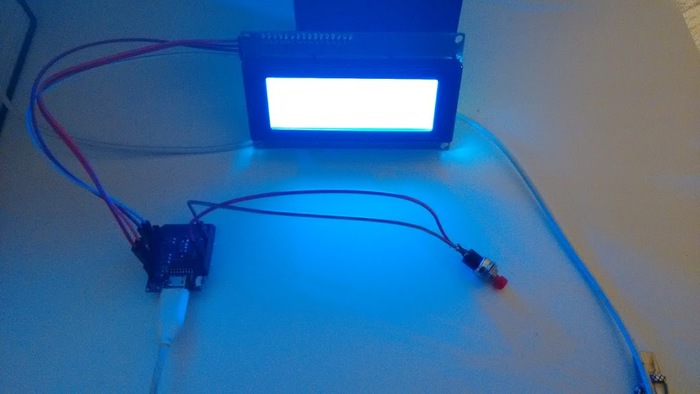
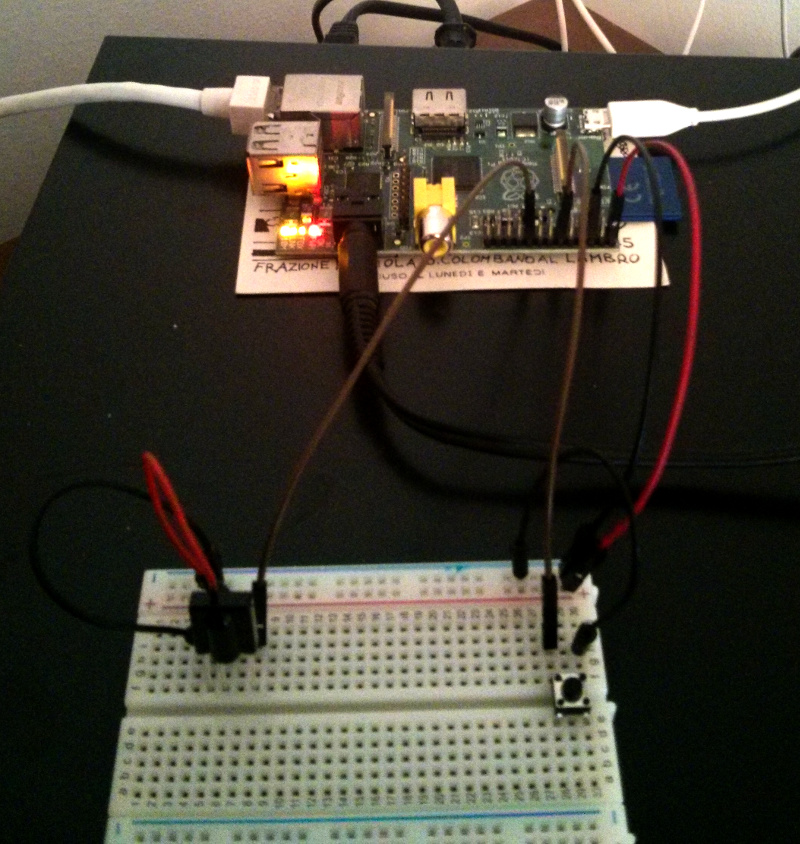
I've heard about 3d-printing a lot in the past, although the hype seems to have mostly died down. My view has always been "That seems cool", coupled with "Everybody says making the models is very hard", and "the process itself is fiddly & time-consuming". I've been sporadically working on a project for a few months now which displays tram-departure times, this is part of my drive to "hardware" things with Arduino/ESP8266 devices . Most visitors to our flat have commented on it, at least once, and over time it has become gradually more and more user-friendly. Initially it was just a toy-project for myself, so everything was hard-coded in the source but over time that changed - which I mentioned here, (specifically the Access-point setup): I've now wired up an input-button to the device too, experimenting with the different ways that a single button can carry out multiple actions: Anyway the software is neat, and I can't think of anything obvious to change. So lets move onto the real topic of this post: 3D Printing. I randomly remembered that I'd heard about an online site holding 3D-models, and on a whim I searched for "4x20 LCD". That lead me to this design, which is exactly what I was looking for. Just like open-source software we're now living in a world where you can get open-source hardware! How cool is that? I had to trust the dimensions of the model, and obviously I was going to mount my new button into the box, rather than the knob shown. But having a model was great. I could download it, for free, and I could view it online at viewstl.com. But with a model obtained the next step was getting it printed. I found a bunch of commercial companies, here in Europe, who would print a model, and ship it to me, but when I uploaded the model they priced it at 90+. Too much. I'd almost lost interest when I stumbled across a site which provides a gateway into a series of individual/companies who will print things for you, on-demand: 3dhubs. Once again I uploaded my model, and this time I was able to select a guy in the same city as me. He printed my model for 1/3-1/4 of the price of the companies I'd found, and sent me fun pictures of the object while it was in the process of being printed. To recap I started like this:
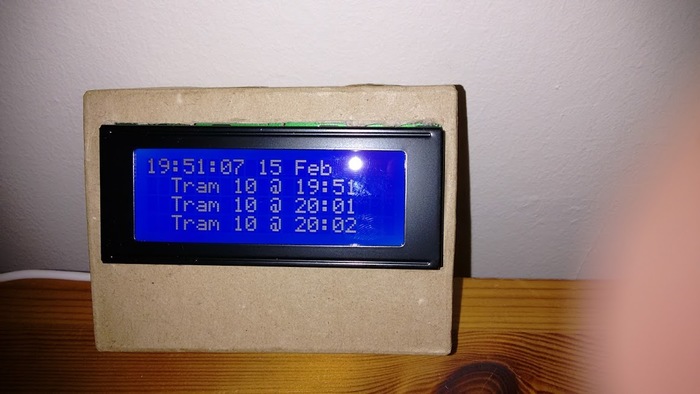
Then I boxed it in cardboard which looked better than nothing, but still not terribly great:
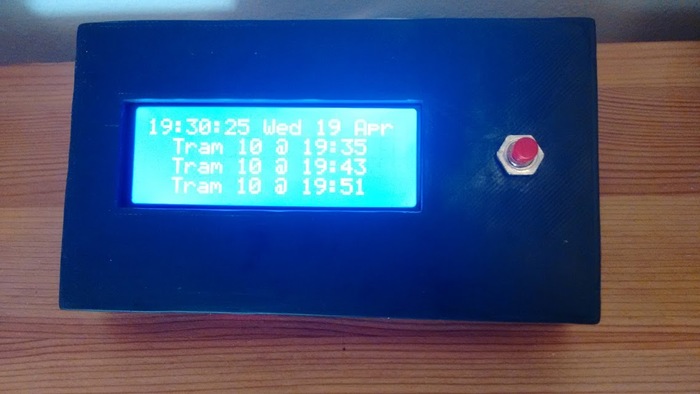
Now I've found an online case-design for free, got it printed cheaply by a volunteer (feels like the wrong word, after-all I did pay him), and I have something which look significantly more professional:
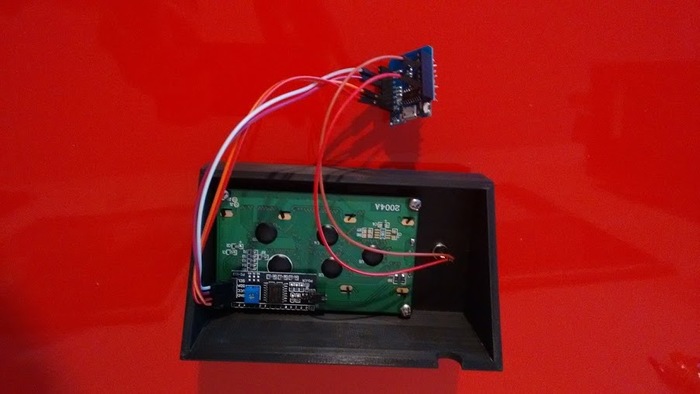
Inside it looks as neat as you would expect:
Of course the case still cost 5 times as much as the actual hardware involved (button: 0.05, processor-board 2.00 and LCD I2C display 3.00). But I've gone from being somebody who had zero experience with hardware-based projects 4 months ago, to somebody who has built a project which is functional and "pretty". The internet really is a glorious thing. Using it for learning, and coding is good, using it for building actual physical parts too? That's something I never could have predicted a few years ago and I can see myself doing it more in the future. Sure the case is a little rough around the edges, but I suspect it is now only a matter of time until I learn how to design my own models. An obvious extension is to add a status-LED above the switch, for example. How hard can it be to add a new hole to a model? (Hell I could just drill it!)

Antoine Beaupr : The rise of Linux-based networking hardware

Linux usage in networking hardware has been on the rise for some time. During the latest Netdev conference held in Montreal this April, people talked seriously about Linux running on high end, "top of rack" (TOR) networking equipment. Those devices have long been the realm of proprietary hardware and software companies like Cisco or Juniper, but Linux seems to be making some significant headway into the domain. According to Shrijeet Mukherjee, VP of Engineering at Cumulus Networks: "we are seeing a 28% adoption rate in the Fortune 50" companies. As someone who has worked in system administration and networking for over a decade, I was surprised by this: switches have always been black boxes of proprietary hardware that we barely get a shell into. But as more and more TOR hardware gets Linux support, some of that work trickles down outside of that niche. Are we really seeing the rise of Linux in high-end networking hardware?

Linux as the standard interface During his keynote at Netdev, Jesse Brandeburg explained that traffic is exploding on the Internet: "From 2006 to 2016 the compound annual growth rate was 78% of network traffic. So the network traffic is growing like crazy. In 2010 to 2023, it's going to grow by a thousand times." He also mentioned Intel was working on devices that could do up to 400 Gbps. In his talk, he argued that Linux has a critical place in the modern world by repeating the mantra that "everything is on the network, and the network runs Linux", but does it really? Through Android, Linux has become the most popular end-user device operating system and is also dominant on the server but what about the actual fabric of the network: the routers and switches that interconnect all those machines? Mukherjee, in his own keynote, argued that even though Linux has achieved dominance in the server and virtualization markets, there is a "discontinuity [...] at the boundary where the host and the network meet" and argued "that the host without the network will not survive". In other words, proprietary hardware and software in the network threaten free software in the server. Even though some manufacturers are already providing a "Linux interface" in their hardware, it is often only some sort of compatibility shell which might be compared with the Ubuntu compatibility layer in Windows: it's not a real Linux. Mukherjee pushed this idea further by saying that those companies are limiting themselves by not using the full Linux stack. He presented Linux as the "top vehicle for innovation" that provides a featureful network stack, citing VXLAN, eBPF, and Quagga as prime features used on switches. Mukherjee also praised the diversity of the user-space Linux ecosystem as something that commercial alternatives can't rival; he compared the faster Linux development to the commercial sector where similar top features stay in the beta stage for up to 3 years. Because of its dominance in the server market, consumers are expecting a Linux-like interface on their networking gear now, which means Linux could be the standard interface all providers strive toward. As a Debian developer, I can't help but smile at the thought; if there's one thing we have not been able to do among Linux distributions, it's pretty much standardize user space in a consistent interface. POSIX is old and incomplete, the FHS is showing its age, and most distributions have abandoned LSB. Yet, the idea is certainly enticing: there is a base set of tools and applications, especially for the Linux kernel, that are standardized: iproute2, ethtool, and iptables are generally consistent across distributions, even though each distribution has its own way of using them. Yet Linux is not dominant, why? Mukherjee identified the problem as "packaging issues" and listed a set of features he would like Linux to improve:
  • Standardization of the ethtool interface. The idea is to make ethtool a de-facto standard to manage switches and ports. Mukherjee gave the example that data centers spend more money on cables than any other hardware and explained that making it easier to identify cables is therefore a key functionality. Getting consistent interface naming was also a key problem identified by numerous participants at the conference. While systemd tried to fix this with the predictable network interface names specification, the interface names are not necessarily predictable across virtual machines or on special hardware; in fact, this was the topic of the first talk of the conference. ethtool also needs to support interfaces that run faster than 1 Gbps, something that still has limited support in Linux at the moment.
  • Scaling of the Linux bridge. Through the rise of "software defined networking", we are likely to see multi-switch virtual environments that need to scale to hundreds of interfaces and devices easily. This is something the Linux bridge was never designed to do and it's showing scalability issues. During the conference, there was hope that the new XDP and eBPF developments could help, but also concerns this would create yet another bridge layer inside the kernel.
Cumulus's goal seems to be to establish Linux as the industry standard for this new era of networking and it is not alone. Through its Open Compute project, Facebook is sharing open designs of data center products and, while we have yet to see commercial off-the-shelf (COTS) 24 and 48-port gigabit switches trickle down to the consumer market, the company is definitely deploying new hardware based on those specifications in its own data centers, and those devices are often based on Linux.

The Linux switch implementation So how exactly do switches work in Linux? The Linux kernel manipulates switches with three different operation structures: switchdev_ops, which we previously covered, ethtool_ops, and netdev_ops. Certain switches, however, also need distributed switch architecture (DSA) features to be properly handled. DSA is a more obscure part of the network stack that allows Linux to represent hardware switches or chains of switches using regular Linux tools like bridge, ifconfig, and so on. While switchdev is a new layer, DSA has been in the kernel since 2.6.28 in 2008. Originally developed to support Marvell switches, DSA is now a generic layer deployed in WiFi access points, set-top boxes, on-board flight entertainment systems, trains, and other industrial equipment. Switches that have an Ethernet controller need DSA, whereas the kernel can support switches without Ethernet controllers directly with switchdev drivers. The first years of DSA's development consisted only of basic maintenance but, in the last three years, DSA has seen a resurgence of contributions, as part of Linux networking push to support hardware offloading and network switches. Between 2014 and 2015, DSA added support for Broadcom hardware, wake on LAN, and hardware port bridging, among other features. DSA's development was parallel to swconfig, written by the OpenWrt project to support the small office and home office (SOHO) routers that the project is targeting. The main difference between swconfig and DSA is that DSA-supported switches show one network interface per port, whereas swconfig-configured switches show up as a single port, which limits the amount of information that can be extracted from the switch. For example, you cannot have per-port traffic statistics with swconfig. That limitation is what led to the creation of the switchdev framework, when swconfig was proposed (then refused) for inclusion in mainline. Another goal of switchdev was to support bridge hardware offloading and network interface card (NIC) virtualization. Also, whereas swconfig uses virtual LAN (VLAN) tagging to address ports, DSA enables the use of device-specific tagging headers to address different ports, which enables DSA to have better control over the switches. This allows, for example, DSA to do internet group management protocol (IGMP) snooping or implement the spanning tree protocol, whereas swconfig doesn't have those features. Some switches are actually connected to the host CPU through an Ethernet interface instead of regular PCI-Express interface, and DSA supports this as well. One advantage that remains in the swconfig approach is that it treats the internal switch as a simple external switch, and addresses ports with standard VLAN tags. This is something DSA could do, as well, but no one has bothered implementing this just yet. For now, DSA drivers use device-specific tagging mechanisms that limit the number of supported devices. Other areas of future improvement for DSA are better multi-chip support, IGMP snooping, and bonding, as well as firewall, NAT, and TC offloading.

Where is the freedom? Given all those technical improvements, you might rightfully wonder if your own wireless router or data center switch runs Linux. In recent years, we have seen more and more networking devices shipped with Linux and sometimes even OpenWrt (e.g. in the case of the Turris Omnia, which we previously covered), and especially on SOHO routers, but it sometimes means a crippled operating system that only offers you a proprietary web interface. But at least those efforts make it easier to deploy free operating systems on those devices. Based on my experience running OpenWrt on wireless routers to build the Montreal mesh network, deploying Linux on routers and switches has always been a manual process. The Ubiquiti hardware being used in the mesh network comes with an OpenWrt derivative, but it includes proprietary drivers and a proprietary web interface. To use the mesh networking protocol that was chosen, it was necessary to deploy custom OpenWrt images by hand. For years, it was a continuous struggle for OpenWrt developers to liberate generation after generation of proprietary hardware with companies like Cisco locking down the venerable WRT platform in 2006 and the US Federal Communications Commission (FCC) rules that forced TP-Link to block free software on its routers, a change that was later reverted. Most hardware providers are obviously not dedicated to software freedom: deploying Linux on their hardware is for them an economic, not political choice. As you might expect, a "Linux router" these days often means a closed device and operating system, using Linux as the only free component. I had the privilege of doing some reverse engineering on the SmartRG SR603n VDSL modem, which also doubles as a WiFi router and VoIP phone adapter. I was able to get a shell on that machine, and what I found was a custom operating system built on top of the Linux kernel. I wrote a detailed report about this two years ago and the situation then was pretty grim. Another experience I had was working over a decade in data centers, which tells an even worse story: most switches and routers there are not running free software at all. We have deployed HP ProCurve switches that provide free (as in beer) software updates and have struggled for years to find free (as in speech) software alternatives for those. We built our own routers using COTS server hardware, at a significant performance cost over the dedicated application-specific integrated circuits (ASICs) built into commercial routers, which do not offer us the trust and flexibility we were looking for. But Linux is definitely making some headway, and has been for a while. When we covered switchdev in February 2016, it was just getting started, but now vendors like Mellanox, Broadcom, Cumulus, and Intel are writing and shipping code using the framework. Cumulus, in particular, is developing a Debian-based distribution (Cumulus Linux) that it deploys for clients on targeted hardware. Most of the hardware in that list, however, is not actually open in the more radical sense: they are devices that can run free software but are not generally open-source hardware. There are some exceptions, but they sit at the higher end of the spectrum: most organizations probably don't need a 100 Gbps ports, let alone the 128 ports in the Backpack switch that Cumulus is shipping. How much this translates to actual freedom for the end-user is therefore questionable. While I have seen encouraging progress on the high end of the hardware spectrum at Netdev, I'm not sure this will translate into immediate wins in the data center or even for home users in the short term. In the long term, however, we will hopefully see some progress in Linux's rise in general-purpose networking hardware following its dominance in general-purpose computing.
The author would like to thank the Netdev organizers for travel assistance. Also, thanks to Andrew Lunn for a technical review of this article. Note: this article first appeared in the Linux Weekly News.

16 April 2017

Shirish Agarwal: single person cult-based political parties

Summer heat

Summer heat

I would like to start with sharing is the mercury has been shot in recent times to record temperatures. For instance, Pune has been recording temperatures between 41 and 43 degrees consistently. The result of that has been a massive reduction in volunteer activity on my part as well as some reduction in work activity. The body wants and needs to conserve energy. Even my mobile phone s lithium-ion battery becomes too hot and I have to turn it off in the crucial time from 12 17:00 hrs after which the weather cools down a bit. I am curious to know if I m the only one or there are others like me. I have seen quite a few construction, re-construction and renovation projects taking quite a hit by this incredible heat wave. If it isn t climate change then I don t know what is. And this is not limited to Pune but the whole of Western Maharashtra, Gujarat, Madhya Pradesh and quite a few parts of North India too. In Pune we are expecting it to hit 45 degrees pretty soon. And I don t see this ending anytime soon, at least till July when the rains comes and we have some relief from this weather. Balasaheb Thackeray, Founder Shiv Sena Balasaheb Thakre/Thackeray founded the Shiv Sena in/around 1966. While he was cartoonist by trade, most of his cartoons were anti-migrant in nature. The target was the urban, unemployed Marathi youth based mostly in Mumbai and the suburbs. The Shiv Sena vandalized properties run by South Indian businessman, Gujaratis. The Shiv Sena and Balasaheb Thackeray were also responsible in part due to the massive closure of cloth mills in South Mumbai. While the workers struggled to make ends meet, some whose wife and children died, fell into prostitution, drugs or whatever they could to make ends meet while the party and more important Mr. Balasahab Thackeray prospered. In spite of the many threats, there are and were many South Indians who prospered inspite of Shiv Sena s threats. Gujaratis on the other hand went back to Gujarat and now Surat rivals Mumbai. Another decade or so and Surat and not Mumbai would be the financial capital of India, the way Gujaratis are working towards it. Then in the 90 s people from U.P. and Bihar came in search of livelihood, again the same rhetoric and even attacks were done against people from U.P. and Bihar. The only thing that was missing for all these people is a domicile certificate which you can get only after living 15 years in Mumbai. The only thing that they and other political parties have been successful is murdering journalists. I m sad to report that Maharashtra, my home state has a very bad report card in preventing such murders. And it s both the State and the Centre who have to share the blame equally. Come to 2017 and Shiv Sena doesn t have a leg to stand on. Balasaheb Thackeray is no more, his son didn t inherit Balasaheb s fiery character and the nephew has now another outfit called Maha Navnirman Sena. Also, all those who were one-time outsiders are now residents of Mumbai (with the domicile certificate) and hence registered voters. There is another angle to it as well, Marathas for far too long thought that people they will elect from their community will do something from their community just like auto rickshaw drivers thought that educated unemployed youth from their community would be better than the agents who rip them off whenever they have some work in the local R.T.O. (Road Transport Office) . Similar to auto rickshaw drivers, the Marathas realized that none of the leaders whom they elected would ever do the work. This is why when last year there were huge Maratha rallies all over the state (peaceful demonstrations all around though). I just shared Pune as am most concerned with my city although similar rallies were held in Mumbai (Khargar), Nagpur, Solapur among other places that I know of. But as shown on youtube there was no central leadership (a.k.a. leaders) and still they were the most disciplined lot. While the Marathas may say one thing, in part they are also culprits of their own past. My interactions with few Marathas was that they are still smitten by what happened in the second and the third Anglo-Maratha War . It is sad because I do see them adding lot of value provided they keep a cool head as I have seen some do. Business or service is the game only for cooler heads. Things came to a head though about couple of weeks back when Mr. Ravindra Gaikwad, a Shiv Sena M.P. assaulted some elderly Air India Staff. While things have cooled down since then, it only belittles both the person and the party. If anything, Air India can be accused of being to gentleman like in the whole case. The only crime of its own making is it has been looted since the beginning by Indian MP s and their relatives with over-staffing and old age of the planes and being over-priced in an extremely price sensitive market. It doesn t have any low-cost options but all of that is another story altogether. Converse to this, the current Prime Minister, Mr. Narendra Modi and Malcolm Turnbull enjoyed the ride of the Delhi Metro. In Politics as well as in life, symbolism scores big. That showed where Mr. Modi s priorities lie and where Mr. Gaikwad s. In the end, the writing seems to be on the wall for not just the Shiv Sena but I would say all single-personality based parties. They need to widen both their political scope and activities and have prominent personalities with strong leadership taking the country along rather than being petty-minded.
Filed under: Miscellenous Tagged: #17th century, #Air India, #anti-migrant policy, #Indian Summer, #Maratha, #Maratha History, #Me Maratha, #Me Maratha rallies, #planet-debian

15 April 2017

Gunnar Wolf: On Dmitry Bogatov and empowering privacy-protecting tools

There is a thorny topic we have been discussing in nonpublic channels (say, the debian-private mailing list... It is impossible to call it a private list if it has close to a thousand subscribers, but it sometimes deals with sensitive material) for the last week. We have finally confirmation that we can bring this topic out to the open, and I expect several Debian people to talk about this. Besides, this information is now repeated all over the public Internet, so I'm not revealing anything sensitive. Oh, and there is a statement regarding Dmitry Bogatov published by the Tor project But I'll get to Tor soon. One week ago, the 25-year old mathematician and Debian Maintainer Dmitry Bogatov was arrested, accused of organizing riots and calling for terrorist activities. Every evidence so far points to the fact that Dmitry is not guilty of what he is charged of He was filmed at different places at the times where the calls for terrorism happened. It seems that Dmitry was arrested because he runs a Tor exit node. I don't know the current situation in Russia, nor his political leanings But I do know what a Tor exit node looks like. I even had one at home for a short while. What is Tor? It is a network overlay, meant for people to hide where they come from or who they are. Why? There are many reasons Uninformed people will talk about the evil wrongdoers (starting the list of course with the drug sellers or child porn distributors). People who have taken their time to understand what this is about will rather talk about people for whom free speech is not a given; journalists, political activists, whistleblowers. And also, about regular people Many among us have taken the habit of doing some of our Web surfing using Tor (probably via the very fine and interesting TAILS distribution The Amnesiac Incognito Live System), just to increase the entropy, and just because we can, because we want to preserve the freedom to be anonymous before it's taken away from us. There are many types of nodes in Tor; most of them are just regular users or bridges that forward traffic, helping Tor's anonymization. Exit nodes, where packets leave the Tor network and enter the regular Internet, are much scarcer Partly because they can be quite problematic to people hosting them. But, yes, Tor needs more exit nodes, not just for bandwidth sake, but because the more exit nodes there are, the harder it is for a hostile third party to monitor a sizable number of them for activity (and break the anonymization). I am coincidentially starting a project with a group of students of my Faculty (we want to breathe life again into LIDSOL - Laboratorio de Investigaci n y Desarrollo de Software Libre). As we are just starting, they are documenting some technical and social aspects of the need for privacy and how Tor works; I expect them to publish their findings in El Nigromante soon (which means... what? ), but definitively, part of what we want to do is to set up a Tor exit node at the university Well documented and with enough academic justification to avoid our network operation area ordering us to shut it down. Lets see what happens :) Anyway, all in all Dmitry is in for a heavy time. He has been detained pre-trial at least until June, and he faces quite serious charges. He has done a lot of good, specialized work for the whole world to benefit. So, given I cannot do more, I'm just speaking my mind here in this space. [Update] Dmitry's case has been covered in LWN. There is also a statement concerning the arrest of Dmitry Bogatov by the Debian project. This case is also covered at The Register.

13 April 2017

Antoine Beaupr : New approaches to network fast paths

With the speed of network hardware now reaching 100 Gbps and distributed denial-of-service (DDoS) attacks going in the Tbps range, Linux kernel developers are scrambling to optimize key network paths in the kernel to keep up. Many efforts are actually geared toward getting traffic out of the costly Linux TCP stack. We have already covered the XDP (eXpress Data Path) patch set, but two new ideas surfaced during the Netconf and Netdev conferences held in Toronto and Montreal in early April 2017. One is a patch set called af_packet, which aims at extracting raw packets from the kernel as fast as possible; the other is the idea of implementing in-kernel layer-7 proxying. There are also user-space network stacks like Netmap, DPDK, or Snabb (which we previously covered). This article aims at clarifying what all those components do and to provide a short status update for the tools we have already covered. We will focus on in-kernel solutions for now. Indeed, user-space tools have a fundamental limitation: if they need to re-inject packets onto the network, they must again pay the expensive cost of crossing the kernel barrier. User-space performance is effectively bounded by that fundamental design. So we'll focus on kernel solutions here. We will start from the lowest part of the stack, the af_packet patch set, and work our way up the stack all the way up to layer-7 and in-kernel proxying.

af_packet v4 John Fastabend presented a new version of a patch set that was first published in January regarding the af_packet protocol family, which is currently used by tcpdump to extract packets from network interfaces. The goal of this change is to allow zero-copy transfers between user-space applications and the NIC (network interface card) transmit and receive ring buffers. Such optimizations are useful for telecommunications companies, which may use it for deep packet inspection or running exotic protocols in user space. Another use case is running a high-performance intrusion detection system that needs to watch large traffic streams in realtime to catch certain types of attacks. Fastabend presented his work during the Netdev network-performance workshop, but also brought the patch set up for discussion during Netconf. There, he said he could achieve line-rate extraction (and injection) of packets, with packet rates as high as 30Mpps. This performance gain is possible because user-space pages are directly DMA-mapped to the NIC, which is also a security concern. The other downside of this approach is that a complete pair of ring buffers needs to be dedicated for this purpose; whereas before packets were copied to user space, now they are memory-mapped, so the user-space side needs to process those packets quickly otherwise they are simply dropped. Furthermore, it's an "all or nothing" approach; while NIC-level classifiers could be used to steer part of the traffic to a specific queue, once traffic hits that queue, it is only accessible through the af_packet interface and not the rest of the regular stack. If done correctly, however, this could actually improve the way user-space stacks access those packets, providing projects like DPDK a safer way to share pages with the NIC, because it is well defined and kernel-controlled. According to Jesper Dangaard Brouer (during review of this article):
This proposal will be a safer way to share raw packet data between user space and kernel space than what DPDK is doing, [by providing] a cleaner separation as we keep driver code in the kernel where it belongs.
During the Netdev network-performance workshop, Fastabend asked if there was a better data structure to use for such a purpose. The goal here is to provide a consistent interface to user space regardless of the driver or hardware used to extract packets from the wire. af_packet currently defines its own packet format that abstracts away the NIC-specific details, but there are other possible formats. For example, someone in the audience proposed the virtio packet format. Alexei Starovoitov rejected this idea because af_packet is a kernel-specific facility while virtio has its own separate specification with its own requirements. The next step for af_packet is the posting of the new "v4" patch set, although Miller warned that this wouldn't get merged until proper XDP support lands in the Intel drivers. The concern, of course, is that the kernel would have multiple incomplete bypass solutions available at once. Hopefully, Fastabend will present the (by then) merged patch set at the next Netdev conference in November.

XDP updates Higher up in the networking stack sits XDP. The af_packet feature differs from XDP in that it does not perform any sort of analysis or mangling of packets; its objective is purely to get the data into and out of the kernel as fast as possible, completely bypassing the regular kernel networking stack. XDP also sits before the networking stack except that, according to Brouer, it is "focused on cooperating with the existing network stack infrastructure, and on use-cases where the packet doesn't necessarily need to leave kernel space (like routing and bridging, or skipping complex code-paths)." XDP has evolved quite a bit since we last covered it in LWN. It seems that most of the controversy surrounding the introduction of XDP in the Linux kernel has died down in public discussions, under the leadership of David Miller, who heralded XDP as the right solution for a long-term architecture in the kernel. He presented XDP as a fast, flexible, and safe solution. Indeed, one of the controversies surrounding XDP was the question of the inherent security challenges with introducing user-provided programs directly into the Linux kernel to mangle packets at such a low level. Miller argued that whatever protections are expected for user-space programs also apply to XDP programs, comparing the virtual memory protections to the eBPF (extended BPF) verifier applied to XDP programs. Those programs are actually eBPF that have an interesting set of restrictions:
  • they have a limited size
  • they cannot jump backward (and thus cannot loop), so they execute in predictable time
  • they do only static allocation, so they are also limited in memory
XDP is not a one-size-fits-all solution: netfilter, the TC traffic shaper, and other normal Linux utilities still have their place. There is, however, a clear use case for a solution like XDP in the kernel. For example, Facebook and Cloudflare have both started testing XDP and, in Facebook's case, deploying XDP in production. Martin Kafai Lau, from Facebook, presented the tool set the company is using to construct a DDoS-resilience solution and a level-4 load balancer (L4LB), which got a ten-times performance improvement over the previous IPVS-based solution. Facebook rolled out its own user-space solution called "Droplet" to detect hostile traffic and deploy blocking rules in the form of eBPF programs loaded in XDP. Lau demonstrated the way Facebook deploys a three-part chained eBPF program: the first part allows debugging and dumping of packets, the second is Droplet itself, which drops undesirable traffic, and the last segment is the load balancer, which mangles the packets to tweak their destination according to internal rules. Droplet can drop DDoS attacks at line rate while keeping the architecture flexible, which were two key design requirements. Gilberto Bertin, from Cloudflare, presented a similar approach: Cloudflare has a tool that processes sFlow data generated from iptables in order to generate cBPF (classic BPF) mitigation rules that are then deployed on edge routers. Those rules are created with a tool called bpfgen, part of Cloudflare's BSD-licensed bpftools suite. For example, it could create a cBPF bytecode blob that would match DNS queries to any example.com domain with something like:
    bpfgen dns *.example.com
Originally, Cloudflare would deploy those rules to plain iptables firewalls with the xt_bpf module, but this led to performance issues. It then deployed a proprietary user-space solution based on Solarflare hardware, but this has the performance limitations of user-space applications getting packets back onto the wire involves the cost of re-injecting packets back into the kernel. This is why Cloudflare is experimenting with XDP, which was partly developed in response to the company's problems, to deploy those BPF programs. A concern that Bertin identified was the lack of visibility into dropped packets. Cloudflare currently samples some of the dropped traffic to analyze attacks; this is not currently possible with XDP unless you pass the packets down the stack, which is expensive. Miller agreed that the lack of monitoring for XDP programs is a large issue that needs to be resolved, and suggested creating a way to mark packets for extraction to allow analysis. Cloudflare is currently in a testing phase with XDP and it is unclear if its whole XDP tool chain will be publicly available. While those two companies are starting to use XDP as-is, there is more work needed to complete the XDP project. As mentioned above and in our previous coverage, massive statistics extraction is still limited in the Linux kernel and introspection is difficult. Furthermore, while the existing actions (XDP_DROP and XDP_TX, see the documentation for more information) are well implemented and used, another action may be introduced, called XDP_REDIRECT, which would allow redirecting packets to different network interfaces. Such an action could also be used to accelerate bridges as packets could be "switched" based on the MAC address table. XDP also requires network driver support, which is currently limited. For example, the Intel drivers still do not support XDP, although that should come pretty soon. Miller, in his Netdev keynote, focused on XDP and presented it as the standard solution that is safe, fast, and usable. He identified the next steps of XDP development to be the addition of debugging mechanisms, better sampling tools for statistics and analysis, and user-space consistency. Miller foresees a future for XDP similar to the popularization of the Arduino chips: a simple set of tools that anyone, not just developers, can use. He gave the example of an Arduino tutorial that he followed where he could just look up a part number and get easy-to-use instructions on how to program it. Similar components should be available for XDP. For this purpose, the conference saw the creation of a new mailing list called xdp-newbies where people can learn how to create XDP build environments and how to write XDP programs.

In-kernel layer-7 proxying The third approach that struck me as innovative is the idea of doing layer-7 (application) proxying directly in the kernel. This comes from the idea that, traditionally, we build firewalls to segregate traffic and apply controls, but as most services move to HTTP, those policies become ineffective. Thomas Graf, presented this idea during Netconf using a Star Wars allegory: what if the Death Star were a server with an API? You would have endpoints like /dock or /comms that would allow you to dock a ship or communicate with the Death Star. Those API endpoints should obviously be public, but then there is this /exhaust-port endpoint that should never be publicly available. In order for a firewall to protect such a system, it must be able to inspect traffic at a higher level than the traditional address-port pairs. Graf presented a design where the kernel would create an in-kernel socket that would negotiate TCP connections on behalf of user space and then be able to apply arbitrary eBPF rules in the kernel. Graf's design of in-kernel proxying In this scenario, instead of doing the traditional transfer from Netfilter's TPROXY to user space, the kernel directly decapsulates the HTTP traffic and passes it to BPF rules that can make decisions without doing expensive context switches or memory copies in the case of simply wanting to refuse traffic (e.g. issue an HTTP 403 error). This, of course, requires the inclusion of kTLS to process HTTPS connections. HTTP2 support may also prove problematic, as it multiplexes connections and is harder to decapsulate. This design was described as a "pure pre-accept() hook". Starovoitov also compared the design to the kernel connection multiplexer (KCM). Tom Herbert, KCM's author, agreed that it could be extended to support this, but would require some extensions in user space to provide an interface between regular socket-based applications and the KCM layer. In any case, if the application does TLS (and lots of them do), kTLS gets tricky because it breaks the end-to-end nature of TLS, in effect becoming a man in the middle between the client and the application. Eric Dumazet argued that HA-Proxy already does things like this: it uses splice() to avoid copying too much data around, but it still does a context switch to hand over processing to user space, something that could be fixed in the general case. Another similar project that was presented at Netdev is the Tempesta firewall and reverse-proxy. The speaker, Alex Krizhanovsky, explained the Tempesta developers have taken one person month to port the mbed TLS stack to the Linux kernel to allow an in-kernel TLS handshake. Tempesta also implements rate limiting, cookies, and JavaScript challenges to mitigate DDoS attacks. The argument behind the project is that "it's easier to move TLS to the kernel than it is to move the TCP/IP stack to user space". Graf explained that he is familiar with Krizhanovsky's work and he is hoping to collaborate. In effect, the design Graf is working on would serve as a foundation for Krizhanovsky's in-kernel HTTP server (kHTTP). In a private email, Graf explained that:
The main differences in the implementation are currently that we foresee to use BPF for protocol parsing to avoid having to implement every single application protocol natively in the kernel. Tempesta likely sees this less of an issue as they are probably only targeting HTTP/1.1 and HTTP/2 and to some [extent] JavaScript.
Neither project is really ready for production yet. There didn't seem to be any significant pushback from key network developers against the idea, which surprised some people, so it is likely we will see more and more layer-7 intelligence move into the kernel sooner rather than later.

Conclusion All of this work aims at replacing a rag-tag bunch of proprietary solutions that recently came up to bypass the Linux kernel TCP/IP stack and improve performance for firewalls, proxies, and other key edge network elements. The idea is that, unless the kernel improves its performance, or at least provides a way to bypass its more complex code paths, people will work around it. With this set of solutions in place, engineers will now be able to use standard APIs to hook high-performance systems into the Linux kernel.
The author would like to thank the Netdev and Netconf organizers for travel assistance, Thomas Graf for a review of the in-kernel proxying section of this article, and Jesper Dangaard Brouer for review of the af_packet and XDP sections. Note: this article first appeared in the Linux Weekly News.

Raphaël Hertzog: Freexian s report about Debian Long Term Support, March 2017

A Debian LTS logoLike each month, here comes a report about the work of paid contributors to Debian LTS. Individual reports In March, about 190 work hours have been dispatched among 14 paid contributors. Their reports are available: Evolution of the situation The number of sponsored hours has been unchanged but will likely decrease slightly next month as one sponsor will not renew his support (because they have switched to CentOS). The security tracker currently lists 52 packages with a known CVE and the dla-needed.txt file 40. The number of open issues continued its slight increase not worrisome yet but we need to keep an eye on this situation. Thanks to our sponsors New sponsors are in bold.

No comment Liked this article? Click here. My blog is Flattr-enabled.

Francois Marier: Automatically renewing Let's Encrypt TLS certificates on Debian using Certbot

I use Let's Encrypt TLS certificates on my Debian servers along with the Certbot tool. Since I use the "temporary webserver" method of proving domain ownership via the ACME protocol, I cannot use the cert renewal cronjob built into Certbot. Instead, this is the script I put in /etc/cron.daily/certbot-renew:
#!/bin/bash
/usr/bin/certbot renew --quiet --pre-hook "/bin/systemctl stop apache2.service" --post-hook "/bin/systemctl start apache2.service"
pushd /etc/ > /dev/null
/usr/bin/git add letsencrypt
DIFFSTAT="$(/usr/bin/git diff --cached --stat)"
if [ -n "$DIFFSTAT" ] ; then
    /usr/bin/git commit --quiet -m "Renewed letsencrypt certs"
    echo "$DIFFSTAT"
fi
popd > /dev/null
It temporarily disables my Apache webserver while it renews the certificates and then only outputs something to STDOUT (since my cronjob will email me any output) if certs have been renewed. Since I'm using etckeeper to keep track of config changes on my servers, my renewal script also commits to the repository if any certs have changed.

External Monitoring In order to catch mistakes or oversights, I use ssl-cert-check to monitor my domains once a day:
ssl-cert-check -s fmarier.org -p 443 -q -a -e francois@fmarier.org
I also signed up with Cert Spotter which watches the Certificate Transparency log and notifies me of any newly-issued certificates for my domains. In other words, I get notified:
  • if my cronjob fails and a cert is about to expire, or
  • as soon as a new cert is issued.
The whole thing seems to work well, but if there's anything I could be doing better, feel free to leave a comment!

11 April 2017

Riku Voipio: Deploying OBS

Open Build Service from SuSE is web service building deb/rpm packages. It has recently been added to Debian, so finally there is relatively easy way to set up PPA style repositories in Debian. Relative as in "there is a learning curve, but nowhere near the complexity of replicating Debian's internal infrastructure". OBS will give you both repositories and build infrastructure with a clickety web UI and command line client (osc) to manage. See Hectors blog for quickstart instructions. Things to learned while setting up OBSMe coming from Debian background, and OBS coming from SuSE/RPM world, there are some quirks that can take by surprise. Well done packagingUsually web services are a tough fit for Distros. The cascade of weird dependencies and build systems where the only practical way to build an "open source" web service is by replicating the upstream CI scripts. Not in case of OBS. Being done by distro people shows. OBS does automatic rebuilds of reverse dependenciesAka automatic binNMUs when you update a library. This however means you need lots of build power around. OBS has it's own dependency resolver on the server that recalculate what packages need rebuilding when - workers just get a list of packages to install for build-depends. This a major divergence from Debian, where sbuild handles dependencies client side. The OBS dependency handler doesn't handle virtual packages* / alternative build-deps like Debian - you may have to add a specific "Prefer: foo-dev" into the OBS project config to solve alternative choices. OBS server and worker do http requests in both directionsOn startup workers connect to OBS server, open a TCP port and wait requests coming OBS. Having connections both directions is a bit of hassle firewall-wise. On the bright side, no need to setup uploads via FTP here.. Signing repositories is complicatedWith Debian 9.0 making signed repositories pretty much mandatory, OBS makes signing rather complicated. obs-signd isn't included in Debian, since it depends on gnupg patch that hasn't been upstreamed. Fortunately I found a workaround. OBS signs release files with /usr/bin/sign -d /path/to/release. Where replacing the obs-signd provided sign command your own script is easy ;) Git integration is rather bolted-on than integratedOBS provides a method to integrate with git using services. - There is no clickety UI to link to git repo, instead you make an xml file called _service with osc. There is no way to have debian/ tree in git. The upstream community is friendlyIncluding the happiest thanks from an upstream I've seen recently. SummaryAll in all rather satisfied with OBS. If you have a home-grown jenkins etc based solution for building DEB/RPM packages, you should definitely consider OBS. For simpler uses, no need to install OBS yourself, openSUSE public OBS will happily build Debian packages for you. *How useful are virtual packages anymore? "foo-defaults" packages seem to be the go-to solution for most real usecases anyways.

Antoine Beaupr : A report from Netconf: Day 1

As is becoming traditional, two times a year the kernel networking community meets in a two-stage conference: an invite-only, informal, two-day plenary session called Netconf, held in Toronto this year, and a more conventional one-track conference open to the public called Netdev. I was invited to cover both conferences this year, given that Netdev was in Montreal (my hometown), and was happy to meet the crew of developers that maintain the network stack of the Linux kernel. This article covers the first day of the conference which consisted of around 25 Linux developers meeting under the direction of David Miller, the kernel's networking subsystem maintainer. Netconf has no formal sessions; although some people presented slides, interruptions are frequent (indeed, encouraged) and the focus is on hashing out issues that are blocked on the mailing list and getting suggestions, ideas, solutions, and feedback from their peers.

Removing ndo_select_queue() One of the first discussions that elicited a significant debate was the ndo_select_queue() function, a key component of the Linux polling system that determines when and how to send packets on a network interface (see netdev_pick_tx and friends). The general question was whether the use of ndo_select_queue() in drivers is a good idea. Alexander Duyck explained that Intel people were considering using ndo_select_queue() for receive/transmit queue matching. Intel drivers do not currently use the hook provided by the Linux kernel and it turns out no one is happy with ndo_select_queue(): the heuristics it uses don't really please anyone. The consensus (including from Duyck himself) seemed to be that it should just not be used anymore, or at least not used for that specific purpose. The discussion turned toward the wireless network stack, which uses it extensively, but for other purposes. Johannes Berg explained that the wireless stack uses ndo_select_queue() for traffic classification, for example to get voice traffic through even if the best-effort queue is backed up. The wireless stack could stop using it by doing flow control completely inside the wireless stack, which already uses the fq_codel flow-control mechanism for other purposes, so porting away from ndo_select_queue() seems possible there. The problem then becomes how to update all the drivers to change that behavior, which would be a lot of work. Still, it seems people are moving away from a generic ndo_select_queue() interface to stack-specific or even driver-specific (in the case of Intel) queue management interfaces.

refcount_t followup There was a followup discussion on the integration of the refcount_t type into the network stack, which we covered recently. This type is meant to be an in-kernel defense against exploits based on overflowing or underflowing an object's reference count. The consensus seems to be that having refcount_t used for debugging is acceptable, but it cannot be enabled by default. An issue that was identified is that the networking developers are fairly sure that introducing refcount_t would have a severe impact on performance, but they do not have benchmarks to prove it, something Miller identified as a problem that needs to be worked on. Miller then expressed some openness to the idea of having it as a kernel configuration option. A similar discussion happened, on the second day, regarding the KASan memory error detector which was covered when it was introduced in 2014. Eric Dumazet warned that there could be a lot of issues that cannot be detected by KASan because of the way the network stack often bypasses regular memory-allocation routines for performance reasons. He also noted that this can sometimes mean the stack may go over the regular 10% memory limit (the tcp_mem parameter, described in the tcp(7) man page) for certain operations, especially when rebuilding out of order packets with lots of parallel TCP connections. Therefore it was proposed that these special memory recycling tricks could be optionally disabled, at run or compile-time, to instrument proper memory tracking. Dumazet argued this was a situation similar to refcount_t in that we need a way to disable high performance to make the network stack easier to debug with KAsan. The problem with optional parameters is that they are often disabled in production or even by default, which, in turn, means that critical bugs cannot actually be found because the code paths are not tested. When I asked Dumazet about this, he explained that Google performs integration testing of new kernels before putting them in production, and those toggles could be enabled there to find and fix those bugs. But he agreed that certain code paths are then not tested until the code gets deployed in production. So it seems the status quo remains: security folks wants to improve the reliability of the kernel, but the network folks can't afford the performance cost. Yet it was clear in the discussions that the team cares about security issues and wants those issues to be fixed; the impact of some of the solutions is just too big.

Lightweight wireless management packet access Berg explained that some users need to have high-performance access to certain management frames in the wireless stack and wondered how to best expose those to user space. The wireless stack already allows users to clone a network interface in "monitor" mode, but this has a big performance cost, as the radiotap header needs to be constructed from scratch and the packet header needs to be copied. As wireless improves and the bandwidth rises to gigabit levels, this can become significant bottleneck for packet sniffers or reporting software that need to know precisely what's going on over the air outside of the regular access point client operation. It seems the proper way to do this is with an eBPF program. As Miller summarized, just add another API call that allows loading a BPF program into the kernel and then those users can use a BPF filtering point to get the statistics they need. This will require an extra hook in the wireless stack, but it seems like this is the way that will be taken to implement this feature.

VLAN 0 inconsistencies Hannes Frederic Sowa brought up the seemingly innocuous question of "how do we handle VLAN 0?" In theory, VLAN 0 means "no VLAN". But the Linux kernel currently handles this differently depending on whether the VLAN module is loaded and whether a VLAN 0 interface was created. Sometimes the VLAN tag is stripped, sometimes not. It turns out the semantics of this were accidentally changed last time there was a change here and this was originally working but is now broken. Sowa therefore got the go-ahead to fix this to make the behavior consistent again.

Loopy fun Then it came the turn of Jamal Hadi Salim, the maintainer of the kernel's traffic-control (tc) subsystem. The first issue he brought up is a problem in the tc REDIRECT action that can create infinite loops within the kernel. The problem can be easily alleviated when loops are created on the same interface: checks can be added that just drop packets coming from the same device and rate-limit logging to avoid a denial-of-service (DoS) condition. The more serious problem occurs when a packet is forwarded from (say) interface eth0 to eth1 which then promptly redirects it from eth1 back to eth0. Obviously, this kind of problem can only be created by a user with root access so, at first glance, those issues don't seem that serious: admins can shoot themselves in the foot, so what? But things become a little more serious when you consider the container case, where an untrusted user has root access inside a container and should have constrained resource limitations. Such a loop could allow this user to deploy an effective DoS attack against a whole group of containers running on the same machine. Even worse, this endless loop could possibly turn into a deadlock in certain scenarios, as the kernel could try to transmit the packet on the same device it originated from and block, progressively filling the queues and eventually completely breaking network access. Florian Westphal argued that a container can already create DoS conditions, for example by doing a ping flood. According to Salim, this whole problem was created when two bits used for tracking such packets were reclaimed from the skb structure used to represent packets in the kernel. Those bits were a simple TTL (time to live) field that was incremented on each loop and dropped after a pre-determined limit was reached, breaking infinite loops. Salim asked everyone if this should be fixed or if we should just forget about this issue and move on. Miller proposed to keep a one-behind state for the packet, fixing the simplest case (two interfaces). The general case, however, would requite a bitmap of all the interfaces to be scanned, which would impose a large overhead. Miller said an attempt to fix this should somehow be made. The root of the problem is that the network maintainers are trying to reduce the size of the skb structure, because it's used in many critical paths of the network stack. Salim's position is that, without the TTL fields, there is no way to fix the general case here, and this constitutes a security issue. So either the bits need to be brought back, or we need to live with the inherent DoS threat.

Dumping large statistics sets Another issue Salim brought up was the question of how to export large statistics sets from the kernel. It turns out that some use cases may end up dumping a lot of data. Salim mentioned a real-world tc use case that calls for reading six-million entries. The current netlink-based API provides a way to get only 20 entries at a time, which means it takes forever to dump the state of all those policy actions. Salim has a patch that changes the dump size be eight times the NLMSG_GOOD_SIZE, which improves performance by an order of magnitude already, although there are issues with checking the user-space buffer size there. But a more complete solution is needed. What Salim proposed was a way to ask only for the states that changed since the last dump was requested. He has a patch to add a last_access field to the netlink_callback structure used by netlink_dump() to output data; that raised the question of how to actually use that field. Since Salim fetches that data every five seconds, he figured he could just tell the kernel to return all the nodes that changed in that period. But then if the dump takes more than five seconds to complete, the next dump may be missing states that changed during the extra delay. An alternative mechanism would be for the user-space utility to keep the time stamp it requested and use that as a delta for the next dump. It turns out this is a larger problem than just tc. Dumazet mentioned this was an issue with fq_codel classes: he would even like to be able to dump those statistics faster than every five seconds. Roopa Prabhu mentioned that Cumulus also has similar problems dumping stats from bridges, so clearly a more generic solution is needed here. There is, however, a fundamental problem with dumping large statistics sets from the kernel: those statistics are constantly changing while the dump is created and unless versioning or locking mechanisms are used which would slow things down the data returned is bound to be only an approximation of reality. Salim promised to send a set of RFC patches to further discussions regarding this issue, but during the following Netdev conference, Berg published a patch to fix this ten-year-old issue, which brought cheers from the audience.
The author would like to thank the Netconf and Netdev organizers for travel to, and hosting assistance in, Toronto. Many thanks to Berg, Dumazet, Salim, and Sowa for their time taken for a technical review of this article. Note: this article first appeared in the Linux Weekly News.

Antoine Beaupr : A report from Netconf: Day 2

This article covers the second day of the informal Netconf discussions, held on on April 4, 2017. Topics discussed this day included the binding of sockets in VRF, identification of eBPF programs, inconsistencies between IPv4 and IPv6, changes to data-center hardware, and more. (See this article for coverage from the first day of discussions).

How to bind to specific sockets in VRF One of the first presentations was from David Ahern of Cumulus, who presented a few interesting questions for the audience. His first was the problem of binding sockets to a given interface. Right now, there are four different ways this can be done:
  • the old SO_BINDTODEVICE generic socket option (see socket(7))
  • the IP_PKTINFO, IP-specific socket option (see ip(7)), introduced in Linux 2.2
  • the IP_UNICAST_IF flag, introduced in Linux 3.3 for WINE
  • the IPv6 scope ID suffix, part of the IPv6 addressing standard
So there's a problem of having too many ways of doing the same thing, something that cannot really be fixed without breaking ABI compatibility. But even worse, conflicts between those options are not reported by the kernel so it's possible for a user to set up socket flags in a way that certain flags override others and there are no checks made or errors reported. It was agreed that the user should get some notification of conflicting changes here, at least. Furthermore, binding sockets to a specific VRF (Virtual Routing and Forwarding) device is not currently possible, so Ahern asked what the best way to do this would be, considering the many options available. A use case example is a UDP multicast socket that could be bound to a specific interface within a VRF. This is an old problem: Tom Herbert explained that there were previous discussions about making the bind() system call more programmable so that, for example, you could bind() a UDP socket to a discrete list of IP addresses or a subnet. So he identified this issue as a broader problem that should be addressed by making the interfaces more generic. Ahern explained that it is currently possible to bind sockets to the slave device of a VRF even though that should not be allowed. He also raised the question of how the kernel should tell which socket should be selected for incoming packets. Right now, there is a scoring mechanism for UDP sockets, but that cannot be used directly in this more general case. David Miller said that there are already different ways of specifying scope: there is the VRF layer and the namespace ("netns") layer. A long time ago, Miller reluctantly accepted the addition of netns keys everywhere, swallowing the performance cost to gain flexibility. He argued that a new key should not be added and instead existing infrastructure should be reused. Herbert argued this was exactly the reason why this should be simplified: "if we don't answer the question, people will keep on trying this". For example, one can use a VRF to limit listening addresses, but it gets complicated if we need a device for every address. It seems the consensus evolved towards using, IP_UNICAST_IF, added back in 2012, which is accessible for non-root users. It is currently limited to UDP and RAW sockets, but it could be extended for TCP.

XDP and eBPF program identification Ahern then turned to the problem of extracting BPF programs from the kernel. He gave the example of a simple cBPF (classic BPF) filter that checks for ARP packets. If the filter is read back from the kernel, the user gets a blob of binary data, which is hard to interpret. There is an kernel verifier that can show C-like output, but that is also difficult to interpret. Ahern then added annotations to his slide that showed what the original program actually does, which was a good demonstration of why such a feature is needed. Ahern explained that, at least for cBPF, it should be possible to recover the original plaintext, or at least something close to the original program. A first step would be to replace known constants (like 0x806 for ARP). Even with eBPF, it should be possible to improve the output. Alexei Starovoitov, the BPF maintainer, explained that it might make sense to start by returning information about the maps used by an eBPF program. Then more complex data structures could be inspected once we know their type. The first priority is to get simple debugging tools working but, in the long term, the goal is a full decompiler that can reconstruct instructions into a human-readable program. The question that remains is how to return this data. Ahern explained that right now the bpf() system call copies the data to a different file descriptor, but it could just fill in a buffer. Starovoitov argued for a file descriptor; that would allow the kernel to stream everything through the same descriptor instead of having many attach points. Netlink cannot be used for this because of its asynchronous nature. A similar issue regarding the way we identify express data path (XDP) programs (which are also written in BPF) was raised by Daniel Borkmann from Covalent. Miller explained that users will want ways to figure out which XDP program was installed, so XDP needs an introspection mechanism. We currently have SHA-1 identifiers that can be internally used to tell which binary is currently loaded but those are not exposed to user space. Starovoitov mentioned it is now just a boolean that shows if a program is loaded or not. A use case for this, on top of just trying to figure out which BPF program is loaded, is to actually fetch the source code of a BPF program that was deployed in the field for which the source was lost. It is still uncertain that it will be possible to extract an exact copy that could then be recompiled into the same program. Starovoitov added that he needed this in production to do proper reporting.

IPv4/IPv6 equivalency The last issue or set of issues that Ahern brought up was the question of inconsistencies between IPv4 and IPv6. It turns out that, because both protocols were (naturally) implemented separately, there are inconsistencies in how they are handled in the Linux kernel, which affect, among other things, the VRF framework. The first example he gave was the fact that IPv6 addresses added on the loopback interface generate unreachable routes in the main routing table, yet this doesn't happen with IPv4 addresses. Hannes Frederic Sowa explained this was part of the IPv6 specification: there are stronger restrictions on loopback interfaces in IPv6 than IPv4. Ahern explained that VRF loopback interfaces do not implement these restrictions and wanted to know if this was a problem. Another issue is that anycast routes are added to the wrong interface. This is apparently not specific to VRF: this was done "just because Java", and has been there from day one. It seems that the Java Virtual Machine builds its own routing table and assumes this behavior, so changing this would break every JVM out there, which is obviously not acceptable. Finally, Martin Kafai Lau asked if work should be done to merge the IPv4 and IPv6 FIB (forwarding information base) trees. The FIB tree is the data structure that represents routing tables in the Linux kernel. Miller explained that the two trees are not semantically equivalent: while IPv6 does source-address lookup and routing, IPv4 does not. We can't remove the source lookups from IPv6, because "people probably use that". According to Alexander Duyck, adding source tables to IPv4 would degrade performance to the level of IPv6 performance, which was jokingly referred to as an incentive to switch to IPv6. More seriously, Sowa argued that using the same compressed tree IPv4 uses in IPv6 could make sense. People may want to have source routing in IPv4 as well. Miller argued that the kernel is optimized for 32-bit addresses in IPv4, and conceded that it could be scaled to 64-bit subnets, but 128-bit addresses would be much harder. Sowa suggested that they could be limited to 64 bits, as global routes that are announced over BGP usually have such a limit, and more specific routes are usually at discrete prefixes like /65, /127 (for interconnect links) or /128 for (for point-to-point links). He expressed concerns over the reliability of such an implementation so, at this point, it is unlikely that the data structures could be merged. What is more likely is that the code path could be merged and simplified, while keeping the data structures separate.

Modules options substitutions The next issue that was raised was from Ji P rko, who asked how to pass configuration options to a driver before the driver is initialized. Some chips require that some settings be sent before the firmware is loaded, which leads to a weird situation where there is a need to address a device before it's actually recognized by the kernel. The question then can be summarized as to how to pass information to a device that doesn't exist yet. The answer seems to be that devlink could do this, as it has access to the full device tree and, therefore, to devices that can be addressed by (say) PCI identifiers. Then a possible devlink command could look something like:
    devlink dev pci/0000:03:00.0 option set foo bar
This idea raised a bunch of extra questions: some devices don't have a one-to-one mapping with the PCI bridge identifiers, for example, meaning that those identifiers cannot be used to access such devices. Another issue is that you may want to send multiple settings in a single transaction, which doesn't fit well in the devlink model. Miller then proposed to let the driver initialize itself to some state and wait for configuration to be sent when necessary. Another way would be to unregister the driver and re-register with the given configuration. Shrijeet Mukherjee explained that right now, Cumulus is doing this using horrible startup script magic by retrying and re-registering, but it would be nice to have a more standard way to do this.

Control over UAPI patches Another issue that came up was the problem of changes in the user-space API (UAPI) which break backward compatibility. P rko said that "we have to be more careful about those changes". The problem is that reviewers are not always available to make detailed reviews of such changes and may not notice API-breaking changes. P rko proposed creating a bot to check if a given patch introduces UAPI changes, changes in structs, or in netlink enums. Miller said he could block merges until discussions happen and that patchwork, which Miller uses to process patches from the mailing list, does some of this. He also pointed out there aren't enough test cases in the first place. Starovoitov argued UAPI isn't special, there are other ways of breaking backward compatibility. He expressed concerns that such a bot could create a false sense that everything is fine while a patch could break compatibility and not be detected. Miller countered that UAPI is special in that "we're stuck with it forever". He then went on to propose that, since there's a maintainer (or more) for each module, he can make sure that each maintainer explicitly approves changes to those modules.

Data-center hardware changes Starovoitov brought up the issue of a new type of hardware that is currently being deployed in data centers called a "multi-host NIC" (network interface card). It's a single NIC that is connected to multiple servers. Facebook, for example, uses this in its Yosemite platform that shoves twelve servers into a 2U rack mount, in three modules. Each module is made of four servers connected to the traditional switch fabric with a single NIC through PCI-Express. Mellanox and and Broadcom also have similar devices. One question is how to manage those devices. Since they are connected through a PCI-Express bus, Linux will see them as a NIC, yet they are also a little like switches, in that they interconnect multiple servers. Furthermore, the kernel security model assumes that a NIC is trusted, and gladly opens its own memory to NICs through DMA; this can become a huge security issue when the NIC is under the control of another server. This can especially become problematic if we consider that there could be TLS hardware offloading in the future with the introduction of in-kernel TLS stacks. The other problem is the question of reliability: since those devices are currently "dumb", they need to be managed just like a regular NIC. If the host managing the card crashes, it could disable a whole set of servers that rely on the same NIC. There could be an election process among the servers, but that complicates significantly what used to be a simple PCI connection. Mukherjee pointed out that the model Cisco uses for this is that the "smart NIC" is a "slave" of the main switch fabric. It's a daughter card, which makes it easier to manage from a network perspective. It is clear that Linux will need a way to represent those devices, probably through the newly introduced switchdev or DSA (distributed switch architecture), but it will be something to keep an eye on as density increases in the data center. There were many more discussions during Netconf, too many to cover here, but in the end, Miller thanked everyone for all the interesting topics as the participants dispersed for a day off to travel to Montreal to attend the following Netdev conference.
The author would like to thank the Netconf and Netdev organizers for travel to, and hosting assistance in, Toronto. Many thanks to Alexei Starovoitov for his time taken for a technical review of this article. Note: this article first appeared in the Linux Weekly News.

10 April 2017

Daniel Pocock: If Alan Turing was born today, would he be a Muslim?

Alan Turing's name and his work are well known to anybody with a theoretical grounding in computer science. Turing developed his theories well before anybody invented file sharing, overclocking or mass surveillance. In fact, Turing was largely working in the absence of any computers at all: the transistor was only invented in 1947 and the microchip, the critical innovation that has made computing both affordable and portable, only came in 1960, four years after Turing's death. To this day, the Turing Test remains a well known challenge in the field of Artificial Intelligence. The most prestigious prize in computing, the A.M. Turing Award from the ACM, equivalent to the Nobel Prize in other fields of endeavour, is named in Turing's honour. (This year's award is another British scientist, Sir Tim Berners-Lee, inventor of the World Wide Web).
Potentially far more people know of Alan Turing for his groundbreaking work at Bletchley Park and the impact it had on cracking the Nazi's Enigma machines during World War 2, giving the allies an advantage against Hitler. While in his lifetime, Turing exposed the secret communications of the Nazis, in his death, he exposed something manifestly repugnant about his own society. Turing's challenges with his sexuality (or Britain's challenge with it) are just as well documented as his greatest scientific achievements. The 2014 movie The Imitation Game tells Turing's story, bringing together the themes from his professional and personal life. Had Turing chosen to flee British persecution by going abroad, he would be a refugee in the same sense as any person who crossed the seas to reach Europe today to avoid persecution elsewhere. Please prove me wrong In March, I blogged about the problem of racism that plagues Britain today. While some may have felt the tone of the blog was quite strong, I was in no way pleased to find my position affirmed by the events that occurred in the two days after the blog appeared. Two days and two more human beings (both immigrants and both refugees) subjected to abhorrent and unnecessary acts of abuse in Great Britain. Both cases appear to be fuelled directly by the evil that has been oozing out of number 10 Downing Street since they decided to have a referendum on "Brexit". What stands out about these latest crimes is not that they occurred (this type of thing has been going on for months now) but certain contrasts between their circumstances and to a lesser extent, the fact they occurred immediately after Theresa May formalized Britain's departure from the EU. One of the victims was almost beaten to death by a street gang, while the other was abused by men wearing uniforms. One was only a child, while the other is a mature adult who has been in the UK almost three decades, completely assimilated into British life, working and paying taxes. Both were doing nothing out of the ordinary at the time the abuse occurred: one had engaged in a conversation at a bus stop, the other was on a routine visit to a Government office. There is no evidence that either of them had done anything to provoke or invite the abhorrent treatment meted out to them by the followers of Theresa May and Nigel Farage. The first victim, on 30 March, was Stojan Jankovic, a refugee from Yugoslavia who has been in the UK for 26 years. He had a routine meeting at an immigration department office where he was ambushed, thrown in the back of a van and sent to rot in a prison cell by Theresa May's gestapo. On Friday, 31 March, it was Reker Ahmed, a 17 year old Kurdish-Iranian beaten to the brink of death by a crowd in south London. One of the more remarkable facts to emerge about these two cases is that while Stojan Jankovic was basically locked up for no reason at all, the street thugs who the police apprehended for the assault on Ahmed were kept in a cell for less than 48 hours and released again on bail. While the harmless and innocent Jankovic was eventually released after a massive public outcry, he spent more time locked up than that gang of violent criminals who beat Reker Ahmed. In other words, Theresa May and Nigel Farage's Britain has more concern for the liberty of violent criminals than somebody like Jankovic who has been working and paying taxes in the UK since before any of those street thugs were born. A deeper insight into Turing's fate With gay marriage having been legal in the UK for a number of years now, the rainbow flag flying at the Tate and Sir Elton John achieving a knighthood, it becomes difficult for people to relate to the world in which Turing and many other victims were collectively classified by their sexuality, systematically persecuted by the state and ultimately died far sooner than they should have. (Turing was only 41 when he died). In fact, the cruel and brutal forces that ripped Turing apart (and countless other victims too) haven't dissipated at all, they have simply shifted their target. The slanderous comments insinuating that immigrants "steal" jobs or that Islam is about terrorism are eerily reminiscent of suggestions that gay men abduct young boys or work as Soviet spies. None of these lies has any basis in fact, but repeat them often enough in certain types of newspaper and these ideas spread like weeds. In an ironic twist, Turing's groundbreaking work at Bletchley Park was founded on the contributions of Polish mathematicians, their own country having been the first casualty to Hitler, they were also both immigrants and refugees in Britain. Today, under the Theresa May/Nigel Farage leadership, Polish citizens have been subjected to regular vilification by the media and some have even been killed in the street. It is said that a picture is worth a thousand words. When you compare these two pieces of propaganda: a 1963 article in the Sunday Mirror advising people "How to spot a possible homo" and a UK Government billboard encouraging people to be on the lookout for people who look different, could you imagine the same type of small-minded and power-hungry tyrants crafting them, singling out a minority so as to keep the public's attention in the wrong place?
Many people have noticed that these latest UK Government posters portray foreigners, Muslims and basically anybody who is not white using a range of characteristics found in anti-semetic propaganda from the Third Reich: Do the people who create such propaganda appear to have any concern whatsoever for the people they hurt? How would Alan Turing have felt when he encountered propaganda like that from the Sunday Mirror? Do posters like these encourage us to judge people by their gifts in science, the arts or sporting prowess or do they encourage us to lump them all together based on their physical appearance? It is a basic expectation of scientific methodology that when you repeat the same experiment, you should get the same result. What type of experiment are Theresa May and Nigel Farage conducting and what type of result would you expect? Playing ping-pong with children If anybody has any doubt that this evil comes from the top, take a moment to contemplate the 3,000 children who were baited with the promise of resettlement from the Calais "jungle" camp into the UK under the Dubs amendment. When French authorities closed the "jungle" in 2016, the children were lured out of the camp and left with nowhere to go as Theresa May and French authorities played ping-pong with them. Given that the UK parliament had already agreed they should be accepted, was there any reason for Theresa May to dig her heels in and make these children suffer? Or was she just trying to prove her credentials as somebody who can bastardize migrants just the way Nigel Farage would do it? How do British politicians really view migrants? Parliamentarian Keith Vaz, former chair of the Home Affairs Select Committee (responsible for security, crime, prostitution and similar things) was exposed with young men from eastern Europe, encouraging them to take drugs before he ordered them "Take your shirt off. I'm going to attack you.". How many British MP's see foreigners this way? Next time you are groped at an airport security checkpoint, remember it was people like Keith Vaz and his committee who oversee those abuses, writing among other things that "The wider introduction of full-body scanners is a welcome development". No need to "take your shirt off" when these machines can look through it as easily as they can look through your children's underwear. According to the World Health Organization, HIV/AIDS kills as many people as the September 11 attacks every single day. Keith Vaz apparently had no concern for the possibility he might spread this disease any further: the media reported he doesn't use any protection in his extra-marital relationships. While Britain's new management continue to round up foreigners like Stojan Jankovic who have done nothing wrong, they chose not to prosecute Keith Vaz for his antics with drugs and prostitution. Who is Britain's next Alan Turing? Britain's next Alan Turing may not be a homosexual. He or she may have been a child turned away by Theresa May's spat with the French at Calais, a migrant bundled into a deportation van by the gestapo (who are just following orders) or perhaps somebody of Muslim appearance who is set upon by thugs in the street who have been energized by Nigel Farage. If you still have any uncertainty about what Brexit really means, this is it. A country that denies itself the opportunity to be great by subjecting itself to be ruled under the "divide and conquer" mantra of the colonial era. Throughout the centuries, Britain has produced some of the most brilliant scientists of their time. Newton, Darwin and Hawking are just some of those who are even more prominent than Turing, household names around the world. One can only wonder what the history books will have to say about Theresa May and Nigel Farage however. Next time you see a British policeman accosting a Muslim, whether it is at an airport, in a shopping centre, keeping Manchester United souvenirs or simply taking a photograph, spare a thought for Alan Turing and the era when homosexuals were their target of choice.

9 April 2017

Sam Hartman: When "when" is too hard a question: SQLAlchemy, Python datetime, and ISO8601

A new programmer asked on a work chat room how timezones are handled in databases. He asked if it was a good idea to store things in UTC. The senior programmers all laughed as we told some of our horror stories with timezones. Yes, UTC is great; if only it were that simple.
About a week later I was designing the schema for a blue sky project I'm implementing. I had to confront time in all its Pythonic horror.
Let's start with the datetime.datetime class. Datetime objects optionally include a timezone. If no timezone is present, several methods such as timestamp treat the object as a local time in the system's timezone. The timezone method returns a POSIX timestamp, which is always expressed in UTC, so knowing the input timezone is important. The now method constructs such an object from the current time.
However other methods act differently. The utcnow method constructs a datetime object that has the UTC time, but is not marked with a timezone. So, for example datetime.fromtimestamp(datetime.utcnow().timestamp()) produces the wrong result unless your system timezone happens to have the same offset as UTC.
It's also possible to construct a datetime object that includes a UTC time and is marked as having a UTC time. The utcnow method never does this, but you can pass the UTC timezone into the now method and get that effect. As you'd expect, the timestamp method returns the correct result on such a datetime.
Now enter SQLAlchemy, one of the more popular Python ORMs. Its DATETIME type has an argument that tries to request a column capable of storing a a timezone from the underlying database. You aren't guaranteed to get this though; some databases don't provide that functionality. With PostgreSQL, I do get such a column, although something in SQLAlchemy is not preserving the timezones (although it is correctly adjusting the time). That is, I'll store a UTC time in an object, flush it to my session, and then read back the same time represented in my local timezone (marked as my local timezone). You'd think this would be safe.
Enter SQLite. SQLite makes life hard for people wanting to store time; it seems to want to store things as strings. That's fairly incompatible with storing a timezone and doing any sort of comparisons on dates. SQLAlchemy does not try to store a timezone in SQLite. It just trims any timezone information from the datetime. So, if I do something like
d = datetime.now(timezone.utc)
obj.date_col = d
session.add(obj)
session.flush()
assert obj.date_col == d # fails
assert obj.date_col.timestamp() == d.timestamp() # fails
assert d == obj.date_col.replace(tzinfo = timezone.utc) # finally succeeds

There are some unfortunate consequences of this. If you mark your datetimes with timezone information (even if it is always the same timezone), whether two datetimes representing the same datetime compare equal depends on whether objects have been flushed to the session yet. If you don't mark your objects with timezones, then you may not store timezone information on other databases.
At least if you use only the methods we've discussed so far, you're reasonably safe if you use local time everywhere in your application and don't mark your datetimes with timezones. That's undesirable because as our new programmer correctly surmised, you really should be using UTC. This is particularly true if users of your database might span multiple timezones.
You can use UTC time and not mark your objects as UTC. This will give the wrong data with a database that actually does support timezones, but will sort of work with SQLite. You need to be careful never to convert your datetime objects into POSIX time as you'll get the wrong result.
It turns out that my life was even more complicated because parts of my project serialize data into JSON. For that serialization, I've chosen ISO 8601. You've probably seen that format: '2017-04-09T18:17:27.340410+00:00. Datetime provides the convenient isoformat method to print timestamps in the ISO 8601 format. If the datetime has a timezone indication, it is included in the ISO formatted string. If not, then no timezone indication is included. You know how I mentioned that datetime takes a string without a timezone marker as local time? Yeah, well, that's not what 8601 does: UTC all the way, baby! And at least the parser in the iso8601 module will always include timezone markers. So, if you use datetime to print a timestamp without a timezone marker and then read that back in to construct a new datetime on the deserialization side, then you'll get the wrong time. OK, so mark things with timezones then. Well, if you use local time, then the time you get depends on whether you print the ISO string before or after session flush (before or after SQLAlchemy trims the timezone information as it goes to SQLite).
It turns out that I had the additional complication of one side of my application using SQLite and one side using PostgreSQL. Remember how I mentioned that something between SQLAlchemy and PostgreSQL was recasting my times in local timezone (although keeping the time the same)? Well, consider how that's going to work. I serialize with the timezone marker on the PostgreSQL side. I get a ISO8601 localtime marked with the correct timezone marker. I deserialize on the SQLite side. Before session flush, I get a local time marked as localtime. After session flush, I get a local time with no marking. That's bad. If I further serialize on the SQLite side, I'll get that local time incorrectly marked as UTC. Moreover, all the times being locally generated on the SQLite side are UTC, and as we explored, SQLite really only wants one timezone in play.
I eventually came up with the following approach:

  1. If I find myself manipulating a time without a timezone marking, assert that its timezone is UTC not localtime.

  2. Always use UTC for times coming into the system.

  3. If I'm generating an ISO 8601 time from a datetime that has a timezone marker in a timezone other than UTC, represent that time as a UTC-marked datetime adjusting the time for the change in timezone.


This is way too complicated. I think that both datetime and SQLAlchemy's SQLite time handling have a lot to answer for. I think SQLAlchemy's core time handling may also have some to answer for, but I'm less sure of that.

7 April 2017

Arturo Borrero Gonz lez: openvpn deployment with Debian Stretch

Debian Openvpn Debian Stretch feels like an excellent release by the Debian project. The final stable release is about to happen in the short term. Among the great things you can do with Debian, you could set up a VPN using the openvpn software. In this blog post I will describe how I ve deployed myself an openvpn server using Debian Stretch, my network environment and my configurations & workflow. Before all, I would like to reference my requisites and the characteristics of what I needed: I agree this is a rather complex scenario and not all the people will face these requirements. The service diagram has this shape: VPN diagram (DIA source file) So, it works like this:
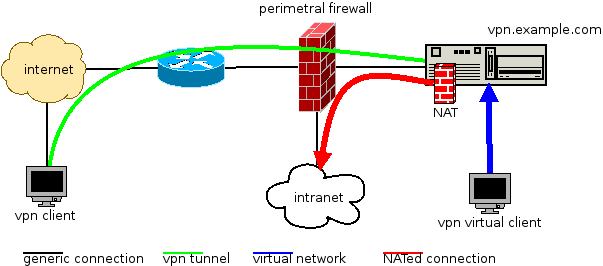
  1. clients connect via internet to our openvpn server, vpn.example.com
  2. the openvpn server validates the connection and the tunnel is established (green)
  3. now the client is virtually inside our network (blue)
  4. the client wants to access some intranet resource, the tunnel traffic is NATed (red)
Our datacenter intranet is using public IPv4 addressing, but the VPN tunnels use private IPv4 addresses. To don t mix public and private address NAT is used. Obviously we don t want to invest public IPv4 addresses in our internal tunnels. We don t have this limitations in IPv6, we could use public IPv6 addresses within the tunnels. But we prefer sticking to a hard dual stack IPv4/IPv6 approach and also use private IPv6 addresses inside the tunnels and also NAT the IPv6 from private to public. This way, there are no differences in how IPv4 and IPv6 network are managed. We follow this approach for the addressing: The NAT runs in the VPN server, since this is kind of a router. We use nftables for this task. As the final win, I will describe how we manage all this configuration using the git version control system. Using git we can track which admin made which change. A git hook will deploy the files from the git repo itself to /etc/ so the services can read them. The VPN server networking configuration is as follows (/etc/network/interfaces file, adjust to your network environments):
auto lo
iface lo inet loopback
# main public IPv4 address of vpn.example.com
allow-hotplug eth0
iface eth0 inet static
        address x.x.x.4
        netmask 255.255.255.0
        gateway x.x.x.1
# main public IPv6 address of vpn.example.com
iface eth0 inet6 static
        address x:x:x:x::4
        netmask 64
        gateway x:x:x:x::1
# NAT Public IPv4 addresses (used to NAT tunnel of client 1)
auto eth0:11
iface eth0:11 inet static
        address x.x.x.11
        netmask 255.255.255.0
# NAT Public IPv6 addresses (used to NAT tunnel of client 1)
iface eth0:11 inet6 static
        address x:x:x:x::11
        netmask 64
# NAT Public IPv4 addresses (used to NAT tunnel of client 2)
auto eth0:12
iface eth0:12 inet static
        address x.x.x.12
        netmask 255.255.255.0
# NAT Public IPv6 addresses (used to NAT tunnel of client 2)
iface eth0:12 inet6 static
        address x:x:x:x::12
        netmask 64
Thanks to the amazing and tireless work of the Alberto Gonzalez Iniesta (DD), the openvpn package in debian is in very good shape, ready to use. In vpn.example.com, install the required packages:
% sudo aptitude install openvpn openvpn-auth-ldap nftables git sudo
Two git repositories will be used, one for the openvpn configuration and another for nftables (the nftables config is described later):
% sudo mkdir -p /srv/git/vpn.example.com-nft.git
% sudo git init --bare /srv/git/vpn.example.com-nft.git
% sudo mkdir -p /srv/git/vpn.example.com-openvpn.git
% sudo git init --bare /srv/git/vpn.example.com-openvpn.git
% sudo chown -R :git /srv/git/*
% sudo chmod -R g+rw /srv/git/*
The repositories belong to the git group, a system group we create to let systems admins operate the server using git:
% sudo addgroup --system git
% sudo adduser admin1 git
% sudo adduser admin2 git
For the openvpn git repository, we need at least this git hook (file /srv/git/vpn.example.com-openvpn.git/hooks/post-receive with execution permission):
#!/bin/bash
NAME="hooks/post-receive"
OPENVPN_ROOT="/etc/openvpn"
export GIT_WORK_TREE="$OPENVPN_ROOT"
UNAME=$(uname -n)
info()
 
        echo "$ UNAME  $ NAME  $1 ..."
 
info "checkout latest data to $GIT_WORK_TREE"
sudo git checkout -f
info "cleaning untracked files and dirs at $GIT_WORK_TREE"
sudo git clean -f -d
For this hook to work, sudo permissions are required (file /etc/sudoers.d/openvpn-git):
User_Alias      OPERATORS = admin1, admin2
Defaults        env_keep += "GIT_WORK_TREE"
 
OPERATORS       ALL=(ALL) NOPASSWD:/usr/bin/git checkout -f
OPERATORS       ALL=(ALL) NOPASSWD:/usr/bin/git clean -f -d
Please review this sudoers file to match your environment and security requirements. The openvpn package deploys several systemd services:
% dpkg -L openvpn   grep service
/lib/systemd/system/openvpn-client@.service
/lib/systemd/system/openvpn-server@.service
/lib/systemd/system/openvpn.service
/lib/systemd/system/openvpn@.service
We don t need all of them, we can use the simple openvpn.service:
% sudo systemctl edit --full openvpn.service
And put a content like this:
% systemctl cat openvpn.service
# /etc/systemd/system/openvpn.service
[Unit]
Description=OpenVPN server
Documentation=man:openvpn(8)
Documentation=https://community.openvpn.net/openvpn/wiki/Openvpn23ManPage
Documentation=https://community.openvpn.net/openvpn/wiki/HOWTO
 
[Service]
PrivateTmp=true
KillMode=mixed
Type=forking
ExecStart=/usr/sbin/openvpn --daemon ovpn --status /run/openvpn/%i.status 10 --cd /etc/openvpn --config /etc/openvpn/server.conf --writepid /run/openvpn/server.pid
PIDFile=/run/openvpn/server.pid
ExecReload=/bin/kill -HUP $MAINPID
WorkingDirectory=/etc/openvpn
ProtectSystem=yes
CapabilityBoundingSet=CAP_IPC_LOCK CAP_NET_ADMIN CAP_NET_BIND_SERVICE CAP_NET_RAW CAP_SETGID CAP_SETUID CAP_SYS_CHROOT CAP_DAC_READ_SEARCH CAP_AUDIT_WRITE
LimitNPROC=10
DeviceAllow=/dev/null rw
DeviceAllow=/dev/net/tun rw
 
[Install]
WantedBy=multi-user.target
We can move on now to configure nftables to perform the NATs. First, it s good to load the NAT configuration at boot time, so you need a service file like this (/etc/systemd/system/nftables.service):
[Unit]
Description=nftables
Documentation=man:nft(8) http://wiki.nftables.org
 
[Service]
Type=oneshot
RemainAfterExit=yes
StandardInput=null
ProtectSystem=full
ProtectHome=true
WorkingDirectory=/etc/nftables.d
ExecStart=/usr/sbin/nft -f ruleset.nft
ExecReload=/usr/sbin/nft -f ruleset.nft
ExecStop=/usr/sbin/nft flush ruleset
 
[Install]
WantedBy=multi-user.target
The nftables git hooks are implemented as described in nftables managed with git. We are interested in the git hooks: (file /srv/git/vpn.example.com-nft.git/hooks/post-receive):
#!/bin/bash
NAME="hooks/post-receive"
NFT_ROOT="/etc/nftables.d"
RULESET="$ NFT_ROOT /ruleset.nft"
export GIT_WORK_TREE="$NFT_ROOT"
UNAME=$(uname -n)
info()
 
        echo "$ UNAME  $ NAME  $1 ..."
 
info "checkout latest data to $GIT_WORK_TREE"
sudo git checkout -f
info "cleaning untracked files and dirs at $GIT_WORK_TREE"
sudo git clean -f -d
info "deploying new ruleset"
set -e
cd $NFT_ROOT && sudo nft -f $RULESET
info "new ruleset deployment was OK"
This hook moves our nftables configuration to /etc/nftables.d and then applies it to the kernel. So a single commit changes the runtime configuration of the server. You could implement some QA using the git hook update, check this file! Remember, git hooks requires exec permissions to work. Of course, you will need again a sudo policy for these nft hooks. Finally, we can start configuring both openvpn and nftables using git. For the VPN you will require the configure the PKI side: server certificates, and the CA signing your client s certificates. You can check openvpn s own documentation about this. Your first commit for openvpn could be the server.conf file:
plugin		/usr/lib/openvpn/openvpn-plugin-auth-pam.so common-auth
mode		server
user		nobody
group		nogroup
port		1194
proto		udp6
daemon
comp-lzo
persist-key
persist-tun
tls-server
cert		/etc/ssl/private/vpn.example.com_pub.crt
key		/etc/ssl/private/vpn.example.com_priv.pem
ca		/etc/ssl/cacert/clients_ca.pem
dh		/etc/ssl/certs/dh2048.pem
cipher		AES-128-CBC
dev		tun
topology	subnet
server		192.168.100.0 255.255.255.0
server-ipv6	fd00:0:1:35::/64
ccd-exclusive
client-config-dir ccd
max-clients	100
inactive	43200
keepalive	10 360
log-append	/var/log/openvpn.log
status		/var/log/openvpn-status.log
status-version	1
verb		4
mute		20
Don t forget the ccd/ directory. This directory contains a file per user using the VPN service. Each file is named after the CN of the client certificate:
# private addresses for client 1
ifconfig-push		192.168.100.11 255.255.255.0
ifconfig-ipv6-push	fd00:0:1::11/64
# routes to the intranet network
push "route-ipv6 x:x:x:x::/64"
push "route x.x.3.128 255.255.255.240"
# private addresses for client 2
ifconfig-push		192.168.100.12 255.255.255.0
ifconfig-ipv6-push	fd00:0:1::12/64
# routes to the intranet network
push "route-ipv6 x:x:x:x::/64"
push "route x.x.3.128 255.255.255.240"
You end with at leats these files in the openvpn git tree:
server.conf
ccd/CN=CLIENT_1
ccd/CN=CLIENT_2
Please note that if you commit a change to ccd/, the changes are read at runtime by openvpn. In the other hand, changes to server.conf require you to restart the openvpn service by hand. Remember, the addressing is like this: Addressing (DIA source file) In the nftables git tree, you should put a ruleset like this (a single file named ruleset.nft is valid):
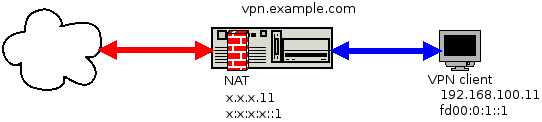
flush ruleset
table ip nat  
	map mapping_ipv4_snat  
		type ipv4_addr : ipv4_addr
		elements =  	192.168.100.11 : x.x.x.11,
				192.168.100.12 : x.x.x.12  
	 
	map mapping_ipv4_dnat  
		type ipv4_addr : ipv4_addr
		elements =  	x.x.x.11 : 192.168.100.11,
				x.x.x.12 : 192.168.100.12  
	 
	chain prerouting  
		type nat hook prerouting priority -100; policy accept;
		dnat to ip daddr map @mapping_ipv4_dnat
	 
	chain postrouting  
		type nat hook postrouting priority 100; policy accept;
		oifname "eth0" snat to ip saddr map @mapping_ipv4_snat
	 
 
table ip6 nat  
	map mapping_ipv6_snat  
		type ipv6_addr : ipv6_addr
		elements =  	fd00:0:1::11 : x:x:x::11,
				fd00:0:1::12 : x:x:x::12  
	 
	map mapping_ipv6_dnat  
		type ipv6_addr : ipv6_addr
		elements =  	x:x:x::11 : fd00:0:1::11,
				x:x:x::12 : fd00:0:1::12  
	 
	chain prerouting  
		type nat hook prerouting priority -100; policy accept;
		dnat to ip6 daddr map @mapping_ipv6_dnat
	 
	chain postrouting  
		type nat hook postrouting priority 100; policy accept;
		oifname "eth0" snat to ip6 saddr map @mapping_ipv6_snat
	 
 
table inet filter  
	chain forward  
		type filter hook forward priority 0; policy accept;
		# some forwarding filtering policy, if required, for both IPv4 and IPv6
	 
 
Since the server is in fact routing packets between the tunnel and the public network, we require forwarding enabled in sysctl:
net.ipv4.conf.all.forwarding = 1
net.ipv6.conf.all.forwarding = 1
Of course, the VPN clients will require a client.conf file which looks like this:
client
remote vpn.example.com 1194
dev tun
proto udp
resolv-retry infinite
comp-lzo
verb 5
nobind
persist-key
persist-tun
user nobody
group nogroup
 
tls-client
ca      /etc/ssl/cacert/server_ca.crt
pkcs12  /home/user/mycertificate.p12
verify-x509-name vpn.example.com name
cipher AES-128-CBC
auth-user-pass
auth-nocache
Workflow for the system admins:
  1. git clone the openvpn repo
  2. modify ccd/ and server.conf
  3. git commit the changes, push to the server
  4. if server.conf was modified, restart openvpn
  5. git clone the nftables repo
  6. modify ruleset
  7. git commit the changes, push to the server
Comments via email welcome!

6 April 2017

Norbert Preining: Planet Earth I From Pole to Pole

In preparation for watching the new Planet Earth II (BBC page, Wiki) by David Attenborough, I re-watched the original 2006 BBC Planet Earth, episode one, From Pole to Pole, fortunately it is now available on Netflix. I have forgotten how great it is. I was moved to tears. This is now 10 years old but still top of the technique, even compared to the new Cosmos series. The nature shots, often in slow motion, give spectacular views onto animals hardly seen in this way. Here is a male Superb bird of paradise posing in front of a female, making a very strange impression (bad screenshot, sorry). White sharks are dangerous, we all know, but did you know that they can actually fly? Well, not actually fly, but they can jump as far as completely leaving the sea: The first episode finishes in the Okavango Delta with elephants bathing in the sea. Here is a young club dancing under water. Deeply impressed, deeply moved. In light of anti-environmental anti-climate-change anti-intelligence comedian at the White House, more of us should actually see these great pieces of journalism, let it influence our thinking, and hopefully vote differently when it is our turn again.

4 April 2017

Matthias Klumpp: On Tanglu

It s time for a long-overdue blogpost about the status of Tanglu. Tanglu is a Debian derivative, started in early 2013 when the systemd debate at Debian was still hot. It was formed by a few people wanting to create a Debian derivative for workstations with a time-based release schedule using and showcasing new technologies (which include systemd, but also bundling systems and other things) and built in the open with a community using the similar infrastructure to Debian. Tanglu is designed explicitly to complement Debian and not to compete with it on all devices. Tanglu has achieved a lot of great things. We were the first Debian derivative to adopt systemd and with the help of our contributors we could kill a few nasty issues affecting it and Debian before it ended up becoming default in Debian Jessie. We also started to use the Calamares installer relatively early, bringing a modern installation experience additionally to the traditional debian-installer. We performed the usrmerge early, uncovering a few more issues which were fed back into Debian to be resolved (while workarounds were added to Tanglu). We also briefly explored switching from initramfs-tools to Dracut, but this release goal was dropped due to issues (but might be revived later). A lot of other less-impactful changes happened as well, borrowing a lot of useful ideas and code from Ubuntu (kudos to them!). On the infrastructure side, we set up the Debian Archive Kit (dak), managing to find a couple of issues (mostly hardcoded assumptions about Debian) and reporting them back to make using dak for distributions which aren t Debian easier. We explored using fedmsg for our infrastructure, went through a long and painful iteration of build systems (buildbot -> Jenkins -> Debile) before finally ending up with Debile, and added a set of own custom tools to collect archive QA information and present it to our developers in an easy to digest way. Except for wanna-build, Tanglu is hosting an almost-complete clone of basic Debian archive management tools. During the past year however, the project s progress slowed down significantly. For this, mostly I am to blame. One of the biggest challenges for a young project is to attract new developers and members and keep them engaged. A lot of the people coming to Tanglu and being interested in contributing were unfortunately no packagers and sometimes no developers, and we didn t have the manpower to individually mentor these people and teach them the necessary skills. People asking for tasks were usually asked where their interests were and what they would like to do to give them a useful task. This sounds great in principle, but in practice it is actually not very helpful. A curated list of junior jobs is a much better starting point. We also invested almost zero time in making our project known and create the necessary buzz and excitement that s actually needed to sustain a project like this. Doing more in the advertisement domain and help newcomers area is a high priority issue in the Tanglu bugtracker, which to the day is still open. Doing good alone isn t enough, talking about it is of crucial importance and that is something I knew about, but didn t realize the impact of for quite a while. As strange as it sounds, investing in the tech only isn t enough, community building is of equal importance. Regardless of that, Tanglu has members working on the project, but way too few to manage a project of this magnitude (getting package transitions migrated alone is a large task requiring quite some time while at the same time being incredibly boring :P). A lot of our current developers can only invest small amounts of time into the project because they have a lot of other projects as well. The other issue why Tanglu has problems is too much stuff being centralized on myself. That is a problem I wanted to rectify for a long time, but as soon as a task wasn t done in Tanglu because no people were available to do it, I completed it. This essentially increased the project s dependency on me as single person, giving it a really low bus factor. It not only centralizes power in one person (which actually isn t a problem as long as that person is available enough to perform tasks if asked for), it also centralizes knowledge on how to run services and how to do things. And if you want to give up power, people will need the knowledge on how to perform the specific task first (which they will never gain if there s always that one guy doing it). I still haven t found a great way to solve this it s a problem that essentially kills itself as soon as the project is big enough, but until then the only way to counter it slightly is to write lots of documentation. Last year I had way less time to work on Tanglu than the project deserves. I also started to work for Purism on their PureOS Debian derivative (which is heavily influenced by some of the choices we made for Tanglu, but with different focus that s probably something for another blogpost). A lot of the stuff I do for Purism duplicates the work I do on Tanglu, and also takes away time I have for the project. Additionally I need to invest a lot more time into other projects such as AppStream and a lot of random other stuff that just needs continuous maintenance and discussion (especially AppStream eats up a lot of time since it became really popular in a lot of places). There is also my MSc thesis in neuroscience that requires attention (and is actually in focus most of the time). All in all, I can t split myself and KDE s cloning machine remains broken, so I can t even use that ;-). In terms of projects there is also a personal hard limit of how much stuff I can handle, and exceeding it long-term is not very healthy, as in these cases I try to satisfy all projects and in the end do not focus enough on any of them, which makes me end up with a lot of half-baked stuff (which helps nobody, and most importantly makes me loose the fun, energy and interest to work on it). Good news everyone! (sort of) So, this sounded overly negative, so where does this leave Tanglu? Fact is, I can not commit the crazy amounts of time for it as I did in 2013. But, I love the project and I actually do have some time I can put into it. My work on Purism has an overlap with Tanglu, so Tanglu can actually benefit from the software I develop for them, maybe creating a synergy effect between PureOS and Tanglu. Tanglu is also important to me as a testing environment for future ideas (be it in infrastructure or in the make bundling nice! department). So, what actually is the way forward? First, maybe I have the chance to find a few people willing to work on tasks in Tanglu. It s a fun project, and I learned a lot while working on it. Tanglu also possesses some unique properties few other Debian derivatives have, like being built from source completely (allowing us things like swapping core components or compiling with more hardening flags, switching to newer KDE Plasma and GNOME faster, etc.). Second, if we do not have enough manpower, I think converting Tanglu into a rolling-release distribution might be the only viable way to keep the project running. A rolling release scheme creates much less effort for us than making releases (especially time-based ones!). That way, users will have a constantly updated and secure Tanglu system with machines doing most of the background work. If it turns out that absolutely nothing works and we can t attract new people to help with Tanglu, it would mean that there generally isn t much interest from the developer or user side in a project like this, so shutting it down or scaling it down dramatically would be the only option. But I do not think that this is the case, and I believe that having Tanglu around is important. I also have some interesting plans for it which will be fun to implement for testing  The only thing that had to stop is leaving our users in the dark on what is happening. Sorry for the long post, but there are some subjects which are worth writing more than 140 characters about  If you are interested in contributing to Tanglu, get in touch with us! We have an IRC channel #tanglu-devel on Freenode (go there for quicker responses!), forums and mailinglists, It looks like I will be at Debconf this year as well, so you can also catch me there! I might even talk about PureOS/Tanglu infrastructure at the conference.

3 April 2017

Markus Koschany: My Free Software Activities in March 2017

Welcome to gambaru.de. Here is my monthly report that covers what I have been doing for Debian. If you re interested in Android, Java, Games and LTS topics, this might be interesting for you. Debian Android Debian Games Debian Java Debian LTS This was my thirteenth month as a paid contributor and I have been paid to work 14,75 hours on Debian LTS, a project started by Rapha l Hertzog. In that time I did the following: Misc Thanks for reading and see you next time.
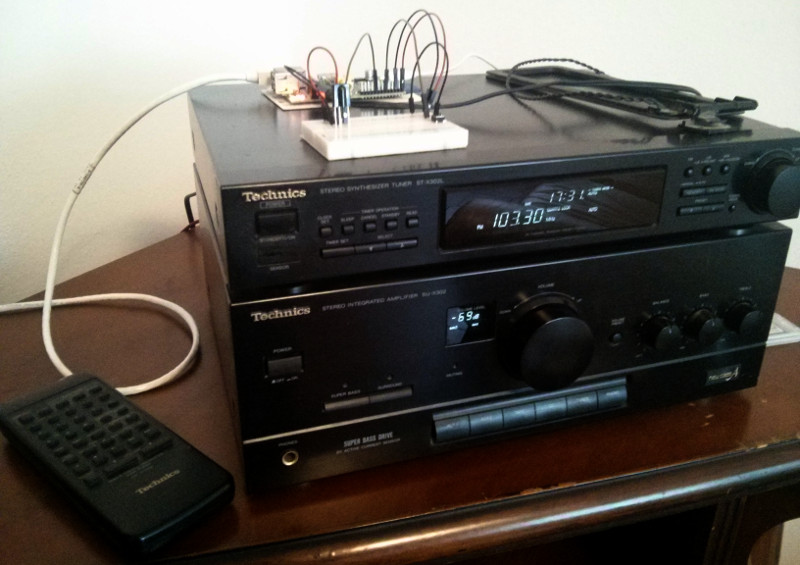
Jonas Meurer: debian lts report 2017.03

Debian LTS report for March 2017 March 2017 was my seventh month as a Debian LTS team member. I was allocated 14,75 hours and spent 11,25 of them on the following tasks:

1 April 2017

Antoine Beaupr : My free software activities, February and March 2017

Looking into self-financing Before I begin, I should mention that I started tracking my time working on free software more systematically. I spend a lot of time on the computer, as regular readers of this blog might remember so I wanted to know exactly how much time was paid vs free work. I was already using org-mode's time clock system to keep track of my work hours, so I just extended this to my regular free software contributions, which also helps in writing those reports. It turns out that over 60% of my computer time is spent working on free software. That's huge! I was expecting something more along the range of 20 to 40% of my time. So I started thinking about ways of financing this work. I created a Patreon page but I'm hesitant into launching such a campaign: the only thing worse than "no patreon page" is "a patreon page with failed goals and no one financing it". So before starting such an effort, I'd like to get a feeling of what other people's experience with it are. I know that joeyh is close to achieving his goals, but I can't compare with the guy that invented git-annex or debhelper, so I'm concerned I wouldn't be able to raise the same level of funding. So any advice you have, feel free to contact me in private or in the comments. If you would be ready to fund my work, I'd love to know about it, obviously, but I guess I wouldn't get real numbers until I actually open up such a page... Now, onto the regular report.

Wallabako I spent a good chunk of time completing most of the things I had in mind for Wallabako, which I mentioned quickly in the previous report. Wallabako is now much easier to installed, with clearer instructions, an easier to use configuration file, more reliable synchronization and read status propagation. As usual the Wallabako README file has all the details. I've also looked at better integration with Koreader, the free software e-reader that forms the basis of the okreader free software distribution which has been able to port Debian to the Kobo e-readers, a project I am really excited about. This project has the potential of supporting Kobo readers beyond the lifetime that upstream grants it and removes a lot of proprietary software and spyware that ships with the Kobo readers. So I have made a few contributions to okreader and also on koreader, the ebook reader okreader is based on.

Stressant I rewrote stressant, my simple burn-in and stress-testing tool. After struggling in turn with Debirf, live-build, vmdebootstrap and even FAI, I just figured maybe it wasn't the best idea to try and reinvent that particular wheel: instead of reinventing how to build yet another Debian system build tool, maybe I should just reuse what's already there. It turns out there's a well known, succesful and fairly complete recovery system called Grml. It is a Debian Derivative, so all I needed to do was to stop procrastinating and actually write the actual stressant tool instead of just creating a distribution with a bunch of random tools shipped in. This allowed me to focus on which tools were the best to stress test different components. This selection ended up being: fio can also be used to overwrite disk drives with the proper options (--overwrite and --size=100%), although grml also ships with nwipe for wiping old spinning disks and hdparm to do a secure erase of SSD disks (whatever that's worth). Stressant still needs to be shipped with grml for this transition to be complete. In the meantime, I was able to configure the excellent public Gitlab CI service to provide ISO images with Stressant built-in as a stopgap measure. I also need to figure out a way to automate starting stressant from a boot menu to automate deployments on a larger scale, although because I have little need for the feature at this moment in time, this will likely wait for a sponsor to show up for this to be implemented. Still, stressant has useful features like the capability of sending logs by email using a fresh new implementation of the Python SMTPHandler (BufferedSMTPHandler) which waits for logging to complete before sending a single email. Another interesting piece of code in there is the NegateAction argparse handler that enables the use of "toggle flags" (e.g. --flag / --no-flag). I'm so happy with the code that I figure I could just share it here directly:
class NegateAction(argparse.Action):
    '''add a toggle flag to argparse

    this is similar to 'store_true' or 'store_false', but allows
    arguments prefixed with --no to disable the default. the default
    is set depending on the first argument - if it starts with the
    negative form (define by default as '--no'), the default is False,
    otherwise True.
    '''
    negative = '--no'
    def __init__(self, option_strings, *args, **kwargs):
        '''set default depending on the first argument'''
        default = not option_strings[0].startswith(self.negative)
        super(NegateAction, self).__init__(option_strings, *args,
                                           default=default, nargs=0, **kwargs)
    def __call__(self, parser, ns, values, option):
        '''set the truth value depending on whether
        it starts with the negative form'''
        setattr(ns, self.dest, not option.startswith(self.negative))
Short and sweet. I wonder why stuff like this is not in the standard library yet - maybe just because no one bothered yet? It'd be great to get feedback of more experienced Pythonistas on this one. I hope that my work on Stressant is complete. I get zero funding for this work, and have little use for it myself: I manage only a few machines and such a tool really shines when you regularly put new hardware online, which is (fortunately?) not my case anymore. I'd be happy, of course, to accompany organisations and people that wish to further develop and use such a tool. A short demo of stressant as well as detailed description of how it works is of course available in its README file.

Standard third party repositories After looking at improvements for the grml repository instructions, I realized there was no real "best practices" document on how to configure an Apt repository. Sure, there are tools like reprepro and others, but those hardly qualify as policy: they are very flexible and there are lots of ways to create insecure repositories or curl sh style instructions, which we of course generally want to avoid. While the larger problem of Unstrusted Debian packages remain generally unsolved (e.g. when you install any .deb file, it can get root on your system), it seemed to me one critical part of this problem was how to add a random third-party repository to your machine while limiting, as much as possible, what possible attackers could do with such a repository. In other words, to solve the more general problem of insecure .deb files, we also need to solve the distribution problem, otherwise fixing the .deb files themselves will be useless. This lead to the creation of standardized repository instructions that define:
  1. how to distribute the repository's public signing key (ie. over HTTPS)
  2. how to name suites and components (e.g. use stable and main unless you have a good reason, and explain yourself)
  3. recommend a healthy does of apt preferences pinning
  4. how to distribute keys (e.g. with a derive-archive-keyring package)
I've seen so many third party repositories get this wrong. For example, a lot of repositories recommend this type of command to intialize the OpenPGP trust path:
curl http://example.com/key.asc   apt-key add -
This has the following problems:
  • the key is transfered in plaintext and can easily be manipulated by an active attacker (e.g. a router on your path to the server or a neighbor in a Wifi cafe)
  • the key is added to the main trust root, which allows the key to authentify as the real Debian archive, therefore giving it all rights over all packages
  • since it's part of the global archive, it's difficult for a package to remove/add the key when a key rollover is necessary (and repositories generally don't provide a deriv-archive-keyring to do that process anyways)
An example of this are the Docker install instructions that, at least, manage to do this over HTTPS. Some other repositories don't even bother teaching people about the proper way of adding those keys. We settled for:
wget -O /usr/share/keyrings/deriv-archive-keyring.gpg https://deriv.example.net/debian/deriv-archive-keyring.gpg
That location was explicitly chosen to be out of the main trust directory, so that it needs to be explicitly added to the sources.list as well:
deb [signed-by=/usr/share/keyrings/deriv-archive-keyring.gpg] https://deriv.example.net/debian/ stable main
Similarly, we highly recommend users setup "apt pinning" to restrict what a given repository can do. Since pinning is so confusing, most people don't actually bother even configuring it and I have yet to see a single repo advise its users to configure those preferences, which are essential to limit what a repository can do. To keep configuration simple, we recommend this:
Package: *
Pin: origin deriv.example.net
Pin-Priority: 100
Obviously, for a single-package repository, the actual package name should be listed, e.g.:
Package: foo
Pin: origin deriv.example.net
Pin-Priority: 100
And the priority should probably be set to 1 unless you want to allow automatic upgrades. It is my hope that this design will get more traction in the years to come and become a de-facto standard that will be a key part in safely adding third party repositories. There is obviously much more work to be done to improve security when installing untrusted .deb files, and I encourage Debian developers to consider contributing to the UntrustedDebs discussions and particularly to the Teams/Dpkg/Spec/DeclarativePackaging work.

Signal R&D I spent a significant amount of time this month struggling with the Signal project on my phone. I'm still ambivalent on Signal: it's a centralized designed, too dependent on phone numbers, but I must admit they get a lot of things right and it's the only free-software platform that allows for easy-to-use, multi-platform videoconferencing that my family can use. I've been following Signal for a while: up until now, I had been using the LibreSignal rebuild of the official client, as it is distributed on a F-Droid repository. Because I try to avoid Google (proprietary) software on my phone, it's basically the only way I could even install Signal. Unfortunately, the repository is out of date and introduces another point of trust in the distribution model: now you not only need to trust the Signal authors to do the right thing, you also need to trust that F-Droid repo not to inject nasty code on your phone. I've therefore started a discussion about how Signal could be distributed outside of the Google Play Store. I'd like to think it's one of the things that led the Signal people to distribute an official copy of Signal outside of the playstore. After much struggling, I was able to upgrade to this official client and will be able to upgrade easily by just downloading the APK. (Do note that I ended up reinstalling and re-registering Signal, which unfortunately changed my secret keys.) I do hope Signal enters F-Droid one day, but it could take a while because it still doesn't work without Google services and barely works with MicroG, the free software alternative to the Google services clients. Moxie also set a list of requirements like crash reporting and statistics that need to be implemented on F-Droid's side before he agrees to the deployment, so this could take a while. I've also participated in the, ahem, discussion on the JWZ blog regarding a supposed vulnerability in Signal where it would leak previously unknown phone numbers to third parties. I reviewed the way the phone number is uploaded and, while it's possible to create a rainbow table of phone numbers (which are hashed with a truncated SHA-1 checksum), I couldn't verify the claims of other participants in the thread. For me, Signal still does the right thing with contacts, although I do question the way "read status" notifications get transmitted, but that belong in another bug report / blog post.

Debian Long Term Support (LTS) It's been more than a year working on Debian LTS, started by Raphael Hertzog at Freexian. I didn't work much in February so I had a lot of hours to catchup with, and was unfortunately unable to do so, partly because I was busy with other projects, and partly because my colleagues are doing a great job at resolving the most important issues. So one my concerns this month was finding work. It seemed that all the hard packages were either taken (e.g. my usual favorites, tiff and imagemagick, we done by others) or just too challenging (e.g. I don't feel quite comfortable tackling the LTS branch of the Linux kernel yet). I spent quite a bit of time trying to figure out what was wrong with pcre3, only to realise the "32" in the report was not about the architecture, but about the character width. Because of thise, I marked 4 CVEs (CVE-2017-7186, CVE-2017-7244, CVE-2017-7245, CVE-2017-7246) as "not-affected", since the 32-bith character support wasn't enabled in wheezy (or jessie, for that matter). I still spent some time trying to reproduce the issues, which require a compiler with an AddressSanitizer, something that was introduced in both Clang and GCC after Wheezy was released, which makes reproducing this fairly complicated... This allowed me to experiment more with Vagrant, however, and I have provided the Debian cloud team with a 32-bit Vagrant box that was merged in shortly after, although it doesn't show up yet in the official list of Debian images. Then I looked at the apparmor situation (CVE-2017-6507), Debian bug #858768). That was one tricky bug as well, since it's not a security issue in apparmor per se, but more an issue with things that assume a certain behavior from apparmor. I have concluded that Wheezy was not affected because there are no assumptions of proper isolation there - which are provided only starting from LXC 1.0 - and Docker is not in Wheezy. I also couldn't reproduce the issue on Jessie, but, as it turns out, the issue was sysvinit-specific, which is why I couldn't reproduce it under the default systemd configuration shipped with Jessie. I also looked at the various binutils security issues: as I reported on the mailing list, I didn't see anything serious enough in there to warrant a a security release and followed the lead of both the stable and Red Hat security teams by marking this "no-dsa". I similiarly reviewed the mp3splt security issues (specifically CVE-2017-5666) and was fairly puzzled by that issue, which seems to be triggered only the same address sanitization extensions than PCRE, although there was some pretty wild interplay with debugging flags in there. All in all, it seems we can't reproduce that issue in wheezy, but I do not feel confident enough in the results to push that issue aside for now. I finally uploaded the pending graphicsmagick issue (DLA-547-2), a regression update to fix a crash that was introduced in the previous release (DLA-547-1, mistakenly named DLA-574-1). Hopefully that release should clear up some of the confusion and fix the regression. I also released DLA-879-1 for the CVE-2017-6369 in firebird2.5 which was an interesting experiment: I couldn't reproduce the issue in a local VM. After following the Ubuntu setup tutorial, as I wasn't too familiar with the Firebird database until now (hint: the default username and password is sysdba/masterkey), I ended up assuming we were vulnerable and just backporting the patch after seeing the jessie folks push out a release just in case. I also looked at updating the ca-certificates package to deal with the pending WoSign/Startcom removal: I made an explicit list of the CAs that need to be removed after reviewing the Mozilla list. I also sent a patch for an unrelated issue where ca-certificates is writing to /usr/local (!!) in Debian bug #843722. I have also done some "meta" work in starting a discussion about fixing the missing DLA links in the tracker, as you will notice all of the above links lead to nowhere. Thanks to pabs, there are now some links but unfortunately there are about 500 DLAs missing from the website. We also discussed ways to Debian bug #859123, something which is currently a manual process. This is now in the hands of the excellent webmaster team. I have also filed a few missing security bugs (Debian bug #859135, Debian bug #859136), partly because I wanted to help the security team. But it turned out that I felt the script needed some improvements, so I submitted a patch to improve the script so it is easier to run.

Other projects As usual, there's the usual mixed bags of chaos: More stuff on Github...

Enrico Zini: Stereo remote control

Wouldn't it be nice if I could use the hifi remote control to control mpd? It turns out many wishes can come true when one has a GPIO board. A friend of mine had a pile of IR receiver components in his stash and gave me one. It is labeled "38A 1424A", and the closest matching datasheet I found is this one. I wired the receiver with the control pin on GPIO port 24, and set up lirc by following roughly this guide. Hifi with shutdown button and IR receiver Enable lirc_rpi support I had to add these lines to /boot/config.txt to enable lirc_rpi support:
dtoverlay=lirc-rpi,gpio_in_pin=24,gpio_out_pin=22
dtparam=gpio_in_pull=up
At first I had missed configuration of the internal pull up resistor, and reception worked but was very, very poor. Then reboot. Install and configure lirc
apt install lirc
I added these lines to /etc/lirc/hardware.conf:
DRIVER="default"
DEVICE="/dev/lirc0"
MODULES="lirc_rpi"
Stopped lircd:
systemctl stop lirc
Tested that the receiver worked:
mode2 -d /dev/lirc0
Downloaded remote control codes for my hifi and put them in /etc/lirc/lircd.conf. Started lircd
systemctl start lirc
Tested that lirc could parse commands from my remote control:
$ irw
0000400405506035 00 CD_PAUSE RAK-SC304W
0000400405506035 01 CD_PAUSE RAK-SC304W
0000400405506035 02 CD_PAUSE RAK-SC304W
0000400405505005 00 CD_PLAY RAK-SC304W
0000400405505005 01 CD_PLAY RAK-SC304W
Interface lirc with mpd I made this simple lirc program and saved it in ~pi/.lircrc:
begin
     prog = irexec
     button = CD_NEXT
     config = mpc next
end
begin
     prog = irexec
     button = TAPE_FWD
     config = mpc next
end
begin
     prog = irexec
     button = TAPE_REW
     config = mpc prev
end
begin
     prog = irexec
     button = CD_PREV
     config = mpc prev
end
begin
     prog = irexec
     button = TAPE_PAUSE
     config = mpc pause
end
begin
     prog = irexec
     button = CD_PAUSE
     config = mpc pause
end
begin
     prog = irexec
     button = CD_PLAY
     config = mpc toggle
end
begin
     prog = debug
     button = TAPE_PLAY_RIGHT
     config = mpc toggle
end
Then wrote a systemd unit file to start irexec and saved it as /etc/systemd/system/mpd-irexec.service:
[Unit]
Description=Control mpd via lirc remote control
After=lirc mpd
[Service]
Type=simple
ExecStart=/usr/bin/irexec
Restart=always
User=pi
WorkingDirectory=~
[Install]
WantedBy=multi-user.target
Then systemctl start mpd-irexec to start irexec, and systemctl enable mpd-irexec to start irexec at boot. Profit! All of this was done by me, with almost no electronics training, following online tutorials for the hardware parts. To connect components I used a breadboard and female-male jumper leads, so I didn't have to solder, for which I have very little practice. Now the Raspberry Pi is so much a part of my hifi component that I can even control it with the hifi remote control. Given that I disconnected the CD and tape players, there are now at least 16 free buttons on the remote control that I can script however I like. Raspberry Pi closeup

Next.

Previous.