Search Results: "ean"

24 April 2020

Norbert Preining: (Working) Unison Sync between for Debian/Buster and Sid

Since many years I am a big big fan of Unison. It is a two-way synchronization tool, meaning that changes on both sides are carried over as long as there is no conflict. Unison is the bread and butter for keeping my computers (main desktop, laptop, server) in sync. There is only one problem with Unison it is extremely picky about with what kind of Unison on the other side it speaks: Even the very same version, compiled with a slightly different OCaml compiler version, already produces incompatibilities. And with me having to sync between Debian/Buster (my server) and Debian/sid (my other machines), this always ended in tears. But heyhoh! the pain is over! My solution up to now was to keep a Unison binary from Buster on my Sid system, and used that binary when syncing to Buster server, but the normal Unison binary when syncing between two sid computers. This created lots of pain, because, when using a incompatible Unison binary, already a simple connect without a sync trial messed up the state files and required a complete resync. And so it happened often that I used the wrong binary, and had to resync a few gigabyte, what a pain. The Debian maintainer is working with upstream to improve this rather unfortunate situation, so maybe this will change in the future, but I need a solution now. BTW, thanks a lot to the excellent work of the current maintainers, setting up the new package was a blaze and only needed a bit of adjustments for the changed layout of recent sources. Big kudos to the maintainers of unison!!! So I have ventured out to create my own Unison package for Debian. And what I mean for Debian/Buster and Debian/sid, so that they are compatible, by using the very same compiler and the very same source and the very same dependencies to build the binaries. Fortunately, the lessons learned from my KDE/Plasma updates for Debian helped, and with a bit of magic and the nice service from the openSUSE build service, I now have packages for Unison ready for Debian/Buster and Debian/sid that are compatible, and in addition also the latest version, not the 5 year old package that is currently Debian. So here it is, the Debian Unison repository, binaries of (currently) Unison 2.51.2 are available for both i386 and amd64: For Debian/Buster
deb http://download.opensuse.org/repositories/home:/npreining:/debian-unison/Debian_10  ./
For Debian/sid:
deb http://download.opensuse.org/repositories/home:/npreining:/debian-unison/Debian_Unstable  ./
To use this repository, you need to import my OBS key obs-npreining.asc, best put it as is into /etc/apt/trusted.gpg.d/obs-npreining.asc. The sources are available at the OBS project debian-unison. For those interested, I had to backport a few package to Buster to ensure that the builds agree: debhelper (because dh_dwz is buggy in Buster), dh-ocaml, findlib, lablgl, lablgtk2, labltk, and ocaml. These packages are available in the OBS debian-ocaml-backports repository, and are also apt accessible if necessary. I guess you can conjure up the correct line ;-). That s it. I can now forget about all the differences between versions and happily sync between Buster and sid. Enjoy.

23 April 2020

Evgeni Golov: Controlling roller shutters using a Shelly 2.5, ESPHome and Home Assistant

Our house has roller shutters on all windows and most of them have an electric motor to open and close them. The motors are Schellenberg shaft motors (not sure this is the right English term), that you can configure end positions for and then by applying current to the right pair of pins they move the shutters up and down until the current is removed or one of the endstops is reached. As the motors were installed over a long period of time, the attached control units varied in functionality: different ways to program open/close times, with and without battery for the clock/settings etc, but they all had something in common: no central management and pretty ugly. We decided to replace those control units with regular 2 gang light switches that match the other switches in the house. And as we didn't want to lose the automatic open/close timer, we had to add some smarts to it. Shelly 2.5 and ESPHome Say hello to Shelly 2.5! The Shelly 2.5 is an ESP8266 with two relays attached to it in a super tiny package you can hide in the wall behind a regular switch. Pretty nifty. It originally comes with a Mongoose OS based firmware and an own app, but ain't nobody needs that, especially nobody who wants to implement some crude logic. That said, the original firmware isn't bad. It has a no-cloud mode, a REST API and does support MQTT for integration into Home Assistant and others. My ESP firmware of choice is ESPHome, which you can flash easily onto a Shelly (no matter 1, 2 or 2.5) using a USB TTL adapter that provides 3.3V. Home Assistant has native ESPHome support with auto-discovery, which is much nicer than manually attaching things to MQTT topics. To get ESPHome compiled for the Shelly 2.5, we'll need a basic configuration like this:
esphome:
  name: shelly25
  platform: ESP8266
  board: modwifi
  arduino_version: 2.4.2
We're using board: modwifi as the Shelly 2.5 (and all other Shellys) has 2MB flash and the usually recommended esp01_1m would only use 1MB of that - otherwise the configurations are identical (see the PlatformIO entries for modwifi and esp01_1m). And arduino_version: 2.4.2 is what the Internet suggests is the most stable SDK version, and who will argue with the Internet?! Now an ESP8266 without network connection is boring, so we add a WiFi configuration:
wifi:
  ssid: !secret wifi_ssid
  password: !secret wifi_password
  power_save_mode: none
The !secret commands load the named variables from secrets.yaml. While testing, I found the network connection of the Shelly very unreliable, especially when placed inside the wall and thus having rather bad bad reception (-75dBm according to ESPHome). However, setting power_save_mode: none explicitly seems to have fixed this, even if NONE is supposed to be the default on ESP8266. At this point the Shelly has a working firmware and WiFi, but does not expose any of its features: no switches, no relays, no power meters. To fix that we first need to find out the GPIO pins all these are connected to. Thankfully we can basically copy paste the definition from the Tasmota (another open-source firmware for ESPs) template:
pin_led1: GPIO0
pin_button1: GPIO2
pin_relay1: GPIO4
pin_switch2n: GPIO5
pin_sda: GPIO12
pin_switch1n: GPIO13
pin_scl: GPIO14
pin_relay2: GPIO15
pin_ade7953: GPIO16
pin_temp: A0
If we place that into the substitutions section of the ESPHome config, we can use the names everywhere and don't have to remember the pin numbers. The configuration for the ADE7953 power sensor and the NTC temperature sensor are taken verbatim from the ESPHome documentation, so there is no need to repeat them here. The configuration for the switches and relays are also rather straight forward:
binary_sensor:
  - platform: gpio
    pin: $ pin_switch1n 
    name: "Switch #1"
    internal: true
    id: switch1
  - platform: gpio
    pin: $ pin_switch2n 
    name: "Switch #2"
    internal: true
    id: switch2
switch:
  - platform: gpio
    pin: $ pin_relay1 
    name: "Relay #1"
    internal: true
    id: relay1
    interlock: &interlock_group [relay1, relay2]
  - platform: gpio
    pin: $ pin_relay2 
    name: "Relay #2"
    internal: true
    id: relay2
    interlock: *interlock_group
All marked as internal: true, as we don't need them visible in Home Assistant. ESPHome and Schellenberg roller shutters Now that we have a working Shelly 2.5 with ESPHome, how do we control Schellenberg (and other) roller shutters with it? Well, first of all we need to connect the Up and Down wires of the shutter motor to the two relays of the Shelly. And if they would not be marked as internal: true, they would show up in Home Assistant and we would be able to flip them on and off, moving the shutters. But this would also mean that we need to flip them off each time after use, as while the motor knows when to stop and will do so, applying current to both wires at the same time produces rather interesting results. So instead of fiddling around with the relays directly, we define a time-based cover in our configuration:
cover:
  - platform: time_based
    name: "$ location  Rolladen"
    id: rolladen
    open_action:
      - switch.turn_on: relay2
    open_duration: $ open_duration 
    close_action:
      - switch.turn_on: relay1
    close_duration: $ close_duration 
    stop_action:
      - switch.turn_off: relay1
      - switch.turn_off: relay2
We use a time-based cover because that's the easiest thing that will also turn the relays off for us after the shutters have been opened/closed, as the motor does not "report" any state back. We could use the integrated power meter of the Shelly to turn off when the load falls under a threshold, but I was too lazy and this works just fine as it is. Next, let's add the physical switches to it. We could just add on_press automations to the binary GPIO sensors we configured for the two switch inputs the Shelly has. But if you have kids at home, you'll know that they like to press ALL THE THINGS and what could be better than a small kill-switch against small fingers?
switch:
  [ previous definitions go here ]
  - platform: template
    id: block_control
    name: "$ location  Block Control"
    optimistic: true
  - platform: template
    name: "Move UP"
    internal: true
    lambda:  -
      if (id(switch1).state && !id(block_control).state)  
        return true;
        else  
        return false;
       
    on_turn_on:
      then:
        cover.open: rolladen
    on_turn_off:
      then:
        cover.stop: rolladen
  - platform: template
    name: "Move DOWN"
    internal: true
    lambda:  -
      if (id(switch2).state && !id(block_control).state)  
        return true;
        else  
        return false;
       
    on_turn_on:
      then:
        cover.close: rolladen
    on_turn_off:
      then:
        cover.stop: rolladen
This adds three more template switches. The first one, "Block Control", is exposed to Home Assistant, has no lambda definition and is set to optimistic: true, which makes is basically a dumb switch that can be flipped at will and the only thing it does is storing the binary on/off state. The two others are almost identical. The name differs, obviously, and so does the on_turn_on automation (one triggers the cover to open, the other to close). And the really interesting part is the lambda that monitors one of the physical switches and if that is turned on, plus "Block Control" is off, reports the switch as turned on, thus triggering the automation. With this we can now block the physical switches via Home Assistant, while still being able to control the shutters via the same. All this (and a bit more) can be found in my esphome-configs repository on GitHub, enjoy!

22 April 2020

Jonathan Dowland: SUPERHOT

Continuing a series of blog posts about casual Nintendo Switch games, next in the series is SUPERHOT. Normally 19.99, I picked it up for 13.99 in a sale. That's a little bit more than I would usually pay for a casual game. SUPERHOT first came on my radar because someone I know from a baby group worked on their VR port in some capacity.
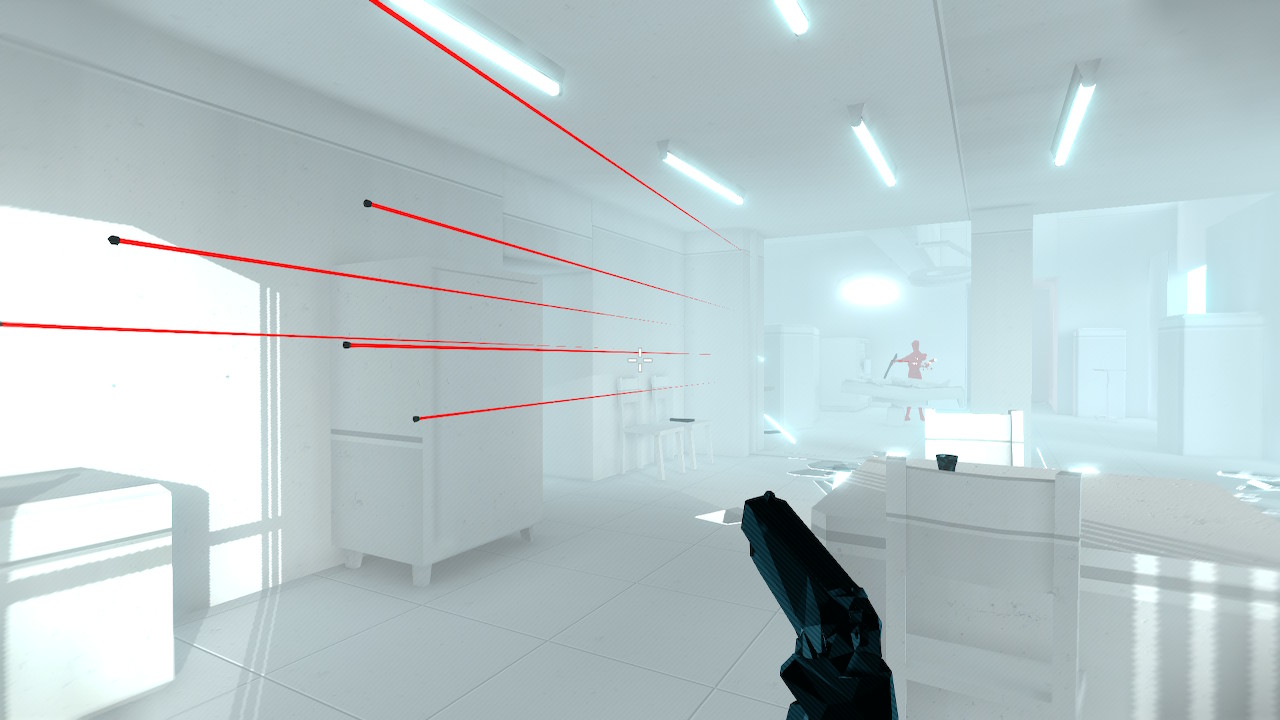
Slow-motion buckshot Slow-motion buckshot
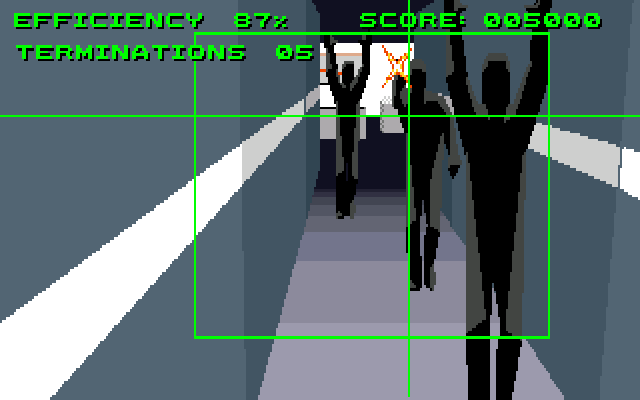
A first-person shooter, SUPERHOT's USP is that time only progresses when you move well, nearly. Time is slowed to a complete crawl when you are not moving. The game's visual style is very distinctive: Almost everything is a washed out grey or white colour and porcelean-like texture, except weapons and objects you can interact with, which are a matt black, and enemies, which are a bright red. It reminds me a lot of the 1992 Amiga game Robocop 3.
Robocop 3 Robocop 3
The play-style is very reminiscent of the "Bullet Time" sequences in The Matrix seemingly impossibly overwhelming odds deftly manoeuvred through thanks to superhuman reaction times. The game has a relatively short campaign of little vignettes, linked together by a cyberpunk narrative. The game is sometimes criticised for the short campaign, but for me that's ideal. And the vignettes being short and quite standalone suits my play requirements very well.
Amiga easter-egg Amiga easter-egg
The narrative interspersed between the play scenarios is a little bit over-long, and you can spend an unreasonable amount of time bashing buttons to get through it. Despite that it's a moderately interesting story. Once you've beaten the campaign, you can go back and play any of the scenarios again, or try the newly unlocked endless mode. I haven't tried that yet. The original prototype for the game is a free-to-play in-browser demo, available here. On Windows PC, there's a sequel-of-sorts in the works called MIND CONTROL DELETE with a lot of new features to add replay value.

21 April 2020

Matthew Garrett: Linux kernel lockdown, integrity, and confidentiality

The Linux kernel lockdown patches were merged into the 5.4 kernel last year, which means they're now part of multiple distributions. For me this was a 7-year journey, which means it's easy to forget that others aren't as invested in the code as I am. Here's what these patches are intended to achieve, why they're implemented in the current form and what people should take into account when deploying the feature.

Root is a user - a privileged user, but nevertheless a user. Root is not identical to the kernel. Processes running as root still can't dereference addresses that belong to the kernel, are still subject to the whims of the scheduler and so on. But historically that boundary has been very porous. Various interfaces make it straightforward for root to modify kernel code (such as loading modules or using /dev/mem), while others make it less straightforward (being able to load new ACPI tables that can cause the ACPI interpreter to overwrite the kernel, for instance). In the past that wasn't seen as a significant issue, since there were no widely deployed mechanisms for verifying the integrity of the kernel in the first place. But once UEFI secure boot became widely deployed, this was a problem. If you verify your boot chain but allow root to modify that kernel, the benefits of the verified boot chain are significantly reduced. Even if root can't modify the on-disk kernel, root can just hot-patch the kernel and then make this persistent by dropping a binary that repeats the process on system boot.

Lockdown is intended as a mechanism to avoid that, by providing an optional policy that closes off interfaces that allow root to modify the kernel. This was the sole purpose of the original implementation, which maps to the "integrity" mode that's present in the current implementation. Kernels that boot in lockdown integrity mode prevent even root from using these interfaces, increasing assurances that the running kernel corresponds to the booted kernel. But lockdown's functionality has been extended since then. There are some use cases where preventing root from being able to modify the kernel isn't enough - the kernel may hold secret information that even root shouldn't be permitted to see (such as the EVM signing key that can be used to prevent offline file modification), and the integrity mode doesn't prevent that. This is where lockdown's confidentiality mode comes in. Confidentiality mode is a superset of integrity mode, with additional restrictions on root's ability to use features that would allow the inspection of any kernel memory that could contain secrets.

Unfortunately right now we don't have strong mechanisms for marking which bits of kernel memory contain secrets, so in order to achieve that we end up blocking access to all kernel memory. Unsurprisingly, this compromises people's ability to inspect the kernel for entirely legitimate reasons, such as using the various mechanisms that allow tracing and probing of the kernel.

How can we solve this? There's a few ways:
  1. Introduce a mechanism to tag memory containing secrets, and only restrict accesses to this. I've tried to do something similar for userland and it turns out to be hard, but this is probably the best long-term solution.
  2. Add support for privileged applications with an appropriate signature that implement policy on the userland side. This is actually possible already, though not straightforward. Lockdown is implemented in the LSM layer, which means the policy can be imposed using any other existing LSM. As an example, we could use SELinux to impose the confidentiality restrictions on most processes but permit processes with a specific SELinux context to use them, and then use EVM to ensure that any process running in that context has a legitimate signature. This is quite a few hoops for a general purpose distribution to jump through.
  3. Don't use confidentiality mode in general purpose distributions. The attacks it protects against are mostly against special-purpose use cases, and they can enable it themselves.

My recommendation is for (3), and I'd encourage general purpose distributions that enable lockdown to do so only in integrity mode rather than confidentiality mode. The cost of confidentiality mode is just too high compared to the benefits it provides. People who need confidentiality mode probably already know that they do, and should be in a position to enable it themselves and handle the consequences.

comment count unavailable comments

Debian Project Leader: Bits from the new DPL

My fellow Debianites, It's been one month, one week and one day since I decided to run for this DPL term. The Debian community has been through a variety of interesting times during the last decade, and instead of focusing on grand, sweeping changes for Debian, core to my DPL campaign was to establish a sense of normality and stability so that we can work on community building, continue to focus on technical excellence and serve our users the best we can. Thing don't always work out as we plan, and for many of us, Debian recently had to take a back seat to personal priorities. Back when I posted my intention to run, there were 125 260 confirmed cases of COVID-19 globally. Today, that number is 20 times higher, with the actual infected number likely to be significantly higher. A large number of us are under lock-down, where we not only fear the disease and its effect on local hospitals and how it will affect our loved ones, but also our very livelihoods and the future of our local businesses and industry. I don't mean to be gloomy with the statement above, I am after all, an optimist - but unfortunately it does get even worse. Governments and corporations around the world have started to take advantage of COVID-19 in negative ways and are making large sweeping changes that undermine the privacy and rights of individuals everywhere. For many reasons, including those above, I believe that the Debian project is more important and relevant now than it's ever been before. The world needs a free, general purpose operating system, unburdened by the needs of profit, which puts the needs of its users first, providing a safe and secure platform for the computing needs of the masses. While we can't control or fix all the problems in the world, we can control our response to it, and be part of the solutions that bring the change we want to see. During my term as DPL, I will be available to help with problems in our community to the maximum extent that my time permits. If we help ourselves, we will be in a better position to help others. If you (or your team) get stuck and are in need of help, then please do not hessitate to e-mail me. A few thank-yous As incoming DPL, I'd like to thank Sam Hartman on behalf of the project for the work that he's done over the last year as DPL. It's a tremendous time commitment that requires constant attention to detail. On Sunday, Sam and I had a handover meeting where we discussed various DPL responsibilities including finances, delegations (including specifics of some delegations), legal matters, outreach and other questions I had. I'd also like to thank Sam for taking the time to do this. Thank you to Sruthi Chadran and Brian Gupta who took the time to also run for DPL this year. Both candidates brought important issues to the forefront and I hope to work with both of them on those in the near future. DPL Blog Today, I've started a new blog for the Debian Project Leader to help facilitate more frequent communication, and to reach a wider audience via Planet Debian. This will contain supplemental information to what I send to the debian-devel-announce mailing list. Want to help? In my platform, I listed some key areas that I'd like to work on. My work won't be limited to those, but it should give you some idea of the type of DPL that I'll be. If you'd like to get involved, feel free to join the #debian-dpl channel on the oftc IRC network, and please introduce yourself along with any areas of interest that you'd like to contribute to.

Wouter Verhelst: Extrepo GitLab update

Earlier this month, GitLab B.V.'s package signing key expired, requiring them to rotate their key. This means that anyone who uses one of their packages needs to jump through a number of manual hoops to update their apt key configuration, which is an annoying manual process that also requires people to download random files from the Internet -- something extrepo was written to prevent. At least they're served over https, but still. I didn't notice until today, but I just updated the extrepo metadata to carry the new key. That means that if you enable one of the GitLab repositories through extrepo enable, you will get the new key rather than the old one. On top of that, if you had already enabled the repository through extrepo, all that is needed for you right now to pull in the new key is to run extrepo update. While I do apologise for the late update, hopefully this should make some people's lives a bit easier. And if GitLab B.V. reads this: please send me a MR to the repository next time, so that we can make process be done in time ;-)

19 April 2020

Russ Allbery: Review: Beyond the Galaxy

Review: Beyond the Galaxy, by Ethan Siegel
Publisher: World Scientific
Copyright: 2016
ISBN: 981-4667-16-1
Format: Kindle
Pages: 370
In the preface of this book, Ethan Siegel recounts his experience as a new college professor in 2009, thrilled to learn that he would be teaching the college's introductory astronomy class. The only disappointment was that he could not find a textbook that described astronomy the way that he wanted to teach it. Siegel did not want to simply describe the current astronomical understanding. He wanted to start at the beginning and tell a story. What questions did we start with? How did we answer them? What new questions did those answers provoke? I enjoyed Sabine Hossenfelder's Lost in Math, but I'm even happier that she included in it a recommendation of Beyond the Galaxy as a good introduction to modern astronomy. I am completely in agreement with Siegel: Astronomy is interesting however it is described, but the best presentation for the interested lay person who does not intend to become a professional astronomy is chronological. (I feel the same way about physics and mathematics.) The narrative structure of scientific discovery draws me in every time. It's so satisfying to see our knowledge growing, breakthrough by breakthrough, only to meet the next puzzling inconsistency. It also is a natural fit for bringing someone up to speed on a field, since the history of the field starts with simpler questions and problems, and the complications of later discoveries build on the gaps left by earlier theories. Siegel tells that story well. Beyond the Galaxy starts with observations of seasonal changes in the path of the Sun through the sky and phases of the moon, quickly moves on to Eratosthenes's calculation of the circumference of the Earth, and continues at pace through early astronomy. The first chapter brings the reader up to the start of the 20th century, after which Siegel slows down and spends the remaining 10 chapters on the last 100 years: special and general relativity, the expansion of the universe, the Big Bang, dark matter, dark energy, the inflationary period, and more. For me, this was perfect. The story of early astronomy and the fight over the heliocentric model of the universe is worth telling, but it's been told many times before and features prominently in history books outside of science classes. The weight of material in this book matched my interest: What new developments have there been after general relativity and the Big Bang theory? What inconsistencies are dark matter and dark energy explaining? What is the inflationary period and how did it modify the Big Bang theory? (My half-formed impression of this part of astronomy from news articles turned out to be almost entirely wrong.) And how do we know all of this? The question of how we know as much as we do about the early origins of the universe turned out to be far more interesting than I had realized. It's one of those pieces of science where, when given only the conclusions, it's hard to imagine how our theories could be as complete as they are. Siegel is a bit repetitive in how he talks about theory development and occasionally skims over the details to avoid getting too deep into techniques and math, but he does a great job explaining the predictions of a theory, the design of experiments to prove or disprove those predictions, and the implications for the boundaries of what we know. This is the first time someone has explained the theorized origin of matter-antimatter asymmetry in sufficient detail that I was able to understand and internalize it. Dark matter and dark energy are the current topics of astronomy that get the most press, and the coverage of both is very good here. I was particularly fascinated by the link between dark matter and the superstructures of the universe that we've discovered. Astronomy does scale in a way that no other science can manage, and the scale of structure we've discovered and been able to map has gone up considerably since the last time I refreshed my astronomical knowledge. If you're looking for a math-light, comprehensive introduction to modern astronomy, I can wholeheartedly recommend this book. That goes double if you, like me, prefer a chronological view of scientific discovery so that you can understand what questions people were trying to answer and how our understanding changed over time. One note on format: Astronomy being what it is, this book is very heavy on pictures. It is not at all suitable for a dedicated ebook reader. The Kindle tries, but the combination of a small screen and black and white e-ink fail miserably. I switched to reading on a tablet, and that was a far better experience. The Kindle app still struggles to put the figures next to the text that discusses them, but that's a typesetting problem that I often have with physical books as well. If you don't have a tablet and you aren't willing to read on a computer screen, you probably want a physical copy of this one (which, sadly, means academic textbook pricing). Rating: 8 out of 10

17 April 2020

Julien Danjou: Being in Charge

Being in ChargeIf you never heard of the 10x engineer myth, it's a pretty great concept. It boils down to the idea where an engineer could be 10x more efficient than a random engineer. I find this fantastically twisted.Last week, I sat and chat with Alexis Monville in Le Podcast a podcast that equips you to make positive change in your organization. We talked about that 10x Engineer myth, and from there we digressed on how to grow your career and handle the different aspects of it.This was a very interesting exchange. Alexis is actually going to publish a new book next month (May 2020) entitled I am a Software Engineer and I am in charge.
Being in Charge
Lucky me, this week, I had the chance to be able to read the book before everybody else which means I actually read after our recording. I understood why Alexis said that a lot of what I was talking about during our podcast resonated with him. I send a detailed review of the book to Alexis and Michael if you're curious. I'm definitely recommending this book if you want to stop complaining about your job and start understanding how to pull the strings.I wish I had this book available 10 years ago!

Daniel Kahn Gillmor: Tech-assisted Contact-Tracing against the COVID-19 pandemic

Today at the ACLU, we released a whitepaper discussing how to evaluate some novel cryptographic schemes that are being considered to provide technology-assisted contact-tracing in the face of the COVID-19 pandemic. The document offers guidelines for thinking about potential schemes like this, and what kinds of safeguards we need to expect and demand from these systems so that we might try to address the (hopefully temporary) crisis of the pandemic without also creating a permanent crisis for civil liberties. The proposals that we're seeing (including PACT, DP^3T, TCN, and the Apple/Google proposal) work in pretty similar ways, and the challenges and tradeoffs there are remarkably similar to Internet protocol design decisions. Only now in addition to bytes and packets and questions of efficiency, privacy, and control, we're also dealing directly with risk of physical harm (who gets sick?), society-wide allocation of scarce and critical resources (who gets tested? who gets treatment?), and potentially serious means of exercising powerful social control (who gets forced into quarantine?). My ACLU colleague Jon Callas and i will be doing a Reddit AMA in r/Coronavirus tomorrow starting at 2020-04-17T19:00:00Z (that's 3pm Friday in TZ=America/New_York) about this very topic, if that's the kind of thing you're into.

16 April 2020

Raphaël Hertzog: Freexian s report about Debian Long Term Support, March 2020

A Debian LTS logo Like each month, here comes a report about the work of paid contributors to Debian LTS. Individual reports In March, 252 work hours have been dispatched among 14 paid contributors. Their reports are available: Evolution of the situation March was a strange month for many people all over the globe. Here we ll just express our hopes that you are and will be well! LTS gained a new contributor in March, Anton Gladky, however he then decided to become active later this year. Similarly Hugo Lefeuvre notified us that he ll be inactive in April. In case you missed it (or missed to act), please read this post about keeping Debian 8 Jessie alive for longer than 5 years. If you expect to have Debian 8 servers/devices running after June 30th 2020, and would like to have security updates for them, please get in touch with Freexian. Hurry up: the end of Jessie LTS is coming in less than three months! The security tracker currently lists 25 packages with a known CVE and the dla-needed.txt file has 23 packages needing an update. Thanks to our sponsors New sponsors are in bold.

No comment Liked this article? Click here. My blog is Flattr-enabled.

14 April 2020

Emmanuel Kasper: Recommended keyboard settings for Productivity and Usability, for European Programmers

TLDR: setxkbmap -layout us -variant altgr-intl and become a happier programmer.
The case for QWERTY for European ProgrammersIf you re working on Unix / Linux, or C based programming languages, it can make sense to switch to the qwerty(us) keyboard layout. Why ?
Unix, C, Perl, Java, and most of programming languages have been conceived on QWERTY keyboards.
So when the designers choose special characters to use for the language synthax, they simply choose what was easy to access on their own keyboard. This has been historically documented for the vi editor.

To give an example, using an Unix shell you have to type the dot . and slash / symbols quite often to navigate the filesystem. The two keys producing these symbols, are nicely aligned on a QWERTY layout and do not require a key combination to be entered. So you can quickly enter something like ../.. using a single hand.
Now using a QWERTZ layout, like in Germany / Austria, you have the . symbol easily accessible, but you need to combine two keys ( Shift + 7 ) to get a / .
And if you are a poor soul using an AZERTY layout, to get the . and / symbol you need each time a key combo.
The need of key combos is bad not only for speed (multiple keys to lookup) but also for usability, as you have to stretch your fingers to reach the key if using a single hand, provoking repetitive strain injury. You might be smiling but this is commonly known amongst Emacs Users, due to the prominent use of commands using Ctrl and Alt combos, and led to the creation of an Emacs Ergonomic wiki.

This goes as well for many symbol commonly used in programming languages, think for instance about the semicolon ; for terminating a statement, the [ , and ] symbols for defining an array, and the backslash \ for escaping.
All these keys are accessible via a single keypress on qwerty and require key combos on qwertz and azerty. No wonder Linux, Minix and BSD were invented on non-azerty layouts: in France we were still busy typing the path to the source code, when in other parts of the world people already had the file open in their editor.
You don t need to throw away your existing keyboards when learning the qwerty (us) layout: for a couple of euros, you can find on ebay alternate keys stickers to put on your laptop.
Accessing keys with diacritics with the AltGr International variantNow if you want to switch to a qwerty keyboard layout, and you re French or German, you might wonder how to access the characters with diacritics, the and of French and and of German.
Fortunately there is a very clever keyboard variant for the us layout who uses the AltGr key, to make all these keys accessible, just hiding them behind the AltGr key.
Need ? that s just AltGr + e away. Needs ? That s just AltGr + , Needs ? AltGr +p
See the coolness of that ? You can type all international diacritics in an easy way, and there are even keyboard stickers for that too.

Now how to access to this layout of wonder ?
You can configure the layout and variant in Xorg, in debian/ubuntu that would be entering in /etc/default/keyboard
XKBLAYOUT="us"
XKBVARIANT="altgr-intl"
After restarting the X server, you can check that the settings have been applied with
setxkbmap -print -verbose 10
If using Gnome, you can also set the keyboard layout and variant by changing the schema org.gnome.desktop-inputsources, which will override the desktop-agnostic settings of /etc/default/keyboard.
For this you can either call
dconf write /org/gnome/desktop/input-sources/sources "[('xkb', 'us+altgr-intl')]"
or navigate with the gui tool dconf-settings to org.gnome.desktop-inputsources and set the value there.

If you want to further improve your keyboard layout, you can also have a look at swapping Ctrl and Alt, as described here (French language article) Happy hacking !

13 April 2020

Giovanni Mascellani: DKIM for Debian Developers

What is DKIM? DKIM (DomainKeys Identified Mail), as Wikipedia puts it, "is an email authentication method designed to detect forged sender addresses in emails (email spoofing), a technique often used in phishing and email spam". More prosaically, one of the reasons email spam is so abundant is that, given a certain email message, there is no simple way to know for certain who sent it and how reputable they are. So even if people having addresses @debian.org are very nice and well-behaving, any random spammer can easily send emails from whatever@debian.org, and even if you trust people from @debian.org you cannot easily configure your antispam filter to just accept all emails from @debian.org, because spammers would get in too. Since nearly ten years DKIM is there to help you. If you send an email from @debian.org with DKIM, it will have a header like this:
DKIM-Signature: v=1; a=rsa-sha256; c=simple/simple; d=debian.org;
    s=vps.gio.user; t=1586779391;
    bh=B6tckJy2cynGjNRdm3lhFDrp0tD7fF8hS4x0FCfLADo=;
    h=From:Subject:To:Date:From;
    b=H4EDlATxVm7XNqPy2x7IqCchBUz1SxFtUSstB23BAsdyTKJIohM0O4RRWhrQX+pqE
     prPVhzcfNALMwlfExNE69940Q6pMCuYsoxNQjU7Jl/UX1q6PGqdVSO+mKv/aEI+N49
     vvYNgPJNLaAFnYqbWCPI8mNskLHLe2VFYjSjE4GJFOxl9o2Gpe9f5035FYPJ/hnqBF
     XPnZq7Osd9UtBrBq8agEooTCZHbNFSyiXdS0qp1ts7HAo/rfrBfbQSk39fOOQ5GbjV
     6FehkN4GAXFNoFnjfmjrVDJC6hvA8m0tJHbmZrNQS0ljG/SyffW4OTlzFzu4jOmDNi
     UHLnEgT07eucw==
The field d=debian.org is the domain this email claims to be from and the fields bh= and b= are a cryptographic public key signature certifying this fact. How do I check that the email is actually from @debian.org? I use the selector s=vps.gio.user to fetch the public key via DNS, and then use the public key to verify the signature.
$ host -t TXT vps.gio.user._domainkey.debian.org
vps.gio.user._domainkey.debian.org descriptive text "v=DKIM1; k=rsa; s=email; h=sha256; p=" "MIIBIjANBgkqhkiG9w0BAQEFAAOCAQ8AMIIBCgKCAQEAsM/W/kxtKWT58Eak0cfm/ntvurfbkkvugrG2jfvSMnHHkFyfJ34Xvn/HhQPLwX1QsjhuLV+tW+BQtxY7jxSABCee6nHQRBrpDej1t86ubw3CSrxcg1mzJI5BbL8un0cwYoBtUvhCYAZKarv1W2otCGs43L0s" "GtEqqtmYN/hIVVm4FcqeYS1cYrZxDsjPzCEocpYBhqHh1MTeUEddVmPHKZswzvllaWF0mgIXrfDNAE0LiX39aFKWtgvflrYFKiL4hCDnBcP2Mr71TVblfDY0wEdAEbGEJqHR1SxvWyn0UU1ZL4vTcylB/KJuV2gMhznOjbnQ6cjAhr2JYpweTYzz3wIDAQAB"
There it is! Debian declares in its DNS record that that key is authorized to sign outbound email from @debian.org. The spammer hopefully does not have access to Debian's DKIM keys, and they cannot sign emails. Many large and small email services have already deployed DKIM since years, while most @debian.org emails still do not use it. Why not? Because people send @debian.org emails from many different servers. Basically, every DD used their @debian.org address sends email from their own mail server, and those mail servers (fortunately) do not have access to Debian's DNS record to install their DKIM keys. Well, that was true until yesterday! :-) A few weeks ago I poked DSA asking to allow any Debian Developer to install their DKIM keys, so that DDs could use DKIM to sign their emails and hopefully reduce the amount of spam sent from @debian.org. They have done it (thank you DSA very much, especially adsb), and now it is possible to use it! How do I configure it? I will not write here a full DKIM tutorial, there are many around. You have to use opendkim-genkey to generate a key and then configure your mail server to use opendkim to digitally sign outbound email. There are a few Debian-specific things you have to care about, though. First the have to choose a selector, which is a string used to distinguish many DKIM keys belonging to the same domain. Debian allows you to installa a key whose selector is <something>.<uid>.user, where <uid> is your Debian uid (this is done both for namespacing reasons and for exposing who might be abusing the system). So check carefully that your selector has this form. Then you cannot edit directly Debian's DNS record. But you can use the email-LDAP gateway on db.debian.org to install your key in a way similar to how entries in debian.net are handled (see the updated documentation). Specifically, suppose that opendkim-genkey generated the following thing for selector vps.gio.user and domain debian.org:
vps.gio.user._domainkey IN  TXT ( "v=DKIM1; h=sha256; k=rsa; "
      "p=MIIBIjANBgkqhkiG9w0BAQEFAAOCAQ8AMIIBCgKCAQEAsM/W/kxtKWT58Eak0cfm/ntvurfbkkvugrG2jfvSMnHHkFyfJ34Xvn/HhQPLwX1QsjhuLV+tW+BQtxY7jxSABCee6nHQRBrpDej1t86ubw3CSrxcg1mzJI5BbL8un0cwYoBtUvhCYAZKarv1W2otCGs43L0sGtEqqtmYN/hIVVm4FcqeYS1cYrZxDsjPzCEocpYBhqHh1MTeUE"
      "ddVmPHKZswzvllaWF0mgIXrfDNAE0LiX39aFKWtgvflrYFKiL4hCDnBcP2Mr71TVblfDY0wEdAEbGEJqHR1SxvWyn0UU1ZL4vTcylB/KJuV2gMhznOjbnQ6cjAhr2JYpweTYzz3wIDAQAB" )  ; ----- DKIM key vps.gio.user for debian.org
Then you have to carefully copy the content of the p= field (without being fooled by it being split between different strings) and construct a request of the form:
dkimPubKey: vps.gio.user MIIBIjANBgkqhkiG9w0BAQEFAAOCAQ8AMIIBCgKCAQEAsM/W/kxtKWT58Eak0cfm/ntvurfbkkvugrG2jfvSMnHHkFyfJ34Xvn/HhQPLwX1QsjhuLV+tW+BQtxY7jxSABCee6nHQRBrpDej1t86ubw3CSrxcg1mzJI5BbL8un0cwYoBtUvhCYAZKarv1W2otCGs43L0sGtEqqtmYN/hIVVm4FcqeYS1cYrZxDsjPzCEocpYBhqHh1MTeUEddVmPHKZswzvllaWF0mgIXrfDNAE0LiX39aFKWtgvflrYFKiL4hCDnBcP2Mr71TVblfDY0wEdAEbGEJqHR1SxvWyn0UU1ZL4vTcylB/KJuV2gMhznOjbnQ6cjAhr2JYpweTYzz3wIDAQAB
and then send it GPG-signed to changes@db.debian.org:
echo 'dkimPubKey: vps.gio.user blahblahblah'   gpg --clearsign   mail changes@db.debian.org
Then use host -t TXT vps.gio.user._domainkey.debian.org to chech the key gets published (it will probably take some minutes/hours, I don't know). Once it is published, you can enable DKIM in you mail server and your email will be signed. Congratulations, you will not look like a spammer any more! You can send an email to check-auth@verifier.port25.com to check that your setup is correct. They will reply with a report, including the success of DKIM test. Notice that currently Debian's setup only allows you to use RSA DKIM keys and doesn't allow you to set other DKIM fields (but you probably won't need to set them). EDIT DSA made an official announcement about DKIM support, which you might want to check out as well, together with its links. EDIT 2 Now ed25519 keys are supported, the syntax for specifying keys on LDAP is a little bit more flexible and you can also insert CNAME records. See the official documentation for the updated details. So we have solved our problems with spam? Ha, no! DKIM is only a small step. Useful, also because it enable other steps to be taken in the future, but small. In particular, DKIM enables you to say: "This particular email actually comes from @debian.org", but doesn't tell anybody what to do with emails that are not signed. A third-party mail server might wonder whether @debian.org emails are actually supposed to be signed or not. There is another standard for dealing with that, which is called DMARD, and I believe that Debian should eventually use it, but not now: the problem is that currently virtually no email from @debian.org is signed with DKIM, so if DMARC was enabled other mail servers would start to nuke all @debian.org emails, except those which are already signed, a minority. If people and services sending emails from @debian.org will start configuring DKIM on their servers, which is now possible, it will eventually come a time when DMARC can be enabled, and spammers will find themselves unable to send forged @debian.org emails. We are not there yet, but todays we are a little step closer than yesterday. Also, notice that having DKIM on @debian.org only counters spam pretending to be from @debian.org, but there is much more. The policy on what to accept is mostly independent on that on what you send. However, knowing that @debian.org emails have DKIM and DMARC would mean that we can set our spam filters to be more aggressive in general, but whitelist official Debian Developers and services. And the same can be done for other domains using DKIM and DMARC. Finally, notice that some incompatibilities between DKIM and mailing lists are known, and do not have a definitive answer yet. Basically, most mailing list engines modify either the body of the headers in forwarded emails, which means that DKIM does not validate any more. There are many proposed solutions, possibly none completely satisfying, but since spam is not very satisfying as well, something will have to be worked out. I wrote a lot already, though, so I wont't discuss this here.

Shirish Agarwal: Migrant worker woes and many other stories

I was gonna use this blog post to share about the migrant worker woes as there has been multiple stories doing the rounds. For e.g. a story which caught the idea of few people but most of us, i.e. middle-class people are so much into our own thing that we care a fig leaf about what happens to migrants. This should not be a story coming from a humane society but it seems India is no different than any other country of the world and in not a good way. Allow me to share
Or for those who don t like youtube, here s an alternative link https://www.invidio.us/watch?v=JGEgZq_1jmc Now the above two editorial shares two stories, one of Trump retaliatory threat to India in the Q&A of the journalist. In fact, Trump has upped the ante on visa sanctions as India buckled so easily under pressure. There have been other stories doing the rounds how people who have illnesses who need HCQ in India are either dying or are close to death because of unavailability of HCQ in the medicine shop. There have been reports in Pune as well as South Mumbai (one of the poshest localities in Mumbai/Bombay) that medicine shops are running empty or emptier. There have been so many stories on that, with reporters going to shops and asking owners of the medicine shops and shop-owners being clueless. I think the best article which vividly describes the Government of India (GOI) response to the pandemic is the free-to-read article shared by Arundhati Roy in Financial Times. It has reduced so much of my work or sharing that it s unbelievable. And she has shared it with pictures and all so I can share other aspects of how the pandemic has been affecting India and bringing the worst out in the Government in its our of need. In fact, not surprisingly though, apparently there was also a pro-Israel similar thing which happened in Africa too . As India has too few friends now globally, hence it decided to give a free pass to them.

Government of India, news agencies and paid News One of the attempts the state tried to do, although very late IMHO is that it tried to reach out to the opposition i.e. Congress party and the others. Mrs. Sonia Gandhi, who is the Congress president asked that the Government should not run any of its ads on private television channels for a period of two years. There had been plenty of articles, both by medianama and others who have alleged that at least from the last 6 odd years, Government ads. comprise of almost 50-60% advertising budget of a channel advertising budget. This has been discussed also in medianama s roundtable on online content which happened few months back. While an edited version is out there on YT, this was full two day s event which happened across two different cities.
or the alternative to youtube https://www.invidio.us/watch?v=c1PhWR1-Urs It was as if the roundtable discussions were not enough, Mrs. Gandhi clarion call was answered by News Broadcaster s Association (NBA) and this is what they had to say
News Broadcasters Association reply to Mrs. Gandhi
To put it simply, NBA deplored the suggestion by Mrs. Gandhi and even called the economy in recession and all they had were the Government s own advertising budget to justify their existence. The statements in themselves are highly pregnant and reveal both the relationship that the media, print or mainstream news channels have with the Government of India. Now if you see that, doesn t it make sense that media always slants the story from the Government s perspective rather than remaining neutral. If my bread basket were on the onus of me siding with the Govt. that is what most sane persons would do, otherwise they would resign and leave which many reporters who had a conscience did. Interestingly enough, the NBA statement didn t just end there but also used the word recession , this is the term that Government of India (GOI) hates and has in turn has been maintaining the word, terminology slowdown . While from a layman s perspective the two terms may seem to be similar, if India has indeed been in recession then the tools and the decisions that should have been taken by GOI should have been much different than what they took. Interestingly, enough GOI has refrained from saying anything on the matter which only reveals their own interests in the matter. Also if an association head is making the statement, it is more than likely that he consulted a lawyer or two and used application of mind while drafting the response. In other words, or put more simply, this was a very carefully drafted letter because they know that tomorrow the opposition party may come into power so they don t want to upset the power dynamics too much.

Privacy issues arising due to the Pandemic On the same Financial Times, two stories which dealt with the possible privacy violations due to the Pandemic have been doing the rounds. The first one, by Yuval Noah Harari is more exploratory by nature and makes some very good points without going far too deep into specific instances of recent times but rather goes into history and past instances where Governments have used the pandemics to exert more control over their populace and drive their agenda. I especially liked the last few lines which he shared in his op-ed Even if the current administration eventually changes tack and comes up with a global plan of action, few would follow a leader who never takes responsibility, who never admits mistakes, and who routinely takes all the credit for himself while leaving all the blame to others. Yuval Noah Harari . The whole statement could right fit onto the American President which he was talking about while at the same time, fits right into the current Indian Prime Minister, Boris Johnson of UK and perhaps Jair Bolsanaro of Brazil. All these three-four individuals have in common is that most of them belong to right-wing and hence cater only to the rich industrialist s agenda. While I don t know about Jair Bolsanaro much, at least three out of four had to turn to socialism and had to give some bailout packages to the public at large, even though continuing to undermine their own actions. More on this probably a bit down the line. The second story shared by Nic Fildes and Javier Espinoza who broke the story of various surveillance attempts and the privacy concerns that people have. Even the Indian PMO has asked this data and because there was no protest by the civil society, a token protest was done by COAI (Cellular Operator Association of India) but beyond that nothing, I am guessing because the civil society didn t make much noise as everybody is busy with their own concerns of safety and things going on, it s possible that such data may have gone to the Government. There is not much new here that people who had been working on the privacy issues know, it s just how easy Governments are finding to do it. The part of informed consent is really a misnomer . Governments lie all the time, for e.g. in the UK, did the leave party and people take informed consent, no they pushed their own agenda. This is and will be similar in many countries of the world.

False Socialism by RW parties In at least the three countries I have observing, simply due to available time, that lot of false promises are being made by our leaders and more often than not, the bailouts will be given to already rich industrialists. An op-ed by Vivek Kaul, who initially went by his handle which means somebody who is educated but unemployed. While Vivek has been one-man army in revealing most of the Government s mischiefs especially as fudging numbers are concerned among other things, there have been others too. As far as the US is concerned, an e-zine called free press (literally) has been sharing Trump s hollowness and proclamations for U.S. . Far more interestingly, I found New York times investigated and found a cache of e-mails starting from early January, which they are calling Red Dawn . The cache is undeniable proof that medical personnel in the U.S. were very much concerned since January 2020 but it was only after other countries started lock-down that U.S. had to follow suit. I am sure Indian medical professionals may have done similar mail exchanges but we will never know as the Indian media isn t independent enough.

Domestic violence and Patriarchy There have been numerous reports of domestic violence against women going up, in fact two prominent publications have shared pieces about how domestic violence has gone up in India since the lockdown but the mainstream press is busy with its own tropes, the reasons already stated above. In fact, interestingly enough, most women can t wear loose fitting clothes inside the house because of the near ones being there 24 7 . This was being shared as India is going through summer where heat waves are common and most families do not have access to A/C s and rely on either a fan or just ventilation to help them out. I can t write more about this as simply I m not a woman so I haven t had to face the pressures that they have to every day. Interestingly though, there was a piece shared by arre. Interestingly, also arre whose content I have shared a few times on my blog has gone from light, funny to be much darker and more serious tone. Whether this is due to the times we live in is something that a social scientist or a social anthropologist may look into in the times to come. One of the good things though, there hasn t been any grid failures as no industrial activity is happening (at all). In fact SEB s (State Electricity Boards) has shown a de-growth in electricity uptake as no industrial activity has been taken. While they haven t reduced any prices (which they ideally should have) as everybody is suffering.

Loot and price rise Again, don t think it is an Indian issue but perhaps may be the same globally. Because of broken supply chains, there are both real and artificial shortages happening which is leading to reasonable and unreasonable price hikes in the market. Fresh veggies which were normally between INR 10/- to INR 20/- for 250 gm have reached INR 40/- 50/- and even above. Many of the things that we have to become depend upon are not there anymore. The shortage of plastic bottles being case in point.
Aryan Plastic bottle
This and many others like these pictures have been shared on social media but it seems the Government is busy doing something else. The only thing we know for sure is that the lock-down period is only gonna increase, no word about PPE s (Personal Protection Equipment) or face masks or anything else. While India has ordered some, those orders are being diverted to US or EU. In fact, many doctors who have asked for the same have been arrested, sacked or suspended for asking such inconvenient questions, although whether in BJP ruled states or otherwise. In fact, the Centre has suspended MPLADS funds , members of parliament get funds which they can use to provide relief work or whatever they think the money is best to spend upon.

Conditions of Labor in the Pandemic Another sort of depressing story has been how the Supreme Court CJI Justice SA Bobde has made statements and refrained from playing any role in directing the Center to provide relief to the daily wage laborers. In fact, Mr. Bobde made statements such as why they need salaries if they are getting food. This was shared by barandbench, a site curated by lawyers and reporters alike. Both livelaw as well as barandbench have worked to enhance people s awareness about the legal happenings in our High Courts and Supreme Court. And while sadly, they cannot cover all, they at least do attempt to cover a bit of what s hot atm. The Chief Justice who draws a salary of INR 250,000 per month besides other perks is perhaps unaware or doesn t care about fate of millions of casual workers, 400 460 million workers who will face abject poverty and by extension even if there are 4 members of the family so probably 1.2 billion people will fall below the poverty line. Three, four major sectors are going to be severely impacted, namely Agriculture, Construction and then MSME (Micro, small and medium enterprises) which cover everything from autos, industrial components, FMCG, electronics, you name it, it s done by the MSME sector. We know that the Rabi crop, even though it was gonna be a bumper crop this year will rot away in the fields. Even the Kharif crop whose window for sowing is at the most 2-3 weeks will not be able to get it done in time. In fact, with the extended lockdown of another 21 days, people will probably return home after 2 months by which time they would have nothing to do there as well as here in the cities. Another good report was done by the wire, the mainstream media has already left the station.

Ministry of Public Health There was an article penned by Dr. Edmond Fernandes which he published last year. The low salary along with the complexities that Indian doctors are and may face in the near future are just mind-boggling.

The Loss Losses have already started pouring in. Just today Air Deccan has ceased all its operations. I had loved Mr. Gopinath s airline which was started in the early 2000 s. While I won t bore you with the history, most of it can be seen from simplify Deccan . This I believe is just the start and it s only after the few months after the lock-down has been lifted would we really know the true extent of losses everywhere. And the more lenghthier the lockdown, the more difficult it would be businesses to ramp back. People have already diagnosed at the very least 15-20 sectors of the economy which would be hit and another similar or more number of sectors which will have first and second-order of losses and ramp-downs. While some guesses are being made, many are wildly optimistic and many are wildly pessimistic, as shared we would only know the results when the lockdown is opened up.

Predictions for the future While things are very much in the air, some predictions can be made or rationally deduced. For instance, investments made in automation and IT would remain and perhaps even accelerate a little. Logistics models would need to be re-worked and maybe, just maybe there would be talk and action in making local supply chains a bit more robust. Financing is going to be a huge issue for at least 6 months to a year. Infrastructure projects which require huge amount of cash upfront will either have to be re-worked or delayed, how they will affect projects like Pune Metro and other such projects only time will tell.

Raghuram Rajan Raghuram Rajan was recently asked if he would come back and let bygones be bygones. Raghuram in his own roundabout way said no. He is right now with Chicago Booth doing the work that he always love. Why would he leave that and be right in the middle of the messes other people have made. He probably gets more money, more freedom and probably has a class full of potential future economists. Immigration Control, Conferences and thought experiment There are so many clueless people out there, who don t know why it takes so long for any visa to be processed. From what little I know, it is to verify who you say you are and you have valid reason to enter the country. The people from home ministry verify credentials, as well as probably check with lists of known criminals and their networks world-wide. They probably have programs for such scenarios and are part and parcel of their everyday work. The same applies to immigration control at Airports. there has been a huge gap at immigration counters and the numbers of passengers who were flying internationally to and fro from India. While in India, we call them as Ministry of Home Affairs, in U.S. it s Department of Homeland security, other countries using similar jargons. Now even before this pandemic happened, the number of people who are supposed to do border control and check people was way less and there have been scenes of Air rage especially in Indian airports after people came after a long-distance flight. Now there are couple of thought experiments, just day before yesterday scientists discovered six new coronaviruses in bats and scientists in Iceland found 40 odd mutations of the virus on people. Now are countries going to ban people from Iceland as in time the icelandic people probably would have anti-bodies on all the forty odd mutations. Now if and when they come in contact onto others who have not, what would happen ? And this is not specifically about one space or ethnicity or whatever, microbes and viruses have been longer on earth than we have. In our greed we have made viruses resistant to antibiotics. While Mr. Trump says as he discovered it today, this has been known to the medical fraternity since tht 1950 s. CDC s own chart shows it. We cannot live in fear of a virus, the only way we can beat it is by understanding it and using science. Jon Cohen shared some of the incredible ways science is looking to beat this thing
or as again an alternative to youtube https://www.invidio.us/watch?v=MPVG_n3w_vM One of the most troubling question is how the differently-abled communities which don t have media coverage at the best of times, haven t had any media coverage at all during the pandemic. What are their stories and what they are experiencing ? How are they coping ? Are there anyways we could help each other ? By not having those stories, we perhaps have left them more vulnerable than we intend. And what does that speak about us, as people or as a community or a society ?

Silver Linings While there is not a lot to be positive about, one interesting project I came about is openbreath.tech . This is an idea, venture started by IISER (Indian Institute of Science Education and Research) , IUCAA (Inter-University Centre for Astronomy and Astrophysics). They are collaborating with octogeneraian Capt (Retd) Rustom Barucha from Barucha Instrumentation and Control, besides IndoGenius, New Delhi, and King s College, London. The first two institutes are from my home town, Pune. While I don t know much of the specifics of this idea other than that there is an existing Barucha ventilator which they hope to open-source and make it easier for people to produce their own. While I have more questions than answers at this point, this is something hopefully to watch out for in the coming days and weeks. The other jolly bit of good news has come from Punjab where after several decades, people in Northern Punjab are finally able to see the Himalayas or the Himalayan mountain range.
Dhauladhar range Northern Punjab Copyright CNN.Com
There you have it, What I have covered is barely scratching the surface. As a large section of the media only focuses on one narrative, other stories and narratives are lost. Be safe, till later.

Matthew Garrett: Implementing support for advanced DPTF policy in Linux

Intel's Dynamic Platform and Thermal Framework (DPTF) is a feature that's becoming increasingly common on highly portable Intel-based devices. The adaptive policy it implements is based around the idea that thermal management of a system is becoming increasingly complicated - the appropriate set of cooling constraints to place on a system may differ based on a whole bunch of criteria (eg, if a tablet is being held vertically rather than lying on a table, it's probably going to be able to dissipate heat more effectively, so you should impose different constraints). One way of providing these criteria to the OS is to embed them in the system firmware, allowing an OS-level agent to read that and then incorporate OS-level knowledge into a final policy decision.

Unfortunately, while Intel have released some amount of support for DPTF on Linux, they haven't included support for the adaptive policy. And even more annoyingly, many modern laptops run in a heavily conservative thermal state if the OS doesn't support the adaptive policy, meaning that the CPU throttles down extremely quickly and the laptop runs excessively slowly.

It's been a while since I really got stuck into a laptop reverse engineering project, and I don't have much else to do right now, so I've been working on this. It's been a combination of examining what source Intel have released, reverse engineering the Windows code and staring hard at hex dumps until they made some sort of sense. Here's where I am.

There's two main components to the adaptive policy - the adaptive conditions table (APCT) and the adaptive actions table (APAT). The adaptive conditions table contains a set of condition sets, with up to 10 conditions in each condition set. A condition is something like "is the battery above a certain charge", "is this temperature sensor below a certain value", "is the lid open or closed", "is the machine upright or horizontal" and so on. Each condition set is evaluated in turn - if all the conditions evaluate to true, the condition set's target is implemented. If not, we move onto the next condition set. There will typically be a fallback condition set to catch the case where none of the other condition sets evaluate to true.

The action table contains sets of actions associated with a specific target. Once we've picked a target by evaluating the conditions, we execute the actions that have a corresponding target. Actions are things like "Set the CPU power limit to this value" or "Load a passive policy table". Passive policy tables are simply tables associating sensors with devices and an associated temperature limit. If the limit is exceeded, the associated device should be asked to reduce its heat output until the situation is resolved.

There's a couple of twists. The first is the OEM conditions. These are conditions that refer to values that are exposed by the firmware and are otherwise entirely opaque - the firmware knows what these mean, but we don't, so conditions that rely on these values are magical. They could be temperature, they could be power consumption, they could be SKU variations. We just don't know. The other is that older versions of the APCT table didn't include a reference to a device - ie, if you specified a condition based on a temperature, you had no way to express which temperature sensor to use. So, instead, you specified a condition that's greater than 0x10000, which tells the agent to look at the APPC table to extract the device and the appropriate actual condition.

Intel already have a Linux app called Thermal Daemon that implements a subset of this - you're supposed to run the binary-only dptfxtract against your firmware to parse a few bits of the DPTF tables, and it writes out an XML file that Thermal Daemon makes use of. Unfortunately it doesn't handle most of the more interesting bits of the adaptive performance policy, so I've spent the past couple of days extending it to do so and to remove the proprietary dependency.

My current work is here - it requires a couple of kernel patches (that are in the patches directory), and it only supports a very small subset of the possible conditions. It's also entirely possible that it'll do something inappropriate and cause your computer to melt - none of this is publicly documented, I don't have access to the spec and you're relying on my best guesses in a lot of places. But it seems to behave roughly as expected on the one test machine I have here, so time to get some wider testing?

comment count unavailable comments

11 April 2020

Joey Hess: lemons

Lemon is one of my things. I homegrow meyer lemons and mostly eat them whole. My mom makes me lemon meringue pie on my birthday. I thought I knew how much work that must be. Gorgeous whole lemon-meringue pie Well, that was harder than anticipated, and so worth it. Glad my mom was there on jitsi to give moral support while I hand whisked the egg whites and cursed. I also got a homemade mask whose quarantimer expired just in time. But all I really want want for my birthday, this April 11th 2020, is for the coronavirus to have peaked today. I mean, having a pandemic peak on your birthday is sour, but it's better than the alternative. Please give me that gift. Stay home. Even when some are saying it's over, watch the graphs. Don't go visit even just one person, even on their birthday. I think you can do it. Yes? Joey in a rainbow tie-die mask, holding a thumb up. Lemon-meringue pie slice

Wouter Verhelst: Married!

If you read this post through Planet Debian, then you may already know this through "Johnathan"'s post on the subject: on the 29th of February this year, Tammy and I got married. Yes. Really. No, I didn't expect this to happen myself about five years ago, but here we are. Tammy and I met four years ago at DebConf16 in Cape Town, South Africa, where she was a local organizer. If you were at dc16, you may remember the beautifully designed conference stationery, T-shirts, and bag; this was all her work. In addition, the opening and closing credits on the videos of that conference were designed by her. As it happens, that's how we met. I've been a member of the Debconf video team since about 2010, when I first volunteered to handle a few cameras. In 2015, since someone had to do it, I installed Carl's veyepar on Debian's on-site servers, configured, and ran it. I've been in charge of the postprocssing infrastructure -- first using veyepar, later using my own SReview -- ever since. So when I went to the Debconf organizers in 2016 to ask for preroll and postroll templates for the videos, they pointed me to Tammy; and we haven't quite stopped talking since. I can speak from experience now when saying that a long-distance relationship is difficult. My previous place of residence, Mechelen, is about 9600km away from Cape Town, and so just seeing Tammy required about a half month's worth of pay -- not something I always have to spare. But after a number of back-and-forth visits and a lot of paperwork, I have now been living in Cape Town for just over a year. Obviously, this has simplified things a lot. The only thing left for me to do now is to train my brain to stop thinking there's something stuck on my left ring finger. It's really meant to be there, after all...

10 April 2020

Norbert Preining: TeX Live 2020 released

Get the Champagne ready, we have released the final images of TeX Live 2020.
Due to COVID-19, DVD production will be delayed, but we have decided to release the current image and update the net installer. The .iso image is available on CTAN, and the net installer will pull all the newest stuff. Currently we are working on getting those packages updated during the freeze to the newest level in TeX Live. Before providing the full list of changes, here a few things I would like to pick out: Most of the above features have been available already either via tlpretest or via regular updates, but are now fully released on the DVD version. Thanks goes to all the developers, builders, the great CTAN team, and everyone who has contributed to this release! Finally, here are the changes as listed in the master TeX Live documentation: General: epTeX, eupTeX: New primitives \Uchar, \Ucharcat, \current(x)spacingmode, \ifincsname; revise \fontchar?? and \iffontchar. For eupTeX only: \currentcjktoken. LuaTeX: Integration with HarfBuzz library, available as new engines luahbtex (used for lualatex) and luajithbtex. New primitives: \eTeXgluestretchorder, \eTeXglueshrinkorder. pdfTeX: New primitive \pdfmajorversion; this merely changes the version number in the PDF output; it has no e ect on any PDF content. \pdfximage and similar now search for image les in the same way as \openin. pTeX: New primitives \ifjfont, \iftfont. Also in epTeX, upTeX, eupTeX. XeTeX: Fixes for \Umathchardef, \XeTeXinterchartoks, \pdfsavepos. Dvips: Output encodings for bitmap fonts, for better copy/paste capabilities (https://tug.org/TUGboat/tb40-2/tb125rokicki-type3search.pdf). MacTeX: MacTeX and x86_64-darwin now require 10.13 or higher (High Sierra, Mojave, and Catalina); x86_64-darwinlegacy supports 10.6 and newer. MacTeX is notarized and command line programs have hardened runtimes, as now required by Apple for install packages. BibDesk and TeX Live Utility are not in MacTeX because they are not notarized, but a README le lists urls where they can be obtained. tlmgr and infrastructure:
9 April 2020

Antoine Beaupr : Mumble dreams

With everyone switching to remote tools for social distancing, I've been using Mumble more and more. That's partly by choice -- I don't like videoconferencing much, frankly -- and partly by necessity: sometimes my web browser fails and Mumble is generally more reliable. Some friend on a mailing list recently asked "shouldn't we make Mumble better?" and opened the door for me to go on a long "can I get a pony?" email. Because I doubt anyone on that mailing list has the time or capacity to actually fix those issues, I figured I would copy this to a broader audience in the hope that someone else would pick it up.

Why Mumble rocks Before I go on with the UI critique, I should show why care: Mumble is awesome. When you do manage to configure it correctly, Mumble just works; it's highly reliable. It uses little CPU, both on the client and the server side, and can have rooms with tens if not hundreds of participants. The server can be easily installed and configured: there's a Debian package and resource requirements are minimal. It's basically network-bound. There are at least three server implementations, the official one called Murmur, the minimalist umurmur and Grumble, a Go rewrite. It has great quality: echo canceling, when correctly configured, is solid and latency is minimal. It has "overlays" so you can use it while gaming or demo'ing in full screen while still having an idea of who's talking. It also supports positional audio for gaming that integrates with popular games like Counterstrike or Half-Life. It's moderately secure: it doesn't support end-to-end encryption, but client/server communication is encrypted with TLS. It supports a server password and some moderation mechanisms.

UI improvements Mumble should be smarter about a bunch of things. Having all those settings is nice for geeky control freaks, but it makes the configuration absolutely unusable for most people. Hide most settings by default, and make better defaults. Specifically, those should be on by default:
  • RNNoise
  • echo cancellation (the proper "monitor" channels)
  • pre-configured shortcut for PTT (Push To Talk) -- right-shift is my favorite
  • "double-PTT" to hold it enabled
  • be more silent by default (I understand why it would want to do voice synthesis, but it would need to be much better at it before it's default)
The echo test should be more accessible, one or two clicks away from the main UI. I have only found out about that feature when someone told me where to find it. This basically means to take it out of the settings page and into its own dialog. The basic UI should be much simpler. It could look something like Jitsi: just one giant mute button with a list of speakers. Basically:
  1. Take that status bar and make it use the entire space of the main window
  2. Push the chat and room list dialog to separate, optional dialog (e.g. the room list could be a popup on login, but we don't need to continuously see the damn thing)
  3. Show the name of the person talking in the main UI, along with other speakers (Big Blue Button does this well: just a label that fades away with time after a person talks)
Some features could be better explained. For example, the "overlay" feature makes no sense at all for most users. It only makes sense when you're a gamer and use Mumble alongside another full-screen program, to show you who's talking. Improved authentication. The current authentication systems in Mumble are somewhat limited: the server can have a shared password to get access to it, and from there it's pretty much free-for-all. There are client certificates but those are hard to understand and the most common usage scenario is that someone manages to configure it once, forgets about it and then cannot login again with the same username. It should be easier to get the audio right. Now, to be fair, this is hard to do in any setup, and Mumble is only a part of this. There are way too many moving parts in Linux for this to be easy: between your hardware, ALSA drivers, Pulseaudio mixers and Mumble, too many things can go wrong. So this is a general problem when doing multimedia in general, and the Linux ecosystem in particular, but Mumble is especially hard to configure in there. Improved speaker stats. When you right-click on a user in Mumble, you get detailed stats about the user: packet loss, latency, bandwidth, codecs... It's pretty neat. But that is hard to parse for a user. Jitsi, in contrast, shows a neat little "bar graph" (similar to what you get on a cell phone) with a color code to show network conditions for that user. Then you can drill down to show more information. Having that info for the user would be really useful to figure out which user is causing that echo or latency. Heck, while I'm dreaming, we could do the same thing Jitsi and tell the user when we detect too much noise on their side and suggest muting! There's probably more UI issues, but at that point you have basically rebuilt the entire user interface. This problem is hard to fix because UX people are unlikely to have the skills required to hack at an (old) Qt app, and C++ hackers are unlikely to have the best UX skills...

Missing features Video. It has been on the roadmap since 2011, so I'm not holding my breath. It is, obviously, the key feature missing from the software when compared to other conferencing tools and it's nice to see they are considering it. Screensharing and whiteboarding would also be a nice addition. Unfortunately, all that is a huge undertaking and it's unlikely to happen in the short term. And even if it does, it's possible hard-core Mumble users would be really upset at the change... A good web app -- a major blocker to the adoption of Mumble is the need for that complex app. If users could join just with a web browser, adoption would be much easier. There is a web app called mumble-web out there, but it seems to work only for listening as there are numerous problems with recording: quality issues, audio glitches, voice activation, voice activation.. The CCC seems to be using that app to stream talk translation, so that part supposedly works correctly. Dial-in -- allow plain old telephones to call into conferences. There seems to be a program called mumsi that can do this, but it's unmaintained and it's unclear if any of the forks work at all. Update: according to samba, mumsi works, but sometimes freezes and needs to be restarted. Each SIP account shows up as a bot that comes up when someone calls the number. It supports multiple callers, although apparently mumsi crashes after a while with 4 callers. A comment here also mentioned there's a fork that mentions using a "pin" as well for dialing in.

Caveats Now the above will probably not happen soon. Unfortunately, Mumble has had trouble with their release process recently. It took them a long time to even agree on releasing 1.3, and when they did agree, it took them a long time again to actually do the release. There has been much more activity on the Mumble client and web app recently, so hopefully I will be proven wrong. The 1.3.1 release actually came out recently(correction:) is actually being worked on, which is encouraging. All in all, mumble has some deeply ingrained UI limitations. it's built like an app from the 1990, all the way down to the menu system and "status bar" buttons. It's definitely not intuitive for a new user and while there's an audio wizard that can help you get started, it doesn't always work and can be confusing in itself. I understand that I'm just this guy saying "please make this for me ktxbye". I'm not writing this as a critic of Mumble: I love the little guy, the underdog. Mumble has been around forever and it kicks ass. I'm writing this in a spirit of solidarity, in the hope the feedback can be useful and to provide useful guidelines on how things could be improved. I wish I had the time to do this myself and actually help the project beyond just writing, but unfortunately the reality is I'm a poor UI designer and I have little time to contribute to more software projects. So hopefully someone could take those ideas and make Mumble even greater. And if not, we'll just have to live with it. Thanks to all the Mumble developers who, over all those years, managed to make and maintain such an awesome product. You rock!

Update: a chat with Mumble folks Update: it seems the idea of simplifying the Mumble interface will take some time to sink in. After presenting this article in the #mumble Freenode IRC channel, it became obvious that having a more usable interface is not a priority. To put it in the words of a participant in the channel:
If someone is too stupid to use a piece of software than they should probably use something else or have someone capable of critical thinking set it up for them. -- meep
So I guess "I'm with stupid": I do not believe we should make software only for "smart" people because that leads to overly complicated and over-engineered user interfaces that are needlessly hard to use and configure. Mumble is actually an excellent example of such programs: powerful software, but too hard to use to actually reach critical mass. Thankfully, meep is not a Mumble developer and does not actually represent the official position of the Mumble project. A core developer (not representing the project either) was more nuanced:
The UI being not up to date is a matter of taste. The kind of UI you are describing is the kind of UI I certainly don't want. More gernally though I agree that the UI needs some rework and especially: Flexibility so that each user can (ideally) make it appear as (s)he wants. Before this can happen though, we'll have to rewrite a fair bit of code as we'll have to separate backend and frontend from one another. -- krzmbrzl
So this will take time. The fact that Qt seems to be moving back to closed-source does not help the situation with Mumble's GUI development, unfortunately. But the other hand, maybe it will provide the necessary "kick" to write a new, simpler GUI.

7 April 2020

Shirish Agarwal: GMRT 2020 and lots of stories

First of all, congratulations to all those who got us 2022 Debconf, so we will finally have a debconf in India. There is of course, lot of work to be done between now and then. For those who would be looking forward to visit India and especially Kochi I would suggest you to hear this enriching tale
I am sorry I used youtube link but it is too good a podcast not to be shared. Those who don t want youtube can use the invidio.us link for the same as shared below. https://www.invidio.us/watch?v=BvjgKuKmnQ4 I am sure there are lot more details, questions, answers etc. but would direct them gently to Praveen, Shruti, Balasankar and the rest who are from Kochi to answer if you have any questions about that history.

National Science Day, GMRT 2020 First, as always, we are and were grateful to both NCRA as well as GMRT for taking such good care of us. Even though Akshat was not around, probably getting engaged, a few of us were there. About 6-7 from the Mozilla Nasik while the rest representing the foss community. Here is a small picture which commentrates the event
National Science Day, GMRT 2020
While there is and was a lot to share about the event. For e.g. Akshay had bought RPI- Zero as well as RPI-2 (Raspberry Pi s ) and showed some things. He had also bought up a Debian stable live drive with persistence although the glare from the sun was too much that we couldn t show it to clearly to students. This was also the case with RPI but still we shared what and how much we could. Maybe next year, we either ask them to have double screens or give us dark room so we can showcase things much better. We did try playing with contrast and all but it didn t have much of an effect  . Of course in another stall few students had used RPI s as part of their projects so at times we did tell some of the newbies to go to those stalls and see and ask about those projects so they would have a much wider experience of things. The Mozilla people were pushing VR as well as Mozilla lite the browser for the mobile. We also gossiped quite a bit. I shared about indicatelts , a third-party certificate extension although I dunno if I should file a wnpp about it or not. We didn t have a good experience of when I had put an RFP (Request for Package) which was accepted for an extension which had similar functionality which we later come to know was sharing the sites people were using the extension to call home and share both the URL and the IP Address they were using it from. Sadly, didn t leave a good taste in mouth

Delhi Riots One thing I have been disappointed with is the lack of general awareness about things especially in the youth. We have people who didn t know that for e.g. in the Delhi riots which happened recently the law and order (Police) lies with Home Minister of India, Amit Shah. This is perhaps the only capital in the world which has its own Chief Minister but doesn t have any say on its law and order. And this has been the case for last 70 years i.e. since independance. The closest I know so far is the UK but they too changed their tune in 2012. India and especially Delhi seems to be in a time-capsule which while being dysfunctional somehow is made to work. In many ways, it s three body or a body split into three personalities which often makes governance a messy issue but that probably is a topic for another day. In fact, scroll had written a beautiful editorial that full statehood for Delhi was not only Arvind Kejriwal s call (AAP) but also something that both BJP as well as Congress had asked in the past. In fact, nothing about the policing is in AAP s power. All salaries, postings, transfers of police personnel everything is done by the Home Ministry, so if any blame has to be given it has to be given to the Home Ministry for the same.

American Capitalism and Ventilators America had been having a history of high cost healthcare as can be seen in this edition of USA today from 2017 . The Affordable Care Act was signed as a law by President Obama in 2010 which Mr. Trump curtailed when he came into power couple of years back. An estimated 80,000 people died due to seasonal flu in 2018-19 . Similarly, anywhere between 24-63,000 have supposed to have died from Last October to February-March this year. Now if the richest country can t take care of their population which is 1/3rd of the population of this country while at the same time United States has thrice the area that India has. This I am sharing as seasonal flu also strikes the elderly as well as young children more than adults. So in one senses, the vulnerable groups overlap although from some of the recent stats, for Covid-19 even those who are 20+ are also vulnerable but that s another story altogether. If you see the CDC graph of the seasonal flu it is clear that American health experts knew about it. One another common factor which joins both the seasonal flu and covid is both need ventilators for the most serious cases. So, in 2007 it was decided that the number of ventilators needed to be ramped up, they had approximately 62k ventilators at that point in time all over U.S. The U.S. in 2010, asked for bids and got bid from a small californian company called Newport Medic Instruments. The price of the ventilators was approximately INR 700000 at 2010 prices, while Newport said they would be able to mass-produce at INR 200000 at 2010 prices. The company got the order and they started designing the model which needed to be certified by FDA. By 2011, they got the product ready when a big company called Covidgen bought Newport Medic and shutdown the project. This was shared in a press release in 2012. The whole story was broken by New York Times again, just a few days ago which highlighted how America s capitalism rough shod over public health and put people s life unnecessarily in jeopardy. If those new-age ventilators would have been a reality then not just U.S. but India and many other countries would have bought the ventilators as every county has same/similar needs but are unable to pay the high cost which in many cases would be passed on to their citizens either as price of service, or by raising taxes or a mixture of both with public being none the wiser. Due to dearth of ventilators and specialized people to operate it and space, there is possibility that many countries including India may have to make tough choices like Italian doctors had to make as to who to give ventilator to and have the mental and emotional guilt which would be associated with the choices made.

Some science coverage about diseases in wire and other publications Since Covid coverage broke out, the wire has been bringing various reports of India s handling of various epidemics, mysteries, some solved, some still remaining unsolved due to lack of interest or funding or both. The Nipah virus has been amply discussed in the movie Virus (2019) which I shared in the last blog post and how easily it could have been similar to Italy in Kerala. Thankfully, only 24 people including a nurse succumbed to that outbreak as shared in the movie. I had shared about Kerala nurses professionalism when I was in hospital couple of years back. It s no wonder that their understanding of hygeine and nursing procedures are a cut above the rest hence they are sought after not just in India but world-over including US and UK and the middle-east. Another study on respitory illness was bought to my attention by my friend Pavithran.

Possibility of extended lockdown in India There was talk in the media of extended lockdown or better put an environment is being created so that an extended lockdown can be done. This is probably in part due to a mathematical model and its derivatives shared by two Indian-origin Cambridge scholars who predict that a minimum 49 days lockdown may be necessary to flatten the covid curve about a week back.
Predictions of the outcome of the current 21-day lockdown (Source: Rajesh Singh, R. Adhikari, Cambridge University)
Alternative lockdown strategies suggested by the Cambridge model (Source: Rajesh Singh, R. Adhikari, Cambridge University)
India caving to US pressure on Hydroxychloroquine While there has been lot of speculation in U.S. about Hydroxychloroquine as the wonder cure, last night Mr. Trump threatened India in a response to a reporter that Mr. Modi has to say no for Hydroxychloroquine and there may be retaliations.
As shared before if youtube is not your cup you can see the same on invidio.us https://www.invidio.us/watch?v=YP-ewgoJPLw Now while there have been several instances in the past of U.S. trying to bully India, going all the way back to 1954. In fact, in recent memory, there were sanctions on India by US under Atal Bihari Vajpayee Government (BJP) 1998 but he didn t buckle under the pressure and now we see our current PM taking down our own notification from a day ago and not just sharing Hydroxychloroquine but also Paracetemol to other countries so it would look as if India is sharing with other countries. Keep in mind, that India, Brazil haven t seen eye to eye on trade agreements of late and Paracetemol prices have risen in India. The price rise has been because the API (Active Pharmaceutical Ingredients) for the same come from China where the supply chain will take time to be fixed and we would also have to open up, although should we, should we not is another question altogether. I talk about supply chains as lean supply chains were the talk since late 90 s when the Japanese introduced Just-in-time manufacturing which lead to lean supply chains as well as lot of outsourcing as consequence. Of course, the companies saved money but at the cost of flexibility and how this model was perhaps flawed was shared by a series of articles in Economist as early as 2004 when there were lot of shocks to that model and would be exaberated since then. There have been frequent shocks to these fragile ecosystem more since 2008 after the financial meltdown and this would put more companies out of business than ever before. The MSME sector in India had already been severely impacted first by demonetization and then by the horrendous implementation of GST whose cries can be heard from all sectors. Also the frequent changing of GST taxes has made markets jumpy and investors unsure. With judgements such as retrospective taxes, AGR (Adjusted Gross Revenue) etc. it made not only the international investors scared, but also domestic investors. The flight of the capital has been noticeable. This I had shared before when Indian Government shared about LRS report which it hasn t since then. In fact Outlook Business had an interesting article about it where incidentally it talked about localcircles, a community networking platform where you get to know of lot of things and whom I am also a member of. At the very end I apologize for not sharing the blog post before but then I was feeling down but then I m not the only one.

Next.

Previous.