Search Results: "don"

24 October 2021

Petter Reinholdtsen: Debian still an excellent choice for Lego builders

The Debian Lego team saw a lot of activity the last few weeks. All the packages under the team umbrella has been updated to fix packaging, lintian issues and BTS reports. In addition, a new and inspiring team member appeared on both the debian-lego-team Team mailing list and IRC channel #debian-lego. If you are interested in Lego CAD design and LEGO Minestorms programming, check out the team wiki page to see what Debian can offer the Lego enthusiast. Patches has been sent upstream, causing new upstream releases, one even the first one in more than ten years, and old upstreams was released with new ones. There are still a lot of work left, and the team welcome more members to help us make sure Debian is the Linux distribution of choice for Lego builders. If you want to contribute, join us in the IRC channel and become part of the team on Salsa. As usual, if you use Bitcoin and want to show your support of my activities, please send Bitcoin donations to my address 15oWEoG9dUPovwmUL9KWAnYRtNJEkP1u1b.

23 October 2021

Antoine Beaupr : The Neo-Colonial Internet

I grew up with the Internet and its ethics and politics have always been important in my life. But I have also been involved at other levels, against police brutality, for Food, Not Bombs, worker autonomy, software freedom, etc. For a long time, that all seemed coherent. But the more I look at the modern Internet -- and the mega-corporations that control it -- and the less confidence I have in my original political analysis of the liberating potential of technology. I have come to believe that most of our technological development is harmful to the large majority of the population of the planet, and of course the rest of the biosphere. And now I feel this is not a new problem. This is because the Internet is a neo-colonial device, and has been from the start. Let me explain.

What is Neo-Colonialism? The term "neo-colonialism" was coined by Kwame Nkrumah, first president of Ghana. In Neo-Colonialism, the Last Stage of Imperialism (1965), he wrote:
In place of colonialism, as the main instrument of imperialism, we have today neo-colonialism ... [which] like colonialism, is an attempt to export the social conflicts of the capitalist countries. ... The result of neo-colonialism is that foreign capital is used for the exploitation rather than for the development of the less developed parts of the world. Investment, under neo-colonialism, increases, rather than decreases, the gap between the rich and the poor countries of the world.
So basically, if colonialism is Europeans bringing genocide, war, and its religion to the Africa, Asia, and the Americas, neo-colonialism is the Americans (note the "n") bringing capitalism to the world. Before we see how this applies to the Internet, we must therefore make a detour into US history. This matters, because anyone would be hard-pressed to decouple neo-colonialism from the empire under which it evolves, and here we can only name the United States of America.

US Declaration of Independence Let's start with the United States declaration of independence (1776). Many Americans may roll their eyes at this, possibly because that declaration is not actually part of the US constitution and therefore may have questionable legal standing. Still, it was obviously a driving philosophical force in the founding of the nation. As its author, Thomas Jefferson, stated:
it was intended to be an expression of the American mind, and to give to that expression the proper tone and spirit called for by the occasion
In that aging document, we find the following pearl:
We hold these truths to be self-evident, that all men are created equal, that they are endowed by their Creator with certain unalienable Rights, that among these are Life, Liberty and the pursuit of Happiness.
As a founding document, the Declaration still has an impact in the sense that the above quote has been called an:
"immortal declaration", and "perhaps [the] single phrase" of the American Revolutionary period with the greatest "continuing importance." (Wikipedia)
Let's read that "immortal declaration" again: "all men are created equal". "Men", in that context, is limited to a certain number of people, namely "property-owning or tax-paying white males, or about 6% of the population". Back when this was written, women didn't have the right to vote, and slavery was legal. Jefferson himself owned hundreds of slaves. The declaration was aimed at the King and was a list of grievances. A concern of the colonists was that the King:
has excited domestic insurrections amongst us, and has endeavoured to bring on the inhabitants of our frontiers, the merciless Indian Savages whose known rule of warfare, is an undistinguished destruction of all ages, sexes and conditions.
This is a clear mark of the frontier myth which paved the way for the US to exterminate and colonize the territory some now call the United States of America. The declaration of independence is obviously a colonial document, having being written by colonists. None of this is particularly surprising, historically, but I figured it serves as a good reminder of where the Internet is coming from, since it was born in the US.

A Declaration of the Independence of Cyberspace Two hundred and twenty years later, in 1996, John Perry Barlow wrote a declaration of independence of cyberspace. At this point, (almost) everyone has a right to vote (including women), slavery was abolished (although some argue it still exists in the form of the prison system); the US has made tremendous progress. Surely this text will have aged better than the previous declaration it is obviously derived from. Let's see how it reads today and how it maps to how the Internet is actually built now.

Borders of Independence One of the key ideas that Barlow brings up is that "cyberspace does not lie within your borders". In that sense, cyberspace is the final frontier: having failed to colonize the moon, Americans turn inwards, deeper into technology, but still in the frontier ideology. And indeed, Barlow is one of the co-founder of the Electronic Frontier Foundation (the beloved EFF), founded six years prior. But there are other problems with this idea. As Wikipedia quotes:
The declaration has been criticized for internal inconsistencies.[9] The declaration's assertion that 'cyberspace' is a place removed from the physical world has also been challenged by people who point to the fact that the Internet is always linked to its underlying geography.[10]
And indeed, the Internet is definitely a physical object. First controlled and severely restricted by "telcos" like AT&T, it was somewhat "liberated" from that monopoly in 1982 when an anti-trust lawsuit broke up the monopoly, a key historical event that, one could argue, made the Internet possible. (From there on, "backbone" providers could start competing and emerge, and eventually coalesce into new monopolies: Google has a monopoly on search and advertisement, Facebook on communications for a few generations, Amazon on storage and computing, Microsoft on hardware, etc. Even AT&T is now pretty much as consolidated as it was before.) The point is: all those companies have gigantic data centers and intercontinental cables. And those are definitely prioritizing the western world, the heart of the empire. Take for example Google's latest 3,900 mile undersea cable: it does not connect Argentina to South Africa or New Zealand, it connects the US to UK and Spain. Hardly a revolutionary prospect.

Private Internet But back to the Declaration:
Do not think that you can build it, as though it were a public construction project. You cannot. It is an act of nature and it grows itself through our collective actions.
In Barlow's mind, the "public" is bad, and private is good, natural. Or, in other words, a "public construction project" is unnatural. And indeed, the modern "nature" of development is private: most of the Internet is now privately owned and operated. I must admit that, as an anarchist, I loved that sentence when I read it. I was rooting for "us", the underdogs, the revolutionaries. And, in a way, I still do: I am on the board of Koumbit and work for a non-profit that has pivoted towards censorship and surveillance evasion. Yet I cannot help but think that, as a whole, we have failed to establish that independence and put too much trust in private companies. It is obvious in retrospect, but it was not, 30 years ago. Now, the infrastructure of the Internet has zero accountability to traditional political entities supposedly representing the people, or even its users. The situation is actually worse than when the US was founded (e.g. "6% of the population can vote"), because the owners of the tech giants are only a handful of people who can override any decision. There's only one Amazon CEO, he's called Jeff Bezos, and he has total control. (Update: Bezos actually ceded the CEO role to Andy Jassy, AWS and Amazon music founder, while remaining executive chairman. I would argue that, as the founder and the richest man on earth, he still has strong control over Amazon.)

Social Contract Here's another claim of the Declaration:
We are forming our own Social Contract.
I remember the early days, back when "netiquette" was a word, it did feel we had some sort of a contract. Not written in standards of course -- or barely (see RFC1855) -- but as a tacit agreement. How wrong we were. One just needs to look at Facebook to see how problematic that idea is on a global network. Facebook is the quintessential "hacker" ideology put in practice. Mark Zuckerberg explicitly refused to be "arbiter of truth" which implicitly means he will let lies take over its platforms. He also sees Facebook as place where everyone is equal, something that echoes the Declaration:
We are creating a world that all may enter without privilege or prejudice accorded by race, economic power, military force, or station of birth.
(We note, in passing, the omission of gender in that list, also mirroring the infamous "All men are created equal" claim of the US declaration.) As the Wall Street Journal's (WSJ) Facebook files later shown, both of those "contracts" have serious limitations inside Facebook. There are VIPs who systematically bypass moderation systems including fascists and rapists. Drug cartels and human traffickers thrive on the platform. Even when Zuckerberg himself tried to tame the platform -- to get people vaccinated or to make it healthier -- he failed: "vaxxer" conspiracies multiplied and Facebook got angrier. This is because the "social contract" behind Facebook and those large companies is a lie: their concern is profit and that means advertising, "engagement" with the platform, which causes increased anxiety and depression in teens, for example. Facebook's response to this is that they are working really hard on moderation. But the truth is that even that system is severely skewed. The WSJ showed that Facebook has translators for only 50 languages. It's a surprisingly hard to count human languages but estimates range the number of distinct languages between 2500 and 7000. So while 50 languages seems big at first, it's actually a tiny fraction of the human population using Facebook. Taking the first 50 of the Wikipedia list of languages by native speakers we omit languages like Dutch (52), Greek (74), and Hungarian (78), and that's just a few random nations picks from Europe. As an example, Facebook has trouble moderating even a major language like Arabic. It censored content from legitimate Arab news sources when they mentioned the word al-Aqsa because Facebook associates it with the al-Aqsa Martyrs' Brigades when they were talking about the Al-Aqsa Mosque... This bias against Arabs also shows how Facebook reproduces the American colonizer politics. The WSJ also pointed out that Facebook spends only 13% of its moderation efforts outside of the US, even if that represents 90% of its users. Facebook spends three more times moderating on "brand safety", which shows its priority is not the safety of its users, but of the advertisers.

Military Internet Sergey Brin and Larry Page are the Lewis and Clark of our generation. Just like the latter were sent by Jefferson (the same) to declare sovereignty over the entire US west coast, Google declared sovereignty over all human knowledge, with its mission statement "to organize the world's information and make it universally accessible and useful". (It should be noted that Page somewhat questioned that mission but only because it was not ambitious enough, Google having "outgrown" it.) The Lewis and Clark expedition, just like Google, had a scientific pretext, because that is what you do to colonize a world, presumably. Yet both men were military and had to receive scientific training before they left. The Corps of Discovery was made up of a few dozen enlisted men and a dozen civilians, including York an African American slave owned by Clark and sold after the expedition, with his final fate lost in history. And just like Lewis and Clark, Google has a strong military component. For example, Google Earth was not originally built at Google but is the acquisition of a company called Keyhole which had ties with the CIA. Those ties were brought inside Google during the acquisition. Google's increasing investment inside the military-industrial complex eventually led Google to workers organizing a revolt although it is currently unclear to me how much Google is involved in the military apparatus. Other companies, obviously, do not have such reserve, with Microsoft, Amazon, and plenty of others happily bidding on military contracts all the time.

Spreading the Internet I am obviously not the first to identify colonial structures in the Internet. In an article titled The Internet as an Extension of Colonialism, Heather McDonald correctly identifies fundamental problems with the "development" of new "markets" of Internet "consumers", primarily arguing that it creates a digital divide which creates a "lack of agency and individual freedom":
Many African people have gained access to these technologies but not the freedom to develop content such as web pages or social media platforms in their own way. Digital natives have much more power and therefore use this to create their own space with their own norms, shaping their online world according to their own outlook.
But the digital divide is certainly not the worst problem we have to deal with on the Internet today. Going back to the Declaration, we originally believed we were creating an entirely new world:
This governance will arise according to the conditions of our world, not yours. Our world is different.
How I dearly wished that was true. Unfortunately, the Internet is not that different from the offline world. Or, to be more accurate, the values we have embedded in the Internet, particularly of free speech absolutism, sexism, corporatism, and exploitation, are now exploding outside of the Internet, into the "real" world. The Internet was built with free software which, fundamentally, was based on quasi-volunteer labour of an elite force of white men with obviously too much time on their hands (and also: no children). The mythical writing of GCC and Emacs by Richard Stallman is a good example of this, but the entirety of the Internet now seems to be running on random bits and pieces built by hit-and-run programmers working on their copious free time. Whenever any of those fails, it can compromise or bring down entire systems. (Heck, I wrote this article on my day off...) This model of what is fundamentally "cheap labour" is spreading out from the Internet. Delivery workers are being exploited to the bone by apps like Uber -- although it should be noted that workers organise and fight back. Amazon workers are similarly exploited beyond belief, forbidden to take breaks until they pee in bottles, with ambulances nearby to carry out the bodies. During peak of the pandemic, workers were being dangerously exposed to the virus in warehouses. All this while Amazon is basically taking over the entire economy. The Declaration culminates with this prophecy:
We will spread ourselves across the Planet so that no one can arrest our thoughts.
This prediction, which first felt revolutionary, is now chilling.

Colonial Internet The Internet is, if not neo-colonial, plain colonial. The US colonies had cotton fields and slaves, we have disposable cell phones and Foxconn workers. Canada has its cultural genocide, Facebook has his own genocides in Ethiopia, Myanmar, and mob violence in India. Apple is at least implicitly accepting the Uyghur genocide. And just like the slaves of the colony, those atrocities are what makes the empire run. The Declaration actually ends like this, a quote which I have in my fortune cookies file:
We will create a civilization of the Mind in Cyberspace. May it be more humane and fair than the world your governments have made before.
That is still inspiring to me. But if we want to make "cyberspace" more humane, we need to decolonize it. Work on cyberpeace instead of cyberwar. Establish clear code of conduct, discuss ethics, and question your own privileges, biases, and culture. For me the first step in decolonizing my own mind is writing this article. Breaking up tech monopolies might be an important step, but it won't be enough: we have to do a culture shift as well, and that's the hard part.

Appendix: an apology to Barlow I kind of feel bad going through Barlow's declaration like this, point by point. It is somewhat unfair, especially since Barlow passed away a few years ago and cannot mount a response (even humbly assuming that he might read this). But then again, he himself recognized he was a bit too "optimistic" in 2009, saying: "we all get older and smarter":
I'm an optimist. In order to be libertarian, you have to be an optimist. You have to have a benign view of human nature, to believe that human beings left to their own devices are basically good. But I'm not so sure about human institutions, and I think the real point of argument here is whether or not large corporations are human institutions or some other entity we need to be thinking about curtailing. Most libertarians are worried about government but not worried about business. I think we need to be worrying about business in exactly the same way we are worrying about government.
And, in a sense, it was a little naive to expect Barlow to not be a colonist. Barlow is, among many things, a cattle rancher who grew up on a colonial ranch in Wyoming. The ranch was founded in 1907 by his great uncle, 17 years after the state joined the Union, and only a generation or two after the Powder River War (1866-1868) and Black Hills War (1876-1877) during which the US took over lands occupied by Lakota, Cheyenne, Arapaho, and other native American nations, in some of the last major First Nations Wars.

Appendix: further reading There is another article that almost has the same title as this one: Facebook and the New Colonialism. (Interestingly, the <title> tag on the article is actually "Facebook the Colonial Empire" which I also find appropriate.) The article is worth reading in full, but I loved this quote so much that I couldn't resist reproducing it here:
Representations of colonialism have long been present in digital landscapes. ( Even Super Mario Brothers, the video game designer Steven Fox told me last year. You run through the landscape, stomp on everything, and raise your flag at the end. ) But web-based colonialism is not an abstraction. The online forces that shape a new kind of imperialism go beyond Facebook.
It goes on:
Consider, for example, digitization projects that focus primarily on English-language literature. If the web is meant to be humanity s new Library of Alexandria, a living repository for all of humanity s knowledge, this is a problem. So is the fact that the vast majority of Wikipedia pages are about a relatively tiny square of the planet. For instance, 14 percent of the world s population lives in Africa, but less than 3 percent of the world s geotagged Wikipedia articles originate there, according to a 2014 Oxford Internet Institute report.
And they introduce another definition of Neo-colonialism, while warning about abusing the word like I am sort of doing here:
I m loath to toss around words like colonialism but it s hard to ignore the family resemblances and recognizable DNA, to wit, said Deepika Bahri, an English professor at Emory University who focuses on postcolonial studies. In an email, Bahri summed up those similarities in list form:
  1. ride in like the savior
  2. bandy about words like equality, democracy, basic rights
  3. mask the long-term profit motive (see 2 above)
  4. justify the logic of partial dissemination as better than nothing
  5. partner with local elites and vested interests
  6. accuse the critics of ingratitude
In the end, she told me, if it isn t a duck, it shouldn t quack like a duck.
Another good read is the classic Code and other laws of cyberspace (1999, free PDF) which is also critical of Barlow's Declaration. In "Code is law", Lawrence Lessig argues that:
computer code (or "West Coast Code", referring to Silicon Valley) regulates conduct in much the same way that legal code (or "East Coast Code", referring to Washington, D.C.) does (Wikipedia)
And now it feels like the west coast has won over the east coast, or maybe it recolonized it. In any case, Internet now christens emperors.

Arthur Diniz: Dropdown for GitHub workflows input parameters

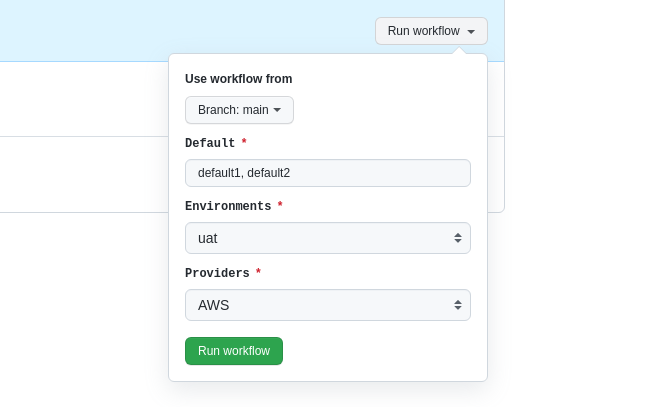
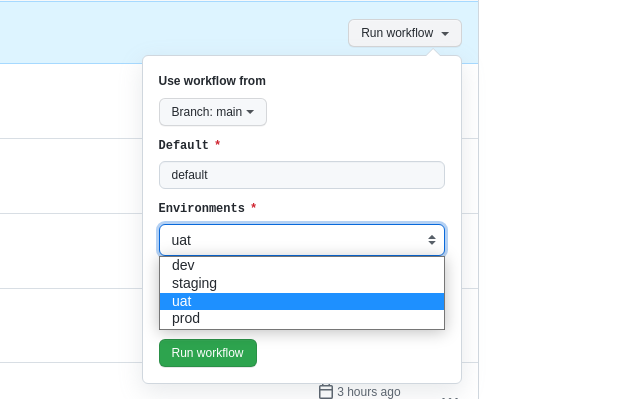
Dropdown for GitHub workflows input parameters Sometimes when we look at CI/CD tools embedded within git-based software repository manager like GitHub, GitLab or Bitbucket, we ran into a lack of some features. This time me and my DevOps/SRE team were facing a pain of not being able to have the option to create drop-downs within GitHub workflows using input parameters. Although this functionality is already available on other platforms such as Bitbucket, the specific client we were working on stored the code inside GitHub. At first I thought that someone has already solved this problem somehow, but doing an extensive search on the internet I found several angry GitHub users opening requests within the Support Community and even in the stack overflow. comment-1 comment-2 comment-3 comment-5 comment-4 So I decided to create a solution for this, always thinking about simplicity and in a way that makes it easy to get this missing functionality. I started by creating an input array pattern using commas and using a tag (the selector) e.g brackets as the default value marker. Here is an example of what an input string would look like:
name: gh-action-dropdown-list-input
on:
  workflow_dispatch:
    inputs:
      environment:
        description: 'Environment'
        required: true
        default: 'dev,staging,[uat],prod'
Now the final question that would turn out to be the most complicated to deal with. How can I change the GitHub Actions interface to replace the input pattern we created earlier to a dropdown? The simplest answer I thought was to create a chrome and firefox extension that would do all this logic behind the scenes and replace the HTML input element with the selected tag containing the array values and leaving the tag value (selector) always as the default. All code was developed in pure JavaScript, open-source licensed under Apache 2.0 and available at https://github.com/arthurbdiniz/gh-action-dropdown-list-input.

Install extension Once installed, the extension is ready to use and the final result we see is the Actions interface with drop-downs. :) showcase-1 showcase-2

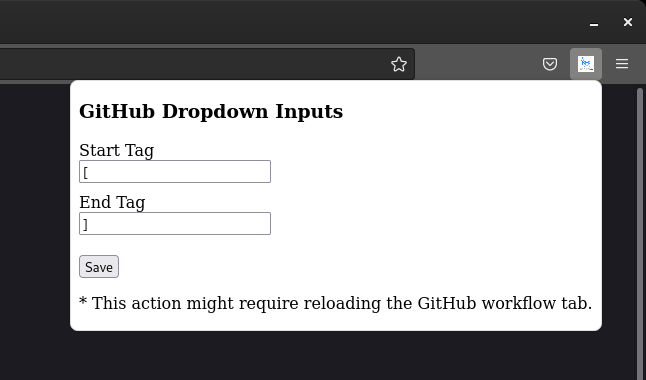
Configuring selectors Go to the top right corner of the browser you are using and click on the extension logo. A screen will popup with tag options. Choose the right tags for you and save it.
This action might require reloading the GitHub workflow tab. config

Have fun using drop-downs inside GitHub. If you liked this project please share this post and if possible star within the repository. Also feel free to connect with me on LinkedIn: https://www.linkedin.com/in/arthurbdiniz

References
  • https://github.community/t/can-workflow-dispatch-input-be-option-list/127338
  • https://stackoverflow.com/questions/69296314/dropdown-for-github-workflows-input-parameters

21 October 2021

Norbert Preining: KDE/Plasma 5.23 25th Anniversary Edition for Debian

In the last week, KDE released version 5.23 25th Anniversary Edition of the Plasma desktop with the usual long list of updates and improvements. This release celebrates 25 years of KDE, and Plasma 5.23.0 was released right on the day 25 years ago Matthias Ettrich sent an email to the de.comp.os.linux.misc newsgroup explaining a project he was working on. And Plasma 5.23 (with the bug fix 5.23.1) is now available for all Debian releases. (And don t forget KDE Gears/Apps 21.08!) As usual, I am providing packages via my OBS builds. If you have used my packages till now, then you only need to change the plasma522 line to read plasma523. To give full details, I repeat (and update) instructions for all here: First of all, you need to add my OBS key say in /etc/apt/trusted.gpg.d/obs-npreining.asc and add a file /etc/apt/sources.lists.d/obs-npreining-kde.list, containing the following lines, replacing the DISTRIBUTION part with one of Debian_11 (for Bullseye), Debian_Testing, or Debian_Unstable:
deb https://download.opensuse.org/repositories/home:/npreining:/debian-kde:/other-deps/DISTRIBUTION/ ./
deb https://download.opensuse.org/repositories/home:/npreining:/debian-kde:/frameworks/DISTRIBUTION/ ./
deb https://download.opensuse.org/repositories/home:/npreining:/debian-kde:/plasma523/DISTRIBUTION/ ./
deb https://download.opensuse.org/repositories/home:/npreining:/debian-kde:/apps2108/DISTRIBUTION/ ./
deb https://download.opensuse.org/repositories/home:/npreining:/debian-kde:/other/DISTRIBUTION/ ./
The sharp eye might have detected also the apps2108 line, yes the KDE Gear suite of packages hgas been updated to 21.08 some time ago and is also available in my OBS builds (and in Debian/experimental). Uploads to Debian Plasma 5.23.0 has been uploaded to Debian, and is currently in transition to testing. Due to incorrect/insufficient Break/Depends, currently Debian/testing with the official packages for Plasma are broken. And as it looks this situation will continue for considerable time, considering that kwin is blocked by mesa, which in turn is blocked by llvm-toolchain-12, which has quite some RC bugs preventing it from transitioning. What a bad coincidence. KDE Gears 21.08 are all in Debian Unstable and Testing, so the repositories here are mostly for users of Debian Bullseye (stable). Krita beta Krita has released the second beta of Krita 5.0, and this is available from the krita-beta repository, but only for amd64 architectures. Just add
deb https://download.opensuse.org/repositories/home:/npreining:/debian-kde:/krita-beta/DISTRIBUTION/ ./
Enjoy the new Plasma!

20 October 2021

Arturo Borrero Gonz lez: Iterating on how we do NFS at Wikimedia Cloud Services

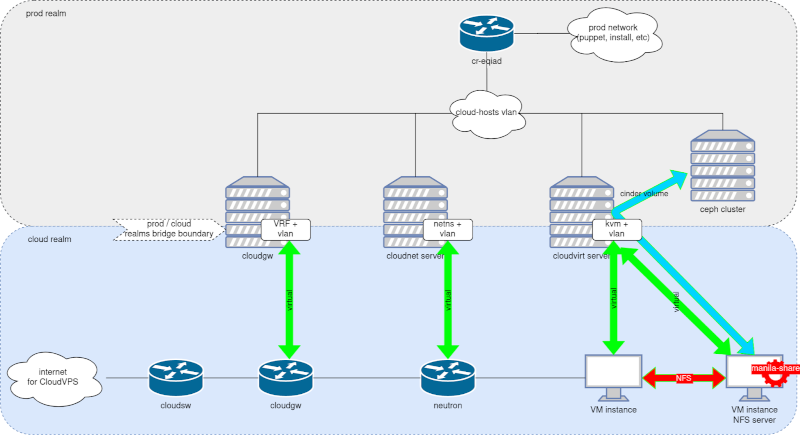
Logos This post was originally published in the Wikimedia Tech blog, authored by Arturo Borrero Gonzalez. NFS is a central piece of infrastructure that is essential to services like Toolforge. Recently, the Cloud Services team at Wikimedia had been reviewing how we do NFS. The current situation NFS is a central piece of technology for some of the services that the Wikimedia Cloud Services team offers to the community. We have several shares that power different use cases: Toolforge user home directories live on NFS, and Cloud VPS users can also access dumps using this protocol. The current setup involves several physical hardware servers, with about 20TB of storage, offering shares over 10G links to the cloud. For the system to be more fault-tolerant, we duplicate each share for redundancy using DRBD. Running NFS on dedicated hardware servers has traditionally offered us advantages: mostly on the performance and the capacity fields. As time has passed, we have been enumerating more and more reasons to review how we do NFS. For one, the current setup is in violation of some of our internal rules regarding realm separation. Additionally, we had been longing for additional flexibility managing our servers: we wanted to use virtual machines managed by Openstack Nova. The DRBD-based high-availability system required mostly a hand-crafted procedure for failover/failback. There s also some scalability concerns as NFS is easy to grow up, but not to grow horizontally, and of course, we have to be able to keep the tenancy setup while doing so, something that NFS does by using LDAP/Unix users and may get complicated too when growing. In general, the servers have become too big to fail , clearly technical debt, and it has taken us years to decide on taking on the task to rethink the architecture. It s worth mentioning that in an ideal world, we wouldn t depend on NFS, but the truth is that it will still be a central piece of infrastructure for years to come in services like Toolforge. Over a series of brainstorming meetings, the WMCS team evaluated the situation and sorted out the many moving parts. The team managed to boil down the potential service future to two competing options: Then we decided to research both options in parallel. For a number of reasons, the evaluation was timeboxed to three weeks. Both ideas had a couple of points in common: the NFS data would be stored on our Ceph farm via Cinder volumes, and we would rely on Ceph reliability to avoid using DRBD. Another open topic was how to back up data from Ceph, to store our important bits in more than one basket. We will get to the back up topic later. The manila experiment The Wikimedia Foundation was an early adopter of some Openstack components (Nova, Glance, Designate, Horizon), but Manila was never evaluated for usage until now. Our approach for this experiment was to closely follow the upstream guidelines. We read the documentation and tried to understand the different setups you can build with Manila. As we often feel with other Openstack components, the documentation doesn t perfectly describe how to introduce a given component in your particular local setup. Here we use an admin-controller flat-topology Neutron network. This network is shared by all tenants (or projects) in our Openstack deployment. Also, Manila can use many different driver backends, for things like NetApps or CephFS that we don t use , yet. After some research, the generic driver was the one that seemed to better fit our use case. The generic driver leverages Nova virtual machines instances plus Cinder volume to create and manage the shares. In general, Manila supports two operational modes, whether it should create/destroy the share servers (i.e, the virtual machine instances) or not. This option is called driver_handles_share_server (or DHSS) and takes a boolean value. We were interested in trying with DHSS=true, to really benefit from the potential of the setup. Manila diagram NFS idea 6, original image in Wikitech So, after sorting all these variables, we moved on with our initial testing. We built a PoC setup as depicted in the diagram above, with the manila-share component running in a virtual machine inside the cloud. The PoC led to us reporting several bugs upstream: In some cases we tried to address these bugs ourselves: It s worth mentioning that the upstream community was extra-welcoming to us, and we re thankful for that. However, at the end of our three-week period, our Manila setup still wasn t working as expected. Your experience may change with other drivers perhaps the ZFSonLinux or the CephFS ones. In general, we were having trouble making the setup work as expected, so we decided to abandon this approach in favor of the other option we were considering at the beginning. Simple virtual machine serving NFS The alternative was to create a Nova virtual machine instance by hand and to configure it using puppet. We have been investing in an automation framework lately, so the idea is to not actually create the server by hand. Anyway, the data would be decoupled from the instance into Cinder volumes, which led us to the question we left for later: How should we back up those terabytes of important information? Just to be clear, the backup problem was independent of the above options; with Manila we would still have had to solve the same challenge. We would like to see our data be backed up somewhere else other than in Ceph. And that s exactly where we are at right now. We ve been exploring different backup strategies and will finally use the Cinder backup API. Conclusion The iteration will end with the dedicated NFS hardware servers being stopped, and the shares being served from within the cloud. The migration will take some time to happen because we will check and double-check that everything works as expected (including from the performance point of view) before making definitive changes. We already have some plans to make sure our users experience as little service impact as possible. The most troublesome shares will be those related to Toolforge. At some point we will need to disallow writes to the NFS share, rsync the data out of the hardware servers into the Cinder volumes, point the NFS clients to the new virtual machines, and then enable writes again. The main Toolforge share has about 8TB of data, so this will take a while. We will have more updates in the future. Who knows, perhaps our next-next iteration, in a couple of years, will see us adopting Openstack Manila for good. Featured image credit: File:(from break water) Manila Skyline panoramio.jpg, ewol, CC BY-SA 3.0 This post was originally published in the Wikimedia Tech blog, authored by Arturo Borrero Gonzalez.

18 October 2021

Gunnar Wolf: raspi.debian.net now hosted on Debian infrastructure

So, since I registered the URL for serving the unofficial Debian images for the Raspberry computers, raspi.debian.net, in April 2020, I had been hosting it in my Dreamhost webspace. Over two years ago yes, before I finished setting it up in Dreamhost Steve McIntyre approached me and invited me to host the images under the Debian cdimages user group. I told him I d first just get the setup running, and later I would approach him for finalizing the setup. Then, I set up the build on my own server, hosted on my Dreamhost account and forgot about it for many months. Last month, there was a not particularly happy flamewar in debian-arm@lists.debian.org finished with me stating I would be moving the hosting to Debian infrastructure soon. Well It took me a bit over a month to get this sorted out, together with several days of half-broken links, but it is finally done: raspi.debian.net is a CNAME for ftp.acc.umu.se, which is the same system that hosts cdimage.debian.org. And, of course it is also reachable as https://cdimage.debian.org/cdimage/unofficial/raspi/ looks more official, but is less memorable Thanks a lot to Steve for the nudging, and to maswan to help finalizing the setup. What next? Well, the images are being built on my server. I d love to move the builder over to Debian machines as well. When? How? That s still in the air.

13 October 2021

Dirk Eddelbuettel: GitHub Streak: Round Eight

Seven years ago I referenced the Seinfeld Streak used in an earlier post of regular updates to to the Rcpp Gallery:
This is sometimes called Jerry Seinfeld s secret to productivity: Just keep at it. Don t break the streak.
and then showed the first chart of GitHub streaking 366 days:
github activity october 2013 to october 2014github activity october 2013 to october 2014
And six years ago a first follow-up appeared in this post about 731 days:
github activity october 2014 to october 2015github activity october 2014 to october 2015
And five years ago we had a followup at 1096 days
github activity october 2015 to october 2016github activity october 2015 to october 2016
And four years ago we had another one marking 1461 days
github activity october 2016 to october 2017github activity october 2016 to october 2017
And three years ago another one for 1826 days
github activity october 2017 to october 2018github activity october 2017 to october 2018
And two year another one bringing it to 2191 days
github activity october 2018 to october 2019github activity october 2018 to october 2019
And last year another one bringing it to 2257 days
github activity october 2019 to october 2020github activity october 2019 to october 2020
And as today is October 12, here is the newest one from 2020 to 2021 with a new total of 2922 days:
github activity october 2020 to october 2021github activity october 2020 to october 2021
Again, special thanks go to Alessandro Pezz for the Chrome add-on GithubOriginalStreak.

This post by Dirk Eddelbuettel originated on his Thinking inside the box blog. Please report excessive re-aggregation in third-party for-profit settings.

12 October 2021

Antonio Terceiro: Triaging Debian build failure logs with collab-qa-tools

The Ruby team is working now on transitioning to ruby 3.0. Even though most packages will work just fine, there is substantial amount of packages that require some work to adapt. We have been doing test rebuilds for a while during transitions, but usually triaged the problems manually. This time I decided to try collab-qa-tools, a set of scripts Lucas Nussbaum uses when he does archive-wide rebuilds. I'm really glad that I did, because those tols save a lot of time when processing a large number of build failures. In this post, I will go through how to triage a set of build logs using collab-qa-tools. I have some some improvements to the code. Given my last merge request is very new and was not merged yet, a few of the things I mention here may apply only to my own ruby3.0 branch. collab-qa-tools also contains a few tools do perform the builds in the cloud, but since we already had the builds done, I will not be mentioning that part and will write exclusively about the triaging tools. Installing collab-qa-tools The first step is to clone the git repository. Make sure you have the dependencies from debian/control installed (a few Ruby libraries). One of the patches I sent, and was already accepted, is the ability to run it without the need to install:
source /path/to/collab-qa-tools/activate.sh
This will add the tools to your $PATH. Preparation The first think you need to do is getting all your build logs in a directory. The tools assume .log file extension, and they can be named $ PACKAGE _*.log or just $ PACKAGE .log. Creating a TODO file
cqa-scanlogs   grep -v OK > todo
todo will contain one line for each log with a summary of the failure, if it's able to find one. collab-qa-tools has a large set of regular expressions for finding errors in the build logs It's a good idea to split the TODO file in multiple ones. This can easily be done with split(1), and can be used to delimit triaging sessions, and/or to split the triaging between multiple people. For example this will create todo into todo00, todo01, ..., each containing 30 lines:
split --lines=30 --numeric-suffixes todo todo
Triaging You can now do the triaging. Let's say we split the TODO files, and will start with todo01. The first step is calling cqa-fetchbugs (it does what it says on the tin):
cqa-fetchbugs --TODO=todo01
Then, cqa-annotate will guide you through the logs and allow you to report bugs:
cqa-annotate --TODO=todo01
I wrote myself a process.sh wrapper script for cqa-fetchbugs and cqa-annotate that looks like this:
#!/bin/sh
set -eu
for todo in $@; do
  # force downloading bugs
  awk ' print(".bugs." $1) ' "$ todo "   xargs rm -f
  cqa-fetchbugs --TODO="$ todo "
  cqa-annotate \
    --template=template.txt.jinja2 \
    --TODO="$ todo "
done
The --template option is a recent contribution of mine. This is a template for the bug reports you will be sending. It uses Liquid templates, which is very similar to Jinja2 for Python. You will notice that I am even pretending it is Jinja2 to trick vim into doing syntax highlighting for me. The template I'm using looks like this:
From:   fullname   <  email  >
To: submit@bugs.debian.org
Subject:   package  : FTBFS with ruby3.0:   summary  
Source:   package  
Version:   version   split:'+rebuild'   first  
Severity: serious
Justification: FTBFS
Tags: bookworm sid ftbfs
User: debian-ruby@lists.debian.org
Usertags: ruby3.0
Hi,
We are about to enable building against ruby3.0 on unstable. During a test
rebuild,   package   was found to fail to build in that situation.
To reproduce this locally, you need to install ruby-all-dev from experimental
on an unstable system or build chroot.
Relevant part (hopefully):
 % for line in extract % >   line  
 % endfor % 
The full build log is available at
https://people.debian.org/~kanashiro/ruby3.0/round2/builds/3/  package  /  filename   replace:".log",".build.txt"  
The cqa-annotate loop cqa-annotate will parse each log file, display an extract of what it found as possibly being the relevant part, and wait for your input:
######## ruby-cocaine_0.5.8-1.1+rebuild1633376733_amd64.log ########
--------- Error:
     Failure/Error: undef_method :exitstatus
     FrozenError:
       can't modify frozen object: pid 2351759 exit 0
     # ./spec/support/unsetting_exitstatus.rb:4:in  undef_method'
     # ./spec/support/unsetting_exitstatus.rb:4:in  singleton class'
     # ./spec/support/unsetting_exitstatus.rb:3:in  assuming_no_processes_have_been_run'
     # ./spec/cocaine/errors_spec.rb:55:in  block (2 levels) in <top (required)>'
Deprecation Warnings:
Using  should  from rspec-expectations' old  :should  syntax without explicitly enabling the syntax is deprecated. Use the new  :expect  syntax or explicitly enable  :should  with  config.expect_with(:rspec)    c  c.syntax = :should   instead. Called from /<<PKGBUILDDIR>>/spec/cocaine/command_line/runners/backticks_runner_spec.rb:19:in  block (2 levels) in <top (required)>'.
If you need more of the backtrace for any of these deprecations to
identify where to make the necessary changes, you can configure
 config.raise_errors_for_deprecations! , and it will turn the
deprecation warnings into errors, giving you the full backtrace.
1 deprecation warning total
Finished in 6.87 seconds (files took 2.68 seconds to load)
67 examples, 1 failure
Failed examples:
rspec ./spec/cocaine/errors_spec.rb:54 # When an error happens does not blow up if running the command errored before execution
/usr/bin/ruby3.0 -I/usr/share/rubygems-integration/all/gems/rspec-support-3.9.3/lib:/usr/share/rubygems-integration/all/gems/rspec-core-3.9.2/lib /usr/share/rubygems-integration/all/gems/rspec-core-3.9.2/exe/rspec --pattern ./spec/\*\*/\*_spec.rb --format documentation failed
ERROR: Test "ruby3.0" failed:
----------------
ERROR: Test "ruby3.0" failed:      Failure/Error: undef_method :exitstatus
----------------
package: ruby-cocaine
lines: 30
------------------------------------------------------------------------
s: skip
i: ignore this package permanently
r: report new bug
f: view full log
------------------------------------------------------------------------
Action [s i r f]:
You can then choose one of the options: When there are existing bugs in the package, cqa-annotate will list them among the options. If you choose a bug number, the TODO file will be annotated with that bug number and new runs of cqa-annotate will not ask about that package anymore. For example after I reported a bug for ruby-cocaine for the issue listed above, I aborted with a ctrl-c, and when I run my process.sh script again I then get this prompt:
----------------
ERROR: Test "ruby3.0" failed:      Failure/Error: undef_method :exitstatus
----------------
package: ruby-cocaine
lines: 30
------------------------------------------------------------------------
s: skip
i: ignore this package permanently
1: 996206 serious ruby-cocaine: FTBFS with ruby3.0: ERROR: Test "ruby3.0" failed:      Failure/Error: undef_method :exitstatus  
r: report new bug
f: view full log
------------------------------------------------------------------------
Action [s i 1 r f]:
Chosing 1 will annotate the TODO file with the bug number, and I'm done with this package. Only a few other hundreds to go.

7 October 2021

Kentaro Hayashi: Sharing mentoring a new Debian contributor experience, lots of fun

I recently did mentoring a new Debian contributor. This is carried out in a framework with OSS Gate on-boarding. oss-gate.github.io In "OSS Gate on-boarding", recruit a new contributor who want to work on continuously. Then, corporation sponsor its employee as a mentor. Thus, employees can do it as a one of their job. During Aug - Oct period, I worked with a new debian contributor every 2h in a week. This experience is lots of fun, and learned a new things for me. The most important point is: a new Debian contributor aimed to do their work continuously even though mentoring period has finished. So, some of the work has been finished, but not for all. I tried to transfer knowledge for it. I'm looking forward that he makes things forward in consultation with other person's help. Here is the report about my activity as a mentor. First OSS Gate onboarding (The article is written by Japanese) The original blog entry is written by Japanese, I don't afford to translate it, so just paste link to google translate for your hints I hope someone can do a similar attempt too! For the record, I worked with a new Debian contributor about:

6 October 2021

Matthew Palmer: Discovering AWS IAM accounts

Let s say you re someone who happens to discover an AWS account number, and would like to take a stab at guessing what IAM users might be valid in that account. Tricky problem, right? Not with this One Weird Trick! In your own AWS account, create a KMS key and try to reference an ARN representing an IAM user in the other account as the principal. If the policy is accepted by PutKeyPolicy, then that IAM account exists, and if the error says Policy contains a statement with one or more invalid principals then the user doesn t exist. As an example, say you want to guess at IAM users in AWS account 111111111111. Then make sure this statement is in your key policy:
 
  "Sid": "Test existence of user",
  "Effect": "Allow",
  "Principal":  
    "AWS": "arn:aws:iam::111111111111:user/bob"
   ,
  "Action": "kms:DescribeKey",
  "Resource": "*"
 
If that policy is accepted, then the account has an IAM user named bob. Otherwise, the user doesn t exist. Scripting this is left as an exercise for the reader. Sadly, wildcards aren t accepted in the username portion of the ARN, otherwise you could do some funky searching with ...:user/a*, ...:user/b*, etc. You can t have everything; where would you put it all? I did mention this to AWS as an account enumeration risk. They re of the opinion that it s a good thing you can know what users exist in random other AWS accounts. I guess that means this is a technique you can put in your toolbox safe in the knowledge it ll work forever. Given this is intended behaviour, I assume you don t need to use a key policy for this, but that s where I stumbled over it. Also, you can probably use it to enumerate roles and anything else that can be a principal, but since I don t see as much use for that, I didn t bother exploring it. There you are, then. If you ever need to guess at IAM users in another AWS account, now you can!

Thomas Goirand: OpenStack Xena, the 24th OpenStack release, is out

It was out at 3pm, and I managed to finish uploading the last bits to Unstable at 9pm Of course, that s because all of the packaging and testing work was done before the release date. All of it is, as usual, also available through a Bullseye non-official backports repository that can be added using extrepo (ie: extrepo enable openstack_xena ).


Reproducible Builds: Reproducible Builds in September 2021

The goal behind reproducible builds is to ensure that no deliberate flaws have been introduced during compilation processes via promising or mandating that identical results are always generated from a given source. This allowing multiple third-parties to come to an agreement on whether a build was compromised or not by a system of distributed consensus. In these reports we outline the most important things that have been happening in the world of reproducible builds in the past month:
First mentioned in our March 2021 report, Martin Heinz published two blog posts on sigstore, a project that endeavours to offer software signing as a public good, [the] software-signing equivalent to Let s Encrypt . The two posts, the first entitled Sigstore: A Solution to Software Supply Chain Security outlines more about the project and justifies its existence:
Software signing is not a new problem, so there must be some solution already, right? Yes, but signing software and maintaining keys is very difficult especially for non-security folks and UX of existing tools such as PGP leave much to be desired. That s why we need something like sigstore - an easy to use software/toolset for signing software artifacts.
The second post (titled Signing Software The Easy Way with Sigstore and Cosign) goes into some technical details of getting started.
There was an interesting thread in the /r/Signal subreddit that started from the observation that Signal s apk doesn t match with the source code:
Some time ago I checked Signal s reproducibility and it failed. I asked others to test in case I did something wrong, but nobody made any reports. Since then I tried to test the Google Play Store version of the apk against one I compiled myself, and that doesn t match either.

BitcoinBinary.org was announced this month, which aims to be a repository of Reproducible Build Proofs for Bitcoin Projects :
Most users are not capable of building from source code themselves, but we can at least get them able enough to check signatures and shasums. When reputable people who can tell everyone they were able to reproduce the project s build, others at least have a secondary source of validation.

Distribution work Fr d ric Pierret announced a new testing service at beta.tests.reproducible-builds.org, showing actual rebuilds of binaries distributed by both the Debian and Qubes distributions. In Debian specifically, however, 51 reviews of Debian packages were added, 31 were updated and 31 were removed this month to our database of classified issues. As part of this, Chris Lamb refreshed a number of notes, including the build_path_in_record_file_generated_by_pybuild_flit_plugin issue. Elsewhere in Debian, Roland Clobus posted his Fourth status update about reproducible live-build ISO images in Jenkins to our mailing list, which mentions (amongst other things) that:
  • All major configurations are still built regularly using live-build and bullseye.
  • All major configurations are reproducible now; Jenkins is green.
    • I ve worked around the issue for the Cinnamon image.
    • The patch was accepted and released within a few hours.
  • My main focus for the last month was on the live-build tool itself.
Related to this, there was continuing discussion on how to embed/encode the build metadata for the Debian live images which were being worked on by Roland Clobus.
Ariadne Conill published another detailed blog post related to various security initiatives within the Alpine Linux distribution. After summarising some conventional security work being done (eg. with sudo and the release of OpenSSH version 3.0), Ariadne included another section on reproducible builds: The main blocker [was] determining what to do about storing the build metadata so that a build environment can be recreated precisely . Finally, Bernhard M. Wiedemann posted his monthly reproducible builds status report.

Community news On our website this month, Bernhard M. Wiedemann fixed some broken links [ ] and Holger Levsen made a number of changes to the Who is Involved? page [ ][ ][ ]. On our mailing list, Magnus Ihse Bursie started a thread with the subject Reproducible builds on Java, which begins as follows:
I m working for Oracle in the Build Group for OpenJDK which is primary responsible for creating a built artifact of the OpenJDK source code. [ ] For the last few years, we have worked on a low-effort, background-style project to make the build of OpenJDK itself building reproducible. We ve come far, but there are still issues I d like to address. [ ]

diffoscope diffoscope is our in-depth and content-aware diff utility. Not only can it locate and diagnose reproducibility issues, it can provide human-readable diffs from many kinds of binary formats. This month, Chris Lamb prepared and uploaded versions 183, 184 and 185 as well as performed significant triaging of merge requests and other issues in addition to making the following changes:
  • New features:
    • Support a newer format version of the R language s .rds files. [ ]
    • Update tests for OCaml 4.12. [ ]
    • Add a missing format_class import. [ ]
  • Bug fixes:
    • Don t call close_archive when garbage collecting Archive instances, unless open_archive definitely returned successfully. This prevents, for example, an AttributeError where PGPContainer s cleanup routines were rightfully assuming that its temporary directory had actually been created. [ ]
    • Fix (and test) the comparison of R language s .rdb files after refactoring temporary directory handling. [ ]
    • Ensure that RPM archives exists in the Debian package description, regardless of whether python3-rpm is installed or not at build time. [ ]
  • Codebase improvements:
    • Use our assert_diff routine in tests/comparators/test_rdata.py. [ ]
    • Move diffoscope.versions to diffoscope.tests.utils.versions. [ ]
    • Reformat a number of modules with Black. [ ][ ]
However, the following changes were also made:
  • Mattia Rizzolo:
    • Fix an autopkgtest caused by the androguard module not being in the (expected) python3-androguard Debian package. [ ]
    • Appease a shellcheck warning in debian/tests/control.sh. [ ]
    • Ignore a warning from h5py in our tests that doesn t concern us. [ ]
    • Drop a trailing .1 from the Standards-Version field as it s required. [ ]
  • Zbigniew J drzejewski-Szmek:
    • Stop using the deprecated distutils.spawn.find_executable utility. [ ][ ][ ][ ][ ]
    • Adjust an LLVM-related test for LLVM version 13. [ ]
    • Update invocations of llvm-objdump. [ ]
    • Adjust a test with a one-byte text file for file version 5.40. [ ]
And, finally, Benjamin Peterson added a --diff-context option to control unified diff context size [ ] and Jean-Romain Garnier fixed the Macho comparator for architectures other than x86-64 [ ].

Upstream patches The Reproducible Builds project detects, dissects and attempts to fix as many currently-unreproducible packages as possible. We endeavour to send all of our patches upstream where appropriate. This month, we wrote a large number of such patches, including:

Testing framework The Reproducible Builds project runs a testing framework at tests.reproducible-builds.org, to check packages and other artifacts for reproducibility. This month, the following changes were made:
  • Holger Levsen:
    • Drop my package rebuilder prototype as it s not useful anymore. [ ]
    • Schedule old packages in Debian bookworm. [ ]
    • Stop scheduling packages for Debian buster. [ ][ ]
    • Don t include PostgreSQL debug output in package lists. [ ]
    • Detect Python library mismatches during build in the node health check. [ ]
    • Update a note on updating the FreeBSD system. [ ]
  • Mattia Rizzolo:
    • Silence a warning from Git. [ ]
    • Update a setting to reflect that Debian bookworm is the new testing. [ ]
    • Upgrade the PostgreSQL database to version 13. [ ]
  • Roland Clobus (Debian live image generation):
    • Workaround non-reproducible config files in the libxml-sax-perl package. [ ]
    • Use the new DNS for the snapshot service. [ ]
  • Vagrant Cascadian:
    • Also note that the armhf architecture also systematically varies by the kernel. [ ]

Contributing If you are interested in contributing to the Reproducible Builds project, please visit our Contribute page on our website. However, you can get in touch with us via:

4 October 2021

Paul Wise: FLOSS Activities September 2021

Focus This month I didn't have any particular focus. I just worked on issues in my info bubble.

Changes

Issues

Review

Administration
  • Debian BTS: reopened bugs closed by a spammer
  • Debian wiki: unblock IP addresses, approve accounts

Communication
  • Respond to queries from Debian users and contributors on the mailing lists and IRC

Sponsors The purple-discord/harmony/pyemd/librecaptcha/esprima-python work was sponsored by my employer. All other work was done on a volunteer basis.

3 October 2021

Louis-Philippe V ronneau: ANC is not for me

Active noise cancellation (ANC) has been all the rage lately in the headphones and in-ear monitors market. It seems after Apple got heavily praised for their AirPods Pro, every somewhat serious electronics manufacturer released their own design incorporating this technology. The first headphones with ANC I remember trying on (in the early 2010s) were the Bose QuietComfort 15. Although the concept did work (they indeed cancelled some sounds), they weren't amazing and did a great job of convincing me ANC was some weird fad for people who flew often. The Sony WH-1000X M3 folded in their case As the years passed, chip size decreased, battery capacity improved and machine learning blossomed truly a perfect storm for the wireless ANC headphones market. I had mostly stayed a sceptic of this tech until recently a kind friend offered to let me try a pair of Sony WH-1000X M3. Having tested them thoroughly, I have to say I'm really tempted to buy them from him, as they truly are fantastic headphones1. They are very light, comfortable, work without a proprietary app and sound very good with the ANC on2 if a little bass-heavy for my taste3. The ANC itself is truly astounding and is leaps and bounds beyond what was available five years ago. It still isn't perfect and doesn't cancel ALL sounds, but transforms the low hum of the subway I find myself sitting in too often these days into a light *swoosh*. When you turn the ANC on, HVAC simply disappears. Most impressive to me is the way they completely cancel the dreaded sound of your footsteps resonating in your headphones when you walk with them. My old pair of Senheiser HD 280 Pro, with aftermarket sheepskin earpads I won't be keeping them though. Whilst I really like what Sony has achieved here, I've grown to understand ANC simply isn't for me. Some of the drawbacks of ANC somewhat bother me: the ear pressure it creates is tolerable, but is an additional energy drain over long periods of time and eventually gives me headaches. I've also found ANC accentuates the motion sickness I suffer from, probably because it messes up with some part of the inner ear balance system. Most of all, I found that it didn't provide noticeable improvements over good passive noise cancellation solutions, at least in terms of how high I have to turn the volume up to hear music or podcasts clearly. The human brain works in mysterious ways and it seems ANC cancelling a class of noises (low hums, constant noises, etc.) makes other noises so much more noticeable. People talking or bursty high pitched noises bothered me much more with ANC on than without. So for now, I'll keep using my trusty Senheiser HD 280 Pro4 at work and good in-ear monitors with Comply foam tips on the go.

  1. This blog post certainly doesn't aim to be a comprehensive review of these headphones. See Zeos' review if you want something more in-depth.
  2. As most ANC headphones, they don't sound as good when used passively through the 3.5mm port, but that's just a testament of how a great job Sony did of tuning the DSP.
  3. Easily fixed using an EQ.
  4. Retrofitted with aftermarket sheepskin earpads, they provide more than 32db of passive noise reduction.

2 October 2021

Jacob Adams: SSH Port Forwarding and the Command Cargo Cult

Someone is Wrong on the Internet If you look up how to only forward ports with ssh, you may come across solutions like this:
ssh -nNT -L 8000:example.com:80 user@bastion.example.com
Or perhaps this, if you also wanted to send ssh to the background:
ssh -NT -L 3306:db.example.com:3306 example.com &
Both of these use at least one option that is entirely redundant, and the second can cause ssh to fail to connect if you happen to be using password authentication. However, they seem to still persist in various articles about ssh port forwarding. I myself was using the first variation until just recently, and I figured I would write this up to inform others who might be still using these solutions. The correct option for this situation is not -nNT but simply -N, as in:
ssh -N -L 8000:example.com:80 user@bastion.example.com
If you want to also send ssh to the background, then you ll want to add -f instead of using your shell s built-in & feature, because you can then input passwords into ssh if necessary1 Honestly, that s the point of this article, so you can stop here if you want. If you re looking for a detailed explaination of what each of these options actually does, or if you have no idea what I m talking about, read on!

What is SSH Port Forwarding? ssh is a powerful tool for remote access to servers, allowing you to execute commands on a remote machine. It can also forward ports through a secure tunnel with the -L and -R options. Basically, you can forward a connection to a local port to a remote server like so:
ssh -L 8080:other.example.com:80 ssh.example.com
In this example, you connect to ssh.example.com and then ssh forwards any traffic on your local machine port 80802 to other.example.com port 80 via ssh.example.com. This is a really powerful feature, allowing you to jump3 inside your firewall with just an ssh server exposed to the world. It can work in reverse as well with the -R option, allowing connections on a remote host in to a server running on your local machine. For example, say you were running a website on your local machine on port 8080 but wanted it accessible on example.com port 804. You could use something like:
ssh -R 8080:example.com:80 example.com
The trouble with ssh port forwarding is that, absent any additional options, you also open a shell on the remote machine. If you re planning to both work on a remote machine and use it to forward some connection, this is fine, but if you just need to forward a port quickly and don t care about a shell at that moment, it can be annoying, especially since if the shell closes ssh will close the forwarding port as well. This is where the -N option comes in.

SSH just forwarding ports In the ssh manual page5, -N is explained like so:
Do not execute a remote command. This is useful for just forwarding ports.
This is all we need. It instructs ssh to run no commands on the remote server, just forward the ports specified in the -L or -R options. But people seem to think that there are a bunch of other necessary options, so what do those do?

SSH and stdin -n controls how ssh interacts with standard input, specifically telling it not to:
Redirects stdin from /dev/null (actually, prevents reading from stdin). This must be used when ssh is run in the background. A common trick is to use this to run X11 programs on a remote machine. For example, ssh -n shadows.cs.hut.fi emacs & will start an emacs on shadows.cs.hut.fi, and the X11 connection will be automatically for warded over an encrypted channel. The ssh program will be put in the background. (This does not work if ssh needs to ask for a password or passphrase; see also the -f option.)

SSH passwords and backgrounding -f sends ssh to background, freeing up the terminal in which you ran ssh to do other things.
Requests ssh to go to background just before command execution. This is useful if ssh is going to ask for passwords or passphrases, but the user wants it in the background. This implies -n. The recommended way to start X11 programs at a remote site is with something like ssh -f host xterm.
As indicated in the description of -n, this does the same thing as using the shell s & feature with -n, but allows you to put in any necessary passwords first.

SSH and pseudo-terminals -T is a little more complicated than the others and has a very short explanation:
Disable pseudo-terminal allocation.
It has a counterpart in -t, which is explained a little better:
Force pseudo-terminal allocation. This can be used to execute arbitrary screen-based programs on a remote machine, which can be very useful, e.g. when implementing menu services. Multiple -t options force tty allocation, even if ssh has no local tty.
As the description of -t indicates, ssh is allocating a pseudo-terminal on the remote machine, not the local one. However, I have confirmed6 that -N doesn t allocate a pseudo-terminal either, since it doesn t run any commands. Thus this option is entirely unnecessary.

What s a pseudo-terminal? This is a bit complicated, but basically it s an interface used in UNIX-like systems, like Linux or BSD, that pretends to be a terminal (thus pseudo-terminal). Programs like your shell, or any text-based menu system made in libraries like ncurses, expect to be connected to one (when used interactively at least). Basically it fakes as if the input it is given (over the network, in the case of ssh) was typed on a physical terminal device and do things like raise an interrupt (SIGINT) if Ctrl+C is pressed.

Why? I don t know why these incorrect uses of ssh got passed around as correct, but I suspect it s a form of cargo cult, where we use example commands others provide and don t question what they do. One stack overflow answer I read that provided these options seemed to think -T was disabling the local pseudo-terminal, which might go some way towards explaining why they thought it was necessary. I guess the moral of this story is to question everything and actually read the manual, instead of just googling it.
  1. Not that you SHOULD be using ssh with password authentication anyway, but people do.
  2. Only on your loopback address by default, so that you re not allowing random people on your network to use your tunnel.
  3. In fact, ssh even supports Jump Hosts, allowing you to automatically forward an ssh connection through another machine.
  4. I can t say I recommend a setup like this for anything serious, as you d need to ssh as root to forward ports less than 1024. SSH forwarding is not for permanent solutions, just short-lived connections to machines that would be otherwise inaccessible.
  5. Specifically, my source is the ssh(1) manual page in OpenSSH 8.4, shipped as 1:8.4p1-5 in Debian bullseye.
  6. I just forwarded ports with -N and then logged in to that same machine and looked at psuedo-terminal allocations via ps ux. No terminal is associated with ssh connections using just the -N option.

1 October 2021

Vincent Bernat: FRnOG #34: how we deployed a datacenter in one click

Here are the slides I presented for FRnOG #34 in October 2021. They are about automating the deployment of Blade s datacenters using Jerikan and Ansible. For more information, have a look at Jerikan+Ansible: a configuration management system for network.
The presentation, in French, was recorded. I have added English subtitles.1

  1. Good thing if you don t understand French as my diction was poor with a lot of fillers.

Russell Coker: Getting Started With Kali

Kali is a Debian based distribution aimed at penetration testing. I haven t felt a need to use it in the past because Debian has packages for all the scanning tools I regularly use, and all the rest are free software that can be obtained separately. But I recently decided to try it. Here s the URL to get Kali [1]. For a VM you can get VMWare or VirtualBox images, I chose VMWare as it s the most popular image format and also a much smaller download (2.7G vs 4G). For unknown reasons the torrent for it didn t work (might be a problem with my torrent client). The download link for it was extremely slow in Australia, so I downloaded it to a system in Germany and then copied it from there. I don t want to use either VMWare or VirtualBox because I find KVM/Qemu sufficient to do everything I want and they are in the Main section of Debian, so I needed to convert the image files. Some of the documentation on converting image formats to use with QEMU/KVM says to use a program called kvm-img which doesn t seem to exist, I used qemu-img from the qemu-utils package in Debian/Bullseye. The man page qemu-img(1) doesn t list the types of output format supported by the -O option and the examples returned by a web search show using -O qcow2 . It turns out that the following command will convert the image to raw format which is the format I prefer. I use BTRFS for storing all my VM images and that does all the copy-on-write I need.
qemu-img convert Kali-Linux-2021.3-vmware-amd64.vmdk ../kali
After converting it the file was 500M smaller than the VMWare files (10.2 vs 10.7G). Probably the Kali distribution file could be reduced in size by converting it to raw and then back to VMWare format. The Kali VMWare image is compressed with 7zip which has a good compression ratio, I waited almost 90 minutes for zstd to compress it with -19 and the result was 12% larger than the 7zip file. VMWare apparently likes to use an emulated SCSI controller, I spent some time trying to get that going in KVM. Apparently recent versions of QEMU changed the way this works and therefore older web pages aren t helpful. Also allegedly the SCSI emulation is buggy and unreliable (but I didn t manage to get it going so can t be sure). It turns out that the VM is configured to work with the virtio interface, the initramfs.conf has the configuration option MODULES=most which makes it boot on all common configurations (good work by the initramfs-tools maintainers). The image works well with the Spice display interface, so it doesn t capture my mouse, the window for the VM works the same way as other windows on my desktop and doesn t capture the mouse cursor. I don t know if this level of Spice integration is in Debian now, last time I tested it didn t work that way. I also downloaded Metasploitable [2] which is a VM image designed to be full of security flaws for testing the tools that are in Kali. Again it worked nicely after converting from VMWare to raw format. One thing to note about Metasploitable is that you must not make it available on the public Internet. My home network has NAT for IPv4 but all systems get public IPv6 addresses. It s usually nice that those things just work on VMs but not for this. So I added an iptables command to block IPv6 to /etc/rc.local. Conclusion Installing VMs for both these distributions was quite easy. Most of my time was spent downloading from a slow server, trying to get SCSI emulation working, working out how to convert image files, and testing different compression options. The time spent doing stuff once I knew what to do was very small. Kali has zsh as the default shell, it s quite nice. I ve been happy with bash for decades, but I might end up trying zsh out on other machines.

Reproducible Builds (diffoscope): diffoscope 186 released

The diffoscope maintainers are pleased to announce the release of diffoscope version 186. This version includes the following changes:
[ Chris Lamb ]
* Don't call close_archive when garbage-collecting Archive instances unless
  open_archive returned successfully. This prevents, amongst others, an
  AttributeError traceback due to PGPContainer's cleanup routines assuming
  that its temporary directory had been created.
  (Closes: reproducible-builds/diffoscope#276)
* Ensure that the string "RPM archives" exists in the package description,
  regardless of whether python3-rpm is installed or not at build time.
[ Jean-Romain Garnier ]
* Fix the LVM Macho comparator for non-x86-64 architectures.
You find out more by visiting the project homepage.

30 September 2021

Holger Levsen: 20210930-Debian-Reunion-Hamburg-2021

Debian Reunion Hamburg 2021 is almost over... The Debian Reunion Hamburg 2021 is almost over now, half the attendees have already left for Regensburg, while five remaining people are still busy here, though tonight there will be two concerts at the venue, plus some lovely food and more. Together with the day trip tomorrow (involving lots of water but hopefully not from above...) I don't expect much more work to be done, so that I feel comfortable publishing the following statistics now, even though I expect some more work will be done while travelling back or due to renewed energy from the event! So I might update these numbers later :-) Together we did: I think that's a pretty awesome and am very happy we did this event! Debian Reunion / MiniDebConf Hamburg 2022 - save the date, almost! Thus I think we should have another Debian event at Fux in 2022, and after checking suitable free dates with the venue I think what could work out is an event from Monday May 23rd until Sunday May 29th 2022. What do you think? For now these dates are preliminary. If you know any reasons why these dates could be less than optimal for such an event, please let me know. Assuming there's no feedback indicating this is a bad idea, the dates shall be finalized by November 1st 2021. Obviously assuming having physical events is still and again a thing! ;-)

29 September 2021

Ingo Juergensmann: LetsEncrypt CA Chain Issues with Ejabberd

UPDATE:
It s not as simple as described below, I m afraid It appears that it s not that easy to obtain new/correct certs from LetsEncrypt that are not cross-signed by DST Root X3 CA. Additionally older OpenSSL version (1.0.x) seems to have problems. So even when you think that your system is now ok, the remote server might refuse to accept your SSL cert. The same is valid for the SSL check on xmpp.net, which seems to be very outdated and beyond repair. Honestly, I think the solution needs to be provided by LetsEncrypt
I was having some strange issues on my ejabberd XMPP server the other day: some users complained that they couldn t connect anymore to the MUC rooms on my server and in the logfiles I discovered some weird warnings about LetsEncrypt certificates being expired although they were just new and valid until end of December. It looks like this:
[warning] <0.368.0>@ejabberd_pkix:log_warnings/1:393 Invalid certificate in /etc/letsencrypt.sh/certs/buildd.net/fullchain.pem: at line 37: certificate is no longer valid as its expiration date has passed
and
[warning] <0.18328.2>@ejabberd_s2s_out:process_closed/2:157 Failed to establish outbound s2s connection nerdica.net -> forum.friendi.ca: Stream closed by peer: Your server's certificate is invalid, expired, or not trusted by forum.friendi.ca (not-authorized); bouncing for 237 seconds
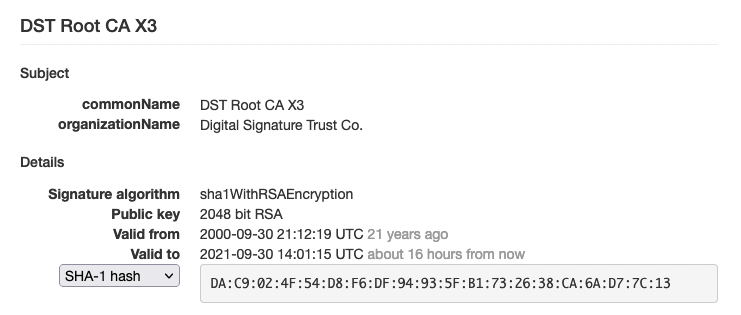
When checking out with some online tools like SSLlabs or XMPP.net the result was strange, because SSLlabs reported everything was ok while XMPP.net was showing the chain with X3 and D3 certs as having a short term validity of a few days:
After some days of fiddling around with the issue, trying to find a solution, it appears that there is a problem in Ejabberd when there are some old SSL certifcates being found by Ejabberd that are using the old CA chain. Ejabberd has a really nice feature where you can just configure a SSL cert directory (or a path containing wildcars. Ejabberd then reads all of the SSL certs and compare them to the list of configured domains to see which it will need and which not. What helped (for me at least) was to delete all expired SSL certs from my directory, downloading the current CA file pems from LetsEncrypt (see their blog post from September 2020), run update-ca-certificates and ejabberdctl restart (instead of just ejabberdctl reload-config). UPDATE: be sure to use dpkg-reconfigure ca-certificates to uncheck the DST Root X3 cert (and others if necessary) before renewing the certs or running update-ca-certificates. Otherwise the update will bring in the expired cert again. Currently I see at least two other XMPP domains in my server logs having certicate issues and in some MUCs there are reports of other domains as well. Disclaimer: Again: this helped me in my case. I don t know if this is a bug in Ejabberd or if this procedure will help you in your case nor if this is the proper solution. But maybe my story will help you solving your issue if you experience SSL certs issues in the last few days, especially now that the R3 cert has already expired and the X3 cert following in a few hours.

Next.

Previous.