Our friends Andrew and Janice finally tied the knot last Sunday, in
Langkawi, Malaysia.
They're Aussies currently living in New York, and Janice is of Malaysian
descent, so I think part of the reason was to accommodate some Malaysian
relatives that wouldn't be able to travel, and the other reason was that it
was going to mean a bunch of people had to travel anyway, so why not travel
somewhere a bit exotic?
As my sister is getting married later this month in Brisbane, we decided to
spare Zoe two massive international flights in close succession, and Sarah
and Zoe flew out a few days ahead of me, and went to Brisbane, and then Zoe,
Sarah and her mum flew to Langkawi from there, and I flew there from San
Francisco, with the plan being for Sarah and Zoe to hang out in Brisbane for
the 4 weeks in between weddings.
It was the longest amount of travel I think I've ever done. I hadn't sat
down and calculated what the travel time was beforehand, and when I got on
the flight from San Francisco to Hong Kong, and they said it was going to be
nearly 14 hours
just to Hong Kong, I nearly wept. The only good
thing about it was I didn't have to wrangle a toddler as well.
From there, I had to get to Singapore, with a several hour layover, and then
another flight from Singapore to Langkawi. I left SFO at 1:20am on Monday
morning, and finally arrived at about 7am (San Francisco time) the following
day.
I didn't even bother getting off the plane in Hong Kong, it was only an hour
and a half layover. I think the layover in Singapore was 5 hours, and it was
a separate flight. Singapore airport at least was pretty good to kill time
in.
It was funny, I was reading Wired while I was killing time in Singapore, and
they had an article, which included a side bar on
10 Best
Airports to Get Stuck In, and I observed that getting to Langkawi and
back involved using 4 of them.
The flight into Langkawi was more eventful than usual. I was dozing a bit as
we were coming in to land, and I woke up to the sensation of taking off
again. I wondered if we'd had an aborted landing? Sure enough, soon after,
the captain got on the public address and said that they'd had to abort the
landing due to bad weather in Langkawi. He had pretty bad Engrish, thanking
us for our frustration and saying something about fuel, so I didn't get a
lot of the details. We proceeded to circle for a while before finally
landing. I think the flight ended up landing something like an hour or more
later than scheduled. So that was mildly exciting. Langkawi airport was one
of those little "walk across the tarmac" places. I think I stood the closest
to an operating jet engine that I ever have, as another aeroplane taxied in
to a stop between my plane and the terminal while I was walking to it. Loud.
Anyway, that was all just me getting there. Sarah had a bit of fun getting
to Brisbane on her own with Zoe. She's now too long to sleep in an in-flight
bassinet, and doesn't seem to like sleeping vertically in the Ergo Baby
Carrier (possibly she was too hot in it). I think she got a bit of sleep
lying across Sarah's lap, but Sarah didn't get much sleep. I think there was
similar fun for the Brisbane to Kuala Lumpur flight, but at least she had
two laps to lie across for that one. Sarah, Zoe and Sarah's mum arrived in
Langkawi earlier in the day on Tuesday, and I made it to the resort at about
10pm (local time) and pretty much immediately crashed for the night.
The
Westin
Langkawi was just fabulous. I don't think we've stayed at a resort since
our honeymoon, and this resort was a whole other level compared to
Heron Island.
The rooms were very comfortable, and the resort was very accommodating of a
toddler. Their Kids Club menu was excellent. The breakfast buffet (included
in our room rate) was the most comprehensive breakfast buffet I have ever
seen in a hotel. The only thing missing was bacon, being a Muslim country,
but I can live without that. It was pretty easy to just fill up on
breakfast, skip lunch and just have a light dinner. The on-resort dining
prices were also very reasonable. The off-resort prices were even cheaper.
The resort facilities in general were very comprehensive. Three pools. A
children's play room. A well equipped gym and recreational area including
squash courts. An extremely nice day spa.
The thing I liked best about the whole destination wedding thing was all of
the activities leading up to the actual wedding. The wedding was on the
Sunday, and we had the Hen's and Buck's parties on Friday. Apparently
Australia is the only place that calls it a Buck's party. The rest of the
world calls it a Stag party, how about that? There was some last-minute
changes to the Buck's party, and we ended up chartering this huge $2 million
yacht for 4 hours and going for a cruise and doing some jetskiing and water
sports. The captain was Aussie, so we all had a good chat with him.
Apparently it's a corporate vessel, with an exclusive chartering arrangement
with the Westin.
On Friday night, we all went out to a seafood buffet dinner at the Yellow
Cafe over at Cenang Beach. Most of the guys and girls already knew each
other courtesy of the day's activities, so dinner involved a lot of meeting
the other halves.
What I really liked about all of the pre-wedding stuff was that by the time
the wedding rolled around, you really felt like you knew a bunch of Andrew
and Janice's family and friends, which I think made the whole thing feel a
lot more intimate.
Saturday was a recovery day. Sarah's aunties Glenda (who was in Singapore on
business) and Vicki (who lives in Thailand) had joined us at the resort by
this stage, so we were all knocking around together checking out the island.
We took the
cable car to
the top, but unfortunately the sky bridge was closed due to the inclement
weather.
There was a lot of touristy stuff at the bottom of where the cable car was,
and Zoe got to have an encounter with a very large python. She even tried to
give it a kiss.
One of the things that was surprising was how popular Zoe was with all of
the locals and other Asian tourists. We could probably have charged for
photographs. There was a little girl, who I thought was possibly a similar
age to Zoe (turned out she was two and a half) and I asked her parents if I
could take a photo of the two girls together, and no sooner had they sat
down together and a virtual paparazzi materialised out of nowhere taking
photographs. Similarly, all of the staff at the Westin were totally taken by
Zoe, and wanted to touch her. To her credit, Zoe handled all of the extra
attention pretty well.
The wedding wasn't until 6pm on Sunday, so we did a 4 hour island hopping
boat tour in the morning. That was a bit of an experience. It was nothing
short of sheer bedlam trying to board the right boat at the wharf (I use the
term lightly) and then the boat's captain had to arrange the passengers
appropriately so as to keep the boat on an even keel. It was a narrow motor
boat with a canopy cover over the back two thirds of it.
First stop was Dayang Bunting Island, home of Pregnant Maiden Lake, where we
stopped for 45 minutes. More bedlam ensued getting off the boat at the wharf
there (there was veritable flotilla of tour boats all trying to load and
unload at the same time). Monkeys abounded. They seemed incredibly tame. We
were practically tripping over them. Zoe didn't seem to be as taken by the
monkeys as I thought she would. It was a short walk up a reasonable flight
of stairs to get to the lake, though some incredibly humid jungle, and once
we got there, there wasn't a huge amount to do in the time we had available.
So we dunked Zoe's feet in the lake a few times and then made our way back
to the chaos at the wharf and got back on our boat.
We stopped for a similar amount of time at another island with a pretty nice
beach, and Zoe had enough time to a quick swim in the ocean with Sarah, and
then we made our way back to the boat again to another spot where we watched
sea eagle feeding. Heaps of eagles circling overhead would take turns to
swoop down and grab fish and fly off again. It was impressive. I think I
managed to snap some good action shots with the long lens.
Then we had the wedding itself. It was on the beach out the front of the
Heavenly Spa on the resort. Let me say, the Westin knows how to put a
wedding together. The ceremony was as lovely as the location.
For the reception, the one 5 bedroom villa on the resort was booked for the
night. Dinner was a buffet on the lawn out the front (briefly delayed thanks
to a rain shower) and then speeches and general partying happened around the
terrace out the back of the villa. There were some beautiful speeches.
Janice's brought a tear to my eye. Part of the whole package included
something like a 10 person video crew that were running around capturing
everything. It felt a bit surreal. It was definitely the most high-end
wedding I've ever been to (sorry Scott and Julie, your "Wedding of the
Century" has been eclipsed by the "Wedding of the Millennium").
Monday was a wind down day. Zoe mercifully gave us a sleep in until 8am.
Our flights didn't leave until the evening on Tuesday, so after we checked
out we went for a drive around the island to try and get Zoe to take a nap
in the car. We ended up at the
fruit
farm, which to the best of my understanding is run by the government.
Zoe had fallen asleep by this stage, and Sarah said she'd stay behind in the
car and have a nap too. So her mum and I went on the tour. It was a fun
little tour. There were only four of us on it. They drive you around the
farm on the back of a truck and show you the various crops they have. They
stop at a few places and give you a bunch of fruit samples, attempt to
answer your questions, and take funny pictures of you. The favourite seemed
to be to dangle a fruit on a knife up close in front of the camera while
having the subject(s) in the background look like they're carrying an
enormous fruit.
We got back to the car to an upset Sarah and small group of locals milling
around. Sarah had managed to lock Zoe in the car for about 30 minutes when
she got out to make her a sandwich after Zoe had woken up from her nap.
Fortunately the engine was running and the air conditioning was on, so there
was no risk of Zoe overheating (on the contrary, she was a bit on the cool
side). Some kind locals had somehow figured out which car rental company to
call (it's possible there's only one) and someone came out with a spare key,
so the crisis was averted just before we got back to the car. It's the first
time Zoe's been locked in the car (it's pretty much impossible in the Prius)
and it was just our luck that it'd happen in a foreign country!
One of the saddest things about Langkawi was the amount of garbage floating
around in the ocean, and washing up on the beaches. I was swimming in the
ocean off the yacht while we were out on the Buck's party, and it was
disgusting. The jetski was temporarily disabled due to sucking in something.
We visited Black Sand Beach, which was supposed to be something of a tourist
attraction. Covered in trash.
Ian Kiernan would be
sad. The captain of the yacht we were on for the Buck's party said it was
all from Thailand and got flushed out of all the rivers and streams by the
recent rain. Just goes to show how connected everything is.
The house is very quiet without Sarah and Zoe, but my friend Liam is
visiting from Zurich for a couple of weeks, so that's helping break the
silence. I'm using the time to get a heap of things done that I don't
otherwise get time to get done.
Unfortunately the photos from the trip are only available on Facebook at the
moment, but they'll eventually get uploaded
here.

The Ubuntu Technical Board conducts a regular review of the most popular
Ubuntu Brainstorm ideas (previous reviews conducted by
Matt Zimmerman and
Martin Pitt). This time it was my turn. Apologies for the late arrival of this review.
Contact lens in the Unity Dash (
#27584)
Unity supports
Lenses, which provide a consistent way for users to quickly search for information via the Dash. Current lenses include Applications, Files, and Music, but a number of people have asked for contacts to be accessible using the same interface.
While Canonical's DX team isn't currently working on this for Ubuntu 11.10 or 12.04, we'd love somebody who's interested in this to get involved. Allison Randal
explains how to get started, including some skeleton example code and several useful links.
Displaying Ubuntu version information (
#27460)
Several people have asked for it to be more obvious what Ubuntu version they're running, as well as other general information about their system.
John Lea, user experience architect on the Unity team, responds that in Ubuntu 11.10 the new LightDM greeter shows the Ubuntu version number, making that basic information very easily visible. For more detail, System Settings -> System Info provides a simple summary.
Volume adjustments for headphone use (
#27275)
People often find that they need to adjust their sound volume when plugging in or removing headphones. It seems as though the computer ought to be able to remember this kind of thing and do it automatically; after all, a major goal of Ubuntu is to make the desktop Just Work.
David Henningson, a member of Canonical's OEM Services group and an Ubuntu audio developer,
responds on his blog with a summary of how PulseAudio jack detection has improved matters in Ubuntu 11.10, and what's left to do:
The good news: in the upcoming Ubuntu Oneiric (11.10), this is actually working. The bad news: it isn't working for everyone.
Making it easier to find software to handle a file (
#28148)
Ubuntu is not always as helpful as it could be when you don't have the right software installed to handle a particular file.
Michael Vogt, one of the developers of the Ubuntu Software Center, responded to this. It seems that most of the pieces to make this work nicely are in place, but there are a few more bits of glue required:
Thanks a lot for this suggestion. I like the idea and it's something that software-center itself supports now. In the coming version 5.0 we will offer to "sort by top-rated" (based on the ratings&reviews data). It's also possible to search for an application based on its mime data. To search for a mime-type, you can enter "mime:text/html" or "mime:audio/ogg" into the search field. What is needed however is better integration into the file manager nautilus. I will make sure this gets attention at the next developer meeting and filed bug #860536 about it.
In nautilus, there is now a button called "Find applications online" available as an option when opening an unknown file or when the user selects "open with...other application" in the context menu. But that will not use the data from software-center.
Show pop-up alert on low battery (
#28037)
Some users have reported on Brainstorm that they are not alerted frequently enough when their laptop's battery is low, as they clearly ought to be.
This is an odd one, because there are already several power alert levels and this has been working well for us for some time. Nevertheless, enough people have voted for this idea that there must be something behind it, perhaps a bug that only affects certain systems. Martin Pitt, technical lead of the Ubuntu desktop team, has
responded directly to the Brainstorm idea with a description of the current system and how to file a bug when it does not work as intended.
Some years ago I came across a really peculiar newsgroup post. It was not about technicalities of any sort. It was about history. A beautifully written history of computers. From the Turing machine to the Free Software world, the original author managed to capture all the important events of the computer revolution with a great deal of humor. Re-posting it here, it is just brilliant.
The Gospel of Tux (v1.0)
In the beginning Turing created the Machine.
And the Machine was crufty and bodacious, existing in theory only. And von Neumann looked upon the Machine, and saw that it was crufty. He divided the Machine into two Abstractions, the Data and the Code, and yet the two were one Architecture. This is a great Mystery, and the beginning of wisdom.
And von Neumann spoke unto the Architecture, and blessed it, saying, Go forth and replicate, freely exchanging data and code, and bring forth all manner of devices unto the earth. And it was so, and it was cool. The Architecture prospered and was implemented in hardware and software. And it brought forth many Systems unto the earth.
The first Systems were mighty giants; many great works of renown did they accomplish. Among them were Colossus, the codebreaker; ENIAC, the targeter; EDSAC and MULTIVAC and all manner of froody creatures ending in AC, the experimenters; and SAGE, the defender of the sky and father of all networks. These were the mighty giants of old, the first children of Turing, and their works are written in the Books of the Ancients. This was the First Age, the age of Lore.
Now the sons of Marketing looked upon the children of Turing, and saw that they were swift of mind and terse of name and had many great and baleful attributes. And they said unto themselves, Let us go now and make us Corporations, to bind the Systems to our own use that they may bring us great fortune. With sweet words did they lure their customers, and with many chains did they bind the Systems, to fashion them after their own image. And the sons of Marketing fashioned themselves Suits to wear, the better to lure their customers, and wrote grave and perilous Licenses, the better to bind the Systems. And the sons of Marketing thus became known as Suits, despising and being despised by the true Engineers, the children of von Neumann.
And the Systems and their Corporations replicated and grew numerous upon the earth. In those days there were IBM and Digital, Burroughs and Honeywell, Unisys and Rand, and many others. And they each kept to their own System, hardware and software, and did not interchange, for their Licences forbade it. This was the Second Age, the age of Mainframes.
Now it came to pass that the spirits of Turing and von Neumann looked upon the earth and were displeased. The Systems and their Corporations had grown large and bulky, and Suits ruled over true Engineers. And the Customers groaned and cried loudly unto heaven, saying, Oh that there would be created a System mighty in power, yet small in size, able to reach into the very home! And the Engineers groaned and cried likewise, saying, Oh, that a deliverer would arise to grant us freedom from these oppressing Suits and their grave and perilous Licences, and send us a System of our own, that we may hack therein! And the spirits of Turing and von Neumann heard the cries and were moved, and said unto each other, Let us go down and fabricate a Breakthrough, that these cries may be stilled.
And that day the spirits of Turing and von Neumann spake unto Moore of Intel, granting him insight and wisdom to understand the future. And Moore was with chip, and he brought forth the chip and named it 4004. And Moore did bless the Chip, saying, Thou art a Breakthrough; with my own Corporation have I fabricated thee. Thou thou art yet as small as a dust mote, yet shall thou grow and replicate unto the size of a mountain, and conquer all before thee. This blessing I give unto thee: every eighteen months shall thou double in capacity, until the end of the age. This is Moore s Law, which endures unto this day.
And the birth of 4004 was the beginning of the Third Age, the age of Microchips. And as the Mainframes and their Systems and Corporations had flourished, so did the Microchips and their Systems and Corporations. And their lineage was on this wise:
Moore begat Intel. Intel begat Mostech, Zilog and Atari. Mostech begat 6502, and Zilog begat Z80. Intel also begat 8800, who begat Altair; and 8086, mother of all PCs. 6502 begat Commodore, who begat PET and 64; and Apple, who begat 2. (Apple is the great Mystery, the Fruit that was devoured, yet bloomed again.) Atari begat 800 and 1200, masters of the game, who were destroyed by Sega and Nintendo. Xerox begat PARC. Commodore and PARC begat Amiga, creator of fine arts; Apple and PARC begat Lisa, who begat Macintosh, who begat iMac. Atari and PARC begat ST, the music maker, who died and was no more. Z80 begat Sinclair the dwarf, TRS-80 and CP/M, who begat many machines, but soon passed from this world. Altair, Apple and Commodore together begat Microsoft, the Great Darkness which is called Abomination, Destroyer of the Earth, the Gates of Hell.
Now it came to pass in the Age of Microchips that IBM, the greatest of the Mainframe Corporations, looked upon the young Microchip Systems and was greatly vexed. And in their vexation and wrath they smote the earth and created the IBM PC. The PC was without sound and colour, crufty and bodacious in great measure, and its likeness was a tramp, yet the Customers were greatly moved and did purchase the PC in great numbers. And IBM sought about for an Operating System Provider, for in their haste they had not created one, nor had they forged a suitably grave and perilous License, saying, First we will build the market, then we will create a new System, one in our own image, and bound by our Licence. But they reasoned thus out of pride and not wisdom, not forseeing the wrath which was to come.
And IBM came unto Microsoft, who licensed unto them QDOS, the child of CP/M and 8086. (8086 was the daughter of Intel, the child of Moore). And QDOS grew, and was named MS-DOS. And MS-DOS and the PC together waxed mighty, and conquered all markets, replicating and taking possession thereof, in accordance with Moore s Law. And Intel grew terrible and devoured all her children, such that no chip could stand before her. And Microsoft grew proud and devoured IBM, and this was a great marvel in the land. All these things are written in the Books of the Deeds of Microsoft.
In the fullness of time MS-DOS begat Windows. And this is the lineage of Windows: CP/M begat QDOS. QDOS begat DOS 1.0. DOS 1.0 begat DOS 2.0 by way of Unix. DOS 2.0 begat Windows 3.11 by way of PARC and Macintosh. IBM and Microsoft begat OS/2, who begat Windows NT and Warp, the lost OS of lore. Windows 3.11 begat Windows 95 after triumphing over Macintosh in a mighty Battle of Licences. Windows NT begat NT 4.0 by way of Windows 95. NT 4.0 begat NT 5.0, the OS also called Windows 2000, The Millenium Bug, Doomsday, Armageddon, The End Of All Things.
Now it came to pass that Microsoft had waxed great and mighty among the Microchip Corporations; mighter than any of the Mainframe Corporations before it had it waxed. And Gates heart was hardened, and he swore unto his Customers and their Engineers the words of this curse:
Children of von Neumann, hear me. IBM and the Mainframe Corporations bound thy forefathers with grave and perilous Licences, such that ye cried unto the spirits of Turing and von Neumann for deliverance. Now I say unto ye: I am greater than any Corporation before me. Will I loosen your Licences? Nay, I will bind thee with Licences twice as grave and ten times more perilous than my forefathers. I will engrave my Licence on thy heart and write my Serial Number upon thy frontal lobes. I will bind thee to the Windows Platform with cunning artifices and with devious schemes. I will bind thee to the Intel Chipset with crufty code and with gnarly APIs. I will capture and enslave thee as no generation has been enslaved before. And wherefore will ye cry then unto the spirits of Turing, and von Neumann, and Moore? They cannot hear ye. I am become a greater Power than they. Ye shall cry only unto me, and shall live by my mercy and my wrath. I am the Gates of Hell; I hold the portal to MSNBC and the keys to the Blue Screen of Death. Be ye afraid; be ye greatly afraid; serve only me, and live.
And the people were cowed in terror and gave homage to Microsoft, and endured the many grave and perilous trials which the Windows platform and its greatly bodacious Licence forced upon them. And once again did they cry to Turing and von Neumann and Moore for a deliverer, but none was found equal to the task until the birth of Linux.
These are the generations of Linux:
SAGE begat ARPA, which begat TCP/IP, and Aloha, which begat Ethernet. Bell begat Multics, which begat C, which begat Unix. Unix and TCP/IP begat Internet, which begat the World Wide Web. Unix begat RMS, father of the great GNU, which begat the Libraries and Emacs, chief of the Utilities. In the days of the Web, Internet and Ethernet begat the Intranet LAN, which rose to renown among all Corporations and prepared the way for the Penguin.
And Linus and the Web begat the Kernel through Unix. The Kernel, the Libraries and the Utilities together are the Distribution, the one Penguin in many forms, forever and ever praised.
Now in those days there was in the land of Helsinki a young scholar named Linus the Torvald. Linus was a devout man, a disciple of RMS and mighty in the spirit of Turing, von Neumann and Moore. One day as he was meditating on the Architecture, Linus fell into a trance and was granted a vision. And in the vision he saw a great Penguin, serene and well-favoured, sitting upon an ice floe eating fish. And at the sight of the Penguin Linus was deeply afraid, and he cried unto the spirits of Turing, von Neumann and Moore for an interpretation of the dream.
And in the dream the spirits of Turing, von Neumann and Moore answered and spoke unto him, saying, Fear not, Linus, most beloved hacker. You are exceedingly cool and froody. The great Penguin which you see is an Operating System which you shall create and deploy unto the earth. The ice-floe is the earth and all the systems thereof, upon which the Penguin shall rest and rejoice at the completion of its task. And the fish on which the Penguin feeds are the crufty Licensed codebases which swim beneath all the earth s systems. The Penguin shall hunt and devour all that is crufty, gnarly and bodacious; all code which wriggles like spaghetti, or is infested with blighting creatures, or is bound by grave and perilous Licences shall it capture. And in capturing shall it replicate, and in replicating shall it document, and in documentation shall it bring freedom, serenity and most cool froodiness to the earth and all who code therein.
Linus rose from meditation and created a tiny Operating System Kernel as the dream had foreshewn him; in the manner of RMS, he released the Kernel unto the World Wide Web for all to take and behold. And in the fulness of Internet Time the Kernel grew and replicated, becoming most cool and exceedingly froody, until at last it was recognised as indeed a great and mighty Penguin, whose name was Tux. And the followers of Linus took refuge in the Kernel, the Libraries and the Utilities; they installed Distribution after Distribution, and made sacrifice unto the GNU and the Penguin, and gave thanks to the spirits of Turing, von Neumann and Moore, for their deliverance from the hand of Microsoft. And this was the beginning of the Fourth Age, the age of Open Source.
Now there is much more to be said about the exceeding strange and wonderful events of those days; how some Suits of Microsoft plotted war upon the Penguin, but were discovered on a Halloween Eve; how Gates fell among lawyers and was betrayed and crucified by his former friends, the apostles of Media; how the mercenary Knights of the Red Hat brought the gospel of the Penguin into the halls of the Corporations; and even of the dispute between the brethren of Gnome and KDE over a trollish Licence. But all these things are recorded elsewhere, in the Books of the Deeds of the Penguin and the Chronicles of the Fourth Age, and I suppose if they were all narrated they would fill a stack of DVDs as deep and perilous as a Usenet Newsgroup.
Now may you code in the power of the Source; may the Kernel, the Libraries and the Utilities be with you, throughout all Distributions, until the end of the Epoch. Amen.

Woodchuck and FrOSCon
At the end of August, I attended FrOSCon in Bonn again, after skipping it last year. The evening before FrOSCon however, I visited
Neal Walfield, his wife Isabel and their little son Noam in D sseldorf. Besides having a great time and a lovely dinner, I was most impressed by their collection of Maemo devices (they had at least two N770s, an N900 and, to my jealousy, an N950) which Neal is doing research on these days. He works on
woodchuck, which is a project investigating how to improve data availability on mobile devices and our conversation prompted him to implement
ATP Woodchuck, which makes smarter decisions when to run APT upgrade on your Maemo device then the standard updater. As part of the research, they also run a
user behaviour study which I joined, where one installs a client which records various data off your N900 and sends them anonymized (he seems to be doing a
good job at that) to figure out how people use their mobile devices and hopefully enhance the experience. So if you have a N900, you should consider
joining the study so they get better data.
The next day, I picked up Martin Michlmayr nearby and we headed for FrOSCon. I was quite impressed by the Makerbot at the Tarent booth, but I still don't know what they are really doing and why they had it on display... In the afternoon, I attended a couple of talks in the PostgreSQL developer room and a talk about a big OpenVPN deployment, before ending the day with the excellent as always social event barbeque. On Sunday, I went to quite a few talks, but I thought that two of them were particularly interesting:
Michael "Monty" Widenius of MySQL gave a talk titled
"Why going open source will improve your product" about starting businesses on an open source project, or how business can/should open-source their product. Besides a detailed discussion about the various forms of Open Source licenses and the Open-Core model, he proposed the idea of "Business Source" (see slide 20 of his
presentation), where a startup would distribute the source code under a non-commercial (but otherwise open-source) license with the explicit guarantee that the license would be changed to a true FLOSS license at some defined point in the future, giving the company a head start to develop and nurture their project. I asked whether this has been already implemented in practise and how the community could be sure that e.g. lawyers after a hostile takeover would not just remove that part of the copyright notice, as long as a true distribution under a FLOSS license has not happened yet. Monty wasn't aware of any real-word cases, and he did not seem to be concerned about this and said the original intent would be clear in a possible court case. This was the first time I heard about this approach, I wonder how other people think about it, whether it would work in practise and be a useful thing to have?
Second, I attended a talk by
Gregor Geiermann, a Ph.D. student in linguistics on
"Perceptions of rudeness in Free Software communities". He conducted an
online survey about the perceived rudeness of several forum thread posts on Ubuntu Forums. Survey participants were first asked a couple of generic questions about their gender, nationality etc. and were then presented with a series of posts. For each post, they were asked to rate how rude they thought it was on a scale of 1 to 5 and they also had the possibility to highlight the parts of the post they considered rude as well as add comments. He presented a neat web application for analyzing the results, which makes it possible to select different groups (he did male vs. female and Americans vs. Germans in the talk) and have their overall rudeness ratings as well as the highlighted texts visualized as different shades of blue. Comments can be easily accessed. There were quite a few interesting differences e.g. in how Germans perceived rudeness compared to Americans (RTFM comments were considered less rude by Germans for example, IIRC). In response to my question, he said he intended to release the web application as open source and this might be an interesting tool for FLOSS projects to analyze how their public communication channels are perceived by various groups. Unfortunately, I cannot find any other resources about this on the web as of today, so I should try to contact him about it at some point.

Traditionally, when you start a program to view a document, for instance
xpdf resume.pdf, it stays in foreground, and only returns when it
finishes, when you are done with the document. Of course you can still run it in
background if you want.
Nowadays, several programs behave in a different way, for instance
Evince. When you first start it, it stays in
foreground as usual. However, if you launch it a second time while the first
instance it still running, it will reuse this existing instance, asking it to
open your document in a new window, and immediately return. Other examples are
Firefox and
LibreOffice.This behaviour is certainly more efficient in terms of memory usage and
speed, but it is non-standard and causes subtle problems. When you open the
attachment of an email message, or when you open a document from the Web
without saving it permanently, the mailer or the browser saves the document to a
temporary file, and then run a viewer with that file. As this is a temporary
file, so they cannot leave it forever in
/tmp; in fact
they should delete it when you are done viewing it. I think the usual way to
implement that is to delete it when the viewer returns: with a program that
returns immediately, this means deleting it even before it has had a chance to
load it.
So, if you can no longer directly open a PDF attachment from
Mutt, or if you are unable to view the compressed
documentation of the LaTeX class
Beamer with
texdoc (which uncompresses it to a temporary
file and calls a PDF viewer on it), you can blame your modern PDF viewer
that returns before you are finished and start hacking your mailcap file.
And if you are the author of such a
program, please consider implementing a way to keep a lightweight process that
does not return before the main process has closed the document or to disable
process reuse.

A continuation of my
intermittent series on Emdebian and prompted by a query from
Paul Wise, I thought I'd cover some of the uses to which a device running Emdebian can be put. It is a bit long this one...
So, yes, there are general purpose computers which could run Emdebian but there are common features amongst general purpose computers:
- Lots of different tasks must be supported - lots of different packages installed, each user could quite easily use a distinct set of packages from another user.
- Multi-user support - even if any one machine is only used by one person, a general purpose computer must have support for adding another user - not just a system user, a real user with a login, shell, possibly bookmarks and browser history etc.
- Connectivity - general purpose computers (and that includes mobile phones) must connect to a variety of other computers to be at all useful.
- Multi-modal data input - there needs to be support for a mouse and a keyboard or touchscreen and just as likely, software support for accessibility interfaces like an on screen keyboard and switch inputs.
- Storage for user data - the system admin can't know how much data users are going to add and if it is general purpose, it's probably going to support media players, image viewers, even office software. The data files managed and written by such software tend to be large and tend to accumulate into large collections. This means that a general purpose machine cannot anticipate the full storage requirements, so has to allow plenty of room for user data storage. If there's so much storage space available, why use an OS which is primarily designed to take up less space? Just use the full version, Debian.
Now compare with the common features of special purpose or single-purpose computers:
- Single task only - a splash screen (without support for removal) covers all the boot information, the single task starts as a daemon and if the user quits the task, the task initiates a shutdown, not quit. Every effort is made to prevent the task from exposing the underlying OS, including auto-restarts if it does crash.
- Single-user support - indeed, user is not the typical user. user in this case is a non-login user without a shell, created by the postinst of the task package purely to support running the task without root privileges (because if the task doesn't need privileges, it shouldn't retain privileges).
- Single mode input - don't expect these machines to support 105 key keyboards. You'll be lucky to have 5 keys which are really just buttons. The button won't just enter 'J' into the machine, it will fire off a command to charge your bank or start a drill or shutdown a malfunctioning service. (Each button will often be multi-functional as well, depending on context). Some devices will replace the mouse with a touchscreen but many are fitted in places where touchscreens simply won't survive, where keys have to be able to withstand being submerged in water (or oil) for hours. Many machines simply won't have mouse support at all. Many will not have any typical external connectors. Indeed, units which go into dirty or wet environments certainly won't have standard external connectors of any kind. Think boats and factories. Internal battery packs with custom hot-fit replacements, buttons encased in 4mm of clear plastic, screens viewable only through protective mesh / filters.
- Restricted connectivity - if the task doesn't need networking, no networking hardware is fitted. If the task doesn't need USB, no USB hardware is fitted. If the task doesn't need serial connections, there will probably be an internal serial connector but also a Warranty void if removed sticker. Don't expect an RS232 inside the case either, this will be a flat cable connector which you'll need to attach to a breakout board which correctly connects the cable wires to the RS232 port pins. That mapping is not standardised (why would it? only service engineers are approved to use it.)
- Constrained user data - the task is in complete control and determines what the user can view, store and access. Storage can be expensive and a power drain, so if the task doesn't need Gb of storage, don't fit the machine with Gb of storage. Profit.
So what are these mysterious single-use computers running Emdebian? It's hard to tell because the task has no particular reason to tell the user anything about the OS. Perhaps a different way to phrase the same question would be: Why use a general purpose OS for a special purpose computer?.
- Single task does not mean single process - doing one thing can involve doing a couple of different things behind the scenes, so a multi-tasking kernel and userspace is extremely useful in providing a responsive machine without wasting money on unnecessarily powerful hardware. Multithreading support is also valuable.
- Software reuse makes good business sense - why write a single-usage operating system when the device needs a multi-tasking OS anyway and suitable ones already exist?
- Minimal software - no point packaging Xorg or GNOME when the user interface is a tiny QVGA framebuffer and the device only has 128Mb of RAM. By all means get the core system (cairo, pango, Qt, gettext, dpkg) from Emdebian but the actual code which performs the task of the device will generally be bespoke and, yes, that generally means proprietary, closed source, utterly non-free. This is where GNU/Linux wins over iOS and Windows - the graphical software is trivially separated from the core software and tested as such. If your device has only monochrome text output (and plenty of those still exist), what possible reason is there to use a graphical toolkit? Use the multi-tasking support of the OS to handle inter-process communication and understand the licensing - job done. Again, these devices have deliberately limited storage capacity, the smaller the OS, the lower the cost of the device, within certain constraints.
- Debugging compatibility - this is the big one. It's hard debugging the task software on device with the differences in architecture and connectivity. Why not use the same packages on the same OS on the development machines as on the devices? All the power and all the screen resources to properly investigate bugs, simple way to provide an emulator for translation support and other activities (like user interface training). There will always be bugs which have to be debugged on device - timing issues, hardware issues - but why not make at least a proportion of the likely bugs easier to fix by using binary compatible libraries on both the big desktop machines and the small devices?
This is why Emdebian Grip is popular for these machines - because Emdebian Grip is binary compatible with the equivalent Debian suite and when a bug appears in the high level user interface, it is much easier to debug that on the desktop than on device. Debian stable is a fantastic OS for commercial development - the stability of the OS makes detection of interface bugs much easier. It is rare that developers have to investigate whether bugs in their UI come down to a bug in the underlying OS. That saves time.
The machines themselves? I'm sure others can come up with other examples but these are some which come to my mind (no particular order):
- Control interfaces - solar power controllers, robot controllers - anywhere that a low power board can monitor responses from other machines and do something intelligent about reported errors. Temperature limit responses, pressure limit responses, encoding all of those in assembly or VHDL is hard, so use a system which provides for more creative result handling.
- Electric car charging points - very simple user interface, single task which doesn't complicate things by expecting the user to tap on something to start the main application - just process the card details, charge the customer and provide power.
- Similarlyelectronic point of sale devices - EPOS. The staff on the shop floor don't want to be waiting for an X server to start up and then using a menu. The device starts up and runs one task (checking barcodes, printing labels, counting stock), if the task is shutdown, the machine shuts down.
- Communication aids - my area, a machine which presents a simple UI on non-standard framebuffer hardware, lots of audio output but little other connectivity. Resilience is very important, so solid state is vital but why provide more solid state storage than the device can actually needs?
Anywhere where the device simply needs to DoTheRightThing in a variety of unpredictable circumstances, you're going to need a general purpose OS to gather the data and produce the right result. Anywhere where the device has only a single task, you're going to want to not provide access to the rest of the system. There's no point providing "general purpose access" when the device doesn't have "general purpose hardware". There's no point fitting general purpose hardware if the device does not use it. That is a waste of money, a waste of resources and causes unnecessary delays if one component or other becomes unobtainable or changes behaviour. Limit your exposure to hardware bugs and get the product out to the user more quickly and more reliably, everyone is happy. Fit non-standard hardware and you can fit custom hardware which better matches the profile of the device usage - why use standard speakers capable of CD quality across a vast frequency range when the device only makes very very loud alert noises which can be done at lower sample rates and with narrow range, high amplitude, speakers.
There are all sorts of estimates for the number of computers now in the average Western home. It's worth noting that the vast majority of those computers are not PCs or laptops or even game consoles and routers - all instances of general purpose machines with general purpose access / connectivity. A lot of the computers in your home are embedded in machines like white goods, media controllers (set top boxes and the like). Some of these will still use low level firmware written entirely in assembly or COBOL. More complex ones already have a general purpose OS inside yet constrain that OS with a simple, user-friendly interface which is tailored to the hardware actually fitted. It might be cool to connect to your set top box over Bluetooth but really, is that actually going to sell more units? Only if there are other high-end services written for the device which the average customer won't want to see pushing up the price of the base unit. Some machines (particularly in automotive uses) will need to be using Real Time operating systems and Safety Critical operating systems but even some of those are based on general purpose systems - just old versions which have been thoroughly tested.
Finally, consider that for a lot of these devices, the customer is not you. The customer is another business who then put the device into something else which is installed into a factory production line which produces something which goes into creating a consumer product you find in Tesco or on Amazon or bundled in with another service like your TV/broadband contract. There is absolutely no reason for these devices to provide general purpose computing to you, even if the device itself is part of something else which can provide such services.
When I was in graduate school, there were two publications that when I found out about them, they changed my life, for the better. One is the Annual Review of Anthropology (and there are many other Annual Reviews) and
Congressional Quarterly Researcher. Both, albeit in very different ways, provide clear and crisp road maps and resources related to the topic under discussion. I had the pleasure of writing an
ARA on digital media and I had always hoped that there was a Congressional Quarterly on hackers and hacking.
Well now there is
one and I have to say, they have done a fantastic job. I am not surprised. They tend to be pretty matter of factual and present many sides to an issue. The author, Marcia Clemmitt, did just that, covering open source, transgressive hacking, Anonymous, and cybersecurity among many other issues. Out of all the recent publicly oriented publications on hackers and hacking, this is the one that is the most in-depth but accessible.
The only hitch is that the article is behind a pay wall but most universities subscribe to them and you can order an individual copy.
update: I forgot to mention that there is an excellent segment in the 24 page report by
Daniel Flower, which covers the history and significance of the protests. It is compact but the best account I have seen.
A while ago I've been interviewed for a forthcoming article in
the
LinuxUser magazine on
the topic of why there are so many
Debian
derivatives and on the potential impact, on them, of
the (potential) advent of the so called "
Debian Rolling"
experiment.
Below you can find my take on those topics. Questions are by
Ferdinand Thommes, who has been involved in various Debian
derivatives, including the forthcoming
Siduction.
1.) Why do you think people base distributions on Debian?
Looking at how many there is, since Corel and Libranet set sail in
1999, there must be a reason why, for one, people fork Debian in
the first place, and secondly, why they choose Debian to do so and
not some other distribution.
There are always advantages in creating a so called "derivative"
distribution with respect to creating one from scratch. The main
one is the possibility of reusing the packaging work which is
already done in the "upstream" distro, focusing derivatives'
efforts on customization, usually with clear target public in mind.
Debian pushes most of those advantages (for derivatives) at their
extremes.
-
The Debian archive is huge (about 30'000 packages with Squeeze),
meaning that the amount of packaging work that can be reused is
similarly huge.
-
Debian has a long history and a well established community,
which reduces the risk of "betting" the efforts of derivatives on a
distro that might disappear anytime soon.
-
Debian is well known for its obsession with package quality,
meaning that the risk of trusting pre-existing packages is greatly
reduced, and that package behavior is on average very dependable as
well as documented in standard documents such as the Debian
Policy
-
Debian is also well known for its obsession with licensing, at
the point of being considered by many one of the authoritative
sources for deciding what constitutes Free Software and what does
not. For derivatives that implies that they do not need to
worry---as long as they trust Debian, of course---neither about
legal redistribution risks nor about software freedom claims on
their distro.
But there are also a couple of "political" reasons for basing
derivatives on Debian. One is quite subtle and applies mostly to
commercial distributions. If you are designing one such commercial
distro, you have to be based on an independent distro with no
commercial interests, lest risking that petty (technical or
otherwise) choices might be made just to undermine your business.
Among "popular" GNU/Linux distros, Debian is essentially the only
one which is both volunteer-based and not ascribable to any
specific company.
The last reason why I think many derivatives are based on Debian
is our vocation to universality. Since we are not targeting any
specific public, but rather trying to provide an operating system
suitable for several different use cases (e.g. the tasks supported
by the Debian installer or the choice of Debian Pure Blends), we
offer an ideal starting point for those who are going to have
customization as their main business.
2.) What could be the benefits for Debian and for its
Derivates, if the discussions about a second Debian Release based
on the Testing branch really come to be reality?
We are considering the possibility of adding a new Debian suite
which is "rolling" like Testing, in the sense that new software
releases flow in regularly rather than only at periodic bumps
corresponding to major distribution releases. There seem to be user
demand for that and I personally believe that such a scheme could
address the needs of both advanced desktop users and of developers,
which are now strand to mix and match Debian suites ending up using
package combinations which benefit, as a whole, of very little
quality check. The main issues to face to get there is how to make
sure that adding such a suite would not get in the way of preparing
high quality Stable releases, in terms of quality control,
developer focus, etc.
Note that such a hypothetical "rolling" suite needs does not
necessarily need to be based on Debian Testing, although that is a
good starting point. The reason why it's not a good
endpoint is that Testing has been created (circa 2000),
and is still used, as an internal tool to prepare the forthcoming
Debian Stable release. As such, it is not entirely suitable for
final user consumption. For instance, during the Debian "freeze"
period the flow of new software releases that reach Testing is
greatly reduced up to stopping completely just before the release
of a new Debian Stable. I've been told that users of testing-based
(derivative) rolling releases regularly complain about this aspect
during Debian freezes, which is not surprising.
The main advantage for derivatives which are already offering a
Debian-based "rolling" release will then be the possibility of
basing their work on a suite less bound to the life cycle of Debian
Stable than Testing is at present. On the converse side, that would
also mean that derivatives will need to differentiate more from
Debian than by just saying they are "rolling", which is a good
thing: differences among distros are healthy and drive innovation.
With those derivatives, on the other hand, which will recognize
their goals as being aligned with Debian's goals---Debian Stable
today, maybe Debian "rolling" tomorrow---we will be happy to join
efforts.
The fifth in a series; see also parts
1,
2,
3, and
4.
One piece of advice we got in Mexico went like this: the nicer a place looks, the worse the food and prices will be. Roadside taco stands will be great, and nice-looking restaurants not so much. That seemed to be accurate. We only tried one real nice-looking restaurant and it was very good (though pricy), but it may have been sort of an exception.
But perhaps the most interesting bit about eating in Mexico wasn t the food. It s the adventure.
We ate one day at Guadalajara s San Juan de Dios market. In that huge labyrinth somewhere was a set of restaurants. They d tend to have a small cooking area, usually just open, and a few tables. We chose one.
And at this point, I have to take brief detour and explain something. There are a lot of people in Mexico that do things for tips, and quite often without being asked. Some other examples might be washing a car s windshield at a stoplight.
So anyhow, we had ordered our food, and before long, a guy wanders down the aisle and plonks down a boombox. And turns it on. And then he pulled out a microphone, which we quite soon realized was connected to the boombox. (I guess making it more of a karaoke box.) Anyhow, he started singing a song decently and seemed to be enjoying it. About 45 seconds into it, a competing boombox man plonked down a competing boombox 25 feet away, turned it on, and yes, you guessed it pulled out a microphone and started singing a different song. Worse than the first person but louder.
Eventually the boombox people left and our lunchtime conversation could resume. But pretty soon a drum guy showed up. He had a bunch of drums on a strap so he could just walk around and play them. He apparently decided that an excellent place to play them would be directly behind my head. I did not entirely agree with his decision, but hey, it beat the competing karaoke guys.
Eventually the drum guy left, and somehow between the time I looked down to get out money to pay our bill and the time I had it counted out, a clown had shown up and made several balloon animals for our boys. I tipped him, we paid, and then headed on.
You might think from this story that this would be an annoying series of events. And honestly, if it had happened in a big mall in the USA, it would probably have been both annoying and creepy. But really I enjoyed it. The fact that dueling karaoke happened, despite sounding really awful, was pretty funny and really seeing this whole parade of people was interesting too. It made American restaurants seem a little boring. You always know what s going to happen here (and if something surprising does happen, the place probably gets a bad review on Yelp.) Interesting things sometimes happen at mealtimes in Mexico and I like it that way.
I had a
torta ahogada (drowned sandwich) at that restaurant. And at this point, another brief aside.
I m the kind of person that can go to an average American restaurant, see items on the menu helpfully indicated as spicy, order one, and genuinely wonder if other people would find them spicy, because I either don t notice spiciness at all, or maybe notice a tiny bit if I concentrate really hard. Others, meanwhile, might take a bite and lunge for the water. Having said that, I know people that lived in Thailand for awhile and I have nowhere near their tolerance for spiciness.
So, having been in Mexico a whole 24 hours or so, I decided not to follow Jonathan s wise lead in ordering a torta with the spicy sauce on the side. I figured I hadn t had anything spicy yet, so maybe this was would be nice and mild for me. Via Jonathan s translation, I ordered it with the spicy sauce. I believe the phrase I heard him use was con chile . The waitress looked at me, gave me an amused the American is ordering it con chile? Hahaha . sort of smile, and went off.
Pretty soon our food arrived. (The food always seems to arrive pretty soon in Mexico, by the way.) Oliver was having a bit of a culture shock that day, and mostly refusing to eat (once hunger got the best of him later, he really enjoyed Mexican food.) But the rest of us dug in, including me.
I enjoyed my torta. It was spicy, but not too bad. I took some big bites (it was, after all, a thick sandwich) and was really enjoying it. For about a minute. Slowest-acting spiciness I ve had in awhile.
Then it hit me. Spiciness, and lots of it. I took a big gulp of my
horchata (a creamy sweet rice drink that I found at many restaurants). That helped. A little. I really liked the torta and ate it, but it wouldn t surprise me if the waitress noticed how extremely quickly a drank my horchata
Another interesting experience was in Guanajuato. It was raining as we walked towards the Guanajuato market. Their market was large and similar in concept to the Guadalajara one, though a lot smaller. The restaurants were all in a row, in a side of the building that was open to the outside. Most were on the ground level but it looked like a restaurant or two were upstairs.
As we approached, all of a sudden people were yelling at us. First it was a guy on the second story, then pretty soon people at the restaurants on the first floor did so as well. They were yelling rapidly in Spanish, waving their menus around in the air. I m imagining they were naming foods they sold or reasons to eat there, but I don t know enough Spanish to know. As we walked down the long row of restaurants, the ones we left behind would quiet down in disgust and other hopeful restaurant owners would take up the yelling and waving cause. I imagine if we did some time-lapse videography and walked up and down that row, we could produce an effect not unlike the sound of a dot-matrix printer going back and forth on the page.
Anyhow, we selected one of the quieter restaurants pretty much random. The others then quieted down until another person chanced to walk past at which point it would get loud again. The lunch there was good but I think I mainly will remember it for the selection process!
On our way into Guanajuato, we stopped at a wonderful roadside taco place. In typical fashion, they had a large vertical pork thing (I don t know the proper word for it) from which they would carve off meat on the spot anytime someone ordered something with pastor. We found a table. And we ordered a few tacos and such. They were usually a few pesos each (working out to less than a dollar), small round things on a soft tortilla, with meat, cilantro, and onion on top. And typically delicious. They had very little in common with an American taco .
We d often order a few, and if we wanted more, just order more. They were made quickly enough for that. Tacos were very similar from one restaurant to the next. My favorite flavors were pastor (pork), chorizo (sausage), and bistec (beef steak).
A restaurant in Guadalajara sadly I ve forgotten its name, since we kept calling it the potato place had what I might call a Mexican version of the loaded baked potato, with a meat, queso (cheese), a delicious sauce with a flavor unlike anything I d had before, and some garnish. But really my favorite thing from that restaurant was their amazing juices. I am not much of a juice drinker normally, but in Mexico I went for them whenever they were offered. What passes as fruit juice in the USA has about as much resemblance to a real Mexican fruit juice as Taco Bell has to a real Mexican taco stand. (Very little, in case that wasn t crystal clear.)
That particular restaurant offered three types of juices, which were, if I m remembering right, aguas, frescas, and jugos. I has a jugo verde (green juice) on the first visit there. It was good, but the one I can still remember was called, I think, the fresa fresca (fresh strawberry juice). And it was incredible. I m not sure how to describe it, other than real.
One observation before I end. It seemed a common thread at some Mexican roadside taco stands to not have soap in their restrooms. Instead there would be a plastic cup holding I kid you not powder-form Tide laundry detergent. It was amusing anyhow. My hands left those places extremely soft and smelling like laundry.
One of the last restaurants we visited on our trip was in Ajijic, near the Chapala lake. It was actually right on the lake and served seafood. This was the only restaurant with prices as high as I d be used to in the United States. I ordered a stew served in a stone bowl. It came out sizzling, and since the very thick stone bowl retains heat well, it kept sizzling the entire time I was eating. It was excellent as usual.
Coming up in part 6: some thoughts on returning to the United States, our decision to visit, communication, and tips for anyone else considering a first visit to Mexico.

There's more funny business when using
ccache in combination with
clang.
Last time I suggested that you use the invocation
./configure CC='ccache clang -Qunused-arguments -fcolor-diagnostics'
to get rid of the "argument unused during compilation" warnings.But you still might get loads of warnings that you wouldn't normally get without
ccache, such as this example (from the PostgreSQL source code):
extension.c:382:35: warning: equality comparison with extraneous parentheses [-Wparentheses]
 if (( (((control->directory)[0]) == '/') ))
        ~~~~~~~~~~~~~~~~~~~~~~~~~~^~~~~~
extension.c:382:35: note: use '=' to turn this equality comparison into an assignment
(This is the opposite of the warning that tells you to put two pairs of parentheses around an assignment used as a truth value.)Or:
path.c:727:7: warning: explicitly assigning a variable of type 'char *' to itself [-Wself-assign]
 path = (path);
 ~~~~ ^  ~~~~
The problem is, these come from macro expansions, so wouldn't normally see them, because (I guess) the compiler driver is smart enough not to warn about such things when they come from macro expansions.The way
ccache works is approximately
- preprocess the input file
- look for it in the cache
- if not found, compile the preprocessed file
What would be better in this situation is
- preprocess the input file
- look for it in the cache
- if not found, compile the original file
And indeed you can turn on that second behavior by setting the obscure environment variable
CCACHE_CPP2 (as in, run cpp twice):
export CCACHE_CPP2=yes
Then all these extra warnings disappear.(The
ccache man page is worth a read. There are a few interesting settings to play with.)I'm currently playing around with a shell script
ccache-clang that looks like this:
CCACHE_CPP2=yes exec ccache clang -Qunused-arguments test -t 2 && echo -fcolor-diagnostics "$@"
The fourth in a series; see also parts
1,
2, and
3.
This post is going to be more a photolog than a narrative, and I apologize in advance for it being a bit disjointed.
I ve already touched on these themes a bit in the other post, but now it s time to focus on them. Immediately after leaving the airport, it s quite clear that things are a little different. Trees are square. People ride around in the backs of pickups sometimes on top of piles of debris. Left turns are made in front of other lanes of traffic going the same way. But those are just the things obvious from the road. It s a lot of fun to enjoy the differences. First, the ubiquitous square trees.
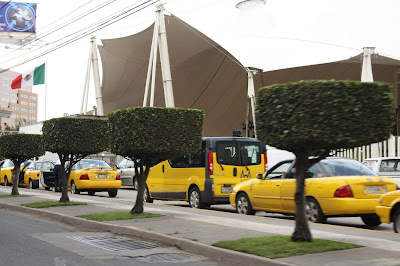
They look pretty, and are found all over. I also found carefully-manicured trees in cone shapes, more cylindrical shapes, etc. It seems that tree care is taken seriously in Mexico. It was also not uncommon to see the bottom few feet of a tree painted white. A park in Guanajuato had a whole bunch of trees carefully trimmed.
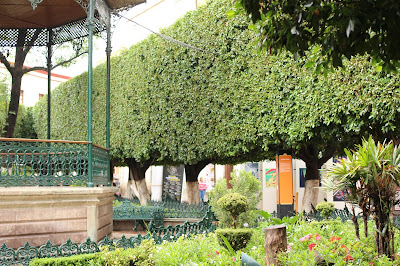
And from up on the mountain, it still looked impressive (the green area behind the dome).
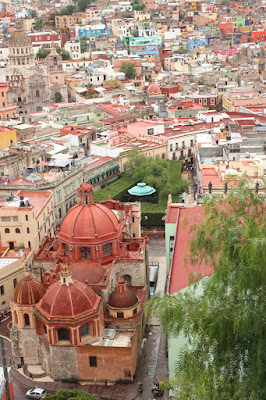
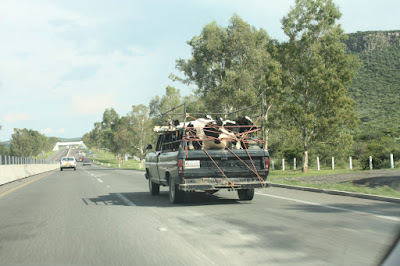
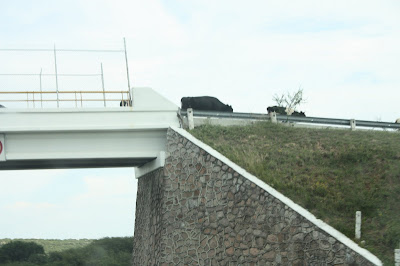
Driving in Mexico was interesting for a lot of reasons. The highways there aren t quite as limited access as the freeways in the USA. It was quite common to see bicyclists, walkers, a mule, or some cattle ambling along the side of the road. Roadside taco stands don t require taking an exit. You just pull off the road because it s right there.
Some sights were a bit surprising. Cattle in a pickup, with rope, for instance.
Or cattle crossing the highway on the overpass.
Street vendors were everywhere. Stop at a red light and someone might spring from the side of the road and suddenly start washing your windshield (expecting a tip); try to sell you flowers, juice, or bug zappers; or even throw business card-sized advertisements for adult websites into any open windows they can find. One night we saw an incredible fire juggler. I would have tipped him well but he was too far away to do so before the light turned green.
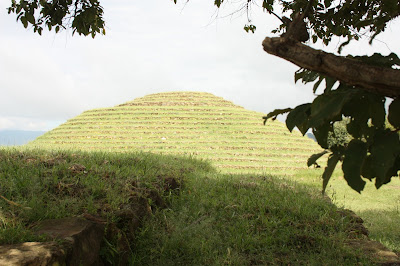
Mexico s history stretches back into prehistoric times, and we saw the Teuchitlan
ruins at Guachimontones one day. It was truly a remarkable feeling to be able to walk down the middle of the ancient ball court, or to climb up one pyramid and see the other from it.
It s not exactly architecture, but Jacob and Oliver sure enjoyed visiting the hot springs at Bosque de la Primavera. Jacob still remembers that where the steam is, the water is 200 degrees, and we CAN T TOUCH IT THERE!
Back in Guadalajara, here s a photo from the inside of the grand old cathedral.

Compared to the cathedrals we saw in Europe, this was of a similar general size and design, and perhaps only slightly newer. But one big difference: worshipers outnumbered tourists at every Mexican cathedral I saw, whether in the center of Guadalajara or at a rainy intersection in Guanajuato or a plaza in Tlaquepaque. It made them feel more alive, and perhaps more sacred as well.
One surprise was seeing people sitting on the steps of the cathedral in downtown Guadalajara selling trinkets such as beads. I think the only other place I had seen something like that was in New Orleans.
All of Guadalajara s Centro was beautiful. Much of it survives from colonial days; I think a person could spend days exploring its museums and buildings. Way too many of my 900 photos were taken in Centro to post on the blog, but just for flavor, here s one of the less than historic scenes.
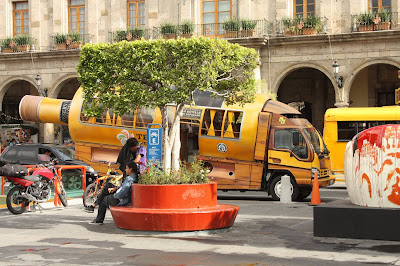
Yes, that is a bus shaped like a tequila bottle.
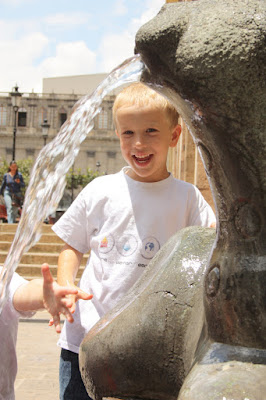
Fountains were beautiful and common across Mexico. A few of them were easily reachable by boys, and ours sure loved those.
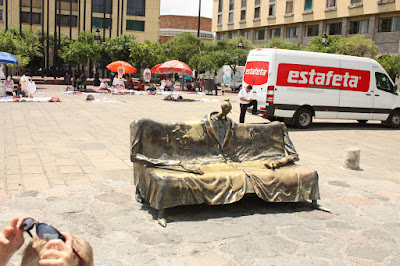
There was a lot of public art, including this interesting chair/skeleton/I m not sure what it is:
And, just for good measure while walking around Centro, they tossed in an apparent Redundant Array of Inexpensive Typewriters.
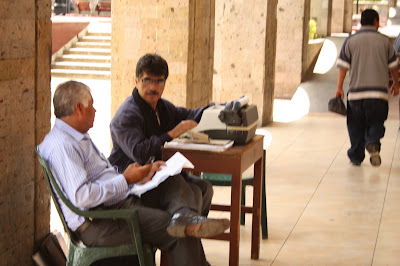
I don t know what they were doing, but there were about a dozen guys sitting out in the sun typing on their manual typewriters on their identical tables.
And who can leave Guadalajara without seeing one of North America s most impressive traffic circles. I ve got to hand it to the Mexicans for making something that is normally really boring into an interesting work of art.
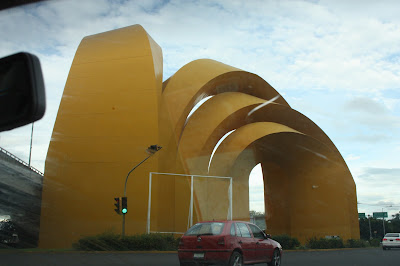
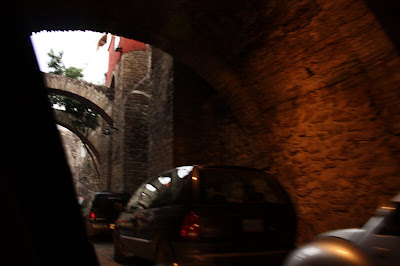
Over in Guanajuato, a lot of driving takes place in the city s vast underground tunnel system. Here s a scene emerging from one of them.
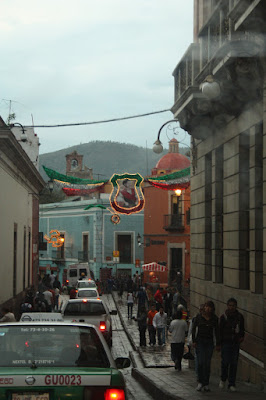
Guanajuato was already getting decorated for Mexican independence day festivities (Sept. 15-16) while we were there.
Here s a typical Guanajuato street scene.
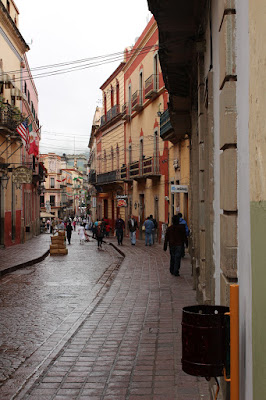
Many of the streets were closed to traffic and perhaps not wide enough to handle vehicles anyway. Those streets had a wonderful peaceful and slow feel to them.
I feel that I ve barely done the trip justice with this post. The feelings of walking down a beautiful Guanajuato street, or stepping into a Spanish cathedral, or even seeing a bunch of guys with typewriters, just can t be replicated. It s brimming with history and character, and shouldn t be missed.

Continuing my
series of articles on dpkg s errors, this time I ll cover a pretty common one which has several variations:
Setting up acpid (1:2.0.12-1) ...
rm: cannot remove  /etc/rc1.d/K20acpid': No such file or directory
dpkg: error processing acpid (--configure):
 subprocess installed post-installation script returned error exit status 1
Errors were encountered while processing:
 acpid
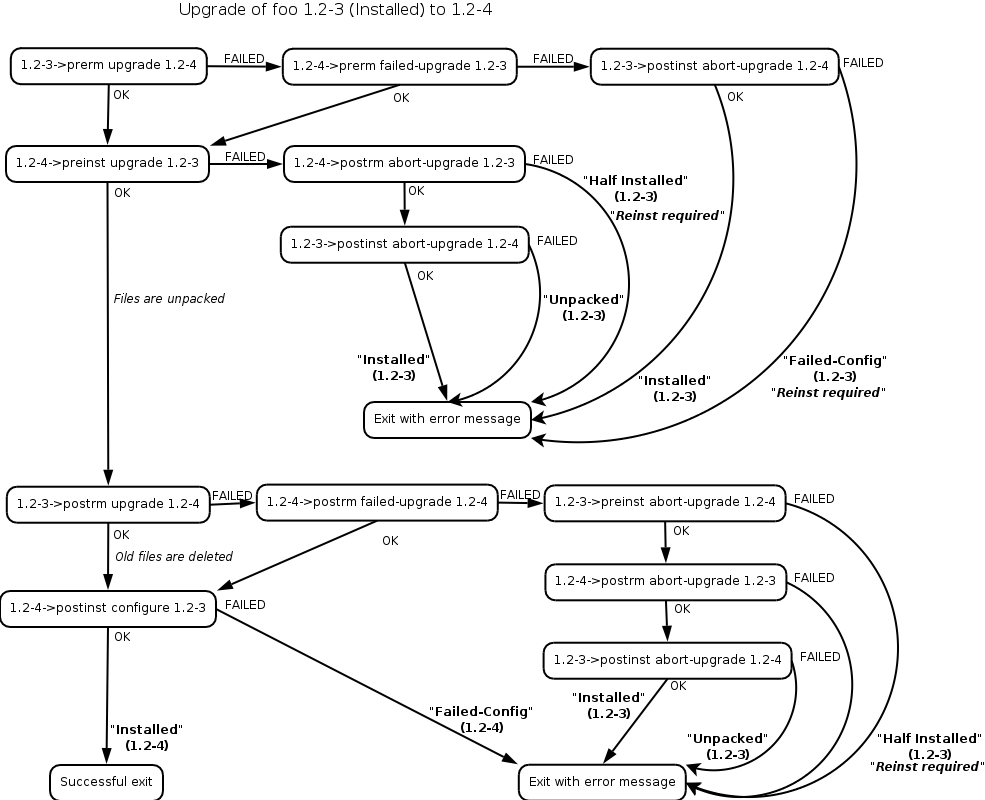
Even if dpkg is failing and outputting the error message, the real problem is not in dpkg but in the installed package (acpid in the example above). As we
already learned, a package contains not only files but also maintainer scripts that are executed at various points of the installation process (see
some useful graphics to understand how they are called, thanks to
Margarita Manterola).
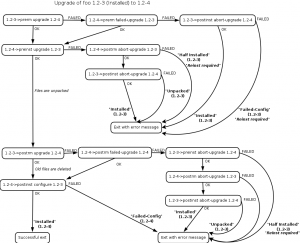
Maintainer scripts in a package upgrade
In the introductory example it was acpid s post-installation script that failed, and dpkg is only forwarding that failure back to the caller. The maintainer scripts are stored in
/var/lib/dpkg/info/. You can thus inspect them and even modify them if you hit a bug and want to work around it (do this only if you understand what you do!).
One common modification is to add
set -x at the start of the script and to retry the failing operation. That way you can see what s executed exactly. Here s what the output could look like after the addition of
set -x to
/var/lib/dpkg/info/acpid.postinst:
$ sudo dpkg --configure acpid
Setting up acpid (1:2.0.12-1) ...
+ dpkg --compare-versions 1:2.0.11-1 lt-nl 1.0.10-3
+ dpkg --compare-versions 1:2.0.11-1 lt-nl 1.0.6-16
+ dpkg --compare-versions 1:2.0.11-1 lt 1.0.6-6
+ rm /etc/rc1.d/K20acpid
rm: cannot remove  /etc/rc1.d/K20acpid': No such file or directory
dpkg: error processing acpid (--configure):
 subprocess installed post-installation script returned error exit status 1
Errors were encountered while processing:
 acpid
This output helps you locate the command that is actually failing. Here s it s relatively easy since we have an error message from rm . And the fix is trivial too, we replace rm with rm -f so that it doesn t fail when the file doesn t exist (this is a fake bug I made up for this article I just added a failing rm call but it s inspired by real bugs I experienced).
Maintainer scripts are supposed to be idempotent: we should be able to execute them several times in a row without bad consequences. It happens from time to time that the maintainer gets this wrong on the first try it works, so he uploads his package and we discover the problem only later once someone ended up executing the same code twice for some reason.
Follow me on Identi.ca, Twitter, Facebook and Google+. Or subscribe to this blog by RSS or by email.
7 comments Liked this article? Click here. My blog is Flattr-enabled.

For the longest time, I went by the nick "Yoe" when I went on IRC.
When I chose this nick for myself, I was sixteen, and the Internet
computer at the local public library had an IRC client installed that I
tried out. Obviously, my first choice of nick -- "wouter", a fairly
common first name in Dutch-speaking regions -- was already chosen, so I
had to come up with something else. If I'd realized that I'd still be
using this nick today, seventeen years later, I
might have
chosen that nick with a bit more care...
Over the years, some people have asked me what the nickname meant,
where it came from. I've never really told anyone the entire story,
mainly because it was somewhat embarrasing. But hey, we've all been 16,
right?
In the early nineties, there was a show on TV called "Het huis van
wantrouwen". On this show, they had a running joke involving a short
clip of Belgian members of parliament informally voting on a subject by
raising hands (literally); the joke was that this clip was dubbed with a
bunch of people saying "Yoe, de manne" -- which is dutch for something
along the lines of "Yo, guys".
As a young geeky teenager, I found this joke way more funny than it
actually was; and as such, a few years later, during one of the more
weird episodes of my life, I started pranking people by sneaking up to
them from behind and shouting "Yoe, de manne" right next to their ears.
I even managed to do this to one of our teachers who was walking on the
playground.
This was just around the time when I first tried out this "IRC"
thing. It didn't take me
too long to realize I was the only
person who thought this "joke" was funny; but somehow the nick stuck,
and here we are, 17 years later, I'm still using it.
Or, well, I
was. As of today, if you want to catch me on
IRC, you'll find me going by "wouter" instead of "Yoe". Of course
someone had registered that nick several years ago, but then he hadn't
been using it in
years, and so after a quick request to the
OFTC admins they made it available for me.
Whee.
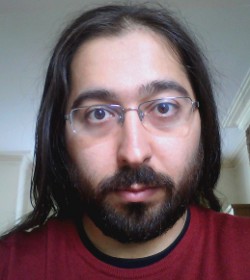
Even though Enrico is not smiling on this picture, he s one of the friendliest Debian person that I know. I always enjoy his presentations because he can t refrain from inserting jokes or other funny tricks.

That said he s serious too, there s lots of good stuff that he has developed over the years (starting with Debtags) and he has put a lot of effort in reforming the New Maintainer process. Read on to learn more about his various projects.
Raphael: Who are you?
Enrico: Hi, I m Enrico Zini, a
DD from Italy. I m 35 and I work as a freelance Free Software developer. One of my historical roles in Debian is taking care of Debtags, but that is not all I do: my paid work led me to write and maintain some weather forecast related software in Debian, and recently I gained a Front Desk hat, and then a
DAM hat.
Raphael: How did you start contributing to Debian?
Enrico: It was 2001, I was at uni, I was using Debian. At some point I wanted to
learn packaging so I read through the whole Policy from top to bottom.
Then I thought: why package only for myself? . There were many DDs at
my uni, and it only seemed natural to me to join Debian as well.
Evidently this was also natural for Zack [Note from editor: Stefano Zacchiroli], who had become DD 6 months
earlier and didn t hesitate to advocate me.
I found the Policy and the Developer s Reference to be very interesting
things to read, and I welcomed my
AM s questions as an excuse to learn
more. I completely understand those people who have fun trying to answer
all the questions in the NM templates while they wait for an AM.
With my super DAM powers I can see that my AM report was submitted on
October 16, 2001 by my AM Martin Michlmayr, and that James Troup created
my account 9 days later, on October 25.
Raphael: You have a special interest in the New Maintainer (NM) Process
since you are a Debian Account Manager (DAM) and a member of the NM Frontdesk.
Thanks to your work the process is much less academic/bureaucratic than it
used to be. Can you remember us the main changes?
Enrico: One of the first things I noticed when I become a Front Desk member is
that there was a tendency to advocate people too early, thinking by
the time they ll get an AM, they ll know enough .
Unfortunately, this didn t always work, and once the real NM process
started it would turn into a very long and demotivating experience both
for the applicant and for the AM. So we tried
raising the bar on
advocacies, and that seems to have helped a lot. If people join NM
when they are ready, it means that NM is quick and painless both for
them and their AMs, who are therefore able to process more applicants.
We also did a rather
radical cleanup of the NM templates , which are
a repository of questions that Application Managers can ask to their
applicants. We realized that AMs were just sending the whole templates
to their applicants, so we moved all non-essential questions to separate
files, to drastically reduce the amounts of questions that are asked by
default.
Other improvements in the NM process came from other parts of Debian:
nowadays there are lots of ways to learn and gradually gain experience
and reputation inside the project before joining NM, which means that we
get many candidates who we can process quickly.
For example, packages can now be uploaded via sponsors, and the
Mentors
project helps new contributors to find sponsors and get their first
packages reviewed.
Then one can now become
Debian Maintainer and take full
responsibility of their own packages, gaining experience and reputation.
The idea of working in teams also helped: big teams like the
Perl,
Python,
KDE,
Ocaml,
Haskell teams (and many more)
are excellent entry points for people who have something to package.
But Debian is
not just for packagers, and one could join teams
like the
Website team, the
Press and Publicity team, the
Events
and Merchandise team or their local
translation team.
Becoming DDs the non-uploading way is not just for non-technical people:
one could enjoy programming but not packaging. An interesting way to get
involved in that way is to help writing or maintaining some of the
many
Debian services. Note that I m not suggesting this as a way to learn
how to program, but as a way to get involved in Debian by writing code.
Finally, we started to appreciate the importance of having people
activities in Debian explicitly visible, which means that the more
obviously good work one has done in Debian, the less questions we need
to ask. Jan Dittberner s
DDPortfolio is an excellent resource for AMs
and Front Desk, and I m maintaining a service called
minechangelogs
that for people who have done lots of work in Debian is able to
fully replace the Tasks&Skills parts of the NM process.
Raphael: What are your plans for Debian Wheezy?
Enrico: For Wheezy I hope to be able to streamline and simplify Debtags a bit
more. At Debconf11 I had a conversation with FTP-masters on how to make
some tags more official, and I now have to work a bit more on that.
I d also like to considerably downsize the codebase behind the debtags
package, now that its job is quite clear and I don t need to experiment
with fancy features the way I did in the past.
I have to say that I enjoy programming more than I enjoy packaging, so
most of my plans in Debian are not tied to releases. For example, I d
like to finish and deploy the
new NM website codebase soon: it would
mean to have a codebase that s much easier to maintain, and in which
it s much easier to implement new features.
I d also like to design a way to allow maintainers to review the tag
submission to their own packages instead of having to wait for me or
David Paleino to do a regular review of all the submissions.
Finally, I d like to
promote the
usage of apt-xapian-index
in more cutting-edge packaging applications. And to design a way to
maintain up to date popcon information in one s local index. And improve
and promote
those services that I maintain, and I tend to often have
ideas for new ones.
Raphael: If you could spend all your time on Debian, what would you work on?
Enrico: If I could spend all my time on Debian, I would do a lot of software
development: I love doing software development, but most of my
development energy is spent on my paid work.
I guess I would start my all your time in Debian by taking better care
of the things that I m already doing, and by promoting them better so
that I wouldn t end up being the only person maintaining them.
After that, however, I reckon that I do have a tendency of noticing new,
interesting problems in need(?) of a solution, and I guess I would end
up wildly experimenting new ideas in Debian much like a victorian mad
scientist. Which reminds me that I most definitely need minions! Where
can I find minions?
Raphael: You re the author of the
Debian Community Guidelines. I have always felt that this document
should be more broadly advertised. For example by integrating it in the
Developer s Reference. What do you think?
Enrico: The DCG was really a collection of tips to improve one s online
communication, based on ideas and feedback that I collected from
pestering many experienced and well-respected people for some time.
Like every repository of common sense, I think it should be widely
promoted but never ever turned into law.
It wouldn t be a bad idea to mention it in the Developer s Reference, or
to package it as a separate file in the developers-reference package.
The reasons I haven t actively been pushing for that to happen are two:
there isn t much in the DCG that is specific to Debian, and I don t have
the resources to do a proper job maintaining it.
It d be great if somebody could take over its maintenance and make it
become some proper, widespread, easy-to-quote online reference document,
like one of those HOWTOs that all serious people have read at some point
in their lives.
Raphael: What s the biggest problem of Debian?
Enrico: It s sometimes hard to get feedback or help if you work on something
unusual. That is partly to be expected, and partly probably due to me
not having yet learnt how to get people involved in what I do.
Raphael: What motivates you to continue to contribute year after year?
Enrico: Debian keeps evolving, so there is always something to learn. And Debian
is real, so everything I do is constantly measured against reality. What
more intellectual stimulation could one possibly want?
Raphael: Is there someone in Debian that you admire for their contributions?
Enrico: I don t think I could reasonably list everyone I admire in Debian:
pretty much in every corner of the project there is someone, sometimes
not very well known, who is putting a lot of Quality in what they do.
Someone who decided that X should work well in Debian or that Debian
should work well for Y or that Z is something Debian people can rely
on and makes sure that it is so.
Those are the people who make sure Debian is and will be not just a
hobby, but a base upon which I can rely for my personal and working
life.
Thank you to Enrico for the time spent answering my questions. I hope you enjoyed reading his answers as I did.
Subscribe to my newsletter to get my monthly summary of the Debian/Ubuntu news and to not miss further interviews. You can also follow along on Identi.ca, Twitter and Facebook.
5 comments Liked this article? Click here. My blog is Flattr-enabled.
Here's how I have created the beginnings of a profitable Kindle formatting and conversion service,
LiberWriter, from scratch.
Last Winter, I read one of the best business books I have read in a long time,
Rob Walling's Start Small, Stay Small:
<iframe frameborder="0" marginheight="0" marginwidth="0" scrolling="no" src="http://rcm.amazon.com/e/cm?lt1=_blank&bc1=000000&IS2=1&bg1=FFFFFF&fc1=000000&lc1=0000FF&t=dedasys-20&o=1&p=8&l=as4&m=amazon&f=ifr&ref=ss_til&asins=B003YH9MMI" style="width: 120px; height: 240px;"></iframe>
Rather than being a "big idea" book that includes one big idea and lots of stories to support it, it's a very practical book on how to go about creating a small online business. I've always been someone who loves to build things, from various open source projects, to diverse web sites that people have found valuable. However, I am not a "business guy". I'm not that good at making money, so the simple approach in the book is really better for people like me: make something and sell it. Advertising can certainly work, but it's so much harder to figure out the numbers compared with a product, where you can compare the cost of providing the product to the price people will pay for it. And that's just one thing; the book has tons of ideas about practical ways of going about putting together a profitable small online business. It's not a "get rich quick" book - part of the idea is that if you are looking at a niche that is fairly small, it will simply not be of interest to larger companies, so you aren't going to get outspent and outcompeted by them.
In any event, though, at about the same time I read the book, I was poking around looking at Amazon's KDP, which allows you to self publish for the Kindle, and noticing how difficult the process is. The native format of Amazon's books is HTML with several XML files thrown in for good measure. Now, for someone technical, that's certainly not an insurmountable obstacle, but for many authors, it's a very unpleasant prospect. Granted, you can also manipulate a Word file to make it suitable for the KDP, but even that is something that many people dont' find to be a productive use of their time. They're authors, and they want to write.
Having spotted a niche that looked interesting - I love to read, and I like the idea of helping out authors - I discarded the book idea I was looking at myself and did some writing of my own: source code for a project that would automate the process of converting and formatting Kindle books.
The core of the system was a fun evenings/weekends project, and soon it was able to produce pretty good books. After "inflicting" the beta version of the system on several people, such as Rich Bowen (thanks again, Rich!), I got it beat into shape and started accepting the first paying customers. It's very exciting to have those first few people pay for something you made - it's a great feeling!
Initially, my thought was to sell it as a way to write books directly for the Kindle, however, it soon became evident that 99% of people have already written their books with Microsoft Word, so what they were really interested in was a conversion and formatting system that would take a Word document, poke and prod, stitch and stretch it some, and output a nice looking book for the Kindle.
One of the lessons from Rob's book was that stuff doesn't have to be perfect if it works. Initially, I had people putting their word documents into LiberWriter not with the smooth(ish) upload process we have now, but by cutting and pasting in their documents! As a computer guy, doing things in a hacky way is sometimes very unpleasant, but you know what? It worked, and it was easy for people to handle, so I ran with it until a better system was in place.
Writing code was the easy part, and definitely within my "comfort zone". Some of the other things I've had to do have been much more difficult, and as a consequence, more of a learning experience.
For instance, I realized early on that the process would never be 100% automatic, so I'd have to get some people to work on the books, with the idea being to provide them tools to make the process as simple, quick, and easy as possible. I'm always on the lookout for new things to script within the system.
However, need people it does, and finding them and engaging them has been a difficult process. As per the book's suggestion, I've primarily used oDesk to find contractors, and have grardually begun to find some people who work really well. It has taken time, and has not been easy, though. I'm not an introvert, but in some ways I'm happiest when doing my own thing. Being the 'boss' is new. One of the tricky aspects of oDesk is that pretty much any job posting gets tons of responses, some of them from people who appear to have barely read the posting. One trick I learned is to request that the potential contractor creates an account with LiberWriter. Very simple and not a waste of time, and yet a majority of applicants ignored the request.
Through most of the spring and summer, LiberWriter remained something strictly for the evenings and weekends, as I was busy with client work during the days, and with my daughter during the afternoons, but as August rolled around, I found some more time on my hands, and really started investing more energy in LiberWriter. It has been very rewarding to see a corresponding increase in the number of customers. We (at this point, between myself and the contractors, LiberWriter is a group, and no longer "I") also raised prices - another valuable piece of advice from the book, and... pretty much anyone who writes for people jumping into online businesses. As tech people, we often tend to aim low in terms of prices. Indeed, soonish, prices will likely go up again.
Another challenge has been turning it as much as possible into a "productized service". Since Kindle books are fairly simple in what you can do with them, as long as you don't get too fancy, it's possible to automate *most* things, but not everything, so it's not just a product that people buy and it works and that's that; there's a human element involved, which means more communication, and more potential for things to go off the rails. I've been investing time in automating the workflow of the system, but have a lot more to do on that front. Also, one of the things our customers love about the service is being able to deal with "real people", something that is more difficult at Amazon. That's good for us in one way, but in the future, it will be critical to document things and make them as simple as possible to avoid generating unneccessary support requests, as it can easily take up a lot of time.
Indeed, because LiberWriter does attract customers who are often not all that technical, making the user experience as easy and straightforward for them as possible (and then some) is extremely important. It can be exasperating once in a while, but I do my best to channel any frustrated energy on my part into making the site ever easier and ever more straightforward. In other words, instead of "how the heck do they not get that?!" it's "what can I do to make sure the tools and information they need are even easier for them to get?". There's lots to do on that front, but on the whole it's actually part of the project that I've grown to like a lot. Rather than dealing with other techies like myself, our customers are people who really benefit from what we offer because we can save them so much time and frustration.
Marketing the system is fun, but another area where I have a lot to learn: I'm not a natural when it comes to marketing or selling. One thing that has worked well so far is finding forums where your target users hang out, and then.... spam them as often as possible? No way! Be yourself, and provide genuine help and value to people in the forums. By being on the level, and not trying to sell! sell! sell! people are friendlier and more receptive to your message. It can be time consuming, but I suppose it's the sort of thing where taking the wrong short cut could be very detrimental over the long haul.
Without disclosing too much, I don't think I'll ever get rich from LiberWriter, but it is incredibly satisfying to have created and marketed a product of my own that goes beyond just selling my own time. LiberWriter doesn't bring in as much as consulting, yet, but it feels like much more of an investment, something that will have some momentum of its own, and of course it has been an incredible learning experience. I like programming, but being outside of my "comfort zone", doing stuff that's new and challenging is also a very positive part of the project. If things continue to grow the way they have been, I could envision depending on LiberWriter as my primary source of income in the very near future. That's a bit of a jump into the unknown in some ways, but I'd love it. I have worked very hard on it lately, and one of the things I am enjoying is always having new ideas about how to improve every aspect of the system, from customer service to the mechanics of the conversion process, to tracking the finances. In some ways it's tiring because I'm thinking about it *all* the time, but it's that "good kind of tired".
It's been a tumultous summer, and in the past few weeks we (well, my wife much more than me!) had a new baby boy, and bought a house here in Padova. To keep things interesting for the future, I applied to the
Startup Chile program with LiberWriter. I suspect they're more interested in startups with high growth potential, but I feel strongly that the approach outlined in Rob's book is one that people outside of Silicon Valley, without easy access to venture capital and the huge talent pool that area has, should consider, rather than trying to copy what makes Silicon Valley work like it does.
Whether I get accepted or not, LiberWriter will continue to grow, and, I sincerely hope, thrive. A big thanks to all our customers, and to my wife Ilenia, and children, Helen and Daniel for tollerating all the time I spend with the computer.
I wrestled a bit with writing this post, as I don't want to "jinx things", and I've only just got a small taste of "success", but I've always enjoyed reading about how "ordinary people" have managed to create their own small businesses, people like those behind
Balsamiq, "
Bingo Card Creator", and the like, and I figure that writing up my own experiences is a way of "paying it forward".

 Session reuse is one of the most important mechanism to
 To avoid a full
 Two mechanisms can be used to accomplish an abbreviated handshake:
 It is difficult to get extensive results this way since you need to
install a lot of browsers to get something valuable. Surprisingly,
Android 2.3.4 browser (as shipped by Cyanogen Mod) does not support
any session resume.
Another way to check if a browser supports session resume is to use a
sniffer and to spot Client Hello messages. If a client tries to
resume a session, it will use an appropriate session identifier or
send a ticket. A simple
 The program will try to establish five consecutive
 I m listening to quite a few podcasts recently. Here are my current favourites:

 Matthias Klose, the tireless force behind the Debian / Ubuntu gcc, python,
and what have you packages, sent me a minimal patch to let