Search Results: "ah"

22 January 2012

Jon Dowland: The Crying Tree

Somebody bought The Crying Tree by Naseem Rakha for Sarah as a present and she asked me to read it so we could talk about it, so I did. It's a novel about a family tragedy, Southern-state U.S.A. and the death penalty. A little boy is shot dead, a man is arrested for the crime and faces the death penalty. The book chronicles what happens to the family and to the killer during the 19 years or so that passes before the execution takes place. The book could be accused of having an anti-capital punishment agenda, but I have no problem with that. At least until about half-way through the book, the plot and happenings follow the synopsis with little in the way of surprise, but then there's a twist. I felt that the twist diminished the message of the book. Without trying to spoil what happens, I felt that you didn't need the core details of the story to be varied or expanded upon or U-turned to push that agenda. In my opinion, it's perfectly possible for someone to construct a story about a killer who faces death, who was unambiguously guilty of the crime they are charged with, and still leave the reader feeling remorse for the killer, and questioning the justice meted out. In fact I thought Rakha was doing a fine job of just that. However, a twist (or twists) occur, and the facts are called into question, and so you ask even further questions about the practise of killing criminals, in my view redundantly. It's a good book and worth a read, regardless of what your position is on the issue. It does a great job of describing the unbearable pain of losing a child, but also of the power of forgiveness for the victims.

19 January 2012

Obey Arthur Liu: Google Summer of Code 2009 at Debian needs you


In case you've been living under a rock these past years, I shouldn't have to tell you what this is about :). Well, just in case.
The Google Summer of Code (GSoC) is an international program that offers student developers stipends to write code for various open source software projects. Debian has participated since 2006, mentoring dozens of students on Debian projects.

The important part of the 2009 edition of the Google Summer of Code is going to start next week with the Organizations application period (March 9th). By that time, we should have listed a reasonable number of ideas on the dedicated wiki page.

We will try this year to improve on the performance of the previous years, starting first with more and more dedicated manpower. If you have some time to spare to help manage our Summer of Code bid this year, we can make it a much better experience for the students and for Debian.

Help is immediately needed in many areas. Some examples:

By mid-March, we will need:

Further in the spring:

In the summer:

As you can see, there is much work ahead. It's time to pitch out your favorite pet project :)
Remember! The Summer of Code has become a prominent outreach forum for open source organizations. It puts a spotlight on each of them to provide a well-rounded and deep experience of open source development.

Right now, you can help with the Wiki, join us on IRC on #debian-soc on OFTC or join the mailing-list at soc-coordination on alioth.

The short "flyers-friendly" URL for the Summer of Code at Debian is : <http://wiki.debian.org/gsoc>. Publicize it!

See you this summer!

Brett Parker: StarTech IP KVM - SV1107IPEXT

So, at work we have a little single port IP KVM, it is a StarTech SV1107IPEXT - it's not a "bad" bit of kit, if you're completely configured for using it in the way they expect... When you're not, then it throws a NullPointerException when you try to connect with it's Java applet. This morning (mostly because the monitor and keyboard I had been using for building stuff on my desk has gone missing) I decided I'd try again with the device, it's not on our default office network range, mostly because it might not always be in the office, so I quickly added an ip alias using ip addr add 192.168.0.59/24 dev wlan0 on my laptop to bring up a route to it. Navigated to the page and asked it to fire up the Java applet. Straight off, a NullPointerException happens - hmm. So looked at what was being logged by the JVM - it was trying to run ifconfig (no, really, the java applet ran ifconfig... with no path...) which, on my debian laptop, is not in the default path... so I went and make a quick wrapper in ~/bin for it... right - now it can run that... still a NPE, hmm. So look a little closer, it's looking for the MAC address assigned to the IP that you're coming from... no, really! WTF! So I went and hacked my little ifconfig wrapper to rewrite the address for wlan0 to be what the KVM expected it to be, low and behold, I can now run the java client (hoorah!). Why the heck are they doing that though - that's just plain insane! On the plus side, I now have a work around, on the minus side, egad that's ugly!

Gerfried Fuchs: Squeeze RCs's Squashing 2012 #1

As sort of new year's resolution I started picking up the habit to work on release critical bugreports for squeeze again. The number is way to high to be healthy, but at least it is (still) below the amount of release critical bugreports for unstable. It will be an uneven fight because it seems that there are quite some people working on weeding out release critical bugreports in unstable, but those who are interested in weeding out releasing critical bugreports in stable seems to be limited, even though it is one of our supported releases and thus should receive quite some attention, at least by the corresponding package maintainers themself. So here is the list that I managed so far: That makes 29 squeeze RCs squashed so far, I hope I can keep up with it. Enjoy!

/debian permanent link Comments: 2 Flattr this

18 January 2012

Christian Perrier: Zou....Italian (and Danish, and Dutch....) take off!

The increasing storm of localization NMUs and uploads, related to debconf translations, has an interesting effect: some teams are now incredibly active at pushing translations for their language towards the magic 100%. So, after Danish (effort lead by Joe Hansen) and Dutch (effort lead by Jeroen Schot) which I already mentioned, it seems that the Italian localization team started engines and is now taking off. It will be interesting to watch these teams competing (in a friendly way) to climb in statistics over next months..:-) So, if you're Italian (or speak it well) and want to help, please join the Italian l10n mailing list (debian-l10n-italian on lists.debian.org. If you're Danish or Dutch and want to stay ahread the two others, please joind debian-l10n-danish or debian-l10n-dutch. PS: why did I write "Zou" in this post's title? Because this is a common French interjection for "Whoooosh" and because this is part of the nickname of the tireless and incredibly active, in many places, Francesca Ciceri, aka MadameZou, who's is doing so much for Italian localization (and many other areas in Debian such as the publicity and web team). And that really deserves some lights, trumpets, etc.

16 January 2012

Eddy Petri&#537;or: What's common between Windows 7 and GNOME 3 / gnome-shell?

Update: I managed to make sound work. For some weird reason, a mute switch option of some the many (and who knows how useful) switches of my sound card was enabled. Now the damn thing works. Did I mention that since I did the upgrade all my sound cards (I have a USB sound card, too) have listed as available inputs all the inputs of my internal sound card (mic, front mic, line in, CD, etc.) in Audacity? That makes for a very confusing and loooong sound input sources list! The upside is that I can finally record clips from televisions that do not provide such a feature and FastVideoDownload doesn't handle.

I also seem to have found a possible fix for the caps-ctrl issue in Xfce4 (obviously, setting "-option ctrl:swapcap" in ~/.Xkbmap, instead of that Alt modifier).


As I said in my previous post, I will tell you what do GNOME 3 and Windows 7 have in common.

Before everything else, I want to make it clear that when I am saying GNOME 3, I am referring to Debian Wheezy's GNOME 3, since I recently upgraded from Squeeze on my laptop. I'll probably drop a line or two about that, too.

First, I'll tell you about the (boring, probably for many) experience with Windows 7. As I said before, my new job requires me to use a Windows machine, so up until a few months ago I was using Windows XP with some additional software and tweaks to make it usable. Then came the Windows 7 upgrade . I am using quotes since the more appropriate term would be fresh installation on a new partition , not even close to what Debian users are used to call an upgrade.

So after a fresh Windows 7 installation, my first shock was the fact there was NO Quick Launch*. Some of you might be laughing, but I had never used Windows 7 up until then, just saw it on a laptop of a friend of mine (Ovidiu, one of the guys with whom I am doing this podcast, went to Denkfest with, and made these interviews). That was the first shock. Initial discussions about this with Windows users lead me to believe Quick Launch was dead and for some unexplained reason, I believed them. Later, much later, a week ago, to be precise, I found out that you can bring back the Quick Launch through some convoluted way**. Up until that point I had to have some icons pinned to the task bar, but some others on the desktop (and I hate that) because some of them, like Cygwin, if pinned, would start a cmd console, since Win 7 pins the process, not the starting script.

Among other things which broke in Win 7 and used to work fine in XP, the Virtual Dimension application which provides me with a virtual desktop, was the first one which was broken. I have been using a liniar 4 desktops-wide virtual desktop for over 5 years and I am worthless and inefficient if all my apps are on the same desktop. Mail application is always on the first desktop, work and file managers are on the second, the third is for extras and multimedia editing while the fourth is my gateway to the internet, containing the browser, instant messenger, or whatever.

The shortcuts I use to get to the various desktops are Win+1 ... Win+4 keyboard shortcuts, but the M$ Evil Empire decided that those shortcuts are going to start or bring foreward the first, second and so on applications pinned on the task bar. And you can't change those shortcuts***. Nor is disabling just those possible since they are all disabled through a huge switch which disables ALL Win+x keyboard shortcuts, among which Win+E (file expolrer) and Win+D (Show Desktop) were also. Luckly, Win+L (lock screen) was not disabled. So I disabled al those Win+ shortcuts, since I need virtual desktops.

Now, imagine if I had to start a Cygwin console and I had all sorts of apps open! Win+D was disabled, so I had to minimize the apps covering the desktop shortcut for Cygwin, click on the icon to start it, bring back the minimized windows and go on with my work. What a waste of clicks, mouse movement, energy and time, just because some dudes thought a Quick Launch-like feature was useless****.


You might wonder already what do those '*' sings mean. Well, sadly, that's what GNOME 3 / gnome-shell and Windows 7 have in common.

Gnome 3 was a shock for me. An empty desktop right after upgrade. No panels, no shortcuts*, no power indicators, no wicd indicator, no virtual desktops, no desktop icons, (I have a few dirs and docs there). Sounds like an Evil Empire decision, doesn't it?

Luckly I have been using Tilda as my always-ready console and I could fire up iceweasel from the console in order to understand where my panel disappeared.

I then realised that the upgrade brought me Network Manager, that app which wicd replaced. As a consequence, I had no working wlan since Network Manager made sure to mess up with the network manager I chose.

After looking through the documentation of Network Manager and realising I either had it set up to leave wlan0 alone or I didn't understood NM's documentation, I simply stopped the service, which let Wicd its job flawlessly.

The first thing I searched was Gnome 3 panel or something of that sort and I was confronted with the obvious option to appeal to the Forced Fallback Mode which was disabled. I figured I either had an old version, or Debian disabled this feature (hoping they provided an alternative). There was also the option to conform to this convoluted way of working** with Actions and such uselessness like that. I still wonder, what is the purpose of the Favourites bar on the left side, since it's accessible only after wasting a lot of mouse movement and time? For Joe's Pesci sake, I use focus under mouse just to avoid needless mouse and keyboard manipulation. Why? Why? WHY would I want every time I need to start or SWITCH to another application to move the mouse to the upper-left corner then take my hands off the mouse to type, move the mouse downwards or move across the whole width of the screen to get to my beloved virtual desktops and pick the app I want?

Making a long story short, after even trying XFCE4 (which for some unknown reason resets almost immediately my keyboard layout to the default layout with the Caps on Caps, instead of my preferred and set Ctrl on Caps - yes, it's global), I managed to find GNOME Shell Frippery** which made the experience better.

Later I found out that GNOME 3's file manager, Nautilus, has decided that an up on level button is useless, since the default is to use that uncopy-pastable button location bar instead of a sane text location bar. And it seems the GNOME developers decided this*** and I should conform to it.

To add insult to injury, those icons on my old panel are apparently useless**** and even in the fallback version I can't get them back. Or so the GNOME developers decided.

At some point this sunday, don't know how or why this change happened, producing sound was impossible. I know the problem is pulseaudio since when I kill the pulseaudio daemon from the console I can play audio. BTW, great timing, just when I needed sound the most, before releasing episode 32 of our podcast (yay, I reaslised that xfce just decided to reset my caps to be caps, after setting to ctrl a few minutes ago).

I know I praised pulseaudio when I first tried it, but failing to make it work out of the box or after some tinkering is a deal breaker for me, so I removed it. Now I find it that is a default in GNOME, yet all it manages to do is prevent audio from working. At least on my machine.

Other problems? Gnome Power Manager manages to hang and block my session, GNOME managed somehow to fail to start at some point. Yeah, and that sound problem which I didn't fix yet, didn't went away after removing all the pulseaudio packages which could be removed (e.g.: ryhtmbox depends on libpulse0, same do some other apps like audacity, so I couldn't remove all pulse related packages).

I got involved with Debian and GNU/Linux because it was tweakable and customisable, didn't use to force all sorts of option on me and now I find with its increasing popularity it becomes more and more like a product of a corporation which decides to change some things just to change and totally disregadring user experience and uses.

So, in the light of all of these problems I think it's time to probably consider trying KDE. Is it any good lately?

Benjamin Mako Hill: Mystery Hunt

I've mentioned before that I compete every year in the MIT Mystery Hunt -- an enormous, multi-day, round-the-clock puzzle competition held in January at MIT each year. Last year, my team Codex won the hunt. The reward (punishment?) for winning is the responsibility to write the 100+ puzzles, (and meta-puzzles, and meta-meta-puzzles, and theme, and events) and to put on the whole event the following year. So over the last year, I've worked with a huge group of folks to put together this year's hunt which had a theme loosely based on The Producers. My own role was small compared to many of my teammates: I contributed to some puzzle writing and to a bunch of "test-solving" of candidate puzzles to make sure they were solvable, not too easy, fun, and well constructed. During the hunt, I visited competing teams, verified answer submissions, and took advantage of my jet-lag from my return from Japan on the day of the hunt to work the night shift distributing items to teams. To get an idea of what the hunt is like, you can check out a puzzle I wrote for this years hunt. The solution is linked from the corner of that page.

15 January 2012

Roland Mas: Looking for the ultimate distributed filesystem

(This is not quite a Dear lazyweb post. If anything, it's Dear lazyweb, I've done my homework, now what? ) I'm looking for the ultimate distributed filesystem. Something that's simple to use, redundant, fault-tolerant, and still smart enough to avoid the more obvious performance chokepoints. Ideally, it should work for all of the following sets of files: The requirements on the ultimate distributed filesystem (which I'll call UDFS for short, otherwise you'll get bored and go look at pictures of kittens) are as follows: Quite a few constraints, eh? I have a feeling they are not mutually incompatible though, so I had a look at several candidates. I started with Wikipedia, and I followed the links to Tahoe-LAFS, XtreemFS and Ceph. The following is my evaluation of these candidates based on much reading of docs and websites and wikis, some questioning on IRC, and very little testing. The overall picture seems full of good things scattered across different solutions, but unfortunately none of the existing ones seems to address the whole problem; at least, not my whole problem. It would be good if each focused on one layer and did that layer well, but that seems not to be the case either, so they can't be combined to get the best of all worlds. It may be that I'm missing something, or that I failed to read some docs properly, or that I misunderstood the docs, or that the docs themselves are simply lacking; but my ideal UDFS currently doesn't seem to exist as a turn-key solution. However, the main pieces are available, and implementing the remaining parts may be doable. My humble idea of a way forward would be based on Tahoe-LAFS, with the following three changes: Also nice to have would be a way to work with multiple introducer nodes, but that seems to be in the works already. This would be pretty damn close to my UDFS; read/write performance would certainly be far from what can be obtained on native filesystems stored on local disks, but my use cases involve reasonably small files for which instant access is not compulsory, and the filesystem cache would probably absorb most of the access times. In case anyone is looking for ideas of things to do in their spare time, here are rough sketches of other possible UDFS implementations I thought of. These are wild ideas, and I'm not even sure they could be doable in practice: Such is the state of my research so far. I would welcome feedback, pointers to things I neglected to read, corrections for things I misread or misunderstood, comments on the ideas and so on. I'll probably post an update if my search goes significantly forward. Update: I've already received two pieces of feedback, including a lengthy one with corrections about Tahoe-LAFS. For the sake of fairness, I'll solicit (and wait for) the same from the other candidates I looked at. I was also pointed at HekaFS, GlusterFS and git-annex, which I'll have to look at in more details. Other suggestions are still welcome, but the more I get, the more the full update will be delayed. Thanks already!

Gregor Herrmann: RC bugs 2012/02

while working on RC bugs, I noticed that some DDs sent patches to the BTS in the last weeks (yeah!) but did not upload the fixes in NMUs. short request: could you please either state the reason for not uploading, or just go ahead and dput/dupload the fixed packages?

& here's my list:

14 January 2012

Lior Kaplan: Israel to recognize software patents

The Israeli patent registrar have reverted previous ruling regarding patents on software and published a draft for the procedures to accept such patents. The procedures are open to public comments for the next 30 days. Two years ago the patent registrar have started to consider revising the the issue and got many position papers (e.g. Hamakor s papter). At the end he decided not to accept patents on software. De facto, at least one such patent (US patent 7,596,609) was accepted to be valid in Israel after that ruling. Now that the rulings is reverted, I guess will see many more software patents granted here. I wonder about the implications on the local software market hopefully it won t stagnate due to patent wars such as the ones we see every now and then in the US.
Filed under: Software Patents

Christian Perrier: Aptitude revival

Maybe many people have missed this: Aptitude package manager is undergoing a revival. Two fellows, Daniel Hartwig and Manuel A. Fernandez Montecelo, started triaging bugs and preparing a possible new version. Daniel Burrows, who maintained it for years (and did a really good job in this, given the high exposure of aptitude, which happened to be the recommended package managers during a few years), has currently less free time for doing the work. So, this is really great to see people motivated in taking the job over. In case you want to help, please joing the "aptitude-devel" mailing list on lists.alioth.debian.org. There is an Alioth project but Daniel is currently the only administrator. I might ask for admin privileges so that I can validate new team members. Of course, I personnally can't do much in this (C++ programming, coding, ah ah ah...things that are black magic for me), except my usual help for i18n/l10n. But, at minimum, I can make noise about this effort to encourage the volunteers who commit themselves to revive the project. And, I can certainly help by sponsoring their work (none of them is DD as of now) even if I am not skilled enough to review everything. I don't want to see good work wasted because people insist on nitpicking each and every commit line before "approving" it (any idea what I'm talking about, here? :-)).

11 January 2012

Jon Dowland: The Silent Land

I've just finished reading Graham Joyce's haunting The Silent Land: an atmospheric and moving love story set in an Alpine ski resort. Husband and Wife Jake and Zoe head out to the slopes early one morning and are caught in an avalanche. They survive, narrowly, but upon returning to the resort, everything has changed Anyone who has read any quantity of SF or fantasy will probably make an early guess at what's going on, and you'd most likely get it wrong. Even if you know where you're going, the journey is often the point, rather than the destination, and this journey is pretty gripping. I do most of my reading on the train to and from work. I often listen to music when I'm reading and I try to choose things which aren't going to distract my attention from the book too much. Film soundtracks are good; so is classical; so is a lot of Eno's work. For this book I mostly listened to the score from the latest film version of The Girl with the Dragon Tattoo, by Trent Reznor and Atticus Ross. Clocking in at only seven minutes shy of three hours, this is a haunting score that evokes a cold, isolated Swedish winter, and thematically matched the book perfectly. The score is a little less accessible than their previous work, but is rewarding on repeat listen. You can get a free 6-track sampler at the website linked above.

9 January 2012

Steve McIntyre: Armhf buildds and status in Debian

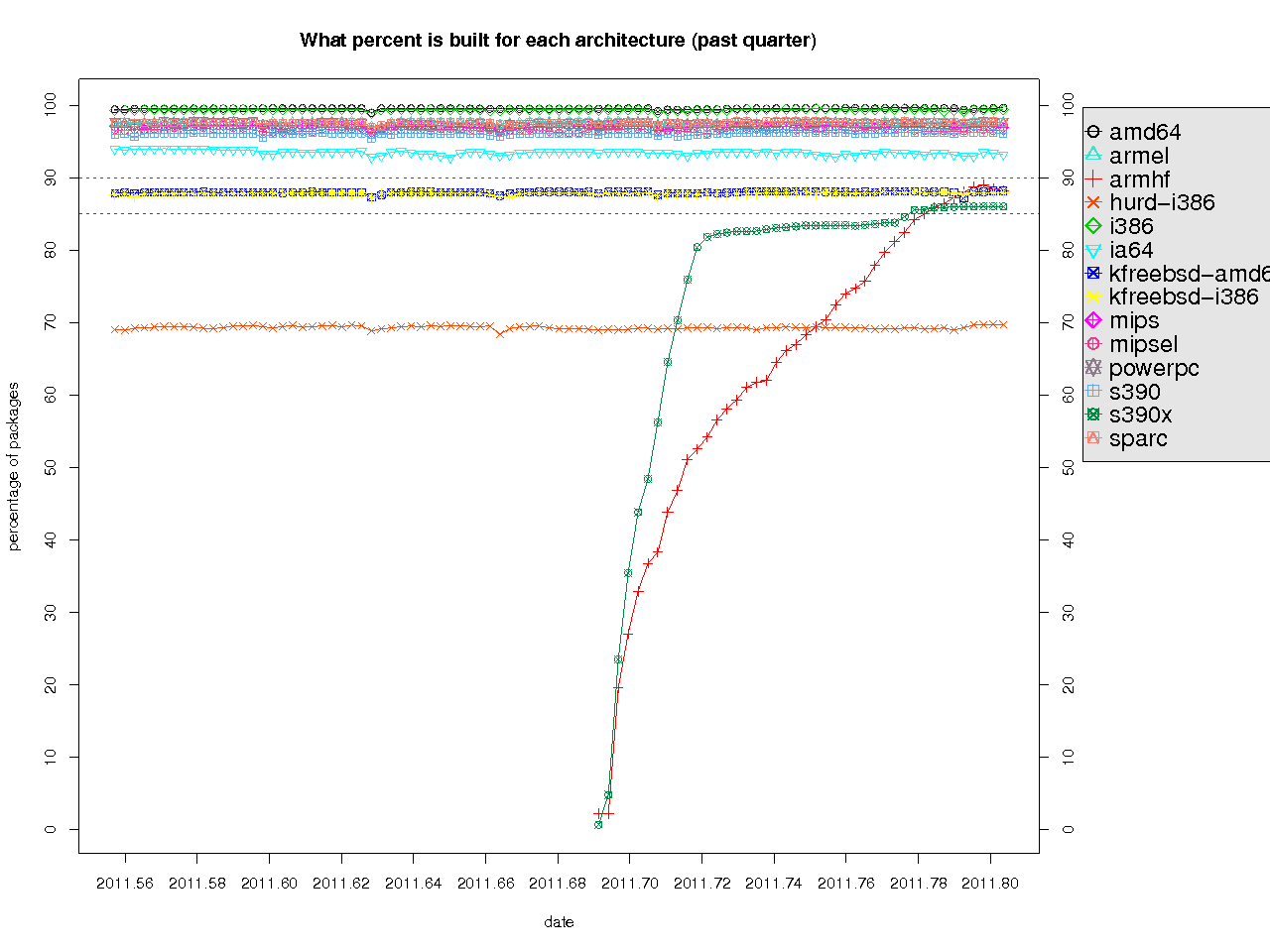
Current status Back in September, I wrote about the machines that I set up to help bootstrap the new armhf port in Debian. Basing on Konstantinos' huge efforts in bringing up the new "architecture" in debian-ports, we started importing armhf into the main Debian archive on the 24th of November. Since then, those builders have been churning away night and day to build the huge collection of software that makes up the Debian archive. The current state can be seen on the armhf buildd status page, and there's a nice graph showing how quickly we've managed to run from 0 to over 90% of the archive here. (Click on the image for a larger version, or visit https://buildd.debian.org/stats/ for other versions. We overtook hurd-i386 quickly and are now ahead of the kfreebsd-* architectures. armhf bootstrap graph We've recently brought 3 more similar build machines online (hildegard, howells and hummel), again sponsored by the nice folks at Linaro but now hosted at the York NeuroImaging Centre at the University of York. This gives us both more build horsepower to keep up with building more different bits of Debian (experimental, updates etc.) and more redundancy in case of problems. We now have the vast majority of the archive built, and now a number of us are concentrating on fixing the remaining issues: language bootstraps and bugs. Also, on the 7th of January we were just added into testing, the next step on our path for inclusion as a Debian release architecture. Setting up the machines A lot of people have been asking me about the physical setup I showed in my last blog about these machines, so here's more details for those who are interested. Mount the 6 boards into the mini-rack, connect up the Molex power connectors to each board, attach ethernet cables and turn it all on! Each board comes with a micro-SD card containing uboot and an Ubuntu installation. I've configured uboot to boot off the hard drive directly, but leaving configuration available to use the Ubuntu on the micro-SD as a simple rescue system should the need arise. The Quickstart boards are not ideal physically for two reasons: the lack of SATA power, plus you need to push a power button on each board to boot it - they don't boot automatically the moment power is applied. However, they're quite inexpensive little machines and have done a great job of building the Debian archive so far! The ideal machines for us would also include more RAM at this point. CPU on these is adequate, but the larger C++ packages (yay webkit!) use a huge amount of memory at link time. Linking in swap is not the best thing, performance-wise... :-( UPDATE 2012-01-12: Ian tells me that the newer Quickstart-R boards apparently have a different power controller; these now boot up straight away without needing you to push a button. That sounds useful.

6 January 2012

Bartosz Fe&#324;ski: Update your packages

I thought it s going to be an easy task. lintian told me it s not so easy I have to review all my packages, bump their stadards policy, comply with DEP-5, use new quilt format and so on That s not an easy task with more than twenty packages. Yeah I know it s not requirenment, but still want to do that.

5 January 2012

Jaldhar Vyas: Jeopardy!: The Post-Mortem

By now hopefully you got a chance to see my Jeopardy! episode so it won't be much of a spoiler to mention that I didn't win. It went like this. I flew into LA on the night of October 31st. The taping was to take place on the next two days. Jeopardy! tapes two weeks of shows, two days a week for a total of 10 episodes. Contestants are randomly chosen for one of those 10 episodes but you don't find out which one you will be on until the last minute. Randomness and secrecy have become become a big part of the production process in games since the quiz show scandals of the 1950s. (Interesting fact: it is a Federal felony to tamper with a TV game show.) There were a group of just under 20 0f us altogether waiting to go on. All very nice people. Here in the New York area one tends to equate very intelligent people with "Type A" personalities but we got on well together. Interspersed between the tapings, we had short practice sessions to familiarize ourselves with the studio setup and this is where I first started getting a little apprehensive. Jeopardy! is not just about general knowledge, there is a physical element too in that you have to buzz in by pressing a button on a stick which is wired up to some producers console. You can't buzz in before Alex has finished reading the question and obviously you can't buzz in if someone is already answering the question. If you buzz at the wrong time, your buzzer locks for 0.75 seconds so just jamming your finger on the button. I didn't even get that far as on the entire first day I failed to buzz in at all despite changing hands, changing grip different ways and other strategies. I was pretty despondent by the second day but then miraculously I managed to get the hang of it. So when I was finally selected (for the 3rd game of that day.) I was back to my usual cool self. I was up against Dave Leach and Nicholas Campiz who were returning after having tied in the previous game. And the game did start well enough. Oh one thing you may notice is that Alex mispronounces my name Jaldhal. I knew he did that once or twice and even mentioned it to a producer but it was only viewing the episode right now that I see he does it consistently. I assumed such things would be fixed up in post-editting but I guess not. Oh well, after living in this country for so many years I've learned to be happy whenever two consonants are more or less in the right place. This particular mispronunciation is actually fairly common, even Indian people have been known to make it. The alternative theory is that Alex couldn't read my horrible handwriting which is also plausible. Anyway, I digress. I started off fairly well. My first mistake was in a category about alcoholic drinks. I answered vermouth when the correct response was gin. In my defense I'm a strict teetoler so none of these words mean anything to me. I also earned the disapproval of my superhero fan son by mistaking Dr. Strange for Dr. Doom. I did get the one about Spiderman villain Dr. Octopus so that mollified him somewhat. The highlight of my evening was strangely enough in a category about books of the Bible. I got a Daily Double. It was a risky move but I have always wanted to make a "true" daily double so I threw caution to the winds and wagered everything I had. To my surprise as much as anyones, got the answer right doubling my score. I was in a pretty good position for the Double Jeopardy but thats when Dave started dominating. If you haven't been watching previous games, Dave Leach is arguably the best player this season. Not only is he smart but he is almost supernaturally fast on the buzzer. You can't see because I kept my hands behind the podium but I again and again I would desperately try to ring in on a question I knew the answer to only to be beaten to the punch by Dave. This caused me to start getting a bit reckless and answering questions where I was less than certain which cost me dearly. One particularly dumb mistake was in a category where all the answers were supposed to start with the letter g. I said compass when I should said gyrocompass but actually I should have left that category alone entirely. By the time Final Jeopardy came around winning was no longer an option as Dave was too far in the lead. I was slightly ahead of Nicholas in 2nd place. This is where I again made a strategic error. My original plan to bet nothing in Final Jeopardy but the category was "1930s Novels" and I liked my chances. The clue was read out and it involved an anti-war novel whose author was blacklisted. I was elated. It had to be "All Quiet on the Western Front" right? The blacklist bit gave me pause as the author Erich Maria Remarque was German and this was obviously a reference to the anti-Communist blacklist in the 1950s USA. But somehow I remembered that he had spent the end of his life in Hollywood or maybe I just convinced myself that it was plausible. Evidently my thought process wasn't too crazy because all three of us came up with the same answer. All three of us were wrong. The correct answer was "Johnny Got His Gun" by Daltan Trumbo. In hindsight I knew this but it illustrates the strange ways the mind works. I knew because the video for Metallicas song "One" from "...And Justice for All" is based on the film adaptation of this book. However in a previous orientation session the lady who is the contestant coordinator for Jeopardy! had mentioned AQOTHWF as anexample of something and this got stuck in my brain crowding out the previously known fact. So when all was said and done I ended up in 3rd place. (I bet big whereas Nicholas was more conservative.) Oh well. Despite not winning I had a blast. I fulfilled my dream of appearing on Jeopardy! I met Alex Trebek. (And I should be receiving an autographed picture of us together soon.) My witty banter was sufficiently witty. I made enough money to cover my travel expenses and still have a nice amount left. And I got to meet lots of interesting and wonderful people. So I'm satisfied.

4 January 2012

Russell Coker: Autism and a Child Beauty Contest

Fenella Wagener wrote an article for the Herald Sun about an Autistic girl who won the best personality award from the controversial new Australian children s beauty pageant [1]. The girl s mother is complaining that an Autistic girl shouldn t win a prize for personality and is critizing the pageant organisers. A beauty contest involves queuing, being quiet, appearing on stage, wearing cosmetics and unusual/uncomfortable clothes. It probably also involves having someone else assist with dressing and applying cosmetics (being touched by another person). These are all things which tend to be difficult or impossible for Autistic kids. So any girl who can get on stage wearing make-up can probably do whatever is required to avoid being obviously excluded from a personality prize. As any such prize has to be largely subjective I don t think it would ever be possible to prove that someone was the correct choice for the winner, it would merely be possible to prove that some candidates excluded themselves. But whether the girl deserved to win isn t the real issue here. I think that beauty pageants should be restricted to adults, merely entering a child in such a contest is bad enough, but making nasty public statements about a child is horrible. If other children made a Facebook page claiming that the girl in question didn t deserve to win a best personality prize it would probably be reported as cyber-bullying. I don t think that publishing the name or photo of the girl in question is in the public interest either. Many news sites that have picked up the story have shown the same lack of journalistic ethics so now the girl has some high traffic sites with her name linked to this story, it seems unlikely that anything good she might do in the near future will get a higher ranking for her name in search engines. So any time she searches for her name on Google (which most people do regularly) she will be reminded that her mother thinks she has some sort of defective personality because she is Autistic. High school is generally bad for almost everyone on the Autism Spectrum. Presumably any parent who would abuse their child by allowing such an article to be published would also send them to a regular school (as opposed to Home Schooling which is probably the only good option for Autistic kids in Australia). I m sure that the standard practice at every high school nowadays is that the kids all use Google to discover things to tease each other about. So in a few years the Herald Sun article will probably be the basis of a high school bullying campaign. The girl in question is only 9, so she s got another 6 or 7 years before she can legally leave her mother. In Australia 16 is the minimum legal age to live without parents and the police won t forcibly return runaway children who are almost 16. The Journalistic Code of Ethics Here is a link to the Australian Media Alliance code of Journalistic Ethics [2]. Section 8 includes Never exploit a person s vulnerability or ignorance of media practice . I think that publishing the name and photograph of a 9yo girl in a way that is likely to lead to bullying in a few years is a clear example of exploiting a vulnerable person. The code of ethics has a guidance clause which says Only substantial advancement of the public interest or risk of substantial harm to people allows any standard to be overridden . Even if it was a proven fact that a beauty pageant was issuing awards to unqualified children there would not be any substantial advancement of the public interest in publishing that. Beauty Contests are Evil The Australian has an article about the same beauty contest by Caroline Overington which quotes adolescent and child psychotherapist Collett Smart calling for government intervention [3]. Catherine Manning has written a good article explaining some of the reasons for opposing child beauty pageants [4]. The American Psychological Association has published a report on the Sexualization of Girls [5], they have lots of references to psychological research which gives a variety of reasons for opposing child beauty contests. IMHO each of the reasons alone should be sufficient to convince people that child beauty pageants are bad. Finally the pictures of contestants who are less than 10yo but made up to look like they are 20+ are rather disturbing. Related posts:
  1. Child Abuse and Censorship In Australia we are currently in the middle of a...
  2. Autism Awareness and the Free Software Community It s Autism Awareness Month April is Autism Awareness month, there...
  3. Autism, Food, etc James Purser wrote Stop Using Autism to Push Your Own...

Kartik Mistry: Wikipedia takes Ahmedabad

* This post is almost translation of my this post on Gujarati blog (with some corrections and additions etc). If you re not interested in Wikipedia, move on. So, as I mentioned here and here, Wikipedians in Ahmedabad planned event: Wikipedia Takes Ahmedabad. We gathered at Gandhi Ashram. Met Noopur again and some volunteers were already there at 8 AM. I never been to Ashram since long time. This place has something, you know it, folks! People started coming around 8.30 and we quickly divided them based upon their interests on 4 routes we already decided. Most of people went to old city s route 1 and our route 2 had odd 6 (and 2 coordinaters) people only. Good. Less is always good. Noopur and Anirudh gave introduction to wikipedia, creative commons license and some basic rules and todo. We then left for Swaminarayan Temple at Sahibaug. We asked for permission to take photographs and we got it after meeting main swamiji there along with nice sweets and he promised to send professional picture for wikipedia to use. We then left for Delhi Darwaja. Ahmedabad has numbers of old fort gates. We covered some of them and moved to Kalupur Railway Station. Palak and Chirag were caught by traffic police and we should take care of following rules from next time. Point noted for next photowalk. We then left for Zulta Minar. This is well known for its carving and some myths associated with it. We discussed some points regarding uploading pictures, categories and left for Raipur Darwaja. This place is famous for Bhajiyas. We didn t taste it but had again fun taking pictures, talking to police and had smile before we leave for home. Only bad thing I ve got in this walk is that due to some or other reason my phone s touch screen seems stopped working :( That s another topic, but I couldn t call Noopur/Anirudh for lunch etc due to that :) You can view all uploaded pictures at: Categories: Ahmedabad 1 Most of Ahmedabad is covered due to event. Time to write articles?

31 December 2011

Iain Lane: Beer bread bakin'

I got a beer bread kit from Mum for Christmas this year. enticing It seems pretty easy, so for a pre-new-year treat, I gave it a go. simple to make ready to go Of course, for the beer I'm using one of my first batch of home brewed beer that I made just before the holidays. :-) professionally crown capped a nice colour, and not too cloudy too Chuck it in slop Mix it for around 30 seconds. bash it about, and this comes out Discover there is no bread tin here, so use cake tins instead. baz it in the oven Flatter than it should be, but otherwise YUM YUM YUM hells yeahs

28 December 2011

Gustavo Noronha Silva: The Blocks C extension and GIO asynchronous calls

So, I intended to be completely away from my computer during my vacations, but hey. I have been interested in this new extension Apple added to the C language a little while ago which introduces the equivalent of closures to C. Today I spent a few minutes looking into it and writing a few tests with the help of clang. Here s something I came up with, to use a block as the callback for a GIO asynchronous call:
#include <Block.h>
#include <gio/gio.h>
typedef void (^Block)();
static void async_result_cb(GObject* source,
                            GAsyncResult* res,
                            gpointer data)
 
    Block block = (Block)data;
    block(res);
 
int main(int argc, char** argv)
 
    g_type_init();
    if (argc != 2)  
        g_error("Blah.");
        return 1;
     
    GMainLoop* loop = g_main_loop_new(NULL, TRUE);
    GFile* file = g_file_new_for_path(argv[1]);
    g_file_query_info_async(file,
                            G_FILE_ATTRIBUTE_STANDARD_CONTENT_TYPE,
                            G_FILE_QUERY_INFO_NONE, G_PRIORITY_DEFAULT,
                            NULL, async_result_cb, (gpointer) ^ (GAsyncResult* res)  
        GError* error = NULL;
        GFileInfo* info = g_file_query_info_finish(file, res, &error);
        if (error)  
            g_error("Failed: %s", error->message);
            g_error_free(error);
            return;
         
        g_message("Content Type: %s",
                  g_file_info_get_attribute_string(info, G_FILE_ATTRIBUTE_STANDARD_CONTENT_TYPE));
        g_object_unref(info);
        g_main_loop_quit(loop);
     );
    g_main_loop_run(loop);
    g_object_unref(file);
    return 0;
 
Pretty neat, don t you think? To build you need to use clang and have the blocks runtime installed (libblocksruntime-dev in Debian). Here s the command I use:
$ clang -fblocks -o gio gio.c -lBlocksRuntime  pkg-config --cflags --libs gio-2.0 

25 December 2011

Gregor Herrmann: RC bugs 2011/51

thanks to my vacations starting I had a bit more time this week for working on RC bugs. here's the usual list; again: thanks to all the restless patch providers!

Next.

Previous.