Search Results: "ed"

10 May 2010

Romain Beauxis: Ubuntu, the firm and its employees

This post is not meant to be offensive in any way. I would just like to write down things that came to my mind recently. It all started when I was considering applying for the right to upload the package I maintain into Ubuntu. Looking at the procedure, I realized that this needs to be present during an IRC meeting at a given date online. This stopped me immediately. I am working most of my day-time and, given the time zone I am living now, this was not an option. But, since I had registered to the corresponding mailing list, I started receiving mails of other applicants that where trying to arrange things with their work and private life to be able to participate. Now, today, I stumbled upon these notes of Mark's presentation in Bruxelles, relayed by a friend that is not either working for Ubuntu. Reading it gave me a strong taste of management-oriented presentation, with all this sort of "yeah we want our product in every box next year" propaganda. Not like Steve Ballmer, fortunately, but not far perhaps. So, yeah, there is something that makes me uncomfortable with Ubuntu. I am really happy by its success and I will continue to recommend it to friends around me. However, I wonder if, in a way, Ubuntu is not a model of commercial company where a minimal core of developers are actually payed, while a second layer of developers are fan-boys that are willing to participate as if there were employees but without being actually payed, and a third layer being the open-source developers whose work is actually what makes 90% of the core of the OS. A very good illustration is at the end of the note from Mark's presentation. It reads:
Somebody asks about advertising Ubuntu, looks like there are no plans for the moment to actually advertise Ubuntu across traditional media. Mark uses the Ubuntu Manual as an example of how Ubuntu gets advertised and will reach the mainstream, Mark points out myself and the room applauds the Ubuntu Manual Project! Woohoo!
Now, guess what:
About Us We are a group of individuals trying to promote the use of Ubuntu and its variants. This is a private web site that is not connected in any official or financial way with Ubuntu, Canonical PL or Ubuntu.com. Official Ubuntu guides and downloads are freely available at www.ubuntu.com. Ubuntu is a registered trademark of Canonical PL
Source: http://ubuntumanual.org/about-us

Ian Wienand: Cook's Illustrated v Food52 Cookie Challenge

I saw Christopher Kimball, doyen of the Cook's Illustrated empire, at our local bookstore a while ago and, as one of my old professors would say, he was "good value". He did, however, have a bit of a rant about the internet and how random websites just did not produce recipes that could compare to the meticulous testing that a Cook's Illustrated recipe went through. I was interested to see this come to a head on Slate where Cook's Illustrated has put their recipes up against food52.com for a head-to-head battle. So yesterday, my wife and I took up the challenge. We resolved to follow both recipes meticulously, which I believe we achieved after a trip for ingredients. Neither was particularly easier or harder than the other -- the Cook's Illustrated had a lot of fiddling with spices, while the food52.com one required creaming the butter and sugar. Both came out pretty much as you would expect, although the Cook's Illustrated ones were a little flat. The recipe does say to be careful to not overwork the dough; it may be partially user error. We were split. I liked the Cook's Illustrated one better, as the spices really were quite mellow and very enjoyable with a cup of coffee. My wife tended towards the plainer food52.com ones, but she is a big fan of a plain sugar cookie. The ultimate test, however, was leaving both of them on the bench at work with a request to vote. The winner was clear -- 10 votes for Cook's Illustrated and only 3 for food52.com. So, maybe Kimball has a point. Either way, when there's cookies, everyone's a winner! Some photos of the results: <object height="300" width="400"> <param name="flashvars" value="offsite=true&amp;lang=en-us&amp;page_show_url=%2Fphotos%2Fiwienand%2Fsets%2F72157623913498245%2Fshow%2F&amp;page_show_back_url=%2Fphotos%2Fiwienand%2Fsets%2F72157623913498245%2F&amp;set_id=72157623913498245&amp;jump_to="> <param name="movie" value="http://www.flickr.com/apps/slideshow/show.swf?v=71649"> <param name="allowFullScreen" value="true"><embed allowfullscreen="true" flashvars="offsite=true&amp;lang=en-us&amp;page_show_url=%2Fphotos%2Fiwienand%2Fsets%2F72157623913498245%2Fshow%2F&amp;page_show_back_url=%2Fphotos%2Fiwienand%2Fsets%2F72157623913498245%2F&amp;set_id=72157623913498245&amp;jump_to=" height="300" src="http://www.flickr.com/apps/slideshow/show.swf?v=71649" type="application/x-shockwave-flash" width="400"></embed></object>

Brandon Holtsclaw: Ubuntu Developer Summit Keynote from Mark Shuttleworth

Click For Larger Image

Mark Shuttleworth just kicked off UDS with the Keynote. I have the Audio at just under one hour in length for everyone to enjoy that could not attend the Ubuntu Developer Summit this time.

Keynote in MP3 ( Direct )
Keynote in MP3 ( Torrent )
Keynote in OGG ( Torrent )

He Announces the next radical changes to the desktop, along with Ubuntu "Lite" being installed Dual Boot by Dell and other OEM's that boots to a USABLE web browser in 7 seconds, and we're not talking about something coming up, this is available today by installing "Unity".

The Perfect 10 as Mark describes it will consist of UNE, new icons, the new font and many other desktop improvements. And he is pushing for a Release on 10 Oct, 2010 or 10.10.10 , for those of you geeks out there ( like me ) binary 101010 = decimal 42 ( HHGTTG Reference )

This is going to be an exciting cycle !

UPDATE: Looks Like Dropbox did not like the excessive traffic, I have updated the links.

Giuseppe Iuculano: Chromium ready for unstable

I m currently testing the new chromium version for unstable. I tried to remove embedded code copies, and I m pleased with the result. Ubuntu i386 binary: -rwxr-xr-x root/root 35804728 2010-05-05 12:01 ./usr/lib/chromium-browser/chromium-browser Debian i386 binary: -rwxr-xr-x root/root 20693336 2010-05-09 21:33 ./usr/lib/chromium-browser/chromium-browser The latest blocker for an upload in unstable is a minor bug in libv8, but Antonio Radici should upload a [...] No related posts.

Giuseppe Iuculano: Chromium ready for unstable

I m currently testing the new chromium version for unstable. I tried to remove embedded code copies, and I m pleased with the result. Ubuntu i386 binary: -rwxr-xr-x root/root 35804728 2010-05-05 12:01 ./usr/lib/chromium-browser/chromium-browser
Debian i386 binary: -rwxr-xr-x root/root 20693336 2010-05-09 21:33 ./usr/lib/chromium-browser/chromium-browser The latest blocker for an upload in unstable is a minor bug in libv8, but Antonio Radici should upload a fixed version this evening :) No related posts.

Stefano Zacchiroli: tickler file for maildir

snooze your INBOX A few days ago Chris made me realize that my GTD setup was still missing a piece: a proper tickler file implementation. As I wanted an IMAP-free implementation, I've rolled up my own: rotate-tickler. Nothing too fancy: shell script triggered by cron, which moves mails around a set of DELAYED. 1,.. maildir-s. Still, it is careful about clashes (which shouldn't happen according to the maildir specs, but better be paranoid with mails), and properly cleans up the "seen" flag for the final (re)delivery in INBOX. Give it a try and feel free to git format-patch-me your improvements. (BTW, does it make any sense today to publish any piece of software, no matter how small, without shelving it into some DVCS?)

9 May 2010

Gregor Herrmann: RC bugs 2010/17, 2010/18

the usual short overview about my RC bug activities: luckily the count of RC bugs is going down; but some more people tackling the remaining ones would be great!

Gunnar Wolf: You will not be renumbered

I woke up with a loud BZZZT It happens every couple of years. The electric transformer for the circuit where my house is located, at the Northern edge of Ciudad Universitaria, decided to die (or at least, to take a break literally). About one hour later, I decided it was time to wake up and start being a useful person. I gave breakfast to my cats and had breakfast myself, and called the electrical company to report this mishap. They told me the report was registered, and I hope to have electricity soon (meanwhile, I'm sitting at a nearby restaurant, as there is some job to do Yes, besides writing blog entries). And they told me, as is often told in Mexico, a general anticorruption phrase With a twist: recuerde que usted no debe renumerar ning n servicio que realice el personal de la Comisi n Federal de Electricidad . (You should not renumber any service done by the Federal Electrical Commission personnel). Yes, remunerado (not renumerado). This shows once again the power of asking people to read things they don't understand.

Robert Collins: Maintainable pyunit test suites

There s a test code maintenance issue I ve been grappling with, and watching others grapple with for a while now. I ve blogged about some infrastructural things related to it before, but now I think its time to talk about the problem itself. The problem shows up as soon as you start writing setUp functions, or custom assertThing functions. And the problem is where do you put this code?
If you have a single TestCase, its easy. But as soon as you have two test classes it becomes more difficult. If you choose either class, the other class cannot use your setUp or assertion code. If you create a base class for your tests and put the code there you end up with a huge base class, and every test paying the total overhead of your test needs, rather than just the overhead needed to test the particular system you want to test. Or with a large and growing list of assertions most of which are irrelevant for most tests.
The reason the choices have to be made is because test code is just code; and all the normal issues there separation of concerns, composition often being better than inheritance, do-one-thing-well all apply to our test code. These issues are exacerbated by pyunit (that is the Python unittest module included with the standard library and extended by various projects)
Lets look some (some) of the concerns involved in a test environment: Test execution, fixture management, outcome decision making. I m using slightly abstract terms here because I don t want to bind the discussion down to an existing implementation. However the down side is that I need to define these terms a little.
Test execution by this I mean the basic machinery of running a single test: the test framework calling into user code and receiving back an outcome with details. E.g. in pyunit your test_method() code is called, success is determined by it returning successfully, and other outcomes by raising specific exceptions. Other languages without exceptions might do this returning an outcome object, or passing some object into the user code to be called by the test.
Fixture management the non trivial code that prepares a situation where you can make assertions. On the small side, creating a few object instances and glueing them together, on the large end, loading data into a database (and creating the database instance at the same time). Isolation issues such as masking out environment variables and creating temp directories are included in this category in my opinion.
Outcome decision making possibly the most obtuse label I ve ever given this, I m referring the process of deciding *what* outcome you wish to have happen. This takes different forms depending on your testing framework. For instance, in Python s doctest:
>>> x
45
provides a specification the test framework calls str(x) and then compares that to the string 45 . In pyunit assertions are typically used:
self.assertEqual(45, x)
Will call 45 == x and if the result is not True, raise an exception indicating a Failure has occured. Unexpected exceptions cause Errors, and in the most recent pyunit, and some extensions, other exceptions can signal that a test should not be run, or should have failed.
So, those are the three concerns that we have when testing; where should each be expressed (in pyunit)? Pragmatically the test execution code is the hardest to separate out: Its partly outside of user control , in that the contract is with the test framework. So lets start by saying that this core facility, which we should very rarely need to change, should be in TestCase.
That leaves fixture management and outcome decision making. Lets tackle decision making if you consider the earlier doctest and assertion examples, I think its fairly clear that there are multiple discrete components at play. Two in particular I d like to highlight are: matching and signalling. In the doctest example the matching is done by string matching the reference object(s) are stringified and compared to an example the test writer provides. In the pyunit example the matching is done by the __eq__ protocol. The signalling in the doctest example is done inside the test framework (so we don t see any evidence of it at all). In the pyunit example the signalling is done by the assertion method calling self.fail(), that being the defined contract for causing a failure. Now for a more complex example: testing a float. In doctest:
>>> %0.3f % x
0.123
In pyunit:
self.assertAlmostEqual(0.123, x, places=3)
This very simple check that a floating point number is effectively 0.123 exposes two problems immediately. The first, in doctest, is that literal string comparisons are extremely limited. A regex or other language would be much more powerful (and there are some extensions to doctest; the point remains though the operator is not enough). The second problem is in pyunit. It is that the contract of assertEqual and assertAlmostEqual are different: you cannot substitute one in where the other was expected without partial function application something that while powerful is not the most obvious thing to reach for, or to read in code. The JUnit folk came up with a nice way to address this: they decoupled /matching/ and /deciding/ with a new assertion called assertThat and a language for matching expressed as classes. The initial matcher library, hamcrest, is pretty ugly in Python; I don t use it because it tries too hard to be english like rather than being honest about being code. (Aside, what would is_() in a python library mean to you? Unless you ve read the hamcrest code, or are not a Python programmer, you ll probably get it wrong. However the concept is totally sound. So, outcome decision making should be done by using a matching language totally seperate from testing, and a small bit of glue for your test framework. In testtools that glue is assertThat , and the matching language is a narrow Matcher contract (in testtools.matchers) which I m going to describe here, in case you cannot or don t want to use the testtools one.
class Matcher:
    def __str__(self):
        "Describe this matcher."""
    def match(self, something):
        """Determine if something is matched.
        :param something: Something to match.
        :return: None if something matched, or a Mismatch object otherwise.
        """
class Mismatch:
    def describe(self):
        """Describe a mismatch that has occured."""
This permits composition and inheritance within your matching code in a pretty clean way. Using == only permits this if you can simultaneously define an __eq__ for your objects that matches with arbitrarily sensitivity (e.g. you might not want to be examining the process_id value for a process a test ran, but do want to check other fields).
Now for fixture management. This one is pretty simple really: stop using setUp (and other similar on-TestCase methods). If you use them, you will end up with a hierarchy like this:
BaseTestCase1
 +TestCase1
 +TestCase2
 +BaseTestCase2
   +TestCase3
   +TestCase4
   +BaseTestCase3
     +TestCase5
     ...
That is, you ll have a tree of base classes, and hanging off them actual test cases. Instead, write on your base TestCase a single glue method e.g.
def useFixture(self, fixture):
      fixture.setUp()
      self.addCleanup(fixture.tearDown)
      return fixture
And then rather than having a setUp function which performs complex operations, define a fixture an object with a setUp and a tearDown method. Use this in tests that need that code::
def test_foo(self):
      server = self.useFixture(NewServerWithUsers())
      self.assertThat(server, HasUser('fred'))
Note that there are some things around that offer this sort of convention already: thats all it is convention. Pick one, and run with it. But please don t use setUp; it was a conflated idea in the first place and is a concrete problem. Something like testresources or testscenarios may fit your needs if it does, great! However they are not the last word they aren t convenient enough to replace just calling a simple helper like I ve presented here.
To conclude, the short story is:
  • use assertThat and have a seperate hierarchy of composable matchers
  • use or create a fixture/resouce framework rather than setUp/tearDown
  • any old TestCase that has the outcomes you want should do at this point (but I love testtools).

Martin Michlmayr: Debian stable installer for SheevaPlug, QNAP TS-11x/TS-21x and OpenRD

We added support for Marvell's Kirkwood platform to the Debian installer a few months ago and a lot of people have installed Debian testing (squeeze) on devices such as the SheevaPlug and QNAP TS-11x/TS-21x. While this works great, some people would prefer to run Debian stable (lenny). Until recently, I thought we wouldn't be able to support lenny in the installer since the kernel in stable doesn't have support for Kirkwood. However, some work by Frans Pop showed me that it would be quite trivial to change the installer so it would install Debian stable plus the kernel from an alternative repository. So from now on, it's possible to install Debian stable (lenny) on the SheevaPlug, QNAP TS-11x/TS-21x and OpenRD. This installation mechanism uses the squeeze installer to install Debian lenny (stable) plus the kernel from a repository I maintain. This repository usually contains the kernel from Debian testing (although I sometimes add the kernel from unstable if it has some important features). Since some users might be wondering which version to install, here is an overview of the benefits and downsides of each version. Debian lenny (stable): it is the current stable version of Debian (version 5.0). Debian squeeze (testing): it is currently under development and will be the next stable version of Debian (version 6.0).

Alexander Wirt: Debian(.de) needs you!

I volunteered to manage the Debian booth on the Linuxtag 2010 in Berlin. I asked for booth members a few weeks ago on debian-events-eu and debian-user-german - but unfortunately there aren't that many helpers listed at the organisation wiki. So if you attend the Linuxtag or the Debian Miniconf please lend Debian a little bit of your time and apply for the debian booth. You don't have to be a Debian Developer for that, an interested user is enough. I'll plan the booth in a way that nobody will be alone at the booth ;).

Craig Small: JFFNMS 0.8.5 released

After my usual battle with PHP and database exports, jffnms 0.8.5 is now released. This program is a network management system written in PHP. The worst part about the whole maintaining process for it would have to be is the release.

Why is it so difficult to track changes within a database and PHP code? You don't get that nice compile-time versus run-time error problems and the database is just diabolical to keep up to date with what you have changed. Someone needs to invent a git for database states!

Looking around other PHP based programs, I don't think anyone else has solved this issue. Well, its out there, enjoy it or not and if you have comments about the program let me know.
<script defer="defer" src="http://static.zemanta.com/readside/loader.js" type="text/javascript"></script>

8 May 2010

Christoph Berg: tenace 0.10 released

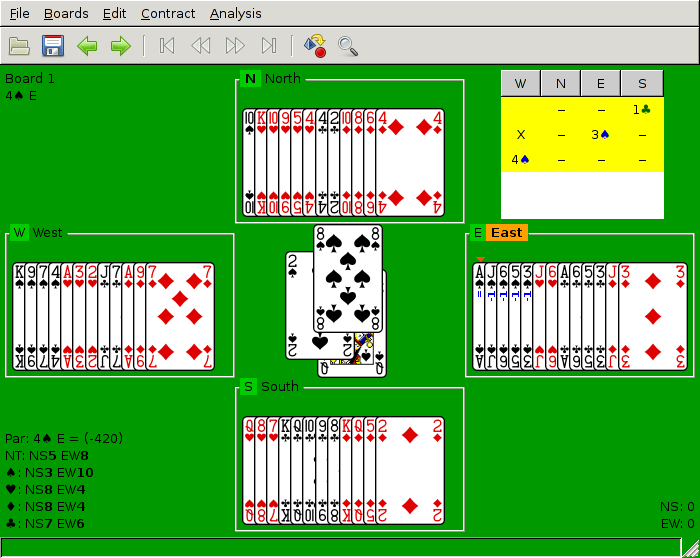
It has been a while since the last update for tenace, my bridge hand viewer. The highlight in version 0.10 is version 2.0 of the double dummy engine dds which has been updated to support parallel computation in multiple threads. The parscore computation in tenace now uses all available CPU cores. Even my notebook has two CPUs :). More on the technical side, the GUI has been switched to use GtkBuilder which comes with Gtk so there is no external library needed anymore (previously libglade). The looks are pretty much the same as before, though. The previous version 0.9 had added windows support via mingw. I would still appreciate if people could test it and tell me which bits I need to improve.

7 May 2010

Christoph Berg: Clamav segfaults

If you are still using clamav on etch, you might want to upgrade now:
# /etc/init.d/clamav-daemon start  
Starting ClamAV daemon: clamd LibClamAV Warning: ***********************************************************
LibClamAV Warning: ***  This version of the ClamAV engine is outdated.     ***
LibClamAV Warning: *** DON'T PANIC! Read http://www.clamav.net/support/faq ***
LibClamAV Warning: ***********************************************************
/etc/init.d/clamav-daemon: line 240:  5221 Segmentation fault      start-stop-daemon --start -o -c $User --exec $DAEMON
 failed!
Rolling back to yesterday's daily.cld fixes the issue, at least for the segfault.

David Welton: Better Software 2010

Florence, Italy, is an extremely popular tourist destination, and for a good reason: it's absolutely full of beautiful architecture and famous art. It apparently gets more than a million tourists a year. So it felt kind of odd for me, as a foreigner, to hole up in a conference talking about computers, software and business within a stone's throw of this. It was well worth it though. "Better Software" was a very interesting conference, and extremely professional. One anecdote: since there were so many people signed up, they did the lunch and coffee breaks in another facility nearby, about a block away. However, the weather wasn't very nice, so the organizers rounded up a bunch of umbrellas, and put them near the door with a sign saying "take one if you need it", so that people could stay dry while going back and forth. Of course, having grown up in Oregon, I don't trust the weather much, and carry an umbrella, but it was a really nice gesture and attention to detail. I expected it to be good, but it ended up being a really great event. Some memorable bits: I suppose that, given the huge success of the event this year, they may look for a larger facility for future events, but I hope it doesn't end up in some soulless place in the suburbs; even if I didn't do any sightseeing, I liked being in the city center. While the organizers would be more than capable of putting on a more international event, I enjoyed the focus on Italy, and the cool things people are doing here, and I feel it also contributed some to the positive atmosphere. It's one thing to have some guy come in from abroad and tell you something, another to see someone like Peldi talk about how he did what he did. And what with all the problems Italy has right now, some "positive energy" was more than welcome. Like I said, Italy has a lot of really talented people; the problems lie elsewhere. A big thanks to the organizers and everyone who came, and I hope to see you there next year.

Andrew Pollock: [life] And we're home

It took longer than expected, but we were finally discharged from the hospital early this afternoon. There was some concern about jaundice in Zoe, so the hospital paediatrician ordered a bilirubin blood test, which we had to wait for the results from. It came back fine though. The other concern was weight loss. She's still hovering around the 5 lbs 13 oz mark, which is at some magical 10% of birth weight lost, which seems to cause some concern for the doctors. So for the next week or so, we're going to bottle feed her breast milk, as she seems very sleepy when she tries to nurse, and we want to make sure she's getting enough. It's nice to be able to more actively participate in the feeding routine. Since we've been home, Zoe's not been sleeping terribly well on her own, so right now her and Sarah are having a nap together. We've got our first appointment with Zoe's ongoing paediatrician tomorrow. She was the recommendation of a friend, and seems to be highly regarded by all of the hospital paediatricians we saw. I'm feeling very disorganised in the nursery, because I didn't really participate in any of the set up of it. I knew where everything was in the hospital, so for a diaper change, everything was under control. I'm going to have to get a couple of totes tomorrow, so everything is on hand. I may also go berserk with a label maker. Looking forward to a hot shower and some shut-eye after this next feeding.

6 May 2010

Marco d'Itri: Ubuntu still bad at contributing back their changes

Not just to Debian (we are mostly used to it now), but also to upstream maintainers. Is it so hard? Case study: whois. Discuss. In related news, I just uploaded a whois release which supports the new IDN ccTLDs. I only had to add the respective servers to the list since I had already added IDN support in 2003.

Debian News: Brief Updates: Chromium browser, KDE and GNOME updates, DebConf sponsoring and Ben NanoNote

Petter Reinholdtsen: Parallellizing the boot in Debian Squeeze - ready for wider testing

These days, the init.d script dependencies in Squeeze are quite complete, so complete that it is actually possible to run all the init.d scripts in parallell based on these dependencies. If you want to test your Squeeze system, make sure dependency based boot sequencing is enabled, and add this line to /etc/default/rcS:
CONCURRENCY=makefile
That is it. It will cause sysv-rc to use the startpar tool to run scripts in parallel using the dependency information stored in /etc/init.d/.depend.boot, /etc/init.d/.depend.start and /etc/init.d/.depend.stop to order the scripts. Startpar is configured to try to start the kdm and gdm scripts as early as possible, and will start the facilities required by kdm or gdm as early as possible to make this happen. Give it a try, and see if you like the result. If some services fail to start properly, it is most likely because they have incomplete init.d script dependencies in their startup script (or some of their dependent scripts have incomplete dependencies). Report bugs and get the package maintainers to fix it. :) Running scripts in parallel could be the default in Debian when we manage to get the init.d script dependencies complete and correct. I expect we will get there in Squeeze+1, if we get manage to test and fix the remaining issues. If you report any problems with dependencies in init.d scripts to the BTS, please usertag the report to get it to show up at the list of usertagged bugs related to this.

Aigars Mahinovs: Going to Debconf10!

After a few months, today I finally got the approval and As I work for Accenture now, I got them to pay for the plane tickets and also spring for the Professional registration, so more people can attend. I am very happy, and very grateful to the company and to the managers here in Riga office for being so very supportive. It is refreshing to see that even a large corporation can be quite nimble. I hope I can get on a direct Riga New York flight (there actually is one, once a week, by Uzbekistan Airways) which would be a wicked cool way to save travel time and worries. This might even be faster end-to-end than last year going to Spain (via Frankfurt). Now I only need to replace my passport with the new biometric one, to qualify for USA Visa Waiver and I ll be good to go :)

Next.

Previous.