Search Results: "ag"

19 April 2009

Miriam Ruiz: Debian packages for Structure Synth

Structure Synth is an application for creating 3D structures from a set of user specified rules. It is an attempt to make a 3D version of Context Free (a free -GPL ed- program that generates images from written instructions called a grammar). The cool thing about Structure Synth is that it has a simple language for writing recursive scripts that can generate complex structures (kinda Processing, but in 3D), and you can feed the result into Sunflow (a rendering system for photo-realistic image synthesis, already available in Debian) to generate Escher-like cool images. The program is waiting in the NEW queue, but you can temporarily download my packages (for Debian SID amd64) if you want. Even though I ve tried hard to be the one to blog about this, my friend Javier Candeira has won the competition and has been able to write about this earlier than me :P Spanish readers might want to have a look at JoSeKBlog, where he describes how to combine Structure Synth and Sunflow, and where I first read about the existence of the program.

Martin Meredith: Trying KDE again

When Kubuntu switched to KDE4 as it s main desktop, I was disheartened. KDE 4, at the time was just, well, pretty unusable for me. It kept crashing, I couldn t do the things that I wanted to, and I spent more time fighting with KDE than I did actually doing work. After about a week, I d had enough, and I switched to Gnome. Now, a lot of people are probably going to respond to this with Gnome vs KDE flames, but let me explain my viewpoint on the whole Desktop Environment war I prefer KDE, but if a desktop will let me do the work I need to do without getting in my way and causing issues, then I can learn to use it. The above is possibly the reason that I can get along ok with Windows XP, but if I have to use Vista, I ll end up wanting to throw the machine out of the window. So, for possibly the last year or so (I m not too sure on the timescale!) I ve been using Gnome in Ubuntu, and I must say, I ve liked it. the fact that I can login, and instantly get access to my servers without having to type in my SSH key password (yes, insecure I know!), and that everything seems to integrate in a nice way, well.. it s been fun. But still, my heart lies with KDE, and I ve been flipping back to it to see how KDE4 is coming along on a regular basis. So far, I ve seen it gradually improving, and well, it looks damned sexy to be honest, but there were a few things that I felt it was missing. The ability to have multiple rows of apps on the task switcher was a big one for me. I generally have a lot of windows open, and I don t like the Grouping functionality. So when I get more than a few apps open, I could only see the icons. That s been fixed in KDE4.2, and it does it in a nicer way than Gnome does it (only switching to two rows once there are a certain amount of windows open. Next on the list is the whole password management thing. Gnome does a GREAT job at this. I login, and it unlocks the default keyring, sets up the SSH agent, adds my key, unlocking it from the keyring, and I don t have to do anything but login with my normal user and password (though I intend to switch that to biometric login once I can be bothered to setup the fingerprint reader). I ve fixed that little issue (well, for SSH) by setting up an autostart script using ksshaskpass to add my SSH key when I login. So far, KDE seems pretty usable for me now, but then, I m quite happy to plod along on my Laptop and try things out. I m feeling a bit lost with all the new functionality, and wishing that the Ubuntu Gnome Notifications (from pidgin, which I use as my IM client) didn t look so ugly in the new sexy KDE Desktop (in fact, if anyone knows a way to get pidgin to use the Jaunty style notifications in KDE, let me know, as they d fit in quite well under the new KDE look :D) - I d like to see some sort of common ground for notifications across the desktops, but who knows when that s going to happen! I ll also try using it at work, if I can use it there without it getting in the way, then I will happily switch back permanently, but that s the ultimate test. I m pretty sure that KDE 4 will be usable for me soon, and I ll let you know if that s now

Kees Cook: recording from PulseAudio

Every PulseAudio "Sink" has a "Source" named "monitor". This lets you attach to a given Sink and chain more stuff to it, for example, recording the audio that is playing through PulseAudio at any given moment. This is very handy for creating, for example, PubQuiz-style clips of songs, movies, etc. Here is a script to find the monitor for the most recently added Sink, record from it, and shove it through "sox" to get a WAV instead of raw sound data (requires recent sox, Pulse, etc):
#!/bin/bash
WAV="$1"
if [ -z "$WAV" ]; then
    echo "Usage: $0 OUTPUT.WAV" >&2
    exit 1
fi
rm -f "$WAV"
# Get sink monitor:
MONITOR=$(pactl list   grep -A1 '^\*\*\* Source #'   \
    grep '^Name: .*\.monitor$'   cut -d" " -f2   tail -n1)
# Record it raw, and convert to a wav
echo "Recording to $WAV ..."
echo "Close this window to stop"
parec -d "$MONITOR"   sox -t raw -r 44k -sLb 16 -c 2 - "$WAV"

Martin F. Krafft: Extending the X keyboard map with xkb

xmodmap has long been the only way to modify the keyboard map of the X server, short of the complex configuration daemon approaches used by the large desktop managers, like KDE and GNOME. But it has always been a hack: it modifies the X keyboard map and thus requires a baseline to work from, kind of like a patch needs the correct context to be applicable. Worse yet, xmodmap weirdness required me to invoke it twice to get the effect I wanted. When the recent upgrade to X.org 7.4 broke larger parts of my elaborate xmodmap configuration, I took the time to finally ditch xmodmap and implement my modifications as proper xkb configuration.

Background information I had tried before to use per-user xkb configuration, but could not find the answers I want. It was somewhat by chance that I found Doug Palmer s Unreliable Guide to XKB configuration at the same time that Julien Cristau and Matthew W. S. Bell provided me the necessary hints on the #xorg/irc.freenode.org IRC channel to get me started. The other resource worth mentioning is Ivan Pascal s collection of XKB documents, which were instrumental in my gaining an understanding of xkb. And just as I am writing this document, Debian s X Strike Force have published their Input Hotplug Guide, which is a nice complement to this very document you are reading right now, since it focuses on auto-configuration of xkb with HAL. The default xkb configuration comes with a lot of flexibility, and often you don t need anything else. But when you do, then this is how to do it:

Installing a new keyboard map The most basic way to install a new keyboard map is using xkbcomp, which can also be used to dump the currently installed map into a file. So, to get a bit of an idea of what we ll be dealing with, please run the following commands:
xkbcomp $DISPLAY xkb.dump
editor xkb.dump
xkbcomp xkb.dump $DISPLAY

The file is complex and large, and it completely went against my aesthetics to simply edit it to have xkb work according to my needs. I sought a way in which I could use as much as possible of the default configuration, and only place self-contained additional snippets in place to do the things I wanted done differently. setxkbmap and rule files Thus began my voyage into the domain of rule files. But before we dive into those, let s take a look at setxkbmap. Despite the trivial invocation of e.g. setxkbmap us to install a standard US-American keyboard map, the command also takes arguments. More specifically, it allows you to specify the following high-level parameters, which determine the sequence of events between key press and an application receiving a KeyPress event:
  • Model: the keyboard model, which defines which keys are where
  • Layout: the keyboard layout, which defines what the keys actually are
  • Variant: slight variantions in the layout
  • Options: configurable aspects of keyboard features and possibilities
Thus, with the following command line, I would select a US layout with international (dead) keys for my Thinkpad keyboard, and switch to an alternate symbol group with the windows keys (more on that later):
setxkbmap -model thinkpad -layout us -variant intl -option grp:win_switch

In many cases, between all combinations of the aforementioned parameters, this is all you ever need. But I wanted more. If you append -print to the above command, it will print the keymap it would install, rather than installing it:
% setxkbmap -model thinkpad -layout us -variant intl -option grp:win_switch -print
xkb_keymap  
  xkb_keycodes    include "evdev+aliases(qwerty)"        ;
  xkb_types       include "complete"     ;
  xkb_compat      include "complete"     ;
  xkb_symbols     include "pc+us(intl)+inet(evdev)+group(win_switch)"    ;
  xkb_geometry    include "thinkpad(us)"         ;
 ;

There are two things to note:
  1. The -option grp:win_switch argument has been turned into an additional include group(win_switch) on the xkb_symbols line, just like the model, layout, and variant are responsible for other aspects in the output.
  2. The output seems related to what xkbcomp dumped into the xkb.dump file we created earlier. Upon closer inspection, it turns out that the dump file is simply a pre-processed version of the keyboard map, with include instructions exploded.
At this point, it became clear to me that this was the correct way forward, and I started to investigate those points in order. The translation from parameters to an xkb_keymap stanza by setxkbmap is actually governed by a rule file. A rule is nothing more than a set of criteria, and what setxkbmap should do in case they all match. On a Debian system, you can find this file in /usr/share/X11/xkb/rules/evdev, and /usr/share/X11/xkb/rules/evdev.lst is a listing of all available parameter values. The xkb_symbols include line in the above xkb_keymap output is the result of the following rules in the first file, which setxkbmap had matched (from top to bottom) and processed:
! model         layout              =       symbols
  [...]
  *             *                   =       pc+%l(%v)
! model                             =       symbols
  *                                 =       +inet(evdev)
! option                            =       symbols
  [...]
  grp:win_switch                    =       +group(win_switch)

It should now not be hard to deduce the xkb_symbols include line quoted above, starting from the setxkbmap command line. I ll reproduce both for you for convenience:
setxkbmap -model thinkpad -layout us -variant intl -option grp:win_switch
xkb_symbols     include "pc+us(intl)+inet(evdev)+group(win_switch)"    ;

A short note about the syntax here: group(win_switch) in the symbols column simply references the xkb_symbols stanza named win_switch in the symbols file group (/usr/share/X11/xkb/symbols/group). Thus, the rules file maps parameters to sets of snippets to include, and the output of setxkbmap applies those rules to create the xkb_keymap output, to be processed by xkbcomp (which setxkbmap invokes implicitly, unless the -print argument was given on invocation). It seems that for a criteria (option, model, layout, ) to be honoured, it has to appear in the corresponding listing file, evdev.lst in this case. There is also evdev.xml, but I couldn t figure out its role.

Attaching symbols to keys I ended up creating a symbols file of reasonable size, which I won t discuss here. Instead, let s solve the following two tasks for the purpose of this document:
  1. Make the Win-Hyphen key combination generate an en dash ( ), and Win-Shift-Hyphen an em dash ( ).
  2. Let the Caps Lock key generate Mod4, which can be used e.g. to control the window manager.
To approach these two tasks, let s create a symbols file in ~/.xkb/symbols/xkbtest and add two stanzas to it:
partial alphanumeric_keys
xkb_symbols "dashes"  
  key <AE11>  
    symbols[Group2] = [ endash, emdash ]
   ;
 ;
partial modifier_keys
xkb_symbols "caps_mod4"  
  replace key <CAPS>  
    [ VoidSymbol, VoidSymbol ]
   ;
  modifier_map Mod4   <CAPS>  ;
 ;

Now let me explain these in turn:
  1. We used the option grp:win_switch earlier, which told xkb that we would like to use the windows keys to switch to group 2. In the custom symbols file, we now simply define the symbols to be generated for each key, when the second group has been selected. Key <AE11> is the hyphen key. To find out the names of all the other keys on your keyboard, you can use the following command:
    xkbprint -label name $DISPLAY -   gv -orientation=seascape -
    
    
    I had to declare the stanza partial because it is not a complete keyboard map, but can only be used to augment/modify other maps. I also declared it alphanumeric_keys to tell xkb that I would be modifying alphanumeric keys inside it. If I also wanted to change modifier keys, I would also specify modifier_keys. The rest should be straight-forward. You can get the names of available symbols from keysymdef.h (/usr/include/X11/keysymdef.h on a Debian system, package x11proto-core-dev), stripping the XK_ prefix.
  2. The second stanza replaces the Caps Lock key definition and prevents it from generating symbols (VoidSymbol). The important aspect of the second stanza is the modifier_map instruction, which causes the key to generate the Mod4 modifier event, which I can later use to bind key combinations for my window manager (awesome).
The easiest way to verify those changes is to put the setxkbmap -print output of the keyboard map you would like to use as a baseline into ~/.xkb/keymap/xkbtest, and append snippets to be included to the xkb_symbols line, e.g.:
"pc+us(intl)+inet(evdev)+group(win_switch)+xkbtest(dashes)+xkbtest(caps_mod4)"

When you try to load this keyboard map with xkbcomp, it will fail because it cannot find the xkbtest symbol definition file. You have to let the tool know where to look, by appending a path to its search list (note the use of $HOME instead of ~, which the shell would not expand):
xkbcomp -I$HOME/.xkb ~/.xkb/keymap/xkbtest $DISPLAY

You can use xev to verify the results, or just type Win-Hyphen into a terminal; does it produce ? By the way, I found xev much more useful for such purposes when invoked as follows (thanks to Penny for the idea):
xev   sed -ne '/^KeyPress/,/^$/p'

Unfortunately, xev does not give any indication of which modifier symbols are generated. I have found no other way to verify the outcome, other than to tell my window manager to do something in response to e.g. Mod4-Enter, reloaded it, and then tried it out.

Rules again, and why I did not use them in the end Once I got this far, I proceeded to add option-to-symbol-snippet mappings to the rules file, and added each option to the listing file too. A few bugs [[!debbugs 524512 desc=later]], I finally had setxkbmap spit out the right xkb_keymap and could install the new keyboard map with xkbcomp, like so:
setxkbmap -I$HOME/.xkb [...] -print   xkbcomp -I$HOME/xkb - :0

I wrote a small script to automatically do that at the start of the X session and could have gone to play outside, if it hadn t been for the itch I felt due to the entire rule file stored in my configuration. I certainly did not like that, but I could also not find a way to extend a rule file with additional rules. When I looked at the aforementioned script again, it suddenly became obvious that I was going a far longer path than I had to. Even though the rule system is powerful and allows me to e.g. automatically include symbol maps to remap keys on my Thinkpad, based on the keyboard model I configured, the benefit (if any) did not justify the additional complexity. In the end, I simplified the script that loads the keyboard map, and defined a default xkb_keymap, as well as one for the Thinkpad, wich I identify by its fully-qualified hostname. If a specific file is available for a given host, it is used. Otherwise, the script uses the default.

Biella Coleman: Paris in June (and better with hackers)

/tmp/lab announces the second Hacker Space Festival
(Paris, 26-30 June 2009) Hacker Space Festival 2009 Call For Proposals HSF2009 In 2008, we organized HSF[1] on the spot, as an ad-hoc meeting for
hackerspaces-related networks, technical and artistic research emerging
from them and social questionning arising from them. This sudden
experiment proved to be a huge success, as much as on the
self-organizing level as on the participants and meetings quality, as
well as the emotionally-charged ambient, the kind of which you make
fond memories. The 2008 edition generated a strong emulation in France, from its
historical role as the first official hack meeting there, and in Europe
with the subsequent creation of the Hacker Space Brussels[2], the
rapprochement with The Fiber in Amsterdam and the hackerspaces.org[3]
network. Initiatives of hackerspace openings in Grenoble or Lille, or
the upcoming FrHack[4] conference show an actual enthusiasm in the
French hackers community that was doomed to the underground not so
long ago. We salute these initiatives and their diversity! Soon enough, we wanted to reiterate the HSF experience : however, it
was out of the question to institutionalize this temporary autonomous
zone, nor make it an ersatz of the previous edition, nor even to wrap
it into an elite or underground aura. On the opposite, we ardently
desire; and especially to explore further, in all directions some
lesser known domains (see below) et foster meeting and sharing around
experiences at the confluence of art, technology and politics. The world financial crisis, the decay of democracy in Europe, the
obscurantism, paranoia and lack of culture presiding over legislation
(Internet and Reaction Err Creation Law[5][6]) seem a fertile
environment for the sensible development of new (social ) life forms.
Quick! Let s rest for a few days in jubilation and ecstasy to take a
deep breathe of freedom under the indelicate smells of the medicine
factory nearby! For if the public space is shrinking to oblivion, where any side-step
becomes suspect, and that, from an early age (deviant behavior
detection in nursery school), where moving without a mobile phone
becomes suspect (hello you Julien Coupat[7], a French political
prisoner in France!), there s a domain that the Leviathan would have a
lot of trouble to contain, and for a reason: that of sensitivity. Even
the desperate attempts of the State to block the free and premonitory
expression of sense (hello you Demeure du Chaos![8]) cannot do anything
against a loud laughter or a knowing glance, a sensual kiss or an
explosion of colors. Sensitivity, we could say, is what is left to a human being when she
has nothing anymore, and differenciates her from the body corporate or
the institution, that are, in essence, devoid of it. Therefore, Art
definitely remains the public space to share between humans, and only
between us. And if it the last one to share, we propose to explore it
and take it over during the upcoming edition of the Hacker Space
Festival, from the 26th to 30th of June, 2009 at Vitry sur Seine[9]. ========================================================================
Keynote Speakers: Sergey Grim and Larry Fake with Eric Schmoudt
Groogle Summer of Crode, Survivor style
VLC, I vote against you because you really fucked up when ========================================================================
== W A N T E D ========================================================= Focus on solutions rather than problems. * The Final (Hardware) Frontier: Open FPGA Cores, Reverse Engineering
* Designer Religions and Creative Beliefs Systems
* WiFiDoors & WiFi System-on-Chip controllers firmware hacking,
infection & backdooring
* Telecom Core Network Equipment Reverse Engineering: MSC, STP,
Switches,
* Algebraic Attacks and Modern Cryptography Attacks
* Autonomous, Parasitic and Viral Drones
* Enhanced or Infected Reality Swarms
* Auto-Builders / Self-Fabrication
* Embedded OS breakins stories & recipes
* Actualization rather than mere concepts
* FPGA & ASIC hacking / backdooring
* Cloud+Privacy+Open Source: O Brave New World?
* Explosion-Proof clothing
* Radio Appz & Hackz: Mesh @ RF Layer 1-3
* Database & Privacy
* Problematic & Ethical Open Source/Content Licenses
* Institutional Relationships: Lobbying or Licking?
* Non Lethal Protection (anti-taser vests?)
* Survival in the Age of the Ministry of Immigration and National
Identity
* Mental asylum improvised visit
* Open Source Legacy Media(TM) Production Solutions (TV, Radio, Press,
DRM)
* Gas Sensors & Environmental Benchmarking
* Building Hackerspaces Without Money
* Milsatcomm hacking: Military satellites shots, broken birds in the
sky
* Other research topics on security and insecurity
* Academics and Hackers
* Organics and Fermentation
* Clean Food in Tainted Environment
* Low Impact Energy & Recycling
* Media Sandwich: layers of crap makes good food?
* Deconstructing Carla Sarkozy
* Knitting DIY Factory (jazzy, eh?)
* Signs of life among industrial wasteland
* Hallucinogenic & Computing: Can you Code on Acid?
* Mesh Networking (Wireless BattleMesh Royal!)
* Legal Sabotage: When Democracy Needs You And anything that does not fit. ========================================================================
== P R O P O S E ======================================================= Send you contributions to HSF2009-CFP@lists.tmplab.org + Type of the proposal: 1. conference (45min. presentation + 10min. for questions)
2. workshop / demo (30min. 2 heures)
3. installation / performance (music, plastic, sound, video) Lightning talks can be proposed and organized until the last moment,
according to available space and schedule, in the form of BarCamps or
Blitz Conferences. + Required Information: * Title of the presentation
* Type (see above)
* Language : French or English
* Name of speaker(s)
* Affiliation (organization / company)
* Short biography
* Abstract (5 to 10 lines)
* Topics / Keywords
* Includes a demo? YES NO
* Release during the festival? YES NO
* Internet connection required? YES NO + Acceptable Formats * Open Document
* PDF
* Plain Text
* RTF + Agenda * beginning of proposals : now
* end of proposals : 01 May 2009
* selection notification : 07 May 2009
* publication of program : 15 May 2009 + Evaluation criteria for proposals: 1. Innovating Topic
2. Open Technology
3. Demonstration / Live Act
4. DIY Reproducibility
5. Fun Potential The Programming Committee resembles that of last year
See : http://hackerspace.net/committee ========================================================================
== V E N U E =========================================================== /tmp/lab
6 Bis rue Leon Geffroy
94400 Vitry sur Seine
France http://hackerspace.net/directions ========================================================================
== P A R T I C I P A T E =============================================== Email : http://lists.tmplab.org/listinfo.cgi/hsf2009-talk-tmplab.org
CFPmail: HSF2009-CFP@lists.tmplab.org
IRC : irc://irc.freenode.net/frlab
Jabber : xmpp:hsf2009@space.cepheide.org?join
Wiki : http://hackerspace.net/hsf2009 ========================================================================
== L I N K S =========================================================== The CFP is available online at http://hackerspace.net/cfp [1] http://hackerspace.net/hsf2008
[2] http://hsb.wikidot.com/
[3] http://hackerspaces.org/
[4] http://www.frhack.org/
[5] http://jaimelesautistes.fr/
[6] http://laquadrature.net/
[7] http://fr.wikipedia.org/wiki/Julien_Coupat
[8] http://www.demeureduchaos.org/
[9] http://hackerspace.net/
Philippe Langlois
Email: philippelanglois@free.fr
PGP Key: 8DAEE244

Andreas Metzler: snowboarding season 08/09

Due to the later date of easter this year we had a rather long season this year. I started snowboarding on 2008-12-06 and stopped today 2009-04-19. Following up on previous entries here is the balance sheet:
2005/062006/072007/082008/09
number of (partial) days25172937
Dam ls1010510
Diedamskopf1542423
Warth/Schr cken0304
total meters of altitude12463474096219936226774
highscore10247m8321m12108m11272m
# of runs309189503551
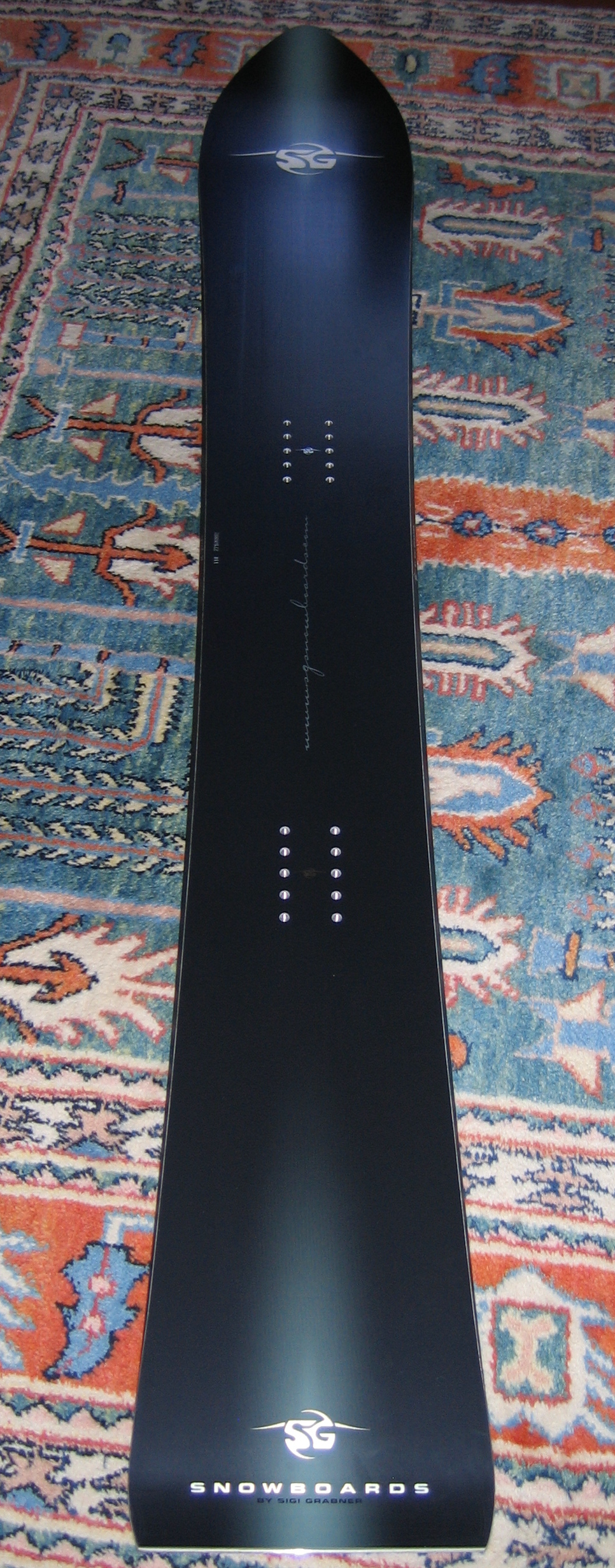
In the second half of the season we actually had a lot of snow, up two 130 cm down at 800m above sealevel. Complete snow cover lasted from December until mid of April. Riding was good, I did not have any major injury, my skills did not increase though. The addition of a snowboard, a SG Speed 173 to my quiver worked out well. Loads of fun and less danger in slushy conditions (nose-in) compared to the shorter slalom board. Now the waiting starts. ;-)

David Welton: BikeChatter.com: Pro Cycling @ twitter and live Amstel Gold chat

Bicycle racing, especially professional road cycling, is really the only sport I follow, but I do so with a passion. Other people are glued to the TV during soccer games, or football, or basketball, or cricket, or whatever. I'm there during the current spring classics season (my favorite races of the year), and the Giro d'Italia and Tour de France. So it was a cool discovery to find people like Lance Armstrong, Levi Leipheimer, George Hincapie, Robbie McEwen and others using Twitter. Some of them really provide a unique window into the life of a professional bike racer, especially all the things that we don't see outside race day. I figured that if it's interesting to me, it's probably interesting to other people too, so I put together this site to aggregate twitter updates related to professional cycling: http://www.bikechatter.com As an extra, I also added a chat widget from Mibbit.com, in order to make it easy to chat with others while races are going on: http://www.bikechatter.com/chat The next race is the Amstel Gold classic, in the Netherlands, today (Sunday April 19th), at about 15:30 CEST (Rome, Paris, Berlin, etc...). Feel free to join us! The site is quite new, and probably has a few bugs, and as is obvious, my UI ideas are to make things very simple and direct, so any comments or suggestions on how to improve it, or new features you'd like to see are welcome. ... and now I'm off for my Sunday bike ride - see you this afternoon!

Julien Valroff: Xorg input hotplug

I had written a few weeks ago about my new (almost) empty xorg.conf file and explained how I had to edit an HAL .fdi file to change my keyboard layout and define my compose key. The Debian Xstrike Force have written a complete guide on the Debian wiki explaining this input hotplug system. I have found that there is no need to edit .fdi files, just set the following options at the end of /etc/default/console-setup:
XKBMODEL="pc105"
XKBLAYOUT="fr"
XKBVARIANT="latin9"
XKBOPTIONS="compose:lwin"
Even better, they should now be automatically grabbed from your existing xorg.conf when upgrading!

Manoj Srivastava: Manoj: Looking at porcelain: Towards a generic, distribution agnostic tool for building packages from a VCS

This is a continuation from before. Before I go plunging into writing code for a generic vcs-pkg implementation, I wanted to take a close look at my current, working, non-generic implementation: making sure that the generic implementation can support at least this one concrete work-flow will keep me grounded. One of the features of my home grown porcelain for building package has been that I use a fixed layout for all the packages I maintain. There is a top level directory for all working trees. Each package gets a sub-directory under this working area. And in each package sub-directory, are the upstream versions, the checked out VCS working directory, and anything else package related. With this layout, knowing the package name is enough to locate the working directory. This enable me to, for example, hack away at a package in Emacs, and when done, go to any open terminal window, and say stage_release kernel-package or tag_releases ucf without needing to know what the current directory is (usually, the packages working directory is several levels deep /usr/local/git/debian/make-dfsg/make-dfsg-3.91, for instance. However, this is less palatable for a generic tool imposing a directory structure layout is pretty heavy. And I guess I can always create a function called cdwd, or something, to take away the tedium of typing out long cd commands. Anyway, looking at my code, there is the information that the scripts seem to need in order to do their work. So, if I do away with the whole working area layout convention, this can be reduced to just requiring the user to: Hmm. One user specified directory, where the results are dumped. I can live with that. However, gitpkg has a different concept: it works purely on the git objects, you feed it upto three tree objects, the first being the tree with sources to build, and the second and third trees being looked at only if the upstream tar archive can not be located, and passes the trees to pristine tar to re-construct the upstram tar. The package name and version are constructed after the source-tar archive is extracted to the staging area. I like the minimality of this. This is continued here.

Matthew Garrett: Extended Qualcomm Gobi features

And while I'm on the subject of bitching about hardware support, I had some time to poke at the Qualcomm Gobi hardware a bit more last week. With the aid of Dan Williams of Network Manager fame we identified[1] that the hardware actually does rather more than is obvious from the qcserial driver. There's two extra ports - one is for diagnostics, and the other claims to be an NMEA port. Poking support for these into qcserial is easy enough, but they don't seem especially chatty. The more interesting factor is that the fourth interface on the endpoint is a network device. This isn't unusual in modern hardware - PPP isn't a terribly helpful layering for data transfer, so most recent high speed data cards also provide support for some kind of network device. If you're lucky it's a spec-compliant cdc device. If you've got a gobi then it claims to be a vendor defined class and type and the .inf file for the driver claims that it's a proprietary cdc device. Testing this got cut short by us not actually having an account on Verizon[2], so we don't have any data dumps to work out what the framing looks like.

Interestingly, doing USB dumps revealed that Windows seemed to do everything via the network device. We didn't see any traffic from the other ports, even when attempting to turn on the GPS. So it may also have some magic out of band configuration that doesn't simply use AT commands.

If anyone has this stuff working under Windows, it'd be interesting to try getting some dumps to try to work out what's going on here.

[1] By the simple process of opening the device manager under Windows. Ahem.

[2] The test machine was a Vaio P, which came with a gobi but no SIM slot. Thanks, Sony. Thony.

18 April 2009

Sandro Tosi: Chain scripts execution in git hooks

The common git hook is something like:
#!/bin/sh

exec "another script"
and since "exec" replace the current script with the other one, only one command can be execute in a hook. Even more, the common hook takes input from the standard input, so the first command takes it, and the second?

The real situation was reportbug post-receive hook, that looked like:
#!/bin/sh

exec /usr/local/bin/git-commit-notice
but I wanted to add seanius' tagpending hook to it. The solution I found was:
#!/bin/sh

# to save stdin on a file to pass to both scripts
cat > post-receive_tmpfile

/usr/local/bin/git-commit-notice < post-receive_tmpfile
/git/reportbug/reportbug.git/hooks/git-post-receive-url-notifications.py < post-receive_tmpfile

rm post-receive_tmpfile
that saves the stdin to a file, passed again to both the scripts.

Of course, I'd be happy to hear more elegant solutions :)

Joey Hess: roan balds

This week I've been feeling wound up and constrained. Thought I was going to be sick and miss this, but it cleared up overnight and me and some tamales made it to Roan Mountain in time for lunch and a long afternoon hike.
typical gorgeous view from round Bald
Roan highlands
from the rocks across Engine Gap to Round Bald and Roan High Knob
Roan highlands
more There was snow here just five days ago, so no sign of spring yet on top of the Mountain, but still a warm gorgeous day. Sunburn!

David Nusinow: Input Hotplug Guide

There's been a lot of questions about the new input system (referred to as "input-hotplug" or "i-h") that we've enabled in the latest X upload. Questions range from "how do I configure my keyboard now?" to "why are you making me install all this other stuff I didn't have before?" While the XSF has been dealing mainly with bug triage for the software itself, we've also been wanting some documentation on the system so people can understand it.

Thus was born our Input Hotplug Guide. The first portion of the doc explains the rationale behind input-hotplug and how it works. The second section is a HOWTO, explaining how to configure it. Hopefully this will answer some of the questions that are out there right now. So if you're curious or just plain frustrated with the changes happening to the X server's input subsystem I recommend that you check it out.

MJ Ray: KohaCon09 remotely

Irma and Bob of CALYX information essentials wrote in:
For those interested and not able to participate in the KohaCon 09 action in Plano. Some conferees are Twittering: Cover it live or pipes. Some are blogging Some again are having their photo taken on flickr. Presentations are starting to show up on slideshare tag kohacon09 and twitter #kohacon It sounds like a great conference!

Bastian Venthur: Using rng for bug triaging

Reportbug-NG s ability to filter and sort bugreports in various ways can greatly help triaging bugreports after a certain criterion. In this example I use the bugs of the KDE team, because they have quite a lot of bugs and are currently on a bug triage. Two releases ago I tried to help them cleaning their BTS from obsolete bugeports. My tactic back then was to find bugreports where no action has been taken for a long time. I noticed that there was no easy way to find such bugs since neither reportbug nor the BTS allowed to sort the bugs this way, so finding the candidates I searched for was very cumbersome. So let s try to find those bugs with rng: To get all bugs belonging to the KDE team start rng with the maintainer as argument:
rng debian-qt-kde@lists.debian.org
After rng started you see a table with all bugreports against the packages of the KDE team. To find potentially solved or unreproducible bugs, click on the last column header to sort the list by the date of the last action. The date of the last action is the date where the bugreport received it s last mail (including control@b.d.o mails). You will see that there are quite a lot bugs which haven t been touched for more than two years. Many of them don t have a unreproducible or moreinfo tag. If you want to help the KDE team, you can now start trying to reproduce the bug. If that s not possible you can tag them with moreinfo and unreproducible. If there is no reply in roughly one month or so it s probably safe to close this bug. To quickly find a lot of other candidates to close one can use the filter of rng. Just enter moreinfo in the filter and the table will reduce to all bugreports containing this word or tag. Now you can again sort this list by date of last action and you will see quite a lot bugs bugs where more info was requested but no action took place for more than one year. Those need to be inspected, but probably quite a few of them are safe to close. This example shows how filtering and sorting can greatly help to find certain bugs and support bug triaging. But please: don t carelessly close very old bugs! Read the reports and try to reproduce them, find matching bugreports in upstream s BTS and ask the submitter if in doubt.

17 April 2009

Jorge Salamero Sanz: New jabberd2 packages, the Debian XMPP team blooms

I ve just uploaded new gsasl, jabberd2 and jabber-muc packages to ftp-master. This is the first release since we moved to git for packging and means a big step for the new Debian XMPP team. I hope this way we can welcome more developers to join the team and improve the Jabber/XMPP status in Debian. This work has been sponsored by my employer in order to improve the jabber module of eBox Platform. BTW, we ll try to release not only Ubuntu packages but also Debian very soon :-).

Sune Vuorela: playing with debian kde bugs - anyone up for it ?

This sunday, the 19th of april, at 11 CEST, I will start work my way thru many open filed against KDE in the Debian Bug Tracking System that really belongs at bugs.kde.org - or just doesn t apply anymore. Feel free to join in in #debian-kde on irc.debian.org aka oftc. See you there.

Erich Schubert: Web data time series

For a research project, I'm looking for some real-world time series data. Time-series are an interesting thing to study, however it is hard to get access to interesting non-trivial real-world data.I was wondering if some people could contribute me some summarized web access data; no URLs or IP addresses.The data I'd like to get can best be explained by the preprocessing step:
...   perl -ne '/\[(\d+\/\w+\/\d 4 :\d\d):\d\d/
&& print $1."\n";'   sort   uniq -c
(Sorry if you aren't fluent in regexp - it extracts the date and hour out of an Apache default log file, nothing else. These lines are then summarized by counting their unique appearances.)That should produce 24 lines per day (one per hour), looking like this:
  count day-of-month/month/year:hour
It would be cool if you could send me some series for a couple of sites, if you happen to be in the position to provide this data. The data should cover at least a few weeks, the longer the better even up to a few years.Too small sites are however not very useful but might be too noisy (so probably not the personal home page of your mom). If you are providing a larger number of series, you are of course free to include them.I don't care much about what the site actually contains, I'd just ask you to give a tiny amount of meta information:Data use:The main project idea is to evaluate different distance metrics in their capability of separting the different data sources, assuming that there is some difference in the shape in these curves. A different problem can be constructed by breaking the series into chunks covering approximately a day and then trying do separate different days, starting hours of the series (or offset server timezone vs. user timezone) and/or weekdays from weekends.In our experiments, we've come to the conclusion that the experimental results are most interesting when there is a sufficient number of classes; so I'd like to get like 20 different interesting data series. At the same time, the series should be long enough, so I can break them into multiple chunks to have a reasonable number of 'sub-series' per class. If I have really long series, or e.g. series covering the same site but from multiple servers, I could even experiment with taking sample of different length from these sets.(Say I have series covering 2 years, that is ~17k samples, from 3 servers, then I can take 51 disjoint sub-series of length 1000, or 102 of length 500, ...)But it's obviously not possible for me to collect this data myself - I don't operate two dozen of such sites myself ...An extra project I've been considering some time is some peak prediction for web accesses. Say you're running some fast growing site, wouldn't it be useful to have a prediction when the number of accesses will likely hit some magical limit (and e.g. overload your server) so you can increase your capacity on time? Of course it would be more sensible to apply this prediction e.g. onto CPU usage, e.g. predicting when your system might hit 90% load average over a 5 minute window in regular operation. Network bandwidth and disk IO also come into mind. You get the idea.Please send them via email to erich.schubert AT gmail comThank you.[P.S. Already recieved the first series, thank you! I can take care of sorting myself, no need to worry about that. And yes, I'm aware that the series will probably all be quite similar - common computer usage patterns such as work hours - but that is common in real world data and part of the challenge. Separting apples from dinosaurs is not a challenge.]

Neil Williams: drivel 2.0.4 released.

Drivel 2.0.4 ("Alive again")
============================

* Improvements:
- Add current patches from Debian and Ubuntu
- Add patches from bugzilla that have accumulated since 2.0.3
- New member of upstream team: Neil Williams
- Add tag support for LiveJournal. Closes #307967

* Translation updates:
- Added Italian translation (Vincenzo Campanella)
- Updated Germann translation (Mario Bl ttermann)
- Updated Portuguese translation. (Am rico Monteiro)
- Updated Canadian English translation. (Adam Weinberger)
- Updated Nepali translation. (Basanta shrestha)
- Updated Portuguese translation. (Miguel Figueiredo)
- Updated Russian translation. (Yuri Kozlov)

Drivel 2.0.4-1 has also arrived in Debian unstable - Ubuntu will update in due course but there's an Ubuntu release to get out before then (I assume).

http://incoming.debian.org/drivel_2.0.4-1_amd64.changes

Description:
drivel - Blogging client for the GNOME desktop
Closes: 465805 521452 521903 522335 522661 523425
Changes:
drivel (2.0.4-1) unstable; urgency=low
.
* New upstream release.
* [INTL:ru] Russian program translation update (Closes: #521452)
* [INTL:pt] Updated Portuguese translation (Closes: #521903)
* Update Standards Version (no changes)
* Drop previous patches and dpatch support, patches implemented
upstream.
* Switch to libcurl4-gnutls-dev instead of libcurl4-openssl-dev
to avoid linked against OpenSSL (Closes: #522335)
* Add LiveJournal tags support (Closes: #465805)
* [INTL:ru] Russian program translation update - added string
(Closes: #522661)
* [INTL:it] New Italian translation (Closes: #523425)
* Add gnome-doc-utils to build-depends

Matthew Garrett: Intel's commitment to open source driver support

Update: It turns out that the original PSB code is still on the moblin site - I just failed to notice that there's two pages of git repositories. I fail. Last update is from March 2008, though.

Edited again: An up-to-date version of the drm code is available as part of the Moblin kernel SRPM - repo.moblin.com isn't obviously linked off the Moblin website, but I should have thought to find and check their source repository.

By and large, working with Intel is a pleasure. In fact, a while ago I said so in a fairly obvious way. So it's a shame that the support for Poulsbo is still an absolute fucking mess with absolutely no obvious end in sight. Intel's Moblin group (the people who seem to be closest to having responsibility for providing any public Linux support for that hardware, though it's really not clear if they've got any more say in this than I do) have a kernel team that don't want or need a git tree despite having someone who's working on forward porting the driver to modern kernels - probably a job that requires more than one person given what a godawful fucking mess the last public release was, but it'd at least be nice to see what the current state is. Especially since you don't even seem to be able to get the last public release - moblin's git repositories have been rearranged and I can't find the psb-kmod one on their gitweb any more.

The most terribly depressing thing about this is that development is clearly still happening internally. Ubuntu is still being sent tarball releases by Intel, not that the code's getting any better judging by the type of diff involved. This is made even more entertaining by the bug in question being private, leaving no indication whatsoever about what bugs this code is meant to fix or why.

Closed development, random private tarball drops to partners without any public releases or changelogs, no indication of any upstream release, kernel developers entirely unrelated to the development of the driver trying to get code merged so people can actually use the hardware they bought? I'd expect this of some random far-east vendor with no experience in working with Linux, but not a company that's consistently one of the top ten contributors to the kernel and has frequently touted their level of support. There's no meaningful support for Poulsbo. There's just a thin cardboard cutout that's been carefully placed in front of a hole filled with users' hopes and money.

Seriously Intel. Sort it the fuck out.

Next.

Previous.