Search Results: "ed"

31 May 2010

Stefano Zacchiroli: document your team - redux

wiki.d.o/Teams to the rescue About 3 years ago (too bad I've actually missed the 3-year anniversary by a few days!), Raphael set up http://wiki.debian.org/Teams. In my recent encounters and contacts with people interested in contributing to Debian, I've found that page to be of invaluable help. In particular, people find it very useful in understanding the macro-structures of Debian and in understanding where they can start to contribute. Approaching a team is most likely "less scary" than contacting a larger forum, and that page offers a good service of team indexing. Of course, the usefulness of wiki.d.o/Teams is directly proportional to how much complete it is and to how much individual team pages are current. So, in case you didn't know about the page or that you just remembered that years ago you set up a page there and then forgot about it, this is probably a good moment to add or update your team information there. To eat my own dog food, I've recently set up Teams/DPL, which is probably not terribly useful, but it contains interesting stuff such as where the daily activity bits are stored. (Yes: I'm just a one-person-team, but given the index is useful to document Debian "parts" in general, I believe we should allow for a slightly semantic abuse of the name.) Incidentally, that shows another way in which wiki team pages can come to the rescue: improve the documentation of our processes. For instance, we are grown accustomed to the fact that d-d-a is an authoritative information source. Well, of course it is, but when you need to find out a 4-year old d-d-a post of some core team, since it is the only documentation of some still current (is it?) procedure, let's be fair and acknowledge that a mailing list archive it's not that handy. So, summarizing relevant d-d-a posts in team pages (with references to the originals) is another way, accessible to everybody, to help in keeping docs current. I've been doing that recently for a handful of teams, and people seem to appreciate (of course it's your responsibility to check that they do appreciate).

Carl Chenet: pykickstart in Debian

The python-pykickstart package just landed in sid. If you wish to create or modify your kickstart configuration file from python, pykickstart is developed by Redhat fellows in order to make your job with kickstart easier. Kickstart aims to make automated systems installations for redhat/fedora.

Gunnar Wolf: Update: A correspondingly pleasant dinner

Update: A correspondingly pleasant dinner
And just to round off my last post (and of course, following a completely non-technical thematic), what is the logical consequence of feeling introspective and blogging just before preparing dinner? Of course Dinner gets prepared with sharing it in mind. The dish ends up even looking as if meant to be served! So this was it: One of my simplest and still favorite dishes: Tostadas. But, yes, these are heterodox tostadas, as they share the basic tostadiness (a hard, roasted and cracky toasted corn tortilla with a soft leguminous layer to give it some consistency, and with... stuff on top. Yes, stuff is sometimes too generic, but that's the beauty of it). What did I come up with? In the strict order with which they were approached at feeding time, and described bottom to top:
  1. Closest to traditional, top left: Mashed beans, bits of panela cheese with little bits of chipotle and soybean-based vegetarian chorizo
  2. Something I have only seen in Guatemala, and which I intend to take a better look at next time I'm there (top right): Mashed frijoles, , cochinita pibil (canned, shame on me, and frankly lacking in taste), grated beet (betabel/remolacha/betarraga/whatnot), grated cabbage
  3. The heterodoxiest of them all, and the idea that led me to the others (center): Mashed lima/fava beans (according to Google habas), cochinita pibil, nopales, and a hint of habanero sauce.
Yum! [update] On a completely unrelated notice, but not worth opening a third post in a row... Some minutes after I published the earlier post, I got a visit to http://gwolf.org/blog/pleasant-perception-changes?utm_source=twitterfeed&utm_medium=twitter. Now, it beats me: I don't use twitter. I don't even care about twitter. And were my message so deep somebody just twitted (twat it?) right away, I still find the time lapse too short. Who's auto-twitting me? Maybe a planet or other such aggregator?

Gunnar Wolf: Pleasant perception changes

My day started late, although I didn't scratch the plan: Enjoy 40Km cycling, as as every last Sunday of the month we have the delicious Ciclot n 32Km, plus ~10km from and to my house. Approximately 12:00-14:20, including stopping at a service station to patch my rear tire. Yes, I was pressing my way up the last bridge (Circuito Interior over Coyoac n and Universidad) when the road was opened to motorized traffic. Two hours of cycling are enough to make me a happy person. However, I have been downish lately, and during the afternoon (which I spent doing some home maintenance, as I usually do on weekends), I felt this downness grow somewhat. Nothing terrible, just I guess the processes that I have to live through. Then, after ~1hr reading a somewhat tough book, I closed it thinking, "this was a good day". And surprised myself with the reflection. So, while I don't think this can put me back into the activity/productivity status I have held and would love to regain... Is certainly a very nice push forward. Time to get something for dinner, as my body also reminded me it is not exempt of such needs (as it faithfully reminds me, often more frequently than it should)

30 May 2010

Gregor Herrmann: RC bugs 2010/19 - 2010/21

as a short reminder that there are still a few RC bugs waiting to be fixed here's a short list of the ones I've worked on in the last time:

Riku Voipio: I'm going to debconf10


Jep, I'm coming. I bought flight tickets from Icelandair just weeks before Eyjafjallaj kull changed from a little known volcano to something everyone knows (but probably can't spell if asked...). The volcano seems to have settled, but at some point I was really happy the ticket was paid with credit card, and at least I'd get my money back. After debconf we plan to travel around NY and nearby, but the accomodation appears to annoyingly expensive, I guess due august being the high season for travel...

In other news it is also possible that I'll visit aKademy 2010 in Tampere, Finland this year.

Erich Schubert: BPM tap toy update

I've updated my BPM tap toy, which started behaving strangely since some GTK update. I've identified two issues, and it is working again now.The BPM tap toy is a tiny Python script to obtain a BPM estimation by tapping on your mouse or keyboard. In contrast to many other such applications it does give you an error estimation and will visualize your precision in tapping. This way, you can judge how precise the value is.I have some ideas to further increase precision while adding another useful visualization to judge the result quality.

Bastian Venthur: I may go to Debconf 10

Today I received a mail from the DebConf Travel Sponsorship Team and they informed me that I may get partially (or fully) sponsored. Ok that s a bit vague for now, but that also means that I may come to Debconf 10 yeah! I also applied for this Debconf Newbies thingy, as this will be the first DebConf for me, but unfortunately there where too many applicants and not enough money and they had to decline my request.

Erich Schubert: Wikipedia contributors are one of a kind

The last weeks, I've occasionally been contributing to Wikipedia. I must say, Wikipedia is a really odd world of its own. Another thing I found quite surprising is the difference between the English and the German Wikipedia.Some things I noticed: So on overall: keep away from Wikipedia contributors, they're all maniacs. And often, don't bother to read a Wikipedia article if you can get an appropriate textbook. The Wikipedia article will just try to sell you a dozen textbooks anyway; you'll also have to read them to check the validity.It is a pity, that despite its size and "eyeballs", Wikipedia so far seems to have not attracted much attention by actual "domain experts", but it seems that it is largely filled by bureocrats, zealots and promoters. (That don't have any real work to do?)There are many things wrong here, that have been pointed out by many others, too. I'm not going to rescue the Wikipedia world, either. And yes, I am aware that you can discuss in Wikipedia, too. I fear that Wikipedia will go the DMOZ road. There was a time that DMOZ was doing quite well. Nowadays, large parts of DMOZ are dead. For two main reasons: it's hard to get in, and the backlog is way too large. If you get into DMOZ for a larger category, you'll be faced with thousands of pending link submissions, where for a large part you don't feel qualified to judge on appropriateness or rewrite their description in a neural manner. I have the impression that the same is happening for Wikipedia: on one hand, users that join are often kicked badly for many of their first contributions and will just leave again. At the same time, many of the old articles are in desparate need for attention, but nobody of the established users is willing to spend the days of cleanup/rewriting needed to get the article into a useful shape again. And a new user will never dare to discard most of the existing article; they usually just add or modify single paragraphs to see what happens. So Wikipedia might be hitting some kind of barrier.Still, I have to admit that I frequently use Wikipedia to look up things. Usually because it just comes up first in Google. I then often follow links to better resources, such as MathWorld. And I wish, Google would have taken me there right away ...And don't assume I'd know how to run things better. I'd sure propose to spend more time at fixing existing articles instead of attacking new contributions that much (you'll lose contributors this way). But I also see the need for fighting spam (although you should also remove old spam ...). But I don't know if there is a solution that will actually attract domain experts to re-write all the badly written and inaccurate articles that don't have their personal zealot to patrol them.P.S. Sorry, no comments on my blog. This isn't Facebook. Instead of commenting on my blog, how about working on Wikipedias backlog instead?P.S. Another example is the German Wikipedia story surrounding Fefe's blog. Many here at the open source communities will know fefe for his work on Dietlibc, libowfat and similar highly respected open source projects. His blog has been famous for being high-quality in security, privacy topics, politics and media critics. Some of his fans (likely) started a Wikipedia page on his blog. There have been at least two huge discussions about deleting the Wikipedia page. "sock puppets" and all such things have been brought up, while Fefe himself was amused. The discussions around deleting the blogs page on Wikipedia made it all the way to the print newspapers. As I said, I'm not actually bringing up new critique on Wikipedia. It's an ongoing problem for years now.[Insert random Deletionism rant against Wikipedia]

Andreas Metzler: exim4 cvs/git snapshot in experimental.

I have uploaded a new cvs/git snapshot of exim4 to experimental. This is 4.72 RC plus some DKIM related fixes that were commited afterwards. For a complete list of changes take a look at the upstream changelog. Lenny packages are here.

Julian Andres Klode: 0 14

So, yesterday was my 0 14 (20th) birthday and Germany won the Eurovision Song Contest 2010. Next up is Formula One in Turkey and Sebastian Vettel starting from position 3, hopefully he manages to overtake Hamilton and Webber and win this race. Let s see
Filed under: General

David Paleino: GoogleCode redirector

I recently saw a couple of bugreports all complaining about debian/watch files failing with GoogleCode. Since I'm myself maintaining some packages whose upstream authors use Google as their hoster, I felt it was a good idea to offer a service for uscan(1) and DEHS. You can reach the service at http://googlecode.debian.net. To use it in your debian/watch, just use:
http://googlecode.debian.net/p/<project>/<regex>
For example:
http://googlecode.debian.net/p/pyproj/pyproj-(\d+.*).tar.gz
The source code is available at debian-it.it (you should give this url to git clone). This service is currently in beta testing; suggestions and patches are more than welcome! Also, feel free to report any issue you might encounter!

Kees Cook: Linux Security Summit 2010

The Call For Participation is open for the 2010 Linux Security Summit, being held just before this year s LinuxCon. If you re interested in helping make Linux more secure, you ve got ideas to present, want to have your opinion heard, or generally just want to hang out, please join us and/or suggest a topic for discussion (CFP ends June 4th, so please hurry). I m hoping to get a chance to discuss what I m calling the popular kernel hardening patches which appear in a lot of distros yet remain missing from the upstream Linux kernel.

29 May 2010

Matt Zimmerman: Extracting files from a nandroid backup using unyaffs

I recently upgraded my G1 phone to the latest Cyanogen build (5.x). Since the upgrade instructions recommend wiping user data, I made a nandroid backup first, using the handy Amon_RA recovery image. I ve gotten pretty familiar with the Android filesystem layout, and was confident I could restore anything I really missed (such as my wpa_supplicant.conf with all of my WiFi credentials). It wasn t until I finished with the upgrade that I realized the backup wasn t trivial to work with. It s a raw yaffs2 flash image, which can t be simply mounted on a loop device. After messing around for a bit with the nandsim module, mtd-utils and the yaffs2 kernel module, I realized there was a much simpler way: the unassuming unyaffs. It says that it can only extract images created by mkyaffs2image, but apparently the images in the nandroid backup are created this way (or otherwise compatible with unyaffs). So I downloaded and built unyaffs:
svn checkout http://unyaffs.googlecode.com/svn/trunk/ unyaffs
cd unyaffs
gcc -o unyaffs unyaffs.c
and then ran it on the backup image:
mkdir g1data && cd g1data # unyaffs extracts into the current directory
~/src/android/unyaffs/unyaffs /media/G1data/nandroid/HT839GZ23983/BCDS-20100529-1311/data.img
At which point I could restore files one by one, e.g.:
adb push /tmp/g1data/misc/wifi/wpa_supplicant.conf /data/misc/wifi/
After toggling WiFi off and then back on, all of my credentials were restored. I was able to restore preferences for various applications in the same way.

Bernhard R. Link: Ghostscript brain-dead...

Some little warning to everyone using ghostscript: Ghostscript always looks for files in the current directory first, including a file that is always executed first (before any safe mode is activated). So by running ghostscript in a directory you do not control, you might execute arbitrary stuff. Two things make this worse: You have been warned.

Rog rio Brito: Preliminary support for webm in youtube-dl

I just added some very, very preliminary support for web in youtube-dl which I uploaded to unstable some minutes ago. This way, at least people will have some material (in, fact, a chance) to play with this format. I implemented this because, so far, I was only hoping here that a player for this would emerge. I guess that Debian s ffmpeg/mplayer will take some time, but I was pleased to see that Sebastian Dr ge to upload a version of something that could use the new libvpx codec. I hope that, now, as a side effect of webm being widely available, more people become interested in Vorbis. More support (no, not alternative , like Rockbox, but straight from the manufacturers) for it in hardware devices will be sweet. Well, I can dream. :-) Well, it seems to be time to shape up that local build of mine of the aotuv tuned version of Vorbis with Aoyumi s patches for libvorbis. Exciting times in the multimedia world.

Bernd Zeimetz: installing debian on the guruplug server plus

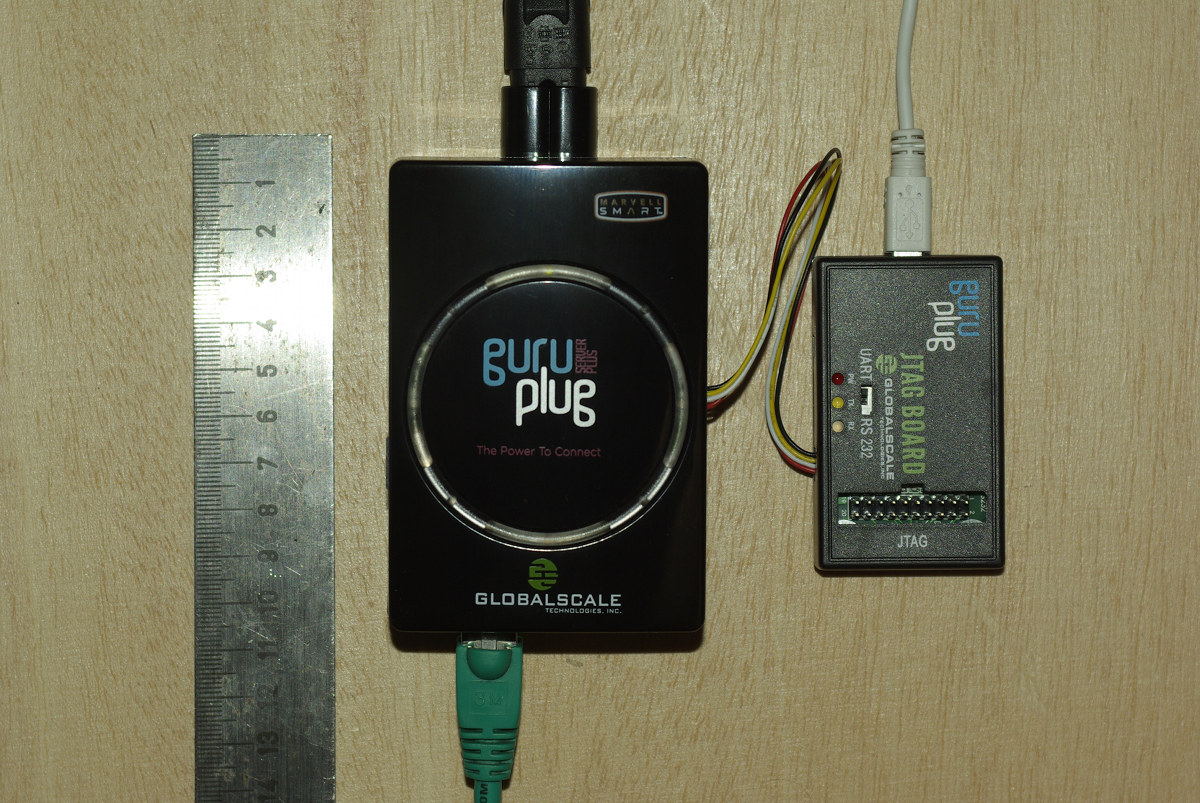
Yesterday finally my GuruPlug Server Plus arrived. Took longer than expected, but as it seems Globalscale had some issues with the power supplies and they were replaced before shipping the GuruPlugs. GuruPlug Server Plus and JTAG Board

The GuruPlug Basically the GuruPlugs are an enhanced version of the well known SheevaPlugs, the biggest difference is probably the need for an external JTAG/UART<>RS232 board to access the serial console. Good thing is that the board comes with a normal JTAG connector and an additional RS232 connector and 2.5V DC power outlet, so it will be useful for other devices, too. Globalscale could have chosen different connectors with less wiggly cables, though. As I was not able to find a useful howto about installing Debian on the Guruplug, I've written down what I did to install Debian unstable on a micro SD card using the Debian installer for the GuruPlug. I did not have a look who modified the Debian installer to work on the plug, but thanks for that! The instructions below are based on Martin Michlmayer's awesome SheevaPlug documentation, the hints from oinkzwurgl.org/guruplug and various forum posts in the plugforum.

Preparations Please note that I'm not resposible for whatever you're doing with your plug. If you follow this tutorial and end up with a brick, it is your fault, not mine. To install the GuruPlug you need the JTAG Board. Connect the UART port to the GuruPlug and the JTAG board to your computer, it should show up as FTDI (thanks for using good chips!) USB<>Serial converter. Serial port settings are 115200, 8-N-1, no hw/sw flow control. The other thing you should prepare is a working tftpd, I'm using aftpd.
apt-get install aftpd
Recent versions share files from /srv/tftp/, in case you're running Lenny /var/lib/tftpboot/ should be the place to drop your files. When everything is connected properly the boot process should show up in minicom, make sure to press some key to enter uBoot. The first thing you should do is to save the original uBoot environment in case you want to restore the factory settings later. Run
printenv
and save the output somewhere.

Upgrading uBoot Unfortunately the uBoot version on the GuruPlug is pretty old and seems to have some issues in booting from USB devices, so the first thing you should do is to upgrade it. You might want to investigate if there is even a better, more recent uBoot version available somewhere, or build one on your own, but I didn't bother and took the uBoot.guruplug.bin from here. The main issue with that is that booting from USB still seems to be buggy (even for FAT partitions) and that ext2load is still not supported. Otherwise it works well :-). I'm mainly following Martin Michlmayer's tutorial again. Download the uBoot.guruplug.bin and drop it into the tftpd directory. Make sure you always set the plug's IP address (ipaddr) and your server's IP address (serverip) properly. I'll use 192.168.121.253 for the plug and 192.168.121.2 for the server in all examples, make sure to change that for your own needs. Stop if something goes wrong, especially when the tftp download failed.
setenv ipaddr 192.168.121.253
setenv serverip 192.168.121.2
tftp 0x6400000 uBoot.guruplug.bin
nand erase 0x00000000 0x0100000
nand write 0x6400000 0x0000000 0x80000
reset
Enter uBoot again after the reset.

Preparing the installer Download uImage and uInitrd to your tftpd directory. Although I've heard that setting mainlineLinux/arcNumber in the uBoot environment is not necessary anymore for very recent kernel, lets set them to make sure the Debian kernel works:
setenv mainlineLinux yes
setenv arcNumber 2097
saveenv
reset
Again, enter uBoot after the reset.

Running the installer Run the following in the uBoot console:
setenv ipaddr 192.168.121.253
setenv serverip 192.168.121.2
tftpboot 0x01100000 uInitrd
tftpboot 0x00800000 uImage
setenv bootargs console=ttyS0,115200n8 base-installer/initramfs-tools/driver-policy=most
bootm 0x00800000 0x01100000
You should see the installer starting now. You might want to follow the following hints:
  • Before configuring the network, go back and set the debconf priority to low, Then continue. While chosing the Debian mirror, chose sid as the Debian version to install. If you don't have sid as choice, use a different mirror. The kernel in testing does not boot on the GuruPlug, you need 2.6.32-13 from sid.
  • You might want to load the 'network console' installer component and continue via ssh. Makes things fater and colourful.
  • Suggested partitioning: I've installed Debian to an 8GB micro SDcard. The SDcard reader is connected via USB and shows up as /dev/sdb (/dev/sda should be the internal NAND and not shown by the installer). I've used 150MB ext2 for /boot and the rest of the space for /, using ext4. You might want to use the noatime option on both filesystems to avoid unnecessary write access to the SDcard. You might choose to add a swap partition, but SDcards are so slow, so I've skipped that.
When you continue the installation, you will hit the following problem:
  • The installer might fail on 'Make the system bootable' (not sure if it does for you, it did so with the kernel from testing).
  • The uBoot is not able to boot from your /boot anyway. USB support is buggy and ext2load missing.
We'll work around these issues by writing the kernel and initrd into the plug's NAND. To do so, enter a shell in the installer and chroot into the install target. We'll then create the necessary uImage.bin and uInitrd and scp them to our tftpd directory:
chroot /target /bin/bash
cd /boot
mkimage -n vmlinuz -A arm -O linux -T kernel -C none -a 0x00008000 -e 0x00008000 -d /boot/vmlinuz uImage.bin
mkimage -n 'vmlinuz initrd' -A arm -O linux -T ramdisk -C gzip -d /boot/initrd.img uInitrd
scp uI* root@192.168.121.2:/srv/tftp
Now leave the shell, finish the installation and reboot, enter uBoot again.

Make the plug bootable To write kernel and initrd to the NAND memory, we have to transfer it via tftp first, then erase the NAND area we want to write to and then write it to the NAND. The values I've chosen here should be fine for the current Debian kernel, but you might need to change the necessary size for the initrd. To do so have a look at the output while transferring the initrd - the transferred bytes are displayed. They have to fit into the amount of bytes you write (the last option to nand write.e).
setenv ipaddr 192.168.121.253
setenv serverip 192.168.121.2
tftp 0x6400000 uImage.bin
nand erase 0x100000 0x400000
nand write.e 0x6400000 0x100000 0x400000
tftp 0x6400000 uInitrd
nand erase 0x500000 0x1fb00000
nand write.e 0x6400000 0x500000 0x600000
Now we need to set the necessary boot options. Make sure to change the root device if you've chosen a different layout from that I've suggested above, or if you're not using a SDcard.
setenv bootargs_debian 'console=ttyS0,115200 root=/dev/sdb2'
setenv bootcmd_nand 'nand start; nand read.e 0x00800000 0x100000 0x400000; nand read.e 0x01100000 0x500000 0x600000'
setenv bootcmd 'setenv bootargs $(bootargs_debian); run bootcmd_nand; bootm 0x00800000 0x01100000'
saveenv
run bootcmd

Finish Your GuruPlug should boot your new Debian installation now. Have fun! I'll try to keep the howto updated for changes in uBoot and the installer, but I might not have the time to so quickly. Patches and comments are welcome!.
root@guruplug:~# uname -a
Linux guruplug 2.6.32-5-kirkwood #1 Fri May 21 05:44:29 UTC 2010 armv5tel GNU/Linux
root@guruplug:~# cat /proc/cpuinfo 
Processor   : Feroceon 88FR131 rev 1 (v5l)
BogoMIPS    : 1192.75
Features    : swp half thumb fastmult edsp 
CPU implementer : 0x56
CPU architecture: 5TE
CPU variant : 0x2
CPU part    : 0x131
CPU revision    : 1
Hardware    : Marvell GuruPlug Reference Board
Revision    : 0000
Serial      : 0000000000000000
root@guruplug:~# 

Thibaut Girka: First week of GSoC

It's almost been a week since the GSoC started! Before describing what I've been doing this week I would like to write a word on the project and thank the ones I'm thankful to. The project Currently, Debian can be installed on the Neo Freerunner (FR) by running a shell script called install.sh on an already running Linux installation on the device (more information here). This works. However, it doesn't make use of the Debian Installer, and it is specific to the FR. The plan is to port Debian Installer to the FR and other similar devices. In order to succeed in this project, I'm mentored by Gaudenz Steinlin and Per Andersson, who I want to thank for their guidance (and the patience they'll probably need to have :p). I have to thank Obey Arhur Liu for all his organizing work, especially for the DebConf 10 sponsoring. While I'm at thanking, I want to thank Google, whithout which this program wouldn't exist at all, and especially Carol Smith, who makes an amazing job at organizing every aspect of the GSoC! What I've been doing Now, what have I been doing this week? As we did not set up git repositories yet, I'll not share the full patches, but only a few files for now: If you want to try the uImage, here is how to boot it. What's coming next First, I hope everything will be in place to share the full sources by then. The first thing I'll do next week is finishing identifying and including the needed drivers. Then, depending on how good goes the installation process, I may:

Martin-&#201;ric Racine: Ubuntu building its i386 libc6 with -m686 ?

This is something that makes me deeply worried about the future of Ubuntu.

Alexander Reichle-Schmehl: Write access for all DDs to the DPNs svn repository

It seems to be quite unknown, that Debian Developers, who are interested in helping with the Debian Project News (be it as editor, reviewer or translator) can already do so. Thanks to the help of the alioth admins the subversion repository where the DPN is drafted is open for all DDs to commit into it. More details on how are available in our wiki.

Next.

Previous.