Search Results: "tim"

10 December 2022

Matthew Garrett: On-device WebAuthn and what makes it hard to do well

WebAuthn improves login security a lot by making it significantly harder for a user's credentials to be misused - a WebAuthn token will only respond to a challenge if it's issued by the site a secret was issued to, and in general will only do so if the user provides proof of physical presence[1]. But giving people tokens is tedious and also I have a new laptop which only has USB-C but does have a working fingerprint reader and I hate the aesthetics of the Yubikey 5C Nano, so I've been thinking about what WebAuthn looks like done without extra hardware.

Let's talk about the broad set of problems first. For this to work you want to be able to generate a key in hardware (so it can't just be copied elsewhere if the machine is compromised), prove to a remote site that it's generated in hardware (so the remote site isn't confused about what security assertions you're making), and tie use of that key to the user being physically present (which may range from "I touched this object" to "I presented biometric evidence of identity"). What's important here is that a compromised OS shouldn't be able to just fake a response. For that to be possible, the chain between proof of physical presence to the secret needs to be outside the control of the OS.

For a physical security token like a Yubikey, this is pretty easy. The communication protocol involves the OS passing a challenge and the source of the challenge to the token. The token then waits for a physical touch, verifies that the source of the challenge corresponds to the secret it's being asked to respond to the challenge with, and provides a response. At the point where keys are being enrolled, the token can generate a signed attestation that it generated the key, and a remote site can then conclude that this key is legitimately sequestered away from the OS. This all takes place outside the control of the OS, meeting all the goals described above.

How about Macs? The easiest approach here is to make use of the secure enclave and TouchID. The secure enclave is a separate piece of hardware built into either a support chip (for x86-based Macs) or directly on the SoC (for ARM-based Macs). It's capable of generating keys and also capable of producing attestations that said key was generated on an Apple secure enclave ("Apple Anonymous Attestation", which has the interesting property of attesting that it was generated on Apple hardware, but not which Apple hardware, avoiding a lot of privacy concerns). These keys can have an associated policy that says they're only usable if the user provides a legitimate touch on the fingerprint sensor, which means it can not only assert physical presence of a user, it can assert physical presence of an authorised user. Communication between the fingerprint sensor and the secure enclave is a private channel that the OS can't meaningfully interfere with, which means even a compromised OS can't fake physical presence responses (eg, the OS can't record a legitimate fingerprint press and then send that to the secure enclave again in order to mimic the user being present - the secure enclave requires that each response from the fingerprint sensor be unique). This achieves our goals.

The PC space is more complicated. In the Mac case, communication between the biometric sensors (be that TouchID or FaceID) occurs in a controlled communication channel where all the hardware involved knows how to talk to the other hardware. In the PC case, the typical location where we'd store secrets is in the TPM, but TPMs conform to a standardised spec that has no understanding of this sort of communication, and biometric components on PCs have no way to communicate with the TPM other than via the OS. We can generate keys in the TPM, and the TPM can attest to those keys being TPM-generated, which means an attacker can't exfiltrate those secrets and mimic the user's token on another machine. But in the absence of any explicit binding between the TPM and the physical presence indicator, the association needs to be up to code running on the CPU. If that's in the OS, an attacker who compromises the OS can simply ask the TPM to respond to an challenge it wants, skipping the biometric validation entirely.

Windows solves this problem in an interesting way. The Windows Hello Enhanced Signin doesn't add new hardware, but relies on the use of virtualisation. The agent that handles WebAuthn responses isn't running in the OS, it's running in another VM that's entirely isolated from the OS. Hardware that supports this model has a mechanism for proving its identity to the local code (eg, fingerprint readers that support this can sign their responses with a key that has a certificate that chains back to Microsoft). Additionally, the secrets that are associated with the TPM can be held in this VM rather than in the OS, meaning that the OS can't use them directly. This means we have a flow where a browser asks for a WebAuthn response, that's passed to the VM, the VM asks the biometric device for proof of user presence (including some sort of random value to prevent the OS just replaying that), receives it, and then asks the TPM to generate a response to the challenge. Compromising the OS doesn't give you the ability to forge the responses between the biometric device and the VM, and doesn't give you access to the secrets in the TPM, so again we meet all our goals.

On Linux (and other free OSes), things are less good. Projects like tpm-fido generate keys on the TPM, but there's no secure channel between that code and whatever's providing proof of physical presence. An attacker who compromises the OS may not be able to copy the keys to their own system, but while they're on the compromised system they can respond to as many challenges as they like. That's not the same security assertion we have in the other cases.

Overall, Apple's approach is the simplest - having binding between the various hardware components involved means you can just ignore the OS entirely. Windows doesn't have the luxury of having as much control over what the hardware landscape looks like, so has to rely on virtualisation to provide a security barrier against a compromised OS. And in Linux land, we're fucked. Who do I have to pay to write a lightweight hypervisor that runs on commodity hardware and provides an environment where we can run this sort of code?


[1] As I discussed recently there are scenarios where these assertions are less strong, but even so

comment count unavailable comments

John Goerzen: Music Playing: Both Whole-House and Mobile

It s been nearly 8 years since I last made choices about music playing. At the time, I picked Logitech Media Server (LMS, aka Slimserver and Squeezebox server) for whole-house audio and Ampache with the DSub Android app. It s time to revisit that approach. Here are the things I m looking for: The current setup Here are the current components: LMS makes an excellent whole-house audio system. I can pull up the webpage (or use an Android app like Squeezer) to browse my music library, queue things up to play, and so forth. I can also create playlists, which it saves as m3u files. This whole setup is boringly reliable. It just works, year in, year out. The main problem with this is that LMS has no real streaming/offline mobile support. It is also a rather dated system, with a painful UI for playlist management, and in general doesn t feel very modern. (It s written largely in Perl also!) So, I paired with it is Ampache. As a streaming player, Ampache is fantastic; I can access it from a web browser, and it will transcode my FLAC files to the quality I ve set in my user prefs. The DSub app for Android is fantastic and remembers my last-play locations and such. The problem is that Ampache doesn t write its playlists back to m3u format, so I can t use them with LMS. I have to therefore maintain all the playlists in LMS, and it has a smallish limit on the number of tracks per playlist. Ampache also doesn t auto-update from LMS playlists, so I have to delete and recreate the playlists catalog periodically to get updates into Ampache. Not fun. The new experiment I m trying out a new system based on these components: This looks a lot more complicated than what I had before, but in reality it only has one additional layer. Since Snapcast is a general audio syncing tool, and Jellyfin doesn t itself output audio, Mopidy and its extensions is the glue . There s a lot to like about this setup. There is one single canonical source for music and playlists. Jellyfin can do a lot more besides music, and its mobile app gives me video access also. The setup, in general, works pretty well. There are a few minor glitches, but nothing huge. For instance, Jellyfin fails to clear the play queue on the mopidy side. But there is one problem, though: when playing a playlist, it is played out of order. Jellyfin itself has the same issue internally, so I m unsure where the bug lies. Rejected option: Jellyfin with jellycli This could be a nice option; instead of mopidy with a plugin, just run jellycli in headless mode as a more native client. It also has the playlist ordering bug, and in addition, fails to play a couple of my albums which Mopidy-Jellyfin handles fine. But, if those bugs were addressed, it has a ton of promise as a simpler glue between Jellyfin and Snapcast than Mopidy. Rejected option: Mopidy-Subidy Plugin with Ampache Mopidy has a Subsonic plugin, and Ampache implements the Subsonic API. This would theoretically let me use a Mopidy client to play things on the whole-house system, coming from the same Ampache system. Although I did get this connected with some trial and error (legacy auth on, API version 1.13.0), it was extremely slow. Loading the list of playlists took minutes, the list of albums and artists many seconds. It didn t cache any answers either, so it was unusably slow. Rejected option: Ampache localplay with mpd Ampache has a feature called localplay which allows it to control a mpd server. I tested this out with mpd and snapcast. It works, but is highly limited. Basically, it causes Ampache to send a playlist a literal list of URLs to the mpd server. Unfortunately, seeking within a track is impossible from within the Ampache interface. I will note that once a person is using mpd, snapcast makes a much easier whole-house solution than the streaming option I was trying to get working 8 years ago.

9 December 2022

Matthew Garrett: End-to-end encrypted messages need more than libsignal

(Disclaimer: I'm not a cryptographer, and I do not claim to be an expert in Signal. I've had this read over by a couple of people who are so with luck there's no egregious errors, but any mistakes here are mine)

There are indications that Twitter is working on end-to-end encrypted DMs, likely building on work that was done back in 2018. This made use of libsignal, the reference implementation of the protocol used by the Signal encrypted messaging app. There seems to be a fairly widespread perception that, since libsignal is widely deployed (it's also the basis for WhatsApp's e2e encryption) and open source and has been worked on by a whole bunch of cryptography experts, choosing to use libsignal means that 90% of the work has already been done. And in some ways this is true - the security of the protocol is probably just fine. But there's rather more to producing a secure and usable client than just sprinkling on some libsignal.

(Aside: To be clear, I have no reason to believe that the people who were working on this feature in 2018 were unaware of this. This thread kind of implies that the practical problems are why it didn't ship at the time. Given the reduction in Twitter's engineering headcount, and given the new leadership's espousal of political and social perspectives that don't line up terribly well with the bulk of the cryptography community, I have doubts that any implementation deployed in the near future will get all of these details right)

I was musing about this last night and someone pointed out some prior art. Bridgefy is a messaging app that uses Bluetooth as its transport layer, allowing messaging even in the absence of data services. The initial implementation involved a bunch of custom cryptography, enabling a range of attacks ranging from denial of service to extracting plaintext from encrypted messages. In response to criticism Bridgefy replaced their custom cryptographic protocol with libsignal, but that didn't fix everything. One issue is the potential for MITMing - keys are shared on first communication, but the client provided no mechanism to verify those keys, so a hostile actor could pretend to be a user, receive messages intended for that user, and then reencrypt them with the user's actual key. This isn't a weakness in libsignal, in the same way that the ability to add a custom certificate authority to a browser's trust store isn't a weakness in TLS. In Signal the app key distribution is all handled via Signal's servers, so if you're just using libsignal you need to implement the equivalent yourself.

The other issue was more subtle. libsignal has no awareness at all of the Bluetooth transport layer. Deciding where to send a message is up to the client, and these routing messages were spoofable. Any phone in the mesh could say "Send messages for Bob here", and other phones would do so. This should have been a denial of service at worst, since the messages for Bob would still be encrypted with Bob's key, so the attacker would be able to prevent Bob from receiving the messages but wouldn't be able to decrypt them. However, the code to decide where to send the message and the code to decide which key to encrypt the message with were separate, and the routing decision was made before the encryption key decision. An attacker could send a message saying "Route messages for Bob to me", and then another saying "Actually lol no I'm Mallory". If a message was sent between those two messages, the message intended for Bob would be delivered to Mallory's phone and encrypted with Mallory's key.

Again, this isn't a libsignal issue. libsignal encrypted the message using the key bundle it was told to encrypt it with, but the client code gave it a key bundle corresponding to the wrong user. A race condition in the client logic allowed messages intended for one person to be delivered to and readable by another.

This isn't the only case where client code has used libsignal poorly. The Bond Touch is a Bluetooth-connected bracelet that you wear. Tapping it or drawing gestures sends a signal to your phone, which culminates in a message being sent to someone else's phone which sends a signal to their bracelet, which then vibrates and glows in order to indicate a specific sentiment. The idea is that you can send brief indications of your feelings to someone you care about by simply tapping on your wrist, and they can know what you're thinking without having to interrupt whatever they're doing at the time. It's kind of sweet in a way that I'm not, but it also advertised "Private Spaces", a supposedly secure way to send chat messages and pictures, and that seemed more interesting. I grabbed the app and disassembled it, and found it was using libsignal. So I bought one and played with it, including dumping the traffic from the app. One important thing to realise is that libsignal is just the protocol library - it doesn't implement a server, and so you still need some way to get information between clients. And one of the bits of information you have to get between clients is the public key material.

Back when I played with this earlier this year, key distribution was implemented by uploading the public key to a database. The other end would download the public key, and everything works out fine. And this doesn't sound like a problem, given that the entire point of a public key is to be, well, public. Except that there was no access control on this database, and the filenames were simply phone numbers, so you could overwrite anyone's public key with one of your choosing. This didn't let you cause messages intended for them to be delivered to you, so exploiting this for anything other than a DoS would require another vulnerability somewhere, but there are contrived situations where this would potentially allow the privacy expectations to be broken.

Another issue with this app was its handling of one-time prekeys. When you send someone new a message via Signal, it's encrypted with a key derived from not only the recipient's identity key, but also from what's referred to as a "one-time prekey". Users generate a bunch of keypairs and upload the public half to the server. When you want to send a message to someone, you ask the server for one of their one-time prekeys and use that. Decrypting this message requires using the private half of the one-time prekey, and the recipient deletes it afterwards. This means that an attacker who intercepts a bunch of encrypted messages over the network and then later somehow obtains the long-term keys still won't be able to decrypt the messages, since they depended on keys that no longer exist. Since these one-time prekeys are only supposed to be used once (it's in the name!) there's a risk that they can all be consumed before they're replenished. The spec regarding pre-keys says that servers should consider rate-limiting this, but the protocol also supports falling back to just not using one-time prekeys if they're exhausted (you lose the forward secrecy benefits, but it's still end-to-end encrypted). This implementation not only implemented no rate-limiting, making it easy to exhaust the one-time prekeys, it then also failed to fall back to running without them. Another easy way to force DoS.

(And, remember, a successful DoS on an encrypted communications channel potentially results in the users falling back to an unencrypted communications channel instead. DoS may not break the encrypted protocol, but it may be sufficient to obtain plaintext anyway)

And finally, there's ClearSignal. I looked at this earlier this year - it's avoided many of these pitfalls by literally just being a modified version of the official Signal client and using the existing Signal servers (it's even interoperable with Actual Signal), but it's then got a bunch of other weirdness. The Signal database (I /think/ including the keys, but I haven't completely verified that) gets backed up to an AWS S3 bucket, identified using something derived from a key using KERI, and I've seen no external review of that whatsoever. So, who knows. It also has crash reporting enabled, and it's unclear how much internal state it sends on crashes, and it's also based on an extremely old version of Signal with the "You need to upgrade Signal" functionality disabled.

Three clients all using libsignal in one form or another, and three clients that do things wrong in ways that potentially have a privacy impact. Again, none of these issues are down to issues with libsignal, they're all in the code that surrounds it. And remember that Twitter probably has to worry about other issues as well! If I lose my phone I'm probably not going to worry too much about whether the messages sent through my weird bracelet app being gone forever, but losing all my Twitter DMs would be a significant change in behaviour from the status quo. But that's not an easy thing to do when you're not supposed to have access to any keys! Group chats? That's another significant problem to deal with. And making the messages readable through the web UI as well as on mobile means dealing with another set of key distribution issues. Get any of this wrong in one way and the user experience doesn't line up with expectations, get it wrong in another way and the worst case involves some of your users in countries with poor human rights records being executed.

Simply building something on top of libsignal doesn't mean it's secure. If you want meaningful functionality you need to build a lot of infrastructure around libsignal, and doing that well involves not just competent development and UX design, but also a strong understanding of security and cryptography. Given Twitter's lost most of their engineering and is led by someone who's alienated all the cryptographers I know, I wouldn't be optimistic.

comment count unavailable comments

Russell Coker: USB-PD and GaN

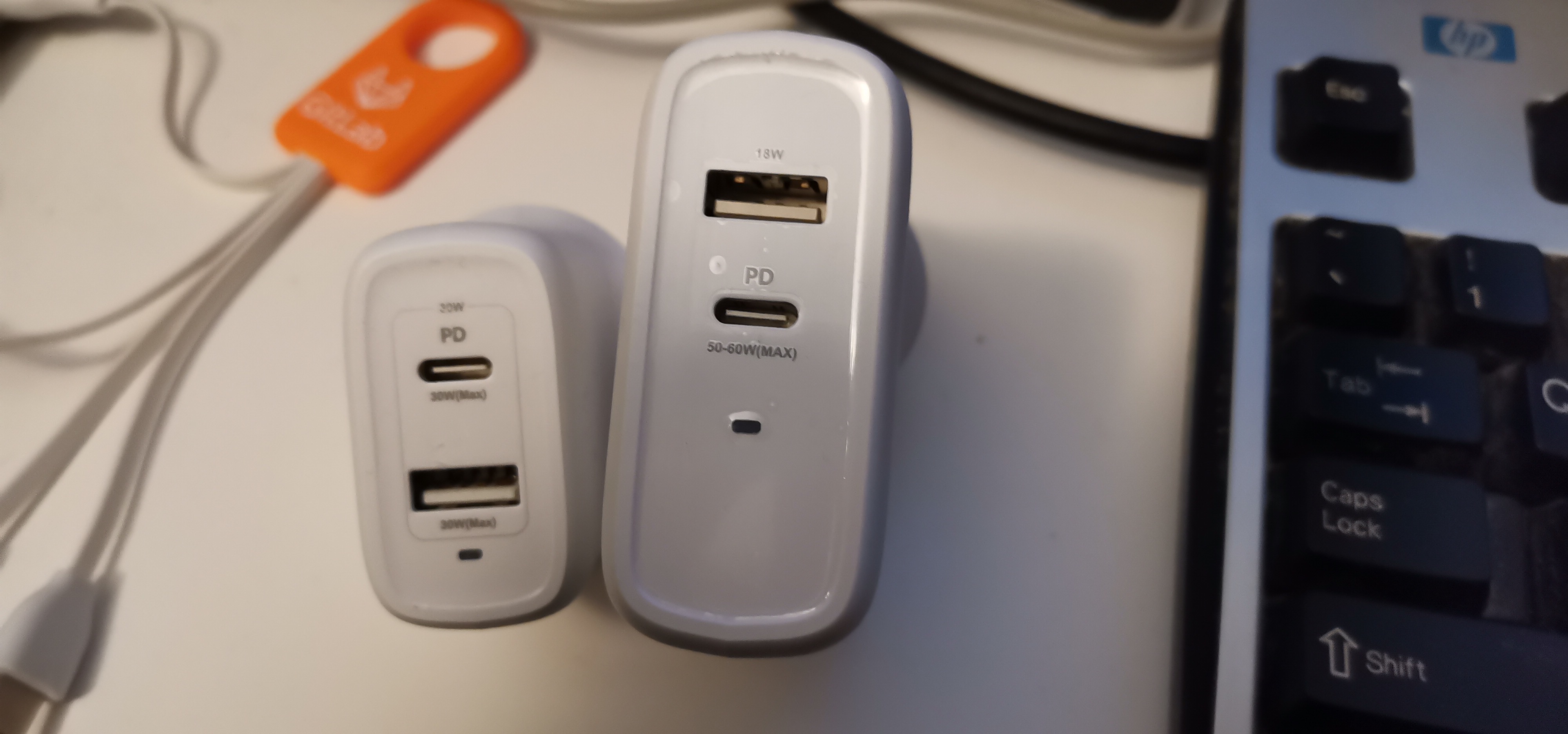
photo of 2 USB-PD chargers A recent development is cheap Gallium Nitride based power supplies that provide better efficiency in a smaller space than other technologies. Kogan recently had a special on such devices so I decided to try them out with my new Thinkpad X1 Carbon Gen 5 [1]. Google searches for power supplies for that Thinkpad included results for 30W PSUs which implies that any 30W USB-C PSU should work. I bought a 30W charger for $10 that can supply 15V/2A or 20V/1.5A on a single USB-C port or 15W on the USB-C port and 15W on the USB-2 port at the same time and expected it to work as a laptop charger. Unfortunately it didn t, I don t know whether the adverts for 30W Thinkpad PSUs were false or whether the claim of the GaN charger I bought being 30W was false, all I know is that the KDE power applet said that the PSU couldn t supply enough power. I then bought a 68W charger for $28 that can supply 20.0V/3.0A on a single USB-C port if the USB-2 port isn t used and 50W on the USB-C port if the USB-2 port is also being used. This worked well which wasn t a great surprise as I had previously run the laptop on 45W PSUs. If I connect a phone to the USB-2 port while the laptop is being charged then the laptop will be briefly cut off, presumably the voltage and current are being renegotiated when that happens. As you can see the 68W charger is significantly larger than the 30W charger, but still small enough to easily fit in a jacket pocket and smaller than a regular laptop charger. One of my uses for this will be to put it in a jacket pocket when I have my laptop in another pocket. Another use will be for charging in my car as the cables from the inverter to convert 12VDC to 240VAC takes enough space. I will probably get a ~50W USB-PD charger that connects to a car cigarette lighter socket when a GaN version of such a charger becomes available.

8 December 2022

Reproducible Builds: Reproducible Builds in November 2022

Welcome to yet another report from the Reproducible Builds project, this time for November 2022. In all of these reports (which we have been publishing regularly since May 2015) we attempt to outline the most important things that we have been up to over the past month. As always, if you interested in contributing to the project, please visit our Contribute page on our website.

Reproducible Builds Summit 2022 Following-up from last month s report about our recent summit in Venice, Italy, a comprehensive report from the meeting has not been finalised yet watch this space! As a very small preview, however, we can link to several issues that were filed about the website during the summit (#38, #39, #40, #41, #42, #43, etc.) and collectively learned about Software Bill of Materials (SBOM) s and how .buildinfo files can be seen/used as SBOMs. And, no less importantly, the Reproducible Builds t-shirt design has been updated

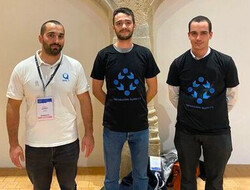
Reproducible Builds at European Cyber Week 2022 During the European Cyber Week 2022, a Capture The Flag (CTF) cybersecurity challenge was created by Fr d ric Pierret on the subject of Reproducible Builds. The challenge consisted in a pedagogical sense based on how to make a software release reproducible. To progress through the challenge issues that affect the reproducibility of build (such as build path, timestamps, file ordering, etc.) were to be fixed in steps in order to get the final flag in order to win the challenge. At the end of the competition, five people succeeded in solving the challenge, all of whom were awarded with a shirt. Fr d ric Pierret intends to create similar challenge in the form of a how to in the Reproducible Builds documentation, but two of the 2022 winners are shown here:

On business adoption and use of reproducible builds Simon Butler announced on the rb-general mailing list that the Software Quality Journal published an article called On business adoption and use of reproducible builds for open and closed source software. This article is an interview-based study which focuses on the adoption and uses of Reproducible Builds in industry, with a focus on investigating the reasons why organisations might not have adopted them:
[ ] industry application of R-Bs appears limited, and we seek to understand whether awareness is low or if significant technical and business reasons prevent wider adoption.
This is achieved through interviews with software practitioners and business managers, and touches on both the business and technical reasons supporting the adoption (or not) of Reproducible Builds. The article also begins with an excellent explanation and literature review, and even introduces a new helpful analogy for reproducible builds:
[Users are] able to perform a bitwise comparison of the two binaries to verify that they are identical and that the distributed binary is indeed built from the source code in the way the provider claims. Applied in this manner, R-Bs function as a canary, a mechanism that indicates when something might be wrong, and offer an improvement in security over running unverified binaries on computer systems.
The full paper is available to download on an open access basis. Elsewhere in academia, Beatriz Michelson Reichert and Rafael R. Obelheiro have published a paper proposing a systematic threat model for a generic software development pipeline identifying possible mitigations for each threat (PDF). Under the Tampering rubric of their paper, various attacks against Continuous Integration (CI) processes:
An attacker may insert a backdoor into a CI or build tool and thus introduce vulnerabilities into the software (resulting in an improper build). To avoid this threat, it is the developer s responsibility to take due care when making use of third-party build tools. Tampered compilers can be mitigated using diversity, as in the diverse double compiling (DDC) technique. Reproducible builds, a recent research topic, can also provide mitigation for this problem. (PDF)

Misc news
On our mailing list this month:

Debian & other Linux distributions Over 50 reviews of Debian packages were added this month, another 48 were updated and almost 30 were removed, all of which adds to our knowledge about identified issues. Two new issue types were added as well. [ ][ ]. Vagrant Cascadian announced on our mailing list another online sprint to help clear the huge backlog of reproducible builds patches submitted by performing NMUs (Non-Maintainer Uploads). The first such sprint took place on September 22nd, but others were held on October 6th and October 20th. There were two additional sprints that occurred in November, however, which resulted in the following progress: Lastly, Roland Clobus posted his latest update of the status of reproducible Debian ISO images on our mailing list. This reports that all major desktops build reproducibly with bullseye, bookworm and sid as well as that no custom patches needed to applied to Debian unstable for this result to occur. During November, however, Roland proposed some modifications to live-setup and the rebuild script has been adjusted to fix the failing Jenkins tests for Debian bullseye [ ][ ].
In other news, Miro Hron ok proposed a change to clamp build modification times to the value of SOURCE_DATE_EPOCH. This was initially suggested and discussed on a devel@ mailing list post but was later written up on the Fedora Wiki as well as being officially proposed to Fedora Engineering Steering Committee (FESCo).

Upstream patches The Reproducible Builds project detects, dissects and attempts to fix as many currently-unreproducible packages as possible. We endeavour to send all of our patches upstream where appropriate. This month, we wrote a large number of such patches, including:

diffoscope diffoscope is our in-depth and content-aware diff utility. Not only can it locate and diagnose reproducibility issues, it can provide human-readable diffs from many kinds of binary formats. This month, Chris Lamb prepared and uploaded versions 226 and 227 to Debian:
  • Support both python3-progressbar and python3-progressbar2, two modules providing the progressbar Python module. [ ]
  • Don t run Python decompiling tests on Python bytecode that file(1) cannot detect yet and Python 3.11 cannot unmarshal. (#1024335)
  • Don t attempt to attach text-only differences notice if there are no differences to begin with. (#1024171)
  • Make sure we recommend apksigcopier. [ ]
  • Tidy generation of os_list. [ ]
  • Make the code clearer around generating the Debian substvars . [ ]
  • Use our assert_diff helper in test_lzip.py. [ ]
  • Drop other copyright notices from lzip.py and test_lzip.py. [ ]
In addition to this, Christopher Baines added lzip support [ ], and FC Stegerman added an optimisation whereby we don t run apktool if no differences are detected before the signing block [ ].
A significant number of changes were made to the Reproducible Builds website and documentation this month, including Chris Lamb ensuring the openEuler logo is correctly visible with a white background [ ], FC Stegerman de-duplicated by email address to avoid listing some contributors twice [ ], Herv Boutemy added Apache Maven to the list of affiliated projects [ ] and boyska updated our Contribute page to remark that the Reproducible Builds presence on salsa.debian.org is not just the Git repository but is also for creating issues [ ][ ]. In addition to all this, however, Holger Levsen made the following changes:
  • Add a number of existing publications [ ][ ] and update metadata for some existing publications as well [ ].
  • Hide draft posts on the website homepage. [ ]
  • Add the Warpforge build tool as a participating project of the summit. [ ]
  • Clarify in the footer that we welcome patches to the website repository. [ ]

Testing framework The Reproducible Builds project operates a comprehensive testing framework at tests.reproducible-builds.org in order to check packages and other artifacts for reproducibility. In October, the following changes were made by Holger Levsen:
  • Improve the generation of meta package sets (used in grouping packages for reporting/statistical purposes) to treat Debian bookworm as equivalent to Debian unstable in this specific case [ ] and to parse the list of packages used in the Debian cloud images [ ][ ][ ].
  • Temporarily allow Frederic to ssh(1) into our snapshot server as the jenkins user. [ ]
  • Keep some reproducible jobs Jenkins logs much longer [ ] (later reverted).
  • Improve the node health checks to detect failures to update the Debian cloud image package set [ ][ ] and to improve prioritisation of some kernel warnings [ ].
  • Always echo any IRC output to Jenkins output as well. [ ]
  • Deal gracefully with problems related to processing the cloud image package set. [ ]
Finally, Roland Clobus continued his work on testing Live Debian images, including adding support for specifying the origin of the Debian installer [ ] and to warn when the image has unmet dependencies in the package list (e.g. due to a transition) [ ].
If you are interested in contributing to the Reproducible Builds project, please visit our Contribute page on our website. You can get in touch with us via:

Shirish Agarwal: Wayland, Hearing aids, Multiverse & Identity

Wayland First up, I read Antoine Beaupr s Wayland to Sway migration with interest. While he said it s done and dusted or something similar, the post shows there s still quite a ways to go. I wouldn t say it s done or whatever till it s integrated so well that a person installs it and doesn t really need to fiddle with config files as an average user. For specific use-cases you may need to, but that should be outside of a normal user (layperson) experience. I have been using mate for a long long time and truth be told been very happy with it. The only thing I found about Wayland on mate is this discussion or rather this entry. The roadmap on Ubuntu Mate is also quite iffy. The Mate Wayland entry on Debian wiki also perhaps need an updation but dunno much as the latest update it shares is 2019 and it s 2022. One thing to note, at least according to Antoine, things should be better as and when it gets integrated even on legacy hardware. I would be interested to know how it would work on old desktops and laptops rather than new or is there some barrier? I, for one would have liked to see or know about why lightdm didn t work on Wayland and if there s support. From what little I know lightdm is much lighter than gdm3 and doesn t require much memory and from what little I have experienced works very well with mate. I have been using it since 2015/16 although the Debian changelog tells me that it has been present since 2011. I was hoping to see if there was a Wayland specific mailing list, something like debian-wayland but apparently there s not :(. Using mate desktop wayland (tried few other variations on the keywords) but search fails to find any meaningful answer :(. FWIW and I don t know the reason why but Archwiki never fails to amaze me. Interestingly, it just says No for mate. I probably would contact upstream in the coming days to know what their plans are and hopefully they will document what their plans are on integrating Wayland in both short-term and long-term with an update, or if there is something more recent they have documented elsewhere, get that update on the Debian wiki so people know. The other interesting thread I read was Russel Coker s Thinkpad X1 Carbon Gen5 entry. I would be in the market in a few months to find/buy a Thinkpad but probably of AMD rather than Intel because part of recent past history with Intel as well as AMD having a bit of an edge over Intel as far as graphics is concerned. I wonder why Russel was looking into Intel and not AMD. Would be interested to know why Intel and not AMD? Any specific reason ???

Hearing Aids I finally bought hearing aids about a couple of weeks back and have been practicing using them. I was able to have quite a few conversations although music is still I m not able to listen clearly but it is still a far cry from before and for the better. I am able to have conversations with people and also reply and they do not have to make that extra effort that they needed to. Make things easier for everybody. The one I bought is at the starting range although the hearing aids go all the way to 8 lakhs for a pair (INR 800,000), the more expensive ones having WiFi, Bluetooth and more channels, it all depends on how much can one afford. And AFAIK there is not a single Indian manufacturer who is known in this business.

One thing I did notice is while the hearing aids are remarkably sturdy if they fall down as they are small, yet you have to be careful of both dust and water . That does makes life a bit difficult as my house and city both gets sand quite a bit everyday. I don t think they made any India-specific changes, if they had, would probably make things better. I haven t yet looked at it, but it may be possible to hack it remotely. There may or may not be security issues involved, probably would try once I ve bit more time am bit more comfortable to try and see what I can find out. If I had bought it before, maybe I would have applied for the Debian event happening in Kerala, if nothing else, would have been to document what happened there in detail.  I probably would have to get a new motherboard for my desktop probably in a year or two as quite a few motherboards also have WiFi (WiFi 6 ?) think on the southbridge. I at least would have a look in new year and know more as to what s been happening. For last at least 2-3 years there has been a rumor which has been confirmed time and again that the Tata Group has been in talks with multiple vendors to set chip fabrication and testing business but to date they haven t been able to find one. They do keep on giving press conferences about the same but that s all they do :(. Just shared the latest one above.

The Long War Terry Pratchett, Stephen Braxter Long Earth Terry Pratchett, Stephen Braxter ISBN13: 9780062067777 Last month there was also a seconds books sale where I was lucky enough to get my hands on the Long War. But before I share about the book itself, I had a discussion with another of my friends and had to re-share part of that conversation. While the gentleman was adamant that non-fiction books are great, my point as always is both are equal. As I shared perhaps on this blog itself, perhaps multiple times, that I had seen a YT video in which a professor shared multiple textbooks of physics and shared how they are wrong and have been wrong and kept them in a specific corner. He took the latest book which he honestly said doesn t have any mistakes as far as he know and yet still kept in that same corner denoting that it is highly possible that future understanding will make the knowledge or understanding we know different. An example of physics in the nano world and how that is different and basically turns our understanding than what we know. Now as far as the book is concerned, remember Michael Crichton s Timeline. Now that book was originally written in the 1960 s while this one was written by both the honorable gentleman in 2013. So almost 50+ years difference between the two books, and that even shows how they think about things. In this book, you no longer need a big machine, but have something called a stepper machine which is say similar to a cellphone, that size and that frame, thickness etc. In this one, the idea of multiverse is also there but done a tad differently. In this, we do not have other humans or copy humans but have multiple earths that may have same or different geography as how evolution happened. None of the multiverse earths have humans but have different species depending on the evolution that happened there. There are something called as trolls but they have a much different meaning and way about them about how most fantasy authors portray trolls. While they are big in this as well, they are as gentle as bears or rabbits. So the whole thing is about real estate and how humans have spread out on multiple earths and the politics therein. Interestingly, the story was trashed or given negative reviews on Goodreads. The sad part is/was that it was written and published in 2013 when perhaps the possibility of war or anything like that was very remote especially in the States, but now we are now in 2022 and just had an insurrection happen and whole lot of Americans are radicalized, whether you see the left or the right depending on your ideology. An American did share few weeks ago how some shares are looking at Proportional Representation and that should make both parties come more towards the center and be a bit more transparent. What was interesting to me is the fact that states have much more rights to do elections and electioneering the way they want rather than a set model which everyone has common which is what happens in India. This also does poke holes into the whole Donald Trump stolen democracy drama but that s a different story altogether. One of the more interesting things I came to know about is that there are 4 books in the long series and this was the second book in itself. I do not want to dwell on the characters themselves as frankly speaking I haven t read all the four books and it would be gross injustice on my part to talk about the characters themselves. Did I enjoy reading the book, for sure. What was interesting and very true of human nature is that even if we have the ability or had the ability to have whole worlds to ourselves, we are bound to mess it up. And in that aspect, I don t think he is too far off the mark. If I had a whole world, wouldn t I try to exploit it to the best or worse of my ability. One of the more interesting topics in the book is the barter system they have thought of that is called as favors. If you are in multiple worlds, then having a currency, even fiat money is of no use and they have to find ways and means to trade with one another. The book also touches a bit on slavery but only just and doesn t really explore it as much as it could have.

Identity Now this has many meanings to it. Couple of weeks ago, saw a transgender meet. For the uninitiated or rather people like me, basically it is about people who are born in one gender but do not identify with it but the other and they express it first through their clothes and expression and the end of the journey perhaps is with having the organs but this may or may not be feasible, as such surgery is expensive and also not available everywhere. After section 377 was repealed few years ago, we do have a third gender on forms as well as have something called a Transgender Act but how much the needle has moved in society is still a question. They were doing a roadshow near my house hence I was able to talk with them with my new hearing aids and while there was lot of traffic was able to understand some of their issues. For e.g. they find it difficult to get houses on rent, but then it is similar for bachelor guys or girls also. One could argue to what degree it is, and that perhaps maybe. Also, there is a myth that they are somehow promiscuous but that I believe is neither here or there. Osho said an average person thinks about the opposite sex every few seconds or a minute. I am sure even Freud would have similar ideas. So, if you look in that way everybody is promiscuous as far as thought is concerned. The other part being opportunity but that again is function of so many other things. Some people are able to attract a lot of people, others might not. And then whether they chose to act on that opportunity or not is another thing altogether. Another word that is or was used is called gender fluid, but that too is iffy as gender fluid may or may not mean transgender. Also, while watching some nature documentary few days/weeks back had come to know that trees have something like 18 odd genders. That just blows me out of the mind and does re-question this whole idea of sexuality and identity to only two which seems somewhat regressive at least to me. If we think humans are part of nature, then we need to be open up perhaps a bit more. But identity as I shared above has more than one meaning. For e.g. citizenship, that one is born in India is even messier to know, understand and define. I had come across this article about couple of months back. Now think about this. Now, there have been studies and surveys about citizenship and it says something like 60% birth registrations are done in metro cities. Now Metro cities are 10 as defined by Indian state. But there are roughly an odd 4k cities in India and probably twice the number of villages and those are conservative numbers as we still don t record things meticulously, maybe due to the Indian oral tradition or just being lazy or both, one part is also that if you document people and villages and towns, then you are also obligated to give them some things as a state and that perhaps is not what the Indian state wants. A small village in India could be anywhere from few hundreds of people to a few thousand. And all the new interventions whether it is PAN, Aadhar has just made holes rather than making things better. They are not inclusive but exclusive. And none of this takes into account Indian character and the way things are done in India. In most households, excluding the celebs (they are in a world of pain altogether when it comes to baby names but then it s big business but that s an entire different saga altogether, so not going to touch that.) I would use or say my individual case as that is and seems to be something which is regular even today. I was given a nickname when I was 3 years old and given a name when I was 5-6 when I was put in school. I also came to know in school few kids who didn t like their names and couple of them cajoled and actually changed their names while they were kids, most of us just stayed with what we got. I do remember sharing about nakushi or something similar a name given to few girls in Maharashtra by their parents and the state intervened and changed their names. But that too is another story in itself. What I find most problematic is that the state seems to be blind, and this seems to be by design rather than a mistake. Couple of years back, Assam did something called NRC (National Register of Citizens) and by the Govt s own account it was a failure of massive proportions. And they still want to bring in CAA, screwing up Assam more. And this is the same Govt. went shown how incorrect it was, blamed it all on the High Court and it s the same Govt. that shopped around for judges to put somebody called Mr. Saibaba (an invalid 90 year adivasi) against whom the Govt. hasn t even a single proof as of date. Apparently, they went to 6 judges who couldn t give what the decision the Govt. wanted. All this info. is in public domain. So the current party ruling, i.e. BJP just wants to make more divisions rather than taking people along as they don t have answers either on economy, inflation or issues that people are facing. One bright light has been Rahul Gandhi who has been doing a padhyatra (walking) from Kanyakumari to Kashmir and has had tremendous success although mainstream media has showed almost nothing what he is doing or why he is doing that. Not only he had people following him, there are and were many who took his example and using the same values of inclusiveness are walking where they can. And this is not to do with just a political party but more with a political thought of inclusiveness, that we are one irrespective of what I believe, eat, wear etc. And that gentleman has been giving press conferences while our dear P.M. even after 8 years doesn t have the guts to do a single press conference. Before closing, I do want to take another aspect, Rahul Gandhi s mother is an Italian or was from Italy before she married. But for BJP she is still Italian. Rishi Sunak, who has become the UK Prime Minister they think of him as Indian and yet he has sworn using the Queen s name. And the same goes for Canada Kumar (Akshay Kumar) and many others. How the right is able to blind and deaf to what it thinks is beyond me. All these people have taken an oath in the name of the Queen and they have to be loyal to her or rather now King Charles III. The disconnect continues.

Jonathan Dowland: Portland, Oregon and Beatdown Records, Newcastle

Powell's frontage Powell's frontage
I'm over on the west coast of the States attending 15th IEEE/ACM International Conference on Utility and Cloud Computing (UCC2022) in Vancouver, WA. Vancouver is a city on the southern extent of Washington, on the north side of the Columbia River from the (better known) Portland, Oregon. (Perhaps more about Vancouver in another post.) In between conference sessions I've made a couple of trips out to Portland to see bits and pieces. My friends with experience here all raved about Powell's City of Books, and with good reason. I managed to escape without a mortal wound to my finances, but only just.
Music Millennium. Keep Portland Weird! Music Millennium. Keep Portland Weird!
Likewise Music Millennium, emblazoned with the unofficial city slogan "Keep Portland Weird!" was a worthwhile pilgrimage. I was saved only by knowing that I had to carry home whatever I bought on the plane. Visiting MM made me realise something about my favourite record store at home, Beatdown Records: It is a truly world-class record store. I have bought from (and sold at) many times over the years, but the last time I had a realisation that it was somewhere a bit special was in between two of the UK's Covid lockdowns. My father and I both qualified for early access to the first two rounds of COVID-19 vaccinations on offer in the UK the Astra Zeneca and The Centre for Life (across the road from Beatdown Records) was the nearest place to go and get them. By the time of our second shot, shops had started to open up again and things had loosened up a bit. We had time to kill around the appointment so I took my Dad to Beatdown. The shop has a reasonably-sized front room with a selection of CDs and records, but the real gold is in the back. Dad hadn't realised there was a back. He's a pretty quiet person so when I took him to the back and he loudly exclaimed " Wow", it was quite satisfying.

Russell Coker: Thinkpad X1 Carbon Gen5

Gen1 Since February 2018 I have been using a Thinkpad X1 Carbon Gen1 [1] as my main laptop. Generally I ve been very happy with it, it s small and light, has good performance for web browsing etc, and with my transition to doing all compiles etc on servers it works well. When I wrote my original review I was unhappy with the keyboard, but I got used to that and found it to be reasonably good. The things that I have found as limits on it are the display resolution as 1600*900 isn t that great by modern standards (most phones are a lot higher resolution), the size (slightly too large for the pocket of my Scott e Vest [2] jacket), and the lack of USB-C. Modern laptops can charge via USB-C/Thunderbolt while also doing USB and DisplayPort video over the same cable. USB-C monitors which support charging a laptop over the same cable as used for video input are becoming common (last time I checked the Dell web site for many models of monitor there was a USB-C one that cost about $100 more). I work at a company with lots of USB-C monitors and docks so being able to use my personal laptop with the same displays when on breaks is really handy. A final problem with the Gen1 is that it has a proprietary and unusual connector for the SSD which means that a replacement SSD costs about what I paid for the entire laptop. Ever since the SSD gave a BTRFS checksum error I ve been thinking of replacing it. Choosing a Replacement The Gen5 is the first Thinkpad X1 Carbon to have USB-C. For work I had used a Gen6 which was quite nice [3]. But it didn t seem to offer much over the Gen5. So I started looking for cheap Thinkpad X1 Carbons of Gen5+. A Cheap? Gen5 In July I saw an ebay advert for a Gen5 with FullHD display for $370 or nearest offer, with the downside being that the BIOS password had been lost. I offered $330 and the seller accepted, in retrospect that was unusually cheap and should have been a clue that I needed to do further investigation. It turned out that resetting the BIOS password is unusually difficult as it s in the TPM so the system would only boot Windows. When I learned that I should have sold the laptop to someone who wanted to run Windows and bought another. Instead I followed some instructions on the Internet about entering a wrong password multiple times to get to a password recovery screen, instead the machine locked up entirely and became unusable for windows (so don t do that). Then I looked for ways of fixing the motherboard. The cheapest was $75.25 for a replacement BIOS flash chip that had a BIOS that didn t check the validity of passwords. The aim was to solder that on, set a new password (with any random text being accepted as the old password), then solder the old one back on for normal functionality. It turned out that I m not good at fine soldering, after I had hacked at it a friend diagnosed the chip and motherboard to probably both be damaged (he couldn t get it going). The end solution was that my friend found a replacement motherboard for $170 from China. This gave a total cost of $575.25 for the laptop which is more than the usual price of a Gen6 and more than I expected to pay. In the past when advocating buying second hand or refurbished laptops people would say what happens if you get one that doesn t work properly , the answer to that question is that I paid a lot less than the new cost of $2700+ for a Thinkpad X1 Carbon and got a computer that does everything I need. One of the advantages of getting a cheap laptop is that I won t be so unhappy if I happen to drop it. A Cheap Gen6 After the failed experiment with a replacement BIOS on the Gen5 I was considering selling it for scrap. So I bought a Gen6 from Australian Computer Traders via Amazon for $390 in August. The advert clearly stated that it was for a laptop with USB-C and Thunderbolt (Gen5+ features) but they shipped me a Gen4 that didn t even have USB-C. They eventually refunded me but I will try to avoid buying from them again. Finally Working The laptop I now have has a i5-6300U CPU that rates 3242 on cpubenchmark.net. My Gen1 thinkpad has a i7-3667U CPU that rates 2378 on cpubenchmark.net, note that the cpubenchmark.net people have rescaled their benchmark since my review of the Gen1 in 2018. So according to the benchmarks my latest laptop is about 36% faster for CPU operations. Not much of a difference when comparing systems manufactured in 2012 and 2017! According to the benchmarks a medium to high end recent CPU will be more than 10* faster than the one in my Gen5 laptop, but such a CPU would cost more than my laptop cost. The storage is a 256G NVMe device that can do sustained reads at 900MB/s, that s not even twice as fast as the SSD in my Gen1 laptop although NVMe is designed to perform better for small IO. It has 2*USB-C ports both of which can be used for charging, which is a significant benefit over the Gen6 I had for work in 2018 which only had one. I don t know why Lenovo made Gen6 machines that were lesser than Gen5 in such an important way. It can power my Desklab portable 4K monitor [4] but won t send a DisplayPort signal over the same USB-C cable. I don t know if this is a USB-C cable issue or some problem with the laptop recognising displays. It works nicely with Dell USB-C monitors and docks that power the laptop over the same cable as used for DisplayPort. Also the HDMI port works with 4K monitors, so at worst I could connect my Desklab monitor via a USB-C cable for power and HDMI for data. The inability to change the battery without disassembly is still a problem, but hopefully USB-C connected batteries capable of charging such a laptop will become affordable in the near future and I have had some practice at disassembling this laptop. It still has the Ethernet dongle annoyance, and of course the seller didn t include that. But USB ethernet devices are quite good and I have a few of them. In conclusion it s worth the $575.25 I paid for it and would have been even better value for money if I had been a bit smarter when buying. It meets the initial criteria of USB-C power and display and of fitting in my jacket pocket as well as being slightly better than my old laptop in every other way.

Louis-Philippe V ronneau: Debian Python Team 2022 Sprint Report

This is the report for the Debian Python Team remote sprint that took place on December 2-3-4 2022. Many thanks to those who participated, namely: Here is a list of issues we worked on: pybuild autodep8 feature About a year ago, Antonio Terceiro contributed code to pybuild to make it possible to automatically run the upstream test suite as autopkgtests. This feature has now been merged and uploaded to unstable. Although you can find out more about it in the pybuild-autopkgtest manpage, an email providing more details should be sent to the debian-python mailing list relatively soon. Fixing packages that run tests via python3 setup.py test Last August, Stefano Rivera poked the team about the deprecation of the python3 setup.py test command to run tests in pybuild. Although this feature has been deprecated upstream for 6 years now, many packages in the archive still use it to run the upstream test suite during build. Around 29 of the 67 packages that are team-maintained by the Debian Python Team were fixed during the sprint. Ideally, all of them would be before the feature is removed from pybuild. if a package you maintain still runs this command, please consider fixing it! Fixing packages that use nose nose, provided by the python3-nose package, is an obsolete testing framework for Python and has been unmaintained since 2015. During the sprint, people worked on fixing some of the many bugs filled against packages still running tests via nose, but there are still around 240 packages affected by this issue in the archive. Again, if a package you maintain still runs this command, please consider fixing it! Removal of the remaining Python2 packages With the upload of dh-python 5.20221202, Stefano Rivera officially removed support for dh_python2 and dh_pypy, thus closing the "Python2 removal in sid/bullseye" bug. It seems some work still needs to be done for complete Python2 removal from Sid, but I expect this will be done in time for the Bookworm release. Working on Lintian tags for the Team During the sprint, I managed to work on some Lintian issues that we had targeted, namely: I also worked on a few other Lintian tags, but they were unrelated to the Debian Python Team itself. I'm also happy to report many of the tags I wrote for the team in the past few months were merged by the awesome Russ Allbery and should land in unstable as soon as a new release is made. I'm particularly looking forward the new "uses-python-distutils" tag that should help us flag packages that still use the deprecated distutils library. Patching distro-tracker (tracker.debian.org) to show pending team MRs It's often hard to have a good overview of pending merge requests when working with team-maintained packages, as by default, Salsa doesn't notify anyone when a MR is opened. Although our workflow typically does not involve creating merge requests, some people still do and they end up sitting there, unnoticed. During the sprint, Kurt Kremitzki worked on solving this issue by having distro-tracker show the pending MRs on our team's tracker page. Sadly, it seems little progress was made, as the removal of python3-django-jsonfield from the archive and breaking changes in python3-selenium has broken the test suite. Migrate packages building with the flit plugin to the generic pyproject one pybuild has been supporting building with PEP-517 style pyproject.toml files via a generic plugin (pybuild-plugin-pyproject) for a while now. As this plugin supersedes the old flit plugin, we've been thinking of deprecating it in time for the Bookworm release. To make this possible, most of the packages in the archive that still used this plugin were migrated to the generic one and I opened bugs on the last handful of packages that were not team-maintained. Other work Many other things were done during the sprint, such as: Thanks Thanks again to everyone who joined the sprint, and three big cheers for all the folks who donate to Debian and made it possible for us to have a food budget for the event.

7 December 2022

Thorsten Alteholz: My Debian Activities in November 2022

FTP master This month I accepted 292 and rejected 43 packages. The overall number of packages that got accepted was 295. Debian LTS This was my hundred-first month that I did some work for the Debian LTS initiative, started by Raphael Hertzog at Freexian. This month my all in all workload has been 14h. During that time I uploaded: I also started to work on ring, but this seems to be a pile of work. Not least because at the moment the package does not migrate to testing. Further I started to investigate what packages are really affected by CVE-2018-17942. It looks like some upstreams and their corresponding maintainers did not care about that CVE in the embedded gnulib. Last but not least I did some days of frontdesk duties. Debian ELTS This month was the fifty second ELTS month. During my allocated time I uploaded: Last but not least I did some days of frontdesk duties. Debian Mobcom This month I uploaded improved packages of: Other stuff This month I uploaded improved packages of:

Matthew Garrett: Making an Orbic Speed RC400L autoboot when USB power is attached

As I mentioned a couple of weeks ago, I've been trying to hack an Orbic Speed RC400L mobile hotspot so it'll automatically boot when power is attached. When plugged in it would flash a "Welcome" screen and then switch to a display showing the battery charging - it wouldn't show up on USB, and didn't turn on any networking. So, my initial assumption was that the bootloader was making a policy decision not to boot Linux. After getting root (as described in the previous post), I was able to cat /proc/mtd and see that partition 7 was titled "aboot". Aboot is a commonly used Android bootloader, based on Little Kernel - LK provides the hardware interface, aboot is simply an app that runs on top of it. I was able to find the source code for Quectel's aboot, which is intended to run on the same SoC that's in this hotspot, so it was relatively easy to line up a bunch of the Ghidra decompilation with actual source (top tip: find interesting strings in your decompilation and paste them into github search, and see whether you get a repo back).

Unfortunately looking through this showed various cases where bootloader policy decisions were made, but all of them seemed to result in Linux booting. Patching them and flashing the patched loader back to the hotspot didn't change the behaviour. So now I was confused: it seemed like Linux was loading, but there wasn't an obvious point in the boot scripts where it then decided not to do stuff. No boot logs were retained between boots, which made things even more annoying. But then I realised that, well, I have root - I can just do my own logging. I hacked in an additional init script to dump dmesg to /var, powered it down, and then plugged in a USB cable. It booted to the charging screen. I hit the power button and it booted fully, appearing on USB. I adb shelled in, checked the logs, and saw that it had booted twice. So, we were definitely entering Linux before showing the charging screen. But what was the difference?

Diffing the dmesg showed that there was a major distinction on the kernel command line. The kernel command line is data populated by the bootloader and then passed to the kernel - it's how you provide arguments that alter kernel behaviour without having to recompile it, but it's also exposed to userland by the running kernel so it also serves as a way for the bootloader to pass information to the running userland. The boot that resulted in the charging screen had a androidboot.poweronreason=USB argument, the one that booted fully had androidboot.poweronreason=PWRKEY. Searching the filesystem for androidboot.poweronreason showed that the script that configures USB did not enable USB if poweronreason was USB, and the same string also showed up in a bunch of other applications. The bootloader was always booting Linux, but it was telling Linux why it had booted, and if that reason was "USB" then Linux was choosing not to enable USB and not starting the networking stack.

One approach would be to modify every application that parsed this data and make it work even if the power on reason was "USB". That would have been tedious. It seemed easier to modify the bootloader. Looking for that string in Ghidra showed that it was reading a register from the power management controller and then interpreting that to determine the reason it had booted. In effect, it was doing something like:
boot_reason = read_pmic_boot_reason();
switch(boot_reason)  
case 0x10:
  bootparam = strdup("androidboot.poweronreason=PWRKEY");
  break;
case 0x20:
  bootparam = strdup("androidboot.poweronreason=USB");
  break;
default:
  bootparam = strdup("androidboot.poweronreason=Hard_Reset");
 
Changing the 0x20 to 0xff meant that the USB case would never be detected, and it would fall through to the default. All the userland code was happy to accept "Hard_Reset" as a legitimate reason to boot, and now plugging in USB results in the modem booting to a functional state. Woo.

If you want to do this yourself, dump the aboot partition from your device, and search for the hex sequence "03 02 00 0a 20"". Change the final 0x20 to 0xff, copy it back to the device, and write it to mtdblock7. If it doesn't work, feel free to curse me, but I'm almost certainly going to be no use to you whatsoever. Also, please, do not just attempt to mechanically apply this to other hotspots. It's not going to end well.

comment count unavailable comments

3 December 2022

Vincent Bernat: Broken commit diff on Cisco IOS XR

TL;DR Never trust show commit changes diff on Cisco IOS XR.

Cisco IOS XR is the operating system running for the Cisco ASR, NCS, and 8000 routers. Compared to Cisco IOS, it features a candidate configuration and a running configuration. In configuration mode, you can modify the first one and issue the commit command to apply it to the running configuration.1 This is a common concept for many NOS. Before committing the candidate configuration to the running configuration, you may want to check the changes that have accumulated until now. That s where the show commit changes diff command2 comes up. Its goal is to show the difference between the running configuration (show running-configuration) and the candidate configuration (show configuration merge). How hard can it be? Let s put an interface down on IOS XR 7.6.2 (released in August 2022):
RP/0/RP0/CPU0:router(config)#int Hu0/1/0/1 shut
RP/0/RP0/CPU0:router(config)#show commit changes diff
Wed Nov 23 11:08:30.275 CET
Building configuration...
!! IOS XR Configuration 7.6.2
+  interface HundredGigE0/1/0/1
+   shutdown
   !
end
The + sign before interface HundredGigE0/1/0/1 makes it look like you did create a new interface. Maybe there was a typo? No, the diff is just broken. If you look at the candidate configuration, everything is like you expect:
RP/0/RP0/CPU0:router(config)#show configuration merge int Hu0/1/0/1
Wed Nov 23 11:08:43.360 CET
interface HundredGigE0/1/0/1
 description PNI: (some description)
 bundle id 4000 mode active
 lldp
  receive disable
  transmit disable
 !
 shutdown
 load-interval 30
Here is a more problematic example on IOS XR 7.2.2 (released in January 2021). We want to unconfigure three interfaces:
RP/0/RP0/CPU0:router(config)#no int GigabitEthernet 0/0/0/5
RP/0/RP0/CPU0:router(config)#int TenGigE 0/0/0/5 shut
RP/0/RP0/CPU0:router(config)#no int TenGigE 0/0/0/28
RP/0/RP0/CPU0:router(config)#int TenGigE 0/0/0/28 shut
RP/0/RP0/CPU0:router(config)#no int TenGigE 0/0/0/29
RP/0/RP0/CPU0:router(config)#int TenGigE 0/0/0/29 shut
RP/0/RP0/CPU0:router(config)#show commit changes diff
Mon Nov  7 15:07:22.990 CET
Building configuration...
!! IOS XR Configuration 7.2.2
-  interface GigabitEthernet0/0/0/5
-   shutdown
   !
+  interface TenGigE0/0/0/5
+   shutdown
   !
   interface TenGigE0/0/0/28
-   description Trunk (some description)
-   bundle id 2 mode active
   !
end
The two first commands are correctly represented by the first two chunks of the diff: we remove GigabitEthernet0/0/0/5 and create TenGigE0/0/0/5. The two next commands are also correctly represented by the last chunk of the diff. TenGigE0/0/0/28 was already shut down, so it is expected that only description and bundle id are removed. However, the diff command forgets about the modifications for TenGigE0/0/0/29. The diff should include a chunk similar to the last one.
RP/0/RP0/CPU0:router(config)#show run int TenGigE 0/0/0/29
Mon Nov  7 15:07:43.571 CET
interface TenGigE0/0/0/29
 description Trunk to other router
 bundle id 2 mode active
 shutdown
!
RP/0/RP0/CPU0:router(config)#show configuration merge int TenGigE 0/0/0/29
Mon Nov  7 15:07:53.584 CET
interface TenGigE0/0/0/29
 shutdown
!
How can the diff be correct for TenGigE0/0/0/28 but incorrect for TenGigE0/0/0/29 while they have the same configuration? How can you trust the diff command if it forgets part of the configuration? Do you remember the last time you ran an Ansible playbook and discovered the whole router ospf block disappeared without a warning? If you use automation tools, you should check how the diff is assembled. Automation tools should build it from the result of show running-config and show configuration merge. This is what NAPALM does. This is not what cisco.iosxr collection for Ansible does. The problem is not limited to the interface directives. You can get similar issues for other parts of the configuration. For example, here is what we get when removing inactive BGP neighbors on IOS XR 7.2.2:
RP/0/RP0/CPU0:router(config)#router bgp 65400
RP/0/RP0/CPU0:router(config-bgp)#vrf public
RP/0/RP0/CPU0:router(config-bgp-vrf)#no neighbor 217.29.66.1
RP/0/RP0/CPU0:router(config-bgp-vrf)#no neighbor 217.29.66.75
RP/0/RP0/CPU0:router(config-bgp-vrf)#no neighbor 217.29.66.110
RP/0/RP0/CPU0:router(config-bgp-vrf)#no neighbor 217.29.66.112
RP/0/RP0/CPU0:router(config-bgp-vrf)#no neighbor 217.29.66.158
RP/0/RP0/CPU0:router(config-bgp-vrf)#show commit changes diff
Tue Aug  2 13:58:02.536 CEST
Building configuration...
!! IOS XR Configuration 7.2.2
   router bgp 65400
    vrf public
-    neighbor 217.29.66.1
-     remote-as 16004
-     use neighbor-group MIX_IPV4_PUBLIC
-     description MIX: MIX-IT
     !
-    neighbor 217.29.66.75
-     remote-as 49367
-     use neighbor-group MIX_IPV4_PUBLIC
     !
-    neighbor 217.29.67.10
-     remote-as 19679
     !
-    neighbor 217.29.67.15
-    neighbor 217.29.66.112
-     remote-as 8075
-     use neighbor-group MIX_IPV4_PUBLIC
-     description MIX: Microsoft
-     address-family ipv4 unicast
-      maximum-prefix 1500 95 restart 5
      !
     !
-    neighbor 217.29.66.158
-     remote-as 24482
-     use neighbor-group MIX_IPV4_PUBLIC
-     description MIX: SG.GS
-     address-family ipv4 unicast
     !
     !
    !
   !
end
The only correct chunk is for neighbor 217.29.66.112. All the others are missing some of the removed lines. 217.29.67.15 is even missing all of them. How bad is the code providing such a diff? I could go all day with examples such as these. Cisco TAC is happy to open a case in DDTS, their bug tracker, to fix specific occurrences of this bug.3 However, I fail to understand why the XR team is not just providing the diff between show run and show configuration merge. The output would always be correct!

  1. IOS XR has several limitations. The most inconvenient one is the inability to change the AS number in the router bgp directive. Such a limitation is a great pain for both operations and automation.
  2. This command could have been just show commit, as show commit changes diff is the only valid command you can execute from this point. Starting from IOS XR 7.5.1, show commit changes diff precise is also a valid command. However, I have failed to find any documentation about it and it seems to provide the same output as show commit changes diff. That s how clunky IOS XR can be.
  3. See CSCwa26251 as an example of a fix for something I reported earlier this year. You need a valid Cisco support contract to be able to see its content.

2 December 2022

Junichi Uekawa: Already December.

Already December. Things changed a lot. Six months ago I was at home most of the time. I hope I can keep on going out for a while.

Reproducible Builds (diffoscope): diffoscope 228 released

The diffoscope maintainers are pleased to announce the release of diffoscope version 228. This version includes the following changes:
[ FC Stegerman ]
* As an optimisation, don't run apktool if no differences are detected before
  the signing block. (Closes: reproducible-builds/diffoscope!105)
[ Chris Lamb ]
* Support both the python3-progressbar and python3-progressbar2 Debian
  packages, two modules providing the "progressbar" Python module.
  (Closes: reproducible-builds/diffoscope#323)
* Ensure we recommend apksigcopier. (Re: reproducible-builds/diffoscope!105)
* Make the code clearer around generating the Debian substvars and tidy
  generation of os_list.
* Update copyright years.
You find out more by visiting the project homepage.

30 November 2022

Matthew Garrett: Making unphishable 2FA phishable

One of the huge benefits of WebAuthn is that it makes traditional phishing attacks impossible. An attacker sends you a link to a site that looks legitimate but isn't, and you type in your credentials. With SMS or TOTP-based 2FA, you type in your second factor as well, and the attacker now has both your credentials and a legitimate (if time-limited) second factor token to log in with. WebAuthn prevents this by verifying that the site it's sending the secret to is the one that issued it in the first place - visit an attacker-controlled site and said attacker may get your username and password, but they won't be able to obtain a valid WebAuthn response.

But what if there was a mechanism for an attacker to direct a user to a legitimate login page, resulting in a happy WebAuthn flow, and obtain valid credentials for that user anyway? This seems like the lead-in to someone saying "The Aristocrats", but unfortunately it's (a) real, (b) RFC-defined, and (c) implemented in a whole bunch of places that handle sensitive credentials. The villain of this piece is RFC 8628, and while it exists for good reasons it can be used in a whole bunch of ways that have unfortunate security consequences.

What is the RFC 8628-defined Device Authorization Grant, and why does it exist? Imagine a device that you don't want to type a password into - either it has no input devices at all (eg, some IoT thing) or it's awkward to type a complicated password (eg, a TV with an on-screen keyboard). You want that device to be able to access resources on behalf of a user, so you want to ensure that that user authenticates the device. RFC 8628 describes an approach where the device requests the credentials, and then presents a code to the user (either on screen or over Bluetooth or something), and starts polling an endpoint for a result. The user visits a URL and types in that code (or is given a URL that has the code pre-populated) and is then guided through a standard auth process. The key distinction is that if the user authenticates correctly, the issued credentials are passed back to the device rather than the user - on successful auth, the endpoint the device is polling will return an oauth token.

But what happens if it's not a device that requests the credentials, but an attacker? What if said attacker obfuscates the URL in some way and tricks a user into clicking it? The user will be presented with their legitimate ID provider login screen, and if they're using a WebAuthn token for second factor it'll work correctly (because it's genuinely talking to the real ID provider!). The user will then typically be prompted to approve the request, but in every example I've seen the language used here is very generic and doesn't describe what's going on or ask the user. AWS simply says "An application or device requested authorization using your AWS sign-in" and has a big "Allow" button, giving the user no indication at all that hitting "Allow" may give a third party their credentials.

This isn't novel! Christoph Tafani-Dereeper has an excellent writeup on this topic from last year, which builds on Nestori Syynimaa's earlier work. But whenever I've talked about this, people seem surprised at the consequences. WebAuthn is supposed to protect against phishing attacks, but this approach subverts that protection by presenting the user with a legitimate login page and then handing their credentials to someone else.

RFC 8628 actually recognises this vector and presents a set of mitigations. Unfortunately nobody actually seems to implement these, and most of the mitigations are based around the idea that this flow will only be used for physical devices. Sadly, AWS uses this for initial authentication for the aws-cli tool, so there's no device in that scenario. Another mitigation is that there's a relatively short window where the code is valid, and so sending a link via email is likely to result in it expiring before the user clicks it. An attacker could avoid this by directing the user to a domain under their control that triggers the flow and then redirects the user to the login page, ensuring that the code is only generated after the user has clicked the link.

Can this be avoided? The best way to do so is to ensure that you don't support this token issuance flow anywhere, or if you do then ensure that any tokens issued that way are extremely narrowly scoped. Unfortunately if you're an AWS user, that's probably not viable - this flow is required for the cli tool to perform SSO login, and users are going to end up with broadly scoped tokens as a result. The logs are also not terribly useful.

The infuriating thing is that this isn't necessary for CLI tooling. The reason this approach is taken is that you need a way to get the token to a local process even if the user is doing authentication in a browser. This can be avoided by having the process listen on localhost, and then have the login flow redirect to localhost (including the token) on successful completion. In this scenario the attacker can't get access to the token without having access to the user's machine, and if they have that they probably have access to the token anyway.

There's no real moral here other than "Security is hard". Sorry.

comment count unavailable comments

Russell Coker: Links November 2022

Here s the US Senate Statement of Frances Haugen who used to work for Facebook countering misinformation and espionage [1]. She believes that Facebook is capable of dealing with the online radicalisation and promotion of bad things on it s platform but is unwilling to do so for financial reasons. We need strong regulation of Facebook and it probably needs to be broken up. Interesting article from The Atlantic about filtered cigarettes being more unhealthy than unfiltered [2]. Every time I think I know how evil tobacco companies are I get surprised by some new evidence. Cory Doctorow wrote an insightful article about resistance to rubber hose cryptanalysis [3]. Cory Doctorow wrote an interesting article When Automation Becomes Enforcement with a new way of thinking about Snapchat etc [4]. Cory Doctorow wrote an insightful and informative article Big Tech Isn t Stealing News Publishers Content, It s Stealing Their Money [5] which should be read by politicians from all countries that are trying to restrict quoting news on the Internet. Interesting articl;e on Santiago Genoves who could be considered as a pioneer of reality TV for deliberately creating disputes between a group of young men and women on a raft in the Atlantic for 3 months [6]. Matthew Garrett wrote an interesting review of the Freedom Phone, seems that it s not good for privacy and linked to some companies doing weird stuff [7]. Definitely worth reading. Cory Doctorow wrote an interesting and amusing article about backdoors for machine learning [8] Petter Reinholdtsen wrote an informative post on how to make a bootable USB stick image from an ISO file [9]. Apparently Lenovo provides ISO images to update laptops that don t have DVD drives. :( Barry Gander wrote an interesting article about the fall of Rome and the decline of the US [10]. It s a great concern that the US might fail in the same way as Rome. Ethan Siegel wrote an interesting article about Iapetus, a moon of Saturn that is one of the strangest objects in the solar system [11]. Cory Doctorow s article Revenge of the Chickenized Reverse-Centaurs has some good insights into the horrible things that companies like Amazon are doing to their employees and how we can correct that [12]. Charles Stross wrote an insightful blog post about Billionaires [13]. They can t do much for themselves with the extra money beyond about $10m or $100m (EG Steve Jobs was unable to extend his own life much when he had cancer) and their money is trivial when compared to the global economy. They are however effective parasites capable of performing great damage to the country that hosts them. Cory Doctorow has an interesting article about how John Deere is being evil again [14]. This time with potentially catastrophic results.

Utkarsh Gupta: FOSS Activites in November 2022

Here s my (thirty-eighth) monthly but brief update about the activities I ve done in the F/L/OSS world.

Debian
This was my 47th month of actively contributing to Debian. I became a DM in late March 2019 and a DD on Christmas 19! \o/ There s a bunch of things I do, both, technical and non-technical. Here are the things I did this month:

Debian Uploads

Other $things:
  • Sponsoring stuff for non-DDs.
  • Mentoring for newcomers.
  • Moderation of -project mailing list.

Ubuntu
This was my 22nd month of actively contributing to Ubuntu. Now that I joined Canonical to work on Ubuntu full-time, there s a bunch of things I do! \o/ I mostly worked on different things, I guess. I was too lazy to maintain a list of things I worked on so there s no concrete list atm. Maybe I ll get back to this section later or will start to list stuff from the fall, as I was doing before. :D

Debian (E)LTS
Debian Long Term Support (LTS) is a project to extend the lifetime of all Debian stable releases to (at least) 5 years. Debian LTS is not handled by the Debian security team, but by a separate group of volunteers and companies interested in making it a success. And Debian Extended LTS (ELTS) is its sister project, extending support to the stretch and jessie release (+2 years after LTS support). This was my thirty-eighth month as a Debian LTS and twenty-nine month as a Debian ELTS paid contributor.
I worked for 41.00 hours for LTS and 30.25 hours for ELTS.

LTS CVE Fixes and Announcements:

ELTS CVE Fixes and Announcements:
  • Issued ELA 731-1, fixing CVE-2022-39377, for sysstat.
    For Debian 9 stretch, these problems have been fixed in version 11.4.3-2+deb9u1.
    For Debian 8 jessie, these problems have been fixed in version 11.0.1-1+deb8u1.
  • Issued ELA 749-1, fixing CVE-2022-41325, for vlc.
    For Debian 9 stretch, these problems have been fixed in version 3.0.17.4-0+deb9u2.
  • Issued ELA 750-1 for a new upstream version update of clamav.
    For Debian 9 stretch, the package has been updated to version 0.103.7+dfsg-0+deb9u1. For Debian 8 jessie, the package has been updated to version 0.103.7+dfsg-0+deb8u1.
  • Started to look at other set of packages.

Other (E)LTS Work:
  • Front desk duty from 21-11 until 27-11 for both, LTS and ELTS.
  • Triaged jqueryui, open-vm-tools, systemd, ffmpeg, lava, pngcheck, snapd, vlc, g810-led, libpgjava, dropbear, python3.5, python3.4, clamav, systat, postgresql-11, and mariadb-10.1.
  • Marked CVE-2009-1143/open-vm-tools as postponed for buster, stretch and jessie.
  • Marked CVE-2022-45873/systemd as not-affected in stretch and jessie.
  • Marked CVE-2022-396 4,5 /ffmpeg as postponed for buster and stretch.
  • Marked CVE-2022-45061/python3. 4,5 as postponed for stretch and jessie.
  • Marked CVE-2022-31160/jqueryui as not-affected for jessie instead.
  • Noted CVE-2022-45061/python3.4 to be marked as postponed; only things to fix is the armhf FTBFS.
  • Auto EOL d linux, libpgjava, nvidia-graphics-drivers, maradns, chromium, and glance for ELTS.
  • Helped and assisted new contributors joining Freexian (LTS/ELTS/internally).
  • Answered questions (& discussions) on IRC (#debian-lts and #debian-elts) and Matrix.
  • Participated and helped fellow members with their queries via private mail and chat.
  • General and other discussions on LTS private and public mailing list.
  • Attended the monthly meeting held on IRC on November 24th.

Until next time.
:wq for today.

Russ Allbery: Review: The Fed Unbound

Review: The Fed Unbound, by Lev Menand
Publisher: Columbia Global Reports
Copyright: 2022
ISBN: 1-7359137-1-5
Format: Kindle
Pages: 156
The Fed Unbound is a short non-fiction exploration of US Federal Reserve actions to reducing systemic risk caused by shadow banking. Its particular focus is the role of the Fed from the 2008 financial crisis to the present, including the COVID shock, but it includes a history of what Menand calls the "American Monetary Settlement," the political compromise that gave rise to the Federal Reserve. In Menand's view, a central cause of instability in the US financial system (and, given the influence of the dollar system, the world financial system as well) is shadow banking: institutions that act as banks without being insured like banks or subject to bank regulations. A bank, in this definition, is an organization that takes deposits. I'm simplifying somewhat, but what distinguishes a deposit from a security or an investment is that deposits can be withdrawn at any time, or at least on very short notice. When you want to spend the money in your checking account, you don't have to wait for a three-month maturity period or pay an early withdrawal penalty. You simply withdraw the money, with immediate effect. This property is what makes deposits "money," rather than something that you can (but possibly cannot) sell for money, such as stocks or bonds. Most people are familiar with the basic story of how banks work. Essentially no bank simply takes people's money and puts it in a vault until the person wants it again. If that were the case, you would need to pay the bank to store your money. Instead, a bank takes in deposits and then lends some portion of that money out to others. Those loans, for things like cars or houses or credit card spending, come due over time, with interest. The interest rate the bank charges on the loans is much higher than the rate it has to pay on its deposits, and it pockets the difference. The problem with this model, of course, is that the bank doesn't have your money, so if all the depositors go to the bank at the same time and ask for their money, the bank won't be able to repay them and will collapse. (See, for example, the movie It's a Wonderful Life, or Mary Poppins, or any number of other movies or books.) Retail banks are therefore subject to stringent regulations designed to promote public trust and to ensure that traditional banking is a boring (if still lucrative) business. Banks are also normally insured, which in the US means that if they do experience a run, federal regulators will step in, shut down the bank in an orderly fashion, and ensure every depositor gets their money back (at least up to the insurance limit). Alas, if you thought people would settle for boring work that makes a comfortable profit, you don't know the financial industry. Highly-regulated insured deposits are less lucrative than acting like a bank without all of those restrictions and rules and deposit insurance payments. As Menand relates in his brief history of US banking, financial institutions constantly invent new forms of deposits with similar properties but without all the pesky rules: eurodollars (which have nothing to do with the European currency), commercial paper, repo, and many others. These forms of deposits are primarily used by large institutions like corporations. The details vary, but they tend to be prone to the same fundamental instability as bank deposits: if there's a run on the market, there may not be enough liquidity for everyone to withdraw their money at once. Unlike bank deposits, though, there is no insurance, no federal regulator to step in and make depositors whole, and much less regulation to ensure that runs are unlikely. Instead, there's the Federal Reserve, which has increasingly become the bulwark against liquidity crises among shadow banks. This happened in 2008 during the financial crisis (which Menand argues can be seen as a shadow bank run sparked by losses on mortgage securities), and again at a larger scale in 2020 during the initial COVID crisis. Menand is clear that these interventions from the Federal Reserve were necessary. The alternative would have been an uncontrolled collapse of large sections of the financial system, with unknown consequences. But the Fed was not intended to perform those types of interventions. It has no regulatory authority to reform the underlying financial systems to make them safer, remove executives who failed to maintain sufficient liquidity for a crisis, or (as is standard for all traditional US banks) prohibit combining banking and more speculative investment on the same balance sheet. What the Federal Reserve can do, and did, is function as a buyer of last resort, bailing out shadow banks by purchasing assets with newly-created money. This works, in the sense that it averts the immediate crisis, but it creates other distortions. Most importantly, constant Fed intervention doesn't create an incentive to avoid situations that require that intervention; if anything, it encourages more dangerous risk-taking. The above, plus an all-too-brief history of the politics of US banking, is the meat of this book. It's a useful summary, as far as it goes, and I learned a few new things. But I think The Fed Unbound is confused about its audience. This type of high-level summary and capsule history seems most useful for people without an economics background and who haven't been following macroeconomics closely. But Menand doesn't write for that audience. He assumes definitions of words like "deposits" and "money" that are going to be confusing or even incomprehensible to the lay reader. For example, Menand describes ordinary retail banks as creating money, even saying that a bank loans money by simply incrementing the numbers in a customer's deposit account. This is correct in the technical economic definition of money (fractional reserve banking effectively creates new money), but it's going to sound to someone not well-versed in the terminology as if retail banks can create new dollars out of the ether. That power is, of course, reserved for the Federal Reserve, and indeed is largely the point of its existence. Much of this book relies on a very specific definition of money and money supply that will only be familiar to those with economics training. Similarly, the history of the Federal Reserve is interesting but slight, and at no point does Menand explain clearly how the record-keeping between it and retail banks works, or what the Fed's "balance sheet" means in practice. I realize this book isn't trying to give a detailed description or history of the Federal Reserve system, but the most obvious audience is likely to flounder at the level of detail Menand provides. Perhaps, therefore, this book is aimed at an audience already familiar with macroeconomics? But, if so, I'm not sure it says anything new. I follow macroeconomic policy moderately closely and found most of Menand's observations obvious and not very novel. There were tidbits here and there that I hadn't understood, but my time would probably have been better invested in another book. Menand proposes some reforms, but they mostly consist of "Congress should do its job and not create situations where the Federal Reserve has to act without the right infrastructure and political oversight," and, well, yes. It's hard to disagree with that, and it's also hard to see how it will ever happen. It's far too convenient to outsource such problems to central banking, where they are hidden behind financial mechanics that are incomprehensible to the average voter. This is an important topic, but I don't think this is the book to read about it. If you want a clearer and easier-to-understand role of the Federal Reserve in shadow banking crises, read Crashed instead. If you want to learn more about how retail bank regulation works, and hear a strong case for why the same principles should be applied to shadow banks, see Sheila Bair's Bull by the Horns. I'm still looking for a great history and explainer of the Federal Reserve system as a whole, but that is not this book. Rating: 5 out of 10

29 November 2022

Jonathan McDowell: onak 0.6.2 released

Over the weekend I released a new version of onak, my OpenPGP compatible keyserver. At 2 years since the last release that means I ve at least managed to speed up a bit, but it s fair to say its development isn t a high priority for me at present. This release is largely driven by a collection of minor fixes that have built up, and the knowledge that a Debian freeze is coming in the new year. The fixes largely revolve around the signature verification that was introduced in 0.6.0, which makes it a bit safer to run a keyserver by only accepting key material that can be validated. All of the major items I wanted to work on post 0.6.0 remain outstanding. For the next release I d like to get some basic Stateless OpenPGP Command Line Interface support integrated. That would then allow onak to be tested with the OpenPGP interoperability test suite, which has recently added support for verification only OpenPGP implementations. I realise most people like to dismiss OpenPGP, and the tooling has been fairly dreadful for as long as I ve been using it, but I do think it fills a space that no competing system has bothered to try and replicate. And that s the web of trust, which helps provide some ability to verify keys without relying on (but also without preventing) a central authority to do so. Anyway. Available locally or via GitHub.
0.6.2 - 27th November 2022
  • Don t take creation time from unhashed subpackets
  • Fix ECDSA/SHA1 signature check
  • Fix handling of other signature requirement
  • Fix deletion of keys with PostgreSQL backend
  • Add support for verifying v3 signature packets

Sam Hartman: Introducing Carthage

For the past four years, I ve been working on Carthage, a free-software Infrastructure as Code framework. We ve finally reached a point where it makes sense to talk about Carthage and what it can do. This is the first in a series of blog posts to introduce Carthage, discuss what it can do and show how it works. Why Another IAC Framework It seems everywhere you look, there are products designed to support the IAC pattern. On the simple side, you could check a Containerfile into Git. Products like Terraform and Vagrant allow you to template cloud infrastructure and VMs. There are more commercial offerings than I can keep up with. We were disappointed by what was out there when we started Carthage. Other products have improved, but for many of our applications we re happy with what Carthage can build. The biggest challenge we ran into is that products wanted us to specify things at the wrong level. For some of our cyber training work we wanted to say things like We want 3 blue teams, each with a couple defended networks, a red team, and some neutral infrastructure for red to exploit. Yet the tools we were trying to use wanted to lay things out at the individual machine/container level. We found ourselves contemplating writing a program to generate input for some other IAC tool. Things were worse for our internal testing. Sometimes we d be shipping hardware to a customer. But sometimes we d be virtualizing that build out in a lab. Sometimes we d be doing a mixture. So we wanted to completely separate the descriptions of machines, networks, and software from any of the information about whether that was realized on hardware, VMs, containers, or a mixture. Dimensional Breakdown In discussing Carthage with Enrico Zini, he pointed me at Cognitive Dimensions of notation as a way to think about how Carthage approaches the IAC problem. I m more interested in the idea of breaking down a design along the idea of dimensions that allow examining the design space than I am particular adherence to Green s original dimensions. Low Viscosity, High Abstraction Reuse One of the guiding principles is that we want to be able to reuse different components at different scales and in different environments. These include being able to do things like: Hidden Dependencies To accomplish these abstraction goals, dependencies need to be non-local. For example, a software role might need to integrate with a directory if a directory is present in the environment. When writing the role, no one is going to know which directory to use, nor whether a directory is present. Taking that as an explicit input into the role is error-prone when the role is combined into large abstract units (bigger roles or collections of machines). Instead it is better to have a non-local dependency, and to find the directory if it is available. We accomplish this using dependency injection. In addition to being non-local, dependencies are sometimes hidden. It is very easy to overwhelm our cognitive capacity with even a fairly simple IAC description. An effective notation allows us to focus on the parts that matter when working with a particular part of the description. I ve found hiding dependencies, especially indirect dependencies, to be essential in building complex descriptions. Obviously, tools are required for examining these dependencies as part of debugging. First Class Modeling Clearly one of the goals of IAC descriptions is to actually build and manage infrastructure. It turns out that there are all sorts of things you want to do with the description well before you instantiate the infrastructure. You might want to query the description to build network diagrams, understand interdependencies, or even build inventory/bill of materials. We often find ourselves building Ansible inventory, switch configurations, DNS zones, and all sorts of configuration artifacts. These artifacts may be installed into infrastructure that is instantiated by the description, but they may be consumed in other ways. Allowing the artifacts to be consumed externally means that you can avoid pre-commitment and focus on whatever part of the description you originally want to work on. You may use an existing network at first. Later the IAC description may replace that, or perhaps it never will. As a result, Carthage separates modeling from instantiation. The model can generally be built and queried without needing to interact with clouds, VMs, or containers. We ve actually found it useful to build Carthage layouts that cannot ever be fully instantiated, for example because they never specify details like whether a model should be instantiated on a container or VM, or what kind of technology will realize a modeled network. This allows developing roles before the machines that use them or focusing on how machines will interact and how the network will be laid out before the details of installing on specific hardware. The modeling separation is by far the difference I value most between Carthage and other systems. A Tool for Experts. In Neal Stephenson s essay In the Beginning Was the Command Line , Stephenson points out that the kind of tools experts need are not the same tools that beginners need. The illustration of why a beginner might not be satisfied with a Hole Hog drill caught my attention. Carthage is a tool for experts. Despite what cloud providers will tell you, IAC is not easy. Doubly so when you start making reusable components. Trying to hide that or focus on making things easy to get started can make it harder for experts to efficiently solve the problems they are facing. When we have faced trade offs between making Carthage easy to pick up and making it powerful for expert users, we have chosen to support the experts. That said, Carthage today is harder to pick up than it needs to be. It s a relatively new project with few external users as of this time. Our documentation and examples need improvement, just like every project at this level of maturity. Similarly, as the set of things people try to do expand, we will doubtless run into bugs that our current test cases don t cover. So Carthage absolutely will get easier to learn and use than it is today. Also, we ve already had success building beginner-focused applications on top of Carthage. For our cyber training, we built web applications on top of Carthage that made rebuilding and exploring infrastructure easy. We ve had success using relatively understood tools like Ansible as integration and customization points for Carthage layouts. But in all these cases, when the core layout had significant reusable components and significant complexity in the networking, only an IAC expert was going to be able to maintain and develop that layout. What Carthage can do. Carthage has a number of capabilities today. One of Carthage s strengths is its extensible design. Abstract interfaces make it easy to add new virtualization platforms, cloud services, and support for various ways of managing real hardware. This approach has been validated by incrementally adding support for virtualization architectures and cloud services. As development has progressed, adding new integrations continues to get faster because we are able to reuse existing infrastructure. Today, Carthage can model: Carthage has excellent facilities for dealing with images on which VMs and Containers can be based, although it does have a bit of a Debian/Ubuntu bias in how it thinks about images: When instantiating infrastructure, Carthage can work with: We have also looked at Oracle Cloud and I believe Openstack, although that code is not merged. Future posts will talk about core Carthage concepts and how to use Carthage to build infrastructure.

comment count unavailable comments

Next.

Previous.