Search Results: "ag"

20 May 2009

Martin F. Krafft: Read notifications, standards, and Microsoft

Some might dread the feature of read notifications supported by certain MUAs; some call it an invasion of privacy ; and yet, it can also be useful in certain situations: When a message is read or seen in a MUA supporting this extension, the programme emits a notification back to the sender saying something along the lines of your message was read on . This is good to know, especially in times when you cannot wait for the failed-delivery-notification that follows four to five days of unsuccessful (but furious) attempts of some delivery agent, assuming it doesn t get trashed as spam. Such a read notification is logically a reply to the original message, isn t it? The RFC 680 proposed in April 1975 defines the header References as a way to point to other correspondence which this message references . This header, along with In-Reply-To (defined in the same RFC), is commonly used in every-day mail traffic to refer to previously exchanged messages, and enables mail readers to thread separate messages together into coherent conversations (it takes a human to remove the coherence, the technical aspect is infallible). Cut. Microsoft was also founded in April 1975, and it took them 20 years to barely manage to squeeze through the Internet door without the proverbial foot in it. They published a browser and several e-mail programmes, and it always appeared as if they tiredlessly tried to be different from the rest, attempting to form a clique of users, a Microsoft league in which to increase their revenue through network effects. Sounds bad, is bad, but yet again, they managed, through unimaginable feats of entrepreneurial genius and ruthless behaviour. Cut. In 1982, STD11 declared the aforementioned In-Reply-To and References headers as standards. At that time, Microsoft software didn t even know what a computer network was. Cut. Does it come as a surprise that read notifications sent by Microsoft e-mail programmes, such as Microsoft Outlook do not make use of either of these standard headers to tag read notifications they send? Instead, Microsoft pushes Thread-Topic and Thread-Index, which are undocumented and thus probably only work in a Microsoft-only context. How am I supposed to assume anything else than Microsoft actively trying to oppose standards. Anyone who boycotts standards is hindering progress and should be left behind. It s good to see that the Internet society seems to follow that trend more and more. Update: I found a way to extract the data to recreate the In-Reply-To with procmail. I don t see a way to do the same for the References header. Also, I ve only verified that this works for message disposition notifications from Outlook 2003, although I expect it to work for other, similarly crippled MUAs too.

Michal Čihař: Translate phpMyAdmin documentation

I've just set up system for translating documentation using gettext, so you have another great opportunity to bring phpMyAdmin closer to non English speaking audience. The translation is done using po4a and gettext, what makes it more standard and probably also easier than translating phpMyAdmin itself. The easiest way to start translating is to go to https://l10n.cihar.com/projects/pmadoc/, login and translate. If you prefer more control, you can get po file (either by svn co https://phpmyadmin.svn.sourceforge.net/svnroot/phpmyadmin/trunk/localized_docs/po or by finding it online using ViewVC) and send us updates. I added all languages which have reasonable amount of translation and/or recent activity in phpMyAdmin. If your language is missing feel free to ask me to add one, but consider first translating phpMyAdmin itself.

Martin F. Krafft: Sardines in Zurich's public transport

Yesterday was my first appearance as a sardine in Zurich s public transport vehicles, as part of a campaign by the Swiss group for sustainable mobility, umverkehR, which I support: Martin and Sandro as sardines at Z rich Stadelhofen We handed out flyers and answered questions, and the general reaction was very positive. The fact that we got covered in Switzerland s most popular newspaper, 20 Minuten will add greatly to the reconnaisance factor, so that in the months to come, us sardines will be immediately recognised, hopefully provoking thought and chat over the roots of the campaign. Most of us know the sardine as a dead fish perched into a can with many others in a way to minimise space. Human-sized, walking sardines are a great way to increase awareness of the issue of over-crowded public transport. It was fun to see even the Really Serious Newspaper Readers unable to suppress a smile. Talking to friends about the campaign, I ve often been met with expressions of how absurd such a campaign is in Switzerland, possibly the country with the best public transport system world-wide. I agree, but that doesn t mean that we should not keep working on further improving it. If you ve ever been stuck in a commuter train during rush-hour, standing around in stifling heat and jealously eyed those that managed to grab a seat before you, you ll probably agree that even in Switzerland, we could be doing it better. These days, with the financial crisis weighing heavy on everyone s budgets, and with environmental concerns on the rise, we are witnessing a never-before level of readiness of the public to make sustainable choices. Confronting those people with stuffed trains doesn t reconfirm those decision. Instead, it will make those people crave their air-conditioned cars and possibly switch back to polluting the air with exhaust and noise, because it surely is more comfortable to sit in your own cool car than it is to be perched in public transport like a sardine. Thus, umverkehR s message goes mainly to the politicians: prioritise public transport in your future mobility plans, keep the prices affordable, and help get people off the road in the interest of our environment. You can see more pictures in the gallery and a short film on Youtube. We have a separate sardine blog, a Facebook account and there s even a chance for you to win travel coupons: all you have to do is submit an original photo of anything to do with over-crowded public transport by e-mail or MMS to sardine t umverkehr.ch by October 2009. You can browse all submissions on Flickr. I hope that we can spread the idea as far as New Zealand and the countries between. There are always chances in any crisis. NP: Porcupine Tree: Stupid Dream

MJ Ray: SPI May 2009

The monthly board meeting of Software in the Public Interest will take place on irc.oftc.net #spi tonight (Wed 20 May) at 20:00 UTC. The meeting announcement was posted and there are indeed minutes to approve, a financial report, and a report on official correspondence related to DebConf10. For the 27th meeting in succession (feels like it anyway), I may be without a stable network connection during the meeting because I ll be at another event, raising the FOSS banner for TTLLP while speakers tell everyone to proprietarise everything (based on the preview essays). Even so, watch the comments below this article for a link to the summary when posted. In other news, the Koha foundation is still going through its birth pangs. I ve suggested associating with SPI in the meantime, so the project could manage assets better, but it s just not happening. I feel partly it s due to misconceptions about SPI and its activities, but there also seems to be some blind faith in private companies. I heard a quote about the current UK Parliament crisis which seems relevant to the situation: He is behaving as if he is just running this gentlemen s club. What we need to do is ask people to be involved.

Steve Kemp: Don't you want to hear my excuse?

Etch -> Lenny
This Saturday I'll be upgrading my main box to lenny. Mostly this should be painless, as the primary services aren't going to change too much. I've tested the upgrade of the virtual hosting configuration which I use for exim4 on lenny and that works, as-is. I also have a local version of qpsmtpd which I'll be deploying and that works on lenny with my custom plugins. A new version of Apache 2.x shouldn't cause any problem, although I will need to test each site I have to make sure that Perl module upgrades don't cause any breakage. I expect random readers will neither notice nor care if my sites go down for an hour or two, but for local people consider this notice ;)
In other news I put together some javascript plugins for jquery recently:
dltoggle
This allows dl/dt/dd/definition lists to have their contents collapsed easily. Currently I use some custom code to do that (e.g. as used here) but this jquery plugin is far neater, even if the plugin code isn't perhaps the best.
autoajax
This plugin converts plain links to things that make AJAX requests. In theory this allows graceful enhancements. e.g. <a href="foo.html#bar">link</a> becomes an AJAX request that loads the contents of "foo.html" into the div with ID bar. It seems this is a cheap clone of ajaxify, but I didn't know that when I put it together.
ObFilm: The Breakfast Club

19 May 2009

Benjamin Mako Hill: Spelling

When he was my adviser at the MIT Media Lab, I used to feel bad that I had trouble spelling Chris Csikszentmih lyi's name. As this screenshot from Chris' Dopplr page shows, I am apparently in good company. /copyrighteous/images/csik_dopplr.png

Martin-&#201;ric Racine: Invandringskonsult

In close to 11 years of living in Europe, I've accomplished plenty beyond working in the high-tech sector: I've also been fairly active in Immigration Policy, especially on aspects that affect migrant labor. Because of this, I keep on getting more and more requests to produce statements or to appear on panels to discuss issues pertaining to migrant labor and to immigrants' integration. The hot topic of last week was Swedish language for immigrants, the crux of the issue being that even though Swedish has an official language status in Finland, in practice, it is pretty much impossibly for immigrants to register their kids at the Swedish language school, to claim public services in Swedish or, even more so, to request labor training in the Swedish language at the Employment Office. The weekly newspaper Helsinki Times, in collaboration with the media think tank Magma, recently conduced a survey of the immigrant population, to find out how much they know about Swedish culture in Finland and about the Swedish language. It was in this context that the Helsinki Times and the national television's Swedish programming (FST) asked for an interview with yours truly, because I have recently visited the Ministry of Employment and Economics with a concrete proposal to facilitate the availability of labor training in the Swedish language. This FST webcast, starting at 16:03 minutes into the show, and the above Helsinki Times article provide more details about the context and about my proposal to the Ministry.

Gunnar Wolf: ftp.mx.debian.org back online

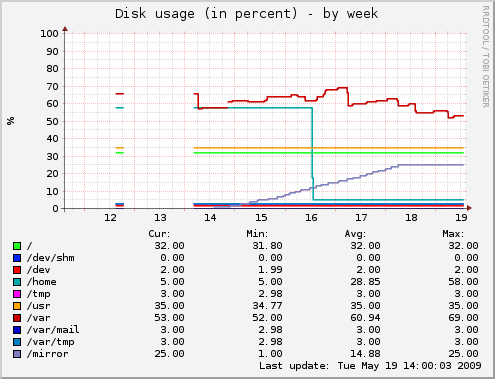
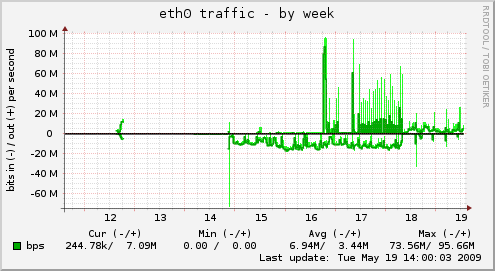
You might have noticed that during last week the Mexican Debian mirror, nisamox.fciencias.unam.mx (a.k.a. ftp.mx.debian.org, a.k.a. debian.unam.mx), went offline. The motherboard died on us, and Facultad de Ciencias was kind enough to give us a brand new one. So, excuse us for the blackout, but we are back Meaner and badder than ever before! Now, Sergio (nisamox's main admin) prefered to rebuild the whole mirror, as there was a shadow of doubt regarding the data integrity. So, rsync was pulling as fast as he could for the whole weekend (leading to some people scratching their heads regarding the 404 for the missing files; sorry, we should have left Apache shut down until the mirror was complete!). After three days of sustaining a 10-20Mbps download from the main mirrors, all 364GB of Debian are finally installed and as you can clearly see we are back to normality, with small, regular mirror pulses and a nice sustained 5-10Mbps (with some up to 40Mbps peaks We have seen up to 100Mbps peaks in the past, and I doubt with the current network infrastructure we won't top that). You can see we have currently plenty of disk space still to fill up. Among our plans is to host the most popular ISOs, which are a common request, and... What else? Well, ask us and we shall do so (quite probably). Ethernet usage over the last week Disk space usage over the last week So, if you switched away from ftp.mx.debian.org due to our downtime, readjust your mirror settings. Nisamox is back!
AttachmentSize
Nisamox Ethernet statistics for the last week23.38 KB
Nisamox disk space statistics for the last week24.29 KB

Neil Williams: libqof2

It's taken a lot longer than I expected (mostly due to getting other things done in Emdebian etc.) but now that Lenny is out, QOF can finally drop all the previously deprecated code and move to libqof2, so the upstream code has now been released via Alioth (0.8.0) and the binaries have been uploaded to Debian and are waiting in NEW.

QOF provides a set of C language utilities for performing generic structured complex queries on a set of data held by a set of C/C++ objects. This framework allows programmers to add query support to their applications without having to hook into a SQL Database. QOF is a large part of my attempts to get some degree of data freedom to complement the source code freedom. This remains a problem with certain applications, especially financial ones, so I've tried to make it easier to both import and export data between programs using QOF and to convert the default QOF data storage formats into other common formats using simple tools and scripts based on XSL or perl. Having a SQL-type query interface accessible via the command line is a huge bonus when dealing with large data sets.

There is a patch for gnotime that makes the final adjustments to handling the removed code. pilot-qof and gpe-expenses already build cleanly without the deprecated code but each of these is also pending a new upstream release, so rather than need a binNMU, I'm simply going to make those releases when QOF clears NEW.

Having said that, pilot-qof and gpe-expenses introduce new binary packages themselves so they will spend time in NEW too. pilot-qof will be the last of the set to be released because the new upstream version can use symbols from the new gpe-expenses release to make it easier to move data between applications. However, that support is optional at build time and could be done via a Debian revision, so I might do it that way.

This also marks the completion of the migration of QOF from SourceForge to Alioth - principally for easier bug tracking and a usable mailing list archive. The QOF VCS is in svn.debian.org.

The mailing list for QOF development is therefore at alioth:
QOF-devel and archives also.

I'm still working on two other QOF-based utilities - one that can handle simple accounts and one to handle simple invoices. The invoice handling is already partially implemented in pilot-qof but I'm looking at a GTK+ frontend with a robust command line interface so that scripts can update the invoice data behind-the-scenes. Hopefully, some form of arbitrary-format parser can be arranged that can handle extracting data from whatever form the client happens to send - typically PDF. It'll need tweaking for each client, but it could work. The objects used by gpe-expenses and pilot-qof (including invoices) are exposed via QOF and can be mixed together in any new QOF application, easily able to read data from multiple sources, merge data sets, query data sets and export into other formats. The core currency and expense types come from pilot-link but are then enhanced to support GnuCash conventions.

For information on another QOF application called "estron" - an idea for a data-driven query interface - see http://estron.alioth.debian.org/. Problem 1 with estron: the examples all rely on postgres and I just can't get that to setup properly as either a test system or as a Debian package. Problem 2: estron was intended to be an interpreter that could be written "in itself" but whilst this is possible for the simpler examples, doing more complicated stuff like calculating values from other values makes the estron XML very obtuse. The current codebase uses GOB2 to

QOF is now stable and I don't expect to need another SONAME bump for quite a while. If anyone is interested in taking on estron or helping with the Cash and/or Invoice frontends, let me know. The problem with estron currently is bitrot - the GTK+ frontend has too many gtk1.2 hangovers which now fail to build.

Obey Arthur Liu: PGP/GPG transition 8CA99047 -> 29C0FFEE *

Here comes the new 4096 bit RSA key, replacing the old (2002) 8CA99047 1024 bit DSA key:
pub  4096R/29C0FFEE 2009-05-18
  Key fingerprint = 9590 8AA6 E4F7 BAA7 8BD6  C148 F1A6 9BE4 29C0 FFEE
uid  Obey Arthur Liu <arthur@milliways.fr>
uid  Obey Arthur Liu <obey.liu@ensimag.imag.fr>
uid  Obey Arthur Liu <graffit@graffit.net>
uid  Obey Arthur Liu <obey.liu@lzb.fr>
uid  Obey Arthur Liu <arthur.randolph@gmail.com>
sub  4096R/15D7FD9B 2009-05-18
In other news, I found a great flatshare on Riedmattstrasse in Kreis 3 in Z rich with a fellow Google summer intern. Thanks to all (Jeroen, Martin, Jaroslavs, Giacomo..) who gave me pointers about finding accomodation in Z rich. I m looking forward to a great summer there. coffee * It did involve generating about 40 millions gpg keys on a few tr s badass computing clusters UPDATE: Come on guys. Of course I followed basic key management rules. The clusters which generated the actual final keys were under my direct control and the particular slice which generated this published key is on my desk.

Joey Hess: "whatcha reading?"

I used to hate that question, particularly in high school, when showing my interlocutor the cover of whatever book I was tearing through was almost certain to end that conversation cold. Maybe that's part of why I switched to reading ebooks as soon as it was practical? Anyway, these days I'm happy to let you know what I'm reading; I just added my 1000th book on GoodReads. The easiest way to explain GoodReads is that it's like Netflix's movie rating and recommendation system, except it can't automatically know what you've got checked out, and it doesn't really do many recommendations, sadly. But it's good about showing you what friends are reading. In other words, it's a social networking site around books. One of several, though the others I've tried seemed clunkier, or too flashy. Goodreads is fairly easy to use, though the UI could use some work in a few places. It's not been especially burdensome to note when I start and finish each book. The best part is that it can keep track of books I want to read. Rating things on a five star system is not something I'm particularly good or consistant at, nor something I want to spend much time on, but I have painlessly rated about 500 books so far, as well as importing 500 more, unrated, from a list of books I read a decade ago. (500 others from that list failed to import.) I'd like to get a high percent of the books I've read recorded there, so I can a) get a grip on just how many books that is (guessing in the 3 thousand range?) and b) avoid accidental rereads and maybe remember some good books I've not read in a while. Of course, as when using any service that silos my data these days, I have to worry about getting it back out. For at least the most important bit -- the list of books, dates, and ratings, GoodReads has a good data export capability, though it's a bit hard to find (hidden here) and not ameanable to automated backups. (Aside: Is anyone working on a one-stop utility that can automatically back up your data from all web silos? Needed.) For the past six months or so, I've been in a bit of a dry spell for finding good new fiction; reading formal book review sites wasn't working for me (most reviews spoil books for me, or just turn me off to them); and ebooks cut down on that library serendipity. I think using this site is helping to break the drought for me, and I'm curious: Whatcha reading? PS: Thanks to whoever sent me the The Design of Everyday Things (your name wasn't listed). I especially like that it's a used copy. Had that on my wishlist and been wanting to read that forever!

Gunnar Wolf: Main character for The Gunnar Wolf chronicles

Main character for The Gunnar Wolf chronicles
I am afraid to say this... But my good friend Kaz has just created a great iconic representation of this angry viking-like antihero on his crusade to spread Free Software and clobber every naysayer with the DFSG and his own personal interpretation of the Social Contract (where Guideline is defined as... Well, better left as an excercise to the reader. To the very patient reader). So, the unofficial, unsanctioned and not related in any way to this (or any other) person, dead or alive... But thanks, kaz, for keeping my name alive in this chaos that Internet has become, even while I cannot stand the stupid twitterosity: http://twitter.com/cgunnarwolf_en (English), http://twitter.com/cgunnarwolf_es (Spanish) (And both empty, as far as I can tell)

Biella Coleman: Chain-reaction of ideas

One day, I would love to teach a class on the culture and politics of technology and ditch all of the academic pieces and replace with a string of novels and fictional short stories. Though it may be a few years before I can pull this off, I am already compiling my list and there is naturally a healthy serving of science fiction (along with Kurt Vonnegut, who I adore). Perhaps one my favorite science fiction authors is Philip Dick who edges his readers close to delirum and sometimes insanity and all through mere words. But one of my favorite writings by PD comes not from his fictional fun house but from a regular (and staid) letter composed of a simple and elegant description of what makes science fiction so e(special):
I think Dr. Willis McNelly at the California State University at
Fullerton put it best when he said that the true protagonist of an sf
story or novel is an idea and not a person. If it is *good* sf the
idea is new, it is stimulating, and, probably most important of all,
it sets off a chain-reaction of ramification-ideas in the mind of the
reader; it so-to-speak unlocks the reader s mind so that the mind,
like the author s, begins to create. Thus sf is creative and it
inspires creativity, which mainstream fiction by-and-large does not
do. We who read sf (I am speaking as a reader now, not a writer) read
it because we love to experience this chain-reaction of ideas being
set off in our minds by something we read, something with a new idea
in it; hence the very best since fiction ultimately winds up being a
collaboration between author and reader, in which both create and
enjoy doing it: joy is the essential and final ingredient of science
fiction, the joy of discovery of newness. Philip Dick (in a letter)
May 14, 1981
Truth be told, I don t really know much about science fiction outside of the classics but I look forward to reading more and slowly am adding a few pieces to my collection. And when I need to find out something about sci fi, I turn to Sumana who is pretty well schooled in its ways. She has recently co-edited a new anthology of science fiction stories including one on hardware hacking and faith that some of you might enjoy.

Bdale Garbee: Launch Photos

I managed to break the LCD on my HP r717 digital camera a while back, but couldn't find anything that excited me as a replacement, so have been doing without and borrowing my son's camera from time to time. That changed recently... my new camera is a Casio High Speed EXILIM model EX-FC100BK. I've never been able to get the timing right to take photos of our rockets leaving the launch rails. I manage to get passable videos from time to time, and a lot of pictures of smoke trails... but WOW, the ability to take a burst of high-resolution still photos at a fast frame rate (some of which are even before the shutter release gets fully pressed!) completely and totally rocks my world! I just put a few of the best frames I captured at Saturday's launch up on Flickr. Enjoy!

Gustavo Noronha Silva: Epiphany/WebKitGTK+ in Debian unstable

I have prepared an epiphany-webkit source package some time ago, and it has finally got out of NEW, thanks to the work Ganeff did this weekend on processing the queue =). The good thing about those packages is I have patched them heavily to allow for easy parallel installation with Epiphany/Gecko, so you don t need to give up your current browser to experiment and test Epiphany with the WebKitGTK+ backend. The gconf tree used for this package is /apps/epiphany-webkit, separate from the normal /apps/epiphany, for extra safety, but notice that your ~/.gnome2/epiphany will be shared between the Gecko and WebKit versions, even though the files used by each of them are different most of the time. Go ahead and install the epiphany-webkit package, and have fun. Notice that if you have an already running session of Epiphany/Gecko, running epiphany-webkit will not be enough to launch Epiphany/Webkit, since Epiphany will just request that a new window be opened through D-Bus. The easiest way to test, if you just want a quick peek, is to run epiphany-webkit -p; this will run a private instance of Epiphany/WebKit, which doesn t touch your history, bookmarks, and passwords. If you are feeling adventurous and want to make Epiphany/WebKit your default Epiphany you can do so using the following command, and selecting epiphany-webkit:
# update-alternatives --config epiphany-browser

18 May 2009

Gunnar Wolf: Summertime, summertime!

Summertime, summertime!
Finally, temperatures are back to sanity, and the air is no longer a mass of dust. For us Mexicans (well, for us central-Mexicans), spring is the hot, dry season. In spring, we usually reach up to 30 C... Not too much for many people, but hellish for me. Summer is much more palatable, having decently sunny days, cloudy evenings and a nice shower as it gets dark. Even if it is a bit harder for a cyclist to take the streets, I think this is my favorite season. This year, we had several (and early!) false starts. I have come to hate April/May's heath waves (that means I am usually grumpy for my birthday). But finally, we have had almost a week of cloudy skies, with almost daily rains. That makes me happy. But I am even happier when I come to work to my office, look out the window, and am not greeted anymore with a 5Km visibility range, but with 20Km. Mind you, this photo was taken past 5PM, when the sky turns nice and gray (just as I've proclaimed my life to be). According to the Weather Channel's information on Mexico City, we currently have 16.1Km Which makes sense, as I can no longer see the Chiquihuite mountain marking the Northern part of the city, but I can perfectly see some buildings near Polanco. The view earlier in the day was... Beautiful, partly perhaps because of the contrast just with last week's. Oh, and yes - Once again, thank you very much my dear University. Instead of the closed cubicles many people spend their hours in, this relaxing view was taken from my office's window. I love it!

Chris Lamb: Poor man's Google Checkout

Google Checkout recently gained support for taking recurring payments, a frequently requested enhancement for my Xen-based server. However, to use any of the non-trivial features we must provide Google with generate a signed XML file for each transaction. This would normally preclude the use of some server-side scripting, but if the details of transaction are static there is no reason we shouldn't be able to generate the relevant HTML ahead-of-time. The resulting HTML file can be hosted anywhere, is almost completely independent of the server configuration and greatly reduces the attack surface by being a simple static file. The main disadvantage of this approach (and indeed of this submission method in general) is that allows trivial replay attacks of previous transactions. Anyway, first we create our request XML:
$ head -n6 order.xml
<?xml version="1.0" encoding="UTF-8"?>
<checkout-shopping-cart xmlns="http://checkout.google.com/schema/2">
 <shopping-cart>
   <items>
     <item>
       <item-name>Lunar object affixed to slender carrying attachment</item-name>
Next, we construct a simple template:
$ cat order.html.in
<h1>Order stuff</h1>
<form method="POST"
    action="https://checkout.google.com/api/checkout/v2/checkout/Merchant/__MERCHANT_ID__">
 <input type="hidden" name="cart" value="__CART__">
 <input type="hidden" name="signature" value="__SIGNATURE__">
 <input type="image" name="Google Checkout" alt="Fast checkout through Google"
   src="http://checkout.google.com/buttons/checkout.gif?merchant_id=__MERCHANT_ID__&w=180&h=46&style=white&variant=text&loc=en_US"
   height="46" width="180">
</form>
Finally, we generate the final page from the above files using the following Makefile:
MERCHANT_ID  = # Enter your merchant ID here
MERCHANT_KEY = # Enter your merchant key here
FILES = order.html
all: $(FILES)
%.html: %.html.in %.xml
       sed -e 's __MERCHANT_ID__ $(MERCHANT_ID) g' \
           -e 's __CART__ '$$(base64 -w0 $*.xml)' g' \
           -e 's __SIGNATURE__ '$$( \
           openssl dgst -sha1 -hmac $(MERCHANT_KEY) -binary <$*.xml   base64 -w0)' ' \
           <$< >$@
clean:
       rm -f $(FILES)
.PHONY: clean
$ make
[...]
$ head -n4 index.html
<h1>Order stuff</h1>
<form method="POST"
    action="https://checkout.google.com/api/checkout/v2/checkout/Merchant/007">
 <input type="hidden" name="cart" value="iAgICAgICAgICAgIDxpdGVtLWRlc2NyaXB0aW9 [..]
Non-trivial dependencies are OpenSSL (to generate the HMAC-SHA-1 signature) and make. You should ensure that you don't upload or otherwise reveal your Makefile as it contains your merchant key.

Sven Mueller: Link collection 2009/05/18

That s it for now, will update the post if I find more interesting links in the next few days.

Ian Wienand: Dig Jazz Applet, V2

It seems the ABC updated the DIG Jazz now-playing list format, breaking V1. Some quick flash disassembly and a bit of hacking, and order is restored. As a bonus, it now shows the upcoming songs. DIG Jazz now-playing Gnome applet Source or Debian package.

Next.

Previous.