Search Results: "ed"

21 June 2010

Kees Cook: kvm kernel console

I know there are a lot of ways to do this, but I just wanted to note what works for me to catch early boot Oopses in the kernel. In virt-manager, I set up a serial device, as a pty . After the VM boots, I pause in Grub, and check the VM details for the serial port (it ll show something like /dev/pts/13 ). In another terminal, sudo cat /dev/pts/13 , and I boot the kernel with console=ttyS0 . When the Oops happens, I get it in the terminal instead of having it scroll off the VM s screen.

Stefano Zacchiroli: DD certification

A couple of months ago, Steve McIntyre introduced the notion of Developer Certification. In essence, if you are (or have been) a Debian Developer, you can ask for a certificate of that status of yours; that might be useful in case you need to "prove" it to anyone (more precisely: to anyone who would care about / believe in a certificate ...). Some people has asked me to provide such certificates and at the n-th iteration I took the chance to streamline a bit the process (yes, I'm lazy). In case you're interested, please check the DDCertificate wiki page and follow the instructions there.
While you are at it, join me in thanking Agnieszka Cicha-Cisek and Patryk Cisek, as they have prepared the LaTeX template. Some other people were interested in being certified, but missed the announcement, so I'm blogging about it mainly to spread the news. Paul Wise has already submitted a request for proper documentation of this possibility. We currently don't have a template for Debian Maintainers, but it should be straightforward to add: patches are welcome!

Dominique Dumont: Why I ve been mostly silent lately

Hello You may have noticed a drop in my activity lately. This is not due to reduced interest in contributing to Debian and Perl. This comes from personal changes: we ve bought a house recently and I m spending most of my free time renovating the house (revamping electric circuits, installing new ones, preparing for internet cables, wall paper, paints, etc etc ) and preparing to move at the end of the week. Starting from next month, I expect to be able to slowly resume a normal schedule. The top priority will be GSoC mentoring (hi random_nick :-) ) Now, it s time to go back packing stuff All the best

Matt Zimmerman: Finishing books

Having invested in some introspection into my reading habits, I made up my mind to dial down my consumption of bite-sized nuggets of online information, and finish a few books. That s where my bottleneck has been for the past year or so. Not in selecting books, not in acquiring books, and not in starting books either. I identify promising books, I buy them, I start reading them, and at some point, I put them down and never pick them back up again. Until now. Over the weekend, I finished two books. I started reading both in 2009, and they each required my sustained attention for a period measured in hours in order to finish them. Taking a tip from Dustin, I decided to try alternating between fiction and non-fiction. Jitterbug Perfume by Tom Robbins This was the first book I had read by Tom Robbins, and I am in no hurry to read any more. It certainly wasn t without merit: its themes were clever and artfully interwoven, and the prose elicited a silent chuckle now and again. It was mainly the characters which failed to earn my devotion. They spoke and behaved in ways I found awkward at best, and problematic at worst. Race, gender, sexuality and culture each endured some abuse on the wrong end of a pervasive white male heteronormative American gaze. I really wanted to like Priscilla, who showed early promise as a smart, self-reliant individual, whose haplessness was balanced by a strong will and sense of adventure. Unfortunately, by the later chapters, she was revealed as yet another vacant vessel yearning to be filled by a man. She s even the steward of a symbolic, nearly empty perfume bottle throughout the book. Yes, really. Managing Humans by Michael Lopp Of the books I ve read on management, this one is perhaps the most outrageously reductionist. Many management books are like this, to a degree. They take the impossibly complex problem domain of getting people to work together, break it down into manageable problems with tidy labels, and prescribe methods for solving them (which are hopefully appropriate for at least some of the reader s circumstances). Managing Humans takes this approach to a new level, drawing neat boxes around such gestalts as companies, roles, teams and people, and assigning them Proper Nouns. Many of these bear a similarity to concepts which have been defined, used and tested elsewhere, such as psychological types, but the text makes no effort to link them to his own. Despite being a self-described collection of tales , it s structured like a textbook, ostensibly imparting nuggets of managerial wisdom acquired through lessons learned in the Real World (so pay attention!). However, as far as I can tell, the author s experience is limited to a string of companies of a very specific type: Silicon Valley software startups in the dot com era. Lopp (also known as Rands) does have substantial insight into this problem domain, though, and does an entertaining job of illustrating the patterns which have worked for him. If you can disregard the oracular tone, grit your teeth through the gender stereotyping, and add an implicit preface that this is (sometimes highly) context-sensitive advice, this book can be appreciated for what it actually is: a coherent, witty and thorough exposition of how one particular manager does their job. I got some good ideas out of this book, and would recommend it to someone working in certain circumstances, but as with Robbins, I m not planning to track down further work by the same author.

Colin Watson: GRUB 2 boot problems

(This is partly a repost of material I've posted to bug reports and to debian-release, put together with some more detail for a wider audience.) You could be forgiven for looking at the RC bug activity on grub2 over the last couple of days and thinking that it's all gone to hell in a handbasket with recent uploads. In fact, aside from an interesting case which turned out to be due to botched handling of the GRUB Legacy to GRUB 2 chainloading setup (which prompted me to fix three other RC bugs along the way), all the recent problems people have been having have been duplicates of one of these bugs which have existed essentially forever: When GRUB boots, its boot sector first loads its "core image", which is usually embedded in the gap between the boot sector and the first partition on the same disk as the boot sector. This core image then figures out where to find /boot/grub, and loads grub.cfg from it as well as more GRUB modules. The thing that tends to go wrong here is that the core image must be from the same version of GRUB as any modules it loads. /boot/grub/*.mod are updated only by grub-install, so this normally works OK. However, for various reasons (deliberate or accidental) some people install GRUB to multiple disks. In this case, grub-install might update /boot/grub/*.mod along with the core image on one disk, but your BIOS might actually be booting from a different disk. The effect of this will be that you'll have an old core image and new modules, which will probably blow up in any number of possible ways. Quite often, this problem lies dormant for a while because GRUB happens not to change in a way that causes incompatibility between the core image and modules, but then we get massive spikes of bug reports any time the interface does change. Since these bugs sometimes bite people upgrading from testing to unstable, they get interpreted as regressions from the version in testing even though that isn't strictly true (but it tends not to be very productive to argue this line; after all, people's computers suddenly don't boot!). Any problem that causes the core image to be installed to a disk other than the one actually being booted from, or not to be installed at all, will show up this way sooner or later. On 2010-06-10, there was a substantial upstream change to the handling of list iterators (to reduce core image size and make code clearer and faster) which introduced an incompatibility between old core images and newer modules. This caused a bunch of dormant problems to flare up again, and so there was a flood of reports of booting problems with 1.98+20100614-1 and newer, often described as "the unaligned pointer bug" due to how it happened to manifest this time round. In previous cases, GRUB reported undefined symbols on boot, but it's all essentially the same problem even though there are different symptoms. The confusing bit when handling bug reports is that not only are there different symptoms with the same cause, but there are also multiple causes for the same symptom! This takes a certain amount of untangling, especially when lots of people have thought "ooh, that bug looks a bit like mine" and jumped in with their own comments. Working through this was a worthwhile exercise, as it came up with an entirely new cause for a problem I thought was fairly well-understood (thanks to debugging assistance from Sedat Dilek). If you had set up GRUB 2 to be automatically chainloaded from GRUB Legacy (which happens automatically on upgrade from the latter to the former), never got round to running upgrade-from-grub-legacy once you confirmed it worked, and then later ran grub-install by hand for one reason or another, then the core image you installed by hand would never be updated and would eventually fall over the next time the core/modules interface changed. Fixing future cases of this was easy enough, but fixing existing cases involved figuring out how to detect whether an installed GRUB boot sector came from GRUB Legacy or GRUB 2, which isn't as easy as you might think. Fortunately, it turns out that there are a limited number of jump offsets that have ever been used in the second byte of the boot sector, and none of the GRUB 2 values clash with the only value ever used in GRUB Legacy; so, if you still have /boot/grub/stage2 et al on upgrade, we scan all disks for a GRUB 2 boot sector, and if we find one then we offer to complete the upgrade to GRUB 2. Unless anything new shows up, that just leaves the problems that were already understood. Today, I posted a patch to generate stable device names in device.map by default. If this is accepted, then we can do something or other to fix up device.map on upgrade, switch over to /dev/disk/by-id names in grub-pc/install_devices at the same time, and that should take care of the vast majority of this kind of upgrade bug. I think at that point it should be feasible to get a new version into testing, and we should be down from 18 RC bugs towards the end of last month to around 6. We can then start attacking things like the lack of support for mdadm 1.x metadata. Since my last blog entry on GRUB 2, improvements have included: The next upstream snapshot will bring several improvements to EFI video support, mainly thanks to Vladimir Serbinenko. I've been working on making grub-install actually work on UEFI systems as one of my goals for the next Ubuntu release, and I hope to get this landed in the not-too-distant future.

20 June 2010

Gregor Herrmann: RC bugs 2010/22 - 2010/24

again, a short overview regarding my RC bug activities:

Stefano Zacchiroli: debian meeting guidelines RFC

How to have a (Debian) summit without turning into a secret cabal It seems rather uncontroversial that sponsoring various kinds of Debian meetings (conferences, sprints, BSPs, etc.) is a good way to spend, actually invest, Debian money. Historically, that has not always saved the Debian community from muttering about "cabal-ish" meetings in very few specific occasions. (No, there is no cabal, in case you wonder.) I've always believed in the good faith of people and I don't think that we have ever had "secret meetings" on purpose. Nevertheless the question of how to have meetings in a community-compatible way is a sound one. Answering properly to such a question is something that it's harder than what it might seem at first sight (at least for me). In particular, organizers have to carefully balance the high efficiency that meetings offer (e.g.: communication bandwidth is higher than when working remotely, people have less distractions, more enthusiasm, more fun!, etc.) with the risk of cutting out the rest of the community which cannot attend the meeting, for whatever reason. Note also that since Debian is not a company, we cannot just require that everybody who is interested attend the meeting. As DPL, I'm starting to get quite some requests for meeting sponsorship, and that's just wonderful: it means that we have thrilling groups of people that are eager to get together and hack to improve Debian! Still, in doing so, we should all try to minimize the above risk; that's why I've started to apply the following Debian meeting guidelines, as a kind of prerequisite for sponsoring.
  1. Before the meeting: the meeting should be announced to the most relevant public mailing list(s); ideally, the tentative agenda of the meeting should be included in the announcement.
    That will enable people interested in the meeting topics to provide their inputs and more generally to know what is going on.
  2. During the meeting (preparation): expenses should be minimized, as a form of respect for all people that donate to Debian. Since we value their contributions, we do our best not to waste them. (TTBOMK, we've always done that, but making it explicit won't hurt.)
  3. After the meeting: meeting minutes should be sent to the most relevant public mailing list(s), usually to d-d-a for meetings that cover topics of general development interest.
    As an obvious consequence, minutes should be taken during the meeting; it is a bit of extra burden, but the risk of leaving the rest of the community in the dark is just not acceptable a community as wide and diverse as ours.
  4. In general, think about communication, e.g.: (micro)blog about the meeting, contact press/-publicity to prepare a news item about it, enable others to attend virtually on IRC or other media, etc.
For now, the above is just a brain dump.
Now, what do you think? Are the above reasonable demands? What else should we ask for?
Feel free to leave a comment or mail me about that.

Andrew Pollock: [life] First Father's Day

Father's Day in the US has always been a weird one for me. I've been pottering through the day oblivious, when a friend who is a father will tell me that they've been thinking of me especially today because of our loss. Then I'm reminded that Father's Day is in June and not September. I wonder what the deal is with that? It seems very few countries observe it on the first Sunday in September. Weird. Zoe hits the 7 week mark tomorrow, and I return to work. Boy is that going to be a shock to the system for all of us. The 7 weeks of paternity leave has been absolutely wonderful. Google's Paternity Leave benefit is now firmly my number one favourite employee benefit. Co-workers had complained that taking it all at birth was a bit of a waste, because all the baby does is sleep, but it's definitely been worthwhile taking it all now. Because we've been predominantly bottle feeding with pumped breast milk, I've been able to be very involved with the feeding, and I've been able to do a lot of the running around helping Sarah, so I wouldn't have done it any other way. It's also been great to watch Zoe grow and develop. She's interactive enough at this age, and it's just great to cuddle with her, or share a nap with her. On the sleeping front, things are a bit all over the place. She definitely gets fussy in the evenings, at around 5pm to 7pm. Often we have trouble getting her to go back to sleep after a feeding around this time. Sometimes the trouble can extend past the 10pm to midnight feeding. She sleeps magnificently during the day, and travels fairly well. She sleeps quite well in her car seat, and stays asleep in it when we're at a cafe or restaurant. We had our first overnight trip while Sarah's Mum was visiting. We went down to San Simeon to take her to Hearst Castle. It was fun having Zoe in a hotel room with us. Whenever she fussed during the night, we'd just grab her and bring her into bed with us. She spent quite a lot of time in our bed asleep on our chests. It was very sweet. It was like a little baby vacation. Zoe also had her first outing to the California Academy of Sciences, and we managed to spend about 5 hours there without any major meltdowns from anybody. It was absolutely fantastic having Sarah's Mum here for 4 weeks too. She's great to have around. She was a big help in cleaning up the back yard significantly, and generally helping out around the house. It was great having her take care of the 7am feeding when Sarah and I were both zonked out from overnight interruptions. It was also nice not to have to think so much about how dinner was going to materialise. My parents have decided they will come and visit in September, which is excellent, as they won't have to wait until February to meet Zoe. One of the other nice things about the Google Paternity Leave is that you keep accruing vacation time while you're on it, so I should have enough vacation time to take a couple of weeks off while they're here, as well as in February when we go back to Australia for Sarah's residential school at the University. The next big event will be Zoe's vaccinations at 8 weeks. Hopefully that will be as uneventful as possible.

Daniel Baumann: Debian Live Web Images Builder

Richard Nelson, an outstanding debian-live contributor and team member since many years, has setup an instance of the live-helper CGI scripts that are included within live-helper. This webbuilder lets users get their own customized images without the need of having to install live-helper and build them on their own. It's available at live-helper.debian.net. Apart from having some better looking html form and adding an online-help that will be worked on soon, it's working great. Thanks you, Richard.

Craig Small: Helping Free Software: Translations

Well the latest version of PSmisc is almost finished, so I pushed the tar archive up to the spot for the translators, waiting for the updates before it gets released.

It reminded me that perhaps a lot of people don't know how their programs get translated. Perhaps there are some that could even contribute. The nice thing about the translation systems is that you don't need to know programming to help.

PSmisc uses the translation project as its method. The program itself uses gettext for the translation part which makes a single text file called a POT file. A translator takes this text file and makes a po file, such as it.po for the Italian translation and then translates, which basically means editing the file, reading each first line of a set and writing the translation on the second line.

For the programmer, once it is setup it is pretty simple to use, just mark your translatable lines and follow some simple rules, mainly about not embedding too much in a string. I've used this system for years for quite a few of my programs and there is little added work for me.

Unfortunately, translating is hard work and should be a long-term commitment. Having a look at the translation project's Translation Matrix and you can see that some languages do suffer, though there are some very good results there too. Particular kudos goes to the Vietnamese group which I think is just Clytie who does a marvellous job and is often the first translation file I get.

For the Debian project, there are many places where translations can occur. There doesn't seem to be a centralised place for this, but some of the places they use translation work are:

<script defer="defer" src="http://static.zemanta.com/readside/loader.js" type="text/javascript"></script>

Francois Marier: Reducing website bandwidth usage

There are lots of excellent tools to help web developers optimise their websites.

Here are two simple things you have no excuse for overlooking on your next project.
HTML, XML, Javascript and CSS filesOne of the easiest ways to speed up a website (often to a surprising degree) is to turn on compression of plaintext content through facilities like mod_deflate or the Gzip Module.

Here's the Apache configuration file I normally use:
<ifmodule>AddOutputFilterByType DEFLATE text/html text/plain text/css text/javascript text/xml application/x-javascript application/javascript
BrowserMatch ^Mozilla/4 gzip-only-text/html
BrowserMatch "MSIE 6" no-gzip dont-vary
BrowserMatch ^Mozilla/4\.0[678] no-gzip</ifmodule>
ImagesAs far as images go, the following tools will reduce file sizes through lossless compression (i.e. with no visual changes at all):
(An alternative to optipng is pngcrush.)

Note that the --strip-all argument to jpegoptim will remove any EXIF/comments tags that may be present.

19 June 2010

Torsten Werner: Results from the Debian Community Poll

I have announced the Debian Community Poll in my former blog post. I have closed the poll today and I will start publishing its results now.
What is the codename of the current stable release?This is the only compulsory question with the intention to block spammers. The correct codename is Lenny but I have accepted almost any answer that is somehow related to Debian. Version numbers, names from Sarge to Experimental, even well known codenames and version numbers from Ubuntu have been counted as correct. 22 partipants answered wrongly and their submissions got removed from the result set. A whopping number of 3258 submissions have been accepted and get analyzed now. Thanks to all participants!
How long have you been using Debian?

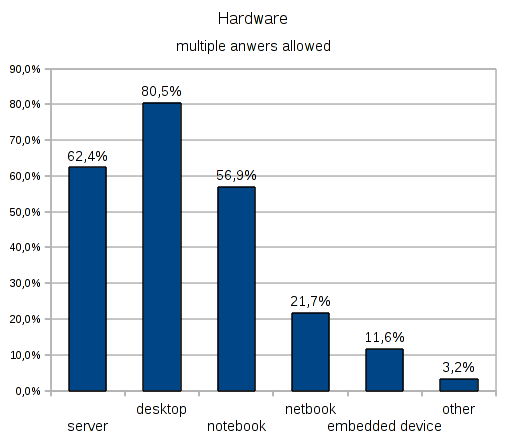
On what kind of hardware are you using Debian?
Multiple answers are allowed for this question and that is why the values do not sum up to 100%.
  • 80.5% are using Debian on the desktop
  • 62.4% on the server
  • 56.9% on the notebook
  • 21.7% on the netbook
  • 11.6% on embedded device(s)
  • 3.2% on other device(s)
The following other devices have been mentioned: smartphone, virtual machine, nettop, NAS, HTPC, workstation, pendrive, live cd, cluster, thin client, router, rocket flight computer, ibm mainframe, and automatic bar tender.

Do you contribute to Debian?
  • 50.0% choose answer #5: I don't contribute on a regular base.
  • 31.2% choose answer #4: I'm regularly helping other Debian users.
  • 8.0% choose other (see below) or simply did not answer
  • 4.9% choose answer #3: I'm regularly contributing to Debian packages without uploading them by myself.
  • 4.5% choose answer #1: I'm a Debian developer.
  • 1.4% choose answer #2: I'm a Debian maintainer.
The following other answers have been provided:
  • upstream developer or contributor
  • translator
  • bug reporter
  • advocator
  • former DD or DM
  • prospective DD or DM
  • mirror maintainer
  • package/installer tester
  • documentation writer
  • donator or debconf sponsor
  • debconf organizer or helper

How do you think about the Debian Free Software Guidelines (DFSG)?
  • 46.0% choose answer #2: I like the DFSG but it is not the most important reason for using Debian.
  • 36.6% choose answer #1: The DFSG is very important to me. I could live with many changes in Debian but I would be very upset if Debian would allow non-free software into its main component in the future.
  • 10.1% choose answer #3: I don't know.
  • 4.9% choose answer #4: I don't care.
  • 2.4% did not answer.

Are you using Debian derived distributions, too?
Multiple answers are allowed for this question and that is why the values do not sum up to 100%. There were a lot of different answers but the most frequent are:
  • 47.1%: Ubuntu (Kubuntu, Lubuntu, Xubuntu)
  • 40.8%: no answer; this was the only way to say that someone does not use a derived distribution
  • 11.0%: other (see below)
  • 7.0%: damn small linux
  • 4.8%: Sidux
  • 4.3%: grml (juxlala)
  • 2.2%: Knoppix
  • 1.6%: ELive
  • 1.4%: Maemo
The other answer includes the following distributions: 64studio, ALT Linux, arch linux, ArtistX, BackTrack, BRLix, Canaima GNU/Linux, catix, cdlinux.pl, CloneZilla, CrunchBang, Custom, ddwrt, debian arm userspace for zipit z2, DebXO (?), DreamLinux, Easy Peasy, eb4, eeebuntu, EMC2 Ubuntu (linuxcnc.org), Emdebian, Estrella Roja, Fedora, Finnix, Gentoo, gNewSense, Hackable:1, Kanotix, Kuliax, LFS and CLFS, LinEx, Linux Mint, live CDs, live-helper, Mepis antix, Musix, My own LiveCD, Mythbuntu, OpenInkpot, openwrt, paipix gnu, Parsix, Peppermint, personal debian derived, proxmox, Puppy, PureOS, qtopia, SHR, simplyMEPIS, Skolelinux, slackware, SymphonyOS, Toutou, Trisquel, tty GNU/Linux, UHU Linux, Univention Corporate Server, vinux, Voyage, Vyatta, whiite, Xandros, Xarnoppix. Not all of them are derived from Debian.

- to be continued -

Julien Valroff: My experience without Adobe Flash Player

Adobe recently announced they have (temporarily) stopped working on the amd64 version of their Flash Player for GNU/Linux. The previous releases contain a big security issue, which makes them totally unusable. As I didn t want to wait until the flashplugin-nonfree package to be updated to support the i386 plugin through nspluginwrapper (as suggested in #586273), I have decided to simply switch to the free alternative: gnash. After a few hours with it, I am now able to use most of the websites I usually visit, including Youtube and Dailymotion. Note that I use Iceweasel, which does not support WebM (for now), nor H.264 (which will never be supported by Mozilla). Youtube support is brought by a Greasemonkey user script available at: http://turanct.wordpress.com/2010/02/25/gnash-youtube/
The only tiny drawback is that the videos load in pause mode. For now, everything else seems to work fine. Users of other browers (Chromium, Safari, Opera) can try their HTML5 beta: http://www.youtube.com/html5 It is even easier for Dailymotion, as the videos on their HTML5 beta program are encoded in the Ogg Theora format, which is natively supported by Iceweasel/Firefox >= 3.5. To ease things, I have written a small Greasemonkey script which simply automatically redirects www.dailymotion.com to openvideo.dailymotion.com. This script can be downloaded here. The drawback is that videos won t play before they are loaded completely, which is not a big problem anyway. I still cannot play the videos avilable on Vimeo, and have noticed while wirting this post that the Flash file uploader of WordPress didn t work with gnash (obviously, WP provides an alternative way for file upload). I will go on with this experience as long as I do not see major issue with gnash.
I will also update this post, or add comments, if I encounter other issues, or find any alternatives. I would be curious to read your comments if you have run similar experience.

Gunnar Wolf: Once upon a time

With due apologies and thanks to my dear and crazy friend UCH:
Once upon a time
Once, because twice would be a repetitive story
A king
One, because two would mean war
Who was married to a queen
One, because two would be drama
They had a princess daughter
One, because two would be a mess
Who was in love with a knight
One, because two would be a soap opera
He was given the task of killing a dragon
One, because two would be a titanic feat
The hero had an idea
One, because two would be asking too much
Using a unique magic sword
One, because were they two, it would no longer be unique
With which, he took the dragon's life
One, because it was a dragon, not a cat
Then they proceeded with the wedding
One, because two would mean bigamy
And they lived happily forever
One, because two forevers would be like two infinites
The end
One, because two ends would be complicated
The bad translation is completely my fault.

18 June 2010

Marco T&uacute;lio Gontijo e Silva: Immix on GHC Summer of Code weekly report #6

My project. This post assumes that the reader has read my last post. I started the change in the line representation. Instead of a single linked list of free lines, it s better to work with line groups, to avoid fragmentation inside lines in allocation. I ve create a struct to represent this line group, with a pointer to the next group, and the size, in lines, of the group. It is stored in includes/rts/storage/GC.h currently, but I m not sure if this is the best place to put it, and I m thinking about changing it latter.
#include "rts/OSThreads.h"
typedef struct line_  
    struct line_ *next;
    StgWord size;
  line;
/* -----------------------------------------------------------------------------
Then we need to change the code of liberation of lines in rts/sm/Sweep.c.
            else if(!(bd->flags & BF_MEDIUM))  
                StgBool sequence;
                sequence = 0;
                for(i = 1; i < BLOCK_SIZE_W / BITS_IN(W_); i++)  
                    StgPtr start;
                    start = bd->start + BITS_IN(W_) * i;
                    if(bd->u.bitmap[i] == 0 && bd->u.bitmap[i - 1] == 0 &&
                       start + BITS_IN(W_) <= bd->free)  
                        printf("DEBUG: line_found(%p)\n", start); fflush(stdout);
                        if(gen->first_line == NULL)  
                            gen->first_line = (line *) start;
                         
                        if(sequence)  
                            last_line->size++;
                         
                        else  
                            if(last_line != NULL)  
                                last_line->next = (line *) start;
                             
                            last_line = (line *) start;
                            last_line->next = NULL;
                            last_line->size = 1;
                         
                        sequence = 1;
                     
                    else  
                        sequence = 0;
                     
I ve tested this code using the same technique as before, checking the produced list trasversing it after it s done. The list obtained showed the correct lines. Now I m back to the allocation code, which never worked. The changes in rts/sm/Evac.c are straightfoward.
        if (gen->first_line != NULL &&
            size <= BITS_IN(W_) * gen->first_line->size)  
            ws->todo_free = (StgPtr) gen->first_line;
            ws->todo_lim = ws->todo_free + BITS_IN(W_) * gen->first_line->size;
            gen->first_line = gen->first_line->next;
            to = ws->todo_free;
         
This cause the same kind of errors I was getting before. I should go back to debugging. My co-supervisor in my Oriented Project in Computer Science suggested me using valgrind. I ll try it.
Last week I forgot to mention I ve presented my final presentation about my Oriented Project in Computer Science. This week I finished writing my monograph.

Christoph Berg: Cool Unix Features: flock

Lockfiles are usually hard to get right, especially in sh scripts. The best bet so far was "lockfile" included with procmail, but its semantics are pretty weird. (Try to understand what exit code you want, with or without "-!".) Not to mention that failing to clean up the lockfile will stop the next cron run, etc. Since Lenny, util-linux ships "flock". Now you simply say
$ flock /path/to/lockfile /path/to/command
and are done. If you want it non-blocking, add "-n":
$ flock -n /path/to/lockfile /path/to/command
I should probably migrate all my cronjobs to use this.

Alexander Reichle-Schmehl: Release Critical Bug report for Week 24

The inofficial rc bug tracker currently knows about the following bugs:
In Total:535
Affecting Squeeze:419
Squeeze only:58
Remaining to be fixed in Squeeze:361
Of these 361 bugs, the following tags are set:
Pending in Squeeze:18
Patched in Squeeze:55
Duplicates in Squeeze:50
Contrib or non-free in Squeeze:8
Claimed in Squeeze:2
Delayed in Squeeze:6
Can fixed in a security Update:31
Otherwise fixed in Squeeze:38
Ignoring all the above (multiple tags possible), 195 bugs need to be fixed by Debian Contributers to get Debian 6.0 Squeeze released. However, the with the view of the Release Managers, 337 need to be dealt with for the release to happen. Please see my older post for an explanation of the different numbers.

Gerfried Fuchs: New Face, Part 3: gitweb

We ain't dead. A long time has passed since I last wrote on this topic, and much happened unfortunately (for this effort) in other areas. This doesn't mean that this effort is being abandoned. So here is the next big step: A gitweb theme using Kalle's proposal. I enabled it on my own gitweb installation so that people can see it live and test it. Feel free to clone it from there, too. Enjoy!

Jo Shields: MonoDevelop 2.4 available now

I ve finished uploading the latest version of the cross-platform MonoDevelop IDE to Debian Experimental. MonoDevelop is a full-blown IDE for working on software written in C#, Visual Basic.NET, Python, Vala, Java (via IKVM.NET), C, C++, and Boo. It also integrates support for debugging (both of C-based apps via GDB, and Mono-based apps via MDB or the new Soft Debugger), GUI design of C# apps, version control via Subversion, database querying, unit testing, and more. Oh, and for good luck, I ve also uploaded it to badgerports.org (which should now display okay on smaller displays), for use with Ubuntu 10.04, where support for authoring with Moonlight is included. It ll be in the main Ubuntu 10.10 repository at some point in the future, also with Moonlight support. Enjoy.

17 June 2010

Steve Kemp: That friend promises his undying friendship if you would do him a small favour.

Perl & Apache?
Once upon a time, within the past year, I saw mention of a simpler version of mod_perl - an apache module which let you write code to run within the context of a persistent perl process. However my DuckDuckGofu is weak, and I'm struggling to find this project. Did I dream it, or could somebody tell me where it lives?
Dynamic Picture Frames
So I've been taking pictures recently. Lots of pictures. Many times many images have been printed and hung upon my walls, and the price of frames is starting to become onerous. I'd love to see some kind of "dynamic" picture wall - but the two alternatives I considered fail:
Metal & Magnets
Place a huge sheet of metal upon your wall. Then put wee magnets inside your frames.
Corkboard
Imagine a full wall that was paneled with what is essentially a large notice-board..
Both of these would look ugly; the metal one perhaps less so. But the idea of having a wall which could have pictures mounted upon it, without having big nail holes if you rearranged and which could cope with dynamic repositioning and sizes is nice .. Invent it for me? I'll buy one. Probably even two...
ObFilm: The Godfather

Next.

Previous.