Search Results: "will"

19 November 2021

Gunnar Wolf: For our millionth bug, bookworms eat raspberries alive

I guess you already heard, right? The Debian Bug Tracking System has hit a big milestone! We just passed our one millionth bug report! (and yes, that s a cause for celebration; bug reporting is probably the best way for the system to grow and improve) So, to celebrate, I want to announce I have nudged our unofficial Raspberry Pi images build scripts to now also build images for our upcoming Debian release, Debian 12 Bookworm (image above: A bookworm learns about raspberries in various stages of testing. Image sources: Transformers Wiki, CC BY-SA and Sam Saunders at Flickr, CC BY-SA) So Get em while they are fresh! https://raspi.debian.net/! And enjoy the following (non-book)worm-on-a-raspberry picture from Wikimedia Commons: Oh, FWIW The site still shows images for Buster. You will notice they are no longer being autobuilt (why spend CPU time in something that s no longer going to change significatively?). The Bookworm images are not yet tested; as soon as I can test them, I will drop the Buster ones.

Neil Williams: git worktrees

A few scenarios have been problematic with git and I've now discovered git worktrees which help with each. You could go to the trouble of making a new directory and re-cloning the same tree. However, a local commit in one tree is then not accessible to the other tree. You could commit everything every time, but with a dirty tree, that involves sorting out the .gitignore rules as well. That could well be pointless with an experimental change. Git worktrees allow multiple filesystems from a single git tree. Commits on any branch are visible from other branches, even when the commit was on a different worktree. This makes things like cherry-picking easy, without needing to push pointless changes or branches. Branches on a worktree can be rebased as normal, with the benefit that commit hashes from other local changes are available for reference and cherry-picks. I'm sure git worktrees are not new. However, I've only started using them recently and others have asked about how the worktree operates. Creating a new tree can be done with a new or existing branch. To make it easier, set the new directory at the same time, usually in ../ New branch (branched from the current branch):
git worktree add -b branch_name ../branch_name
Existing branch - note, slightly different syntax here, specify the commit-ish last (branch name, tag or hash):
git worktree add ../branch_name branch_name
git worktree list
/home/neil/Documents/testing/testrepo        0612677 [master]
/home/neil/Documents/testing/testtree        d38f5a3 [testtree]
Use git worktree remove <name> to drop the entire directory for that tree and the git tracking. I'm using this for work on the Debian Security Tracker. I have two local branches and having two worktrees allows me to have three terminals open, using the same files and the same git repository. One to run make serve and update the local SQLite database. One to access master to run git pull One to make local changes without risking collisions on master.
git add data/CVE/list
git commit
# pre commit hook runs here
git log -n 1
# copy the hash
# switch to master terminal
git pull
git cherry-pick <HASH>
git push
# switch to server terminal
git rebase master
# no git pull or fetch, it's all local
make
# switch back to changes terminal
git rebase master
Sadly, one area where this isn't as easy is with importing a new DSC into Salsa with git-buildpackage as that uses several branches at the same time. It would be possible but you'll need to have a separate upstream and possibly pristine-tar branches and supply the relevant options. Possibly something git-buildpackage to adopt - it is common to need to make changes to the packaging with a new upstream release & a lot of those changes are currently done outside git. For the rest of the support, see git worktree (1)

Dirk Eddelbuettel: RcppArmadillo 0.10.7.3.0 on CRAN: Bugfix, New Features

armadillo image Armadillo is a powerful and expressive C++ template library for linear algebra aiming towards a good balance between speed and ease of use with a syntax deliberately close to a Matlab. RcppArmadillo integrates this library with the R environment and language and is widely used by (currently) 928 other packages on CRAN. I somehow missed to blog and tweet about the recent release based on the Armadillo 10.7.3 upstream release. Conrad is in long-term support mode , and 10.7.* is meant to provide fixes and stability relative to the most recent release which we did on September 30. We did actually find a regression when checking reverse-dependencies requiring an upstream move to 10.7.3. At the same time, we folded pull request #352 in. It addresses an old bug of ours where Armadillo fields types were not converted correctly in all dimensions. So no we do have 0.10.7.3.0 on CRAN, as well as 0.10.7.3.1 with the (opt-in) field) fixes on the drat repo) repo. As the change perturbs a few existing packages, it is opt-in for now. We will likely aim at a proper deprecation of the old behaviour and give packages time to adjust. Stay tuned. With that, big thanks to Jonathan Berrisch for filing issue #351 and basically addressing it in pull request #352. Very nice work, and I basically just wrapped a few more tests around it. The full set of changes (since the last CRAN release 0.10.7.0.) follows.

Changes in RcppArmadillo version 0.10.7.3.1 (2021-11-18)
  • Correct dimensions setting in import/export of arma::field types, protected by #define (Jonathan Berrisch in #352 fixing #351)
  • Add unit tests for fields both with and without new #define (Dirk)

Changes in RcppArmadillo version 0.10.7.3.0 (2021-11-04)
  • Upgraded to Armadillo release 10.7.3
    • fix regression in alias handling by fliplr(), flipud(), reverse()

Changes in RcppArmadillo version 0.10.7.2.0 (2021-11-02)
  • Upgraded to Armadillo release 10.7.2
    • more robust handling of diagonal matrices by pinv()

Changes in RcppArmadillo version 0.10.7.1.0 (2021-10-08)
  • Upgraded to Armadillo release 10.7.1
    • fix regression in interactions between dense matrix subviews and sparse matrices

Courtesy of my CRANberries, there is a diffstat report relative to previous release. More detailed information is on the RcppArmadillo page. Questions, comments etc should go to the rcpp-devel mailing list off the R-Forge page. If you like this or other open-source work I do, you can sponsor me at GitHub.

This post by Dirk Eddelbuettel originated on his Thinking inside the box blog. Please report excessive re-aggregation in third-party for-profit settings.

17 November 2021

Christoph Berg: PostgreSQL and Undelete

pg_dirtyread Earlier this week, I updated pg_dirtyread to work with PostgreSQL 14. pg_dirtyread is a PostgreSQL extension that allows reading "dead" rows from tables, i.e. rows that have already been deleted, or updated. Of course that works only if the table has not been cleaned-up yet by a VACUUM command or autovacuum, which is PostgreSQL's garbage collection machinery. Here's an example of pg_dirtyread in action:
# create table foo (id int, t text);
CREATE TABLE
# insert into foo values (1, 'Doc1');
INSERT 0 1
# insert into foo values (2, 'Doc2');
INSERT 0 1
# insert into foo values (3, 'Doc3');
INSERT 0 1
# select * from foo;
 id    t
 
  1   Doc1
  2   Doc2
  3   Doc3
(3 rows)
# delete from foo where id < 3;
DELETE 2
# select * from foo;
 id    t
 
  3   Doc3
(1 row)
Oops! The first two documents have disappeared. Now let's use pg_dirtyread to look at the table:
# create extension pg_dirtyread;
CREATE EXTENSION
# select * from pg_dirtyread('foo') t(id int, t text);
 id    t
 
  1   Doc1
  2   Doc2
  3   Doc3
All three documents are still there, but only one of them is visible. pg_dirtyread can also show PostgreSQL's system colums with the row location and visibility information. For the first two documents, xmax is set, which means the row has been deleted:
# select * from pg_dirtyread('foo') t(ctid tid, xmin xid, xmax xid, id int, t text);
 ctid    xmin   xmax   id    t
 
 (0,1)   1577   1580    1   Doc1
 (0,2)   1578   1580    2   Doc2
 (0,3)   1579      0    3   Doc3
(3 rows)
Undelete Caveat: I'm not promising any of the ideas quoted below will actually work in practice. There are a few caveats and a good portion of intricate knowledge about the PostgreSQL internals might be required to succeed properly. Consider consulting your favorite PostgreSQL support channel for advice if you need to recover data on any production system. Don't try this at work. I always had plans to extend pg_dirtyread to include some "undelete" command to make deleted rows reappear, but never got around to trying that. But rows can already be restored by using the output of pg_dirtyread itself:
# insert into foo select * from pg_dirtyread('foo') t(id int, t text) where id = 1;
This is not a true "undelete", though - it just inserts new rows from the data read from the table. pg_surgery Enter pg_surgery, which is a new PostgreSQL extension supplied with PostgreSQL 14. It contains two functions to "perform surgery on a damaged relation". As a side-effect, they can also make delete tuples reappear. As I discovered now, one of the functions, heap_force_freeze(), works nicely with pg_dirtyread. It takes a list of ctids (row locations) that it marks "frozen", but at the same time as "not deleted". Let's apply it to our test table, using the ctids that pg_dirtyread can read:
# create extension pg_surgery;
CREATE EXTENSION
# select heap_force_freeze('foo', array_agg(ctid))
    from pg_dirtyread('foo') t(ctid tid, xmin xid, xmax xid, id int, t text) where id = 1;
 heap_force_freeze
 
(1 row)
Et voil , our deleted document is back:
# select * from foo;
 id    t
 
  1   Doc1
  3   Doc3
(2 rows)
# select * from pg_dirtyread('foo') t(ctid tid, xmin xid, xmax xid, id int, t text);
 ctid    xmin   xmax   id    t
 
 (0,1)      2      0    1   Doc1
 (0,2)   1578   1580    2   Doc2
 (0,3)   1579      0    3   Doc3
(3 rows)
Disclaimer Most importantly, none of the above methods will work if the data you just deleted has already been purged by VACUUM or autovacuum. These actively zero out reclaimed space. Restore from backup to get your data back. Since both pg_dirtyread and pg_surgery operate outside the normal PostgreSQL MVCC machinery, it's easy to create corrupt data using them. This includes duplicated rows, duplicated primary key values, indexes being out of sync with tables, broken foreign key constraints, and others. You have been warned. pg_dirtyread does not work (yet) if the deleted rows contain any toasted values. Possible other approaches include using pageinspect and pg_filedump to retrieve the ctids of deleted rows. Please make sure you have working backups and don't need any of the above.

15 November 2021

Vincent Bernat: Git as a source of truth for network automation

The first step when automating a network is to build the source of truth. A source of truth is a repository of data that provides the intended state: the list of devices, the IP addresses, the network protocols settings, the time servers, etc. A popular choice is NetBox. Its documentation highlights its usage as a source of truth:
NetBox intends to represent the desired state of a network versus its operational state. As such, automated import of live network state is strongly discouraged. All data created in NetBox should first be vetted by a human to ensure its integrity. NetBox can then be used to populate monitoring and provisioning systems with a high degree of confidence.
When introducing Jerikan, a common feedback we got was: you should use NetBox for this. Indeed, Jerikan s source of truth is a bunch of YAML files versioned with Git.

Why Git? If we look at how things are done with servers and services, in a datacenter or in the cloud, we are likely to find users of Terraform, a tool turning declarative configuration files into infrastructure. Declarative configuration management tools like Salt, Puppet,1 or Ansible take care of server configuration. NixOS is an alternative: it combines package management and configuration management with a functional language to build virtual machines and containers. When using a Kubernetes cluster, people use Kustomize or Helm, two other declarative configuration management tools. Tapped together, these tools implement the infrastructure as code paradigm.
Infrastructure as code is an approach to infrastructure automation based on practices from software development. It emphasizes consistent, repeatable routines for provisioning and changing systems and their configuration. You make changes to code, then use automation to test and apply those changes to your systems. Kief Morris, Infrastructure as Code, O Reilly.
A version control system is a central tool for infrastructure as code. The usual candidate is Git with a source code management system like GitLab or GitHub. You get:
Traceability and visibility
Git keeps a log of all changes: what, who, why, and when. With a bit of discipline, each change is explained and self-contained. It becomes part of the infrastructure documentation. When the support team complains about a degraded experience for some customers over the last two months or so, you quickly discover this may be related to a change to an incoming policy in New York.
Rolling back
If a change is defective, it can be reverted quickly, safely, and without much effort, even if other changes happened in the meantime. The policy change at the origin of the problem spanned over three routers. Reverting this specific change and deploying the configuration let you solve the situation until you find a better fix.
Branching, reviewing, merging
When working on a new feature or refactoring some part of the infrastructure, a team member creates a branch and works on their change without interfering with the work of other members. Once the branch is ready, a pull request is created and the change is ready to be reviewed by the other team members before merging. You discover the issue was related to diverting traffic through an IX where one ISP was connected without enough capacity. You propose and discuss a fix that includes a change of the schema and the templates used to declare policies to be able to handle this case.
Continuous integration
For each change, automated tests are triggered. They can detect problems and give more details on the effect of a change. Branches can be deployed to a test infrastructure where regression tests are executed. The results can be synthesized as a comment in the pull request to help the review. You check your proposed change does not modify the other existing policies.

Why not NetBox? NetBox does not share these features. It is a database with a REST and a GraphQL API. Traceability is limited: changes are not grouped into a transaction and they are not documented. You cannot fork the database. Usually, there is one staging database to test modifications before applying them to the production database. It does not scale well and reviews are difficult. Applying the same change to the production database can be hazardous. Rolling back a change is non-trivial.

Update (2021-11) Nautobot, a fork of NetBox, will soon address this point by using Dolt, an SQL database engine allowing you to clone, branch, and merge, like a Git repository. Dolt is compatible with MySQL clients. See Nautobots, Roll Back! for a preview of this feature.

Moreover, NetBox is not usually the single source of truth. It contains your hardware inventory, the IP addresses, and some topology information. However, this is not the place you put authorized SSH keys, syslog servers, or the BGP configuration. If you also use Ansible, this information ends in its inventory. The source of truth is therefore fragmented between several tools with different workflows. Since NetBox 2.7, you can append additional data with configuration contexts. This mitigates this point. The data is arranged hierarchically but the hierarchy cannot be customized.2 Nautobot can manage configuration contexts in a Git repository, while still allowing to use of the API to fetch them. You get some additional perks, thanks to Git, but the remaining data is still in a database with a different lifecycle. Lastly, the schema used by NetBox may not fit your needs and you cannot tweak it. For example, you may have a rule to compute the IPv6 address from the IPv4 address for dual-stack interfaces. Such a relationship cannot be easily expressed and enforced in NetBox. When changing the IPv4 address, you may forget the IPv6 address. The source of truth should only contain the IPv4 address but you also want the IPv6 address in NetBox because this is your IPAM and you need it to update your DNS entries.

Why not Git? There are some limitations when putting your source of truth in Git:
  1. If you want to expose a web interface to allow an external team to request a change, it is more difficult to do it with Git than with a database. Out-of-the-box, NetBox provides a nice web interface and a permission system. You can also write your own web interface and interact with NetBox through its API.
  2. YAML files are more difficult to query in different ways. For example, looking for a free IP address is complex if they are scattered in multiple places.
In my opinion, in most cases, you are better off putting the source of truth in Git instead of NetBox. You get a lot of perks by doing that and you can still use NetBox as a read-only view, usable by other tools. We do that with an Ansible module. In the remaining cases, Git could still fit the bill. Read-only access control can be done through submodules. Pull requests can restrict write access: a bot can check the changes only modify allowed files before auto-merging. This still requires some Git knowledge, but many teams are now comfortable using Git, thanks to its ubiquity.

  1. Wikimedia manages its infrastructure with Puppet. They publish everything on GitHub. Creative Commons uses Salt. They also publish everything on GitHub. Thanks to them for doing that! I wish I could provide more real-life examples.
  2. Being able to customize the hierarchy is key to avoiding repetition in the data. For example, if switches are paired together, some data should be attached to them as a group and not duplicated on each of them. Tags can be used to partially work around this issue but you lose the hierarchical aspect.

14 November 2021

Russ Allbery: Review: The Last Graduate

Review: The Last Graduate, by Naomi Novik
Series: The Scholomance #2
Publisher: Del Rey
Copyright: 2021
ISBN: 0-593-12887-7
Format: Kindle
Pages: 388
This is a direct sequel to A Deadly Education, by which I mean it starts in the same minute at which A Deadly Education ends (and let me say how grateful I am for a sequel that doesn't drop days, months, or years between books). You do not want to read this series out of order. This book is also very difficult to review without spoiling either it or the previous book, so please bear with me if I'm elliptical in my ravings. Because The Last Graduate is so good. So good, not only as a piece of writing, but as a combination of two of my favorite tropes in fiction, one of which I can't talk about because of spoilers. I adored this book in a way that is not entirely rational. I will attempt a review below anyway, but if you liked the first book, just stop reading here and go read the second one. It's more of everything I loved in the first book except even better, it did some things I was expecting and some things I didn't expect at all, and it's just so ridiculously good. Just be aware that it has another final-line cliffhanger. The third book is coming in (hopefully) 2022. Novik handles the cliffhanger at the end of the previous book beautifully, which is worth noting because there were so many ways in which it could have gone poorly. One of the best things about this series is Novik's skill at writing El's relationship with her mother, even though her mother has not appeared in the series so far. El argues with her mother's voice in her head, tells stories about her, wonders what her mother would think of her classmates (or in some cases knows exactly what her mother would think of her classmates), and sometimes makes the explicit decision to not be her mother. The relationship has the sort of messy complexity, shared history, and underlying respect that many people experience in life but that I've rarely seen portrayed this well in a fantasy novel. Novik's presentation of that relationship works because El's voice is so strong. Within fifteen minutes of starting The Last Graduate, I was already muttering "I love this book" to myself, mostly because of how much I enjoy El's sarcastic, self-deprecating internal commentary. Novik strikes a balance between self-awareness, snark, humor, and real character growth that rivals Murderbot in its effectiveness of first-person perspective. It carries the story over a few weak points, such as a romance that didn't do much for me. Even when I didn't care about part of the plot, I cared about El's opinion of the plot and what it said about El's growing understanding of how to navigate the world. A Deadly Education was scene and character establishment. El insisted on being herself and following her own morals and social rules, and through that found some allies. The Last Graduate gives El enough breathing space to make more nuanced decisions. This is the part of growing up where one realizes the limitations of one's knee-jerk reactions and innate moral judgment. It's also when it becomes hard to trust success that is entirely outside of one's previous experience. El was not a kid who had friends, so she doesn't know what to do with them now that she has them. She's barely able to convince herself that they are friends. This is one of the two fictional tropes I mentioned, the one that I can talk about (at least briefly) without major spoilers. I have such a soft spot for stubborn, sarcastic, principled characters who refuse to play by the social rules that they think are required to make friends and who then find friends who like them for themselves. The moment when they start realizing this has happened and have no idea how to deal with it or how to be a person who has friends is one I will happily read over and over again. I enjoyed this book from the beginning, but there were two points when it grabbed my heart and I was all in. The first one is a huge spoiler that I can't talk about. The second was this paragraph:
[She] came round to me and put her arm around my waist and said under her breath, "Hey, she can be taught," with a tease in her voice that wobbled a little, and when I looked at her, her eyes were bright and wet, and I put my arm around her shoulders and hugged her.
You'll know it when you get there. The Last Graduate also gives the characters other than El and Orion more room, which is part of how it handles the chosen one trope. It's been obvious since early in the first book that Orion is a sort of chosen one, and it becomes obvious to the reader that El may be as well. But Novik doesn't let the plot focus only on them; instead, she uses that trope to look at how alliances and collective action happen, and how no one can carry the weight by themselves. As El learns more and gains power, she also becomes less central to the plot resolution and has to learn how to be less self-reliant. This is not a book where one character is trained to save the world. It's a book where she manages to enlist the support of a kick-ass project manager and becomes part of a team. Middle books of a trilogy are notoriously challenging. Often they're travel books: the first book sets up a problem, the second book moves the characters both physically and emotionally into a position to solve the problem, and the third book is the payoff. Travel books often sag. They can feel obligatory but somewhat boring, like a chore on the way to the third-book climax. The Last Graduate is not a travel book; it is, instead, a pivot book, which is my favorite form of trilogy. It's a book that rewrites the problem the first book set up, both resolving it and expanding the scope beyond what the reader had expected. This is immensely satisfying when done well, and Novik does it extremely well. This is not a flawless book. There are some pacing hiccups, there is a romance angle that didn't work for me (although it does arrive at some character insights that I thought were spot on), and although I think Novik is doing something interesting with the trope, there is a lot of chosen one power escalation happening here. It's not the sort of book that I can claim is perfectly written. Instead, it's the sort of book that uses some of my favorite plot elements and emotional beats in such an effective way and with such a memorable character that I do not have it in me to care about any of the flaws. Your mileage may therefore vary, but I would be happy to read books like this until the end of time. As mentioned above, The Last Graduate ends on another cliffhanger. This time I was worried that Novik might have ended the series there, since there's enough of an internal climax that I could imagine some literary fiction (which often seems allergic to endings) would have stopped here. Thankfully, Novik's web site says this is not the case. The next year is going to be a difficult wait. The third book of this series is going to be incredibly difficult to write, and I hope Novik is up to the challenge she's made for herself. But she handled the transition between the first and second book so well, and this book is so good that I have a lot of hope. If the third book is half as good as I'm hoping, this is going to be one of my favorite fantasy series of all time. Followed by an as-yet-untitled third book. Rating: 10 out of 10

Ruby Team: Ruby transition and packaging hints #2 - Gemfile.lock created by bundler/setup with Ruby 2.7 preventing successful test with Ruby 3.0

We currently face an issue in all packages requiring bunlder/setup and trying to run the tests for Ruby 2.7 and 3.0. The problem is that the first tests will create Gemfile.lock (or gemfile/gemfile-*.lock) using Ruby 2.7 and the next run for Ruby 3 will report e.g.:
Failure/Error: require 'bundler/setup' # Set up gems listed in the Gemfile.
Bundler::GemNotFound:
  Could not find racc-1.4.16 in any of the sources
or
/usr/share/rubygems-integration/all/gems/bundler-2.2.27/lib/bundler/definition.rb:496:in  materialize':
  Could not find rexml-3.2.3.1 in any of the sources (Bundler::GemNotFound)
Both bugs #996207 and #996302 are incarnations of this issue. The fix is as easy as making sure that the .lock files are removed before each run. This can be done in e.g. debian/ruby-tests.rake as very first task:
File.delete("Gemfile.lock") if File.exist?("Gemfile.lock")
In another case the .lock file is created by the tests in gemfiles/. While the first examples could actually be solved by gem2deb removing Gemfile.lock on its own, I m not quite sure how to handle the last case using packaging tools. The interesting part is that we will unlikely be confronted with this issue anytime soon again. It seems very specific to the Ruby 3.0 transition.

Update After talking to Antonio he added some code to gem2deb-test-runner to moving Gemfile.lock files out of the way. The tool already did this in an autopkgtest environment. In the upcoming 1.7 release it will do it in general and this will fix some more FTBFSes, e.g. #998497 and #996141 - originally reported against ruby-voight-kampff and ruby-bootsnap.

13 November 2021

Ruby Team: Ruby transition and packaging hints #1 - Adjusting Ruby version in commands

This is the first part of a series of short posts about issues that came up during the Ruby 3.0 transition and how to fix them. Hopefully more team members will join in and add their input. During the Ruby 3.0 transition there are essentially two different Ruby versions with two different binaries available, /usr/bin/ruby2.7 and /usr/bin/ruby3.0, while /usr/bin/ruby points to the current default version, which is Ruby 2.7. In some cases the tests shipped by the source packages will use shell commands to run scripts or Ruby code. It is imparative that in these cases the Ruby executable is not invoked by /usr/bin/ruby or ruby, because this will point to Ruby 2.7 only and fail if the tests are invoked with Ruby version 3. The fix is to rely on RbConfig.ruby which will point to the absolute pathname of the ruby command for the current Ruby environment, e.g.
cmd = "# RbConfig.ruby  ..."
This issue appeard for example in ruby-byebug and ruby-backports.

10 November 2021

Jonathan Dowland: LEGO Princess Castle-books

The set The set
My eldest daughter and I visited a LEGO shop recently and I wanted to buy her a gift. The catch was that we were going to be flying on an airplane the next day, so I wanted to find something with the lowest risk of losing parts on the plane. We settled on Ariel, Belle, Cinderella and Tiana's Storybook Adventures which had a number of things going for it: It was reasonably priced at under 20, for the size of the set; it included four human minifigs (albeit in a sub-minifig size, some kind of munchkin size, but that did not seem to matter) and an assortment of animal accompaniments; but mostly, it folded up into a self-contained mock fairytail "book", and opened up into an enclosed "tray" play area, minimising the risk of losses on the flight.
The set in its resting state The set in its resting state
Lego have done a few of these styles of sets, all Disney princess themed, and it looks like they have a few more on their product roadmap. The newer ones incorporate a locking mechanism with a cute Lego key. I love the concept and think it should be extended to other themes/properties. I can imagine a Lego Star Wars-themed version with a little Death Star trench in the middle, or even an original IP like Classic Space, or Medieval.
Exploring a DIY Lego book frame Exploring a DIY Lego book frame
I really liked the Book device which reminded me of hollow books as a child. The cover and spine pieces are bespoke Lego bricks made for purpose, but I thought you could create something similar with generic parts. Holly and I had a go at the concept with what bricks we had to hand. It's definitely viable (and you could do a lot better with a wider selection of bricks / more skilled builders) and it will be fun to pick something to try and build on the spine.

Neil Williams: LetsEncrypt with Apache, Gunicorn and Debian Bullseye

This took me far too long to identify and debug, so I'm going to write it up here for my own reference and to possibly help others.
Background Upgrading an old codebase from Python2 on Buster to Python3 ready for Bullseye and from Django1 to Django2 (prepared for Django3). Everything is fine at this stage - the Django test server is happy with HTTP and it gives enough support to do the actual code changes to get to Python3. All well and good so far. The main purpose of this particular code was to support payments, so a chunk of the testing cannot be done without HTTPS, which is where things got awkward. This particular service needs HTTPS using LetsEncrypt and Apache2. To support Django, I typically use Gunicorn. All of this works with HTTP. Moving to HTTPS was easy to test using the default-ssl virtual host that comes with Apache2 in Debian. It's a static page and it worked well with https. The problems all start when trying to use this known-working HTTPS config with the other Apache virtual host to add support for the gunicorn proxy.
Apache reverse proxy AH00898 Error during SSL Handshake with remote server
Investigating Now that I know why this happened, it's easier to see what was happening. At the time, I was swamped in a plethora of options and permutations between the Django HTTPS options and the Apache VirtualHost SSL and proxy commands. Going through all of those took up huge amounts of time, all in the wrong area. In previous configurations using packages in Buster, gunicorn could simply run on http://localhost:8000 and Apache would proxy that as https. In versions in Bullseye, this no longer works and it is that handover from https in Apache to http in the proxy is where it is failing. Apache is using HTTPS because the LetsEncrypt certificates, created using dehydrated, are specified in the VirtualHost configuration. To fix the handshake error, the proxy server needs to know about the certificates created by dehydrated as well.
Gunicorn needs the certificates The clue is in the gunicorn help:
--keyfile FILE        SSL key file [None]
--certfile FILE       SSL certificate file [None]
The final part of the puzzle is that the certificates created by dehydrated are in a private location:
drwx------ 2 root root /var/lib/dehydrated/certs/
To test gunicorn, this will mean using sudo but that's just a step towards running gunicorn as a systemd service (when access to the certs will not be a problem). Starting gunicorn using these options shows the proxy now being available at https://localhost:8000 which is a subtle but very important change.
Environment=LOGLEVEL=DEBUG WORKERS=4 LOGFILE=/var/log/gunicorn/site.log
ExecStart=/usr/bin/gunicorn3 site.wsgi --log-level $LOGLEVEL --log-file $LOGFILE --workers $WORKERS \
--certfile /var/lib/dehydrated/certs/site/cert.pem \
--keyfile /var/lib/dehydrated/certs/site/privkey.pem
The specified locations are symbolic links created by dehydrated to cope with regular updates of the certificates using cron.

Craig Small: Changing Grafana Legends

I m not sure if I just can search Google properly, or this really is just not written down much, but I have had problems with Grafana Legends (I would call them the series labels). The issue is that Grafana queries Prometheus for a time series and you want to display multiple lines, but the time-series labels you get are just not quite right. A simple example is you might be using the black-box exporter to monitor an external TCP port and you would just like the port number separate to display. The default output would look like this:
probe_duration_seconds instance="example.net:5222",job="blackbox",module="xmpp_banner"  = 0.01
probe_duration_seconds instance="example.net:5269",job="blackbox",module="xmpp_banner"  = 0.01
I can graph the number of seconds that it takes to probe the 5222 and 5269 TCP ports, but my graph legend is going to have the hostname, making it cluttered. I just want the legend to be the port numbers on Grafana. The answer is to use a Prometheus function called label_replace that takes an existing label, applies a regular expression, then puts the result into another label. That s right, regular expressions, and if you get them wrong then the label just doesn t appear.
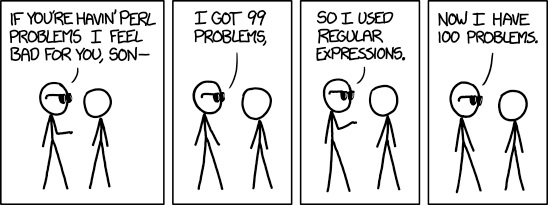
Perl REGEX Problems courtesy of XKCD
The label_replace documentation is a bit terse, and in my opinion, the order of parameters is messed up, but after a few goes I had what I needed:
label_replace(probe_duration_seconds module="xmpp_banner" , "port", "$1", "instance", ".*:(.*)")
probe_duration_seconds instance="example.net:5222",job="blackbox",module="xmpp_banner",port="5222" 	0.001
probe_duration_seconds instance="example.net:5269",job="blackbox",module="xmpp_banner",port="5269" 	0.002
The response now has a new label (or field if you like) called port. So what is this function to our data coming from probe_duration_seconds? The function format is: label_replace(value, dst_label, replacement, src_label, regex) So the function does the following:
  1. Evaluate value, which is generally some sort of query such as probe_duration_seconds
  2. Find the required source label src_label, in this example is instance, in this case the values are example.net:5222 and example.net:5269
  3. Apply regular expression regex, for us its .*:(.*) That says skip everying before : then capture/store everything past : . The brackets mean copy what is after the colon and put it in match #1
  4. Make a new label specified in dst_label, for us this is port
  5. Whatever is in replacement goes into dst_label. For this example it is $1 which means match #1 in our regular expression in the label called port.
In short, the function captures everything after the colon in the instance label and puts that into a new label called port. It does this for each value that is returned into the first parameter. This means I can use the port in my Grafana graph Legend and it will show 5222 or 5269 respectively. I have made the Legend TCP port to give the below result, but I could have used port in Grafana Legend and made the result TCP $1 in the label_replace function to get the same result.
Grafana console showing the use of the label_replace function

9 November 2021

Joachim Breitner: How to audit an Internet Computer canister

I was recently called upon by Origyn to audit the source code of some of their Internet Computer canisters ( canisters are services or smart contracts on the Internet Computer), which were written in the Motoko programming language. Both the application model of the Internet Computer as well as Motoko bring with them their own particular pitfalls and possible sources for bugs. So given that I was involved in the creation of both, they reached out to me. In the course of that audit work I collected a list of things to watch out for, and general advice around them. Origyn generously allowed me to share that list here, in the hope that it will be helpful to the wider community.

Inter-canister calls The Internet Computer system provides inter-canister communication that follows the actor model: Inter-canister calls are implemented via two asynchronous messages, one to initiate the call, and one to return the response. Canisters process messages atomically (and roll back upon certain error conditions), but not complete calls. This makes programming with inter-canister calls error-prone. Possible common sources for bugs, vulnerabilities or simply unexpected behavior are:
  • Reading global state before issuing an inter-canister call, and assuming it to still hold when the call comes back.
  • Changing global state before issuing an inter-canister call, changing it again in the response handler, but assuming nothing else changes the state in between (reentrancy).
  • Changing global state before issuing an inter-canister call, and not handling failures correctly, e.g. when the code handling the callback rolls backs.
If you find such pattern in your code, you should analyze if a malicious party can trigger them, and assess the severity that effect These issues apply to all canisters, and are not Motoko-specific.

Rollbacks Even in the absence of inter-canister calls the behavior of rollbacks can be surprising. In particular, rejecting (i.e. throw) does not rollback state changes done before, while trapping (e.g. Debug.trap, assert , out of cycle conditions) does. Therefore, one should check all public update call entry points for unwanted state changes or unwanted rollbacks. In particular, look for methods (or rather, messages, i.e. the code between commit points) where a state change is followed by a throw. This issues apply to all canisters, and are not Motoko-specific, although other CDKs may not turn exceptions into rejects (which don t roll back).

Talking to malicious canisters Talking to untrustworthy canisters can be risky, for the following (likely incomplete) reasons:
  • The other canister can withhold a response. Although the bidirectional messaging paradigm of the Internet Computer was designed to guarantee a response eventually, the other party can busy-loop for as long as they are willing to pay for before responding. Worse, there are ways to deadlock a canister.
  • The other canister can respond with invalidly encoded Candid. This will cause a Motoko-implemented canister to trap in the reply handler, with no easy way to recover. Other CDKs may give you better ways to handle invalid Candid, but even then you will have to worry about Candid cycle bombs that will cause your reply handler to trap.
Many canisters do not even do inter-canister calls, or only call other trustwothy canisters. For the others, the impact of this needs to be carefully assessed.

Canister upgrade: overview For most services it is crucial that canisters can be upgraded reliably. This can be broken down into the following aspects:
  1. Can the canister be upgraded at all?
  2. Will the canister upgrade retain all data?
  3. Can the canister be upgraded promptly?
  4. Is three a recovery plan for when upgrading is not possible?

Canister upgradeability A canister that traps, for whatever reason, in its canister_preupgrade system method is no longer upgradeable. This is a major risk. The canister_preupgrade method of a Motoko canister consists of the developer-written code in any system func preupgrade() block, followed by the system-generated code that serializes the content of any stable var into a binary format, and then copies that to stable memory. Since the Motoko-internal serialization code will first serialize into a scratch space in the main heap, and then copy that to stable memory, canisters with more than 2GB of live data will likely be unupgradeable. But this is unlikely the first limit: The system imposes an instruction limit on upgrading a canister (spanning both canister_preupgrade and canister_postupgrade). This limit is a subnet configuration value, and sepearate (and likely higher) than the normal per-message limit, and not easily determined. If the canister s live data becomes too large to be serialized within this limit, the canister becomes non-upgradeable. This risk cannot be eliminated completely, as long as Motoko and Stable Variables are used. It can be mitigated by appropriate load testing: Install a canister, fill it up with live data, and exercise the upgrade. If this succeeds with a live data set exceeding the expected amount of data by a margin, this risk is probably acceptable. Bonus points for adding functionality that will prevent the canister s live data to increase above a certain size. If this testing is to be done on a local replica, extra care needs to be taken to make sure the local replica actually performs instruction counting and has the same resource limits as the production subnet. An alternative mitigation is to avoid canister_pre_upgrade as much as possible. This means no use of stable var (or restricted to small, fixed-size configuration data). All other data could be
  • mirrored off the canister (possibly off chain), and manually re-hydrated after an upgrade.
  • stored in stable memory manually, during each update call, using the ExperimentalStableMemory API. While this matches what high-assurance Rust canisters (e.g. the Internet Identity) do, This requires manual binary encoding of the data, and is marked experimental, so I cannot recommend this at the moment.
  • not put into a Motoko canister until Motoko has a scalable solution for stable variable (for example keeping them in stable memory permanently, with smart caching in main memory, and thus obliterating the need for pre-upgrade code.)

Data retention on upgrades Obviously, all live data ought to be retained during upgrades. Motoko automatically ensures this for stable var data. But often canisters want to work with their data in a different format (e.g. in objects that are not shared and thus cannot be put in stable vars, such as HashMap or Buffer objects), and thus may follow following idiom:
stable var fooStable =  ;
var foo = fooFromStable(fooStable);
system func preupgrade()   fooStable := fooToStable(foo);  )
system func postupgrade()   fooStable := (empty);  )
In this case, it is important to check that
  • All non-stable global vars, or global lets with mutable values, have a stable companion.
  • The assignments to foo and fooStable are not forgotten.
  • The fooToStable and fooFromStable form bijections.
An example would be HashMaps stored as arrays via Iter.toArray( .entries()) and HashMap.fromIter( .vals()). It is worth pointiong out that a code view will only look at a single version of the code, but cannot check whether code changes will preserve data on upgrade. This can easily go wrong if the names and types of stable variables are changed in incompatible way. The upgrade may fail loudly in this cases, but in bad cases, the upgrade may even succeed, losing data along the way. This risk needs to be mitigated by thorough testing, and possibly backups (see below).

Prompt upgrades Motoko and Rust canisters cannot be safely upgraded when they are still waiting for responses to inter-canister calls (the callback would eventually reach the new instance, and because of infelicities of the IC s System API, could possibly call arbitrary internal functions). Therefore, the canister needs to be stopped before upgrading, and started again. If the inter-canister calls take a long time, this mean that upgrading may take a long time, which may be undesirable. Again, this risk is reduced if all calls are made to trustworthy canisters, and elevated when possibly untrustworthy canisters are called, directly or indirectly.

Backup and recovery Because of the above risk around upgrades it is advisable to have a disaster recovery strategy. This could involve off-chain backups of all relevant data, so that it is possible to reinstall (not upgrade) the canister and re-upload all data. Note that reinstall has the same issue as upgrade described above in prompt upgrades : It ought to be stopped first to be safe. Note that the instruction limit for messages, as well as the message size limit, limit the amount of data returned. If the canister needs to hold more data than that, the backup query method might have to return chunks or deltas, with all the extra complexity that entails, e.g. state changes between downloading chunks. If large data load testing is performed (as Irecommend anyways to test upgradeability), one can test whether the backup query method works within the resource limits.

Time is not strictly monotonic The timestamps for current time that the Internet Computer provides to its canisters is guaranteed to be monotonic, but not strictly monotonic. It can return the same values, even in the same messages, as long as they are processed in the same block. It should therefore not be used to detect happens-before relations. Instead of using and comparing time stamps to check whether Y has been performed after X happened last, introduce an explicit var y_done : Bool state, which is set to False by X and then to True by Y. When things become more complex, it will be easier to model that state via an enumeration with speaking tag names, and update this state machine along the way. Another solution to this problem is to introduce a var v : Nat counter that you bump in every update method, and after each await. Now v is your canister s state counter, and can be used like a timestamp in many ways. While we are talking about time: The system time (typically) changes across an await. So if you do let now = Time.now() and then await, the value in now may no longer be what you want.

Wrapping arithmetic The Nat64 data type, and the other fixed-width numeric types provide opt-in wrapping arithmetic (e.g. +%, fromIntWrap). Unless explicitly required by the current application, this should be avoided, as usually a too large or negatie value is a serious, unrecoverable logic error, and trapping is the best one can do.

Cycle balance drain attacks Because of the IC s canister pays model, all canisters are prone to DoS attacks by draining their cycle balance, and this risk needs to be taken into account. The most elementary mitigation strategy is to monitor the cycle balance of canisters and keep it far from the (configurable) freezing threshold. On the raw IC-level, further mitigation strategies are possible:
  • If all update calls are authenticated, perform this authentication as quickly as possible, possibly before decoding the caller s argument. This way, a cycle drain attack by an unauthenticated attacker is less effective (but still possible).
  • Additionally, implementing the canister_inspect_message system method allows the above checks to be performed before the message even is accepted by the Internet Computer. But it does not defend against inter-canister messages and is therefore not a complete solution.
  • If an attack from an authenticated user (e.g. a stakeholder) is to be expected, the above methods are not effective, and an effective defense might require relatively involved additional program logic (e.g. per-caller statistics) to detect such an attack, and react (e.g. rate-limiting).
  • Such defenses are pointless if there is only a single method where they do not apply (e.g. an unauthenticated user registration method). If the application is inherently attackable this way, it is not worth the bother to raise defenses for other methods.
Related: A justification why the Internet Identity does not use canister_inspect_message) A motoko-implemented canister currently cannot perform most of these defenses: Argument decoding happens unconditionally before any user code that may reject a message based on the caller, and canister_inspect_message is not supported. Furthermore, Candid decoding is not very cycle defensive, and one should assume that it is possible to construct Candid messages that require many instructions to decode, even for simple argument type signatures. The conclusion for the audited canisters is to rely on monitoring to keep the cycle blance up, even during an attack, if the expense can be born, and maybe pray for IC-level DoS protections to kick in.

Large data attacks Another DoS attack vector exists if public methods allow untrustworthy users to send data of unlimited size that is persisted in the canister memory. Because of the translation of async-await code into multiple message handlers, this applies not only to data that is obviously stored in global state, but also local data that is live across an await point. The effectiveness of such attacks is limited by the Internet Computer s message size limit, which is in the order of a few megabytes, but many of those also add up. The problem becomes much worse if a method has an argument type that allows a Candid space bomb: It is possible to encode very large vectors with all values null in Candid, so if any method has an argument of type [Null] or [?t], a small message will expand to a large value in the Motoko heap. Other types to watch out:
  • Nat and Int: This is an unbounded natural number, and thus can be arbitrarily large. The Motoko representation will however not be much larger than the Candid encoding (so this does not qualify as a space bomb).
It is still advisable to check if the number is reasonable in size before storing it or doing an await. For example, when it denotes an index in an array, throw early if it exceeds the size of the array; if it denotes a token amount to transfer, check it against the available balance, if it denotes time, check it against reasonable bounds.
  • Principal: A Principal is effectively a Blob. The Interface specification says that principals are at most 29 bytes in length, but the Motoko Candid decoder does not check that currently (fixed in the next version of Motoko). Until then, a Principal passed as an argument can be large (the principal in msg.caller is system-provided and thus safe). If you cannot wait for the fix to reach you, manually check the size of the princial (via Principal.toBlob) before doing the await.

Shadowing of msg or caller Don t use the same name for the message context of the enclosing actor and the methods of the canister: It is dangerous to write shared(msg) actor, because now msg is in scope across all public methods. As long as these also use public shared(msg) func , and thus shadow the outer msg, it is correct, but it if one accidentially omits or mis-types the msg, no compiler error would occur, but suddenly msg.caller would now be the original controller, likely defeating an important authorization step. Instead, write shared(init_msg) actor or shared( caller = controller ) actor to avoid using msg.

Conclusion If you write a serious canister, whether in Motoko or not, it is worth to go through the code and watch out for these patterns. Or better, have someone else review your code, as it may be hard to spot issues in your own code. Unfortunately, such a list is never complete, and there are surely more ways to screw up your code in addition to all the non-IC-specific ways in which code can be wrong. Still, things get done out there, so best of luck!

6 November 2021

Evgeni Golov: I just want to run this one Python script

So I couldn't sleep the other night, and my brain wanted to think about odd problems Ever had a script that's compatible with both, Python 2 and 3, but you didn't want to bother the user to know which interpreter to call? Maybe because the script is often used in environments where only one Python is available (as either /usr/bin/python OR /usr/bin/python3) and users just expect things to work? And it's only that one script file, no package, no additional wrapper script, nothing. Yes, this is a rather odd scenario. And yes, using Python doesn't make it easier, but trust me, you wouldn't want to implement the same in bash. Nothing that you will read from here on should ever be actually implemented, it will summon dragons and kill kittens. But it was a fun midnight thought, and I like to share nightmares! The nice thing about Python is it supports docstrings, essentially strings you can put inside your code which are kind of comments, but without being hidden inside commnent blocks. These are often used for documentation that you can reach using Python's help() function. (Did I mention I love help()?) Bash on the other hand, does not support docstrings. Even better, it doesn't give a damn whether you quote commands or not. You can call "ls" and you'll get your directory listing the same way as with ls. Now, nobody would under normal circumstances quote ls. Parameters to it, sure, those can contain special characters, but ls?! Another nice thing about Python: it doesn't do any weird string interpolation by default (ssssh, f-strings are cool, but not default). So "$(ls)" is exactly that, a string containing a Dollar sign, an open parenthesis, the characters "l" and "s" and a closing parenthesis. Bash, well, Bash will run ls, right? If you don't yet know where this is going, you have a clean mind, enjoy it while it lasts! So another thing that Bash has is exec: "replace[s] the shell without creating a new process". That means that if you write exec python in your script, the process will be replaced with Python, and when the Python process ends, your script ends, as Bash isn't running anymore. Well, technically, your script ended the moment exec was called, as at that point there was no more Bash process to execute the script further. Using exec is a pretty common technique if you want to setup the environment for a program and then call it, without Bash hanging around any longer as it's not needed. So we could have a script like this:
#!/bin/bash
exec python myscript.py "$@"
Here "$@" essentially means "pass all parameters that were passed to this Bash script to the Python call" (see parameter expansion). We could also write it like this:
#!/bin/bash
"exec" "python" "myscript.py" "$@"
As far as Bash is concerned, this is the same script. But it just became valid Python, as for Python those are just docstrings. So, given this is a valid Bash script and a valid Python script now, can we make it do something useful in the Python part? Sure!
#!/bin/bash
"exec" "python" "myscript.py" "$@"
print("lol")
If we call this using Bash, it never gets further than the exec line, and when called using Python it will print lol as that's the only effective Python statement in that file. Okay, but what if this script would be called myscript.py? Exactly, calling it with Python would print lol and calling it with Bash would end up printing lol too (because it gets re-executed with Python). We can even make it name-agnostic, as Bash knows the name of the script we called:
#!/bin/bash
"exec" "python" "$0" "$@"
print("lol")
But this is still calling python, and it could be python3 on the target (or even something worse, but we're not writing a Halloween story here!). Enter another Bash command: command (SCNR!), especially "The -v option causes a single word indicating the command or file name used to invoke command to be displayed". It will also exit non-zero if the command is not found, so we can do things like $(command -v python3 command -v python) to find a Python on the system.
#!/bin/bash
"exec" "$(command -v python3   command -v python)" "$0" "$@"
print("lol")
Not well readable, huh? Variables help!
#!/bin/bash
__PYTHON="$(command -v python3   command -v python)"
"exec" "$ __PYTHON " "$0" "$@"
print("lol")
For Python the variable assignment is just a var with a weird string, for Bash it gets executed and we store the result. Nice! Now we have a Bash header that will find a working Python and then re-execute itself using said Python, allowing us to use some proper scripting language. If you're worried that $0 won't point at the right file, just wrap it with some readlink -f .

Reproducible Builds: Reproducible Builds in October 2021

Welcome to the October 2021 report from the Reproducible Builds project!
This month Samanta Navarro posted to the oss-security security mailing on a novel category of exploit in the .tar archive format, where a single .tar file contains different contents depending on the tar utility being used. Naturally, this has consequences for reproducible builds as Samanta goes onto reply:

Arch Linux uses libarchive (bsdtar) in its build environment. The default tar program installed is GNU tar. It is possible to create a source distribution which leads to different files seen by the build environment than compared to a careful reviewer and other Linux distributions.
Samanta notes that addressing the tar utilities themselves will not be a sufficient fix:
I have submitted bug reports and patches to some projects but eventually I had to conclude that the problem itself cannot be fixed by these implementations alone. The best choice for these tools would be to only allow archives which are fully compatible to standards but this in turn would render a lot of archives broken.
Reproducible builds, with its twin ideas of reaching consensus on the build outputs as well as precisely recording and describing the build environment, would help address this problem at a higher level.
Codethink announced that they had achieved ISO-26262 ASIL D Tool Certification, a way of determining specific safety standards for software. Codethink used open source tooling to achieve this, but they also leverage:
Reproducibility, repeatability and traceability of builds, drawing heavily on best-practices championed by the Reproducible Builds project.

Elsewhere on the internet, according to a comment on Hacker News, Microsoft are now comparing NPM Javascript packages with their original source repositories:
I got a PR in my repository a few days ago leading back to a team trying to make it easier for packages to be reproducible from source.

Lastly, Martin Monperrus started an interesting thread on our mailing list about Github, specifically that their autogenerated release tarballs are not deterministic . The thread generated a significant number of replies that are worth reading.

Events and presentations

Community news On our mailing list this month:
There were quite a few changes to the Reproducible Builds website and documentation this month as well, including Feng Chai updating some links on our publications page [ ] and marco updated our project metadata around the Bitcoin Core building guide [ ].
Lastly, we ran another productive meeting on IRC during October. A full set of notes from the meeting is available to view.

Distribution work Qubes was heavily featured in the latest edition of Linux Weekly News, and a significant section was dedicated to discussing reproducibility. For example, it was mentioned that the Qubes project has been working on incorporating reproducible builds into its continuous integration (CI) infrastructure . But the LWN article goes on to describe that:
The current goal is to be able to build the Qubes OS Debian templates solely from packages that can be built reproducibly. Templates in Qubes OS are VM images that can be used to start an application qube quickly based on the template. The qube will have read-only access to the root filesystem of the template, so that the same root filesystem can be shared with multiple application qubes. There are official templates for several variants of both Fedora and Debian, as well as community maintained templates for several other distributions.
You can view the whole article on LWN, and Fr d ric also published a lengthy summary about their work on reproducible builds in Qubes as well for those wishing to learn more.
In Debian this month, 133 reviews of Debian packages were added, 81 were updated and 24 were removed this month, adding to Debian s ever-growing knowledge about identified issues. A number of issues were categorised and added by Chris Lamb and Vagrant Cascadian too [ ][ ][ ]. In addition, work on alternative snapshot service has made progress by Fr d ric Pierret and Holger Levsen this month, including moving from the existing host (snapshot.notset.fr) to snapshot.reproducible-builds.org (more info) thanks to OSUOSL for the machine and hosting and Debian for the disks.
Finally, Bernhard M. Wiedemann posted his monthly reproducible builds status report.

diffoscope diffoscope is our in-depth and content-aware diff utility. Not only can it locate and diagnose reproducibility issues, it can provide human-readable diffs from many kinds of binary formats. This month, Chris Lamb made the following changes, including preparing and uploading versions 186, 187, 188 and 189 to Debian
  • New features:
    • Add support for Python Sphinx inventory files (usually named objects.inv on-disk). [ ]
    • Add support for comparing .pyc files. Thanks to Sergei Trofimovich for the inspiration. [ ]
    • Try some alternative suffixes (e.g. .py) to support distributions that strip or retain them. [ ][ ]
  • Bug fixes:
    • Fix Python decompilation tests under Python 3.10+ [ ] and for Python 3.7 [ ].
    • Don t raise a traceback if we cannot unmarshal Python bytecode. This is in order to support Python 3.7 failing to load .pyc files generated with newer versions of Python. [ ]
    • Skip Python bytecode testing where we do not have an expected diff. [ ]
  • Codebase improvements:
    • Use our file_version_is_lt utility instead of accepting both versions of uImage expected diff. [ ]
    • Split out a custom call to assert_diff for a .startswith equivalent. [ ]
    • Use skipif instead of manual conditionals in some tests. [ ]
In addition, Jelle van der Waa added external tool references for Arch Linux for ocamlobjinfo, openssl and ffmpeg [ ][ ][ ] and added Arch Linux as a Continuous Integration (CI) test target. [ ] and Vagrant Cascadian updated the testsuite to skip Python bytecode comparisons when file(1) is older than 5.39. [ ] as well as added external tool references for the Guix distribution for dumppdf and ppudump. [ ][ ]. Vagrant Cascadian also updated the diffoscope package in GNU Guix [ ][ ]. Lastly, Guangyuan Yang updated the FreeBSD package name on the website [ ], Mattia Rizzolo made a change to override a new Lintian warning due to the new test files [ ], Roland Clobus added support to detect and log if the GNU_BUILD_ID field in an ELF binary been modified [ ], Sandro J ckel updated a number of helpful links on the website [ ] and Sergei Trofimovich made the uImage test output support file() version 5.41 [ ].

reprotest reprotest is the Reproducible Build s project end-user tool to build same source code twice in widely differing environments, checking the binaries produced by the builds for any differences. This month, reprotest version 0.7.18 was uploaded to Debian unstable by Holger Levsen, which also included a change by Holger to clarify that Python 3.9 is used nowadays [ ], but it also included two changes by Vasyl Gello to implement realistic CPU architecture shuffling [ ] and to log the selected variations when the verbosity is configured at a sufficiently high level [ ]. Finally, Vagrant Cascadian updated reprotest to version 0.7.18 in GNU Guix.

Upstream patches The Reproducible Builds project detects, dissects and attempts to fix unreproducible packages. We try to send all of our patches upstream where appropriate. We authored a large number of such patches this month, including:

Testing framework The Reproducible Builds project runs a testing framework at tests.reproducible-builds.org, to check packages and other artifacts for reproducibility. This month, the following changes were made:
  • Holger Levsen:
    • Debian-related changes:
      • Incorporate a fix from bremner into builtin-pho related to binary-NMUs. [ ]
      • Keep bullseye environments around longer, in an attempt to fix a Jenkins issue. [ ]
      • Improve the documentation of buildinfos.debian.net. [ ]
      • Improve documentation for the builtin-pho setup. [ ][ ]
    • OpenWrt-related changes:
      • Also use -j1 for better debugging. [ ]
      • Document that that Python 3.x is now used. [ ]
      • Enable further debugging for the toolchain build. [ ]
    • New snapshot.reproducible-builds.org service:
      • Actually add new node. [ ][ ]
      • Install xfsprogs on snapshot.reproducible-builds.org. [ ]
      • Create account for fpierret on new node. [ ]
      • Run node_health_check job on new node too. [ ]
  • Mattia Rizzolo:
    • Debian-related changes:
      • Handle schroot errors when invoking diffoscope instead of masking them. [ ][ ]
      • Declare and define some variables separately to avoid masking the subshell return code. [ ]
      • Fix variable name. [ ]
      • Improve log reporting. [ ]
      • Execute apt-get update with the -q argument to get more decent logs. [ ]
      • Set the Debian HTTP mirror and proxy for snapshot.reproducible-builds.org. [ ]
      • Install the libarchive-tools package (instead of bsdtar) when updating Jenkins nodes. [ ]
    • Be stricter about errors when starting the node agent [ ] and don t overwrite NODE_NAME so that we can expect Jenkins to properly set for us [ ].
    • Explicitly warn if the NODE_NAME is not a fully-qualified domain name (FQDN). [ ]
    • Document whether a node runs in the future. [ ]
    • Disable postgresql_autodoc as it not available in bullseye. [ ]
    • Don t be so eager when deleting schroot internals, call to schroot -e to terminate the schroots instead. [ ]
    • Only consider schroot underlays for deletion that are over a month old. [ ][ ]
    • Only try to unmount /proc if it s actually mounted. [ ]
    • Move the db_backup task to its own Jenkins job. [ ]
Lastly, Vasyl Gello added usage information to the reproducible_build.sh script [ ].

Contributing If you are interested in contributing to the Reproducible Builds project, please visit our Contribute page on our website. However, you can get in touch with us via:

5 November 2021

Molly de Blanc: Tea(GL) Sandwiches

For SeaGL 2021 I m making some tea sandwiches. I know nothing about tea sandwiches, but read a Wikipedia article. If you want to make them along with me, I recommend getting the ingredients ahead of time. Smoked Not-salmon Sandwiches I guess you could make these with smoked salmon, though I think it s cleverer this way. Ingredients Procedure Apple and Brie Sandwiches This sounded good to me. Let s see how it goes. Ingredients Procedure

4 November 2021

Mike Gabriel: Call for Translations: Ayatana Indicators 0.9.x Release Series

We (Robert Tari, the UBports developers team, myself) are very close to releasing Ayatana Indicators 0.9.x. The work on Ayatana Indicators is currently nearly completed funded by the UBports Foundation and over the past half year, many many changes, improvements and clean-ups have been added to the code. Ayatana Indicators 0.9.x will be the first release series to be in the development tree of Ubuntu Touch 20.04 (which is currently under very heavy development). Ayatana Indicators 0.9.x will also be used in various other desktop environments available in upcoming Ubuntu 22.04 LTS, such as Ubuntu MATE, Xubuntu, (optionally in) Ubuntu Budgie (please correct my wording, if you know better), (send me a note, if I forgot your desktop env), etc. So, to all Ubuntu Touch, Ubuntu MATE, Xubuntu, etc. users. If you not already are a translator of Ayatana Indicators and you are good in English and fluent in at least one other language, please consider helping out with translating or improving translations of Ayatana Indicators. The translation work needs to be done on Hosted Weblate [1], please sign up for an account (if you haven't done so, yet) and chime in. Thanks so much for your contributions! light+love
Mike https://hosted.weblate.org/projects/ayatana-indicators/

Sandro Tosi: Python: send emails with embedded images

to send emails with images you need to use MIMEMultipart, but the basic approach:
import smtplib

from email.mime.multipart import MIMEMultipart
from email.mime.image import MIMEImage

msg = MIMEMultipart('alternative')
msg['Subject'] = "subject"
msg['From'] = from_addr
msg['To'] = to_addr

part = MIMEImage(open('/path/to/image', 'rb').read())

s = smtplib.SMTP('localhost')
s.sendmail(from_addr, to_addr, msg.as_string())
s.quit()

will produce an email with empty body and the image as an attachment.The better way, ie to have the image as part of the body of the email, requires to write an HTML body that refers to that image:
import smtplib

from email.mime.multipart import MIMEMultipart
from email.mime.text import MIMEText
from email.mime.image import MIMEImage

msg = MIMEMultipart('alternative')
msg['Subject'] = "subject
msg['From'] = from_addr
msg['To'] = to_addr

text = MIMEText('<img src="cid:image1">', 'html')
msg.attach(text)

image = MIMEImage(open('/path/to/image', 'rb').read())

# Define the image's ID as referenced in the HTML body above
image.add_header('Content-ID', '<image1>')
msg.attach(image)

s = smtplib.SMTP('localhost')
s.sendmail(from_addr, to_addr, msg.as_string())
s.quit()

The trick is to define an image with a specific Content-ID and make that the only item in an HTML body: now you have an email with contains that specific image as the only content of the body, embedded in it.

Bonus point: if you want to take a snapshot of a webpage (which is kinda the reason i needed the code above) i found it extremely useful to use the Google PageSpeed Insights API; a good description on how to use that API with Python is available at this StackOverflow answer.

UPDATE (2020-12-26): I was made aware via email that some mail providers may not display images inline when the Content-ID value is too short (say, for example, Content-ID: 1). A solution that seems to work on most of the providers is using a sequence of random chars prefixed with a dot and suffixed with a valid mail domain.

Russell Coker: USB Microphones

The Situation I bought myself some USB microphones over ebay, I couldn t see any with USB type A connectors (the original USB connectors) and bought ones with USB-C connectors. I thought it would be good to have microphones that could work with recent mobile phones and with PCs, because surely it wouldn t be difficult to get an adaptor. I tested one of the microphones, it worked well on a phone. I bought a pair of adaptors for USB A ports on a PC or laptop to USB-C (here s the link to where I bought them). I used one of the adaptors with a USB-C HDMI device which gave the following line from lsusb, I didn t try using a HDMI monitor on my laptop, having the device recognised was enough.
Bus 003 Device 002: ID 2109:0100 VIA Labs, Inc. USB 2.0 BILLBOARD
I tried connecting a USB-C microphone and Linux didn t recognise the existence of a USB device, I tried that on a PC and a laptop on multiple ports. I wondered whether the description of the VIA BILLBOARD device as USB 2.0 was relevant to my problem. According to Big Mess O Wires USB-C has separate wires for USB 3.1 and USB 2 [1]. So someone could make a device that converts USB-A to USB-C with only USB-2 wires in place. I tested the USB-A to USB-C adaptor with the HDMI device in a USB SuperSpeed (IE 3.x) port and it still identified as USB 2.0. I suspect that the USB-C HDMI device is using all the high speed wires for DisplayPort data (with a conversion to HDMI) and therefore looks like a USB 2.0 device. The Problem I want to install a microphone in my workstation for long Zoom training sessions (7 hours in a day) that otherwise require me to use multiple Android devices as I don t have a device that will do 7 hours of Zoom without running out of battery. A new workstation with USB-C is unreasonably expensive. A PCIe USB-C card would give me the port at the back of the machine, I can t have the back of the machine near the microphone because it s too noisy. If I could have a USB-C hub with reasonable length cables (the 1M cables typical for USB 2.0 hubs would be fine) connected to a USB-C port at the back of my workstation that would work. But there seems to be a great lack of USB-C hubs. NewBeDev has an informative post about the lack of USB-C hubs that have multiple USB-C ports [2]. There also seems to be a lack of USB-C hubs with cables longer than 20cm. The Solution I ended up ordering a Sades Wand gaming headset [3], that has over-ear headphones and an attached microphone which connects to the computer via USB 2.0. I gave the URL for the sades.com.au web site for reference but you will get a significantly better price by buying on ebay ($39+postage vs about $30 including postage). I guess I won t be using my new USB-C microphones for a while.

3 November 2021

Benjamin Mako Hill: Q&A about doing a PhD with my research group

Ever considered doing research about online communities, free culture/software, and peer production full time? It s PhD admission season and my research group the Community Data Science Collective is doing an open-to-anyone Q&A about PhD admissions this Friday November 5th. We ve got room in the session and its not too late to sign up to join us! The session will be a good opportunity to hear from and talk to faculty recruiting students to our various programs at the University of Washington, Purdue, and Northwestern and to talk with current and previous students in the group. I am hoping to admit at least one new PhD advisee to the Department of Communication at UW this year (maybe more) and am currently co-advising (and/or have previously co-advised) students in UW s Allen School of Computer Science & Engineering, Department of Human-Centered Design & Engineering, and Information School. One thing to keep in mind is that my primary/home department Communication has a deadline for PhD applications of November 15th this year. The registration deadline for the Q&A session is listed as today but we ll do what we can to sneak you in even if you register late. That said, please do register ASAP so we can get you the link to the session!

Next.

Previous.