Search Results: "rra"

7 April 2009

Mike Hommey: How not to provide robust clustered storage with Linux and GFS

(The title is a bit strong, on purpose) LWN links to an article describing how to provide robust clustered storage with Linux and GFS. While explaining how to setup GFS can be nice, the incentive made me jump. The author writes:
Load balancing is difficult; often we need to share file systems via NFS or other mechanisms to provide a central location for the data. While you may be protected against a Web server node failure, you are still sharing fate with the central storage node. Using GFS, the free clustered file system in Linux, you can create a truly robust cluster that does not depend on other servers. In this article, we show you how to properly configure GFS.
In case you don t know, GFS is not exactly a clustered storage . It is more a shared storage . You have one storage, and several clients accessing it. You have one storage array, compared to the NFS case, where you have one central server for the data. But what is a storage array except a special (and expensive) kind of server ? You don t depend on other servers, but you depend on other servers ? How is that supposed to be different ?
Conceptually, a clustered file system allows multiple operating systems to mount the same file system, and write to it at the same time. There are many clustered file systems available including Sun s Lustre, OCFS from Oracle, and GFS for Linux.
OCFS and GFS are the same class of file systems, but Lustre is definitely out of league and would, actually, provide a truly robust cluster that does not depend on other servers. Lustre is a truly clustered filesystem, that distributes data on several nodes such that losing some nodes don t make you lose access to the data. With the incentive given by the author, and considering he lists Lustre as an example, I would actually have preferred an article about setting up Lustre.

3 April 2009

Russell Coker: Google Server Design

Cnet has an article on the design of the Google servers [1]. It seems that their main servers are 2RU systems with a custom Gigabyte motherboard that takes only 12V DC input. The PSUs provide 12V DC and each system has a 12V battery backup to keep things running before a generator starts in the event of a power failure. They claim that they get better efficiency with small batteries local to the servers than with a single large battery array. From inspecting the pictures it seems that the parts most likely to fail are attached by velcro. The battery is at one end, the PSU is at the other, and the hard disks are at one side. It appears that it might be possible to replace the PSU or the battery while the server is operational and in the rack. The hard disks are separated from the motherboard by what appears to be a small sheet of aluminium which appears to give two paths for air to flow through the system. The thermal characteristics of the motherboard (CPUs) and the hard drives are quite different to having separate air flows seems likely to allow warmer air to be used in cooling the system (thus saving power). Google boast that their energy efficiency now matches what the rest of the industry aims to do by 2011! The servers are described as taking up 2RU, which gives a density of one CPU per RU. This surprised me as some companies such as Servers Direct [2] sell 1RU servers that have four CPUs (16 cores). Rackable systems [3] (which just bought the remains of SGI) sells 2RU half-depth systems (which can allow two systems in 2RU of rack space) that have four CPUs and 16 cores (again 4 CPUs per RU). Rackable systems also has a hardware offering designed for Cloud Computing servers, those CloudRack [4] systems have a number of 1RU trays. Each CloudRack tray can have as many as two server boards that has two CPUs (4 CPUs in 1RU) and 8 disks. While I wouldn t necessarily expect that Google would have the highest density of CPUs per rack, it did surprise me to see that they have 1/4 the CPU density of some commercial offerings and 1/8 the disk density! I wonder if this was a deliberate decision to use more server room space to allow slower movement of cooling air and thus save energy. It s interesting to note that Google have been awarded patents on some of their technology related to the batteries. Are there no journalists reading the new patents? Surely anyone who saw such patents awarded to Google could have published most of this news before Cnet got it. Now, I wonder how long it will take for IBM, HP, and Dell to start copying some of these design features. Not that I expect them to start selling their systems by the shipping crate.

2 April 2009

Marc 'Zugschlus' Haber: LV naming, UUIDs, file systems labels

In the last few weeks, I spent quite some time wondering about how to arrange the hard disk layout of my productive systems in the future. This article outlines my thoughts and would like to ask the lazyweb for comments. I try to keep my Debian servers as identically as possible, making it possible to talk non-linux persons remotely through the system without having to worry about this particular box configuration. I have been especially worrying about: On my current systems, I usually have the root file system on /dev/hda1, with /dev/hda2 being a PV which is the only PV of a VG vg0, which in turn has LVs named home, var and usr. This setup has a bunch of disadvantages. Thankfully, there is a number of possible solutions: I am pondering about a solution, but suspect that this is totally overengineered. Did I miss something? Is this a realistic solution? How do you handle this issue? Comments to this article will be open for quite a while.

1 April 2009

Francois Marier: Safer synergy setup for laptop-desktop keyboard sharing

Synergy is a very useful piece of software for anybody wanting to share a mouse and keyboard between two networked computers.

Here is the setup I use to:
First of all, I've got the following ~/.synergy.conf on both of my laptop and desktop machines:
section: screens
mylaptop:
mydesktop:
end
section: links
mylaptop:
right = mydesktop
mydesktop:
left = mylaptop
end
section: options
keystroke(alt+shift+space) = switchInDirection(left)
keystroke(alt+space) = switchInDirection(right)
end

With this, I am ready to start the server on my desktop machine:
synergys -a localhost
Now, in order to encrypt the synergy client/server traffic, I create an ssh tunnel between the two machines:
ssh -f -N -L localhost:24800:localhost:24800 mydesktop
Then I start the synergy client on my laptop. However, some recent problems have convinced me to have a more robust alternative to simply starting the client like this:
synergyc localhost
As recommended by a few helpful people on #debian-devel, I decided to use the supervise tool (part of the daemontools package) to automatically restart the synergy client if it crashes. Here is how I do it:
supervise ~/.synergyc &
This command refers to a ~/.synergyc directory containing a single run script. That shell script consists of:
#!/bin/sh
xset r rate 500 30
/usr/bin/synergyc --no-daemon localhost

(The xset call is necessary since synergyc crashes seem to reset the repeat flag of X for some reason...)

The only problem I still need to fix in my setup is the potential password leak in the next few seconds after the synergy client crashes. Such a crash has already caused me to accidentally type my laptop password into a desktop IRC window the other day :(

Ideally, I would like the synergy server to swallow the first second or two of keyboard input after its client suddenly drops out. This could eliminate quite a few embarrassing wrong windows.

30 March 2009

John Goerzen: Kindle 2: How s It Going?

It s now been almost a month since I got my Kindle 2 and wrote about my first impressions of it. In that amount of time, I figure I have read, on the Kindle, the equivalent of 1500 to 2000 printed pages. I ll start with my personal reactions to the device, and then move on into some less subjective observations about it. What I ve Used It For To give you a quick idea of what I m reading: The Gut Reaction I want everything to be available on the Kindle, and I want to read everything on it. Whether that s just some excitement at a new device (still possible after a month, I guess), or something more lasting, I m still a little unclear about but I suspect it s something more lasting. I have read far, far more since I have had the Kindle than I had for quite some time prior, excepting a certain Hitchhiker s Guide to the Galaxy marathon one Christmas vacation. This leads me to think that the Kindle s main competitor isn t the Sony PRS-505, but rather the XBox, Wii, Netflix, and Hulu. Not that I watched that much TV to start with, but I haven t even been keeping up with the Daily Show since I got the Kindle. Not only that, but it prompted me to go to the local used bookstore (all proceeds go to charity) and buy a paper copy of David Copperfield for $10, so Terah could read it with me while I reread it on the Kindle. So it seems that Amazon s stats which show that people tend to read more once they get the Kindle, and don t cut down on paper book buying are about right in my case. Plus there s the fact that I ve loaded up the Kindle with over a hundred free books of all sorts of descriptions, some from Amazon s own free book catalog (extensive in itself), and others from Feedbooks, Gutenberg, or other places. That s taken up some time itself, and I now have achieved what I tend to achieve with all devices like this (iPod, MythTV, etc): more material than I can ever possibly get through. Why I Like It So, what exactly IS it about this thing that I like? Part of it has to be the size of the device. Granted, I wish the screen were larger, but even with the leather case, the device is a pretty nice size. I find that I keep two or three books that I m reading at the top of my list, and it s great to be able to carry around a single device and be able to select from a book as the mood strikes. Part of it is the built-in dictionary and search tools, which I ve already discussed. In the end, Amazon s execution of the concept is just done really, really well. It doesn t require some sort of proprietary Windows app like Sony s reader does. It doesn t even require a PC at all. It acts as reliable as a book, and that s something. The highlight/clippings feature is also pretty nice. You can highlight a section of text, which then causes it to be rendered with an underline on-screen just like you can underline something in a book. Better yet, when you re reading the book, you can call up a list of all such passages (as well as your bookmarks, etc), see them with an excerpt of text, and jump directly to them. No more need for millions of tiny pieces of paper marking a page that contains a marking. Even better than that, the Kindle creates a .txt (yes, plain text) file in the documents/ directory for you. Each time you bookmark or highlight a passage, it adds a little summary of the passage to that file, as well as information about the location of it. For highlights, the summary is the content of the highlight itself. So if you re going to go blog about the book later, there are a bunch of ready-made quotes you can cut-and-paste later. You can read that file both on the Kindle and on a PC. Sweet. So, I guess I would say that the Kindle makes it easier to read complex texts, and fun to read lighter ones. Availability of Content There are several ways you can get content onto the Kindle. The first, of course, is Amazon s own Kindle Store. Quite the clever bit of engineering there. You hit buy , and generally by the time you can walk over to the Kindle and pick it up, the book s on it, thanks to the integrated cell-network wireless modem. Subscriptions to newspapers and magazines work similarly each issue is automatically delivered in the middle of the night. However, it seems that the magazines such as New Yorker and Atlantic aren t exactly complete replicas of the print editions for some reason. The pricing of Kindle content is generally cheaper than paperback editions of books, but not by much. I think it should be more heavily discounted than it is, and part of that may be due to the large commission Amazon takes on things. Ironically, Amazon also has a tremendous array of free public domain and copyrighted books, and an equally staggering number of books available for under $1. For the classics, and other things out of copyright, my favorite place to turn is Feedbooks. They ve got ebooks available for download for just about any format, including Kindle, and generally do a good job of providing a real linked Table of Contents and the like. Kindle can read DRM-free content in .txt or .mobi format. I ve also built my own ebooks for the Kindle using Mobiperl. It takes an ePub source directory and makes a MobiPocket file out of it, which can be installed on the Kindle directly. For things I find on Project Gutenberg, GutenMark is a nice tool to create a good-looking HTML representation. I also use quote-fixer to help with my other pet peeve: straight quotes and lack of em-dashes on a device that can, and should, display both. Screen I m still of two minds about the screen. On the one hand, it doesn t give me eyestrain like reading on a PC, laptop, or cellphone screen does. Also, it looks remarkably book-like. A well-prepared Kindle etext feels so professional on the screen, so real, so lovingly-prepared, that it s fun to read. The Feedbooks David Copperfield is an excellent example of this, as is Houston Smith s Why Religion Matters. There are several things I don t like about the screen. One is that, while reading a book, it leaves a margin around the edge of the text. I can t figure out why it doesn t use all the available screen real-estate, especially since its built-in web browser does. Another is that, while not terribly reflective, it is still somewhat reflective, and glare from the sun or a light at a bad angle can make the screen unreadable unless you turn it a bit to a different angle. But my biggest gripe about the screen is that it s not as high-contrast as I d like. Still, I very much enjoy the Kindle, so I guess it s not as huge a problem as I think it could be sometimes. Pet Peeve I get really annoyed when I download content for the Kindle and discover that it doesn t have a linked Table of Contents (meaning I can click on a chapter and go directly to it). I m even more annoyed when it uses straight typewriter quotes instead of the angled typesetter s quotes or smart quotes . The Kindle is capable of beautifully rendering them, as well as things such as em dashes, and when I see what is obviously some cheap attempt at a conversion of some ancient ASCII document, rather than a proper attempt to make a good-looking book, I get annoyed. And so it was that I requested, and got, a $0.80 refund for my purchase of Sherlock Holmes: The Complete Collection and instead paid $3.60 for The Complete Sherlock Holmes. Yes, I could have spent a few hours converting all these from Gutenberg, but $3.60 is so cheap that it wasn t worth it. Customer Service Amazingly, Amazon s customer service for the Kindle is not their usual Asian form letter service. It s Americans, who seem to read, understand, and care about problems. I was pleasantly surprised. Too bad the rest of Amazon doesn t learn a thing or two from it. Conclusion I think the Kindle is worth it. It will pay for itself exceptionally quickly for people like me that don t live anywhere near a large library, and enjoy reading out-of-copyright material. Even if it doesn t pay for itself that quickly, the convenience of being able to carry several actively reading books with you on a single small device is pretty nice. No more pile of books in my suitcase for travel.

Wouter Verhelst: Cinelerra as an advocacy tool

This weekend, I was going to go to an acquaintance so that we could edit the material which we had filmed at the concert. Yes, we did use DVswitch, but due to me being somewhat late in proposing a video team, there was no team, and hence nobody switched anything. So instead we'll have to edit stuff now. Since I'd never done anything of the sort before, I guess it's fair to say that I'm not exactly the expert. As such, I installed samba, plugged the (LVM2/ext3 formatted) external hard disk containing the movie files to my laptop, and served them over a gigE link to his; the idea being that we could then do the editing on his system, using the software which he knew. After having copied those files (one 22G DV file, one 15G one, and a few much smaller ones), he loaded them into the editing software. Which promptly sat on its ass, making us wait, as it 'analyzed' the movie clip. This of course took ages. As said, I don't really know a lot about movie editing. However, in preparation to this, I had been playing with Cinelerra CV, and so I knew that this particular application does not require such an utterly useless delay. This I told Werner, who got interested. So we went over to Cinelerra's website, and had a look at the features list. That got him interested, and he suggested that it might be more interesting for me to install Linux and Cinelerra on his laptop, so that he could do the editing using that, rather than the Windows application that he wasn't entirely fond of anyway. So I did. A few hours later, everything was up and running, we had had lunch, and we were copying data from my external hard disk to his. As we were waiting on the data to be copied, I installed foobillard, and we had a bit of fun playing pool and snooker. Closing words, as we were wrapping up and he had a slightly more general look at the system: "sortof useful these days, isn't it?" Sure. I really believe that this kind of thing is the ideal way to do advocacy; rather than suggesting freedom for freedom's sake, one should suggest something people actually care about, and work from there. Of course, that doesn't always work.

28 March 2009

Tiago Bortoletto Vaz: Some cool audio stuff for Debian


(I was a kind of impolite in not mentioning any detail about the packages I asked for sponsors in my previous post. Sorry about that. Here I ll try to summarize what kind of stuff I m currently trying to push into Debian) Rakarrak is a nice guitar effects processor for GNU/Linux. An ITP was opened about Jul/2008 with no progress since then. I ve quite often used this software and it seems to be pretty stable - at least in a i386 system. Tapiir is a simpler one. It provides a high quality real-time delay/feedback effects which can be useful for any kind of audio output. This software used to be maintained by the Debian QA group. It was orphaned few months ago, removed from the archive and now I m working to have it back again. I ve talked to the upstream and he has agreed to have Tappir maintained in collab-maint git repository. Hey, both support JACK :) (See Rakarrack git browser)
(See Tappir git browser) Posted in english Tagged: audio, debian, gnu, guitar, music

24 March 2009

John Goerzen: Review: David Copperfield

I finished reading David Copperfield on the Kindle a few days ago. This is a review of the novel, not the Kindle. I m not an English major, and so I m not going to pretend to be one. I m not going to discuss what themes the book touches on, what category it fits in, or generally dissect it to the point where it s more monotonous than fun. I read the book because I wanted to, not because I had to write a paper about it. I must say, first of all, that this has got to be one of the best books I ve ever read. The vivid descriptions of the characters were just fun to read. One particularly meek man was described like this: He was so extremely conciliatory in his manner that he seemed to apologize to the very newspaper for taking the liberty of reading it. Some of the scenes in the novel are amazingly vivid and memorable. The hilarious and tense scene towards the end where one of the main villains is taken down was one, and of course just about every scene involving David s aunt is too. Dickens is a master of suspense. He does it through subtle premonitions in the book. You might not even really notice them as you re reading. But it sure had an effect on me: I had trouble putting the book down, and stayed up later than I should have on more than one night to keep reading another chapter or three. Like any good book, this one left me to think even after I was done reading it, and left me wanting to read it again. Right now. There are some practical downsides to it, though. It was written in the 1850s, and some of the vocabulary and British legal, business, and monetary discussions are strange to a modern American audience. Nevertheless, with the exception of the particularly verbose Mr. Micawber, you can probably make it through without a dictionary, though one will be handy. I read it on the Kindle, which integrates a dictionary and makes it very easy to look up words. I learned that a nosegay is a bouquet of showy flowers. And that Mr. Micawber was fond of using words obsolete since the 17th century, according to the Kindle. If you remember that pecuniary emoluments refers to a salary, you ll be doing OK. The other thing that occasionally bugged me was that the narrator (David) would comment on some sort of gesture, or comment that wasn t very direct, and then say something like, But she didn t need to be more explicit, because I understood the meaning perfectly. Well, sometimes I didn t. Though I usually figured it out after a bit. I was never quite sure if Dickens was being intentionally needling to the reader, or if an 1850s British reader would have figured out the meaning perfectly well. But that was part of the fun of it, I think.

Adeodato Sim : Multa por dar de comer a las palomas

Marga escribe una entrada sobre las palomas de ciudad. Cuenta la historia de c mo erradicaron las palomas de Trafalgar Square en Londres una vez prohibieron dar de comer a estos animales. En Alicante tambi n est prohibido alimentar a las palomas. Hay unos signos en grande que as lo anuncian, so pena de multa de 601,01 euros. Este curioso n mero da cuenta de que la prohibici n ya lleva algunos a os con nosotros: la multa ya exist a cuando a n us bamos pesetas, y era por entonces de 100.000 pesetas. Que, escrupulosamente traducidas a euros, son 601,01.

22 March 2009

Neil Williams: multistrap - debootstrap for multiple repositories

debootstrap has only ever been designed to work with a single repository and the current code includes a comment:

# XXX: I can't think how to deal well with dependency resolution and
# lots of Packages files. -- aj 2005/06/12

The main reason for that, AFAICT, is that debootstrap has a perfectly valid goal of trying to work without needing dpkg or apt themselves, doing everything in the chroot. Theoretically, anything that can run POSIX shell should be able to run debootstrap.

Emdebian has a need for a different script that can assume that both dpkg and apt are fully functional already and behave as normal Debian packages which opens the door to supporting as many repositories as apt itself can handle and, until now, that support was --foreign only. i.e. it was explicitly for cross-debootstrap (armel, etc.) for use with Emdebian Grip and actually used debootstrap for some of the work. That code has been simplified and there is no need for debootstrap now in multistrap. (multistrap itself is written in perl.)

I recognise that native support could be useful so I've been working on a fix for the native support - partially achieved by dropping the need to use debootstrap at all and porting the existing fix for #518719 from the emdebian-rootfs package (shell) into perl.

In effect, multistrap allows you to collapse the following stages into one:

  1. $ sudo debootstrap $suite $dir $mirror

  2. $ sudo chroot $dir

  3. # nano /etc/apt/sources.list

  4. # apt-get update

  5. # apt-get install $package_list

  6. # apt-get clean

  7. $ sudo $my_config_script


That much is architecture-neutral (due to the support for working around #518719 which allows packages to be unpacked without running the configure scripts) - what I've added for native support is that sudo chroot $dir dpkg --configure -a can be automatically run before the config_script. In the typical Emdebian case, the configure stage would happen immediately after unpacking the multistrap filesystem onto the device (certainly before first boot).

That gives you a single method for creating a complete root filesystem with everything you need installed, everything configured and the config_script hook allows you to put in things like kernels and kernel modules etc. too - all ready for tar -czf and unpacking onto your device. Instead of a plain debootstrap, multistrap can give you a complete filesystem with all the packages you'd only install as soon as debootstrap had finished.

In addition, multistrap allows apt to decide which versions to install from the collection of Packages files so you can implement fallbacks and other permutations of mirrors and packages. Emdebian is using this functionality to mix private packages with official packages from Emdebian Grip 1.0 and ensure that not only are all dependencies met but that each dependency has the chance to be the latest version without needing any configuration or manual parsing. Just specify the repositories and which packages you need at the top level from each one. apt does the rest.

So, the question:

Does this deserve to be a separate source package ? For now, it's heading into Emdebian as part of the emdebian-rootfs package, version 1.6.1.

The advantages will be that multistrap itself doesn't need to be tied to the still rapidly developing emdebian-tools source package and doesn't need to carry the quite large changelog from emdebian-tools (which is just going to keep on growing).
 3014 2009-03-17 20:54 ./usr/share/doc/multistrap/README
2265 2009-02-18 18:32 ./usr/share/doc/multistrap/TODO
1536 2008-08-20 14:25 ./usr/share/doc/multistrap/copyright
21067 2009-03-17 21:58 ./usr/share/doc/multistrap/changelog.gz
1233 2008-10-28 13:13 ./usr/share/doc/multistrap/NEWS.Debian.gz


Disadvantages, it's very small (a lot of the current content is actually POD documentation) and probably doesn't warrant a source package all alone.

17774 2009-03-22 13:41 ./usr/sbin/multistrap


Details:
 Package: multistrap
Source: emdebian-tools
Version: 1.6.1
Architecture: all
Maintainer: Neil Williams
Installed-Size: 120
Depends: perl, apt, debhelper (>= 5),
libconfig-auto-perl, libparse-debian-packages-perl
Replaces: emdebian-rootfs (<= 1.6.0)
Section: admin
Priority: extra
Homepage: http://www.emdebian.org/
Description: multiple repository bootstrap based on apt
debootstrap replacement with multiple repository support
using apt to handle all dependency issues and conflicts.
.
Includes support for foreign architecture multistraps that need
only minimal configuration on the final device. Supports cleaning
up the generated bootstrap filesystem to remove downloaded packages
and hooks to modify the files in the bootstrap filesystem after
the packages have been unpacked but before being configured.


Is there a better home? devscripts? Ideas? (It would need to be a package I can join as Uploader: and I'd prefer if that package used subversion.)

20 March 2009

Russell Coker: Choosing a Server for CPU Intensive work

A client is considering some options for serious deployment of some CPU intensive work. The options that are being considered include cloud computing (Amazon EC2 [1]), virtual machines (Slicehost [2] and Linode [3]), and purchasing servers to install in racks at various locations. I can t disclose the criteria that will determine when each of those three options will be used (I expect that we will end up using all of them). But my research on the prices of various servers will hopefully be useful to someone. For the server vendor I chose Dell. I believe that HP offers slightly better quality hardware than Dell, but they cost more and are more difficult to deal with (I can t even get a price online). For this project I will be using a bunch of redundant servers (in a similar concept to the Google server array) so I m not going to be overly bothered about losing a server occasionally - therefore the slight benefit that HP offers for reliability does not make up for the expense. Dell has some 1RU servers that have two CPU sockets and allow eight CPU cores. It seems that the best value that Dell offers for a server without RAID (the entire server is redundant) is a PowerEdge SC1435 that has two Opteron 2352 quad-core CPUs running at 2.1GHz, 4G of RAM, a 1TB SATA disk, and a Broadcom PCIe Gig-e card for $3,816.50. That machine gives an option of 2.3GHz CPUs for an extra $621.50, I am not sure that increasing the clock speed by almost 10% for a 16% increase in system price is a good idea. The second best option was a PowerEdge 1950 III that has two Xeon E5420 2.5GHz quad-core CPUs with 12M of cache, 4G of RAM and a 1TB SATA disk for $4,302.30. The Intel option has 3 years of support included while the AMD option included 1 year of support and needed at least an extra $990 for 3 years of support. So it seems that if 3 years of support is desired then the Intel based server becomes significantly cheaper and is probably a better option. Dell s 2RU and 4RU servers are of no interest if you want CPU performance. The 2RU servers only support two processors and the 4RU servers only support four processors. So it s a ratio of 2 processors per RU for 1RU servers vs one processor per RU for 2RU and 4RU servers, and the 2RU and 4RU servers are a lot more expensive too. I am investigating the Dell blade server. Blade servers are great for CPU density and good for management. The Dell blade enclosure M1000e takes 10RU of space and supports 16 half-height blades or 8 full-height blades. The Dell M905 blade supports four AMD quad-core processors for a total of 128 cores in 10RU, there are also half-height blades that support two quad-core processors for the same CPU density. So in terms of CPU density it s an average of 12.8 cores per RU for the blade server vs 8 cores per RU for 1RU servers. While I haven t got a complete price yet, it seems that four CPUs suitable for the M905 will cost about as much as four 1RU servers. So the 1RU systems are definitely better value for money than the blade server. The difference is the management cost. N servers that have two CPUs will be more work than N/2 servers that have four CPUs, but on the other hand blade servers require some specialised skills to run them (which I don t have) and that might also cause problems. I don t think that blades will be part of this project.

19 March 2009

Michael Banck: 19 Mar 2009

My experience with LapStore's used-ThinkPad warranty repair service My ThinkPad T40 arrived back from warranty repair today (well, actually yesterday, but I had to run off to the Gnome-2.26 release get-together in Munich so I did not have time to open the box then). I bought it used roughly two years ago at LapStore when my R51 had died. I had bought the R51 new with a one year IBM warranty but unfortunately within two years the graphics chip with got damaged and would freeze the notebook after a couple of minutes. I then decided that I do not really need a new notebook anymore, and opted for a used T4x series (there were no used X40s available at that time). I chose LapStore because they offered a one-year "Garantie" (guarantee? warranty?), which was rather unusual for used notebooks - at best, you would get a one-year "Gewaehrleistung" which is the promise to fix things which were supposedly broken already by delivery. Even better, one could optionally extend the warranty to two years, which I did. The notebook they sent was in pretty good condition (apparently a business out-of-warranty return) and I put in my R51's hard disk, the ipw2100 WLAN card and the RAM (unfortunately, I realized too late that the keyboard and the CDRW/DVD drive do not fit). I was pretty happy with it (and LapStore in general, I recommended it to a couple of friends since, and e.g. my current flatmate bought a T42 there a while ago as well) until the fan started dropping out and making weird noises by the end of 2008. So just before the end of warranty, I sent it (after removing hard disk, optical drive and battery) in to LapStore to see how their service is. I also mentioned a clear bright spot on the display (apparently some fatigue, you see it often mentioned in ThinkPad eBay descriptions) and a crack in the palmrest between the cursor-right key and the hard disk slot. When they sent a mail that the ThinkPad had arrived at their site, I also followed-up via mail that the "indestructible" keyboard caps stickers they used to mod a Scandinavian(?) keyboard into a German one were pretty much destroyed by now and would also need servicing. I assumed that they would service the fan (which looked like a clear-cut warranty issue to me) without arguing, but probably not the display and palmrest (and did not know whether they got the mail about the keyboard stickers), so when they sent another mail two days ago that they sent the notebook back without asking further questions, I became worried about what happened at all. So, long story short, I was totally positively surprised when I opened the box today and read: "Aktion: L fter, Display, Palmrest und Tastatur getauscht" (action: fan, display, palmrest and keyboard replaced) The replacements are still used parts (and the keyboard is still not a real German one, but one with new stickers on it), but they basically changed my almost-totally-broken-will-fall-apart T40 back into a almost-as-good-as-new T40. (not sure whether that is positive or negative, but they also forgot to remove the service-hard disk they put in to test things, I guess I will send it back to them) So all in all, I am very much impressed by their service. I would have expected this kind of service from IBM/Lenovo if I had a manufacturer warranty, but not from some random sell-used-ThinkPads shops on the net. I can now even more strongly recommend LapStore as the place to buy good notebooks. Certainly you can get cheaper prices at some eBay stores, but you do not get real warranty then and what about the service? I recommend geting a T42 - I believe the T43 is inferior to it and the T40s and T41s don't have "LapStore Garantie" anymore. You can get them without operating system and can customize the hard disk, memory and optical drives - unfortunately you cannot downgrade those, which is my only gripe with them.

Wouter Verhelst: Dealing with apt's GPG signing stuff -- the right way.

Philippe blogs about how one can import a GPG key into apt's GPG keyring so that it will stop complaining about unknown keys. While his method will work, it has a major flaw: Importing random keys without checking them first makes secure apt totally useless, since it allows an attacker to replace an apt repository with another one that he signed with his own key and you won't even notice because you blindly import keys anyway. So what's the right way? Depends:

18 March 2009

Biella Coleman: Expectations

Expectations: A little over a week ago I participated in a camp/event/conference/ that threw together 12 different networked based-groups/phenomenon/organizations. They got to do what many often can t do: spend some time working face-to-face as well as thinking about about questions of un(organizational) growth/ungrowth. Some of us spent some time learning about the nature of networked coordinations and organizations from these groups. There is a lot I could write about but, in part because I was in Amsterdam for a week, I am now playing serious catch up, but there are a few things that really struck me both of which relate to expectations, which I thought worth jotting down. Generally present were the following types of groups: open source projects (such as Blender), tech-oriented activist projects (Dyne), non-tech oriented projects (such as Free Dimensional), artistic-tech projects (such as GOTO10), artistic projects (Upgrade), academic-activist (Edu Factory) and others which are harder to classify (such as Gender Changes, and FLOSS Manuals). One thing that came out during the plenary sessions, which is when we got together as a large group to debate and discuss, is that technically oriented open source projects are at times singled out for not being inclusive. That is, people pointed out that most projects expect you to contribute technically in order to participate (and don t necessarily offer people the training/capacity so you can participate). I have heard a version of this many many and many times before and find it to be a curious (and generally unproductive) accusation, though I understand why the confusions arises. I say confusion because most of these projects are not overtly set up to be inclusive/technically pedagogical, and this is perhaps the key point they don t purport to be though many folks think this is part of their overall message/mission. Because these free software projects are open source, this, for some, somehow automatically translates into the political projects of inclusivity (that is, training folks so that they can become part of this world). And yet some other projects, such as Edu Factory and GoTo10, which are run as tight-knit of collectives, are rarely accused of not being inclusive. Why should this be? I raise this mostly because I find it interesting, pointing to the way certain terms or phrases (Freedom, Openness) combined with the visibility of FLOSS projects, automatically generate other expectations and meanings even if they don t actually exist. I also raise it because I think it is an unfair expectation to have of these communities only in so far as most of them are full of folks busy hacking up technology and this in and of itself, as I have written about before is worthwhile politically. And yet If one wants to make them more inclusive, then one can go ahead and bring into being such a project for most of them are quite open to various initiatives to enlarge the scope of participation. These projects can be internal to projects or external to them. That is, self-initiative goes a long way in this world, and has helped changed the terrain of participation and inclusivity and I am sure will continue to do so. Which brings me to my second point about expectations. Many people complain that open source is not easy to use. While this was entirely, 1000% true prior to 1998, every passing day makes this statement harder to stand by. I imagine in another 10 years, there will be many many programs that are as usable for the novice user as proprietary software. They had to play serious catch-up and I think have done a decent job. In some regards, all that was and is needed is time because time has already shown that usability has improved leaps and bounds. And yet there is still something odd about the accusations, which my friend tulpje but in the following way One would never accuse the Zapatistas for not having their military might/shit together like the US army, so why accuse open source for not being the mightiest software our there?) While I actually think that free software has already and will continue to give proprietary firms a run for their money in a way that a rag-tag guerrilla army can t do with a national army, it is nonetheless important to couch one s responses and accusations in terms of the constraints and realities of these projects. That said, I still think such expectations reflect important hopes and desires. They show us just how profoundly free software/open source has, simply by virtue of its existence, inspired many to follow suite politically, turning to FLOSS as a beacon of possibility.

17 March 2009

Neil Williams: If the law is inconvenient, unelected bodies just change the rules?

From the FFII:

EPO seeks to validate software patents without the European Parliament

Benjamin Henrion, President of the association, says: "The current plan of the patent lobby is very clear: avoid a new software patent directive, validate the EPO practice via a central patent court, and guide the hand of the courts via a decision of the Enlarged Board of Appeal. They want to avoid the intervention of the European Parliament in substantive patent law."

In other words, seeing as the elected representatives have blocked a change in the law, the unelected quango will simply seek a change in the rules to make it unnecessary to change the law and therefore avoid asking the elected representatives at all.

This is crazy, dangerous and downright sinister.

"Considering that the EPO is an institution acting as judge and party, where the attributions and procedures have to be revised. [...] Demand the revision of rules of function of the EPO in order to guarantee that this institution can publicly justify the accountability in the exercise of its functions [...]."

Judge, jury and executioner more like.

Interested parties have up to the last day of April to send their comments to the Enlarged Board of Appeal.

Information for third parties wishing to file written statements

Communication from the Enlarged Board of Appeal concerning case G 3/08

(my comments added in bold)

In accordance with Article 112(1)(b) EPC, the President of the European Patent Office has referred the following points of law concerning the limits of patentability of programs for computers within the meaning of Article 52(2)(c) and (3) EPC to the Enlarged Board of Appeal. The case is pending under ref. No. G 3/08.

The questions referred are:

1. Can a computer program only be excluded as a computer program as such if it is explicity claimed as a computer program?

No, any computer program is excluded no matter how it is claimed because a computer program is not patentable. The patent claim must contain material other than a computer program and the computer program itself cannot be claimed as part of any patent claim nor can any computer program ever be deemed to have infringed any patent claim even if that claim was previously based entirely in hardware.

2.(a) Can a claim in the area of computer programs avoid exclusion under Art. 52(2)(c) and (3) merely by explicity mentioning the use of a computer or a computer-readable data storage medium?

No patent claim can be made against any method expressed as a computer program. It is the software that matters, not the paraphernalia of computers. Therefore, whether a computer or computer-readable data storage media are mentioned, any software is automatically excluded from patentability. If the claim makes no sense without that software, then the claim is excluded.

(b) If question 2(a) is answered in the negative, is a further technical effect necessary to avoid exclusion, said effect going beyond those effects inherent in the use of a computer or data storage medium to respectively execute or store a computer program?

Any effect is excluded from patentability if that effect is or can be executed by software. If the effect becomes possible via software at some point in the future, the software cannot be deemed to have infringed the patent claim because software is not patentable.

3.(a) Must a claimed feature cause a technical effect on a physical entity in the real world in order to contribute to the technical character of the claim?

Effects on the "real world" are irrelevant - if the effect is or can be performed in software, the effect is excluded and any software implementing that effect cannot be deemed to have infringed the patent claim. The real world still includes the electrons that implement the effect of software but software is not patentable.

(b) If question 3(a) is answered in the positive, is it sufficient that the physical entity be an unspecified computer?

No, the effect is not the issue, the method is the issue.

(c) If question 3(a) is answered in the negative, can features contribute to the technical character of the claim if the only effects to which they contribute are independent of any particular hardware that may be used?

Portability infers software and software is not patentable. A claim must be excluded if it is wholly or partially implemented as software or can be wholly implemented as software and no software implementation can be deemed to have infringed the patent claim either in whole or in part now or in the future because software is not patentable.

4.(a) Does the activity of programming a computer necessarily involve technical considerations?

No. Programming is a form of speech, it uses languages and different languages have different requirements for technical expertise. Some languages require little or no technical expertise to generate an effect within a computer by means of software.

(b) If question 4(a) is answered in the positive, do all features resulting from programming thus contribute to the technical character of a claim?

No software programming can have any technical character for patentability because software is not patentable.

(c) If question 4(a) is answered in the negative, can features resulting from programming contribute to the technical character of a claim only when they contribute to a further technical effect when the program is executed?

No, if the features result from programming then the software to effect those features is not patentable and the feature itself is not patentable. No effect of a computer program can be wholly or partially patentable.

The text of the referral in the English language is available under Referrals pending before the Enlarged Board of Appeal.

The Enlarged Board of Appeal considering the referral will be composed as follows:

* P. Messerli (CH) (Chairman)
* M. Vogel (DE)
* D. Rees (GB)
* M. Dorn (DK)
* K. H rmand (EE)
* A. Klein (FR)
* J.-P. Seitz (FR)

It is expected that third parties will wish to use the opportunity to file written statements in accordance with Article 10 of the Rules of Procedure of the Enlarged Board of Appeal (OJ EPO 2007, 303 ff). To ensure that any such statements can be given due consideration they should be filed together with any new cited documents by the end of April 2009 at the Registry of the Enlarged Board of Appeal, quoting case number G 3/08. An additional filing of the statement and documents in electronic form would be appreciated (Dg3registry_eba@epo.org ).


Feel free to add your own answers to the questions as comments.

16 March 2009

Michal &#268;iha&#345;: Expert Python Programming

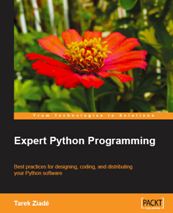
The book Expert Python Programming comes with subtitle Best practices for designing, coding, and distributing your Python software. Well this seems to be quite broad area to be covered by a single book, but the book really tries to cover all topics at least in some form of overview and pointing user to other documentation sources. Expert Python Programming In first chapter you can find information about installing Python on various platforms. As the book seems to be targeted to more experienced users, this chapter seems to be a bit useless, but author decided to give a chance also to users, who do not know the basics. Next chapters describe best practices for writing Python code, which was the most interesting part for me. I use Python several years, but I never really found time time to properly look at using decorators, generators and other "recently" introduced language features. Second chapter nicely covers these and I really appreciated that I got idea for what decorators can be used. Third chapter into class level and describes how to use metaclasses, attributes, constructors and other things you can face on class level. Fourth moves the topic to even more abstract way and in short summarises PEP 8 best coding practices. Here we leave solid ground of writing code and we move to more abstract areas of managing projects, testing, documenting and distributing software. It begins with description of distutils and setuptools in chapters five and six, where you will find basic information about distributing your software. Seventh chapter covers zc.buildout, which can help you with setting up and deploying applications in way Zope and Plone do. Next chapter is not really related to Python, it just describes advantages of version control. The most Python related part is using Mercurial VCS, which is written in Python, but you can of course use it for managing any project. Next tree chapters are devoted to project development in general, describing management of the project, generating documentation for project using Sphinx (what actually made me into starting documentation for python-gammu in it) and test-driven development practices. Now comes again two more interesting chapters describing optimization of Python code, giving the best advice not to optimize unless you are sure it is needed ;-). But it also goes more deeper and describes benchmarking procedures, how to debug memory usage and some basic tips for general things which might improve performance. Last chapter is some kind of extra in the book and to me it looks it was added just to use buzzwords design patters, but well it is there and it covers few design patterns which might be useful in Python like singleton or more advanced version of it called borg. In general this book covers quite wide range of topics, what can be seen as biggest advantage and disadvantage. You will get basic overview of creating Python project using modern methods (test driven development, design patters, best practices for Python code), but you can not expect it will go into much deep details. The book can extend your knowledge of development in Python, but you should carefully check examples with errata, because otherwise several of them will fail. I'm not that good at spotting problems in written English (as you can probably see in this post), but I spotted several errors in code and I think more careful editor work on the book would improve my feelings a bit. Also I personally would prefer much deeper look into some topics and skipping the others, but one book can not fit all ;-).

Theodore Ts'o: Don t fear the fsync!

After reading the comments on my earlier post, Delayed allocation and the zero-length file problem as well as some of the comments on the Slashdot story as well as the Ubuntu bug, it s become very clear to me that there are a lot of myths and misplaced concerns about fsync() and how best to use it. I thought it would be appropriate to correct as many of these misunderstandings about fsync() in one comprehensive blog posting. As the Eat My Data presentation points out very clearly, the only safe way according that POSIX allows for requesting data written to a particular file descriptor be safely stored on stable storage is via the fsync() call. Linux s close(2) man page makes this point very clearly:
A successful close does not guarantee that the data has been successfully saved to disk, as the kernel defers writes. It is not common for a file system to flush the buffers when the stream is closed. If you need to be sure that the data is physically stored use fsync(2).
Why don t application programmers follow these sage words? These three reasons are most often given as excuses:
  1. (Perceived) performance problems with fsync()
  2. The application only needs atomicity, but not durability
  3. The fsync() causing the hard drive to spin up unnecessarily in laptop_mode
Let s examine each of these excuses one at a time, to see how valid they really are. (Perceived) performance problems with fsync() Most of the bad publicity with fsync() originated with the now infamous problem with Firefox 3.0 that showed up about a year ago in May, 2008. What happened with Firefox 3.0 was that the primary user interface thread called the sqllite library each time the user clicked on a link to go to a new page. The sqllite library called fsync(), which in ext3 s data=ordered mode, caused a large, visible latency which was visible to the user if there was a large file copy happening by another process. Nearly all of the reported delays was a few seconds, which would be expected; normally there isn t that much dirty data that needs to be flushed out on a Linux system, even if it is even very busy. For example, consier the example of a laptop downloading an .iso image from a local file server; if the laptop has the exclusive link of a 100 megabit/second ethernet link, and the server has the .iso file in cache, or has a nice fast RAID array so it is not the bottleneck, then in the best case, the laptop will be able to download data at the rate of 10-12 MB/second. Assuming the default 5 second commit interval, that means that in the worst case, there will be at most 60 megabytes which must be written out before the commit can proceed. A reasonably modern 7200 rpm laptop drive can write between 60 and 70 MB/second. (The Seagate Momentus 7200.4 laptop drive is reported to be able to deliver 85-104 MB/second, but I can t find it for sale anywhere for love or money.) In this example, an fsync() will trigger a commit and might need to take a second while the download is going on; perhaps half a second if you have a really fast 7200 rpm drive, and maybe 2-3 seconds if you have a slow 5400 rpm drive. (Jump to Sidebar: What about those 30 second fsync reports?) Obviously, you can create workloads that aren t bottlenecked on the maximum ethernet download speed, or the speed of reading from a local disk drive; for example, dd if=/dev/zero of=big-zero-file will create a very large number of dirty pages that must be written to the hard drive at the next commit or fsync() call. It s important to remember though, fsync() doesn t create any extra I/O (although it may remove some optimization opportunities to avoid double writes); fsync() just pushes around when the I/O gets done, and whether it gets done synchronously or asynchronously. If you create a large number of pages that need to be flushed to disk, sooner or later it will have a significant and unfortunate effect on your system s performance. Fsync() might make things more visible, but if the fsync() is done off the main UI thread, the fact that fsync() triggers a commit won t actually disturb other processes doing normal I/O; in ext3 and ext4, we start a new transaction to take care of new file system operations while the committing transction completes. The final observation I ll make is that part of the problem is that Firefox as an application wants to make a huge number of updates to state files and was concerned about not losing that information even in the face of a crash. Every application writer should be asking themselves whether this sort of thing is really necessary. For example, doing some quick measurements using ext4, I determined that Firefox was responsible for 2.54 megabytes written to the disk for each web page visited by the user (and this doesn t include writes to the Firefox cache; I symlinked the cache directory to a tmpfs directory mounted on /tmp to reduce the write load to my SSD). So these 2.54 megabytes is just for Firefox s cookie cache and Places database to maintain its Awesome bar . Is that really worth it? If you visit 400 web pages in a day, that s 1GB of writes to your SSD, and if you write more than 20GB/day, the Intel SSD will enable its write endurance management feature which slows down the performance of the drive. In light of that, exactly how important is it to update those darned sqllite databases after every web click? What if Firefox saved a list of URL s that has been visited, and only updated every 30 or 60 minutes, instead? Is it really that every last web page that you browse be saved if the system crashes? An fsync() call every 15, 30, or 60 minutes, done by a thread which doesn t block the application s UI, would have never been noticed and would have not started the firestorm on Firefox s bugzilla #421482. Very often, after a little thinking, a small change in the application is all that s necessary for to really optimize the application s fsync() usage. (Skip over the sidebar if you ve already read it). Sidebar: What about those 30 second fsync reports? If you read through the Firefox s bugzilla entry, you ll find reports of fsync delays of 30 seconds or more. That tale has grown in the retelling, and I ve seen some hyperbolic claims of five minute delays. Where did that come from? Well, if you look that those claims, you ll find they were using a very read-heavy workload, and/or they were using the ionice command to set a real-time I/O priority. For example, something like ionice -c 1 -n 0 tar cvf /dev/null big-directory . This will cause some significant delays, first of all because ionice -c 1 causes the process to have a real-time I/O priority, such that any I/O requests issued by that process will be serviced before all others. Secondly, even without the real-time I/O priority, the I/O scheduler naturally prioritizes reads as higher priority than writes because normally processes are waiting for reads to complete, but writes are normally asynchronous. This is not at all realistic workload, and it is even more laughable that some people thought this might be an accurate representation of the I/O workload of a kernel compile. These folks had never tried the experiment, or measured how much I/O goes on during a kernel compile. If you try it, you ll find that a kernel compile sucks up a lot of CPU, and doesn t actually do that much I/O. (In fact, that s why an SSD only speeds up a kernel compile by about 20% or so, and that s in a completely cold cache case. If the commonly used include files are already in the system s page cache, the performance improvement of the SSD is much less.) Jump back to reading Performance problems with fsync. The atomicity not durability argument One argument that has commonly been made on the various comment streams is that when replacing a file by writing a new file and the renaming file.new to file , most applications don t need a guarantee that new contents of the file are committed to stable store at a certain point in time; only that either the new or the old contents of the file will be present on the disk. So the argument is essentially that the sequence: is too expensive, since it provides atomicity and durability , when in fact all the application needed was atomicity (i.e., either the new or the old contents of foo should be present after a crash), but not durability (i.e., the application doesn t need to need the new version of foo now, but rather at some intermediate time in the future when it s convenient for the OS). This argument is flawed for two reasons. First of all, the squence above exactly provides desired atomicity without durability . It doesn t guarantee which version of the file will appear in the event of an unexpected crash; if the application needs a guarantee that the new version of the file will be present after a crash, it s necessary to fsync the containing directory. Secondly, as we discussed above, fsync() really isn t that expensive, even in the case of ext3 and data=ordered; remember, fsync() doesn t create extra I/O s, although it may introduce latency as the application waits for some of the pending I/O s to complete. If the application doesn t care about exactly when the new contents of the file will be committed to stable store, the simplest thing to do is to execute the above sequence (open-write-fsync-close-rename) in a separate, asynchronous thread. And if the complaint is that this is too complicated, it s not hard to put this in a library. For example, there is currently discussion on the gtk-devel-list on adding the fsync() call to g_file_set_contents(). Maybe if someone asks nicely, the glib developers will add an asynchronous version of this function which runs g_file_set_contents() in a separate thread. Voila! Avoiding hard drive spin-ups with laptop_mode Finally, as Nathaniel Smith said in Comment #111 of of my previous post:
The problem is that I don t, really, want to turn off fsync s, because I like my data. What I want to do is to spin up the drive as little as possible while maintaining data consistency. Really what I want is a knob that says I m willing to lose up to minutes of work, but no more . We even have that knob (laptop mode and all that), but it only works in simple cases.
This is a reasonable concern, and the way to fix this is to enhance laptop_mode in the Linux kernel. Bart Samwel, the author and maintainer of laptop_mode, actually discussed this idea with me last month at FOSDEM. Laptop_mode already adjusts /proc/sys/vm/dirty_expire_centisecs and /proc/sys/vm/dirty_writeback_centisecs based on the configuration parameter MAX_LOST_WORK_SECONDS, and it also adjusts the file system commit time (for ext3; it needs to be taught to do the same thing for ext4, which is a simple patch) to MAX_LOST_WORK_SECONDS as well. All that is necessary is a kernel patch to allow laptop_mode to disable fsync() calls, since the kernel knows that it is in laptop_mode, and it notices that the disk has spun up, it will sync out everything to disk, since once the energy has been spent to spin up the hard drive, we might as well write everything in memory that needs to be written out right away. Hence, a patch which allows fsync() calls to be disabled while in laptop_mode should do pretty much everything Nate has asked. I need to check to see if laptop_mode does this already, but if it doesn t force a file system commit when it detects that the hard drive has been spun up, it should obviously do this as well. (In addition to having a way to globally disable fsync() s, it may also be useful to have a way to selectively disable fsync() s on a per-process basis, or on the flip side, exempt some process from a global fsync-disable flag. This may be useful if there are some system daemons that really do want to wake up the hard drive and once the hard drive is spinning, naturally everything else that needs to pushed out to stable store should be immediately written.) With this relatively minor change to the kernel s support of laptop_mode, it should be possible to achieve the result that Nate desires, without needing force applications to worry about this issue; applications should be able to just simply use fsync() without fear. Summary As we ve seen, the reasons most people think fsync() should be avoided really don t hold water. The fsync() call really is your friend, and it s really not the villain that some have made it out to be. If used intelligently, it can provide your application with a portable way of assuring that your data has been safely written to stable store, without causing a user-visible latency in your application. The problem is getting people to not fear fsync(), understand fsync(), and then learning the techniques to use fsync() optimally. So just as there has been a Don t fear the penguin campaign, maybe we also need to have a Don t fear the fsync() campaign. All we need is a friendly mascot and logo for a Don t fear the fsync() campaign. Anybody want to propose an image? We can make some T-shirts, mugs, bumper stickers Related posts (automatically generated):
  1. Delayed allocation and the zero-length file problem A recent Ubuntu bug has gotten slashdotted, and has started...

15 March 2009

Kapil Paranjape: Slumdog millionaire

We managed to watch the multi-award winning "Slumdog Millionaire" this weekend. It is difficult for me to understand why people (in India or PIO's) are so upset about the movie. It is a good movie (I do not know enough about cinema to pronounce it a great movie). As a Rahman fan since "Kadal Desam" (1993 or so), my opinion on the music is a bit biased. His work on this movie is more than competent though not his best. A. R. Rahman has written better songs than "Jai Ho!" and I didn't notice anything spectacular about the rest of the music. Still, it is worth noting that his best work is in the context of Indian-style films, where there are a lot of songs; the background score of those films only stands out if it is bad! So, I suppose that the criticism of this movie by Indians is largely based on its story-line and setting. This is strange, since poverty in a Mumbai slum (to the extent that I am acquainted with it) is depicted quite accurately here. The plot (like any Dickensian story) drives home the terrible nature of poverty in cities but still manages to inject a note of optimism.
If you are lucky/strong enough to survive with your humanity intact after growing up in a Mumbai slum, then the luck required to win a TV show is nothing in comparison.

12 March 2009

Ian Wienand: Relocation truncated to fit - WTF?

If you code for long enough on x86-64, you'll eventually hit an error such as:
(.text+0x3): relocation truncated to fit: R_X86_64_32S against symbol  array' defined in foo section in ./pcrel8.o
Here's a little example that might help you figure out what you've done wrong. Consider the following code:
$ cat foo.s
.globl foovar
  .section   foo, "aw",@progbits
  .type foovar, @object
  .size foovar, 4
foovar:
   .long 0
.text
.globl _start
 .type function, @function
_start:
  movq $foovar, %rax
In case it's not clear, that would look something like:
int foovar = 0;
void function(void)  
  int *bar = &foovar;
 
Let's build that code, and see what it looks like
$ gcc -c foo.s
$ objdump --disassemble-all ./foo.o
./foo.o:     file format elf64-x86-64
Disassembly of section .text:
0000000000000000 <_start>:
   0:		 48 c7 c0 00 00 00 00	mov    $0x0,%rax
Disassembly of section foo:
0000000000000000 <foovar>:
   0:		 00 00			add    %al,(%rax)
   ...
We can see that the mov instruction has only allocated 4 bytes (00 00 00 00) for the linker to put in the address of foovar. If we check the relocations:
$ readelf --relocs ./foo.o
Relocation section '.rela.text' at offset 0x3a0 contains 1 entries:
  Offset          Info           Type           Sym. Value    Sym. Name + Addend
000000000003  00050000000b R_X86_64_32S      0000000000000000 foovar + 0
The R_X86_64_32S relocation is indeed only a 32-bit relocation. Now we can tickle this error. Consider the following linker script, which puts the foo section about 5 gigabytes away from the code.
$ cat test.lds
SECTIONS
 
 . = 10000;
 .text :   *(.text)  
 . = 5368709120;
 .data :   *(.foo)  
 
This now means that we can not fit the address of foovar inside the space allocated by the relocation. When we try it:
$ ld -Ttest.lds ./foo.o
./foo.o: In function  _start':
(.text+0x3): relocation truncated to fit: R_X86_64_32S against symbol  foovar' defined in foo section in ./foo.o
What this means is that the full 64-bit address of foovar, which now lives somewhere above 5 gigabytes, can't be represented within the 32-bit space allocated for it. For code optimisation purposes, the default immediate size to the mov instructions is a 32-bit value. This makes sense because, for the most part, programs can happily live within a 32-bit address space, and people don't do things like keep their data so far away from their code it requires more than a 32-bit address to represent it. Defaulting to using 32-bit immediates therefore cuts the code size considerably, because you don't have to make room for a possible 64-bit immediate for every mov. So, if you want to really move a full 64-bit immediate into a register, you want the movabs instruction. Try it out with the code above - with movabs you should get a R_X86_64_64 relocation and 64-bits worth of room to patch up the address, too. If you're seeing this and you're not hand-coding, you probably want to check out the -mmodel argument to gcc.

Next.

Previous.