Search Results: "mt"

17 July 2007

Marc 'Zugschlus' Haber: From the personal Inbox of the exim4 maintainer

The DDs reading this might know the situation: You are subscribed to a gazillion of mailing lists, and spend quite some time answering questions of people using your packages. That’s fine, service to your users. Occasionally, users take great pains in finding out a personal mail address (for example, by googling, and finding the webmasteridiot mail address on my personal web page) to ask their question in private e-mail. This prevents the answers from showing up in mail archives and deprives the public of a possibility to find a solution to this question themselves in the future. Today, I had this happen to me twice. In the morning, I received a question about exim4 in private e-mail. In German. I investigated the user’s problem (which looked interesting enough), found two minor issues in the Debian exim4 packages and upstream exim behaving not as expected. I fixed the two issues in the package and reported the unexpected behavior of exim to the upstream mailing list. I then reported this - in German - back to the person who asked the question. Time from incoming message to outgoing report was like 80 minutes, most of which I spent with this user’s issue. On my personal time. A short while afterwards, I found out that this person has waited a mere eleven minutes before asking the same question on pkg-exim4-users, this time in English. Had I known before, I would have drafted my answer in English as well, to have the answer publicly visible. By doing this double post, the user has deprived the public of my answer. I’m probably going to stop answering questions asked in private mail. I might draft a boilerplate answer along the lines of “I don’t answer questions asked in private mail unless I am being paid to do so. You might be better off by asking one of the numerous mailing lists that are available on the Internet. I read a lot of them, might see your question, and you might get an answer from me. But otoh, there are many more knowledgeable people on these lists, and you’d want them to see your question as well.” Or I just might hit Delete on questions in my private inbox. The “Delete” approach has become more attractive this afternoon after I pulled the following (anonymized) from my personal Inbox:
Great job breaking exim4 on my system with no easy way to fix it.
$ /etc/init.d/exim4 start
Starting MTA:DEBCONFsomethingDEBCONF found in exim configuration. This
is most probably
caused by you upgrading to exim4 4.67-3 or later without accepting the
suggested conffile changes. Please read
/usr/share/doc/exim4-config/NEWS.Debian.gz for 4.67-2 and 4.67-4
2007-07-17 11:31:57 Exim configuration error in line 25 of
/var/lib/exim4/config.autogenerated.tmp:
  malformed macro definition
Invalid new configfile /var/lib/exim4/config.autogenerated.tmp, not
installing
/var/lib/exim4/config.autogenerated.tmp to
/var/lib/exim4/config.autogenerated
I’ve been running exim4 v4.63 for awhile now and only have you bugger
exim4-config it doesn’t work.
I mean, this user has Sorry, but: How stupid can people be? I think I’m going to stop being responsive to users. They’re not worth the blood pressure.

15 July 2007

Russell Coker: Desktop Machines and ECC RAM

In a comment on my post about memory errors Chris Samuel referred me to an interesting post on the Beowulf mailing list about memory errors. In that list posting Joe Landman says “it is pretty easy to deduce which chip is problematic (assuming it is ram) based upon the address” and then describes how to use Machine Check Exception (MCE) data from an error detected/corrected by the ECC system. Damn the vendors of motherboards for switching to 8-bit RAM just when it was about to be useful to have 9-bit RAM! 286 class machines had 9 bits of RAM per byte with one bit used for parity. Parity errors were extremely rare, largely due to the fact that memory errors could affect more than one bit at a time and therefore would often give a correct parity - if multiple bit errors were totally random then parity might be expected to pass 50% of the time! The Pentium was the first commonly used CPU to operate with a 64bit memory bus. If it had 9 bits per byte it would have had 72 bit wide memory buses - a Hamming Code could use this to detect and correct single-bit errors, detect all double-bit errors, and detect some errors involving more bits. This would mean that some errors would be recoverable and would display the location of the memory problem instead of being fatal and giving no information. Now it’s become a standard feature in servers to have ECC memory (at significantly greater cost) and most desktop machines don’t have ECC support - I wonder whether this is aimed at price-gouging people who need reliable servers (they can’t use cheap RAM from desktop machines). Unfortunately due to issues of electricity use, noise, and price I have to run all the servers that are most important to me on desktop PC hardware. Is anyone selling ECC RAM in desktop systems? I am particularly interested in machines that are a couple of years old so I can get them cheap at auction…

14 July 2007

Russell Coker: Memory Errors and Memtest86+

Early this year I deployed a server. As part of my normal procedure I ran the Memtest86+ memory test program (which showed no errors) before deploying it. After some time running the machine started to become unreliable, yesterday it crashed twice and I had to replace it. I ran Memtest86+ before removing it from where it was installed and found several memory errors. When a server crashes I highly recommend running Memtest86+ before removing it so that you at least know the cause of the problems. As I want to use the machine elsewhere I want to discover the cause of the problem. The machine has two DIMM sockets (I’ll call them A and B) and two DIMM modules (again I’ll call them A and B). After getting the machine home I first tested the machine with DIMM A in socket A (and DIMM B removed) which passed, then I tested it with DIMM A in socket B which also passed. I removed DIMM A and tested DIMM B in each socket and those tests passed. Then I installed both DIMMs and again the test passed! I now realise that I made a mistake in removing a DIMM when I got the machine home. I should have tested it again with the DIMMs in place. If the problem was due to heat or a poor contact made worse by vibration then the problem might have gone away during the trip home - it would have been handy to know that I would be unable to reproduce the problem! My mistake here was to change multiple factors at the same time. When diagnosing faults you should try to change one thing at a time so that you will know what fixes it! Now, I am wondering what I should do next? Assume that it was just a bad contact and put the machine back in service? Suggestions appreciated.

13 July 2007

Scott James Remnant: Mail Strike

Like most geeks, I run my own mail server. The burden of administering it is much less than the increased flexibility in filtering incoming mail, let alone dealing with SPAM. My mail server configuration has remained pretty static the entire time, and controversially, I’ve always used qmail. The reason for this dates back to my first sysadmin job in the mid-to-late nineties, and the decision in those days did tend to be sendmail or qmail; with the security conscious choosing the latter. qmail’s delivery system is a little odd, everything on the left hand side up to the first “-” is considered a user, and everything after can be used for filtering. The default local delivery component takes this into account, so e-mail to scott-foo can be filtered by the /home/scott/.qmail-foo file. This gives a pretty natural way to deal with mailing lists; you subscribe with a unique address for that list, and all the mail goes into the right folder automatically. This has served me reasonably well over the years, with heavy patching across the daemon to add features such as LDAP integration, and SPAM filtering that I wanted. Unfortunately it’s been getting to burdensome to maintain. Since it’s not true open source software, and is effectively abandoned upstream, it’s not as up to date as I’d like. SPAM filtering tends to take place in the local delivery loop, rather than at SMTP time; and due to the strange delivery system, it’s unreasonably hard to perform any kind of sender verification or greylisting. Since every special address is filtered differently, it’s quite hard to add common filtering unless it’s pre-planned and you use addresses with a common prefix. The clincher has been dealing with super-sites like Launchpad which send huge amounts of different e-mails to a single address, and no facility to separate that from your published contact address. I needed a better mail server. So I’ve now moved to exim. I was surprised by how quickly I was able to pick it up, I did the migration in two day outages. The first to simply migrate delivery and stash the mail in one big folder, and the second to customise the delivery and filtering to my liking. I’ve also re-subscribed to mailing lists with single addresses again, so now I have a single filter rule which happily can filter Launchpad mails around as well. Happily I’ve been able to make a change I’ve wanted to for a while, home and work e-mail is separated into different Maildir/ trees; and mailing list subscriptions made with the most appropriate address. The magic of dovecot lets me create a fake scott+canonical user that uses the alternate Maildir tree, while still retaining my user permissions, etc. Overall I’m pleased with the new setup, and how the migration went. SpamAssassin needs some tuning as a little SPAM is still getting through, but otherwise it seems to be working well.

MJ Ray: Putting the Tour de France commentary on your root window

#!/bin/bash
# keeps updating le tour on the top left of the root window
# Depends: bash, netpbm
while true ; do
  xsetroot -bitmap <(
    curl -s 'http://live.cyclingnews.com/?id=latest' \
      sed -e 's/<br[^>]*>/\n/g;s/<[^>]*>//g;s/&nbsp;/ /g;s/ *$//;1,/Tour de France/d;/\(rovisional\ start.*prev\)/,$d' \
      cat -s   fmt \
      pbmtext -builtin fixed   pnminvert \
      pnmflip -tb   pnmcut -h 620 -pad   pnmflip -tb \
      pnmpad -black -w 1024 -h 768 -b 620 -l 0 \
      pbmtoxbm )
  sleep 300
done

Eddy Petri&#537;or: glest: a free 3D real time strategy game

After almost a year of working on and off on the package, glest is now in the new queue.

Glest is really a free 3D real time strategy game with amazing graphics and really interesting game play.

So maybe you're wondering why did it took me so long to package it. Well, glest is mainly developed on a Windows platform and GNU/Linux is the platform it was later ported to. So this came with some problems:
Since when I started the packaging work I was using a PowerBook G4 as my main machine I was upset that the game was little endian only, so I started working on a patch. I made an incomplete patch but I got stuck at some point. Time passed by and I replaced my laptop and I wasn't able to continue working on the patch. So I kind of forgot about it. Before debconf I decided is time to do the upload for little endian machines, add the endianess patch disabled.

During debconf I asked Tolimar to make an upload, and it turns out that for some reason I still don't know, the build resulted in a statically linked binary. I was amazed since I didn't recall doing any changes that might have triggered this. At some point I suspected that the build system is broken on other arches than i386 (my main machine is amd64) and halted. This until a few days ago Joey Hess added a comment in the ITP bug pointing out that the game is ok. After a couple of emails I realized that the static issue was just some strange temporary issue on my machine and now the package is in NEW.

So, that's my excuse. I hope that upstream glest issue get fixed. If not, I'll probably package glevolution, too.

3 July 2007

John Goerzen: Sierra Wireless 595U / Sprint on Linux

Here's how you use a Sierra Wireless 595U USB modem to connect to wireless Internet service with Sprint:

Insert the modem into the USB slot. lsusb should show:

Bus 001 Device 005: ID 1199:0120 Sierra Wireless, Inc.

rmmod usbserial

Then:

modprobe usbserial vendor=0x1199 product=0x0120

You should see /dev/ttyUSB0, ttyUSB1, and ttyUSB2 appear. See also instructions for automating this with a similar card (modify vendor and product to above settings).

Now you will need to configure PPP for this. On Debian, run pppconfig. Your settings will be:

Phone number: #777
Username: 1234567890@sprintpcs.com (replace 1234567890 with your data card's "phone number", no dashes)
Password: your sprint password
Speed (BPS): 921600 (use lower numbers such as 115200 if you have trouble with this)
Port: /dev/ttyUSB0
Init string: ATZ

Here are some other helpful pages:

Verizon EVDO
Sprint and Linux
Cingular AT&T UMTS
Sierra's Linux page

30 June 2007

Dirk Eddelbuettel: Improving simple charts

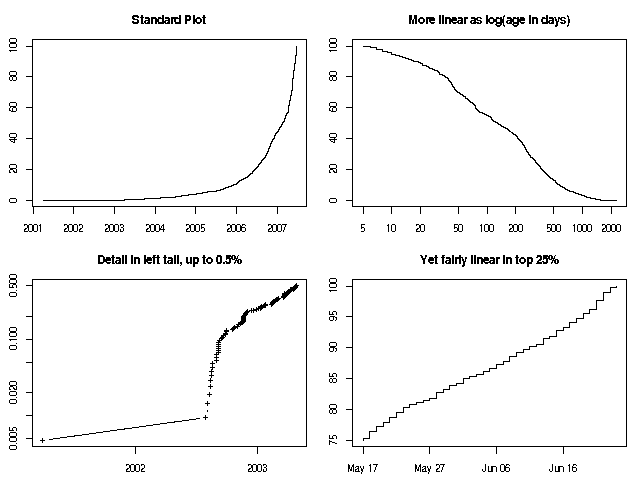
Earlier today and via Planet Debian, Lucas blogged about the 'age distribution' of Debian packages, defined as the time since the last (re-)compilation. He illustrated his findings with an, umm, rather ugly chart. Having climbed onto the soap box once before, I would like to point out how easy it can be to create simple, informative, and, at to least to me, prettier charts using R. Lucas included a URL to the data. The first nice thing to note that we can read the data directly from the URL -- no need to copy the file:
pkgAge <- read.table(file="http://people.debian.org/~lucas/arch-age/arch-age.log", col.names=c("pkg","yyyymmdd"))
read the data into a data.frame which we have given two column names.
pkgAge[,"date"] <- as.Date(as.character(pkgAge[,"yyyymmdd"]), "%Y%m%d")
pkgAge[,"age"] <- as.numeric(difftime(Sys.Date(), pkgAge[,"date"], units="day"))
pkgAge[,"prop"] <- (1:nrow(pkgAge)) / nrow(pkgAge) * 100
We then create three new columns. First is a date, by parsing the (integer) dates (after first casting them into characters) by supplying the format in standard C notation: "%Y%m%d" for year, date and month without any separators or formatters. Now, having the date as an actual date object inside a real data analysis language we can do things as e.g. computing date differences. The difftime function does just that, using the current date as other point. We ask for the return to be in days, and cast this down to a purely numeric vector (instead of datediff object). Lastly, we quickly compute the date proportion in percentages. We can then view the date. Before we plot,
png("packageAges.png", quality=100, width=640, height=480, pointsize=10)
oldpar <- par(mfrow=c(2,2), mar=c(2.5,2.5,3,1))
we direct the charts to a png file of given dimensions, and ask for all plots in one figure (using mfrow with two rows by two) with somewhat smaller figure margins using the mar argument to par. The first chart shows again proportion over date:
with(pkgAge, plot(date, prop, type='l', main="Standard Plot"))
(The with() function simply allows us to refer to the columns by their names without explicit subsetting. plot(pkgAge[,"date",], pkgAge[,"prop"]) is equivalent, but more cumbersome.) As it clear that the data has a fairly long tail in the older dates, we can also try to plot the plot over logarithmic time differences. This doesn't work for dates, but it works for our (positive-valued) age variable:
with(pkgAge, plot(age, prop, type='l', log="x", main="More linear as log(age in days)"))
The very far left tail below 0.5 percent is interesting as the one very old package is clearly an outlier within an outlier region. We use the subset function to take just one portion of the data, use logs, and explicit plotting symbols '+' in a points-and-lines plot:
with(subset(pkgAge, prop0.5), plot(date, prop, type='b', log="y", pch="+", main="Detail in left tail, up to 0.5%"))
Lastly, the upper quartile is fairly linear.
with(subset(pkgAge, prop>75), plot(date, prop, type='l', pch=".", main="Yet fairly linear in top 25%"))
At the end
oldpar <- par(mfrow=c(2,3))
dev.off()
we restore the graphics paramters and close the device (here the file). All this then yields the following chart: Debian Package Age-since-recompile Distributions Updated to correctly display the assignment operator <-

28 June 2007

Jan Wagner: performancing.com and privacy

Today I was crawling through my mail logs for various reasons.
I was really surprised, that I saw a mail to a dedicated mailaddress which I’m using for communication with performancing.com. I was short checking, if this mailaddress is anywhere published at performancing.com, but couldn’t find anything. A one liner over the last week of mail logs:

# zgrep performancing /var/log/mail.info* grep clam wc -l
26 For a address only used for communicating with one organisation (used as contact mail address) this seems a bit too much traffic and this are only the mails, which was accepted by the MTA. So the questions comes to my mind …. what happens with the addresses at performancing.com? Maybe I missed something? , ,

27 June 2007

Jacobo Tarr&#237;o Barreiro: All Mexico All

For several days now, I have been seeing messages like this in my logcheck output:
Jun 27 19:24:07 maestro postfix/smtpd[14339]: warning: malformed domain name in resource data of MX record for neolookups.com: *.mx.*
Obviously, the MX entry for the domain neolookups.com (and all its subdomains, apparently) is 0 *.mx.* . It turns out that you cannot search for *.mx.* on Google, so I ask you, dear Lazyweb, is this one of the latest tricks spammers use to try and thwart antispam countermeasures?

20 June 2007

Isaac Clerencia: QtScript ing In Your Face

I’m currently developing In Your Face, a free software 3d basketball game. I have reached the moment to create an scripting interface to be able to script cool AI’s. After having a look at LuaBind and Boost::Python I’ve decided to go with QtScript. I’m quite happy with it, but I’m facing an issue that I’m having problems to figure out. I’ll probably send it to Qt Interest, but I’ll try to explain it here too to see if I get an answer. I have a whole hierarchy of classes that I want to export. The base class is Action::Base, and there are plenty of other actions, like Action::MoveTo or Action::Shoot. I’m (almost) already able to do stuff like this from JavaScript:
function enter()
  var teamPlay = new TeamPlay();
  var al = new ActionList();
  var mta = new MoveToAction(0,10);
  al.append(mta);
  teamPlay.insert(0,al);
  state.setTeamPlay(teamPlay);
  state.setChanged();
Everything works fine except the “append” call. “append” takes a pointer to the abstract class Action::Base. If I invoke it with a MoveToAction object, I get an “incompatible types” error. I have tried adding a toAction() method to MoveToAction which returned a QScriptValue-wrapped Action::Base *, but I’m still getting the same error. Anyone has a QtScript example where something like this is done?

13 June 2007

Eddy Petri&#537;or: Whacky ideas, my addition...

PriorityIncreaseIfBinariesFromTheSameSource:

It would be really useful if a -dev package's priority would inflate proportionally with every binary package originating from the same source as the dev package.

This way I would never see this[1]:

# LANG=C apt-get install libxmu-dev libagg-dev libgstreamer0.10-dev libgtkglext1-dev libmad0-dev libxul-dev libdirectfb-dev libkonq4-dev libcurl3-gnutls-dev libcaca-dev libboost-date-time-dev libavcodec-dev libavformat-dev libming-dev
Reading package lists... Done
Building dependency tree... Done
The following extra packages will be installed:
kdelibs4-dev liba52-0.7.4-dev libacl1-dev libarts1-dev libartsc0-dev libasound2-dev libaspell-dev libattr1-dev
libaudio-dev libavahi-qt3-dev libcucul-dev libcupsys2-dev libdc1394-13-dev libdts-dev libfam-dev libfam0
libgl1-mesa-dev libglu1-mesa-dev libgsm1-dev libgtkglext1 libidn11-dev libjack0.100.0-dev libjasper-1.701-dev
liblcms1-dev liblua50-dev liblualib50-dev libmng-dev libmozjs-dev libmpeg3-dev libnspr4-dev libnss3-dev libogg-dev
libopenexr-dev libqt3-headers libqt3-mt-dev libraw1394-dev libsasl2-dev libslang2-dev libtheora-dev libtiff4-dev
libvorbis-dev libxslt1-dev libxt-dev mesa-common-dev qt3-dev-tools xlibmesa-gl-dev
Suggested packages:
libasound2-doc aspell-doc libqt3-i18n qt3-doc libraw1394-doc
Recommended packages:
fam gstreamer0.10-doc libqt3-compat-headers
The following packages will be REMOVED:
gamin libgamin0
The following NEW packages will be installed:
kdelibs4-dev liba52-0.7.4-dev libacl1-dev libagg-dev libarts1-dev libartsc0-dev libasound2-dev libaspell-dev
libattr1-dev libaudio-dev libavahi-qt3-dev libavcodec-dev libavformat-dev libboost-date-time-dev libcaca-dev
libcucul-dev libcupsys2-dev libcurl3-gnutls-dev libdc1394-13-dev libdirectfb-dev libdts-dev libfam-dev libfam0
libgl1-mesa-dev libglu1-mesa-dev libgsm1-dev libgstreamer0.10-dev libgtkglext1 libgtkglext1-dev libidn11-dev
libjack0.100.0-dev libjasper-1.701-dev libkonq4-dev liblcms1-dev liblua50-dev liblualib50-dev libmad0-dev libming-dev
libmng-dev libmozjs-dev libmpeg3-dev libnspr4-dev libnss3-dev libogg-dev libopenexr-dev libqt3-headers libqt3-mt-dev
libraw1394-dev libsasl2-dev libslang2-dev libtheora-dev libtiff4-dev libvorbis-dev libxmu-dev libxslt1-dev libxt-dev
libxul-dev mesa-common-dev qt3-dev-tools xlibmesa-gl-dev
0 upgraded, 60 newly installed, 2 to remove and 0 not upgraded.
Need to get 21.6MB/22.2MB of archives.
After unpacking 108MB of additional disk space will be used.
Do you want to continue [Y/n]?


[1] these are gnash's build deps, in case you're wondering

11 June 2007

Joachim Breitner: Visualizer for Anagrams

For my uncles wedding my brothers and I did a show where we took his name and use its letters to create a bunch of new words that are part of a speech about him. This was visualized on a projector by a program by me that let s the letter swirl around, forming each built word, as well as some special effects (such as rotating one letter around to show another).The program is written in Haskell, using gtk2hs and Cairo. You can find the sources in my darcs repository (Browse via DarcsWeb). To build it on a debian machine, this should work:
apt-get install darcs gtk2hs libghc6-cairo-dev libghc6-gtk-dev libghc6-mtl-dev happy
darcs get http://darcs.nomeata.de/anapres
make
./anapres examples/RolandHochzeit.anapres
I can also provide pre-compiled binaries, if you want.There is a very simple text file format that describes the sequence of words and special effects, but so far it is only tested with the one example file (the one from the wedding).If you want to try this and have any kind of trouble, do not hesitate to contact me. I m also interested in bug reports and patches, of course.

9 June 2007

Matthew Palmer: Project Honeypot: The Joining

After asking last week if anyone had any experience with Project Honeypot, I got one response, from Chris Samuel, who was pretty positive about the whole thing:
I'm one of the people contributing, from the stats on my site it appears I've contributed to the identification of 6 harvesters and a comment spammer. I'm only running it on one site at the moment, but it seems to be a useful service and once it's up and running it seems fairly inconspicuous.
I decided to give it a go myself, and signed up. It's pretty nifty the way it all works. You can do a number of different things to be part of the project, from linking to other people's honeypots (through the trivial act of adding some HTML to your web pages), or you can setup a honeypot of your own (which is done in an ingenious manner, and just requires you to be able to run one of a bunch of different forms of dynamic script -- about ten minutes work, tops). You can also contribute a domain (or subdomain) which the project will use as a spamtrap domain -- all you have to do there is add an MX record. The use of lots of different domains makes it harder for spammers to filter known spamtrap domains out of their lists. In exchange you get good karma from helping to identify network abusers, and you can monitor chunks of IP space (such as space that your company sub-leases to others, for example) for evidence of abuse, or use the collected data to block abusers from your own web servers through the project's http:BL service. The http:BL, for me, is probably the most valuable "payback". It lists IP addresses that have been used recently by comment spammers, address harvesters, and other abusers of HTTP resources. It's not a list of spam sources, though -- there's no shortage of DNSBLs for that. The project has an Apache module that can query the list and re-route or block requests from those IP addresses, and there's also a Wordpress plugin that queries the list (not that I use Wordpress, but it's an example of what can be done). Unlike Chris, I haven't helped to identify any bad activity yet, but there's been some activity on my honeypot, so I'm hoping that I'll catch someone soon. I think it's worth getting involved and contributing what you can -- there's very little cost involved (I got all my resources setup inside of an hour, and I haven't noticed any increased load on my server or bandwidth), and everyone wants to stop Internet abuse. So please, take a look at the project and consider joining.

8 June 2007

Evan Prodromou: 19 Prairial CCXV

It's been a topsy-turvy week, but I'm finally getting my head above water again here at our new home. A lot has happened, which I'll try to capture here, but I'm not sure I can get it all. On Tuesday, Maj, Amita June and I spent the morning in Central Park in New York City. It was a beautiful day -- the rains had cleared overnight, and it was warm and crisp everywhere. We went to the big playground near Columbus Circle, which had about 1000 kids from 2 to 14 running in every direction, and a huge water spray fountain which meant that most of those kids were soaking wet. We went and grabbed lunch at the Whole Foods Market on the circle itself, and ate it out on the grass. AJ and Maj went back to the hotel for a nap, and I got a haircut for the awards ceremony that night. Then I had coffee with Tim Wu, creator of the concept of net neutrality and a writer for Slate. We had a great talk about net neutrality, the future of Wikitravel (Tim wrote a critical piece in Slate in April), and new projects we're both working on. It was really pretty fun. Unfortunately, I took too long talking to Tim, and not enough time buying myself a pair of pants for the awards ceremony. So by the time we were done, I was in a huge hurry. I ran down to the Old Navy on W 34th, picked a pair of black khakis off the shelf, and jammed in a cab to get back to our hotel room in time. Maj was done up to the nines, so I jumped in the shower, shaved, threw on my sport jacket and slacks, cut off all the tags with nail clippers, and ran out the door. The event itself was pretty incredible, and I don't want to flood this blog post with all of my comments and recollections. So I'll add a more detailed report later today. tags:

Drive time Suffice it to say that we were out really, really late. We got up at 6AM the next morning to make our 8AM train back to Montreal, and it was clear to everyone (even Amita June) that if we tried to make this train it would be one of the worst days of our life. But there's only one train from NYC to Montreal per day, so we'd have to stay in town another night, and then have the same problem the next morning. So Maj canceled our Amtrak train tickets -- which were 100% refundable, even a couple of hours before the train leaves. Bravo, Amtrak! Then I got to work trying to rent us a car to drive home. It turns out that it's hard to get a rental car for a one-way trip from New York to Montreal. I tried Budget and Avis and National, and none of them would let me rent one-way into Canada. Annoyingly, none of their Web sites gave straight error messages on the subject -- I got "no cars available" or "unable to find your destination" (!) -- and I had to call the 1-800 numbers for each one in turn. I finally got a car from Hertz, on-line, and there was even a little note in my confirmation email to the effect of "ONE WAY TRAVEL CONFIRMED". I guess there's a reason that some companies get to be number one -- the more flexible you are, the more grateful your customers are going to be. I, for one, am planning to use Hertz in the future. I picked up the car at the W 55th Hertz office, and it took me 45 minutes to get back to our hotel at 7th and W 47th. The garage at Hertz goes onto W 54th, which is a "Thru Street" -- no turns allowed until you're halfway across town. And, it was bumper-to-bumper, of course. I finally gave up and made an illegal turn, and was promptly pulled over by a motorcycle cop. D'oh! Luckily, he let me off with a warning. Our trip out of New York was uneventful, but pleasant. It was a beautiful day, and the Catskills and Hudson Valley are a beautiful place to drive in the early summer. Deep, cool woods and bright green fields -- they're lush and fertile-looking. We stopped in Lake George for an early-afternoon dinner, and then had a pretty sunset drive through the Adirondacks up to the border. We got in late -- 10:30PM -- but it was overall a pretty good trip. And nice to have left at 2PM rather than 6AM. tags:

MANA Yesterday Mark, Allegra, No ma and Anoushka stopped back through Montreal as they wended their way home to Lausanne?. We had a nice lunch at Zyng and then took a walk down av Mont-Royal, where a pedestrian fair is going on this week. They got off yesterday evening, which makes the last of our RoCoCoCamp visitors to leave. tags:

Pecha Kucha Montreal I'm very interested to hear via Boris and James that we'll be having a Pecha Kucha night here in Montreal. It's going to be on 14 Jun 2007 at 20:20h (8:20PM) at the SAT. Pecha Kucha is an unconference for designers (not necessarily Web designers). I think it sounds like a really interesting event, and I hope to go. tags:

7 June 2007

Adam Rosi-Kessel: Religion, Secularism, and Mystery

To follow up on my early post Christopher Hitchens v. God, Jonah at the Frontal Cortex has some insightful comments on religion and secularism. The money quote:
When people like Dawkins attack wimpy agnostics or moderate believers, they forget that many atheists aren’t uber-rationalists. They carry around tarot cards, not The Selfish Gene.
Jonah also makes a good point that science and religion may not have irreconcilable differences:
It’s important to note that science isn’t necessarily in conflict with our need to believe in some sort of mystery. Modern science, after all, has discovered some of the craziest ideas around, from the principles of quantum physics to the fact that our head holds a trillion cells trafficking in minor jolts of electricity. These ideas are both materialist and mysterious, since they hint at a universe that exceeds the current capacities of our imagination. What Hamlet said to Horatio is still true.
This sort of analysis seems to me far more nuanced and interesting than that advanced by what I’ll call the “vulgar atheists” — Dawkins, Hitchens, Dennett, et al.

4 June 2007

Evan Prodromou: 15 Prairial CCXV

I'm sitting in our suite in the Doubletree on Times Square in New York City, catching up with some email and generally trying to pull myself together. It's been a remarkably busy week and this is the first time I've been able to sit down to blog for a while. We moved to our new house at 4690 rue Pontiac last Wednesday, and most of my time last week was taken up either packing things (clothes, computers, dishes), unpacking the same things, or taking things that I didn't want to pack/unpack to various charitable organizations. Our move-in went smoothly -- the hardest part was moving our old fridge and stove to our new house, then moving the fridge and stove and deep freeze from our new house to the old apartment for Julia and Antoine to use. The new house came with a lot of new goodies, too. We bought a new couch for our new livingroom, and a new king-size bed for our new bedroom. On top of all that, I signed us up for Vid otron cable Internet instead of our old reliable Bell Canada DSL, and it's turned out to be quite fast and easy to use. So on top of the excitement of having a new place to live, there have been a lot of new toys to play with. Thankfully, our cats and our daughter have adapted quite well to their new environment. Amita June has a new bedroom, but she's been through so much travel -- hotel rooms and friends' homes -- that she's able to sleep just about anywhere. Topaz and Xe (the cats) don't usually adapt very well, but Maj kept them in the upstairs bathroom for a few days The thing that's surprised me the most about moving into the new house is how seldom we go upstairs. All our bedrooms are downstairs, as well as the new office/den, and we seem to get a lot of our needs met down there. The upstairs area is really really nice, though: lots of light and air. But the stairs are a real energy barrier. I guess my legs are going to get stronger and I'll get used to running up and down them several times a day. Probably the biggest disappointment of the move-in was that our new paint job, which had been so lovingly planned, got pretty marked-up in certain parts of the house -- specifically, the halls and stairs. We'll be doing some touch-up painting ourselves, but it is still kind of a bummer to see all these nicks and scratches on the otherwise pristine walls. tags:

Train in vain We're in New York City for the awards ceremony for the Webby Awards. Wikitravel won the Webby award for best travel Web site of 2007 -- quite an honor. We came right after our move-in, so it feels a little rushed. We're just here for about 72 hours. We'd thought about going down to visit family in New Jersey, but we really need to finish getting unpacked and settled in to the new house. We're planning on coming down for a relaxed family visit in NJ later this summer, instead -- maybe combining it with a trip to the Jersey Shore. Although there are plenty of flights between Montreal and New York, and it's only about a 6- to 8-hour drive, we decided to try something different this time. We took the Adirondack (Amtrak) train, which runs down the shores of Lake Champlain and the Hudson River Valley. My theory was that the train trip would let us stretch our legs, read, and get some work done, and that AJ could run around and enjoy herself, rather than being cooped up in a car or airplane seat. Although the train was the slowest option (it's scheduled as a 9-hour trip), it might end up being the most comfortable. I think the results were mixed. Indeed, the trip was a comfortable one, and Amita June got to run up and down the aisles and climb all over the empty seats. However, we got stopped at the US border due to an elevated terror alert, and what was supposed to be a 30-minute scheduled customs stop dragged into a two-and-a-half hour inspection. By the time we got to New York, we were more than two hours late. Among other things, this meant that I missed the opening cocktail reception for the Webbies, which was kind of a bummer. It was dumping down rain in torrents when we finally got to Penn Station, though, so I think that the rooftop reception probably wasn't all that much fun. I got soaked trying to get us a cab, but we had a decent ride to our hotel -- the functional but unexciting DoubleTree Suites on Times Square. We had a hard time finding a hotel that would be even remotely affordable, in Manhattan, and had junior suite rooms. Suites are great when you're traveling with a toddler -- it means you can put them to bed at 8PM and then go in the other room to stay up the rest of the evening. We had a decent room-service dinner -- Caesar's, nachos, 2 Heinekens -- and crashed out. This morning I woke up to a text message from my friend Ben Cerveny. He's also in New York for a few days -- he figured out that we were both going to be here using the cool Dopplr service. I rousted up Maj and Amita June -- late sleepers, lately -- and we all went down to Greenwich Village to meet Ben at The Grey Dog. The caf had decent coffee and pretty hearty breakfasts. We stayed for about 2 hours. We ambled over to the Center for Architecture to check out a few exhibits and stretch our legs. It turned out to be a great place to bring a toddler -- not too crowded, and pretty noise-tolerant. Amita burned herself out running through the exhibits. We left Ben behind and headed back to the room for naps and computer time. I was going to try to go to the Webby event for film and video tonight, but there was some complicated signup thing I was supposed to do, and I ended up failing to do it. It's probably just as well -- Maj isn't feeling great. So we're going to just get some dinner together and call it an early evening. tags:

Certifi.ca re-certified For the last month I've had a TODO item on my list: New SSL cert for certifi.ca. Of course, I let it slide and slide -- definitely not an urgent item, right? Well, not until the cert expired last Sunday. Oops. It took me a while to get certifi.ca a new cert -- I wanted to get it with the name of the new corporation I've started to manage my OpenID sites, called Control Yourself, Inc. or, in French, Contr lez-vous, Inc.. (I'm not even sure if contr lez-vous makes any sense, actually.) The folks at Comodo had a hard time with the Quebec corporate registration and asked for a lot of extra documentation, which dragged things out a few days. On top of that, I got distracted by the move, so I haven't had much time to think about SSL certs. But I got the cert late last week, and ended up with another problem: when I replaced the old cert and "ca-bundle" files with the new ones, Apache mysteriously failed to start up -- at all. It just kerploded with no error log information. I was unable to find any documentation on why this would be the case. I spent some extra time debugging this afternoon, and came to an embarrassing conclusion. The program I used to feed a password to Apache (using SSLPassPhraseDialog) was giving it the password for the old key. Doh! Fixing that made Apache start up just fine. I wish I had a good way to attract Google searches for this, but maybe this sentence will work: If your Apache server with mod_ssl fails mysteriously right after startup, make sure that the passphrase is generated correctly. tags:

Creative Commons shrinks a bit Kudos to Creative Commons, who have retired their controversial Developing Nations and Sampling licenses. Critics have pointed out that all CC licenses allowed a basic universal right -- verbatim, non-commercial copying -- except for the Sampling and DevNations. I think the move has helped to focus CC somewhat. Although Creative Commons started as a way to explore novel methods for letting people share certain rights to their works, this move will set a baseline for what's an acceptable CC license and what's just not enough. As Lawrence Lessig says in the announcement: There is a strong movement to convince Creative Commons that our core licenses at least permit the freedom to share a work noncommercially. Creative Commons supports that movement. We will not adopt as a Creative Commons license any license that does not assure at least this minimal freedom at least not without substantial public discussion. It's a good idea, and I'm glad CC is taking this tack. I hope that those people who've criticized CC in the past for not having such a baseline will take the opportunity for a rapprochement. tags:

Funds for Standout Jobs Congrats to Montreal entrepreneurs Fred Ngo, Ben Yoskovitz, and Austin Hill. Their new high-high-end recruiting engine, Standout Jobs, just got an angel round of funding to the tune of $1.5 million. Yeah, they're only Canadian dollars (see Journal/1 Brumaire CCXV), but that means a lot more today. Fred, Ben and Austin have all done a lot to advance the local technology community. I'm glad to hear that their project is taking the first steps to success. tags:

3 June 2007

Matthew Palmer: OfflineIMAP and Deleting Folders

(File this under "Reminders for the future Matt") I use, and highly recommend, OfflineIMAP for the synchronisation of your e-mail between your daily working machine and your IMAP server (if you don't have an IMAP server available for your mail, it's high time you got one). You point it at an IMAP server somewhere far, far away, and a local Maildir, and all of your mail and folders magically get synchronised in both directions. New folder on the server? After the next run, it'll be on your local machine. Even more magical, though, is that any new mail or folders you create on your local machine will be uploaded to the server. Woohoo! Offsite Backups! (Before you GUI mail users say "pfft, my client does that all for me", I'll remind you that I don't need to chew several hundred megs of core to delete my spam) I've got some magical procmail rules (specifically, look for "ARTFUL PROCMAIL") that automatically filter list e-mail into individual folders (with automatic creation of the folder if necessary, of course). This makes mailing lists soooo much easier to handle. Of course, when I unsubscribe from the list a couple of weeks later, that folder is still sitting there, empty and forlorn. I don't mind empty directories, except that they slow down the OfflineIMAP sync run, since it asks "any new mail in here?" for every one of them. I'd just delete them from my local machine periodically, except that OfflineIMAP can't delete folders off the server if you remove them from your local Maildir (and vice versa). Instead, the folder gets re-created on the local machine, which is definitely not the result I'm looking for. I'm pretty sure this is an IMAP limitation, so I'm not criticising John Goerzen for not implementing this particular feature. However, the empty folders bother me a bit, so I decided to do something about it. Namely, I hacked up some little shell one-liners. These one-liners are all dependant on you having the same IMAP server (Courier) and folder name mapping (none) as me, otherwise there's a good chance that your file names won't match the patterns I've used. For reference, My folders on the server are dot-directories under $HOME/Maildir, and my folders all start with INBOX. on the client. Also, both sides use periods to separate folder levels. As an example, e-mail to the debian-devel-announce list gets stored in $HOME/Maildir/.lists.debian-devel-announce on the server, and $HOME/Maildir/INBOX.lists.debian-devel-announce on the client. I've got one big before you start warning: this process involves deleting things. If you're not able to verify that what these snippets are doing is correct for your particular situation, then please do not run them. Also, if running them causes all your e-mail to disappear or your cat to fall pregnant (despite being spayed and/or male), then that isn't my fault. The only warranty I give is that It Works For Me. It May Not Work For You. As a first step, make sure that your local and remote mail stores are in sync -- presumably by running OfflineIMAP. Otherwise, a folder which is empty on one side might not be quite-so-empty on the other side, and that would possibly make for sadness. Stopping e-mail from coming into your mailboxes would be good, too -- I just turned off my MTA for a few minutes, because clogging other people's queues is fun. Doing something smart with procmail would also work. On the OfflineIMAP client machine (laptop, home desktop, whatever), cd into your local mail store, and run this to generate a list of IMAP folders that don't have anything in them:
 for i in INBOX.*; do find $i -type f   grep -q $i   \
 (echo $i   sed 's/^INBOX//'); done >/tmp/empties
The contents of /tmp/empties should look something like:
 .Deleted
 .junk
 .lists.debian-devel-announce
 .lists.something-funny
 .spam
Review the list of folders it produced (just to make sure nothing really unpleasant ended up in the list), and then run:
 for i in $(cat /tmp/empties); do rm -rf INBOX$i; done
to delete all the empty folders. Next, copy the list of folders onto the IMAP server (yes, you need shell access on the server to do all of this; that's why I run a Linode), cd into your Maildir on the server, and run this:
 rm -rf $(cat /tmp/empties)
That removes the folders from the server as well. For some reason, OfflineIMAP doesn't notice that a folder has gone away, and so it doesn't remove the metadata for the deleted folders from it's cache. I'm not sure if that hurts performance or is otherwise injurious to your health. To be ultra-neat, go into $HOME/.offlineimap (or wherever your metadata dir is) on the client machine and run
 for i in $(cat /tmp/empties); do find . -name INBOX$ i ; done  xargs rm -rf
And that makes everything clean and tidy. Now, of course, someone's going to point me to a small script that finds all of your local empty folders and deletes them locally then issues an IMAP "delete folder" command on the server. But I had fun working all this out, so it's not a complete waste.

31 May 2007

Antti-Juhani Kaijanaho: Announcing darcs-monitor 0.3.1

Darcs-monitor will send email to a specified recipient about new changes added to a specific darcs repository. It can be run as an apply posthook (resulting in near-instantaneous push emails), or periodically from Cron, or occasionally by hand, whatever seems most convenient. This new release (0.3) contains the following changes: The minor update 0.3.1 brings the documentation up to date. Benja Fallenstein and Benjamin Franksen provided some of the features and bug fixes in this release. My thanks to them :) You can get it by darcs at http://antti-juhani.kaijanaho.fi/darcs/darcs-monitor/ (darcsweb
available
), or as a tarball at http://antti-juhani.kaijanaho.fi/software/dist/. It depends on mtl and
HaXml and is written in Haskell, naturally. It has been tested only with GHC 6.6 so far. For installation and usage instructions, refer to the README at any of the locations above. Please note that this software is very new and thus can be buggy. As with any email-sending software, bugs can result in major annoyance; user caution is warranted.

Amaya Rodrigo: It's that time of the year again

It s that time of the year again, and I have this silly smile on my face again: Next Friday I will be landing in Edinburgh, just before Debconf officially starts.

2007 has been a bit difficult so far, but I know Debconf will recharge my batteries and I will, again, get intoxicated with the enthusiasm of my fellow DDs. I always find inspiration, motivation and nice technical challenges during Debconf and anticipation fills my heart with warmth.

 
I m really looking forward to seeing the dudes and dudettes again. Hug you in Debconf!


Ganneff Hugging

Next.

Previous.