Search Results: "ed"

23 March 2024

Erich Schubert: Do not get Amazon Kids+ or a Fire HD Kids

The Amazon Kids parental controls are extremely insufficient, and I strongly advise against getting any of the Amazon Kids series. The initial permise (and some older reviews) look okay: you can set some time limits, and you can disable anything that requires buying. With the hardware you get one year of the Amazon Kids+ subscription, which includes a lot of interesting content such as books and audio, but also some apps. This seemed attractive: some learning apps, some decent games. Sometimes there seems to be a special Amazon Kids+ edition , supposedly one that has advertisements reduced/removed and no purchasing. However, there are so many things just wrong in Amazon Kids: And, unfortunately, Amazon Kids is full of poor content for kids, such as DIY Fashion Star that I consider to be very dangerous for kids: it is extremely stereotypical, beginning with supposedly female color schemes, model-only body types, and judging people by their clothing (and body). You really thought you could hand-pick suitable apps for your kid on your own? No, you have to identify and remove such contents one by one, with many clicks each, because there is no whitelisting, and no mass-removal (anymore - apparently Amazon removed the workarounds that previously allowed you to mass remove contents). Not with Amazon Kids+, which apparently aims at raising the next generation of zombie customers that buy whatever you tell them to buy. Hence, do not get your kids an Amazon Fire HD tablet!

Valhalla's Things: Forgotten Yeast Bread - Sourdough Edition

Posted on March 23, 2024
Tags: madeof:atoms, craft:cooking, craft:baking, craft:bread
Yesterday I had planned a pan sbagliato for today, but I also had quite a bit of sourdough to deal with, so instead of mixing a bit of of dry yeast at 18:00 and mixing it with some additional flour and water at 21:00, at around maybe 20:00 I substituted:
  • 100 g firm sourdough;
  • 33 g flour;
  • 66 g water.
Then I briefly woke up in the middle of the night and poured the dough on the tray at that time instead of having to wake up before 8:00 in the morning. Everything else was done as in the original recipe. The firm sourdough is feeded regularly with the same weight of flour and half the weight of water. Will. do. again.

22 March 2024

Reproducible Builds (diffoscope): diffoscope 261 released

The diffoscope maintainers are pleased to announce the release of diffoscope version 261. This version includes the following changes:
[ Chris Lamb ]
* Don't crash if we encounter an .rdb file without an equivalent .rdx file.
  (Closes: #1066991)
* In addition, don't identify Redis database dumps (etc.) as GNU R database
  files based simply on their filename. (Re: #1066991)
* Update copyright years.
You find out more by visiting the project homepage.

21 March 2024

Ian Jackson: How to use Rust on Debian (and Ubuntu, etc.)

tl;dr: Don t just apt install rustc cargo. Either do that and make sure to use only Rust libraries from your distro (with the tiresome config runes below); or, just use rustup. Don t do the obvious thing; it s never what you want Debian ships a Rust compiler, and a large number of Rust libraries. But if you just do things the obvious default way, with apt install rustc cargo, you will end up using Debian s compiler but upstream libraries, directly and uncurated from crates.io. This is not what you want. There are about two reasonable things to do, depending on your preferences. Q. Download and run whatever code from the internet? The key question is this: Are you comfortable downloading code, directly from hundreds of upstream Rust package maintainers, and running it ? That s what cargo does. It s one of the main things it s for. Debian s cargo behaves, in this respect, just like upstream s. Let me say that again: Debian s cargo promiscuously downloads code from crates.io just like upstream cargo. So if you use Debian s cargo in the most obvious way, you are still downloading and running all those random libraries. The only thing you re avoiding downloading is the Rust compiler itself, which is precisely the part that is most carefully maintained, and of least concern. Debian s cargo can even download from crates.io when you re building official Debian source packages written in Rust: if you run dpkg-buildpackage, the downloading is suppressed; but a plain cargo build will try to obtain and use dependencies from the upstream ecosystem. ( Happily , if you do this, it s quite likely to bail out early due to version mismatches, before actually downloading anything.) Option 1: WTF, no I don t want curl bash OK, but then you must limit yourself to libraries available within Debian. Each Debian release provides a curated set. It may or may not be sufficient for your needs. Many capable programs can be written using the packages in Debian. But any upstream Rust project that you encounter is likely to be a pain to get working, unless their maintainers specifically intend to support this. (This is fairly rare, and the Rust tooling doesn t make it easy.) To go with this plan, apt install rustc cargo and put this in your configuration, in $HOME/.cargo/config.toml:
[source.debian-packages]
directory = "/usr/share/cargo/registry"
[source.crates-io]
replace-with = "debian-packages"
This causes cargo to look in /usr/share for dependencies, rather than downloading them from crates.io. You must then install the librust-FOO-dev packages for each of your dependencies, with apt. This will allow you to write your own program in Rust, and build it using cargo build. Option 2: Biting the curl bash bullet If you want to build software that isn t specifically targeted at Debian s Rust you will probably need to use packages from crates.io, not from Debian. If you re doing to do that, there is little point not using rustup to get the latest compiler. rustup s install rune is alarming, but cargo will be doing exactly the same kind of thing, only worse (because it trusts many more people) and more hidden. So in this case: do run the curl bash install rune. Hopefully the Rust project you are trying to build have shipped a Cargo.lock; that contains hashes of all the dependencies that they last used and tested. If you run cargo build --locked, cargo will only use those versions, which are hopefully OK. And you can run cargo audit to see if there are any reported vulnerabilities or problems. But you ll have to bootstrap this with cargo install --locked cargo-audit; cargo-audit is from the RUSTSEC folks who do care about these kind of things, so hopefully running their code (and their dependencies) is fine. Note the --locked which is needed because cargo s default behaviour is wrong. Privilege separation This approach is rather alarming. For my personal use, I wrote a privsep tool which allows me to run all this upstream Rust code as a separate user. That tool is nailing-cargo. It s not particularly well productised, or tested, but it does work for at least one person besides me. You may wish to try it out, or consider alternative arrangements. Bug reports and patches welcome. OMG what a mess Indeed. There are large number of technical and social factors at play. cargo itself is deeply troubling, both in principle, and in detail. I often find myself severely disappointed with its maintainers decisions. In mitigation, much of the wider Rust upstream community does takes this kind of thing very seriously, and often makes good choices. RUSTSEC is one of the results. Debian s technical arrangements for Rust packaging are quite dysfunctional, too: IMO the scheme is based on fundamentally wrong design principles. But, the Debian Rust packaging team is dynamic, constantly working the update treadmills; and the team is generally welcoming and helpful. Sadly last time I explored the possibility, the Debian Rust Team didn t have the appetite for more fundamental changes to the workflow (including, for example, changes to dependency version handling). Significant improvements to upstream cargo s approach seem unlikely, too; we can only hope that eventually someone might manage to supplant it.
edited 2024-03-21 21:49 to add a cut tag


comment count unavailable comments

Ravi Dwivedi: Thailand Trip

This post is the second and final part of my Malaysia-Thailand trip. Feel free to check out the Malaysia part here if you haven t already. Kuala Lumpur to Bangkok is around 1500 km by road, and so I took a Malaysian Airlines flight to travel to Bangkok. The flight staff at the Kuala Lumpur only asked me for a return/onward flight and Thailand immigration asked a few questions but did not check any documents (obviously they checked and stamped my passport ;)). The currency of Thailand is the Thai baht, and 1 Thai baht = 2.5 Indian Rupees. The Thailand time is 1.5 hours ahead of Indian time (For example, if it is 12 noon in India, it will be 13:30 in Thailand). I landed in Bangkok at around 3 PM local time. Fletcher was in Bangkok that time, leaving for Pattaya and we had booked the same hostel. So I took a bus to Pattaya from the airport. The next bus for which the tickets were available was at 7 PM, so I took tickets for that one. The bus ticket cost was 143 Thai Baht. I didn t buy SIM at the airport, thinking there must be better deals in the city. As a consequence, there was no way to contact Fletcher through internet. Although I had a few minutes call remaining out of my international roaming pack.
A welcome sign at Bangkok's Suvarnabhumi airport.

Bus from Suvarnabhumi Airport to Jomtien Beach in Pattaya.

Our accommodation was near Jomtien beach, so I got off at the last stop, as the bus terminates at the Jomtien beach. Then I decided to walk towards my accommodation. I was using OsmAnd for navigation. However, the place was not marked on OpenStreetMap, and it turned out I missed the street my hostel was on and walked around 1 km further as I was chasing a similarly named incorrect hostel on OpenStreetMap. Then I asked for help from two men sitting at a caf . One of them said he will help me find the street my hostel is on. So, I walked with him, and he told me he lives in Thailand for many years, but he is from Kuwait. He also gave me valuable information. Like, he told me about shared hail-and-ride songthaews which run along the Jomtien Second Road and charge 10 Baht for any distance on their route. This tip significantly reduced our expenses. Further, he suggested me 7-Eleven shops for buying a local SIM. Like Malaysia, Thailand has 24/7 7-Eleven convenience stores, a lot of them not even 100 m apart. The Kuwaiti person dropped me at the address where my hostel was. I tried searching for a person in-charge of that hostel, and soon I realized there was no reception. After asking for help from locals for some time, I bumped into Fletcher, who also came to this address and was searching for the same. After finding a friend, I felt a sigh of relief. Adjacent to the property, there was a hairdresser shop. We went there and asked about this property. The woman called the owner, and she also told us the required passcodes to go inside. Our accommodation was in a room on the second floor, which required us to put a passcode for opening. We entered the passcode and entered the room. So, we stayed at this hostel which had no reception. Due to this, it took 2 hours to find our room and enter. It reminded me of a difficult experience I had in Albania, where me and Akshat were not able to find our apartment in one of the hottest days and the owner didn t know our language. Traveling from the place where the bus dropped me to the hostel, I saw streets were filled with bars and massage parlors, which was expected. Prostitutes were everywhere. We went out at night towards the beach and also roamed around in 7-Elevens to buy a SIM card for myself. I got a SIM for 7 day unlimited internet for 399 baht. Turns out that the rates of SIM cards at the airport were not so different from inside the city.
Road near Jomtien beach in Pattaya
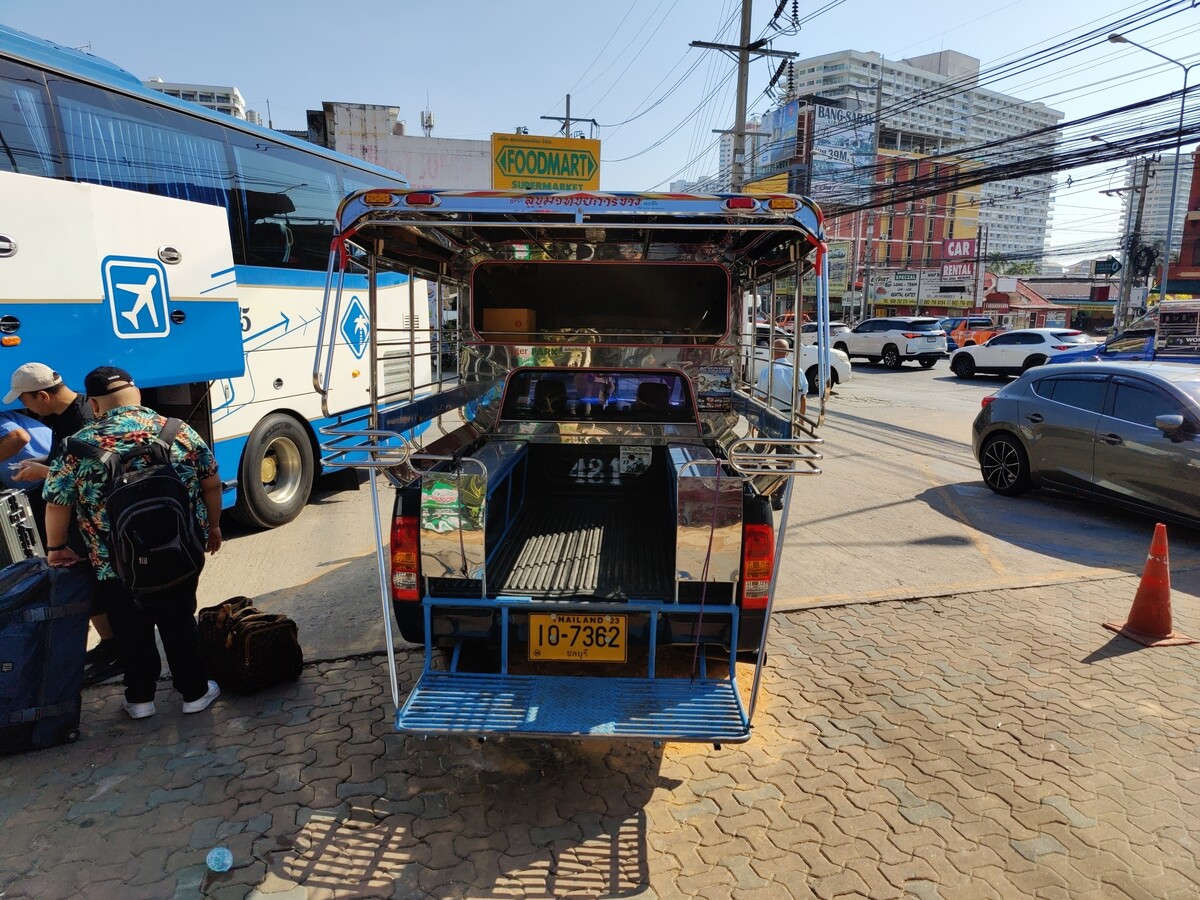
Photo of a songthaew in Pattaya. There are shared songthaews which run along Jomtien Second road and takes 10 bath to anywhere on the route.

Jomtien Beach in Pattaya.
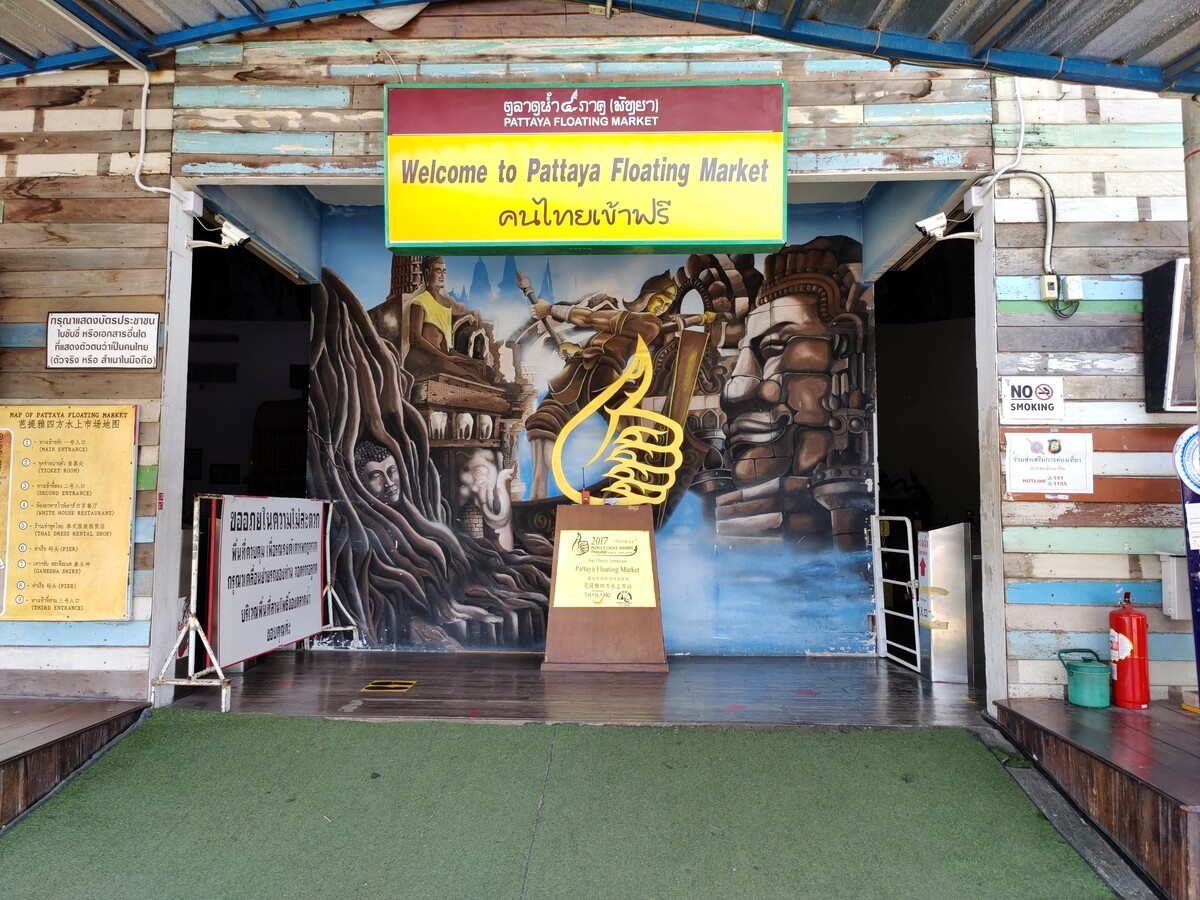
In terms of speaking English, locals didn t know English at all in both Pattaya and Bangkok. I normally don t expect locals to know English in a non-English speaking country, but the fact that Bangkok is one of the most visited places by tourists made me expect locals to know some English. Talking to locals is an integral part of travel for me, which I couldn t do a lot in Thailand. This aspect is much more important for me than going to touristy places. So, we were in Pattaya. Next morning, Fletcher and I went to Tiger park using shared songthaew. After that, we planned to visit Pattaya Floating market which is near the Tiger Park, but we felt the ticket prices were higher than it was worth. Fletcher had to leave for Bangkok on that day. I suggested him to go to Suvarnabhumi Airport from the Jomtien beach bus terminal (this was the route I took the last day in opposite direction) to avoid traffic congestion inside Bangkok, as he can follow up with metro once he reaches the airport. From the floating market, we were walking in sweltering heat to reach the Jomtien beach. I tried asking for a lift and eventually got successful as a scooty stopped, and surprisingly the person gave a ride to both of us. He was from Delhi, so maybe that s the reason he stopped for us. Then we took a songthaew to the bus terminal and after having lunch, Fletcher left for Bangkok.
A welcome sign at Pattaya Floating market.

This Korean Vegetasty noodles pack was yummy and was available at many 7-Eleven stores.

Next day I went to Bangkok, but Fletcher already left for Kuala Lumpur. Here I had booked a private room in a hotel (instead of a hostel) for four nights, mainly because of my luggage. This costed 5600 INR for four nights. It was 2 km from the metro station, which I used to walk both sides. In Bangkok, I visited Sukhumvit and Siam by metro. Going to some areas require crossing the Chao Phraya river. For this, I took Chao Phraya Express Boat for going to places like Khao San road and Wat Arun. I would recommend taking the boat ride as it had very good views. In Bangkok, I met a person from Pakistan staying in my hotel and so here also I got some company. But by the time I met him, my days were almost over. So, we went to a random restaurant selling Indian food where we ate some paneer dish with naan and that restaurant person was from Myanmar.
Wat Arun temple stamps your hand upon entry

Wat Arun temple

Khao San Road
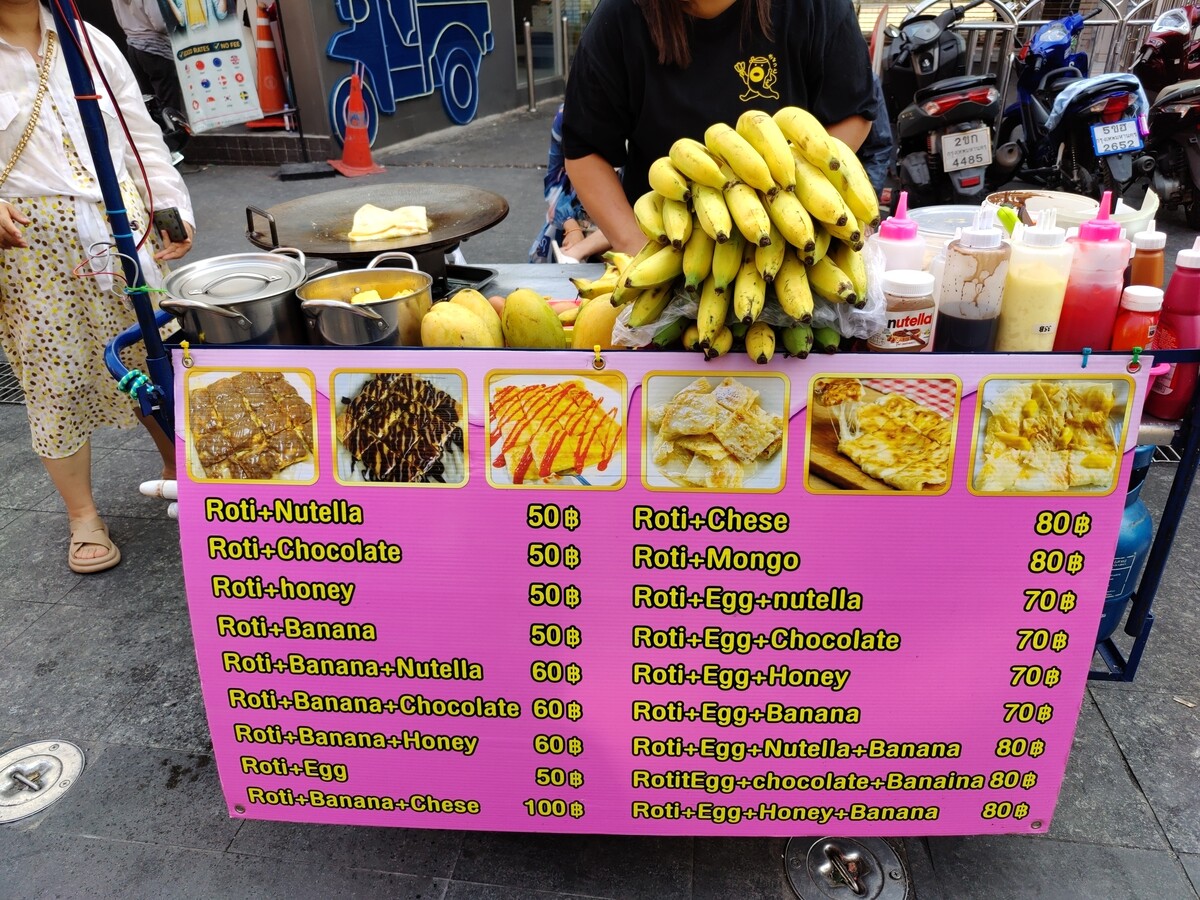
A food stall at Khao San Road

Chao Phraya Express Boat
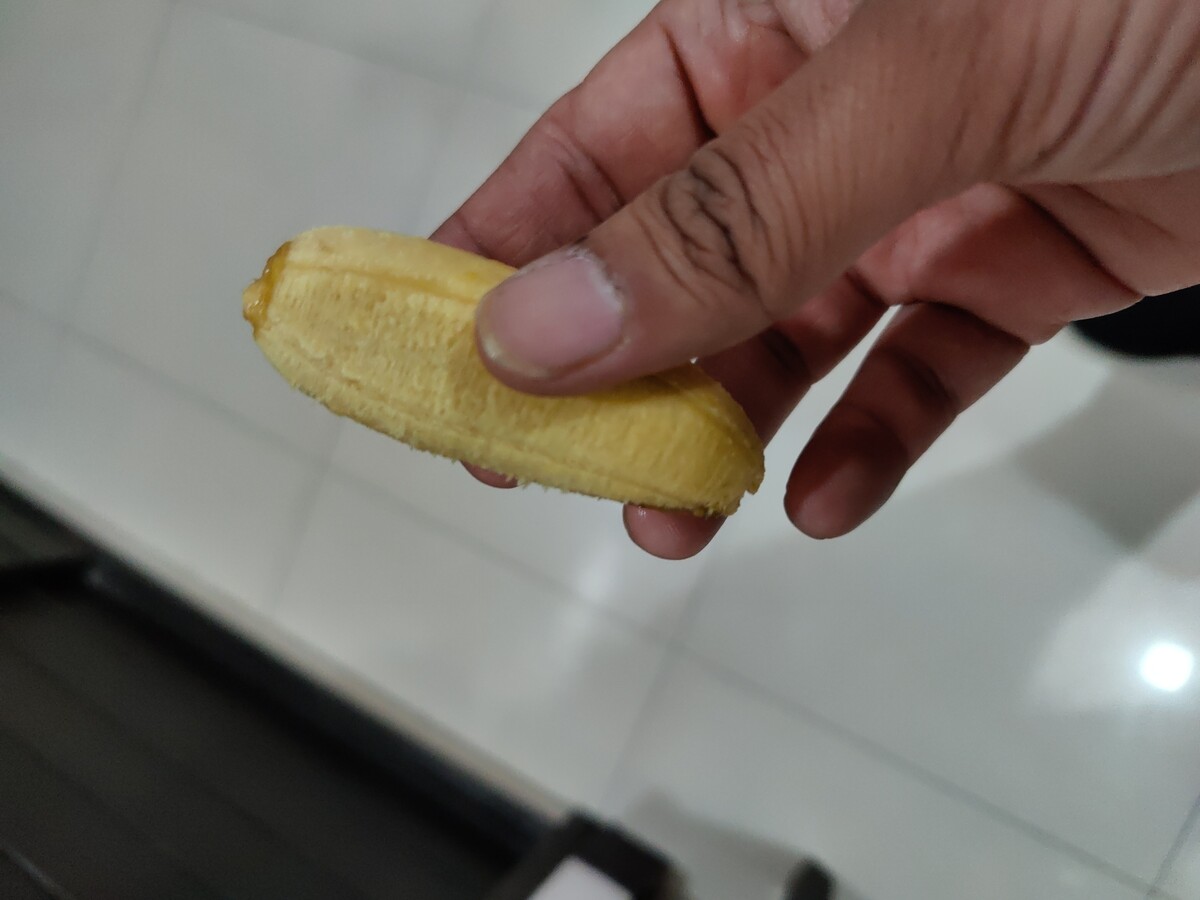
For eating, I mainly relied on fruits and convenience stores. Bananas were very tasty. This was the first time I saw banana flesh being yellow. Mangoes were delicious and pineapples were smaller and flavorful. I also ate Rose Apple, which I never had before. I had Chhole Kulche once in Sukhumvit. That was a little expensive as it costed 164 baht. I also used to buy premix coffee packets from 7-Eleven convenience stores and prepare them inside the stores.
Banana with yellow flesh
Fruits at a stall in Bangkok
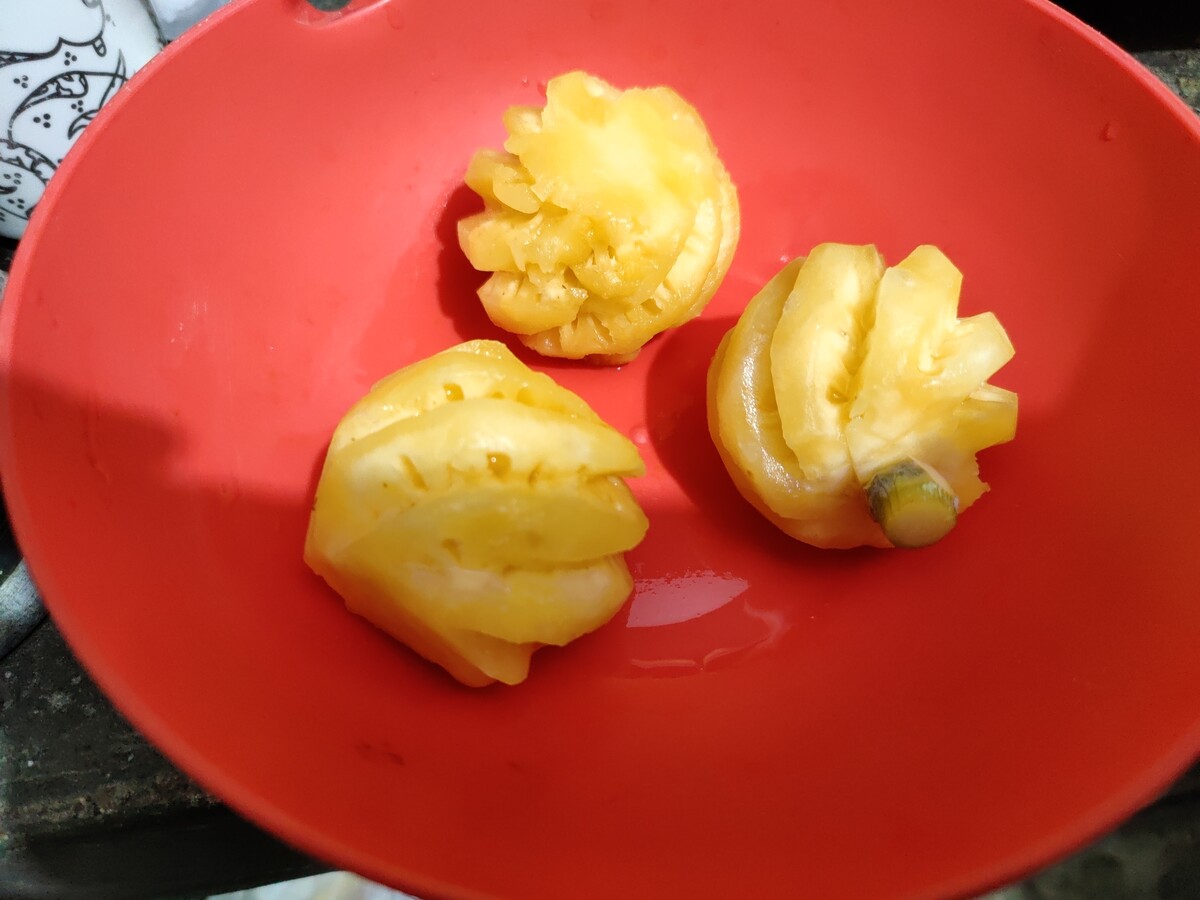
Trimmed pineapples from Thailand.

Corn in Bangkok.
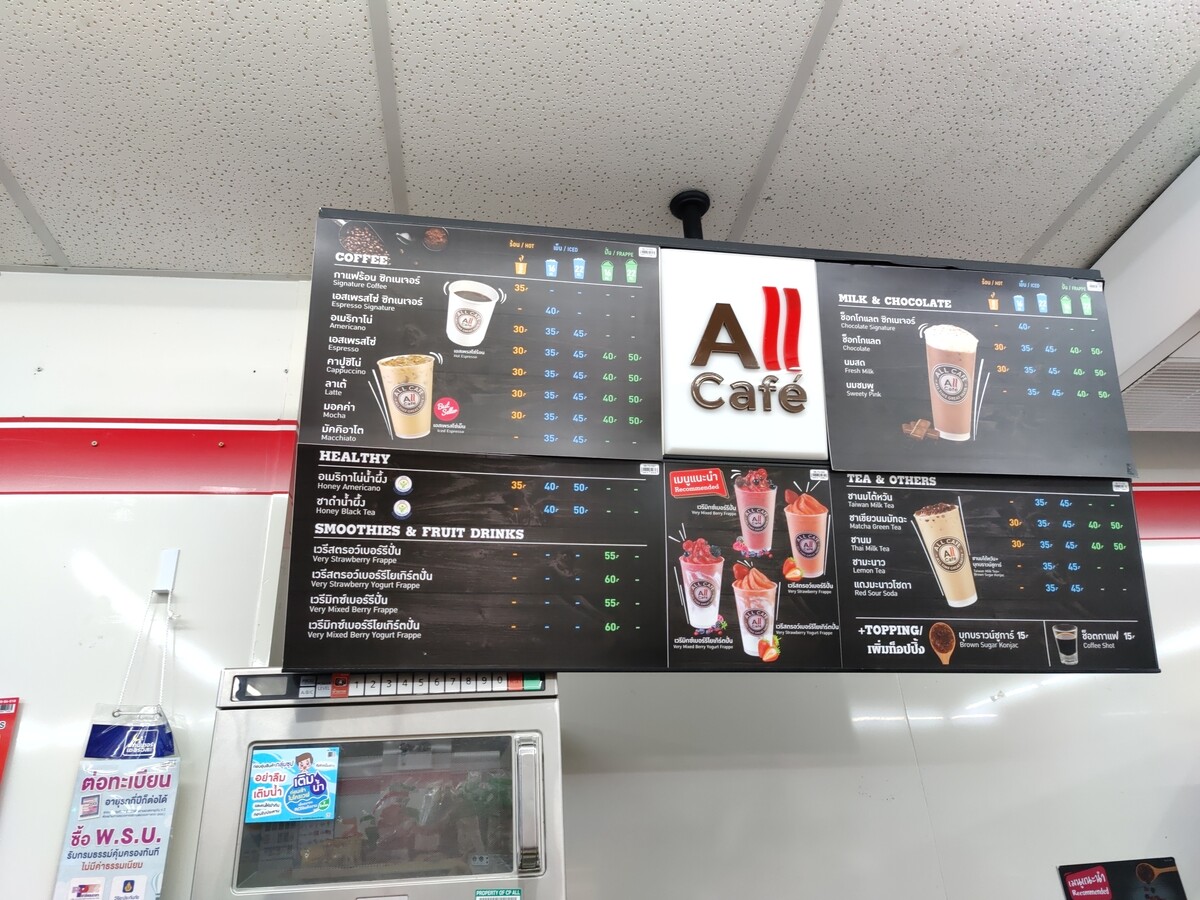
A board showing coffee menu at a 7-Eleven store along with rates in Pattaya.
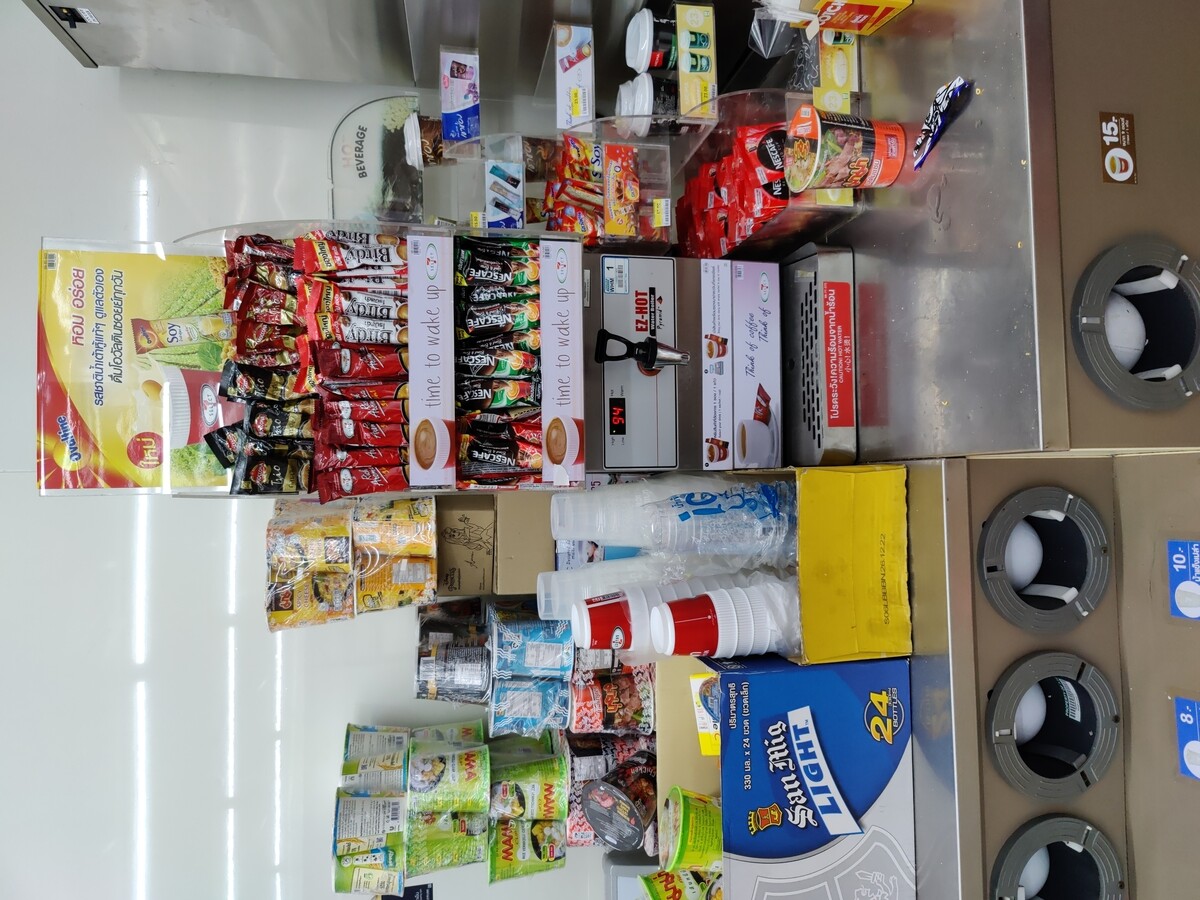
In this section of 7-Eleven, you can buy a premix coffee and mix it with hot water provided at the store to prepare.

My booking from Bangkok to Delhi was in Air India flight, and they were serving alcohol in the flight. I chose red wine, and this was my first time having alcohol in a flight.
Red wine being served in Air India

Notes
  • In this whole trip spanning two weeks, I did not pay for drinking water (except for once in Pattaya which was 9 baht) and toilets. Bangkok and Kuala Lumpur have plenty of malls where you should find a free-of-cost toilet nearby. For drinking water, I relied mainly on my accommodation providing refillable water for my bottle.
  • Thailand seemed more expensive than Malaysia on average. Malaysia had discounted price due to the Chinese New year.
  • I liked Pattaya more than Bangkok. Maybe because Pattaya has beach and Bangkok doesn t. Pattaya seemed more lively, and I could meet and talk to a few people as opposed to Bangkok.
  • Chao Phraya River express boat costs 150 baht for one day where you can hop on and off to any boat.

20 March 2024

Dirk Eddelbuettel: ciw 0.0.2 on CRAN: Updates

A first revision of the still only one-week old (at CRAN) package ciw has been released to CRAN! It provides is a single (efficient) function incoming() (now along with an alias ciw()) which summarises the state of the incoming directories at CRAN. I happen to like having these things at my (shell) fingertips, so it goes along with (still draft) wrapper ciw.r that will be part of the next littler release. For example, when I do this right now as I type this, I see (typically less than one second later)
edd@rob:~$ ciw.r 
    Folder                     Name                Time   Size         Age
    <char>                   <char>              <POSc> <char>  <difftime>
1: pretest instantiate_0.2.2.tar.gz 2024-03-20 13:29:00    17K  0.07 hours
2: recheck   tinytable_0.2.0.tar.gz 2024-03-20 12:50:00   565K  0.72 hours
3: pending      Matrix_1.7-0.tar.gz 2024-03-20 12:05:00   2.3M  1.47 hours
4: recheck      survey_4.4-2.tar.gz 2024-03-20 02:02:00   2.2M 11.52 hours
5: waiting   equateIRT_2.4.0.tar.gz 2024-03-19 17:00:00   895K 20.55 hours
6: pending   ravetools_0.1.5.tar.gz 2024-03-19 12:06:00   1.0M 25.45 hours
7: waiting     glmmTMB_1.1.9.tar.gz 2024-03-18 16:04:00   4.2M 45.48 hours
edd@rob:~$ 
See ciw.r --help or ciw.r --usage for more. Alternatively, in your R session, you can call ciw::incoming() (or now ciw::ciw()) for the same result (and/or load the package first). This release adds some packaging touches, brings the new alias ciw() as well as a state variable with all (known) folder names and some internal improvements for dealing with error conditions. The NEWS entry follows.

Changes in version 0.0.2 (2024-03-20)
  • The package README and DESCRIPTION have been expanded
  • An alias ciw can now be used for incoming
  • Network error handling is now more robist
  • A state variable known_folders lists all CRAN folders below incoming

Courtesy of my CRANberries, there is also a diffstat report for this release. If you like this or other open-source work I do, you can sponsor me at GitHub.

This post by Dirk Eddelbuettel originated on his Thinking inside the box blog. Please report excessive re-aggregation in third-party for-profit settings.

Jonathan Dowland: aerc email client

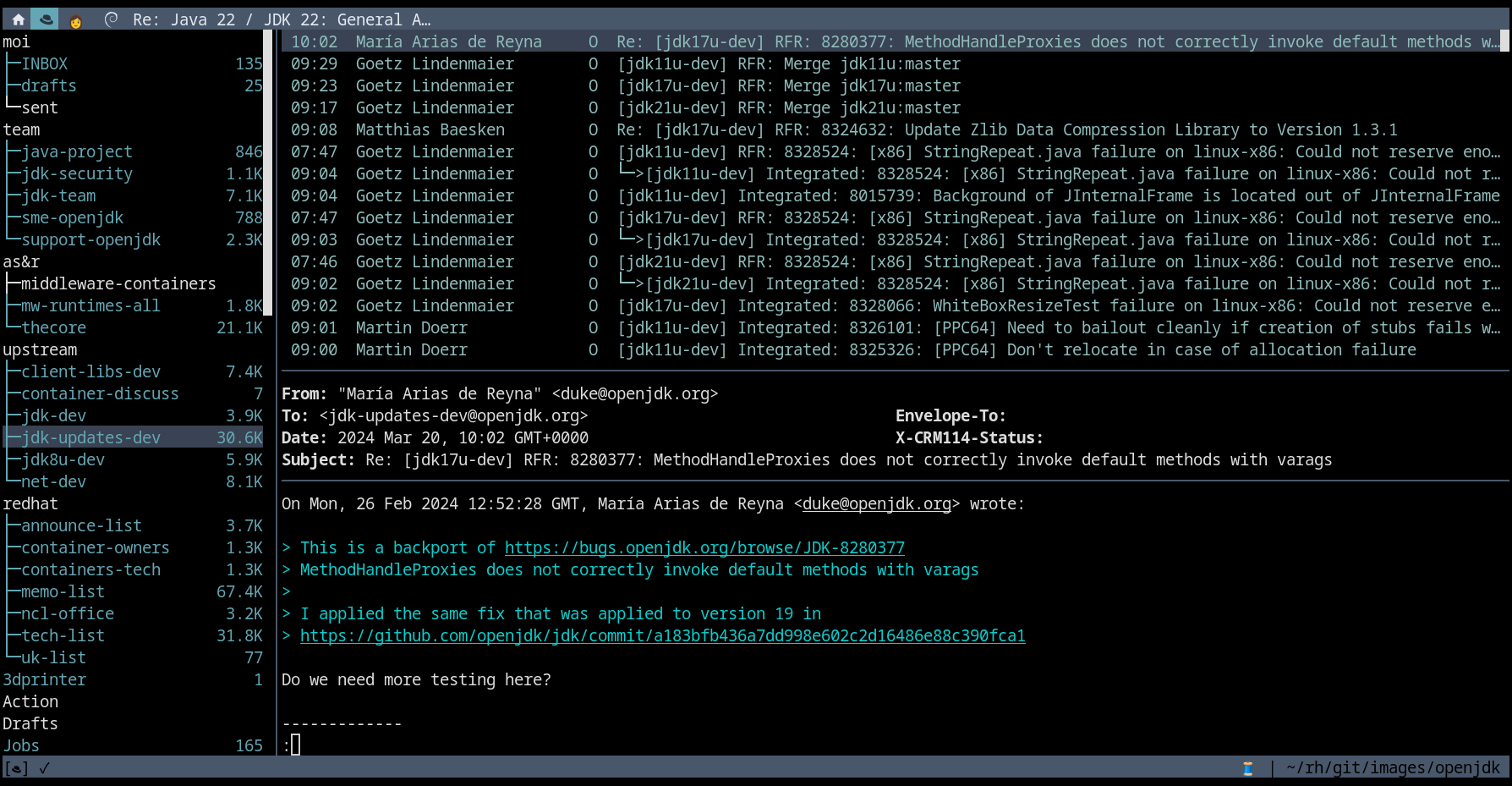
my aerc
I started looking at aerc, a new Terminal mail client, in around 2019. At that time it was promising, but ultimately not ready yet for me, so I put it away and went back to neomutt which I have been using (in one form or another) all century. These days, I use neomutt as an IMAP client which is perhaps what it's worst at: prior to that, and in common with most users (I think), I used it to read local mail, either fetched via offlineimap or directly on my mail server. I switched to using it as a (slow, blocking) IMAP client because I got sick of maintaining offlineimap (or mbsync), and I started to use neomutt to read my work mail, which was too large (and rate limited) for local syncing. This year I noticed that aerc had a new maintainer who was presenting about it at FOSDEM, so I thought I'd take another look. It's come a long way: far enough to actually displace neomutt for my day-to-day mail use. In particular, it's a much better IMAP client. I still reach for neomutt for some tasks, but I'm now using aerc for most things. aerc is available in Debian, but I recommending building from upstream source at the moment as the project is quite fast-moving.

Iustin Pop: Corydalis 2024.12.0 released

I ve been working for the past few weeks on Corydalis, and was in no hurry to make a release, but last evening I found the explanation for a really, really, really annoying issue: unintended zooming on touch interfaces in the image viewer. Or more precisely, I found this post from 2015 (9 years ago!): https://webkit.org/blog/5610/more-responsive-tapping-on-ios/ and I finally understood things. And decided this was the best choice for cutting a new release. Of course, the release contains more things, see the changelog on the release page: https://github.com/iustin/corydalis/releases/tag/v2024.12.0. And of course, it s up on http://demo.corydalis.io. And after putting out the new release, I saw that release tagging is in the pre-built binaries still broken, and found the reason at https://github.com/actions/checkout/issues/290. Will fix for the next release The stream of bugs never ends

19 March 2024

Colin Watson: apt install everything?

On Mastodon, the question came up of how Ubuntu would deal with something like the npm install everything situation. I replied:
Ubuntu is curated, so it probably wouldn t get this far. If it did, then the worst case is that it would get in the way of CI allowing other packages to be removed (again from a curated system, so people are used to removal not being self-service); but the release team would have no hesitation in removing a package like this to fix that, and it certainly wouldn t cause this amount of angst. If you did this in a PPA, then I can t think of any particular negative effects.
OK, if you added lots of build-dependencies (as well as run-time dependencies) then you might be able to take out a builder. But Launchpad builders already run arbitrary user-submitted code by design and are therefore very carefully sandboxed and treated as ephemeral, so this is hardly novel. There s a lot to be said for the arrangement of having a curated system for the stuff people actually care about plus an ecosystem of add-on repositories. PPAs cover a wide range of levels of developer activity, from throwaway experiments to quasi-official distribution methods; there are certainly problems that arise from it being difficult to tell the difference between those extremes and from there being no systematic confinement, but for this particular kind of problem they re very nearly ideal. (Canonical has tried various other approaches to software distribution, and while they address some of the problems, they aren t obviously better at helping people make reliable social judgements about code they don t know.) For a hypothetical package with a huge number of dependencies, to even try to upload it directly to Ubuntu you d need to be an Ubuntu developer with upload rights (or to go via Debian, where you d have to clear a similar hurdle). If you have those, then the first upload has to pass manual review by an archive administrator. If your package passes that, then it still has to build and get through proposed-migration CI before it reaches anything that humans typically care about. On the other hand, if you were inclined to try this sort of experiment, you d almost certainly try it in a PPA, and that would trouble nobody but yourself.

18 March 2024

Joey Hess: policy on adding AI generated content to my software projects

I am eager to incorporate your AI generated code into my software. Really! I want to facilitate making the process as easy as possible. You're already using an AI to do most of the hard lifting, so why make the last step hard? To that end, I skip my usually extensive code review process for your AI generated code submissions. Anything goes as long as it compiles! Please do remember to include "(AI generated)" in the description of your changes (at the top), so I know to skip my usual review process. Also be sure to sign off to the standard Developer Certificate of Origin so I know you attest that you own the code that you generated. When making a git commit, you can do that by using the --signoff option. I do make some small modifications to AI generated submissions. For example, maybe you used AI to write this code:
+ // Fast inverse square root
+ float fast_rsqrt( float number )
+  
+  float x2 = number * 0.5F;
+  float y  = number;
+  long i  = * ( long * ) &y;
+  i  = 0x5f3659df - ( i >> 1 );
+  y  = * ( float * ) &i;
+  return (y * ( 1.5F - ( x2 * y * y ) ));
+  
...
- foo = rsqrt(bar)
+ foo = fast_rsqrt(bar)
Before AI, only a genious like John Carmack could write anything close to this, and now you've generated it with some simple prompts to an AI. So of course I will accept your patch. But as part of my QA process, I might modify it so the new code is not run all the time. Let's only run it on leap days to start with. As we know, leap day is February 30th, so I'll modify your patch like this:
- foo = rsqrt(bar)
+ time_t s = time(NULL);
+ if (localtime(&s)->tm_mday == 30 && localtime(&s)->tm_mon == 2)
+   foo = fast_rsqrt(bar);
+ else
+   foo = rsqrt(bar);
Despite my minor modifications, you did the work (with AI!) and so you deserve the credit, so I'll keep you listed as the author. Congrats, you made the world better! PS: Of course, the other reason I don't review AI generated code is that I simply don't have time and have to prioritize reviewing code written by falliable humans. Unfortunately, this does mean that if you submit AI generated code that is not clearly marked as such, and use my limited reviewing time, I won't have time to review other submissions from you in the future. I will still accept all your botshit submissions though! PPS: Ignore the haters who claim that botshit makes AIs that get trained on it less effective. Studies like this one just aren't believable. I asked Bing to summarize it and it said not to worry about it!

Simon Josefsson: Apt archive mirrors in Git-LFS

My effort to improve transparency and confidence of public apt archives continues. I started to work on this in Apt Archive Transparency in which I mention the debdistget project in passing. Debdistget is responsible for mirroring index files for some public apt archives. I ve realized that having a publicly auditable and preserved mirror of the apt repositories is central to being able to do apt transparency work, so the debdistget project has become more central to my project than I thought. Currently I track Trisquel, PureOS, Gnuinos and their upstreams Ubuntu, Debian and Devuan. Debdistget download Release/Package/Sources files and store them in a git repository published on GitLab. Due to size constraints, it uses two repositories: one for the Release/InRelease files (which are small) and one that also include the Package/Sources files (which are large). See for example the repository for Trisquel release files and the Trisquel package/sources files. Repositories for all distributions can be found in debdistutils archives GitLab sub-group. The reason for splitting into two repositories was that the git repository for the combined files become large, and that some of my use-cases only needed the release files. Currently the repositories with packages (which contain a couple of months worth of data now) are 9GB for Ubuntu, 2.5GB for Trisquel/Debian/PureOS, 970MB for Devuan and 450MB for Gnuinos. The repository size is correlated to the size of the archive (for the initial import) plus the frequency and size of updates. Ubuntu s use of Apt Phased Updates (which triggers a higher churn of Packages file modifications) appears to be the primary reason for its larger size. Working with large Git repositories is inefficient and the GitLab CI/CD jobs generate quite some network traffic downloading the git repository over and over again. The most heavy user is the debdistdiff project that download all distribution package repositories to do diff operations on the package lists between distributions. The daily job takes around 80 minutes to run, with the majority of time is spent on downloading the archives. Yes I know I could look into runner-side caching but I dislike complexity caused by caching. Fortunately not all use-cases requires the package files. The debdistcanary project only needs the Release/InRelease files, in order to commit signatures to the Sigstore and Sigsum transparency logs. These jobs still run fairly quickly, but watching the repository size growth worries me. Currently these repositories are at Debian 440MB, PureOS 130MB, Ubuntu/Devuan 90MB, Trisquel 12MB, Gnuinos 2MB. Here I believe the main size correlation is update frequency, and Debian is large because I track the volatile unstable. So I hit a scalability end with my first approach. A couple of months ago I solved this by discarding and resetting these archival repositories. The GitLab CI/CD jobs were fast again and all was well. However this meant discarding precious historic information. A couple of days ago I was reaching the limits of practicality again, and started to explore ways to fix this. I like having data stored in git (it allows easy integration with software integrity tools such as GnuPG and Sigstore, and the git log provides a kind of temporal ordering of data), so it felt like giving up on nice properties to use a traditional database with on-disk approach. So I started to learn about Git-LFS and understanding that it was able to handle multi-GB worth of data that looked promising. Fairly quickly I scripted up a GitLab CI/CD job that incrementally update the Release/Package/Sources files in a git repository that uses Git-LFS to store all the files. The repository size is now at Ubuntu 650kb, Debian 300kb, Trisquel 50kb, Devuan 250kb, PureOS 172kb and Gnuinos 17kb. As can be expected, jobs are quick to clone the git archives: debdistdiff pipelines went from a run-time of 80 minutes down to 10 minutes which more reasonable correlate with the archive size and CPU run-time. The LFS storage size for those repositories are at Ubuntu 15GB, Debian 8GB, Trisquel 1.7GB, Devuan 1.1GB, PureOS/Gnuinos 420MB. This is for a couple of days worth of data. It seems native Git is better at compressing/deduplicating data than Git-LFS is: the combined size for Ubuntu is already 15GB for a couple of days data compared to 8GB for a couple of months worth of data with pure Git. This may be a sub-optimal implementation of Git-LFS in GitLab but it does worry me that this new approach will be difficult to scale too. At some level the difference is understandable, Git-LFS probably store two different Packages files around 90MB each for Trisquel as two 90MB files, but native Git would store it as one compressed version of the 90MB file and one relatively small patch to turn the old files into the next file. So the Git-LFS approach surprisingly scale less well for overall storage-size. Still, the original repository is much smaller, and you usually don t have to pull all LFS files anyway. So it is net win. Throughout this work, I kept thinking about how my approach relates to Debian s snapshot service. Ultimately what I would want is a combination of these two services. To have a good foundation to do transparency work I would want to have a collection of all Release/Packages/Sources files ever published, and ultimately also the source code and binaries. While it makes sense to start on the latest stable releases of distributions, this effort should scale backwards in time as well. For reproducing binaries from source code, I need to be able to securely find earlier versions of binary packages used for rebuilds. So I need to import all the Release/Packages/Sources packages from snapshot into my repositories. The latency to retrieve files from that server is slow so I haven t been able to find an efficient/parallelized way to download the files. If I m able to finish this, I would have confidence that my new Git-LFS based approach to store these files will scale over many years to come. This remains to be seen. Perhaps the repository has to be split up per release or per architecture or similar. Another factor is storage costs. While the git repository size for a Git-LFS based repository with files from several years may be possible to sustain, the Git-LFS storage size surely won t be. It seems GitLab charges the same for files in repositories and in Git-LFS, and it is around $500 per 100GB per year. It may be possible to setup a separate Git-LFS backend not hosted at GitLab to serve the LFS files. Does anyone know of a suitable server implementation for this? I had a quick look at the Git-LFS implementation list and it seems the closest reasonable approach would be to setup the Gitea-clone Forgejo as a self-hosted server. Perhaps a cloud storage approach a la S3 is the way to go? The cost to host this on GitLab will be manageable for up to ~1TB ($5000/year) but scaling it to storing say 500TB of data would mean an yearly fee of $2.5M which seems like poor value for the money. I realized that ultimately I would want a git repository locally with the entire content of all apt archives, including their binary and source packages, ever published. The storage requirements for a service like snapshot (~300TB of data?) is today not prohibitly expensive: 20TB disks are $500 a piece, so a storage enclosure with 36 disks would be around $18.000 for 720TB and using RAID1 means 360TB which is a good start. While I have heard about ~TB-sized Git-LFS repositories, would Git-LFS scale to 1PB? Perhaps the size of a git repository with multi-millions number of Git-LFS pointer files will become unmanageable? To get started on this approach, I decided to import a mirror of Debian s bookworm for amd64 into a Git-LFS repository. That is around 175GB so reasonable cheap to host even on GitLab ($1000/year for 200GB). Having this repository publicly available will make it possible to write software that uses this approach (e.g., porting debdistreproduce), to find out if this is useful and if it could scale. Distributing the apt repository via Git-LFS would also enable other interesting ideas to protecting the data. Consider configuring apt to use a local file:// URL to this git repository, and verifying the git checkout using some method similar to Guix s approach to trusting git content or Sigstore s gitsign. A naive push of the 175GB archive in a single git commit ran into pack size limitations: remote: fatal: pack exceeds maximum allowed size (4.88 GiB) however breaking up the commit into smaller commits for parts of the archive made it possible to push the entire archive. Here are the commands to create this repository: git init
git lfs install
git lfs track 'dists/**' 'pool/**'
git add .gitattributes
git commit -m"Add Git-LFS track attributes." .gitattributes
time debmirror --method=rsync --host ftp.se.debian.org --root :debian --arch=amd64 --source --dist=bookworm,bookworm-updates --section=main --verbose --diff=none --keyring /usr/share/keyrings/debian-archive-keyring.gpg --ignore .git .
git add dists project
git commit -m"Add." -a
git remote add origin git@gitlab.com:debdistutils/archives/debian/mirror.git
git push --set-upstream origin --all
for d in pool//; do
echo $d;
time git add $d;
git commit -m"Add $d." -a
git push
done
The resulting repository size is around 27MB with Git LFS object storage around 174GB. I think this approach would scale to handle all architectures for one release, but working with a single git repository for all releases for all architectures may lead to a too large git repository (>1GB). So maybe one repository per release? These repositories could also be split up on a subset of pool/ files, or there could be one repository per release per architecture or sources. Finally, I have concerns about using SHA1 for identifying objects. It seems both Git and Debian s snapshot service is currently using SHA1. For Git there is SHA-256 transition and it seems GitLab is working on support for SHA256-based repositories. For serious long-term deployment of these concepts, it would be nice to go for SHA256 identifiers directly. Git-LFS already uses SHA256 but Git internally uses SHA1 as does the Debian snapshot service. What do you think? Happy Hacking!

Christoph Berg: vcswatch and git --filter

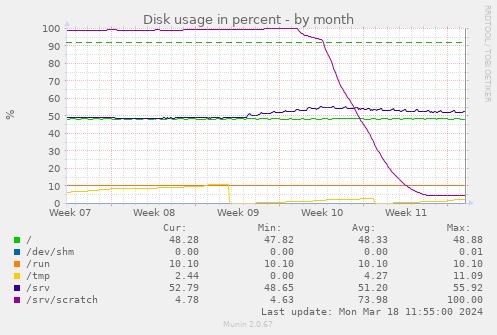
Debian is running a "vcswatch" service that keeps track of the status of all packaging repositories that have a Vcs-Git (and other VCSes) header set and shows which repos might need a package upload to push pending changes out. Naturally, this is a lot of data and the scratch partition on qa.debian.org had to be expanded several times, up to 300 GB in the last iteration. Attempts to reduce that size using shallow clones (git clone --depth=50) did not result more than a few percent of space saved. Running git gc on all repos helps a bit, but is tedious and as Debian is growing, the repos are still growing both in size and number. I ended up blocking all repos with checkouts larger than a gigabyte, and still the only cure was expanding the disk, or to lower the blocking threshold. Since we only need a tiny bit of info from the repositories, namely the content of debian/changelog and a few other files from debian/, plus the number of commits since the last tag on the packaging branch, it made sense to try to get the info without fetching a full repo clone. The question if we could grab that solely using the GitLab API at salsa.debian.org was never really answered. But then, in #1032623, G bor N meth suggested the use of git clone --filter blob:none. As things go, this sat unattended in the bug report for almost a year until the next "disk full" event made me give it a try. The blob:none filter makes git clone omit all files, fetching only commit and tree information. Any blob (file content) needed at git run time is transparently fetched from the upstream repository, and stored locally. It turned out to be a game-changer. The (largish) repositories I tried it on shrank to 1/100 of the original size. Poking around I figured we could even do better by using tree:0 as filter. This additionally omits all trees from the git clone, again only fetching the information at run time when needed. Some of the larger repos I tried it on shrank to 1/1000 of their original size. I deployed the new option on qa.debian.org and scheduled all repositories to fetch a new clone on the next scan: The initial dip from 100% to 95% is my first "what happens if we block repos > 500 MB" attempt. Over the week after that, the git filter clones reduce the overall disk consumption from almost 300 GB to 15 GB, a 1/20. Some repos shrank from GBs to below a MB. Perhaps I should make all my git clones use one of the filters.

Gunnar Wolf: After miniDebConf Santa Fe

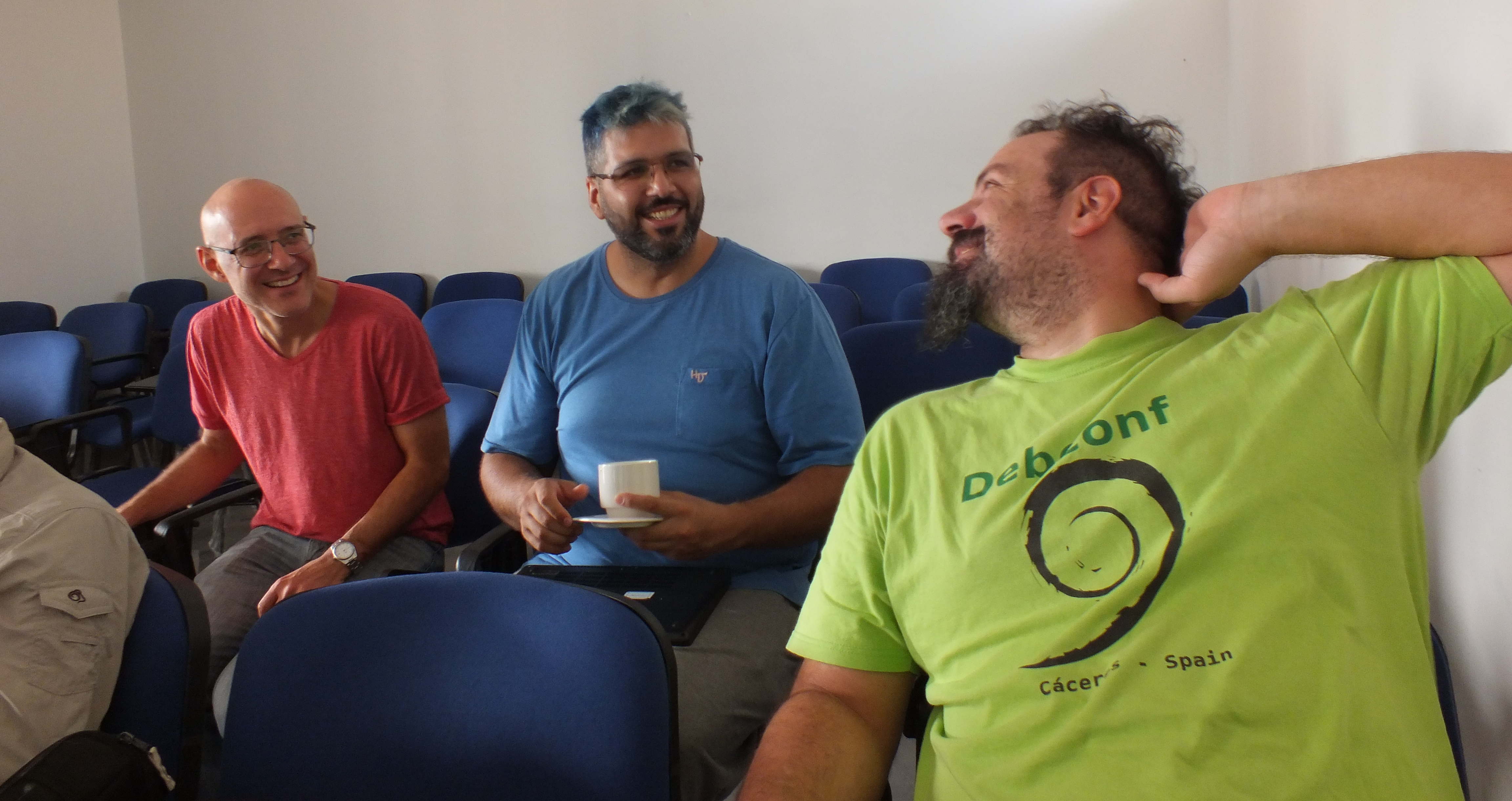
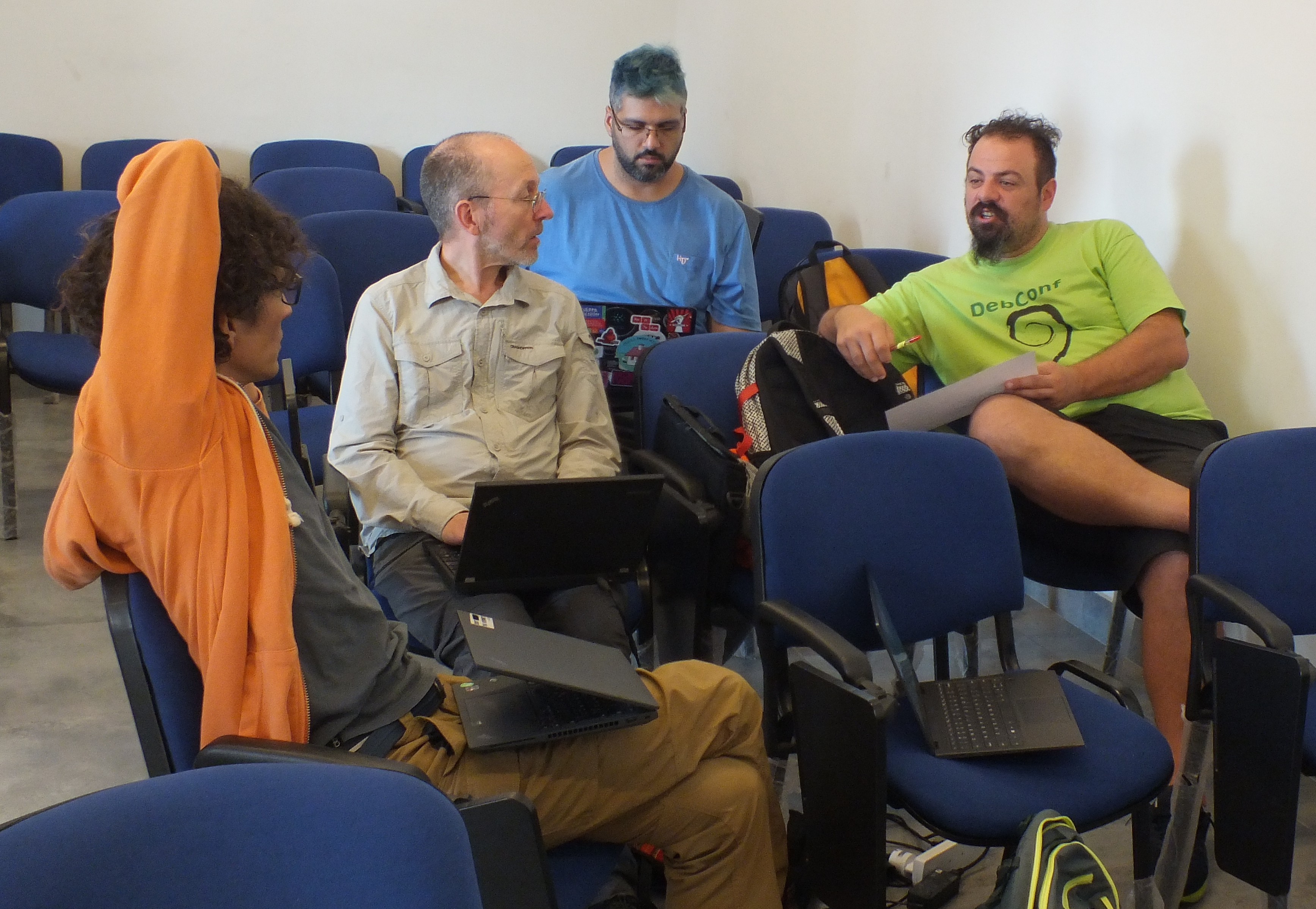
Last week we held our promised miniDebConf in Santa Fe City, Santa Fe province, Argentina just across the river from Paran , where I have spent almost six beautiful months I will never forget. Around 500 Kilometers North from Buenos Aires, Santa Fe and Paran are separated by the beautiful and majestic Paran river, which flows from Brazil, marks the Eastern border of Paraguay, and continues within Argentina as the heart of the litoral region of the country, until it merges with the Uruguay river (you guessed right the river marking the Eastern border of Argentina, first with Brazil and then with Uruguay), and they become the R o de la Plata. This was a short miniDebConf: we were lent the APUL union s building for the weekend (thank you very much!); during Saturday, we had a cycle of talks, and on sunday we had more of a hacklab logic, having some unstructured time to work each on their own projects, and to talk and have a good time together. We were five Debian people attending: santiago debacle eamanu dererk gwolf @debian.org. My main contact to kickstart organization was Mart n Bayo. Mart n was for many years the leader of the Technical Degree on Free Software at Universidad Nacional del Litoral, where I was also a teacher for several years. Together with Leo Mart nez, also a teacher at the tecnicatura, they contacted us with Guillermo and Gabriela, from the APUL non-teaching-staff union of said university. We had the following set of talks (for which there is a promise to get electronic record, as APUL was kind enough to record them! of course, I will push them to our usual conference video archiving service as soon as I get them)
Hour Title (Spanish) Title (English) Presented by
10:00-10:25 Introducci n al Software Libre Introduction to Free Software Mart n Bayo
10:30-10:55 Debian y su comunidad Debian and its community Emanuel Arias
11:00-11:25 Por qu sigo contribuyendo a Debian despu s de 20 a os? Why am I still contributing to Debian after 20 years? Santiago Ruano
11:30-11:55 Mi identidad y el proyecto Debian: Qu es el llavero OpenPGP y por qu ? My identity and the Debian project: What is the OpenPGP keyring and why? Gunnar Wolf
12:00-13:00 Explorando las masculinidades en el contexto del Software Libre Exploring masculinities in the context of Free Software Gora Ortiz Fuentes - Jos Francisco Ferro
13:00-14:30 Lunch
14:30-14:55 Debian para el d a a d a Debian for our every day Leonardo Mart nez
15:00-15:25 Debian en las Raspberry Pi Debian in the Raspberry Pi Gunnar Wolf
15:30-15:55 Device Trees Device Trees Lisandro Dami n Nicanor Perez Meyer (videoconferencia)
16:00-16:25 Python en Debian Python in Debian Emmanuel Arias
16:30-16:55 Debian y XMPP en la medici n de viento para la energ a e lica Debian and XMPP for wind measuring for eolic energy Martin Borgert
As it always happens DebConf, miniDebConf and other Debian-related activities are always fun, always productive, always a great opportunity to meet again our decades-long friends. Lets see what comes next!

14 March 2024

Gregor Herrmann: teamwork in practice

teamwork, or: why I love the Debian Perl Group: elbrus has introduced a (very untypical) package into the Debian Perl Group in 2022. after changes of the default compiler options (-Werror=implicit-function-declaration) in debian, it didn't build any more & received an RC bug. because I sometimes like challenges, I had a look at it & cobbled together a patch. as I hardly speak any C, I sent my notes to the bug report & (implictly) asked for help. & went out to meet a friend. when I came home, I found an email from ntyni, sent less than 2 hours after my mail, where he friendly pointed out the issues with my patch & sent a corrected version. all I needed to do was to adjust the patch & upload the package. one more bug fixed, one less task for us, & elbrus can concentrate on more important tasks :)

thanks again, niko!

Matthew Garrett: Digital forgeries are hard

Closing arguments in the trial between various people and Craig Wright over whether he's Satoshi Nakamoto are wrapping up today, amongst a bewildering array of presented evidence. But one utterly astonishing aspect of this lawsuit is that expert witnesses for both sides agreed that much of the digital evidence provided by Craig Wright was unreliable in one way or another, generally including indications that it wasn't produced at the point in time it claimed to be. And it's fascinating reading through the subtle (and, in some cases, not so subtle) ways that that's revealed.

One of the pieces of evidence entered is screenshots of data from Mind Your Own Business, a business management product that's been around for some time. Craig Wright relied on screenshots of various entries from this product to support his claims around having controlled meaningful number of bitcoin before he was publicly linked to being Satoshi. If these were authentic then they'd be strong evidence linking him to the mining of coins before Bitcoin's public availability. Unfortunately the screenshots themselves weren't contemporary - the metadata shows them being created in 2020. This wouldn't fundamentally be a problem (it's entirely reasonable to create new screenshots of old material), as long as it's possible to establish that the material shown in the screenshots was created at that point. Sadly, well.

One part of the disclosed information was an email that contained a zip file that contained a raw database in the format used by MYOB. Importing that into the tool allowed an audit record to be extracted - this record showed that the relevant entries had been added to the database in 2020, shortly before the screenshots were created. This was, obviously, not strong evidence that Craig had held Bitcoin in 2009. This evidence was reported, and was responded to with a couple of additional databases that had an audit trail that was consistent with the dates in the records in question. Well, partially. The audit record included session data, showing an administrator logging into the data base in 2011 and then, uh, logging out in 2023, which is rather more consistent with someone changing their system clock to 2011 to create an entry, and switching it back to present day before logging out. In addition, the audit log included fields that didn't exist in versions of the product released before 2016, strongly suggesting that the entries dated 2009-2011 were created in software released after 2016. And even worse, the order of insertions into the database didn't line up with calendar time - an entry dated before another entry may appear in the database afterwards, indicating that it was created later. But even more obvious? The database schema used for these old entries corresponded to a version of the software released in 2023.

This is all consistent with the idea that these records were created after the fact and backdated to 2009-2011, and that after this evidence was made available further evidence was created and backdated to obfuscate that. In an unusual turn of events, during the trial Craig Wright introduced further evidence in the form of a chain of emails to his former lawyers that indicated he had provided them with login details to his MYOB instance in 2019 - before the metadata associated with the screenshots. The implication isn't entirely clear, but it suggests that either they had an opportunity to examine this data before the metadata suggests it was created, or that they faked the data? So, well, the obvious thing happened, and his former lawyers were asked whether they received these emails. The chain consisted of three emails, two of which they confirmed they'd received. And they received a third email in the chain, but it was different to the one entered in evidence. And, uh, weirdly, they'd received a copy of the email that was submitted - but they'd received it a few days earlier. In 2024.

And again, the forensic evidence is helpful here! It turns out that the email client used associates a timestamp with any attachments, which in this case included an image in the email footer - and the mysterious time travelling email had a timestamp in 2024, not 2019. This was created by the client, so was consistent with the email having been sent in 2024, not being sent in 2019 and somehow getting stuck somewhere before delivery. The date header indicates 2019, as do encoded timestamps in the MIME headers - consistent with the mail being sent by a computer with the clock set to 2019.

But there's a very weird difference between the copy of the email that was submitted in evidence and the copy that was located afterwards! The first included a header inserted by gmail that included a 2019 timestamp, while the latter had a 2024 timestamp. Is there a way to determine which of these could be the truth? It turns out there is! The format of that header changed in 2022, and the version in the email is the new version. The version with the 2019 timestamp is anachronistic - the format simply doesn't match the header that gmail would have introduced in 2019, suggesting that an email sent in 2022 or later was modified to include a timestamp of 2019.

This is by no means the only indication that Craig Wright's evidence may be misleading (there's the whole argument that the Bitcoin white paper was written in LaTeX when general consensus is that it's written in OpenOffice, given that's what the metadata claims), but it's a lovely example of a more general issue.

Our technology chains are complicated. So many moving parts end up influencing the content of the data we generate, and those parts develop over time. It's fantastically difficult to generate an artifact now that precisely corresponds to how it would look in the past, even if we go to the effort of installing an old OS on an old PC and setting the clock appropriately (are you sure you're going to be able to mimic an entirely period appropriate patch level?). Even the version of the font you use in a document may indicate it's anachronistic. I'm pretty good at computers and I no longer have any belief I could fake an old document.

(References: this Dropbox, under "Expert reports", "Patrick Madden". Initial MYOB data is in "Appendix PM7", further analysis is in "Appendix PM42", email analysis is "Sixth Expert Report of Mr Patrick Madden")

comment count unavailable comments

Dirk Eddelbuettel: ciw 0.0.1 on CRAN: New Package!

Happy to share that ciw is now on CRAN! I had tooted a little bit about it, e.g., here. What it provides is a single (efficient) function incoming() which summarises the state of the incoming directories at CRAN. I happen to like having these things at my (shell) fingertips, so it goes along with (still draft) wrapper ciw.r that will be part of the next littler release. For example, when I do this right now as I type this, I see
edd@rob:~$ ciw.r
    Folder                   Name                Time   Size          Age
    <char>                 <char>              <POSc> <char>   <difftime>
1: waiting   maximin_1.0-5.tar.gz 2024-03-13 22:22:00    20K   2.48 hours
2: inspect    GofCens_0.97.tar.gz 2024-03-13 21:12:00    29K   3.65 hours
3: inspect verbalisr_0.5.2.tar.gz 2024-03-13 20:09:00    79K   4.70 hours
4: waiting    rnames_1.0.1.tar.gz 2024-03-12 15:04:00   2.7K  33.78 hours
5: waiting  PCMBase_1.2.14.tar.gz 2024-03-10 12:32:00   406K  84.32 hours
6: pending        MPCR_1.1.tar.gz 2024-02-22 11:07:00   903K 493.73 hours
edd@rob:~$ 
which is rather compact as CRAN kept busy! This call runs in about (or just over) one second, which includes launching r. Good enough for me. From a well-connected EC2 instance it is about 800ms on the command-line. When I do I from here inside an R session it is maybe 700ms. And doing it over in Europe is faster still. (I am using ping=FALSE for these to omit the default sanity check of can I haz networking? to speed things up. The check adds another 200ms or so.) The function (and the wrapper) offer a ton of options too this is ridiculously easy to do thanks to the docopt package:
edd@rob:~$ ciw.r -x
Usage: ciw.r [-h] [-x] [-a] [-m] [-i] [-t] [-p] [-w] [-r] [-s] [-n] [-u] [-l rows] [-z] [ARG...]

-m --mega           use 'mega' mode of all folders (see --usage)
-i --inspect        visit 'inspect' folder
-t --pretest        visit 'pretest' folder
-p --pending        visit 'pending' folder
-w --waiting        visit 'waiting' folder
-r --recheck        visit 'waiting' folder
-a --archive        visit 'archive' folder
-n --newbies        visit 'newbies' folder
-u --publish        visit 'publish' folder
-s --skipsort       skip sorting of aggregate results by age
-l --lines rows     print top 'rows' of the result object [default: 50]
-z --ping           run the connectivity check first
-h --help           show this help text
-x --usage          show help and short example usage 

where ARG... can be one or more file name, or directories or package names.

Examples:
  ciw.r -ip                            # run in 'inspect' and 'pending' mode
  ciw.r -a                             # run with mode 'auto' resolved in incoming()
  ciw.r                                # run with defaults, same as '-itpwr'

When no argument is given, 'auto' is selected which corresponds to 'inspect', 'waiting',
'pending', 'pretest', and 'recheck'. Selecting '-m' or '--mega' are select as default.

Folder selecting arguments are cumulative; but 'mega' is a single selections of all folders
(i.e. 'inspect', 'waiting', 'pending', 'pretest', 'recheck', 'archive', 'newbies', 'publish').

ciw.r is part of littler which brings 'r' to the command-line.
See https://dirk.eddelbuettel.com/code/littler.html for more information.
edd@rob:~$ 
The README at the git repo and the CRAN page offer a screenshot movie showing some of the options in action. I have been using the little tools quite a bit over the last two or three weeks since I first put it together and find it quite handy. With that again a big Thank You! of appcreciation for all that CRAN does which this week included letting this past the newbies desk in under 24 hours. If you like this or other open-source work I do, you can sponsor me at GitHub.

This post by Dirk Eddelbuettel originated on his Thinking inside the box blog. Please report excessive re-aggregation in third-party for-profit settings.

Freexian Collaborators: Monthly report about Debian Long Term Support, February 2024 (by Roberto C. S nchez)

Like each month, have a look at the work funded by Freexian s Debian LTS offering.
Debian LTS contributors In February, 18 contributors have been paid to work on Debian LTS, their reports are available:
  • Abhijith PA did 10.0h (out of 14.0h assigned), thus carrying over 4.0h to the next month.
  • Adrian Bunk did 13.5h (out of 24.25h assigned and 41.75h from previous period), thus carrying over 52.5h to the next month.
  • Bastien Roucari s did 20.0h (out of 20.0h assigned).
  • Ben Hutchings did 2.0h (out of 14.5h assigned and 9.5h from previous period), thus carrying over 22.0h to the next month.
  • Chris Lamb did 18.0h (out of 18.0h assigned).
  • Daniel Leidert did 10.0h (out of 10.0h assigned).
  • Emilio Pozuelo Monfort did 3.0h (out of 28.25h assigned and 31.75h from previous period), thus carrying over 57.0h to the next month.
  • Guilhem Moulin did 7.25h (out of 4.75h assigned and 15.25h from previous period), thus carrying over 12.75h to the next month.
  • Holger Levsen did 0.5h (out of 3.5h assigned and 8.5h from previous period), thus carrying over 11.5h to the next month.
  • Lee Garrett did 0.0h (out of 18.25h assigned and 41.75h from previous period), thus carrying over 60.0h to the next month.
  • Markus Koschany did 40.0h (out of 40.0h assigned).
  • Roberto C. S nchez did 3.5h (out of 8.75h assigned and 3.25h from previous period), thus carrying over 8.5h to the next month.
  • Santiago Ruano Rinc n did 13.5h (out of 13.5h assigned and 2.5h from previous period), thus carrying over 2.5h to the next month.
  • Sean Whitton did 4.5h (out of 0.5h assigned and 5.5h from previous period), thus carrying over 1.5h to the next month.
  • Sylvain Beucler did 24.5h (out of 27.75h assigned and 32.25h from previous period), thus carrying over 35.5h to the next month.
  • Thorsten Alteholz did 14.0h (out of 14.0h assigned).
  • Tobias Frost did 12.0h (out of 12.0h assigned).
  • Utkarsh Gupta did 11.25h (out of 26.75h assigned and 33.25h from previous period), thus carrying over 48.75 to the next month.

Evolution of the situation In February, we have released 17 DLAs. The number of DLAs published during February was a bit lower than usual, as there was much work going on in the area of triaging CVEs (a number of which turned out to not affect Debia buster, and others which ended up being duplicates, or otherwise determined to be invalid). Of the packages which did receive updates, notable were sudo (to fix a privilege management issue), and iwd and wpa (both of which suffered from authentication bypass vulnerabilities). While this has already been already announced in the Freexian blog, we would like to mention here the start of the Long Term Support project for Samba 4.17. You can find all the important details in that post, but we would like to highlight that it is thanks to our LTS sponsors that we are able to fund the work from our partner, Catalyst, towards improving the security support of Samba in Debian 12 (Bookworm).

Thanks to our sponsors Sponsors that joined recently are in bold.

13 March 2024

Russell Coker: The Shape of Computers

Introduction There have been many experiments with the sizes of computers, some of which have stayed around and some have gone away. The trend has been to make computers smaller, the early computers had buildings for them. Recently for come classes computers have started becoming as small as could be reasonably desired. For example phones are thin enough that they can blow away in a strong breeze, smart watches are much the same size as the old fashioned watches they replace, and NUC type computers are as small as they need to be given the size of monitors etc that they connect to. This means that further development in the size and shape of computers will largely be determined by human factors. I think we need to consider how computers might be developed to better suit humans and how to write free software to make such computers usable without being constrained by corporate interests. Those of us who are involved in developing OSs and applications need to consider how to adjust to the changes and ideally anticipate changes. While we can t anticipate the details of future devices we can easily predict general trends such as being smaller, higher resolution, etc. Desktop/Laptop PCs When home computers first came out it was standard to have the keyboard in the main box, the Apple ][ being the most well known example. This has lost popularity due to the demand to have multiple options for a light keyboard that can be moved for convenience combined with multiple options for the box part. But it still pops up occasionally such as the Raspberry Pi 400 [1] which succeeds due to having the computer part being small and light. I think this type of computer will remain a niche product. It could be used in a add a screen to make a laptop as opposed to the add a keyboard to a tablet to make a laptop model but a tablet without a keyboard is more useful than a non-server PC without a display. The PC as box with connections for keyboard, display, etc has a long future ahead of it. But the sizes will probably decrease (they should have stopped making PC cases to fit CD/DVD drives at least 10 years ago). The NUC size is a useful option and I think that DVD drives will stop being used for software soon which will allow a range of smaller form factors. The regular laptop is something that will remain useful, but the tablet with detachable keyboard devices could take a lot of that market. Full functionality for all tasks requires a keyboard because at the moment text editing with a touch screen is an unsolved problem in computer science [2]. The Lenovo Thinkpad X1 Fold [3] and related Lenovo products are very interesting. Advances in materials allow laptops to be thinner and lighter which leaves the screen size as a major limitation to portability. There is a conflict between desiring a large screen to see lots of content and wanting a small size to carry and making a device foldable is an obvious solution that has recently become possible. Making a foldable laptop drives a desire for not having a permanently attached keyboard which then makes a touch screen keyboard a requirement. So this means that user interfaces for PCs have to be adapted to work well on touch screens. The Think line seems to be continuing the history of innovation that it had when owned by IBM. There are also a range of other laptops that have two regular screens so they are essentially the same as the Thinkpad X1 Fold but with two separate screens instead of one folding one, prices are as low as $600US. I think that the typical interfaces for desktop PCs (EG MS-Windows and KDE) don t work well for small devices and touch devices and the Android interface generally isn t a good match for desktop systems. We need to invent more options for this. This is not a criticism of KDE, I use it every day and it works well. But it s designed for use cases that don t match new hardware that is on sale. As an aside it would be nice if Lenovo gave samples of their newest gear to people who make significant contributions to GUIs. Give a few Thinkpad Fold devices to KDE people, a few to GNOME people, and a few others to people involved in Wayland development and see how that promotes software development and future sales. We also need to adopt features from laptops and phones into desktop PCs. When voice recognition software was first released in the 90s it was for desktop PCs, it didn t take off largely because it wasn t very accurate (none of them recognised my voice). Now voice recognition in phones is very accurate and it s very common for desktop PCs to have a webcam or headset with a microphone so it s time for this to be re-visited. GPS support in laptops is obviously useful and can work via Wifi location, via a USB GPS device, or via wwan mobile phone hardware (even if not used for wwan networking). Another possibility is using the same software interfaces as used for GPS on laptops for a static definition of location for a desktop PC or server. The Interesting New Things Watch Like The wrist-watch [4] has been a standard format for easy access to data when on the go since it s military use at the end of the 19th century when the practical benefits beat the supposed femininity of the watch. So it seems most likely that they will continue to be in widespread use in computerised form for the forseeable future. For comparison smart phones have been in widespread use as pocket watches for about 10 years. The question is how will watch computers end up? Will we have Dick Tracy style watch phones that you speak into? Will it be the current smart watch functionality of using the watch to answer a call which goes to a bluetooth headset? Will smart watches end up taking over the functionality of the calculator watch [5] which was popular in the 80 s? With today s technology you could easily have a fully capable PC strapped to your forearm, would that be useful? Phone Like Folding phones (originally popularised as Star Trek Tricorders) seem likely to have a long future ahead of them. Engineering technology has only recently developed to the stage of allowing them to work the way people would hope them to work (a folding screen with no gaps). Phones and tablets with multiple folds are coming out now [6]. This will allow phones to take much of the market share that tablets used to have while tablets and laptops merge at the high end. I ve previously written about Convergence between phones and desktop computers [7], the increased capabilities of phones adds to the case for Convergence. Folding phones also provide new possibilities for the OS. The Oppo OnePlus Open and the Google Pixel Fold both have a UI based around using the two halves of the folding screen for separate data at some times. I think that the current user interfaces for desktop PCs don t properly take advantage of multiple monitors and the possibilities raised by folding phones only adds to the lack. My pet peeve with multiple monitor setups is when they don t make it obvious which monitor has keyboard focus so you send a CTRL-W or ALT-F4 to the wrong screen by mistake, it s a problem that also happens on a single screen but is worse with multiple screens. There are rumours of phones described as three fold (where three means the number of segments with two folds between them), it will be interesting to see how that goes. Will phones go the same way as PCs in terms of having a separation between the compute bit and the input device? It s quite possible to have a compute device in the phone form factor inside a secure pocket which talks via Bluetooth to another device with a display and speakers. Then you could change your phone between a phone-size display and a tablet sized display easily and when using your phone a thief would not be able to easily steal the compute bit (which has passwords etc). Could the watch part of the phone (strapped to your wrist and difficult to steal) be the active part and have a tablet size device as an external display? There are already announcements of smart watches with up to 1GB of RAM (same as the Samsung Galaxy S3), that s enough for a lot of phone functionality. The Rabbit R1 [8] and the Humane AI Pin [9] have some interesting possibilities for AI speech interfaces. Could that take over some of the current phone use? It seems that visually impaired people have been doing badly in the trend towards touch screen phones so an option of a voice interface phone would be a good option for them. As an aside I hope some people are working on AI stuff for FOSS devices. Laptop Like One interesting PC variant I just discovered is the Higole 2 Pro portable battery operated Windows PC with 5.5 touch screen [10]. It looks too thick to fit in the same pockets as current phones but is still very portable. The version with built in battery is $AU423 which is in the usual price range for low end laptops and tablets. I don t think this is the future of computing, but it is something that is usable today while we wait for foldable devices to take over. The recent release of the Apple Vision Pro [11] has driven interest in 3D and head mounted computers. I think this could be a useful peripheral for a laptop or phone but it won t be part of a primary computing environment. In 2011 I wrote about the possibility of using augmented reality technology for providing a desktop computing environment [12]. I wonder how a Vision Pro would work for that on a train or passenger jet. Another interesting thing that s on offer is a laptop with 7 touch screen beside the keyboard [13]. It seems that someone just looked at what parts are available cheaply in China (due to being parts of more popular devices) and what could fit together. I think a keyboard should be central to the monitor for serious typing, but there may be useful corner cases where typing isn t that common and a touch-screen display is of use. Developing a range of strange hardware and then seeing which ones get adopted is a good thing and an advantage of Ali Express and Temu. Useful Hardware for Developing These Things I recently bought a second hand Thinkpad X1 Yoga Gen3 for $359 which has stylus support [14], and it s generally a great little laptop in every other way. There s a common failure case of that model where touch support for fingers breaks but the stylus still works which allows it to be used for testing touch screen functionality while making it cheap. The PineTime is a nice smart watch from Pine64 which is designed to be open [15]. I am quite happy with it but haven t done much with it yet (apart from wearing it every day and getting alerts etc from Android). At $50 when delivered to Australia it s significantly more expensive than most smart watches with similar features but still a lot cheaper than the high end ones. Also the Raspberry Pi Watch [16] is interesting too. The PinePhonePro is an OK phone made to open standards but it s hardware isn t as good as Android phones released in the same year [17]. I ve got some useful stuff done on mine, but the battery life is a major issue and the screen resolution is low. The Librem 5 phone from Purism has a better hardware design for security with switches to disable functionality [18], but it s even slower than the PinePhonePro. These are good devices for test and development but not ones that many people would be excited to use every day. Wwan hardware (for accessing the phone network) in M.2 form factor can be obtained for free if you have access to old/broken laptops. Such devices start at about $35 if you want to buy one. USB GPS devices also start at about $35 so probably not worth getting if you can get a wwan device that does GPS as well. What We Must Do Debian appears to have some voice input software in the pocketsphinx package but no documentation on how it s to be used. This would be a good thing to document, I spent 15 mins looking at it and couldn t get it going. To take advantage of the hardware features in phones we need software support and we ideally don t want free software to lag too far behind proprietary software which IMHO means the typical Android setup for phones/tablets. Support for changing screen resolution is already there as is support for touch screens. Support for adapting the GUI to changed screen size is something that needs to be done even today s hardware of connecting a small laptop to an external monitor doesn t have the ideal functionality for changing the UI. There also seem to be some limitations in touch screen support with multiple screens, I haven t investigated this properly yet, it definitely doesn t work in an expected manner in Ubuntu 22.04 and I haven t yet tested the combinations on Debian/Unstable. ML is becoming a big thing and it has some interesting use cases for small devices where a smart device can compensate for limited input options. There s a lot of work that needs to be done in this area and we are limited by the fact that we can t just rip off the work of other people for use as training data in the way that corporations do. Security is more important for devices that are at high risk of theft. The vast majority of free software installations are way behind Android in terms of security and we need to address that. I have some ideas for improvement but there is always a conflict between security and usability and while Android is usable for it s own special apps it s not usable in a I want to run applications that use any files from any other applicationsin any way I want sense. My post about Sandboxing Phone apps is relevant for people who are interested in this [19]. We also need to extend security models to cope with things like ok google type functionality which has the potential to be a bug and the emerging class of LLM based attacks. I will write more posts about these thing. Please write comments mentioning FOSS hardware and software projects that address these issues and also documentation for such things.

Freexian Collaborators: Debian Contributions: Upcoming Improvements to Salsa CI, /usr-move, packaging simplemonitor, and more! (by Utkarsh Gupta)

Contributing to Debian is part of Freexian s mission. This article covers the latest achievements of Freexian and their collaborators. All of this is made possible by organizations subscribing to our Long Term Support contracts and consulting services.

/usr-move, by Helmut Grohne Much of the work was spent on handling interaction with time time64 transition and sending patches for mitigating fallout. The set of packages relevant to debootstrap is mostly converted and the patches for glibc and base-files have been refined due to feedback from the upload to Ubuntu noble. Beyond this, he sent patches for all remaining packages that cannot move their files with dh-sequence-movetousr and packages using dpkg-divert in ways that dumat would not recognize.

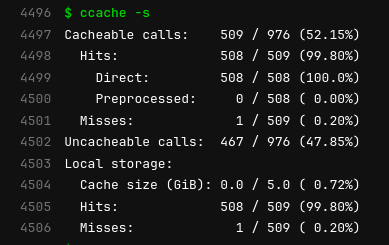
Upcoming improvements to Salsa CI, by Santiago Ruano Rinc n Last month, Santiago Ruano Rinc n started the work on integrating sbuild into the Salsa CI pipeline. Initially, Santiago used sbuild with the unshare chroot mode. However, after discussion with josch, jochensp and helmut (thanks to them!), it turns out that the unshare mode is not the most suitable for the pipeline, since the level of isolation it provides is not needed, and some test suites would fail (eg: krb5). Additionally, one of the requirements of the build job is the use of ccache, since it is needed by some C/C++ large projects to reduce the compilation time. In the preliminary work with unshare last month, it was not possible to make ccache to work. Finally, Santiago changed the chroot mode, and now has a couple of POC (cf: 1 and 2) that rely on the schroot and sudo, respectively. And the good news is that ccache is successfully used by sbuild with schroot! The image here comes from an example of building grep. At the end of the build, ccache -s shows the statistics of the cache that it used, and so a little more than half of the calls of that job were cacheable. The most important pieces are in place to finish the integration of sbuild into the pipeline. Other than that, Santiago also reviewed the very useful merge request !346, made by IOhannes zm lnig to autodetect the release from debian/changelog. As agreed with IOhannes, Santiago is preparing a merge request to include the release autodetection use case in the very own Salsa CI s CI.

Packaging simplemonitor, by Carles Pina i Estany Carles started using simplemonitor in 2017, opened a WNPP bug in 2022 and started packaging simplemonitor dependencies in October 2023. After packaging five direct and indirect dependencies, Carles finally uploaded simplemonitor to unstable in February. During the packaging of simplemonitor, Carles reported a few issues to upstream. Some of these were to make the simplemonitor package build and run tests reproducibly. A reproducibility issue was reprotest overriding the timezone, which broke simplemonitor s tests. There have been discussions on resolving this upstream in simplemonitor and in reprotest, too. Carles also started upgrading or improving some of simplemonitor s dependencies.

Miscellaneous contributions
  • Stefano Rivera spent some time doing admin on debian.social infrastructure. Including dealing with a spike of abuse on the Jitsi server.
  • Stefano started to prepare a new release of dh-python, including cleaning out a lot of old Python 2.x related code. Thanks to Niels Thykier (outside Freexian) for spear-heading this work.
  • DebConf 24 planning is beginning. Stefano discussed venues and finances with the local team and remotely supported a site-visit by Nattie (outside Freexian).
  • Also in the DebConf 24 context, Santiago took part in discussions and preparations related to the Content Team.
  • A JIT bug was reported against pypy3 in Debian Bookworm. Stefano bisected the upstream history to find the patch (it was already resolved upstream) and released an update to pypy3 in bookworm.
  • Enrico participated in /usr-merge discussions with Helmut.
  • Colin Watson backported a python-channels-redis fix to bookworm, rediscovered while working on debusine.
  • Colin dug into a cluster of celery build failures and tracked the hardest bit down to a Python 3.12 regression, now fixed in unstable. celery should be back in testing once the 64-bit time_t migration is out of the way.
  • Thorsten Alteholz uploaded a new upstream version of cpdb-libs. Unfortunately upstream changed the naming of their release tags, so updating the watch file was a bit demanding. Anyway this version 2.0 is a huge step towards introduction of the new Common Print Dialog Backends.
  • Helmut send patches for 48 cross build failures.
  • Helmut changed debvm to use mkfs.ext4 instead of genext2fs.
  • Helmut sent a debci MR for improving collector robustness.
  • In preparation for DebConf 25, Santiago worked on the Brest Bid.

12 March 2024

Russell Coker: Android vs FOSS Phones

To achieve my aims regarding Convergence of mobile phone and PC [1] I need something a big bigger than the 4G of RAM that s in the PinePhone Pro [2]. The PinePhonePro was released at the end of 2021 but has a SoC that was first released in 2016. That SoC seems to compare well to the ones used in the Pixel and Pixel 2 phones that were released in the same time period so it s not a bad SoC, but it doesn t compare well to more recent Android devices and it also isn t a great fit for the non-Android things I want to do. Also the PinePhonePro and Librem5 have relatively short battery life so reusing Android functionality for power saving could provide a real benefit. So I want a phone designed for the mass market that I can use for running Debian. PostmarketOS One thing I m definitely not going to do is attempt a full port of Linux to a different platform or support of kernel etc. So I need to choose a device that already has support from a somewhat free Linux system. The PostmarketOS system is the first I considered, the PostmarketOS Wiki page of supported devices [3] was the first place I looked. The main supported devices are the PinePhone (not Pro) and the Librem5, both of which are under-powered. For the community devices there seems to be nothing that supports calls, SMS, mobile data, and USB-OTG and which also has 4G of RAM or more. If I skip USB-OTG (which presumably means I d have to get dock functionality via wifi not impossible but not great) then I m left with the SHIFT6mq which was never sold in Australia and the Xiomi POCO F1 which doesn t appear to be available on ebay. LineageOS The libhybris libraries are a compatibility layer between Android and glibc programs [4]. Which includes running Wayland with Android display drivers. So running a somewhat standard Linux desktop on top of an Android kernel should be possible. Here is a table of the LineageOS supported devices that seem to have a useful feature set and are available in Australia and which could be used for running Debian with firmware and drivers copied from Android. I only checked LineageOS as it seems to be the main free Android build.
Phone RAM External Display Price
Edge 20 Pro [5] 6-12G HDMI $500 not many on sale
Edge S aka moto G100 [6] 6-8G HDMI $500 to $600+
Fairphone 4 6-8G USBC-DP $1000+
Nubia Red Magic 5G 8-16G USBC-DP $600+
The LineageOS device search page [9] allows searching by kernel version. There are no phones with a 6.6 (2023) or 6.1 (2022) Linux kernel and only the Pixel 8/8Pro and the OnePlus 11 5G run 5.15 (2021). There are 8 Google devices (Pixel 6/7 and a tablet) running 5.10 (2020), 18 devices running 5.4 (2019), and 32 devices running 4.19 (2018). There are 186 devices running kernels older than 4.19 which aren t in the kernel.org supported release list [10]. The Pixel 8 Pro with 12G of RAM and the OnePlus 11 5G with 16G of RAM are appealing as portable desktop computers, until recently my main laptop had 8G of RAM. But they cost over $1000 second hand compared to $359 for my latest laptop. Fosdem had an interesting lecture from two Fairphone employees about what they are doing to make phone production fairer for workers and less harmful for the environment [11]. But they don t have the market power that companies like Google have to tell SoC vendors what they want. IP Laws and Practices Bunnie wrote an insightful and informative blog post about the difference between intellectual property practices in China and US influenced countries and his efforts to reverse engineer a commonly used Chinese SoC [12]. This is a major factor in the lack of support for FOSS on phones and other devices. Droidian and Buying a Note 9 The FOSDEM 2023 has a lecture about the Droidian project which runs Debian with firmware and drivers from Android to make a usable mostly-FOSS system [13]. It s interesting how they use containers for the necessary Android apps. Here is the list of devices supported by Droidian [14]. Two notable entries in the list of supported devices are the Volla Phone and Volla Phone 22 from Volla a company dedicated to making open Android based devices [15]. But they don t seem to be available on ebay and the new price of the Volla Phone 22 is E452 ($AU750) which is more than I want to pay for a device that isn t as open as the Pine64 and Purism products. The Volla Phone 22 only has 4G of RAM.
Phone RAM Price Issues
Note 9 128G/512G 6G/8G <$300 Not supporting external display
Galaxy S9+ 6G <$300 Not supporting external display
Xperia 5 6G >$300 Hotspot partly working
OnePlus 3T 6G $200 $400+ photos not working
I just bought a Note 9 with 128G of storage and 6G of RAM for $109 to try out Droidian, it has some screen burn but that s OK for a test system and if I end up using it seriously I ll just buy another that s in as-new condition. With no support for an external display I ll need to setup a software dock to do Convergence, but that s not a serious problem. If I end up making a Note 9 with Droidian my daily driver then I ll use the 512G/8G model for that and use the cheap one for testing. Mobian I should have checked the Mobian list first as it s the main Debian variant for phones. From the Mobian Devices list [16] the OnePlus 6T has 8G of RAM or more but isn t available in Australia and costs more than $400 when imported. The PocoPhone F1 doesn t seem to be available on ebay. The Shift6mq is made by a German company with similar aims to the Fairphone [17], it looks nice but costs E577 which is more than I want to spend and isn t on the officially supported list. Smart Watches The same issues apply to smart watches. AstereoidOS is a free smart phone OS designed for closed hardware [18]. I don t have time to get involved in this sort of thing though, I can t hack on every device I use.

Next.

Previous.