Search Results: "cts"

30 June 2017

Arturo Borrero Gonz lez: About the OutlawCountry Linux malware

netfilter_predator Today I noticed the internet buzz about a new alleged Linux malware called OutlawCountry by the CIA, and leaked by Wikileaks. The malware redirects traffic from the victim to a control server in order to spy or whatever. To redirect this traffic, they use simple Netfilter NAT rules injected in the kernel. According to many sites commenting on the issue, is seems that there is something wrong with the Linux kernel Netfilter subsystem, but I read the leaked docs, and what they do is to load a custom kernel module in order to be able to load Netfilter NAT table/rules with more priority than the default ones (overriding any config the system may have). Isn t that clear? The attacker is loading a custom kernel module as root in your machine. They don t use Netfilter to break into your system. The problem is not Netfilter, the problem is your whole machine being under their control. With root control of the machine, they could simply use any mechanism, like kpatch or whatever, to replace your whole running kernel with a new one, with full access to memory, networking, file system et al. They probably use a rootkit or the like to take over the system.

Michal Čihař: Weblate 2.15

Weblate 2.15 has been released today. It is slightly behind schedule what was mostly caused by my vacation. As with 2.14, there are quite a lot of security improvements based on reports we got from HackerOne program and various new features. Full list of changes: If you are upgrading from older version, please follow our upgrading instructions. You can find more information about Weblate on https://weblate.org, the code is hosted on Github. If you are curious how it looks, you can try it out on demo server. You can login there with demo account using demo password or register your own user. Weblate is also being used on https://hosted.weblate.org/ as official translating service for phpMyAdmin, OsmAnd, Turris, FreedomBox, Weblate itself and many other projects. Should you be looking for hosting of translations for your project, I'm happy to host them for you or help with setting it up on your infrastructure. Further development of Weblate would not be possible without people providing donations, thanks to everybody who have helped so far! The roadmap for next release is just being prepared, you can influence this by expressing support for individual issues either by comments or by providing bounty for them.

Filed under: Debian English SUSE Weblate

27 June 2017

Daniel Pocock: How did the world ever work without Facebook?

Almost every day, somebody tells me there is no way they can survive without some social media like Facebook or Twitter. Otherwise mature adults fearful that without these dubious services, they would have no human contact ever again, they would die of hunger and the sky would come crashing down too. It is particularly disturbing for me to hear this attitude from community activists and campaigners. These are people who aspire to change the world, but can you really change the system using the tools the system gives you? Revolutionaries like Gandhi and the Bolsheviks don't have a lot in common: but both of them changed the world and both of them did so by going against the system. Gandhi, of course, relied on non-violence while the Bolsheviks continued to rely on violence long after taking power. Neither of them needed social media but both are likely to be remembered far longer than any viral video clip you have seen recently. With US border guards asking visitors for their Facebook profiles and Mark Zuckerberg being a regular participant at secretive Bilderberg meetings, it should be clear that Facebook and conventional social media is not on your side, it's on theirs. Kettling has never been easier When street protests erupt in major cities such as London, the police build fences around the protesters, cutting them off from the rest of the world. They become an island in the middle of the city, like a construction site or broken down bus that everybody else goes around. The police then set about arresting one person at a time, taking their name and photograph and then slowly letting them leave in different directions. This strategy is called kettling. Facebook helps kettle activists in their arm chair. The police state can gather far more data about them, while their impact is even more muted than if they ventured out of their home. You are more likely to win the lottery than make a viral campaign Every week there is news about some social media campaign that has gone viral. Every day, marketing professionals, professional campaigners and motivated activists sit at their computer spending hours trying to replicate this phenomenon. Do the math: how many of these campaigns can really be viral success stories? Society can only absorb a small number of these campaigns at any one time. For most of the people trying to ignite such campaigns, their time and energy is wasted, much like money spent buying lottery tickets and with odds that are just as bad. It is far better to focus on the quality of your work in other ways than to waste any time on social media. If you do something that is truly extraordinary, then other people will pick it up and share it for you and that is how a viral campaign really begins. The time and effort you put into trying to force something to become viral is wasting the energy and concentration you need to make something that is worthy of really being viral. An earthquake and an escaped lion never needed to announce themselves on social media to become an instant hit. If your news isn't extraordinary enough for random people to spontaneously post, share and tweet it in the first place, how can it ever go far? The news media deliberately over-rates social media News media outlets, including TV, radio and print, gain a significant benefit crowd-sourcing live information, free of charge, from the public on social media. It is only logical that they will cheer on social media sites and give them regular attention. Have you noticed that whenever Facebook's publicity department makes an announcement, the media are quick to publish it ahead of more significant stories about social or economic issues that impact our lives? Why do you think the media puts Facebook up on a podium like this, ahead of all other industries, if the media aren't getting something out of it too? The tail doesn't wag the dog One particular example is the news media's fascination with Donald Trump's Twitter account. Some people have gone as far as suggesting that this billionaire could have simply parked his jet and spent the whole of 2016 at one of his golf courses sending tweets and he would have won the presidency anyway. Suggesting that Trump's campaign revolved entirely around Twitter is like suggesting the tail wags the dog. The reality is different: Trump has been a prominent public figure for decades, both in the business and entertainment world. During his presidential campaign, he had at least 220 major campaign rallies attended by over 1.2 million people in the real world. Without this real-world organization and history, the Twitter account would have been largely ignored like the majority of Twitter accounts. On the left of politics, the media have been just as quick to suggest that Bernie Sanders and Jeremy Corbyn have been supported by the "Facebook generation". This label is superficial and deceiving. The reality, again, is a grass roots movement that has attracted young people to attend local campaign meetings in pubs up and down the country. Getting people to get out and be active is key. Social media is incidental to their campaign, not indispensible. Real-world meetings, big or small, are immensely more powerful than a social media presence. Consider the Trump example again: if 100,000 people receive one of his tweets, how many even notice it in the non-stop stream of information we are bombarded with today? On the other hand, if 100,000 bellow out a racist slogan at one of his rallies, is there any doubt whether each and every one of those people is engaged with the campaign at that moment? If you could choose between 100 extra Twitter followers or 10 extra activists attending a meeting every month, which would you prefer? Do we need this new definition of a Friend? Facebook is redefining what it means to be a friend. Is somebody who takes pictures of you and insists on sharing them with hundreds of people, tagging your face for the benefit of biometric profiling systems, really a friend? If you want to find out what a real friend is and who your real friends really are, there is no better way to do so then blowing away your Facebook and Twitter account and waiting to see who contacts you personally about meeting up in the real world. If you look at a profile on Facebook or Twitter, one of the most prominent features is the number of friends or followers they have. Research suggests that humans can realistically cope with no more than about 150 stable relationships. Facebook, however, has turned Friending people into something like a computer game. This research is also given far more attention then it deserves though: the number of really meaningful friendships that one person can maintain is far smaller. Think about how many birthdays and spouse's names you can remember and those may be the number of real friendships you can manage well. In his book Busy, Tony Crabbe suggests between 10-20 friendships are in this category and you should spend all your time with these people rather than letting your time be spread thinly across superficial Facebook "friends". This same logic can be extrapolated to activism and marketing in its many forms: is it better for a campaigner or publicist to have fifty journalists following him on Twitter (where tweets are often lost in the blink of an eye) or three journalists who he meets for drinks from time to time? Facebook alternatives: the ultimate trap? Numerous free, open source projects have tried to offer an equivalent to Facebook and Twitter. GNU social, Diaspora and identi.ca are some of the more well known examples. Trying to persuade people to move from Facebook to one of these platforms rarely works. In most cases, Metcalfe's law suggests the size of Facebook will suck them back in like the gravity of a black hole. To help people really beat these monstrosities, the most effective strategy is to help them live without social media, whether it is proprietary or not. The best way to convince them may be to give it up yourself and let them see how much you enjoy life without it. Share your thoughts The FSFE community has recently been debating the use of propriety software and services. Please feel free to join the list and click here to reply on the thread.

Reproducible builds folks: Reproducible Builds: week 113 in Stretch cycle

Here's what happened in the Reproducible Builds effort between Sunday June 18 and Saturday June 24 2017: Upcoming and Past events Our next IRC meeting is scheduled for the 6th of July at 17:00 UTC with this agenda currently:
  1. Introductions
  2. Reproducible Builds Summit update
  3. NMU campaign for buster
  4. Press release: Debian is doing Reproducible Builds for Buster
  5. Reproducible Builds Branding & Logo
  6. should we become an SPI member
  7. Next meeting
  8. Any other business
On June 19th, Chris Lamb presented at LinuxCon China 2017 on Reproducible Builds. On June 23rd, Vagrant Cascadian held a Reproducible Builds question and answer session at Open Source Bridge. Reproducible work in other projects LEDE: firmware-utils and mtd-utils/mkfs.jffs2 now honor SOURCE_DATE_EPOCH. Toolchain development and fixes There was discussion on #782654 about packaging bazel for Debian. Dan Kegel wrote a patch to use ar determinitiscally for Homebrew, a package manager for MacOS. Dan Kegel worked on using SOURCE_DATE_EPOCH and other reproduciblity fixes in fpm, a multi plattform package builder. The Fedora Haskell team disabled parallel builds to achieve reproducible builds. Bernhard M. Wiedemann submitted many patches upstream: Packages fixed and bugs filed Patches submitted upstream: Other patches filed in Debian: Reviews of unreproducible packages 573 package reviews have been added, 154 have been updated and 9 have been removed in this week, adding to our knowledge about identified issues. 1 issue type has been updated: Weekly QA work During our reproducibility testing, FTBFS bugs have been detected and reported by: diffoscope development Version 83 was uploaded to unstable by Chris Lamb. It also moved the previous changes from experimental (to where they were uploaded) to unstable. It included contributions from previous weeks. You can read about these changes in our previous weeks' posts, or view the changelog directly (raw form). We plan to maintain a backport of this and future versions in stretch-backports. Ximin Luo also worked on better html-dir output for very very large diffs such as those for GCC. So far, this includes unreleased work on a PartialString data structure which will form a core part of a new and more intelligent recursive display algorithm. strip-nondeterminism development Versions 0.035-1 was uploaded to unstable from experimental by Chris Lamb. It included contributions from: Later in the week Mattia Rizzolo uploaded 0.035-2 with some improvements to the autopkgtest and to the general packaging. We currently don't plan to maintain a backport in stretch-backports like we did for jessie-backports. Please speak up if you think otherwise. reproducible-website development tests.reproducible-builds.org Misc. This week's edition was written by Ximin Luo, Holger Levsen, Bernhard M. Wiedemann, Mattia Rizzolo, Chris Lamb & reviewed by a bunch of Reproducible Builds folks on IRC & the mailing lists.

Colin Watson: New address book

I ve had a kludgy mess of electronic address books for most of two decades, and have got rather fed up with it. My stack consisted of: The biggest practical problem with this was that I had the address book that was most convenient for me to add things to (Google Contacts) and the one I used when sending email, and no sensible way to merge them or move things between them. I also wasn t especially comfortable with having all my contact information in a proprietary web service. My goals for a replacement address book system were: I think I have all this now! New stack The obvious basic technology to use is CardDAV: it s fairly complex, admittedly, but lots of software supports it and one of my goals was not having to write my own thing. This meant I needed a CardDAV server, some way to sync the database to and from both Android and the system where I run mutt, and whatever query glue was necessary to get mutt to understand vCards. There are lots of different alternatives here, and if anything the problem was an embarrassment of choice. In the end I just decided to go for things that looked roughly the right shape for me and tried not to spend too much time in analysis paralysis. CardDAV server I went with Xandikos for the server, largely because I know Jelmer and have generally had pretty good experiences with their software, but also because using Git for history of the backend storage seems like something my future self will thank me for. It isn t packaged in stretch, but it s in Debian unstable, so I installed it from there. Rather than the standalone mode suggested on the web page, I decided to set it up in what felt like a more robust way using WSGI. I installed uwsgi, uwsgi-plugin-python3, and libapache2-mod-proxy-uwsgi, and created the following file in /etc/uwsgi/apps-available/xandikos.ini which I then symlinked into /etc/uwsgi/apps-enabled/xandikos.ini:
[uwsgi]
socket = 127.0.0.1:8801
uid = xandikos
gid = xandikos
umask = 022
master = true
cheaper = 2
processes = 4
plugin = python3
module = xandikos.wsgi:app
env = XANDIKOSPATH=/srv/xandikos/collections
The port number was arbitrary, as was the path. You need to create the xandikos user and group first (adduser --system --group --no-create-home --disabled-login xandikos). I created /srv/xandikos owned by xandikos:xandikos and mode 0700, and I recommend setting a umask as shown above since uwsgi s default umask is 000 (!). You should also run sudo -u xandikos xandikos -d /srv/xandikos/collections --autocreate and then Ctrl-c it after a short time (I think it would be nicer if there were a way to ask the WSGI wrapper to do this). For Apache setup, I kept it reasonably simple: I ran a2enmod proxy_uwsgi, used htpasswd to create /etc/apache2/xandikos.passwd with a username and password for myself, added a virtual host in /etc/apache2/sites-available/xandikos.conf, and enabled it with a2ensite xandikos:
<VirtualHost *:443>
        ServerName xandikos.example.org
        ServerAdmin me@example.org
        ErrorLog /var/log/apache2/xandikos-error.log
        TransferLog /var/log/apache2/xandikos-access.log
        <Location />
                ProxyPass "uwsgi://127.0.0.1:8801/"
                AuthType Basic
                AuthName "Xandikos"
                AuthBasicProvider file
                AuthUserFile "/etc/apache2/xandikos.passwd"
                Require valid-user
        </Location>
</VirtualHost>
Then service apache2 reload, set the new virtual host up with Let s Encrypt, reloaded again, and off we go. Android integration I installed DAVdroid from the Play Store: it cost a few pounds, but I was OK with that since it s GPLv3 and I m happy to help fund free software. I created two accounts, one for my existing Google Contacts database (and in fact calendaring as well, although I don t intend to switch over to self-hosting that just yet), and one for the new Xandikos instance. The Google setup was a bit fiddly because I have two-step verification turned on so I had to create an app-specific password. The Xandikos setup was straightforward: base URL, username, password, and done. Since I didn t completely trust the new setup yet, I followed what seemed like the most robust option from the DAVdroid contacts syncing documentation, and used the stock contacts app to export my Google Contacts account to a .vcf file and then import that into the appropriate DAVdroid account (which showed up automatically). This seemed straightforward and everything got pushed to Xandikos. There are some weird delays in syncing contacts that I don t entirely understand, but it all seems to get there in the end. mutt integration First off I needed to sync the contacts. (In fact I happen to run mutt on the same system where I run Xandikos at the moment, but I don t want to rely on that, and going through the CardDAV server means that I don t have to poke holes for myself using filesystem permissions.) I used vdirsyncer for this. In ~/.vdirsyncer/config:
[general]
status_path = "~/.vdirsyncer/status/"
[pair contacts]
a = "contacts_local"
b = "contacts_remote"
collections = ["from a", "from b"]
[storage contacts_local]
type = "filesystem"
path = "~/.contacts/"
fileext = ".vcf"
[storage contacts_remote]
type = "carddav"
url = "<Xandikos base URL>"
username = "<my username>"
password = "<my password>"
Running vdirsyncer discover and vdirsyncer sync then synced everything into ~/.contacts/. I added an hourly crontab entry to run vdirsyncer -v WARNING sync. Next, I needed a command-line address book tool based on this. khard looked about right and is in stretch, so I installed that. In ~/.config/khard/khard.conf (this is mostly just the example configuration, but I preferred to sort by first name since not all my contacts have neat first/last names):
[addressbooks]
[[contacts]]
path = ~/.contacts/<UUID of my contacts collection>/
[general]
debug = no
default_action = list
editor = vim
merge_editor = vimdiff
[contact table]
# display names by first or last name: first_name / last_name
display = first_name
# group by address book: yes / no
group_by_addressbook = no
# reverse table ordering: yes / no
reverse = no
# append nicknames to name column: yes / no
show_nicknames = no
# show uid table column: yes / no
show_uids = yes
# sort by first or last name: first_name / last_name
sort = first_name
[vcard]
# extend contacts with your own private objects
# these objects are stored with a leading "X-" before the object name in the vcard files
# every object label may only contain letters, digits and the - character
# example:
#   private_objects = Jabber, Skype, Twitter
private_objects = Jabber, Skype, Twitter
# preferred vcard version: 3.0 / 4.0
preferred_version = 3.0
# Look into source vcf files to speed up search queries: yes / no
search_in_source_files = no
# skip unparsable vcard files: yes / no
skip_unparsable = no
Now khard list shows all my contacts. So far so good. Apparently there are some awkward vCard compatibility issues with creating or modifying contacts from the khard end. I ve tried adding one address from ~/.mutt/aliases using khard and it seems to at least minimally work for me, but I haven t explored this very much yet. I had to install python3-vobject 0.9.4.1-1 from experimental to fix eventable/vobject#39 saving certain vCard files. Finally, mutt integration. I already had set query_command="lbdbq '%s'" in ~/.muttrc, and I wanted to keep that in place since I still wanted to use LDAP querying as well. I had to write a very small amount of code for this (perhaps I should contribute this to lbdb upstream?), in ~/.lbdb/modules/m_khard:
#! /bin/sh
m_khard_query ()  
    khard email --parsable --remove-first-line --search-in-source-files "$1"
 
My full ~/.lbdb/rc now reads as follows (you probably won t want the LDAP stuff, but I ve included it here for completeness):
MODULES_PATH="$MODULES_PATH $HOME/.lbdb/modules"
METHODS='m_muttalias m_khard m_ldap'
LDAP_NICKS='debian canonical'
Next steps I ve deleted one account from Google Contacts just to make sure that everything still works (e.g. I can still search for it when composing a new message), but I haven t yet deleted everything. I won t be adding anything new there though. I need to push everything from ~/.mutt/aliases into the new system. This is only about 30 contacts so shouldn t take too long. Overall this feels like a big improvement! It wasn t a trivial amount of setup for just me, but it means I have both better usability for myself and more independence from proprietary services, and I think I can add extra users with much less effort if I need to. Postscript A day later and I ve consolidated all my accounts from Google Contacts and ~/.mutt/aliases into the new system, with the exception of one group that I had defined as a mutt alias and need to work out what to do with. This all went smoothly. I ve filed the new lbdb module as #866178, and the python3-vobject bug as #866181.
Benjamin Mako Hill: Learning to Code in One s Own Language

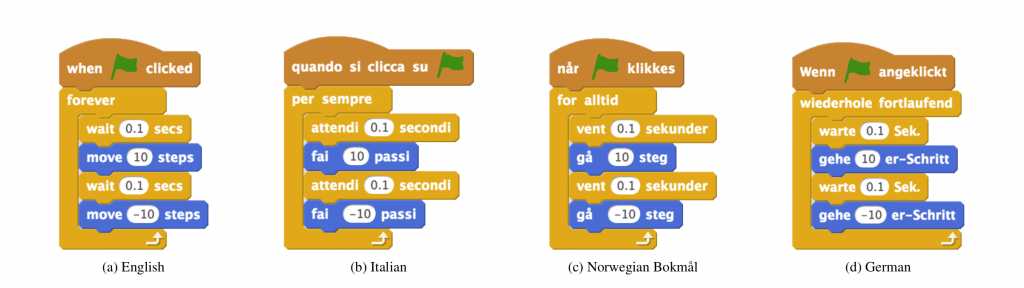
I recently published a paper with Sayamindu Dasgupta that provides evidence in support of the idea that kids can learn to code more quickly when they are programming in their own language. Millions of young people from around the world are learning to code. Often, during their learning experiences, these youth are using visual block-based programming languages like Scratch, App Inventor, and Code.org Studio. In block-based programming languages, coders manipulate visual, snap-together blocks that represent code constructs instead of textual symbols and commands that are found in more traditional programming languages. The textual symbols used in nearly all non-block-based programming languages are drawn from English consider if statements and for loops for common examples. Keywords in block-based languages, on the other hand, are often translated into different human languages. For example, depending on the language preference of the user, an identical set of computing instructions in Scratch can be represented in many different human languages:
Examples of a short piece of Scratch code shown in four different human languages: English, Italian, Norwegian Bokm l, and German.
Although my research with Sayamindu Dasgupta focuses on learning, both Sayamindu and I worked on local language technologies before coming back to academia. As a result, we were both interested in how the increasing translation of programming languages might be making it easier for non-English speaking kids to learn to code. After all, a large body of education research has shown that early-stage education is more effective when instruction is in the language that the learner speaks at home. Based on this research, we hypothesized that children learning to code with block-based programming languages translated to their mother-tongues will have better learning outcomes than children using the blocks in English. We sought to test this hypothesis in Scratch, an informal learning community built around a block-based programming language. We were helped by the fact that Scratch is translated into many languages and has a large number of learners from around the world. To measure learning, we built on some of our our own previous work and looked at learners cumulative block repertoires similar to a code vocabulary. By observing a learner s cumulative block repertoire over time, we can measure how quickly their code vocabulary is growing. Using this data, we compared the rate of growth of cumulative block repertoire between learners from non-English speaking countries using Scratch in English to learners from the same countries using Scratch in their local language. To identify non-English speakers, we considered Scratch users who reported themselves as coming from five primarily non-English speaking countries: Portugal, Italy, Brazil, Germany, and Norway. We chose these five countries because they each have one very widely spoken language that is not English and because Scratch is almost fully translated into that language. Even after controlling for a number of factors like social engagement on the Scratch website, user productivity, and time spent on projects, we found that learners from these countries who use Scratch in their local language have a higher rate of cumulative block repertoire growth than their counterparts using Scratch in English. This faster growth was despite having a lower initial block repertoire. The graph below visualizes our results for two prototypical learners who start with the same initial block repertoire: one learner who uses the English interface, and a second learner who uses their native language.
Summary of the results of our model for two prototypical individuals.
Our results are in line with what theories of education have to say about learning in one s own language. Our findings also represent good news for designers of block-based programming languages who have spent considerable amounts of effort in making their programming languages translatable. It s also good news for the volunteers who have spent many hours translating blocks and user interfaces. Although we find support for our hypothesis, we should stress that our findings are both limited and incomplete. For example, because we focus on estimating the differences between Scratch learners, our comparisons are between kids who all managed to successfully use Scratch. Before Scratch was translated, kids with little working knowledge of English or the Latin script might not have been able to use Scratch at all. Because of translation, many of these children are now able to learn to code.
This blog post and the work that it describes is a collaborative project with Sayamindu Dasgupta. Sayamindu also published a very similar version of the blog post in several places. Our paper is open access and you can read it here. The paper was published in the proceedings of the ACM Learning @ Scale Conference. We also recently gave a talk about this work at the International Communication Association s annual conference. We received support and feedback from members of the Scratch team at MIT (especially Mitch Resnick and Natalie Rusk), as well as from Nathan TeBlunthuis at the University of Washington. Financial support came from the US National Science Foundation.

25 June 2017

Andreas Bombe: PDP-8/e Replicated Introduction

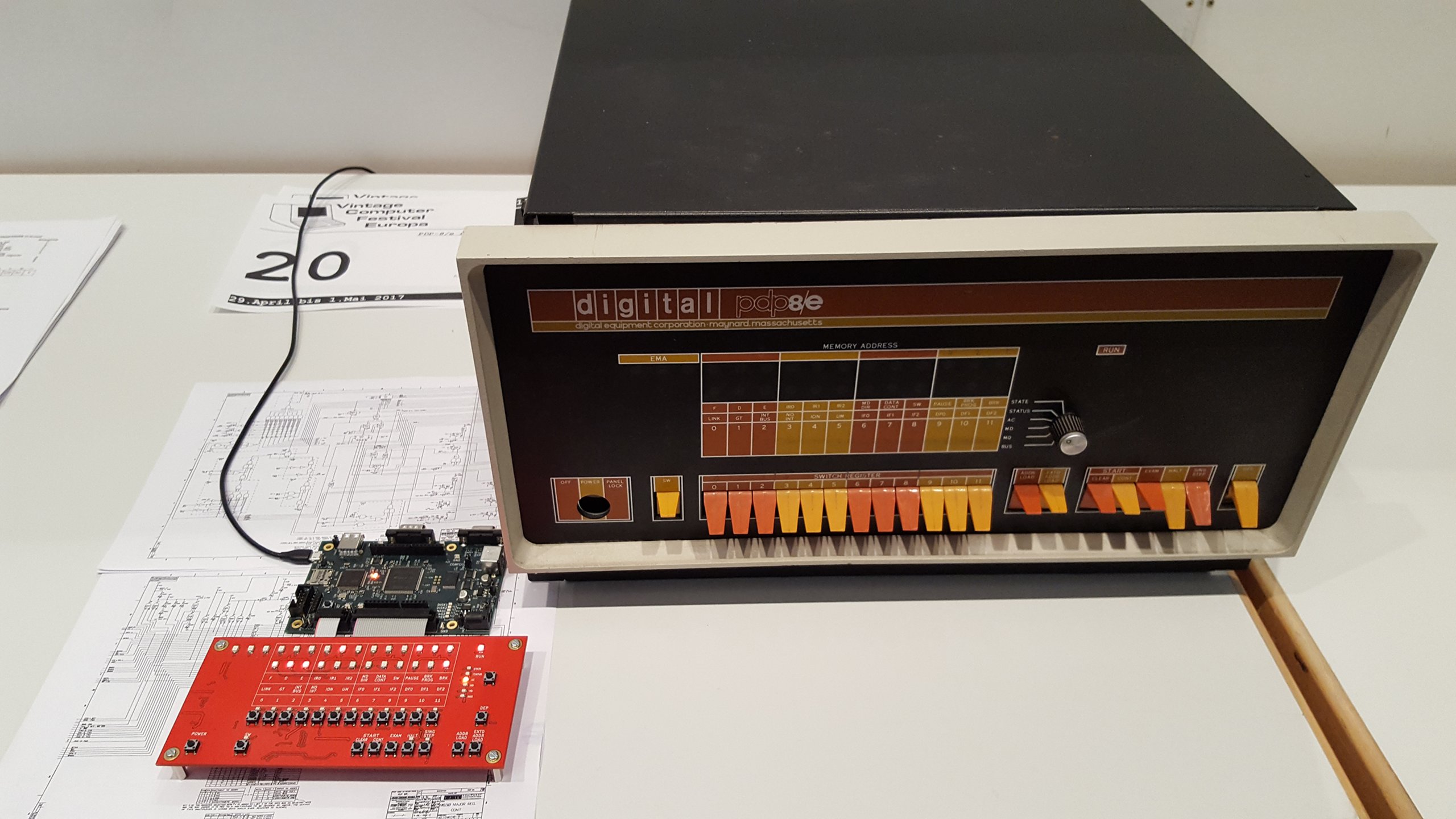
I am creating a replica of the DEC PDP-8/e architecture in an FPGA from schematics of the original hardware. So how did I end up with a project like this? The story begins with me wanting to have a computer with one of those front panels that have many, many lights where you can really see, in real time, what the computer is doing while it is executing code. Not because I am nostalgic for a prior experience with any of those I was born a bit too late for that and my first computer as a kid was a Commodore 64. Now, the front panel era ended around 40 years ago with the advent of microprocessors and computers of that age and older that are complete and working are hard to find and not cheap. And even if you do, there s the issue of weight, size (complete systems with peripherals fill at least a rack) and power consumption. So what to do build myself a small one with modern technology of course. While there s many computer architectures of that era to choose from, the various PDP machines by DEC are significant and well known (and documented) due to their large numbers. The most important are probably the 12 bit PDP-8, the 16 bit PDP-11 and the 36 bit PDP-10. While the PDP-11 is enticing because of the possibility to run UNIX I wanted to start with something simpler, so I chose the PDP-8.
My implementation on display next to a real PDP-8/e at VCFe 18.0

The Original DEC started the PDP-8 line of computers programmed data processors designed as low cost machines in 1965. It is a quite minimalist 12 bit architecture based on the earlier PDP-5, and by minimalist I mean seriously minimal. If you are familiar with early 8 bit microprocessors like the 6502 or 8080 you will find them luxuriously equipped in comparison. The PDP-8 base architecture has a program counter (PC) and an accumulator (AC)1. That s it. There are no pointer or index registers2. There is no stack. It has addition and AND instructions but subtractions and OR operations have to be manually coded. The optional Extended Arithmetic Element adds the MQ register but that s really it for visible registers. The Wikipedia page on the PDP-8 has a good detailed description. Regarding technology, the PDP-8 series has been in production long enough to get the whole range of implementations from discrete transistor logic to microprocessors. The 8/e which I target was right in the middle, implemented in TTL logic where each IC contains multiple logic elements. This allowed the CPU itself (including timing generator) to fit on three large circuit boards plugged into a backplane. Complete systems would have at least another board for the front panel and multiple boards for the core memory, then additional boards for whatever options and peripherals were desired.

Design Choices and Comparisons I m not the only one who had the idea to build something like that, of course. Among the other modern PDP-8 implementations with a front panel, probably the most prominent project is the Spare Time Gizmos SBC6120 which is a PDP-8 single board computer built around the Harris/Intersil HD-6120 microprocessor, which implementes the PDP-8 architecture, combined with a nice front panel. Another is the PiDP-8/I, which is another nice front panel (modeled after the 8/i which has even more lights) driven by the simh simulator running under Linux on a Raspberry Pi. My goal is to get front panel lights that appear exactly like the real ones in operation. This necessitates driving the lights at full speed as they change with every instruction or even within instructions for some display selections. For example, if you run a tight loop that does nothing but increment AC while displaying that register, it would appear that all lights are lit at equal but less than full brightness. The reason is that the loop runs at such a high speed that even the most significant bit, which is blinking the slowest, is too fast to see flicker. Hence they are all effectively 50% on, just at different frequencies, and appear to be constantly light at the same brightness. This is where the other projects lack what I am looking for. The PiDP-8/I is a multiplexed display which updates at something like 30 Hz or 60 Hz, taking whatever value is current in the simulation software at the time. All the states the lights took inbetween are lost and consequently there is flickering where there shouldn t be. On the SBC6120 at least the address lines appear to update at full speed as these are the actual RAM address lines. However the used 6120 microprocessor does not have required data for the indicator display externally available. Instead, the SBC6120 runs an interrupt at 30 Hz to trap into its firmware/monitor program which then reads the current state and writes it to the front panel display, which is essentially just another peripheral. A different considerable problem with the SBC6120 is its use of the 6100 microprocessor family ICs, which are themselves long out of production and not trivial (or cheaply) to come by. Given that the way to go is to drive all lights in step with every cycle3, this can be done by a software running on a dedicated microcontroller which is how I started or by implementing a real CPU with all the needed outputs in an FPGA which is the project I am writing about. In the next post I give an overview of the hardware I built so far and some of the features that are yet to be implemented.

  1. With an associated link bit which is a little different from a carry bit in that it is treated as a thirteenth bit, i.e. it will be flipped rather than set when a carry occurs. [return]
  2. Although there are 8 specially treated memory addresses that will pre-increment when used in indirect addressing. [return]
  3. Basic cycles on the PDP-8/e are 1.4 s for memory modifying cycles and fast cycles of 1.2 s for everything else. Instructions can be one to three cycles long. [return]

23 June 2017

Bits from Debian: Hewlett Packard Enterprise Platinum Sponsor of DebConf17

HPElogo We are very pleased to announce that Hewlett Packard Enterprise (HPE) has committed support to DebConf17 as a Platinum sponsor. "Hewlett Packard Enterprise is excited to support Debian's annual developer conference again this year", said Steve Geary, Senior Director R&D at Hewlett Packard Enterprise. "As Platinum sponsors and member of the Debian community, HPE is committed to supporting Debconf. The conference, community and open distribution are foundational to the development of The Machine research program and will our bring our Memory Driven Computing agenda to life." HPE is one of the largest computer companies in the world, providing a wide range of products and services, such as servers, storage, networking, consulting and support, software, and financial services. HPE is also a development partner of Debian, and provides hardware for port development, Debian mirrors, and other Debian services (hardware donations are listed in the Debian machines page). With this additional commitment as Platinum Sponsor, HPE contributes to make possible our annual conference, and directly supports the progress of Debian and Free Software helping to strengthen the community that continues to collaborate on Debian projects throughout the rest of the year. Thank you very much Hewlett Packard Enterprise, for your support of DebConf17! Become a sponsor too! DebConf17 is still accepting sponsors. Interested companies and organizations may contact the DebConf team through sponsors@debconf.org, and visit the DebConf17 website at https://debconf17.debconf.org.

22 June 2017

Dirk Eddelbuettel: nanotime 0.2.0

A new version of the nanotime package for working with nanosecond timestamps just arrived on CRAN. nanotime uses the RcppCCTZ package for (efficient) high(er) resolution time parsing and formatting up to nanosecond resolution, and the bit64 package for the actual integer64 arithmetic. Thanks to a metric ton of work by Leonardo Silvestri, the package now uses S4 classes internally allowing for greater consistency of operations on nanotime objects.

Changes in version 0.2.0 (2017-06-22)
  • Rewritten in S4 to provide more robust operations (#17 by Leonardo)
  • Ensure tz="" is treated as unset (Leonardo in #20)
  • Added format and tz arguments to nanotime, format, print (#22 by Leonardo and Dirk)
  • Ensure printing respect options()$max.print, ensure names are kept with vector (#23 by Leonardo)
  • Correct summary() by defining names<- (Leonardo in #25 fixing #24)
  • Report error on operations that are meaningful for type; handled NA, NaN, Inf, -Inf correctly (Leonardo in #27 fixing #26)

We also have a diff to the previous version thanks to CRANberries. More details and examples are at the nanotime page; code, issue tickets etc at the GitHub repository.

This post by Dirk Eddelbuettel originated on his Thinking inside the box blog. Please report excessive re-aggregation in third-party for-profit settings.

21 June 2017

Vincent Bernat: IPv4 route lookup on Linux

TL;DR: With its implementation of IPv4 routing tables using LPC-tries, Linux offers good lookup performance (50 ns for a full view) and low memory usage (64 MiB for a full view).
During the lifetime of an IPv4 datagram inside the Linux kernel, one important step is the route lookup for the destination address through the fib_lookup() function. From essential information about the datagram (source and destination IP addresses, interfaces, firewall mark, ), this function should quickly provide a decision. Some possible options are: Since 2.6.39, Linux stores routes into a compressed prefix tree (commit 3630b7c050d9). In the past, a route cache was maintained but it has been removed1 in Linux 3.6.

Route lookup in a trie Looking up a route in a routing table is to find the most specific prefix matching the requested destination. Let s assume the following routing table:
$ ip route show scope global table 100
default via 203.0.113.5 dev out2
192.0.2.0/25
        nexthop via 203.0.113.7  dev out3 weight 1
        nexthop via 203.0.113.9  dev out4 weight 1
192.0.2.47 via 203.0.113.3 dev out1
192.0.2.48 via 203.0.113.3 dev out1
192.0.2.49 via 203.0.113.3 dev out1
192.0.2.50 via 203.0.113.3 dev out1
Here are some examples of lookups and the associated results:
Destination IP Next hop
192.0.2.49 203.0.113.3 via out1
192.0.2.50 203.0.113.3 via out1
192.0.2.51 203.0.113.7 via out3 or 203.0.113.9 via out4 (ECMP)
192.0.2.200 203.0.113.5 via out2
A common structure for route lookup is the trie, a tree structure where each node has its parent as prefix.

Lookup with a simple trie The following trie encodes the previous routing table: Simple routing trie For each node, the prefix is known by its path from the root node and the prefix length is the current depth. A lookup in such a trie is quite simple: at each step, fetch the nth bit of the IP address, where n is the current depth. If it is 0, continue with the first child. Otherwise, continue with the second. If a child is missing, backtrack until a routing entry is found. For example, when looking for 192.0.2.50, we will find the result in the corresponding leaf (at depth 32). However for 192.0.2.51, we will reach 192.0.2.50/31 but there is no second child. Therefore, we backtrack until the 192.0.2.0/25 routing entry. Adding and removing routes is quite easy. From a performance point of view, the lookup is done in constant time relative to the number of routes (due to maximum depth being capped to 32). Quagga is an example of routing software still using this simple approach.

Lookup with a path-compressed trie In the previous example, most nodes only have one child. This leads to a lot of unneeded bitwise comparisons and memory is also wasted on many nodes. To overcome this problem, we can use path compression: each node with only one child is removed (except if it also contains a routing entry). Each remaining node gets a new property telling how many input bits should be skipped. Such a trie is also known as a Patricia trie or a radix tree. Here is the path-compressed version of the previous trie: Patricia trie Since some bits have been ignored, on a match, a final check is executed to ensure all bits from the found entry are matching the input IP address. If not, we must act as if the entry wasn t found (and backtrack to find a matching prefix). The following figure shows two IP addresses matching the same leaf: Lookup in a Patricia trie The reduction on the average depth of the tree compensates the necessity to handle those false positives. The insertion and deletion of a routing entry is still easy enough. Many routing systems are using Patricia trees:

Lookup with a level-compressed trie In addition to path compression, level compression2 detects parts of the trie that are densily populated and replace them with a single node and an associated vector of 2k children. This node will handle k input bits instead of just one. For example, here is a level-compressed version our previous trie: Level-compressed trie Such a trie is called LC-trie or LPC-trie and offers higher lookup performances compared to a radix tree. An heuristic is used to decide how many bits a node should handle. On Linux, if the ratio of non-empty children to all children would be above 50% when the node handles an additional bit, the node gets this additional bit. On the other hand, if the current ratio is below 25%, the node loses the responsibility of one bit. Those values are not tunable. Insertion and deletion becomes more complex but lookup times are also improved.

Implementation in Linux The implementation for IPv4 in Linux exists since 2.6.13 (commit 19baf839ff4a) and is enabled by default since 2.6.39 (commit 3630b7c050d9). Here is the representation of our example routing table in memory3: Memory representation of a trie There are several structures involved: The trie can be retrieved through /proc/net/fib_trie:
$ cat /proc/net/fib_trie
Id 100:
  +-- 0.0.0.0/0 2 0 2
      -- 0.0.0.0
        /0 universe UNICAST
     +-- 192.0.2.0/26 2 0 1
         -- 192.0.2.0
           /25 universe UNICAST
         -- 192.0.2.47
           /32 universe UNICAST
        +-- 192.0.2.48/30 2 0 1
            -- 192.0.2.48
              /32 universe UNICAST
            -- 192.0.2.49
              /32 universe UNICAST
            -- 192.0.2.50
              /32 universe UNICAST
[...]
For internal nodes, the numbers after the prefix are:
  1. the number of bits handled by the node,
  2. the number of full children (they only handle one bit),
  3. the number of empty children.
Moreover, if the kernel was compiled with CONFIG_IP_FIB_TRIE_STATS, some interesting statistics are available in /proc/net/fib_triestat4:
$ cat /proc/net/fib_triestat
Basic info: size of leaf: 48 bytes, size of tnode: 40 bytes.
Id 100:
        Aver depth:     2.33
        Max depth:      3
        Leaves:         6
        Prefixes:       6
        Internal nodes: 3
          2: 3
        Pointers: 12
Null ptrs: 4
Total size: 1  kB
[...]
When a routing table is very dense, a node can handle many bits. For example, a densily populated routing table with 1 million entries packed in a /12 can have one internal node handling 20 bits. In this case, route lookup is essentially reduced to a lookup in a vector. The following graph shows the number of internal nodes used relative to the number of routes for different scenarios (routes extracted from an Internet full view, /32 routes spreaded over 4 different subnets with various densities). When routes are densily packed, the number of internal nodes are quite limited. Internal nodes and null pointers

Performance So how performant is a route lookup? The maximum depth stays low (about 6 for a full view), so a lookup should be quite fast. With the help of a small kernel module, we can accurately benchmark5 the fib_lookup() function: Maximum depth and lookup time The lookup time is loosely tied to the maximum depth. When the routing table is densily populated, the maximum depth is low and the lookup times are fast. When forwarding at 10 Gbps, the time budget for a packet would be about 50 ns. Since this is also the time needed for the route lookup alone in some cases, we wouldn t be able to forward at line rate with only one core. Nonetheless, the results are pretty good and they are expected to scale linearly with the number of cores. The measurements are done with a Linux kernel 4.11 from Debian unstable. I have gathered performance metrics accross kernel versions in Performance progression of IPv4 route lookup on Linux . Another interesting figure is the time it takes to insert all those routes into the kernel. Linux is also quite efficient in this area since you can insert 2 million routes in less than 10 seconds: Insertion time

Memory usage The memory usage is available directly in /proc/net/fib_triestat. The statistic provided doesn t account for the fib_info structures, but you should only have a handful of them (one for each possible next-hop). As you can see on the graph below, the memory use is linear with the number of routes inserted, whatever the shape of the routes is. Memory usage The results are quite good. With only 256 MiB, about 2 million routes can be stored!

Routing rules Unless configured without CONFIG_IP_MULTIPLE_TABLES, Linux supports several routing tables and has a system of configurable rules to select the table to use. These rules can be configured with ip rule. By default, there are three of them:
$ ip rule show
0:      from all lookup local
32766:  from all lookup main
32767:  from all lookup default
Linux will first lookup for a match in the local table. If it doesn t find one, it will lookup in the main table and at last resort, the default table.

Builtin tables The local table contains routes for local delivery:
$ ip route show table local
broadcast 127.0.0.0 dev lo proto kernel scope link src 127.0.0.1
local 127.0.0.0/8 dev lo proto kernel scope host src 127.0.0.1
local 127.0.0.1 dev lo proto kernel scope host src 127.0.0.1
broadcast 127.255.255.255 dev lo proto kernel scope link src 127.0.0.1
broadcast 192.168.117.0 dev eno1 proto kernel scope link src 192.168.117.55
local 192.168.117.55 dev eno1 proto kernel scope host src 192.168.117.55
broadcast 192.168.117.63 dev eno1 proto kernel scope link src 192.168.117.55
This table is populated automatically by the kernel when addresses are configured. Let s look at the three last lines. When the IP address 192.168.117.55 was configured on the eno1 interface, the kernel automatically added the appropriate routes:
  • a route for 192.168.117.55 for local unicast delivery to the IP address,
  • a route for 192.168.117.255 for broadcast delivery to the broadcast address,
  • a route for 192.168.117.0 for broadcast delivery to the network address.
When 127.0.0.1 was configured on the loopback interface, the same kind of routes were added to the local table. However, a loopback address receives a special treatment and the kernel also adds the whole subnet to the local table. As a result, you can ping any IP in 127.0.0.0/8:
$ ping -c1 127.42.42.42
PING 127.42.42.42 (127.42.42.42) 56(84) bytes of data.
64 bytes from 127.42.42.42: icmp_seq=1 ttl=64 time=0.039 ms
--- 127.42.42.42 ping statistics ---
1 packets transmitted, 1 received, 0% packet loss, time 0ms
rtt min/avg/max/mdev = 0.039/0.039/0.039/0.000 ms
The main table usually contains all the other routes:
$ ip route show table main
default via 192.168.117.1 dev eno1 proto static metric 100
192.168.117.0/26 dev eno1 proto kernel scope link src 192.168.117.55 metric 100
The default route has been configured by some DHCP daemon. The connected route (scope link) has been automatically added by the kernel (proto kernel) when configuring an IP address on the eno1 interface. The default table is empty and has little use. It has been kept when the current incarnation of advanced routing has been introduced in Linux 2.1.68 after a first tentative using classes in Linux 2.1.156.

Performance Since Linux 4.1 (commit 0ddcf43d5d4a), when the set of rules is left unmodified, the main and local tables are merged and the lookup is done with this single table (and the default table if not empty). Moreover, since Linux 3.0 (commit f4530fa574df), without specific rules, there is no performance hit when enabling the support for multiple routing tables. However, as soon as you add new rules, some CPU cycles will be spent for each datagram to evaluate them. Here is a couple of graphs demonstrating the impact of routing rules on lookup times: Routing rules impact on performance For some reason, the relation is linear when the number of rules is between 1 and 100 but the slope increases noticeably past this threshold. The second graph highlights the negative impact of the first rule (about 30 ns). A common use of rules is to create virtual routers: interfaces are segregated into domains and when a datagram enters through an interface from domain A, it should use routing table A:
# ip rule add iif vlan457 table 10
# ip rule add iif vlan457 blackhole
# ip rule add iif vlan458 table 20
# ip rule add iif vlan458 blackhole
The blackhole rules may be removed if you are sure there is a default route in each routing table. For example, we add a blackhole default with a high metric to not override a regular default route:
# ip route add blackhole default metric 9999 table 10
# ip route add blackhole default metric 9999 table 20
# ip rule add iif vlan457 table 10
# ip rule add iif vlan458 table 20
To reduce the impact on performance when many interface-specific rules are used, interfaces can be attached to VRF instances and a single rule can be used to select the appropriate table:
# ip link add vrf-A type vrf table 10
# ip link set dev vrf-A up
# ip link add vrf-B type vrf table 20
# ip link set dev vrf-B up
# ip link set dev vlan457 master vrf-A
# ip link set dev vlan458 master vrf-B
# ip rule show
0:      from all lookup local
1000:   from all lookup [l3mdev-table]
32766:  from all lookup main
32767:  from all lookup default
The special l3mdev-table rule was automatically added when configuring the first VRF interface. This rule will select the routing table associated to the VRF owning the input (or output) interface. VRF was introduced in Linux 4.3 (commit 193125dbd8eb), the performance was greatly enhanced in Linux 4.8 (commit 7889681f4a6c) and the special routing rule was also introduced in Linux 4.8 (commit 96c63fa7393d, commit 1aa6c4f6b8cd). You can find more details about it in the kernel documentation.

Conclusion The takeaways from this article are:
  • route lookup times hardly increase with the number of routes,
  • densily packed /32 routes lead to amazingly fast route lookups,
  • memory use is low (128 MiB par million routes),
  • no optimization is done on routing rules.

  1. The routing cache was subject to reasonably easy to launch denial of service attacks. It was also believed to not be efficient for high volume sites like Google but I have first-hand experience it was not the case for moderately high volume sites.
  2. IP-address lookup using LC-tries , IEEE Journal on Selected Areas in Communications, 17(6):1083-1092, June 1999.
  3. For internal nodes, the key_vector structure is embedded into a tnode structure. This structure contains information rarely used during lookup, notably the reference to the parent that is usually not needed for backtracking as Linux keeps the nearest candidate in a variable.
  4. One leaf can contain several routes (struct fib_alias is a list). The number of prefixes can therefore be greater than the number of leaves. The system also keeps statistics about the distribution of the internal nodes relative to the number of bits they handle. In our example, all the three internal nodes are handling 2 bits.
  5. The measurements are done in a virtual machine with one vCPU. The host is an Intel Core i5-4670K running at 3.7 GHz during the experiment (CPU governor was set to performance). The benchmark is single-threaded. It runs a warm-up phase, then executes about 100,000 timed iterations and keeps the median. Timings of individual runs are computed from the TSC.
  6. Fun fact: the documentation of this first tentative of more flexible routing is still available in today s kernel tree and explains the usage of the default class .

20 June 2017

Andreas Bombe: New Blog

So I finally got myself a blog to write about my software and hardware projects, my work in Debian and, I guess, stuff. Readers of planet.debian.org, hi! If you can see this I got the configuration right. For the curious, I m using a static site generator for this blog Hugo to be specific like all the cool kids do these days.

Norbert Preining: TeX Live 2017 hits Debian/unstable

Yesterday I uploaded the first packages of TeX Live 2017 to Debian/unstable, meaning that the new release cycle has started. Debian/stretch was released over the weekend, and this opened up unstable for new developments. The upload comprised the following packages: asymptote, cm-super, context, context-modules, texlive-base, texlive-bin, texlive-extra, texlive-extra, texlive-lang, texworks, xindy.

I mentioned already in a previous post the following changes: The last two changes are described together with other news (easy TEXMF tree management) in the TeX Live release post. These changes more or less sum up the new infra structure developments in TeX Live 2017. Since the last release to unstable (which happened in 2017-01-23) about half a year of package updates have accumulated, below is an approximate list of updates (not split into new/updated, though). Enjoy the brave new world of TeX Live 2017, and please report bugs to the BTS! Updated/new packages:
academicons, achemso, acmart, acro, actuarialangle, actuarialsymbol, adobemapping, alkalami, amiri, animate, aomart, apa6, apxproof, arabluatex, archaeologie, arsclassica, autoaligne, autobreak, autosp, axodraw2, babel, babel-azerbaijani, babel-english, babel-french, babel-indonesian, babel-japanese, babel-malay, babel-ukrainian, bangorexam, baskervaldx, baskervillef, bchart, beamer, beamerswitch, bgteubner, biblatex-abnt, biblatex-anonymous, biblatex-archaeology, biblatex-arthistory-bonn, biblatex-bookinother, biblatex-caspervector, biblatex-cheatsheet, biblatex-chem, biblatex-chicago, biblatex-claves, biblatex-enc, biblatex-fiwi, biblatex-gb7714-2015, biblatex-gost, biblatex-ieee, biblatex-iso690, biblatex-manuscripts-philology, biblatex-morenames, biblatex-nature, biblatex-opcit-booktitle, biblatex-oxref, biblatex-philosophy, biblatex-publist, biblatex-shortfields, biblatex-subseries, bibtexperllibs, bidi, biochemistry-colors, bookcover, boondox, bredzenie, breqn, bxbase, bxcalc, bxdvidriver, bxjalipsum, bxjaprnind, bxjscls, bxnewfont, bxorigcapt, bxpapersize, bxpdfver, cabin, callouts, chemfig, chemformula, chemmacros, chemschemex, childdoc, circuitikz, cje, cjhebrew, cjk-gs-integrate, cmpj, cochineal, combofont, context, conv-xkv, correctmathalign, covington, cquthesis, crimson, crossrefware, csbulletin, csplain, csquotes, css-colors, cstldoc, ctex, currency, cweb, datetime2-french, datetime2-german, datetime2-romanian, datetime2-ukrainian, dehyph-exptl, disser, docsurvey, dox, draftfigure, drawmatrix, dtk, dviinfox, easyformat, ebproof, elements, endheads, enotez, eqnalign, erewhon, eulerpx, expex, exsheets, factura, facture, fancyhdr, fbb, fei, fetamont, fibeamer, fithesis, fixme, fmtcount, fnspe, fontmfizz, fontools, fonts-churchslavonic, fontspec, footnotehyper, forest, gandhi, genealogytree, glossaries, glossaries-extra, gofonts, gotoh, graphics, graphics-def, graphics-pln, grayhints, gregoriotex, gtrlib-largetrees, gzt, halloweenmath, handout, hang, heuristica, hlist, hobby, hvfloat, hyperref, hyperxmp, ifptex, ijsra, japanese-otf-uptex, jlreq, jmlr, jsclasses, jslectureplanner, karnaugh-map, keyfloat, knowledge, komacv, koma-script, kotex-oblivoir, l3, l3build, ladder, langsci, latex, latex2e, latex2man, latex3, latexbug, latexindent, latexmk, latex-mr, leaflet, leipzig, libertine, libertinegc, libertinus, libertinust1math, lion-msc, lni, longdivision, lshort-chinese, ltb2bib, lualatex-math, lualibs, luamesh, luamplib, luaotfload, luapackageloader, luatexja, luatexko, lwarp, make4ht, marginnote, markdown, mathalfa, mathpunctspace, mathtools, mcexam, mcf2graph, media9, minidocument, modular, montserrat, morewrites, mpostinl, mptrees, mucproc, musixtex, mwcls, mweights, nameauth, newpx, newtx, newtxtt, nfssext-cfr, nlctdoc, novel, numspell, nwejm, oberdiek, ocgx2, oplotsymbl, optidef, oscola, overlays, pagecolor, pdflatexpicscale, pdfpages, pdfx, perfectcut, pgfplots, phonenumbers, phonrule, pkuthss, platex, platex-tools, polski, preview, program, proofread, prooftrees, pst-3dplot, pst-barcode, pst-eucl, pst-func, pst-ode, pst-pdf, pst-plot, pstricks, pstricks-add, pst-solides3d, pst-spinner, pst-tools, pst-tree, pst-vehicle, ptex2pdf, ptex-base, ptex-fontmaps, pxbase, pxchfon, pxrubrica, pythonhighlight, quran, ran_toks, reledmac, repere, resphilosophica, revquantum, rputover, rubik, rutitlepage, sansmathfonts, scratch, seealso, sesstime, siunitx, skdoc, songs, spectralsequences, stackengine, stage, sttools, studenthandouts, svg, tcolorbox, tex4ebook, tex4ht, texosquery, texproposal, thaienum, thalie, thesis-ekf, thuthesis, tikz-kalender, tikzmark, tikz-optics, tikz-palattice, tikzpeople, tikzsymbols, titlepic, tl17, tqft, tracklang, tudscr, tugboat-plain, turabian-formatting, txuprcal, typoaid, udesoftec, uhhassignment, ukrainian, ulthese, unamthesis, unfonts-core, unfonts-extra, unicode-math, uplatex, upmethodology, uptex-base, urcls, variablelm, varsfromjobname, visualtikz, xassoccnt, xcharter, xcntperchap, xecjk, xepersian, xetexko, xevlna, xgreek, xsavebox, xsim, ycbook.

19 June 2017

Michal &#268;iha&#345;: Call for Weblate translations

Weblate 2.15 is almost ready (I expect no further code changes), so it's really great time to contribute to it's translations! Weblate 2.15 should be released early next week. As you might expect, Weblate is translated using Weblate, so the contributions should be really easy. In case there is something unclear, you can look into Weblate documentation. I'd especially like to see improvements in the Italian translation which was one of the first in Weblate beginnings, but hasn't received much love in past years.

Filed under: Debian English SUSE Weblate

18 June 2017

Benjamin Mako Hill: The Community Data Science Collective Dataverse

I m pleased to announce the Community Data Science Collective Dataverse. Our dataverse is an archival repository for datasets created by the Community Data Science Collective. The dataverse won t replace work that collective members have been doing for years to document and distribute data from our research. What we hope it will do is get our data like our published manuscripts into the hands of folks in the forever business. Over the past few years, the Community Data Science Collective has published several papers where an important part of the contribution is a dataset. These include: Recently, we ve also begun producing replication datasets to go alongside our empirical papers. So far, this includes: In the case of each of the first groups of papers where the dataset was a part of the contribution, we uploaded code and data to a website we ve created. Of course, even if we do a wonderful job of keeping these websites maintained over time, eventually, our research group will cease to exist. When that happens, the data will eventually disappear as well. The text of our papers will be maintained long after we re gone in the journal or conference proceedings publisher s archival storage and in our universities institutional archives. But what about the data? Since the data is a core part perhaps the core part of the contribution of these papers, the data should be archived permanently as well. Toward that end, our group has created a dataverse. Our dataverse is a repository within the Harvard Dataverse where we have been uploading archival copies of datasets over the last six months. All five of the papers described above are uploaded already. The Scratch dataset, due to access control restrictions, isn t listed on the main page but it s online on the site. Moving forward, we ll be populating this new datasets we create as well as replication datasets for our future empirical papers. We re currently preparing several more. The primary point of the CDSC Dataverse is not to provide you with way to get our data although you re certainly welcome to use it that way and it might help make some of it more discoverable. The websites we ve created (like for the ones for redirects and for page protection) will continue to exist and be maintained. The Dataverse is insurance for if, and when, those websites go down to ensure that our data will still be accessible.
This post was also published on the Community Data Science Collective blog.

16 June 2017

Bits from Debian: Upcoming Debian 9.0 Stretch!

Alt Stretch is coming on 2017-06-17 The Debian Release Team in coordination with several other teams are preparing the last bits needed for releasing Debian 9 Stretch. Please, be patient! Lots of steps are involved and some of them take some time, such as building the images, propagating the release through the mirror network, and rebuilding the Debian website so that "stable" points to Debian 9. Follow the live coverage of the release on https://micronews.debian.org or the @debian profile in your favorite social network! We'll spread the word about what's new in this version of Debian 9, how the release process is progressing during the weekend and facts about Debian and the wide community of volunteer contributors that make it possible.

Michal &#268;iha&#345;: New projects on Hosted Weblate

Hosted Weblate provides also free hosting for free software projects. The hosting requests queue was over one month long, so it's time to process it and include new project. This time, the newly hosted projects include: We now also host few new Minetest mods: If you want to support this effort, please donate to Weblate, especially recurring donations are welcome to make this service alive. You can do them on Liberapay or Bountysource.

Filed under: Debian English SUSE Weblate

14 June 2017

Antoine Beaupr : Alioth moving toward pagure

Since 2003, the Debian project has been running a server called Alioth to host source code version control systems. The server will hit the end of life of the Debian LTS release (Wheezy) next year; that deadline raised some questions regarding the plans for the server over the coming years. Naturally, that led to a discussion regarding possible replacements. In response, the current Alioth maintainer, Alexander Wirt, announced a sprint to migrate to pagure, a free-software "Git-centered forge" written in Python for the Fedora project, which LWN covered last year. Alioth currently runs FusionForge, previously known as GForge, which is the free-software fork of the SourceForge code base when that service closed its source in 2001. Alioth hosts source code repositories, mainly Git and Subversion (SVN) and, like other "forge" sites, also offers forums, issue trackers, and mailing list services. While other alternatives are still being evaluated, a consensus has emerged on a migration plan from FusionForage to a more modern and minimal platform based on pagure.

Why not GitLab? While this may come as a surprise to some who would expect Debian to use the more popular GitLab project, the discussion and decision actually took place a while back. During a lengthy debate last year, Debian contributors discussed the relative merits of different code-hosting platforms, following the initiative of Debian Developer "Pirate" Praveen Arimbrathodiyil to package GitLab for Debian. At that time, Praveen also got a public GitLab instance running for Debian (gitlab.debian.net), which was sponsored by GitLab B.V. the commercial entity behind the GitLab project. The sponsorship was originally offered in 2015 by the GitLab CEO, presumably to counter a possible move to GitHub, as there was a discussion about creating a GitHub Organization for Debian at the time. The deployment of a Debian-specific GitLab instance then raised the question of the overlap with the already existing git.debian.org service, which is backed by Alioth's FusionForge deployment. It then seemed natural that the new GitLab instance would replace Alioth. But when Praveen directly proposed to move to GitLab, Wirt stepped in and explained that a migration plan was already in progress. The plan then was to migrate to a simpler gitolite-based setup, a decision that was apparently made in corridor discussions surrounding the Alioth Git replacement BoF held during Debconf 2015. The first objection raised by Wirt against GitLab was its "huge number of dependencies". Another issue Wirt identified was the "open core / enterprise model", preferring a "real open source system", an opinion which seems shared by other participants on the mailing list. Wirt backed his concerns with an hypothetical example:
Debian needs feature X but it is already in the enterprise version. We make a patch and, for commercial reasons, it never gets merged (they already sell it in the enterprise version). Which means we will have to fork the software and keep those patches forever. Been there done that. For me, that isn't acceptable.
This concern was further deepened when GitLab's Director of Strategic Partnerships, Eliran Mesika, explained the company's stewardship policy that explains how GitLab decides which features end up in the proprietary version. Praveen pointed out that:
[...] basically it boils down to features that they consider important for organizations with less than 100 developers may get accepted. I see that as a red flag for a big community like debian.
Since there are over 600 Debian Developers, the community seems to fall within the needs of "enterprise" users. The features the Debian community may need are, by definition, appropriate only to the "Enterprise Edition" (GitLab EE), the non-free version, and are therefore unlikely to end up in the "Community Edition" (GitLab CE), the free-software version. Interestingly, Mesika asked for clarification on which features were missing, explaining that GitLab is actually open to adding features to GitLab CE. The response from Debian Developer Holger Levsen was categorical: "It's not about a specific patch. Free GitLab and we can talk again." But beyond the practical and ethical concerns, some specific features Debian needs are currently only in GitLab EE. For example, debian.org systems use LDAP for authentication, which would obviously be useful in a GitLab deployment; GitLab CE supports basic LDAP authentication, but advanced features, like group or SSH-key synchronization, are only available in GitLab EE. Wirt also expressed concern about the Contributor License Agreement that GitLab B.V. requires contributors to sign when they send patches, which forces users to allow the release of their code under a non-free license. The debate then went on going through a exhaustive inventory of different free-software alternatives:
  • GitLab, a Ruby-based GitHub replacement, dual-licensed MIT/Commercial
  • Gogs, Go, MIT
  • Gitblit, Java, Apache-licensed
  • Kallithea, in Python, also supports Mercurial, GPLv3
  • and finally, pagure, also written Python, GPLv2
A feature comparison between each project was created in the Debian wiki as well. In the end, however, Praveen gave up on replacing Alioth with GitLab because of the controversy and moved on to support the pagure migration, which resolved the discussion in July 2016. More recently, Wirt admitted in an IRC conversation that "on the technical side I like GitLab a lot more than pagure" and that "as a user, GitLab is much nicer than pagure and it has those nice CI [continuous integration] features". However, as he explained in his blog "GitLab is Opencore, [and] that it is not entirely opensource. I don't think we should use software licensed under such a model for one of our core services" which leaves pagure as the only stable candidate. Other candidates were excluded on technical grounds, according to Wirt: Gogs "doesn't scale well" and a quick security check didn't yield satisfactory results; "Gitblit is Java" and Kallithea doesn't have support for accessing repositories over SSH (although there is a pending pull request to add the feature). In an email interview, Sid Sijbrandij, CEO of GitLab, did say that "we want to make sure that our open source edition can be used by open source projects". He gave examples of features liberated following requests by the community, such as branded login pages for the VLC project and GitLab Pages after popular demand. He stressed that "There are no artificial limits in our open source edition and some organizations use it with more than 20.000 users." So if the concern of the Debian community is that features may be missing from GitLab CE, there is definitely an opening from GitLab to add those features. If, however, the concern is purely ethical, it's hard to see how an agreement could be reached. As Sijbrandij put it:
On the mailinglist it seemed that some Debian maintainers do not agree with our open core business model and demand that there is no proprietary version. We respect that position but we don't think we can compete with the purely proprietary software like GitHub with this model.

Working toward a pagure migration The issue of Alioth maintenance came up again last month when Boyuan Yang asked what would happen to Alioth when support for Debian LTS (Wheezy) ends next year. Wirt brought up the pagure migration proposal and the community tried to make a plan for the migration. One of the issues raised was the question of the non-Git repositories hosted on Alioth, as pagure, like GitLab, only supports Git. Indeed, Ben Hutchings calculated that while 90% (\~19,000) of the repositories currently on Alioth are Git, there are 2,400 SVN repositories and a handful of Mercurial, Bazaar (bzr), Darcs, Arch, and even CVS repositories. As part of an informal survey, however, most packaging teams explained they either had already migrated away from SVN to Git or were in the process of doing so. The largest CVS user, the web site team, also explained it was progressively migrating to Git. Mattia Rizzolo then proposed that older repository services like SVN could continue running even if FusionForge goes down, as FusionForge is, after all, just a web interface to manage those back-end services. Repository creation would be disabled, but older repositories would stay operational until they migrate to Git. This would, effectively, mean the end of non-Git repository support for new projects in the Debian community, at least officially. Another issue is the creation of a Debian package for pagure. Ironically, while Praveen and other Debian maintainers have been working for 5 years to package GitLab for Debian, pagure isn't packaged yet. Antonio Terceiro, another Debian Developer, explained this isn't actually a large problem for debian.org services: "note that DSA [Debian System Administrator team] does not need/want the service software itself packaged, only its dependencies". Indeed, for Debian-specific code bases like ci.debian.net or tracker.debian.org, it may not make sense to have the overhead of maintaining Debian packages since those tools have limited use outside of the Debian project directly. While Debian derivatives and other distributions could reuse them, what usually happens is that other distributions roll their own software, like Ubuntu did with the Launchpad project. Still, Paul Wise, a member of the DSA team, reasoned that it was better, in the long term, to have Debian packages for debian.org services:
Personally I'm leaning towards the feeling that all configuration, code and dependencies for Debian services should be packaged and subjected to the usual Debian QA activities but I acknowledge that the current archive setup (testing migration plus backporting etc) doesn't necessarily make this easy.
Wise did say that "DSA doesn't have any hard rules/policy written down, just evaluation on a case-by-case basis" which probably means that pagure packaging will not be a blocker for deployment. The last pending issue is the question of the mailing lists hosted on Alioth, as pagure doesn't offer mailing list management (nor does GitLab). In fact, there are three different mailing list services for the Debian project: Wirt, with his "list-master hat" on, explained that the main mailing list service is "not really suited as a self-service" and expressed concern at the idea of migrating the large number mailing lists hosted on Alioth. Indeed, there are around 1,400 lists on Alioth while the main service has a set of 300 lists selected by the list masters. No solution for those mailing lists was found at the time of this writing. In the end, it seems like the Debian project has chosen pagure, the simpler, less featureful, but also less controversial, solution and will use the same hosting software as their fellow Linux distribution, Fedora. Wirt is also considering using FreeIPA for account management on top of pagure. The plan is to migrate away from FusionForge one bit at a time, and pagure is the solution for the first step: the Git repositories. Lists, other repositories, and additional features of FusionForge will be dealt with later on, but Wirt expects a plan to come out of the upcoming sprint. It will also be interesting to see how the interoperability promises of pagure will play out in the Debian world. Even though the federation features of pagure are still at the early stages, one can already clone issues and pull requests as Git repositories, which allows for a crude federation mechanism. In any case, given the long history and the wide variety of workflows in the Debian project, it is unlikely that a single tool will solve all problems. Alioth itself has significant overlap with other Debian services; not only does it handle mailing lists and forums, but it also has its own issue tracker that overlaps with the Debian bug tracking system (BTS). This is just the way things are in Debian: it is an old project with lots of moving part. As Jonathan Dowland put it: "The nature of the project is loosely-coupled, some redundancy, lots of legacy cruft, and sadly more than one way to do it." Hopefully, pagure will not become part of that "legacy redundant cruft". But at this point, the focus is on keeping the services running in a simpler, more maintainable way. The discussions between Debian and GitLab are still going on as we speak, but given how controversial the "open core" model used by GitLab is for the Debian community, pagure does seem like a more logical alternative.
Note: this article first appeared in the Linux Weekly News.

Sjoerd Simons: Debian Jessie on Raspberry Pi 2

Apart from being somewhat slow, one of the downsides of the original Raspberry Pi SoC was that it had an old ARM11 core which implements the ARMv6 architecture. This was particularly unfortunate as most common distributions (Debian, Ubuntu, Fedora, etc) standardized on the ARMv7-A architecture as a minimum for their ARM hardfloat ports. Which is one of the reasons for Raspbian and the various other RPI specific distributions. Happily, with the new Raspberry Pi 2 using Cortex-A7 Cores (which implement the ARMv7-A architecture) this issue is out of the way, which means that a a standard Debian hardfloat userland will run just fine. So the obvious first thing to do when an RPI 2 appeared on my desk was to put together a quick Debian Jessie image for it. The result of which can be found at: https://images.collabora.co.uk/rpi2/ Login as root with password debian (Obviously do change the password and create a normal user after booting). The image is 3G, so should fit on any SD card marketed as 4G or bigger. Using bmap-tools for flashing is recommended, otherwise you'll be waiting for 2.5G of zeros to be written to the card, which tends to be rather boring. Note that the image is really basic and will just get you to a login prompt on either serial or hdmi, batteries are very much not included, but can be apt-getted :). Technically, this image is simply a Debian Jessie debootstrap with a extra packages for hardware support. Unlike Raspbian the first partition (which contains the firmware & kernel files to boot the system) is mounted on /boot/firmware rather then on /boot. This is because the VideoCore expects the first partition to be a FAT filesystem, but mounting FAT on /boot really doesn't work right on Debian systems as it contains files managed by dpkg (e.g. the kernel package) which requires a POSIX compatible filesystem. Essentially the same reason why Debian is using /boot/efi for the ESP partition on Intel systems rather the mounting it on /boot directly. For reference, the RPI2 specific packages in this image are from https://repositories.collabora.co.uk/debian/ in the jessie distribution and rpi2 component (this repository is enabled by default on the image). The relevant packages there are: For the future, it would be nice to see the Raspberry Pi 2 support out of the box on Debian. For that to happen, the most important thing would be to have some mainline kernel support for this board (supporting multiplatform!) so it can be build as part of debians armmp kernel flavour. And ideally, having the firmware load a bootloader (such as u-boot) rather than a kernel directly to allow for a much more flexible boot sequence and support for using an initramfs (u-boot has some support for the original Raspberry Pi, so adding Raspberry Pi 2 support should hopefully not be too tricky) Update: An updated image (20150705) is available with the latest packages from Jessie and a GPG key that's not expired :).

Mike Gabriel: Ayatana Indicators

In the near future various upstream projects related to the Ubuntu desktop experience as we have known it so far may become only sporadically maintained or even fully unmaintained. Ubuntu will switch to the Gnome desktop environment with 18.04 LTS as its default desktop, maybe even earlier. The Application Indicators [1] brought into being by Canonical Ltd. will not be needed in Gnome (AFAIK) any more. We can expect the Application Indicator related projects become unmaintained upstream. (In fact I have recently been offered continuation of upstream maintenance of libdbusmenu). Historical Background This all started at Ubuntu Developer Summit 2012 when Canonical Ltd. announced Ubuntu to become the successor of Windows XP in business offices. The Unity Greeter received an Remote Login Service enhancement: since then it supports Remote Login to Windows Terminal Servers. The question came up, why Remote Login to Linux servers--maybe even Ubuntu machines--is not on the agenda. It turned out, that it wasn't even a discussable topic. At that time, I started looking into the Unity Greeter code, adding support for X2Go Logon into Unity Greeter. I never really stopped looking at the greeter code from time to time. Since then, it turned into some sort of a hobby... While looking into the Unity Greeter code over the past years and actually forking Unity Greeter as Arctica Greeter [2] in September 2015, I also started looking into the Application Indicators concept just recently. And I must say, the more I have been looking into it, the more I have started liking the concept behind Application Indicators. The basic idea is awesome. However, lately all indicators became more and more Ubuntu-centric and IMHO too polluted by code related to the just declared dead Ubuntu phablet project. Forking Application Indicators Saying all this, I recently forked Application Indicators as Ayatana Indicators. At the moment I represent upstream and Debian package maintainer in one person. Ideally, this is only temporary and more people join in. (I heard some Unity 7 maintainers think about switching to Ayatana Indicators for the now community maintained Unity 7). The goal is to provide Ayatana Indicators to all desktop environments generically, all that want to use them, either as default or optionally. Release-wise, the idea is to strictly differentiate between upstream and Debian downstream in the release cycles of the various related components. I hope, noone is too concerned about the choice of name, as the "Ayatana" word actually was first used for upstream efforts inside Ubuntu [3]. Using the Ayatana term for the indicator forks is meant as honouring the previously undertaken efforts. I have seen very good work, so far, while going through the indicators' code. The upstream code must not be distro-specific, but, of course, can be distro-aware. Contributions Welcome The Ayatana Indicators upstream project components are currently hosted on Github under the umbrella of the Arctica Project. Regarding Debian, first uploads have recently been accepted to Debian experimental. The Debian packages are maintained under the umbrella of the revived Ayatana Packagers team [4]. Meet you at the Ayatana Indicators BoF at DebConf 17 (hopefully) For DebConf 17 (yeah, I am going there, if all plans work out well!!!!) I have submitted a BoF on this topic (let's hope, it gets accepted...). I'd like to give a quick overview on the current status of above named efforts and reasonings behind my commitment to the work. Most of the time during that BoF I would like to get into discussion with desktop maintainers, possibly upstream developers, Ubuntu developers, etc. Anyone who sees an asset in the Indicators approach is welcome to share and contribute. References

13 June 2017

Dirk Eddelbuettel: RcppMsgPack 0.1.1

A new package! Or at least new on CRAN as the very initial version 0.1.0 had been available via the ghrr drat for over a year. But now we have version 0.1.1 to announce as a CRAN package. RcppMspPack provides R with MessagePack header files for use via C++ (or C, if you must) packages such as RcppRedis. MessagePack itself is an efficient binary serialization format. It lets you exchange data among multiple languages like JSON. But it is faster and smaller. Small integers are encoded into a single byte, and typical short strings require only one extra byte in addition to the strings themselves. MessagePack is used by Redis and many other projects, and has bindings to just about any language. To use this package, simply add it to the LinkingTo: field in the DESCRIPTION field of your R package---and the R package infrastructure tools will then know how to set include flags correctly on all architectures supported by R. More information may be on the RcppMsgPack page. Issues and bugreports should go to the GitHub issue tracker.

This post by Dirk Eddelbuettel originated on his Thinking inside the box blog. Please report excessive re-aggregation in third-party for-profit settings.

Next.

Previous.