Search Results: "ed"

1 July 2010

Sylvain Le Gall: 5 years old CD-RW...

This blog post is a kind of followup of a previous blog post about reading 10 years old CD-R. Today, I get a new shiny ASRock ION 330 to play with, in itself this PC has nothing particular. As usual, I begin by using System Rescue CD to check bad blocks on the hard drive, before working with it (badblocks -v -s -w -c 4096 /dev/sda). Once done, I will check the memory (memtest). This is my standard procedure when receiving a new PC. But I don't have my System Rescue CD at hand. No problem, I download it and and write it on an old CD-RW, bought 5 years ago but still sealed into his blister. For your information, this is a Memorex CD-RW 700MB 16-24x. I blank it (wodim blank=all). I write it at speed 16x, because I don't know how to lower the speed. After writing the CD, I re-read it to check everything is fine (readom dev=/dev/cdrw1 f=test.iso). Ooops:
$ readom dev=/dev/cdrw1 f=test.iso
[...] 
Errno: 5 (Input/output error), read_g1 scsi sendcmd: no error
CDB:  28 00 00 01 3C 00 00 00 40 00
status: 0x2 (CHECK CONDITION)
Sense Bytes: 70 00 03 00 00 00 00 0A 00 00 00 00 11 05 00 00
Sense Key: 0x3 Medium Error, Segment 0
Sense Code: 0x11 Qual 0x05 (l-ec uncorrectable error) Fru 0x0
Sense flags: Blk 0 (not valid) 
cmd finished after 6.614s timeout 40s
readom: Input/output error. Cannot read source disk
readom: Retrying from sector 80896.
.............
readom: Error on sector 80908 corrected after 9 tries. Total of 0 errors.
..............---
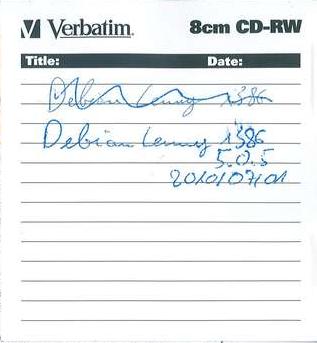
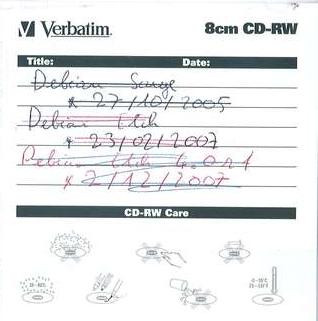
OK, I re-blank it (wodim blank=fast) and rewrite it. The CD seems to be readable this time. But when I try to boot with it my new ASRock, it fails. Enough is enough, I get an heavy used Verbatim 8cm CD-RW. Just to show you how old he is: the first ISO written on it was "Debian Sarge". And the magic happens: it works on the first try!!!! You will probably think that I work for Verbatim. This is not true but I must admit that first-price CD-RW/CD-R seems to be very low quality and don't hold data in time. This is probably related to the chemical compounds of the CD. The failing Memorex CD-RW will end up in a trash and I will continue to use my 5 years old Verbatim CD-RW. Dear reader, in order to find a way not to dump this failing CD-RW, do you know a way to make it to work? What you should now about the failing CD-RW:

Petter Reinholdtsen: Caching password, user and group on a roaming Debian laptop

For a laptop, centralized user directories and password checking is a bit troubling. Laptops are typically used also when not connected to the network, and it is vital for a user to be able to log in or unlock the screen saver also when a central server is unavailable. This is possible by caching passwords and directory information (user and group attributes) locally, and the packages to do so are available in Debian. Here follow two recipes to set this up in Debian/Squeeze. It is also possible to set up in Debian/Lenny, but require more manual setup there because pam-auth-update is missing in Lenny. LDAP/Kerberos + nscd + libpam-ccreds + libpam-mklocaluser/pam_mkhomedir This is the traditional method with a twist. The password caching is provided by libpam-ccreds (version 10-4 or later is needed on Squeeze), and the directory caching is done by nscd. The directory lookup and password checking is done using LDAP. If one want to use Kerberos for password checking the libpam-ldapd package can be replaced with libpam-krb5 or libpam-heimdal. If one is happy having a local home directory with the path listed in LDAP, one can use the pam_mkhomedir module from pam-modules to make this happen instead of using libpam-mklocaluser. A setup for pam-auth-update to enable pam_mkhomedir will have to be written until a fix for bug #568577 is in the archive. Because I believe it is a bad idea to have local home directories using misleading paths like /site/server/partition/, I prefer to create a local user with the home directory in /home/. This is done using the libpam-mklocaluser package. These packages need to be installed and configured
libnss-ldapd libpam-ldapd nscd libpam-ccreds libpam-mklocaluser
The ldapd packages will ask for LDAP connection information, and one have to fill in the values that fits ones own site. Make sure the PAM part uses encrypted connections, to make sure the password is not sent in clear text to the LDAP server. I've been unable to get TLS certificate checking for a self signed certificate working, which make LDAP authentication unsafe for Debian Edu (nslcd is not checking if it is talking to the correct LDAP server), and very much welcome feedback on how to get this working. Because nscd do not have a default configuration fit for offline caching until bug #485282 is fixed, this configuration should be used instead of the one currently in /etc/nscd.conf. The changes are in the fields reload-count and positive-time-to-live, and is based on the instructions I found in the LDAP for Mobile Laptops instructions by Flyn Computing.
	debug-level		0
	reload-count		unlimited
	paranoia		no
	enable-cache		passwd		yes
	positive-time-to-live	passwd		2592000
	negative-time-to-live	passwd		20
	suggested-size		passwd		211
	check-files		passwd		yes
	persistent		passwd		yes
	shared			passwd		yes
	max-db-size		passwd		33554432
	auto-propagate		passwd		yes
	enable-cache		group		yes
	positive-time-to-live	group		2592000
	negative-time-to-live	group		20
	suggested-size		group		211
	check-files		group		yes
	persistent		group		yes
	shared			group		yes
	max-db-size		group		33554432
	auto-propagate		group		yes
	enable-cache		hosts		no
	positive-time-to-live	hosts		2592000
	negative-time-to-live	hosts		20
	suggested-size		hosts		211
	check-files		hosts		yes
	persistent		hosts		yes
	shared			hosts		yes
	max-db-size		hosts		33554432
	enable-cache		services	yes
	positive-time-to-live	services	2592000
	negative-time-to-live	services	20
	suggested-size		services	211
	check-files		services	yes
	persistent		services	yes
	shared			services	yes
	max-db-size		services	33554432
While we wait for a mechanism to update /etc/nsswitch.conf automatically like the one provided in bug #496915, the file content need to be manually replaced to ensure LDAP is used as the directory service on the machine. /etc/nsswitch.conf should normally look like this:
passwd:         files ldap
group:          files ldap
shadow:         files ldap
hosts:          files mdns4_minimal [NOTFOUND=return] dns mdns4
networks:       files
protocols:      files
services:       files
ethers:         files
rpc:            files
netgroup:       files ldap
The important parts are that ldap is listed last for passwd, group, shadow and netgroup. With these changes in place, any user in LDAP will be able to log in locally on the machine using for example kdm, get a local home directory created and have the password as well as user and group attributes cached. LDAP/Kerberos + nss-updatedb + libpam-ccreds + libpam-mklocaluser/pam_mkhomedir Because nscd have had its share of problems, and seem to have problems doing proper caching, I've seen suggestions and recipes to use nss-updatedb to copy parts of the LDAP database locally when the LDAP database is available. I have not tested such setup, because I discovered sssd. LDAP/Kerberos + sssd + libpam-mklocaluser A more flexible and robust setup than the nscd combination mentioned earlier that has shown up recently, is the sssd package from Redhat. It is part of the FreeIPA project to provide a Active Directory like directory service for Linux machines. The sssd system combines the caching of passwords and user information into one package, and remove the need for nscd and libpam-ccreds. It support LDAP and Kerberos, but not NIS. Version 1.2 do not support netgroups, but it is said that it will support this in version 1.5 expected to show up later in 2010. Because the sssd package was missing in Debian, I ended up co-maintaining it with Werner, and version 1.2 is now in testing. These packages need to be installed and configured to get the roaming setup I want
libpam-sss libnss-sss libpam-mklocaluser
The complete setup of sssd is done by editing/creating /etc/sssd/sssd.conf.
[sssd]
config_file_version = 2
reconnection_retries = 3
sbus_timeout = 30
services = nss, pam
domains = INTERN
[nss]
filter_groups = root
filter_users = root
reconnection_retries = 3
[pam]
reconnection_retries = 3
[domain/INTERN]
enumerate = false
cache_credentials = true
id_provider = ldap
auth_provider = ldap
chpass_provider = ldap
ldap_uri = ldap://ldap
ldap_search_base = dc=skole,dc=skolelinux,dc=no
ldap_tls_reqcert = never
ldap_tls_cacert = /etc/ssl/certs/ca-certificates.crt
I got the same problem here with certificate checking. Had to set "ldap_tls_reqcert = never" to get it working. With the libnss-sss package in testing at the moment, the nsswitch.conf file is update automatically, so there is no need to modify it manually. If you want to help out with implementing this for Debian Edu, please contact us on debian-edu@lists.debian.org.

30 June 2010

Joey Hess: Osmos

I love this game. Love that it's so abstract and beautiful and meditative. Love how it plays with fractal scale. Am I a planet or a unicelled organism? Love that this basic game idea could have been written at any point since Spacewar (1961), and could be said to be recycling ideas from everything from that to Pac Man ... but instead seems entirely new, pure, and fresh. Love that I can be playing it and it makes me think about things right out of a Greg Egan novel. Like about how it's most efficient for conciousness to be slow and not care about the passage of time. So you don't have to waste much mass on delta-v. Until carnivorous life enters the picture. Then you have to be bold, and fast. Love that it has a linux port. Love that it's hard. A screenshot can't do it justice -- the video on its site gives a better idea.

Vincent Sanders: Programmers are suckers for a meme

Many Open Source projects have and IRC # for developers. The NetSurf project is no different. During a discussion someone jokingly suggested that one contributor should be asked to take the FizzBuzz test. Can you guess what happened next?

Ten minutes later Michael Drake posted this solid example in C which is where it all ought to have ended.

<iframe src="http://pastebin.com/embed_iframe.php?i=MesmvSjk" style="border:none;width:100%;height:200px;"></iframe>

Being programmers, of course this had a predictable result. The original question, the reason for asking it and any the serious point being made in the original article were discarded. Just so everyone (including myself) could play silly buggers over our lunch break. Coders, it would seem, simply like to produce a solution even if it is only for fun.

None of these programs took more than ten minutes (except the JAVA monstrosity), are reproduced with permission and I am to blame for none of them (ok maybe just the one ;-).

First up was Rob Kendrick with the classic solution in C (his day job is as a support team lead which seems to make those programmers who cannot do this seem even more scary bad.)

<iframe src="http://pastebin.com/embed_iframe.php?i=EaQ2414U" style="border:none;width:100%;height:200px;"></iframe>

Next was Daniel Silverstone who turned this Lua solution out very quickly and berated the rest of us for not following the rules ;-)

<iframe src="http://pastebin.com/embed_iframe.php?i=cYY0YDYM" style="border:none;width:100%;height:220px;"></iframe>

The final C solution was my own uber silly sieve implementation

<iframe src="http://pastebin.com/embed_iframe.php?i=5w5BhKt3" style="border:none;width:100%;height:200px;"></iframe>

Peter Howkins decided the world required a solution in PHP

<iframe src="http://pastebin.com/embed_iframe.php?i=h2aQ5eXM" style="border:none;width:100%;height:200px;"></iframe>

When pointed out that his solution stopped at 50 he presented this vastly superior and obviously idiomatic solution

<iframe src="http://pastebin.com/embed_iframe.php?i=k8T6VtJu" style="border:none;width:100%;height:200px;"></iframe>

Finally after a long time James Shaw caused mental anguish and wailing with this abomination unto Nuggin.

<iframe src="http://pastebin.com/embed_iframe.php?i=GFeHdJdr" style="border:none;width:100%;height:200px;"></iframe>

With Luck everyone has now got it out of their system and we will never have to put up with this again (yeah right). And now you also know why Open Source projects sometimes take ages to release ;-)

Ingo Juergensmann: Getting hit by a spammer with Exim

Yesterday I was warned by Nagios that something is going on with my server. The number of processes has been gone beyond the limit. The reason for this were a bunch of Exim processes trying to deliver a lot of mails. Apparently a spammer made it happen to send spams via my server. How could this happen? I was seeing a lot of those log entries:
2010-06-28 16:29:25 1OTFKt-0004cZ-1R <= vsvc@euhu.com H=(qknlvj.com) [58.212.194.230] P=esmtpa A=cram_md5:inna S=1455 id=0ec5ff00b06c43369e2582fc4269839e@e12c17c51ec546bf9e7a23e6f9875941
2010-06-28 16:29:27 1OTFKw-0004cZ-KZ <= ebms@ylmdbm.com H=(qknlvj.com) [58.212.194.230] P=esmtpa A=cram_md5:inna S=1520 id=58913c34bde64e908310db7e1280eff5@2dc8ed5998b64e8485c472cae5ef98c3
2010-06-28 16:29:28 1OTFKy-0004cZ-1p <= wiyscy@hegyogz.com H=(qknlvj.com) [58.212.194.230] P=esmtpa A=cram_md5:inna S=1436 id=814a7bdcbe85447a9283d4a0a074830b@0ada3cde4a4c41c38c65bc912639afb6
Apparently the spammer has successfully found a way to bypass the authenticators in Exim. By default only authenticated users can send mails via my mailserver, of course. But this spammer found a way around that problem. A user "inna" is not known, so the spammer shouldn't be able to send mails at all. But he can. Something is broken apparently. The spammer sent an empty password ('') and the database didn't find an user by this name and returned an empty resultset (''). Both sides of the comparison matches and the mail is allowed in. Let's have a look at my Exim config:
cram_md5:
server_debug_print = "running smtp auth $1 $2"
driver = cram_md5
public_name = CRAM-MD5
server_secret = $ lookup pgsql select clear from passwd where passwd.usr='$1' limit 1 $value
server_set_id = $1
On #exim@freenode there was just another user with the very same problem with exactly the same spammer. Apparently the lookup is true for empty passwords or users. The solution is to add a "fail" in the lookup statement:
server_secret = $ lookup pgsql select clear from passwd where passwd.usr='$1' limit 1 $value fail
That's pretty all to do to prevent the spamming. But how could this happen at all? Back then when I was configuring my mailserver (around 2003 or so) I can remember that I tried a "fail" statement in the server_secret as it is described in the Exim documentation, but it didn't work as expected. So I ended up with no "fail". This worked fairly well over the years and I remember that I tested this lookup by trying to send with user/password combinations of all different sorts. So it went into "production". Apparently it doesn't work anymore today. The other guy on the #exim channel said that he found no database lookup example with "fail" at all. Even the example in one of his books was without "fail". So I believe that something changed either in Exim or in PostgreSQL to make submitting an empty password string a positive match for bypassing authentication nowadays. For the records: the spammer send approx. >10.000 mails. Another bunch of 8000 mails were rejected, but this is just slightly over the daily average.

Marco T&uacute;lio Gontijo e Silva: Immix on GHC Summer of Code weekly report #7

My project. This post assumes that the reader has read my last post. This week I had less time to work on my project than the last ones, because it was kind of the last week of the semester for some disciplines. This was unfortunate from a point of view, but it s good in another, because now I ve finished most of my disciplines and can focus more. This is also the reason why the weekly report is slightly delayed. Most of my work this week was continuing the investigation of the segfault caused by my implementation of allocation in lines. The most interesting thing I discovered came after a suggestion from my menthor: to use +RTS -DS to turn on the sanity checker. I runned the code with my allocation implementation and the sanity checker and got a segfault. I runned again only with the code to free memory in lines and I got also a segfault. Then I runned without all my patches, using sweep, and I got the segfault. So it seems that there is something wrong with sweep, and now I m investigating this new segfault. I m using the bernouilli program from nofib to test, running with 148 as a parameter and, naturally, +RTS -w -DS passed to the RunTime System. The output of gdb:
Current directory is /home/marcot/trabalho/livre/ghc/nofib/imaginary/bernouilli/
GNU gdb (GDB) 7.1-debian
Copyright (C) 2010 Free Software Foundation, Inc.
License GPLv3+: GNU GPL version 3 or later <http://gnu.org/licenses/gpl.html>
This is free software: you are free to change and redistribute it.
There is NO WARRANTY, to the extent permitted by law.  Type "show copying"
and "show warranty" for details.
This GDB was configured as "x86_64-linux-gnu".
For bug reporting instructions, please see:
<http://www.gnu.org/software/gdb/bugs/>...
Reading symbols from /home/marcot/trabalho/livre/ghc/nofib/imaginary/bernouilli/Main...done.
(gdb) r 148 +RTS -w -DS
Starting program: /home/marcot/trabalho/livre/ghc/nofib/imaginary/bernouilli/Main 148 +RTS -w -DS
[Thread debugging using libthread_db enabled]
Program received signal SIGSEGV, Segmentation fault.
0x00000000006309cb in LOOKS_LIKE_INFO_PTR_NOT_NULL (p=12297829382473034410) at includes/rts/storage/ClosureMacros.h:225
(gdb) where
#0  0x00000000006309cb in LOOKS_LIKE_INFO_PTR_NOT_NULL (p=12297829382473034410) at includes/rts/storage/ClosureMacros.h:225
#1  0x0000000000630a16 in LOOKS_LIKE_INFO_PTR (p=12297829382473034410) at includes/rts/storage/ClosureMacros.h:230
#2  0x0000000000630a4b in LOOKS_LIKE_CLOSURE_PTR (p=0x7ffff6c84062) at includes/rts/storage/ClosureMacros.h:235
#3  0x0000000000631427 in checkClosure (p=0x7ffff6853a08) at rts/sm/Sanity.c:320
#4  0x00000000006319ef in checkHeap (bd=0x7ffff68014c0) at rts/sm/Sanity.c:479
#5  0x000000000063222f in checkSanity (check_heap=rtsTrue) at rts/sm/Sanity.c:686
#6  0x000000000062dfdb in GarbageCollect (force_major_gc=rtsFalse, gc_type=0, cap=0x8d2ec0) at rts/sm/GC.c:768
#7  0x0000000000620431 in scheduleDoGC (cap=0x8d2ec0, task=0x8f5080, force_major=rtsFalse) at rts/Schedule.c:1420
#8  0x000000000061fa2c in schedule (initialCapability=0x8d2ec0, task=0x8f5080) at rts/Schedule.c:539
#9  0x0000000000620c77 in scheduleWaitThread (tso=0x7ffff6c80000, ret=0x0, cap=0x8d2ec0) at rts/Schedule.c:1902
#10 0x000000000065762b in rts_evalLazyIO (cap=0x8d2ec0, p=0x89d8b0, ret=0x0) at rts/RtsAPI.c:495
#11 0x000000000061d3db in real_main () at rts/RtsMain.c:66
#12 0x000000000061d4ca in hs_main (argc=5, argv=0x7fffffffe6d8, main_init=0x406558 <__stginit_ZCMain>, main_closure=0x89d8b0) at rts/RtsMain.c:115
#13 0x00007ffff6fbcabd in __libc_start_main (main=<value optimized out>, argc=<value optimized out>, ubp_av=<value optimized out>, init=<value optimized out>, fini=<value optimized out>, rtld_fini=<value optimized out>, stack_end=0x7fffffffe6c8) at libc-start.c:222
#14 0x0000000000403a69 in _start ()
I started the investigation with the most obvious test: to remove the call to sweep() in rts/sm/GC.c.
  if (major_gc && oldest_gen->mark)  
      if (oldest_gen->compact)
          compact(gct->scavenged_static_objects);
      // else
      //     sweep(oldest_gen);
The result was the same, same segfault in the same place. So I decided to do it a little stronger and avoid the blocks getting the BF_MARKED flag, so that they are not even marked.
                if (!(bd->flags & BF_FRAGMENTED))  
                    // bd->flags  = BF_MARKED;
                 
This one worked. The code in sweep() is not commented, but it s irrelevant, since it ignores blocks that don t have this flag. My third try was to comment the places where the BF_MARKED flag is read, to see each one was causing the segfault. I got a list of places to search with grep, and there weren t a lot of them.
$ grep BF_MARKED rts/sm/*.c
rts/sm/Compact.c:       if (bd->flags & BF_MARKED)
rts/sm/Evac.c:  if ((bd->flags & (BF_LARGE   BF_MARKED   BF_EVACUATED)) != 0)  
rts/sm/Evac.c:        if (bd->flags & BF_MARKED)  
rts/sm/GCAux.c:    if ((bd->flags & BF_MARKED) && is_marked((P_)q,bd))  
rts/sm/GC.c:                    if (!(bd->flags & BF_MARKED))
rts/sm/GC.c:                        // time, so reset the BF_MARKED flags.
rts/sm/GC.c:                        // compact.  (search for BF_MARKED above).
rts/sm/GC.c:                        bd->flags &= ~BF_MARKED;
rts/sm/GC.c:                // Also at this point we set the BF_MARKED flag
rts/sm/GC.c:                // BF_MARKED is always unset, except during GC
rts/sm/GC.c:                    bd->flags  = BF_MARKED;
rts/sm/Sweep.c:        if (!(bd->flags & BF_MARKED))  
The first one is in rts/sm/Compact.c, so it s not relevant to the use with -w. The second one, in rts/sm/Evac.c, is a bit indirect.
  if ((bd->flags & (BF_LARGE   BF_MARKED   BF_EVACUATED)) != 0)  
      // pointer into to-space: just return it.  It might be a pointer
      // into a generation that we aren't collecting (> N), or it
      // might just be a pointer into to-space.  The latter doesn't
      // happen often, but allowing it makes certain things a bit
      // easier; e.g. scavenging an object is idempotent, so it's OK to
      // have an object on the mutable list multiple times.
      if (bd->flags & BF_EVACUATED)  
          // We aren't copying this object, so we have to check
          // whether it is already in the target generation.  (this is
          // the write barrier).
	  if (bd->gen < gct->evac_gen)  
	      gct->failed_to_evac = rtsTrue;
	      TICK_GC_FAILED_PROMOTION();
	   
	  return;
       
      /* evacuate large objects by re-linking them onto a different list.
       */
      if (bd->flags & BF_LARGE)  
	  info = get_itbl(q);
	  if (info->type == TSO &&
	      ((StgTSO *)q)->what_next == ThreadRelocated)  
	      q = (StgClosure *)((StgTSO *)q)->_link;
              *p = q;
	      goto loop;
	   
	  evacuate_large((P_)q);
	  return;
       
      /* If the object is in a gen that we're compacting, then we
       * need to use an alternative evacuate procedure.
       */
      if (!is_marked((P_)q,bd))  
          mark((P_)q,bd);
          push_mark_stack((P_)q);
       
      return;
   
The first if, in line 466, is executed if any of the three flags is present: BF_LARGE, BF_MARKED or BF_EVACUATED. The second if, in line 474, checks for BF_EVACUATED, and returns. The third if, in line 487, checks for BF_LARGE and returns. The code in lines 502-505 is only executed if BF_MARKED is present, and not the other ones. I tried commenting this code, and got an assertion fail in the user code, so I think this is not a good path to follow. The second occurence of BF_MARKED is in the same file.
        if (bd->flags & BF_MARKED)  
            // must call evacuate() to mark this closure if evac==rtsTrue
            *q = (StgClosure *)p;
            if (evac) evacuate(q);
            unchain_thunk_selectors(prev_thunk_selector, (StgClosure *)p);
            return;
         
Commenting it, with or without the call to sweep() commented, causes the same segfault. So, I m tending to think this part of the code is unrelated to the issue. The third occurence is in rts/sm/GCAux.c. I tried commenting it with all the four combinations of the two others commented and not commented, and all resulted in the segfault in the same place. There s another place to check in rts/sm/GC.c. Again, commenting it made no difference. The last one is part of sweep(), so it s avoided anyway when the call to this function is commented.

Dirk Eddelbuettel: Rcpp 0.8.3

A new version 0.8.3 of Rcpp is now CRAN and in Debian. It comes about three weeks after the 0.8.2 release. And even though we promised to concentrate on documentation, it contains a raft of new features: The main thing here is Rcpp sugar for which we also have a new (seventh !!) vignette Rcpp-sugar. As a quick example, consider this simple C++ function that takes two vectors from R and creates a new one conditional on the relative values:
export "C" SEXP foo( SEXP xs, SEXP ys)  
    Rcpp::NumericVector x(xs), y(ys);
    int n = x.size();
    Rcpp::NumericVector res( n );
    double xd = 0.0, yd = 0.0 ;
    for( int i=0; i<n; i++) 
        xd = x[i];
        yd = y[i];
        if( xd < yd ) 
            res[i] = xd * xd ;
          else  
            res[i] = -( yd * yd);
         
     
    return res ;
 
Now, if you use R, you really want to writes this more compactly. And now you can, thanks to Rcpp sugar:
extern "C" SEXP foo( SEXP xs, SEXP ys) 
    Rcpp::NumericVector x(xs), y(xs);
    return ifelse( x < y, x*x, -(y*y));
 
Same great taste, but much less filling! More details are in the Rcpp-sugar vignette. Doug Bates is already a fan of this and is employing it in the lme4a development version of the well-known lme4 package. The full NEWS entry for this release follows below:
0.8.3   2010-06-27
    o	This release adds Rcpp sugar which brings (a subset of) the R syntax
        into C++. This supports : 
         - binary operators : <,>,<=,>=,==,!= between R vectors
         - arithmetic operators: +,-,*,/ between compatible R vectors
         - several functions that are similar to the R function of the same name:
        abs, all, any, ceiling, diff, exp, ifelse, is_na, lapply, pmin, pmax, 
        pow, sapply, seq_along, seq_len, sign
        
        Simple examples :
        
          // two numeric vector of the same size
          NumericVector x ;
          NumericVector y ;
          NumericVector res = ifelse( x < y, x*x, -(y*y) ) ;
        
          // sapply'ing a C++ function
          double square( double x )  return x*x ;  
          NumericVector res = sapply( x, square ) ;
        
        Rcpp sugar uses the technique of expression templates, pioneered by the 
        Blitz++ library and used in many libraries (Boost::uBlas, Armadillo). 
        Expression templates allow lazy evaluation of expressions, which 
        coupled with inlining generates very efficient code, very closely 
        approaching the performance of hand written loop code, and often
        much more efficient than the equivalent (vectorized) R code.
        
        Rcpp sugar is curently limited to vectors, future releases will 
        include support for matrices with sugar functions such as outer, etc ...
        
        Rcpp sugar is documented in the Rcpp-sugar vignette, which contains
        implementation details.
    o   New helper function so that "Rcpp?something" brings up Rcpp help
    o   Rcpp Modules can now expose public data members
    o   New classes Date, Datetime, DateVector and DatetimeVector with proper
        'new' API integration such as as(), wrap(), iterators, ...
    o   The so-called classic API headers have been moved to a subdirectory
        classic/ This should not affect client-code as only Rcpp.h was ever
        included.
    o   RcppDate now has a constructor from SEXP as well
    o   RcppDateVector and RcppDatetimeVector get constructors from int
        and both const / non-const operator(int i) functions
        
    o   New API class Rcpp::InternalFunction that can expose C++ functions
    	to R without modules. The function is exposed as an S4 object of 
    	class C++Function
As always, even fuller details are in Rcpp Changelog page and the Rcpp page which also leads to the downloads, the browseable doxygen docs and zip files of doxygen output for the standard formats. A local directory has source and documentation too. Questions, comments etc should go to the rcpp-devel mailing list off the R-Forge page

Anand Kumria: Vodafone and Talktalk billing

Another day, another bill Like most countries, the UK has been valiantly trying to force consumers to reduce their paper usage. Let's set aside the fact that most paper is not generated by consumers. And that, it isn't about reduce usage but reducing expenses relating to delivery of this paper. Let's us also leave aside the fact that most airlines want consumers to print out their boarding cards at home. Because it reduces expenses incurred in maintaining staff at airport check-in counters. Anyway, most communications providers have taken up this challenge by making it more expensive to obtain a paper bill. But I don't want a paper bill, per se, what I am really after is a copy of the bill I can keep for my own records. And print if I so need to. Both Vodafone and Talktalk will send you notifications, via email, that you have a bill. But neither of them allow you to obtain a copy of the PDF that would have been printed and sent to you. Instead you have to fart-arse around with their systems to get (at best) a CSV file. Why, oh why, can neither of them just send the PDF that was going to be generated? That have a bill run process anyway, it generates the PDF, sends the emails, and then promptly discards the PDFs. That would mean I have an immediate archive of all my bills from both companies in my email. Just Broken.

29 June 2010

Marco d'Itri: DNSBLs and IPv6

From time to time I see people arguing that the wide deployment of IPv6 will force DNSBLs to significantly change their operations and semantics. Usually they have little or no actual experience with IPv6 and the main argument used to justify this view appears to be more or less "OMG so many bits!1!!!". I have no reason to believe that this will really happen. People are already sending mail over IPv6 and I expect that the same reputation mechanisms used for IPv4 will be deployed as soon as they will be needed, with small policy changes to cope with the fact that end users typically get a whole network instead of a single IP address. So I expect that DNSBLs will continue to operate as usual like they currently do for IPv4 addresses, optionally by promoting "single IP" listings to "whole /64" listings when appropriate.

Let's briefly categorize the common types of DNSBL listings: If anything, with IPv6 much less guessing is needed to know how large each customer assignment is, so some things will actually be easier for operators. (I have been using IPv6 for at least ten years and I have received email over IPv6 networks for at least five.)

Jan Hauke Rahm: [OT] Online magazine in German about music

It s pretty off topic for my blog since I usually only blog about technical stuff. But this is just great. Real life people having a real look at concerts of prominent and not-so-prominent musicians. And it s all in German which is a nice thing since most of such stuff I have to find on English web sites (except the obvious German big press influence). Made me notice I missed the concert of Jamie Cullum of course. But the article is quite nice and I definitely enjoy reading more of those. Have a look if you re as keen on music as I am, or not. :)

Matthew Garrett: Complications

It turns out that it's actually really, really easy to set up an l2tp tunnel. You just need to install xl2tpd, configure some address ranges and then add an authentication entry to chap-secrets. It's just that the entire known universe appears to be more interested in using ipsec as well, and that looks worse than setting up Kerberos and I've already done that enough in my life thanks. I don't care about my connection being encrypted (I've got encrypted protocols for that), so this seems to be an entirely reasonable solution.

Matthew Garrett: The paradox of choice

Searching for information on setting up an L2TP VPN takes me here, where I get to choose between OpenSWAN, KAME and some OpenBSD port. Searching for information on setting up a PPTP VPN takes me here, where I'm told exactly what I need to do.

Given choices, I chose the one that reduced my choices. THERE IS A LESSON HERE.

(Sadly, I'm now going to have to deal with L2TP anyway because something in the intermediate network is dropping GRE)

Daniel Stone: xhost plus considered harmful

So, flipping through the otherwise good MeeGo SDK setup instructions, I was pretty disheartened to see this:
Next, configure X on the host machine to enable the Simulator (running from the chroot) to access the display of the normal user:

xhost +local:

This gives everyone who can execute anything on your machine full permission to rip your credit card numbers out of Chromium and your password out of gnome-terminal. Sweet. This comes up all the time, so man wouldn't it be great if there was some kind of better way?

xhost +SI:localuser:usernametogiveaccesstogoeshere

I'm pretty sure this has been available in every single X.Org release since 6.8 or so, so next time you see someone advocating something as daft as the above, please point them towards the correct way. Thanks.

Russell Coker: Play Machine Online Again with Xen 4.0

My SE Linux Play Machine [1] has been offline for almost a month (it went offline late May 30 and has just gone online again). It s the sort of downtime that can happen when you use Debian/Unstable. For a while I ve been using a HP E-PC (a SFF desktop system with 256M of RAM and a P3-800 CPU) to run my SE Linux Play Machine. I run it under Xen to make it easier for me to watch what happens. I ve had some problems with increased memory use in the Xen Dom0 in Squeeze [2]. The latest installment of the memory problems is when I discovered that I can t run two copies of tcpdump (for tracing separate interfaces) at once on a Xen Dom0 that has ~110M of RAM this seems unreasonable, I m sure that back when a big server had 128M of RAM I could have done such things! So now I m using a Thinkpad T20 with 512M of RAM for my new SE Linux Play Machine, it uses less power than most systems (probably even less than the HP E-PC) and is very quiet. I was forced to install on a new system when I broke my GRUB configuration. GRUB-2 in Debian currently has no support for generating a configuration that will boot a Xen Dom0. You can manually edit the GRUB configuration to get this working, but if you get it wrong then you can make GRUB not even display a prompt and force a reinstall (as I did). As an aside it would be really handy if someone would create a CD or USB bootable image that does nothing but install GRUB. Such an image would ideally allow replacing the configuration of an existing GRUB, overwriting an existing GRUB installation (all files in /boot/grub get replaced), or formatting a spare partition (default swap space) and installing GRUB there. My current solution to the GRUB problems is to use the old version of GRUB in the grub-legacy package. The old version of GRUB has always done everything I want so I don t seem to be missing anything by not using the new version. I m happy to refrain from using Ext4 for /boot and have no desire to have /boot on an LVM volume. Most of the month of down-time for my Play Machine was caused by bugs in the SE Linux policy I m developing for Squeeze, while they weren t difficult bugs I haven t had much time to work on them consistently. I m still running the Play Machine on Lenny, but the Dom0 is running Unstable.

Russell Coker: New SE Linux Policy for Squeeze

I have just uploaded refpolicy version 0.2.20100524-1 to Unstable. This policy is not well tested (a SE Linux policy package ending in -1 is not something that tends to work well for all people) and in particular lacks testing for Desktop environments. But for servers it should work reasonably well. I expect to have a better version uploaded before this one gets out of Unstable. Note that the selinux-policy-default package in this release lacks support for roles, it s a targeted policy only. I plan to fix this soon.

28 June 2010

Carl Chenet: Debian maintainer

As some of you may (or more certainly may not) have noticed reading the Debian Project News, I recently became a Debian maintainer. A hugh thanks to Sandro Tosi (morph) and Piotr O arowski (piotr) for their careful reviews of my work. And thanks to Raphael Hertzog (buxy) to pull the trigger for the beginning of my involvment in Debian. I can t wait to attend Debconf 2010. See you there ! Follow me on Identi.ca: http://identi.ca/carlchenet

Steve Kemp: Because I don't trust myself with you.

Debian Packages
Every now and again I look over server logs and see people downloading random .deb packages from my mirrors, or from my servers, via wget or Firefox (rather than with apt-get/aptitude). Personally I don't often download random binaries even from people I believe I can trust. Instead I'll download source and rebuild. But it bugs me that somebody might download a work-in-progress, decide it isn't complete or otherwise good enough, and miss out on an update of awesome-sauce a day or two later. I suspect there is no real solution to this "problem", and that including /etc/apt/sources.list.d/ entries inside a binary package to "force" an upgrade behind the scenes is a little too evil to tolerate. And yet .. something something dark-side .. something something seductive something?
Blog Update
This is my last film-subject entry. In the future I will have more accurate subjects, albeit more dull ones. I still amuse myself with quotations, and before that the song lyrics, but I guess that now is a good time to call it a day with that.
ObFilm: Cruel Intentions

Aurelien Jarno: Debian and the ARM hype

Thanks to the versatility of the Linux kernel, Debian has always been known for supporting a large number of architectures. It has also often been criticized for that as it is said to slow down the development of Debian. Among these architectures, the ARM one was considered dead a few years ago, and some people wanted to get rid of it. Today all major distributions now have an ARM port, one of those distributions being even based on Debian. It seems Debian was right. Now that Android has been ported to MIPS, we may see more and more MIPS based devices. Will the same scenario happen again?

Russell Coker: Can you run SE Linux on a Xen Guest?

I was asked Can you run SELinux on a XEN guest without any problem? . In a generic sense the answer is of course YES, Xen allows you to run Linux kernels with all the usual range of features and SE Linux isn t a particularly difficult feature to enable. I do most of my SE Linux development and testing on virtual machines and until recently I didn t have any hardware suitable for running KVM, so in the last few years I ve done more SE Linux testing on Xen than on non-virtual machines. My SE Linux Play Machine [1] (which will be online again tomorrow) is one SE Linux system running under Xen. But the question was asked in the context of my blog post comparing the prices of virtual hosting providers [2], which changes things. Both Linode and Slicehost (the two virtual hosting providers that my clients use) provide kernels without SE Linux support, the command grep selinux /proc/filesystems (which is the easiest way to test for SE Linux support) gives no output. I am not aware of any other virtual hosting company that provides SE Linux support. If anyone knows of a virtual hosting company that runs Xen or KVM virtual machines with SE Linux support then please let me know, I ll write a blog post comparing such companies if there are some. For the people who work at ISPs: If your company supports SE Linux virtual machines then I would be happy to review your service, just give me a free DomU for a couple of weeks so I can test it out. If your company is considering offering such virtual machines then I would be happy to have a confidential discussion about the issues that you will face, while I am available for paid consulting work in this area I am more than happy to spend an hour or two helping a company that s going to help support my favorite free software project without expecting to be paid. But I have to note that if a dozen hosting companies happen to want advice I won t be able to provide two hours of free advice to each of them. I think that there is an unsatisfied market demand for SE Linux virtual machines. I don t expect all virtual hosting companies to support it in the near future, but this will make it more profitable for those that do. If for the sake of discussion we assume that 5% of sysadmins who are making purchasing decisions regarding virtual servers really want to have SE Linux support and if 5% of virtual hosting companies were to offer such support, then those hosting companies would almost double their market share as a result of supporting SE Linux. It s the usual economic factors relating to small companies that profit from providing good support for the needs of a minority of customers.

Benjamin Mako Hill: Wikimedia Scholarship 2009-2010

Folks at last year's Wikimania may remember the presentation I gave there. It was essentially a literature review of Wikipedia and Wikimedia scholarship from the previous year. The idea was to give a bird's-eye-view as well a series of highlights -- all aimed at Wikimedians. Apparently somebody found it useful because I've been asked to do it again! I'm going to be paired up in a longer session with Felipe Ortega -- whose excellent dissertation I summarized as part of my talk last year -- and Mayo Fuster Morell has also agreed to help out. Felipe is program chair for WikiSym this year and will be focusing on providing folks with a summary of the papers published at that conference. It will be held immediately before Wikimania in Gdansk. For my part, I'm going to be focusing more broadly and talking about papers published, well, anywhere else. And this is where you come in! With search engines and all, I've got a pretty good idea of breadth of the work that's out there. I also "just know" stuff from my own areas of interest and study. That said, I don't have as strong of an idea of what's good and what's relevant beyond what I can grok from citation counts. And after one year (or less!), that's clearly not very much information. As a result, I'm looking for suggestions or recommendations from anybody on interesting, useful, important, or otherwise noteworthy scholarly papers on or about Wikipedia or other Wikimedia projects published in the last year. Feel free to leave a comment, email mako@atdot.cc, or edit this page.

Next.

Previous.