Search Results: "ag"

8 September 2009

Michal Čihař: Fun with blacklists

Yes, blacklists are great, especially if wrongly used. Currently I can not renew SSL certificate I used to have from StartSSL, because they somehow use blacklist from Google to block sites with malware. The word somehow is important here, because I am not listed as being suspicious, but they still see me blacklisted. And the more funny thing seems to be that Google found sometimes some malware on my site, but there is no way to find out what it was. Maybe it is somehow related to the broken antivirus complaining that NSIS binary contains a virus, but who knows... As the funny story goes on, I get to know that it is because I'm on AS:15685 network. Well I am. And as well are about other thousands of servers hosted in that place. So what? PS: Just to be sure, I just did full scan of all files on dl.cihar.com and here is the result:
----------- SCAN SUMMARY -----------
Known viruses: 621888
Engine version: 0.95.2
Scanned directories: 133
Scanned files: 3975
Infected files: 0
Data scanned: 14546.95 MB
Data read: 2462.58 MB (ratio 5.91:1)
Time: 1093.524 sec (18 m 13 s)

Andreas Metzler: hugin 0.8.0 in experimental

We have finally managed to upload hugin 0.8.0 to experimental. It will probably end up in sid soonish. Upstream is already busy preparing 2009.2 (swiftly sidestepping any possibility for a 1.0 ever ;-) lenny backport available on this site.

Frans Pop: debtree-next - More steroids

Funny how working on a program immediately inspires to do more. Remember that the initial motivation for debtree was to find out why a package was installed? It can now show that in the dependency graphs! I'm not quite ready to do a new release, but the new version is available from the git repository. Let's start with a simple example (all graphs are based on Lenny).
$ debtree -I --rdeps-depth=3 apt
reverse deps for apt Only installed packages are displayed here; if the -I option is omitted, debmirror will display all, but that does tend to explode the graphs, especially for common libraries. As for forward dependencies, the color of the arrows indicates Pre-Depends, Depends and Recommends. The reverse dependencies are shown three levels deep (one is default). The graph will always include all direct reverse dependencies (both on the package itself and all virtual packages provided by it. For indirect reverse dependencies there's a cut of that is set at five by default. Example is debconf, that apparently has 9 reverse Pre-Depends and 58 reverse Depends installed on my system. The next one is simply beautiful.
$ debtree -I --rdeps-depth=20 --no-conflicts libcairo2
reverse deps for libcairo2 Because of the --rdeps-depth=20 this shows the full recursion! I was surprised that this graph remained a reasonable size. Apparently no packages depend on the virtual package libcairo, at least none that I have installed. The final one is extreme, and I must confess that I have cheated a bit by suppressing the least interesting reverse depends (which explains why it does not match the numbers from the apt graph).
$ debtree -I -R --no-recommends --no-conflicts debconf
reverse deps for debconf The most interesting thing here is how it shows the debconf-2.0 transition. Most packages depend on 'debconf debconf2.0'; tex-common instead has 'debconf cdebconf', while tasksel and exim4 have both combinations (probably one explicitly in debian/control and the other added by debhelper. ucf is missing the alternative; apparently does not use debhelper (no prizes for guessing who the maintainer is :-). Notice anything about iamerican and ibritish? Yes, they really have a double dependency on 'debconf debconf2.0'. The one thing missing is the version info for versioned dependecies. Not sure yet if I want to add that for reverse dependencies. P.S. SVG versions of the images are available in the same directory as the JPGs.

Gustavo Noronha Silva: WebKitGTK+ 1.1.14 is here!

1.1.14 is definitely worth blogging about. While I was updating the gtk-doc stuff to update the documentation that is available in our website I was thinking that this is probably the release with the largest amount of API addition I have seen in my time as a contributor to the project! Before I start talking about the new APIs, though, let me talk of something that went under the hood: Xan has patched WebKitGTK+ to override libsoup s connection limits, so that our limits match those of other modern browsers - we now allow up to 60 connections total, and 6 per host. People have been reporting load performance improvements for some sites! We have an initial set of APIs to deal with the data that was loaded to render the page, represented by the new DataSource object. This allows you to peek at the source of the HTML that was rendered, for instance. In the near future we will have ways of getting the data and other information for each resource that is downloaded to compose the page. Jan Alonzo has spent quite some time studying, implementing and perfecting this API, with some help from me and Xan. One initial piece of the larger API to control resource loading is already there, as well. The WebView will use the new resource-request-starting signal to let you know that a request is about to be sent, and allow you to modify headers, or even the URI that is going to be fetched. For some, the greatest news here is that this allows a basic implementation of AD blocking, which is now supported in Epiphany with the WebKit backend, as of version 2.27.92, released today! This is something I have been looking at in my Collabora time for some time now, and working along with Xan and Jan, we finally seem to have figure out the API interactions correctly. There s more to come regarding resource loading tracking, in the near future. That would already be a lot, from my point of view, but there s a whole lot more. A new contributor, Martin Robinson, has arrived proposing new API pieces for an important HTML5 tool: web databases, which brings with it the concept of SecurityOrigin. Jan has exposed API to put the WebView in view source mode, Xan has given us undo/redo support for editable content, and Zan Dobersek has done some overall improvement of our HTML5 media player. That s a lot of change for a release, which also goes to show we still have quite a gap to fill, but we are being able to move forward and fill them quite quickly. If you want to help out, pick something in your area of interest, and send us patches!

Michal Čihař: Gammu stable version 1.26.1

Gammu 1.26.1 is out! This release just fixes few bugs in AT driver. Full list of changes: You can download from usual place: http://cihar.com/gammu/. Debian users will find packages in unstable soon, SUSE, Fedora and Mandriva users can check repository in OpenSuse Build Service and Ubuntu in my PPA.

Romain Beauxis: New structure for mediawiki-extensions

A new upload of the mediawiki-extensions package has just been accepted into experimental today ! Now the extensions follow more strictly upstream's recommended installation process. Indeed, the initial structure for packaged extension all extensions in a flat directory was a bit naive, and when it came to complex extensions such as ConfirmEdit, it quickly became a nightmare. Also, the extensions should be usable without the mediawiki package, though they still recommend it. Additionally, each extension that requires an additional dependency is now shipped into a seperate package. Eventually, the base code is now taken from the SVN branch tagged for mediawiki 1.15 release, which should make them more stable. The next step now is to clean a bit the internal checkout script and test more extensively the various extensions hence the upload to experimental. Hopefully, we should also have a mediawiki farm system at some point, which should fix the long-lasting wish for a multisite support.

Holger Levsen: upstream debian dir

Convinced. "mostly because of _hyste/orical_ tool limitations."

Emphasis mine.

Asheesh Laroia: I travel (like a food truck)

I end up traveling quite a bit. Sometimes I forget to tell friends in the places I'm going that I'm going to be there. This results in a tragedy: we end up missing each other! So now, when I'm going to be traveling, I'm going to write updates that you can easily follow. Here are some reasons you might want to subscribe: To subscribe, here are your choices: (And thanks to Chris for suggesting I do this, and helping me give it a name.) Parker wondered how I'm keeping these all up to date. Here's what I do:

C.J. Adams-Collier: Mono 2.4.2.3+dfsg-2 just hit debian

Thanks to Meebey! Sorry for the being out of touch thing and the not posting anything recently thing. A vacation took me by surprise and clocked me right upside the head. Next on the TODO list:
<script>//<script language="javascript" src="http://reddit.com/button.js?t=1"></script>

7 September 2009

Joey Hess: look who's packaging

So, Debian is still trying to decide if it likes upstream developers including debian directories in their source. Unlike the rpm world, where including a spec file in the tarball is expected, there has historically been some dislike about this being done on the deb side, mostly because of tool limitations. In the meantime, an interesting thing is happening in the wider world. Developing "apps" for mobile phones is appealing to lots of developers. And in an inversion of the linux distro status quo, part of making such an "app" is packaging it. Typically, for linux-based phones, into a .deb package, or something very close to it. Since N900 apps can fairly easily be ported to/from desktop linux, I won't be suprised if debian directories start popping up in lots more upstream sources. Like it or not.

Gunnar Wolf: Google having gender issues related to old-agers?

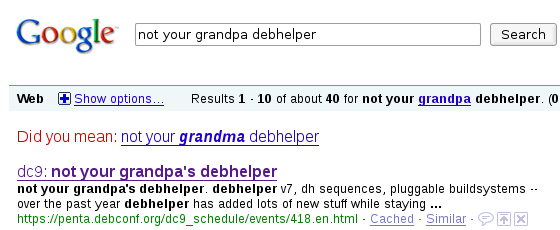
I am updating an old package's packaging style to take advantage of the new DebHelper 7 goodities. So far, I have been quite successful, but I hit a problem And before bugging on IRC, I decided to check with Joey Hess' presentation at DebConf9, Not your grandpa's debhelper. Of course, not remembering the URL, it was the most natural thing to ask Google: Did you mean... Not your grandma's Debhelper  WTF! Of course, putting this thingy aside, the right answer was the first hit. However, what is the first hit for the Grandma version? Quite dangerous: A post in Ubuntuforums for which the Google excrept reads: this tool can obviously eat your cat, poison your grandma, create an earthquake or do any other unexpected harm, so I don't provide any warranty whatsoever. I sincerely prefer joeyh's version.
Jordi Mallach: Flags and outrages

A bit more than two years ago, two young Spaniards on vacation in Latvia maybe went a bit too far during one of their night parties and decided to remove some Latvian flags that hanged from a post in the streets of Riga. They spent 1 month in prison, with charges for outraging the Latvian flag. The Spanish media talked about the disproportionate charges, the ridiculous and medieval laws in Latvia and so on. Today, we learn that Jaume d'Urgell will go to prison due to the outraging crime of substituting the current Spanish flag with the Republican flag of 1931 on the facade of a public building. So much for medieval laws and institutions like the Spanish monarchy.

Adnan Hodzic: New GPG key

I wanted to renew my key for what seems as eternity, and finally I ve done it, didn t even want to participate in keysigning party on DC9 for the same reason. So here s my RSA 4096 bit replacement for my old 1024 DSA.
pub  4096R/2D516C09 2009-09-07
Key fingerprint = 6878 DFA1 A95C 3D55 713F  42B1 EE0E 2790 2D51 6C09
uid  Adnan Hodzic (AbsintheSyringe) <adnan@foolcontrol.org>
uid  [jpeg image of size 3877]
sub  4096R/E3FBC33A 2009-09-07
We ll see how/when will I get it signed, even though I got some basic idea how we can start doing it remotely Smile

Eugene V. Lyubimkin: I became DD.

That are only 3 simple words, but their value is hard to underrate. It's very important milestone in my Debian work.

The achievement might not be possible, if there wasn't the help of:
- Vincent Bernat, who thoroughly corrected my first packaging and sponsored my first (and not only) package;
- Dmitry E. Oboukhov, who uploaded many packages for me and also gave some useful advices;
- Roger Leigh, who spent not one day to improve my packaging skills, and also advocated my NM application;
- Enrico Zini, who was my NM Application Manager.
Thank you!

Thanks to people who built my NM procession chain up to creating the account: Bernd Zeimetz (FD), Christoph Berg (DAM), Peter Palfrader (account creation).

Wouter Verhelst: Tennis: Back Again!

It wasn't too long that Kim Clijsters retired from Tennis, with Justine Henin following her not too long after that. At that point, with the next best player, Kirsten Flipkens, being ranked a hundred-something, I thought it'd be a long time before we'd see Belgian women's tennis reappear. Certainly I didn't think we'd be hopeful this year already. As such, I'm delighted to be able to say that not only is Kim Clijsters making a smashing come-back already beating Venus Williams, ranked 3rd on the WTA lists, at the US open, and only a few months after her returning to tennis at that but Yanina Wickmayer, ranked 50-something on the WTA lists by now, has managed to reach the last 16 players. With Kirsten besting her career record by reaching the 3rd round of the US Open (before being ousted by Kim, no less), I feel the future of Belgian Women's tennis is looking very bright indeed. Perhaps I should think about getting that cable subscription, so I can actually watch the matches.

Russell Coker: Gnash and use of Free Software

There is currently a discussion on a private mailing list about whether some money from a community organisation should be used to assist the development of Gnash (the free software Flash player) [1]. The main reason for this is that there are apparently some schools that depend on flash web sites to such a degree that they won t consider using a free OS that lacks Flash support. It has been shown that there are a number of issues related to contributing financially to free projects, the people who advocate financial contributions in this case assure us that such problems have been addressed but it will remain controversial to some extent. One thing that is not controversial is the fact that testing and debugging is universally a good thing. So I advocate doing such testing as a way to contribute to Flash development and therefore free software use in education. The Debian-Edu project has a web page with a link to flash sites that can be used for testing [2]. So I plan to now install Gnash on all Linux desktop systems that I run and get bug reports to help development. I encourage others to do the same. Also there is the Ming library for developing Flash files which could apparently do with some help in the development process [3]. While a non-free format such as Flash is not ideal, it s certainly a lot better than Silverlight! Note that I don t have strong feelings about the issues of financial support for Gnash (which is why I didn t contribute to the private discussion in question). But I am convinced that more people using and testing Gnash is a good thing.

Andreas Barth: Feed of RC bug changes

In response to Andrews request for a feed of RC buggy packages there is currently a 3 times per day changelist on http://bts.turmzimmer.net/. Converting that list to an RSS feed shouldn't be an issue if it's helpful to people. (And if you want it, just sent me an example how the two current top entries should look like as rss feed.)

Russell Coker: Bad but Appealing Copyright Arguments

Some people seem to believe that the problem with copyright law is the inability of people on the free culture side of the debate to compete with the large amounts of money that are being spent but the RIAA et al. I think that a significant part of the problem is that many intelligent and well-meaning people are simply unaware of or unconvinced by the arguments. For example the Reid Report post titled Paul Porter speaks truth to Black radio [1] includes the quote Only the United States, North Korea and Iran don t pay royalties for performers on free AM/FM radio . This point actually sounds quite reasonable and will convince many intelligent and well-meaning people who have an interest in politics such as Ms Reid. Cory Doctorow has written an interesting article titled Internet rapshoot: How Internet Gatekeepers Stifle Progress [2]. He describes how the big entertainment companies are failing to properly represent their customers or the artists who produce the content, and in the process creating monopolies out of companies such as Apple and Google. Cory starts by raising the issue of cultural discourse, monopolies in the distribution of popular art will lead to control over the political process. Ironically the article that Ms Reid cited [3] mentions the issue of pay for play which led to a steady diet of misogyny, violence and drug culture on the airwaves. Brendan Scott has written about a similar issue in Australia where the music copyright holders are trying to get massive increases in license fees from restaurants and other small businesses [4]. The expected result of this is greater use of classical music (which is out of copyright) and more interest in purchasing licenses from small musicians who aren t affiliated with the music cartels. One of his main points is that playing music in public places (including public radio frequencies) is the major form of advertising for musicians. Michael Tiemann writes about a Brazilian band that has been quite profitable by skipping the recording industry, providing the fans what they want, and selling CDs direct to fans [5]. This is one of many examples to illustrate the fact that the current music factory system is not required for musicians to make a profit. Amanda Palmer has written an interesting blog post about how the Warner music group wasn t getting as much money from Youtube as they wanted so they demanded that HER music videos be removed [6] (among many others). So we have a music studio that doesn t even pay the artist (below a certain number of sales the artist gets no payment, selling 30,000 albums is not enough to get a cent) demanding that the music videos be made unavailable to fans when the artist wants them published. This is a travesty and if similar licensing schemes are implemented for radio stations then we can expect that some radio stations will be financially discouraged from playing music even when the artist would be happy to have it played for free! In Australia we have an organisation that secretly taxes all viewing of material that they think is under copyright with a suitable license (they give no detailed information on how they determine the copyright and license status they probably violate my license by taxing universities for copying posts from my blog). Educational institutions and other organisations that sign up get to pay them some money based on what they are deemed to have used. The money is then distributed to the creators in proportion to the amount of use their material received. The distribution rules state that any amount less than $50 per year for an Australian resident or $200 per year for a non-resident will be instead redistributed to other people [7]. Usually analysis of The Long Tail [8] comprises the majority of the sales if users are given enough opportunities to search for a product that is a good match for their requirements. This is the entire basis of businesses such as Amazon.com. The Australian Copyright Agency (Copyright Agency Limited CAL) seems to have a business model of taking all the revenue that might be earned by the creative people in the long tail and give it all to the top performers. If a similar system was implemented for the US music industry then it would be great for Michael Jackson s estate, but bad for the vast majority of musicians. It seems likely to me that the current situation with the music industry is fairly optimal for making a few very popular musicians very rich. The proposed changes for the US will make things even better/worse (depending if you are among the rich few or the majority of the population). One thing we need to ask ourselves is whether we want laws that will make a few people rich or laws that will give many people an adequate income for work they enjoy and which also enriches our culture. This correct decision seems obvious to me. Can anyone think of other good points that should be raised when discussing such issues with people who don t consider copyright to be a big issue?

6 September 2009

Dirk Eddelbuettel: RQuantLib 0.3.0 Windows build snag

Yesterday's upload of RQuantLib 0.3.0 contained one minor oversight: I had failed to update src/Makefile.win to the new and enlarged set of source files. The proper fix (of using wildcards and implicit rules) was simple, and Uwe Ligges kindly rebuilt RQuantLib on the Windows builder for CRAN using an updated Makefile so that binaries for Windows will be available. This fix will also be in the next upload. Should you need it in the meantime, here is a link to the new version directly from SVN.

Andrew Pollock: [debian] RSS feed of RC bugs?

Stefano Zacchiroli's post about fixing an RC bug a day got me thinking. In my Google Reader, I already have the feed of new Debian packages (which was incidentally the highlight of Debian Weekly News for me, and now that I found this feed, I miss its now infrequent publications a whole lot less). What I'd really like to compliment this, is a daily feed of new release critical bugs opened or elevated to release critical status. Then, in my copious amounts of spare time, if I got the urge when an appropriate RC bug went by, I might be more inclined to try and do something about it. Does such a feed already exist somewhere?

Next.

Previous.

