Search Results: "tb"

19 April 2015

Richard Hartmann: Release Critical Bug report for Week 16

The UDD bugs interface currently knows about the following release critical bugs: How do we compare to the Squeeze and Wheezy release cycles?
Week Squeeze Wheezy Jessie
43 284 (213+71) 468 (332+136) 319 (240+79)
44 261 (201+60) 408 (265+143) 274 (224+50)
45 261 (205+56) 425 (291+134) 295 (229+66)
46 271 (200+71) 401 (258+143) 427 (313+114)
47 283 (209+74) 366 (221+145) 342 (260+82)
48 256 (177+79) 378 (230+148) 274 (189+85)
49 256 (180+76) 360 (216+155) 226 (147+79)
50 204 (148+56) 339 (195+144) ???
51 178 (124+54) 323 (190+133) 189 (134+55)
52 115 (78+37) 289 (190+99) 147 (112+35)
1 93 (60+33) 287 (171+116) 140 (104+36)
2 82 (46+36) 271 (162+109) 157 (124+33)
3 25 (15+10) 249 (165+84) 172 (128+44)
4 14 (8+6) 244 (176+68) 187 (132+55)
5 2 (0+2) 224 (132+92) 175 (124+51)
6 release! 212 (129+83) 161 (109+52)
7 release+1 194 (128+66) 147 (106+41)
8 release+2 206 (144+62) 147 (96+51)
9 release+3 174 (105+69) 152 (101+51)
10 release+4 120 (72+48) 112 (82+30)
11 release+5 115 (74+41) 97 (68+29)
12 release+6 93 (47+46)
13 release+7 50 (24+26)
14 release+8 51 (32+19)
15 release+9 39 (32+7)
16 release+10 20 (12+8)
17 release+11 24 (19+5)
18 release+12 2 (2+0)
Graphical overview of bug stats thanks to azhag:

18 April 2015

Russ Allbery: Review: The Long Way to a Small, Angry Planet

Review: The Long Way to a Small, Angry Planet, by Becky Chambers
Publisher: CreateSpace
Copyright: 2014
ISBN: 1-5004-5330-7
Format: Kindle
Pages: 503
The Wayfarer is a tunneling ship: one of the small, unremarked construction ships that help build the wormhole network used for interstellar transport. It's a working ship with a crew of eight (although most people would count seven and not count the AI). They don't all like each other particularly not the algaeist, who is remarkably unlikeable but they're used to each other. It's not a bad life, although a more professional attention to paperwork and procedure might help them land higher-paying jobs. That's where Rosemary Harper comes in. At the start of the book, she's joining the ship as their clerk: nervous, hopeful, uncertain, and not very experienced. But this is a way to get entirely away from her old life and, unbeknownst to the ship she's joining, her real name, identity, and anyone who would know her. Given that introduction, I was expecting this book to be primarily about Rosemary. What is she fleeing? Why did she change her identity? How will that past come to haunt her and the crew that she joined? But that's just the first place that Chambers surprised me. This isn't that book at all. It's something much quieter, more human, more expansive, and more joyful. For one, Chambers doesn't stick with Rosemary as a viewpoint character, either narratively or with the focus of the plot. The book may open with Rosemary and the captain, Ashby, as focal points, but that focus expands to include every member of the crew of the Wayfarer. We see each through others' eyes first, and then usually through their own, either in dialogue or directly. This is a true ensemble cast. Normally, for me, that's a drawback: large viewpoint casts tend to be either jarring or too sprawling, mixing people I want to read about with people I don't particularly care about. But Chambers avoids that almost entirely. I was occasionally a touch disappointed when the narrative focus shifted, but then I found myself engrossed in the backstory, hopes, and dreams of the next crew member, and the complex ways they interweave. Rosemary isn't the center of this story, but only because there's no single center. It's very hard to capture in a review what makes this book so special. The closest that I can come is that I like these people. They're individual, quirky, human (even the aliens; this is from more the Star Trek tradition of alien worldbuilding), complicated, and interesting, and it's very easy to care about them. Even characters I never expected to like. The Long Way to a Small, Angry Planet does have a plot, but it's not a fast-moving or completely coherent one. The ship tends to wander, even when the mission that gives rise to the title turns up. And there are a lot of coincidences here, which may bother you if you're reading for plot. At multiple points, the ship ends up in exactly the right place to trigger some revelation about the backstory of one of the crew members, even if the coincidence strains credulity. Similar to the algae-driven fuel system, some things one just has to shrug about and move past. On other fronts, though, I found The Long Way to be refreshingly willing to take a hard look at SF assumptions. This is not the typical space opera: humans are a relatively minor species in this galaxy, one that made rather a mess of their planet and are now refugees. They are treated with sympathy or pity; they're not somehow more flexible, adaptable, or interesting than the rest of the galaxy. More fascinatingly to me, humans are mostly pacifists, a cultural reaction to the dire path through history that brought them to their current exile. This is set against a backdrop of a vibrant variety of alien species, several of whom are present onboard the Wayfinder. The history and background of the other species are not, sadly, as well fleshed out as the humans, but each with at least a few twists that add interest to the story. But the true magic of this book, the thing that it has in overwhelming abundance, is heart. Not everyone in this book is a good person, but most of them are trying. I've rarely read a book full of so much empathy and willingness to reach out to others with open hands. And, even better, they're all nice in different ways. They bring their own unique personalities and approaches to their relationships, particularly the complex web of relationships that connects the crew. When bad things happen, and, despite the overall light tone, a few very bad things happen, the crew rallies like friends, or like chosen family. I have to say it again: I like these people. Usually, that's not a good sign for a book, since wholly likeable people don't generate enough drama. But this is one of the better-executed "protagonist versus nature" plots I've read. It successfully casts the difficulties of making a living at a hard and lonely and political job as the "nature" that provides the conflict. This is a rather unusual book. It's probably best classified as space opera, but it doesn't fit the normal pattern of space opera and it doesn't have enough drama. It's not a book about changing the universe; at the end of the book, the universe is in pretty much the same shape as we found it. It's not even about the character introduced in the first pages, or really that much about her dilemma. And it's certainly not a book about winning a cunning victory against your enemies. What it is, rather, is a book about friendships, about chosen families and how they form, about being on someone else's side, about banding together while still being yourself. It's about people making a living in a hard universe, together. It's full of heart, and I loved it. I'm unsurprised that The Long Way to a Small, Angry Planet had to be self-published via a Kickstarter campaign to find its audience. I'm also unsurprised that, once it got out there, it proved very popular and has now been picked up by a regular publisher. It's that sort of book. I believe it's currently out of print, at least in the US, as its new publisher spins up that process, but it should be back in print by late 2015. When that happens, I recommend it to your attention. It was the most emotionally satisfying book I've read so far this year. Rating: 9 out of 10

14 April 2015

Neil Williams: Extending an existing ARMMP initramfs

The actual use of this extension is still in development and the log files are not currently publicly visible, but it may still be useful for people to know the what and why The Debian ARMMP kernel can be used for multiple devices, just changing the DTB. I ve already done tests with this for Cubietruck and Beaglebone-Black, iMX.53 was one of the original test devices too. Whilst these tests can deploy a full image (there are examples of building such images in the vmdebootstrap package), it is a lot quicker to do simple tests of a kernel using a ramdisk. The default Debian initramfs has a focused objective but still forms a useful base for extension. In particular, I want to be able to test one initramfs on multiple boards (so multiple dtbs) with the same kernel image. I then want to be able, on selected boards, to mount a SATA drive or write an image to eMMC or a USB stick or whatever. LAVA (via the ongoing refactoring, not necessarily in the current dispatcher code) can automate such tests, e.g. to allow me to boot a Cubietruck into a standard Debian ARMMP armhf install on the SATA drive but using a modified (or updated) ARMMP kernel over TFTP without needing to install it on the device itself. That same kernel image can then be tested on multiple boards to see if the changes have benefitted one board at the expense of another. Automating all of that could be of a lot of benefit to the ARM kernel developers in Debian and outside Debian. So, the start point. Install Debian onto a Cubietruck in my case, with a SATA drive attached. All well and good so far, standard Debian Jessie ARMMP. (Cubietruck uses the LPAE kernel flavour but that won t matter for the initramfs.) Rather than building the initramfs manually, this provides a shortcut at some point I may investigate how to do this in QEMU but for now, it s just as quick to SSH onto the Cubietruck and update. I ve already written a little script to download the relevant linux-image package for ARMMP, unpack it and pull out the vmlinuz, the dtbs and a selected list of modules. The list is selective because TFTP has a 32Mb download limit and there are more modules than that. So I borrowed a snippet from the Xen folks (already shown previously here). The script is in a support repository for LAVA but can be used anywhere. (You ll need to edit the package name in the script to choose between ARMMP and ARMMP LPAE. Steps
  1. Get a working initramfs from an installed device running Debian ARMMP and copy some files for use later. Note: use the name of the symlink in the copy so that the file in /tmp/ is the actual file, using the name of the symlink as the filename. This is important later as it saves a step of having to make the (unnecessary) symlink inside the initramfs. Also, mkinitramfs, which built this initrd.img file in the first place, uses the same shared libraries as the main system, so copying these into the initramfs still works. (This is really useful when you get your ramdisk to support the attached secondary storage, allowing you to simply mount the original Debian install and fixup the initramfs by copying files off the main Debian install.) The relevant files are to support DNS lookup inside the initramfs which then allows a test to download a new image to put onto the attached media before rebooting into it.
    cp /boot/initrd.img-3.16.0-4-armmp-lpae /tmp/
    cp /lib/arm-linux-gnueabihf/libresolv.so.2 /tmp/
    cp /mnt/lib/arm-linux-gnueabihf/libnss_dns.so.2 /tmp/
    
    Copy these off the device for local adjustment:
    scp IP_ADDR:/tmp/FILE .
    
  2. Decompress the initrd.img:
    cp initrd.img-3.16.0-4-armmp-lpae initrd.img-3.16.0-4-armmp-lpae.gzip
    gunzip initrd.img-3.16.0-4-armmp-lpae.gzip
    
  3. Make a new empty directory
    mkdir initramfs
    cd initramfs
    
  4. Unpack:
    sudo cpio -id < initrd.img-3.16.0-4-armmp-lpae
    
  5. Remove the old modules (LAVA can add these later, allowing tests to use an updated build with updated modules):
    sudo rm -rf ./lib/modules/*
    
  6. Start to customise - need a script for udhcpc and two of the libraries from the installed system to allow the initramfs to do DNS lookups successfully.
    cp ../libresolv.so.2 ./lib/arm-linux-gnueabihf/
    cp ../libnss_dns.so.2 ./lib/arm-linux-gnueabihf/
    
  7. Copy the udhcpc default script into place:
    mkdir ./etc/udhcpc/
    sudo cp ../udhcpc.d ./etc/udhcpc/default.script
    sudo chmod 0755 ./etc/udhcpc/default.script
    
  8. Rebuild the cpio archive:
    find .   cpio -H newc -o > ../initrd.img-armmp.cpio
    
  9. Recompress:
    cd ..
    gzip initrd.img-armmp.cpio
    
  10. If using u-boot, add the UBoot header:
    mkimage -A arm -T ramdisk -C none -d initrd.img-armmp.cpio.gz initrd.img-armmp.cpio.gz.u-boot
    
  11. Checksum the final file so that you can check that against the LAVA logs.
    md5sum initrd.img-armmp.cpio.gz.u-boot
    
Each type of device will need a set of modules modprobed before tests can start. With the refactoring code, I can use an inline YAML and use dmesg -n 5 to reduce the kernel message noise. The actual module names here are just those for the Cubietruck but by having these only in the job submission, it makes it easier to test particular combinations and requirements.
- dmesg -n 5
- lava-test-case udevadm --shell udevadm hwdb --update
- lava-test-case depmod --shell depmod -a
- lava-test-case sata-mod --shell modprobe -a stmmac ahci_sunxi sd_mod sg ext4
- lava-test-case ifconfig --shell ifconfig eth0 up
- lava-test-case udhcpc --shell udhcpc
- dmesg -n 7
In due course, this will be added to the main LAVA documentation to allow others to keep the initramfs up to date and to support further test development.

Michal &#268;iha&#345;: Hacking Gammu

I've spent first day of SUSE Hackweek on Gammu. There are quite many tasks to be done and I wanted to complete at least some of them. First I started with the website. I did not really like the old layout and aggressive colors and while touching it's code it's good idea to make the website work well in mobile devices. I've started with conversion to Bootstrap and It turned out to be quite easy task. The next step was making the pages simpler as in many places there was too much information hidden in sidebar. While doing content cleanup, I've removed some features which really don't make much sense these days (such as mirror selection). Anyway read more in the news entry on the site itself. Second big task was to add support for Python 3 in python-gammu. It seems that world is finally slowly moving towards Python 3 and people started to request python-gammu to be available there as well. The porting itself took quite some time, but I've mostly completed it before Hackweek. Yesterday, there was just some time spent on polishing and releasing standalone python-gammu and Gammu without python bindings. Now you can build python-gammu using distutils or install it using pip install python-gammu.

Filed under: English Gammu python-gammu SUSE Wammu 0 comments

13 April 2015

Russ Allbery: Review: Zero Sum Game

Review: Zero Sum Game, by S.L. Huang
Series: Russell's Attic #1
Publisher: S.L. Huang
Copyright: 2014
ISBN: 0-9960700-1-X
Format: Kindle
Pages: 326
Cas Russell finds things for people, often involving some strategic violence. She belongs to that genre of action novel protagonists who have a rough code of ethics, but who don't exactly follow the law. Her friend Rio is much worse: a functioning sociopath with his own code of ethics, the derivation of which is a key plot point. When the book opens, Cas is on a mission to find a person and rescue them from a drug cartel not her normal mission, but her contact said she was referred by Rio. Oh, and Rio is currently hitting her in the face. This setup matches any number of present-day thrillers. The SFnal twist is that Cas is very good at numbers, in a completely unrealistic action hero way. (I found it unsurprising that Huang was inspired by the superhero genre; that's the right model to have in mind when reading about Cas.) She can calculate where bullets are going to go, knows just the right angle and velocity with which to throw things (and, even more notably, can get her body to do that), and, in one particularly memorable scene, sets up an eavesdropping sound concentrator by changing the angles of available random surfaces in the neighborhood, like trash cans. This ability is not without drawbacks. When she's not in a middle of a job, with something to focus on, she usually ends up drinking herself into a stupor to get her brain to stop working. But it's an extremely useful ability that requires the villains of this book go to great efforts to try to kill her. The plot starts out as fairly typical thriller material, involving threats and dire consequences to those Cas loves (or at least likes a lot) and an unfolding sense that this retrieval of a kidnapped woman is the tip of a very deep iceberg. The expected counterpart, a private investigator with a less casual attitude towards killing than Cas, shows up early on. (Rio does not play that role in the story. His role is much more complex.) But the superhero inspirations show up in the villains as well, in a twist that many on-line summaries spoil, but which I will leave unmentioned. Mostly, Zero Sum Game is a fast-moving story with lots of violence, lots of guns, shadowy conspiracies, and a hypercompetent protagonist. (Female, refreshingly, particularly since she doesn't fall in love with any of the other characters in the book.) It's a recipe for enjoyable brain candy, and I think that's the best attitude to bring to it. However, a couple of things set it apart for me. First, Cas spends quite a bit of time really thinking about her life and questioning her decisions, rather than just blithely enjoying her world of stress and violence. There's more introspection here than in the typical thriller plot, but she stops short of wallowing in angst and stays decisive. I liked that balance: a bit of inner discomfort, and a few hard ethical decisions, but not to the point of paralyzing her. Second, her relationship with Rio is something special. Rio himself is a character type that I've seen before in books like this, but I don't think I've seen the dynamic with a character like that handled this well before. I particularly liked that the focus of the book stayed on Cas, not on Rio, and the reader was encouraged to see that relationship as a reflection on Cas and her sense of internal ethics. Seeing Rio through Cas's eyes, and then seeing other characters react to him and react to their relationship, touched some chords that I really enjoyed reading. Unfortunately, the villains weren't as successful, at least for me. Partly this is a personal quirk: the nature of the threat posed (not revealed for about half the book) is a kind that I dislike reading about. It makes my skin crawl in a way that I don't enjoy. But, even putting that aside, the story ends on a very odd and disturbing anti-climax. It's clearly the first book of an ongoing series, and I hope later books will salvage this. (I certainly liked it well enough to read on.) But the ending left me unsettled and rather irritated at the author. Huang plays fair, and the ending is consistent with what we know by the end of the book, but I read this sort of action-thriller story for catharsis and the glory of competent people doing what they do well. I got deeply engrossed in this book and had a hard time putting it down. Both Cas and Rio are great characters, as are most of the supporting cast. I wish the ending wasn't quite as much of a letdown so that I could recommend it more strongly. But it's still a fun superhero thriller. If you're looking for something with unrealistic superpowers, a large helping of competence, and a high body count, this may be worth picking up. (And no, I don't know what the series title means. I know what the series title refers to, but I haven't yet figured out what connection it or the Axiom of Choice has to the plot.) Followed by Half Life. Rating: 7 out of 10

10 April 2015

Andrew Shadura: Kallithea 0.2 released

This post is almost a carbon copy of the Kallithea 0.2 release notes. Kallithea project have just released Kallithea 0.2. Kallithea is a Python-based GPLv3 source code management software for web-based hosting of Mercurial and Git repositories. This release brings many changes since 0.1. Notably, pull requests system have been improved, making contributing changes more robust. The visual appearance has also been refined: modern font-based symbolic icons from FontAwesome and GitHub Octicons have replaced the previously used bitmap icons, and revision graphs are now drawn with HiDPI display support. Kallithea now supports Mercurial 3.3 and Dulwich 0.9.9. Several fixes in the database code boosted performance significantly. We have also updated our Javascript libraries: jQuery, CodeMirror and Mergely. Javascript and CSS code have been cleaned up, with less and less code depending on Yahoo UI library. Since 0.1 we have discovered two security issues, so all users are strongly recommended to upgrade. For more details on these issues, please see our Security Notices page For more information, see https://kallithea-scm.org/ or http://docs.kallithea-scm.org/. The summary of the changes since 0.1 release is below. Bug fixes: Features and improvements: Changes (might influence workflows): Cleanup:

Richard Hartmann: Release Critical Bug report for Week 15

Still on the road with shittynet; sorry for missing last week. The UDD bugs interface currently knows about the following release critical bugs: How do we compare to the Squeeze and Wheezy release cycles?
Week Squeeze Wheezy Jessie
43 284 (213+71) 468 (332+136) 319 (240+79)
44 261 (201+60) 408 (265+143) 274 (224+50)
45 261 (205+56) 425 (291+134) 295 (229+66)
46 271 (200+71) 401 (258+143) 427 (313+114)
47 283 (209+74) 366 (221+145) 342 (260+82)
48 256 (177+79) 378 (230+148) 274 (189+85)
49 256 (180+76) 360 (216+155) 226 (147+79)
50 204 (148+56) 339 (195+144) ???
51 178 (124+54) 323 (190+133) 189 (134+55)
52 115 (78+37) 289 (190+99) 147 (112+35)
1 93 (60+33) 287 (171+116) 140 (104+36)
2 82 (46+36) 271 (162+109) 157 (124+33)
3 25 (15+10) 249 (165+84) 172 (128+44)
4 14 (8+6) 244 (176+68) 187 (132+55)
5 2 (0+2) 224 (132+92) 175 (124+51)
6 release! 212 (129+83) 161 (109+52)
7 release+1 194 (128+66) 147 (106+41)
8 release+2 206 (144+62) 147 (96+51)
9 release+3 174 (105+69) 152 (101+51)
10 release+4 120 (72+48) 112 (82+30)
11 release+5 115 (74+41) 97 (68+29)
12 release+6 93 (47+46)
13 release+7 50 (24+26)
14 release+8 51 (32+19)
15 release+9 39 (32+7)
16 release+10 20 (12+8)
17 release+11 24 (19+5)
18 release+12 2 (2+0)
Graphical overview of bug stats thanks to azhag:

7 April 2015

Mike Hommey: Announcing git-cinnabar 0.2.0

Git-cinnabar is a git remote helper to interact with mercurial repositories. It allows to clone, pull and push from/to mercurial remote repositories, using git. Get it on github. What s new since 0.1.1? What to expect next? If you want to follow the improvements more closely, I encourage you to switch to the next branch. I won t push anything there that hasn t been extensively tested on the above mentioned repositories. And as always, please report any issue you run into.

6 April 2015

Jonathan Carter: Squashfs Performance Testing

Experiments Last week I discovered The Fan Club s Experiments page. It reminds me of the Debian Experiments community on Google+. I like the concept of trying out all kinds of different things and reporting back to the community on how it works. I ve been meaning to do more of that myself so this is me jumping in and reporting back on something I ve been poking at this weekend. Introducing Squashfs Squashfs is a read-only compressed filesystem commonly used on embedded devices, Linux installation media and remote file systems (as is done in LTSP). Typically, a system like tmpfs, unionfs or aufs is mounted over this read-only system to make it usable as a root filesystem. It has plenty of other use cases too but for the purposes of this entry we ll stick with those use cases in mind. It supports gzip, lzo and xz(lzma) as compression back-ends. It also supports block sizes from 4K up to 1M. Compression technique as well as block size can have major effects on both performance and file size. In most cases the defaults will probably be sufficient, but if you want to find a good balance between performance and space saving, then you ll need some more insight. My Experiment: Test effects of squashfs compression methods and block sizes I m not the first person to have done some tests on squashfs performance and reported on it. Bernhard Wiedemann and the Squashfs LZMA project have posted some results before, and while very useful I want more information (especially compress/uncompress times). I was surprised to not find a more complete table elsewhere either. Even if such a table existed, I probably wouldn t be satisfied with it. Each squashfs is different and it makes a big difference whether it contains already compressed information or largely uncompressed information like clear text. I d rather be able to gather compression ratio/times for a specific image rather than for one that was used for testing purposes once-off. So, I put together a quick script that takes a squashfs image, extracts it to tmpfs, and then re-compressing it using it all the specified compression techniques and block sizes and then uncompressing those same images for their read speeds. My Testing Environment For this post, I will try out my script on the Ubuntu Desktop 14.04.2 LTS squashfs image. It s a complex image that contains a large mix of different kinds of files. I m extracting it to RAM since I want to avoid having disk performance as a significant factor. I m compressing the data back to SSD and extracting from there for read speed tests. The SSD seems fast enough not to have any significant effect on the tests. If you have a slow storage, the results of the larger images (with smaller block sizes) may be skewed unfavourably. As Bernhard mentioned on his post, testing the speed of your memory can also be useful, especially when testing on different kinds of systems and comparing the results:
# dd if=/dev/zero of=/dev/null bs=1M count=100000
104857600000 bytes (105 GB) copied, 4.90059 s, 21.4 GB/s
CPU is likely to be your biggest bottleneck by far when compressing. mksquashfs is SMP aware and will use all available cores by default. I m testing this on a dual core Core i7 laptop with hyper-threading (so squashfs will use 4 threads) and with 16GB RAM apparently transferring around 21GB/s. The results of the squashfs testing script will differ greatly based on the CPU cores, core speed, memory speed and storage speed of the computer you re running it on, so it shouldn t come as a surprise if you get different results than I did. If you don t have any significant bottleneck (like slow disks, slow CPU, running out of RAM, etc) then your results should more or less correspond in scale to mine for the same image. How to Run It Create a directory and place the filesystem you d like to test as filesystem.squashfs, then:
$ apt-get install squashfs-tools 
$ wget https://raw.githubusercontent.com/highvoltage/squashfs-experiments/master/test-mksquashfs.sh
$ bash test-mksquashfs.sh
With the default values in that file, you ll end up with 18 squashfs images taking up about 18GB of disk space. I keep all the results for inspection, but I ll probably adapt/fix the script to be more friendly to disk space usage some time. You should see output that look something like this, with all the resulting data in the ./results directory.
* Setting up...
- Testing gzip
  * Running a squashfs using compression gzip, blocksize 4096
  * Running a squashfs using compression gzip, blocksize 8192
  * Running a squashfs using compression gzip, blocksize 16384
  ...
- Testing lzo
  * Running a squashfs using compression lzo, blocksize 4096
  * Running a squashfs using compression lzo, blocksize 8192
  * Running a squashfs using compression lzo, blocksize 16384
  ...
- Testing xz
  * Running a squashfs using compression xz, blocksize 4096
  * Running a squashfs using compression xz, blocksize 8192
  * Running a squashfs using compression xz, blocksize 16384
  ...
* Testing uncompressing times...
  * Reading results/squashfs-gzip-131072.squashfs...
  * Reading results/squashfs-gzip-16384.squashfs...
  * Reading results/squashfs-gzip-32768.squashfs...
  ...
* Cleaning up...
On to the Results The report script will output the results into CSV. Here s the table with my results. Ratio is percentage of the size of the original uncompressed data, CTIME and UTIME is compression time and uncompress time for the entire image.
Filename Size Ratio CTIME UTIME
squashfs-gzip-4096.squashfs 1137016 39.66% 0m46.167s 0m37.220s
squashfs-gzip-8192.squashfs 1079596 37.67% 0m53.155s 0m35.508s
squashfs-gzip-16384.squashfs 1039076 36.27% 1m9.558s 0m26.988s
squashfs-gzip-32768.squashfs 1008268 35.20% 1m30.056s 0m30.599s
squashfs-gzip-65536.squashfs 987024 34.46% 1m51.281s 0m35.223s
squashfs-gzip-131072.squashfs 975708 34.07% 1m59.663s 0m22.878s
squashfs-gzip-262144.squashfs 970280 33.88% 2m13.246s 0m23.321s
squashfs-gzip-524288.squashfs 967704 33.79% 2m11.515s 0m24.865s
squashfs-gzip-1048576.squashfs 966580 33.75% 2m14.558s 0m28.029s
squashfs-lzo-4096.squashfs 1286776 44.88% 1m36.025s 0m22.179s
squashfs-lzo-8192.squashfs 1221920 42.64% 1m49.862s 0m21.690s
squashfs-lzo-16384.squashfs 1170636 40.86% 2m5.008s 0m20.831s
squashfs-lzo-32768.squashfs 1127432 39.36% 2m23.616s 0m20.597s
squashfs-lzo-65536.squashfs 1092788 38.15% 2m48.817s 0m21.164s
squashfs-lzo-131072.squashfs 1072208 37.43% 3m4.990s 0m20.563s
squashfs-lzo-262144.squashfs 1062544 37.10% 3m26.816s 0m15.708s
squashfs-lzo-524288.squashfs 1057780 36.93% 3m32.189s 0m16.166s
squashfs-lzo-1048576.squashfs 1055532 36.85% 3m42.566s 0m17.507s
squashfs-xz-4096.squashfs 1094880 38.19% 5m28.104s 2m21.373s
squashfs-xz-8192.squashfs 1002876 34.99% 5m15.148s 2m1.780s
squashfs-xz-16384.squashfs 937748 32.73% 5m11.683s 1m47.878s
squashfs-xz-32768.squashfs 888908 31.03% 5m17.207s 1m43.399s
squashfs-xz-65536.squashfs 852048 29.75% 5m27.819s 1m38.211s
squashfs-xz-131072.squashfs 823216 28.74% 5m42.993s 1m29.708s
squashfs-xz-262144.squashfs 799336 27.91% 6m30.575s 1m16.502s
squashfs-xz-524288.squashfs 778140 27.17% 6m58.455s 1m20.234s
squashfs-xz-1048576.squashfs 759244 26.51% 7m19.205s 1m28.721s
Some notes:

Eddy Petri&#537;or: HOWTO: Dnsmasq server for network booting using TFTP and DHCP

Dnsmasq is a very lightweight server that besides the expected DNS caching functionality, it also offers DHCP and TFTP functionality in a single binary.

This makes it very useful if one needs to network boot a system since you can have the TFTP and DHCP part of the setup done easily, and only add NFS for a complete network boot.

Add to that that

One extra nice thing dnsmasq has is that it can mark specific hosts, addresses or ranges with some internal markers, then use those markers as symbolic names to apply settings based for classes of devices.

In the configuration snippet below, there is a rule I set up to make sure I would apply the 'netbsd' label to any system connecting through specific ethernet interfaces (one is the interface of the system, the other is a USB NIC I use from time to time):
#You will need a range for static IPs in the main file
dhcp-range=192.168.77.250,192.168.77.254,static

# give the name 'kinder' to any machine connecting through the given ethernet nics and apply 'netbsd' label
dhcp-host=00:1a:70:99:60:BB,00:06:4F:0D:B1:95, kinder, 192.168.77.251, set:netbsd

# Machines tagged 'netbsd' shall use the given NFS root path
dhcp-option=tag:netbsd, option:root-path,/export/netbsd-nslu2/root
# Enable dnsmasq's built-in TFTP server
enable-tftp

# Set the root directory for files available via FTP.
tftp-root=/srv/tftp
Saving this configuration file in /etc/dnsmasq.d/kinder-netboot will enable this to be used by dnsmasq if this line is present in /etc/dnsmasq.conf
conf-dir=/etc/dnsmasq.d
Commenting it will disable the netbsd part easily.

5 April 2015

Ingo Juergensmann: It has been 30 years now...

Sometimes you happen to realize how old you are when listening to the radio where they announce hits from your days of youth as "oldies". Or when todays youth asking you what a music casette or a 5.25" floppy disk is. You're even older than that when you still know 8" disks. We have one of those on our pin board. Or you may realize your age when your favorite computer of your youth will celebrate its 30th anniversary this year! In 1985 the Amiga was introduced to the public - and 30 years later Amigas around the world are still running! Some are still operated under AmigaOS, some are running maybe NetBSD, but some are running the Debian m68k port - even though the port was expelled from Debian years ago! But some people still take care of this port and it is keeping up with building packages, although mostly due to emulators doing the most work. But anyway, the Amiga is turning 30 this year! And what a great machine this was! It brought multitasking, colorful graphics and multi-channel audio to the masses. It was years ahead of its competitors, but it was doomed to fail because of management failures by the producing company Commodore, which went bankrupt in 1994. The "30th Anniversary Event" will take place on July 25th at the Computer History Museum in Mountain View, California, USA - if the kickstarting the event will be successful during the next two weeks. So, when you earned your first merits in computing on an Amiga as well, you might want to give your Amiga history another kickstart! Not the Kickstart floppy as the A1000 needed to boot up, but fundraising the event on kickstart.org! I think this event is not only important to old Amiga users from the good old days, but for the rememberance of computing history in general. Without doubt the Amiga set new standards in computer history and is an important part of industrial heritage.
Kategorie:

2 April 2015

Rudy Godoy: No SSH for you how to fix OpenRG routers

I find interesting when faced a taken-for-granted situation, in particular in the tech world. This time s history is about an Internet ADSL connection that allows all traffic but SSH. Yes, you read it correctly. It was very bizarre confirming such event was a real-life situation. I don t claim to be a networking expert but at least I want to think I m well educated. After few minutes I ve focused my efforts on dealing with the ADSL router/modem s networking configuration. The device is provided by Movistar (formerly Telefonica) and it runs OpenRG. I ve discovered that other people have experienced the same issue and what Movistar did was basically replacing the device. Of course the problem is gone after that. So, this post is dedicated to those who don t give up. Following the steps below will allow SSH outbound traffic for a OpenRG-based device. OpenRG device specs
Software Version: 6.0.18.1.110.1.52 Upgrade
Release Date: Oct 7 2014
Diagnostic When you do the command below, it shows nothing but timeout. Even when you SSH the router it doesn t establish connection to it.
ssh -vv host.somewhere.com
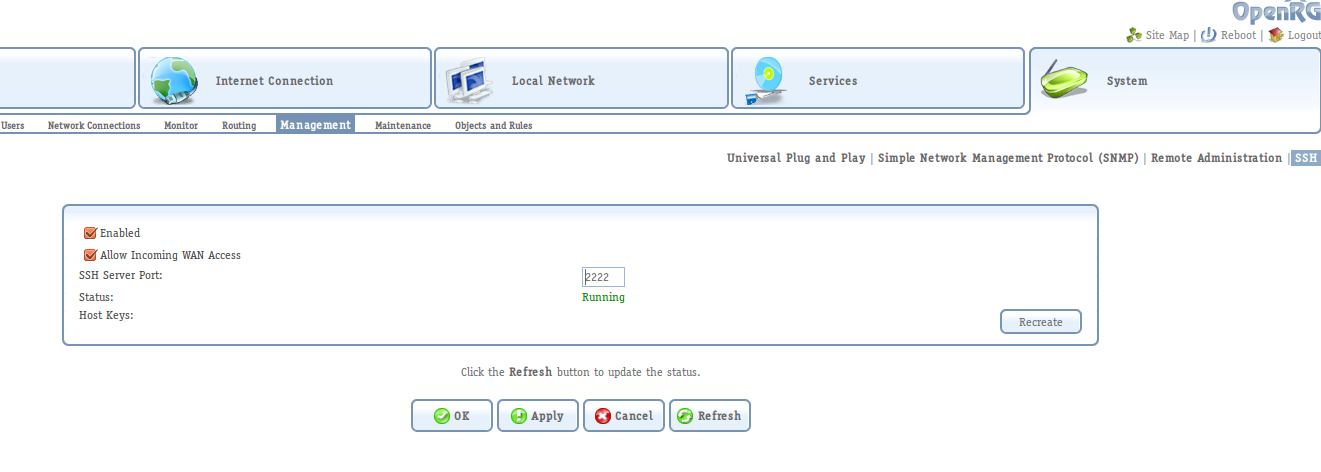
Solution Change router s SSH service port. This step will allow you to access the console-based configuration for the router (since I haven t found any way to do the steps described below from the web management interface). To do so, go to System > Management > SSH. Update the service port to something else than 22, for instance 2222.
OpenRG SSH service configuration

OpenRG SSH service configuration

Connect to the SSH interface Once you have changed the SSH service port, you can access it from a SSH client.
ssh -p 2222 admin@192.168.1.1
admin@192.168.1.1's password: 
OpenRG>
Once you have the console prompt, issue the following commands to allow SSH outbound traffic coming from the LAN and Wifi networks. After the last command, which saves and updates the device s configuration, you should be able to do SSH from any computer in your network to the Internet (thanks to tips from inkhorn).
OpenRG> conf set fw/policy/0/chain/fw_br0_in/rule/0/enabled 0
Returned 0
OpenRG> conf set fw/policy/0/chain/fw_br1_in/rule/0/enabled 0
Returned 0
OpenRG> conf reconf 1
Returned 0

1 April 2015

Holger Levsen: 20150401-reproducible-jessie

Testing jessie for reproducibility or "here, have some 8 cores and 25 GB RAM extra..." So three weeks ago it occurred to me that it would be useful to test the reproducibility of Jessie too (until then we only tested unstable and experimental), as this will give us a nice data point to compare future developments against and also because we wanted to test "testing" in future anyway, so we could as well start while "testing" is still jessie... (because then we will have to test less once stretch development has started, as in the beginning stretch will be jessie anyway.) Quite quickly I then realized that building all packages twice on the current, quite heavily loaded jenkins.debian.net machine, would take 4-6 weeks and that it might well happen that we'll release Jessie before this has finished. (And I do want a Jessie release rather sooner than later!) So I've asked Profitbricks, who have been sponsoring the jenkins.debian.net setup since October 2012, for some more resources temporarily, and once again they quickly helped out and the next day I could add eight cores and 25 GB of RAM to the existing VM, for a total of 23 Cores and 75 GB RAM. So currently jenkins.d.n runs eight reproducible build jobs simultaneously, each of them is pbuilding packages in tmpfs in RAM. Thus these builds are really fast: for small packages without additional build depends build times as low as 40 seconds can be seen, which doesn't sound impressive at first, but this includes the source download and building twice and it includes untar'ing the base.tgz twice as well as running debbindiff on the resulting binary packages. (And all this is while quite many other jobs continue to hammer the machine as well.) (BTW: I doubt using LVM snapshots is faster then running this in tmpfs, but if you think LVM is faster I'd be curious to see some numbers.) Interestingly this rebuild also discovered a rather unexpected result as we found an RC bug in jessie, which caused build failures for >20 packages: "#781076 cdbs: perlmodule-vars.mk LDDLFLAGS quoting problem". And then there were some unexpected but really expectable results: testing turned out to "only" give reproducible results for 79.4% of all packages in main, while unstable has 82.6% reproducible packages. This was unexpected, as our (few) fixed packages in our repo are also used for testing testing and as testing is smaller than sid, I at first believed the reproducible percentage should be higher, as testing has 1000 packages less. So why was the lower percentage to be expected? This is due to two factors: since FOSDEM we have introduced a number of new variations for the second build, that is we now build with a.) a different domainname, b.) with a different umask, c.) a different timezone and d.) a different kernel version (using 'linux64 --uname-2.6'). And secondly, most packages in sid haven't been rebuild since FOSDEM. Thus we'll now reschedule all packages in testing which are unreproducible in unstable, which should decrease the current reproducibility of sid a bit... For those wondering about the 622 packages failing to build in testing: at least 453 are due to our test setup, categorized in (currently) three issues: timestamps_from_cpp_macros, ftbfs_werror_equals and ocaml_configure_not_as_root. The ones in this third issue category are rather trivial to fix, so this leaves 622-453=169 minus those fixed by #781076, so roughly 150 packeges which fail to build in our setup which need to be investigated... And for those wondering about other missing variations, there is at least one big one missing: changing the build date. Current guestimate is that this will make 1-2000 packages unreprdoucible again but we'll only know for sure once we tested them. So I would like to once again thank Profitbricks for supporting jenkins.d.n in the last 2.5 years and making reproducible.d.n possible so smoothly. Being able to painlessly add more resources when we needed them was incredible useful and I hope we can count on their support in the future. (I have some more ideas how to burn resources usefully in future. Stay tuned and btw, if you know how to put more hours in the day, please do tell me. ;) And, of course: thanks for your work on Debian, no matter whether you've been working on Jessie, reproducibility or something totally different! To finish this post I'd like to remind everyone that currently all this is just about the prospects of reproducible builds for Debian. Debian is not 80% reproducible yet - but it easily could be! And I certainly hope it will be "soon", and hopefully "soon" will only mean a few months. We will rebuild and see.


Benjamin Mako Hill: RomancR: The Future of the Sharing-Your-Bed Economy

romancer_logo Today, Aaron Shaw and I are pleased to announce a new startup. The startup is based around an app we are building called RomancR that will bring the sharing economy directly into your bedrooms and romantic lives. When launched, RomancR will bring the kind of market-driven convenience and efficiency that Uber has brought to ride sharing, and that AirBnB has brought to room sharing, directly into the most frustrating and inefficient domain of our personal lives. RomancR is Uber for romance and sex. Here s how it will work: Of course, there are many existing applications like Tinder and Grindr that help facilitate romance, dating, and hookups. Unfortunately, each of these still relies on old-fashion intrinsic ways of motivating people to participate in romantic endeavors. The sharing economy has shown us that systems that rely on these non-monetary motivations are ineffective and limiting! For example, many altruistic and socially-driven ride-sharing systems existed on platforms like Craigslist or Ridejoy before Uber. Similarly, volunteer-based communities like Couchsurfing and Hospitality Club existed for many years before AirBnB. None of those older systems took off in the way that their sharing economy counterparts were able to! The reason that Uber and AirBnB exploded where previous efforts stalled is that this new generation of sharing economy startups brings the power of markets to bear on the problems they are trying to solve. Money both encourages more people to participate in providing a service and also makes it socially easier for people to take that service up without feeling like they are socially in debt to the person providing the service for free. The result has been more reliable and effective systems for proving rides and rooms! The reason that the sharing economy works, fundamentally, is that it has nothing to do with sharing at all! Systems that rely on people s social desire to share without money projects like Couchsurfing are relics of the previous century. RomancR, which we plan to launch later this year, will bring the power and efficiency of markets to our romantic lives. You will leave your pitiful dating life where it belongs in the dustbin of history! Go beyond antiquated non-market systems for finding lovers. Why should we rely on people s fickle sense of taste and attractiveness, their complicated ideas of interpersonal compatibility, or their sense of altruism, when we can rely on the power of prices? With RomancR, we won t have to! Note: Thanks to Yochai Benkler whose example of how leaving a $100 bill on the bedside table of a person with whom you spent the night can change the nature of the a romantic interaction inspired the idea for this startup.

31 March 2015

Dirk Eddelbuettel: R / Finance 2015 Open for Registration

The annoucement below just went to the R-SIG-Finance list. More information is as usual at the R / Finance page.
Registration for R/Finance 2015 is now open! The conference will take place on May 29 and 30, at UIC in Chicago. Building on the success of the previous conferences in 2009-2014, we expect more than 250 attendees from around the world. R users from industry, academia, and government will joining 30+ presenters covering all areas of finance with R. We are very excited about the four keynote presentations given by Emanuel Derman, Louis Marascio, Alexander McNeil, and Rishi Narang.
The conference agenda (currently) includes 18 full presentations and 19 shorter "lightning talks". As in previous years, several (optional) pre-conference seminars are offered on Friday morning. There is also an (optional) conference dinner at The Terrace at Trump Hotel. Overlooking the Chicago river and skyline, it is a perfect venue to continue conversations while dining and drinking. Registration information and agenda details can be found on the conference website as they are being finalized.
Registration is also available directly at the registration page. We would to thank our 2015 sponsors for the continued support enabling us to host such an exciting conference: International Center for Futures and Derivatives at UIC Revolution Analytics
MS-Computational Finance and Risk Management at University of Washington Ketchum Trading
OneMarketData
RStudio
SYMMS On behalf of the committee and sponsors, we look forward to seeing you in Chicago! For the program committee:
Gib Bassett, Peter Carl, Dirk Eddelbuettel, Brian Peterson,
Dale Rosenthal, Jeffrey Ryan, Joshua Ulrich
See you in Chicago in May!

This post by Dirk Eddelbuettel originated on his Thinking inside the box blog. Please report excessive re-aggregation in third-party for-profit settings.

27 March 2015

Richard Hartmann: Release Critical Bug report for Week 13

The UDD bugs interface currently knows about the following release critical bugs: How do we compare to the Squeeze and Wheezy release cycles?
Week Squeeze Wheezy Jessie
43 284 (213+71) 468 (332+136) 319 (240+79)
44 261 (201+60) 408 (265+143) 274 (224+50)
45 261 (205+56) 425 (291+134) 295 (229+66)
46 271 (200+71) 401 (258+143) 427 (313+114)
47 283 (209+74) 366 (221+145) 342 (260+82)
48 256 (177+79) 378 (230+148) 274 (189+85)
49 256 (180+76) 360 (216+155) 226 (147+79)
50 204 (148+56) 339 (195+144) ???
51 178 (124+54) 323 (190+133) 189 (134+55)
52 115 (78+37) 289 (190+99) 147 (112+35)
1 93 (60+33) 287 (171+116) 140 (104+36)
2 82 (46+36) 271 (162+109) 157 (124+33)
3 25 (15+10) 249 (165+84) 172 (128+44)
4 14 (8+6) 244 (176+68) 187 (132+55)
5 2 (0+2) 224 (132+92) 175 (124+51)
6 release! 212 (129+83) 161 (109+52)
7 release+1 194 (128+66) 147 (106+41)
8 release+2 206 (144+62) 147 (96+51)
9 release+3 174 (105+69) 152 (101+51)
10 release+4 120 (72+48) 112 (82+30)
11 release+5 115 (74+41) 97 (68+29)
12 release+6 93 (47+46) 87 (71+16)
13 release+7 50 (24+26) 97 (77+20)
14 release+8 51 (32+19)
15 release+9 39 (32+7)
16 release+10 20 (12+8)
17 release+11 24 (19+5)
18 release+12 2 (2+0)
Graphical overview of bug stats thanks to azhag:

25 March 2015

Francois Marier: Keeping up with noisy blog aggregators using PlanetFilter

I follow a few blog aggregators (or "planets") and it's always a struggle to keep up with the amount of posts that some of these get. The best strategy I have found so far to is to filter them so that I remove the blogs I am not interested in, which is why I wrote PlanetFilter.

Other options In my opinion, the first step in starting a new free software project should be to look for a reason not to do it :) So I started by looking for another approach and by asking people around me how they dealt with the firehoses that are Planet Debian and Planet Mozilla. It seems like a lot of people choose to "randomly sample" planet feeds and only read a fraction of the posts that are sent through there. Personally however, I find there are a lot of authors whose posts I never want to miss so this option doesn't work for me. A better option that other people have suggested is to avoid subscribing to the planet feeds, but rather to subscribe to each of the author feeds separately and prune them as you go. Unfortunately, this whitelist approach is a high maintenance one since planets constantly add and remove feeds. I decided that I wanted to follow a blacklist approach instead.

PlanetFilter PlanetFilter is a local application that you can configure to fetch your favorite planets and filter the posts you see. If you get it via Debian or Ubuntu, it comes with a cronjob that looks at all configuration files in /etc/planetfilter.d/ and outputs filtered feeds in /var/cache/planetfilter/. You can either:
  • add file:///var/cache/planetfilter/planetname.xml to your local feed reader
  • serve it locally (e.g. http://localhost/planetname.xml) using a webserver, or
  • host it on a server somewhere on the Internet.
The software will fetch new posts every hour and overwrite the local copy of each feed. A basic configuration file looks like this:
[feed]
url = http://planet.debian.org/atom.xml
[blacklist]

Filters There are currently two ways of filtering posts out. The main one is by author name:
[blacklist]
authors =
  Alice Jones
  John Doe
and the other one is by title:
[blacklist]
titles =
  This week in review
  Wednesday meeting for
In both cases, if a blog entry contains one of the blacklisted authors or titles, it will be discarded from the generated feed.

Tor support Since blog updates happen asynchronously in the background, they can work very well over Tor. In order to set that up in the Debian version of planetfilter:
  1. Install the tor and polipo packages.
  2. Set the following in /etc/polipo/config:
     proxyAddress = "127.0.0.1"
     proxyPort = 8008
     allowedClients = 127.0.0.1
     allowedPorts = 1-65535
     proxyName = "localhost"
     cacheIsShared = false
     socksParentProxy = "localhost:9050"
     socksProxyType = socks5
     chunkHighMark = 67108864
     diskCacheRoot = ""
     localDocumentRoot = ""
     disableLocalInterface = true
     disableConfiguration = true
     dnsQueryIPv6 = no
     dnsUseGethostbyname = yes
     disableVia = true
     censoredHeaders = from,accept-language,x-pad,link
     censorReferer = maybe
    
  3. Tell planetfilter to use the polipo proxy by adding the following to /etc/default/planetfilter:
     export http_proxy="localhost:8008"
     export https_proxy="localhost:8008"
    

Bugs and suggestions The source code is available on repo.or.cz. I've been using this for over a month and it's been working quite well for me. If you give it a go and run into any problems, please file a bug! I'm also interested in any suggestions you may have.

24 March 2015

Simon Josefsson: Laptop indecision

I wrote last month about buying a new laptop and I still haven t made a decision. One reason for this is because Dell doesn t seem to be shipping the E7250. Some online shops claim to be able to deliver it, but aren t clear on what configuration it has and I really don t want to end up with Dell Wifi. Another issue has been the graphic issues with the Broadwell GPU (see the comment section of my last post). It seems unlikely that this will be fixed in time for Debian Jessie. I really want a stable OS on this machine, as it will be a work-horse and not a toy machine. I haven t made up my mind whether the graphics issue is a deal-breaker for me. Meanwhile, a couple of more sub-1.5kg (sub-3.3lbs) Broadwell i7 s have hit the market. Some of these models were suggested in comments to my last post. I have decided that the 5500U CPU would also be acceptable to me, because some newer laptops doesn t come with the 5600U. The difference is that the 5500U is a bit slower (say 5-10%) and lacks vPro, which I have no need for and mostly consider a security risk. I m not aware of any other feature differences. Since the last round, I have tightened my weight requirement to be sub-1.4kg (sub-3lbs), which excludes some recently introduced models, and actually excludes most of the models I looked at before (X250, X1 Carbon, HP 1040/810). Since I m leaning towards the E7250, with the X250 as a reliable fallback option, I wanted to cut down on the number of further models to consider. Weigth is a simple distinguisher. The 1.4-1.5kg (3-3.3lbs) models I am aware that of that is excluded are the Asus Zenbook UX303LN, the HP Spectre X360, and the Acer TravelMate P645. The Acer Aspire S7-393 (1.3kg) and Toshiba Kira-107 (1.26kg) would have been options if they had RJ45 ports. They may be interesting to consider for others. The new models I am aware of are below. I m including the E7250 and X250 for comparison, since they are my preferred choices from the first round. A column for maximum RAM is added too, since this may be a deciding factor for me. Higher weigth is with touch screens.
Toshiba Z30-B 1.2-1.34kg 16GB 13.3 1920 1080
Fujitsu Lifebook S935 1.24-1.36kg 12GB 13.3 1920 1080
HP EliteBook 820 G2 1.34-1.52kg 16GB 12.5 1920 1080
Dell Latitude E7250 1.25kg 8/16GB? 12.5 1366 768
Lenovo X250 1.42kg 8GB 12.5 1366 768
It appears unclear whether the E7250 is memory upgradeable, some sites say max 8GB some say max 16GB. The X250 and 820 has DisplayPort, the S935 and Z30-B has HDMI, and the E7250 has both DisplayPort/HDMI. The E7250 does not have VGA which the rest has. All of them have 3 USB 3.0 ports except for X250 that only has 2 ports. The E7250 and 820 claims NFC support, but Debian support is not given. Interestingly, all of them have a smartcard reader. All support SDXC memory cards. The S935 has an interesting modular bay which can actually fit a CD reader or an additional battery. There is a detailed QuickSpec PDF for the HP 820 G2, haven t found similar detailed information for the other models. It mentions support for Ubuntu, which is nice. Comparing these laptops is really just academic until I have decided what to think about the Broadwell GPU issues. It may be that I ll go back to a fourth-gen i7 laptop, and then I ll probably pick a cheap reliable machine such as the X240.

Russ Allbery: Review: Fukushima

Review: Fukushima, by David Lochbaum, et al.
Author: David Lochbaum
Author: Edwin Lyman
Author: Susan Q. Stranahan
Author: Union of Concerned Scientists
Publisher: The New Press
Copyright: 2014
ISBN: 1-59558-927-9
Format: Kindle
Pages: 320
This is a very interesting book, and I can recommend it, but there are two things you should be aware of up-front. The packaging does not necessarily make clear what expectations you should have of it going in. First, the subtitle (The Story of a Nuclear Disaster) should have appended to it And Its Implications for US Nuclear Power Policy. This book is very concerned with the impact of the Fukushima disaster on US policy and nuclear regulation, to the point where I think more than half of the book is about US agencies, nuclear regulatory history, and US reaction. There's nothing wrong with that, of course: the US should take a hard look at its own nuclear energy policy given the events at Fukushima, and it's a worthy topic for a book. But if you go into this book expecting a broader perspective, you will be disappointed. For example, I think the fact that France has a lot of nuclear power was mentioned maybe twice in the whole book, and French reaction was never discussed at all. There is a very detailed examination of exactly what happened at Fukushima (more on that in a moment), but most of the policy implications are examined purely from a US perspective. Even Japanese nuclear policy gets somewhat short shrift. Second, note that the fourth listed co-author is the Union of Concerned Scientists. For those not familiar with US environmental groups, the UCS has a reputation as an anti-nuclear advocacy organization. I don't think that's entirely fair; I think the UCS's position on nuclear power is better summarized as holding that it is theoretically possible to run a nuclear power plant safely, but the actual US nuclear power industry is not very close to that standard, and it would require much tighter regulation and more investment in safety systems to reach that standard. But be aware that the authors of this book have a clear position on the adequacy of current nuclear power safety standards, namely that they aren't. And they don't try to conceal that position in this book. Personally, I prefer authors to be open about their perspective in books like this, but your mileage may vary. There, disclaimers out of the way. I bought this book for a specific reason: I had followed some of the news coverage at the time of the earthquake and tsunami, and then (like many people, I suspect) lost track of the final outcome as the story fell out of the news and I started ignoring people who didn't understand how large the Pacific Ocean is. Now that we've had the benefit of several years of analysis and thoughtful reconstruction of events, I wanted to know what had actually happened. I'm happy to say that this book delivers quite well on that front. Roughly the first half of the book is a detailed blow-by-blow description of exactly what happened at Fukushima, at least as well as we've been able to reconstruct, told as an engrossing and dramatic narrative. There may be a little too much interleaving of reactions within the US government, which I suspect will particularly annoy non-US readers, but the level of factual detail is excellent, clear, and well-explained. What I wasn't expecting, but was pleasantly surprised by, is that it's also a great story. There's tension, conflict, heroism, hard choices, and moral quandries, and the authors do a great job conveying factual information while still giving the reader the sense of being in the middle of the unfolding drama. They resist the urge to disclose all the results of later analysis in the middle of the story, which may provide a slightly less clear view of the disaster, but which makes the telling far more compelling. I usually read non-fiction more slowly than fiction, but Fukushima dragged me in. I found myself grabbing moments to read just another few pages. Unfortunately, this is only about half the book. The other half is a mix of other things that won't have as broad of appeal: an analysis of the challenges of US nuclear regulation, a history of the US nuclear power industry, and a presentation of the authors' opinions about the best path forward for regulation of nuclear power in the US. Since I'm a US citizen and resident with an interest in both nuclear power and regulation of nuclear power in my country, I found this interesting, if not as engrossing as the rest of the book. But it felt a bit oddly tacked on, and I think it's a stretch to say that it's part of the story of Fukushima. The authors try to draw that link by presenting the Japanese nuclear power industry as heavily influenced by their US counterparts, and their regulatory problems as similar to the problems in the US, but there is nowhere near enough detail about Japanese regulatory practices here to support that conclusion. I think the largest weakness, and the most obvious gap, in this book is the lack of detailed analysis of the history and players in the Japanese nuclear regulatory environment. This is an odd miss. If one is concerned about regulatory inadequacy, Japanese government policy is far more obviously part of the story of Fukushima than US policy. I can only speculate that the authors had inside sources for the US policy discussions but not for the Japanese policy discussions (and, sadly, fall back on painting with a rather broad brush and making unsupported generalizations about Japanese regulatory approaches in a few spots). The result feels like two partly-unrelated books stacked and partly shuffled together. So, there are parts of Fukushima that are rather disappointing, particularly for non-US readers. But I still recommend it as a great detailed history of the actual incident and a summary of what we now think happened. That summary is unfortunately sketchy and still very unclear, but I don't think that's the fault of the authors. The inside of a nuclear power plant during a meltdown is a very difficult environment to measure or analyze, and there's a lot of data that we will probably never have. Some details may never be known. But what we do know, and how that knowledge unfolded, is told very well. This is the only book-length treatment on Fukushima I've read, so I can't compare it against other books on the same topic. But it satisfied my curiousity nicely. If you have a similar curiosity, I recommend this book to your attention, although be aware of its approach and its US-centric analysis going in so that you're not surprised by a mismatch of expectations. Rating: 8 out of 10

Next.

Previous.


