Search Results: "tar"

12 March 2022

Dirk Eddelbuettel: Rcpp 1.0.8.2: Hotfix release per CRAN request

rcpp logo A new hot-fix release 1.0.8.2 of Rcpp just got to CRAN. It will also be uploaded to Debian shortly, and Windows and macOS binaries will appear at CRAN in the next few days. This release breaks with the six-months cycle started with release 1.0.5 in July 2020 as CRAN desired an update to silence nags from the newest clang version which turned a little loud over a feature deprecated in C++11 (namely std::unary_function() and std::binary_function()). This was easy to replace with std::function() which we did. The release also contains a minor bugfix relative to 1.0.8 and C++98 builds, and minor correction to one pdf vignette. The release was fully tested by us and CRAN as usual against all reverse dependencies. Rcpp has become the most popular way of enhancing R with C or C++ code. Right now, around 2519 packages on CRAN depend on Rcpp for making analytical code go faster and further, along with 239 in BioConductor. The full list of details for this interim release follows.

Changes in Rcpp hotfix release version 1.0.8.2 (2022-03-10)
  • Changes in Rcpp API:
    • Accomodate C++98 compilation by adjusting attributes.cpp (Dirk in #1193 fixing #1192)
    • Accomodate newest compilers replacing deprecated std::unary_function and std::binary_function with std::function (Dirk in #1202 fixing #1201 and CRAN request)
  • Changes in Rcpp Documentation:
    • Adjust one overflowing column (Bill Denney in #1196 fixing #1195)
  • Changes in Rcpp Deployment:
    • Accomodate four digit version numbers in unit test (Dirk)

Thanks to my CRANberries, you can also look at a diff to the previous release. Questions, comments etc should go to the rcpp-devel mailing list off the R-Forge page. Bugs reports are welcome at the GitHub issue tracker as well (where one can also search among open or closed issues); questions are also welcome under rcpp tag at StackOverflow which also allows searching among the (currently) 2843 previous questions. If you like this or other open-source work I do, you can sponsor me at GitHub.

This post by Dirk Eddelbuettel originated on his Thinking inside the box blog. Please report excessive re-aggregation in third-party for-profit settings.

11 March 2022

Santiago Garc a Manti n: tcpping-nmap a substitute for tcpping based on nmap

I was about to setup a tcpping based monitoring on smokeping but then I discovered this was based on tcptraceroute which on Debian comes setuid root and the alternative is to use sudo, so, anyway you put it... this runs with root privileges.I didn't like what I saw, so, I said... couldn't we do this with nmap without needing root?And so I started to write a little script that could mimic what tcpping and tcptraceroute were outputing but using nmap.The result is tcpping-nmap which does this. The only little thing is that nmap only outputs miliseconds while the tcpping gets to microseconds.Hope you enjoy it :-)

10 March 2022

Michael Ablassmeier: fscom switch shell

fs.com s5850 and s8050 series type switches have a secret mode which lets you enter a regular shell from the switch cli, like so:
hostname # start shell
Password:
The command and password are not documented by the manufacturer, i wondered wether if its possible to extract that password from the firmware. After all: its my device, and i want to have access to all the features! Download the latest firmware image for those switch types and let binwalk do its magic:
$ wget https://img-en.fs.com/file/user_manual/s5850-and-s8050-series-switches-fsos-v7-2-5r-software.zip
binwalk FSOS-S5850-v7.2.5.r.bin  -e
This will extract an regular cpio archive, including the switch root FS:
$ file 2344D4 
2344D4: ASCII cpio archive (SVR4 with no CRC)
$ cpio --no-absolute-filenames -idv < 2344D4
The extracted files include the passwd file with hashes:
cat etc/passwd
root:$1$ZrdxfwMZ$1xAj.S6emtA7gWD7iwmmm/:0:0:root:/root:/bin/sh
nms:$1$nUbsGtA7$5omXOHPNK.ZzNd5KeekUq/:0:0:root:/ftp:/bin/sh
Let john do its job:
$ wget https://github.com/brannondorsey/naive-hashcat/releases/download/data/rockyou.txt
$ sudo john etc/passwd  --wordlist=rockyou.txt
<the_password>   (nms)
<the_password>   (root)
2g 0:00:04:03 100% 0.008220g/s 58931p/s 58935c/s 58935C/s nancy..!*!hahaha!*!
Thats it (wont reveal the password here, but well: its an easy one ;)) Now have fun poking around on your switches firmware:
hostname # start shell
Password: <the_password>
[root@hostname /mnt/flash]$ ps axw
  PID TTY      STAT   TIME COMMAND
    1 ?        Ss     0:29 init
    2 ?        S      0:06 [kthreadd]
 [..]
[root@hostname /mnt/flash]$ uname -a
Linux hostname 2.6.35-svn37723 #1 Thu Aug 22 20:43:19 CST 2019 ppc unknow
even tho the good things wont work, but i guess its time to update the firmware anyways:
[root@hostname /mnt/flash]$ tcpdump -pni vlan250
tcpdump: can't get TPACKET_V3 header len on packet socket: Invalid argument

9 March 2022

Jonathan Dowland: Broken webcam aspect ratio

picture of my Sony RX100-III camera Sony RX100-III, relegated to a webcam
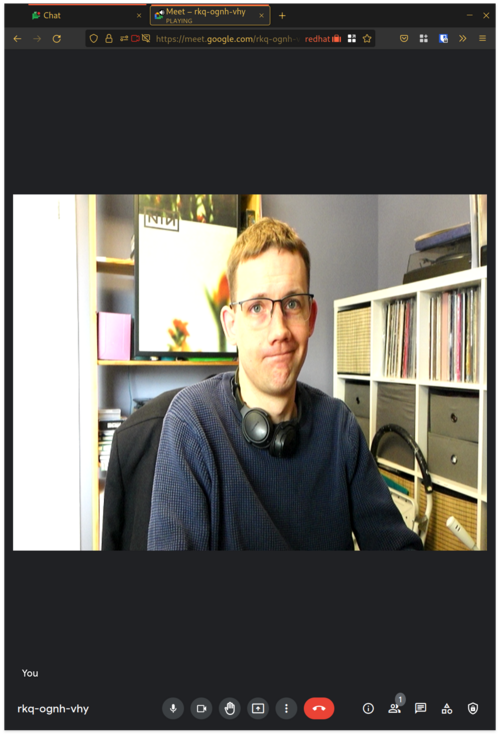
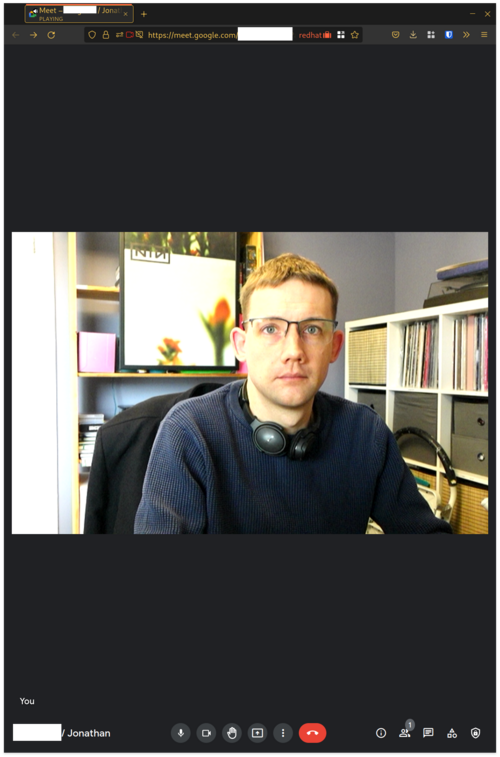
Sometimes I have remote meetings with Google Meet. Unlike the other video-conferencing services that I use (Bluejeans, Zoom), my video was stretched out of proportion under Google Meet with Firefox. I haven't found out why this was happening, but I did figure out a work-around. Thanks to Daniel Silverstone, Rob Kendrick, Gregor Herrmann and Ben Allen for pointing me in the right direction! Hardware The lovely Sony RX-100 mk3 that I bought in 2015 has spent most of its life languishing unused. During the Pandemic, once I was working from home all the time, I decided to press-gang it into service as a better-quality webcam. Newer models of this camera the mark 4 onwards have support for a USB mode called "PC Remote", which effectively makes them into webcams. Unfortunately my mark 3 does not support this, but it does have HDMI out, so I picked up a cheap "HDMI to USB Video Capture Card" from eBay. Video modes
Before: wrong aspect ratio Before: wrong aspect ratio
This device offers a selection of different video modes over a webcam interface. I used qv4l2 to explore the different modes. It became clear that the camera was outputting a signal at 16:9, but the modes on offer from the dongle were for a range of different aspect ratios. The picture for these other ratios was not letter or pillar-boxed, but stretched to fit. I also noticed that the modes which had the correct aspect ratio were at very low framerates: 1920x1080@5fps, 1360x768@8fps, 1280x720@10fps. It felt to me that I would look unnatural at such a low framerate. The most promising mode was close to the right ratio, 720x480 and 30 fps. Software
After: corrected aspect ratio After: corrected aspect ratio
My initial solution is to use the v4l2loopback kernel module, which provides a virtual loop-back webcam interface. I can write video data to it from one process, and read it back from another. Loading it as follows:
modprobe v4l2loopback exclusive_caps=1
The option exclusive_caps configures the module into a mode where it initially presents a write-only interface, but once a process has opened a file handle, it then switches to read-only for subsequent processes. Assuming there are no other camera devices connected at the time of loading the module, it will create /dev/video0.1 I experimented briefly with OBS Studio, the very versatile and feature-full streaming tool, which confirmed that I could use filters on the source video to fix the aspect ratio, and emit the result to the virtual device. I don't otherwise use OBS, though, so I achieve the same result using ffmpeg:
fmpeg -s 720x480 -i /dev/video1 -r 30 -f v4l2 -vcodec rawvideo \
    -pix_fmt yuyv422 -s 720x405 /dev/video0
The source options are to select the source video mode I want. The codec and pixel formats are to match what is being emitted (I determined that using ffprobe on the camera device). The resizing is triggered by supplying a different size to the -s parameter. I think that is equivalent to explicitly selecting a "scale" filter, and there might be other filters that could be used instead (to add pillar boxes for example). This worked just as well. In Google Meet, I select the Virtual Camera, and Google Meet is presented with only one video mode, in the correct aspect ratio, and no configurable options for it, so it can't misbehave. Future I'm planning to automate the loading (and unloading) of the module and starting the ffmpeg process in response to the real camera device being plugged or unplugged, using systemd events and services. (I don't leave the camera plugged in all the time due to some bad USB behaviour I've experienced if I do so.) If I get that working, I will write a follow-up.

  1. you can request a specific device name/number with another module option.

7 March 2022

Ayoyimika Ajibade: Progress Report!! Modifying Expectations...

Wait! Just like yesterday when I was accepted as an Outreachy intern and the first half of the internship is finished . How time flies when you are having a good time As part of the requirements for the final application during the contribution period for the Outreachy internship, I needed to provide a timeline to achieve our goal on my outreachy task which is transitioning of dependencies in node16 and webpack5. Having consulted my mentors who implied that the packages depending on webpack and nodejs combined are so numerous that its impossible to finish all within a space of three months but we have steps to guide us through the entire process to achieve most of our goals which are As of this writing(though a little late ) we have successfully rebuilt all reverse dependencies of webpack5 and split them equally each for I and my co-intern for all Javascript modules as ruby packages also depend on webpack which is a total of 44 packages. Filed a bug report on Debian bug tracking system for failing packages, also the original maintainer or uploader of the package to the Debian archive mostly Debian developers also get a mail in references to the package bug report. Sometimes the uploader who also receives the bug report decides to help out to fix the package and forward the patch upstream if need be. We have also filed an issue to upstream repo mostly via github where some respond and create PR to solve those errors and others are plain aversive to the whole idea. PR from the upstream developer is cherry-picked and a patch is created by us to incorporate the code into our own working repository. some package upstream maintainer rejects such issues or doesn't respond, we take it upon ourselves to fix the package. The total number of packages that are successfully updated and ready to be merged is 10 packages while 12 packages remain on my own end to be updated. One of the most challenging packages to update so far was prop-type as its runs its large test suite using jest of a lower version 19.0.2 compared to that of Debian OS which is version 27.5.1 updating and migrating its API's and methods to use the Debian updated version is so challenging after several googling, testing out the solution from StackOverflow, trials, and errors, reading documentations we eventually made progress with the help of my mentor, co-intern and the whole community member. It's so crazy that when I got it working I said to myself. phew it's not rocket science why can I figure it out sooner than expected I initially proposed that I would be halfway done with the project by now, I guess the reason am not able to achieve some of our goals which are finishing up with the packages for webpack and moving to transition some of the nodejs packages at all is DEBUGGING. Yes DEBUGGING! where you never can predict what the solution is. is the problem coming from Debian? or dependencies of the package you are working on, upstream bug, or dependencies of dependencies of the package you are working on, so many questions to answer. You can't easily find a solution to a bug as it takes time to try out so many guesses more of an educated guess, or even try out all the solutions from stack overflow and still no viable progress. Obviously, you cannot really know about something to set up a plan for unless you get right into it. One way of doing this, if I have to start again is the truly understand how the javascript package work under the hood, how its handles different interaction between packages, some of its dos and don't of transpiling, bundling, testing, e.t.c I guess my unrealistic goals need to be modified because some drawback that was not envisaged popped up and I underestimated the complexity of the tasks, which will be reducing the number of packages to update in transitioning of nodejs from what I planned My major focus for the second half of the internship is to fix bugs and errors I discover, file bug reports for future bugs to seek help from co-maintainer or developers, file issues upstream and close those whose bugs are already resolved for the remaining 12 packages, and ultimately successfully uploading all reverse dependencies. Also diving into transitioning of nodejs16. Thanks for stopping by

5 March 2022

Thorsten Alteholz: My Debian Activities in February 2022

FTP master This month I accepted 484 and rejected 73 packages. The overall number of packages that got accepted was 495. The overall number of rejected packages was 76, which is about 15% of the uploads to NEW. While most of the maintainers do a great job when creating their debian/copyright, others are a bit lax. Unfortunately those people seem to be more enthusiastic when fighting for changes in NEW processing or even removing NEW. One argument in discussions about NEW is that the copyright verification of packages can be done by the community after accepting the packages in the archive.
Last month I did not get any hint that such checks have been done by anybody. As the past already showed several times, this community based checks simply do not exist. So in the end poorly maintained copyright information will rot in the archive and I am not sure that this really corresponds with the Debian Social Contract. Debian LTS This was my ninety-second month that I did some work for the Debian LTS initiative, started by Raphael Hertzog at Freexian. This month my all in all workload has been 40h. During that time I did LTS and normal security uploads of: Unfortunately salsa went down at the end of the month, so several planned uploads did not happen and have to be delayed to March. I also continued to work on security support for golang packages. Further I worked on packages in NEW on security-master and injected missing sources. Last but not least I did some days of frontdesk duties. Debian ELTS This month was the forty-fourth ELTS month. During my allocated time I uploaded: Further I worked on cyrus-sasl but did not do an upload yet. Last but not least I did some days of frontdesk duties. Debian Printing As announced last month I uploaded a new version of cups. Altogether I uploaded new upstream versions or improved packaging of: Debian Astro This month I uploaded new upstream versions or improved packaging of: Other stuff This month I uploaded new upstream versions or improved packaging of:

Reproducible Builds: Reproducible Builds in February 2022

Welcome to the February 2022 report from the Reproducible Builds project. In these reports, we try to round-up the important things we and others have been up to over the past month. As ever, if you are interested in contributing to the project, please visit our Contribute page on our website.
Jiawen Xiong, Yong Shi, Boyuan Chen, Filipe R. Cogo and Zhen Ming Jiang have published a new paper titled Towards Build Verifiability for Java-based Systems (PDF). The abstract of the paper contains the following:
Various efforts towards build verifiability have been made to C/C++-based systems, yet the techniques for Java-based systems are not systematic and are often specific to a particular build tool (eg. Maven). In this study, we present a systematic approach towards build verifiability on Java-based systems.

GitBOM is a flexible scheme to track the source code used to generate build artifacts via Git-like unique identifiers. Although the project has been active for a while, the community around GitBOM has now started running weekly community meetings.
The paper Chris Lamb and Stefano Zacchiroli is now available in the March/April 2022 issue of IEEE Software. Titled Reproducible Builds: Increasing the Integrity of Software Supply Chains (PDF), the abstract of the paper contains the following:
We first define the problem, and then provide insight into the challenges of making real-world software build in a reproducible manner-this is, when every build generates bit-for-bit identical results. Through the experience of the Reproducible Builds project making the Debian Linux distribution reproducible, we also describe the affinity between reproducibility and quality assurance (QA).

In openSUSE, Bernhard M. Wiedemann posted his monthly reproducible builds status report.
On our mailing list this month, Thomas Schmitt started a thread around the SOURCE_DATE_EPOCH specification related to formats that cannot help embedding potentially timezone-specific timestamp. (Full thread index.)
The Yocto Project is pleased to report that it s core metadata (OpenEmbedded-Core) is now reproducible for all recipes (100% coverage) after issues with newer languages such as Golang were resolved. This was announced in their recent Year in Review publication. It is of particular interest for security updates so that systems can have specific components updated but reducing the risk of other unintended changes and making the sections of the system changing very clear for audit. The project is now also making heavy use of equivalence of build output to determine whether further items in builds need to be rebuilt or whether cached previously built items can be used. As mentioned in the article above, there are now public servers sharing this equivalence information. Reproducibility is key in making this possible and effective to reduce build times/costs/resource usage.

diffoscope diffoscope is our in-depth and content-aware diff utility. Not only can it locate and diagnose reproducibility issues, it can provide human-readable diffs from many kinds of binary formats. This month, Chris Lamb prepared and uploaded versions 203, 204, 205 and 206 to Debian unstable, as well as made the following changes to the code itself:
  • Bug fixes:
    • Fix a file(1)-related regression where Debian .changes files that contained non-ASCII text were not identified as such, therefore resulting in seemingly arbitrary packages not actually comparing the nested files themselves. The non-ASCII parts were typically in the Maintainer or in the changelog text. [ ][ ]
    • Fix a regression when comparing directories against non-directories. [ ][ ]
    • If we fail to scan using binwalk, return False from BinwalkFile.recognizes. [ ]
    • If we fail to import binwalk, don t report that we are missing the Python rpm module! [ ]
  • Testsuite improvements:
    • Add a test for recent file(1) issue regarding .changes files. [ ]
    • Use our assert_diff utility where we can within the test_directory.py set of tests. [ ]
    • Don t run our binwalk-related tests as root or fakeroot. The latest version of binwalk has some new security protection against this. [ ]
  • Codebase improvements:
    • Drop the _PATH suffix from module-level globals that are not paths. [ ]
    • Tidy some control flow in Difference._reverse_self. [ ]
    • Don t print a warning to the console regarding NT_GNU_BUILD_ID changes. [ ]
In addition, Mattia Rizzolo updated the Debian packaging to ensure that diffoscope and diffoscope-minimal packages have the same version. [ ]

Website updates There were quite a few changes to the Reproducible Builds website and documentation this month as well, including:
  • Chris Lamb:
    • Considerably rework the Who is involved? page. [ ][ ]
    • Move the contributors.sh Bash/shell script into a Python script. [ ][ ][ ]
  • Daniel Shahaf:
    • Try a different Markdown footnote content syntax to work around a rendering issue. [ ][ ][ ]
  • Holger Levsen:
    • Make a huge number of changes to the Who is involved? page, including pre-populating a large number of contributors who cannot be identified from the metadata of the website itself. [ ][ ][ ][ ][ ]
    • Improve linking to sponsors in sidebar navigation. [ ]
    • drop sponsors paragraph as the navigation is clearer now. [ ]
    • Add Mullvad VPN as a bronze-level sponsor . [ ][ ]
  • Vagrant Cascadian:

Upstream patches The Reproducible Builds project attempts to fix as many currently-unreproducible packages as possible. February s patches included the following:

Testing framework The Reproducible Builds project runs a significant testing framework at tests.reproducible-builds.org, to check packages and other artifacts for reproducibility. This month, the following changes were made:
  • Daniel Golle:
    • Update the OpenWrt configuration to not depend on the host LLVM, adding lines to the .config seed to build LLVM for eBPF from source. [ ]
    • Preserve more OpenWrt-related build artifacts. [ ]
  • Holger Levsen:
  • Temporary use a different Git tree when building OpenWrt as our tests had been broken since September 2020. This was reverted after the patch in question was accepted by Paul Spooren into the canonical openwrt.git repository the next day.
    • Various improvements to debugging OpenWrt reproducibility. [ ][ ][ ][ ][ ]
    • Ignore useradd warnings when building packages. [ ]
    • Update the script to powercycle armhf architecture nodes to add a hint to where nodes named virt-*. [ ]
    • Update the node health check to also fix failed logrotate and man-db services. [ ]
  • Mattia Rizzolo:
    • Update the website job after contributors.sh script was rewritten in Python. [ ]
    • Make sure to set the DIFFOSCOPE environment variable when available. [ ]
  • Vagrant Cascadian:
    • Various updates to the diffoscope timeouts. [ ][ ][ ]
Node maintenance was also performed by Holger Levsen [ ] and Vagrant Cascadian [ ].

Finally If you are interested in contributing to the Reproducible Builds project, please visit our Contribute page on our website. However, you can get in touch with us via:

4 March 2022

Abiola Ajadi: Outreachy-And it s a wrap!

Outreachy Wrap-up Project Improve Debian Continuous Integration UX
Project Link: https://www.outreachy.org/outreachy-december-2021-internship-round/communities/debian/#improve-debian-continuous-integration-ux
Code Repository: https://salsa.debian.org/ci-team/debci
Mentors: Antonio Terceiro, Paul Gevers and Pavit Kaur

About the project Debci exist to make sure packages work currently after an update, How it does this is by testing all of the packages that have tests written in them to make sure it works and nothing is broken This project entails making improvements to the platform to make it easier to use and maintain.

Deliverables of the project:
  • Package landing page displaying pending jobs
  • web frontend: centralize job listings in a single template
  • self-service: request test form forgets values when validation fails
  • Improvement to status

Work done

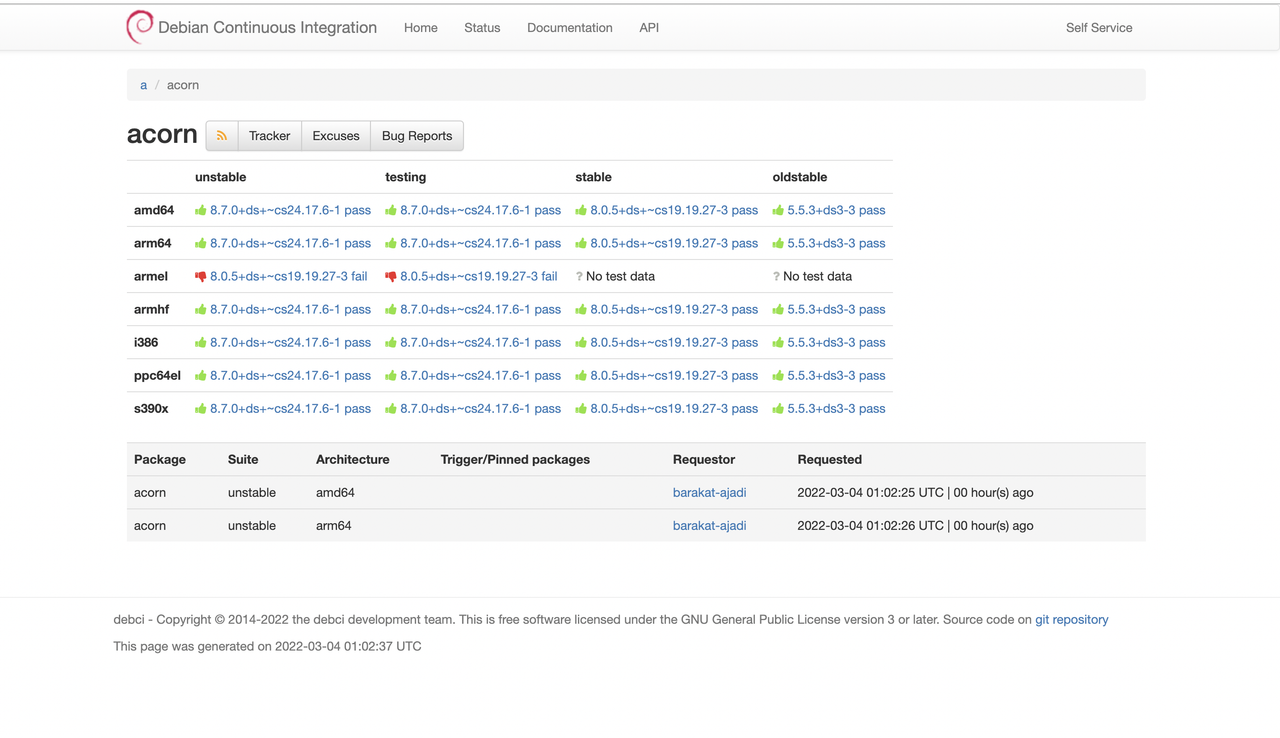
Package landing page displaying pending jobs Previously, Jobs that were pending were not displayed on the package page. Working on this added a feature to display pending jobs on package landing. Working on this task made it known that the same block of codes was repeated in different files which led to the next task Screenshot-2022-03-04-at-02-03-06.png Merge request
web frontend: centralize job listings in a single template Jobs are listed in various landings such as status packages, Status alerts, status failing, History, and so on. The same Code was repeated in these pages to list the jobs, I worked on refactoring it and created a single template for job listing so it can be used anywhere it s needed. I also wrote a test for the feature I added.
Merge request
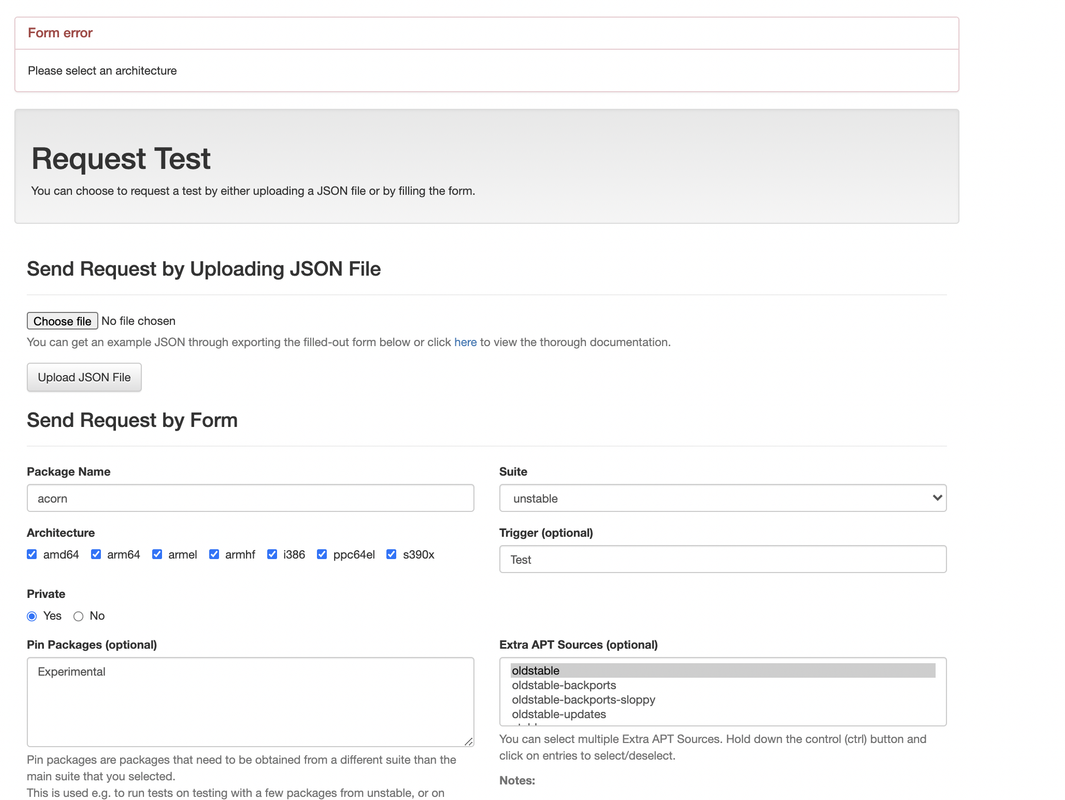
self service: request test form forgets values when validation fails When one tries to request for a test and it fails with an error, originally the form does not remember the values that were typed in the package name, suite field et. c. This fix ensures the form remembers the values inputted even when it throws an error. Image of request test page N/B: The form checks all architecture on the load of the page
merge request
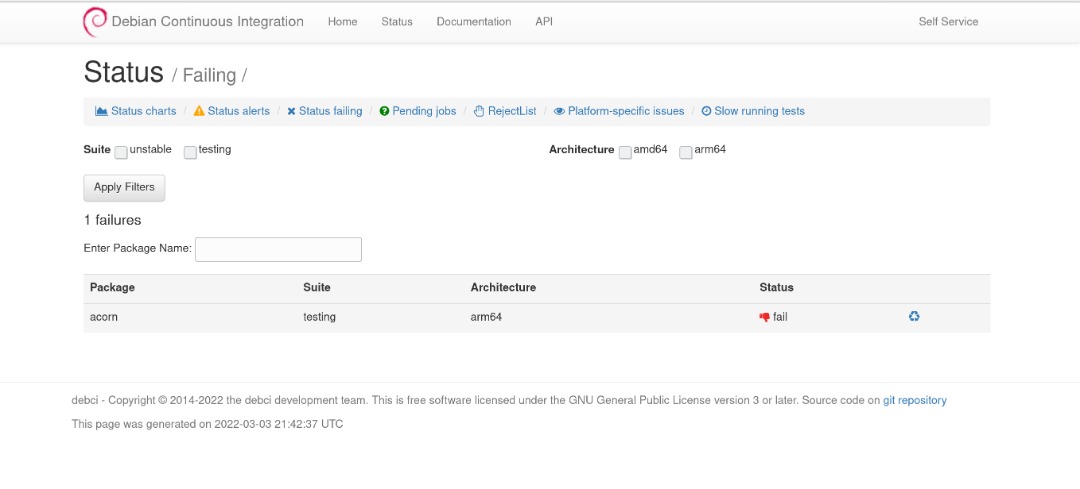
Improvement to status Originally the Status pages were rendered as static HTML pages but I converted these pages to be generated dynamically, I wrote endpoints for each page. Since most of the status pages have a list of jobs I modified it to use the template I created for job-listing. Previously, the status pages had a mechanism to filter such as All, Latest 50 et.c which wasn t paginated. I removed this mechanism added a filter by architecture and suites to these pages and also add pagination. Last but not the least, I wrote tests for these implementations carried out on the status page. Image of Status failing page merge request:
first task
second task

Major take-aways I learnt a lot during my internship but most importantly I learnt how to:
  • write Tests in Ruby and how writing tests is an important aspect of software development
  • maintain good coding practice, Paying attending to commit messages, Indentation et.c are good areas I developed in writing code.
  • make contributions in Ruby Programming Language.

Acknowledgement I can not end this without saying thank you to my mentors Antonio Terceiro, Paul Gevers, and Pavit Kaur for their constant support and guidance throughout the entire duration of this Internship. It has been a pleasure Interacting and learning from everyone.

Review Outreachy has helped me feel more confident about open-source, especially during the application phase. I had to reach out to the community I was interested in and ask questions on how to get started. The informal chats week was awesome I was able to build my network and have interesting conversations with amazing individuals in open-source. To round up, Always ask questions and do not be afraid of making a mistake, as one of the outreachy blog post topics says Everyone struggles!, but never give up!

3 March 2022

Enrico Zini: Migrating from procmail to sieve

Anarcat's "procmail considered harmful" post convinced me to get my act together and finally migrate my venerable procmail based setup to sieve. My setup was nontrivial, so I migrated with an intermediate step in which sieve scripts would by default pipe everything to procmail, which allowed me to slowly move rules from procmailrc to sieve until nothing remained in procmailrc. Here's what I did. Literature review https://brokkr.net/2019/10/31/lets-do-dovecot-slowly-and-properly-part-3-lmtp/ has a guide quite aligned with current Debian, and could be a starting point to get an idea of the work to do. https://wiki.dovecot.org/HowTo/PostfixDovecotLMTP is way more terse, but more aligned with my intentions. Reading the former helped me in understanding the latter. https://datatracker.ietf.org/doc/html/rfc5228 has the full Sieve syntax. https://doc.dovecot.org/configuration_manual/sieve/pigeonhole_sieve_interpreter/ has the list of Sieve features supported by Dovecot. https://doc.dovecot.org/settings/pigeonhole/ has the reference on Dovecot's sieve implementation. https://raw.githubusercontent.com/dovecot/pigeonhole/master/doc/rfc/spec-bosch-sieve-extprograms.txt is the hard to find full reference for the functions introduced by the extprograms plugin. Debugging tools: Backup of all mails processed One thing I did with procmail was to generate a monthly mailbox with all incoming email, with something like this:
BACKUP="/srv/backupts/test- date +%Y-%m-d .mbox"
:0c
$BACKUP
I did not find an obvious way in sieve to create montly mailboxes, so I redesigned that system using Postfix's always_bcc feature, piping everything to an archive user. I'll then recreate the monthly archiving using a chewmail script that I can simply run via cron. Configure dovecot
apt install dovecot-sieve dovecot-lmtpd
I added this to the local dovecot configuration:
service lmtp  
  unix_listener /var/spool/postfix/private/dovecot-lmtp  
    user = postfix
    group = postfix
    mode = 0666
   
 
protocol lmtp  
  mail_plugins = $mail_plugins sieve
 
plugin  
  sieve = file:~/.sieve;active=~/.dovecot.sieve
 
This makes Dovecot ready to receive mail from Postfix via a lmtp unix socket created in Postfix's private chroot. It also activates the sieve plugin, and uses ~/.sieve as a sieve script. The script can be a file or a directory; if it is a directory, ~/.dovecot.sieve will be a symlink pointing to the .sieve file to run. This is a feature I'm not yet using, but if one day I want to try enabling UIs to edit sieve scripts, that part is ready. Delegate to procmail To make sieve scripts that delegate to procmail, I enabled the sieve_extprograms plugin:
 plugin  
   sieve = file:~/.sieve;active=~/.dovecot.sieve
+  sieve_plugins = sieve_extprograms
+  sieve_extensions +vnd.dovecot.pipe
+  sieve_pipe_bin_dir = /usr/local/lib/dovecot/sieve-pipe
+  sieve_trace_dir = ~/.sieve-trace
+  sieve_trace_level = matching
+  sieve_trace_debug = yes
  
and then created a script for it:
mkdir -p /usr/local/lib/dovecot/sieve-pipe/
(echo "#!/bin/sh'; echo "exec /usr/bin/procmail") > /usr/local/lib/dovecot/sieve-pipe/procmail
chmod 0755 /usr/local/lib/dovecot/sieve-pipe/procmail
And I can have a sieve script that delegates processing to procmail:
require "vnd.dovecot.pipe";
pipe "procmail";
Activate the postfix side These changes switched local delivery over to Dovecot:
--- a/roles/mailserver/templates/dovecot.conf
+++ b/roles/mailserver/templates/dovecot.conf
@@ -25,6 +25,8 @@
 
+auth_username_format = %Ln
+
 
diff --git a/roles/mailserver/templates/main.cf b/roles/mailserver/templates/main.cf
index d2c515a..d35537c 100644
--- a/roles/mailserver/templates/main.cf
+++ b/roles/mailserver/templates/main.cf
@@ -64,8 +64,7 @@ virtual_alias_domains =
 
-mailbox_command = procmail -a "$EXTENSION"
-mailbox_size_limit = 0
+mailbox_transport = lmtp:unix:private/dovecot-lmtp
 
Without auth_username_format = %Ln dovecot won't be able to understand usernames sent by postfix in my specific setup. Moving rules over to sieve This is mostly straightforward, with the luxury of being able to do it a bit at a time. The last tricky bit was how to call spamc from sieve, as in some situations I reduce system load by running the spamfilter only on a prefiltered selection of incoming emails. For this I enabled the filter directive in sieve:
 plugin  
   sieve = file:~/.sieve;active=~/.dovecot.sieve
   sieve_plugins = sieve_extprograms
-  sieve_extensions +vnd.dovecot.pipe
+  sieve_extensions +vnd.dovecot.pipe +vnd.dovecot.filter
   sieve_pipe_bin_dir = /usr/local/lib/dovecot/sieve-pipe
+  sieve_filter_bin_dir = /usr/local/lib/dovecot/sieve-filter
   sieve_trace_dir = ~/.sieve-trace
   sieve_trace_level = matching
   sieve_trace_debug = yes
  
Then I created a filter script:
mkdir -p /usr/local/lib/dovecot/sieve-filter/"
(echo "#!/bin/sh'; echo "exec /usr/bin/spamc") > /usr/local/lib/dovecot/sieve-filter/spamc
chmod 0755 /usr/local/lib/dovecot/sieve-filter/spamc
And now what was previously:
:0 fw
  /usr/bin/spamc
:0
* ^X-Spam-Status: Yes
.spam/
Can become:
require "vnd.dovecot.filter";
require "fileinto";
filter "spamc";
if header :contains "x-spam-level" "**************"  
    discard;
  elsif header :matches "X-Spam-Status" "Yes,*"  
    fileinto "spam";
 
Updates Ansgar mentioned that it's possible to replicate the monthly mailbox using the variables and date extensions, with a hacky trick from the extensions' RFC:
require "date"
require "variables"
if currentdate :matches "month" "*"   set "month" "$ 1 ";  
if currentdate :matches "year" "*"   set "year" "$ 1 ";  
fileinto :create "$ month -$ year ";

Jamie McClelland: LVM Cache Surprises

By far the biggest LVM Cache surprise is just how well it works. Between 2010 and 2020, my single, biggest and most consistent headache managing servers at May First has been disk i/o. We run a number of physical hosts with encrypted disks, with each providing a dozen or so sundry KVM guests. And they consume a lot of disk i/o. This problem kept me awake at night and made me want to put my head on the table and cry during the day as I monitored the output of vmstat 1 and watched each disk i/o death spiral unfold. We tried everything. Turned off fsck s, turned off RAID monthly checks. Switched to less intensive backup systems. Added solid state drives and tried to stragically distribute them to our database partitions and other read/write heavy services. Added tmpfs file systems where it was possible. But, the sad truth was: we simply did not have the resources to pay for the infrastructure that could support the disk i/o our services demanded. Then, we discovered LVM caching (cue Hallelujah). We starting provisioning SSD partitions to back up our busiest spinning disk logical volumes and presto. Ten years of agony gone like a poof of smoke! I don t know which individuals are responsible for writing the LVM caching code but if you see this: THANK YOU! Your contributions to the world are noticed, appreciated and have had an enormous impact on at least one individual.

Some surprises

Filters For the last two years, with the exception of one little heart attack, LVM caches have gone very smoothly. Then, last week we upgraded 13 physical servers straight through from stretch to bullseye. It went relatively smoothly for the first half of our servers (the old ones hosting fewer resources). But, after rebooting our first server with lvm caching going on, we noticed that the cached disk wasn t accessible. No problem, we reasoned. We ll just uncache it. Except that didn t work either. We tried every argument we could find on the Internet but lvm insisted that the block device from the SSD volume group (that provides the caching device) was not available. Running pvs showed an unknown device and vgs reported similar errors. Now I started to panic a bit. There was a clean shutdown of the server, so surely all the data had been flushed to the disk. But, how can we get that data? We started a restore from backup process because we really thought that data was gone for ever. Then we had a really great theory: the caching logical volume comes from the SSD volume group, which gets decrypted after the spinning disk volume group. Maybe there s a timing issue? When the spinning disk volume group comes online, the caching logical volume is not yet available. So, we booted into busybox, and manually decrypted the SSD volume first, followed by the spinning disk volume. Alas, no dice. Now that we were fully desperate, we decided to restore the lvm configuration file for the entire spinning disk volume group. This felt kinda risky since we might be damaging all the currently working logical volumes, but it seemed like the only option we had. The main problem was that busybox didn t seem to have the lvm config tool we needed to restore the configuration from our backup (I think it might be there but it was late and we couldn t figure it out). And, our only readily available live install media was a Debian stretch disk via debirf. Debian stretch is pretty old and we really would have preferred to have the most modern tools available, but we decided to go with what we had. And, that was a good thing, because as soon as we booted into stretch and decrypted the disks, the lvm volume suddenly appeared, happy as ever. We uncached it and booted into the host system and there it was. We went to bed confused but relieved. The next morning my co-worker figured it out: filtering. During the stretch days we occassionally ran into an annoying problem: the logical volumes from guests would suddenly pop up on the host. This was mostly annoying but also it made possible some serious mistakes if you accidentally took a volume from a guest and used it on the host. The LVM folks seemed to have noticed this problem and introduced a new default filter that tries to only show you the devices that you should be seeing. Unfortunately for us, this new filter removed logical volumes from the list of available physical volumes. That does make sense for most people. But, not for us. It sounds a bit weird, but our setup looks like this:
  • One volume group derived from the spinning disks
  • One volume group derived from the SSD disks
Then we carve out logical volumes from each for each guest. Once we discovered LVM caching, we carved out SSD logical volumes to be used as caches for the spinning logical volumes. In restrospect, if we could start over, we would probably do it differently. In any event, once we discovered the problem, we used the handy configuration options in lvm.conf to tweak the filters to include our cache disks and once again, everything is back to working.

Saturated SSDs The other surprise seems unrelated to the upgrade. We have a phsyical server that has been suffering from disk i/o problems despite our use of LVM caching. Our answer, of course, was to add more LVM caches to the spinning logical volumes that seemed to be suffering. But somehow this was making things even worse. Then, we finally just removed the LVM caches from all the spinning disks and presto, disk i/o problems seemed to go away. What? Isn t that the opposite of what s supposed to happen? We re still trying to figure this one out, but it seems that our SSDs are saturated, in which case adding them as a caching volume really is going to make things worse. We re still not sure why they are saturated when none of the SSDs on our other hosts are saturated, but a few theories include:
  • They are doing more writing and/or it s a different kind of writing. I m still not sure I quite have the right tool to compare this host with other hosts. And, this host is our only MySQL network database server, hosting hundreds of GBs of database - all writing/reading direclty onto the SSDs.
  • They are broken or substanard SSDs (smartctl doesn t uncover any problems but maybe it s a bad model?)
I ll update this post as we learn more but welcome any suggestions in the comments. Update: 2022-03-07 Two more possible causes:
  • Our use of the write back feature: LVM cache has a nice feature that caches writes to smooth out writes to the underlying disk. Maybe our disks are simply writing more then can be handled and not using write back is our solution. This server supports a guest with an unusually large disk.
  • Maybe we haven t allocated a big enough LVM cache for the given volume so the contents are constantly being ejected?

John Goerzen: Tools for Communicating Offline and in Difficult Circumstances

Note: this post is also available on my website, where it will be updated periodically. When things are difficult maybe there s been a disaster, or an invasion (this page is being written in 2022 just after Russia invaded Ukraine), or maybe you re just backpacking off the grid there are tools that can help you keep in touch, or move your data around. This page aims to survey some of them, roughly in order from easiest to more complex.

Simple radios Handheld radios shouldn t be forgotten. They are cheap, small, and easy to operate. Their range isn t huge maybe a couple of miles in rural areas, much less in cities but they can be a useful place to start. They tend to have no actual encryption features (the privacy features really aren t.) In the USA, options are FRS/GMRS and CB.

Syncthing With Syncthing, you can share files among your devices or with your friends. Syncthing essentially builds a private mesh for file sharing. Devices will auto-discover each other when on the same LAN or Wifi network, and opportunistically sync. I wrote more about offline uses of Syncthing, and its use with NNCP, in my blog post A simple, delay-tolerant, offline-capable mesh network with Syncthing (+ optional NNCP). Yes, it is a form of a Mesh Network! Homepage: https://syncthing.net/

Briar Briar is an instant messaging service based around Android. It s IM with a twist: it can use a mesh of Bluetooh devices. Or, if Internet is available, Tor. It has even been extended to support the use of SD cards and USB sticks to carry your messages. Like some others here, it can relay messages for third parties as well. Homepage: https://briarproject.org/

Manyverse and Scuttlebutt Manyverse is a client for Scuttlebutt, which is a sort of asynchronous, offline-friendly social network. You can use it to keep in touch with your family and friends, and it supports syncing over Bluetooth and Wifi even in the absence of Internet. Homepages: https://www.manyver.se/ and https://scuttlebutt.nz/

Yggdrasil Yggdrasil is a self-healing, fully end-to-end Encrypted Mesh Network. It can work among local devices or on the global Internet. It has network services that can egress onto things like Tor, I2P, and the public Internet. Yggdrasil makes a perfect companion to ad-hoc wifi as it has auto peer discovery on the local network. I talked about it in more detail in my blog post Make the Internet Yours Again With an Instant Mesh Network. Homepage: https://yggdrasil-network.github.io/

Ad-Hoc Wifi Few people know about the ad-hoc wifi mode. Ad-hoc wifi lets devices in range talk to each other without an access point. You just all set your devices to the same network name and password and there you go. However, there often isn t DHCP, so IP configuration can be a bit of a challenge. Yggdrasil helps here.

NNCP Moving now to more advanced tools, NNCP lets you assemble a network of peers that can use Asynchronous Communication over sneakernet, USB drives, radios, CD-Rs, Internet, tor, NNCP over Yggdrasil, Syncthing, Dropbox, S3, you name it . NNCP supports multi-hop file transfer and remote execution. It is fully end-to-end encrypted. Think of it as the offline version of ssh. Homepage: https://nncp.mirrors.quux.org/

Meshtastic Meshtastic uses long-range, low-power LoRa radios to build a long-distance, encrypted, instant messaging system that is a Mesh Network. It requires specialized hardware, about $30, but will tend to get much better range than simple radios, and with very little power. Homepages: https://meshtastic.org/ and https://meshtastic.letstalkthis.com/

Portable Satellite Communicators You can get portable satellite communicators that can send SMS from anywhere on earth with a clear view of the sky. The Garmin InReach mini and Zoleo are two credible options. Subscriptions range from about $10 to $40 per month depending on usage. They also have global SOS features.

Telephone Lines If you have a phone line and a modem, UUCP can get through just about anything. It s an older protocol that lacks modern security, but will deal with slow and noisy serial lines well. XBee SX radios also have a serial mode that can work well with UUCP.

Additional Suggestions It is probably useful to have a Linux live USB stick with whatever software you want to use handy. Debian can be installed from the live environment, or you could use a security-focused distribution such as Tails or Qubes.

References This page originated in my Mastodon thread and incorporates some suggestions I received there. It also formed a post on my blog.

2 March 2022

Antoine Beaupr : procmail considered harmful

TL;DR: procmail is a security liability and has been abandoned upstream for the last two decades. If you are still using it, you should probably drop everything and at least remove its SUID flag. There are plenty of alternatives to chose from, and conversion is a one-time, acceptable trade-off.

Procmail is unmaintained procmail is unmaintained. The "Final release", according to Wikipedia, dates back to September 10, 2001 (3.22). That release was shipped in Debian since then, all the way back from Debian 3.0 "woody", twenty years ago. Debian also ships 25 uploads on top of this, with 3.22-21 shipping the "3.23pre" release that has been rumored since at least the November 2001, according to debian/changelog at least:
procmail (3.22-1) unstable; urgency=low
  * New upstream release, which uses the  standard' format for Maildir
    filenames and retries on name collision. It also contains some
    bug fixes from the 3.23pre snapshot dated 2001-09-13.
  * Removed  sendmail' from the Recommends field, since we already
    have  exim' (the default Debian MTA) and  mail-transport-agent'.
  * Removed suidmanager support. Conflicts: suidmanager (<< 0.50).
  * Added support for DEB_BUILD_OPTIONS in the source package.
  * README.Maildir: Do not use locking on the example recipe,
    since it's wrong to do so in this case.
 -- Santiago Vila <sanvila@debian.org>  Wed, 21 Nov 2001 09:40:20 +0100
All Debian suites from buster onwards ship the 3.22-26 release, although the maintainer just pushed a 3.22-27 release to fix a seven year old null pointer dereference, after this article was drafted. Procmail is also shipped in all major distributions: Fedora and its derivatives, Debian derivatives, Gentoo, Arch, FreeBSD, OpenBSD. We all seem to be ignoring this problem. The upstream website (http://procmail.org/) has been down since about 2015, according to Debian bug #805864, with no change since. In effect, every distribution is currently maintaining its fork of this dead program. Note that, after filing a bug to keep Debian from shipping procmail in a stable release again, I was told that the Debian maintainer is apparently in contact with the upstream. And, surprise! they still plan to release that fabled 3.23 release, which has been now in "pre-release" for all those twenty years. In fact, it turns out that 3.23 is considered released already, and that the procmail author actually pushed a 3.24 release, codenamed "Two decades of fixes". That amounts to 25 commits since 3.23pre some of which address serious security issues, but none of which address fundamental issues with the code base.

Procmail is insecure By default, procmail is installed SUID root:mail in Debian. There's no debconf or pre-seed setting that can change this. There has been two bug reports against the Debian to make this configurable (298058, 264011), but both were closed to say that, basically, you should use dpkg-statoverride to change the permissions on the binary. So if anything, you should immediately run this command on any host that you have procmail installed on:
dpkg-statoverride --update --add root root 0755 /usr/bin/procmail
Note that this might break email delivery. It might also not work at all, thanks to usrmerge. Not sure. Yes, everything is on fire. This is fine. In my opinion, even assuming we keep procmail in Debian, that default should be reversed. It should be up to people installing procmail to assign it those dangerous permissions, after careful consideration of the risk involved. The last maintainer of procmail explicitly advised us (in that null pointer dereference bug) and other projects (e.g. OpenBSD, in [2]) to stop shipping it, back in 2014. Quote:
Executive summary: delete the procmail port; the code is not safe and should not be used as a basis for any further work.
I just read some of the code again this morning, after the original author claimed that procmail was active again. It's still littered with bizarre macros like:
#define bit_set(name,which,value) \
  (value?(name[bit_index(which)] =bit_mask(which)):\
  (name[bit_index(which)]&=~bit_mask(which)))
... from regexp.c, line 66 (yes, that's a custom regex engine). Or this one:
#define jj  (aleps.au.sopc)
It uses insecure functions like strcpy extensively. malloc() is thrown around gotos like it's 1984 all over again. (To be fair, it has been feeling like 1984 a lot lately, but that's another matter entirely.) That null pointer deref bug? It's fixed upstream now, in this commit merged a few hours ago, which I presume might be in response to my request to remove procmail from Debian. So while that's nice, this is the just tip of the iceberg. I speculate that one could easily find an exploitable crash in procmail if only by running it through a fuzzer. But I don't need to speculate: procmail had, for years, serious security issues that could possibly lead to root privilege escalation, remotely exploitable if procmail is (as it's designed to do) exposed to the network. Maybe I'm overreacting. Maybe the procmail author will go through the code base and do a proper rewrite. But I don't think that's what is in the cards right now. What I expect will happen next is that people will start fuzzing procmail, throw an uncountable number of bug reports at it which will get fixed in a trickle while never fixing the underlying, serious design flaws behind procmail.

Procmail has better alternatives The reason this is so frustrating is that there are plenty of modern alternatives to procmail which do not suffer from those problems. Alternatives to procmail(1) itself are typically part of mail servers. For example, Dovecot has its own LDA which implements the standard Sieve language (RFC 5228). (Interestingly, Sieve was published as RFC 3028 in 2001, before procmail was formally abandoned.) Courier also has "maildrop" which has its own filtering mechanism, and there is fdm (2007) which is a fetchmail and procmail replacement. Update: there's also mailprocessing, which is not an LDA, but processing an existing folder. It was, however, specifically designed to replace complex Procmail rules. But procmail, of course, doesn't just ship procmail; that would just be too easy. It ships mailstat(1) which we could probably ignore because it only parses procmail log files. But more importantly, it also ships:
  • lockfile(1) - conditional semaphore-file creator
  • formail(1) - mail (re)formatter
lockfile(1) already has a somewhat acceptable replacement in the form of flock(1), part of util-linux (which is Essential, so installed on any normal Debian system). It might not be a direct drop-in replacement, but it should be close enough. formail(1) is similar: the courier maildrop package ships reformail(1) which is, presumably, a rewrite of formail. It's unclear if it's a drop-in replacement, but it should probably possible to port uses of formail to it easily.
Update: the maildrop package ships a SUID root binary (two, even). So if you want only reformail(1), you might want to disable that with:
dpkg-statoverride --update --add root root 0755 /usr/bin/lockmail.maildrop 
dpkg-statoverride --update --add root root 0755 /usr/bin/maildrop
It would be perhaps better to have reformail(1) as a separate package, see bug 1006903 for that discussion.
The real challenge is, of course, migrating those old .procmailrc recipes to Sieve (basically). I added a few examples in the appendix below. You might notice the Sieve examples are easier to read, which is a nice added bonus.

Conclusion There is really, absolutely, no reason to keep procmail in Debian, nor should it be used anywhere at this point. It's a great part of our computing history. May it be kept forever in our museums and historical archives, but not in Debian, and certainly not in actual release. It's just a bomb waiting to go off. It is irresponsible for distributions to keep shipping obsolete and insecure software like this for unsuspecting users. Note that I am grateful to the author, I really am: I used procmail for decades and it served me well. But now, it's time to move, not bring it back from the dead.

Appendix

Previous work It's really weird to have to write this blog post. Back in 2016, I rebuilt my mail setup at home and, to my horror, discovered that procmail had been abandoned for 15 years at that point, thanks to that LWN article from 2010. I would have thought that I was the only weirdo still running procmail after all those years and felt kind of embarrassed to only "now" switch to the more modern (and, honestly, awesome) Sieve language. But no. Since then, Debian shipped three major releases (stretch, buster, and bullseye), all with the same vulnerable procmail release. Then, in early 2022, I found that, at work, we actually had procmail installed everywhere, possibly because userdir-ldap was using it for lockfile until 2019. I sent a patch to fix that and scrambled to remove get rid of procmail everywhere. That took about a day. But many other sites are now in that situation, possibly not imagining they have this glaring security hole in their infrastructure.

Procmail to Sieve recipes I'll collect a few Sieve equivalents to procmail recipes here. If you have any additions, do contact me. All Sieve examples below assume you drop the file in ~/.dovecot.sieve.

deliver mail to "plus" extension folder Say you want to deliver user+foo@example.com to the folder foo. You might write something like this in procmail:
MAILDIR=$HOME/Maildir/
DEFAULT=$MAILDIR
LOGFILE=$HOME/.procmail.log
VERBOSE=off
EXTENSION=$1            # Need to rename it - ?? does not like $1 nor 1
:0
* EXTENSION ?? [a-zA-Z0-9]+
        .$EXTENSION/
That, in sieve language, would be:
require ["variables", "envelope", "fileinto", "subaddress"];
########################################################################
# wildcard +extension
# https://doc.dovecot.org/configuration_manual/sieve/examples/#plus-addressed-mail-filtering
if envelope :matches :detail "to" "*"  
  # Save name in $ name  in all lowercase
  set :lower "name" "$ 1 ";
  fileinto "$ name ";
  stop;
 

Subject into folder This would file all mails with a Subject: line having FreshPorts in it into the freshports folder, and mails from alternc.org mailing lists into the alternc folder:
:0
## mailing list freshports
* ^Subject.*FreshPorts.*
.freshports/
:0
## mailing list alternc
* ^List-Post.*mailto:.*@alternc.org.*
.alternc/
Equivalent Sieve:
if header :contains "subject" "FreshPorts"  
    fileinto "freshports";
  elsif header :contains "List-Id" "alternc.org"  
    fileinto "alternc";
 

Mail sent to root to a reports folder This double rule:
:0
* ^Subject: Cron
* ^From: .*root@
.rapports/
Would look something like this in Sieve:
if header :comparator "i;octet" :contains "Subject" "Cron"  
  if header :regex :comparator "i;octet"  "From" ".*root@"  
        fileinto "rapports";
   
 
Note that this is what the automated converted does (below). It's not very readable, but it works.

Bulk email I didn't have an equivalent of this in procmail, but that's something I did in Sieve:
if header :contains "Precedence" "bulk"  
    fileinto "bulk";
 

Any mailing list This is another rule I didn't have in procmail but I found handy and easy to do in Sieve:
if exists "List-Id"  
    fileinto "lists";
 

This or that I wouldn't remember how to do this in procmail either, but that's an easy one in Sieve:
if anyof (header :contains "from" "example.com",
           header :contains ["to", "cc"] "anarcat@example.com")  
    fileinto "example";
 
You can even pile up a bunch of options together to have one big rule with multiple patterns:
if anyof (exists "X-Cron-Env",
          header :contains ["subject"] ["security run output",
                                        "monthly run output",
                                        "daily run output",
                                        "weekly run output",
                                        "Debian Package Updates",
                                        "Debian package update",
                                        "daily mail stats",
                                        "Anacron job",
                                        "nagios",
                                        "changes report",
                                        "run output",
                                        "[Systraq]",
                                        "Undelivered mail",
                                        "Postfix SMTP server: errors from",
                                        "backupninja",
                                        "DenyHosts report",
                                        "Debian security status",
                                        "apt-listchanges"
                                        ],
           header :contains "Auto-Submitted" "auto-generated",
           envelope :contains "from" ["nagios@",
                                      "logcheck@",
                                      "root@"])
     
    fileinto "rapports";
 

Automated script There is a procmail2sieve.pl script floating around, and mentioned in the dovecot documentation. It didn't work very well for me: I could use it for small things, but I mostly wrote the sieve file from scratch.

Progressive migration Enrico Zini has progressively migrated his procmail setup to Sieve using a clever way: he hooked procmail inside sieve so that he could deliver to the Dovecot LDA and progressively migrate rules one by one, without having a "flag day". See this explanatory blog post for the details, which also shows how to configure Dovecot as an LMTP server with Postfix.

Other examples The Dovecot sieve examples are numerous and also quite useful. At the time of writing, they include virus scanning and spam filtering, vacation auto-replies, includes, archival, and flags.

Harmful considered harmful I am aware that the "considered harmful" title has a long and controversial history, being considered harmful in itself (by some people who are obviously not afraid of contradictions). I have nevertheless deliberately chosen that title, partly to make sure this article gets maximum visibility, but more specifically because I do not have doubts at this moment that procmail is, clearly, a bad idea at this moment in history.

Developing story I must also add that, incredibly, this story has changed while writing it. This article is derived from this bug I filed in Debian to, quite frankly, kick procmail out of Debian. But filing the bug had the interesting effect of pushing the upstream into action: as mentioned above, they have apparently made a new release and merged a bunch of patches in a new git repository. This doesn't change much of the above, at this moment. If anything significant comes out of this effort, I will try to update this article to reflect the situation. I am actually happy to retract the claims in this article if it turns out that procmail is a stellar example of defensive programming and survives fuzzing attacks. But at this moment, I'm pretty confident that will not happen, at least not in scope of the next Debian release cycle.

Keith Packard: picolibc-testing

Testing Picolibc with the glibc tests Picolibc has a bunch of built-in tests, but more testing is always better, right? I decided to see how hard it would be to run some of the tests provided in the GNU C Library (glibc). Parallel meson build files Similar to how Picolibc uses meson build files to avoid modifying the newlib autotools infrastructure, I decided to take the glibc code and write meson build rules that would compile the tests against Picolibc header files and link against Picolibc libraries. I decided to select a single target for this project so I could focus on getting things building and not worry too much about making it portable. I wanted to pick something that had hardware floating point so that I would have rounding modes and exception support, so I picked the ARM Cortex M7 with hard float ABI:
$ arm-none-eabi-gcc -mcpu=cortex-m7 -mfloat-abi=hard
It should be fairly easy to extend this to other targets, but for now, that's what I've got working. There's a cross-cortex-m7.txt file containing all of the cross compilation details which is used when running meson setup. All of the Picolibc-specific files live in a new picolibc directory so they are isolated from the main glibc code. Pre-loading a pile of hacks Adapt Picolibc to support the Glibc test code required a bunch of random hacks, from providing _unlocked versions of the stdio macros to stubbing out various unsupportable syscalls (like sleep and chdir). Instead of modifying the Glibc code, I created a file called hacks.h which is full of this stuff and used the gcc -include parameter to read that into the compiler before starting compilation on all of the files. Supporting command line parameters The glibc tests all support a range of command line parameters, some of which turned out to be quite useful for this work. Picolibc had limited semihosting support for accessing the command line, but that required modifying applications to go fetch the command line using a special semihosting function. To make this easier, I added a new crt0 variant for picolibc called (oddly) semihost. This extends the existing hosted variant by adding a call to the semihosting library to fetch the current command line and splitting that into words at each space. It doesn't handle any quoting, but it's sufficient for the needs here. Avoiding glibc headers The glibc tests use some glibc-specific extensions to the standard POSIX C library, so I needed to include those in the test builds. Headers for those extensions are mixed in with the rest of the POSIX standard headers, which conflict with the Picolibc versions. To work around this, I stuck stub #include files in the picolibc directory which directly include the appropriate headers for the glibc API extensions. This includes things like argp.h and array_length.h. For other headers which weren't actually needed for picolibc, I created empty files. Adding more POSIX to Picolibc At this point, code was compiling but failing to find various standard POSIX functions which aren't available in Picolibc. That included some syscalls which could be emulated using semihosting, like gettimeofday and getpagesize. It also included some generally useful additions, like replacing ecvtbuf and fcvtbuf with ecvt_r and fcvt_r. The _r variants provide a target buffer size instead of assuming that it was large enough as the Picolibc buf variants did. Which tests are working? So far, I've got some of the tests in malloc, math, misc and stdio-common running. There are a lot of tests in the malloc directory which cover glibc API extensions or require POSIX syscalls not supported by semihosting. I think I've added all of the tests which should be supported. For the math tests, I'm testing the standard POSIX math APIs in both float and double forms, except for the Bessel and Gamma functions. Picolibc's versions of those are so bad that they violate some pretty basic assumptions about error bounds built into the glibc test code. Until Picolibc gets better versions of these functions, we'll have to skip testing them this way. In the misc directory, I've only added tests for ecvt, fcvt, gcvt, dirname and hsearch. I don't think there are any other tests there which should work. Finally, for stdio-common, almost all of the tests expect a fully functioning file system, which semihosting really can't support. As a result, we're only able to run the printf, scanf and some of the sprintf tests. All in all, we're running 78 of the glibc test programs, which is a small fraction of the total tests, but I think it's the bulk of the tests which cover APIs that don't depend too much on the underlying POSIX operating system. Bugs found and fixed in Picolibc This exercise has resulted in 17 fixes in Picolibc, which can be classified as:
  1. Math functions taking sNaN and not raising FE_INVALID and returning qNaN. Almost any operation on an sNaN value is supposed to signal an invalid operand and replace that with a qNaN so that further processing doesn't raise another exception. This was fairly easy to fix, just need to use return x + x; instead of return x;.
  2. Math functions failing to set errno. I'd recently restructured the math library to get rid of the separate IEEE version of the functions which didn't set errno and missed a couple of cases that needed to use the errno-setting helper functions.
  3. Corner cases in string/float conversion, including the need to perform round-to-even for '%a' conversions in printf and supporting negative decimal values for fcvt. This particular exercise led to replacing the ecvtbuf and fcvtbuf APIs with glibc's ecvt_r and fcvt_r versions as those pass explicit buffer lengths, making overflow prevention far more reliable.
  4. A bunch of malloc entry points were not handling failure correctly; allocation values close to the maximum possible size caused numerous numeric wrapping errors with the usual consequences (allocations "succeed", but return a far smaller buffer than requested). Also, realloc was failing to check the return value from malloc before copying the old data, which really isn't a good idea.
  5. Tinystdio's POSIX support code was returning an error instead of EOF at end of file.
  6. Error bounds for the Picolibc math library aren't great; I had to generate Picolibc-specific ulps files. Most functions are between 0 and 3 ulps, but for some reason, the float version of erfc (ercf) has errors as large as 64 ulps. That needs investigation.
Tests added to Picolibc With all of the fixes applied to Picolibc, I added some tests to verify them without relying on running the glibc tests, that includes sNaN vs qNaN tests for math functions, testing fopen and mktemp, checking the printf %a rounding support and adding a ecvt/fcvt tests. I also discovered that the github-based CI system was compiling but not testing when using clang with a riscv target, so that got added in. Where's the source code? The Picolibc changes are sitting on the glibc-testing branch. I'll merge them once the current CI pass finishes. The hacked-up Glibc bits are in a glibc mirror at github in the picolibc project on the picolibc-testing branch. It would be interesting to know what additional tests should be usable in this environment. And, perhaps, finding a way to use this for picolibc CI testing in the future. Concluding thoughts Overall, I'm pretty pleased with these results. The bugs in malloc are fairly serious and could easily result in trouble, but the remaining issues are mostly minor and shouldn't have a big impact on applications using Picolibc. I'll get the changes merged and start thinking about doing another Picolibc release.

1 March 2022

Utkarsh Gupta: FOSS Activites in February 2022

Here s my (twenty-ninth) monthly but brief update about the activities I ve done in the F/L/OSS world.

Debian
This was my 38th month of actively contributing to Debian. I became a DM in late March 2019 and a DD on Christmas 19! \o/ I had been sick this month, so most of the time I spent away from system, recovering, et al, and also went through the huge backlog that I had, which is starting to get smaller. :D Anyway, I did the following stuff in Debian:

Uploads and bug fixes:
  • at (3.4.4-1) - Adding a DEP8 test for the package, fixing bug #985421.

Other $things:
  • Mentoring for newcomers.
  • Moderation of -project mailing list.

Ubuntu
This was my 13th month of actively contributing to Ubuntu. Now that I joined Canonical to work on Ubuntu full-time, there s a bunch of things I do! \o/ I mostly worked on different things, I guess. I was too lazy to maintain a list of things I worked on so there s no concrete list atm. Maybe I ll get back to this section later or will start to list stuff from the fall, as I was doing before. :D

Debian (E)LTS
Debian Long Term Support (LTS) is a project to extend the lifetime of all Debian stable releases to (at least) 5 years. Debian LTS is not handled by the Debian security team, but by a separate group of volunteers and companies interested in making it a success. And Debian Extended LTS (ELTS) is its sister project, extending support to the Jessie release (+2 years after LTS support). This was my twenty-ninth month as a Debian LTS and eighteenth month as a Debian ELTS paid contributor.
Whilst I was assigned 42.75 hours for LTS and 45.25 hours for ELTS, I could only work a little due to being sick and so I spent 15.75 hours on LTS and 9.25 hours on ELTS and worked on the following things:

LTS CVE Fixes and Announcements:

ELTS CVE Fixes and Announcements:

Other (E)LTS Work:

Debian LTS Survey I ve spent 10 hours on the LTS survey on the following bits:
(and 5 hours of the last month that I m going to invoice this month)
  • Put most of the content in the instance according to the question type.
  • Been going back and forth updating the status of the survey on the issue.
  • Trying to find a way to send to DDs - discussing with DPL, Raphael, and other people on the issue itself.
  • Completing the last bits to start the survey for the paid contributors, at least. Talking to Jeremiah about this.

Until next time.
:wq for today.

Paul Wise: FLOSS Activities February 2022

Focus This month I didn't have any particular focus. I just worked on issues in my info bubble.

Changes

Issues

Review

Administration
  • Debian BTS: fix usertags for some users, unarchive/reopen/triage bugs for reintroduced packages: horae dh-haskell shutter logging-tree openstreetmap-carto gnome-commander
  • Debian servers: restore wiki data from backup, restarted bacula director for TLS cert update
  • Debian wiki: restore wiki account from backup, approve accounts

Communication
  • Respond to queries from Debian users and contributors on the mailing lists and IRC

Sponsors The purple-discord, gensim, DiskANN, SPTAG, wsproto work was sponsored by my employer. All other work was done on a volunteer basis.

Abiola Ajadi: Career Interest!

Hi, Welcome back. In this blog, I will be discussing my career interests and what I plan to pursue after my internship.

What comes next after the internship After working a while with Debci project, I was able to learn better software development practices and love the open source community. I will love to build my career path around open-source.

What I am looking for Prior to starting my internship, I have worked as a front-end developer with react and javascript. During my internship with Debci I learn Ruby and also how to write tests . I am also passionate about community which is one of my core-values, I build and organize communities. I am looking for opportunities in areas of front-end development, Ruby, React. i am also open to opportunities in developer relations/community management where i can be part of building or managing a community, Interacting with developers, meeting new people. I am based in lagos, Nigeria and can work remotely, but also open to relocation. You can connect with me on linkedin

26 February 2022

Daniel Silverstone: Subplot and FOSDEM 2022 talk

As many of you may be aware, I work with Lars Wirzenius on a project we call Subplot which is a tool for writing documentation which helps all stakeholders involved with a proejct to understand how the project meets its requirements. At the start of February we had FOSDEM which was once again online, and I decided to give a talk in the Safety and open source devroom to introduce the concepts of safety argumentation and to bring some attention to how I feel that Subplot could be used in that arena. You can view the talk on the FOSDEM website at some point in the future when they manage to finish transcoding all the amazing talks from the weekend, or if you are more impatient, on Youtube, whichever you prefer. If, after watching the talk, or indeed just reading about Subplot on our website, you are interested in learning more about Subplot, or talking with us about how it might fit into your development flow, then you can find Lars and myself in the Subplot Matrix Room or else on any number of IRC networks where I hang around as kinnison.

Thomas Koch: Corona Plandemic

Posted on February 26, 2022
Tags: debian, life, peace
This is a short statement on what I understand about Covid-19 and the current situation so that I can refer to it in other posts and don t need to repeat myself. What I do, think and eventually write is heavily influenced by this understanding, as outlined futher below. Also I want to set a counterpoint to the people that still publicly proclaim the official narrative. On November 15th 2020 I already wrote an email to debian-private@ with the subject Basic information about Corona in German that referred to my information collection on that topic. Since then my understanding has refined but not fundamentally changed: I m happy to talk in detail about this topic and provide pointers. Right now a comprehensive overview is available at Grand-Jury.net. Why is this relevant? The internet in its current state is an instrument of control and suppression. This becomes especially obvious in the increase in censorship and the introduction of vaccine-passports which are planned to become universal passports for all aspects of our life. Therefor I want to work on initiatives for a free internet for the people. Right now I think about the freedombox, distributed search engines, re-decentralization in general and especially a decentralized alternative to Wikipedia.

Russ Allbery: INN 2.6.5

This is a bit of a sneak preview announcement since I'm waiting for the ISC mirror to update before sending the official announcement to the normal channels, but INN 2.6.5 has been released. (The release was finalized a few days ago, and I'm a bit behind in posting it.) This is a bug fix and minor feature release over INN 2.6.4, and the upgrade should be painless. You can download the new release from ftp.isc.org (once it updates) or my personal INN pages. The latter also has links to the full changelog and the other INN documentation. As always, thanks to Julien LIE for preparing this release and doing most of the maintenance work on INN! Changes in this release:

24 February 2022

Dirk Eddelbuettel: #36: pub/sub for live market monitoring with R and Redis

Welcome to the 36th post of the really randomly reverberating R, or R4 for short, write-ups. Today s post is about using Redis, and especially RcppRedis, for live or (near) real-time monitoring with R. market monitor There is an saying that you can take the boy out of the valley, but you cannot the valley out of the boy so for those of us who spent a decade or two in finance and on trading floors, having some market price information available becomes second nature. And/or sometimes it is just good fun to program this. A good while back Josh posted a gist on a simple-yet-robust while loop. It (very cleverly) uses his quantmod package to access the SP500 in real-time . (I use quotes here because at the end of retail broadband one is not at the same market action as someone co-located in a New Jersey data center. It is however not delayed: as an index, it is not immediately tradeable as a stock, etf, or derivative may be all of which are only disseminated as delayed price information, usually by ten minutes.) I quite enjoyed the gist and used it and started tinkering with it. For example, it collects data but only saves (i.e. persists ) it after market close. If for whatever reason one needs to restart recent history is gone. In any event, I used his code and generalized it a little and published this about a year ago as function intradayMarketMonitor() in my dang package. (See this blog post announcing it.) The chart of the left shows this in action, the chart is a snapshot from a couple of days ago when the vignettes (more on them below) were written. As lovely as intradayMarketMonitor() is, it also limits itself to market hours. And sometimes you want to see, say, how the market opens on Sunday (futures usually restart at 17h Chicago time), or how news dissipates during the night, or where markets are pre-open, or . So I both wanted to complement this with futures, and also cache it locally so that, say, one machine might collect data and one (or several others) can visualize. For such tasks, Redis is unparalleled. (Yet I also always felt Redis could do with another, simple, short and sweet introduction stressing the key features of i) being multi-lingual: write in one language, consume in another and ii) loose coupling: no linking as one talks to Redis via standard tcp/ip networking. So I wrote a new intro vignette that is now in RcppRedis. I hope this comes in handy. Comments welcome!) Our RcppRedis package had long been used for such tasks, and it was easy to set it up. Standard use is to loop, fetch some data, push it to Redis, sleep, and start over. Clients do the same: fetch most recent data, plot or report it, sleep, start over. That works, but it has a dual delay as the client sleeping may miss the data update! The standard answer to this is called publish/pubscribe, or pub/sub. Libraries such as 0mq or zeromq specialise in this. But it turns out Redis already has it. I had some initial difficulty adding it to RcppRedis so for a trial I tested the marvellous rredis package by Bryan and simply instantiated two Redis clients. Now the data getter simply publishes a new data point in a given channel, by convention named after the security it tracks. Clients register with the Redis server which does all the actual work of keeping track of who listens to what. The clients now simply listen (which is a blocking operation) and as soon as data comes in receive it. market monitor This is quite mesmerizing when you just run two command-line clients (in a byobu session, say). As sone as the data is written (as shown on console log) it is consumed. No measruable overhead. Just lovely. Bryan and I then talked a litte as he may or may not retire rredis. Having implemented the pub/sub logic for both sides once, he took a good hard look at RcppRedis and just like that added it there. With some really clever wrinkles for (optional) per-symbol callback as closure attached to the instance. Truly amazeballs And once we had it in there, generalizing from publishing or subscribing to just one symbol easily generalizes to having one listener collect and publish for multiple symbols, and having one or more clients subscribe and listen one, more or even all symbol. All with ease thanks tp Redis. The second chart, also from a few days ago, shows four symbols for four (front-contract) futures for Bitcoin, Crude Oil, SP500, and Gold. As all this can get a little technical, I wrote a second vignette for RcppRedis on just this: market monitoring. Give this a read, if interested, feedback on this one is most welcome too! But all the code you need is included in the package just run a local Redis instance. Before closing, one sour note. I uploaded all this in a new and much improved updated RcppRedis 0.2.0 to CRAN on March 13 ten days ago. Not only is it still not there , but CRAN in their most delightful way also refuses to answer any emails of mine. Just lovely. The package exhibited just one compiler warning: a C++ compiler objected to the (embedded) C library hiredis (included as a fallback) for using a C language construct. Yes. A C++ compiler complaining about C. It s a non-issue. Yet it s been ten days and we still have nothing. So irritating and demotivating. Anyway, you can get the package off its GitHub repo. If you like this or other open-source work I do, you can sponsor me at GitHub.

This post by Dirk Eddelbuettel originated on his Thinking inside the box blog. Please report excessive re-aggregation in third-party for-profit settings.

Next.

Previous.