Search Results: "sten"

30 September 2011

Thorsten Glaser: Improvements welcome

No I don t really know any SQL. In fact, even at vocational school, where we focussed on database normalisation anyway, I tried hard to avoid the topic. Feel free to access here my entire knowledge about SQL (I did use Amaya, Arena and Arachne though. Liked only Arachne out of these three, and then, only under DOS, not its Unix version. Maybe the WWW could be named AAA instead? But then, lynx(1) is the one true browser ) Ah, well. While at it the entirety of my Perl knowledge is here: perltoc(1) with quick links to perlfunc(1). The entirety of my (X)HTML and ECMAscript knowledge, DE: SELFHTML; although, the spec and DTD helped; and to write my notes on JSON, I took a peek at the formal ECMAscript spec as well propos, does anyone know a (good enough) indent(1) equivalent for ECMAscript, as I am trying to strip down some, inherited (GPL, yes) code for a hobby project, but Geo-people seem to produce illegible code?

Axel Beckert: Fun facts from the UDD

After spotting an upload of mira, who in turn spotted an upload of abe (the package, not an upload by me aka abe@d.o), mira (mirabilos aka tg@d.o) noticed that there are Debian packages which have same name as some Debian Developers have as login name. Of course I noticed a long time ago that there is a Debian package with my login name abe . Another well-known Debian login and former package name is amaya. But since someone else came up with that thought, too, it was time for finding the definite answer to the question which are the DD login names which also exist as Debian package names. My first try was based on the list of trusted GnuPG keys:
$ apt-cache policy $(gpg --keyring /etc/apt/trusted.gpg --list-keys 2>/dev/null   \
                     grep @debian.org   \
        	     awk -F'[<@]' ' print $2 '   \
                     sort -u) 2>/dev/null   \
                   egrep -o '^[^ :]*'
alex
tor
ed
bam
ng
But this was not satisfying as my own name didn t show up and gpg also threw quite a lot of block reading errors (which is also the reason for redirecting STDERR). mira then had the idea of using the Ultimate Debian Database to answer this question more properly:
udd=> SELECT login, name FROM carnivore_login, carnivore_names
      WHERE carnivore_login.id=carnivore_names.id AND login IN
      (SELECT package AS login FROM packages, active_dds
       WHERE packages.package=active_dds.login UNION
       SELECT source AS name FROM sources, active_dds
       WHERE sources.source=active_dds.login)
      ORDER BY login;
 login                   name
-------+---------------------------------------
 abe     Axel Beckert
 alex    Alexander List
 alex    Alexander M. List  4402020774 9332554
 and     Andrea Veri
 ash     Albert Huang
 bam     Brian May
 ed      Ed Boraas
 ed      Ed G. Boraas [RSA Compatibility Key]
 ed      Ed G. Boraas [RSA]
 eric    Eric Dorland
 gq      Alexander GQ Gerasiov
 iml     Ian Maclaine-cross
 lunar   J r my Bobbio
 mako    Benjamin Hill
 mako    Benjamin Mako Hill
 mbr     Markus Braun
 mlt     Marcela Tiznado
 nas     Neil A. Schemenauer
 nas     Neil Schemenauer
 opal    Ola Lundkvist
 opal    Ola Lundqvist
 paco    Francisco Moya
 paul    Paul Slootman
 pino    Pino Toscano
 pyro    Brian Nelson
 stone   Fredrik Steen
(26 rows)
Interestingly tor (Tor Slettnes) is missing in this list, so it s not complete either At least I m quite sure that nobody maintains a package with his own login name as package name. :-) We also have no packages ending in -guest , so there s no chance that a package name matches an Alioth guest account either

29 September 2011

Wouter Verhelst: Youtube music

There's loads of music on YouTube. However, when I want to listen to music, I'm not necessarily interested in slideshows. And yes, that's a euphemism. Luckily, extracting the video and audio from a youtube clip isn't very hard. The critical bit is the '-vn' part, which tells ffmpeg not to encode the video to the output file. The 'mplayer' step isn't strictly required; but since youtube only uses lossy audio codecs, re-encoding the audio to a different codec will cost you audio quality. You may not want to do that; hence the mplayer step (to figure out which codec the source file is using), and the '-acodec copy' argument to ffmpeg's command line (which tells ffmpeg to not re-encode the audio, but just store the unmodified original audio stream in a different container file). Tadaa, music without video.

27 September 2011

Vincent Bernat: Speeding up SSL: enabling session reuse

Session reuse is one of the most important mechanism to improve SSL performance: by submitting an appropriate blob to the server, a client is able to trigger an abbreviated handshake, improving latency and computation time. There exists two distinct ways to achieve session reuse: session identifiers as described in RFC 5246 and session tickets as depicted in RFC 5077. A quick note: when I say SSL, unless I mention a version number, you should read TLS instead. Look at the article for TLS on Wikipedia for some background on this.

Theory of operation To establish a SSL connection, four messages need to be exchanged between client and server. With a latency of 50 ms, we have a 200 ms overhead to establish the connection (plus TCP handshake). Moreover, to share a common secret, both the client and the server needs to achieve some public-key cryptographic operations which are costly, computation-wise. SSL full handshake To avoid a full SSL handshake each time a client request a resource, it is possible for the client to request an abbreviated handshake, saving a complete round-trip (100 ms) and avoiding the costliest part of the full SSL handshake. SSL abbreviated handshake Two mechanisms can be used to accomplish an abbreviated handshake:
  1. When the server sends the Server Hello message, it can include a session identifier. The client should store it and present it in the Client Hello message of the next session. If the server finds the corresponding session in its cache and accepts to resume the session, it will send back the same session identifier and will continue with the abbreviated SSL handshake. Otherwise, it will issue a new session identifier and switch to a full handshake. This mechanism is detailed in RFC 5246. It is the most common mechanism because it exists since earlier versions of SSL.
  2. In the last exchange of a full SSL handshake, the server can include a New Session Ticket message (not represented in the handshake described in the picture) which will contain the complete session state (including the master secret negotiated between the client and the server and the cipher suite used). Therefore, this state is encrypted and integrity-protected by a key known only by the server. This opaque datum is known as a session ticket. The details lie in RFC 5077 which supersedes RFC 4507.
The ticket mechanism is a TLS extension. The client can advertise its support by sending an empty Session Ticket extension in the Client Hello message. The server will answer with an empty Session Ticket extension in its Server Hello message if it supports it. If one of them does not support this extension, they can fallback to the session identifier mechanism built into SSL. RFC 5077 identifies situations where tickets are desirable over session identifiers. The main improvement is to avoid to maintain a server-side session cache since the whole session state is remembered by the client, not the server. A session cache can be costly in term of memory and difficult to share between multiple hosts when requests are load-balanced across servers.

Browser support Session identifiers are part of SSL and are therefore supported since a long time by clients and servers. However, session tickets are an optional TLS extension and therefore, the support is not as widespread as for session identifiers. Support for tickets was added in OpenSSL 0.9.8f (October 2007). In GnuTLS, this is version 2.9.3 (August 2009). For NSS, the set of libraries behind most browsers, support of RFC 5077 is in version 3.12 (June 2008). Schannel, Microsoft implementation of TLS, does not currently supports tickets. To check if a browser supports session resume without and with tickets, I have written a web server listening to several ports with different configurations (session cache disabled or enabled, ticket support disabled or enabled). With the help of some Javascript, it is possible to interact with this server to determine what kind of session resume a browser support. Checking for browser support for session resume It is difficult to get extensive results this way since you need to install a lot of browsers to get something valuable. Surprisingly, Android 2.3.4 browser (as shipped by Cyanogen Mod) does not support any session resume. Another way to check if a browser supports session resume is to use a sniffer and to spot Client Hello messages. If a client tries to resume a session, it will use an appropriate session identifier or send a ticket. A simple program parsing PCAP files allows to automate this task and get some interesting statistics. Here are random facts from more than 300 000 requests (38 000 clients) to a customer care service of an important French telco:
  • 35% of requests exhibit support of tickets;
  • 53.3% of requests ask to resume without tickets; 25.6% with tickets;
  • 67.2% of requests exhibit support of SNI;
  • 86.7% of requests use TLS 1.0; the remaining uses SSL 3.0; almost no TLS 1.1/1.2;
  • in average, a client execute 8 SSL handshakes;
  • ciphers supported by all clients are 3DES-SHA, RC4-MD5 and RC4-SHA.
With some log analysis to match each requests with the appropriate user agent, we can split the world in two parts: browsers supporting RFC 5077 (Chrome and Firefox) and browsers not supporting RFC 5077 (Internet Explorer, Opera 9.80, Safari for MacOS and iOS and Android browser).

Web server support There is no unique recipe to configure a web server to handle appropriately and efficiently session resume. Here are some generic directions :
  • if the web server uses multiple processes, you need to configure a shared memory session cache; usually, tickets will work just fine in this setup;
  • if you use local load-balancing, one easy way to avoid any problem is to use ensure that one IP is mapped to one server (either statically with hashing or dynamically with a stick table); if your load-balancer understands SSL, you can also use session identifier (and disable tickets1) to build a stick table;
  • if you don t want to apply the previous advice, you need to share the session cache between the servers with something like memcached and disable tickets;
  • if you use global load-balancing (DNS based), there is no need to ensure that session resumption works across geographic pools since a user will usually stick to one pool.
Remember that only one client out of three supports TLS tickets. Therefore, you cannot rely on them to ensure proper session resume. You need a session cache.

Setting a session cache with Apache & nginx Apache features two different SSL engines. The first one is mod_ssl and uses OpenSSL as backend. It is possible to setup a shared session cache with SSLSessionCache but the memcached-enabled session cache is available only in the development branch. You can also get one by switching to mod_gnutls backend. The cache is enabled with GnuTLSCache. In this case, do not enable tickets because they cannot be shared. With nginx, you need to enable the shared session cache with ssl_session_cache. Currently, it lacks a memcached-enabled session cache but Matt Palmer has some patches to add it to the 0.8 branch. However, those patches can have a serious impact on nginx performance since retrieving a session from memcached is done synchronously (mostly because a limitation in OpenSSL design who does not allow to register asynchronous callbacks with SSL_CTX_sess_set_get_cb()). As a proof of concept, I have also added a similar feature to stud, the scalable TLS unwrapping daemon, a very efficient network proxy terminating SSL connections. The same limitation as for nginx applies: performances will suffer. Look at the pull request for more details.

Sharing tickets RFC 5077 tells tickets allow to load-balance requests across servers. However, to the best of my knowledge, there is currently no web server able to share tickets across a pool. Actually, when a server initializes its SSL stack, it will randomly generate some keys that will be used to protect and encrypt tickets. In OpenSSL, from ssl/ssl_lib.c:
    /* Setup RFC4507 ticket keys */
    if ((RAND_pseudo_bytes(ret->tlsext_tick_key_name, 16) <= 0)
              (RAND_bytes(ret->tlsext_tick_hmac_key, 16) <= 0)
              (RAND_bytes(ret->tlsext_tick_aes_key, 16) <= 0))
            ret->options  = SSL_OP_NO_TICKET;
Therefore, with a round-robin load-balanced pool of servers, tickets have to be disabled because servers would not accept tickets from neighbors. One way to solve this is to generate keys deterministically by hashing some common secret with the private key. I have implemented this approach for stud. Here is a simplified version (no error handling, no allocation) of the pull request for this feature:
    unsigned char keys[48];
    EVP_PKEY *pkey = grab_private_key();
    /* To get our key, we sign the seed with the private key */
    unsigned int siglen;
    unsigned char sign[LARGE_ENOUGH];
    EVP_MD_CTX mdctx;
    EVP_MD_CTX_init(&mdctx);
    EVP_SignInit(&mdctx, EVP_sha256());
    EVP_SignUpdate(&mdctx, some_secret, strlen(some_secret));
    EVP_SignFinal(&mdctx, sign, &siglen, pkey);
    /* And we keep only the first bytes. */
    memcpy(keys, sign, sizeof(keys));
    /* Tell OpenSSL to use those keys */
    SSL_CTX_set_tlsext_ticket_keys(ctx, keys, sizeof(keys));

Testing While tests can be done with just openssl s_client and openssl sess_id, testing all aspects can take a lot of time. For this purpose, I have written a client testing session resume with and without tickets. Here is a typical result: twitter.com RFC session resume The program will try to establish five consecutive SSL connections for each IP without and with tickets. For each IP, the last four SSL connections should always reuse the first SSL session. Here, Twitter web servers seem properly configured: for each IP, session resume is successful. Their web servers do not support tickets or they may have disabled it because they share the session cache between servers inside the same pool.

  1. RFC 5077 describes interactions between session identifiers and session tickets. When using tickets, the server should send back an empty session identifier. The client may present an empty session identifier or generate one. However, for all practical purposes, it seems that servers send back a non-empty session identifier and clients just stick to this identifier. Please, investigate if you want to use SSL session identifiers for load-balancing while keeping tickets enabled.

26 September 2011

Gunnar Wolf: e-voting: Something is brewing in Jalisco...

There's something brewing, moving in Jalisco (a state in Mexico's West, where our second largest city, Guadalajara, is located). And it seems we have an opportunity to participate, hopefully to be taken into account for the future. Ten days ago, I was contacted by phone by the staff of UDG Noticias, for an interview on the Universidad de Guadalajara radio station. The topic? Electronic voting. If you are interested in what I said there, you can get the interview from my webpage. I held some e-mail contact with the interviewer, and during the past few days, he sent me some links to notes in the La Jornada de Jalisco newspaper, and asked for my opinion on them: On September 23, a fellow UNAM researcher, C sar Astudillo, claims the experience in three municipalities in Jalisco prove that e-voting is viable in the state, and today (September 26), third generation of an electronic booth is appearingly invulnerable. Of course, I don't agree with the arguments presented (and I'll reproduce the mails I sent to UDG Noticias about it before my second interview just below They are in Spanish, though). However, what I liked here is that it does feel like a dialogue. Their successive texts seem to answer to my questioning. So, even though I cannot yet claim this is a real dialogue (it would be much better to be able to sit down face to face and have a fluid conversation), it feels very nice to actually be listened to from the other side! My answer to the first note:
El tema de las urnas electr nicas sigue dando de qu hablar por ac en Jalisco... nosotros en Medios UDG hemos presentado distintas voces como la del Dr. Gabriel Corona Armenta, que est a favor del voto electr nico, del Dr. Luis Antonio Sobrado, magistrado presidente del tribunal supremo de elecciones de Costa Rica, quien nos habl sobre los 20 MDD que les cuesta implementar el sistema por lo que no lo han logrado hasta el momento, pudimos hablar hasta argentina con Federico Heinz y su rotunda oposici n al voto electr nico y por supuesto la entrevista que le realizamos a usted. Sin embargo este d a La Jornada Jalisco publica la siguiente nota http://www.lajornadajalisco.com.mx/2011/09/23/index.php?section=politica... nos gustar a saber cu l es su punto de vista al respecto, quedo a la espera de su respuesta
Hola, Pues... Bueno, s que el IFE hizo un desarrollo muy interesante y bien hecho hace un par de a os, dise ando desde cero las urnas que propon an emplear, pero no se instrumentaron fuera de pilotos (por cuesti n de costos, hasta donde entiendo). Se me hace triste y peligroso que el IEPC de Jalisco est proponiendo, teniendo ese antecedente, la compra de tecnolog a prefabricada, y confiando en lo que les ofrece un proveedor. Se me hace bastante iluso, directamente, lo que propone el t tulo: comicios en tres municipios prueban la viabilidad del voto electr nico en todo el estado . Pong moslo en estos t rminos: El que no se caiga una choza de l mina con estructura de madera demuestra que podemos construir rascacielos de l mina con estructura de madera? Ahora, un par de p rrafos que me llaman la atenci n de lo que publica esta nota de La Jornada:
la propuesta de realizar la elecci n en todo el estado con urnas electr nicas que desea llevar a cabo el Instituto Electoral y de Participaci n Ciudadana (IEPC) es viable, pues los comicios realizados en tres municipios son pruebas suficientes para demostrar que la urna es fiable
y algunos p rrafos m s adelante,
Cu ntas experiencias m s se necesitan para saber si es confiable, 20, 30, no lo s (...) Pero cuando se tiene un diagn stico real, efectivo y serio de cu ndo t cnicamente procede, se puede tomar la decisi n
Como lo menciono en mi art culo... No podemos confundir a la ausencia de evidencia con la evidencia de ausencia. Esto es, que en un despliegue menor no haya habido irregulares no significa que no pueda haberlas. Que haya pa ses que operan 100% con urnas electr nicas no significa que sea el camino a seguir. Hay algunas -y no pocas- experiencias de fallas en diversos sentidos de urnas electr nicas, y eso demuestra que no puede haber confianza en las implementaciones. Aunque el equipo nos saliera gratis (que no es el caso), hay que invertir recursos en su resguardo y mantenimiento. Aunque se generara un rastro impreso verificado por el votante (que s lo ha sido el caso en una peque a fracci n de las estacione de votaci n), nada asegura que los resultados reportados por el equipo sean siempre consistentes con la realidad. El potencial para mal uso que ofrecen es demasiado. Saludos,
And to September 26th:
Disculpe que lo molestemos otra vez, pero este d a fue publicada otra nota m s sobre el tema de las Urnas electr nicas en Jalisco donde se asegura que la urna es invulnerable. http://www.lajornadajalisco.com.mx/2011/09/26/index.php?section=politica... nos podr a conceder unos minutos para hablar con usted, como la vez pasada, v a telef nica sobre el caso espec fico de Jalisco, en referencia a estas notas publicadas recientemente? si es posible podr a llamarle este d a a las 2 pm? Quedo a la espera de su respuesta agradeci ndole su ayuda, apreciamos mucho esta colaboraci n que est haciendo con nosotros
Hola, ( ) Respecto a esta nota: Nuevamente, ausencia de evidencia no es evidencia de ausencia. Se le permite a un peque o segmento de personas jugar con una m quina. Significa eso que fue una prueba completa, exhaustiva? No, s lo que ante un jugueteo casual no pudieron encontrar fallos obvios y graves. Un verdadero proceso que brindara confianza consistir a en (como lo hicieron en Brasil - Y resultaron vulnerables) convocar a la comunidad de expertos en seguridad en c mputo a hacer las pruebas que juzguen necesarias teniendo un nivel razonable de acceso al equipo. Adem s, la seguridad va m s all de modificar los resultados guardados. Un par de ejemplos que se me ocurren sin darle muchas vueltas:
  • Qu pasa si meto un chicle a la ranura lectora de tarjeta magn tica?
  • Qu pasa si golpeo alguna de las teclas lo suficiente para hacerla un poquito menos sensible sin destruirla por completo? (o, ya entrados en gastos, si la destruyo)
La negaci n de servicio es otro tipo de ataque con el cual tenemos que estar familiarizados. No s lo es posible modificar el sentido de la votaci n, sino que es muy f cil impedir que la poblaci n ejerza su derecho. Qu har an en este caso? Bueno, podr an caer de vuelta a votaci n sobre papel - Sobre hojas de un block, probablemente firmadas por cada uno de los funcionarios, por ejemplo. Pero si un atacante bloque la lectura de la tarjeta magn tica, que es necesaria para que el presidente de casilla la marque como cerrada, despoj de su voto a los usuarios. S , se tienen los votos impresos (que, francamente, me da mucho gusto ver que esta urna los maneja de esta manera). El conteo es posible, aunque un poco m s inc modo que en una votaci n tradicional (porque hay que revisar cu les son los que est n marcados como invalidados - no me queda muy claro c mo es el escenario del elector que vot por una opci n, se imprimi otra, y el resultado fue corregido y marcado como tal)... Pero es posible. Sin embargo, y para cerrar con esta respuesta: Si hacemos una corrida de prueba, en circunstancias controladas, obviamente no se notar n los much simos fallos que una urna electr nica puede introducir cuando los "chicos malos" son sus programadores. Podemos estar seguro que este marcador Atlas-Chivas-Cruz Azul tenga el mismo ndice de fiabilidad como una elecci n de candidatos reales, uno de los cuales puede haberle pagado a la empresa desarrolladora para manipular la elecci n? Y a n si el proceso fuera perfecto, indican aqu que est n _intentando_ licitar estas urnas (y nuevamente, si lo que menciona esta nota es cierto, son de las mejores urnas disponibles, y han atendido a muchos de los se alamientos - Qu bueno!)... Para qu ? Qu nos van a dar estas urnas, qu va a ganar la sociedad? Mayor rapidez? Despreciable - Media hora de ganancia. A cambio de cu nto dinero? Mayor confiabilidad? Me queda claro que no, siendo que no s lo somos cuatro trasnochados los que ponemos su sistema en duda, sino que sus mismos proponentes apuntan a la duda generalizada. La frase con la que cierra la nota se me hace digna para colgar un ep logo: "en ese futuro quiz no tan distante la corrupci n tambi n ocurre y sta se debe siempre al factor humano". Y el factor humano sigue ah . Las urnas electr nicas son programadas por personas, por personas falibles. Sin importar del lado que est n, recordar n la pol mica cuando se hizo p blico que la agregaci n de votos en el 2006 fue supervisada por la empresa Hildebrando, propiedad del cu ado del entonces candidato a la presidencia Felipe Calder n. Qu evita que caigamos en un escenario similar, pero ampliamente distribu do? Y aqu hay que referirnos a la sentencia de la Suprema Corte de Alemania: En dicho pa s, las votaciones electr nicas fueron declaradas anticonstitucionales porque s lo un grupo de especialistas podr an auditarlas. Una caja llena de papeles con la evidencia clara del sentido del voto de cada participante puede ser comprendida por cualquier ciudadano. El c digo que controla a las urnas electr nicas, s lo por un peque o porcentaje de la poblaci n.

Benjamin Mako Hill: Science as Dance

The following selected bibliography showcases only a small portion of the academics who have demonstrated that while it may take two to tango, it only takes one to give a scholarly paper a silly cliche title:
Briganti, G. 2006. It Takes Two to Tango-The CH-53K is arguably the first serious US attempt to open the defense cooperation NATO has been seeking. Rotor and Wing 40(7):60 63.
Coehran, J. 2006. It Takes Two to Tango: Problems with Community Property Ownership of Copyrights and Patents in Texas. Baylor L. Rev. 58:407.
Diamond, M.J. 1984. It takes two to tango: Some thoughts on the neglected importance of the hypnotist in an interactive hypnotherapeutic relationship. American Journal of Clinical Hypnosis 27(1):3 13.
Kraack, A. 1999. It takes two to tango: The place of women in the construction of hegemonic masculinity in a student pub. Masculinities in Aotearoa/New Zealand 153 165.
Lackey, J. 2006. It takes two to tango: beyond reductionism and non-reductionism in the epistemology of testimony. The Epistemology of testimony 160 89.
Miller, C.A. 1998. It takes two to tango: understanding and acquiring symmetrical verbs. Journal of psycholinguistic research 27(3):385 411.
Modiano, N. 1984. It Takes Two to Tango, or Transmission is a Two-Way Street. Anthropology & Education Quarterly 15(4):326 330.
Ott, M.A. 2008. It Takes Two to Tango: Ethical Issues Raised by the Study of Topical Microbicides with Adolescent Dyads. The Journal of adolescent health: official publication of the Society for Adolescent Medicine 42(6):541.
Rubenstein, J.H. 2009. It takes two to tango: dance steps for diagnosing Barrett s esophagus. Respiratory Care Clinics of North America 69(6):1011 1013.
Settersten Jr, R.A. 2009. It takes two to tango: the (un) easy dance between life-course sociology and life-span psychology. Advances in Life Course Research 14(1-2):74 81.
Skaerbaek, E. 2004. It takes two to tango on knowledge production and intersubjectivity. NORA: Nordic Journal of Women's Studies 12(2):93 101.
Spencer, M. 2005. It takes two to tango. Journal of Business Strategy 26(5):62 68.
Vanaerschot, G. 2004. It Takes Two to Tango: On Empathy With Fragile Processes. Psychotherapy: Theory, Research, Practice, Training 41(2):112.
Viskochil, D.H. 2003. It takes two to tango: mast cell and Schwann cell interactions in neurofibromas. Journal of Clinical Investigation 112(12):1791 1792.
Weiner, A. 2001. It Takes Two to Tango:: Information, Metabolism, and the Origins of Life. Cell 105(3):307 308.
Wittman, M.L. 1990. It Takes Two to Tango: Your Simplistic System for Self-survival. Witmark Pub. Co.
There are also a few hundred groups who have demonstrated that larger groups can so as well.

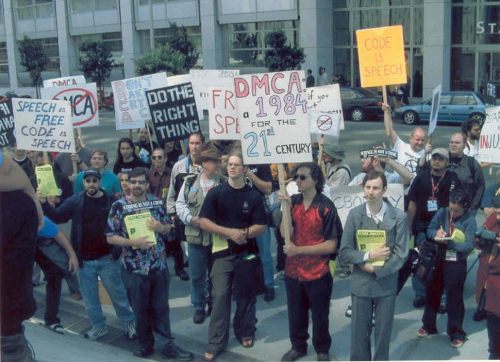
Biella Coleman: Now for the harder photo request: Free Dmitry!

Free Dmitry! So one my favorite fieldwork photos is the one above and I would love to include it in my book but I have no idea where I got it from much less who took it. The photo was taken during a San Francisco protest against the DMCA, and more urgently at the time, also calling for the release of Dimitry Sklyrov (and we were all listening to Richard Stallman who was giving a small speech and I am on the right hand side of the photo, furiously scribbling notes) I am looking for a high quality photo from one of the many Dmitry Sklyarov protests that were held in San Francisco or San Jose a photo that is either under CC license or given to me with formal permission to publish (I have forms to get official permissions). As I mentioned in my previous post, the book will be published with Princeton University Press with a CC license.

25 September 2011

Gregor Herrmann: RC bugs 2011/38

quick overview over my RC bug activities during the last week: random notes:

20 September 2011

MJ Ray: Six of the Best Podcasts?

I m listening to quite a few podcasts recently. Here are my current favourites: And now for number six, what are you listening to? Anything you d recommend?

17 September 2011

Joey Hess: destructive impulse

I used to know guys who would take old computer hardware out in the desert and shoot it up. I never went, and I've never gratuitously destroyed a computer in 2 decades of working with the things. Until yesterday when I picked one up by the monitor and introduced it to the floor. My regret isn't that I violently destroyed a computer, but that it was my Mom's computer, and I did it right in front of her, and without even a story-worthy reason, just out of garden variety frustration. And perhaps there's some regret that I was actually unsucessful in destroying anything other than the monitor and some speakers. The computer was salvaged, and my mom has a new monitor and a working system again. Sorry Mom & Maggie. To make up for it, I'll humiliate myself with this recording of "broke mom's computer blues", which will only be available for a very limited time: click to listen (warning: contains harmonica). Anyway, don't worry; any remaining frustration will be taken out the usual way: Splitting firewood.

16 September 2011

Rapha&#235;l Hertzog: How to triage bugs in the Debian bug tracking system

Triaging bugs is one of the easiest way to start contributing to Debian. I ll teach you the basics in this article. 1. Prerequisites All interactions with the Debian Bug Tracking System (BTS) happen through email so you need to have an email account with an address that you re willing to make public. All the mail that you send to the BTS will be archived and publicly available through its web-interface. This also means that you should have some spam filters in place because it will inevitably be harvested by spammers. :-( To ensure that this email address is consistently used by the various tools that we re going to use, it s a good idea to put this email address in the DEBEMAIL environment variable. You can also specify your full name in DEBFULLNAME (in case you don t want to use the name associated with your Unix account). You usually do this by modifying ~/.bashrc (if you use bash as login shell):
export DEBEMAIL="hertzog@debian.org"
export DEBFULLNAME="Rapha l Hertzog"
You should also install the devscripts package, it provides the bts command that we re going to use. 2. Find a package or a team with too many bugs You can literally pick any popular software that s in Debian, they almost always get more bug reports than the maintainers can handle. Instead of picking a package, you can also select a packaging team and concentrate your efforts on the set of packages managed by the team. In any case, it s important to receive the bug traffic for the packages that you re going to work on. If you went for a specific package, you should subscribe to the package via the Package Tracking System (there s a subscribe box on the bottom left corner once you selected the source package of interest). If you decided to help a team, there s usually a dedicated mailing list receiving all bug traffic. You can browse a list of packages with the most bugs if you have troubles finding a package to work on. A stack of bug reports to triage 3. Triage bugs! Bug triaging is all about making sure that bugs are correctly classified so that when a developer looks at the bug list, he can quickly find bugs with all the information required to be able to fix them! 3.1 Adding information to bug Adding supplementary information is easily done just by sending a mail to XXXX@bugs.debian.org (replace XXXX with the bug number). But often you want to reply to a message in the bug history, in that case bts --mbox show XXXX is for you. It will grab the corresponding mailbox and open a mailer (mutt by default) on it. Now you can directly reply in your favorite mailer. 3.2 Classifying bugs The Debian BTS uses tags (click the link and read the doc!) to classify bugs. bts tag XXXX + foo will add the foo tag (replace the + with a to remove a tag). If you want to explain why you re adding a tag, you should instead reply in the bug log as explained above, put control@bugs.debian.org in Bcc (Blind Carbon Copy) and start the body of your message with your tag command:

tag XXXX + foo
thanks
But what tag should you add? When a bug is submitted, you should try to reproduce the bug. If you can reproduce it, then tag the bug confirmed (example in #641710). If you can t, you should request more information (ex: a sample document triggering the bug, a configuration file, the output of some relevant command, etc.) until you can reproduce it or conclude that it was a user mistake. When you request supplementary information due to this, you should tag the bug unreproducible moreinfo (example in #526774). moreinfo should be later dropped when the requested information are provided, and unreproducible should be dropped if those information were enough to actually help reproduce the bug (example in #526774). During that initial evaluation, it s also worth differentiating packaging bugs (which are specific to Debian) from upstream bugs (which are relevant also for non-Debian users). The latter should be tagged upstream (and forwarded upstream if the bug is reproducible or contains enough information for the upstream developers, example in #635112). If you saw a (viable) patch in the bug log, the bug should be tagged patch . This is usually done by the patch submitter but sometimes it s forgotten (example in #632460). Take care though to not reinstate the patch tag if it was initially set but then dropped by the package maintainer after a review of the patch. If the title of the bug report is not descriptive enough, you can change it with a retitle XXXX new-title command (example in #170850). You can also change the severity of the bug report depending on the impact of the problem (with a command severity XXXX new-severity , what a surprise!). Request for new features are wishlist , most documentation problems are minor . On the other side of the scale, you can use important for bugs that are very annoying but that should not block a release. serious , grave and critical are used for release critical bugs, check the official definitions of the severities (examples in 502738 or #506498). 3.3 Closing non-bugs and bugs that are already fixed If your analysis of the bug report is that it s not really a bug but a user mistake, then you should close it by sending a mail to XXXX-done@bugs.debian.org with some explanations of the user s mistake so that he can get past his problem (example in #592853). If the problem was a real bug, but one that is apparently already fixed, you should try to quickly find the version that fixed the bug. If you can t find it in the changelog (there s a link to it in the PTS, or you can use /usr/share/doc/package/changelog.Debian.gz), you ll make the safe assumption that the upstream version you re currently using is the first one where this is fixed. Then you send a mail to XXXX-done@bugs.debian.org but you start your mail with Version: version-that-fixed-the-bug and continue with a small explanation of why you believe the bug to be fixed by this version (example in #122948). 3.4 Reassigning misfiled bug reports Bug reports are not always filed against the proper package. Users file bugs against applications where they experience the bugs, but the real bug might be in an underlying library or application. When that happens, you should use the reassign XXXX correct-package version command to get it filed against the correct package. The version parameter is optional but should be provided if possible, it should be the oldest version that we know to have the problem (example in #626232). 3.5 Forwarding bugs Forwarding bugs means opening bug reports in the upstream bug tracker for issues that have been reported in Debian but that applies to the upstream (unmodified) source code. Be sure to include all the relevant information and a link to the corresponding Debian bug. Depending on the upstream bug tracker, you might have to open an account to be able to file new bug reports. On the Debian side, you must record that a bug has been forwarded with bts forwarded XXXX upstream-bug-url . upstream-bug-url is the URL corresponding to the upstream bug report you created (ex: http://projects.ciarang.com/p/feed2omb/issues/21/ recorded in #609345 ). If the upstream authors fix the bug you reported, you can tag the Debian bug with fixed-upstream so that it s easier to find bugs to close when the next upstream release comes out (example in #637275). 3.6 Updating version information The Debian BTS uses version tracking to know which package versions are affected by a given bug. It s particularly important to have correct version information for release critical bugs since it might affect the migration of packages to testing. You can learn more on this topic here: http://wiki.debian.org/HowtoUseBTS. 4. More advice Colin Watson wrote a constructive rant explaining some mistakes that bug triagers are often doing. While it refers mainly to Ubuntu s launchpad, the advice apply equally as well to Debian. Check it out to become a better bug triager! Note that you can refer to this article with this shorter URL: http://raphaelhertzog.com/go/bugtriaging/

Do you want to read more tutorials like this one? Click here to subscribe to my free newsletter, you can opt to receive future articles by email.

One comment Liked this article? Click here. My blog is Flattr-enabled.

14 September 2011

Thorsten Glaser: MirBSD online manpages major facelift

Our MirBSD online manual pages and other assorted BSD documentation (except of course the merely copied ncurses, lynx etc. documentation and the texinfo generated HTML pages) has just gained a major facelift. They look alike in lynx(1) best web browser ever and less(1)/man(1) now, and remind of a DEC VT420 on a CSS capable Buntbrause. Thanks to our contributor XTaran for aid with the colour scheme! Since these are generated from catmanpages, heuristics are used for things like where should bold/underline begin/end (since nroff(1) is not always the brightest but working on that), and hyperlinks can only be generated for other manpage references (whose targets may or may not exist, for example if they aren t part of MirOS base/XFree86 ). But on the other hand, Valid XHTML/1.1 and CSS speaks for itself

13 September 2011

Christian Perrier: 10 years being Debian Developer - part 4: NM process

So, this story begins in January 2001, when I applied in the Debian New Maintainer Process. I wanted to maintain Geneweb, which I was using to publish my genealogy research results. And I wanted to keep it up-to-date while upstream was doing a quite fast development. Moreover, I quickly noticed that Geneweb had big trouble in respecting the way data is organized on a Debian system, and respect the FHS. How to have weveral users able to publish their data on the same server without compromizing the overall system security, etc. Upstream development didn't really care about that. Daniel de Rauglaudre is an excellent genealogist and developer but he was not interested in making Geneweb clean "the Debian way". For instance, at that time, it wasn't easy to setup a server, where genealogy databases could be published without having to manually launch a daemon in user mode at each reboot. Arranging this was indeed my first contribution. I contributed a few patches to make it easier to turn Geneweb into something FHS-compliant...and I developed init scripts and an organization allowing one to have shared databases after system reboots. That was rapidly a great introduction to Debian maintainer scripts and even security-related challenges. And all this....because I needed it. Basically, in 2001, the geneweb package adopted the organization it still has in Debian and Ubuntu, 10 years later: While doing so, I was going through the New Maintainer Process. The Debian developer who had signed my key was Sam Tardieu, of of those longstanding "Freenix" dudes I was sometimes hanging around. I don't remember who did write my advocacy. Michael Mattice was my first Application Manager. Interestingly, here are the three first questions he asked my as part of the Policy and Procedures check : Mike actually asked the questions on February 17th and I probably answered immediately. Unfortunately it seems that I lost my answers. Maybe they are in some archive somewhere. Would be interesting to see how I ended giving an answer about the TeX exception.:-) Immediately, Mike moved to the Tasks and Skills step and checked my geneweb and lifelines packages (I already prepared a package for that other genealogy software). From my records, he found a few lintian warnings, which I probably made my best to fix, then later on, on March 12th, he answered me that thigns were OK and he was marking the T&S step as passed...handing things over to the NM database, asking me what username I wanted on debian.org (obviously, you know what I answered to this!). Then nothing happened..:-) I was not that impatient, but finally, around June 27th, I politely mailed NM Frontdesk (I guess) to get news...and I got a very quick answer by Martin Michlmayr. Martin was indeed worried about the situation (he told me I was on his radar....fun as, many years later, as many DDs, Martin probably went on mine because of pending localization work..:-)) Finally, Martin decided he was not entirely happy with the (maybe too short) processing for P&P and proposed me (very politely, you know how Martin is!) to do it again. So, some more questions...:-) Here, I have the answers. Really fun ro read. Hang on, pure bubulle style, very verbose! What a bunch of questions..:-). Reading my answers ten years after, I see that some answers are somehow naive but, after all, they're not so bad. I really remember spending hours in writing them (my English was somehow more shaky at that time) The last question was: "Please tell me about about yourself and what you intend to do for Debian". Here, Martin opened a big can of worms..:-) So, you'll learn about this in the next episode..:-)

12 September 2011

Antonio Terceiro: Laptop fun, or "WTF, HP?"

A couple of weeks ago my old laptop decided to rest forever, and I was forced to impose some economic pressure onto the consumption of the planet resources by acquiring a new one. Fortunately this happened while I am still here in Canada, where it is reasonably cheaper to get a decent laptop than it is in Brazil. Although I did not have the budget I wanted for buying a really kick ass laptop, I was able to buy a decent one, an HP Pavilion G6 1B74CA. I went on 4 different shops with a USB stick loaded with Debian Live to check whether all the hardware would work ok. I always asked one of the salesman before rebooting the laptops, but it was funny to see the reactions of the different employees who came by to check what I was doing: some of them barely noticed that GNOME was not Windows XYZ, and and some asked whether I was hacking the laptops. Unfortunately, I wasn t able to find a single laptop in which the wireless worked out of the box with the Squeeze kernel, which sucks. I searched over the internet a lot, and it seems that even the vendors recommended by the FSF do not provide laptops with wireless cards that work without non-free blobs. Other issue I had was with the Intel graphics. After the kernel enables the modesetting, the backlight goes to the minimum and it looks like you have no video. There are a couple of workarounds in the internet, and the one in which you add acpi_osi=Linux acpi_backlight=vendor to the kernel parameters makes the laptop turn on by itself in the morning. This is probably caused by broken ACPI handling in the BIOS, who almost always is written by people on crack. The other issues I had were related to the keyboard. First, the BIOS came by default with Access keys mode enabled, which means that by default pressing F2-F12 actually activated the multimedia keys instead of the real function keys. It was disapointing to hit F12 and have my wireless turned off. After disabling this in the BIOS setup, it was OK. Well, not quite: for some reason, Fn+F4 did not generate the expected keycodes. After some research on the internet, I found a interesting Ubuntu bug . It seems that the latest and greatest version of Windows starts its video setup application via the Meta+P shortcut ( Meta is the actual name of what Windows people call the Windows key ). Guess what the morons writing the HP BIOS did yes, they made the keys Fn+F4 (where F4 has video setup as its multimedia key ) generate the keycodes for Meta+P! It would be a lot easier for everyone in the world if the people at Microsoft just make their stuff listen to both Meta+P and the video setup keycode, which is generated by every laptop out there, to activate the Windows screen setup thing. This way the very smart dudes writing BIOS at HP wouldn t need to make Fn+F4 generate the keycodes for Meta+P and break every single desktop that is not procuced at Redmond.

5 September 2011

Tanguy Ortolo: Startup scripts of Bash and Zsh

Both Bash and Zsh use several startup scripts: profile, bashrc, zlogin, zshrc, etc. The existence of several startup scripts exists to allow you to apply specific actions for interactive or login shells. For instance, you may want to set up a fancy colour prompt or to enable a powerful completion system for interactive shells only, as it would be pointless to apply it to non-interactive shells (that is, for shell scripts). Or you may want to display a joke and the weather forecast at login, but not each time you spawn a shell by other means.Common Both Bash and Zsh first execute a system-wide file, then the corresponding user-specific one. For instance, /etc/profile then ~/.profile. For simplicity I shall only mention the files' base names. Bash At startup, depending on the case: At exit, it executes ~/.bash_logout (no system-wide version). Note the funny (read: insane) non-login condition for executing bashrc: it is often worked around by having the profile execute bashrc anyway. Zsh Zsh always executes zshenv. Then, depending on the case: At the end of a login session, it executes zlogout, but in reverse order, the user-specific file first, then the system-wide one, constituting a chiasmus with the zlogin files. Summary
Bash
login
yes no
interactiveyesprofilebashrc
no profile-
Zsh
login
yes no
interactiveyeszshenv zprofile zshrc zloginzshenv zshrc
no zshenv zprofile zlogin zshenv
I personally find the Zsh process much saner. To be honest I should rather say that I find Bash's behaviour insane, with an absurd process (bashrc for interactive, non-login shells ) that needs to be worked around, and an inconsistent naming and search convention (~/.bashrc vs. /etc/bash.bashrc, no system-wide version of bash_logout).

Kai Wasserb ch: What wasn't said about the Linux graphics stack

This post is a small follow-up on yesterday's post about the Linux graphics stack. I'm still keeping to high level stuff and won't dig too deep, but a few questions arose (others reached me by e-mail), so, here we go. Gallium3D is a framework, initially developed by Tungsten Graphics, which were bought by VMware. The idea behind Gallium3D is, that many functions can be shared between drivers for different GPUs and that the effort to support a new platform/system is for classic drivers pretty high. With Gallium3D you just need a state tracker and a target. The state tracker is code, that gives the pipeline of Gallium3D drivers access to a platform/system, like OpenGL or X on various operating systems. A target is the required as glue between a state tracker and the actual driver. For example: there is a state tracker for video playback acceleration (the recently added g3dvl). The state tracker itself offers the interface and common functions (with some help from the auxilliary stuff) between the Gallium3D pipeline and the userland libraries like libvdpau1. Targets like vdpau-[DRIVER] glue the driver and the state tracker together. The winsys part of Gallium3D is a similar concept but it abstracts the windowing system on the target platform away (e.g. Wayland, X or GDI). I didn't write about the proprietary drivers yesterday, as I don't consider them a real part of the Linux graphics stack, more like parasites, and didn't want to encourage anyone to use them (yes, I know, there are some cases in which you might be better off with them, but generally I'd avoid them). Anyway, I got some questions about those (some by e-mail, the other I'm aware off, can be found behind the link at the beginning of this entry). So, where do the proprietary drivers come in? They are basically the entire stack in a closed form, plugging into the public interfaces of the Kernel (whether that's legal is disputed), some other parts like X (by building a DDX) and building their own libGL. Especially the last part can be a cause for a lot of pain, when you don't use the proprietary driver packages offered by the distribution (e.g. Debian's fglrx packages divert the libGL and restore the default one on unistallation, with the vendor build scripts and tools this is not really guaranteed, which might leave you with a broken OpenGL setup). Another question was, why Mesa was lacking support for a recent OpenGL version (i.e. 4.x). In my opinion there are a few reasons, though I don't really feal like the best person to answer this. The first are design issues by some internal representations (e.g. missing integer support in the intermediate representations). The second is the available number of developers being able to implement new OpenGL functions. Apart from a not all too clear specification the Mesa code base is huge (even if you ignore most of the drivers), which makes it difficult for new developers to start coding away. Then you need an understanding of how modern GPUs operate to find good solutions for the problems faced. If you want to get an idea for this, take a look at Zack Rusin's or Alex Deucher's blog. Then, there is a sad split of developers, on the one hand we've got the Gallium3D-using developers on the other we've got the ones staying with the classic driver model. This means, that you have to implement e.g. GLSL extensions for TGSI and Mesa's IR respectivly. There might be other reasons, I'm totally missing, but this should give you some insight into why it takes so long, to get current OpenGL versions supported. I hope this clears some of the remaining questions, if not, feel free to write me an e-mail, but please remember, that this is not an in-depth analysis.

Kai Wasserb ch: Mesa packages on dev.carbon-project.org

Thanks to the awesome patent situation (if you're unaware of what I'm talking, you can catch up by listening to PRI's This American Life episode about patents, reading Florian Mueller's write-ups about the patent wars (current focus: mobile devices) or by having a look into my posts with the "patent-mess" tag), Debian will most likely be unable to distribute Mesa packages with ARB_texture_float enabled (if you want to build mesa yourself with this extension enabled, just add --enable-texture-float to confflags-dri in the Mesa source package's debian/rules). But some programs really like to have this extension, thus I started building Mesa myself. The resulting packages can be found on dev.carbon-project.org. Big fat warning: please check, whether you're affected by the US patent #6,650,327 (i.e. if it's a valid patent in your jurisdiction) before you use the packages. If in doubt, consult with your lawyer. By the way, if you're not working in an area where knowledge of the specifc claims/content of the patent might be harmful, you have some time on your hands and you want to learn, what's "patentworthy" these days, have a look at the claims of the patent. Otherwise the three links from the beginning must do. Before I end this post, just one more remark about my Mesa packages: they'll follow upstream's Git and thus might have problems from time to time. If Debian's Mesa packages suffice your needs, stay with them. If not, feel free to use my packages or use them as a base for your own packages.

4 September 2011

Thorsten Glaser: Cat weather

Another cat posting, about 100 KiB worth of images embedded so follow to the main article to read it, I don t want Planet readers to suffer from traffic overuse.

3 September 2011

Thorsten Glaser: Saturday Noon Cat wlog-entry-writing

As written about here earlier, cats have a nice life. I walked into my home seeing three cats in a row, all black: two lazing around, the third (with white spots, and belonging to a different neighbour from the other two) ambulating. I went up and got my PocketPC with the already mentioned camera application to take a shoot. Sadly, the more shy cat went away, but I got some pictures of the other two here they are, internet photo stars follow the hyperlink to get a large version. two of three black cats I met today  in a row! Later I came back from geocaching (2 GC.COM-only, 1 OC-only *yay!* found, one not found due to not taking any hardware with me) the bigger guy lazed around in the bush next to where I usually park my bike. Lucky

1 September 2011

Thorsten Glaser: Subversion for Dummies (or visitors of the #cvs IRC channel)

Oh well someone came into the #cvs channel on IRC without a clue, again. I ve made a nice picture to show the competition (rival, whatever) to newbies (warning, sarcasm ahead)

Next.

Previous.