Search Results: "rra"

21 May 2009

Christian Perrier: Stupid CRM114

Thanks, CRM114. From yesterday morning (where I ran my daily dist-upgrade) to now, you just *trashed* all my legitimate mail. Oh, sure, I got warned in some way by NEWS.Debian entries, but I didn'tfigure out that it was URGENT that I change my *.css files. What was happening is, in short, that all non whitelisted mail was just...reduced to a blank line. And I didn't figure out immediately because I have several whitelist entries, so I was still receiving *some* mails. So, it is not only "stop working"....it is doing much harm. If you're a CRM114 user and haven't upgraded to 20090423-1, you've been warned. I'm currently considering what to do and if a bug report is warranted (RC, of course). Oh, for sure, there *is* a warning through NEWS.Debian but is breaking existing behaviour so badly really something that we want in Debian? Losing legitimate mail is the worse thing a program can do, isn't it?

19 May 2009

Neil Williams: libqof2

It's taken a lot longer than I expected (mostly due to getting other things done in Emdebian etc.) but now that Lenny is out, QOF can finally drop all the previously deprecated code and move to libqof2, so the upstream code has now been released via Alioth (0.8.0) and the binaries have been uploaded to Debian and are waiting in NEW.

QOF provides a set of C language utilities for performing generic structured complex queries on a set of data held by a set of C/C++ objects. This framework allows programmers to add query support to their applications without having to hook into a SQL Database. QOF is a large part of my attempts to get some degree of data freedom to complement the source code freedom. This remains a problem with certain applications, especially financial ones, so I've tried to make it easier to both import and export data between programs using QOF and to convert the default QOF data storage formats into other common formats using simple tools and scripts based on XSL or perl. Having a SQL-type query interface accessible via the command line is a huge bonus when dealing with large data sets.

There is a patch for gnotime that makes the final adjustments to handling the removed code. pilot-qof and gpe-expenses already build cleanly without the deprecated code but each of these is also pending a new upstream release, so rather than need a binNMU, I'm simply going to make those releases when QOF clears NEW.

Having said that, pilot-qof and gpe-expenses introduce new binary packages themselves so they will spend time in NEW too. pilot-qof will be the last of the set to be released because the new upstream version can use symbols from the new gpe-expenses release to make it easier to move data between applications. However, that support is optional at build time and could be done via a Debian revision, so I might do it that way.

This also marks the completion of the migration of QOF from SourceForge to Alioth - principally for easier bug tracking and a usable mailing list archive. The QOF VCS is in svn.debian.org.

The mailing list for QOF development is therefore at alioth:
QOF-devel and archives also.

I'm still working on two other QOF-based utilities - one that can handle simple accounts and one to handle simple invoices. The invoice handling is already partially implemented in pilot-qof but I'm looking at a GTK+ frontend with a robust command line interface so that scripts can update the invoice data behind-the-scenes. Hopefully, some form of arbitrary-format parser can be arranged that can handle extracting data from whatever form the client happens to send - typically PDF. It'll need tweaking for each client, but it could work. The objects used by gpe-expenses and pilot-qof (including invoices) are exposed via QOF and can be mixed together in any new QOF application, easily able to read data from multiple sources, merge data sets, query data sets and export into other formats. The core currency and expense types come from pilot-link but are then enhanced to support GnuCash conventions.

For information on another QOF application called "estron" - an idea for a data-driven query interface - see http://estron.alioth.debian.org/. Problem 1 with estron: the examples all rely on postgres and I just can't get that to setup properly as either a test system or as a Debian package. Problem 2: estron was intended to be an interpreter that could be written "in itself" but whilst this is possible for the simpler examples, doing more complicated stuff like calculating values from other values makes the estron XML very obtuse. The current codebase uses GOB2 to

QOF is now stable and I don't expect to need another SONAME bump for quite a while. If anyone is interested in taking on estron or helping with the Cash and/or Invoice frontends, let me know. The problem with estron currently is bitrot - the GTK+ frontend has too many gtk1.2 hangovers which now fail to build.

16 May 2009

Andrew Pollock: [tech] Deciding between the Lenovo T400 and X301

I'm in the market for a new laptop. I've got almost 4 years out of my Dell D610 (which I've been despising from not long after purchasing) and decided that I'll never buy from Dell again. I used to be very down on ThinkPads because of the placement of the Escape key, but since I've been using one at work for the last 3.5 years, I've gotten used to the Escape key location, and found the laptops themselves to otherwise be very solid and well supported by Linux. So Lenovo it is. Next question: T400 or X301? I've seen both, and the X301 is very sexy in terms of thickness, weight, and having all the latest bells and whistles, but boy, is it expensive. I did a side-by-side comparison between a T400 decked out the way I wanted, and an X301 decked out the best I could choose, and I've opted for the T400. The main problems I had with the X301 were that there was no choice of processor, and the processor available seemed significantly slower than what I could get in the T400, and of course the cost. I seemed to be paying nearly $1000 more for a slower processor, just to get something extra thin and light, with LED backlighting and an SSD disk. What finally swayed me to spending less money and getting an arguably "better" laptop was if I paid less now, I'd be more comfortable possibly getting something in less than 4 years time down the track. So if it came down to the X301 for 4 years or the T400 for 2 years, the T400 seemed like a better deal. What will hopefully end up happening is I'll end up using the T400 for four years and not end up hating it by the end of that time. Here's what I ended up going with: All of that plus a 2 year warranty and an additional 90W AC adapter came out at $1,240 (they have a 15% off discount code thing running until tomorrow, which brought the price down a bit) I'm particularly excited about not having a proprietary graphics chipset. I'm particularly unexcited about it including Windows Vista Home Basic. Drat, enumerating all of the options made me just realise that I seem to have omitted the 5-in-1 media reader from the final order. Oh well. That was largely just a nice-to-have anyway. Sarah tends to do all of the photo management on her laptop. I doubt this will get to me before Thursday, so I should have it waiting for me by the time I get back from Barcelona.

Steve Kemp: Humans don't drink blood.

I've said it multiple times, but all mailing list managers suck. Especially mailman. (On that topic SELinux is nasty, Emacs is the one true editor, and people who wear furry boots are silly.) Having setup some new domains I needed a mailing list manager, and had to re-evaluate the available options. Mostly I want something nice and simple, that doesn't mess around with character sets, that requires no fancy deamons, and has no built in archiving solution. Really all we need is three basic operations: Using pipes we can easily arrange for a script to be invoked for different options:
# Aliases for 'list-blah' mailing list.
#
^list-blah-subscribe$:   " /sbin/skxlist --list=list-blah --domain=example.com --subscribe"
^list-blah-unsubscribe$: " /sbin/skxlist --list=list-blah --domain=example.com --unsubscribe"
^list-blah$:             " /sbin/skxlist --list=list-blah --domain=example.com --post"
The only remaining concerns are security related. The most obvious concern is that the script named will be launched by the mailserver user (Debian-exim in my case). That suggests that any files it creates (such as a list of email addresses - i.e. list members) will be owned by that user. That can be avoided with setuid-fu and having the mailing list manager be compiled. But compiled code? When there are so many lovely Perl modules out there? No chance! In conclusion, if you're happy for the exim user to own and be able to read the list data then you can use skxlist. It is in live use, allows open lists, member-only lists, and admin-only lists. It will archive messages in a maildir, but they are ignored for you to use if you see fit. List options are pretty minimal, but I do a fair amount of sanity checking and I see no weaknesses except for the use of the Debian-exim UID. ObFilm: Blade

14 May 2009

Antti-Juhani Kaijanaho: Asynchronous transput and gnutls

CC0
To the extent possible under law,
Antti-Juhani Kaijanaho has waived all copyright and related or neighboring rights to
Asynchronous transput and gnutls. This work is published from Finland.
GnuTLS is a wonderful thing. It even has a thick manual but nevertheless its documentation is severely lacking from the programmer s point of view (and there doesn t even seem to be independent howtos floating on the net). My hope is to remedy with this post, in small part, that problem. I spent the weekend adding STARTTLS support to the NNTP (reading) server component of Alue. Since Alue is written in C++ and uses the Boost ASIO library as its primary concurrency framework, it seemed prudent to use ASIO s SSL sublibrary. However, the result wasn t stable and debugging it looked unappetizing. So, I wrote my own TLS layer on top of ASIO, based on gnutls. Now, the gnutls API looks like it works only with synchronous transput: all TLS network operations are of the form do this and return when done ; for example gnutls_handshake returns once the handshake is finished. So how does one adapt this to asynchronous transput? Fortunately, there are (badly documented) hooks for this purpose. An application can tell gnutls to call application-supplied functions instead of the read(2) and write(2) system calls. Thus, when setting up a TLS session but before the handshake, I do the following:
                gnutls_transport_set_ptr(gs, this);
                gnutls_transport_set_push_function(gs, push_static);
                gnutls_transport_set_pull_function(gs, pull_static);
                gnutls_transport_set_lowat(gs, 0);
Here, gs is my private copy of the gnutls session structure, and the push_static and pull_static are static member functions in my sesssion wrapper class. The first line tells gnutls to give the current this pointer (a pointer to the current session wrapper) as the first argument to them. The last line tells gnutls not to try treating the this pointer as a Berkeley socket. The pull_static static member function just passes control on to a non-static member, for convenience:
ssize_t session::pull_static(void * th, void *b, size_t n)
 
        return static_cast<session *>(th)->pull(b, n);
 
The basic idea of the pull function is to try to return immediately with data from a buffer, and if the buffer is empty, to fail with an error code signalling the absence of data with the possibility that data may become available later (the POSIX EAGAIN code):
class session
 
        [...]
        std::vector<unsigned char> ins;
        size_t ins_low, ins_high;
        [...]
 ;
ssize_t session::pull(void *b, size_t n_wanted)
 
        unsigned char *cs = static_cast<unsigned char *>(b);
        if (ins_high - ins_low > 0)
         
                errno = EAGAIN;
                return -1;
         
        size_t n = ins_high - ins_low < n_wanted
                ?  ins_high - ins_low
                :  n_wanted;
        for (size_t i = 0; i < n; i++)
         
                cs[i] = ins[ins_low+i];
         
        ins_low += n;
        return n;
 
Here, ins_low is an index to the ins vector specifying the first byte which has not already been passed on to gnutls, while ins_high is an index to the ins vector specifying the first byte that does not contain data read from the network. The assertions 0 <= ins_low, ins_low <= ins_high and ins_high <= ins.size() are obvious invariants in this buffering scheme. The push case is simpler: all one needs to do is buffer the data that gnutls wants to send, for later transmission:
class session
 
        [...]
        std::vector<unsigned char> outs;
        size_t outs_low;
        [...]
 ;
ssize_t session::push(const void *b, size_t n)
 
        const unsigned char *cs = static_cast<const unsigned char *>(b);
        for (size_t i = 0; i < n; i++)
         
                outs.push_back(cs[i]);
         
        return n;
 
The low water mark outs_low (indicating the first byte that has not yet been sent to the network) is not needed in the push function. It would be possible for the push callback to signal EAGAIN, but it is not necessary in this scheme (assuming that one does not need to establish hard buffer limits). Once gnutls receives an EAGAIN condition from the pull callback, it suspends the current operation and returns to its caller with the gnutls condition GNUTLS_E_AGAIN. The caller must arrange for more data to become available to the pull callback (in this case by scheduling an asynchronous write of the data in the outs buffer scheme and scheduling an asynchronous read to the ins buffer scheme) and then call the operation again, allowing the operation to resume. The code so far does not actually perform any network transput. For this, I have written two auxiliary methods:
class session
 
        [...]
        bool read_active, write_active;
        [...]
 ;
void session::post_write()
 
        if (write_active) return;
        if (outs_low > 0 && outs_low == outs.size())
         
                outs.clear();
                outs_low = 0;
         
        else if (outs_low > 4096)
         
                outs.erase(outs.begin(), outs.begin() + outs_low);
                outs_low = 0;
         
        if (outs_low < outs.size())
         
                stream.async_write_some
                        (boost::asio::buffer(outs.data()+outs_low,
                                             outs.size()-outs_low),
                         boost::bind(&session::sent_some,
                                     this, _1, _2));
                write_active = true;
         
 
void session::post_read()
 
        if (read_active) return;
        if (ins_low > 0 && ins_low == ins.size())
         
                ins.clear();
                ins_low = 0;
                ins_high = 0;
         
        else if (ins_low > 4096)
         
                ins.erase(ins.begin(), ins.begin() + ins_low);
                ins_high -= ins_low;
                ins_low = 0;
         
        if (ins_high + 4096 >= ins.size()) ins.resize(ins_high + 4096);
        stream.async_read_some(boost::asio::buffer(ins.data()+ins_high,
                                                   ins.size()-ins_high),
                               boost::bind(&session::received_some,
                                           this, _1, _2));
        read_active = true;
 
Both helpers prune the buffers when necessary. (I should really remove those magic 4096s and make them a symbolic constant.) The data members read_active and write_active ensure that at most one asynchronous read and at most one asynchronous write is pending at any given time. My first version did not have this safeguard (instead trying to rely on the ASIO stream reset method to cancel any outstanding asynchronous transput at need), and the code sent some TLS records twice which is not good: sending the ServerHello twice is guaranteed to confuse the client. Once ASIO completes an asynchronous transput request, it calls the corresponding handler:
void session::received_some(boost::system::error_code ec, size_t n)
 
        read_active = false;
        if (ec)   pending_error = ec; return;  
        ins_high += n;
        post_pending_actions();
 
void session::sent_some(boost::system::error_code ec, size_t n)
 
        write_active = false;
        if (ec)   pending_error = ec; return;  
        outs_low += n;
        post_pending_actions();
 
Their job is to update the bookkeeping and to trigger the resumption of suspended gnutls operations (which is done by post_pending_actions). Now we have all the main pieces of the puzzle. The remaining pieces are obvious but rather messy, and I d rather not repeat them here (not even in a cleaned-up form). But their essential idea goes as follows: When called by the application code or when resumed by post_pending_actions, an asynchronous wrapper of a gnutls operation first examines the session state for a saved error code. If one is found, it is propagated to the application using the usual ASIO techniques, and the operation is cancelled. Otherwise, the wrapper calls the actual gnutls operation. When it returns, the wrapper examines the return value. If successful completion is indicated, the handler given by the application is posted in the ASIO io_service for later execution. If GNUTLS_E_AGAIN is indicated, post_read and post_write are called to schedule actual network transput, and the wrapper is suspended (by pushing it into a queue of pending actions). If any other kind of failure is indicated, it is propagated to the application using the usual ASIO techniques. The post_pending_actions merely empties the queue of pending actions and schedules the actions that it found in the queue for resumption. The code snippets above are not my actual working code. I have mainly removed from them some irrelevant details (mostly certain template parameters, debug logging and mutex handling). I don t expect the snippets to compile. I expect I will be able to post my actual git repository to the web in a couple of days. Please note that my (actual) code has received only rudimentary testing. I believe it is correct, but I won t be surprised to find it contains bugs in the edge cases. I hope this is, still, of some use to somebody :)

12 May 2009

Erich Schubert: Dropbox experiences?

Has anyone experience with Dropbox?It seems to be an interesting web storage service, with 2 GB of free storage.However, the Linux client seems to be closed source (which is understandable, it seems to have a lot of neat features) - so I intend to use the web interface only (at least for now).Update #2: There is a RFP bug for Debian, some Source is on the download site. And while this sort (except the images) is GPL, it's just the nautilus integration part, not the daemon you also need.Did you try Dropbox? Does it work well? I know some people (especially Windows users) who could benefit a lot from a service like that, so I wonder if I should recommend them Dropbox. Or is there some better alternative (it should allow sharing of files though - synchronization is not as essential, it is a lot about exchanging files too large for usual email in small user groups; still synchronization probably is a comfortable way of transferring the files without having to think about it yourself)?No comments in this blog - email me via erich AT debian ORG.P.S. I know there is some referral program to get more storage, feel free to send me your referral link - I'll remove this PS once I've signed up.P.P.S. There also is Ubuntu one, but as far as I can tell Ubuntu only so far. Looks very similar.P.P.P.S. So far, I've received a lot of praise for DropBox.P^4.S. My own referral link, feel free to use this to sign up (+256 MB for you, too!) and "upgrade" my account.

James Morrison: Sita Sings the Blues

Sita sings the blues is playing at the red vic. I went to see it tonight, it was really cool. There are 4 styles of animation and the narration is a lot of fun. The narration style is 3 people sitting around chatting trying to remember a story. The really cool part is most of the music is recordings of Annette Hanshaw from the 20s.

My part in tonight was using 2 rolls of dimes to pay to get into the movie :) That's two rolls of dimes now back in circulation.

9 May 2009

Andrew Pollock: [life] A few days in British Columbia

We got back from our brief visit to Canada last night. We had a great time, Vancouver and Victoria were both very nice. YVR (Vancouver Airport) This airport has to win the award for nicest airport I've seen. Clearly they pulled out all the stops in preparation for the Winter Olympics next year. The airport is very bright, airy and open. Before you even hit the immigration line, you pass through a couple of water features, some indigenous art, all of that jazz. Immigration is done in the open in a huge hall, instead of in the dark bowels of the airport, which was a pleasant change from the usual US airport immigration experience. (That said, Houston airport had a pretty nice immigration experience). Oh, and it was blanketed with free WiFi, which was a nice touch. Ferry to Victoria The brief geography lesson I got was that Victoria is on Vancouver Island, and Vancouver (the city) is not on Vancouver (the island). Go figure. Getting to Victoria from the airport via BC Ferries was a very seamless experience. You board a bus from the side of the airport terminal, and it drives to Tsawwassen, drives onto the ferry, and then you get off the bus and go sit on one of the passenger levels of the ferry. BC Ferries BC Ferries deserves special mention. The ferry itself is huge - 7 decks (three of them for vehicles). It's a veritable shopping mall on water. It's got some stores, buffets, exclusive $10 entry lounges, video arcades, cellular payphones, the works. The trip to Victoria The ferry ride took about 1.5 hours, and was very scenic. We passed by a few smaller islands, and I had an instant flashback to the TV show The Beachcombers that I used to watch as a kid, particularly the opening sequence. Victoria Victoria is a beautiful city. It's the capital of the province of British Columbia, and I likened it to Canberra in a lot of ways. It had more modern conveniences than a town with a population of its size would otherwise normally have. It was a government and university town. Nice houses, very green in general, and being an island, there was water everywhere. It seemed to have lots of bays, and harbours and rivers. It was very nice. Flight back to Vancouver We took a Harbour Air seaplane back to Vancouver on Sunday afternoon. That was fun. I've never been on a seaplane before. It took about 35 minutes. Vancouver First order of business in Vancouver was the purpose of the whole trip: renewing our visas. That went fine, I'll write a separate post about the process. Afterwards, we bought tickets for the Big Bus, and toured the city for the remainder of Monday and Tuesday. Drive to Whistler For Wednesday and Thursday, we hired a car, and went a bit further afield. On Wednesday, we drove up to Whistler to check it out. The drive up took about 5 hours, because we stopped at every scenic spot we came by. Waterfalls abounded. There was a lot of work being done on the roads between Vancouver and Whistler, upgrading them for the Olympics. Whistler itself was pretty spectacular. Some crazy looking ski runs. The village looked like Squaw Village on steroids. The drive back only took about 2 hours. Cleveland Dam, Lynn Canyon suspension bridge For the last day, we drove to Cleveland Dam, where there was a salmon hatchery, and checked out the dam, hatchery and surrounding area. It was lovely and green. After that, we drove to Lynn Canyon to check out the suspension bridge there (unlike the Capilano Suspension Bridge, which costs $26 a pop, the Lynn Canyon one is free). That was all we had time for really. The weather wasn't fantastic during our stay, but it didn't really prevent us from doing anything either. I'd have liked to have checked out Stanley Park if we had more time, and Sarah wanted to go to Grouse Mountain. We had a near-100% success rate at being picked as Australians, unlike when we're in the US, where more often than not, people ask us if we're British. Apparently this is mainly attributed to the fact that Australians run all of the ski lifts at Whistler. We certainly heard a lot of Australian accents while we were getting around. I'd also never seen such a saturation of Starbucks before. In Vancouver, there were literally Starbucks across the road from Starbucks, and around the corner from another one. Whistler village had two. The Canadian accent is cute. They really do tack "eh?" on the end of everything, although it's phonetically more like "ay?". "House" and "about" are also pronounced distinctively differently. Overall, Vancouver wasn't what I'd call bursting at the seams with tourist attractions, but seemed like a nice city. It was fairly flat. The beggars were well dressed. Everyone was very friendly. A lot of the taxis were Priuses. It seemed pretty clean. I could handle living there. Not sure how bad it gets in winter.

5 May 2009

Ingo Juergensmann: Non-Stop re-syncing RAID1

Ok, since a few days there is always the same going on on one of the companies (hosted) servers: the RAID1 syncs in a loop because a medium error always happen during the rebuild progress:

May 5 21:55:28 spion29 kernel: [2339524.778339] md: md2: recovery done.
May 5 21:55:28 spion29 mdadm: RebuildFinished event detected on md device /dev/md2, component device mismatches found: 512
May 5 21:55:30 spion29 kernel: [2339526.287680] RAID1 conf printout:
May 5 21:55:30 spion29 kernel: [2339526.287702] --- wd:1 rd:2
May 5 21:55:30 spion29 kernel: [2339526.287712] disk 0, wo:1, o:1, dev:sda3
May 5 21:55:30 spion29 kernel: [2339526.287721] disk 1, wo:0, o:1, dev:sdb3
May 5 21:55:30 spion29 mdadm: RebuildStarted event detected on md device /dev/md2
May 5 21:55:30 spion29 kernel: [2339526.295476] RAID1 conf printout:
May 5 21:55:30 spion29 kernel: [2339526.295487] --- wd:1 rd:2
May 5 21:55:30 spion29 kernel: [2339526.295497] disk 1, wo:0, o:1, dev:sdb3
May 5 21:55:30 spion29 kernel: [2339526.295515] RAID1 conf printout:
May 5 21:55:30 spion29 kernel: [2339526.295523] --- wd:1 rd:2
May 5 21:55:30 spion29 kernel: [2339526.295531] disk 0, wo:1, o:1, dev:sda3
May 5 21:55:30 spion29 kernel: [2339526.295541] disk 1, wo:0, o:1, dev:sdb3
May 5 21:55:30 spion29 kernel: [2339526.295589] md: recovery of RAID array md2
May 5 21:55:30 spion29 kernel: [2339526.295598] md: minimum guaranteed speed: 1000 KB/sec/disk.
May 5 21:55:30 spion29 kernel: [2339526.295608] md: using maximum available idle IO bandwidth (but not more than 200000 KB/sec) for recovery.
May 5 21:55:30 spion29 kernel: [2339526.295625] md: using 128k window, over a total of 390628416 blocks.
May 5 22:11:52 spion29 kernel: [2340506.396514] ata3.00: exception Emask 0x0 SAct 0x0 SErr 0x0 action 0x0
May 5 22:11:52 spion29 kernel: [2340506.396539] ata3.00: irq_stat 0x40000001
May 5 22:11:52 spion29 kernel: [2340506.396552] ata3.00: cmd 25/00:00:a2:20:ed/00:04:0e:00:00/e0 tag 0 dma 524288 in
May 5 22:11:52 spion29 kernel: [2340506.396553] res 51/40:00:c9:21:ed/18:00:0e:00:00/e0 Emask 0x9 (media error)
May 5 22:11:52 spion29 kernel: [2340506.396601] ata3.00: status: DRDY ERR
May 5 22:11:52 spion29 kernel: [2340506.396611] ata3.00: error: UNC
May 5 22:11:54 spion29 kernel: [2340507.733453] ata3.00: configured for UDMA/133
May 5 22:11:54 spion29 kernel: [2340507.733795] ata3: EH complete
May 5 22:11:54 spion29 kernel: [2340507.844814] sd 2:0:0:0: [sdb] 1465149168 512-byte hardware sectors (750156 MB)
May 5 22:11:54 spion29 kernel: [2340507.851787] sd 2:0:0:0: [sdb] Write Protect is off
May 5 22:11:54 spion29 kernel: [2340507.851809] sd 2:0:0:0: [sdb] Mode Sense: 00 3a 00 00
May 5 22:11:54 spion29 kernel: [2340507.852536] sd 2:0:0:0: [sdb] Write cache: enabled, read cache: enabled, doesn't support DPO or FUA


Usually I would wait for the rebuild to be finished and asking the hosting provider to replace the second disk (sdb), but as the medium error causes just another rebuild process, this won't work for obvious reasons. So, the next plan is to fail the drive sdb and get a replacement disk then. Hopefully the first disk won't fail as well then... but well, Murphy, Backup, stuff... sigh

1 May 2009

Chris Lamb: April 2009 in UK civil liberties

Wednesday 1st
At the G20 protests, Londoner Ian Tomlinson collapses and is attended to by the emergency services; Metropolitan Police claim "during this time a number of missiles - believed to be bottles - were being thrown at them". Tomlinson dies that evening.
Thursday 2nd
The Evening Standard reports that "police were bombarded with bricks, bottles and planks of wood" as they helped Tomlinson.
Saturday 4th
Postmortem of Tomlinson finds he died of a heart attack.
Monday 6th
The EC Data Retention Regulations 2009 comes into force requiring internet service providers to retain details of emails, internet phone calls and other web traffic.
Tuesday 7th
The Guardian publishes a video of a police officer assualting Tomlinson on 1st April.
Wednesday 8th
Twelve Pakistani students are arrested on suspicion of planning terror attacks over the Easter holiday weekend.
Thursday 9th
The Guardian publishes a second video of Tomlinson's assualt, contributing that no missiles were thrown.
Monday 13th
Police arrest 114 climate protestors on conspiracy to cause criminal damage at Nottingham power plant. [ref]
Tuesday 14th
A video of a seperate assualt at the G20 protests is published.
Thursday 16th
Police claim tourist's photography of transport-related buildings is "strictly forbidden" and demand the photos are deleted. [ref]
Friday 17th
A second postmortem of Iam Tomlinson finds the cause of death to be an abdominal haemorrhage. A policeman is interviewed under caution on suspicion of manslaughter. [ref]
Saturday 18th
The Times reveals MP Damian Green private emails were searched by the police using the keywords "Shami Chakrabarti" (director of Liberty) after his arrest last year.
Monday 20th
The Guardian reveals police intelligence was given to E.On before the Nottingham climate demonstration, including movements of protesters and their meetings.
Tuesday 21st
Another video of the Tomlinson assault is revealed showing his head hitting the pavement. The Independent Police Complaints Commission fails to obtain an injunction to prevent broadcast.
Wednesday 22nd
Nine Pakistani students arrested during anti-terror raids are released after 13 days without charge and are passed to UK Border Agency custody for deportation. [ref]
Monday 27th
Home Secretary Jacqui Smith announces that ISPs and telecoms companies will be asked to record usage "to track murderers and paedophiles" without a warrant. [ref]
Tuesday 28th
Emails are revealed of the Home Office asking Phorm, the behavioural targeted advertising service, whether they are falling outside the law. Home Office claim Phorm would be legal if consent is obtained and that "providers of goods and services need only ensure they are compliant with relevant legislation". [ref]
Wednesday 29th
The Guardian documents the friends of the 7/7 bombers were denied bail on secret evidence - "the appellant asked the judge the question: why are you sending me to prison? To which the judge replied: 'I cannot tell you that.'"

Simon McVittie: Implementing D-Bus clients with telepathy-glib (and telepathy-qt4)

(The much-delayed part 2 in an ongoing series: shiny things in telepathy-glib) Over a year ago I explained my first major round of work on telepathy-glib, with which it could be used to implement D-Bus services. I started to write this post shortly after, but then got distracted by a bee or something; recent discussion about having a D-Bus binding in GLib has finally prompted me to finish it. The second major round of work on telepathy-glib dealt with implementing client code, and went sufficiently well that telepathy-qt4 (currently under development) uses essentially the same model. Again, while telepathy-glib is intended for Telepathy implementors, I think TpProxy's ideas are generically useful, particularly for "large" D-Bus APIs.
Some background: dbus-glib and libtelepathy
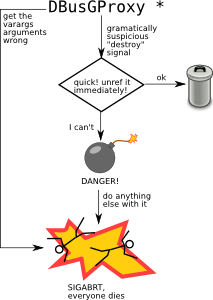
GObject-CRITICAL: Assertion failed: proxy->convenient
The life-cycle of a DBusGProxy (PD clipart credit: karderio and Andy)
The API provided by dbus-glib for client code is, er, rather less than ideal. The basic object is DBusGProxy, which has a few problems. There's one per interface, rather than one per object; this leads to a maze of twisty GObjects, all suspiciously similar. Our old client library, libtelepathy, got round this by subclassing DBusGProxy to make helper objects called TpChan, TpConn etc., which were simultaneously the proxy for the "main" interface (Channel, Connection etc.), and a factory for proxies for the other interfaces (like Channel.Type.Text and Channel.Interface.Password). This still wasn't ideal, but it was a start. If you use a DBusGProxy in any way after it has emitted the destroy signal, this is considered to be invalid use of the API, and dbus-glib asserts all over the place. We'd rather it didn't do that - remote objects becoming invalid is a fact of life, and if you don't immediately discard all your references to those objects, remote operations on them should just give you a runtime error. You have to be prepared to handle such runtime errors already, because any IPC call can fail at any time. The main API for calling methods uses varargs and is rather subtle. Notably, the calling convention for variant parameters (of D-Bus signature 'v') is not consistent with the calling convention for any other container. For any other container, for instance a GPtrArray *, you pass in a GPtrArray ** pointing to a GPtrArray * variable containing NULL; on success, a pointer to a new GPtrArray is written into that variable. For variant parameters, though, you must pass in a GValue * pointing to a zero-filled GValue, and the result will be written into that GValue. dbus-binding-tool generates thin wrappers around this method-calling API which provide type-safety, although they can't directly specify a non-default timeout. As for signals, before binding to a signal, you have to tell dbus-glib about its signature. This tells dbus-glib how it should push the signal arguments onto the C stack (in GObject terminology: how it should marshal them), to match the signature of the signal-handler function. The documentation claims that this isn't necessary for objects supporting the Introspect method, but that's untrue - on the other hand, if the documented behaviour actually happened, I would consider this to be a critical bug in dbus-glib, since it would enable remote objects to crash dbus-glib clients (by causing signal arguments to be pushed onto the stack in a way that does not match the signature of the signal handler). Of course, the signal-adding function takes varargs, and has to be called exactly once per signal per object. If you don't, dbus-glib asserts when you connect to the signal; if you call it twice, dbus-glib asserts anyway.

TpProxy TpProxy is a GObject subclass vaguely inspired by Python's dbus.proxy.ProxyObject. It isn't a subclass of DBusGProxy, which lets us encapsulate dbus-glib almost completely - in fact, all the references to DBusGProxy are in a separate header, proxy-subclass.h, only used by subclasses of TpProxy (as opposed to normal library API users). TpProxy instances are per-remote-object (per-object-path) like in dbus-python, rather than per-interface like in dbus-glib or QtDBus. As explained below, I believe that this is the most natural object mapping for D-Bus interfaces; in practice it tends to lead to clearer code for us, since one remote object often maps nicely to one UI element (of course, if your objects only have one interface, this approach is no better or worse than dbus-glib's). TpProxy provides support for the following common D-Bus things:
  • Calling methods
  • Connecting to signals
  • Objects becoming invalid
  • Objects with optional interfaces
  • Extensibility
It doesn't currently provide any particular help with Properties - the Properties interface is just another interface as far as we're concerned. We find that, in practice, that's not a problem (even though we use D-Bus properties extensively). In telepathy-qt4 we basically reinvented TpProxy in C++, as Tp::DBusProxy. I've put in some comments below illustrating how the general ideas we used in TpProxy translate into a different object mapping.

Calling methods Method calls on TpProxy are done through auto-generated wrapper functions, much like DBusGProxy. These look something like this:
typedef void (*tp_cli_channel_callback_for_close) (TpChannel *proxy,
    /* any 'out' arguments would go here - Close() doesn't have any */
    const GError *error, gpointer user_data,
    GObject *weak_object);
TpProxyPendingCall *tp_cli_channel_call_close (TpChannel *proxy,
    gint timeout_ms,
    /* any 'in' arguments would go here - Close() doesn't have any */
    tp_cli_channel_callback_for_close callback,
    gpointer user_data,
    GDestroyNotify destroy,
    GObject *weak_object);
Methods for some interfaces, like DBus.Properties, are available on TpProxy itself; others, like Telepathy's Channel.anything, are only available on a particular subclass, like TpChannel. Things to note here:
  • It's an asynchronous call with a callback. General design principle: "this is IPC, get over it". We don't try to hide the fact that IPC is taking place by doing pseudo-blocking calls.
  • The timeout is explicit (although you can always pass -1 to let libdbus pick a "reasonable" default for you). This is because the remote service might not respond, and API users should be at least vaguely aware of this: "this is IPC, get over it".
  • The callback isn't a GCallback; it has an explicit signature, for some semblance of type-safety (it's not much, but it's better than nothing).
  • The callback takes a GError, because any IPC call can fail for any reason.
  • A TpProxyPendingCall * is returned. This is a pointer to an object that only exists until just after the callback is called (so you can ignore it if you don't want it), with a method you can call to cancel the method call (with hindsight this is not ideal, and if I was writing this API now, I'd use gio's GCancellable). "Cancel" is perhaps slightly misleading: the method call still takes place (it was already in libdbus's outgoing queue) but the result gets ignored and the callback isn't called. This is mostly so you an object can forget all the calls it was busy making at the time that the results become irrelevant (e.g. the object is destroyed).
  • There is an extra weak_object argument, which is weakly referenced and is passed to the callback: in practice, most users of telepathy-glib use this as well as or instead of user_data. If the weak_object runs out of references, the callback is automatically cancelled, which means that in practice, explicit cancellation is almost never needed.
  • The generated code has as its first argument a suitable subclass of TpProxy, in this case TpChannel (we tell the code generator about subclasses).
  • You can't see it in the API, but the TpProxy gains an extra ref while a method call is in progress, so you never have to worry about what happens if the proxy gets unreffed during a method call.
  • There's an explicit destructor for the user_data, which is called even if you "cancel" the method call.
In telepathy-qt4, these methods are on small generated helper classes similar to dbus-python's dbus.Interface, one per interface (we provide accessors for them on the non-generated DBusProxy subclass). Instead of using callbacks, we return a temporary QObject per call, which emits a Qt signal on success or failure (that's how all async calls in QtDBus work).

Connecting to signals Similarly, signals have some generated functions:
typedef void (*tp_cli_channel_signal_callback_closed) (TpChannel *proxy,
    /* any arguments would go here - Closed doesn't have any */
    gpointer user_data, GObject *weak_object);
TpProxySignalConnection *tp_cli_channel_connect_to_closed (TpChannel *proxy,
    tp_cli_channel_signal_callback_closed callback,
    gpointer user_data,
    GDestroyNotify destroy,
    GObject *weak_object,
    GError **error);
API notes for these:
  • The callback doesn't take a GError any more, because signals can't fail; the weak_object and the user_data are the same as for method calls
  • This isn't actually a GObject signal at all: those aren't particularly typesafe, and lack namespacing. This might not be very binding-friendly, we haven't tried doing that yet... it might be worth introducing a signal with details, like in dbus-glib, for which these functions are "C bindings".
  • The returned TpProxySignalConnection lets you disconnect from the signal, just like the TpProxyPendingCall above; it can safely be ignored
  • Similarly, if the weak_object dies, then the signal automatically disconnects
  • It is possible for connecting to a signal to fail: this happens if the proxy doesn't actually have the requested interface. If this happens, it's graceful, not a crash. In practice, the flow of code is almost always such that error can safely be NULL because the interfaces are already known.
In telepathy-qt4 the per-interface generated helper classes emit Qt signals. In many cases, we end up proxying these signals by responding to them in the hand-written Tp::DBusProxy subclass by emitting a different signal, in order to give them a nicer representation.

Becoming invalid This is IPC, and any error can happen to you at any time. We found that it was useful to have a general concept of "this object is no longer useful", so we introduced the concept of an object becoming invalidated. The invalidation reason is stored on the object as a GError. If this GError is NULL (as it is initially), then the object is still expected to be valid; if it's non-NULL, the remote object has vanished and the local proxy no longer works. There are several ways a TpProxy can become invalid:
  • its bus name falls off the bus (the process exited or crashed)
  • application-specific reasons (usually triggered by a D-Bus signal in a subclass, like the Telepathy Channel's Closed signal)
  • the GObject gets disposed
Method calls on an invalidated object always fail, with the invalidation reason as the error. This means that calling a method on a TpProxy should never crash your process. The method's callback has to be prepared to handle an error in any case, because this is Sparta^WIPC, so there's no loss in giving it another error. Connecting to signals on an invalidated object always fails, and any existing signal connections are disconnected when it becomes invalidated. This means that if a new remote object appears, and it happens to have the same object path, bus name etc. as the old one, you won't get its signals. A TpProxy can either be bound to a unique bus name or a well-known bus name. In the equivalent code in telepathy-qt4, we call this "stateful" or "stateless" - these names don't capture the intention perfectly, but they're the best we could come up with. A proxy for a stateful API like Telepathy's Channel should always bind to a unique name - when the unique name falls off the bus, the TpProxy becomes invalidated automatically, representing the fact that the Channel you had no longer exists, and nothing can be a perfect replacement for it (the VoIP call has already been terminated, you've already left the chatroom, or whatever - if you make another Channel, that's e.g. a distinct VoIP call). A proxy for a stateless API like Telepathy's ConnectionManager, where an exiting process can disappear, be service-activated again, and still have exactly the same API, should bind to the well-known name. Proxies for well-known names aren't invalidated when the process exits. Qt doesn't have a natural equivalent for GError, so the invalidation reasons in telepathy-qt4 are just a pair of strings, the namespaced name and the message - basically a libdbus DBusError. The principle is the same, though.

Optional interfaces As mentioned above, TpProxy instances are per-remote-object (per-object-path) like in dbus-python, rather than per-interface like in dbus-glib or QtDBus. I believe that this is the most natural object mapping for the D-Bus object model, because the D-Bus interfaces on a remote object can behave like any of these:
  • classes and subclasses (Telepathy.Channel.Type.Text is a Telepathy.Channel)
  • shared interfaces (some Telepathy.Channel objects, of many Types, implement Telepathy.Channel.Interface.Group; any D-Bus object can implement DBus.Properties)
  • optional features (some Telepathy.Channel.Type.Text objects implement Telepathy.Channel.Interface.ChatStates, some do not)
  • discoverable extensions (some Telepathy.Channel.Type.Text objects implement Telepathy.Channel.Interface.Messages, which is more or less Text 2.0)
The way in which interfaces are discovered is also variable. The "classic" D-Bus way to discover interfaces would be to call Introspect. Telepathy services still support that style of introspection, but we don't use it for anything beyond d-feet:
  • Introspect returns a blob of XML, which you have to parse into something useful; if it was in a D-Bus data structure, you'd already have some sensible data structure.
  • Finding out more information about the supported interfaces than their names isn't very useful: in a static language like C you already need to know the methods, signals, properties and their signatures in order to write and compile your code, and in a dynamic language like Python consumers of Introspect end up being remotely crashable by services with unexpected method signatures (this is one of dbus-python's big mistakes in my opinion).
  • If a method that you want to call turns out to be missing, the worst that can happen (in a competently written service) is that it fails with a D-Bus error - and you have to handle D-Bus errors anyway, because this is IPC and anything could fail.
  • Static bindings like dbus-glib have poor support for removing interfaces for which C code exists at runtime, whereas Telepathy needs features like an IM connection that might or might not support avatars (we don't get to find out until we've successfully connected to the server).
Instead, our older interfaces have a method on the "base class" (Channel, Connection etc.) called GetInterfaces, which just returns an array of strings. Newer interfaces (like Account), and older interfaces that have been ported (like Channel), have a property called Interfaces which is, again, an array of strings - this lets us combine the download of the interfaces list with downloading other basic information in a GetAll call. To cater for all these ways to use interfaces, the TpProxy base class has very basic support for interface discovery - you can ask it whether it supports an interface, and you can tell it that it does, in fact, support an interface. Asking which interfaces are supported is directly useful for library users; it's also used as a check by the generated method-call and signal-connection stubs, which return a canned error (Telepathy.Error.NotImplemented in Telepathy's case) if the object isn't known to have the interface. Telling TpProxy that it does support an interface is intended for use by subclasses, and might have been protected if we were writing C++: what happens in practice is that a concrete subclass like TpChannel knows how to discover the fully supported interfaces for this particular object, does so, and calls methods on the TpProxy to tell it which interfaces can work.

Extensibility The API stubs used by TpProxy to call methods and bind to signals are generated from XML documents containing an augmented form of D-Bus introspection data. These XML documents contain various Telepathy-specific extensions, but none of the extensions are language-specific - telepathy-glib, telepathy-python and telepathy-qt4 all operate from exactly the same XML specification. telepathy-qt4's different object-mapping did require us to tighten up some rules that were previously only conventions, but even so, the format is the same. I think this is vitally important - it just doesn't scale to have one set of language-specific annotations in a D-Bus API for each language that will have bindings. One thing that we make heavy use of is what I call "Ugly_Case", which is camel-case with underscores at word boundaries. This gives us a simple, unambiguous and foolproof rule to use in code generators whenever we generate any of the popular conventions for identifiers:
  • CamelCase: delete underscores
  • javaCamelCase: force everything before the first underscore to lower case, then delete underscores
  • lower_case: force everything to lower case, retain underscores
  • UPPER_CASE: force everything to upper case, retain underscores
dbus-glib, by contrast, applies a complex and subtly buggy algorithm to the CamelCase D-Bus names, which results in our SendDTMF method being mapped into GLib as send_dt_mf, and requires that telepathy-glib's Python reimplementation of dbus-binding-tool uses a bug-for-bug compatible implementation (we ended up reimplementing dbus-binding-tool in order to generate the TpProxy-based bindings). Our code generation tools are still rather ad-hoc, because so is our spec format, but for draft interfaces it's possible to copy them into individual projects and use them to generate additional methods for TpProxy or any subclass. This is how we implement unfinished APIs like geolocation in Empathy, for instance. The Interfaces or GetInterfaces hook described above is entirely usable for these extension interfaces, and in fact that's how they're set up. In telepathy-qt4, the generated method stubs are genuine C++ methods, so we can't just append methods to an existing class: this is why we have one helper class per interface, so individual clients can generate a helper class for their particular version of an unfinished API, and instantiate an object of this class attached to a particular Tp::DBusProxy. When an interface becomes stable, it can be added to the set of interfaces for which code is generated in telepathy-glib or telepathy-qt4, at which point any client or service that was already using the final draft of that interface can easily be ported to the library version using sed (the API remains the same).

Becoming ready The concept of being "ready" does not directly exist in TpProxy, but is implemented in TpChannel, TpConnection and TpConnectionManager. The idea is that a freshly created proxy object isn't really fully usable yet - you have to connect to basic signals and recover the initial state of the remote object, as well as checking which extension interfaces are supported. In many well-designed D-Bus APIs you can do this initial setup with a few signal connections and a DBus.Properties.GetAll call. After doing that initial setup (which has to be done asynchronously, because it's IPC), the TpProxy subclass has a local cache of the remote object's state (not necessarily in the same format as the representation on the bus), which can be accessed synchronously at any time, and will be updated in response to change-notification signals. TpChannel and subclasses like it have explicit support for checking for readiness, and having a callback called when the object is ready or invalidated (whichever happens first). The "ready" property also supports the GObject notify signal. telepathy-qt4 took this concept and ran with it - there is library support for objects that can become ready, including a mixin. If I had as much time to work on telepathy-glib as I wish I had, this would be one of the first telepathy-qt4 features to be added to telepathy-glib.

Features becoming ready Going beyond that, in an extensible framework like Telepathy it's probable that not every client understands (or wants to understand) every feature of every object, so it's highly inefficient for every proxy object to subscribe to all the change notification signals and cache all the remote state on the off-chance that the library user wants them. In the API for TpContact (which is not actually a TpProxy for various reasons) we introduced the concept of optional features; telepathy-qt4 extended this idea throughout the library. The idea is that each library user knows which of the optional features are "interesting" to it, and makes a single asynchronous call (which expands into a series of D-Bus calls inside the library) to download the state for core functionality plus all of the selected features, and subscribe to change notification for all of those. This is another telepathy-qt4 thing that telepathy-glib still needs to catch up with; until someone works out how to make the clone() syscall apply to programmers, I fear all libraries are doomed to lag behind how their designers want them to look :-) (license: CC-BY-3.0 / LGPL-2.1+)

30 April 2009

Pablo Lorenzzoni: EeePC: Surviving liquid spills

Last few months since I got my EeePC have been a lot of fun. Playing and tweaking the little bastard is a joy in the end of a busy day. Besides, since I loaded it with the most useful SysAdmin tools, it became a powerful device in my tool belt . Unfortunately, I ve been stupid enough to drink a glass of orange juice while messing with it. I know, I know! Silly thing to do. I should know better! But life is like that I spilled a few drops over it. Of course, the web is pouring off information on what to do in cases like this, so I ll just summarize what I did:
  1. Imediatelly, without thinking or questioning, I turned it upside down and removed the battery. It was a clumsy thing to do I ended up spilling the rest of my orange juice on the floor while worrying about the EeePC. Concearns about filesystem corruption (or whatever) crossed my mind, but I can always deal with that later First things first!
  2. I went online in another computer and found out how to disassemble it. For me it was easy, since I got other two computers at home but if I needed to leave it there while looking for information, I would! If it s upside down and has no power whatsoever (the battery was removed), it s safe, I think. The information was easily found. I decided I didn t need to disassemble all of it, but having those information at hand was pretty useful.
  3. I began by removing the keyboard. It s tricky but not difficult. The secret relies on the spring-mounted tabs near the screen. I checked for spills under it and cleaned with a cotton swab.
  4. I was not very confortable to open the case, but I decided that turning it back on without checking the electronic parts first was too risky. So I said goodbye to my warranty and unscrewed the 6 screws from the bottom and the 9 from the silver casing under the keyboard.
  5. There I found some little drops! Good decision to open it up! I dried it using cotton swabs again.
  6. Before putting it all together, I decided to leave it open until the next day. I was pretty sure everything was dry again, but better safe than sorry . The next day I successfully assembled it and turned it on. Great! Everything worked fine.
Now that was just what worked for me. My EeePC is back, fully restored but, of course, the warranty is void :-( So I cannot recommend you to do the same. Best advice I can tell you: Keep liquids away your EeePC!

26 April 2009

Matthew Palmer: ~/porn

It seems there are plenty of people who do take careful note of my scribblings, even down to noticing the apparent directory I'm in when I SSH to not-yet-existent SheevaPlug-based serial console concentrators. For the record: Thanks, however, to those people who noticed and let me know; if I ever do make an embarrassing cut-n-paste gaff, at least I'll know about it quickly.

23 April 2009

Romain Beauxis: Lastfm no longer free as in free beer (and some bits about xml in OCaml)

Lastfm no longer free as in free beer As I was trying move the code of ocaml-lastfm [1] from the unmaintained xml-light [2] to xmlm [3], I discovered that it now fails to request track in anonymous mode. Then, I went on the lastfm [4] site, and discovered that now I cannot find any full content available for anonymous users. Some more researches and I found this [5]:
Today we are making the changes to the radio that were previously announced here. This means that from today, listeners to Last.fm Radio outside of the USA, UK and Germany will be asked to subscribe for 3.00 per month, after a 30 track free trial period. In the USA, UK and Germany, where it's feasible to run an ad-supported radio service, there won't be any changes. Everything else on Last.fm (scrobbling, recommendations, charts, biographies, events, videos etc.) will remain free in all countries, like it is now.
JPEG - 42.5 kb
Alcool ! Voil l'ennemi.
Poster by French painter and missionary Fr d ric Christol (1850-1933) warning of the dangers of absinthe and other alcoholic drinks.
Although I will not comment this with the same violence as in the comments of the above message, this is not a good news at all. I totally understand how it can be difficult to find financial resources for this kind of business, and how complicated it can be after few years to maintain an activity that initially was breaking new and attracting investors. However, given the current global [6] propaganda [7] campaign [8] that is organized [9] by the major music companies, I do not believe this decision has only to do with lastfm's financial resources. In particular, also the legality of Deezer [10] was challenged by universal [11] such that they had to require registration [12] and also limit drastically the available titles. The current situation is now really becoming worse and worse. Not only the music companies are trying to push for dangerous laws for the civil rights while pretending to fight against illegal music sharing, but also they are trying to shutdown all the new competitors that were successful in doing exactly what they refused to do during the same time. All of this is just simply pathetic, and I strongly hope there will soon be an end to this, which will surely mean for these companies adapt or perish.. Or perhaps they plan to impose their restricting and dangerous laws in any country in the world ? Another remark about all this is that it clearly demonstrate the importance of having the right to copy and store for your own usage any copyrighted material. Indeed, these are not only products but also artistic productions, and for this reason it is important to be able to save them in some place in order to not loose track of it if the streaming company was to be shutdown, as it seems to be the trend now.
JPEG - 71 kb
Viktor Oliva: The Absinthe Drinker.
The original painting can be found in the Caf Slavia in Prague.

Moving from xml-light to Xmlm The other part of this post is about moving from xml-light to xmlm. This is in fact very easy, and should only be a matter of adding a piece of code like this:
type xml =
Element of (string * (string * string) list * xml list)
PCData of string

let parse_string s =
let source = String (0,s) in
let input = Xmlm.make_input source in
(* Map a tag representation in xmlm to
* (name, attributes list) where attribute = string*string. *)
let make_tag (x,l) =
(* Forget about the uri attribute *)
let l =
List.map (fun ((_,y),z) -> (y,z)) l
in
snd x,l
in
let rec get_elems l =
if Xmlm.eoi input then
l
else
match Xmlm.input input with
El_start tag ->
let elem = get_elems [] in
let (name,attributes) = make_tag tag in
get_elems ((Element (name, attributes, List.rev elem)) :: l)
El_end -> l
Data s ->
get_elems ((PCData s) :: l)
Dtd _ -> get_elems l
in
let elems = get_elems [] in
Element ("", [], List.rev elems)
This is a very simple code that surely needs more fixes, but starting from that, you can parse a string into an equivalent representation of the xml data, and then use it as before in your code..


[1] Ocaml-lastfm: http://www.rastageeks.org/lastfm.html [2] Xml-light: http://tech.motion-twin.com/xmlligh... [3] Xmlm: http://erratique.ch/software/xmlm [4] Lastfm: http://www.last.fm/ [5] "Radio Subscriptions": http://blog.last.fm/2009/04/22/radi... [6] "New Zealand: safe from Big Music. Or is it?": http://www.p2pnet.net/story/19074 [7] " La Quadrature du Net discr dit e aupr s des d put s anti-Hadopi": http://www.numerama.com/magazine/12.... Link is in french. It explains how, after filling a so-called petition with hundreds of signatures from employees presented as artists, or artists abused by the presentation of the content, these companies complain about the "totalitarian methods" used to verify the validity of the signature, which were simply based on the public available information on these names on the web, while they propose a system that would automatically cut the internet access to probably 1.000 people a day in France... [8] "Faux proc s : Les pirates paient": http://www.ecrans.fr/Faux-proces-Le.... again, in french, the article reports a Danish study that prove once again that people who tend to download a lot of music are also much more likely to spend their money in the music business, being concert, records or else.. [9] ""Three strikes" for Ireland - Eircom, music industry settle filtering case": http://tjmcintyre.com/2009/01/three... [10] Deezer: http://www.deezer.com/ [11] "Universal Music challenges the legality of Deezer, a free streaming website": http://french-law.net/universal-mus... [12] "Now Deezer Required Registration": http://forums.techarena.in/technolo...

Manoj Srivastava: Manoj: Ontologies: Towards a generic, distribution agnostic tool for building packages from a VCS

This is a continuation from before. I am digressing a little in this post. One of the things I want to get out of this exercise is to learn more about Ontologies and Ontology editors, and on the principle that you can never learn something unless you build something with it (aka bone knowledge), so this is gathering my thoughts to get started on creating an Ontology for package building. Perhaps this has been done before, and better, but I ll probably learn more trying to create my own. Also, I am playing around with code, an odd melange of my package building porcelain, and gitpkg, and other ideas bruited on IRC, and I don t want to blog about something that would be embarrassing in the long run if some of the concepts I have milling around turn out to not meet the challenge of first contact with reality. I want to create a ontology related to packaging software. It should be general enough to cater to the needs any packaging effort in a distribution agnostic and version control agnostic manner. It should enable us to talk about packaging schemes and mechanisms, compare different methods, and perhaps to work towards a common interchange mechanism good enough for people to share the efforts spent in packaging software. The ontology should be able to describe common practices in packaging, concepts of upstream sources, versioning, commits, package versions, and other meta-data related to packages. vcs-pkg concept diagram I am doing this ontology primarily for myself, but I hope this might be useful for other folks involved in packaging software. So, here follow a set of concepts related to packaging software, people who like pretty pictures can click on the thumbnail on the right:

17 April 2009

Matthew Garrett: Intel's commitment to open source driver support

Update: It turns out that the original PSB code is still on the moblin site - I just failed to notice that there's two pages of git repositories. I fail. Last update is from March 2008, though.

Edited again: An up-to-date version of the drm code is available as part of the Moblin kernel SRPM - repo.moblin.com isn't obviously linked off the Moblin website, but I should have thought to find and check their source repository.

By and large, working with Intel is a pleasure. In fact, a while ago I said so in a fairly obvious way. So it's a shame that the support for Poulsbo is still an absolute fucking mess with absolutely no obvious end in sight. Intel's Moblin group (the people who seem to be closest to having responsibility for providing any public Linux support for that hardware, though it's really not clear if they've got any more say in this than I do) have a kernel team that don't want or need a git tree despite having someone who's working on forward porting the driver to modern kernels - probably a job that requires more than one person given what a godawful fucking mess the last public release was, but it'd at least be nice to see what the current state is. Especially since you don't even seem to be able to get the last public release - moblin's git repositories have been rearranged and I can't find the psb-kmod one on their gitweb any more.

The most terribly depressing thing about this is that development is clearly still happening internally. Ubuntu is still being sent tarball releases by Intel, not that the code's getting any better judging by the type of diff involved. This is made even more entertaining by the bug in question being private, leaving no indication whatsoever about what bugs this code is meant to fix or why.

Closed development, random private tarball drops to partners without any public releases or changelogs, no indication of any upstream release, kernel developers entirely unrelated to the development of the driver trying to get code merged so people can actually use the hardware they bought? I'd expect this of some random far-east vendor with no experience in working with Linux, but not a company that's consistently one of the top ten contributors to the kernel and has frequently touted their level of support. There's no meaningful support for Poulsbo. There's just a thin cardboard cutout that's been carefully placed in front of a hole filled with users' hopes and money.

Seriously Intel. Sort it the fuck out.

12 April 2009

Benjamin Mako Hill: AttachCheck Revved

I finally got around to pushing out a new version of AttachCheck --- a trivial little program I wrote several years ago that tries to prevent people from having to send followup emails with subjects that include phrases like, "REALLY attached this time," by asking you for confirmation when you send an email that says you've attached something when it looks like you haven't. The release fixes a single bug that affected a few users --- thanks to Iain Murray who sent the patch in and apologies to him and others for taking a while to push it out. There's very little to AttachCheck and, if I remember correctly, it was the very first program I wrote in Python. I'm only mentioning this revision because it's been quite a few years since I last mentioned the program and, while the script doesn't do much, it continues to save me a little embarrassment and effort every other week or so.

Yves-Alexis Perez: Status update on Xfce 4.6 in Debian Sid

Since we uploaded Xfce 4.6 into Debian Sid, last week, not much have happened to most people. We had some bug reports, but mostly from amd64 users, because i386 and ppc packages are not yet available. The aren't all built at the moment. You can follow the build status here if you want. Most packages are built now, but xfce4-settings is waiting for libcanberra which is not installable because of a transition and a package waiting in NEW. It's quite painful to have this upload a bit harmed by this, but there's not much we could do. We already passed NEW when uploading to experimental to minimize the delay where unstable would be unusable, but we can't do that for packages we don't maintain but depend on. I'm wondering if, for Xfce 4.6.1 (which is supposed to be out this weekend but won't because of some problems on the release manager box), I won't disable the sound settings in xfce4-settings and thus get rid of the libcanberra build-dep. If you have keyboard (layout and shortcuts) related bugs, make sure to re-assign the shortcuts correctly, and re-set the keyboard model and layout in the keyboard settings. There was a quite large xorg update at the same time, which now use hal and console-setup stuff. So you may have problems with that and it can be a bit hard to know what's going wrong (settings migrations from Xfce 4.4 to Xfce 4.6, bugs in Xfce 4.6, configuration problems, conflicts, bugs in xorg etc.) But all in all, for amd64 users, it seems the transition is well received and not that bugs have been reported yet (I'm expecting bug reports to come more when i386 users begin upgrading).

10 April 2009

Obey Arthur Liu: Google Summer of Code 2009: Debian s Shortlist

Copy of http://lists.debian.org/debian-devel/2009/04/msg00421.html. Hi folks, We have been pretty busy these past few weeks with the whole Google Summer of Code 2009 student application process.
I can say that we have this year a very good set of proposals and I d like to thank all the students and mentors for this. I am going to present to you our shortlist of projects that we would like to be funded and believe we can reasonably manage to get funded. As always, remember that the number of slots is not final yet at this point so we can t promise anything. The first preliminary slot count given today was *10* (same as last year) and we hope to get *2* more (as we did last year). This shortlist is alphabetically ordered because we don t want to reveal the current internal rankings. I am inviting you to debate what you think is cool, what is useful, what is important to Debian, maybe give us pointers to resources or people that could be helpful for the projects. We will try to alter our current rankings to reflect the zeitgeist in Debian, while taking into account the personal information that we have about each student involved. The deadline for any modification is on the 15th, so get everything in by the 14th. The final selected projects will be announced by Google April 20th, ~12 noon PDT / 19:00 UTC. We ll have another announcement then. Three proposals need or may need a mentor, I indicated it. For more information about the projects or mentoring and how to talk to us directly, scroll down past the list. Debian s Shortlist : - Aptitude Package Management History Tracking
- Automatic Debug Packages Creation and Handling
- Debbugs Web UI: Amancay Strikes Back
- Control Files Parsing/Editing Library/Qt4-Debconf Qt4-Perl bindings
- Debian-Installer Support for GNU/kFreeBSD
- KDE/Qt4 Adept 3.0 Package Manager
- Large Scientific Dataset Package Management
- MIPS N32 ABI Port
- MTD Embedded Onboard flash Partitioning and Installation
- On-demand Cloud Computing with Amazon EC2 and Eucalyptus Integration
- Port back update-manager to Debian and all Derivatives
- Debian Autobuilding Infrastructure Rewrite And the details: Aptitude Package Management History Tracking Student: Cristian Mauricio Porras Duarte, Mentor: Daniel Burrows Aptitude currently does not track actions that the user has performed beyond a single session of the program. One of the most frequent requests from users is to find out when they made a change to a package, or why a package was changed; we want to store this information and expose it in the UI in convenient locations. As a side effect, this might also provide some ability to revert past changes. Automatic Debug Packages Creation and Handling Student: Emilio Pozuelo Monfort, Mentor: Marc Brockschmidt This proposal aims at providing debug binary packages for the packages in the Debian archive in an automatic manner, moving them away from the official Debian archive to an special one. This has the benefits of providing thousands of debug packages without any work needed from the developers, for all the architectures, without bloating
the archive. Debbugs Web UI: Amancay Strikes Back Student: Diego Escalante Urrelo, Mentor: Margarita Manterola The Amancay project aims to be a new read/write web frontend to Debian s BTS; allowing DDs and contributors to easily interact with bugs via an intuitive yet powerful interface, enabling new workflows and creating new contribution opportunities like triaging while upholding reporting quality. Control Files Parsing/Editing Library/Qt4-Debconf Qt4-Perl bindings Student: Jonathan Yu, Mentor: (probably) Dominique Dumont see below This project proposes a common library for parsing and manipulating Debian Control files, including control, copyright and changelog. Main ideas include validating and parsing of these files, with both Strict and Quirks modes for the parser. The second idea is a new frontend for Debconf using Qt4 (for which Perl bindings will be written). Debian-Installer Support for GNU/kFreeBSD Student: Luca Favatella, Mentor: Aurelien Jarno GNU/kFreeBSD is currently using a hacked version of the FreeBSD installer combined with crosshurd as its own installer. While this works more or less correctly for standard installations (read: the exact same installation as in the documentation), it does not allow any changes in the installation process except the hard disk partitioning. This project is about porting debian-installer on GNU/kFreeBSD, and to a bigger extent, make debian-installer less Linux dependant. KDE/Qt4 Adept 3.0 Package Manager Student: Mateusz Marek, Mentor: NEEDS MENTOR, see below. Finish Adept 3.0, a fully integrated package manager for Qt4/KDE4. Adept is currently the only viable path to a Debian native package manager on KDE that would support modern features such as tags, indexed search or good conflict resolving. With Aptitude-gtk still in development and only available for GTK+ and (K)PackageKit having fundamental problems, Debian needs this project to stay in control of its package management on KDE after much neglect in the recent years. Large Scientific Dataset Package Management Student: Roy Flemming Hvaara, Mentor: Charles Plessy Large public datasets, like databases for bioinformatics are typically too big and too volatile to fit the traditional source/binary packaging scheme of Debian. There are some programs that are distributed in Debian, like blast and emboss, that can index specialised databases, but Debian lacks a tool to install or update the datasets they need and keep their indexing in sync. MIPS N32 ABI Port Student: Sha Liu, Mentor: Anthony Fok This project first focuses on creating a new MIPS N32 ABI port for Debian. Different from O32 and N64, N32 is an address model which has most 64-bit capabilities but using 32-bit data structures to save space and process time. A second focus will be given on making such a mipsn32el arch fully optimized for the Loongson 2F CPU which gains more and more popularity in subnotebooks/netbooks in many countries. MTD Embedded Onboard flash Partitioning and Installation Student: Per Andersson, Mentor: Wookey Many embedded devices have MTD onboard flash as persistent storage like the Kurobox Pro NAS, the Neo Freerunner, the Sheeva Plug or the OLPC. With MTD flash being so popular and with increases in capacity, support for MTD partition/installation would make Debian even more interesting to a wide range of of devices, making it one step closer to being universal. On-demand Cloud Computing with Amazon EC2 and Eucalyptus Integration Student: David Wendt Jr, Mentor: (probably) Steffen Moeller see below In many academic fields, as well as commercial industries, people use clusters to distribute tasks among multiple machines. Many times this is done by packaging a whole operating system disk image, uploading it onto the cluster, and having the cluster run it in a VM. This project intends to make it easier for Debian to distribute prepared disk images templates like they distribute CD images now, for the users to recreate or customise these templates with Debian packages and for administrators to host such clusters with Debian. Port back update-manager to Debian and all Derivatives Student: Stephan Peijnik, Mentor: Michael Vogt The project would involve taking the distribution-(Ubuntu-)specific update-manager code, analyzing it, and creating a package with just its core functionality, decoupling the distribution-specific parts and thus making the core code extensible by distribution-specific add-ons. This in turn would remove the need of porting update-manager to Debian with every upstream release. An additional optional goal would be replacing the synaptics-backend with a python-apt based one. Debian Autobuilding Infrastructure Rewrite Student: Philipp Kern, Mentor: Luk Claes Rewrite the software that currently runs the Debian autobuilding infrastructure in a way that makes it more maintainable and robust. It will use Python as its programming language and PostgreSQL for the database backend. By harmonizing buildds, many build failures can be prevented and wasteful workload on buildd volunteers can be reduced. On mentoring: Petr Rockai, the original developer of Adept has offered help to anyone willing to adopt Adept. Sune Vuorela has offered help for any Qt4 and KDE related issues. *We really need a mentor here*. The student is quite competent but Google dictates that we provide a mentor to handle student management. Dominique Dumont, although not DD, has signaled interest in mentoring this, although it hasn t been confirmed yet. Sune Vuorela has offered to help co-mentor for the Qt4-Debconf and Qt4-Perl bindings part. Steffen Moeller has signaled interest in mentoring this, although it hasn t been formally confirmed yet. Charles Plessy of the Debian Med team will provide help for use cases related issues. Eric Hammond, developer of the original vmbuilder image creation tool and maintainer of a set of Debian and Ubuntu images will provide help for Amazon EC2 and image creation issues. Chris Grzegorczyk from the Eucalyptus team will provide help for Eucalyptus and Eucalyptus/Debian integration issues. Contacting us: Considering the tight schedule, most stuff happens live on IRC: #debian-soc on irc.debian.org You can also consult our wiki page for some additional information:
<http://wiki.debian.org/SummerOfCode2009> We have a mailing-list at:
<http://lists.alioth.debian.org/mailman/listinfo/soc-coordination> Keep this discussion on debian-devel@lists.debian.org while cc-ing soc-coordination@lists.alioth.debian.org. This thread is for debian-devel primarily.

8 April 2009

John Goerzen: Goodbye

Jacob has lately been telling us gate gamma kassen so sick (Great Grandma Klassen is so sick), after his visit to the hospital, and it s true. Today started normal enough, but by 2:45 I got an email from my mom, saying that grandma had taken yet another turn for the worse; her pulse was racing, her temperature feverish, and her breathing shallow and difficult. The last grandchild that was going to be there made it, and got the last flicker of recognition from grandma. I wrapped some things up at work. Then I made the short drive from work to the nursing home, and got there just after 4. I went in to her room there, and it was full of family. Two of her children were singing her favorite hymns. I can never forget my uncle s deep bass voice as he stood at her bedside, holding her arm, while my aunt patted her head, both of them singing. Grandma s only remaining sibling, her younger brother Melvin, sat on the other side of the bed, looking on. Grandma s white table and chairs, which were in grandma and grandpa s house as long as I can remember, and followed grandma through all of the four other places she lived in the last years of her life, were in her room at the nursing home too. It always felt like home to be with grandma and those familiar things that she always took with her. Despite what was happening, I was glad she was back at home. My uncle motioned me over to her bedside, and I took her hand for a few minutes. It felt cold and weak; for the first time, she didn t grab my hand at all. A nurse came in to check oxygen saturation, but the machine wasn t able to get a reading due to poor circulation to her hand. She wasn t able to get a heart rate either because the heart was racing so fast. She discussed briefly whether the family wanted them to continue giving her oxygen, and they decided that they would, for her comfort. My uncle and aunt kept singing. I blew my nose and dabbed at my eyes, and there were hugs all around. And just a few minutes later, grandma peacefully stopped breathing, maybe 20 minutes after I had arrived. They went to get the nurse, who came back to listen to grandma s heart again, though we knew what she would find. She took the stethoscope off, and she almost lost her composure, but managed to say you can turn the oxygen off now. Several people gave grandma a last hug. After a few minutes with just the family, they told the nurses to go ahead and call the funeral home. That set off a lot of activity making arrangements for the next few days, funeral plans, and the like. I stepped back into grandma s room a few times, while the family was in the sitting area right outside it discussing. I looked around at the family photos on the wall, the old table and chairs, the recliner. Now, these are the things that were grandma s. It didn t feel like home anymore. Terah and Jacob were stuck at home Terah s car was at the mechanic for repair today. I called to give her the news. She wanted to come to be with the family, but I didn t really want to leave. She tried calling some friends to see if they could give her a lift to the mechanic, but not one of them was available. I talked to her again and suggested she just call the mechanic. She wasn t even halfway through describing the situation when he interrupted with, We ll have it at your place right away! Well, I don t expect you to have to do that, or you could certainly wait until you close. Nope, this isn t your average community, we ll bring it right over. You should be there. Grandma has enjoyed a simple life and had requested a simple death: no extraordinary measures at the end of life, no embalming either. So, by law, the burial must happen within 24 hours of death, and will be tomorrow. After all the arrangements, people realized nobody had supper yet. We went to the quickest available option pizza and ate there. It was paid for out of grandma s remaining money the last meal of so many that she provided for her family over the years. It was a happy meal. As I drove home, NPR news was on the radio. There were the same stories we hear all the time: the economy, the mideast, the president. Normally I m interested, but today I shut it off. Today is different. Tomorrow, for the second time in four years, I will help carry a grandparent s casket a few days before Easter. I ll end tonight with this photo. It was taken soon after Jacob was born. Grandma came to the hospital and held him. That smile sums her up perfectly. img_4965r.jpg

Next.

Previous.