Search Results: "nic"

29 September 2020

Vincent Bernat: Speeding up bgpq4 with IRRd in a container

When building route filters with bgpq4 or bgpq3, the speed of rr.ntt.net or whois.radb.net can be a bottleneck. Updating many filters may take several tens of minutes, depending on the load:
$ time bgpq4 -h whois.radb.net AS-HURRICANE   wc -l
909869
1.96s user 0.15s system 2% cpu 1:17.64 total
$ time bgpq4 -h rr.ntt.net AS-HURRICANE   wc -l
927865
1.86s user 0.08s system 12% cpu 14.098 total
A possible solution is to run your own IRRd instance in your network, mirroring the main routing registries. A close alternative is to bundle IRRd with all the data in a ready-to-use Docker image. This also has the advantage of easy integration into a Docker-based CI/CD pipeline.
$ git clone https://github.com/vincentbernat/irrd-legacy.git -b blade/master
$ cd irrd-legacy
$ docker build . -t irrd-snapshot:latest
[ ]
Successfully built 58c3e83a1d18
Successfully tagged irrd-snapshot:latest
$ docker container run --rm --detach --publish=43:43 irrd-snapshot
4879cfe7413075a0c217089dcac91ed356424c6b88808d8fcb01dc00eafcc8c7
$ time bgpq4 -h localhost AS-HURRICANE   wc -l
904137
1.72s user 0.11s system 96% cpu 1.881 total
The Dockerfile contains three stages:
  1. building IRRd,1
  2. retrieving various IRR databases, and
  3. assembling the final container with the result of the two previous stages.
The second stage fetches the databases used by rr.ntt.net: NTTCOM, RADB, RIPE, ALTDB, BELL, LEVEL3, RGNET, APNIC, JPIRR, ARIN, BBOI, TC, AFRINIC, ARIN-WHOIS, and REGISTROBR. However, it misses RPKI.2 Feel free to adapt! The image can be scheduled to be rebuilt daily or weekly, depending on your needs. The repository includes a .gitlab-ci.yaml file automating the build and triggering the compilation of all filters by your CI/CD upon success.

  1. Instead of using the latest version of IRRd, the image relies on an older version that does not require a PostgreSQL instance and uses flat files instead.
  2. Unlike the others, the RPKI database is built from the published RPKI ROAs. They can be retrieved with rpki-client and transformed into RPSL objects to be imported in IRRd.

Norbert Preining: Performance with Intel i218/i219 NIC

I always had the feeling that my server, hosted by Hetzner, somehow has a slow internet connection. Then, I did put it on the distance between Finland and Japan, and didn t care too much. Until yesterday my server stopped reacting to pings/ssh, and needed a hard reset. It turned out that the server was running fine, only that the ethernet card did hang. Hetzner support answered promptly and directed me to this web page, which described a change in the kernel concerning fragmentation offloading, and suggested the following configuration to regain connection speed:
ethtool -K <interface> tso off gso off
And to my surprise, this simple thing did wonder, and the connection speed improved dramatically, even from Japan (something like factor 10 in large rsync transfers). I have added this incantation to system cron tab and run it every hour, just to be sure that even after a reboot it is fine. If you have bad connection speed with this kind of ethernet card, give it a try.

28 September 2020

Vincent Bernat: Syncing RIPE, ARIN and APNIC objects with a custom Ansible module

Internet is split into five regional Internet registry: AFRINIC, ARIN, APNIC, LACNIC and RIPE. Each RIR maintains an Internet Routing Registry. An IRR allows one to publish information about the routing of Internet number resources.1 Operators use this to determine the owner of an IP address and to construct and maintain routing filters. To ensure your routes are widely accepted, it is important to keep the prefixes you announce up-to-date in an IRR. There are two common tools to query this database: whois and bgpq4. The first one allows you to do a query with the WHOIS protocol:
$ whois -BrG 2a0a:e805:400::/40
[ ]
inet6num:       2a0a:e805:400::/40
netname:        FR-BLADE-CUSTOMERS-DE
country:        DE
geoloc:         50.1109 8.6821
admin-c:        BN2763-RIPE
tech-c:         BN2763-RIPE
status:         ASSIGNED
mnt-by:         fr-blade-1-mnt
remarks:        synced with cmdb
created:        2020-05-19T08:04:58Z
last-modified:  2020-05-19T08:04:58Z
source:         RIPE
route6:         2a0a:e805:400::/40
descr:          Blade IPv6 - AMS1
origin:         AS64476
mnt-by:         fr-blade-1-mnt
remarks:        synced with cmdb
created:        2019-10-01T08:19:34Z
last-modified:  2020-05-19T08:05:00Z
source:         RIPE
The second one allows you to build route filters using the information contained in the IRR database:
$ bgpq4 -6 -S RIPE -b AS64476
NN = [
    2a0a:e805::/40,
    2a0a:e805:100::/40,
    2a0a:e805:300::/40,
    2a0a:e805:400::/40,
    2a0a:e805:500::/40
];
There is no module available on Ansible Galaxy to manage these objects. Each IRR has different ways of being updated. Some RIRs propose an API but some don t. If we restrict ourselves to RIPE, ARIN and APNIC, the only common method to update objects is email updates, authenticated with a password or a GPG signature.2 Let s write a custom Ansible module for this purpose!

Notice I recommend that you read Writing a custom Ansible module as an introduction, as well as Syncing MySQL tables for a more instructive example.

Code The module takes a list of RPSL objects to synchronize and returns the body of an email update if a change is needed:
- name: prepare RIPE objects
  irr_sync:
    irr: RIPE
    mntner: fr-blade-1-mnt
    source: whois-ripe.txt
  register: irr

Prerequisites The source file should be a set of objects to sync using the RPSL language. This would be the same content you would send manually by email. All objects should be managed by the same maintainer, which is also provided as a parameter. Signing and sending the result is not the responsibility of this module. You need two additional tasks for this purpose:
- name: sign RIPE objects
  shell:
    cmd: gpg --batch --user noc@example.com --clearsign
    stdin: "  irr.objects  "
  register: signed
  check_mode: false
  changed_when: false
- name: update RIPE objects by email
  mail:
    subject: "NEW: update for RIPE"
    from: noc@example.com
    to: "auto-dbm@ripe.net"
    cc: noc@example.com
    host: smtp.example.com
    port: 25
    charset: us-ascii
    body: "  signed.stdout  "
You also need to authorize the PGP keys used to sign the updates by creating a key-cert object and adding it as a valid authentication method for the corresponding mntner object:
key-cert:  PGPKEY-A791AAAB
certif:    -----BEGIN PGP PUBLIC KEY BLOCK-----
certif:    
certif:    mQGNBF8TLY8BDADEwP3a6/vRhEERBIaPUAFnr23zKCNt5YhWRZyt50mKq1RmQBBY
[ ]
certif:    -----END PGP PUBLIC KEY BLOCK-----
mnt-by:    fr-blade-1-mnt
source:    RIPE
mntner:    fr-blade-1-mnt
[ ]
auth:      PGPKEY-A791AAAB
mnt-by:    fr-blade-1-mnt
source:    RIPE

Module definition Starting from the skeleton described in the previous article, we define the module:
module_args = dict(
    irr=dict(type='str', required=True),
    mntner=dict(type='str', required=True),
    source=dict(type='path', required=True),
)
result = dict(
    changed=False,
)
module = AnsibleModule(
    argument_spec=module_args,
    supports_check_mode=True
)

Getting existing objects To grab existing objects, we use the whois command to retrieve all the objects from the provided maintainer.
# Per-IRR variations:
# - whois server
whois =  
    'ARIN': 'rr.arin.net',
    'RIPE': 'whois.ripe.net',
    'APNIC': 'whois.apnic.net'
 
# - whois options
options =  
    'ARIN': ['-r'],
    'RIPE': ['-BrG'],
    'APNIC': ['-BrG']
 
# - objects excluded from synchronization
excluded = ["domain"]
if irr == "ARIN":
    # ARIN does not return these objects
    excluded.extend([
        "key-cert",
        "mntner",
    ])
# Grab existing objects
args = ["-h", whois[irr],
        "-s", irr,
        *options[irr],
        "-i", "mnt-by",
        module.params['mntner']]
proc = subprocess.run("whois", *args, capture_output=True)
if proc.returncode != 0:
    raise AnsibleError(
        f"unable to query whois:  args ")
output = proc.stdout.decode('ascii')
got = extract(output, excluded)
The first part of the code setup some IRR-specific constants: the server to query, the options to provide to the whois command and the objects to exclude from synchronization. The second part invokes the whois command, requesting all objects whose mnt-by field is the provided maintainer. Here is an example of output:
$ whois -h whois.ripe.net -s RIPE -BrG -i mnt-by fr-blade-1-mnt
[ ]
inet6num:       2a0a:e805:300::/40
netname:        FR-BLADE-CUSTOMERS-FR
country:        FR
geoloc:         48.8566 2.3522
admin-c:        BN2763-RIPE
tech-c:         BN2763-RIPE
status:         ASSIGNED
mnt-by:         fr-blade-1-mnt
remarks:        synced with cmdb
created:        2020-05-19T08:04:59Z
last-modified:  2020-05-19T08:04:59Z
source:         RIPE
[ ]
route6:         2a0a:e805:300::/40
descr:          Blade IPv6 - PA1
origin:         AS64476
mnt-by:         fr-blade-1-mnt
remarks:        synced with cmdb
created:        2019-10-01T08:19:34Z
last-modified:  2020-05-19T08:05:00Z
source:         RIPE
[ ]
The result is passed to the extract() function. It parses and normalizes the results into a dictionary mapping object names to objects. We store the result in the got variable.
def extract(raw, excluded):
    """Extract objects."""
    # First step, remove comments and unwanted lines
    objects = "\n".join([obj
                         for obj in raw.split("\n")
                         if not obj.startswith((
                                 "#",
                                 "%",
                         ))])
    # Second step, split objects
    objects = [RPSLObject(obj.strip())
               for obj in re.split(r"\n\n+", objects)
               if obj.strip()
               and not obj.startswith(
                   tuple(f" x :" for x in excluded))]
    # Last step, put objects in a dict
    objects =  repr(obj): obj
               for obj in objects 
    return objects
RPSLObject() is a class enabling normalization and comparison of objects. Look at the module code for more details.
>>> output="""
... inet6num:       2a0a:e805:300::/40
... [ ]
... """
>>> pprint( k: str(v) for k,v in extract(output, excluded=[]) )
 '<Object:inet6num:2a0a:e805:300::/40>':
   'inet6num:       2a0a:e805:300::/40\n'
   'netname:        FR-BLADE-CUSTOMERS-FR\n'
   'country:        FR\n'
   'geoloc:         48.8566 2.3522\n'
   'admin-c:        BN2763-RIPE\n'
   'tech-c:         BN2763-RIPE\n'
   'status:         ASSIGNED\n'
   'mnt-by:         fr-blade-1-mnt\n'
   'remarks:        synced with cmdb\n'
   'source:         RIPE',
 '<Object:route6:2a0a:e805:300::/40>':
   'route6:         2a0a:e805:300::/40\n'
   'descr:          Blade IPv6 - PA1\n'
   'origin:         AS64476\n'
   'mnt-by:         fr-blade-1-mnt\n'
   'remarks:        synced with cmdb\n'
   'source:         RIPE' 

Comparing with wanted objects Let s build the wanted dictionary using the same structure, thanks to the extract() function we can use verbatim:
with open(module.params['source']) as f:
    source = f.read()
wanted = extract(source, excluded)
The next step is to compare got and wanted to build the diff object:
if got != wanted:
    result['changed'] = True
    if module._diff:
        result['diff'] = [
            dict(before_header=k,
                 after_header=k,
                 before=str(got.get(k, "")),
                 after=str(wanted.get(k, "")))
            for k in set((*wanted.keys(), *got.keys()))
            if k not in wanted or k not in got or wanted[k] != got[k]]

Returning updates The module does not have a side effect. If there is a difference, we return the updates to send by email. We choose to include all wanted objects in the updates (contained in the source variable) and let the IRR ignore unmodified objects. We also append the objects to be deleted by adding a delete: attribute to each them them.
# We send all source objects and deleted objects.
deleted_mark = f" 'delete:':16 deleted by CMDB"
deleted = "\n\n".join([f" got[k].raw \n deleted_mark "
                       for k in got
                       if k not in wanted])
result['objects'] = f" source \n\n deleted "
module.exit_json(**result)

The complete code is available on GitHub. The module supports both --diff and --check flags. It does not return anything if no change is detected. It can work with APNIC, RIPE and ARIN. It is not perfect: it may not detect some changes,3 it is not able to modify objects not owned by the provided maintainer4 and some attributes cannot be modified, requiring to manually delete and recreate the updated object.5 However, this module should automate 95% of your needs.

  1. Other IRRs exist without being attached to a RIR. The most notable one is RADb.
  2. ARIN is phasing out this method in favor of IRR-online. RIPE has an API available, but email updates are still supported and not planned to be deprecated. APNIC plans to expose an API.
  3. For ARIN, we cannot query key-cert and mntner objects and therefore we cannot detect changes in them. It is also not possible to detect changes to the auth mechanisms of a mntner object.
  4. APNIC do not assign top-level objects to the maintainer associated with the owner.
  5. Changing the status of an inetnum object requires deleting and recreating the object.

27 September 2020

Joachim Breitner: Learn Haskell on CodeWorld writing Sokoban

Two years ago, I held the CIS194 minicourse on Haskell at the University of Pennsylvania. In that installment of the course, I changed the first four weeks to teach the basics of Haskell using the online Haskell environment CodeWorld, and lead the students towards implementing the game Sokoban. As it is customary for CIS194, I put my lecture notes and exercises online, and this has been used as a learning resources by people from all over the world. But since I have left the University of Pennsylvania, I lost the ability to update the text, and as the CodeWorld API has evolved, some of the examples and exercises no longer work. Some recent complains about that, in bug reports against CodeWorld and in unrealistically flattering tweets ( Shame, this was the best Haskell course ever!!! ) motivated me to extract that material and turn it into an updated stand-alone tutorial that I can host myself. So if you feel like learning Haskell without worrying about local installation, and while creating a reasonably fun game, head over to https://haskell-via-sokoban.nomeata.de/ and get started! Improvements can now also be contributed at https://github.com/nomeata/haskell-via-sokoban. Credits go to Brent Yorgey, Richard Eisenberg and Noam Zilberstein, who held the previous installments of the course, and Chris Smith for creating the CodeWorld environment.

25 September 2020

Colin Watson: Porting Launchpad to Python 3: progress report

Launchpad still requires Python 2, which in 2020 is a bit of a problem. Unlike a lot of the rest of 2020, though, there s good reason to be optimistic about progress. I ve been porting Python 2 code to Python 3 on and off for a long time, from back when I was on the Ubuntu Foundations team and maintaining things like the Ubiquity installer. When I moved to Launchpad in 2015 it was certainly on my mind that this was a large body of code still stuck on Python 2. One option would have been to just accept that and leave it as it is, maybe doing more backporting work over time as support for Python 2 fades away. I ve long been of the opinion that this would doom Launchpad to being unmaintainable in the long run, and since I genuinely love working on Launchpad - I find it an incredibly rewarding project - this wasn t something I was willing to accept. We re already seeing some of our important dependencies dropping support for Python 2, which is perfectly reasonable on their terms but which is starting to become a genuine obstacle to delivering important features when we need new features from newer versions of those dependencies. It also looks as though it may be difficult for us to run on Ubuntu 20.04 LTS (we re currently on 16.04, with an upgrade to 18.04 in progress) as long as we still require Python 2, since we have some system dependencies that 20.04 no longer provides. And then there are exciting new features like type hints and async/await that we d like to be able to use. However, until last year there were so many blockers that even considering a port was barely conceivable. What changed in 2019 was sorting out a trifecta of core dependencies. We ported our database layer, Storm. We upgraded to modern versions of our Zope Toolkit dependencies (after contributing various fixes upstream, including some substantial changes to Zope s test runner that we d carried as local patches for some years). And we ported our Bazaar code hosting infrastructure to Breezy. With all that in place, a port seemed more of a realistic possibility. Still, even with this, it was never going to be a matter of just following some standard porting advice and calling it good. Launchpad has almost a million lines of Python code in its main git tree, and around 250 dependencies of which a number are quite Launchpad-specific. In a project that size, not only is following standard porting advice an extremely time-consuming task in its own right, but just about every strange corner case is going to show up somewhere. (Did you know that StringIO.StringIO(None) and io.StringIO(None) do different things even after you account for the native string vs. Unicode text difference? How about the behaviour of .union() on a subclass of frozenset?) Launchpad s test suite is fortunately extremely thorough, but even just starting up the test suite involves importing most of the data model code, so before you can start taking advantage of it you have to make a large fraction of the codebase be at least syntactically-correct Python 3 code and use only modules that exist in Python 3 while still working in Python 2; in a project this size that turns out to be a large effort on its own, and can be quite risky in places. Canonical s product engineering teams work on a six-month cycle, but it just isn t possible to cram this sort of thing into six months unless you do literally nothing else, and please can we put all feature development on hold while we run to stand still is a pretty tough sell to even the most understanding management. Fortunately, we ve been able to grow the Launchpad team in the last year or so, and so it s been possible to put Python 3 on our roadmap on the understanding that we aren t going to get all the way there in one cycle, while still being able to do other substantial feature development work as well. So, with all that preamble, what have we done this cycle? We ve taken a two-pronged approach. From one end, we identified 147 classes that needed to be ported away from some compatibility code in our database layer that was substantially less friendly to Python 3: we ve ported 38 of those, so there s clearly a fair bit more to do, but we were able to distribute this work out among the team quite effectively. From the other end, it was clear that it would be very inefficient to do general porting work when any attempt to even run the test suite would run straight into the same crashes in the same order, so I set myself a target of getting the test suite to start up, and started hacking on an enormous git branch that I never expected to try to land directly: instead, I felt free to commit just about anything that looked reasonable and moved things forward even if it was very rough, and every so often went back to tidy things up and cherry-pick individual commits into a form that included some kind of explanation and passed existing tests so that I could propose them for review. This strategy has been dramatically more successful than anything I ve tried before at this scale. So far this cycle, considering only Launchpad s main git tree, we ve landed 137 Python-3-relevant merge proposals for a total of 39552 lines of git diff output, keeping our existing tests passing along the way and deploying incrementally to production. We have about 27000 more lines of patch at varying degrees of quality to tidy up and merge. Our main development branch is only perhaps 10 or 20 more patches away from the test suite being able to start up, at which point we ll be able to get a buildbot running so that multiple developers can work on this much more easily and see the effect of their work. With the full unlanded patch stack, about 75% of the test suite passes on Python 3! This still leaves a long tail of several thousand tests to figure out and fix, but it s a much more incrementally-tractable kind of problem than where we started. Finally: the funniest (to me) bug I ve encountered in this effort was the one I encountered in the test runner and fixed in zopefoundation/zope.testrunner#106: IDs of failing tests were written to a pipe, so if you have a test suite that s large enough and broken enough then eventually that pipe would reach its capacity and your test runner would just give up and hang. Pretty annoying when it meant an overnight test run didn t give useful results, but also eloquent commentary of sorts.

Reproducible Builds: ARDC sponsors the Reproducible Builds project

The Reproducible Builds project is pleased to announce a donation from Amateur Radio Digital Communications (ARDC) in support of its goals. ARDC s contribution will propel the Reproducible Builds project s efforts in ensuring the future health, security and sustainability of our increasingly digital society.

About Amateur Radio Digital Communications (ARDC) Amateur Radio Digital Communications (ARDC) is a non-profit that was formed to further research and experimentation with digital communications using radio, with a goal of advancing the state of the art of amateur radio and to educate radio operators in these techniques. It does this by managing the allocation of network resources, encouraging research and experimentation with networking protocols and equipment, publishing technical articles and number of other activities to promote the public good of amateur radio and other related fields. ARDC has recently begun to contribute funding to organisations, groups, individuals and projects towards these and related goals, and their grant to the Reproducible Builds project is part of this new initiative. Amateur radio is an entirely volunteer activity performed by knowledgeable hobbyists who have proven their ability by passing the appropriate government examinations. No remuneration is permitted. Ham radio, as it is also known, has proven its value in advancements of the state of the communications arts, as well as in public service during disasters and in times of emergency. For more information about ARDC, please see their website at ampr.org.

About the Reproducible Builds project One of the original promises of open source software was that peer review would result in greater end-user security and stability of our digital ecosystem. However, although it is theoretically possible to inspect and build the original source code in order to avoid maliciously-inserted flaws, almost all software today is distributed in prepackaged form. This disconnect allows third-parties to compromise systems by injecting code into seemingly secure software during the build process, as well as by manipulating copies distributed from app stores and other package repositories. In order to address this, Reproducible builds are a set of software development practices, ideas and tools that create an independently-verifiable path from the original source code, all the way to what is actually running on our machines. Reproducible builds can reveal the injection of backdoors introduced by the hacking of developers own computers, build servers and package repositories, but can also expose where volunteers or companies have been coerced into making changes via blackmail, government order, and so on. A world without reproducible builds is a world where our digital infrastructure cannot be trusted and where online communities are slower to grow, collaborate less and are increasingly fragile. Without reproducible builds, we leave space for greater encroachments on our liberties both by individuals as well as powerful, unaccountable actors such as governments, large corporations and autocratic regimes. The Reproducible Builds project began as a project within the Debian community, but is now working with many crucial and well-known free software projects such as Coreboot, openSUSE, OpenWrt, Tails, GNU Guix, Arch Linux, Tor, and many others. It is now an entirely Linux distribution independent effort and serves as the central clearing house for all issues related to securing build systems and software supply chains of all kinds. For more about the Reproducible Builds project, please see their website at reproducible-builds.org.
If you are interested in ensuring the ongoing security of the software that underpins our civilisation, and wish to sponsor the Reproducible Builds project, please reach out to the project by emailing contact@reproducible-builds.org.

23 September 2020

Vincent Fourmond: Tutorial: analyze Km data of CODHs

This is the first post of a series in which we will provide the readers with simple tutorial approaches to reproduce the data analysis of some of our published papers. All our data analysis is performed using QSoas. Today, we will show you how to analyze the experiments we used to characterize the behaviour of an enzyme, the Nickel-Iron CO dehydrogenase IV from Carboxytothermus hydrogenoformans. The experiments we analyze here are described in much more details in the original publication, Domnik et al, Angewandte Chemie, 2017. The only things you need to know for now are the following: This means that we expect a response of the type: $$i(t) = \frac i_m 1 + \frac K_m [\mathrm CO ](t) $$ in which $$[\mathrm CO ](t) = \begin cases 0, & \text for t < t_0 \\ C_0 \exp \frac t_0 - t \tau , & \text for t\geq t_0 %> \end cases $$ To begin this tutorial, first download the files from the github repository (direct links: data, parameter file and ruby script). Start QSoas, go to the directory where you saved the files, load the data file, and remove spikes in the data using the following commands:
QSoas> cd
QSoas> l Km-CODH-IV.dat
QSoas> R
First fitThen, to fit the above equation to the data, the simplest is to take advantage of the time-dependent parameters features of QSoas. Run simply:
QSoas> fit-arb im/(1+km/s) /with=s:1,exp
This simply launches the fit interface to fit the exact equations above. The im/(1+km/s) is simply the translation of the Michaelis-Menten equation above, and the /with=s:1,exp specifies that s is the result of the sum of 1 exponential like for the definition of above. Then, load the Km-CODH-IV.params parameter files (using the "Parameters.../Load from file" action at the bottom, or the Ctrl+L keyboard shortcut). Your window should now look like this:
To fit the data, just hit the "Fit" button ! (or Ctrl+F). Including an offset The fit is not bad, but not perfect. In particular, it is easy to see why: the current predicted by the fit goes to 0 at large times, but the actual current is below 0. We need therefore to include an offset to take this into consideration. Close the fit window, and re-run a fit, but now with this command:
QSoas> fit-arb im/(1+km/s)+io /with=s:1,exp
Notice the +io bit that corresponds to the addition of an offset current. Load again the base parameters, run the fit again... Your fit window show now look like:
See how the offset current is now much better taken into account. Let's talk a bit more about the parameters: Taking into account mass-transport limitations However, the fit is still unsatisfactory: the predicted curve fails to reproduce the curvature at the beginning and at the end of the decrease. This is due to issues linked to mass-transport limitations, which are discussed in details in Merrouch et al, Electrochimica Acta, 2017. In short, what you need to do is to close the fit window again, load the transport.rb Ruby file that contains the definition of the itrpt function, and re-launch the fit window using:
QSoas> ruby-run transport.rb
QSoas> fit-arb itrprt(s,km,nFAm,nFAmu)+io /with=s:1,exp
Load again the parameter file... but this time you'll have to play a bit more with the starting parameters for QSoas to find the right values when you fit. Here are some tips: A successful fit should look like this:
Here you are ! I hope you enjoyed analyzing our data, and that it will help you analyze yours ! Feel free to comment and ask for clarifications.

About QSoasQSoas is a powerful open source data analysis program that focuses on flexibility and powerful fitting capacities. It is released under the GNU General Public License. It is described in Fourmond, Anal. Chem., 2016, 88 (10), pp 5050 5052. Current version is 2.2. You can download its source code or buy precompiled versions for MacOS and Windows there.

22 September 2020

Russ Allbery: Review: Unconquerable Sun

Review: Unconquerable Sun, by Kate Elliott
Series: Sun Chronicles #1
Publisher: Tor
Copyright: 2020
ISBN: 1-250-19725-2
Format: Kindle
Pages: 526
Sun is the daughter and heir of the mercurial Queen-Marshal Eirene, ruler of the Republic of Chaonia. Chaonia, thanks to Eirene and her ancestors, has carved out a fiercely independent position between the Yele League and the Phene Empire. Sun's father, Prince Jo o, is one of Eirene's three consorts, all chosen for political alliances to shore up that fragile position. Jo o is Gatoi, a civilization of feared fighters and supposed barbarians from outside Chaonia who normally ally with the Phene, which complicates Sun's position as heir. Sun attempts to compensate for that by winning battles for the Republic, following in the martial footsteps of her mother. The publisher's summary of this book is not great (I'm a huge fan of Princess Leia, but that is... not the analogy that comes to mind), so let me try to help. This is gender-swapped Alexander the Great in space. However, it is gender-swapped Alexander the Great in space with her Companions, which means the DNA of this novel is half space opera and half heist story (without, to be clear, an actual heist, although there are some heist-like maneuvers). It's also worth mentioning that Sun, like Alexander, is not heterosexual. The other critical thing to know before reading, mostly because it will get you through the rather painful start, is that the most interesting viewpoint character in this book is not Sun, the Alexander analogue. It's Persephone, who isn't introduced until chapter seven. Significant disclaimer up front: I got a reasonably typical US grade school history of Alexander the Great, which means I was taught that he succeeded his father, conquered a whole swath of the middle of the Eurasian land mass at a very young age, and then died and left his empire to his four generals who promptly divided it into four uninteresting empires that no one's ever heard of, and that's why Rome is more important than Greece. (I put in that last bit to troll one specific person.) I am therefore not the person to judge the parallels between this story and known history, or to notice any damage done to Greek pride, or to pick up on elements that might cause someone with a better grasp of that history to break out in hives. I did enough research to know that one scene in this book is lifted directly out of Alexander's life, but I'm not sure how closely the other parallels track. Yele is probably southern Greece and Phene is probably Persia, but I'm not certain even of that, and some of the details don't line up. If I had to hazard a guess, I'd say that Elliott has probably mangled history sufficiently to make it clear that this isn't intended to be a retelling, but if the historical parallels are likely to bother you, you may want to do more research before reading. What I can say is that the space opera setup, while a bit stock, has all the necessary elements to make me happy. Unconquerable Sun is firmly in the "lost Earth" tradition: The Argosy fleet fled the now-mythical Celestial Empire and founded a new starfaring civilization without any contact with their original home. Eventually, they invented (or discovered; the characters don't know) the beacons, which allow for instantaneous travel between specific systems without the long (but still faster-than-light) journeys of the knnu drive. More recently, the beacon network has partly collapsed, cutting off the characters' known world from the civilization that was responsible for the beacons and guarded their secrets. It's a fun space opera history with lots of lost knowledge to reference and possibly discover, and with plot-enabling military choke points at the surviving beacons that link multiple worlds. This is all background to the story, which is the ongoing war between Chaonia and the Phene Empire mixed with cutthroat political maneuvering between the great houses of the Chaonian Republic. This is where the heist aspects come in. Each house sends one representative to join the household of the Queen-Marshal and (more to the point for this story) another to join her heir. Sun has encouraged the individual and divergent talents of her Companions and their cee-cees (an unfortunate term that I suspect is short for Companion's Companion) and forged them into a good working team. A team that's about to be disrupted by the maneuverings of a rival house and the introduction of a new team member whom no one wants. A problem with writing tactical geniuses is that they often aren't good viewpoint characters. Sun's tight third-person chapters, which is a little less than half the book, advance the plot and provide analysis of the interpersonal dynamics of the characters, but aren't the strength of the story. That lies with the interwoven first-person sections that follow Persephone, an altogether more interesting character. Persephone is the scion of the house that is Sun's chief rival, but she has no interest in being part of that house or its maneuverings. When the story opens, she's a cadet in a military academy for recruits from the commoners, having run away from home, hidden her identity, and won a position through the open entrance exams. She of course doesn't stay there; her past catches up with her and she gets assigned to Sun, to a great deal of mutual suspicion. She also is assigned an impeccably dressed and stunningly beautiful cee-cee, Tiana, who has her own secrets and who was my favorite character in the book. Somewhat unusually for the space opera tradition, this is a book that knows that common people exist and have interesting lives. It's primarily focused on the ruling houses, but that focus is not exclusive and the rulers do not have a monopoly on competence. Elliott also avoids narrowing the political field too far; the Gatoi are separate from the three rival powers, and there are other groups with traditions older than the Chaonian Republic and their own agendas. Sun and her Companions are following a couple of political threads, but there is clearly more going on in this world than that single plot. This is exactly the kind of story I think of when I think space opera. It's not doing anything that original or groundbreaking, and it's not going to make any of my lists of great literature, but it's a fun romp with satisfyingly layered bits of lore, a large-scale setting with lots of plot potential, and (once we get through the confusing and somewhat tedious process of introducing rather too many characters in short succession) some great interpersonal dynamics. It's the kind of book in which the characters are in the middle of decisive military action in an interstellar war and are also near-teenagers competing for ratings in an ad hoc reality TV show, primarily as an excuse to create tactical distractions for Sun's latest scheme. The writing is okay but not great, and the first few chapters have some serious infodumping problems, but I thoroughly enjoyed the whole book and will pre-order the sequel. One Amazon review complained that Unconquerable Sun is not a space opera like Hyperion or Use of Weapons. That is entirely true, but if that's your standard for space opera, the world may be a disappointing place. This is a solid entry in a subgenre I love, with some great characters, sarcasm, competence porn, plenty of pages to keep turning, a few twists, and the promise of more to come. Recommended. Followed by the not-yet-published Furious Heaven. Rating: 7 out of 10

21 September 2020

Kees Cook: security things in Linux v5.7

Previously: v5.6 Linux v5.7 was released at the end of May. Here s my summary of various security things that caught my attention: arm64 kernel pointer authentication
While the ARMv8.3 CPU Pointer Authentication (PAC) feature landed for userspace already, Kristina Martsenko has now landed PAC support in kernel mode. The current implementation uses PACIASP which protects the saved stack pointer, similar to the existing CONFIG_STACKPROTECTOR feature, only faster. This also paves the way to sign and check pointers stored in the heap, as a way to defeat function pointer overwrites in those memory regions too. Since the behavior is different from the traditional stack protector, Amit Daniel Kachhap added an LKDTM test for PAC as well. BPF LSM
The kernel s Linux Security Module (LSM) API provide a way to write security modules that have traditionally implemented various Mandatory Access Control (MAC) systems like SELinux, AppArmor, etc. The LSM hooks are numerous and no one LSM uses them all, as some hooks are much more specialized (like those used by IMA, Yama, LoadPin, etc). There was not, however, any way to externally attach to these hooks (not even through a regular loadable kernel module) nor build fully dynamic security policy, until KP Singh landed the API for building LSM policy using BPF. With this, it is possible (for a privileged process) to write kernel LSM hooks in BPF, allowing for totally custom security policy (and reporting). execve() deadlock refactoring
There have been a number of long-standing races in the kernel s process launching code where ptrace could deadlock. Fixing these has been attempted several times over the last many years, but Eric W. Biederman and Ernd Edlinger decided to dive in, and successfully landed the a series of refactorings, splitting up the problematic locking and refactoring their uses to remove the deadlocks. While he was at it, Eric also extended the exec_id counter to 64 bits to avoid the possibility of the counter wrapping and allowing an attacker to send arbitrary signals to processes they normally shouldn t be able to. slub freelist obfuscation improvements
After Silvio Cesare observed some weaknesses in the implementation of CONFIG_SLAB_FREELIST_HARDENED s freelist pointer content obfuscation, I improved their bit diffusion, which makes attacks require significantly more memory content exposures to defeat the obfuscation. As part of the conversation, Vitaly Nikolenko pointed out that the freelist pointer s location made it relatively easy to target too (for either disclosures or overwrites), so I moved it away from the edge of the slab, making it harder to reach through small-sized overflows (which usually target the freelist pointer). As it turns out, there were a few assumptions in the kernel about the location of the freelist pointer, which had to also get cleaned up. RISCV page table dumping
Following v5.6 s generic page table dumping work, Zong Li landed the RISCV page dumping code. This means it s much easier to examine the kernel s page table layout when running a debug kernel (built with PTDUMP_DEBUGFS), visible in /sys/kernel/debug/kernel_page_tables. array index bounds checking
This is a pretty large area of work that touches a lot of overlapping elements (and history) in the Linux kernel. The short version is: C is bad at noticing when it uses an array index beyond the bounds of the declared array, and we need to fix that. For example, don t do this:
int foo[5];
...
foo[8] = bar;
The long version gets complicated by the evolution of flexible array structure members, so we ll pause for a moment and skim the surface of this topic. While things like CONFIG_FORTIFY_SOURCE try to catch these kinds of cases in the memcpy() and strcpy() family of functions, it doesn t catch it in open-coded array indexing, as seen in the code above. GCC has a warning (-Warray-bounds) for these cases, but it was disabled by Linus because of all the false positives seen due to fake flexible array members. Before flexible arrays were standardized, GNU C supported zero sized array members. And before that, C code would use a 1-element array. These were all designed so that some structure could be the header in front of some data blob that could be addressable through the last structure member:
/* 1-element array */
struct foo  
    ...
    char contents[1];
 ;
/* GNU C extension: 0-element array */
struct foo  
    ...
    char contents[0];
 ;
/* C standard: flexible array */
struct foo  
    ...
    char contents[];
 ;
instance = kmalloc(sizeof(struct foo) + content_size);
Converting all the zero- and one-element array members to flexible arrays is one of Gustavo A. R. Silva s goals, and hundreds of these changes started landing. Once fixed, -Warray-bounds can be re-enabled. Much more detail can be found in the kernel s deprecation docs. However, that will only catch the visible at compile time cases. For runtime checking, the Undefined Behavior Sanitizer has an option for adding runtime array bounds checking for catching things like this where the compiler cannot perform a static analysis of the index values:
int foo[5];
...
for (i = 0; i < some_argument; i++)  
    ...
    foo[i] = bar;
    ...
 
It was, however, not separate (via kernel Kconfig) until Elena Petrova and I split it out into CONFIG_UBSAN_BOUNDS, which is fast enough for production kernel use. With this enabled, it's now possible to instrument the kernel to catch these conditions, which seem to come up with some regularity in Wi-Fi and Bluetooth drivers for some reason. Since UBSAN (and the other Sanitizers) only WARN() by default, system owners need to set panic_on_warn=1 too if they want to defend against attacks targeting these kinds of flaws. Because of this, and to avoid bloating the kernel image with all the warning messages, I introduced CONFIG_UBSAN_TRAP which effectively turns these conditions into a BUG() without needing additional sysctl settings. Fixing "additive" snprintf() usage
A common idiom in C for building up strings is to use sprintf()'s return value to increment a pointer into a string, and build a string with more sprintf() calls:
/* safe if strlen(foo) + 1 < sizeof(string) */
wrote  = sprintf(string, "Foo: %s\n", foo);
/* overflows if strlen(foo) + strlen(bar) > sizeof(string) */
wrote += sprintf(string + wrote, "Bar: %s\n", bar);
/* writing way beyond the end of "string" now ... */
wrote += sprintf(string + wrote, "Baz: %s\n", baz);
The risk is that if these calls eventually walk off the end of the string buffer, it will start writing into other memory and create some bad situations. Switching these to snprintf() does not, however, make anything safer, since snprintf() returns how much it would have written:
/* safe, assuming available <= sizeof(string), and for this example
 * assume strlen(foo) < sizeof(string) */
wrote  = snprintf(string, available, "Foo: %s\n", foo);
/* if (strlen(bar) > available - wrote), this is still safe since the
 * write into "string" will be truncated, but now "wrote" has been
 * incremented by how much snprintf() *would* have written, so "wrote"
 * is now larger than "available". */
wrote += snprintf(string + wrote, available - wrote, "Bar: %s\n", bar);
/* string + wrote is beyond the end of string, and availabe - wrote wraps
 * around to a giant positive value, making the write effectively 
 * unbounded. */
wrote += snprintf(string + wrote, available - wrote, "Baz: %s\n", baz);
So while the first overflowing call would be safe, the next one would be targeting beyond the end of the array and the size calculation will have wrapped around to a giant limit. Replacing this idiom with scnprintf() solves the issue because it only reports what was actually written. To this end, Takashi Iwai has been landing a bunch scnprintf() fixes. That's it for now! Let me know if there is anything else you think I should mention here. Next up: Linux v5.8.

2020, Kees Cook. This work is licensed under a Creative Commons Attribution-ShareAlike 4.0 License.
CC BY-SA 4.0

Antoine Beaupr : PSA: Mailman used to harrass people

It seems that Mailman instances are being abused to harrass people with subscribe spam. If some random people complain to you that they "never wanted to subscribe to your mailing list", you may be a victim to that attack, even if you run the latest Mailman 2.

TL;DR: IKR! HOW DO I FIX THIS!? Make sure you have SUBSCRIBE_FORM_SECRET set in your mailman configuration:
SECRET=$(tr -dc 'A-Za-z0-9' < /dev/urandom   head -c 30)'
echo "SUBSCRIBE_FORM_SECRET = '$SECRET'" >> /etc/mailman/mm.cfg
This will add a magic token to all forms in the Mailman web forms that will force the attacker to at least get a token before asking for registration. There are, of course, other ways of performing the attack then, but it's more expensive than a single request for the attacker and keeps most of the junk out.

Other solutions I originally deployed a different fix, using referrer checks and an IP block list:
RewriteMap hosts-deny  txt:/etc/apache2/blocklist.txt
RewriteCond $ hosts-deny:% REMOTE_ADDR NOT-FOUND  !=NOT-FOUND [OR]
RewriteCond $ hosts-deny:% REMOTE_HOST NOT-FOUND  !=NOT-FOUND [OR]
RewriteCond % HTTP_REFERER  !^https://lists.torproject.org/$ [NC]
RewriteRule ^/cgi-bin/mailman/subscribe/ - [F]
# see also https://www.w3.org/TR/referrer-policy/#referrer-policy-origin
Header always set Referrer-Policy "origin"
I kept those restrictions in place because it keeps the spammers from even hitting the Mailman CGI, which is useful to preserve our server resources. But if "they" escalate with smarter crawlers, the block list will still be useful. You can use this query to extract the top 10 IP addresses used for subscription attempts:
awk '  print $NF  ' /var/log/mailman/subscribe   sort   uniq -c   sort -n   tail -10    awk '  print $2 " " $1  '
Note that this might include email-based registration, but in our logs those are extremely rare: only two in three weeks, out of over 73,000 requests. I also use this to keep an eye on the logs:
tail -f  /var/log/mailman/subscribe /var/log/apache2/lists.torproject.org-access.log   grep -v 'GET /pipermail/'
The server-side mitigations might also be useful if you happen to run an extremely old version of Mailman, that is pre-2.1.18, but it's now over 6 years old and part of every supported Debian release out there (all the way back to Debian 8 jessie).

Why does that attack work? Because Mailman 2 doesn't have CSRF tokens in its forms by default, anyone can send a POST request to /mailman/subscribe/LISTNAME to have Mailman send an email to the user. In the old "Internet is for nice people" universe, that wasn't a problem: all it does is ask the victim if they want to subscribe to LISTNAME. Innocuous, right? But in the brave, new, post-Eternal-September, "Internet is for stupid" universe, some assholes think it's a good idea to make a form that collects hundreds of mailing list URLs and spam them through an iframe. To see what that looks like, you can look at the rendered source code behind samedyfreeday.co.uk (not linking to avoid promoting it). That site does what is basically a distributed cross-site scripting attack against Mailman servers. Obviously, CSRF protection should be enabled by default in Mailman, but there you go. Hopefully this will help some folks... (The latest Mailman 3 release doesn't suffer from such idiotic defaults and ships with proper CSRF protection out of the box.)

Jonathan McDowell: Mainline Linux on the MikroTik RB3011

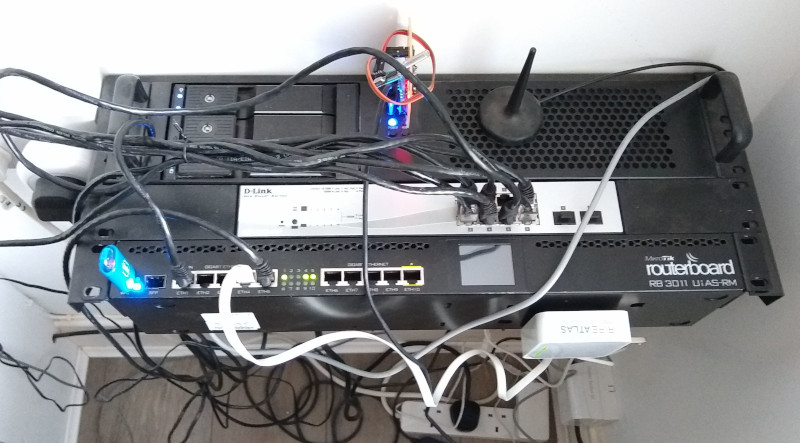
I upgraded my home internet connection to fibre (FTTP) last October. I m still on an 80M/20M service, so it s no faster than my old VDSL FTTC connection was, and as a result for a long time I continued to use my HomeHub 5A running OpenWRT. However the FTTP ONT meant I was using up an additional ethernet port on the router, and I was already short, so I ended up with a GigE switch in use as well. Also my wifi is handled by a UniFi, which takes its power via Power-over-Ethernet. That mean I had a router, a switch and a PoE injector all in close proximity. I wanted to reduce the number of devices, and ideally upgrade to something that could scale once I decide to upgrade my FTTP service speed. Looking around I found the MikroTik RB3011UiAS-RM, which is a rack mountable device with 10 GigE ports (plus an SFP slot) and a dual core Qualcomm IPQ8064 ARM powering it. There s 1G RAM and 128MB NAND flash, as well as a USB3 port. It also has PoE support. On paper it seemed like an ideal device. I wasn t particularly interested in running RouterOS on it (the provided software), but that s based on Linux and there was some work going on within OpenWRT to add support, so it seemed like a worthwhile platform to experiment with (what, you expected this to be about me buying an off the shelf device and using it with only the supplied software?). As an added bonus a friend said he had one he wasn t using, and was happy to sell it to me for a bargain price. RB3011 router in use I did try out RouterOS to start with, but I didn t find it particularly compelling. I m comfortable configuring firewalling and routing at a Linux command line, and I run some additional services on the router like my MQTT broker, and mqtt-arp, my wifi device presence monitor. I could move things around such that they ran on the house server, but I consider them core services and as a result am happier with them on the router. The first step was to get something booting on the router. Luckily it has an RJ45 serial console port on the back, and a reasonably featured bootloader that can manage to boot via tftp over the network. It wants an ELF binary rather than a plain kernel, but Sergey Sergeev had done the hard work of getting u-boot working for the IPQ8064, which mean I could just build normal u-boot images to try out. Linux upstream already had basic support for a lot of the pieces I was interested in. There s a slight fudge around AUTO_ZRELADDR because the network coprocessors want a chunk of memory at the start of RAM, but there s ongoing discussions about how to handle this cleanly that I m hopeful will eventually mean I can drop that hack. Serial, ethernet, the QCA8337 switches (2 sets of 5 ports, tied to different GigE devices on the processor) and the internal NOR all had drivers, so it was a matter of crafting an appropriate DTB to get them working. That left niggles. First, the second switch is hooked up via SGMII. It turned out the IPQ806x stmmac driver didn t initialise the clocks in this mode correctly, and neither did the qca8k switch driver. So I need to fix up both of those (Sergey had handled the stmmac driver, so I just had to clean up and submit his patch). Next it turned out the driver for talking to the Qualcomm firmware (SCM) had been updated in a way that broke the old method needed on the IPQ8064. Some git archaeology figured that one out and provided a solution. Ansuel Smith helpfully provided the DWC3 PHY driver for the USB port. That got me to the point I could put a Debian armhf image onto a USB stick and mount that as root, which made debugging much easier. At this point I started to play with configuring up the device to actually act as a router. I make use of a number of VLANs on my home network, so I wanted to make sure I could support those. Turned out the stmmac driver wasn t happy reconfiguring its MTU because the IPQ8064 driver doesn t configure the FIFO sizes. I found what seem to be the correct values and plumbed them in. Then the qca8k driver only supported port bridging. I wanted the ability to have a trunk port to connect to the upstairs switch, while also having ports that only had a single VLAN for local devices. And I wanted the switch to handle this rather than requiring the CPU to bridge the traffic. Thankfully it s easy to find a copy of the QCA8337 datasheet and the kernel Distributed Switch Architecture is pretty flexible, so I was able to implement the necessary support. I stuck with Debian on the USB stick for actually putting the device into production. It makes it easier to fix things up if necessary, and the USB stick allows for a full Debian install which would be tricky on the 128M of internal NAND. That means I can use things like nftables for my firewalling, and use the standard Debian packages for things like collectd and mosquitto. Plus for debug I can fire up things like tcpdump or tshark. Which ended up being useful because when I put the device into production I started having weird IPv6 issues that turned out to be a lack of proper Ethernet multicast filter support in the IPQ806x ethernet device. The driver would try and setup the multicast filter for the IPv6 NDP related packets, but it wouldn t actually work. The fix was to fall back to just receiving all multicast packets - this is what the vendor driver does. Most of this work will be present once the 5.9 kernel is released - the basics are already in 5.8. Currently not queued up that I can think of are the following: Overall I consider the device a success, and it s been entertaining getting it working properly. I m running a mostly mainline kernel, it s handling my house traffic without breaking a sweat, and the fact it s running Debian makes it nice and easy to throw more things on it as I desire. However it turned out the RB3011 isn t as perfect device as I d hoped. The PoE support is passive, and the UniFi wants 802.1af. So I was going to end up with 2 devices. As it happened I picked up a cheap D-Link DGS-1210-10P switch, which provides the PoE support as well as some additional switch ports. Plus it runs Linux, so more on that later
20 September 2020

Dirk Eddelbuettel: RcppSpdlog 0.0.2: New upstream, awesome new stopwatch

Following up on the initial RcppSpdlog 0.0.1 release earlier this week, we are pumped to announce release 0.0.2. It contains upstream version 1.8.0 for spdlog which utilizes (among other things) a new feature in the embedded fmt library, namely completely automated formatting of high resolution time stamps which allows for gems like this (taken from this file in the package and edited down for brevity):
    spdlog::stopwatch sw;                                   // instantiate a stop watch

    // some other code

    sp->info("Elapsed time:  ", sw);
What we see is all there is: One instantiates a stopwatch object, and simply references it. The rest, as they say, is magic. And we get tic / toc alike behaviour in modern C++ at essentially no cost us (as code authors). So nice. Output from the (included in the package) function exampleRsink() (again edited down just a little):
R> RcppSpdlog::exampleRsink()
[13:03:23.845114] [fromR] [I] [thread 793264] Welcome to spdlog!
[...]
[13:03:23.845205] [fromR] [I] [thread 793264] Elapsed time: 0.000103611
[...]
[13:03:23.845281] [fromR] [I] [thread 793264] Elapsed time: 0.00018203
R> 
We see that the two simple logging instances come 10 and 18 microseconds into the call. RcppSpdlog bundles spdlog, a wonderful header-only C++ logging library with all the bells and whistles you would want that was written by Gabi Melman, and also includes fmt by Victor Zverovic. The NEWS entry for this release follows.

Changes in RcppSpdlog version 0.0.2 (2020-09-17)
  • Upgraded to upstream release 1.8.0
  • Switched Travis CI to using BSPM, also test on macOS
  • Added 'stopwatch' use to main R sink example

Courtesy of my CRANberries, there is a diffstat report relative to previous release. More detailed information is on the RcppSpdlog page. The only sour grapes, again, are once more over the CRAN processing. And just how 0.0.1 was delayed for no good reason for three weeks, 0.0.2 was delayed by three days just because well that is how CRAN rules sometimes. I d be even more mad if I had an alternative but I don t. We remain grateful for all they do but they really could have let this one through even at one-day update delta. Ah well, now we re three days wiser and of course nothing changed in the package. If you like this or other open-source work I do, you can now sponsor me at GitHub. For the first year, GitHub will match your contributions.

This post by Dirk Eddelbuettel originated on his Thinking inside the box blog. Please report excessive re-aggregation in third-party for-profit settings.

19 September 2020

Vincent Bernat: Keepalived and unicast over multiple interfaces

Keepalived is a Linux implementation of VRRP. The usual role of VRRP is to share a virtual IP across a set of routers. For each VRRP instance, a leader is elected and gets to serve the IP address, ensuring the high availability of the attached service. Keepalived can also be used for a generic leader election, thanks to its ability to use scripts for healthchecking and run commands on state change. A simple configuration looks like this:
vrrp_instance gateway1  
  state BACKUP          #  
  interface eth0        #  
  virtual_router_id 12  #  
  priority 101          #  
  virtual_ipaddress  
    2001:db8:ff/64
   
 
The state keyword in instructs Keepalived to not take the leader role when starting. Otherwise, incoming nodes create a temporary disruption by taking over the IP address until the election settles. The interface keyword in defines the interface for sending and receiving VRRP packets. It is also the default interface to configure the virtual IP address. The virtual_router_id directive in is common to all nodes sharing the virtual IP. The priority keyword in helps choosing which router will be elected as leader. If you need more information around Keepalived, be sure to check the documentation. VRRP design is tied to Ethernet networks and requires a multicast-enabled network for communication between nodes. In some environments, notably public clouds, multicast is unavailable. In this case, Keepalived can send VRRP packets using unicast:
vrrp_instance gateway1  
  state BACKUP
  interface eth0
  virtual_router_id 12
  priority 101
  unicast_peer  
    2001:db8::11
    2001:db8::12
   
  virtual_ipaddress  
    2001:db8:ff/64 dev lo
   
 
Another process, like a BGP daemon, should advertise the virtual IP address to the network . If needed, Keepalived can trigger whatever action is needed for this by using notify_* scripts. Until version 2.21 (not released yet), the interface directive is mandatory and Keepalived will transmit and receive VRRP packets on this interface only. If peers are reachable through several interfaces, like on a BGP on the host setup, you need a workaround. A simple one is to use a VXLAN interface:
$ ip -6 link add keepalived6 type vxlan id 6 dstport 4789 local 2001:db8::10 nolearning
$ bridge fdb append 00:00:00:00:00:00 dev keepalived6 dst 2001:db8::11
$ bridge fdb append 00:00:00:00:00:00 dev keepalived6 dst 2001:db8::12
$ ip link set up dev keepalived6
Learning of MAC addresses is disabled and one generic entry for each peer is added in the forwarding database: transmitted packets are broadcasted to all peers, notably VRRP packets. Have a look at VXLAN & Linux for additional details.
vrrp_instance gateway1  
  state BACKUP
  interface keepalived6
  mcast_src_ip 2001:db8::10
  virtual_router_id 12
  priority 101
  virtual_ipaddress  
    2001:db8:ff/64 dev lo
   
 
Starting from Keepalived 2.21, unicast_peer can be used without the interface directive. I think using VXLAN is still a neat trick applicable to other situations where communication using broadcast or multicast is needed, while the underlying network provide no support for this.

Bits from Debian: New Debian Maintainers (July and August 2020)

The following contributors were added as Debian Maintainers in the last two months: Congratulations!

18 September 2020

Daniel Lange: Fixing the Nextcloud menu to show more than eight application icons

I have been late to adopt an on-premise cloud solution as the security of Owncloud a few years ago wasn't so stellar (cf. my comment from 2013 in Encryption files ... for synchronization across the Internet). But the follow-up product Nextcloud has matured quite nicely and we use it for collaboration both in the company and in FLOSS related work at multiple nonprofit organizations. There is a very annoying "feature" in Nextcloud though that the designers think menu items for apps at the top need to be limited to eight or less to prevent information overload in the header. The whole item discussion is worth reading as it it an archetypical example of design prevalence vs. user choice. And of course designers think they are right. That's a feature of the trade.
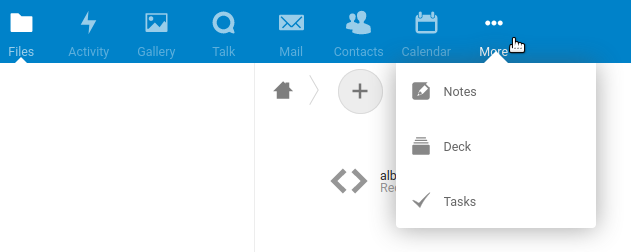
And because they know better there is no user configurable option to extend that 8 items to may be 12 or so which would prevent the annoying overflow menu we are seeing with 10 applications in use: Screenshot of stock Nextcloud menu Luckily code can be changed and there are many comments floating around the Internet to change const minAppsDesktop = 8. In this case it is slightly complicated by the fact that the javascript code is distributed in compressed form (aka "minified") as core/js/dist/main.js and you probably don't want to build the whole beast locally to change one constant. Basically
const breakpoint_mobile_width = 1024;

const resizeMenu = () =>
const appList = $('#appmenu li')
const rightHeaderWidth = $('.header-right').outerWidth()
const headerWidth = $('header').outerWidth()
const usePercentualAppMenuLimit = 0.33
const minAppsDesktop = 8
let availableWidth = headerWidth - $('#nextcloud').outerWidth() - (rightHeaderWidth > 210 ? rightHeaderWidth : 210)
const isMobile = $(window).width() < breakpoint_mobile_width
if (!isMobile)
availableWidth = availableWidth * usePercentualAppMenuLimit

let appCount = Math.floor((availableWidth / $(appList).width()))
if (isMobile && appCount > minAppsDesktop)
appCount = minAppsDesktop

if (!isMobile && appCount < minAppsDesktop)
appCount = minAppsDesktop


// show at least 2 apps in the popover
if (appList.length - 1 - appCount >= 1)
appCount--


$('#more-apps a').removeClass('active')
let lastShownApp
for (let k = 0; k < appList.length - 1; k++)
const name = $(appList[k]).data('id')
if (k < appCount)
$(appList[k]).removeClass('hidden')
$('#apps li[data-id=' + name + ']').addClass('in-header')
lastShownApp = appList[k]
else
$(appList[k]).addClass('hidden')
$('#apps li[data-id=' + name + ']').removeClass('in-header')
// move active app to last position if it is active
if (appCount > 0 && $(appList[k]).children('a').hasClass('active'))
$(lastShownApp).addClass('hidden')
$('#apps li[data-id=' + $(lastShownApp).data('id') + ']').removeClass('in-header')
$(appList[k]).removeClass('hidden')
$('#apps li[data-id=' + name + ']').addClass('in-header')


// show/hide more apps icon
if ($('#apps li:not(.in-header)').length === 0)
$('#more-apps').hide()
$('#navigation').hide()
else
$('#more-apps').show()

gets compressed during build time to become part of one 15,000+ character line. The relevant portion reads:
var f=function() var e=s()("#appmenu li"),t=s()(".header-right").outerWidth(),n=s()("header").outerWidth()-s()("#nextcloud").outerWidth()-(t>210?t:210),i=s()(window).width()<1024;i (n*=.33);var r,o=Math.floor(n/s()(e).width());i&&o>8&&(o=8),!i&&o<8&&(o=8),e.length-1-o>=1&&o--,s()("#more-apps a").removeClass("active");for(var a=0;a<e.length-1;a++) var l=s()(e[a]).data("id");a<o?(s()(e[a]).removeClass("hidden"),s()("#apps li[data-id="+l+"]").addClass("in-header"),r=e[a]):(s()(e[a]).addClass("hidden"),s()("#apps li[data-id="+l+"]").removeClass("in-header"),o>0&&s()(e[a]).children("a").hasClass("active")&&(s()(r).addClass("hidden"),s()("#apps li[data-id="+s()(r).data("id")+"]").removeClass("in-header"),s()(e[a]).removeClass("hidden"),s()("#apps li[data-id="+l+"]").addClass("in-header"))) 0===s()("#apps li:not(.in-header)").length?(s()("#more-apps").hide(),s()("#navigation").hide()):s()("#more-apps").show()
Well, we can still patch that, can we? Continue reading "Fixing the Nextcloud menu to show more than eight application icons"

Daniel Lange: Getting rid of the Google cookie consent popup

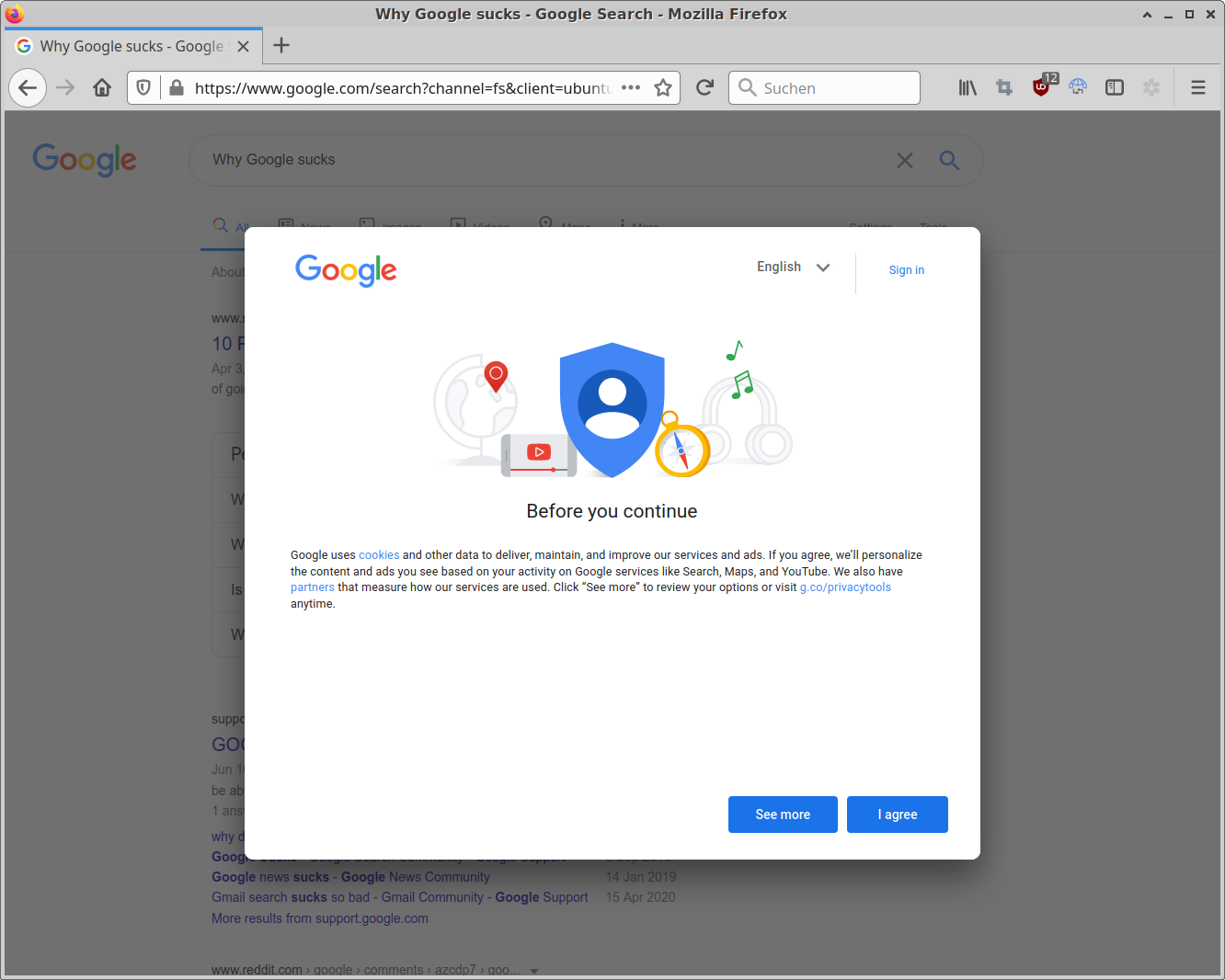
If you clear your browser cookies regularly (as you should do), Google will annoy you with a full screen cookie consent overlay these days. And - of course - there is no "no tracking consent, technically required cookies only" button. You may log in to Google to set your preference. Yeah, I'm sure this is totally following the intent of the EU Directive 2009/136/EC (the "cookie law"). Google cookie consent pop-up Unfortunately none of the big "anti-annoyances" filter lists seem to have picked that one up yet but the friendly folks from the Computerbase Forum [German] to the rescue. User "Sepp Depp" has created the following filter set that WFM: Add this to your uBlock Origin "My filters" tab:
! Google - remove cookie-consent-popup and restore scroll functionality
google.*##.wwYr3.aID8W.bErdLd
google.*##.aID8W.m114nf.t7xA6
google.*##div[jsname][jsaction^="dg_close"]
google.*##html:style(overflow: visible !important;)
google.*##.widget-consent-fullscreen.widget-consent

15 September 2020

Rapha&#235;l Hertzog: Freexian s report about Debian Long Term Support, August 2020

A Debian LTS logo Like each month, here comes a report about the work of paid contributors to Debian LTS. Individual reports In August, 237.25 work hours have been dispatched among 14 paid contributors. Their reports are available: Evolution of the situation August was a regular LTS month once again, even though it was only our 2nd month with Stretch LTS.
At the end of August some of us participated in DebConf 20 online where we held our monthly team meeting. A video is available.
As of now this video is also the only public resource about the LTS survey we held in July, though a written summary is expected to be released soon. The security tracker currently lists 56 packages with a known CVE and the dla-needed.txt file has 55 packages needing an update. Thanks to our sponsors Sponsors that recently joined are in bold.

No comment Liked this article? Click here. My blog is Flattr-enabled.

13 September 2020

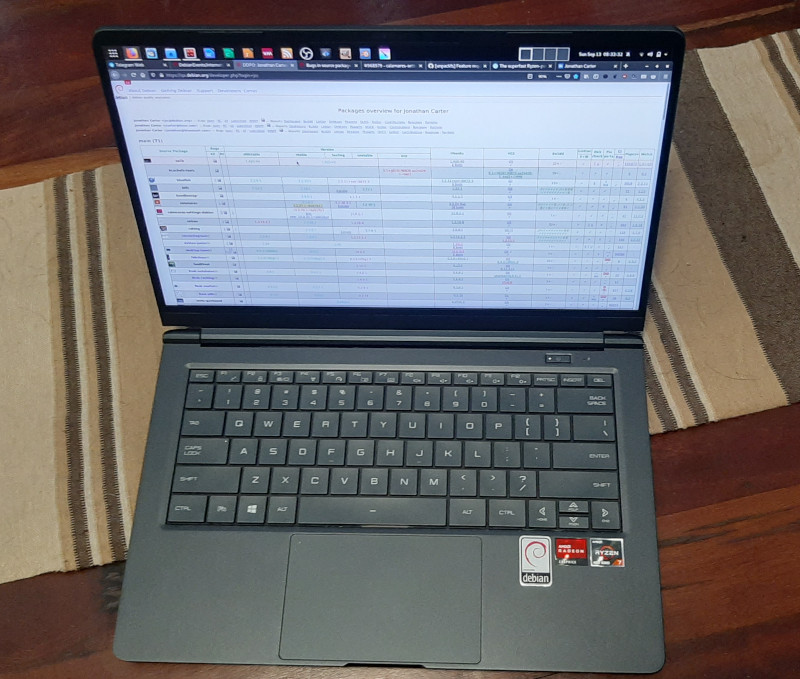
Jonathan Carter: Wootbook / Tongfang laptop

Old laptop I ve been meaning to get a new laptop for a while now. My ThinkPad X250 is now 5 years old and even though it s still adequate in many ways, I tend to run out of memory especially when running a few virtual machines. It only has one memory slot, which I maxed out at 16GB shortly after I got it. Memory has been a problem in considering a new machine. Most new laptops have soldered RAM and local configurations tend to ship with 8GB RAM. Getting a new machine with only a slightly better CPU and even just the same amount of RAM as what I have in the X250 seems a bit wasteful. I was eyeing the Lenovo X13 because it s a super portable that can take up to 32GB of RAM, and it ships with an AMD Ryzen 4000 series chip which has great performance. With Lenovo s discount for Debian Developers it became even more attractive. Unfortunately that s in North America only (at least for now) so that didn t work out this time.

Enter Tongfang I ve been reading a bunch of positive reviews about the Tuxedo Pulse 14 and KDE Slimbook 14. Both look like great AMD laptops, supports up to 64GB of RAM and clearly runs Linux well. I also noticed that they look quite similar, and after some quick searches it turns out that these are made by Tongfang and that its model number is PF4NU1F. I also learned that a local retailer (Wootware) sells them as the Wootbook. I ve seen one of these before although it was an Intel-based one, but it looked like a nice machine and I was already curious about it back then. After struggling for a while to find a local laptop with a Ryzen CPU and that s nice and compact and that breaks the 16GB memory barrier, finding this one that jumped all the way to 64GB sealed the deal for me. This is the specs for the configuration I got:

This configuration cost R18 796 ( 947 / $1122). That s significantly cheaper than anything else I can get that even starts to approach these specs. So this is a cheap laptop, but you wouldn t think so by using it.
I used the Debian netinstall image to install, and installation was just another uneventful and boring Debian installation (yay!). Unfortunately it needs the firmware-iwlwifi and firmare-amd-graphics packages for the binary blobs that drives the wifi card and GPU. At least it works flawlessly and you don t need an additional non-free display driver (as is the case with NVidia GPUs). I haven t tested the graphics extensively yet, but desktop graphics performance is very snappy. This GPU also does fancy stuff like VP8/VP9 encoding/decoding, so I m curious to see how well it does next time I have to encode some videos. The wifi upgrade was nice for copying files over. My old laptop maxed out at 300Mbps, this one connects to my home network between 800-1000Mbps. At this speed I don t bother connecting via cable at home. I read on Twitter that Tuxedo Computers thinks that it s possible to bring Coreboot to this device. That would be yet another plus for this machine. I ll try to answer some of my own questions about this device that I had before, that other people in the Debian community might also have if they re interested in this device. Since many of us are familiar with the ThinkPad X200 series of laptops, I ll compare it a bit to my X250, and also a little to the X13 that I was considering before. Initially, I was a bit hesitant about the 14 form factor, since I really like the portability of the 12.5 ThinkPad. But because the screen bezel is a lot smaller, the Wootbook (that just rolls off the tongue a lot better than the PF4NU1F ) is just slightly wider than the X250. It weighs in at 1.1KG instead of the 1.38KG of the X250. It s also thinner, so even though it has a larger display, it actually feels a lot more portable. Here s a picture of my X250 on top of the Wootbook, you can see a few mm of Wootbook sticking out to the right.
Card Reader One thing that I overlooked when ordering this laptop was that it doesn t have an SD card reader. I see that some variations have them, like on this Slimbook review. It s not a deal-breaker for me, I have a USB card reader that s very light and that I ll just keep in my backpack. But if you re ordering one of these machines and have some choice, it might be something to look out for if it s something you care about. Keyboard/Touchpad On to the keyboard. This keyboard isn t quite as nice to type on as on the ThinkPad, but, it s not bad at all. I type on many different laptop keyboards and I would rank this keyboard very comfortably in the above average range. I ve been typing on it a lot over the last 3 days (including this blog post) and it started feeling natural very quickly and I m not distracted by it as much as I thought I would be transitioning from the ThinkPad or my mechanical desktop keyboard. In terms of layout, it s nice having an actual Insert button again. This is things normal users don t care about, but since I use mc (where insert selects files) this is a welcome return :). I also like that it doesn t have a Print Screen button at the bottom of my keyboard between alt and ctrl like the ThinkPad has. Unfortunately, it doesn t have dedicated pgup/pgdn buttons. I use those a lot in apps to switch between tabs. At leas the Fn button and the ctrl buttons are next to each other, so pressing those together with up and down to switch tabs isn t that horrible, but if I don t get used to it in another day or two I might do some remapping. The touchpad has en extra sensor-button on the top left corner that s used on Windows to temporarily disable the touchpad. I captured it s keyscan codes and it presses left control + keyscan code 93. The airplane mode, volume and brightness buttons work fine. I do miss the ThinkPad trackpoint. It s great especially in confined spaces, your hands don t have to move far from the keyboard for quick pointer operations and it s nice for doing something quick and accurate. I painted a bit in Krita last night, and agree with other reviewers that the touchpad could do with just a bit more resolution. I was initially disturbed when I noticed that my physical touchpad buttons were gone, but you get right-click by tapping with two fingers, and middle click with tapping 3 fingers. Not quite as efficient as having the real buttons, but it actually works ok. For the most part, this keyboard and touchpad is completely adequate. Only time will tell whether the keyboard still works fine in a few years from now, but I really have no serious complaints about it. Display The X250 had a brightness of 172 nits. That s not very bright, I think the X250 has about the dimmest display in the ThinkPad X200 range. This hasn t been a problem for me until recently, my eyes are very photo-sensitive so most of the time I use it at reduced brightness anyway, but since I ve been working from home a lot recently, it s nice to sometimes sit outside and work, especially now that it s spring time and we have some nice days. At full brightness, I can t see much on my X250 outside. The Wootbook is significantly brighter even (even at less than 50% brightness), although I couldn t find the exact specification for its brightness online. Ports The Wootbook has 3x USB type A ports and 1x USB type C port. That s already quite luxurious for a compact laptop. As I mentioned in the specs above, it also has a full-sized ethernet socket. On the new X13 (the new ThinkPad machine I was considering), you only get 2x USB type A ports and if you want ethernet, you have to buy an additional adapter that s quite expensive especially considering that it s just a cable adapter (I don t think it contains any electronics). It has one hdmi port. Initially I was a bit concerned at lack of displayport (which my X250 has), but with an adapter it s possible to convert the USB-C port to displayport and it seems like it s possible to connect up to 3 external displays without using something weird like display over usual USB3.

Overall remarks When maxing out the CPU, the fan is louder than on a ThinkPad, I definitely noticed it while compiling the zfs-dkms module. On the plus side, that happened incredibly fast. Comparing the Wootbook to my X250, the biggest downfall it has is really it s pointing device. It doesn t have a trackpad and the touchpad is ok and completely usable, but not great. I use my laptop on a desk most of the time so using an external mouse will mostly solve that. If money were no object, I would definitely choose a maxed out ThinkPad for its superior keyboard/mouse, but the X13 configured with 32GB of RAM and 128GB of SSD retails for just about double of what I paid for this machine. It doesn t seem like you can really buy the perfect laptop no matter how much money you want to spend, there s some compromise no matter what you end up choosing, but this machine packs quite a punch, especially for its price, and so far I m very happy with my purchase and the incredible performance it provides. I m also very glad that Wootware went with the gray/black colours, I prefer that by far to the white and silver variants. It s also the first laptop I ve had since 2006 that didn t come with Windows on it. The Wootbook is also comfortable/sturdy enough to carry with one hand while open. The ThinkPads are great like this and with many other brands this just feels unsafe. I don t feel as confident carrying it by it s display because it s very thin (I know, I shouldn t be doing that with the ThinkPads either, but I ve been doing that for years without a problem :) ). There s also a post on Reddit that tracks where you can buy these machines from various vendors all over the world.

11 September 2020

Louis-Philippe V ronneau: Hire me!

I'm happy to announce I handed out my Master's Thesis last Monday. I'm not publishing the final copy just yet1, as it still needs to go through the approval committee. If everything goes well, I should have my Master of Economics diploma before Christmas! It sure hasn't been easy, and although I regret nothing, I'm also happy to be done with university. Looking for a job What an odd time to be looking for a job, right? Turns out for the first time in 12 years, I don't have an employer. It's oddly freeing, but also a little scary. I'm certainly not bitter about it though and it's nice to have some time on my hands to work on various projects and read things other than academic papers. Look out for my next blog posts on using the NeTV2 as an OSHW HDMI capture card, on hacking at security tokens and much more! I'm not looking for anything long term (I'm hoping to teach Economics again next Winter), but for the next few months, my calendar is wide open. For the last 6 years, I worked as Linux system administrator, mostly using a LAMP stack in conjunction with Puppet, Shell and Python. Although I'm most comfortable with Puppet, I also have decent experience with Ansible, thanks to my work in the DebConf Videoteam. I'm not the most seasoned Debian Developer, but I have some experience packaging Python applications and libraries. Although I'm no expert at it, lately I've also been working on Clojure packages, as I'm trying to get Puppet 6 in Debian in time for the Bullseye freeze. At the rate it's going though, I doubt we're going to make it... If your company depends on Puppet and cares about having a version in Debian 11 that is maintained (Puppet 5 is EOL in November 2020), I'm your guy! Oh, and I guess I'm a soon-to-be Master of Economics specialising in Free and Open Source Software business models and incentives theory. Not sure I'll ever get paid putting that in application, but hey, who knows. If any of that resonates with you, contact me and let's have a chat! I promise I don't bite :)

  1. The title of the thesis is What are the incentive structures of Free Software? An economic analysis of Free Software's specific development model. Once the final copy is approved, I'll be sure to write a longer blog post about my findings here.

10 September 2020

Daniel Silverstone: Broccoli Sync Conversation

Broccoli Sync Conversation A number of days ago (I know, I'm an awful human who failed to post this for over a week), myself, Lars, Mark, and Vince discussed Dropbox's article about Broccoli Sync. It wasn't quite what we'd expected but it was an interesting discussion of compression and streamed data. Vince observed that it was interesting in that it was a way to move storage compression cost to the client edge. This makes sense because decompression (to verify the uploaded content) is cheaper than compression; and also since CPU and bandwidth are expensive, spending the client CPU to reduce bandwidth is worthwhile. Lars talked about how even in situations where everyone has gigabit data connectivity with no limit on total transit, bandwidth/time is a concern, so it makes sense. We liked how they determined the right compresison level to use available bandwidth (i.e. not be CPU throttled) but also gain the most compression possible. Their diagram showing relative compression sizes for level 1 vs. 3 vs. 5 suggests that the gain for putting the effort in for 5 rather than 1. It's interesting in that diagram that 'documents' don't compress well but then again it is notable that such documents are likely DEFLATE'd zip files. Basically if the data is already compressed then there's little hope Brotli will gain much. I raised that it was interesting that they chose Brotli, in part, due to the availability of a pure Rust implementation of Brotli. Lars mentioned that Microsoft and others talk about how huge quantities of C code has unexpected memory safety issues and so perhaps that is related. Daniel mentioned that the document talked about Dropbox having a policy of not running unconstrained C code which was interesting. Vince noted that in their deployment challenges it seemed like a very poor general strategy to cope with crasher errors; but Daniel pointed out that it might be an over-simplified description, and Mark suggested that it might be sufficient until a fix can be pushed out. Vince agreed that it's plausible this is a tiered/sharded deployment process and thus a good way to smoke out problems. Daniel found it interesting that their block storage sounds remarkably like every other content-addressible storage and that while they make it clear in the article that encryption, client identification etc are elided, it looks like they might be able to deduplicate between theoretically hostile clients. We think that the compressed-data plus type plus hash (which we assume also contains length) is an interesting and nice approach to durability and integrity validation in the protocol. And the compressed blocks can then be passed to the storage backend quickly and effectively which is nice for latency. Daniel raised that he thought it was fun that their rust-brotli library is still workable on Rust 1.12 which is really quite old. We ended up on a number of tangential discussions, about Rust, about deployment strategies, and so on. While the article itself was a little thin, we certainly had a lot of good chatting around topics it raised. We'll meet again in a month (on the 28th Sept) so perhaps we'll have a chunkier article next time. (Possibly this and/or related articles)

Next.

Previous.