Junichi Uekawa: August.
 August. I think I finally understood what's going on in io_uring.
 This July my girlfriend and I hiked the Slovenian part of the Red Trail of the Via Alpina, from the edge of the Julian Alps to Trieste, and I d like to share some observations and tips that we might have found useful before our trip.
 Our most favorite camp spot
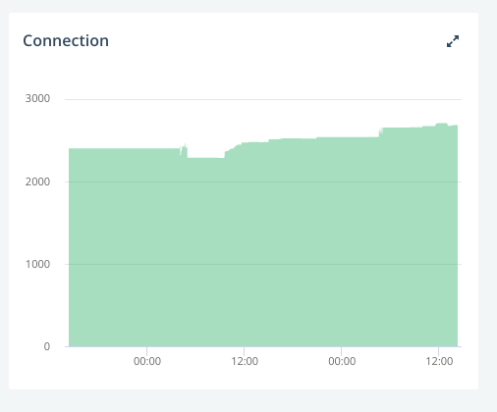 That seemed quite a lot given the low traffic at that time, but not necessarily a problem.
Then, I went to the Azure console, and I got the first hint about the origin of the problem: the SNATs were exhausted on some nodes of the clusters.
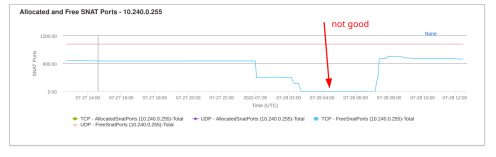 SNATs are involved in connections from the cluster to the outside world, i.e. to our MongoDB server and are quite limited: only 1024 SNAT ports are available per node. This was consistent with the number of used connections on MongoDB.
OK, then the number of used connections on MongoDB was a real problem.
The next question was: which pods and how many connections ?
First I had to filter out the pods that did not use MongoDB. Fortunately, all our pods have labels so I could list all pods using MongoDB:
$ kubectl -n prod get pods -l db=mongo   wc -l
236
Hmm, still quite a lot. Next problem is to check which pod used too many MongoDB connections. Unfortunately, the logs mentioned that a connection to MongoDB was opened, but that did not give a clue on how many were used. Netstat is not installed on the pods, and cannot be installed since the pods are running as root (which is a good idea for security reasons) Then, my Debian Developer experience kicked in and I remembered that
/proc file system on Linux gives a lot of information on consumed kernel resources, including resources consumed by each process.
The trick is to know the PID of the process using the connections.
In our case, Docker files are written in a way so the main process of a pod using NodeJS is 1, so, the command to list the connections of pod is:
$ kubectl -n prod exec redacted-pod-name-69875496f8-8bj4f -- cat /proc/1/net/tcp
  sl  local_address rem_address   st tx_queue rx_queue tr tm->when retrnsmt   uid  timeout inode
   0: AC00F00A:C9FA C2906714:6989 01 00000000:00000000 02:00000DA9 00000000  1001        0 376439162 2 0000000000000000 21 4 0 10 -1
   1: AC00F00A:CA00 C2906714:6989 01 00000000:00000000 02:00000E76 00000000  1001        0 376439811 2 0000000000000000 21 4 0 10 -1
   2: AC00F00A:8ED0 C2906714:6989 01 00000000:00000000 02:000004DA 00000000  1001        0 445806350 2 0000000000000000 21 4 30 10 -1
   3: AC00F00A:CA02 C2906714:6989 01 00000000:00000000 02:000000DD 00000000  1001        0 376439812 2 0000000000000000 21 4 0 10 -1
   4: AC00F00A:C9FE C2906714:6989 01 00000000:00000000 02:00000DA9 00000000  1001        0 376439810 2 0000000000000000 21 4 0 10 -1
   5: AC00F00A:8760 C2906714:6989 01 00000000:00000000 02:00000810 00000000  1001        0 375803096 2 0000000000000000 21 4 0 10 -1
   6: AC00F00A:C9FC C2906714:6989 01 00000000:00000000 02:00000DA9 00000000  1001        0 376439809 2 0000000000000000 21 4 0 10 -1
   7: AC00F00A:C56C C2906714:6989 01 00000000:00000000 02:00000DA9 00000000  1001        0 376167298 2 0000000000000000 21 4 0 10 -1
   8: AC00F00A:883C C2906714:6989 01 00000000:00000000 02:00000734 00000000  1001        0 375823415 2 0000000000000000 21 4 30 10 -1
OK, that s less appealing that netstat output. The trick is that rem_address and port are expressed in hexa. A quick calculation confirms the port
0x6989 is indeed port 27017, which is the listening port of MongoDB server.
So the number of opened MongoDB connections is given by:
$ kubectl -n prod exec redacted-pod-name-69875496f8-8bj4f -- cat /proc/1/net/tcp   grep :6989   wc -l
9
What s next ? The ideal solution would be to fix the NodeJS code to handle correctly the termination of the connections, but that would have taken too long to develop. So I ve written a small Perl script to:
kubectl -n prod get pods -l db=mongokubectl exec command shown abovekubectl rollout restart deployment command


 On Sunday 24 July 2022, the annual Debian Developers and
Contributors Conference came to a close.
Hosting 260 attendees
from 38 different countries over a combined 91 event talks, discussion
sessions, Birds of a Feather (BoF) gatherings, workshops, and
activities, DebConf22 was a large
success.
The conference was preceded by the annual DebCamp held 10 July to 16
July which focused on individual work and team sprints for in-person
collaboration towards developing Debian. In particular, this year there
have been sprints to advance development of Mobian/Debian on mobile,
reproducible builds and Python in Debian, and a BootCamp for newcomers,
to get introduced to Debian and have some hands-on experience with using
it and contributing to the community.
The actual Debian Developers Conference started on Sunday 17 July 2022.
Together with activities such as the traditional 'Bits from the DPL'
talk, the continuous key-signing party, lightning talks
and the announcement of next year's DebConf
(DebConf23 in Kochi, India),
there were several sessions related to programming language teams such as
Python, Perl and Ruby, as well as news updates on several projects and
internal Debian teams, discussion sessions (BoFs) from many technical
teams (Long Term Support, Android tools, Debian Derivatives, Debian
Installer and Images team, Debian Science...) and local communities
(Debian Brasil, Debian India, the Debian Local Teams),
along with many other events of interest regarding Debian and free software.
The schedule
was updated each day with planned and ad-hoc activities introduced by attendees
over the course of the entire conference. Several activities that couldn\'t be
organized in past years due to the COVID pandemic returned to the
conference\'s schedule: a job fair, open-mic and poetry night, the
traditional Cheese and Wine party, the group photos and the Day Trip.
For those who were not able to attend, most of the talks and sessions were
recorded for live streams with videos made,
available through the
Debian meetings archive website.
Almost all of the sessions facilitated remote participation via IRC messaging
apps or online collaborative text documents.
The DebConf22 website
will remain active for archival purposes and will continue to offer
links to the presentations and videos of talks and events.
Next year, DebConf23 will be held in Kochi, India,
from September 10 to September 16, 2023.
As tradition follows before the next DebConf the local organizers in India
will start the conference activites with DebCamp (September 03 to September 09, 2023),
with particular focus on individual and team work towards improving the distribution.
DebConf is committed to a safe and welcome environment for all
participants.
See the web page about the Code of Conduct in DebConf22 website
for more details on this.
Debian thanks the commitment of numerous sponsors
to support DebConf22, particularly our Platinum Sponsors:
Lenovo,
Infomaniak,
ITP Prizren
and Google.
About Debian
The Debian Project was founded in 1993 by Ian Murdock to be a truly free
community project. Since then the project has grown to be one of the
largest and most influential open source projects. Thousands of
volunteers from all over the world work together to create and maintain
Debian software. Available in 70 languages, and supporting a huge range
of computer types, Debian calls itself the universal operating system.
About DebConf
DebConf is the Debian Project's developer conference. In addition to a
full schedule of technical, social and policy talks, DebConf provides an
opportunity for developers, contributors and other interested people to
meet in person and work together more closely. It has taken place
annually since 2000 in locations as varied as Scotland, Argentina, and
Bosnia and Herzegovina. More information about DebConf is available from
https://debconf.org/.
About Lenovo
As a global technology leader manufacturing a wide portfolio of
connected products, including smartphones, tablets, PCs and workstations
as well as AR/VR devices, smart home/office and data center solutions,
Lenovo understands how critical open systems
and platforms are to a connected world.
About Infomaniak
Infomaniak is Switzerland\'s largest
web-hosting company, also offering backup and storage services,
solutions for event organizers, live-streaming and video on demand
services. It wholly owns its datacenters and all elements critical to
the functioning of the services and products provided by the company
(both software and hardware).
About ITP Prizren
Innovation and Training Park Prizren intends
to be a changing and boosting element in the area of ICT, agro-food and
creatives industries, through the creation and management of a
favourable environment and efficient services for SMEs, exploiting
different kinds of innovations that can contribute to Kosovo to improve
its level of development in industry and research, bringing benefits to
the economy and society of the country as a whole.
About Google
Google is one of the largest technology companies
in the world, providing a wide range of Internet-related services and
products such as online advertising technologies, search, cloud
computing, software, and hardware.
Google has been supporting Debian by sponsoring DebConf for more than
ten years, and is also a Debian partner sponsoring parts of
Salsa's continuous integration
infrastructure within Google Cloud Platform.
Contact Information
For further information, please visit the DebConf22 web page at
https://debconf22.debconf.org/ or send mail to press@debian.org.

 You can also see it in:
             total        used        free      shared  buff/cache  available
Mem:      32717924     3101156    26950016      143608     2666752  29011928
Swap:      1000444           0     1000444
/proc/meminfo which are scaled and presented to the user. A good example of a simple stat is total, which is just the MemTotal row located in that file. For the rest of this post, I ll make the rows from /proc/meminfo have an amber background.
What is Free, and what is Used?
While you could say that the free value is also merely the MemFree row, this is where Linux memory statistics start to get odd. While that value is indeed what is found for MemFree and not a calculated field, it can be misleading.
Most people would assume that Free means free to use, with the implication that only this amount of memory is free to use and nothing more. That would also mean the used value is really used by something and nothing else can use it.
In the early days of free and Linux statistics in general that was how it looked. Used is a calculated field (there is no MemUsed row) and was, initially, Total - Free.
The problem was, Used also included Buffers and Cached values. This meant that it looked like Linux was using a lot of memory for something. If you read old messages before 2002 that are talking about excessive memory use, they quite likely are looking at the values printed by free.
The thing was, under memory pressure the kernel could release Buffers and Cached for use. Not all of the storage but some of it so it wasn t all used. To counter this, free showed a row between Memory and Swap with Used having Buffers and Cached removed and Free having the same values added:
             total       used       free     shared    buffers     cached
Mem:      32717924    6063648   26654276          0     313552    2234436
-/+ buffers/cache:    3515660   29202264
Swap:      1000444          0    1000444
Cached + Slab while Used was calculated as Total - Free - main_cache - Buffers. This was very close to what the Used column in the +/- line used to show.
What s on the Slab?
The next issue that came across was the use of slabs. At this point, main_cache was Cached + Slab, but Slab consists of reclaimable and unreclaimable components. One part of Slab can be used elsewhere if needed and the other cannot but the procps tools treated them the same. The Used calculation should not subtract SUnreclaim from the Total because it is actually being used.
So in 2015 main_cache was changed to be Cached + SReclaimable. This meant that Used memory was calculated as Total - Free - Cached - SReclaimable - Buffers.
Revenge of tmpfs and the return of Available
The tmpfs impacting Cached was still an issue. If you added a 10MB file into a tmpfs partition, then Free would reduce by 10MB and Cached would increase by 10MB meaning Used stayed unchanged even though 10MB had gone somewhere.
It was time to retire the complex calculation of Used. For procps 4.0.1 onwards, Used now means not available . We take the Total memory and subtract the Available memory. This is not a perfect setup but it is probably going to be the best one we have and testing is giving us much more sensible results. It s also easier for people to understand (take the total value you see in free, then subtract the available value).
What does that mean for main_cache which is part of the buff/cache value you see? As this value is no longer in the used memory calculation, it is less important. Should it also be reverted to simply Cached without the reclaimable Slabs?
The calculated fields
In summary, what this means for the calculated fields in procps at least is:
Total - Available, unless Available is not present then it s Total FreeCached + Reclaimable SlabsTotal - Free (no change here)/proc/meminfo which is straight from the kernel.
DebConf22 is taking place in Prizren, Kosovo,
from 17th to 24th July, 2022.
It is the 23rd edition of the Debian conference and organizers are working hard
to create another interesting and fruitful event for attendees.
We would like to warmly welcome the sponsors of DebConf22, and
introduce you to them.
We have four Platinum sponsors.
Our first Platinum sponsor is Lenovo.
As a global technology leader manufacturing a wide portfolio of connected products,
including smartphones, tablets, PCs and workstations as well as AR/VR devices,
smart home/office and data center solutions, Lenovo
understands how critical open systems and platforms are to a connected world.
Infomaniak is our second Platinum sponsor.
Infomaniak is Switzerland's largest web-hosting company,
also offering backup and storage services, solutions for event organizers,
live-streaming and video on demand services.
It wholly owns its datacenters and all elements critical
to the functioning of the services and products provided by the company
(both software and hardware).
The ITP Prizren is our third Platinum sponsor.
ITP Prizren intends to be a changing and
boosting element in the area of ICT, agro-food and creatives industries, through
the creation and management of a favourable environment and efficient services
for SMEs, exploiting different kinds of innovations that can contribute to
Kosovo to improve its level of development in industry and research, bringing
benefits to the economy and society of the country as a whole.
Google is our fourth Platinum sponsor.
Google is one of the largest technology companies in the
world, providing a wide range of Internet-related services and products such
as online advertising technologies, search, cloud computing, software, and hardware.
Google has been supporting Debian by sponsoring DebConf for more than
ten years, and is also a Debian partner sponsoring parts
of Salsa's continuous integration infrastructure
within Google Cloud Platform.
Our Gold sponsors are:
Roche,
a major international pharmaceutical provider and research company dedicated to
personalized healthcare.
Microsoft,
enables digital transformation for the era of an intelligent cloud and an
intelligent edge. Its mission is to empower every person and every organization
on the planet to achieve more.
Ipko Telecommunications,
provides telecommunication services and it is the first and the most
dominant mobile operator which offers fast-speed mobile internet 3G and 4G networks in Kosovo.
Ubuntu,
the Operating System delivered by Canonical.
U.S. Agency for International Development,
leads international development and humanitarian efforts to save lives, reduce
poverty, strengthen democratic governance and help people progress beyond
assistance.
Our Silver sponsors are:
Pexip, is the video communications platform that
solves the needs of large organizations.
Deepin is a Chinese commercial company focusing on
the development and service of Linux-based operating systems.
Hudson River Trading,
a company researching and developing automated trading algorithms
using advanced mathematical techniques.
Amazon Web Services (AWS),
is one of the world's most comprehensive and broadly adopted cloud platforms,
offering over 175 fully featured services from data centers globally.
The Bern University of Applied Sciences
with near 7,800 students
enrolled, located in the Swiss capital.
credativ,
a service-oriented company focusing on open-source software and also a
Debian development partner.
Collabora,
a global consultancy delivering Open Source software solutions to the commercial
world.
Arm: with the world s Best SoC Design Portfolio,
Arm powered solutions have been supporting innovation for more than 30 years
and are deployed in over 225 billion chips to date.
GitLab,
an open source end-to-end software development platform with built-in version
control, issue tracking, code review, CI/CD, and more.
Two Sigma,
rigorous inquiry, data analysis, and invention to help solve the toughest
challenges across financial services.
Starlabs, builds software experiences and focus
on building teams that deliver creative Tech Solutions for our clients.
Solaborate, has the world s most integrated
and powerful virtual care delivery platform.
Civil Infrastructure Platform,
a collaborative project hosted by the Linux Foundation,
establishing an open source base layer of industrial grade software.
Matanel Foundation, operates in Israel,
as its first concern is to preserve the cohesion of a society and a nation
plagued by divisions.
Bronze sponsors:
bevuta IT,
Kutia,
Univention,
Freexian.
And finally, our Supporter level sponsors:
Altus Metrum,
Linux Professional Institute,
Olimex,
Trembelat,
Makerspace IC Prizren,
Cloud68.co,
Gandi.net,
ISG.EE,
IPKO Foundation,
The Deutsche Gesellschaft f r Internationale Zusammenarbeit (GIZ) GmbH.
Thanks to all our sponsors for their support!
Their contributions make it possible for a large number
of Debian contributors from all over the globe to work together,
help and learn from each other in DebConf22.

| Series: | Trang #1 |
| Publisher: | Mary Sisson |
| Copyright: | 2011 |
| Printing: | December 2013 |
| ASIN: | B004I6DAQ8 |
| Format: | Kindle |
| Pages: | 374 |
Armed with the new and improved at_pid component, the new line will look like this:loadrt pid names=pid.x,pid.y,pid.z
The rest of the HAL setup can stay the same. This work because the components are referenced by name. If the component had used count=3 instead, all use of pid.# had to be changed to at_pid.#. To start tuning the X axis, move the axis to the middle of its range, to make sure it do not hit anything when it start moving back and forth. Next, set the tune-effort to a low number in the output range. I used 0.1 as my initial value. Next, assign 1 to the tune-mode value. Note, this will disable the pid controlling part and feed 0 to the output pin, which in my case initially caused a lot of drift. In my case it proved to be a good idea with X and Y to tune the motor driver to make sure 0 voltage stopped the motor rotation. On the other hand, for the Z axis this proved to be a bad idea, so it will depend on your setup. It might help to set the bias value to a output value that reduce or eliminate the axis drift. Finally, after setting tune-mode, set tune-start to 1 to activate the auto tuning. If all go well, your axis will vibrate for a few seconds and when it is done, new values for Pgain, Igain and Dgain will be active. To test them, change tune-mode back to 0. Note that this might cause the machine to suddenly jerk as it bring the axis back to its commanded position, which it might have drifted away from during tuning. To summarize with some halcmd lines:loadrt at_pid names=pid.x,pid.y,pid.z
After doing this task quite a few times while trying to figure out how to properly tune the PID controllers on the machine in, I decided to figure out if this process could be automated, and wrote a script to do the entire tuning process from power on. The end result will ensure the machine is powered on and ready to run, home all axis if it is not already done, check that the extra tuning pins are available, move the axis to its mid point, run the auto tuning and re-enable the pid controller when it is done. It can be run several times. Check out the run-auto-pid-tuner script on github if you want to learn how it is done. My hope is that this little adventure can inspire someone who know more about motor PID controller tuning can implement even better algorithms for automatic PID tuning in LinuxCNC, making life easier for both me and all the others that want to use LinuxCNC but lack the in depth knowledge needed to tune PID controllers well. As usual, if you use Bitcoin and want to show your support of my activities, please send Bitcoin donations to my address 15oWEoG9dUPovwmUL9KWAnYRtNJEkP1u1b.setp pid.x.tune-effort 0.1 setp pid.x.tune-mode 1 setp pid.x.tune-start 1 # wait for the tuning to complete setp pid.x.tune-mode 0
 Recently I've been working with simple/trivial scripting languages, and I guess I finally reached a point where I thought "Lisp? Why not". One of the reasons for recent experimentation was thinking about the kind of minimalism that makes implementing a language less work - being able to actually use the language to write itself.
FORTH is my recurring example, because implementing it mostly means writing a virtual machine which consists of memory ("cells") along with a pair of stacks, and some primitives for operating upon them. Once you have that groundwork in place you can layer the higher-level constructs (such as "for", "if", etc).
Lisp allows a similar approach, albeit with slightly fewer low-level details required, and far less tortuous thinking. Lisp always feels higher-level to me anyway, given the explicit data-types ("list", "string", "number", etc).
Here's something that works in my toy lisp:
;; Define a function,  fact , to calculate factorials (recursively).
(define fact (lambda (n)
  (if (<= n 1)
    1
      (* n (fact (- n 1))))))
;; Invoke the factorial function, using apply
(apply (list 1 2 3 4 5 6 7 8 9 10)
  (lambda (x)
    (print "%s! => %s" x (fact x))))
car, cdr, and simple recursion. That means you end up writing lots of small functions like this:
(define zero? (lambda (n) (if (= n 0) #t #f)))
(define even? (lambda (n) (if (zero? (% n 2)) #t #f)))
(define odd?  (lambda (n) (! (even? n))))
(define sq    (lambda (x) (* x x)))
(print "Even numbers from 0-10: %s"
  (filter (nat 11) (lambda (x) (even? x))))
(print "Squared numbers from 0-10: %s"
  (map (nat 11) (lambda (x) (sq x))))
map, apply, filter are all written using the lisp - and they're easy to write.
Lisp takes things further than some other "basic" languages because of the (infamous) support for Macros. But even without them writing new useful functions is pretty simple. Where things struggle? I guess I don't actually have a history of using lisp to actually solve problems - although it's great for configuring my editor..
Anyway I guess the journey continues. Having looked at the obvious "minimal core" languages I need to go further afield:

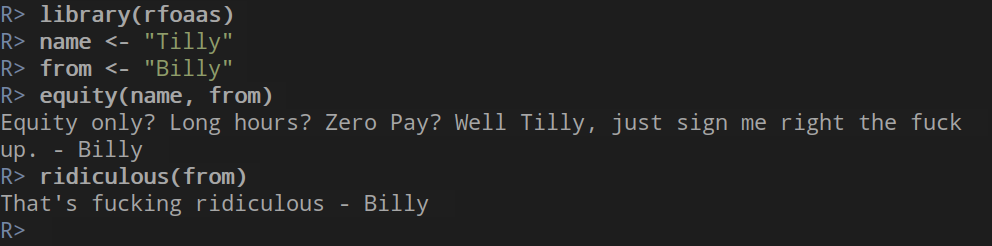 FOAAS by now moved to version 2.3.2 in its repo. This releases 2.3.2 of rfoaas catches up, and brings the first release in about two and a half years.
This 2.3.2 release of FOAAS brings us six new REST access points:
absolutely(), dense(), dumbledore(), lowpoly(), understand(), and yeah(). Along with these new functions, documentation and tests were updated.
My CRANberries service provides a diff to the previous CRAN release. Questions, comments etc should go to the GitHub issue tracker. More background information is on the project page as well as on the github repo
If you like this or other open-source work I do, you can sponsor me at GitHub.
This post by Dirk Eddelbuettel originated on his Thinking inside the box blog. Please report excessive re-aggregation in third-party for-profit settings.
 Welcome to the June 2022 report from the Reproducible Builds project. In these reports, we outline the most important things that we have been up to over the past month. As a quick recap, whilst anyone may inspect the source code of free software for malicious flaws, almost all software is distributed to end users as pre-compiled binaries.
 David Wheeler filed an issue against the Rust programming language to report that builds are not reproducible because full path to the source code is in the panic and debug strings . Luckily, as one of the responses mentions: the
--remap-path-prefix solves this problem and has been used to great effect in build systems that rely on reproducibility (Bazel, Nix) to work at all and that there are efforts to teach cargo about it here .
TheAs their announcement later goes onto state, version-pinning using hash-checking mode can prevent this attack, although this does depend on specific installations using this mode, rather than a prevention that can be applied systematically.ctxhosted project on PyPI was taken over via user account compromise and replaced with a malicious project which contained runtime code which collected the content ofos.environ.items()when instantiating Ctx objects. The captured environment variables were sent as a base64 encoded query parameter to a Heroku application [ ]
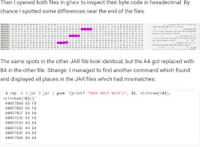 Developer vanitasvitae published an interesting and entertaining blog post detailing the blow-by-blow steps of debugging a reproducibility issue in PGPainless, a library which aims to make using OpenPGP in Java projects as simple as possible .
Whilst their in-depth research into the internals of the
.jar may have been unnecessary given that diffoscope would have identified the, it must be said that there is something to be said with occasionally delving into seemingly low-level details, as well describing any debugging process. Indeed, as vanitasvitae writes:
Yes, this would have spared me from 3h of debugging But I probably would also not have gone onto this little dive into the JAR/ZIP format, so in the end I m not mad.
KBUILD_BUILD_TIMESTAMP) in order to prepare my build with the known to disrupt code layout options disabled .
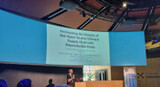 Stefano Zacchiroli gave a presentation at GDR S curit Informatique based in part on a paper co-written with Chris Lamb titled Increasing the Integrity of Software Supply Chains. (Tweet)
 In Debian in this month, 28 reviews of Debian packages were added, 35 were updated and 27 were removed this month adding to our knowledge about identified issues. Two issue types were added:
nondeterministic_checksum_generated_by_coq and nondetermistic_js_output_from_webpack.
After Holger Levsen found hundreds of packages in the bookworm distribution that lack .buildinfo files, he uploaded 404 source packages to the archive (with no meaningful source changes). Currently bookworm now shows only 8 packages without .buildinfo files, and those 8 are fixed in unstable and should migrate shortly. By contrast, Debian unstable will always have packages without .buildinfo files, as this is how they come through the NEW queue. However, as these packages were not built on the official build servers (ie. they were uploaded by the maintainer) they will never migrate to Debian testing. In the future, therefore, testing should never have packages without .buildinfo files again.
Roland Clobus posted yet another in-depth status report about his progress making the Debian Live images build reproducibly to our mailing list. In this update, Roland mentions that all major desktops build reproducibly with bullseye, bookworm and sid but also goes on to outline the progress made with automated testing of the generated images using openQA.
 Vagrant Cascadian made a significant number of contributions to GNU Guix:
FORCE_SOURCE_DATE=1 in the environment of all builds in order to fix numerous timestamp issues in documentation generation tools.
maradns package as it appears to embed a random prime number. (Patch)
This paper focuses on one research question: how can [Guix]((https://www.gnu.org/software/guix/) and similar systems allow users to securely update their software? [ ] Our main contribution is a model and tool to authenticate new Git revisions. We further show how, building on Git semantics, we build protections against downgrade attacks and related threats. We explain implementation choices. This work has been deployed in production two years ago, giving us insight on its actual use at scale every day. The Git checkout authentication at its core is applicable beyond the specific use case of Guix, and we think it could benefit to developer teams that use Git.A full PDF of the text is available.
 In the world of openSUSE, SUSE announced at SUSECon that they are preparing to meet SLSA level 4. (SLSA (Supply chain Levels for Software Artifacts) is a new industry-led standardisation effort that aims to protect the integrity of the software supply chain.)
However, at the time of writing, timestamps within RPM archives are not normalised, so bit-for-bit identical reproducible builds are not possible. Some in-toto provenance files published for SUSE s SLE-15-SP4 as one result of the SLSA level 4 effort. Old binaries are not rebuilt, so only new builds (e.g. maintenance updates) have this metadata added.
Lastly, Bernhard M. Wiedemann posted his usual monthly openSUSE reproducible builds status report.
 diffoscope is our in-depth and content-aware diff utility. Not only can it locate and diagnose reproducibility issues, it can provide human-readable diffs from many kinds of binary formats. This month, Chris Lamb prepared and uploaded versions
215, 216 and 217 to Debian unstable. Chris Lamb also made the following changes:
--profile and we were killed via a TERM signal. This should help in situations where diffoscope is terminated due to some sort of timeout. [ ]IndexError exceptions (in addition to ValueError) when parsing .pyc files. (#1012258)argcomplete module. [ ]readelf (ie. binutils), as it appears that this patch level version change resulted in a change of output, not the minor version. [ ]@skip_unless_tool_is_at_least decorator (NB. at_least) over @skip_if_tool_version_is (NB. is) to fix tests under Debian stable. [ ]TERM signal. [ ]build-compare caused a regression for a few days.python-fasttext (CPU-related issue).node-dommatrix.rtpengine.sphinxcontrib-mermaid.yaru-theme.mapproxy (forwarded upstream).libxsmm.yt-dlp (forwarded upstream). The Reproducible Builds project runs a significant testing framework at tests.reproducible-builds.org, to check packages and other artifacts for reproducibility. This month, the following changes were made:
lz4, lzop and xz-utils packages on all nodes in order to detect running kernels. [ ]SOURCE_DATE_EPOCH environment variable [ ]. In addition, Sebastian Crane very-helpfully updated the screenshot of salsa.debian.org s request access button on the How to join the Salsa group. [ ]
#reproducible-builds on irc.oftc.net.
rb-general@lists.reproducible-builds.org
 After I mentioned that Lenovo are now shipping laptops that only boot Windows by default, a few people pointed to a Lenovo document that says:
Starting in 2022 for Secured-core PCs it is a Microsoft requirement for the 3rd Party Certificate to be disabled by default.
 The Rcpp team is please to announce the newest release 1.0.9 of Rcpp which hit CRAN late yesterday, and has been uploaded to Debian as well. Windows and macOS builds should appear at CRAN in the next few days, as will builds in different Linux distribution and of course at r2u. The release was prepared om July 2, but it took a few days to clear a handful of spurious errors as false positives with CRAN this can when the set of reverse dependencies is so large, and the CRAN team remains busy. This release continues with the six-months cycle started with release 1.0.5 in July 2020. (This time, CRAN had asked for an interim release to silence a C++ warning; we then needed a quick follow-up to tweak tests.) As a reminder, interim dev or rc releases should generally be available in the Rcpp drat repo. These rolling release tend to work just as well, and are also fully tested against all reverse-dependencies.
Rcpp has become the most popular way of enhancing R with C or C++ code. Right now, around 2559 packages on CRAN depend on Rcpp for making analytical code go faster and further, along with 252 in BioConductor. On CRAN, 13.9% of all packages depend (directly) on CRAN, and 58.5% of all compiled packages do. From the cloud mirror of CRAN (which is but a subset of all CRAN downloads), Rcpp has been downloaded 61.5 million times.
This release is incremental and extends Rcpp with a number of small improvements all detailed in the NEWS file as well as below. We want to highlight the external contributions: a precious list tag is cleared on removal, and a move constructor and assignment for strings has been added (thanks to Dean Scarff), and (thanks to Bill Denney and Marco Colombo) two minor errors are corrected in the vignette documentation. A big Thank You! to everybody who contributed pull request, opened or answered issues, or questions at StackOverflow or on the mailing list.
The full list of details follows.
Thanks to my CRANberries, you can also look at a diff to the previous release. Questions, comments etc should go to the rcpp-devel mailing list off the R-Forge page. Bugs reports are welcome at the GitHub issue tracker as well (where one can also search among open or closed issues); questions are also welcome underChanges in Rcpp hotfix release version 1.0.9 (2022-07-02)
- Changes in Rcpp API:
- Accomodate C++98 compilation by adjusting attributes.cpp (Dirk in #1193 fixing #1192)
- Accomodate newest compilers replacing deprecated
std::unary_functionandstd::binary_functionwithstd::function(Dirk in #1202 fixing #1201 and CRAN request)- Upon removal from precious list, the tag is set to null (I aki in #1205 fixing #1203)
- Move constructor and assignment for strings have been added (Dean Scarff in #1219).
- Changes in Rcpp Documentation:
- Changes in Rcpp Deployment:
- Accomodate four digit version numbers in unit test (Dirk)
- Do not run complete test suite to limit test time to CRAN preference (Dirk in #1206)
- Small updates to the CI test containers have been made
- Some of changes also applied to an interim release 1.0.8.3 made for CRAN on 2022-03-14.
rcpp tag at StackOverflow which also allows searching among the (currently) 2886 previous questions.
If you like this or other open-source work I do, you can sponsor me at GitHub.
This post by Dirk Eddelbuettel originated on his Thinking inside the box blog. Please report excessive re-aggregation in third-party for-profit settings.
I finally managed to get hold of a Thinkpad Z13 to examine a functional implementation of Microsoft's Pluton security co-processor. Trying to boot Linux from a USB stick failed out of the box for no obvious reason, but after further examination the cause became clear - the firmware defaults to not trusting bootloaders or drivers signed with the Microsoft 3rd Party UEFI CA key. This means that given the default firmware configuration, nothing other than Windows will boot. It also means that you won't be able to boot from any third-party external peripherals that are plugged in via Thunderbolt.| Series: | Dead Djinn Universe #1 |
| Publisher: | Tordotcom |
| Copyright: | 2021 |
| ISBN: | 1-250-26767-6 |
| Format: | Kindle |
| Pages: | 391 |
Next.
