Search Results: "eric"

26 March 2008

Erich Schubert: Measuring code quality by database support...

Do you know why so many (mostly PHP) developers have problems porting their applications to PostgreSQL?Because PostgreSQL actually enforces constraints on the data.MySQL, which can even have values that are NULL and NOT NULL at the same time (yes, this is not a joke, Details are found here), is not particularly good at that. And people get used to all kind of stuff they can throw at MySQL and it will try to make the best out of it, instead of forcing the programmer to correctly specify what he intends to do.That's the reason why I so far have been avoiding any application which only support MySQL: If it only supports MySQL, it probably means they can't get it to work with anything else. And that is a really bad sign.I was looking for some cheap WebCMS. The big names are Typo3, Joomla, Drupal. Joomla is MySQL only. Plus it doesn't support iCalendar. Typo3, I've had had a look on that one before, it was ugly, used things like line numbers for layouting. And Drupal was pretty much the only one I heard not just negative things about (I was mostly talking to tech guys, not "web designers"). So I thought I'd give it a try. With PostgreSQL, since I want a consistent database.Drupal (6.1) installation with PostgreSQL worked fine. Then I tried installing the add-on modules I was most interested in: Date and Event; since the web site I'm considering it for will be mostly around organizing events, so I do need some solid calendaring functions.Apparently, the Date module of Drupal currently does not support PostgreSQL, it failed creating or filling it's timezone table in the database.How come that pretty much all PHP stuff is broken on so many levels? I figure the Drupal people have spent a lot of time in getting their core working well, and I also believe that the cores of the other systems might all be okay. But when it comes to extension modules, it seems to be as bad as ever before with PHP...Some people might just say "well, run MySQL, and it would be working".If a module isn't capable of storing timezone information in other SQL databases, how can it be of good code quality?(Yes, I know that I'm not being entirely fair. Picking on Drupal or even on the not yet finished Date extension is probably not really fair. But you have to admit that an application which can work with multiple databases probably has received more attention to doing database things the proper way, right?The Date module is not yet "released". I'm not saying it's worthless, it just does not work for me yet. And it actually backs my first claim: working support for other SQL databases is a sign of code maturity.And in most (if not all) PHP web applications, extension modules with their varying code quality are known for introducing security issues again and again.)

25 March 2008

Gunnar Wolf: Perl6 and sigils

Zack, Wouter: Yup, Perl 6's scheme changes to reduce confusion to the programmer and to make the language better Huffman coded. Why?
As for the programmer, it comes out of observation - Changing the sigil depending on what you are expecting to get back (i.e. a hash has a '%' sigil, but if you only want one value off it, you use the '$' sigil, as it indicates a scalar variable) confuses more often than it helps - Specially newcomers. Besides, it will be easier for the interpreter itself - The sigil will become an invariant but required part of the variable name itself. Hence, Martin will be happier, as there will no longer be different namespaces under which to store your variables. Oh, BTW, Martin: Not only Perl behaves this way. Ruby also uses that concept - There, you have local variables (no sigil), instance variables ('@'), class variables (ugly '@@') and global variables ('$'). I remember in old (Quick GW)BASIC you had numeric variables (no sigil) and string variables (postfix sigil '$') as well. Any others?
Now, about the Huffman coding part, WTF?
It is one of the design goals of Perl 6 to make the most often used operators be the shortest, so you, programmer, don't wear out your keyboard and lose your valuable fractions of seconds typing i.e. '->' for a method call when you can just type a '.' - Similarly, currently you have to type too many characters for the (too common) dereferencing - If you have a reference to a hash of arrays of arrays of objects on which you want to call methods, you have to do $something-> key [0][0]->boo - Whereas with Perl 6 you will only have to do $something key [0][0].boo
Anyway, I cannot elaborate much further, as I've been -at best- just a bystander. But yes, large changes loom in Perl's future. Let see what comes on...
And when. Sigh.

24 March 2008

David Nusinow: Little Things

Still putting most all of my brain and time in to trying to graduate. This has left me shockingly little time for things like working on Debian.

Part of the reason why I haven't been working on more visible things (X, Debian) is that I haven't had the solid blocks of time to devote to reading email. I think I need to unsubscribe from all but two or three lists so I don't end up paralyzed by the email onslaught the way I am now. I need to get back to slinging code.

My iPod completely crapped out on me a week and a half ago. I plug it in to my computer and it's totally dead. It was only a little over a year old. Massive fail. Fuck you Apple. I've purchased a 4GB Cowon U3 which plays oggs natively and explicitly "supports" linux. We'll see how that goes, but after one day of use I'm pretty happy.

The entry of Squeak in to Debian and my own realization that GNU Smalltalk exists for those of us who might not want to live inside the smalltalk environment has prompted me to look at the language for the first time. A half hour a night (about a third of the time it takes me to read my email on a very good night) has only made me more excited about this language. If you haven't taken a serious look at Smalltalk yet, it's worth your while. It's like all sorts of things that we can approximate and dream about not only are a reality, but they were invented back in the 70's and have been here all along. It's made me seriously question some of the directions that Linux and Debian have gone in.

22 March 2008

Eric Dorland: Adventures in IPv6 Land

The recent IPv6 Conference at Google and the launching of ipv6.google.com (only accessible over IPv6) inspired me to set up a 6to4 tunnel on my WRT54G running OpenWRT. I've been reading about IPv6 for years, but there didn't seem to be much point. Now I've seen the bouncing Google logo and the dancing turtle, and it really wasn't all that difficult. One issue I ran into was the 2.4 kernel that is needed to run on the WRT54G doesn't have a connection tracking for stateful firewall rules, which makes it a pretty poor IPv6 firewall. It's disabled for now, and tomorrow I'll go buy a WRTSL54GS so I can run a 2.6 kernel.

I'm looking forward to the day when IPv6 transit is normal and all these tunnels are unnecessary.

21 March 2008

Erich Schubert: Google Summer of Code 2008

Debian is part of the Google Summer Of Code again this year (2008).Last year was quite successful, so we hopefully will get at least as many slots as last year.Applications will be possible March 24th to March 31st. This means, you should already starting writing your project proposals and get feedback by possible mentors. Ideas can be found in the Debian Wiki, but notice these are just ideas. You are by no means limited to what we're proposing there.As for writing an application, here are some general notes: In turn, we (= the mentors and admins) will try to (again - we did that last year) have at least three mentors read through your application, provide feedback on it and judge it. We don't draw lots for the slots, but we'll rank the applications based on the scoring by the mentors. We'll also try to assign you a fallback mentor in case your mentor has to step back for whatever reason and to give you additional people to talk to.

20 March 2008

Erich Schubert: Art Deco Web Design?

Do you know some web sites sporting an Art Deco or Roaring Twenties web design? I find that period (the Swing and Jazz age, where Gangsters were still stylish) very fascinating, and I'm looking for things to get inspired.Art Deco is usually described as being "simple shapes, geometric, vibrant colors", which would fit to web design restrictions quite well, wouldn't it? Other important aspects seem to be the use of materials; which obviously isn't really possible in web design (mind you, textures are only a bad approximation).If you know some sites where you'd say "this is Art Deco Webdesign", please let me now via EMail, erich (AT) debian (DOT) org[Update: Web Designer Wall has a list with a couple of nice pages. Not all of them are Art Decoish or Roaring Twenties, but some a pretty nice.I'm looking particularly for Art Deco and Twenties, but any Vintage and Retro Design can be inspiring.And I'm not looking for pages to blindly clone, but to get some inspiration from. I don't copy, since I do pages in my own particular (XMLish) way anyway.]

18 March 2008

Adam Rosi-Kessel: Bridge Year

This, from my alma mater, is a good idea:
Group to explore creation of ‘bridge year’ program
Princeton President Shirley M. Tilghman has appointed a working group to explore the creation of a “bridge year” program that would allow newly admitted undergraduates to spend a year of public service abroad before beginning their freshman year. The program would enable students to pursue a tuition-free, pre-collegiate enrichment year outside their home country with support from the University.
I finished my high school requirements early and spent a year abroad before college in Li ge, Belgium. It was an excellent decision. There would have been practically no benefit to starting college early, and having living abroad without my parents for a year was as important to my university experience as most of what I learned in high school. I propose that some sort of “bridge year” become something like a default option before higher education. This is much more common outside the United States. Indeed, depending on whom you believe, only seven to twenty-five percent of Americans own passports. My completely unscientific survey of Australians, by contrast, suggests that every last one of them travels abroad as young adults. (I have to admit that this survey is not only unscientific but fatally biased, inasmuch as I’ve only met Australians traveling abroad, not having been there myself). While I’m praising Princeton, this, too, is good news:
Aggressive goals set for sustainability initiatives
Princeton has committed to reduce its carbon dioxide emissions to 1990 levels by 2020 as part of a comprehensive Sustainability Plan that sets ambitious goals in the areas of greenhouse gas emissions reduction, resource conservation, and research, education and civic engagement.
I’ve a big fan of Shirley Tilghman, Princeton’s first non-male non-alum president. She has been working to fix a lot of what was wrong when I was student, despite some stiff resistance from the old guard. Technorati Tags: , , ,

15 March 2008

Daniel Leidert: Diploma exams are calling: Please read if you want to NMU my packages

Because my diploma exams are getting nearer, I have to reduce my contribution to the Debian project for the next two months (up to mid/end of May). There is fortunately currently not much to do for me and also no need to NMU my packages. But please read the following notes, if you (still) think there is a reason for a NMU: GCC 4.3 transition Done. All related packages have been fixed. My sponsor just needs to upload psicode to fix the last outstanding bug. PS: Also the build-twice-in-a-row release goal will be reached by the upload of the apbs update by my sponsor. gfortran transition Almost done. mpqc already reached the buildds. ghemical has been uploaded, but waits for mopac7 and libghemical, which are in NEW because of the new library names. apbs and psicode already have been transitioned. Other bugs Ok, I’ve closed almost all relevant bugs in my packages. There are a few outstanding bugs that should be examined for Lenny and can be fixed in NMUs - preferable via delayed NMU queue and an information to the debichem group:
#420795: chemical-mime-data: Unknown media type in type ‘chemical/x-*’
Upstream bug tracker for shared-mime-info contains some more information, how to deal with this. Patches/ideas welcome.
#438694: gabedit: Crashes when loading any XYZ format file
Looks tricky. Maybe an OpenGL issue related to some video card drivers. Not sure.
#442223: openbabel: some connect information lost when convert from pdb to txyz
Nothing examined yet to solve this bug.
#464867: extrema: conflicts with psi3 package
Hope, my team will cover this asap.
#465723: mopac7 — please do not use g2c.
There is currently a workaround using f2c to solve this bug. But MOPAC7 has been written in FORTRAN and we can use gfortran and drop f2c completely. See the report for more information. This is something I would like to see in Lenny.
For the xmlto package it was planned to add the dblatex toolchain for PDF/PS/DVI creation because passivetex will very probably never have a comeback in Debian and docbook-xsl/fop is not fully main and cannot create DVI output. In the case you want to help, feel free to add this feature by NMU to experimental (maybe with version 0.0.21~dblatexX.Y). A first patch is available in bug report #416622. New upstream releases It is possible that there will be a new upstream release for docbook-xsl in the near future. DO NOT consider uploading it by NMU if you did not test it! This upcoming release ships manpage stylesheets, that have been rewritten in large parts. So regressions can be expected. Fortunately Michael Smith and me agreed, that we should test it carefully, before the release is done. Unfortunately I will not have the time to do it. So if you consider uploading it, please get in contact with Michael (xmldoc) and offer your help testing it. He added (and I hope, many Debian packagers and packaging groups will like that) some kind of regressions tests. These tests build the manpages from several Debian packages: e.g. samba, apt, aptitude, git, fglrx and some more. There are further some new supported features, that should be added to the manpage example shipped with the Debian package. I also planned to split the source package (atm, docbook-xsl and docbook-xsl-doc tarballs are merged together for Debian) as soon as docbook-xsl-ns is packaged - which I wanted to do with the next upstream release. So consider all of the above notes if you plan an NMU to upload a new upstream release and in question, mail me and wait for my answer (which will need some days). In all other cases, new upstream releases should be easier to handle. ITPs All my ITPs are delayed. However if you plan to still upload one of these packages, you should consider the following notes:
docbook-xsl-ns
See the above note about docbook-xsl and the source package split.
html-xml-utils
Already in a good shape, but I sent upstream some patches to improve the manpages. Version 4.6 of the html-xml-utils should contain these patches and this version should be uploaded into Debian. With this version, Bert Bos will probably also decide, which prefix will be used for the binaries (they have very generic names atm; the prefix will probably be hx- or hxu-). Waiting for this releaes therefor is IMHO a good choice.
DocBook 5
I already found a problem that need to be addressed in the package: Where to install its catalog? You will see, that there is already a catalog file in /usr/share/xml/docbook/schema/dtd/ shipped by the docbook-xml. Now I’m not sure, what to do here. Upstream ships one catalog file for all supported schemas (RNG, DTD, W3C schema and schematron), so maybe the catalog file can go into /usr/share/xml/docbook/schema/. Really not sure atm. The answer to this question might affect the Debian XML policy and should be made carefully.
QA work/fixes Several lintian warnings have already been fixed in the SVN repositories used for my packages but have not yet been uploaded. I really only plan to reduce my work during the preparation and the exams. So whatever you do, please try to make it easy for me to continue my packaging work after the exams :)

Dirk Eddelbuettel: SFJAZZ Collective at CSO

Went to the CSO yesterday as a nice way to end a frantic workweek: first a beer or two after work, and then off for some Jazz. Yesterday's program was the SFJAZZ Collective: eight individuals, all noted in their own right, coming together for a few weeks each year to play as an ensemble. The program generally consists of two halfes: one with material by a modern composer -- Wayne Shorter is this year's pick -- and new original compositions by the band members. This was a special treat as Wayne Shorter's compositions from the 1960s, both from the bands he lead and as a member of the legendary Miles Davis Quintet, have always been some of my most favourite modern pieces. At the same time, it gave me a chance to finally see Joe Lovano on ts and Stefon Harris on vb. Other band members were equally impressive: Dave Douglas tp, Miguel Zenon as, Robin Eubanks tb, Renee Rosnes p, Matt Penman b, Eric Harland dr. Favourite new composition of the night: 'Angel's Shares' by Penman. All in all a nice evening out to cap off a busy week.

Daniel Burrows: Full upgrade and conflicts

Erich Schubert wonders how to improve the handling of conflicts in package managers, particularly in aptitude full-upgrade and apt-get dist-upgrade. From the point of view of the package manager, conflicts are a bit tricky to deal with. The problem is that a conflict only really tells you not to install two packages at once; it doesn't tell you which package should end up on the system by default. Worse, aptitude has two approaches to this:
  • When a package is marked for installation in the visual interface or listed on the command-line, then if Aptitude::Auto-Install is enabled, aptitude will automatically resolve conflicts in favor of that package. The same applies to packages that are upgraded by pressing U or by full-upgrade.
  • When aptitude's dependency resolver encounters a conflict, it considers both resolutions to the conflict to be equally valid. If there are no other reasons to choose one package over the other, it will be unpredictable which one gets removed first, and even when there are reasons to choose, the user may not understand what they are.
I don't think it's possible to always make upgrades predictable. But I think that even just making Auto-Install stick to installing packages and not removing conflicts would be a plus. Installing obvious dependencies up-front is good because it means less work for the resolver and a more predictable starting point. Many trivial dependency problems can even be completely solved this way. But removing conflicts is a lot trickier and should probably kick the problem into the full resolver. Unfortunately, the code enabled by Auto-Install is all deep in the guts of libapt. I've tried to avoid duplicating this code so far, but it does seem like I periodically run into cases where it doesn't do exactly what I need, so maybe I'll have to eventually. :-(

11 March 2008

Isaac Clerencia: On why I love The Wire

I have just watched The Wire’s last episode. For those who don’t know about it, The Wire is the greatest TV series ever created (Salon and Slate back me on this). It’s been acclaimed by critics, but widely disregarded by audience. I’ll never forget Jimmy McNulty, a troubled Irish American dipsomaniac murder detective (played by brilliant Brit Dominic West) or Omar Little, a Robin Hood-like stickup homosexual man in west Baltimore. The rest of the deeply portrayed characters of the show are great too, but above all of them, the real starring role belongs to Baltimore. I am sure Baltimore’s reality goes way beyond this show, but I don’t think a show can get more real than The Wire. Each season focuses on a different topic, such as drug-dealing, unions, politics, the press, always keeping the police department around. The story arcs are really long and complex, The Wire is not the kind of show you can enjoy watching a single episode of, but more like, as its own creator - a former Baltimore Sun journalist - put it, a “66 hour movie”. Well, I could keep praising it for hours, but lots of people have done that already, even Barack Obama loves it (:P, let’s ride the hype). Praise available in Spanish too :P Besides, Eliot Spitzer has made wiretaps really popular again these last days ;) Really, you must see it.

10 March 2008

Dirk Eddelbuettel: PGApack 1.1: Almost as good as new

PGAPack is rather nice and fairly small library for 'parallel' optimisation via generic algorithms using the MPI message passing protocol. PGAPack 1.0 was written by David Levine while doing graduate work during the mid-1990s at Argonne Labs / University of Chicago. PGAPack has also been in or around Debian for a rather long time, but it suffered from benign neglect in the last few years. Some of this came to the fore in this bugreport which lead to my offer to the then-maintainer Andreas to help on the relicencing request. After all, Argonne Labs is just a few miles from where I live, and I had already spent a little bit of time polishing and upgrading the package for my own exploratory use. So I called Rusty Lust, head of the Mathematics and Computer Science section at Argonne to try to sort this out. He was sympathetic and put me in email contact with David Levine. As we are all somewhat busy, this dragged on for a little longer than we thought --- but as of today, about and a half years later, we have a new and shiny PGAPack 1.1 release, or around twelve years after the initial 1.0 version came out. I have done a fair amount of polishing: there are now two library packages for serial use (i.e. for debugging) as well as parallel use via MPI. We use Open MPI where available and LAM where not. All open Debian bugs have been addressed. One minor issue in the postscript documentation remains as David can no longer locate his LaTeX sources; I may just have to extract the text and re-latex this from scratch to update it. One day. Anyway, for full reference, the changelog entry is below. The package is currently in the NEW queue (as the new sub-package require manual inspection and approval) but should hit mirrors in a couple of days. My thanks to the two previous Debian maintainers; to Rusty Lusk for helping with the from the end MSC department at Argonne Labs and for suggesting the rather liberal and easy MPICH2 license (and he happens to be one of the MPICH2 authors); and of course to David Levine for writing PGAPack in the first place, for agreeing to relicense it and giving valuable feedback on my repackaging of what is now version 1.1 on the MCS ftp server at Argonne --- this library has held up really well over the years; let's hope it will find more good use going forward.
pgapack (1.1-1) unstable; urgency=low
  * Really good news:  The MCS divsion of Argonne National Laboratories has
    agreed to relicense pgapack using the MPICH2 license. So pgapack
    is now Free Software and can move into Debian's main archive!
  
    Our thanks go to David Levine and Rusty Lusk to make this possible.
  
  * New maintainer, following Andreas' offer dated 2006-10-04 in #379388
  * debian/control: Change section to math		(Closes: #379388)
  
  * Added new brinary packages libpgapack-mpi1 and libpgapack-serial1
  * The MPI package is configured using Open MPI where available and LAM
    where not. 
  * debian/control: Changed Build-Depends: to use OpenMPI where available, 
    and LAM otherwise.
 
  * Finally acknowledges old NMUs 		(Closes: #379168,#359549)
  * source/integer.c: Apply patch for one-off error 	(Closes: #333381)
  * source/report.c:  Do not unconditionally print at generation 1
  
  * debian/rules: Remove a bashism 			(Closes: #379168)
  * debian/rules: Install examples directly 		(Closes: #134331)
  * debian/control: libpgapack-lam1 Depends on lam4 	(Closes: #60376)
  * debian/rules: Rewritten using debhelper
  * debian/control: Added Build-Depends: section for debhelper
  * No longer install mpi.h in /usr/include		(Closes: #404027)
    
  * debian/control: Updated Standards-Version: to current version
  * man/man1/PGAGetCharacterAllele.1: fix whatis entry 		(lintian)
  
 -- Dirk Eddelbuettel   Mon, 10 Mar 2008 18:03:34 -0500

9 March 2008

Enrico Zini: ldap-userdb-fields

Fields used by an LDAP Unix user database Some notes about LDAP for Unix user management: Meaning of fields for objectClass posixAccount: Meaning of fields for objectClass posixGroup: For objectClass inetOrgPerson: what you put there can be used as if it were a vCard by mail programs and contact lists. Now, the name of people could potentially be split in cn,givenName,sn,gecos and displayName (possibly more): how would normal user tools deal with the redundancy? To show a gecos field, pam_ldap will search for a gecos field first, then automatically fallback on building a gecos field out of the other suitable info it finds. To show a name, sane programs try displayName first and if it's not present they guess using the rest. Then there is the issue of how to chose the dn to identify users, groups and so on. Users usually go in uid=$USERNAME,ou=People,$SUFFIX, while groups would usually go in cn=$GROUPNAME,ou=Groups,$SUFFIX. Should you need to create the People and Groups organizational units, this could be the proper bit of LDIF:
dn: ou=$NAME,$SUFFIX
ou: $NAME
objectClass: organizationalUnit
To add fields that are not already part of a schema, one needs to create their own schema. To do that, one needs to first obtain (free of charge) a Private Enterprise Number that is used in various places in the schema definition. Making up your own one means risking conflicts if you eventually grow larger. But it is rarely needed, because for most things there are already schemas available. Many thanks to Wouter and noshadow for allowing me to crudely extract all this content from their brains.

8 March 2008

Neil Williams: self-delusion and Debian

Daniel notes that self-delusion is a necessary component of all voluntary work.
Any human activity can be over-analysed into oblivion, especially if the terms of reference for "meaning" are impacted by a view of the real world that is overly abstract. Even paid work needs some self-delusion because no matter how much money you earn, the old maxims bite back - "you can't take it with you" and "no point earning it unless you can enjoy it".
Before I started with voluntary software work, I was heavily involved in voluntary charity work and the motivation is much the same. "The grand scheme of things" will never be sufficiently affected by any activity such as to provide the sole justification for that activity. The vast majority of people and the vast majority of actions simply are not and cannot become that important. (This is where religion is important for some people, the hope that despite all evidence to the contrary, acts of random kindness have some meaning to the person doing the act instead of just to the recipient.)
Voluntary work is generally for the benefit of others. In free software it is about writing code to solve our own issues in a way that others can use without facing the problems that we had to solve. Writing new code to solve a problem or fixing bugs in existing code to solve a new problem can only help others if the solution is shared. So the validation of that work is in helping someone else accomplish a task without having to spend the time fixing that issue, leaving them time to fix the next one.
Working on free software of all kinds is worthwhile simply because it is a way of helping others.
"When all things are considered", most people working on Debian are the lucky ones. Born into an environment where good education is available and where parents/relatives were able to indulge our fascination with electronic and computerised widgets that had no direct bearing on whether our basic human needs were met with regard to food, warmth and health. Trained at great expense and able to use that training not only to meet our personal financial needs but also to make time available for other unpaid tasks that benefit others who do not have those things. Living in a time of peace and stability, where the more esoteric and "frivolous" tasks can be undertaken without causing hardship or neglect of others. (My nephew frequently sums up this whole idea as like having won the lottery just by existing.)
There is an element of justification that can be derived from such a view - an element of responsibility and duty. After experiencing all those good things and after realising that we have such an opportunity, it can engender a feeling of obligation to do something that justifies what we have already received to balance out those who have the skills to do what we do but, for reasons of birth alone, do not have that opportunity or the means.
That is a form of secular humanism - validation of our own situation in the use of our skills and time to make things easier for those who are less fortunate.
OK, Debian isn't about providing clean water for all, or the redistribution of food and medicines to those without but the organisations that do that work can be assisted indirectly by making the systems used by such organisations work more efficiently, with greater stability and with more flexibility.
Not everyone can (or should) be on the front line of whatever acts of kindness will solve the problem of inequality but there is an obligation on those of us who have received the benefits of inequality to do what we can to make it easier to redraw the balance.
Debian is one such way and it is a truly international way of benefiting others too. It is more beneficial than the charity work that I did previously - chiefly because that was a very local service that was very labour-intensive and so could only benefit small numbers of people.
Improving Debian won't make us more important to the universe, life and everything (the answer to that is 42 as we all know), but it will help others do what they do, it will improve their lives and their ability to spend their time on what they want to do instead of having to fix problems that we have already solved.
Debian, to me, is about sharing solutions. Helping someone else do something that Debian could not do before, without requiring them to fix all the problems that I had to solve to devise the solution in the first place. Sharing not just the solution but the method of the solution and the means to extend the solution to new problems.
We, as Debian developers, have been granted the access and tools to solve these problems for the benefit of those who do not have upload privileges. Those rights come with responsibilities (as always) to use our skills and time to find the solution and without making things more difficult in the process.
In the grand scheme of what I can actually do as opposed to what might be possible if X, Y and Z were different, what I do in Debian and Emdebian is worthwhile. In fact, it is just as worthwhile as my paid non-IT employment in healthcare provision because, within healthcare, I can only help the single person in front of me. In Debian, I can help all those people who I will probably never meet but who want Debian to do something that I am able to achieve.
What is particularly nice about Emdebian is that there are people who tell us that our work is worthwhile by putting up the hard cash to fund work sessions and conferences that bring the various developers into one place. The international aspects of Debian can be a barrier in some ways and things always happen more quickly when the various members of the team can be brought from the four corners of the planet into one place for a week or so. It is these gatherings that boost the motivation and the enjoyment of making progress towards a common goal. Debian can be a solitary world where communication is limited to plain text. Probably the best way to "oil the wheels" in Debian is to get a group of Debian people together and just let them hack.
Voluntary work of all kinds requires personal motivation and working alone with only limited means of communication with others can be quite demotivating. Getting people together is a very useful antidote.

6 March 2008

Ondřej Čertík: Sage Days 8

Between February 29 and March 4, 2008 I attended the Sage Days 8, hosted at the Enthought headquarters in Austin, Texas. This was my 5th time in the USA and it was a marvelous experience, as with all my visits in the states.

As usual, I had some adventures in Atlanta, that interested readers can find at the end of this post. Anyway, on the Austin's airport I met Peter and his wife Crystal, Fernando, Benjamin, Jarrod, Eric and Clement. We went to have a dinner and then me and Clement were staying at Peter's house:
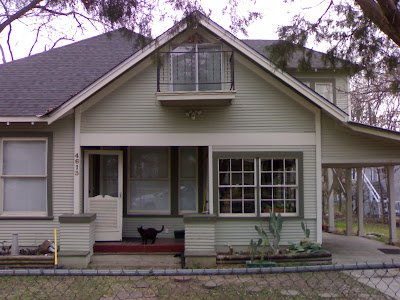


You can see the neighbor's cat and Peter's dog Trinity behind the window. The next day we went to Enthought, that was providing us with a breakfast and a lunch each day - and it was delicious. After the breakfast, we gathered in the room and introduced ourselves. Enthought rents 3/4 of the 21th floor in the Bank of America building, so when I looked left I saw:
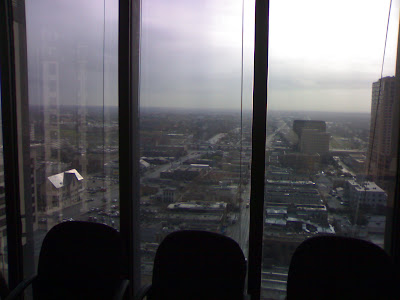


When I looked behind I saw:
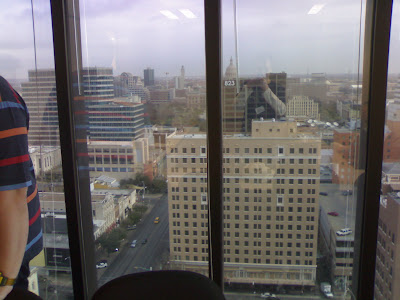


and in front of me, I saw all the participants (I took photos of all participants together with names). As you can see, there were really good people in there, like Travis (creator of NumPy), William (main author of Sage), Eric (CEO of Enthought), Fernando (author of IPython), Jarrod (the release manager of SciPy), Michael (the release manager of Sage) etc. See also the Fernando's welcome speech and the video of each of us introducting himself.

The views from the windows are terrific. I enjoyed working on each of the 4 sides of the skyscraper with completely different scenery, or when the sun is going down, that's also very cool.

We spent the whole Friday doing presentations, some of which you can find here. Then we went to Eric's house to have a big dinner together.

On Saturday, Sunday and Monday we were all hacking on many different things. I joined Fernando, Benjamin, Brian and Stefan on ipython1, Travis was implementing a new type (gmp integer) in NumPy, William wrote a manipulate command in Sage, Eric did the same in Traits, Gary and Michael implemented parallel testing of Sage, ...

On Tuesday we had final status reports and people left in the afternoon. In the evening we went with Clement to have a dinner and then we visited some bars on the 6th street, having a beer in each.

On Wednesday I visited John and Roy from the Computational Fluid Dynamics Lab at the University of Texas, Austin, who wrote the libMesh library, that I extensively used and also created a Debian package of. It was very influential to see the libMesh "from behind", also John and Roy are cool people (not mentioning the Debian tradition of having good relations with upstream:). Then I visited some professors at the same campus, after which I went into the Capitol and then I took the bus to the Barton Creek Square Mall to buy some ipods and jeans, so that I can say I have jeans from Texas. BTW, the ipod works excellent in Debian - I plugged it in and it just shows on my Gnome desktop. It's true that naively dragging mp3 files on it didn't make it play, but these instructions made it work.

On Thursday I fixed the remaining release blockers in SymPy and made a new release. In the evening, I am going to meet Aswin, he also uses SciPy and also is a friend of Kumar, who is now maintaining python-numpy and python-scipy Debian packages with me (Kumar also knows Prabhu, the author of Mayavi2 hosted at Enthought, so it's all connected).

Anyway, the whole workshop was an excellent experience for me. I learned a lot of new things and being able to speak with people who wrote tools that I use almost everyday is important. We also extensively discussed the future of all the projects (Sage, SciPy, NumPy, IPython, Cython, SymPy). See my summarizing email to the SymPy mailinglist.

Another thing, that I find very interesting is that Microsoft is financing the windows port of Sage, that will make basically anything that uses Python/Cython/C/Fortran very easy to install on windows (just a spkg package in sage). I find it really cool that MS is not only supporting but even financing a truly opensource project.

Finally the promised adventure in Atlanta: we took off the Prague airport on February 28th with a 2 hours delay (due to some paperwork as we were told by the captain). As I had 3 hours in Atlanta for the connection to Austin and I had to go through immigration, it was clear that I'll miss it. But I was not surprised, last time I was flying through Atlanta, they canceled my flight to LA completely. We arrived in Atlanta an hour and a half before my departure, then I was waiting for about an hour at immigration, it was incredibly slow. When I had around 20 min to departure, I had to ask people standing in front of me if they let me in, they were very nice and did. I was leaving immigration 10 min to my departure, then I was running to get my luggage and myself through customs and screening, it was 5 min to my departure when I ran down to the display with departure times. Then I was sprinting like hell to the terminal D to only see the clerk doing some final paperwork with all the people already boarded and the jetway door shut. After a little persuading he let me in too, fortunately there was still one seat left, so I made it. You can imagine my pleasant surprise in Austin when I discovered, that my luggage made it too, considering that I handed it to the Atlanta's airport personnel exactly 10 min prior the departure.

4 March 2008

Andrew Pollock: [life/americania] Viva la fortnight!

I'm slowly converting the team I work with to use the term fortnight. It's so much less ambiguous than "bi-weekly". (Provoked by Dave Jones' post)

Rob Taylor: More Obama Love..

Obama is world’s choice for Democratic nominee? So, no surprise there then! If you’re reading this in Ohio, Texas, Rhode Island or Vermont, please go place a vote tomorrow for the rest of us out here and also for someone who understands the internet, creative commons, freakonomics and wants to make life easier for those that need it.

2 March 2008

Andrew Pollock: [life/americania] Australia to American translation #4

truckie
teamster

1 March 2008

Anthony Towns: Been a while...

So, sometime over the past few weeks I clocked up ten years as a Debian developer:
From: Anthony Towns <aj@humbug.org.au>
Subject: Wannabe maintainer.
Date: Sun, 8 Feb 1998 18:35:28 +1000 (EST)
To: new-maintainer@debian.org
Hello world,
I'd like to become a debian maintainer.
I'd like an account on master, and for it to be subscribed to the
debian-private list.
My preferred login on master would have been aj, but as that's taken
ajt or atowns would be great.
I've run a debian system at home for half a year, and a system at work
for about two months. I've run Linux for two and a half years at home,
two years at work. I've been active in my local linux users' group for
just over a year. I've written a few programs, and am part way through
packaging the distributed.net personal proxy for Debian (pending
approval for non-free distribution from distributed.net).
I've read the Debian Social Contract.
My PGP public key is attached, and also available as
<http://azure.humbug.org.au/~aj/aj_key.asc>.
If there's anything more you need to know, please email me.
Thanks in advance.
Cheers,
aj
-- 
Anthony Towns <aj@humbug.org.au> <http://azure.humbug.org.au/~aj/>
I don't speak for anyone save myself. PGP encrypted mail preferred.
On Netscape GPLing their browser:  How can you trust a browser that
ANYONE can hack? For the secure choice, choose Microsoft.''
        -- <oryx@pobox.com> in a comment on slashdot.org
Apparently that also means I’ve clocked up ten and a half years as a Debian user; I think my previous two years of Linux (mid-95 to mid-97) were split between Slackware and Red Hat, though I couldn’t say for sure at this point. There’s already been a few other grand ten-year reviews, such as Joey Hess’s twenty-part serial, or LWN’s week-by-week review, or ONLamp’s interview with Bruce Perens, Eric Raymond and Michael Tiemann on ten years of “open source”. I don’t think I’m going to try matching that sort of depth though, so here are some of my highlights (after the break).
Hrm, this is going on longer than I’d hoped. Oh well, to be continued!

28 February 2008

Erich Schubert: Vote Green, please.

There are communal elections in my region this weekend.Green campaignI'm a supporter and member of the Greens. Please support us by voting for us.Don't vote for CSU. Ever. Just think of what they've been doing towards spying on citizens, data retention and such. They fight against your freedom by blaming the "terrorists".We could use up to 20% greens, and there is no way we're going to reach that anytime soon. So it's save to vote for the Greens. Even with your vote, they'll probably just reach 10%, and that definitely is a good thing for democracy. Nobody is talking about the Greens becoming the strongest party, you know... but we could use more Greens than we currently have in the parliaments. If we have 4-5 reasonably strong parties and changing coalitions, that helps fighting corruption.

Next.

Previous.
