Search Results: "edd"

13 January 2012

Dirk Eddelbuettel: RInside 0.2.6

A new version of RInside, now at 0.2.6, is now available via CRAN. RInside provides a set of convenience classes which facilitate embedding of R inside of C++ applications and programs, using the classes and functions provided by the Rcpp R and C++ integration package. This release has an additional fix for the Windows use case, adds cmake support files for the examples, switches to using the same RNG initialization of time and process id that R uses, and other minor fixes. All changes since the last release are summarized below:
2012-01-11  Dirk Eddelbuettel  <edd>
        * DESCRIPTION: Release 0.2.6
        * DESCRIPTION: Updated Description: text 
2012-01-08  Dirk Eddelbuettel  <edd>
        * src/RInside.cpp: Correct console writer on Windows to not use
        Rprintf (with thanks to both James Bates and John Brzustowski)
        * src/RInside.cpp: Update RNG seeding to same scheme now used by
        R which blends both (millisecond) time and process id
        * src/RInside.cpp: Replace fprintf(stderr,...) with Rf_error(...)
        * src/setenv/setenv.c: Idem
        
        * inst/examples/*: Added CMake build support for all example
        directories kindly provided by Peter Aberline; this helps when coding
        inside of IDEs such as Eclipse, KDevelop or Code::Blocks
        * inst/examples/standard/Makefile.win: Allow for an R_ARCH variable
        to be set to enforce either i386 or x64 builds
CRANberries also provides a short report with changes from the previous release. More information is on the RInside page. Questions, comments etc should go to the rcpp-devel mailing list off the Rcpp R-Forge page.

10 January 2012

John Goerzen: Social Overload

I m finding social media is becoming a bit annoying. I enjoy using it to keep in touch with all sorts of people, but my problem is the proliferation of services that don t integrate well with each other. Right now, I have: So my problems are:
  1. Posting things multiple places. I currently can post on identi.ca, which automatically posts to twitter, which automatically posts to Facebook. But then I d still have to post to Google+, assuming it s something that I d like to share with both my Facebook friends and my Google+ circles it usually is.
  2. The situation is even worse for re-tweeting/re-sharing other people s posts. That is barely possible between platforms and usually involves cutting and pasting. Though this is somewhat more rare.
  3. It s probably possible to make my blog posts automatically generate a tweet, but not to automatically generate a G+ post.
All the hassle of posting things multiple places leads me to just not bother at all some of the time, which is annoying too. There are some tools that would take G+ content and put it on Twitter, but without a character counter on G+, I don t think this would be useful. Anyone else having similar issues? How are you coping?

9 January 2012

Eddy Petri&#537;or: Another Windows tip - How to store cvspass login for CVSNT

Since I am currently working on a Windows machine at work I am looking for ways to make this thing work in a sane way. The latest insane thing is the fact that I wasn't able to log on a CVS server at work from WinCVS (which uses CVSNT) with my regular credentials, while the cached password in Cygwin did work with the Cygwin CVS.

So the obvious fix was to copy the .cvspass file from cygwin to whereever CVSNT kept its cvspass file. Well, it isn't that easy, since CVSNT keeps such passwords in the Windows registry. But since I had no previous logins with CVSNT, I didn't knew what to put in the registry.

I found really easily that the key is under HKEY_CURRENT_USER\Software\cvsnt\cvspass, but how do I save it? Looking at the line in my cygwin .cvspass I saw the line had the format:

/1 :pserver:username@our.cvs.server.net:/u S()meh4s'h00

I finally found out that I have to create a string value with the name ":pserver:username@our.cvs.server.net:/u" and the value data that hash "S()meh4s'h00" and plainly ignore the first field.


Stay tuned. The next article will be about what's common between Windows 7 and GNOME 3 / gnome-shell, since I upgraded my home laptop to wheezy (I really wanted to use pitivi 0.15), and my desktop at work to Windows 7.

8 January 2012

Niels Thykier: Testing migration and package relations

While looking at the dpkg Breaks-field[0]
$ aptitude show dpkg
Package: dpkg
[...]
Version: 1.16.1.2
[...]
Breaks: apt (< 0.7.7), aptitude (< 0.4.7-1), dpkg-dev (< 1.15.8), libdpkg-perl (< 1.15.8), pinfo (< 0.6.9-3.1), tkinfo (< 2.8-3.1)
it occurred to me that most (all?) of these relations were irrelevant to Britney when she migrated dpkg 1.16.1.2 to testing. Right now, at least the APT relations are only relevant if you are doing something like a distribution upgrade from Lenny/Squeeze to Wheezy. Similarly, the version constraints in a lot of dependency relations (e.g. libc6 (>= 2.11) ) are satisfied in testing and unstable at the same time. Removing the version constrains on dependencies is a rather minor thing as it is basically just a minor constant time optimization on each dependency check. However, removing an entire clause slightly reduces the problem size a bit. Particularly, the Conflicts/Breaks relations tends to be expensive for us. The first task was to identify the relations that can (or cannot) be simplified. In a Britney run we at most 4 versions of the same package per architecture, though usually only 1 or 2[1]. I devised a small set of rules to simplify the relations. These rules are applied to each package in the relation (atomic proposition, if you will).
  1. If the relation is versioned and it involves a virtual package in any suite, then do not change the relation in any way. Rationale: A virtual package cannot satisfy any versioned relation (Policy Manual 7.5)
  2. If the relation is a dependency (i.e. Pre-Depends or Depends) and the package is not available in any suite, then do not change the relation in any way.
  3. If the relation is versioned and the relation is satisfied in all suites (where the relationed-on package is available), then remove the version constrain. Rationale: If all (present) versions satisfy the relation, then version constrain does not change the semantics.
  4. If the relation is a conflict (i.e. Conflicts or Breaks) and relation is unsatisfiable in all suites, then remove the relation. Rationale: If none of the (present) versions satisfy the conflict-relation, then there is no conflict[2].
The rules are rather conservative in some cases and there is room for improvements. However, one has to remember that removing too few relations costs a bit in runtime, removing too many breaks testing and possibly a lot. Obviously, I prefer the former to the latter (especially because I will be a part of the clean up -crew). I tested my implementation of those four rules above against the current master branch. In short, it produces the same result as the master branch in all the tests so far. In the hand-made test-suite, the tests generally do not have any superfluous relations. Thus, it is slightly slower, though usually within 0.1 seconds of the master branch. On the other hand, in the live-data samples I have collected so far it does vastly better. For the longest run (sample from 2011-12-13), it reduces the runtime with ~70 seconds (from ~215 to ~145 seconds). In the other runs, it reduces total runtime with ~35 and ~2 seconds, respectively. In these samples, only the amd64 and i386 packages are considered (and human hints are ignored). For those interested, the code is available in my branch. :) [0] There is perfectly valid reason for doing that. I might get back to that in a later post. [1] One in unstable, testing, testing-proposed-updates and proposed-updates. The latter may seem a bit weird, but [0] [2] This is the rule that prune relations like the one in the dpkg Breaks-field. Edit: 2011-01/09, clarified that we have at most 4 versions per architecture.

6 January 2012

Robert Collins: Public service announcement: signals implies reentrant code even in Python

This is a tiny PSA prompted by my digging into a deadlock condition in the Launchpad application servers. We were observing a small number of servers stopping cold when we did log rotation, with no particularly rhyme or reason. tl;dr: do not call any non-reentrant code from a Python signal handler. This includes the signal handler itself, queueing tools, multiprocessing, anything with locks (including RLock). Tracking this down I found we were using an RLock from within the signal handler (via a library ) so I filed a bug upstream: http://bugs.python.org/issue13697 Some quick background: when a signal is received by Python, the VM sets a status flag saying that signal X has been received and returns. The next chance that thread 0 gets to run bytecode, (and its always thread 0) the signal handler in Python itself runs. For builtin handlers this is pretty safe e.g. for SIGINT a KeyboardInterrupt is raised. For custom signal handlers, the current frame is pushed and a new stack frame created, which is used to execute the signal handler. Now this means that the previous frame has been interrupted without regard for your code: it might be part way through evaluating a multi-condition if statement, or between receiving the result of a function and storing it in a variable. Its just suspended. If the code you call somehow ends up calling that suspended function (or other methods on the same object, or variations on this theme), there is no guarantee about the state of the object; it becomes very hard to reason about. Consider, for instance, a writelines() call, which you might think is safe. If the internal implementation is for line in lines: foo.write(line) , then a signal handler which also calls writelines, could have what it outputs appear between any two of the lines in writelines. True reentrancy is a step up from multithreading in terms of nastiness, primarily because guarding against it is very hard: a non-reentrant lock around the area needing guarding will force either a deadlock, or an exception from your reentered code; a reentrant lock around it will provide no protection. Both of these things apply because the reentering occurs within the same thread kindof like a generator but without any control or influence on what happens. Safe things to do are: In Launchpad s case, we will be setting a flag variable unconditionally from the signal handler, and the next log write that occurs will lock out other writers, consult the flag, and if needed do a rotation, resetting the flag. Writes after the rotation signal, which don t see the new flag, would be ok. This is the only possible race, if a write to the variable isn t seen by an in-progress or other-thread log write. That is all.

Niels Thykier: Britney in 5 minutes

About 26-28 hours ago in #debian-release on IRC:
<nthykier> damn, a britney run in 5 minutes
<adsb> they happen
<adsb> you've been spoilt by never seeing b1 at her "finest" *cough*
<aba> you mean, running for more than a day?
<Ganneff> adsb wants night-long runs?
<aba> I can remember runs where we had to block certain packages to
      make sure the run could actually end *sometimes*
<adsb> I'm quite happy with just the memory of that sort of run,
       thanks :P
<nthykier> I don't mind being spoiled if it stays at 5 minutes :P
I took the liberty of collecting the resulting data for the Britney test suite. In its reduced state[1] in runs in 30 seconds on my machine. It is already my favourite live data sample in the test suite. :D [1] Only i386 and amd64 are considered, manual hints are ignored etc.

4 January 2012

Lior Kaplan: FOSDEM 2012

I'm going to FOSDEM, the Free and Open Source Software Developers' European Meeting See you there
Filed under: Debian GNU/Linux, FOSDEM, LibreOffice

Kartik Mistry: Wikipedia takes Ahmedabad

* This post is almost translation of my this post on Gujarati blog (with some corrections and additions etc). If you re not interested in Wikipedia, move on. So, as I mentioned here and here, Wikipedians in Ahmedabad planned event: Wikipedia Takes Ahmedabad. We gathered at Gandhi Ashram. Met Noopur again and some volunteers were already there at 8 AM. I never been to Ashram since long time. This place has something, you know it, folks! People started coming around 8.30 and we quickly divided them based upon their interests on 4 routes we already decided. Most of people went to old city s route 1 and our route 2 had odd 6 (and 2 coordinaters) people only. Good. Less is always good. Noopur and Anirudh gave introduction to wikipedia, creative commons license and some basic rules and todo. We then left for Swaminarayan Temple at Sahibaug. We asked for permission to take photographs and we got it after meeting main swamiji there along with nice sweets and he promised to send professional picture for wikipedia to use. We then left for Delhi Darwaja. Ahmedabad has numbers of old fort gates. We covered some of them and moved to Kalupur Railway Station. Palak and Chirag were caught by traffic police and we should take care of following rules from next time. Point noted for next photowalk. We then left for Zulta Minar. This is well known for its carving and some myths associated with it. We discussed some points regarding uploading pictures, categories and left for Raipur Darwaja. This place is famous for Bhajiyas. We didn t taste it but had again fun taking pictures, talking to police and had smile before we leave for home. Only bad thing I ve got in this walk is that due to some or other reason my phone s touch screen seems stopped working :( That s another topic, but I couldn t call Noopur/Anirudh for lunch etc due to that :) You can view all uploaded pictures at: Categories: Ahmedabad 1 Most of Ahmedabad is covered due to event. Time to write articles?

3 January 2012

Jon Dowland: instagr/am/bient

Via Boing Boing, I stumbled across an excellent audio/visual project called instagr/am/bient: 25 ambient pieces of music inspired by 25 photos on the instagram photo service. The original upload featured a high-resolution PDF of the pictures, with MP3 audio and low-quality embedded copies of each picture as each track's artwork. I was a little disappointed about this, as I thought the tracks would be best appreciated next to the higher-quality picture that inspired them. So, I fixed it: Instagr/am/bient (HD images) This was possible thanks the liberal licensing of the original, but also two excellent pieces of software: pdfimages (from the poppler-utils package) and eyeD3, which made it not just possible but trivial. See also the 9.5M accompanying PDF. I do like what people are creating with instagram; I also like the "tumble-blog" approach to sharing similar images. I occasionally rotate the indexpics on my site; perhaps I should do so more often, and publish the new ones on my blog, too.

Rapha&#235;l Hertzog: My Debian Activities in December 2011

This is my monthly summary of my Debian related activities. If you re among the people who made a donation to support my work (364.18 , thanks everybody!), then you can learn how I spent your money. Otherwise it s just an interesting status update on my various projects. Dpkg and Multiarch I had some hope to have a multiarch-enabled dpkg in sid for Christmas as Guillem told me that it was realistic. Alas Guillem got sick. We re in January and we re still not there. While some of Guillem s commits in December were related to multi-arch, the size of his pu/multiarch/master branch did not really shrink. We still have 36 commits to merge most of the work he did was refactoring some parts of the code that were already merged. And he initiated some discussion on interface changes. I participated to those discussions hoping to bring them to a quick resolution. I m still maintaining my own pu/multiarch/full branch, it is based on Guillem s branch but with further fixes that I developed and that he has not yet merged and with a change reverted (Guillem s branch allows crossgrading packages between different architectures while dpkg does not manage this correctly yet). I can only hope that January will be the last month of this never-ending saga. It s been one year since I started working on this project. :- Misc dpkg work I reviewed (and later merged) a patch of Kees Cook to enhance dpkg-buildflags so that it can report which hardening features are enabled. This feature might then be used by tools like lintian to detect missing hardening features. I mentored Gianluca Ciccarelli who is trying to enhance dpkg-maintscript-helper to take care of replacing a directory by a symlink and vice-versa. I took care of #651993 so that dpkg-mergechangelogs doesn t fail when it encounters an invalid version in the changelog, and of #652414 so that dpkg-source --commit accepts a relative filename when a patch file is explicitly given. Guillem also merged a fix I developed for LP#369898. Packaging work WordPress 3.3 came out so I immediately packaged it. Despite my upstream bug report, they did not update their GPL compliance page which offers the corresponding sources for what s bundled in the tarball. So I hunted for the required sources myself, and bundled them in the debian.tar.xz of the Debian source package. It s a rather crude solution but this allowed me to close the release critical bug #646729 and to reintroduce the Flash files that were dropped in the past which is great since the Flash-based file uploader is nicer than the one using the browser s file field. Quilt 0.50 came out after 2 years of (slow) development. The Debian package has many patches and several of them had to be updated to cope with the new upstream release. Fortunately some of them were also merged upstream. It still took an entire morning to complete this update. I also converted the packaging from CDBS to dh with a short rules file. Zim 0.54 came out and I immediately updated the package since it fixed a bug that was annoying me. Review of the ledgersmb packaging As the sql-ledger maintainer (and a user of this software for my accounting), I have been hoping to get ledgersmb packaged as a possible replacement for it. I have been following the various efforts initiated over time but none of them resulted in a real package in Debian. This is a real pity so I tried to fix this by offering to sponsor package uploads. That s why I did a first review of the packaging. It took several hours because you have to explain everything that s not good enough. I also filed a wishlist bug against lintian (#652963) to suggest that lintian should detect improper usage of dpkg-statoverride (this is a mistake that was present in the package that I reviewed). nautilus-dropbox work I wanted to polish the package in time for the Ubuntu LTS release and since Debian Import Freeze is in January, I implemented some of the important fixes that I wanted. The Debian package diverges from upstream in that the non-free binaries are installed in /var/lib/dropbox/ instead of $HOME.

Due to a bug, the files were not properly root-owned so I first fixed this (unpacking the tarball as root lead to reuse of the embedded user & group information, and those information changed recently on the Dropbox side apparently). Then we recently identified other problems related to proxy handling (see #651065). I fixed this too because it s relatively frequent that the initial download triggered during the package configuration fails and in that case it s the user that will re-trigger a package download after having given the appropriate credentials through PackageKit. Without my fix, usage of pkexec would imply the loss of the http_proxy environment variable and thus it would not be possible for a user to download through a proxy. Last but not least I reorganized the Debian specific patches to better separate what can and should be merged upstream, from the changes that upstream doesn t want. Unfortunately Dropbox insists on being able to auto-update their non-free binaries, they are, thus, against the installation under /var/lib/dropbox and the corresponding changes. Book update We re making decent progress in the translation of the Debian Administrator s Handbook, about 6 chapters are already translated (not yet reviewed though). The liberation campaign is also (slowly) going forward. We re at 67% now (thanks to 90 new supporters!) while we were only at 60% at the start of December. Thanks See you next month for a new summary of my activities.

No comment Liked this article? Click here. My blog is Flattr-enabled.

30 December 2011

Dirk Eddelbuettel: RcppExamples 0.1.3

A minor new release of the RcppExamples package is now on CRAN. RcppExamples contains a few illustrations of how to use Rcpp. It grew out of documentation for the classic API (now in its own package RcppClassic), and while we added a few more functions documenting how to do the same with the new API, the package is still nowhere near completion. The two ChangeLog entries since the last release are below. One new example was added, and some things were changed in order to make R CMD check (and the CRAN gate keepers) happy.
2011-12-28  Dirk Eddelbuettel  <edd>
        * DESCRIPTION: Release 0.1.3
        * src/newRcppDateExample.cpp: switch from std::cout to the new
        Rcpp::Rcout device available since Rcpp 0.9.8
        * src/classicRcppDateExample.cpp: idem
        * DESCRIPTION: Depends on Rcpp (>= 0.9.9) for Rcpp::Rcout
2011-04-08  Dirk Eddelbuettel  <edd>
        * R/RcppDataFrame.R: Added new example for Rcpp::DataFrame
        * src/RcppDataFrame.cpp: C++ source for new example
        * man/RcppDataFrame.Rd: Documentation
        * man/RcppParams.Rd: Small change to suppres a warning
Thanks to CRANberries, you can also look at a diff to the previous release 0.1.2. Questions, comments etc should go to the rcpp-devel mailing list off the R-Forge page

Kartik Mistry: xosview

* Some months back, we (Mark Hills is main culprit here) decided to fork xosview codebase and released new version 1.9.0. I had no luck contacting main authors and there were 23 Debian patches pending. Mark did amazing job here and we ve one major and one minor releases in two months. Kudos to him again. You can always grab latest Debian packages from unstable and code from Mark s Github xosview project page. Temporary homepage until we take over SF.net project is here. Feel free to send patches! (This post is bought to you by myself that this blog exists :) )

29 December 2011

Jon Dowland: backup

Backups are something I don't do well. I hope to write a more thorough article about them at some point. For now, here are some tips. Like most home users, I don't have access to a tape drive or jukebox for backups. I'm therefore looking for a solution that backs up to a local block device. I haven't ruled out a solution that backs up to DVD-Rs, but I haven't found a suitable one. I first tried rsnapshot, which uses hard link trees to represent increments. I found that this resulted in enormous filesystem metadata, sufficient to cause the machine I was running it on (an embedded ARM system) to slow to a crawl. I'd recommend to avoid anything using this technique. I more recently have been using rdiff-backup. This has appeared to work quite well for a number of years. However, it does not gracefully handle the backup volume being full, spewing python backtraces. This is compounded with some confusing use of temporary directies and not honouring $TMPDIR. This has been known about for years (1, 2). I've just independently discovered these problems for the second time. Aside from that, because it does not de-duplicate files, it is sensitive to large files being moved around in the source being backed up. It also cannot do a dry-run estimate of the disk space required for the next increment. So: time to move on. Back in 2010 I discovered bup, an intriguing backup tool that used a git-style backing store. It's interesting enough that I packaged it and use it in a few situations, but I wouldn't rely on it for my main backups, for two reasons: one, it's not tried-and-tested enough yet (but that is rapidly being resolved), two: you can't get rid of old increments, so your backup volume will always increase in size over time, and never throw away old data. So, for now: move on. Next on my list to try is Lars Wirzenius' obnam.

28 December 2011

Dirk Eddelbuettel: Rcpp 0.9.9

Release 0.9.9 of Rcpp is now on CRAN and getting into Debian too. This is mainly a bug fix release: our addition of int64 support in 0.9.8 came at the expense of support for long and unsigned long which broke some packages using Rcpp, and expecting those types. Ooops. The complete NEWS entry for 0.9.9; more details are in the ChangeLog file in the package and on the Rcpp Changelog page.
0.9.9   2012-12-25
    o   Reverting the 'int64' changes from release 0.9.8 which adversely
        affect packages using Rcpp: We will re-apply the 'int64' changes in a 
        way which should cooperate more easily with 'long' and 'unsigned long'.
    o   Unit test output directory fallback changed to use Rcpp.Rcheck
    o   Conditioned two unit tests to not run on Windows where they now break
        whereas they passed before, and continue to pass on other OSs
Thanks to CRANberries, you can also look at a diff to the previous release 0.9.8. As always, even fuller details are on the Rcpp Changelog page and the Rcpp page which also leads to the downloads, the browseable doxygen docs and zip files of doxygen output for the standard formats. A local directory has source and documentation too. Questions, comments etc should go to the rcpp-devel mailing list off the R-Forge page

27 December 2011

Niels Thykier: Handling transitions with smooth updates

Lately, I have been working more on release stuff. It all started when Julien convinced me to do the gpsd transition. It was a small, simple transition though I had to bounce obdgpslogger from testing (#648495). After that I picked up the zita-convovler transition (finished yesterday) and gssdp/gupnp ,-igd (currently blocked by #653131 and #652783). I also got the mono, libindicator+libdbusmenu+libindicate and the libarchive transitions on my to-do list. The mono transition is going to be most interesting and challenging of these. It is a bit above 100 packages and the binNMU order (for the 30ish packages that are not arch:all) is non-trivial. Thankfully, Iain Laney appears to have that part covered and will be helping me get it right. I am also very happy with Britney2 s transition assistance. Unlike her retired older sister, Britney2 smooth updates libraries, which allows us to break the transition into smaller steps. Normally when Britney2 migrates a source package, she will throw out all the binaries from the old (version of the) source package. Then she moves the new source package and its binaries into testing. But in a smooth update, she will keep the old library binary packages around (if they are still in use). In a concrete example, during the zita-convolver transition, we transitioned from libzita-convolver2 to libzita-convolver3. On the 24th of December[1], Britney migrated zita-convolver 3.1.0-1 to testing with libzita-convolver3, but kept libzita-convolver2 in testing as well. This is because ir.lv2 was not ready to migrate at that time. With Britney1 zita-convolver 3.1.0-1 would have had to wait until all of its reverse dependencies were ready to migrate. For a small transition like zita-convolver (with 3 or so reverse dependencies), it would have been easy. But having to keep 100+ packages migration ready for the mono transition that is where handling a transition becomes an art. I may still need some hinting to finish the mono transition, but most likely it will be a lot easier than it would have been with Britney1. :) [1] The PTS says the 25th. This is because it uses the day it receives the migration -email from trille, which was sent the day after.

26 December 2011

Steve Kemp: So I'm a peddler of smut nowadays.

Over the Christmas period I've not been doing too much. December was a month that started out pretty well, in the first 10 days I had five models/friends/random-folk come to pose for me. (I have a few folk lined up for mid-January, but things tailed off quickly this month due to people having little free time). I spent a while mulling over what I was doing with images, as I've recently been doing a fair number of more NSFW images - In December this and this were my two favourite shots. I've posted NSFW images in various places over the past year (with permission; some volunteers/victims/friends don't want me to share anything, so I don't. They just hang on my walls.) but I was never consistent. Anyway I realised that .xxx domains are now available, so I figured I'd snarf one up and use that. That lead to tasteful.xxx - which is mostly full of images I didn't actually take, but that will change. (Sadly "artistic" was gone!) In more on-topic news I reported #651896 - a trivial security issue in another setgid(games) binary. I've got a couple more of those to tidy up and report in the near future. ObQuote: "Bright light. Bright light." - Gremlins

22 December 2011

Dirk Eddelbuettel: Rcpp 0.9.8

A new release 0.9.8 of Rcpp is now on CRAN and will also get into Debian shortly (once I finish building R 2.14.1). This release contains a few incremental changes. Romain, sponsored by by the Open Source Programs Office at Google, had released a new package int64 bringing larger integers to R, and this is now supported by Rcpp as well. John Chambers contributed some code to have Reference Classes extend existing C++ classes (typically brought in via Rcpp Modules). Jelmer Ypma sent us a patch to add a Rcout device not unlike cout, but aligned with R's io buffering. We added some more unit tests, and made a few small fixes here or there. The complete NEWS entry is below; more details are in the ChangeLog file in the package and on the Rcpp Changelog page.
0.9.8   2011-12-21
    o   wrap now handles 64 bit integers (int64_t, uint64_t) and containers 
        of them, and Rcpp now depends on the int64 package (also on CRAN).
        This work has been sponsored by the Google Open Source Programs
        Office.
    o   Added setRcppClass() function to create extended reference classes 
        with an interface to a C++ class (typically via Rcpp Module) which
        can have R-based fields and methods in addition to those from the C++.
    o   Applied patch by Jelmer Ypma which adds an output stream class
        'Rcout' not unlike std::cout, but implemented via Rprintf to
        cooperate with R and its output buffering.
        
    o   New unit tests for pf(), pnf(), pchisq(), pnchisq() and pcauchy()
    o   XPtr constructor now checks for corresponding type in SEXP
    o   Updated vignettes for use with updated highlight package
    o   Update linking command for older fastLm() example using external 
        Armadillo
Thanks to CRANberries, you can also look at a diff to the previous release 0.9.7. As always, even fuller details are on the Rcpp Changelog page and the Rcpp page which also leads to the downloads, the browseable doxygen docs and zip files of doxygen output for the standard formats. A local directory has source and documentation too. Questions, comments etc should go to the rcpp-devel mailing list off the R-Forge page

19 December 2011

Robert Millan: ZFS v28

ZFS v28 (finally, with deduplication) is available in latest D-I daily builds when selecting kernel of FreeBSD 9 as boot option. Testers wanted!!

Jon Dowland: wadc

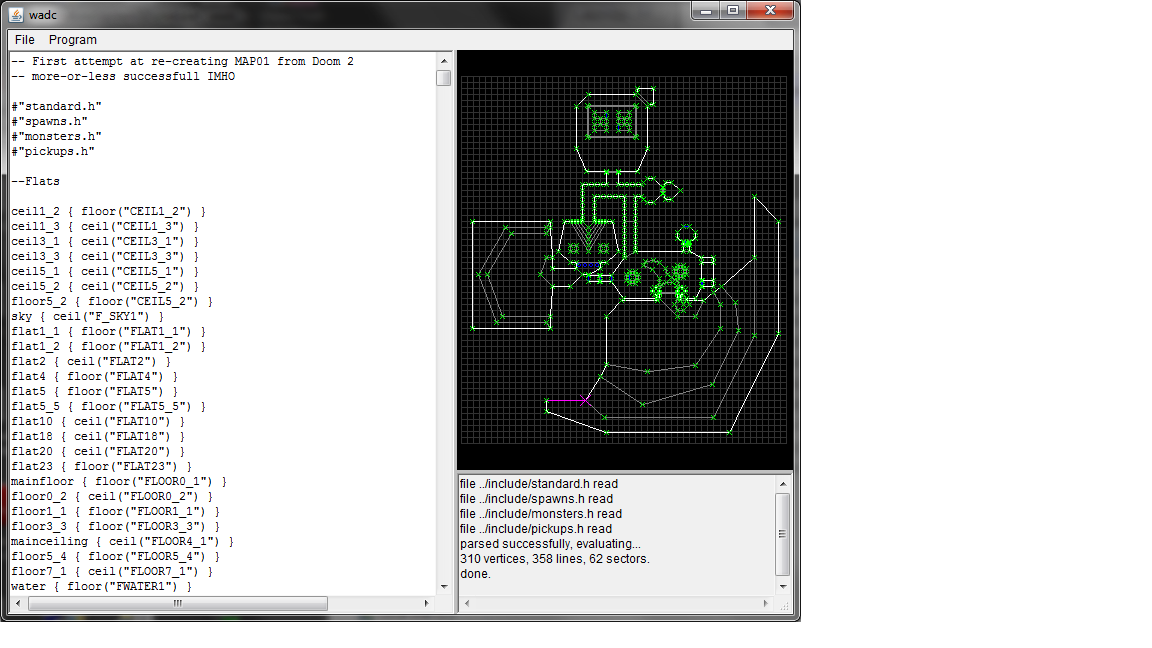
I'm happy to announce the release of wadc version 1.2.
A WadC session A WadC session
WadC is a functional programming language for the composition of Doom-format maps. Originally created by Wouter "Aardappel" van Oortmerssen, I was granted permission to take over the project over a year ago, but didn't get around to releasing anything until now. This version adds a few functions that permit you to draw two-sided lines which are textured and impassible: important for a lot of detailing techniques. You can also create friendly monsters for Boom-compatible ports. There's a new example demonstrating these features; plus a recreation of Doom 2's "entryway", courtesy of GreyGhost. See WadC for a summary, or go straight to the binaries or source on github. Discussions: reddit, doomworld.

17 December 2011

Lior Kaplan: Can t select my country on the Ubuntu installation map

In 1977 Tal Brody said after winning the Euroleague Basketball cup with Maccabi Tel Aviv as sentence which became quite famous in Israel:
We are on the map! And we are staying on the map not only in sports, but in everything.
I found out through Invar Hovav that there s a regression in the Ubuntu installation doesn t believe this is true anymore, as according to lp#905754, you can t select Israel or its major cities, and instead get suggestions for Gaza and Hebron. This is a regression from past installers when you could at least choose Tel Aviv, Jerusalem and Gaza. It used to be hard to pin point each location, but was still possible. This might be part of a bigger problem of selecting close/adjacent cities, but the default behavior in the past was different. From the technical point of view, the Gaza and Hebron TZ files are weird (tzdata version 2011n-1). Both don t have info for 2012 daylight saving time (usually start in late March or early April). Hebron switches twice a year to DST, hopefully nothing critical uses this time zone.
$ zdump -v Asia/Hebron grep 2011
Asia/Hebron Fri Apr 1 10:00:59 2011 UTC = Fri Apr 1 12:00:59 2011 EET isdst=0 gmtoff=7200
Asia/Hebron Fri Apr 1 10:01:00 2011 UTC = Fri Apr 1 13:01:00 2011 EEST isdst=1 gmtoff=10800
Asia/Hebron Sun Jul 31 20:59:59 2011 UTC = Sun Jul 31 23:59:59 2011 EEST isdst=1 gmtoff=10800
Asia/Hebron Sun Jul 31 21:00:00 2011 UTC = Sun Jul 31 23:00:00 2011 EET isdst=0 gmtoff=7200
Asia/Hebron Mon Aug 29 21:59:59 2011 UTC = Mon Aug 29 23:59:59 2011 EET isdst=0 gmtoff=7200
Asia/Hebron Mon Aug 29 22:00:00 2011 UTC = Tue Aug 30 01:00:00 2011 EEST isdst=1 gmtoff=10800
Asia/Hebron Thu Sep 29 23:59:59 2011 UTC = Fri Sep 30 02:59:59 2011 EEST isdst=1 gmtoff=10800
Asia/Hebron Fri Sep 30 00:00:00 2011 UTC = Fri Sep 30 02:00:00 2011 EET isdst=0 gmtoff=7200
And Gaza only have a 3 months daylight saving time, while Israel has 6 and European eastern time has 7 months (all are UTC+2 region).
$ zdump -v Asia/Gaza grep 2011
Asia/Gaza Sat Apr 2 10:00:59 2011 UTC = Sat Apr 2 12:00:59 2011 EET isdst=0 gmtoff=7200
Asia/Gaza Sat Apr 2 10:01:00 2011 UTC = Sat Apr 2 13:01:00 2011 EEST isdst=1 gmtoff=10800
Asia/Gaza Sun Jul 31 20:59:59 2011 UTC = Sun Jul 31 23:59:59 2011 EEST isdst=1 gmtoff=10800
Asia/Gaza Sun Jul 31 21:00:00 2011 UTC = Sun Jul 31 23:00:00 2011 EET isdst=0 gmtoff=7200
p.s.
This isn t a political post, don t make it into one.
Filed under: Debian GNU/Linux, Ubuntu

Next.

Previous.