Search Results: "cts"

22 July 2017

Niels Thykier: Improving bulk performance in debhelper

Since debhelper/10.3, there has been a number of performance related changes. The vast majority primarily improves bulk performance or only have visible effects at larger input sizes. Most visible cases are: For debhelper, this mostly involved: How to take advantage of these improvements in tools that use Dh_Lib: Credits: I would like to thank the following for reporting performance issues, regressions or/and providing patches. The list is in no particular order: Should I have missed your contribution, please do not hesitate to let me know.
Filed under: Debhelper, Debian

20 July 2017

Gunnar Wolf: Hey, everybody, come share the joy of work!

I got several interesting and useful replies, both via the blog and by personal email, to my two previous posts where I mentioned I would be starting a translation of the Made With Creative Commons book. It is my pleasure to say: Welcome everybody, come and share the joy of work! Some weeks ago, our project was accepted as part of Hosted Weblate, lowering the bar for any interested potential contributor. So, whoever wants to be a part of this: You just have to log in to Weblate (or create an account if needed), and start working! What is our current status? Amazingly better than anything I have exepcted: Not only we have made great progress in Spanish, reaching >28% of translated source strings, but also other people have started translating into Norwegian Bokm l (hi Petter!) and Dutch (hats off to Heimen Stoffels!). So far, Spanish (where Leo Arias and myself are working) is most active, but anything can happen. I still want to work a bit on the initial, pre-po4a text filtering, as there are a small number of issues to fix. But they are few and easy to spot, your translations will not be hampered much when I solve the missing pieces. So, go ahead and get to work! :-D Oh, and if you translate sizeable amounts of work into Spanish: As my university wants to publish (in paper) the resulting works, we would be most grateful if you can fill in the (needless! But still, they ask me to do this...) authorization for your work to be a part of a printed book.

Benjamin Mako Hill: Testing Our Theories About Eternal September

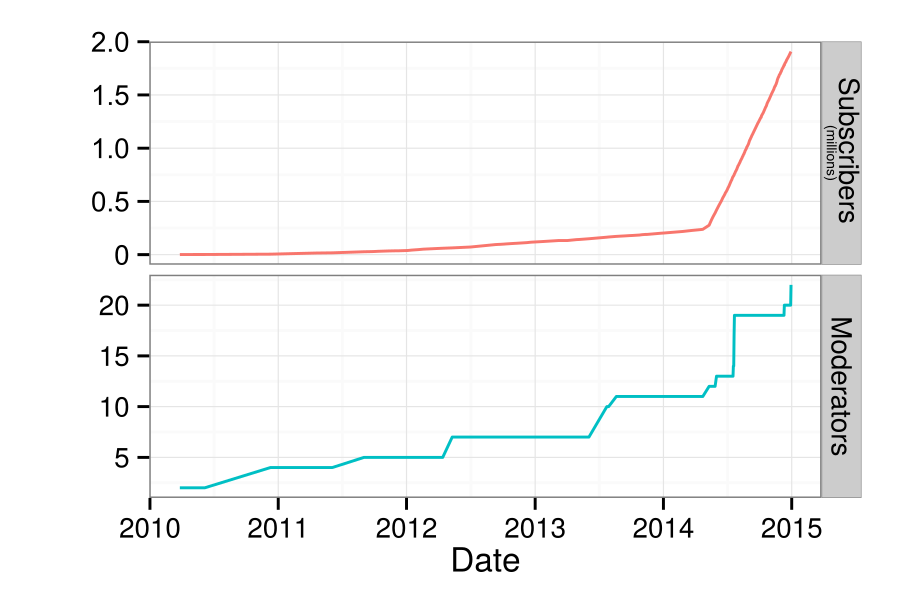
Graph of subscribers and moderators over time in /r/NoSleep. The image is taken from our 2016 CHI paper.
Last year at CHI 2016, my research group published a qualitative study examining the effects of a large influx of newcomers to the /r/nosleep online community in Reddit. Our study began with the observation that most research on sustained waves of newcomers focuses on the destructive effect of newcomers and frequently invokes Usenet s infamous Eternal September. Our qualitative study argued that the /r/nosleep community managed its surge of newcomers gracefully through strategic preparation by moderators, technological systems to reign in on norm violations, and a shared sense of protecting the community s immersive environment among participants. We are thrilled that, less a year after the publication of our study, Zhiyuan Jerry Lin and a group of researchers at Stanford have published a quantitative test of our study s findings! Lin analyzed 45 million comments and upvote patterns from 10 Reddit communities that a massive inundation of newcomers like the one we studied on /r/nosleep. Lin s group found that these communities retained their quality despite a slight dip in its initial growth period. Our team discussed doing a quantitative study like Lin s at some length and our paper ends with a lament that our findings merely reflected, propositions for testing in future work. Lin s study provides exactly such a test! Lin et al. s results suggest that our qualitative findings generalize and that sustained influx of newcomers need not doom a community to a descent into an Eternal September. Through strong moderation and the use of a voting system, the subreddits analyzed by Lin appear to retain their identities despite the surge of new users. There are always limits to research projects work quantitative and qualitative. We think the Lin s paper compliments ours beautifully, we are excited that Lin built on our work, and we re thrilled that our propositions seem to have held up! This blog post was written with Charlie Kiene. Our paper about /r/nosleep, written with Charlie Kiene and Andr s Monroy-Hern ndez, was published in the Proceedings of CHI 2016 and is released as open access. Lin s paper was published in the Proceedings of ICWSM 2017 and is also available online.

18 July 2017

Reproducible builds folks: Reproducible Builds: week 116 in Stretch cycle

Here's what happened in the Reproducible Builds effort between Sunday July 9 and Saturday July 15 2017: Packages reviewed and fixed, and bugs filed Reviews of unreproducible packages 13 package reviews have been added, 12 have been updated and 19 have been removed in this week, adding to our knowledge about identified issues. 2 issue types have been added: 3 issue types have been updated: Weekly QA work During our reproducibility testing, FTBFS bugs have been detected and reported by: diffoscope development Version 84 was uploaded to unstable by Mattia Rizzolo. It included contributions already reported from the previous weeks, as well as new ones: After the release, development continued in git with contributions from: strip-nondeterminism development Versions 0.036-1, 0.037-1 and 0.038-1 were uploaded to unstable by Chris Lamb. They included contributions from: reprotest development Development continued in git with contributions from: buildinfo.debian.net development tests.reproducible-builds.org Misc. This week's edition was written by Bernhard M. Wiedemann, Chris Lamb, Mattia Rizzolo, Vagrant Cascadian & reviewed by a bunch of Reproducible Builds folks on IRC & the mailing lists.

Matthew Garrett: Avoiding TPM PCR fragility using Secure Boot

In measured boot, each component of the boot process is "measured" (ie, hashed and that hash recorded) in a register in the Trusted Platform Module (TPM) build into the system. The TPM has several different registers (Platform Configuration Registers, or PCRs) which are typically used for different purposes - for instance, PCR0 contains measurements of various system firmware components, PCR2 contains any option ROMs, PCR4 contains information about the partition table and the bootloader. The allocation of these is defined by the PC Client working group of the Trusted Computing Group. However, once the boot loader takes over, we're outside the spec[1].

One important thing to note here is that the TPM doesn't actually have any ability to directly interfere with the boot process. If you try to boot modified code on a system, the TPM will contain different measurements but boot will still succeed. What the TPM can do is refuse to hand over secrets unless the measurements are correct. This allows for configurations where your disk encryption key can be stored in the TPM and then handed over automatically if the measurements are unaltered. If anybody interferes with your boot process then the measurements will be different, the TPM will refuse to hand over the key, your disk will remain encrypted and whoever's trying to compromise your machine will be sad.

The problem here is that a lot of things can affect the measurements. Upgrading your bootloader or kernel will do so. At that point if you reboot your disk fails to unlock and you become unhappy. To get around this your update system needs to notice that a new component is about to be installed, generate the new expected hashes and re-seal the secret to the TPM using the new hashes. If there are several different points in the update where this can happen, this can quite easily go wrong. And if it goes wrong, you're back to being unhappy.

Is there a way to improve this? Surprisingly, the answer is "yes" and the people to thank are Microsoft. Appendix A of a basically entirely unrelated spec defines a mechanism for storing the UEFI Secure Boot policy and used keys in PCR 7 of the TPM. The idea here is that you trust your OS vendor (since otherwise they could just backdoor your system anyway), so anything signed by your OS vendor is acceptable. If someone tries to boot something signed by a different vendor then PCR 7 will be different. If someone disables secure boot, PCR 7 will be different. If you upgrade your bootloader or kernel, PCR 7 will be the same. This simplifies things significantly.

I've put together a (not well-tested) patchset for Shim that adds support for including Shim's measurements in PCR 7. In conjunction with appropriate firmware, it should then be straightforward to seal secrets to PCR 7 and not worry about things breaking over system updates. This makes tying things like disk encryption keys to the TPM much more reasonable.

However, there's still one pretty major problem, which is that the initramfs (ie, the component responsible for setting up the disk encryption in the first place) isn't signed and isn't included in PCR 7[2]. An attacker can simply modify it to stash any TPM-backed secrets or mount the encrypted filesystem and then drop to a root prompt. This, uh, reduces the utility of the entire exercise.

The simplest solution to this that I've come up with depends on how Linux implements initramfs files. In its simplest form, an initramfs is just a cpio archive. In its slightly more complicated form, it's a compressed cpio archive. And in its peak form of evolution, it's a series of compressed cpio archives concatenated together. As the kernel reads each one in turn, it extracts it over the previous ones. That means that any files in the final archive will overwrite files of the same name in previous archives.

My proposal is to generate a small initramfs whose sole job is to get secrets from the TPM and stash them in the kernel keyring, and then measure an additional value into PCR 7 in order to ensure that the secrets can't be obtained again. Later disk encryption setup will then be able to set up dm-crypt using the secret already stored within the kernel. This small initramfs will be built into the signed kernel image, and the bootloader will be responsible for appending it to the end of any user-provided initramfs. This means that the TPM will only grant access to the secrets while trustworthy code is running - once the secret is in the kernel it will only be available for in-kernel use, and once PCR 7 has been modified the TPM won't give it to anyone else. A similar approach for some kernel command-line arguments (the kernel, module-init-tools and systemd all interpret the kernel command line left-to-right, with later arguments overriding earlier ones) would make it possible to ensure that certain kernel configuration options (such as the iommu) weren't overridable by an attacker.

There's obviously a few things that have to be done here (standardise how to embed such an initramfs in the kernel image, ensure that luks knows how to use the kernel keyring, teach all relevant bootloaders how to handle these images), but overall this should make it practical to use PCR 7 as a mechanism for supporting TPM-backed disk encryption secrets on Linux without introducing a hug support burden in the process.

[1] The patchset I've posted to add measured boot support to Grub use PCRs 8 and 9 to measure various components during the boot process, but other bootloaders may have different policies.

[2] This is because most Linux systems generate the initramfs locally rather than shipping it pre-built. It may also get rebuilt on various userspace updates, even if the kernel hasn't changed. Including it in PCR 7 would entirely break the fragility guarantees and defeat the point of all of this.

comment count unavailable comments

16 July 2017

Vasudev Kamath: Overriding version information from setup.py with pbr

I recently raised a pull request on zfec for converting its python packaging from pure setup.py to pbr based. Today I got review from Brian Warner and one of the issue mentioned was python setup.py --version is not giving same output as previous version of setup.py. Previous version used versioneer which extracts version information needed from VCS tags. Versioneer also provides flexibility of specifying type of VCS used, style of version, tag prefix (for VCS) etc. pbr also does extract version information from git tag but it expects git tag to be of format tags/refs/x.y.z format but zfec used a zfec- prefix to tag (example zfec-1.4.24) and pbr does not process this. End result, I get a version in format 0.0.devNN where NN is number of commits in the repository from its inception. Me and Brian spent few hours trying to figure out a way to tell pbr that we would like to override version information it auto deduces, but there was none other than putting version string in PBR_VERSION environment variable. That documentation was contributed by me 3 years back to pbr project. So finally I used versioneer to create a version string and put it in the environment variable PBR_VERSION.
import os
import versioneer
os.environ['PBR_VERSION'] = versioneer.get_version()
...
setup(
    setup_requires=['pbr'],
    pbr=True,
    ext_modules=extensions
)
And added below snippet to setup.cfg which is how versioneer can be configured with various information including tag prefixes.
[versioneer]
VCS = git
style = pep440
versionfile_source = zfec/_version.py
versionfile_build = zfec/_version.py
tag_prefix = zfec-
parentdir_prefix = zfec-
Though this work around gets the work done, it does not feel correct to set environment variable to change the logic of other part of same program. If you guys know the better way do let me know!. Also probably I should consider filing an feature request against pbr to provide a way to pass tag prefix for version calculation logic.

15 July 2017

Dirk Eddelbuettel: Rcpp 0.12.12: Rounding some corners

The twelveth update in the 0.12.* series of Rcpp landed on CRAN this morning, following two days of testing at CRAN preceded by five full reverse-depends checks we did (and which are always logged in this GitHub repo). The Debian package has been built and uploaded; Windows and macOS binaries should follow at CRAN as usual. This 0.12.12 release follows the 0.12.0 release from late July, the 0.12.1 release in September, the 0.12.2 release in November, the 0.12.3 release in January, the 0.12.4 release in March, the 0.12.5 release in May, the 0.12.6 release in July, the 0.12.7 release in September, the 0.12.8 release in November, the 0.12.9 release in January, the 0.12.10.release in March, and the 0.12.11.release in May making it the sixteenth release at the steady and predictable bi-montly release frequency. Rcpp has become the most popular way of enhancing GNU R with C or C++ code. As of today, 1097 packages (and hence 71 more since the last release in May) on CRAN depend on Rcpp for making analytical code go faster and further, along with another 91 in BioConductor. This releases contain a fairly large number of fairly small and focused pull requests most of which either correct some corner cases or improve other aspects. JJ tirelessly improved the package registration added in the previous release and following R 3.4.0. Kirill tidied up a number of small issues allowing us to run compilation in even more verbose modes---usually a good thing. Jeroen, Elias Pipping and Yo Gong all contributed as well, and we thank everybody for their contributions. All changes are listed below in some detail.

Changes in Rcpp version 0.12.12 (2017-07-13)
  • Changes in Rcpp API:
    • The tinyformat.h header now ends in a newline (#701).
    • Fixed rare protection error that occurred when fetching stack traces during the construction of an Rcpp exception (Kirill M ller in #706).
    • Compilation is now also possibly on Haiku-OS (Yo Gong in #708 addressing #707).
    • Dimension attributes are explicitly cast to int (Kirill M ller in #715).
    • Unused arguments are no longer declared (Kirill M ller in #716).
    • Visibility of exported functions is now supported via the R macro atttribute_visible (Jeroen Ooms in #720).
    • The no_init() constructor accepts R_xlen_t (Kirill M ller in #730).
    • Loop unrolling used R_xlen_t (Kirill M ller in #731).
    • Two unused-variables warnings are now avoided (Jeff Pollock in #732).
  • Changes in Rcpp Attributes:
    • Execute tools::package_native_routine_registration_skeleton within package rather than current working directory (JJ in #697).
    • The R portion no longer uses dir.exists to no require R 3.2.0 or newer (Elias Pipping in #698).
    • Fix native registration for exports with name attribute (JJ in #703 addressing #702).
    • Automatically register init functions for Rcpp Modules (JJ in #705 addressing #704).
    • Add Shield around parameters in Rcpp::interfaces (JJ in #713 addressing #712).
    • Replace dot (".") with underscore ("_") in package names when generating native routine registrations (JJ in #722 addressing #721).
    • Generate C++ native routines with underscore ("_") prefix to avoid exporting when standard exportPattern is used in NAMESPACE (JJ in #725 addressing #723).

Thanks to CRANberries, you can also look at a diff to the previous release. As always, even fuller details are on the Rcpp Changelog page and the Rcpp page which also leads to the downloads page, the browseable doxygen docs and zip files of doxygen output for the standard formats. A local directory has source and documentation too. Questions, comments etc should go to the rcpp-devel mailing list off the R-Forge page.

This post by Dirk Eddelbuettel originated on his Thinking inside the box blog. Please report excessive re-aggregation in third-party for-profit settings.

Vasudev Kamath: debcargo: Replacing subprocess crate with git2 crate

In my previous post I talked about using subprocess crate to extract beginning and ending year from git repository for generating debian/copyright file. In this post I'm going to talk on how I replaced subprocess with native git2 crate and achieved the same result in much cleaner and safer way. git2 is a native Rust crate which provides access to Git repository internals. git2 does not involve any unsafe invocation as it is built against libgit2-sys which is actually using Rust FFI to directly bind to underlying libgit library. Below is the new copyright_fromgit function with git2 crate.
fn copyright_fromgit(repo_url: &str) -> Result<String>  
   let tempdir = TempDir::new_in(".", "debcargo")?;
   let repo = Repository::clone(repo_url, tempdir.path())?;
   let mut revwalker = repo.revwalk()?;
   revwalker.push_head()?;
   // Get the latest and first commit id. This is bit ugly
   let latest_id = revwalker.next().unwrap()?;
   let first_id = revwalker.last().unwrap()?; // revwalker ends here is consumed by last
   let first_commit = repo.find_commit(first_id)?;
   let latest_commit = repo.find_commit(latest_id)?;
   let first_year =
       DateTime::<Utc>::from_utc(
               NaiveDateTime::from_timestamp(first_commit.time().seconds(), 0),
               Utc).year();
   let latest_year =
       DateTime::<Utc>::from_utc(
             NaiveDateTime::from_timestamp(latest_commit.time().seconds(), 0),
             Utc).year();
   let notice = match first_year.cmp(&latest_year)  
       Ordering::Equal => format!(" ", first_year),
       _ => format!(" - ,", first_year, latest_year),
    ;
   Ok(notice)
 
So here is what I'm doing
  1. Use git2::Repository::clone to clone the given URL. We are thus avoiding exec of git clone command.
  2. Get a revision walker object. git2::RevWalk implements Iterator trait and allows walking through the git history. This is what we are using to avoid exec of git log command.
  3. revwalker.push_head() is important because we want to tell revwalker from where we want to walk the history. In this case we are asking it to walk history from repository HEAD. Without this line next line will not work. (Learned it in hard way :-) ).
  4. Then we extract git2::Oid which is we can say similar to commit hash and can be used to lookup a particular commit. We take latest commit hash using RevWalk::next call and the first commit using Revwalk::last, note the order this is because Revwalk::last consumes the revwalker so doing it in reverse order will make borrow checker unhappy :-). This replaces exec of head -n1 command.
  5. Look up the git2::Commit objects using git2::Repository::find_commit
  6. Then convert the git2::Time to chrono::DateTime and take out the years.
After this change I found an obvious error which went unnoticed in previous version, that is if there was no repository key in Cargo.toml. When there was no repo URL git clone exec did not error out and our shell commands happily extracted year from the debcargo repository!. Well since I was testing code from debcargo repository It never failed, but when I executed from non-git repository folder git threw an error but that was git log and not git clone. This error was spotted right away because git2 threw me an error that I gave it empty URL. When it comes to performance I see that debcargo is faster compared to previous version. This makes sense because previously it was doing 5 fork and exec system calls and now that is avoided.

13 July 2017

Lars Wirzenius: Adding Yakking to Planet Debian

In a case of blatant self-promotion, I am going to add the Yakking RSS feed to the Planet Debian aggregation. (But really because I think some of the readership of Planet Debian may be interested in the content.) Yakking is a group blog by a few friends aimed at new free software contributors. From the front page description:
Welcome to Yakking. This is a blog for topics relevant to someone new to free software development. We assume you are already familiar with computers, and are curious about participating in the production of free software. You don't need to be a programmer: software development requires a wide variety of skills, and you can be a valued core contributor to a project without being a programmer.
If anyone objects, please let me know.

12 July 2017

Reproducible builds folks: Reproducible Builds: week 115 in Stretch cycle

Here's what happened in the Reproducible Builds effort between Sunday July 2 and Saturday July 8 2017: Reproducible work in other projects Ed Maste pointed to a thread on the LLVM developer mailing list about container iteration being the main source of non-determinism in LLVM, together with discussion on how to solve this. Ignoring build path issues, container iteration order was also the main issue with rustc, which was fixed by using a fixed-order hash map for certain compiler structures. (It was unclear from the thread whether LLVM's builds are truly path-independent or rather that they haven't done comparisons between builds run under different paths.) Bugs filed Patches submitted upstream: Reviews of unreproducible packages 52 package reviews have been added, 62 have been updated and 20 have been removed in this week, adding to our knowledge about identified issues. No issue types were updated or added this week. Weekly QA work During our reproducibility testing, FTBFS bugs have been detected and reported by: diffoscope development Development continued in git with contributions from: With these changes, we are able to generate a dynamically loaded HTML diff for GCC-6 that can be displayed in a normal web browser. For more details see this mailing list post. Misc. This week's edition was written by Ximin Luo, Bernhard M. Wiedemann and Chris Lamb & reviewed by a bunch of Reproducible Builds folks on IRC & the mailing lists.

11 July 2017

Andreas Bombe: PDP-8/e Replicated Overview

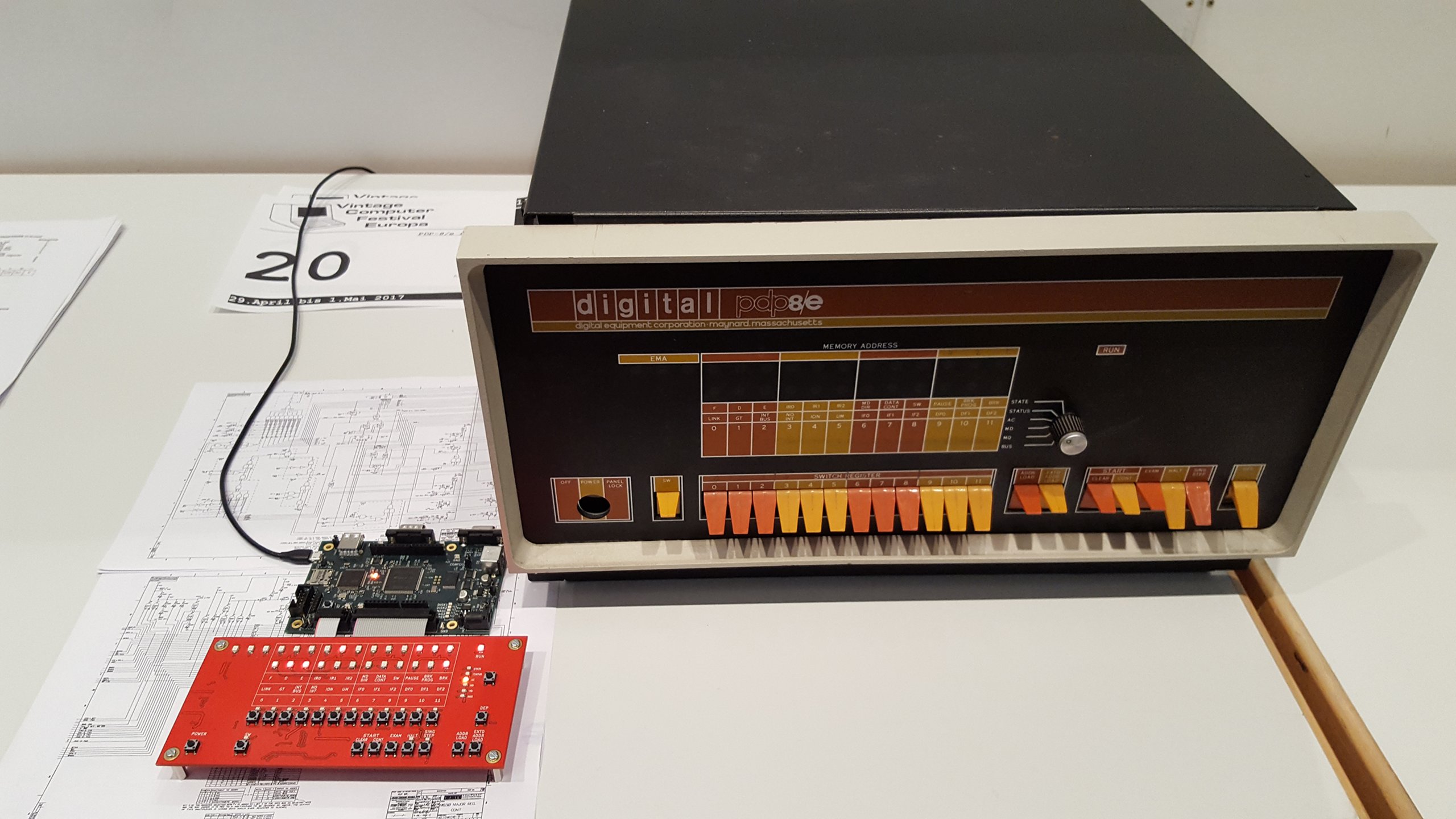
This is an overview of the hardware and internals of the PDP-8/e replica I m building.

The front panel board
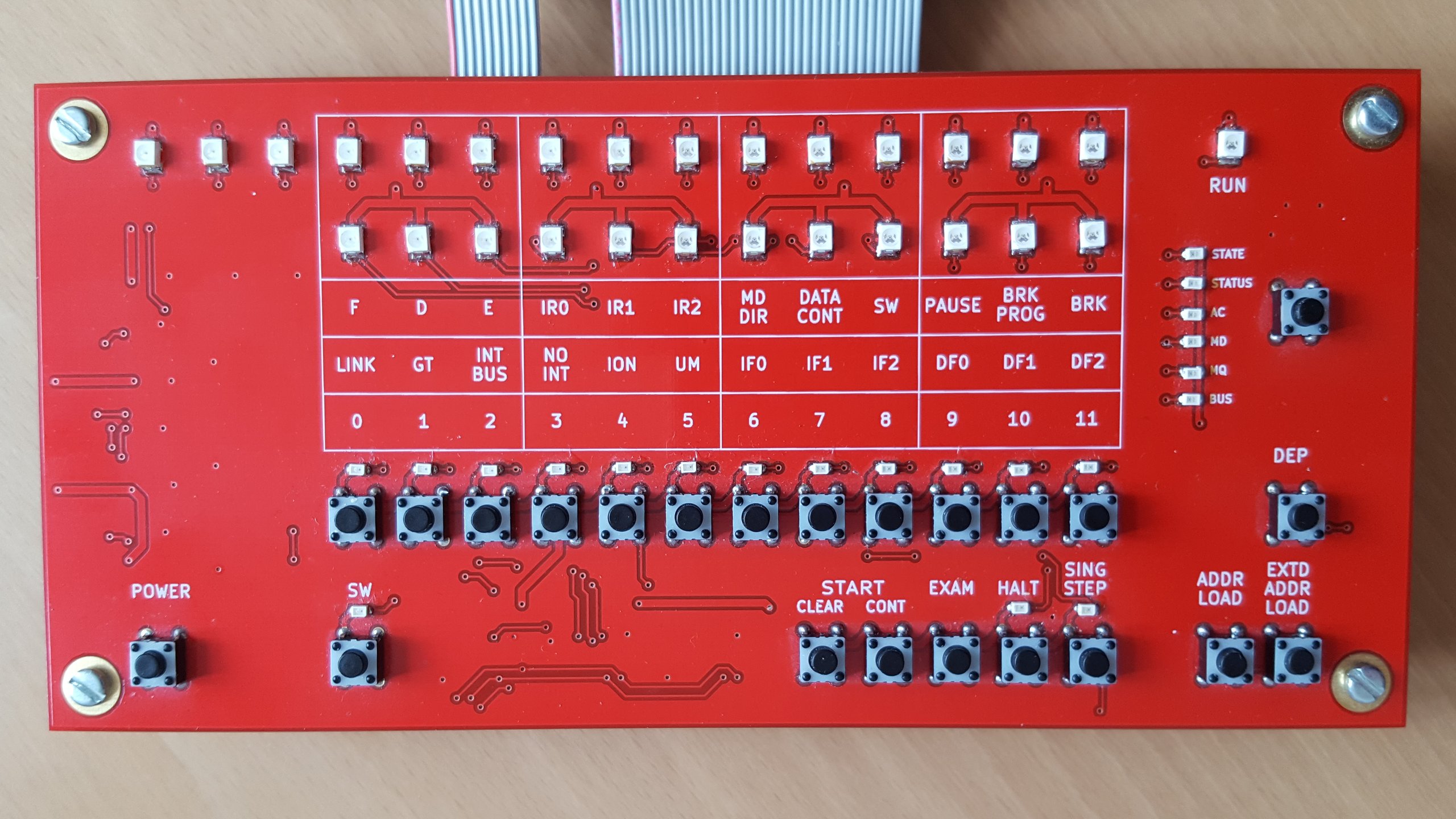
functional replica of the PDP-8/e front panel
If you know the original or remember the picture from the first post it is clear that this is a functional replica not aiming to be as pretty as those of the other projects I mentioned. I have reordered the switches into two rows to make the board more compact (which also means cheaper) without sacrificing usability. There s the two rows of display lights plus one run light the 8/e provides. The upper row is the address made up of 12 bits of memory address and 3 bits of extended memory address or field. Below are the 12 bits indicator which can show one data set out of six as selected by the user. All the switches of the original are implemented as more compact buttons1. While momentary switches are easily substituted by buttons, all buttons implementing two position switches toggle on/off with each press and they have a LED above that shows the current state. The six position rotary switch is implemented as a button cycling through all indicator displays together with six LEDs which show the active selection. Markings show the meaning of the indicator and switches as on the original, grouped in threes as the predominant numbering system for the PDPs was octal. The upper line shows the meaning for the state indicator, the middle for the status indicator and bit numbers for the rest. Note that on the PDP-8 and opposite to modern conventions, the most significant bit was numbered 0. I designed it as a pure front panel board without any PDP-8 simulation parts. The buttons and associated lights are controllable via SPI lines with a 3.3 V supply. The address and indicator lights have a separate common anode configuration with all cathodes individually available on a pin header without any resistors in the path, leaving voltage and current regulation up to the simulation board. This board is actually a few years old from a similar project where I emulated the PDP-8 in software on a microcontroller and the flexible design allowed me to reuse it unchanged.

The main board
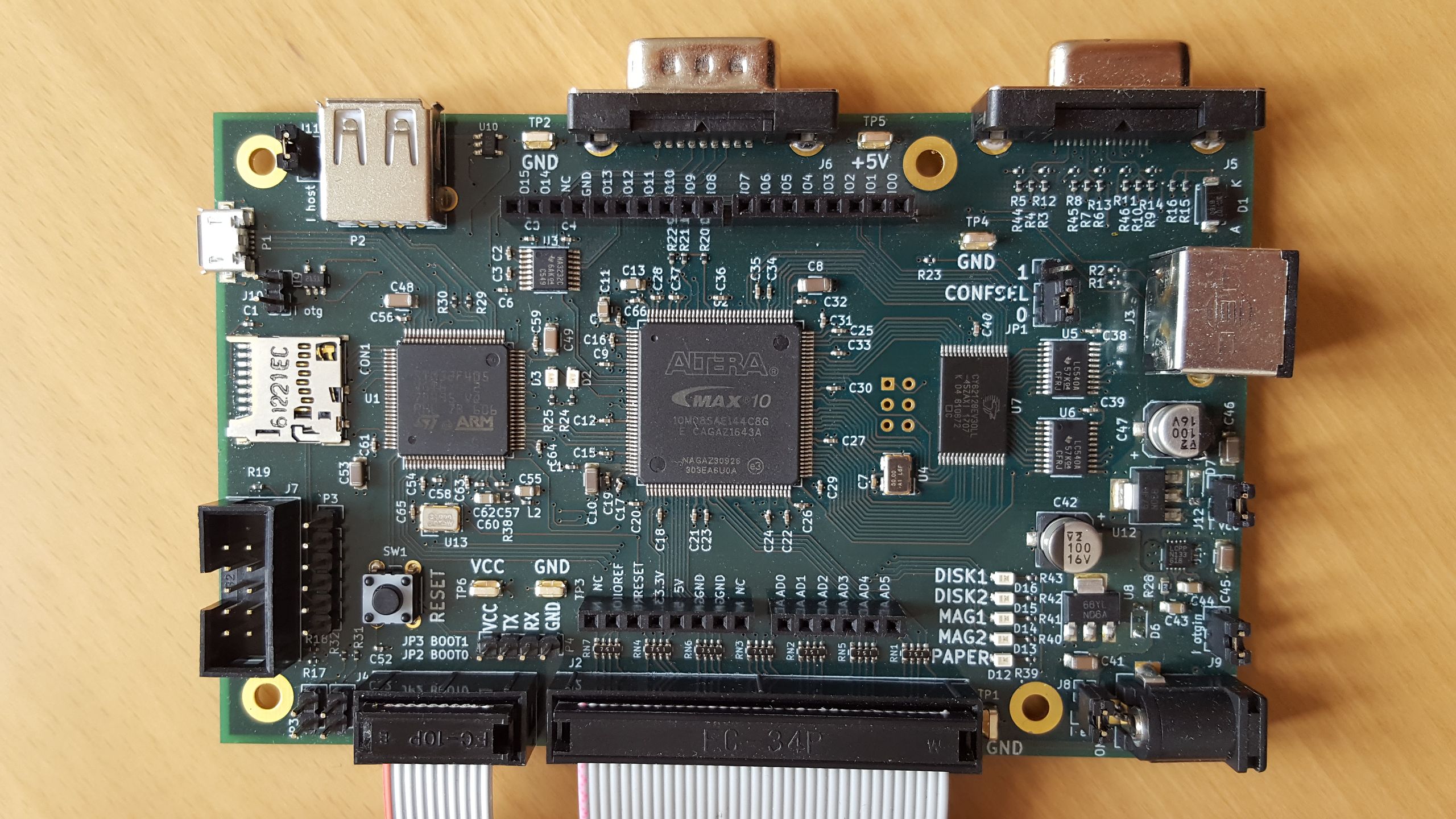
main board with CPU and peripherals of the replicated PDP-8/e
This is where the magic happens. You can see three big ICs on the board: On the left is the STM32F405 microcontroller (with ARM Cortex-M4 core), the bigger one in the middle is the Altera2 MAX 10 FPGA and finally to the right is the SRAM that is large enough to hold all the main memory of the 32 KW maximum expansion of the PDP-8/e. The two smaller chips to the right of that are just buffers that drive the front panel address LEDs, the small chip at the top left is a RS-232 level shifter. The idea behind this is that the PDP-8 and peripherals that are simple to directly implement, such as GPIO or a serial port, are fully on the FPGA. Other peripherals such as paper and magnetic tape and disks, which are after all not connected to real PDP-8 drives but disk images on a microSD, are implemented on the microcontroller interfacing with stub devices in the FPGA. Compared to implementing everything everything in the FPGA, the STM32F4 has the advantage of useful built in peripherals such as two host/device capable USB ports. 5 V tolerant I/O pins are very useful and simply not available in any FPGA. I have to admit that this board was a bit of a rush job in order to have something at all to show at the Vintage Computer Festival Europe 18.0. Given that it was my first time designing a board with a large microcontroller and the first time with an FPGA, it wasn t exactly my fastest progressing project either and I got basic functionality (front panel allows toggling in small programs and running them) working just in time. For various reasons the project hasn t progressed much since, so the following is still just plans, but plans for which the hardware was designed. Since the aim is to have a cycle accurate PDP-8/e implementation, digital I/O was always planned. Rather than defining my own header I have included Arduino R3 compatible headers (for 3.3 V compatible boards only) that have become a popular even outside the Arduino world for this purpose. The digital Arduino pins are connected directly to the FPGA and will be directly controllable by PDP-8 software. The downside of choosing the Arduino headers is that the original PDP-8 digital I/O interface is not a perfect match since it naturally has 12 lines whereas the Arduino has 15. The analog inputs are not connected to the FPGA, the documentation of the MAX10 s ADC in the EQFP package are not very encouraging. They are connected to the STM32 instead3. Another interface connected directly to the FPGA and that would be directly under PDP-8 control is a standard 9 pin RS-232 interface. RX, TX, CTS and RTS are connected and level-shifted between 3.3 V and RS-232 levels by a MAX3232. Besides the PDP-8, I also plan to implement a full video terminal on the board. The idea is that with a power supply, keyboard and monitor this board would form a complete system without the need of connecting another computer to act as a terminal. To that end, there is a VGA port attached to the FPGA with simple resistor network DACs for 9 bits color (RGB with 3 bits each). This is another spot where I left myself room to expand, for e.g. a VT220 you really only need one color in two brightness levels. Keyboards will be connected either via the PS/2 connector on the right or the USB-A host port at the top left. Last of the interface ports is the USB micro-AB port on the left, which for now I am using only for power supply. I mainly plan to use it to provide alternative or additional serial ports to the PDP-8 or to export the video terminal serial port for testing purposes. Other possible uses are access to the image files on the microSD and firmware updates. This has gotten rather long again, so I m stopping here and leave some implementation notes for another post.

  1. They are also much cheaper. Given the large number of switches, the savings are substantial. Additionaly the buttons are nicer to operate than long rows of tiny switches. [return]
  2. Or rather Intel now. At least Altera s web site, documentation and software have already been thoroughly rebranded, but the chips I got were produced prior to that. [return]
  3. That s not to say that the analog conversions on the STM32 are necessarily better than those of the MAX10 when you can t follow their guidelines, I have no comparisons. Certainly following the guidelines would have been prohibitive given how many pins usage they restrict. [return]

9 July 2017

Steinar H. Gunderson: Nageru 1.6.1 released

I've released version 1.6.1 of Nageru, my live video mixer. Now that Solskogen is coming up, there's been a lot of activity on the Nageru front, but hopefully everything is actually coming together now. Testing has been good, but we'll see whether it stands up to the battle-hardening of the real world or not. Hopefully I won't be needing any last-minute patches. :-) Besides the previously promised Prometheus metrics (1.6.1 ships with a rather extensive set, as well as an example Grafana dashboard) and frame queue management improvements, a surprising late addition was that of a new transcoder called Kaeru (following the naming style of Nageru itself, from the japanese verb kaeru ( ) which means roughly to replace or excahnge iKnow! claims it can also mean convert , but I haven't seen support for this anywhere else). Normally, when I do streams, I just let Nageru do its thing and send out a single 720p60 stream (occasionally 1080p), usually around 5 Mbit/sec; less than that doesn't really give good enough quality for the high-movement scenarios I'm after. But Solskogen is different in that there's a pretty diverse audience when it comes to networking conditions; even though I have a few mirrors spread around the world (and some JavaScript to automatically pick the fastest one; DNS round-robin is really quite useless here!), not all viewers can sustain such a bitrate. Thus, there's also a 480p variant with around 1 Mbit/sec or so, and it needs to come from somewhere. Traditionally, I've been using VLC for this, but streaming is really a niche thing for VLC. I've been told it will be an increased focus for 4.0 now that 3.0 is getting out the door, but over the last few years, there's been a constant trickle of little issues that have been breaking my transcoding pipeline. My solution for this was to simply never update VLC, but now that I'm up to stretch, this didn't really work anymore, and I'd been toying around with the idea of making a standalone transcoder for a while. (You'd ask why not the ffmpeg(1) command-line client? , but it's a bit too centered around files and not streams; I use it for converting to HLS for iOS devices, but it has a nasty habit of I/O blocking real work, and its HTTP server really isn't meant for production work. I could survive the latter if it supported Metacube and I could feed it into Cubemap, but it doesn't.) It turned out Nageru had already grown most of the pieces I needed; it had video decoding through FFmpeg, x264 encoding with speed control (so that it automatically picks the best preset the machine can sustain at any given time) and muxing, audio encoding, proper threading everywhere, and a usable HTTP server that could output Metacube. All that was required was to add audio decoding to the FFmpeg input, and then replace the GPU-based mixer and GUI with a very simple driver that just connects the decoders to the encoders. (This means it runs fine on a headless server with no GPU, but it also means you'll get FFmpeg's scaling, which isn't as pretty or fast as Nageru's. I think it's an okay tradeoff.) All in all, this was only about 250 lines of delta, which pales compared to the ~28000 lines of delta that are between 1.3.1 (used for last Solskogen) and 1.6.1. It only supports a rather limited set of Prometheus metrics, and it has some limitations, but it seems to be stable and deliver pretty good quality. I've denoted it experimental for now, but overall, I'm quite happy with how it turned out, and I'll be using it for Solskogen. Nageru 1.6.1 is on its way into Debian, but it depends on a new version of Movit which needs to go through the NEW queue (a soname bump), so it might be a few days. In the meantime, I'll be busy preparing for Solskogen. :-)

8 July 2017

Daniel Silverstone: Gitano - Approaching Release - Access Control Changes

As mentioned previously I am working toward getting Gitano into Stretch. A colleague and friend of mine (Richard Maw) did a large pile of work on Lace to support what we are calling sub-defines. These let us simplify Gitano's ACL files, particularly for individual projects. In this posting, I'd like to cover what has changed with the access control support in Gitano, so if you've never used it then some of this may make little sense. Later on, I'll be looking at some better user documentation in conjunction with another friend of mine (Lars Wirzenius) who has promised to help produce a basic administration manual before Stretch is totally frozen.

Sub-defines With a more modern lace (version 1.3 or later) there is a mechanism we are calling 'sub-defines'. Previously if you wanted to write a ruleset which said something like "Allow Steve to read my repository" you needed:
define is_steve user exact steve
allow "Steve can read my repo" is_steve op_read
And, as you'd expect, if you also wanted to grant read access to Jeff then you'd need yet set of defines:
define is_jeff user exact jeff
define is_steve user exact steve
define readers anyof is_jeff is_steve
allow "Steve and Jeff can read my repo" readers op_read
This, while flexible (and still entirely acceptable) is wordy for small rulesets and so we added sub-defines to create this syntax:
allow "Steve and Jeff can read my repo" op_read [anyof [user exact jeff] [user exact steve]]
Of course, this is generally neater for simpler rules, if you wanted to add another user then it might make sense to go for:
define readers anyof [user exact jeff] [user exact steve] [user exact susan]
allow "My friends can read my repo" op_read readers
The nice thing about this sub-define syntax is that it's basically usable anywhere you'd use the name of a previously defined thing, they're compiled in much the same way, and Richard worked hard to get good error messages out from them just in case.

No more auto_user_XXX and auto_group_YYY As a result of the above being implemented, the support Gitano previously grew for automatically defining users and groups has been removed. The approach we took was pretty inflexible and risked compilation errors if a user was deleted or renamed, and so the sub-define approach is much much better. If you currently use auto_user_XXX or auto_group_YYY in your rulesets then your upgrade path isn't bumpless but it should be fairly simple:
  1. Upgrade your version of lace to 1.3
  2. Replace any auto_user_FOO with [user exact FOO] and similarly for any auto_group_BAR to [group exact BAR].
  3. You can now upgrade Gitano safely.

No more 'basic' matches Since Gitano first gained support for ACLs using Lace, we had a mechanism called 'simple match' for basic inputs such as groups, usernames, repo names, ref names, etc. Simple matches looked like user FOO or group !BAR. The match syntax grew more and more arcane as we added Lua pattern support refs ~^refs/heads/$ user /. When we wanted to add proper PCRE regex support we added a syntax of the form: user pcre ^/.+?... where pcre could be any of: exact, prefix, suffix, pattern, or pcre. We had a complex set of rules for exactly what the sigils at the start of the match string might mean in what order, and it was getting unwieldy. To simplify matters, none of the "backward compatibility" remains in Gitano. You instead MUST use the what how with match form. To make this slightly more natural to use, we have added a bunch of aliases: is for exact, starts and startswith for prefix, and ends and endswith for suffix. In addition, kind of match can be prefixed with a ! to invert it, and for natural looking rules not is an alias for !is. This means that your rulesets MUST be updated to support the more explicit syntax before you update Gitano, or else nothing will compile. Fortunately this form has been supported for a long time, so you can do this in three steps.
  1. Update your gitano-admin.git global ruleset. For example, the old form of the defines used to contain define is_gitano_ref ref ~^refs/gitano/ which can trivially be replaced with: define is_gitano_ref ref prefix refs/gitano/
  2. Update any non-zero rulesets your projects might have.
  3. You can now safely update Gitano
If you want a reference for making those changes, you can look at the Gitano skeleton ruleset which can be found at https://git.gitano.org.uk/gitano.git/tree/skel/gitano-admin/rules/ or in /usr/share/gitano if Gitano is installed on your local system. Next time, I'll likely talk about the deprecated commands which are no longer in Gitano, and how you'll need to adjust your automation to use the new commands.

6 July 2017

Thadeu Lima de Souza Cascardo: News on Debian on apexqtmo

I had been using my Samsung Galaxy S Relay 4G for almost three years when I decided to get a new phone. I would use this new phone for daily tasks and take the chance to get a new model for hacking in the future. My apexqtmo would still be my companion and would now be more available for real hacking. And so it also happened that its power button got stuck. It was not the first time, but now it would happen every so often, and would require me to disassemble it. So I managed to remove the plastic button and leave it with a hole so I could press the button with a screwdriver or a paperclip. That was the excuse I needed to get it to running Debian only. Though it's now always plugged on my laptop, I got the chance to hack on it on my scarce free time. As I managed to get a kernel I built myself running on it, I started fixing things like enabling devtmpfs. I didn't insist much on running systemd, though, and kept with System V. The Xorg issues were either on the server or the client, depending on which client I ran. I decided to give a chance to running the Android userspace on a chroot, but gave up after some work to get some firmware loaded. I managed to get the ALSA controls right after saving them inside a chroot on my CyanogenMod system. Then, restoring them on Debian allowed to play songs. Unfortunately, it seems I broke the audio jack when disassembling it. Otherwise, it would have been a great portable audio player. I even wrote a small program that would allow me to control mpd by swiping on the touchscreen. Then, as Debian release approached, I decided to investigate the framebuffer issue closely. I ended finding out that it was really a bug in the driver, and after fixing it, the X server and client crashes were gone. It was beautiful to get some desktop environment running with the right colors, get a calculator started and really using the phone as a mobile device. There are two lessons or findings here for me. The first one is that the current environments are really lacking. Even something like GPE can't work. The buttons are tiny, scrollbars are still the only way for scrolling, some of the time. No automatic virtual keyboards. So, there needs to be some investing in the existing environments, and maybe even the development of new environments for these kinds of devices. This was something I expected somehow, but it's still disappointing to know that we had so much of those developed in the past and now gone. I really miss Maemo. Running something like Qtopia would mean grabing a very old unmaintained software not available in Debian. There is still matchbox, but it's as subpar as the others I tested. The second lesson is that building a userspace to run on old kernels will still hit the problem of broken drivers. In my particular case, unless I wrote code for using Ion instead of the framebuffer, I would have had that problem. Or it would require me to add code to xorg-xserver that is not appropriate. Or fix the kernel drivers of available kernel sourcecodes. But this does not scale much more than doing the right thing and adding upstream support for these devices. So, I decided it was time I started working on upstream support for my device. I have it in progress and may send some upstream patches soon. I have USB and MMC/SDcard working fine. DRM is still a challenge, but thanks to Rob Clark, it's something I expect to get working soon, and after that, I would certainly celebrate. Maybe even consider starting the work on other devices a little sooner. Trying to review my post on GNU on smartphones, here is where I would put some of the status of my device and some extra notes. On Halium I am really glad people started this project. This was one of the things I criticized: that though Ubuntu Phone and FirefoxOS built on Android userspace, they were not easily portable to many devices out there. But as I am looking for a more pure GNU experience, let's call it that, Halium does not help much in that direction. But I'd like to see it flourish and allow people to use more OSes on more devices. Unfortunately, it suffers from similar problems as the strategy I was trying to go with. If you have a device with a very old kernel, you won't be able to run some of the latest userspace, even with Android userspace help. So, lots of devices would be left unsupported, unless we start working on some upstream support. On RYF Hardware My device is one of the worst out there. It's a modem that has a peripherical CPU. Much has already been said about Qualcomm chips being some of the least freedom-friendly. Ironically, it's some with the best upstream support, as far as I found out while doing this upstreaming work. Guess we'll have to wait for opencores, openrisc and risc-v to catch up here. Diversity Though I have been experimenting with Debian, the upstream work would sure benefit lots of other OSes out there, mainly GNU+Linux based ones, but also other non-GNU Linux based ones. Not so much for other kernels. On other options After the demise of Ubuntu Phone, I am glad to see UBports catching up. I hope the project is sustainable and produce more releases for more devices. Rooting This needs documentation. Most of the procedures rely on booting a recovery system, which means we are already past the root requirement. We simply boot our own system, then. However, for some debugging strategies, getting root on the OEM system is useful. So, try to get root on your system, but beware of malware out there. Booting Most of these devices will have their bootloaders in there. They may be unlocked, allowing unsigned kernels to be booted. Replacing these bootloaders is still going to be a challenge for another future phase. Though adding a second bootloader there, one that is freedom respecting, and that allows more control on that booting step to the user is something possible once you have some good upstream support. One could either use kexec for that, or try to use the same device tree for U-Boot, and use the knowledge of the device drivers for Linux on writing drivers for U-Boot, GRUB or Libreboot. Installation If you have root on your OEM system, this is something that could be worked on. Otherwise, there is magic-device-tool, whose approach is one that could be used. Kernels While I am working on adding Linux upstream support for my device, it would be wonderful to see more kernels supporting those gadgets. Hopefully, some of the device driver writing and reverse engineering could help with that, though I am not too much optimistic. But there is hope. Basic kernel drivers Adding the basic support, like USB and MMC, after clocks, gpios, regulators and what not, is the first step to a long road. But it would allow using the device as a board computer, under better control of the user. Hopefully, lots of eletronic garbage out there would have some use as control gadgets. Instead of buying a new board, just grab your old phone and put it to some nice use. Sensors, input devices, LEDs There are usually easy too. Some sensors may depend on your modem or some userspace code that is not that easily reverse engineered. But others would just require some device tree work, or some small input driver. Graphics Here, things may get complicated. Even basic video output is something I have some trouble with. Thanks to some other people's work, I have hope at least for my device. And using the vendor's linux source code, some framebuffer should be possible, even some DRM driver. But OpenGL or other 3D acceleration support requires much more work than that, and, at this moment, it's not something I am counting on. I am thankful for the work lots of people have been doing on this area, nonetheless. Wireless Be it Wifi or Bluetooth, things get ugly here. The vendor driver might be available. Rewriting it would take a long time. Even then, it would most likely require some non-free firmware loading. Using USB OTG here might be an option. Modem/GSM The work of the Replicant folks on that is what gives me some hope that it might be possible to get this working. Something I would leave to after I have a good interface experience in my hands. GPS Problem is similar to the Modem/GSM one, as some code lives in userspace, sometimes talking to the modem is a requirement to get GPS access, etc. Shells This is where I would like to see new projects, even if they work on current software to get them more friendly to these form factors. I consider doing some work there, though that's not really my area of expertise. Next steps For me, my next steps are getting what I have working upstream, keep working on DRM support, packaging GPE, then experimenting with some compositor code. In the middle of that, trying to get some other devices started. But documenting some of my work is something I realized I need to do more often, and this post is some try on that.

5 July 2017

Yakking: Open your minds, and your data (formats)

Whether I am writing my own program, or chosing between existing solutions, one aspect of the decision making process which always weighs heavily on my mind is that of the input and output data formats. I have been spending a lot of my work days recently working on converting data from a proprietary tool's export format into another tool's input format. This has involved a lot of XML diving, a lot more swearing, and a non-trivial amount of pain. This drove home to me once more that the format of input and output of data is such a critical part of software tooling that it must weigh as heavily as, or perhaps even more heavily than, the software's functionality. As Tannenbaum tells us, the great thing about standards is that there's so many of them to choose from. XKCD tells us, how that comes about. Data formats are many and varied, and suffer from specifications as vague as "plain text" to things as complex as the structure of data stored in custom database formats. If you find yourself writing software which requires a brand new data format then, while I might caution you to examine carefully if it really does need a new format, you should ensure that you document the format carefully and precisely. Ideally give your format specification to a third party and get them to implement a reader and writer for your format, so that they can check that you've not missed anything. Tests and normative implementations can help prop up such an endeavour admirably. Be sceptical of data formats which have "implementation specific" areas, or "vendor specific extension" space because this is where everyone will put the most important and useful data. Do not put such beasts into your format design. If you worry that you've made your design too limiting, deal with that after you have implemented your use-cases for the data format. Don't be afraid to version the format and extend later; but always ensure that a given version of the data format is well understood; and document what it means to be presented with data in a format version you do not normally process. Phew.
Given all that, I exhort you to consider carefully how your projects manage their input and output data, and for these things to be uppermost when you are choosing between different solutions to a problem at hand. Your homework is, as you may have grown to anticipate at this time, to look at your existing projects and check that their input and output data formats are well documented if appropriate.

4 July 2017

Rapha&#235;l Hertzog: My Free Software Activities in June 2017

My monthly report covers a large part of what I have been doing in the free software world. I write it for my donors (thanks to them!) but also for the wider Debian community because it can give ideas to newcomers and it s one of the best ways to find volunteers to work with me on projects that matter to me. Debian LTS I was allocated 12 hours to work on security updates for Debian 7 Wheezy. During this time I did the following: Debian packaging Django. A last-minute update to Django in stretch before the release, I uploaded python-django 1:1.10.7-2 fixing two bugs (among which one was release critical) and filed the corresponding unblock request. schroot. I tried to prepare another last-minute update, this time for schroot. The goal was to fix the bash completion (#855283) and a problem encountered by the Debian sysadmins (#835104). Those issues are fixed in unstable/testing but my unblock request got turned into a post-release stretch update because the release managers wanted to give the package some more testing time in unstable. Even now, they are wondering whether they should accept the new systemd service file. live-build, live-config and live-boot. On live-build, I merged a patch to add a keyboard shortcut for the advanced option menu entry (#864386). For live-config, I uploaded version 5.20170623 to fix a broken boot sequence when you have multiple partitions (#827665). For live-boot, I uploaded version 1:20170623 to fix the path to udevadm (#852570) and avoiding a file duplication in the initrd (864385). zim. I packaged a release candidate (0.67~rc2) in Debian Experimental and started to use it. I quickly discovered two annoying regressions that I reported upstream (here and here). logidee-tools. This is a package I authored a long time ago and that I m no longer actively using. It does still work but I sometimes wonder if it still has real users. Anyway I wanted to quickly replace the broken dependency on pgf but I ended up converting the Subversion repository to Git and I also added autopkgtests. At least those tests will inform me when the package no longer works otherwise I would not notice since I m no longer using it. Bugs filed. I filed #865531 on lintian because the new check testsuite-autopkgtest-missing is giving some bad advice and probably does its check in a bad way. I also filed #865541 on sbuild because sbuild --apt-distupgrade can under some circumstances remove build-essential and break the build chroot. I filed an upstream ticket on publican to forward the request I received in #864648. Sponsorship. I sponsored a jessie update for php-tcpdf (#814030) and dolibarr 5.0.4+dfsg3-1 for unstable. I sponsored many other packages, but all in the context of the pkg-security team. pkg-security work Now that the Stretch freeze is over, the team became more active again and I have been overwhelmed with the number of packages to review and sponsor: I also updated hashcat to a new upstream release (3.6.0) and had to discuss with upstream about its weird versioning change. Looks like we will have to introduce an epoch to be able to get back in sync with upstream.  To be able to get in sync with Kali, I introduced an hashcat-meta source package (in contrib) providing hashcat-nvidia to make it easy to install hashcat for owners of NVidia hardware. Misc stuff Distro Tracker. I merged a small CSS fix from Aur lien Couderc (#858101) and added a missing constraint on the data model (found through an unexpected traceback that I received by email). I also updated the list of repositories shortly after the stretch release (#865070). Salt formulas. As part of my Kali work, I did setup a build daemon on Debian stretch host and I encountered a couple of issues with my Salt rules. I reported one against salt-formula (here) and I pushed updates for debootstrap-formula, apache-formula and schroot-formula. Thanks See you next month for a new summary of my activities.

No comment Liked this article? Click here. My blog is Flattr-enabled.

3 July 2017

Vincent Bernat: Performance progression of IPv4 route lookup on Linux

TL;DR: Each of Linux 2.6.39, 3.6 and 4.0 brings notable performance improvements for the IPv4 route lookup process.
In a previous article, I explained how Linux implements an IPv4 routing table with compressed tries to offer excellent lookup times. The following graph shows the performance progression of Linux through history: IPv4 route lookup performance Two scenarios are tested: All kernels are compiled with GCC 4.9 (from Debian Jessie). This version is able to compile older kernels1 as well as current ones. The kernel configuration used is the default one with CONFIG_SMP and CONFIG_IP_MULTIPLE_TABLES options enabled (however, no IP rules are used). Some other unrelated options are enabled to be able to boot them in a virtual machine and run the benchmark. The measurements are done in a virtual machine with one vCPU2. The host is an Intel Core i5-4670K and the CPU governor was set to performance . The benchmark is single-threaded. Implemented as a kernel module, it calls fib_lookup() with various destinations in 100,000 timed iterations and keeps the median. Timings of individual runs are computed from the TSC (and converted to nanoseconds by assuming a constant clock). The following kernel versions bring a notable performance improvement:

  1. Compiling old kernels with an updated userland may still require some small patches.
  2. The kernels are compiled with the CONFIG_SMP option to use the hierarchical RCU and activate more of the same code paths as actual routers. However, progress on parallelism are left unnoticed.

1 July 2017

Russ Allbery: Review: Make It Stick

Review: Make It Stick, by Peter C. Brown, et al.
Author: Peter C. Brown
Author: Henry L. Roediger III
Author: Mark A. McDaniel
Publisher: Belknap Press
Copyright: 2014
ISBN: 0-674-72901-3
Format: Kindle
Pages: 255
Another read for the work book club. "People generally are going about learning in the wrong ways." This is the first sentence of the preface of this book by two scientists (Roediger and McDaniel are both psychology researchers specializing in memory) and a novelist and former management consultant (Brown). The goal of Make It Stick is to apply empirical scientific research to the problem of learning, specifically retention of information for long-term use. The authors aim to convince the reader that subjective impressions of the effectiveness of study habits are highly deceptive, and that scientific evidence points strongly towards mildly counter-intuitive learning methods that don't feel like they're producing as good of results. I have such profound mixed feelings about this book. Let's start with the good. Make It Stick is a book containing actual science. The authors quote the studies, results, and scientific argument at length. There are copious footnotes and an index, as well as recommended reading. And the science is concrete and believable, as is the overlaid interpretation based on cognitive and memory research. The book's primary argument is that short-term and long-term memory are very different things, that what we're trying to achieve when we say "learning" is based heavily on long-term memory and recall of facts for an extended time after study, and that building this type of recall requires not letting our short-term memory do all the work. We tend towards study patterns that show obvious short-term improvement and that produce an increased feeling of effortless recall of the material, but those study patterns are training short-term memory and mean the knowledge slips away quickly. Choosing learning methods that instead make us struggle a little with what we're learning are significantly better. It's that struggle that leads to committing the material to long-term memory and building good recall pathways for it. On top of this convincingly-presented foundation, the authors walk through learning methods that feel worse in the moment but have better long-term effects: mixing practice of different related things (different types of solids when doing geometry problems, different pitches in batting practice) and switching types before you've mastered the one you're working on, forcing yourself to interpret and analyze material (such as writing a few paragraphs of summary in your own words) instead of re-reading it, and practicing material at spaced intervals far enough apart that you've forgotten some of the material and have to struggle to recall it. Possibly the most useful insight here (at least for me) was the role of testing in learning, not as just a way of measuring progress, but as a learning tool. Frequent, spaced, cumulative testing forces exactly the type of recall that builds long-term memory. The tests themselves help improve our retention of what we're learning. It's bad news for people like me who were delighted to leave school and not have to take a test again, but viewing tests as a more effective learning tool than re-reading and review (which they are) does cast them in a far more positive light. This is all solid stuff, and I'm very glad the research underlying this book exists and that I now know about it. But there are some significant problems with its presentation. The first is that there just isn't much here. The two long paragraphs above summarize nearly all of the useful content of this book. The authors certainly provide more elaboration, and I haven't talked about all of the study methods they mention or some of the useful examples of their application. But 80% of it is there, and the book is intentionally repetitive (because it tries to follow the authors' advice on learning theory). Make It Stick therefore becomes tedious and boring, particularly in the first four chapters. I was saying a lot of "yes, yes, you said that already" and falling asleep while trying to read it. The summaries at the end of the book are a bit better, but you will probably not need most of this book to get the core ideas. And then there's chapter five, which ends in a train wreck. Chapter five is on cognitive biases, and I see why the authors wanted to include it. The Dunning-Kruger effect is directly relevant to their topic. It undermines our ability to learn, and is yet another thing that testing helps avoid. Their discussion of Daniel Kahneman's two system theory (your fast, automatic, subconscious reactions and your slow, thoughtful, conscious processing) is somewhat less directly relevant, but it's interesting stuff, and it's at least somewhat related to the short-term and long-term memory dichotomy. But some of the stories they choose to use to illustrate this are... deeply unfortunate. Specifically, the authors decided to use US police work in multiple places as their example of choice for two-system thinking, and treat it completely uncritically. Some of you are probably already wincing because you can see where this is going. They interview a cop who, during scenario training for traffic stops, was surprised by the car trunk popping open and a man armed with a shotgun popping out of it. To this day, he still presses down on the trunk of the car as he walks up; it's become part of his checklist for every traffic stop. This would be a good example if the authors realized how badly his training has failed and deconstructed it, but they're apparently oblivious. I wanted to reach into the book and shake them. People have a limited number of things they can track and follow as part of a procedure, and some bad trainer has completely wasted part of this cop's attention in every traffic stop and thereby made him less safe! Just calculate the chances that someone would be curled up in an unlocked trunk with a shotgun and a cop would just happen to stop that car for some random reason, compared to any other threat the cop could use that same attention to watch for. This is exactly the type of scenario that's highly memorable but extremely improbable and therefore badly breaks human risk analysis. It's what Bruce Schneier calls a movie plot threat. The correct reaction to movie plot threats is to ignore them; wasting effort on mitigating them means not having that effort to spend on mitigating some other less memorable but more likely threat. This isn't the worst, though. The worst is the very next paragraph, also from police training, of showing up at a domestic call, seeing an armed person on the porch who stands up and walks away when ordered to drop their weapon, and not being sure how to react, resulting in that person (in the simulated exercise) killing the cop before they did anything. The authors actually use this as an example of how the cop was using system two and needed to train to use system one in that situation to react faster, and that this is part of the point of the training. Those of us who have been paying attention to the real world know what using system one here means: the person on the porch gets shot if they're black and doesn't get shot if they're white. The authors studiously refuse to even hint at this problem. I would have been perfectly happy if this book avoided the unconscious bias aspect of system one thinking. It's a bit far afield of the point of the book, and the authors are doubtless trying to stay apolitical. But that's why you pick some other example. You cannot just drop this kind of thing on the page and then refuse to even comment on it! It's like writing a chapter about the effect of mass transit on economic development, choosing Atlanta as one of your case studies, and then never mentioning race. Also, some editor seriously should have taken an ax to the sentence where the authors (for no justified reason) elaborate a story to describe a cop maiming a person, solely to make a cliched joke about how masculinity is defined by testicles and how people who lose body parts are less human. Thanks, book. This was bad enough that it dominated my memory of this chapter, but, reviewing the book for this review, I see it was just a few badly chosen examples at the end of the chapter and one pointless story at the start. The rest of the chapter is okay, although it largely summarizes things covered better in other books. The most useful part that's relevant to the topic of the book is probably the discussion of peer instruction. Just skip over all the police bits; you won't be missing anything. Thankfully, the rest of the book mostly avoids failing quite this hard. Chapter six does open with the authors obliviously falling for a string of textbook examples of survivorship bias (immediately after the chapter on cognitive biases!), but they shortly thereafter settle down to the accurate and satisfying work of critiquing theories of learning methods and types of intelligence. And by critiquing, I mean pointing out that they're mostly unscientific bullshit, which is fighting the good fight as far as I'm concerned. So, mixed feelings. The science seems solid, and is practical and directly applicable to my life. Make It Stick does an okay job at presenting it, but gets tedious and boring in places, particularly near the beginning. And there are a few train-wreck examples that had me yelling at the book and scribbling notes, which wasn't really the cure for boredom I was looking for. I recommend being aware of this research, and I'm glad the authors wrote this book, but I can't really recommend the book itself as a reading experience. Rating: 6 out of 10

30 June 2017

Chris Lamb: Free software activities in June 2017

Here is my monthly update covering what I have been doing in the free software world (previous month):
Reproducible builds

Whilst anyone can inspect the source code of free software for malicious flaws, most software is distributed pre-compiled to end users. The motivation behind the Reproducible Builds effort is to allow verification that no flaws have been introduced either maliciously or accidentally during this compilation process by promising identical results are always generated from a given source. Multiple third-parties then can come to a consensus on whether a build was compromised or not. I have generously been awarded a grant from the Core Infrastructure Initiative to fund my work in this area. This month I:
  • Chaired our monthly IRC meeting. (Summary, logs, etc.)
  • Presented at Hong Kong Open Source Conference 2017.
  • Presented at LinuxCon China.
  • Submitted the following patches to fix reproducibility-related toolchain issues within Debian:
    • cracklib2: Ensuring /var/cache/cracklib/src-dicts are reproducible. (#865623)
    • fontconfig: Ensuring the cache files are reproducible. (#864082)
    • nfstrace: Make the PDF footers reproducible. (#865751)
  • Submitted 6 patches to fix specific reproducibility issues in cd-hit, janus, qmidinet, singularity-container, tigervnc & xabacus.
  • Submitted a wishlist request to the TeX mailing list to ensure that PDF files are reproducible even if generated from a difficult path after identifying underlying cause. (Thread)
  • Categorised a large number of packages and issues in the Reproducible Builds notes.git repository.
  • Worked on publishing our weekly reports. (#110, #111, #112 & #113)
  • Updated our website with 13 missing talks (e291180), updated the metadata for some existing talks (650a201) and added OpenEmbedded to the projects page (12dfcf0).

I also made the following changes to our tooling:
diffoscope

diffoscope is our in-depth and content-aware diff utility that can locate and diagnose reproducibility issues.


strip-nondeterminism

strip-nondeterminism is our tool to remove specific non-deterministic results from a completed build.

  • Add libarchive-cpio-perl with the !nocheck build profile. (01e408e)
  • Add dpkg-dev dependency build profile. (f998bbe)


Debian My activities as the current Debian Project Leader are covered in my "Bits from the DPL" email to the debian-devel-announce mailing list. However, I:
Debian LTS

This month I have been paid to work 16 hours hours on Debian Long Term Support (LTS). In that time I did the following:
  • "Frontdesk" duties, triaging CVEs, etc.
  • Issued DLA 974-1 fixing a command injection vulnerability in picocom, a dumb-terminal emulation program.
  • Issued DLA 972-1 which patches a double-free vulnerability in the openldap LDAP server.
  • Issued DLA 976-1 which corrects a buffer over-read vulnerability in the yodl ("Your Own Document Language") document processor.
  • Issued DLA 985-1 to address a vulnerability in libsndfile (a library for reading/writing audio files) where a specially-crafted AIFF file could result in an out-of-bounds memory read.
  • Issued DLA 990-1 to fix an infinite loop vulnerability in the expat, an XML parsing library.
  • Issued DLA 999-1 for the openvpn VPN server if clients used a HTTP proxy with NTLM authentication, a man-in-the-middle attacker could cause the client to crash or disclose stack memory that was likely to contain the proxy password.

Uploads
  • bfs (1.0.2-1) New upstream release, add basic/smoke autopkgtests.
  • installation-birthday (5) Add some basic autopkgtest smoke tests and correct the Vcs- Git,Browser headers.
  • python-django:
    • 1:1.11.2-1 New upstream minor release & backport an upstream patch to prevent a test failure if the source is not writable. (#816435)
    • 1:1.11.2-2 Upload to unstable, use !nocheck profile for build dependencies that are only required for tests and various packaging updates.

I also made the following non-maintainer uploads (NMUs):
  • kluppe (0.6.20-1.1) Fix segmentation fault caused by passing a truncated pointer instead of a GtkType. (#863421)
  • porg (2:0.10-1.1) Fix broken LD_PRELOAD path for libporg-log.so. (#863495)
  • ganeti-instance-debootstrap (0.16-2.1) Fix "illegal option for fgrep" error by using "--" to escape the search needle. (#864025)
  • pavuk (0.9.35-6.1) Fix segmentation fault when opening the "Limitations" window due to pointer truncation in src/gtkmulticol.[ch]. (#863492)
  • timemachine (0.3.3-2.1) Fix two segmentation faults in src/gtkmeter.c and gtkmeterscale.c caused by passing a truncated pointers using guint instead of a GtkType. (#863420)
  • jackeq (0.5.9-2.1) Fix another segmentation fault caused by passing a truncated pointer instead of a GtkType. (#863416)

Debian bugs filed
  • debhelper: Don't run dh_installdocs if nodoc is specified in DEB_BUILD_PROFILES? (#865869)
  • python-blessed: Non-determistically FTBFS due to unreliable timing in tests. (#864337)
  • apt: Please print a better error message if zero certificates are loaded from the system CA store. (#866377)

Next.

Previous.