Search Results: "az"

5 April 2013

Clint Adams: And the men who hold high places

Antonia came into the room. Where's Alieta? she asked. We don't know, replied Luda. It was true; we hadn't seen Alieta in quite some time, and we had no idea where she was. Antonia left. Varvara eyed me mischievously and said, You could call her. How? I asked. Touch the grandmother clock and you will figure it out. I touched the clock trepidly. Nothing happened. I opened my mouth to speak, but the word I had been about to say resonated in my mind as if spoken through a comb filter. I concentrated. Alieta, dozens of human-like voices sang over and over in different harmonies. I let go. What was that? I demanded. Clock, Varvara said dismissively. Come on, let's do laundry, Luda grunted. We carried our laundry out to the garage, which is where the washer and dryer lived. Alieta slipped in through one of the open garage doors, and surreptitiously pulled Varvara over for a whispered conversation. Antonia wandered in and squinted in Alieta's general direction. Luda quickly pulled Varvara in front of her. It's just Varvara, she announced. Antonia's eyes glazed over and she went back into the house. Alieta pursed her lips and studied the wall as if there might be some reflective object that had alerted her mother to her presence. Then she grabbed Varvara by the hand, pulled her over to push the buttons that closed the garage doors, and dragged her into the house. I watched the garage doors close. Then I watched the one on the left reverse direction. I opened my mouth to notify someone of this, but the doors reversed direction again, and proceeded to partially open and close as if possessed. I tried to hide behind Luda, without success. Now she was watching as well, as reality seemed to to shimmer and bend. The roof became arched, and there were loud mechanical noises as our environs transformed. When it finished, the place where the garage doors had been was now a wall of screens displaying video as you might encounter in a television store. More disconcertingly, we were in front of a railing which overlooked what appeared to be a car dealership showroom. Luda sucked in her breath. Benjamin Snow, you were into some serious shit, she muttered.

4 April 2013

Hideki Yamane: waagent_1.2-1_amd64.changes ACCEPTED into unstable

Thank you, ftpmasters.

waagent (Windows Azure Linux Agent) hits Debian repository now... Yes, "Windows Azure" is cloud computing service provided by Microsoft.

Michal Čihař: phpMyAdmin translations status

phpMyAdmin 4.0-rc1 is out and it's really time to work on translations if you want them to be ready for final release.. So let's look at which translations are at 100% right now (new ones are bold): Almost complete: As you can see, there is still lot of languages missing, this might be your opportunity to contribute to phpMyAdmin. Also you are welcome to translate phpMyAdmin 4.0 using translation server. If your language is already fully translated and you want to help as well, you can translate our documentation as well.

Filed under: English Phpmyadmin 0 comments Flattr this!

3 April 2013

Luke Faraone: Teaching free/open source to high school students

A few weeks ago I taught a class on Open Source: Contributing to free culture (catalog entry) for Spark, a one-day program put on by the student-run MIT Educational Studies Program. I was fortunate to have two helpful co-teachers, Tyler Hallada and Jacob Hurwitz, who assisted with the lesson plan and the in class lecture.

We ended up teaching 3 sessions of the 1hr 50min class that Saturday, with about 10 students in each session.

I was pretty impressed by the quality of the students; a number of them had used GNU/Linux before, but even those who hadn't were able to gain something from the experience. The class was broken up into three segments:

  1. Lecture on a brief history of open source and the free software movement
  2. Small research project on an open source project
  3. Lab where students could work through OpenHatch's training missions
The point was to mix up what could otherwise be a very boring lecture.

I think we might have missed the mark on the last bit, as I get the feeling that we didn't end up giving the students good actionables. While the quality of OpenHatch is high and the organization's campus outreach programs are amazing, skills practice only goes so far without clear direction to apply said skills. I'll be following up with the class participants to see how they're progressing on their own open source contributor journey, and will post updates if I have any.

While not an OpenHatch event, if this sort of thing interests you, OpenHatch runs a series of events like this one and has a mailing list for discussing planning and sharing best practices. Subscribe and say hi!

The presentation is enclosed below, and of course is licensed under CreativeCommons Attribution-ShareAlike 3.0. [PDF]

<iframe allowfullscreen="true" frameborder="0" height="389" mozallowfullscreen="true" src="https://docs.google.com/presentation/d/14R1o_5rOfjCw19mFtxZj29HQOhlJWK0F53MNj5tL8iU/embed?start=false&amp;loop=false&amp;delayms=3000" webkitallowfullscreen="true" width="480"></iframe>

1 April 2013

Andrew Pollock: [life/repatexpat] On Queensland electricity retailers

So one of the first things I need to do when I get my apartment today is get the electricity on. I've actually already ordered ADSL, which shows you what I think is more important, but without electricity, there is no Internet... It would appear that in 2007, Queensland opened up its electricity and gas markets to "full retail competition". According to Energex, they do the generation, distribution, and the retailer handles connections, disconnections, billing and green energy. I still need to deal directly with Energex for power outages, reporting faulty street lights, requesting a tree that's near power lines be trimmed, and so on. So if the retailers have no say in what price they're paying for the electricity that's being generated by Energex, I'm struggling to see what their point is. I guess they get to differentiate on customer service, but really, that's it? It was also really hard to find a canonical list of retailers to choose from. I would have thought that'd be linked off Energex's "Choosing your electricity retailer" page, but no, it's buried in the FAQ. Now it comes down to a case of doing a comparison between 11 retailers and trying to choose one. Or just going with the first one on the list. It's just electricity, people. It's a utility. I do not want to expend as much time on choosing an electricity retailer as I would my ISP (interestingly, it looks like Dodo has gotten in on the electricity retailing act). But one could say that an upside of having jet lag and being awake since 3am, is that one has time to comparison shop the 11 electricity retailers, except I won't. I'll just write this blog post instead. I have heard of one horror story, where a homeowner returned to living in his house, and had a nightmare time with one retailer because the previous occupants had an outstanding debt with that retailer, and he was trying to get a connection going with a different retailer, and lots of hilarity ensued. Except it wasn't hilarious. So I'll have to keep an eye on that. My current thought is to go with AGL, because What's pretty crazy is that at no point from quickly skimming AGL's landing page for Queensland pricing is there any indication of kWh or an actual price for anything. There's lots of noise about discounts, and flexibility, and other nonsense, but it seems like the actual cost of energy is so buried, it's incredible. It seems to be all about locking in on a contract, which is somewhat amazing. This is just electricity, but they seem to have turned this into a mobile phone plan type of situation. Amazing. After more digging, it looks like I can pay 5.5 cents per kWh for 100% green energy. Maybe.

31 March 2013

Enrico Zini: A proposal to solve gender imbalance in Debian

A proposal to solve gender imbalance in Debian We've done all we can so far: Debian Women, the Diversity Statement, the anti-harassment contact, gender neutral language, lots of education all round, but we still suffer from a strong gender imbalance in Debian. I think that the reason is that the majority group of cisgender men in the project, although they don't actively work /against/ the rest, still have /no incentive/ to be inclusive, and generally do not understand what bearing a female name online is like. I think it is about time we addressed that, and after a lot of thinking and discussing with many other concerned debianers, I think I have just the right proposal, which is twofold. The first part is this: since the goal is to have an equal gender perception in Debian, we can just decide to only approve one obviously-male-named DD for every obviously-female-named one. That's right: no new obviously-male-named DD unless an obviously-female-named DD has just been approved. It may sound like affirmative action gone wild, but please stop a moment to think about it: this would create precisely the right incentive for the currently dominant group of developers to be inclusive! People shouldn't just assume they can get a Debian account regardless of what happens around them. We already ask NM candidates to fix RC bugs and, well, gender imbalance should be treated as an RC bug, and everyone should feel compelled to join the effort to fix it! Now, of course since there currently are many male names in NM but not a single female name, it would not be reasonable to just stop the flow of new developers into the project: that would just have the effect to make us starve on personpower. So here is the second part of the proposal: the one-female-name-one-male-name policy will not be enforced for, say, a year. But during this year, everyone currently in NM or joining NM will be asked to adopt a female identity. Crazy? No, genius! It's about time people understood what it means to get advances in private every time they make a public contribution! What better way than just trying it out for themselves? On top of that, as more and more female names appear in Debian changelogs, fake or not, people will finally start to understand that it does not matter what name is used to sign the contribution, but the contribution itself. I don't know if this will give us a community where people realise female or male contributions are equally valuable, which is what I hope, or a community where people will think that everyone is a cisgender man even if they have female names. In the end, really, it does not matter. Either way, we finally get to have a community where everyone is /guaranteed/ to be treated the same. But gender imbalance isn't the only imbalance we have in Debian. People accrue a reputation over time, good or bad, and this reputation tends to stick on you for years, regardless of how you may change, for better or for worse. When we evaluate the merit a contribution, we should not be biased by the reputation of the contributor! How can new contributors be taken seriously otherwise? I believe we are loosing lots of fresh, good ideas this way. And how much damage could be wrecked on the project by a well-respected contributor, like a Debian Account Manager, who is having a funny day? I think we can address this just as I propose to address gender imbalance: let's swap identities from time to time, like it usually happens with nametags at the end of Debconfs. Let's see gregoa upload a patched versions of python3.2, and enrico upload a new upstream version of eglibc! See if we won't finally have some peer review at last! Reputation and real identities have many merits, but we have come to rely too much on them, and it is hurting us. It is time we did something about it, before it is too late!

30 March 2013

Joey Hess: Goodreads vs LibraryThing vs Free software

Four years ago I started using Goodreads to maintain the list of books I've read (which had lived in a flat text file for a decade+ before that). Now it's been aquired by Amazon. I doubt it will survive in its current form for more than 2 years. Anyway, while Goodreads has been a quite good way to find what my friends are reading, I've been increasingly annoyed by the quality of its recommendations, and its paucity of other features I need. It really doesn't seem to help me keep up with new and interesting fiction at all, unless my friends happen to read it. So I looked at LibraryThing. Actually, I seem to have looked at it several times before, since it had accounts named "joey", "joeyh", and "joeyhess" that were all mine. Which is what happens to me on sites that lack Openid or Browserid. Digging a little deeper this time, I am finding its recommendations much better than Goodreads' -- although it seems to sometimes recommend books I've already read. And it has some nice features like tracking series, so you can easily tell when you've read all the books in a series or not. The analytics overall seem quite impressive. The UI is cluttered and it seems to take 5 clicks to add and rate a single book. It supports half stars. Overall I get the feeling this was designed for a set of needs that doesn't quite match mine. For example, it seems it doesn't have a single database entry per book; instead each time I add a book, it seems to pull in data from primary sources (library of congress, Amazon cough) and treat this as a separate (but related) entry somehow. Weird. Perhaps this makes sense to say, librarians. I'm willing to adjust how I think about things if there's an underlying reason that can be grasped. There's a quite interesting thread on LibraryThing where the founder says:
Don't say we should open-source the code. That would be a nightmare! And I have limited confidence in APIs. LibraryThing has the book geeks, but not so much the computers geeks.
I assume that the nightmare is that there would be dozens of clones of the site, all balkanized, with no data transfer, no federation between them. Except, that's the current situation, as every Goodreads user who is now trying to use LibraryThing is discovering. Before I ever started using Goodreads, I made sure it met my minimum criteria for putting my data into a proprietary silo: That I could get the data back out. I can, and have. LibraryThing can import it. But the import process loses data! And it's majorly clunky. If I want to continue using Goodreads due to its better UI, and get the data into LibraryThing, for its better analytics, I have to do periodic dumps and loads of CSV files with manual fixups. This is why we have standards. This is why we're building federated social networks like status.net and the upcoming pump.io that can pass structured data between nodes transparently. It doesn't have to be a nightmare. It doesn't have to rely on proprietary APIs. We have the computer geeks. Thing is, sites like GoodReads and LibraryThing need domain-specific knowledge, and communities to curate data, and stuff like that. Things that work well in a smallish company. (LibraryThing even has a business model that makes sense, yearly payments to store more books in it.) With free software, it's much more appealing to sink the time we have into the most general-purpose solution we can. Why build a LibraryThing when we could build something that tracks not only books but movies and music? Why build that when we could build a generic federated network for structured social data? And that's great, as infrastructure, but if that infrastructure is only used to build a succession of proprietary data silos, what was the point? So, could some computer & book geeks please build a free software alternative to these things, focused on books, that federates using any of the fine APIs we have available? Bear in mind that there is already a nice start at a comprehensive collection of book data in the Open Library. I'd happily contribute to a crowd funded project doing this.

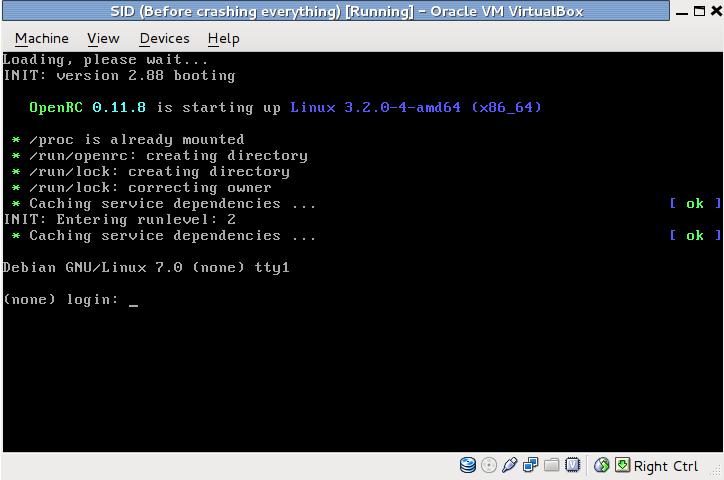
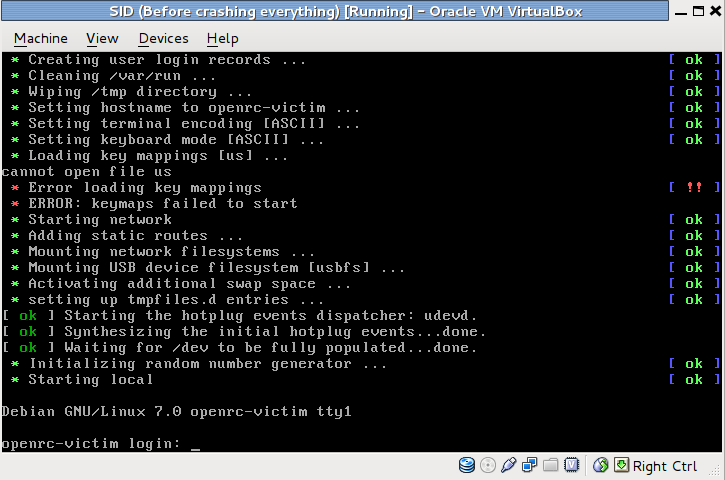
Thomas Goirand: An afternoon of fun hacks, booting Debian

Step one: building OpenRC, and force it with a big hammer to replace sysv-rc. openrc A few minutes later, with even more hacks, we have a more decent boot process which uses Gentoo boot scripts (amazingly, most of them do work out of the box!): openrc_take2 Notice the udev script, which is hacked from the Debian sysv-rc, still has the color scheme of Debian, while the other scripts are just drop-ins from Gentoo. Of course, this is only a big hack to have the above. There is only so much you can do in a 4 hours hacking session. It will need more serious work to make it a viable solution (like finding a way to upgrade smoothly and allow the first reboot to shutdown processes which aren t running using cgroup, converting existing init scripts automatically, hooking into update-rc.d, etc.). Though the proof of concept is there: the rc-status command works, we have cgroups working, and so on. Thanks to Patrick Lauer for spending with me this fun afternoon, hacking OpenRC in SID.

Steve Kemp: Time passes, Thorin sits down and starts singing about gold.

This weekend I have mostly been reading Longitude: The True Story of a Lone Genius Who Solved the Greatest Scientific Problem of His Time . In modern times we divide the earth up into rings of lines, latitude and longitude, as wikipedia will explain. Finding your latitude is easy, finding your longitude is a difficult process, and it was vitaly important when people started to sail large distances, the book contained lots of stories of sailors being suddenly suprised by the appearance of land - because they'd misjudged their position. Having four ships, containing garlic, pepper, and other goods of value exceeding the total wealth of the UK, sink all at once was a major blow. Not to mention the large number of sailors who lost their lives. There were several solutions proposed, involving steady hands and telescopes, etc, but the book mostly discusses John Harrison and his use of watches/clocks.
John Harrison was featured in Only Fools & Horses, as the designer of the watch that made Delboy & Rodney millionaires. ->Time on our hands
The idea of using a clock is that you take one with you, set to the time of your departure location. Using that clock you can compare the time to the local-time, by viewing the sun, etc. Calculating the difference between the two times allows you to see how far away, in degrees, from your port, and thus how far you've traveled. Until harrison came along clocks weren't accurate enough to keep time. His clocks would lose a second a month, until then clocks might lose 15 minutes a day. (With more variations depending on temperture, location, and pressure. Clearly things like pendulum clocks weren't suitable for rocking ships either.) All in all this book was a great read, there were mentions of Galilao, Newton, and similar folk who we've all heard of. There was angst, drama, deceit, and some stunning craftmanship. Harrison was a woodworker, and he made his clocks out of wood (+brass where necessary). Choosing fast/slow-grown wood depending on purpose, and using wood that secreted oils naturally allowed him to avoid lubrication - which improved accuracy, as lubricants tend to thin/thicken when temperature/pressure change. A lovely read, thank you very much. In other news I received several patches for my templer static-site generator, and this has resulted in much improvement. I've also started using Test::Exception now, and slowly updating all my perl code to use this.

29 March 2013

R&#233;mi Vanicat: New printer: Samsung SCX-3400

I've just buy a new printer/scanner, and as the documentation found on the web on how to setup the printer falsely instruct me to download some third-party driver, I will explain here how to set it up: By the way, Dear lazy web, I was wondering. In gimp, when I ask it to create a new image using Xsane, the menu give me the choice between the "Device Dialog" or my webcam. Is there any way to have my scanner there?

Richard Hartmann: Release Critical Bug report for Week 13

Hallowed fornicating k lusk tur, Chiroptera Sapiens Sapiens! Look at that corrected bug count... It seems week 16, or even week 15, will really be the week of the penguin! The UDD bugs interface currently knows about the following release critical bugs: How do we compare to the Squeeze release cycle?
Week Squeeze Wheezy Diff
43 284 (213+71) 468 (332+136) +184 (+119/+65)
44 261 (201+60) 408 (265+143) +147 (+64/+83)
45 261 (205+56) 425 (291+134) +164 (+86/+78)
46 271 (200+71) 401 (258+143) +130 (+58/+72)
47 283 (209+74) 366 (221+145) +83 (+12/+71)
48 256 (177+79) 378 (230+148) +122 (+53/+69)
49 256 (180+76) 360 (216+155) +104 (+36/+79)
50 204 (148+56) 339 (195+144) +135 (+47/+90)
51 178 (124+54) 323 (190+133) +145 (+66/+79)
52 115 (78+37) 289 (190+99) +174 (+112/+62)
1 93 (60+33) 287 (171+116) +194 (+111/+83)
2 82 (46+36) 271 (162+109) +189 (+116/+73)
3 25 (15+10) 249 (165+84) +224 (+150/+74)
4 14 (8+6) 244 (176+68) +230 (+168/+62)
5 2 (0+2) 224 (132+92) +222 (+132/+90)
6 release! 212 (129+83) +212 (+129/+83)
7 release+1 194 (128+66) +194 (+128/+66)
8 release+2 206 (144+62) +206 (+144/+62)
9 release+3 174 (105+69) +174 (+105/+69)
10 release+4 120 (72+48) +120 (+72/+48)
11 release+5 115 (74+41) +115 (+74/+41)
12 release+6 93 (47+46) +93 (+47/+46)
13 release+7 50 (24+26) +50 (+24/+26)
14 release+8
15 release+9
16 release+10
17 release+11
18 release+12
Graphical overview of bug stats thanks to azhag:

28 March 2013

Michal &#268;iha&#345;: phpMyAdmin translations status

Next round of phpMyAdmin 4.0 translation status report is coming. So let's look at which translations are at 100% right now (new ones are bold): Almost complete: As you can see, there is still lot of languages missing, this might be your opportunity to contribute to phpMyAdmin. Also you are welcome to translate phpMyAdmin 4.0 using translation server. If your language is already fully translated and you want to help as well, you can translate our documentation as well.

Filed under: English Phpmyadmin 2 comments Flattr this!

Hideki Yamane: short article for Japanese tech magazine


I wrote short article (8p) for Japanese tech magazine "Software Design 2001-2012", an overview for Debian and its derivative (Ubuntu). Have fun.

27 March 2013

Paul Tagliamonte: Debian as part of the GNOME OPW

As some may have seen, zack put out a note about the GNOME OPW. The GNOME OPW program, as some of you may know, is the GNOME Outreach Program for Women. Debian has been considering participating this year, and I think it s something we should focus on this year. So, please, if you have ideas, please feel free to send along ideas on that thread it d be amazing to get this going (in conjunction with) GSoC this year. Also, if you have any GSoC ideas, please do also add those! GNOME OPW allows for things that are non-technical, so feel free to post non-technical things too (publicity team, www team, I m looking at you!)

Bits from Debian: Debian Project Leader elections 2013: interview with Gergely Nagy

We have asked Gergely Nagy, one of the three candidates for DPL elections 2013, to tell our readers about himself and his ideas for the Debian Project. You can also read the interviews to the other two candidates: Lucas Nussbaum and Moray Allan.
Please tell us a little about yourself. I was born in Hungary, a little bit over three decades ago, as a son of a biochemist and a pharmacist, who gave me the name Gergely Nagy (however, online - and offline too by now - I'm mostly known by my nickname, algernon). I went on to study human arts (hungarian grammar & literature, in particular), and to support this passion, I work as a software engineer, one who gets paid to work on free software. As such, I'm in a fortunate situation where my hobby supports my passion, and my hobby aligns well with my Debian work too. What do you do in Debian and how did you started contributing? At the moment, apart from maintaining a few packages, I'm doing a few other, mostly invisible things, like reassigning misfiled bugs so they don't end up being forgotten; or review newly uploaded packages before they enter the archive, making sure we are allowed to distribute them, and that their quality is up to our standards. I used to do quite a lot of other things, but I chose to spend the past year mostly invisible, learning. I started contributing by packaging an editor I was using at the time, but quickly ended up adopting another package - things escalated from there quickly. Why did you decide to run as DPL? There were two reasons that motivated me to run: one is that I believe I can bring something new to the table, that I can help Debian expand in new directions. The other reason is that I'm always on the lookout for new ways to contribute back to Debian, and being the project leader is a position where I believe I could contribute most at this point in time. Three keywords to summarise your platform. Non-technical contributors. What are the biggest challenges that you envision for Debian in the future? The biggest challenge is growing up, to become more than a group of computer geeks creating an amazing distribution. To become a community of a wide variety of people, where both computer geeks and art geeks feel equally at home. Yet, at the same time, where we as a project, keep our focus straight, and be the champions of Free Software. We just need to realize that there's much more to Free Software than the software itself. What are, in your opinion, the areas of the project more in need of technical and/or social improvements? I believe that while we do have many areas where we could use technical improvements, we are reasonably safe there, because we do have very skilled technical people to help us solve these problems. We can make our tools better, we can develop our infrastructure better to aid us even more - and so on and so forth. While we need work on many areas, we're on the right track there. However, when it comes to social issues, we're at a loss. We have serious trouble keeping certain topics civilised on mailing lists, we have trouble attracting women, and we have trouble reaching people who are not naturally exposed to Debian (or Free Software). We could really use a more diverse community, but that requires us to overcome quite a lot of social roadblocks, so to say. Outreach is one particular area where we need much more technical and social improvements. Why should people vote for you? People should vote me, because they found my platform, my answers on debian-vote@, and my ideas and goals convincing and worthy to pursue. People should vote me, because they trust I'll be able to serve the project well. Name three tools you couldn't stay without. Emacs, git and a pencil. Because with these three, I can pretty much do anything. What keep you motivated to work in Debian? The community. Over the years, I had the good fortune to meet with a lot of people I hold in high esteem, whose enthusiasm and motivation I found inspiring. For any other common goals Debian and I may share, in the end, it is the people within Debian that keep me motivated. Are there any other fields where you call yourself a geek, besides computers? I'm not quite there yet, but I'm working hard on becoming a human arts geek, or at least a geek of the hungarian language.

25 March 2013

Christoph Berg: How not to monitor a boolean

We were lazy and wrote a simple PostgreSQL monitoring check in shell instead of using some proper language. The code looked about this:
out=$(psql -tAc "SELECT some_stuff, t > now() - '1 day'::interval FROM some_table" some_db 2>&1)
case $out in
    *t) echo "OK: $out" ;;
    *) echo "NOT OK: $out" ;;
esac
If the string ends with 't', all is well, if it ends with 'f' or someting else, something is wrong. Unfortunately, this didn't go that well: OK: psql: FATAL: database "some_db" does not exist

22 March 2013

Richard Hartmann: Release Critical Bug report for Week 12

Let's see if we will have 82 open bugs next week ;) Current trend points towards week 16/17. The UDD bugs interface currently knows about the following release critical bugs: How do we compare to the Squeeze release cycle?
Week Squeeze Wheezy Diff
43 284 (213+71) 468 (332+136) +184 (+119/+65)
44 261 (201+60) 408 (265+143) +147 (+64/+83)
45 261 (205+56) 425 (291+134) +164 (+86/+78)
46 271 (200+71) 401 (258+143) +130 (+58/+72)
47 283 (209+74) 366 (221+145) +83 (+12/+71)
48 256 (177+79) 378 (230+148) +122 (+53/+69)
49 256 (180+76) 360 (216+155) +104 (+36/+79)
50 204 (148+56) 339 (195+144) +135 (+47/+90)
51 178 (124+54) 323 (190+133) +145 (+66/+79)
52 115 (78+37) 289 (190+99) +174 (+112/+62)
1 93 (60+33) 287 (171+116) +194 (+111/+83)
2 82 (46+36) 271 (162+109) +189 (+116/+73)
3 25 (15+10) 249 (165+84) +224 (+150/+74)
4 14 (8+6) 244 (176+68) +230 (+168/+62)
5 2 (0+2) 224 (132+92) +222 (+132/+90)
6 release! 212 (129+83) +212 (+129/+83)
7 release+1 194 (128+66) +194 (+128/+66)
8 release+2 206 (144+62) +206 (+144/+62)
9 release+3 174 (105+69) +174 (+105/+69)
10 release+4 120 (72+48) +120 (+72/+48)
11 release+5 115 (74+41) +115 (+74/+41)
12 release+6 93 (47+46) +93 (+47/+46)
13 release+7
14 release+8
15 release+9
16 release+10
17 release+11
18 release+12
Graphical overview of bug stats thanks to azhag:

19 March 2013

Daniel Pocock: My low-tech investment strategy

People often ask me why I invest in low-tech, old-school investments like gold and silver bullion. Surely for somebody working with technology every day, I would have some advantage in the world of investment? The events of Cyprus this week should provide a clear answer: we've all been told that there is nothing safer than cash in the bank, protected by a Government deposit insurance scheme. Yet it appears that in a pattern reminiscent of the real life Ocean's 11 bank robbery, the culprits waited for a long weekend and set about doing the unthinkable after the lights went out on a Friday night. Three days wasn't enough for them to complete their plan (or getaway?), and so Cypriot banks are closed for a further two days. Just like in the type of bank robbery seen in the movies, the money was put there by people who worked for it, and it is taken away by people who didn't. Sadly, this is also a reflection on a society as a whole. As a result of apathy, contentedness, obsession with non-issues such as immigration, or excuses about how we don't care about politics, nobody has bothered to watch the politicians. The 2008 British film The Bank Job showed real robbers sent into a bank in the traditional manner (it is based on the true story of the 1971 Baker Street robbery). Although not substantiated, conjecture in the press suggests that British authorities were involved and got real crooks to make it look authentic. Today's press suggests that Cypriot authorities are in a similar way trying to make it look like Germany is the bad guy. Back to the gold and silver. A recent report in Science Magazine suggests it takes 100,000 years for natural processes such as earthquakes to create even small deposits of precious metals. Most politicians are taking their pension in less than 10 years and wouldn't have the time or power to interfere with or manipulate such an inherently natural physical phenomenon, and this is why bullion has remained a consistent and respected investment for thousands of years. Does anyone imagine that fresh reserves of gold are forming in the cavities under Cyprus during this week's tremors? Or will those cavities be somewhat more sparse?

18 March 2013

Hideki Yamane: Monthly magazine and Ubuntu Server


Recently, I've got two books. One is "Software Design" as monthly Debian article, and another is "Ubuntu Server (Ubuntu Server practical bible)" by Fumihito Yoshida (hito, who is a member of Ubuntu Japanese LoCo (and I'm same Loco member, too).

Well, it's bit a hard to write "hot" topic since it's paper magazine, I should write an article as possible (magazine would be published, then next deadline comes 2 or 3 days after that...), anyway I'm enjoying to write about Debian :-)


Also I've got a "Ubuntu Server " - it means "hey, you should put review to the web!!!" - okay, hito. I'll do so! :)

It probably targets "beginners" but "practical" as named and worth for non-beginners, too. If you want to try set up servers, this would help you a lot. However, if you just want "Copy & Paste" thing, this book is not suitable for you. google it (but we cannot assume search result as best suitable one, and most of that lucks "why you should do this operation", of course). This book shows process of thinking and background for set up servers.

I like "conclusion first, then show its reason and other methods" style, but sometimes not in this book, it frustrated me a bit. But anyway, explorations may be fun.

This book doesn't cover "cloud", but he says "if sales is good, I'll write about it". I'll be glad to review it.

Michal &#268;iha&#345;: phpMyAdmin translations status

Next round of phpMyAdmin 4.0 translation status report is coming. So let's look at which translations are at 100% right now: Almost complete: As you can see, there is still lot of languages missing, this might be your opportunity to contribute to phpMyAdmin. Also you are welcome to translate phpMyAdmin 4.0 using translation server. If your language is already fully translated and you want to help as well, you can translate our documentation as well.

Filed under: English Phpmyadmin 0 comments Flattr this!

Next.

Previous.