Search Results: "ed"

25 July 2010

Petter Reinholdtsen: One step closer to single signon in Debian Edu

The last few months me and the other Debian Edu developers have been working hard to get the Debian/Squeeze based version of Debian Edu/Skolelinux into shape. This future version will use Kerberos for authentication, and services are slowly migrated to single signon, getting rid of password questions one at the time. It will also feature a roaming workstation profile with local home directory, for laptops that are only some times on the Skolelinux network, and for this profile a shortcut is created in Gnome and KDE to gain access to the users home directory on the file server. This shortcut uses SMB at the moment, and yesterday I had time to test if SMB mounting had started working in KDE after we added the cifs-utils package. I was pleasantly surprised how well it worked. Thanks to the recent changes to our samba configuration to get it to use Kerberos for authentication, there were no question about user password when mounting the SMB volume. A simple click on the shortcut in the KDE menu, and a window with the home directory popped up. :) One step closer to a single signon solution out of the box in Debian Edu. We already had PAM, LDAP, IMAP and SMTP in place, and now also Samba. Next step is Cups and hopefully also NFS. We had planned a alpha0 release of Debian Edu for today, but thanks to the autobuilder administrators for some architectures being slow to sign packages, we are still missing the fixed LTSP package we need for the release. It was uploaded three days ago with urgency=high, and if it had entered testing yesterday we would have been able to test it in time for a alpha0 release today. As the binaries for ia64 and powerpc still not uploaded to the Debian archive, we need to delay the alpha release another day. If you want to help out with implementing Kerberos for Debian Edu, please contact us on debian-edu@lists.debian.org.

Stefano Zacchiroli: RCBC - release critical bugs contest

Recipe for RCBC - Release Critical Bug squashing Contest:
squash RC bugs for 2 weeks , from July 25th to August 7th
help the release of Debian Squeeze
earn fame and glory (for sure)
win a GuruPlug and other geeky gadgets (maybe)
read on for more info ...
It has been a while since my last post in the RCBW tradition. Luckily, the tradition is in very good health of its own, thanks to many others that have picked up the habit of SPAM-ing planet with good news for Debian, encouraging others to do the same. With all that RC-obsessed people around and with the Squeeze release forthcoming, can DebConf10 be devoid of geeky RC-squashing activities? Of course not! Thanks to the orga team we expect the conference to contain a 2-week long RC bug squashing pride with tutorials, BoFs, a permanent bug squashing party, ... and a contest! I won't indulge much on the contest as the wiki page contains all rules and gory details. Obviously, all usual rules and best practices of bug squashing parties will apply; coordination will happen on #debian-bugs. Get involved, it starts today, and it's open to everyone (DebConf10 attendees as well as Debian enthusiasts abroad, regular RC squashers as well as casual bystanders, etc). All this wouldn't have been possible without the help of many people that love Debian, so many thanks to: PS a corresponding announcement is in the debconf-announce pipeline already

Russell Coker: SE Linux audit2allow -R and Milter policy

Since the earliest days there has been a command named audit2allow that takes audit messages of operations that SE Linux denied and produces policy that will permit those operations. A lesser known option for this program is the -R option to use the interfaces from the Reference Policy (the newer version of the policy that was introduced a few years ago). I have updated my SE Linux repository for Lenny [1] with new packages of policy and python-sepolgen that fix some bugs that stopped this from being usable. To use the -R option you have to install the selinux-policy-dev package and then run the command sepolgen-ifgen to generate the list of interfaces (for Squeeze I will probably make the postinst script of selinux-policy-dev do this). Doing this on Lenny requires selinux-policy-default version 0.0.20080702-20 or better and doing this on Debian/Unstable now requires selinux-policy-default version 0.2.20100524-2 (which is now in Testing) or better. Would it be useful if I maintained my own repository of SE Linux packages from Debian/Unstable that can be used with Debian/Testing? You can use preferences to get a few packages from Unstable with the majority from Testing, but that s inconvenient and anyone who wants to test the latest SE Linux stuff would need to include all SE Linux related packages to avoid missing an important update. If I was to use my own repository I would only include packages that provide a significant difference and let the trivial changes migrate through Testing in the normal way. The new Lenny policy includes a back-port of the new Milter policy from Unstable, this makes it a lot easier to write policy for milters. Here is an example of the basic policy for two milters, it allows the milters (with domains foo_milter_t and bar_milter_t) to start, to receive connections from mail servers, and to create PID files and Unix domain sockets. policy_module(localmilter,1.0.0)

milter_template(foo)
files_pid_filetrans(foo_milter_t, foo_milter_data_t, sock_file file )

milter_template(bar)
files_pid_filetrans(bar_milter_t, bar_milter_data_t, sock_file file )
allow bar_milter_t self:process signull;
type bar_milter_tmp_t;
files_tmp_file(bar_milter_tmp_t)
files_tmp_filetrans(bar_milter_t, bar_milter_tmp_t, file)
manage_files_pattern(bar_milter_t, tmp_t, bar_milter_tmp_t) After generating that policy I ran a test system in permissive mode and sent a test message. I ran audit2allow on the resulting AVC messages from /var/log/audit/audit.log and got the following output: #============= bar_milter_t ==============
allow bar_milter_t bin_t:dir search;
allow bar_milter_t bin_t:file getattr;
allow bar_milter_t home_root_t:dir search;
allow bar_milter_t ld_so_cache_t:file read getattr ;
allow bar_milter_t lib_t:file execute;
allow bar_milter_t mysqld_port_t:tcp_socket name_connect;
allow bar_milter_t net_conf_t:file read getattr ioctl ;
allow bar_milter_t self:process signal;
allow bar_milter_t self:tcp_socket read write create connect setopt ;
allow bar_milter_t unlabeled_t:association recvfrom sendto ;
allow bar_milter_t unlabeled_t:packet recv send ;
allow bar_milter_t urandom_device_t:chr_file read;
allow bar_milter_t usr_t:file read getattr ioctl ;
allow bar_milter_t usr_t:lnk_file read;
#============= foo_milter_t ==============
allow foo_milter_t ld_so_cache_t:file read getattr ;
allow foo_milter_t lib_t:file execute;
allow foo_milter_t mysqld_port_t:tcp_socket name_connect;
allow foo_milter_t net_conf_t:file read getattr ;
allow foo_milter_t self:capability setuid setgid ;
allow foo_milter_t self:tcp_socket write setopt shutdown read create connect ;
allow foo_milter_t unlabeled_t:association recvfrom sendto ;
allow foo_milter_t unlabeled_t:packet recv send ; Running the audit2allow command with the -R option gives the following output, it includes the require section that is needed for generating policy modules:
require
type sshd_t;
type ld_so_cache_t;
type bar_milter_t;
type foo_milter_t;
class process signal;
class tcp_socket setopt read create write connect shutdown ;
class capability setuid setgid ;
class fd use;
class file read getattr ;

#============= bar_milter_t ==============
allow bar_milter_t ld_so_cache_t:file read getattr ;
allow bar_milter_t self:process signal;
allow bar_milter_t self:tcp_socket read write create connect setopt ;
corecmd_getattr_sbin_files(bar_milter_t)
corecmd_search_sbin(bar_milter_t)
corenet_sendrecv_unlabeled_packets(bar_milter_t)
corenet_tcp_connect_mysqld_port(bar_milter_t)
dev_read_urand(bar_milter_t)
files_read_usr_files(bar_milter_t)
files_read_usr_symlinks(bar_milter_t)
files_search_home(bar_milter_t)
kernel_sendrecv_unlabeled_association(bar_milter_t)
libs_exec_lib_files(bar_milter_t)
sysnet_read_config(bar_milter_t)
#============= foo_milter_t ==============
allow foo_milter_t ld_so_cache_t:file read getattr ;
allow foo_milter_t self:capability setuid setgid ;
allow foo_milter_t self:tcp_socket write setopt shutdown read create connect ;
corenet_sendrecv_unlabeled_packets(foo_milter_t)
corenet_tcp_connect_mysqld_port(foo_milter_t)
kernel_sendrecv_unlabeled_association(foo_milter_t)
libs_exec_lib_files(foo_milter_t)
sysnet_read_config(foo_milter_t) To get this working I removed the require lines for foo_milter_t and bar_milter_t as it s not permitted to both define a type and require it in the same module. Then I replaced the set of tcp_socket operations write setopt shutdown read create connect with create_socket_perms as it s easiest to allow all the operations in that set and doesn t give any security risks. Finally I replaced the mysql lines such as corenet_tcp_connect_mysqld_port(foo_milter_t) with sections such as the following:
mysql_tcp_connect(foo_milter_t)
optional_policy(
mysql_stream_connect(foo_milter_t)
) This gives it all the access it needs and additionally the optional policy will allow Unix domain socket connections for the case where the mysqld is running on localhost.

24 July 2010

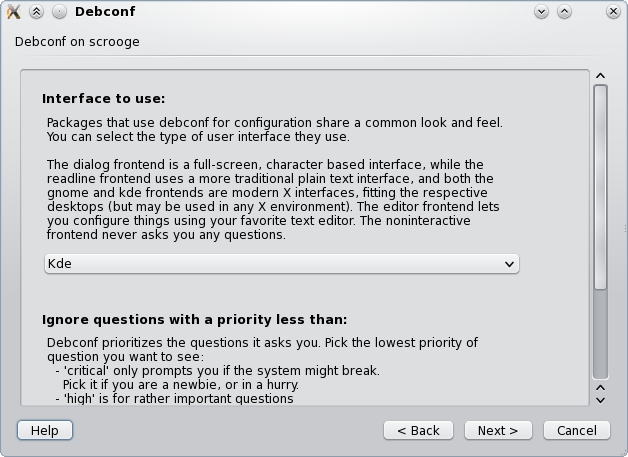
Sune Vuorela: debconf kde frontend

I wrote another blog post a while back talking about Debconf kde frontend. I spend some days at akademy looking at it, and then refined it a bit when I got home.
Results: debconf kde frontend in action. hopefully, the debconf people will accept it soon.

Andrew Pollock: [geek] Cleaning up from 20 years ago

I'm a terrible hoarder. I hang onto old stuff because I think it might be fun to have a look at again later, when I've got nothing to do. The problem is, I never have nothing to do, or when I do, I never think to go through the stuff I've hoarded. As time goes by, the technology becomes more and more obsolete to the point where it becomes impractical to look at it. Today's example: the 3.5" floppy disk. I've got a disk holder thingy with floppies in it dating back to the mid-nineties and earlier. Stuff from high school, which I thought might be a good for a giggle to look at again some time. In the spirit of recording stuff before I throw it out, I present the floppy disks I'm immediately tossing out.
MS-DOS 6.2 and 6.22
Ah the DOS days. I remember excitedly looking forward to new versions of MS-DOS to see what new features they brought. I remember DOS 5.0 being the revolutionary one. The dir command grew a ton of options.
XTreeGold
More from the DOS days, when file management was such a pain in the arse that there was a business model to do it better. ytree seems like a fairly good looking clone of it for Linux.
WinZip for Windows 95, Windows NT and Windows 3.1
Ha. I actually paid money for an official WinZip floppy disk.
Nissan Maxima Electronic Brochure
I'm amazed this fit on a floppy disk
Turbo Pascal 6.0
Excluding GW-BASIC, this was the first "real" language I dabbled in. I learned it in Information Processing & Technology in grades 11 and 12. I never got into the OO stuff that version 6.0 was particularly geared towards.
Where in the World is Carmen Sandiego?
Awesome educational game. I was first introduced to this on the Apple ][, and loved it. This deserves being resurrected for a console.
Captain Comic II
Good sequel to the original, but I never found a version that worked properly (I could never convince it to let me finish it)
HDM IV
Ah, Hard Disk Menu. A necessity from the DOS days when booting up to a C:\> prompt just really didn't cut it. I used to love customising this thing.
ARJ, LHA, PK-ZIP
Of course, you needed a bazillion different decompression programs back in the days of file trading. I guess things haven't changed much with Linux. There's gzip, bzip2, 7zip, etc.
Zeliard
I wasted so many hours playing this. The ending was so hard.
MicroSQL
This was some locally produced software from Brisbane, written in Turbo Pascal (I think). It was a good introduction to SQL, I used it in high school and my first stab at University.
DOOM and DOOM II
Classics. I don't seem to have media for it any more, but I also enjoyed playing Heretic and Hexen. Oooh, Hexen has been ported to Linux? Must check that out...
SimCity 2000
I wasn't a big fan of this game, but I liked the isometric view that 2000 had, compared to the previous version.

Dirk Eddelbuettel: useR 2010 at NIST in Gaithersburg

This past week, the annual R user conference useR! 2010 took place at the National Institute of Standards and Technology (NIST) in Gaithersburg, MD (which is a tad northwest of Washington, DC). Kate Mullen and her team of local organizers did a truly tremendous job in putting together a very smooth conference attended by almost 500 people. It is always nice to meet so many other R contributors and users in person. And needless to say it's also just plain fun to hang out with these folks. As at the preceding useR! 2008 in Dortmund and useR! 2009 in Rennes, I presented a three-hour tutorial on high-performance computing with R. This covers scripting/automation, profiling, vectorisation, interfacing compiled code, parallel computing and large-memory approaches. The slides, as well as a condensed 2-up version, are now on my presentations page. On Wednesday, Romain and I had a chance to talk about recent work on Rcpp, our R and C++ integration. Thursday, we followed up with a presentation on RProtoBuf -- a project integrating Google's Protocol Buffers with R which much to our delight already seems to be in use at Google itself! It was quite fun to do these two talks jointly with Romain. But my other coauthor Khanh had to be at a conference related to his actual PhD work. So on Friday it was just me to give a presentation about RQuantLib which brings QuantLib to R. Slides from all these talks have now been added to my presentations page. I will also upload them via the conference form so that they can be part of the conference's collection of presentations which should be forthcoming.

Biella Coleman: Silent Cry for Help: Debconf Volunteers


silent-cry-for-help, originally uploaded by the biella.
Hi Debcamper s and Debconfer s. I am currently coordinating volunteers and can use your help! Here is a list of our current and most pressing volunteer needs. If you are interested in volunteering and know what you would like to do, drop me a line with details. If you are interested in volunteering and are up for anything, drop me a line. If you want to volunteer but can only spare a couple of hours, drop me a line! You can reach me at biella(at)nyu.edu We are most in need of finding help for the front desk and for assisting with the talks (starting/ending on time and fielding questions). This year if you are a coordinator for a track you will be in charge of doing this, so we only need volunteers for non-track talks. Volunteers get a free, volunteer tee-shirt and a huge huge thanks from the orga team who simply cannot do this without you!

Chris Lamb: Four men in a mine

kumbunterland posed this question in the park yesterday:
There are four men in a coal mine. This exit is narrow so that no more than 2 men can exit at the same time. In addition, there is only one torch and they can't leave the mine without it. Each man walks at a different speed. The first man takes one minute to exit the mine the bridge distance, the second takes two minutes, the third takes five, and the fourth takes eight minutes. If two men walk together they must walk at the slower speed. For example, if person #1 and person #3 go together, they will leave the mine in 5 minutes. Then, person #1 could return back to return the torch to the others (taking another one minute) so they can use it to exit again. The coal mine will collapse in exactly 15 minutes; you must find a way to allow all the men to leave the mine within this time.
Unfortunately, swi-prolog is broken on the N900, so I wasn't able to solve it right then:
solution(Men, Bound, Out) :-
    torchInside(Men, [], [], Log),
    totalDuration(Log, 0, Duration), Duration =< Bound,
    swritef(Out, '%w  (%w minutes)', [Log, Duration]).
% We use torch Inside,Outside  predicates like a state machine.
torchInside(A, B, Log, X) :-
    % Move two people from inside -> outside the mine
    combination(2, A, S), subtract(A, S, A1), append(S, B, B1),
    torchOutside(A1, B1, [S Log], X).
torchOutside([], _, Log, Log).
torchOutside(A, B, Log, X) :-
    % Move someone from outside -> inside the mine
    combination(1, B, S), subtract(B, S, B1), append(S, A, A1),
    torchInside(A1, B1, [S Log], X).
% Utilities:
totalDuration([], X, X).
totalDuration([H T], Acc, X) :-
    max_list(H, Max), NewAcc is Acc + Max,
    totalDuration(T, NewAcc, X).
combination(0, _, []).
combination(N, [H T], [H Comb]) :-
    N > 0, N1 is N - 1, combination(N1, T, Comb).
combination(N, [_ T], Comb) :-
    N > 0, combination(N, T, Comb).
?- solution([1, 2, 5, 8], 15, X).
X = "[[2, 1], [2], [5, 8], [1], [1, 2]]  (15 minutes)" ;
X = "[[1, 2], [1], [5, 8], [2], [1, 2]]  (15 minutes)" ;
false.
I'm fun at parties.

John Goerzen: Daniel Schorr

For many years now, I ve admired Daniel Schorr s reporting on NPR. I could instantly recognize his voice, and perhaps to the irritation of Terah, whenever I heard him on the radio, I d turn it up and ask that we be quiet for a couple minutes so I could listen. The thing about Dan is that he was a reporter for 60 years. He reported from Moscow for CBS, from the Netherlands, Berlin, Washington. He interviewed Kruschev, got on Nixon s enemies list a fact he famously discovered as he was reading the list for the first time live on the air and was fired from several jobs for insisting on sticking to his standards over the objections of more profit-driven executives. The reason I listened to him was that he had a perspective nobody else does. There d be some contemporary story, and inevitably he d relate it to something Eisenhower said, or a G7 meeting in the Reagan years, or something Kruschev or Gorbachev mentioned. And not only was it accurate, it was incisive and enlightening. Some things well worth reading:

23 July 2010

Luca Falavigna: Lightspark news

Lightspark, the modern and efficient open source Flash player, just landed in experimental! Few days have passed since 0.4.2 release, and thanks to the great packaging efforts made by Didier Raboud, package is ready to be widely tested. Don t expect a fully functional Flash player, though. Some features aren t implemented yet, and it s still buggy, but it looks very promising. Stay tuned for updates!

Joey Hess: Flattr FOSS

Raphael's Flattr FOSS is a good idea: Make it really easy for users to pay tips for free software and maybe users who otherwise wouldn't express their appreciation will. I've added Flattr buttons for a few of my Free Software packages. Am interested to see how it works out.
Flattr this
Regarding Flattr itself, I have always wanted a way to easily micropay artists, coders, etc online. Especially musicians like Mosaik! The way it splits your monthly payment amoung everyone you've Flattr'd that month is smart; it takes money out of the picture when deciding whether to click on a Flattr button. I think it would be more honest, though, if rather than taking 10% of everything (which would be just absurd and indefensible if this were used on a large scale, and whiffs faintly of pyramid scheme even now), Flattr took one share of your monthly payment (as if you automatically Flattr'd them each month). That would provide even more incentive to Flattr lots of other things. And if lots of people were Flattring lots of things, Flattr would still make plenty of money.

Matthew Garrett: Meego kernel watch

sgx535 drivers in today's Meego kernel tree: 3 (GMA600, CE4100, N900)

sgx535 drivers submitted upstream: 1 (Tungsten GMA500 driver, submitted March 2009, rejected due to significant chunks of functionality there purely to support closed userspace)

To be fair, the rest of the Moorestown support code seems to be shaping up fairly nicely. But the lack of a coherent story about what graphics support is going to look like isn't hugely reassuring.

Update:

The Meego kernel tree isn't really a fair comparison here - I should be talking about the Intel MID tree. That's only got the GMA600 and CE4100 drivers at the moment, and I'm told that there's consolidation work going on there.

Steve Kemp: I'm a CPAN author.

As of this morning I'm a published author on CPAN! Thus far I have only a single module to my name, but that will most likely change in the future:
CGI::Session::Driver::redis
A module for storing (CGI) session data within a Redis database.
A while back I setup a dynamic website which was 100% redis backed, using my redis backports for lenny, and realised I needed somewhere to store the session data too. Hence this module. I'll create a .deb package of the module, and stick it alongside the redis server. ObQuote:I like to keep this handy... for close encounters.

Aliens

Kees Cook: Achievement Unlocked

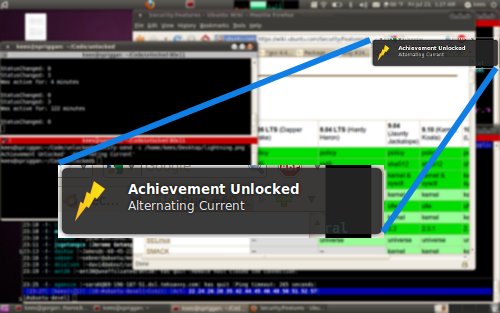
I think it would be fun to add an achievement system to the Ubuntu Desktop, like is done on Steam and XBox. The tricky part is tracking various events and finding amusing correlations. For example, if your screen-saver kicks in 40 times in a single 24 hour period, you could earn the Alternating Current achievement, indicating that you re being repeatedly interrupted all day long: achievement unlocked: alternating current There are all kind of things to track and correlate. Miles moved with the mouse, clicks taken, keys pressed, files opened, applications installed, buddies added, IMs received, sent, etc. There are all kinds of achievements that could be designed that could be used to help people discover how to use Ubuntu, or for just plain humor. Achievement Unlocked: Application Deficit Disorder when you uninstall 100 applications you installed in the prior week. I ve been told this might all be very easy to implement with the Gnome Activity Journal (Zeitgeist), but I haven t had a chance to investigate further. UPDATE: I can easily imagine this being tracked in CouchDB, synced between systems via UbuntuOne, and could be linked to any other remote APIs that people could dream up, including Launchpad, Forums, REVU, Identi.ca, etc.
David Welton: Rails I18n translate with empty string - bug?

Normally, it's pretty easy in Rails to take advantage of the simple i18n tools provided. You just write I18n.t("some_key") and it'll translate that into whichever language. Today, however, I discovered what seems like a problem. If you do I18n.t(""), it returns a hash of all possible translations! And if you give it a nil, it returns an error because that's not a key in the DB. The first behavior doesn't sound correct at all, and the second seems dubious as well. I'm thinking about fixing it like so:
  def translate(key, options =  )
    return nil if key.nil?
    return "" if key == ""
    locale = options.delete(:locale)   I18n.locale
    backend.translate(locale, key, options)
  rescue I18n::ArgumentError => e
    raise e if options[:raise]
    send(@@exception_handler, e, locale, key, options)
  end
Is there any reason not to do this?

Alexander Reichle-Schmehl: Release Critical Bug report for Week 29

The unofficial rc bug tracker currently knows about the following bugs:
In Total:446
Affecting Squeeze:348
Squeeze only:62
Remaining to be fixed in Squeeze:286
Of these 286 bugs, the following tags are set:
Pending in Squeeze:18
Patched in Squeeze:48
Duplicates in Squeeze:36
Contrib or non-free in Squeeze:12
Claimed in Squeeze:2
Delayed in Squeeze:7
Can fixed in a security Update:23
Otherwise fixed in Squeeze:36
Ignoring all the above (multiple tags possible), 152 bugs need to be fixed by Debian Contributers to get Debian 6.0 Squeeze released. However, with the view of the Release Managers, 250 need to be dealt with for the release to happen. Please see my older post for an explanation of the different numbers.

Robert Collins: Switch

No, not the bzr switch rather the book : http://www.amazon.com/Switch-Change-Things-When-Hard/dp/0385528752 Read it, its solid.

Christian Perrier: Bug #590000

Joe Hansen reported the Debian bug #590000 on Thursday July 22nd, against the uif package. Guess what? That was a localization bug..:-)... Joe is doing a lot of work for Danish localization in Debian since a few months and I'm happy to see him rewarded byt this little "success". Bug #580000 was reported as of May 2nd. It is now confirmed that the rate for 10,000 bugs is more 2.5 months than 2 months as it was in the past. So, now my next post about this topic will be about Bug #600000 for which a bet was placed two years ago. I already lost the bet as I predicted it to happen on June 30th. Either Ren Mayorga or Josu Abarca are likely to win this bet, more likely Ren , I would say. One should note that all people who did bet where optimistic about the moment where bug #600000 would be reported.

22 July 2010

Steve Kemp: My Linksys router now runs Linux and almost provides PXE.

I've been interesting in running Linux upon my router for a long time, but I never had a really compelling reason to do so. The potential for brickage was always too high to make me want to experiment for the sake of it. However last night I installed Gargoyle upon my Linksys WRT53GL. Although I have no single compelling reason to do so there were a few things on my mind which made me risk it:
Syslog
I thought it would be nice to log things to my desktop machine.
QoS
I often run rsync to mirror my photographs, videos, and files, to off-site locations. These are then replicated via chironfs. Being able to use QoS to prioritise SSH traffic, which is the transport I use for rsync, means I don't suffer from laggy connections.
Graphing & Statistics
Having statistics and traffic information is interesting.
Since I've only just installed it I've not had too much opportunity to experiment with it - and my initial forays were not so productive. For example "opkg install tcpdump" failed as the root filesystem wasn't big enough. However which was to update the router to function as PXE server. I installed the tftpd server:
opkg install tftpd-hpa
Then I added this to /etc/dnsmasq.conf:
dhcp-boot=pxelinux.0,router.my.flat,192.168.1.1
Only after I'd done this did I realise two things: Tomorrow, (after visiting the dentist. Uggh) I will experiment with this further. Right now it looks like I have two options: Either way I have to store the files upon another host, due to the constrained space on the router's filsystem. So the question becomes "Which service should I run externally: TFPTD or NFS?". Running TFTPD, upon my desktop, seems smaller, less of a security risk, and neater. Running TFTPD also avoids issues if I reboot both the router and my desktop at the same time as a stalling NFS mount could prevent a timely router-boot. ObQuote: Looking for a secret door. Places like this always have a secret door.

- St Trinian's 2: The Legend of Fritton's Gold

Next.

Previous.