Thomas Koch: Free Software in companies
At work we currently have a discussion: I'd like to develop some components as Free
Software. My bosses like the idea, but the client goes nuts only thinking about it.
So as part of the discussion I thought to collect those companies who actively advertise their Free Software. I know about the big ones, but it would be even more interesting to get a list of succesful small companies that share at least part of their inhouse projects. On the other hand it would not be too interesting to list full Free Software companies like Red Hat.
It would also be fine to share this list in some wiki (FSFE?) when it grows larger. For some companies I also list very popular projects from my point of view. big companies
- Adobe
- Facebook: Cassandra, Thrift, Scribe, HipHop for PHP, ...
- Yahoo: YUI, Design Pattern Library, YSlow, Hadoop, ZooKeeper
- Google: Chromium Browser, Google Summer of Code, Android, Google Web Toolkit (GWT), Protocol Buffers - data interchange format, Java Collections Library, unladen-swallow - faster implementation of Python, ...
- IBM: Developerworks (Tutorials), Eclipse, International Components for Unicode (ICU)
Update: Need to add Danga (Gearman), Liip.ch with Okapi, Flux CMS, Jackalope
 Hot on the heels of
 Time to introduce what I've been working on for these past too many
months..

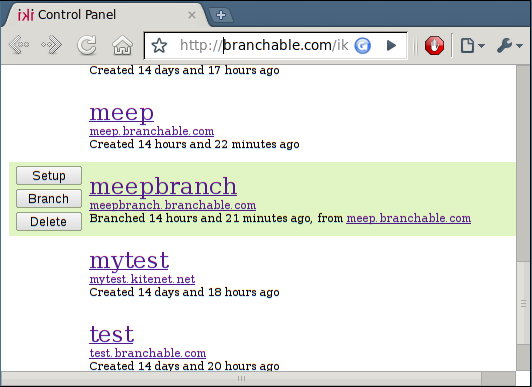 The ability to take your data and configuration and go home, as well as
everything being free software, means Branchable follows the vision of the
 After Arjuna Rao Chavala successfully completed enough of D-I
translation, I just activated support for the Telugu language in
Debian Installer.
Given the currently planned released, that will be available in the
next release, so hopefully for Squeeze.
Telugu is spoken in Andhra Pradesh, one of the largest states in
India, on the south-eastern coast of the country. The main city of
Andrha Pradesh is Hyderabad, the 6th largest city of India. Telugu is
the third most-spoken language in India, with about 74 million native
speakers.
As of now, out of the 29 languages in India with over 1 million
speakers, we do support 9 of them that represent over 70% of the
population of India. We indeed now support the five most spoken
languages in India (of course, all this by excluding English).
 The svn repository used to draft the Debian Project News just passed the
sixth hundreds commit. If my calculations are correct, that's quite
more than the number of edits done, back when the DPN was drafted in the
wiki. I take it as a hint, that the new work flow works better than the
old one.
However, playing a bit with statistics (done by horrible shell one
liners ;)
I noticed, that - while every Debian Developer may commit to
the subversion repository - not that many commits from other DDs where
made: Of the 602 commits so far, only 70 where done by other DDs:


 I've got a pretty packed August.
I just wrapped the
 Science and Math Track at DebConf10
This year's


 I dunno why, but hearing bagpipes always gives me the creeps, probably because their melodies sound like a whole country was just brutally slaughtered and is being mourned.
Sure enough, this morning, on my way to pick up my new national ID card matching my

 Debian always was known for its communication "style". There were even

 In the evening today (Tuesday), the Debconf organizers arranged for a screening of the Creative Commons licensed film "Sita Sings the Blues" by Nina Paley. I went to see it as I had missed it when it was first released among tales of trials and tribulation at the hands of copyright meanies.
So first let me say yay Free Culture!, boo Intellectual Property! etc. etc. Now we have that out of the way...
"Sita Sings the Blues" has two main narrative threads: The breakup of Ninas relationship with her boyfriend and the Ramayana particularly a story from the uttarakanda about how after Shri Rama returned from Lanka, Sita had to undergo the agnipravesha to prove her chastity and even after she passed that test was eventually banished to the forest. I had an adverse reaction to this film. In fact I stayed to the end to be polite but I left afterwards as soon as I could. I had almost a physical feeling of nausea and I was surprised by this. Since then I have been pondering why this is so.
It's not that its blasphemous. Shri Rama is not just a "perfect man", he is God (an avatar of Vishnu Bhagavan as is briefly touched upon in the film) for millions of people so, well, yes it is blasphemous but its more Rowan Atkinson style rather than Norwegian Black Metal style blasphemy. One never gets the impression that the author hates Hinduism or Indian culture the opposite in fact. And in fact it is not uncommon in our culture to speak of Sita and Rama in this way. They are not remote authority figures but as familiar to us as our own friends and family and the Ramayana is not just about events that happened long ago it is relevant to our lives right now. Even the "good woman done wrong by big dumb male jerk" narrative is not unknown. (See the Uttararamacharita of Bhavabhuti for instance.) though I would suggest reducing the Ramayana this way is akin to treating the Hitchhikers Guide to the Galaxy as a book about towels.
Even the milder criticism that it is not accurate is offbase because although the Sanskrit poem by Maharshi Valmiki is the canonical rendition of the Ramayana, there are other well-known versions. Not just in Sanskrit, the Hindi retelling by Sant Tulsidas called Ramacharitamanasa is more popular than Valmiki. Also speaking as someone who has preached Ramakatha "professionally" I can tell you that even the priests do not stick to the letter of the text. It is encouraged and expected that they will riff on the basic stories adding or removing details according to the needs and taste of the audience. And the device of the three narrators made me smile as this is exactly the kind of discussions that go on after hearing the Ramakatha. (I must say Paley picked a notably illiterate trio though.) One place where this fell flat was when they discussed the alleged discrepancy between Sita living simply in the forest and dropping a trail of jewellery on the way to Lanka. Although I can imagine someone at some point saying, "Do not question these stories" not at this point. Even the most retarded westernized Indian would know that removing ones ornaments is a sign of widowhood. A married woman would only do that in extremis certainly not just merely because she was a hermit. In a few cases some extra details might have helped the story. It was not explained that Ravana does not just have rakshasas in his command but he is one himself. (And he certainly wasn't a good guy until one day he got up and kidnapped Sita.) Shri Ramas brother Lakshamana accompanied the couple into the forest to Lanka and back but he only pops up (for no apparent reason) at the end. But look at me, I'm turning into one of those people who rant about Star Trek continuity errors or complain that the Romans in a gladiator movie have the wrong helmets for that time period etc. One has to cut a storyteller some slack and I entered the screening determined to be charitable.
It's also not because I don't really see much connection between the two stories. Getting dumped by someone who simply loses interest in you hardly seems equivalent to being trapped by a moral code that doesn't allow for individuals feelings. Paley could have easily made "Princess Leia Sings the Blues" and it wouldn't have changed the significance much. But in India people make far more tenuous connections between the epics and events in their own life so one can hardly complain about that.
Aesthetics are not the problem either. The first version of the Ramayana I ever read was the Amar Chitra Katha comicbook version which partly influenced the visual style of this film. (In fact you briefly see it in one scene when different editions of the Ramayana flash by.) Hindu popular culture is very gaudy. (See Ramanand Sagars '80s Ramayana Hindi TV serial, which was very reverential, insanely popular and tacky beyond belief.) The animation in this film is very good and quite artistic.
"So Jaldhar", you might be asking if you've read this far, "what exactly is your problem with this film?"
I have read the Valmiki Ramayana in Sanskrit with the commentaries from beginning to end. I've read other Ramayanas in Sanskrit, Gujarati, and English. I have read the comicbook, I've read anti-Ramayana polemics. When you learn Sanskrit in the traditional way the first lesson, in the declension of masculine gendered nouns ending in vowels is rAma.h rAmau rAmA.h ... I am well aware there are different emphases, different interpretations in various versions. Why can't I accept this as just another take on a story that has shown its fluidity over and over again? It's just...wrong on a subrational level. How can I put this? Imagine you are flipping through the TV channels and you see your grandparents amongst Lady Gaga's backup dancers. Or you came home one night to find everything that was on the floor meticulously glued to the ceiling. Over the course of my life (to hear my mother tell it my first exposure to the Ramayana was before I could speak.) I have developed a mental bond with this story a certain idea of how it should be. I think so has Nina Paley. And this is the problem. "Sita Sings the Blues" is Nina Paleys Ramayana not mine.