Search Results: "ed"

9 August 2010

Stefano Zacchiroli: missing DebConf10

It is not that I've missed DebConf10, I've totally been there (as some embarrassing video and photo evidence can prove ...).
Rather, I've just got back home and I already miss DebConf10, melancholy is in the air. It will probably stay around for a while and then leave room to a vivid memory of 2 weeks of Debian life, as strong as I've never experienced before. So, before I become too sentimental, let me just thank everyone who has made the conference possible: the orga team, the video team, all the volunteers, the sponsors, the speakers, the attendees, and everyone else I couldn't possibly remember. Specific kudos of mine goes to the Debian NYC cabal: DDs and non-DDs, new to our project and not-so-new. You guys made me remember what does living Debian mean, you guys made all this possible (emotions included!), you guys rock. Say whaaaaaat?

John Goerzen: Being A Butterfly

Well, I m back in Kansas after a bit over a week in New York for Debconf. I didn t have time to write much, so I ll probably be posting about it a few times. I already wrote about the trip to New York, and now will say just a bit about the time there and trip back home. I have to start with a quote from Jacob. We went on the Q train from Coney Island a few stops down to Brighton Beach. It s elevated, and provides an excellent view of the amusement park. Jacob s excited comment, face pressed to window, was: Wow! I see lots of everything! Which, come to think of it, sums up NYC itself pretty well. Speaking of faces pressed to windows: this was Jacob s default mode of operating in NYC. Get into any subway car, bus, whatever and he wants to stand on the seat nearest the window and look out it. It s a real problem if no such seats are available. More than once, though, we ll get on the subway and he ll run to the nearest window seat to claim it, no matter who will be his neighbors for the next few minutes. And after a few days of this, Oliver started picking up on it. Pretty soon both boys wanted to be pressed to the windows watching interesting things (to me, it was a dark tunnel with occasional lights, but interesting to them) go by. Which brings me to today. Today was Oliver s first time flying, and Jacob s second though he was an infant the first time he flew and doesn t remember it. Jacob has been perhaps cautiously optimistic about flying. The idea of it was exciting, but then again it s something completely new, which he doesn t care for so much. So we had no idea what to expect. What was got was excitement. And lots of it. From the La Guardia terminal, Dad, is this our plane? No, not that one. Well, is THIS our plane? No, not that one either. Well, is *THIS* our plane? At this point, a parent has to confront the question: which is worse, causing serious disappointment to a 3-year-old and possibly inviting a meltdown in the middle of the D concourse, or a bit of harmless encouragement that might not be 100% literally true? Uhmm . that might be it (Ah, so I went for the literally true but still exciting route ) YAY!! *jumping and clapping* Terah reminds me at this point of our security adventure. I, wearing socks, carried Oliver (1 year old) through the security checkpoint at La Guardia. But oh! I failed to remove his shoes (not really shoes). TSA made me go back through, put them in the bowl, and run them through the scanner. A nearby pilot, getting screened, noticed this and made this ironic comment well within TSA earshot: Look at his face! He s gonna get us all! Good thing you re checking his shoes! Terah and the pilot both just about bust up laughing. Meanwhile, I m carrying Oliver through, and the agent that made me take off his shoes had this look of I m sorry, I know this is stupid, but I have to. (For an excellent pilot s rant about TSA, read this). Anyhow, we got on the plane, and of course Jacob nabbed the window seat. IMG_4458.JPG There was plenty interesting to see. At each step of the way, I told him what was going to happen next, so there wouldn t be any surprises. I told him once we got in the air, and got a breathy Woooooooow .. I told him, Jacob, we are flying! And his reply has to be his best quote of the week:
Dad, I don t know that I ve ever been a butterfly before!
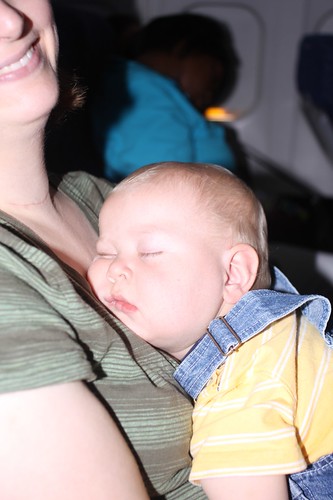
I pointed out that we were above the clouds, which was also exciting. About every 5 minutes, he d poke me, and say, Dad, look out the window. Look down. WE ARE UP IN THE SKY! Meanwhile, Oliver slept. IMG_4461.JPG On the second flight, Jacob slept (and was in a very foul mood when he woke up on the ground) while Oliver tried his best to squirm out of the seat and onto the ground. Now, to wind up this post, I would like to leave you with some statistics and photos comparing my home with New York.
Item NYC Marion County, KS
Land Area 469 sq mi 954 sq mi
Population 8,391,881 12,952 (6871 excluding the 3 largest towns quite some distance away)
Population Density 27,532/sq mi 14/sq mi (7 if excluding large towns)
I think of this as a wonderful difference! I ve said before how much fun it is to spend some time in NYC, where we can just walk to a fruit stand, any number of grocery stores, restaurants, etc. And finally, I leave you with two street scenes. The first is from our hotel s front door. IMG_4352.JPG That s our fruit guy there, and the bagel and roll place is across the street by the RadioShack. Now, the street view from our front door after we got home: IMG_4466.JPG OK, so that s sort of misleading. You can t actually see the street scene because it s on the other side of the hill. That s just our driveway to get to the street. (Not that the street looks much different. It has the weeds growing on the sides instead of in the middle, as one notable difference.) We loved New York and I m certain we ll go back again. It s also nice to be home and enjoy the peace of the countryside. Thanks to Debconf for a wonderful conference a topic I ll have more to say about in the coming days.

8 August 2010

DebConf team: DebConf10: beta versions of the recordings are up (Posted by DebConf10 Videoteam)

For your enjoyment and enlightment, 85 videos in low and high encoding quality are available at the usual location already, which I think is totally superimpressive, even though the videos are relased as betas (or maybe alphas?) - so you might find issues. We will continue to work on them the next days and^w^w weeks, if you re on the team you can use the reviewing interface in penta like you did in NYC. More information about the work still to be done should be available on our mailing list in a few days

As previously said, please leave a thanks-message in our wiki. We truely love to hear your stories, where, what, how and why you watched our videos and how you benefit from our work. Your feedback is truely very important to us!
It is important to leave your thanks mesaage on the wiki, as our team consisted of about 40 wonderful people this year, so if you just say thanks to a few members, your message will not be as powerful and motivating as it could be :-)
So much for now, big thanks to everyone who help make DebConf10 a wonderful experience and great conference! You rock!

Kumar Appaiah: Debconf10 and New York Visit

So, I have finally visited my first Debconf, and it was a phenomenal experience. To meet persons who have guided you, persons work with, and persons you respect face-to-face and have conversations with them about several topics ranging from their vision for Debian to their views on topics totally unrelated to software is something truly great. I am now convinced that events like this, which provide the right environment to socialize and discuss various issues concerning Debian, will go a long way into getting several aspects of the project moving along in the right directions, as well as create awareness to the outside world about what the project is about and how it benefits users.In terms of discussions, the Debian Science track was a nice way to see how contributors are putting Debian to good use for scientific research, and it was a nice opportunity to list out the things to be done to fill in the gaps and take Debian as a science platform forward. The Debian Python BoF was also a good place to meet many contributors face-to-face, and learn more about the technical concerns which people have in regard to the future of Python in Debian.While I didn't hack much during the conference, Christian's presence made me finish the Hindi translation of the Debian Installer. We can now shift focus to other aspects, such as getting packages in order for a short freeze-to-release cycle.Columbia University provides for a very nice venue, with easy access while maintaining a quaint environment within itself. Since this is my second visit to New York City, I had an idea of the common tourist locations, so I did not go around much during the conference. However, since I have a buffer day, I might try my hand at some photography around the place.Have a safe trip home, and a wonderful time ahead! I leave you with a photo I took when I went with a friend across the Brooklyn Bridge after Debconf.Downtown Manhattan Panorama - from the Brooklyn Heights Promenade, Brooklyn, NY

Petter Reinholdtsen: Testing if a file system can be used for home directories...

A few years ago, I was involved in a project planning to use Windows file servers as home directory servers for Debian Edu/Skolelinux machines. This was thought to be no problem, as the access would be through the SMB network file system protocol, and we knew other sites used SMB with unix and samba as the file server to mount home directories without any problems. But, after months of struggling, we had to conclude that our goal was impossible. The reason is simply that while SMB can be used for home directories when the file server is Samba running on Unix, this only work because of Samba have some extensions and the fact that the underlying file system is a unix file system. When using a Windows file server, the underlying file system do not have POSIX semantics, and several programs will fail if the users home directory where they want to store their configuration lack POSIX semantics. As part of this work, I wrote a small C program I want to share with you all, to replicate a few of the problematic applications (like OpenOffice.org and GCompris) and see if the file system was working as it should. If you find yourself in spooky file system land, it might help you find your way out again. This is the fs-test.c source:
/*
 * Some tests to check the file system sematics.  Used to verify that
 * CIFS from a windows server do not work properly as a linux home
 * directory.
 * License: GPL v2 or later
 * 
 * needs libsqlite3-dev and build-essential installed
 * compile with: gcc -Wall -lsqlite3 -DTEST_SQLITE fs-test.c -o fs-test
*/
#define _FILE_OFFSET_BITS 64
#define _LARGEFILE_SOURCE 1
#define _LARGEFILE64_SOURCE 1
#define _GNU_SOURCE /* for asprintf() */
#include <errno.h>
#include <fcntl.h>
#include <stdio.h>
#include <string.h>
#include <stdlib.h>
#include <sys/file.h>
#include <sys/stat.h>
#include <sys/types.h>
#include <unistd.h>
#ifdef TEST_SQLITE
/*
 * Test sqlite open, as done by gcompris require the libsqlite3-dev
 * package and linking with -lsqlite3.  A more low level test is
 * below.
 * See also <URL: http://www.sqlite.org./faq.html#q5 >.
 */
#include <sqlite3.h>
#define CREATE_TABLE_USERS                                              \
  "CREATE TABLE users (user_id INT UNIQUE, login TEXT, lastname TEXT, firstname TEXT, birthdate TEXT, class_id INT ); "
int test_sqlite_open(void)  
  char *zErrMsg;
  char *name = "testsqlite.db";
  sqlite3 *db=NULL;
  unlink(name);
  int rc = sqlite3_open(name, &db);
  if( rc ) 
    printf("error: sqlite open of %s failed: %s\n", name, sqlite3_errmsg(db));
    sqlite3_close(db);
    return -1;
   
  /* create tables */
  rc = sqlite3_exec(db,CREATE_TABLE_USERS, NULL,  0, &zErrMsg);
  if( rc != SQLITE_OK ) 
    printf("error: sqlite table create failed: %s\n", zErrMsg);
    sqlite3_close(db);
    return -1;
   
  printf("info: sqlite worked\n");
  sqlite3_close(db);
  return 0;
 
#endif /* TEST_SQLITE */
/*
 * Demonstrate locking issue found in gcompris using sqlite3.  This
 * work with ext3, but not with cifs server on Windows 2003.  This is
 * done in the sqlite3 library.
 * See also
 * <URL:http://www.cygwin.com/ml/cygwin/2001-08/msg00854.html> and the
 * POSIX specification
 * <URL:http://www.opengroup.org/onlinepubs/009695399/functions/fcntl.html>.
 */
int test_gcompris_locking(void)  
  struct flock fl;
  char *name = "testsqlite.db";
  unlink(name);
  int fd = open(name, O_RDWR O_CREAT O_LARGEFILE, 0644);
  printf("info: testing fcntl locking\n");
  fl.l_whence = SEEK_SET;
  fl.l_pid    = getpid();
  printf("  Read-locking 1 byte from 1073741824");
  fl.l_start  = 1073741824;
  fl.l_len    = 1;
  fl.l_type   = F_RDLCK;
  if (0 != fcntl(fd, F_SETLK, &fl) ) printf(" - error!\n"); else printf("\n");
  printf("  Read-locking 510 byte from 1073741826");
  fl.l_start  = 1073741826;
  fl.l_len    = 510;
  fl.l_type   = F_RDLCK;
  if (0 != fcntl(fd, F_SETLK, &fl) ) printf(" - error!\n"); else printf("\n");
  printf("  Unlocking 1 byte from 1073741824");
  fl.l_start  = 1073741824;
  fl.l_len    = 1;
  fl.l_type   = F_UNLCK;
  if (0 != fcntl(fd, F_SETLK, &fl) ) printf(" - error!\n"); else printf("\n");
  printf("  Write-locking 1 byte from 1073741824");
  fl.l_start  = 1073741824;
  fl.l_len    = 1;
  fl.l_type   = F_WRLCK;
  if (0 != fcntl(fd, F_SETLK, &fl) ) printf(" - error!\n"); else printf("\n");
  printf("  Write-locking 510 byte from 1073741826");
  fl.l_start  = 1073741826;
  fl.l_len    = 510;
  if (0 != fcntl(fd, F_SETLK, &fl) ) printf(" - error!\n"); else printf("\n");
  printf("  Unlocking 2 byte from 1073741824");
  fl.l_start  = 1073741824;
  fl.l_len    = 2;
  fl.l_type   = F_UNLCK;
  if (0 != fcntl(fd, F_SETLK, &fl) ) printf(" - error!\n"); else printf("\n");
  close(fd);
  return 0;
 
/*
 * Test if permissions of freshly created directories allow entries
 * below them.  This was a problem with OpenOffice.org and gcompris.
 * Mounting with option 'sync' seem to solve this problem while
 * slowing down file operations.
 */
int test_subdirectory_creation(void)  
#define LEVELS 5
  char *path = strdup("test");
  char *dirs[LEVELS];
  int level;
  printf("info: testing subdirectory creation\n");
  for (level = 0; level < LEVELS; level++)  
    char *newpath = NULL;
    if (-1 == mkdir(path, 0777))  
      printf("  error: Unable to create directory '%s': %s\n",
	     path, strerror(errno));
      break;
     
    asprintf(&newpath, "%s/%s", path, "test");
    free(path);
    path = newpath;
   
  return 0;
 
/*
 * Test if symlinks can be created.  This was a problem detected with
 * KDE.
 */
int test_symlinks(void)  
  printf("info: testing symlink creation\n");
  unlink("symlink");
  if (-1 == symlink("file", "symlink"))
    printf("  error: Unable to create symlink\n");
  return 0;
 
int main(int argc, char **argv)  
  printf("Testing POSIX/Unix sematics on file system\n");
  test_symlinks();
  test_subdirectory_creation();
#ifdef TEST_SQLITE
  test_sqlite_open();
#endif /* TEST_SQLITE */
  test_gcompris_locking();
  return 0;
 
When everything is working, it should print something like this:
Testing POSIX/Unix sematics on file system
info: testing symlink creation
info: testing subdirectory creation
info: sqlite worked
info: testing fcntl locking
  Read-locking 1 byte from 1073741824
  Read-locking 510 byte from 1073741826
  Unlocking 1 byte from 1073741824
  Write-locking 1 byte from 1073741824
  Write-locking 510 byte from 1073741826
  Unlocking 2 byte from 1073741824
I do not remember the exact details of the problems we saw, but one of them was with locking, where if I remember correctly, POSIX allow a read-only lock to be upgraded to a read-write lock without unlocking the read-only lock (while Windows do not). Another was a bug in the CIFS/SMB client implementation in the Linux kernel where directory meta information would be wrong for a fraction of a second, making OpenOffice.org fail to create its deep directory tree because it was not allowed to create files in its freshly created directory. Anyway, here is a nice tool for your tool box, might you never need it. :)

Lior Kaplan: I miss meeting the debian people

This year I couldn t attend Debconf, making it the third in a row Debian conference I miss. I watched Aigars group photo carefully to see who do I recognize, and just thought to myself that I just miss too many of the people. Especially ones I met in 2005 and 2006 which were years I had the chance to see some of the members twice a year. I hope to see you all next year!
Filed under: Debian GNU/Linux

Michael Banck: 8 Aug 2010

So, DebConf is over and it was a blast. I wanted to blog about my talks for a couple of days, but the conference was so great that I did not get around to it until now. The unique thing about this year's conference were the outstanding contributions by non-Debian FLOSS people from the east coast. I am really glad the organizers decided to reach out to the communi ty and take this opportunity when a lot of great minds were just a couple of hours away. Also, discussing and hanging out with the local team people was so much fun and interesting that it was wor th the visit alone. The venue was just perfect, the dorms were on campus, the cafeteria had an all-you-can-eat buffet, everything was in short walking distance and the Columbia campus is beautiful. I would have liked to go to a couple more places in the evenings, but hanging out in the Carman basement lounge with awesome people was just as good. A big thanks to Richard Darst, Biella, Micah and the rest of the crew. The Debian GNU/Hurd talk went quite well, I was pleasantly surprised so many people made it to the Davis auditorium. I wanted to do the presentation on Debian GNU/Hurd (and I had it working before the talk), but as my notebook has a different resolution than the projector, I decided to play it safe and just show a d-i run in qemu. Nevertheless, Jeremie's wo rk on debian-installer is impressive, I got it installed on my ThinkPad without a problem (using qemu) and it automatically installed and setup grub2. Unfortunately, grub2 seems to be having issues when booting my notebook natively, but I got it to work with grub-legacy, including X and evince. There were quite a few comments and I had interesting conversations afterwards with a couple of people. It is a shame Emilio Pozuelo Monfort (pochu) could not make it to DebConf to give the talk himself, he did lots of great work on porting packages and fixing the Hurd and glibc for various testsuites over the last couple of months. My other talk about GOsa and FAI was a bit rougher, I scrambled to get FAI integration in GOsa to work based on Mark Pavlichuk'sinstallation scripts which I fixed up over the last couple of weeks to the point where one can install a client using the FAI simple demo classes (which I ported to GOsa's FAI LDAP). There were some problems with the demonstration during the talk and I guess it was a tough audience for a web-based admin tool but I hopefully got my point across that we should salvage this work done for the city of Munich. Indeed, I had great discussions with Andreas Mundt from debian-edu afterwards who posted a summary and call for discussion to the debian-edu mailing list.

Joey Hess: bye bye, ny ny

view of Manhatten, Statue of Liberty, and Ellis Island from helicopter
In a few hours I will be catching the train for home. It's been a great DebConf, and a thrilling visit to New York. I'm especially happy with how well my CUT BoF went, and that we launched Branchable. As usual, DebConf is inspiring. I'm leaving with a scary new todo list:
my foot at 1000 feet

7 August 2010

Petter Reinholdtsen: Autodetecting Client setup for roaming workstations in Debian Edu

A few days ago, I tried to install a Roaming workation profile from Debian Edu/Squeeze while on the university network here at the University of Oslo, and noticed how much had to change to get it operational using the university infrastructure. It was fairly easy, but it occured to me that Debian Edu would improve a lot if I could get the client to connect without any changes at all, and thus let the client configure itself during installation and first boot to use the infrastructure around it. Now I am a huge step further along that road. With our current squeeze-test packages, I can select the roaming workstation profile and get a working laptop connecting to the university LDAP server for user and group and our active directory servers for Kerberos authentication. All this without any configuration at all during installation. My users home directory got a bookmark in the KDE menu to mount it via SMB, with the correct URL. In short, openldap and sssd is correctly configured. In addition to this, the client look for http://wpad/wpad.dat to configure a web proxy, and when it fail to find it no proxy settings are stored in /etc/environment and /etc/apt/apt.conf. Iceweasel and KDE is configured to look for the same wpad configuration and also do not use a proxy when at the university network. If the machine is moved to a network with such wpad setup, it would automatically use it when DHCP gave it a IP address. The LDAP server is located using DNS, by first looking for the DNS entry ldap.$domain. If this do not exist, it look for the _ldap._tcp.$domain SRV records and use the first one as the LDAP server. Next, it connects to the LDAP server and search all namingContexts entries for posixAccount or posixGroup objects, and pick the first one as the LDAP base. For Kerberos, a similar algorithm is used to locate the LDAP server, and the realm is the uppercase version of $domain. So, what is not working, you might ask. SMB mounting my home directory do not work. No idea why, but suspected the incorrect Kerberos settings in /etc/krb5.conf and /etc/samba/smb.conf might be the cause. These are not properly configured during installation, and had to be hand-edited to get the correct Kerberos realm and server, but SMB mounting still do not work. :( With this automatic configuration in place, I expect a Debian Edu roaming profile installation would be able to automatically detect and connect to any site using LDAP and Kerberos for NSS directory and PAM authentication. It should also work out of the box in a Active Directory environment providing posixAccount and posixGroup objects with UID and GID values. If you want to help out with implementing these things for Debian Edu, please contact us on debian-edu@lists.debian.org.

Dirk Eddelbuettel: RInside release 0.2.3

A new 0.2.3 release of RInside is now on CRAN. RInside is a set of convenience classes which facilitate embedding of R inside of C++ applications and programs. RInside works particularly well with Rcpp and now depends on it. This is the first release since March when we released 0.2.2. A few things got added to Rcpp in the meantime, and RInside is taking advantage of some of these as illustrated in several of the included examples. More details and the changelog are on the RInside page which also leads

Christian Perrier: Developers per country

Back in 2009, I did some analysis of the number of developers per country. Apparently, some people at DebConf remember this and asked if I could update this data. So, here we are with the 2010 version, sorted by the ratio of *active* developers per million population for each country.
Act: number of active developers
Dev: total number of developers
A/M: number of active devels per million pop.
D/M: number of devels per million pop.
2009: rank in 2009
2010: rank in 2010
Code	Name		Population	Act	Dev	A/M	D/M	2009	2010
fi	Finland		5359538		21	32	3,92	5,97	1	1
ch	Switzerland	7782900		22	26	2,83	3,34	2	2
nz	New Zealand	4386207		11	15	2,51	3,42	4	3
no	Norway		4895500		11	14	2,25	2,86	5	4
lu	Luxemburg	502202		1	1	1,99	1,99	8	5
se	Sweden		9354462		18	34	1,92	3,63	3	6
de	Germany		81757600	148	212	1,81	2,59	7	7
at	Austria		8356707		14	23	1,68	2,75	6	8
ie	Ireland		6197100		9	12	1,45	1,94	13	9
au	Australia	22413132	32	56	1,43	2,5	9	10
be	Belgium		10827519	14	16	1,29	1,48	10	11
fr	France		65447374	84	112	1,28	1,71	12	12
nl	Netherlands	16607943	20	38	1,2	2,29	11	13
uk	United-Kingdom	62041708	64	102	1,03	1,64	14	14
ca	Canada		34199000	27	56	0,79	1,64	15	15
es	Spain		46030109	34	52	0,74	1,13	16	16
dk	Denmark		5540241		4	8	0,72	1,44	17	17
hr	Croatia		4489409		3	3	0,67	0,67	20	18
lt	Lithuania	3341966		2	2	0,6	0,6	28	19
cz	Czech Rep	10506813	6	6	0,57	0,57	21	20
us	USA		309913000	165	360	0,53	1,16	19	21
it	Italy		60231214	32	46	0,53	0,76	23	22
bg	Bulgaria	7563710		4	4	0,53	0,53	25	23
il	Israel		7602400		4	6	0,53	0,79	24	24
hu	Hungary		10005000	5	11	0,5	1,1	18	25
lv	Latvia		2217969		1	2	0,45	0,9	26	26
uy	Uruguay		3494382		1	2	0,29	0,57	22	27
jp	Japan		127420000	32	45	0,25	0,35	30	28
pl	Poland		38192000	9	13	0,24	0,34	29	29
cr	Costa Rica	4253897		1	1	0,24	0,24	31	30
sk	Slovakia	5379455		1	1	0,19	0,19	32	31
pt	Portugal	11317192	2	4	0,18	0,35	27	32
ar	Argentina	40134425	6	8	0,15	0,2	34	33
tw	Taiwan		23119772	3	3	0,13	0,13	37	34
br	Brazil		192272890	20	21	0,1	0,11	36	35
by	Belarus		9648533		1	1	0,1	0,1	35	36
mg	Madagascar	20653556	2	2	0,1	0,1	44	37
gr	Greece		11306183	1	3	0,09	0,27	33	38
kr	South Korea	48758000	4	6	0,08	0,12	39	39
ec	Ecuador		14790608	1	1	0,07	0,07		40
cl	Chile		17063000	1	2	0,06	0,12	42	41
ru	Russia		141927297	7	8	0,05	0,06	43	42
ro	Romania		22215421	1	2	0,05	0,09	45	43
co	Colombia	45393050	2	3	0,04	0,07	41	44
ve	Venezuela	26814843	1	1	0,04	0,04	40	45
pe	Peru		29461933	1	1	0,03	0,03	46	46
tr	Turkey		72561312	2	2	0,03	0,03	47	47
za	South Africa	49991300	1	8	0,02	0,16	38	48
mx	Mexico		111211789	2	2	0,02	0,02	49	49
th	Thailand	66404688	1	2	0,02	0,03	50	50
eg	Egypt		78737000	1	2	0,01	0,03	51	51
in	India		1184344000	7	7	0,01	0,01	52	52
cn	China		1338612968	6	10	0	0,01	53	53
ua	Ukraine		45888000	0	0	0	0	48	54
								
								
					873	1410	61,91%			
A few interesting facts:

6 August 2010

Ben Hutchings: 'This Week in Debian' podcast

A few weeks ago Zack wrote about preparations for a new podcast to be called 'This Week in Debian'. I volunteered to be interviewed, and have now talked with Jonathan Nadeau for about 30 minutes about the work of the kernel team and the release process. Hopefully he'll be editing down my rambling so the first episode won't be too boring! If you do work on Debian that you'd like to talk about to an interested audience, follow the link above and yourself to the list of potential interviewees.

Matthew Garrett: AE_AML_BUFFER_LIMIT in \_SB_._OSC

If you get messages like this:

ACPI Error (psparse-0537): Method parse/execution failed [\_SB_._OSC] (Node ffff8801e8c62b30), AE_AML_BUFFER_LIMIT

then you've fallen foul of one of the less appealing aspects of ACPI. _OSC methods are defined as methods to allow the operating system and the firmware to handshake over their support of optional features. Different _OSC methods apply to different types of hardware. CPU _OSC methods allow the operating system to inform the firmware that it supports ACPI 3.0 throttling states, while PCIe _OSC methods allow the operating system to indicate that it can manage native PCIe hotplug. The firmware can choose whether or not to give up control of these features, and the OS then has to cope.

The problem arises when we get to the _OSC method on the system bus. This wasn't specified until ACPI 4.0, leaving an attractive mechanism for vendors to add OS/firmware integration. To that end, we now have at least three different _SB_._OSC methods in the wild:
  1. The ACPI specified _OSC. This exists purely for the OS to tell the firmware what it supports, without the firmware having the opportunity to disagree. As such it passes 8 bytes of data to the method.
  2. The Microsoft WHEA _OSC. This exists to allow the firmware and Windows to handshake over whether or not the firmware supports Microsoft's hardware error reporting.
  3. HP's PCC _OSC method, designed to allow handshaking between the OS and the firmware in order to determine whether they support OS interaction with the firmware-level CPU scaling


This wouldn't be enough to be a problem in itself. The ACPI spec requires _OSC methods to have GUIDs in order to protect users from exactly this kind of situation - Windows can attempt to enable WHEA on a machine with a spec-compliant _OSC, and the _OSC method will return an immediate failure because the GUID doesn't match. Except that the WHEA and PCC versions of _SB_._OSC pass 12 bytes of data in the third argument, against the ACPI spec version's 8. And many _OSC implementations attempt to access the region between bytes 9 and 12 before checking the GUID, resulting in the AE_AML_BUFFER_LIMIT error.

This is made even more annoying due to the fact that argument 2 contains the number of parameters being passed in argument 3, making it straightforward to avoid this kind of failure. Firmware authors, tbh.

DebConf team: DebConf10: please say thank you to the whole team (Posted by DebConf10 Videoteam)

If you appreciate the videoteams work, please leave a message in our wiki. We truely love to her your stories, where, what, how and why you watched our videos and how you benefit from our work. Your feedback is truely very important to us! :-)

Steve McIntyre: DebConf in New York

Nearly at the end of the week already - time flies! As always, it's been a great event. The orga folks have done a wonderful job, and New York is a cool place. Well, rather more of a hot place at the moment with the weather... :-) The highlight for me, as always, has been meeting up with people during the conference. Old friends like Lars, Joey, Marga, Bdale (and many more than I can mention here!). And finally getting to say hi to people whom I feel I know well from their blogs via Planet, and their Debian work that I benefit from every day. It was great to see John Goerzen at the baseball on Wednesday night and thank him in person for his offlineimap development. Even if I didn't recognise him directly, but via the photos of his two sons that he's been posting over the last few years *grin*

Martin-&#201;ric Racine: Hell just froze over a.k.a. Squeeze is frozen

Just noticed about an hour ago on debian-announce: Squeeze entered into freeze tonight. Hurray! What this means in practice is that, unless a new version of something fixes a serious bug, it will not be allowed to trickle down from Sid into Squeeze on time for the actual release. Still, I cannot help but feel sad that it happened just a few days short of upstream releasing the Geode 2.11.9 driver for X.org, because AMD recently committed a lot of resources towards fixing all outstanding issues on this driver and yet one major Linux distribution is about to release without those fixes, unless the Release Manager agrees to let us squeeze 2.11.9 into, well, Squeeze. Doable? Possibly, if enough people calmly ask the Release Manager for it.

Thorsten Glaser: FrOSCon 2010 and other sundries

The FrOSCon 5 - 21./22. August 2010 booth plans have finalised, I am rather content:

	               I   STANDPLAN FROSCON 2010
	  F reeWRT
	 
	  M irBSD
	    
	 
	  D ebian
	                     C = Collectd
	 
	 C     G rml


This is especially good, as XTaran will be shared among (at least) Debian, Grml, FreeWRT; same for me plus of course MirBSD; kimnotyze is FreeWRT but may help with MirBSD; benz and gecko2 probably are MirBSD but gecko2 could help with FreeWRT, tokkee was interested in FreeWRT too anyway.

Some days, you just love software.

	Aug  6 13:55:01 blau firesomething-bin: stack overflow
	    in function VFY_EndWithSignature
	Aug  6 13:55:01 blau /bsd: signal 6 received by
	    (firesomething-bi:1146) UID(2999) EUID(2999),
	    parent (sh:9059) UID(2999) EUID(2999)
 

Thus, let me re terate it for all of you:
(removed from Planet Debian) Well, now that the Debian Release Managers have sent their freezing bits around *shudder* Squeeze is frozen. Well, at least everything I have my hands in has migrated. I m still not persuaded. I also can t decide which looks worse (KDE 4 or Win 7), tending towards KDE 4 (Read on for more controverse/questionable statements.)

Alexander Reichle-Schmehl: Release Critical Bug report for Week 31

The unofficial rc bug tracker currently knows about the following bugs:
In Total:433
Affecting Squeeze:314
Squeeze only:69
Remaining to be fixed in Squeeze:245
Of these 245 bugs, the following tags are set:
Pending in Squeeze:18
Patched in Squeeze:45
Duplicates in Squeeze:28
Contrib or non-free in Squeeze:10
Claimed in Squeeze:2
Delayed in Squeeze:7
Can fixed in a security Update:9
Otherwise fixed in Squeeze:32
Ignoring all the above (multiple tags possible), 145 bugs need to be fixed by Debian Contributers to get Debian 6.0 Squeeze released. However, with the view of the Release Managers, 220 need to be dealt with for the release to happen. Please see my older post for an explanation of the different numbers.

Andreas Barth: RFH: buildd and multiple builds in parallel

On some machines, we have enough cpus to run more than one build in parallel. However, as of now, this isn't supported by buildd. What needs to be done is to change the following code to have up to n builds happening in parallel (including of getting the next package if there is a free slot).
    while( 1 )  
        $self->check_restart();
        $self->read_config();
        my ( $dist_config, $pkg_ver) = get_next_REDO($self);
        $self->do_build( $dist_config, $pkg_ver) if $pkg_ver;
        next if $pkg_ver;
        ( $dist_config, $pkg_ver) = get_next_WANNABUILD($self);
        $self->do_build( $dist_config, $pkg_ver) if $pkg_ver;
        next if $pkg_ver;
        # sleep a little bit if there was nothing to do this time
            $self->log("Nothing to do -- sleeping " .
                       $self->get_conf('IDLE_SLEEP_TIME') . " seconds\n");
            my $idle_start_time = time;
            sleep( $self->get_conf('IDLE_SLEEP_TIME') );
            my $idle_end_time = time;
            $self->write_stats("idle-time", $idle_end_time - $idle_start_time);
     
Any takers? The full code is available from git://git.debian.org/buildd-tools/sbuild.git in the file lib/Buildd/Daemon.pm (and I'm happy to try out appropriate patches). Update The code above lives in the git branch buildd, and not master. Also, I already have one proposal in my mail.

Thomas Koch: Free Software in companies

At work we currently have a discussion: I'd like to develop some components as Free Software. My bosses like the idea, but the client goes nuts only thinking about it.
So as part of the discussion I thought to collect those companies who actively advertise their Free Software. I know about the big ones, but it would be even more interesting to get a list of succesful small companies that share at least part of their inhouse projects. On the other hand it would not be too interesting to list full Free Software companies like Red Hat.
It would also be fine to share this list in some wiki (FSFE?) when it grows larger. For some companies I also list very popular projects from my point of view. big companies
  • Adobe
  • Facebook: Cassandra, Thrift, Scribe, HipHop for PHP, ...
  • Yahoo: YUI, Design Pattern Library, YSlow, Hadoop, ZooKeeper
  • Twitter
  • Google: Chromium Browser, Google Summer of Code, Android, Google Web Toolkit (GWT), Protocol Buffers - data interchange format, Java Collections Library, unladen-swallow - faster implementation of Python, ...
  • IBM: Developerworks (Tutorials), Eclipse, International Components for Unicode (ICU)
middle sized companies small companies

Update: Need to add Danga (Gearman), Liip.ch with Okapi, Flux CMS, Jackalope

Next.

Previous.