Search Results: "xam"

6 May 2016

Matthias Klumpp: Adventures in D programming

I recently wrote a bigger project in the D programming language, the appstream-generator (asgen). Since I rarely leave the C/C++/Python realm, and came to like many aspects of D, I thought blogging about my experience could be useful for people considering to use D. Disclaimer: I am not an expert on programming language design, and this is not universally valid criticism of D just my personal opinion from building one project with it. Why choose D in the first place? The previous AppStream generator was written in Python, which wasn t ideal for the task for multiple reasons, most notably multiprocessing and LMDB not working well together (and in general, multiprocessing being terrible to work with) and the need to reimplement some already existing C code in Python again. So, I wanted a compiled language which would work well together with the existing C code in libappstream. Using C was an option, but my least favourite one (writing this in C would have been much more cumbersome). I looked at Go and Rust and wrote some small programs performing basic operations that I needed for asgen, to get a feeling for the language. Interfacing C code with Go was relatively hard since libappstream is a GObject-based C library, I expected to be able to auto-generate Go bindings from the GIR, but there were only few outdated projects available which did that. Rust on the other hand required the most time in learning it, and since I only briefly looked into it, I still can t write Rust code without having the coding reference open. I started to implement the same examples in D just for fun, as I didn t plan to use D (I was aiming at Go back then), but the language looked interesting. The D language had the huge advantage of being very familiar to me as a C/C++ programmer, while also having a rich standard library, which included great stuff like std.concurrency.Generator, std.parallelism, etc. Translating Python code into D was incredibly easy, additionally a gir-d-generator which is actively maintained exists (I created a small fork anyway, to be able to directly link against the libappstream library, instead of dynamically loading it). What is great about D? This list is just a huge braindump of things I had on my mind at the time of writing  Interfacing with C There are multiple things which make D awesome, for example interfacing with C code and to a limited degree with C++ code is really easy. Also, working with functions from C in D feels natural. Take these C functions imported into D:
extern(C):
nothrow:
struct _mystruct  
alias mystruct_p = _mystruct*;
mystruct_p = mystruct_create ();
mystruct_load_file (mystruct_p my, const(char) *filename);
mystruct_free (mystruct_p my);
You can call them from D code in two ways:
auto test = mystruct_create ();
// treating "test" as function parameter
mystruct_load_file (test, "/tmp/example");
// treating the function as member of "test"
test.mystruct_load_file ("/tmp/example");
test.mystruct_free ();
This allows writing logically sane code, in case the C functions can really be considered member functions of the struct they are acting on. This property of the language is a general concept, so a function which takes a string as first parameter, can also be called like a member function of string. Writing D bindings to existing C code is also really simple, and can even be automatized using tools like dstep. Since D can also easily export C functions, calling D code from C is also possible. Getting rid of C++ cruft There are many things which are bad in C++, some of which are inherited from C. D kills pretty much all of the stuff I found annoying. Some cool stuff from D is now in C++ as well, which makes this point a bit less strong, but it s still valid. E.g. getting rid of the #include preprocessor dance by using symbolic import statements makes sense, and there have IMHO been huge improvements over C++ when it comes to metaprogramming. Incredibly powerful metaprogramming Getting into detail about that would take way too long, but the metaprogramming abilities of D must be mentioned. You can do pretty much anything at compiletime, for example compiling regular expressions to make them run faster at runtime, or mixing in additional code from string constants. The template system is also very well thought out, and never caused me headaches as much as C++ sometimes manages to do. Built-in unit-test support Unittesting with D is really easy: You just add one or more unittest blocks to your code, in which you write your tests. When running the tests, the D compiler will collect the unittest blocks and build a test application out of them. The unittest scope is useful, because you can keep the actual code and the tests close together, and it encourages writing tests and keep them up-to-date. Additionally, D has built-in support for contract programming, which helps to further reduce bugs by validating input/output. Safe D While D gives you the whole power of a low-level system programming language, it also allows you to write safer code and have the compiler check for that, while still being able to use unsafe functions when needed. Unfortunately, @safe is not the default for functions though. Separate operators for addition and concatenation D exclusively uses the + operator for addition, while the ~ operator is used for concatenation. This is likely a personal quirk, but I love it very much that this distinction exists. It s nice for things like addition of two vectors vs. concatenation of vectors, and makes the whole language much more precise in its meaning. Optional garbage collector D has an optional garbage collector. Developing in D without GC is currently a bit cumbersome, but these issues are being addressed. If you can live with a GC though, having it active makes programming much easier. Built-in documentation generator This is almost granted for most new languages, but still something I want to mention: Ddoc is a standard tool to generate code documentation for D code, with a defined syntax for describing function parameters, classes, etc. It will even take the contents of a unittest scope to generate automatic examples for the usage of a function, which is pretty cool. Scope blocks The scope statement allows one to execute a bit of code before the function exists, when it failed or was successful. This is incredibly useful when working with C code, where a free statement needs to be issued when the function is exited, or some arbitrary cleanup needs to be performed on error. Yes, we do have smart pointers in C++ and with some GCC/Clang extensions a similar feature in C too. But the scopes concept in D is much more powerful. See Scope Guard Statement for details. Built-in syntax for parallel programming Working with threads is so much more fun in D compared to C! I recommend taking a look at the parallelism chapter of the Programming in D book. Pure functions D allows to mark functions as purely-functional, which allows the compiler to do optimizations on them, e.g. cache their return value. See pure-functions. D is fast! D matches the speed of C++ in almost all occasions, so you won t lose performance when writing D code that is, unless you have the GC run often in a threaded environment. Very active and friendly community The D community is very active and friendly so far I only had good experience, and I basically came into the community asking some tough questions regarding distro-integration and ABI stability of D. The D community is very enthusiastic about pushing D and especially the metaprogramming features of D to its limits, and consists of very knowledgeable people. Most discussion happens at the forums/newsgroups at forum.dlang.org. What is bad about D? Half-proprietary reference compiler This is probably the biggest issue. Not because the proprietary compiler is bad per se, but because of the implications this has for the D ecosystem. For the reference D compiler, Digital Mars D (DMD), only the frontend is distributed under a free license (Boost), while the backend is proprietary. The FLOSS frontend is what the free compilers, LLVM D Compiler (LDC) and GNU D Compiler (GDC) are based on. But since DMD is the reference compiler, most features land there first, and the Phobos standard library and druntime is tuned to work with DMD first. Since major Linux distributions can t ship with DMD, and the free compilers GDC and LDC lack behind DMD in terms of language, runtime and standard-library compatibility, this creates a split world of code that compiles with LDC, GDC or DMD, but never with all D compilers due to it relying on features not yet in e.g. GDCs Phobos. Especially for Linux distributions, there is no way to say use this compiler to get the best and latest D compatibility . Additionally, if people can t simply apt install latest-d, they are less likely to try the language. This is probably mainly an issue on Linux, but since Linux is the place where web applications are usually written and people are likely to try out new languages, it s really bad that the proprietary reference compiler is hurting D adoption in that way. That being said, I want to make clear DMD is a great compiler, which is very fast and build efficient code. I only criticise the fact that it is the language reference compiler. UPDATE: To clarify the half-proprietary nature of the compiler, let me quote the D FAQ:
The front end for the dmd D compiler is open source. The back end for dmd is licensed from Symantec, and is not compatible with open-source licenses such as the GPL. Nonetheless, the complete source comes with the compiler, and all development takes place publically on github. Compilers using the DMD front end and the GCC and LLVM open source backends are also available. The runtime library is completely open source using the Boost License 1.0. The gdc and ldc D compilers are completely open sourced.
Phobos (standard library) is deprecating features too quickly This basically goes hand in hand with the compiler issue mentioned above. Each D compiler ships its own version of Phobos, which it was tested against. For GDC, which I used to compile my code due to LDC having bugs at that time, this means that it is shipping with a very outdated copy of Phobos. Due to the rapid evolution of Phobos, this meant that the documentation of Phobos and the actual code I was working with were not always in sync, leading to many frustrating experiences. Furthermore, Phobos is sometimes removing deprecated bits about a year after they have been deprecated. Together with the older-Phobos situation, you might find yourself in a place where a feature was dropped, but the cool replacement is not yet available. Or you are unable to import some 3rd-party code because it uses some deprecated-and-removed feature internally. Or you are unable to use other code, because it was developed with a D compiler shipping with a newer Phobos. This is really annoying, and probably the biggest source of unhappiness I had while working with D especially the documentation not matching the actual code is a bad experience for someone new to the language. Incomplete free compilers with varying degrees of maturity LDC and GDC have bugs, and for someone new to the language it s not clear which one to choose. Both LDC and GDC have their own issues at time, but they are rapidly getting better, and I only encountered some actual compiler bugs in LDC (GDC worked fine, but with an incredibly out-of-date Phobos). All issues are fixed meanwhile, but this was a frustrating experience. Some clear advice or explanation which of the free compilers is to prefer when you are new to D would be neat. For GDC in particular, being developed outside of the main GCC project is likely a problem, because distributors need to manually add it to their GCC packaging, instead of having it readily available. I assume this is due to the DRuntime/Phobos not being subjected to the FSF CLA, but I can t actually say anything substantial about this issue. Debian adds GDC to its GCC packaging, but e.g. Fedora does not do that. No ABI compatibility D has a defined ABI too bad that in reality, the compilers are not interoperable. A binary compiled with GDC can t call a library compiled with LDC or DMD. GDC actually doesn t even support building shared libraries yet. For distributions, this is quite terrible, because it means that there must be one default D compiler, without any exception, and that users also need to use that specific compiler to link against distribution-provided D libraries. The different runtimes per compiler complicate that problem further. The D package manager, dub, does not yet play well with distro packaging This is an issue that is important to me, since I want my software to be easily packageable by Linux distributions. The issues causing packaging to be hard are reported as dub issue #838 and issue #839, with quite positive feedback so far, so this might soon be solved. The GC is sometimes an issue The garbage collector in D is quite dated (according to their own docs) and is currently being reworked. While working with asgen, which is a program creating a large amount of interconnected data structures in a threaded environment, I realized that the GC is significantly slowing down the application when threads are used (it also seems to use UNIX signals SIGUSR1 and SIGUSR2 to stop/resume threads, which I still find odd). Also, the GC performed poorly on memory pressure, which did get asgen killed by the OOM killer on some more memory-constrained machines. Triggering a manual collection run after a large amount of these interconnected data structures wasn t needed anymore solved this problem for most systems, but it would of course have been better to not needing to give the GC any hints. The stop-the-world behavior isn t a problem for asgen, but it might be for other applications. These issues are at time being worked on, with a GSoC project laying the foundation for further GC improvements. version is a reserved word Okay, that is admittedly a very tiny nitpick, but when developing an app which works with packages and versions, it s slightly annoying. The version keyword is used for conditional compilation, and needing to abbreviate it to ver in all parts of the code sucks a little (e.g. the Package interface can t have a property version , but now has ver instead). The ecosystem is not (yet) mature In general it can be said that the D ecosystem, while existing for almost 9 years, is not yet that mature. There are various quirks you have to deal with when working with D code on Linux. It s always nothing major, usually you can easily solve these issues and go on, but it s annoying to have these papercuts. This is not something which can be resolved by D itself, this point will solve itself as more people start to use D and D support in Linux distributions gets more polished. Conclusion I like to work with D, and I consider it to be a great language the quirks it has in its toolchain are not that bad to prevent writing great things with it. At time, if I am not writing a shared library or something which uses much existing C++ code, I would prefer D for that task. If a garbage collector is a problem (e.g. for some real-time applications, or when the target architecture can t run a GC), I would not recommend to use D. Rust seems to be the much better choice then. In any case, D s flat learning curve (for C/C++ people) paired with the smart choices taken in language design, the powerful metaprogramming, the rich standard library and helpful community makes it great to try out and to develop software for scenarios where you would otherwise choose C++ or Java. Quite honestly, I think D could be a great language for tasks where you would usually choose Python, Java or C++, and I am seriously considering to replace quite some Python code with D code. For very low-level stuff, C is IMHO still the better choice. As always, choosing the right programming language is only 50% technical aspects, and 50% personal taste  UPDATE: To get some idea of D, check out the D tour on the new website tour.dlang.org.

5 May 2016

Sean Whitton: dh_make_elpa & dh_elpa_test

I recently completed and released some work on Debian s tooling for packaging Emacs Lisp addons to GNU Emacs. Emacs grew a package manager called package.el a few years ago, and last year David Bremner wrote the dh_elpa tool to simplify packaging addons for Debian by leveraging package.el features. Packaging a series of addons for Debian left me with a wishlist of features for dh_elpa and I was recently able to implement them. Debian tooling generally uses Perl, a language I didn t know before starting on this project. I was fortunate enough to receive a free review copy of Perl 5 by Example when I attended a meeting of the Bay Area Linux Users Group while I was visiting San Francisco a few months ago. I accepted the book with the intent of doing this work. dh_make_elpa dh_make_elpa (at present available from Debian experimental) is a Perl script to convert a git repository cloned from the upstream of an Emacs Lisp addon to a rudimentary Debian package. It performs a lot of guesswork, and its simple heuristics are something I hope to improve on. Since I am new to object-oriented program design in Perl and I wanted to leverage object-oriented Debian tooling library code, I took the structure of my project from dh_make_perl. In this manner I found it easy and pleasant to write a maintainable script. dh_elpa_test A lot of Emacs Lisp addon packages use a program called Cask to manage the Emacs Lisp dependencies needed to run their test suites. That meant that dh_auto_test often fails to run Emacs Lisp addon package test suites. Since the Debian packaging toolchain already has advanced dependency management, it s undesirable to involve Cask in the package build pipeline if it can be avoided. I had been copying and pasting the code needed to make the tests run in our environment to the debian/rules files of each package whose test suite I wanted to run. dh_elpa_test tries to detect Emacs Lisp addon package test suites and run them with the workarounds needed in our environment. This avoids boilerplate in debian/rules. dh_elpa_test also disables dh_auto_test to avoid a inadvertent Cask invocation. Future & acknowledgements My hope for this work was to make it easier and faster to package Emacs Lisp addon packages for Debian, for my own sake and for anyone new who is interested in joining the pkg-emacsen team. In the future, I want to have dh_elpa_test generate an autopkgtest definition so that a Testsuite: pkg-emacsen line in debian/control is enough to have an Emacs Lisp addon package test suite run on Debian CI. I m very grateful to David Bremner for reviewing and supporting this work, and also for supporting my Emacs Lisp addon packaging work more generally.

4 May 2016

Debian Java Packaging Team: What's new since Jessie?

Jessie was released one year ago now and the Java Team has been busy preparing the next release. Here is a quick summary of the current state of the Java packages: Outlook, goals and request for help Java and Friends Package updates The packages listed below detail the changes in jessie-backports and testing. Libraries and Debian specific tools have been excluded. Packages added to jessie-backports: Packages removed from testing: Packages added to testing: Packages upgraded in testing:

3 May 2016

Mart n Ferrari: New sources for contributors.debian.org

Many people might not be aware of it, but since a couple of years ago, we have an excellent tool for tracking and recognising contributors to the Debian Project: Debian Contributors Debian is a big project, and there are many people working that do not have great visibility, specially if they are not DDs or DMs. We are all volunteers, so it is very important that everybody gets credited for their work. No matter how small or unimportant they might think their work is, we need to recognise it! One great feature of the system is that anybody can sign up to provide a new data source. If you have a way to create a list of people that is helping in your project, you can give them credit! If you open the Contributors main page, you will get a list of all the groups with recent activity, and the people credited for their work. The data sources page gives information about each data source and who administers it. For example, my Contributors page shows the many ways in which the system recognises me, all the way back to 2004! That includes commits to different projects, bug reports, and package uploads. I have been maintaining a few of the data sources that track commits to Git and Subversion repositories: The last two are a bit problematic, as they group together all commits to the respective VCS repositories without distinguishing to which sub-projects the contributions were made. The Go and Perl groups' contributions are already extracted from that big pile of data, but it would be much nicer if each substantial packaging team had their own data source. Sadly, my time is limited, so this is were you come into the picture! If you are a member of a team, and want to help with this effort, adopt a new data source. You can be providing commit logs, but it is not limited to that; think of translators, event volunteers, BSP attendants, etc. The initial work is very small, and there is almost no maintenance. There is information on how to contribute here and here, but I would be more than happy to guide you if you contact me. Comment

2 May 2016

Vincent Bernat: Pragmatic Debian packaging

While the creation of Debian packages is abundantly documented, most tutorials are targeted to packages implementing the Debian policy. Moreover, Debian packaging has a reputation of being unnecessarily difficult1 and many people prefer to use less constrained tools2 like fpm or CheckInstall. However, I would like to show how building Debian packages with the official tools can become straightforward if you bend some rules:
  1. No source package will be generated. Packages will be built directly from a checkout of a VCS repository.
  2. Additional dependencies can be downloaded during build. Packaging individually each dependency is a painstaking work, notably when you have to deal with some fast-paced ecosystems like Java, Javascript and Go.
  3. The produced packages may bundle dependencies. This is likely to raise some concerns about security and long-term maintenance, but this is a common trade-off in many ecosystems, notably Java, Javascript and Go.

Pragmatic packages 101 In the Debian archive, you have two kinds of packages: the source packages and the binary packages. Each binary package is built from a source package. You need a name for each package. As stated in the introduction, we won t generate a source package but we will work with its unpacked form which is any source tree containing a debian/ directory. In our examples, we will start with a source tree containing only a debian/ directory but you are free to include this debian/ directory into an existing project. As an example, we will package memcached, a distributed memory cache. There are four files to create:
  • debian/compat,
  • debian/changelog,
  • debian/control, and
  • debian/rules.
The first one is easy. Just put 9 in it:
echo 9 > debian/compat
The second one has the following content:
memcached (0-0) UNRELEASED; urgency=medium
  * Fake entry
 -- Happy Packager <happy@example.com>  Tue, 19 Apr 2016 22:27:05 +0200
The only important information is the name of the source package, memcached, on the first line. Everything else can be left as is as it won t influence the generated binary packages.

The control file debian/control describes the metadata of both the source package and the generated binary packages. We have to write a block for each of them.
Source: memcached
Maintainer: Vincent Bernat <bernat@debian.org>
Package: memcached
Architecture: any
Description: high-performance memory object caching system
The source package is called memcached. We have to use the same name as in debian/changelog. We generate only one binary package: memcached. In the remaining of the example, when you see memcached, this is the name of a binary package. The Architecture field should be set to either any or all. Use all exclusively if the package contains only arch-independent files. In doubt, just stick to any. The Description field contains a short description of the binary package.

The build recipe The last mandatory file is debian/rules. It s the recipe of the package. We need to retrieve memcached, build it and install its file tree in debian/memcached/. It looks like this:
#!/usr/bin/make -f
DISTRIBUTION = $(shell lsb_release -sr)
VERSION = 1.4.25
PACKAGEVERSION = $(VERSION)-0~$(DISTRIBUTION)0
TARBALL = memcached-$(VERSION).tar.gz
URL = http://www.memcached.org/files/$(TARBALL)
%:
    dh $@
override_dh_auto_clean:
override_dh_auto_test:
override_dh_auto_build:
override_dh_auto_install:
    wget -N --progress=dot:mega $(URL)
    tar --strip-components=1 -xf $(TARBALL)
    ./configure --prefix=/usr
    make
    make install DESTDIR=debian/memcached
override_dh_gencontrol:
    dh_gencontrol -- -v$(PACKAGEVERSION)
The empty targets override_dh_auto_clean, override_dh_auto_test and override_dh_auto_build keep debhelper from being too smart. The override_dh_gencontrol target sets the package version3 without updating debian/changelog. If you ignore the slight boilerplate, the recipe is quite similar to what you would have done with fpm:
DISTRIBUTION=$(lsb_release -sr)
VERSION=1.4.25
PACKAGEVERSION=$ VERSION -0~$ DISTRIBUTION 0
TARBALL=memcached-$ VERSION .tar.gz
URL=http://www.memcached.org/files/$ TARBALL 
wget -N --progress=dot:mega $ URL 
tar --strip-components=1 -xf $ TARBALL 
./configure --prefix=/usr
make
make install DESTDIR=/tmp/installdir
# Build the final package
fpm -s dir -t deb \
    -n memcached \
    -v $ PACKAGEVERSION  \
    -C /tmp/installdir \
    --description "high-performance memory object caching system"
You can review the whole package tree on GitHub and build it with dpkg-buildpackage -us -uc -b.

Pragmatic packages 102 At this point, we can iterate and add several improvements to our memcached package. None of those are mandatory but they are usually worth the additional effort.

Build dependencies Our initial build recipe only work when several packages are installed, like wget and libevent-dev. They are not present on all Debian systems. You can easily express that you need them by adding a Build-Depends section for the source package in debian/control:
Source: memcached
Build-Depends: debhelper (>= 9),
               wget, ca-certificates, lsb-release,
               libevent-dev
Always specify the debhelper (>= 9) dependency as we heavily rely on it. We don t require make or a C compiler because it is assumed that the build-essential meta-package is installed and it pulls those. dpkg-buildpackage will complain if the dependencies are not met. If you want to install those packages from your CI system, you can use the following command4:
mk-build-deps \
    -t 'apt-get -o Debug::pkgProblemResolver=yes --no-install-recommends -qqy' \
    -i -r debian/control
You may also want to investigate pbuilder or sbuild, two tools to build Debian packages in a clean isolated environment.

Runtime dependencies If the resulting package is installed on a freshly installed machine, it won t work because it will be missing libevent, a required library for memcached. You can express the dependencies needed by each binary package by adding a Depends field. Moreover, for dynamic libraries, you can automatically get the right dependencies by using some substitution variables:
Package: memcached
Depends: $ misc:Depends , $ shlibs:Depends 
The resulting package will contain the following information:
$ dpkg -I ../memcached_1.4.25-0\~unstable0_amd64.deb   grep Depends
 Depends: libc6 (>= 2.17), libevent-2.0-5 (>= 2.0.10-stable)

Integration with init system Most packaged daemons come with some integration with the init system. This integration ensures the daemon will be started on boot and restarted on upgrade. For Debian-based distributions, there are several init systems available. The most prominent ones are:
  • System-V init is the historical init system. More modern inits are able to reuse scripts written for this init, so this is a safe common denominator for packaged daemons.
  • Upstart is the less-historical init system for Ubuntu (used in Ubuntu 14.10 and previous releases).
  • systemd is the default init system for Debian since Jessie and for Ubuntu since 15.04.
Writing a correct script for the System-V init is error-prone. Therefore, I usually prefer to provide a native configuration file for the default init system of the targeted distribution (Upstart and systemd).

System-V If you want to provide a System-V init script, have a look at /etc/init.d/skeleton on the most ancient distribution you want to target and adapt it5. Put the result in debian/memcached.init. It will be installed at the right place, invoked on install, upgrade and removal. On Debian-based systems, many init scripts allow user customizations by providing a /etc/default/memcached file. You can ship one by putting its content in debian/memcached.default.

Upstart Providing an Upstart job is similar: put it in debian/memcached.upstart. For example:
description "memcached daemon"
start on runlevel [2345]
stop on runlevel [!2345]
respawn
respawn limit 5 60
expect daemon
script
  . /etc/default/memcached
  exec memcached -d -u $USER -p $PORT -m $CACHESIZE -c $MAXCONN $OPTIONS
end script
When writing an Upstart job, the most important directive is expect. Be sure to get it right. Here, we use expect daemon and memcached is started with the -d flag.

systemd Providing a systemd unit is a bit more complex. The content of the file should go in debian/memcached.service. For example:
[Unit]
Description=memcached daemon
After=network.target
[Service]
Type=forking
EnvironmentFile=/etc/default/memcached
ExecStart=/usr/bin/memcached -d -u $USER -p $PORT -m $CACHESIZE -c $MAXCONN $OPTIONS
Restart=on-failure
[Install]
WantedBy=multi-user.target
We reuse /etc/default/memcached even if it is not considered a good practice with systemd6. Like for Upstart, the directive Type is quite important. We used forking as memcached is started with the -d flag. You also need to add a build-dependency to dh-systemd in debian/control:
Source: memcached
Build-Depends: debhelper (>= 9),
               wget, ca-certificates, lsb-release,
               libevent-dev,
               dh-systemd
And you need to modify the default rule in debian/rules:
%:
    dh $@ --with systemd
The extra complexity is a bit unfortunate but systemd integration is not part of debhelper7. Without those additional modifications, the unit will get installed but you won t get a proper integration and the service won t be enabled on install or boot.

Dedicated user Many daemons don t need to run as root and it is a good practice to ship a dedicated user. In the case of memcached, we can provide a _memcached user8. Add a debian/memcached.postinst file with the following content:
#!/bin/sh
set -e
case "$1" in
    configure)
        adduser --system --disabled-password --disabled-login --home /var/empty \
                --no-create-home --quiet --force-badname --group _memcached
        ;;
esac
#DEBHELPER#
exit 0
There is no cleanup of the user when the package is removed for two reasons:
  1. Less stuff to write.
  2. The user could still own some files.
The utility adduser will do the right thing whatever the requested user already exists or not. You need to add it as a dependency in debian/control:
Package: memcached
Depends: $ misc:Depends , $ shlibs:Depends , adduser
The #DEBHELPER# marker is important as it will be replaced by some code to handle the service configuration files (or some other stuff). You can review the whole package tree on GitHub and build it with dpkg-buildpackage -us -uc -b.

Pragmatic packages 103 It is possible to leverage debhelper to reduce the recipe size and to make it more declarative. This section is quite optional and it requires understanding a bit more how a Debian package is built. Feel free to skip it.

The big picture There are four steps to build a regular Debian package:
  1. debian/rules clean should clean the source tree to make it pristine.
  2. debian/rules build should trigger the build. For an autoconf-based software, like memcached, this step should execute something like ./configure && make.
  3. debian/rules install should install the file tree of each binary package. For an autoconf-based software, this step should execute make install DESTDIR=debian/memcached.
  4. debian/rules binary will pack the different file trees into binary packages.
You don t directly write each of those targets. Instead, you let dh, a component of debhelper, do most of the work. The following debian/rules file should do almost everything correctly with many source packages:
#!/usr/bin/make -f
%:
    dh $@
For each of the four targets described above, you can run dh with --no-act to see what it would do. For example:
$ dh build --no-act
   dh_testdir
   dh_update_autotools_config
   dh_auto_configure
   dh_auto_build
   dh_auto_test
Each of those helpers has a manual page. Helpers starting with dh_auto_ are a bit magic . For example, dh_auto_configure will try to automatically configure a package prior to building: it will detect the build system and invoke ./configure, cmake or Makefile.PL. If one of the helpers do not do the right thing, you can replace it by using an override target:
override_dh_auto_configure:
    ./configure --with-some-grog
Those helpers are also configurable, so you can just alter a bit their behaviour by invoking them with additional options:
override_dh_auto_configure:
    dh_auto_configure -- --with-some-grog
This way, ./configure will be called with your custom flag but also with a lot of default flags like --prefix=/usr for better integration. In the initial memcached example, we overrode all those magic targets. dh_auto_clean, dh_auto_configure and dh_auto_build are converted to no-ops to avoid any unexpected behaviour. dh_auto_install is hijacked to do all the build process. Additionally, we modified the behavior of the dh_gencontrol helper by forcing the version number instead of using the one from debian/changelog.

Automatic builds As memcached is an autoconf-enabled package, dh knows how to build it: ./configure && make && make install. Therefore, we can let it handle most of the work with this debian/rules file:
#!/usr/bin/make -f
DISTRIBUTION = $(shell lsb_release -sr)
VERSION = 1.4.25
PACKAGEVERSION = $(VERSION)-0~$(DISTRIBUTION)0
TARBALL = memcached-$(VERSION).tar.gz
URL = http://www.memcached.org/files/$(TARBALL)
%:
    dh $@ --with systemd
override_dh_auto_clean:
    wget -N --progress=dot:mega $(URL)
    tar --strip-components=1 -xf $(TARBALL)
override_dh_auto_test:
    # Don't run the whitespace test
    rm t/whitespace.t
    dh_auto_test
override_dh_gencontrol:
    dh_gencontrol -- -v$(PACKAGEVERSION)
The dh_auto_clean target is hijacked to download and setup the source tree9. We don t override the dh_auto_configure step, so dh will execute the ./configure script with the appropriate options. We don t override the dh_auto_build step either: dh will execute make. dh_auto_test is invoked after the build and it will run the memcached test suite. We need to override it because one of the test is complaining about odd whitespaces in the debian/ directory. We suppress this rogue test and let dh_auto_test executes the test suite. dh_auto_install is not overriden either, so dh will execute some variant of make install. To get a better sense of the difference, here is a diff:
--- memcached-intermediate/debian/rules 2016-04-30 14:02:37.425593362 +0200
+++ memcached/debian/rules  2016-05-01 14:55:15.815063835 +0200
@@ -12,10 +12,9 @@
 override_dh_auto_clean:
-override_dh_auto_test:
-override_dh_auto_build:
-override_dh_auto_install:
    wget -N --progress=dot:mega $(URL)
    tar --strip-components=1 -xf $(TARBALL)
-   ./configure --prefix=/usr
-   make
-   make install DESTDIR=debian/memcached
+
+override_dh_auto_test:
+   # Don't run the whitespace test
+   rm t/whitespace.t
+   dh_auto_test
It is up to you to decide if dh can do some work for you, but you could try to start from a minimal debian/rules and only override some targets.

Install additional files While make install installed the essential files for memcached, you may want to put additional files in the binary package. You could use cp in your build recipe, but you can also declare them:
  • files listed in debian/memcached.docs will be copied to /usr/share/doc/memcached by dh_installdocs,
  • files listed in debian/memcached.examples will be copied to /usr/share/doc/memcached/examples by dh_installexamples,
  • files listed in debian/memcached.manpages will be copied to the appropriate subdirectory of /usr/share/man by dh_installman,
Here is an example using wildcards for debian/memcached.docs:
doc/*.txt
If you need to copy some files to an arbitrary location, you can list them along with their destination directories in debian/memcached.install and dh_install will take care of the copy. Here is an example:
scripts/memcached-tool usr/bin
Using those files make the build process more declarative. It is a matter of taste and you are free to use cp in debian/rules instead. You can review the whole package tree on GitHub.

Other examples The GitHub repository contains some additional examples. They all follow the same scheme:
  • dh_auto_clean is hijacked to download and setup the source tree
  • dh_gencontrol is modified to use a computed version
Notably, you ll find daemons in Java, Go, Python and Node.js. The goal of those examples is to demonstrate that using Debian tools to build Debian packages can be straightforward. Hope this helps.

  1. People may remember the time before debhelper 7.0.50 (circa 2009) where debian/rules was a daunting beast. However, nowaday, the boilerplate is quite reduced.
  2. The complexity is not the only reason. Those alternative tools enable the creation of RPM packages, something that Debian tools obviously don t.
  3. There are many ways to version a package. Again, if you want to be pragmatic, the proposed solution should be good enough for Ubuntu. On Debian, it doesn t cover upgrade from one distribution version to another, but we assume that nowadays, systems get reinstalled instead of being upgraded.
  4. You also need to install devscripts and equivs package.
  5. It s also possible to use a script provided by upstream. However, there is no such thing as an init script that works on all distributions. Compare the proposed with the skeleton, check if it is using start-stop-daemon and if it sources /lib/lsb/init-functions before considering it. If it seems to fit, you can install it yourself in debian/memcached/etc/init.d/. debhelper will ensure its proper integration.
  6. Instead, a user wanting to customize the options is expected to edit the unit with systemctl edit.
  7. See #822670
  8. The Debian Policy doesn t provide any hint for the naming convention of those system users. A common usage is to prefix the daemon name with an underscore (like _memcached). Another common usage is to use Debian- as a prefix. The main drawback of the latest solution is that the name is likely to be replaced by the UID in ps and top because of its length.
  9. We could call dh_auto_clean at the end of the target to let it invoke make clean. However, it is assumed that a fresh checkout is used before each build.

Russ Allbery: Review: The Girl with the Dragon Tattoo

Review: The Girl with the Dragon Tattoo, by Stieg Larsson
Translator: Reg Keeland
Series: Millennium #1
Publisher: Vintage Crime
Copyright: 2005, 2008
Printing: June 2009
ISBN: 0-307-47347-3
Format: Mass market
Pages: 644
As The Girl with the Dragon Tattoo opens, Mikael Blomkvist is losing a criminal libel suit in Swedish court. His magazine, Millennium, published his hard-hitting piece of investigative journalism that purported to reveal sketchy arms deals and financial crimes by Hans-Erik Wennerstr m, a major Swedish businessman. But the underlying evidence didn't hold up, and Blomkvist could offer no real defense at trial. The result is a short prison stint for him (postponed several months into this book) and serious economic danger for Millennium. Lisbeth Salander is a (very) freelance investigator for Milton Security. Her specialty is research and background checks: remarkably thorough, dispassionate, and comprehensive. She's almost impossible to talk to, tending to meet nearly all questions with stony silence, but Dragan Armansky, the CEO of Milton Security, has taken her partly under his wing. She, and Milton Security, were hired by a lawyer named Dirch Frode to do a comprehensive background check on Mikael Blomkvist, which she and Dragan present near the start of the book. The reason, as the reader discovers in a few more chapters, is that Frode's employer wants to offer Blomkvist a very strange job. Over forty years ago, Harriet Vanger, scion of one of Sweden's richest industrial families, disappeared. Her uncle, Henrik Vanger, has been obsessed with her disappearance ever since, but in forty years of investigation has never been able to discover what happened to her. There are some possibilities for how her body could have been transported off the island the Vangers (mostly) lived, and live, on, but motive and suspects are still complete unknowns. Vanger wants Blomkvist to try his hand under the cover of writing a book about the Vanger family. Payment is generous, but even more compelling is Henrik Vanger's offer to give Blomkvist documented, defensible evidence against Wennerstr m at the end of the year. The Girl with the Dragon Tattoo (the original Swedish title is M n som hatar kvinnor, "Men who hate women") is the first of three mystery novels written at the very end of Stieg Larsson's life, all published posthumously. They made quite a splash when they were published: won multiple awards, sold millions of copies, and have resulted in four movies to date. I've had a copy of the book sitting around for a while and finally picked it up when in the mood for something a bit different. A major disclaimer up front: I read very little crime and mystery fiction. Every genre has its own conventions and patterns, and regular genre readers often look for different things than people new to that genre. My review is from a somewhat outside and inexperienced perspective, which may not be useful for regular genre readers. I'm also a US reader, reading the book in translation. It appears to be a very good translation, but it was also quite obvious to me that The Girl with the Dragon Tattoo was written from a slightly different set of cultural assumptions than I brought to the book. This is one of the merits of reading books from other cultures in translation. It can be eye-opening, and can carry some of the same thrill as science fiction or fantasy, to hit the parts of the book that question your assumptions. But it can also be hard to tell whether some striking aspect of a book is due to a genre convention I wasn't familiar with, a Swedish cultural assumption that I don't share, or just the personal style of the author. A few things do leap out as cultural differences. Blomkvist has to spend a few months in prison in the middle of this book, and that entire experience is completely foreign to an American understanding of what prison is like. The degradation, violence, and awfulness that are synonymous with prison for an American are almost entirely absent. He even enjoys the experience as quiet time to focus on writing a history of the Vangers (Blomkvist early on decides to take his cover story seriously, since he doubts he'll make any inroads into the mystery of Harriet's disappearance but can at least get a book out of it). It's a minor element in the book, glossed over in a few pages, but it's certainly eye-opening for how minimum security prison could be structured in a civilized country. Similarly, as an American reader, I was struck by how hard Larsson has to work to ruin Salander's life. Although much of the book is written from Blomkvist's perspective (in tight third person), Lisbeth Salander is the titular girl with the dragon tattoo and becomes more and more involved in the story as it develops. The story Larsson wanted to tell requires that she be in a very precarious position legally and socially. In the US, this would be relatively easy, particularly for someone who acts like Salander does. In Sweden, Larsson has to go to monumental efforts to find ways for Salander to credibly fall through Sweden's comprehensive social safety net, and still mostly relies on Salander's complete refusal to assist or comply with any form of authority or support. I've read a lot about differences in policies around social support between the US and Scandinavian countries, but I've rarely read something that drove the point home more clearly than the amount of work a novelist has to go to in order to mess up their protagonist's life in Sweden. The actual plot is slow-moving and as much about the psychology of the characters as it is about the mystery. The reader gets inside the thoughts of the characters occasionally, but Larsson shows far more than tells and leaves it to the reader to draw more general conclusions. Blomkvist's relationship with his long-time partner and Millennium co-founder is an excellent example: so much is left unstated that I would have expected other books to lay down in black and white, and the characters seem surprisingly comfortable with ambiguity. (Some of this may be my genre unfamiliarity; SFF tends to be straightforward to a fault, and more literary fiction is more willing to embrace ambiguous relationships.) While the mystery of Harriet's disappearance forms the backbone of the story, rather more pages are spent on Blomkvist navigating the emotional waters of the near-collapse of his career and business, his principles around investigation and journalism, and the murky waters of the Vanger's deeply dysfunctional family. Harriet's disappearance is something of a locked room mystery. The day she disappeared, a huge crash closed the only bridge from the island to the mainland, both limiting suspects and raising significant questions about why her body was never found on the island. It's also forty years into the past, so Blomkvist has to rely on Henrik Vanger's obsessive archives, old photographs, and old police reports. I found the way it unfolded to be quite satisfying: there are just enough clues to let Blomkvist credibly untangle things with some hard work and research, but they're obscure enough to make it plausible that previous investigators missed them. Through most of this novel, I wasn't sure what I thought of it. I have a personal interest in Blomkvist's journalistic focus wrongdoing by rich financiers but I had trouble warming to Blomkvist himself. He's a very passive, inward character, who spends a lot of the early book reacting to things that are happening to him. Salander is more dynamic and honestly more likable, but she's also deeply messed up, self-destructive, and does some viciously awful things in this book. And the first half of the book is very slow: lots of long conversations, lots of character introduction, and lots of Blomkvist wandering somewhat aimlessly. It's only when Larsson gets the two protagonists together that I thought the book started to click. Salander sees Blomkvist's merits more clearly than the reader can, I think. I also need to give a substantial warning: The Girl with the Dragon Tattoo is a very violent novel, and a lot of that violence is sexual. By mid-book, Blomkvist realizes that Harriet's disappearance is somehow linked with a serial killer whose trademark is horrific, sexualized symbolism drawn from Leviticus. There is a lot of rape here, including revenge rape by a protagonist. If that sort of thing is likely to bother you, you may want to steer way clear. That said, despite the slow pace, the nauseating subject matter, the occasionally very questionable ethics of protagonists, and a twist of the knife at the very end of the novel that I thought was gratuitously nasty on Larsson's part and wasn't the conclusion I wanted, I found myself enjoying this. It has a different pace and a different flavor than what I normally read, the characters are deep and complex enough to play off each other in satisfying ways, and Salander is oddly compelling to read about. Given the length, it's a substantial investment of time, but I don't regret reading it, and I'm quite tempted to read the sequel. I'm not sure this is the sort of book I can recommend (or not recommend) given my lack of familiarity with the genre, but I think US readers might get an additional layer of enjoyment out of seeing how different of a slant the Swedish setting puts on some of the stock elements of a crime novel. Followed by The Girl Who Played with Fire. Rating: 7 out of 10

1 May 2016

Lior Kaplan: Backporting of PHP security fixes

4 months ago I wrote my thoughts about PHP support during the PHP 5 support timeline vote:
I think we should limit what we guarantee (meaning keeping only one year of security support till end of 2017), and encourage project members and the eco-system (e.g. Linux distributions) to maintain further security based on best effort. This is already the case for out of official support releases like the 5.3 and 5.4 branches (examples for backports done by Debian: 5.3 and 5.4). And of course, we also have companies that make their money out of long term support (e.g. RedHat). On the other hand, we should help the eco system in doing such extended support, and hosting backported fixes in the project s git repo instead of having each Linux disto do the same patch work on its own.
But suggesting to others what they should do is easy, so I decided to finally find the time to also implement this myself. I ve started with back porting PHP 5.5 fixes to PHP 5.4, resulting in a GitHub repository with all the fixes, including CVE info NEWS file entries and references to the original commits. See https://github.com/kaplanlior/php-src/commits/PHP-5.4-security-backports . I hope this would later on find it s way into PHP LTS packages for Debian Wheezy. Next step would be to start doing the same for PHP 5.3 (back porting from PHP 5.4, and later on also from PHP 5.5). This can be in use for RHEL 6.x (as LTS support for Debian Squeeze was recently finished). The main idea of this repo, is to have a more central location for such work, hoping people would review and contribute fixes that should be taken into consideration. During the process of digging into the CVE information and the commits, I m also filling up a info such as CVE IDs to the NEWS file (e.g. https://github.com/php/php-src/pull/1892/files) and the web changelog (e.g. https://github.com/php/web-php/commits?author=kaplanlior), so users and researchers would find this info where it should be instead of digging themselves.
Filed under: Debian GNU/Linux, PHP

30 April 2016

Daniel Stender: My work for Debian in April

This month I've worked on the these things for Debian: To begin with that, I've set up a Debhelper sequencer script for dh-buildinfo1, this add-on now can be used with dh $@ --with buildinfo in deb/rules instead of having to explicitly call it somewhere in an override. Debops I've set up initial Debian packages of Debops2, a collection of fine crafted Ansible roles and playbooks especially for Debian servers (servers which run on Debian), which are shipped with a couple of helper and wrapper scripts in Python3. There are two binary packages, one for the toolset (debops), and the other for the playbooks and roles of the project (debops-playbooks). The application is easy to use, just initialize a new project with debops-init foo and add your server(s) to foo/ansible/inventory/hosts belonging to groups representing services and things you want to employ on them. For example, the group [debops_gitlab] automatically installs a complete running Gitlab setup on one or a multitude of servers in the same run with the debops command4. Other groups like [debops_mariadb_server] could be used accordingly in the same host inventory. Ansible works without agent, so you don't have to prepare freshly setup servers with nothing special to use that tool randomly (like on localhost). The list of things you could deploy with Debops is quite amazing and dozens of services are at hand. The new Debian packages are currently in experimental because they need some more fine tuning, e.g. there are a couple of minor error messages which recently occur using it, but it works well. The (early staged) documentation unfortunately couldn't be packaged because of the scattered resp. collective nature of the project (all parts have their own Github repositories)5, and also how to generate the upstream tarball remains a bit of a challenge (currently, it's the outcome of debops-init)6. I'll have this package in unstable soon. More info on Debops is coming up, then. HashiCorp's Packer I'm very glad to announce that Packer7 is ready being available in unstable, and the RFP bug could be finally closed after I've taken it over8. It's another great and much convenient devops tool which does a lot of different things in an automated fashion using only a single "one-argument" CLI tool in combination with a couple of lines in a configuration script (thanks to Yaroslav Halchenko for the tip). Packer helps creating machine images for different platforms. This is like when you use e.g. Debian installations in a Qemu box for testing or development purposes. Instead of setting up a new virtual machine manually the same way as installing Debian on another computer this process can be completely automated with Packer, like I've written about in this blog entry here9. You just need a template which contains instructions for the included Qemu builder and a preseeding script for the Debian installer, and there you go drinking your coffee while Packer does all the work: download the ISO image for installation, create the new virtual harddrive, boot the emulator, run the whole installation process automatically like with answering questions, selecting things, reboot without ISO image to complete the installation etc. A couple of minutes and you have a new pre-baked virtual machine image like from a vendoring machine, another fresh one could be created anytime. Packer10 supports a number of builders for different target platforms (desktop virtualization solutions as much as public cloud providers and private cloud software), can build in parallel, and also the full range of common provisioners can be employed in the process to equip the newly installed OSs with services and programs. Vagrant boxes could be generated by one of the included postprocessors. I'll write more on Packer here on this blog, soon. There were more then two dozens of packages missing to complete Packer11, which is the achievement of combined forces within the pkg-go group. Much thanks esp. to Alexandre Viau who have worked on the most of the needed new packages. Thanks also to the FTP masters which were always very quick in reviewing the Go packages, so that it could be proceeded to build and package the sub dependent new ones always consecutively. Squirrel3 I've didn't had the major work of that and just sponsored this for Fabian Wolff, but want to highlight here that there's a new package of Squirrel12 now available in Debian13. Squirrel is a lightweight scripting language, somewhat comparable to Lua. It's fully object-oriented and highly embeddable, it's used in a lot of commerical computer games under the hood for implementing intelligence for bots next to other things14, but also for the Internet of Things (it's embedded in hardware from Electric Imp). Squirrel functions could be called from C++15. I've filed an ITP bug for Squirrel already in 2011 (#651195), but always something else had a higher priority, and it ended up being an RFP. I'm really glad that it got picked up and completed quickly afterwards. misc There were a couple of uploads on updated upstream tarballs and for fixing bugs, namely afl/2.10b-1 and 2.11b-1, python-afl/0.5.3-1, pyutilib/5.3.2-1, pyomo/4.3.11327-1, libvigraimpex/1.10.0+git20160211.167be93dfsg-2 (fix of #820429, thanks to Tobias Frost), and gamera/3.4.2+svn1454-1. For the pkg-go group, I've set up a new package of github-mitchellh-ioprogress (which is needed by the official DigitalOcean CLI tool doctl, now RFP #807956 instead of ITP due to the lack of time, again a lot of missing packages are missing for that), and provided a little patch for dh-make-golang updating some standards16. For Packer I've also updated azure-go-autorest and azure-sdk as team upload (#821938, #821832), but it came out that the project which is currently under heavy development towards a new official release broke a lot in the past weeks (no Git branching have been used), so that Packer as a matter of fact needed a vendored snapshot, although there have been only a couple of commits in between. Docker-registry has the same problem with the new package of azure-sdk/2.1.1~beta1, so that it needed to be fixed, too (#822146). By the way, the tool ratt17 comes very handy for automatically test building down all reverse dependencies, not only for Go packages (thanks to Tianon Gravi for the tip). Finally, I've posted the needed reverse depencies as RFP bugs for Terraform18 (again quite a lot), Vuls19, and cve-dictionary20, which is needed for Vuls. I'll let them rest a while waiting to get picked up before working anything down.

27 April 2016

Stig Sandbeck Mathisen: Using LLDP on Linux. What's on the other side?

On any given server, or workstation, knowing what is at the other end of the network cable is often very useful. There s a protocol for that: LLDP. This is a link layer protocol, so it is not routed. Each end transmits information about itself periodically. You can typically see the type of equipment, the server or switch name, and the network port name of the other end, although there are lots of other bits of information available, too. This is often used between switches and routers in a server centre, but it is useful to enable on server hardware as well. There are a few different packages available. I ve looked at a few of them available for the RedHat OS family (Red Hat Enterprise Linux, CentOS, ) as well as the Debian OS family (Debian, Ubuntu, ) (Updated 2016-04-29, added more recent information about lldpd, and gathered the switch output at the end.)

ladvd A simple daemon, with no configuration needed. This runs as a privilege-separated daemon, and has a command line control utility. You invoke it with a list of interfaces as command line arguments to restrict the interfaces it should use. ladvd is not available on RedHat, but is available on Debian. Install the ladvd package, and run ladvdc to query the daemon for information.
root@turbotape:~# ladvdc
Capability Codes:
    r - Repeater, B - Bridge, H - Host, R - Router, S - Switch,
    W - WLAN Access Point, C - DOCSIS Device, T - Telephone, O - Other
Device ID        Local Intf Proto Hold-time Capability Port ID
office1-switch23 eno1       LLDP  98        B          42
Even better, it has output that can be parsed for scripting:
root@turbotape:~# ladvdc -b eno1
INTERFACE_0='eno1'
HOSTNAME_0='office1-switch23'
PORTNAME_0='42'
PORTDESCR_0='42'
PROTOCOL_0='LLDP'
ADDR_INET4_0=''
ADDR_INET6_0=''
ADDR_802_0='00:11:22:33:44:55
VLAN_ID_0=''
CAPABILITIES_0='B'
TTL_0='120'
HOLDTIME_0='103'
my new favourite :)

lldpd Another package is lldpd , which is also simple to configure and use. lldpd is not available on RedHat, but it is present on Debian. It features a command line interface, lldpcli , which can show output with different level of detail, and on different formats, as well as configure the running daemon.
root@turbotape:~# lldpcli show neighbors
-------------------------------------------------------------------------------
LLDP neighbors:
-------------------------------------------------------------------------------
Interface:    eno1, via: LLDP, RID: 1, Time: 0 day, 00:00:59
  Chassis:
    ChassisID:    mac 00:11:22:33:44:55
    SysName:      office1-switch23
    SysDescr:     ProCurve J9280A Switch 2510G-48, revision Y.11.12, ROM N.10.02 (/sw/code/build/cod(cod11))
    Capability:   Bridge, on
  Port:
    PortID:       local 42
    PortDescr:    42
-------------------------------------------------------------------------------
Among the output formats are json , which is easy to re-use elsewhere.
root@turbotape:~# lldpcli -f json show neighbors
 
  "lldp":  
    "interface":  
      "eno1":  
        "chassis":  
          "office1-switch23":  
            "descr": "ProCurve J9280A Switch 2510G-48, revision Y.11.12, ROM N.10.02 (/sw/code/build/cod(cod11))",
            "id":  
              "type": "mac",
              "value": "00:11:22:33:44:55"
             ,
            "capability":  
              "type": "Bridge",
              "enabled": true
             
           
         ,
        "via": "LLDP",
        "rid": "1",
        "age": "0 day, 00:53:23",
        "port":  
          "descr": "42",
          "id":  
            "type": "local",
            "value": "42"


lldpad A much more featureful LLDP daemon, available for both the Debian and RedHat OS families. This has lots of features, but is less trivial to set up.

Configure lldp for each interface
#!/bin/sh
find /sys/class/net/ -maxdepth 1 -name 'en*'  
    while read device; do
        basename "$device"
    done  
    while read interface; do
         
            lldptool set-lldp -i "$interface" adminStatus=rxtx
            for item in sysName portDesc sysDesc sysCap mngAddr; do
                lldptool set-tlv -i "$interface" -V "$item" enableTx=yes  
                    sed -e "s/^/$item /"
            done
           
            sed -e "s/^/$interface /"
    done

Show LLDP neighbor information
#!/bin/sh
find /sys/class/net/ -maxdepth 1 -name 'en*'  
    while read device; do
        basename "$device"
    done  
    while read interface; do
        printf "%s\n" "$interface"
        ethtool $interface   grep -q 'Link detected: yes'    
            echo "  down"
            echo
            continue
         
        lldptool get-tlv -n -i "$interface"   sed -e "s/^/  /"
        echo
    done
[...]
enp3s0f0
  Chassis ID TLV
    MAC: 01:23:45:67:89:ab
  Port ID TLV
    Local: 588
  Time to Live TLV
    120
  System Name TLV
    site3-row2-rack1
  System Description TLV
    Juniper Networks, Inc. ex2200-48t-4g , version 12.3R12.4 Build date: 2016-01-20 05:03:06 UTC
  System Capabilities TLV
    System capabilities:  Bridge, Router
    Enabled capabilities: Bridge, Router
  Management Address TLV
    IPv4: 10.21.0.40
    Ifindex: 36
    OID: $
  Port Description TLV
    some important server, port 4
  MAC/PHY Configuration Status TLV
    Auto-negotiation supported and enabled
    PMD auto-negotiation capabilities: 0x0001
    MAU type: Unknown [0x0000]
  Link Aggregation TLV
    Aggregation capable
    Currently aggregated
    Aggregated Port ID: 600
  Maximum Frame Size TLV
    9216
  Port VLAN ID TLV
    PVID: 2000
  VLAN Name TLV
    VID 2000: Name bumblebee
  VLAN Name TLV
    VID 2001: Name stumblebee
  VLAN Name TLV
    VID 2002: Name fumblebee
  LLDP-MED Capabilities TLV
    Device Type:  netcon
    Capabilities: LLDP-MED, Network Policy, Location Identification, Extended Power via MDI-PSE
  End of LLDPDU TLV
enp3s0f1
[...]

on the switch side On the switch, it is a bit easier to see what s connected to each interface:

office switch On the switch side, this system looks like:
office1-switch23# show lldp info remote-device
 LLDP Remote Devices Information
  LocalPort   ChassisId                 PortId PortDescr SysName
  --------- + ------------------------- ------ --------- ----------------------
  [...]
  42          22 33 44 55 66 77         eno1   Intel ... turbotape.example.com
  [...]
office1-switch23# show lldp info remote-device 42
 LLDP Remote Device Information Detail
  Local Port   : 42
  ChassisType  : mac-address
  ChassisId    : 00 11 22 33 33 55
  PortType     : interface-name
  PortId       : eno1
  SysName      : turbotape.example.com
  System Descr : Debian GNU/Linux testing (stretch) Linux 4.5.0-1-amd64 #1...
  PortDescr    : Intel Corporation Ethernet Connection I217-LM
  System Capabilities Supported  : bridge, router
  System Capabilities Enabled    : bridge, router
  Remote Management Address
     Type    : ipv4
     Address : 192.0.2.93
     Type    : ipv6
     Address : 20 01 0d b8 00 00 00 00 00 00 00 00 00 00 00 01
     Type    : all802
     Address : 22 33 44 55 66 77

datacenter switch
ssm@site3-row2-rack1> show lldp neighbors
Local Interface    Parent Interface    Chassis Id          Port info          System Name
[...]
ge-0/0/38.0        ae1.0               01:23:45:67:89:58   Interface   2 as enp3s0f0 server.example.com
ge-1/0/38.0        ae1.0               01:23:45:67:89:58   Interface   3 as enp3s0f1 server.example.com
[...]
ssm@site3-row2-rack1> show lldp neighbors interface ge-0/0/38
LLDP Neighbor Information:
Local Information:
Index: 157 Time to live: 120 Time mark: Fri Apr 29 13:00:19 2016 Age: 24 secs
Local Interface    : ge-0/0/38.0
Parent Interface   : ae1.0
Local Port ID      : 588
Ageout Count       : 0
Neighbour Information:
Chassis type       : Mac address
Chassis ID         : 01:23:45:67:89:58
Port type          : Mac address
Port ID            : 01:23:45:67:89:58
Port description   : Interface   2 as enp3s0f0
System name        : server.example.com
System Description : Linux server.example.com 3.10.0-327.13.1.el7.x86_64 #1 SMP Thu Mar 4
System capabilities
        Supported  : Station Only
        Enabled    : Station Only
Management Info
        Type              : IPv6
        Address           : 2001:0db8:0000:0000:0000:dead:beef:cafe
        Port ID           : 2
        Subtype           : 2
        Interface Subtype : ifIndex(2)
        OID               : 1.3.6.1.2.1.31.1.1.1.1.2

26 April 2016

Matthias Klumpp: Why are AppStream metainfo files XML data?

This is a question raised quite quite often, the last time in a blogpost by Thomas, so I thought it is a good idea to give a slightly longer explanation (and also create an article to link to ). There are basically three reasons for using XML as the default format for metainfo files: 1. XML is easily forward/backward compatible, while YAML is not This is a matter of extending the AppStream metainfo files with new entries, or adapt existing entries to new needs. Take this example XML line for defining an icon for an application:
<icon type="cached">foobar.png</icon>
and now the equivalent YAML:
Icons:
  cached: foobar.png
Now consider we want to add a width and height property to the icons, because we started to allow more than one icon size. Easy for the XML:
<icon type="cached" width="128" height="128">foobar.png</icon>
This line of XML can be read correctly by both old parsers, which will just see the icon as before without reading the size information, and new parsers, which can make use of the additional information if they want. The change is both forward and backward compatible. This looks differently with the YAML file. The foobar.png is a string-type, and parsers will expect a string as value for the cached key, while we would need a dictionary there to include the additional width/height information:
Icons:
  cached: name: foobar.png
          width: 128
          height: 128
The change shown above will break existing parsers though. Of course, we could add a cached2 key, but that would require people to write two entries, to keep compatibility with older parsers:
Icons:
  cached: foobar.png
  cached2: name: foobar.png
          width: 128
          height: 128
Less than ideal. While there are ways to break compatibility in XML documents too, as well as ways to design YAML documents in a way which minimizes the risk of breaking compatibility later, keeping the format future-proof is far easier with XML compared to YAML (and sometimes simply not possible with YAML documents). This makes XML a good choice for this usecase, since we can not do transitions with thousands of independent upstream projects easily, and need to care about backwards compatibility. 2. Translating YAML is not much fun A property of AppStream metainfo files is that they can be easily translated into multiple languages. For that, tools like intltool and itstool exist to aid with translating XML using Gettext files. This can be done at project build-time, keeping a clean, minimal XML file, or before, storing the translated strings directly in the XML document. Generally, YAML files can be translated too. Take the following example (shamelessly copied from Dolphin):
<summary>File Manager</summary>
<summary xml:lang="bs">Upravitelj datoteka</summary>
<summary xml:lang="cs">Spr vce soubor </summary>
<summary xml:lang="da">Filh ndtering</summary>
This would become something like this in YAML:
Summary:
  C: File Manager
  bs: Upravitelj datoteka
  cs: Spr vce soubor 
  da: Filh ndtering
Looks manageable, right? Now, AppStream also covers long descriptions, where individual paragraphs can be translated by the translators. This looks like this in XML:
<description>
  <p>Dolphin is a lightweight file manager. It has been designed with ease of use and simplicity in mind, while still allowing flexibility and customisation. This means that you can do your file management exactly the way you want to do it.</p>
  <p xml:lang="de">Dolphin ist ein schlankes Programm zur Dateiverwaltung. Es wurde mit dem Ziel entwickelt, einfach in der Anwendung, dabei aber auch flexibel und anpassungsf hig zu sein. Sie k nnen daher Ihre Dateiverwaltungsaufgaben genau nach Ihren Bed rfnissen ausf hren.</p>
  <p>Features:</p>
  <p xml:lang="de">Funktionen:</p>
  <p xml:lang="es">Caracter sticas:</p>
  <ul>
  <li>Navigation (or breadcrumb) bar for URLs, allowing you to quickly navigate through the hierarchy of files and folders.</li>
  <li xml:lang="de">Navigationsleiste f r Adressen (auch editierbar), mit der Sie schnell durch die Hierarchie der Dateien und Ordner navigieren k nnen.</li>
  <li xml:lang="es">barra de navegaci n (o de ruta completa) para URL que permite navegar r pidamente a trav s de la jerarqu a de archivos y carpetas.</li>
  <li>Supports several different kinds of view styles and properties and allows you to configure the view exactly how you want it.</li>
  ....
  </ul>
</description>
Now, how would you represent this in YAML? Since we need to preserve the paragraph and enumeration markup somehow, and creating a large chain of YAML dictionaries is not really a sane option, the only choices would be: In both cases, we would loose the ability to translate individual paragraphs, which also means that as soon as the developer changes the original text in YAML, translators would need to translate the whole bunch again, which is inconvenient. On top of that, there are no tools to translate YAML properly that I am aware of, so we would need to write those too. 3. Allowing XML and YAML makes a confusing story and adds complexity While adding YAML as a format would not be too hard, given that we already support it for DEP-11 distro metadata (Debian uses this), it would make the business of creating metainfo files more confusing. At time, we have a clear story: Write the XML, store it in /usr/share/metainfo, use standard tools to translate the translatable entries. Adding YAML to the mix adds an additional choice that needs to be supported for eternity and also has the problems mentioned above. I wanted to add YAML as format for AppStream, and we discussed this at the hackfest as well, but in the end I think it isn t worth the pain of supporting it for upstream projects (remember, someone needs to maintain the parsers and specification too and keep XML and YAML in sync and updated). Don t get me wrong, I love YAML, but for translated metadata which needs a guarantee on format stability it is not the ideal choice. So yeah, XML isn t fun to write by hand. But for this case, XML is a good choice.

Matthias Klumpp: A GNOME Software Hackfest report

Two weeks ago was the GNOME Software hackfest in London, and I ve been there! And I just now found the time to blog about it, but better do it late than never  . Arriving in London and finding the Red Hat offices After being stuck in trains for the weekend, but fortunately arriving at the airport in time, I finally made it to London with quite some delay due to the slow bus transfer from Stansted Airport. After finding the hotel, the next issue was to get food and a place which accepted my credit card, which was surprisingly hard in defence of London I must say though, that it was a Sunday, 7 p.m. and my card is somewhat special (in Canada, it managed to crash some card readers, so they needed a hard-reset). While searching for food, I also found the Red Hat offices where the hackfest was starting the next day by accident. My hotel, the office and the tower bridge were really close, which was awesome! I have been to London in 2008 the last time, and only for a day, so being that close to the city center was great. The hackfest didn t leave any time to visit the city much, but by being close to the center, one could hardly avoid the London experience  . Cool people working on great stuff towerbridge2016That s basically the summary for the hackfest  . It was awesome to meet with Richard Hughes again, since we haven t seen each other in person since 2011, but work on lots of stuff together. This was especially important, since we managed to solve quite some disagreements we had over stuff Richard even almost managed to make me give in to adding <kudos/> to the AppStream spec, something which I was pretty against supporting (it didn t make it yet, but I am no longer against the idea of having that the remaining issues are solvable). Meeting Iain Lane again (after FOSDEM) was also very nice, and also seeing other people I ve only worked with over IRC or bug reports (e.g. William, Kalev, ) was great. Also lots of new people were there, like guys from Endless, who build their low-budget computer for developing/emerging countries on top of GNOME and Linux technologies. It s pretty cool stuff they do, you should check out their website! (they also build their distribution on top of Debian, which is even more awesome, and something I didn t know before (because many Endless people I met before were associated with GNOME or Fedora, I kind of implicitly assumed the system was based on Fedora  )). The incarnation of GNOME Software used by endless looks pretty different from what the normal GNOME user sees, since it s adjusted for a different audience and input method. But it looks great, and is a good example for how versatile GS already is! And for upstream GNOME, we ve seen some pretty great mockups done by Endless too I hope those will make it into production somehow.
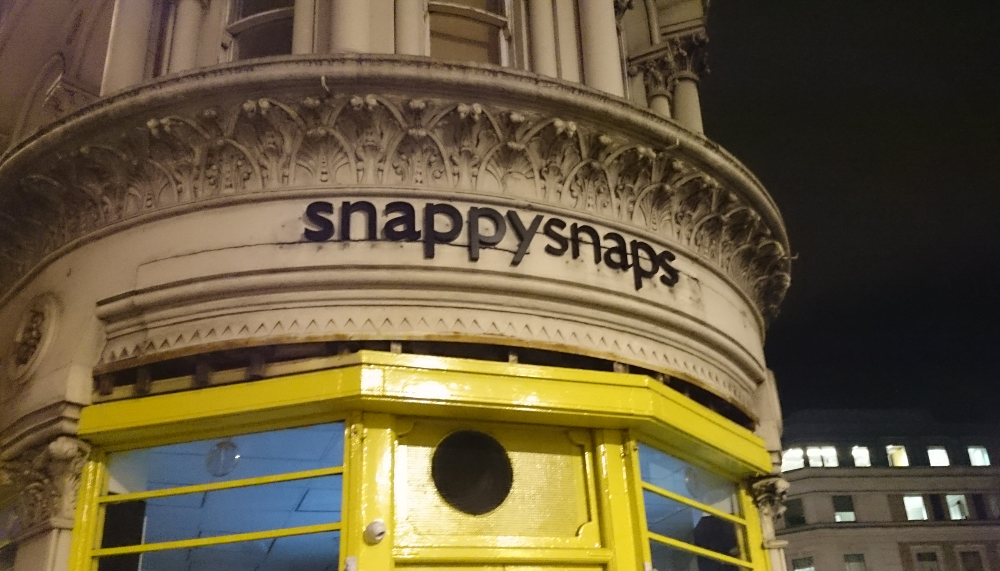
Ironically, a "snapstore" was close to the office ;-)

Ironically, a snapstore was close to the office ;-)

XdgApp and sandboxing of apps was also a big topic, aside from Ubuntu and Endless integration. Fortunately, Alexander Larsson was also there to answer all the sandboxing and XdgApp-questions. I used the time to follow up on a conversation with Alexander we started at FOSDEM this year, about the Limba vs. XdgApp bundling issue. While we are in-line on the sandboxing approach, the way how software is distributed is implemented differently in Limba and XdgApp, and it is bad to have too many bundling systems around (doesn t make for a good story where we can just tell developers ship as this bundling format, and it will be supported everywhere ). Talking with Alex about this was very nice, and I think there is a way out of the too-many-solutions dilemma, at least for Limba and XdgApp I will blog about that separately soon. On the Ubuntu side, a lot of bugs and issues were squashed and changes upstreamed to GNOME, and people were generally doing their best to reduce Richard s bus-factor on the project a little  . I mainly worked on AppStream issues, finishing up the last pieces of appstream-generator and running it against some sample package sets (and later that week against the whole Debian archive). I also started to implement support for showing AppStream issues in the Debian PTS (this work is not finished yet). I also managed to solve a few bugs in the old DEP-11 generator and prepare another release for Ubuntu. We also enjoyed some good Japanese food, and some incredibly great, but also suddenly very expensive Indian food (but that s a different story  ). The most important thing for me though was to get together with people actually using AppStream metadata in software centers and also more specialized places. This yielded some useful findings, e.g. that localized screenshots are not something weird, but actually a wanted feature of Endless for their curated AppStore. So localized screenshots will be part of the next AppStream spec. Also, there seems to be a general need to ship curation information for software centers somehow (which apps are featured? how are they styled? added special banners for some featured apps, app of the day features, etc.). This problem hasn t been solved, since it s highly implementation-specific, and AppStream should be distro-agnostic. But it is something we might be able to address in a generic way sooner or later (I need to talk to people at KDE and Elementary about it). In summary It was a great event! Going to conferences and hackfests always makes me feel like it moves projects leaps ahead, even if you do little coding. Sorting out issues together with people you see in person (rather than communicating with them via text messages or video chat), is IMHO always the most productive way to move forward (yeah, unless you do this every week, but I think you get my point  ). For me, being the only (and youngest ^^) developer at the hackfest who was not employed by any company in the FLOSS business, the hackfest was also motivating to continue to invest spare time into working on these projects. So, the only thing left to do is a huge shout out of THANK YOU to the Ubuntu Community Fund and therefore the Ubuntu community for sponsoring me! You rock! Also huge thanks to Canonical for organizing the sponsoring really quickly, so I didn t get into trouble with paying my flights.

Laney and attente walking on the Millennium Bridge after we walked the distance between Red Hat and Canonical's offices.

Laney and attente on the Millennium Bridge after we walked the distance between Red Hat and Canonical s offices.

To worried KDE people: No, I didn t leave the blue side I just generally work on cross-desktop stuff, and would like all desktops to work as well as possible

25 April 2016

Antoine Beaupr : My free software activities, April 2016

Debian Long Term Support (LTS) This is my 5th month working on Debian LTS, started by Raphael Hertzog at Freexian. This is my largest month so far, in which I worked on completing the Xen and NSS packages updates from last month, but also spent a significant amount of time working on phpMyAdmin and libidn.

Updates to NSS and Xen completed This basically consisted on following up on the reviews from other security people. I basically continued building up on Brian's work and tested the package on a test server at Koumbit, which seems to have survived well the upgrade. The details are in this post to the debian-lts mailing list. As for NSS, the package was mostly complete, but I forgot to ship the tests for some reason, so I added them back. I also wrote the release team to see if it was possible to update NSS to the same version in all suites. Unfortunately, this issue is still pending, but I still hope we can find better ways of managing that package in the long term.

IDN and phpMyAdmin Most of my time this month was spent working on IDN and phpMyAdmin. Unfortunately, it turns out that someone else had worked on the libidn package. This is partly my fault: I forgot to check in the dsa-needed.txt file for assignment before working on the package. But considering how in flux the workflow currently is with the switch between the main security team and the LTS team for the wheezy maintenance, I don't feel too bad. Still, I prepared a package which was a bit more painful than it should have been because of GNUlib. I didn't even know about GNUlib before, oddly enough, and after that experience, I feel that it should just not exist at all anymore. I have filed a bug to remove that dependency at the very least, but I do not clearly see how such a tool is necessary on Debian at this point in time. But phpMyAdmin, no one had worked on that. And I understand why: even though it's a very popular package, there were quite a few outstanding issues (8!) in Wheezy, with 10-15 patches to be ported. Plus, it's ... well, PHP. And old PHP at that, with parts of it with modern autoloader classes, and other with mixed HTML and PHP content, require (and not require_once) and all sorts of nasty things you still find in the PHP universe. I nevertheless managed to produce a new Debian package for wheezy and test it on Koumbit's test servers. Hopefully, that can land into Wheezy soon.

Long term software support I am a little worried that we are, both in Jessie and Wheezy sitting in between stable releases for phpMyAdmin, something that is a recurring issue for a lot of packages in Debian stable or LTS. Sometimes, it just happens that the version that happens to be in Debian testing when it is released as stable is just not a supported release upstream. It's the case for phpMyAdmin in Jessie (4.3, whereas 4.0 and 4.4 are supported) and Wheezy (3.4, although it's unclear how long that was supported upstream). But even if the next Debian stable (Stretch), would pick a stable release upstream, there is actually no phpMyAdmin release that has a support window as long as Debian stable (roughly 3 years), let alone as long as Debian LTS (5 years). This is a similar problem with NSS: upstream is simply not supporting their product in the long term, or at least not in the terms we are used to in the Debian community (ie. only security fixes or regressions). This is, in my opinion, a real concern for the reliability and sustainability of the computing infrastructure we are creating. While some developers are of the opinion that software older than 18 months is too old, here we are shipping hardware and software in space or we have Solaris, which is supported for 16 years! Now that is a serious commitment and something we can rely on. 18 months is really, really, a tiny short time in the history of our civilization. I know computer programmers and engineers like to think of themselves in elitist terms, that they are changing the world every other year. But the truth is that things have not changed much in the last 4 decades where computing has existed, both in terms of security or functionality. Two quotes from my little quotes collection come to mind here:
Software gets slower faster than hardware gets faster. - Wirth's law The future is already here it's just not very evenly distributed. - William Gibson
Because of course, the response to my claims that computing is not really advancing is "but look! we have supercomputers in our pockets now!" Yes, of course, we do have those fancy phones and they are super-connected, but they are a threat to our fundamental rights and freedom. And those glittering advances always pale in comparison to what could be done if we wouldn't be wasting our time rewriting the same software over and over again on different, often proprietary, platforms, simply because of the megalomaniac fantasies of egoistic programmers. It would be great to build something that lasts, for a while. Software that does not need to be updated every 16 months. You'd think that something as basic as a screensaver release could survive what is basically the range of human infancy. Yet it seems we like to run mindlessly in the minefield of software development, one generation following the other without questioning the underlying assumption of infinite growth that permeates our dying civilization. I have talked about this before of course, but working with the LTS project just unnerves me so bad that I just needed to let out another rant. (For the record, I really have a lot of respect for JWZ and all the work he has done in the free software world. I frequently refer to his "no-bullshit" backup guide and use Xscreensaver daily. But I do think he was wrong in this case: asking Debian to remove Xscreensaver is just too much. The response from the maintainer was exemplary of how to handle such issues in the future. I restarted Xscreensaver after the stable update, and the message is gone, and things are still all fine. Thanks JWZ and Tormod for keeping things rolling.)

Other free software work With that in mind, I obviously didn't stop doing other computing work this month. In fact, I did a lot of work to try to generally fix the internet, that endless and not-quite-gratifying hobby so many of us are destroying our bodies to accomplish.

Build tools I have experimented a bit more with different build tools. I got worried because at some point cowbuilder got orphaned and I figured I could refresh the way I build packages for LTS. I looked into sbuild, but that ended up not bringing much improvements over my current cowbuilder setup (which I really need to document better). I was asked by the new maintainer to open a bug report to make such setups easier by guessing the basepath better, so we'll see how that goes. I did enjoy the simplicity of gitpkg and discovered cowpoke which made it about 2 times faster to build packages because I could use another server to build larger packages. I also found that gitpkg doesn't use -n by default when calling gzip, which makes it harder to reproduce tarballs when they are themselves built reproducibly, which is the case for Github tarballs (really nice of them). So I filed bug #820842 about that. It would be pretty awesome if such buildds would be available for Debian Developers to do their daily tasks. It could simply be a machine that would spin up a chroot with cowbuilder or it could even be a full, temporary VM although that would take way more resources than a simple VM with a cowbuilder setup. In the meantime, I should probably look at whalebuilder as an alternative to cowbuilder. It is a tool that supports building packages within a Docker chroot, which means that packages are built from a clean environment like pbuilder, and using COW optimisations but also without privileges or network access, which is a huge plus especially when you build untrusted packages.

Ikiwiki admonitions I have done some work to implement Moinmoin-like admonitions in Ikiwiki, something I am quite happy about since it's something I was really missing about Moinmoin. Admonitions bring a really nice way to outline certain blocks with varying severity levels and distinct styles. For example:
Admonitions are great!
This was done with a macro, but basically, since Markdown allows more or less arbitrary HTML, this can also be done with the <div> tag. I like that we don't have a new weird markup here. Yet, I still liked the sub-parser feature of MoinMoin, something that can be implemented in Ikiwiki, but it's a little more clunky. Normally, you'd probably do this with the inline macro and subpages, but it's certainly less intuitive that directly inlined content.

Ereader I got a new e-reader! I was hesitant between the Kobo Aura H20 and the Kobo Glo HD, which were the ones available at Bestbuy. So I bought both and figured I would return the other. That was a painful decision! In the end, both machines are pretty nice:
  • Aura H2O
    • Pros:
      • waterproof
      • larger screen (makes it easier to see web pages and better for the eyes)
      • naturally drawn to it
    • Cons:
      • heavier
      • larger (fits in outside pocket though)
      • port cover finicky
      • more expensive (180$) - prices may go down in future
  • Aura Glo HD
    • Pros
      • smaller (fits in inside pocket of both coats)
      • better resolution in theory (can't notice in practice)
      • cheaper (100$)
      • may be less common on the future (larger models more common? just a guess)
    • Cons
      • no SD card
      • smaller screen
      • power button in the middle
... but in the end, I ended up settling down on the Glo, mostly for the price. Heck, I saved around 100$, so for that amount, I could have gotten two machines so that if one breaks I would still have the other. I have ordered a cover for it on Deal Extreme about two weeks ago, and it still hasn't arrived. I suspect it's going to take a few more months to get there, by which point I may have changed e-reader again. Note that both e-readers needed an update to calibre, so I started working on a calibre backport (#818309) which I will complete soon. So anyways, I looked into better ways of transferring articles from the web to the e-reader, something which I do quite a bit to avoid spending too much time on the computer. Since the bookmark manager I use (Bookie) is pretty much dead, I started looking at other alternatives. And partly inspired by Framasoft's choice of Wallabag for their bookmarking service (Framabag), I started to look into that software, especially since my friend who currently runs the Bookie instance is thinking of switching to Wallabag as well. It seems the simplest way to browse articles remotely through a standard protocol is by implementing OPDS support in Wallabag. OPDS is a standard developed in part by the Internet Archive and it allows for browsing book collections and downloading them. Articles and bookmarks would then be presented as individual books that would be accessible from any OPDS-compatible device. Unfortunately, the Kobo e-readers don't support OPDS out of the box: you need to setup some OPDS-compatible reader like Koreader. And that I found nearly impossible to do: I was able to setup KSM (the "start menu", not to be confused with that KSM), but not Koreader in KSM. Besides, I do not want a separate OS running here on the tablet: I just want to start Koreader every once in a while. KSM just starts another system when you reboot the e-reader, something which is not really convenient on the Kobo. Basically, I just want to add Koreader as a tile in the home screen on the e-reader. I found the documentation on that topic to be sparse and hard to follow. It is often dispersed across multiple forum threads and involves uploading random binaries, often proprietary, to the e-reader. It had been a long time since I was asked to "register my software" frenetically, and I hadn't missed that one bit. So I decided to stay away from this until that solution and its documentation matures a bit.

Streaming re-established I have worked a bit on my home radio stream. I simply turned the Liquidsoap stream back online, and did a few tweaks to the documentation that I had built back then. All that experimenting led me to do two NMUs. One was for gmpc-plugins to fix a FTBFS (bug #807735) and to properly kill the shout streamer when completing the playback (bug #820908). The other was to fix the ezstream manpage (bug #573928), a patch that had been sitting there for 5 years! This was to try to find an easy way to stream random audio (say from a microphone) to the Icecast server, something which is surprisingly difficult, consider how basic that functionality is. I was surprised to see that Darkice just completely fails to start (bug #821040) and I had to fallback to the simplest ices2 software to stream the audio. I am still having issues with Liquidsoap: it's really unstable! As a server, I would expect it to keep running for days if not years. Unfortunately, there's always something that makes it crash. I had assertion failed (bug #821112) and I keep seeing it crash after 2-3 days fairly reliably, a bug I reported 3 years ago and that is still not fixed (bug #727307). Switching back the stream to Vorbis (because I was having problems with the commandline mp3 players and ogg123 is much more lightweight) created another set of problems too, this time with the phone. It seems that Android cannot stream Vorbis at all, something that is even worse in Cyanogenmod... I also had to tweak my MPD config to make the Android client be able to load the larger playlists (see dmix buffer is full).

Android apps So I have also done quite a bit of work again on my phone. I finally was told how to access from Termux from adb shell which is pretty cool because now I can start a screen on my phone and then, when I'm tired of tapping to type, I can just reconnect to it when I plug in a USB cable on my laptop. I sent a pull request to fix the documentation regarding that. I also tried to see how my SMS and Signal situation could be improved. Right now, I have two different apps to do SMS on my phone: I use both Signal and the VoIP.ms SMS client, because I do not have a contract or SIM card in my phone. Both work well independently, but it's somewhat annoying to have to switch between the two. (In fact, I feel that Signal itself has an issue with how it depends on the network to send encrypted messages: I often have to "ping" people in clear text (and therefore in the other app) so that they connect to their data plan to fetch my "secure" signal messages...) Anyways, I figured it would be nice if at least there would be a SMS fallback in Signal that would allow me to send regular text messages from signal through Voip.MS. That was dismissed really fast. Moxie even closed the conversation completely, something I had never experienced before, and doesn't feel exactly pleasant. The Voip.MS side was of course not impressed and basically shrugged it off because Signal was not receptive. I also tried to clear up the Libresignal confusion: there are 3 different projects named "Libresignal", and I am not sure I figured out the right thing, even though the issue is now closed and there's a FAQ that is supposed to make all that clear. Nevertheless, I opened two distinct feature requests to try to steer the conversation into a more productive direction: GCM-less calls and GCM support. But I'm not sure neither will go anywhere. In the meantime, I am using the official signal client, which I downloaded using gplaycli and which I keep up to date with Aptoide. Even though the reliability of that site is definitely questionable, it seems that once you have a trusted version, it is safe to upgrade, regardless of the source because there is a trust path between you and the developer. I also filed a few issues with varying levels of success/response from the community:

Random background radiation And then there's of course the monthly background noise of all the projects I happened to not only stumble on, but also file bugs or patches against:

21 April 2016

John Goerzen: Count me as a systemd convert

Back in 2014, I wrote about some negative first impressions of systemd. I also had a plea to debian-project to end all the flaming, pointing out that jessie will still boot , noting that my preference was for sysvinit but things are what they are and it wasn t that big of a deal. Although I still have serious misgivings about the systemd upstream s attitude, I ve got to say I find the system rather refreshing and useful in practice. Here s an example. I was debugging the boot on a server recently. It mounts a bunch of NFS filesystems and runs a third-party daemon that is started from an old-style /etc/init.d script. We had a situation where the NFS filesystems the daemon required didn t mount on boot. The daemon then was started, and unfortunately it basically does a mkdir -p on startup. So it started running and processing requests with negative results. So there were two questions: why did the NFS filesystems fail to start, and how could we make sure the daemon wouldn t start without them mounted? For the first, journalctl -xb was immensely helpful. It logged the status of each individual mount, and it turned out that it looked like a modprobe or kernel race condition when a bunch of NFS mounts were kicked off in parallel and all tried to load the nfsv4 module at the same time. That was easy enough to work around by adding nfsv4 to /etc/modules. Now for the other question: refusing to start the daemon if the filesystems weren t there. With systemd, this was actually trivial. I created /etc/systemd/system/mydaemon.service.requires (I ll call the service mydaemon here), and in it I created a symlink to /lib/systemd/system/remote-fs.target. Then systemctl daemon-reload, and boom, done. systemctl list-dependencies mydaemon will even show the the dependency tree, color-coded status of each item on it, and will actually show every single filesystem that remote-fs requires and the status of it in one command. Super handy. In a non-systemd environment, I d probably be modifying the init script and doing a bunch of manual scripting to check the filesystems. Here, one symlink and one command did it, and I get tools to inspect the status of the mydaemon prerequisites for free. I ve got to say, as someone that has occasionally had to troubleshoot boot ordering and update-rc.d symlink hell, troubleshooting this stuff in systemd is considerably easier and the toolset is more powerful. Yes, it has its set of poorly-documented complexity, but then so did sysvinit. I never thought the world is falling folks were right, but by now I can be counted among those that feels like systemd has matured to the point where it truly is superior to sysvinit. Yes, in 2014 it had some bugs, but by here in 2016 it looks pretty darn good and I feel like Debian s decision has been validated through my actual experience with it.

20 April 2016

Jonathan Dowland: mount-on-demand backups

Last week, someone posted a request for help on the popular Server Fault Q&A site: they had apparently accidentally deleted their entire web hosting business, and all their backups. The post (now itself deleted) was a reasonably obvious fake, but mainstream media reported on it anyway, and then life imitated art and 123-reg went and did actually delete all their hosted VMs, and their backups. I was chatting to some friends from $job-2 and we had a brief smug moment that we had never done anything this bad, before moving on to incredulity that we had never done anything this bad in the 5 years or so we were running the University web servers. Some time later I realised that my personal backups were at risk from something like this because I have a permanently mounted /backup partition on my home NAS. I decided to fix it. I already use Systemd to manage mounting the /backup partition (via a backup.mount file) and its dependencies. I'll skip the finer details of that for now. I planned to define some new Systemd units for each backup job which was previously scheduled via Cron in order that I could mark them as depending on the /backup mount. I needed to adjust that mount definition by adding StopWhenUnneeded=true. This ensures that /backup will be unmounted when it is not in use by another job, and not at risk of a stray rm -rf. The backup jobs are all simple shell scripts that convert quite easily into services. An example: backup-home.service:

[Unit]
Requires=backup.mount
After=backup.mount
[Service]
User=backupuser
Group=backupuser
ExecStart=/home/backupuser/bin/phobos-backup-home
To schedule this, I also need to create a timer: backup-home.timer:
[Timer]
OnCalendar=*-*-* 04:01:00
[Install]
WantedBy=timers.target
To enable the timer, you have to both enable and start it:
systemctl enable backup-home.timer
systemctl start backup-home.timer
I created service and timer units for each of my cron jobs. The other big difference to driving these from Cron is that by default I won't get any emails if the jobs generate output - in particular, if they fail. I definitely do want mail if things fail. The Arch Wiki has an interesting proposed solution to this which I took a look at. It's a bit clunky, and my initial experiments with a derivation from this (using mail(1) not sendmail(1)) have not yet generated any mail. Pros and Cons The Systemd timespec is more intuitive than Cron's. It's a shame you need a minimum of three more lines of boilerplate for the simplest of timers. I think WantedBy=timers.target should probably be an implicit default for all .timer type units. Here I think clarity suffers in the name of consistency. With timers, start doesn't kick-off the job, it really means "enable" in the context of timers, which is clumsy considering the existing enable verb, which seems almost superfluous, but is necessary for consistency, since Systemd units need to be enabled before they can be started As Simon points out in the comments, this is not true. Rather, "enable" is needed for the timer to be active upon subsequent boots, but won't enable it in the current boot. "Start" will enable it for the current boot, but not for subsequent ones. Since I need a .service and a .unit file for each active line in my crontab, that's a lot of small files (twice as many as the number of jobs being defined) and they're all stored in system-wide folder because of the dependency on the necessarily system-level units defining the mount. It's easy to forget the After= line for the backup services. On the one hand, it's a shame that After= doesn't imply Require=, so you don't need both; or alternatively there was a convenience option that did both. On the other hand, there are already too many Systemd options and adding more conjoined ones would just make it even more complicated. It's a shame I couldn't use user-level units to achieve this, but they could not depend on the system-level ones, nor activate /backup. This is a sensible default, since you don't want any user to be able to start any service on-demand, but some way of enabling it for these situations would be good. I ruled out systemd.automount because a stray rm -rf would trigger the mount which defeats the whole exercise. Apparently this might be something you solve with Polkit, as the Arch Wiki explains, which looks like it has XML disease. I need to get mail-on-error working reliably.

Ben Hutchings: Experiments with signed kernels and modules in Debian

I've lately been working on support for Secure Boot in Debian, mostly in the packages maintained by the kernel team. My instructions for setting up UEFI Secure Boot are based on OVMF running on KVM/QEMU. All 'Designed for Windows' PCs should allow reconfiguration of SB, but it may not be easy to do so. They also assume that the firmware includes an EFI shell. Updated: Robert Edmonds pointed out that the 'Designed for Windows' requirements changed with Windows 10: The ability to reconfigure SB is indeed now optional for devices which are designed to always boot with a specific Secure Boot configuration. I also noticed that the requirements say that OEMs should not sign an EFI shell binary. Therefore I've revised the instructions to use efibootmgr instead. Background UEFI Secure Boot, when configured and enabled (which it is on most new PCs) requires that whatever it loads is signed with a trusted key. The one common trusted key for PCs is held by Microsoft, and while they will sign other people's code for a nominal fee, they require that it also validates the code it loads, i.e. the kernel or next stage boot loader. The kernel in turn is responsible for validating any code that could compromise its integrity (kernel modules, kexec images). Currently there are no such signed boot loaders in Debian, though the shim and grub-signed packages included in many other distributions should be usable. However it's possible to load an appropriately configured Linux kernel directly from the UEFI firmware (typically through the shell) which is what I'm doing at the moment. Packaging signed kernels Signing keys obviously need to be protected against disclosure; the private keys can't be included in a source package. We also won't install them on buildds separately, and generating signatures at build time would of course be unreproducible. So I've created a new source package, linux-signed, which contains detached signatures prepared offline. Currently the binary packages built from linux-signed also contain only detached signatures, which are applied as necessary at installation time. The signed kernel image (only on x86 for now) is named /boot/vmlinuz-kversion.efi.signed. However, since packages must not modify files owned by another package and I didn't want to dpkg-divert thousands of modules, the module signatures remain detached. Detached module signatures are a new invention of mine, and require changes in kmod and various other packages to support them. (An alternate might be to put signed modules under a different directory and drop a configuration file in /lib/depmod.d to make them higher priority. But then we end up with two copies of every module installed, which can be a substantial waste of space.) Preparation The packages you need to repeat the experiment: For Secure Boot, you'll then need to copy the signed kernel and the initrd onto the EFI system partition, normally mounted at /boot/efi. SB requires a Platform Key (PK) which will already be installed on a real PC. You can replace it but you don't need to. If you're using OVMF, there are no persistent keys so you do need to generate your own:
openssl req -new -x509 -newkey rsa:2048 -keyout pk.key -out pk.crt \
    -outform der -nodes
You'll also need to install the certificate for my kernel image signing key, which is under debian/certs in the linux-signed package. OVMF requires this in DER format:
openssl x509 -in linux-signed-1~exp3/debian/certs/linux-image-benh@debian.org.cert.pem \
    -out linux.crt -outform der 
You'll need to copy the certificate(s) to a FAT-formatted partition such as the EFI system partition, so that the firmware can read it. Use efibootmgr to add a boot entry for the kernel, for example:
efibootmgr -c -d /dev/sda -L linux-signed -l '\vmlinuz.efi' -u 'initrd=initrd.img root=/dev/sda2 ro quiet'
You should use the same kernel parameters as usual, except that you also need to specify the initrd filename using the initrd= parameter. The EFI stub code at the beginning of the kernel will load the initrd using EFI boot services. Enabling Secure Boot
  1. Reboot the system and enter UEFI setup
  2. Find the menu entry for Secure Boot customisation (in OVMF, it's under 'Device Manager' for some reason)
  3. In OVMF, enrol the PK from pk.crt
  4. Add linux.crt to the DB (whitelist database)
  5. Ensure that Secure Boot is enabled and in 'User Mode'
Booting the kernel in Secure Boot If all went well, Linux will boot as normal. You can confirm that Secure Boot was enabled by reading /sys/kernel/security/securelevel, which will contain 1 if it was. Module signature validation Module signatures are now always checked and unsigned modules will be given the 'E' taint flag. If Secure Boot is used or you add the kernel parameter module.sig_enforce=1, unsigned modules will be rejected. You can also turn on signature enforcement and turn off various other methods of modifying kernel code (such as kexec) by writing 1 to /sys/kernel/security/securelevel.

Michal &#268;iha&#345;: Testing Sphinx documentation with Jenkins

While reviewing comments on phpMyAdmin wiki (which we're shrinking down to developer documentation and moving end user documentation to proper documentation) I've noticed that people complained there on broken links in our documentation. Indeed there was quite some of them as this is something nobody really checks. It seems like obvious task to automate. It seemed to me as obvious as somebody had to do it already. Unfortunately I have not found much, but at least there was Using Jenkins to parse sphinx warnings. This helps with the build warnings, but unfortunately I found no integration for the linkcheck builder. Fortunately it's quite easy with the Jenkins Warnings plugin to write custom parsers and to parse linkcheck output as well. The Sphinx output parser based on above link can be configured like: Regular Expression:
^(.*):(\d+): \((.*)\) (.*)
Mapping Script:
import hudson.plugins.warnings.parser.Warning
String fileName = matcher.group(1)
String lineNumber = matcher.group(2)
String category = matcher.group(3)
String message = matcher.group(4)
return new Warning(fileName, Integer.parseInt(lineNumber), "sphinx", category, message);
Example Log Message:
Percona-Server-1.0.2-3.rst:67: (WARNING/2) Inline literal start-string without end-string.
The Sphinx linkcheck output is quite similar: Regular Expression:
^(.*):(\d+): \[([^\]]*)\] (.*)
Mapping Script:
import hudson.plugins.warnings.parser.Warning
String fileName = matcher.group(1)
String lineNumber = matcher.group(2)
String category = matcher.group(3)
String message = matcher.group(4)
return new Warning(fileName, Integer.parseInt(lineNumber), "sphinx-linkcheck", category, message);
Example Log Message:
faq.rst:793: [broken] http://www.hardened-php.net/: <urlopen error [Errno -3] Temporary failure in name resolution>
All you need to do now is to enable these in your Jenkins project, let the Sphinx parse output and the Sphinx linkcheck one file generated by linkcheck (usually _build/linkcheck/output.txt). The result can be found on the phpMyAdmin CI server.

Filed under: English phpMyAdmin 2 comments

18 April 2016

Reproducible builds folks: Reproducible builds: week 50 in Stretch cycle

What happened in the reproducible builds effort between April 3rd and April 9th 2016: Media coverage Emily Ratliff wrote an article for SecurityWeek called Establishing Correspondence Between an Application and its Source Code - How Combining Two Completely Separate Open Source Projects Can Make Us All More Secure. Tails have started work on a design for freezable APT repositories to make it easier and practical to perform reproductions of an entire distribution at a given point in time, which will be needed to create reproducible installation- or live-media. Toolchain fixes Alexis Bienven e submitted patches adding support for SOURCE_DATE_EPOCH in several tools: transfig, imagemagick, rdtool, and asciidoctor. boyska submitted one for python-reportlab. Packages fixed The following packages have become reproducible due to changes in their build dependencies: atinject-jsr330 brailleutils cglib3 gnugo libcobra-java libgnumail-java libjchart2d-java libjcommon-java libjfreechart-java libjide-oss-java liblaf-widget-java liblastfm-java liboptions-java octave-control octave-mpi octave-nan octave-parallel octave-stk octave-struct octave-tsa oar The following packages became reproducible after getting fixed: Several uploads fixed some reproducibility issues, but not all of them: Patches submitted which have not made their way to the archive yet: Other upstream fixes Alexander Batischev made a commit to make newsbeuter reproducible. tests.reproducible-builds.org Package reviews 93 reviews have been removed, 66 added and 21 updated in the previous week. 12 new FTBFS bugs have been reported by Chris Lamb and Niko Tyni. Misc. This week's edition was written by Lunar, Holger Levsen, Reiner Herrmann, Mattia Rizzolo and Ximin Luo. With the departure of Lunar as a full-time contributor, Reproducible Builds Weekly News (this thing you're reading) has moved from his personal Debian blog on Debian People to the Reproducible Builds team web site on Debian Alioth. You may want to update your RSS or Atom feeds. Very many thanks to Lunar for writing and publishing this weekly news for so long, well & continously!

Dirk Eddelbuettel: RcppCCTZ 0.0.4

A few days ago a new upstream version "2.0" of CCTZ was released. See here for the corresponding post on the Google OpenSource Blog. CCTZ is a C++ library for translating between absolute and civil times using the rules of a time zone. It requires only a proper C++11 compiler and the standard IANA time zone data base which standard Unix, Linux, OS X, ... computers tend to have in /usr/share/zoneinfo. RcppCCTZ connects this library to R by relying on Rcpp. This new version adds more support to the notion of civil time representation -- i.e. independent of timezones -- which can then be mapped to different time zone representations. Changes in this version are summarized here:

Changes in version 0.0.4 (2016-04-17)
  • Synchronized with CCTZ v2 upstream.
  • Updated examples.cpp accordingly
A quick example is provided here where we look at the time when Neil Armstrong first stepped on the moon as an absolute ("civil") time and two local representations:
// from examples/hello.cc
// 
// [[Rcpp::export]]
int helloMoon()  
    cctz::time_zone syd;
    if (!cctz::load_time_zone("Australia/Sydney", &syd)) return -1;
    // Neil Armstrong first walks on the moon
    const auto tp1 = cctz::convert(cctz::civil_second(1969, 7, 21, 12, 56, 0), syd);
    const std::string s = cctz::format("%F %T %z", tp1, syd);
    Rcpp::Rcout << s << "\n";
    cctz::time_zone nyc;
    cctz::load_time_zone("America/New_York", &nyc);
    const auto tp2 = cctz::convert(cctz::civil_second(1969, 7, 20, 22, 56, 0), nyc);
    return tp2 == tp1 ? 0 : 1;
 
We can call this from R, and get the expected result (of equivalence between the dates):
R> library(RcppCCTZ)
R> helloMoon()
1969-07-21 12:56:00 +1000
[1] 0
R>
We also have a diff to the previous version thanks to CRANberries. More details, issue tickets etc at the GitHub repository.

This post by Dirk Eddelbuettel originated on his Thinking inside the box blog. Please report excessive re-aggregation in third-party for-profit settings.

16 April 2016

Matthias Klumpp: Introducing AppStream-Generator

AppStream GeneratorSince mid-2015 we were using the dep11-generator in Debian to build AppStream metadata about available software components in the distribution. Getting rid of dep11-generator Unfortunately, the old Python-based dep11-generator was hitting some hard limits pretty soon. For example, using multiprocessing with Python was a pain, since it resulted in some very hard-to-track bugs. Also, the multiprocessing approach (as opposed to multithreading) made it impossible to use the underlying LMDB database properly (it was basically closed and reopened in each forked off process, since pickling the Python LMDB object caused some really funny bugs, which usually manifested themselves in the application hanging forever without any information on what was going on). Additionally to that, the Python-based generator forced me to maintain two implementations of the AppStream YAML spec, one in C and one in Python, which consumes quite some time. There were also some other issues (e.g. no unit-tests) in the implementation, which made me think about rewriting the generator. Adventures in Go / Rust / D Since I didn t want to write this new piece of software in C (or basically, writing it in C was my last option  ), I explored Go and Rust for this purpose and also did a small prototype in the D programming language, when I was starting to feel really adventurous. And while I never intended to write the new generator in D (I was pretty fixated on Go ), this is what happened. The strong points for D for this particular project were its close relation to C (and ease of using existing C code), its super-flat learning curve for someone who knows and likes C and C++ and its pretty powerful implementations of the concurrent and parallel programming paradigms. That being said, not all is great in D and there are some pretty dark spots too, mainly when it comes to the standard library and compilers. I will dive into my experiences with D in a separate blogpost. What good to expect from appstream-generator? So, what can the new appstream-generator do for you? Basically, the same as the old dep11-generator: It will extract metadata from a distribution s package archive, download and resize screenshots, search for icons and size them properly and generate reports in JSON and HTML of found metadata and issues. LibAppStream-based parsing, generation of YAML or XML, multi-distro support, As opposed to the old generator, the new generator utilizes the metadata parsers and writers of libappstream. This allows it to return the extracted metadata as AppStream YAML (for Debian) or XML (everyone else) It is also written in a distribution-agnostic way, so if someone wants to use it in a different distribution than Debian, this is possible now. It just requires a very small distribution-specific backend to be written, all of the details of the metadata extraction are abstracted away (just two interfaces need to be implemented). While I do not expect anyone except Debian to use this in the near future (most distros have found a solution to generate metadata already), the frontend-backend split is a much cleaner design than what was available in the previous code. It also allows to unit-test the code properly, without providing a Debian archive in the testsuite. Feature Flags, Optipng, The new generator also allows to enable and disable certain sets of features in a standardized way. E.g. Ubuntu uses a language-pack system for translations, which Debian doesn t use. Features like this can be implemented as disableable separate modules in the generator. We use this at time to e.g. allow descriptions from packages to be used as AppStream descriptions, or for running optipng on the generated PNG images and icons. No more Contents file dependency Another issue the old generator had was that it used the Contents file from the Debian archive to find matching icons for an application. We could never be sure whether the contents in the Contents file actually matched the contents of the package we were currently dealing with. What made things worse is that at Ubuntu, the archive software is only updating the Contents file weekly daily (while the generator might run multiple times a day), which has lead to software being ignored in the metadata, because icons could not yet be found. Even on Debian, with its quickly-updated Contents file, we could immediately see the effects of an out-of-date Contents file when updating it failed once. In the new generator, we read the contents of each package ourselves now and store them in a LMDB database, bypassing the Contents file and removing the whole class of problems resulting from missing or wrong contents-data. It can t all be good, right? That is true, there are also some known issues the new generator has: Large amounts of RAM required The better speed of the new generator comes at the cost of holding more stuff in RAM. Much more. When processing data from 5 architectures initially on Debian, the amount of required RAM might lie above 4GB, with the OOM killer sometimes being quicker than the garbage collector That being said, on subsequent runs the amount of required memory is much lower. Still, this is something I am working on to improve. What are symbolic links? To be faster, the appstream-generator will read the md5sum file in .deb packages instead of extracting the payload archive and reading its contents. Since the md5sums file does not list symbolic links, symlinks basically don t exist for the new generator. This is a problem for software symlinking icons or even .desktop files around, like e.g. LibreOffice does. I am still investigating how widespread the use of symlinks for icons and .desktop files is, but it looks like fixing packages (making them not-symlink stuff and rather move the files) might be the better approach than investing additional computing power to find symlinks or even switch back to parsing the Contents file. Input on this is welcome! Deploying asgen I finished the last pieces of the appstream-generator (together with doing lots of other cool things and talking to great people) at the GNOME Software Hackfest in London last week (detailed blogposts about things that happened there will follow many thanks once again for the Ubuntu community for sponsoring my attendance!). Since today, the new generator is running on the Debian infrastructure. If bigger issues are found, we can still roll back to the old code. I decided to deploy this faster, so we can get some good testing done before the Stretch release. Please report any issues you may find!

John Goerzen: A Year of Flight

Dad-o, I m so glad you re a pilot! My 9-year-old son Jacob has been saying that, always with a big hug and his fond nickname for me ( dad-o ). It has now been a year since the first time I sat in the pilot s seat of a plane, taking my first step towards exploring the world from the sky. And now, one year after I first sat in the pilot s seat of an airborne plane, it s prompted me to think back to my own memories. vlcsnap-2015-07-24-20h35m16s96_1

Flying over the airport at Moundridge, KS Memories Back when I was a child, maybe about the age my children are now, I d be outside in the evening and see this orange plane flying overhead. Our neighbor Don had a small ultralight plane and a grass landing strip next to his house. I remember longing to be up in the sky with Don, exploring the world from up there. At that age, I didn t know all the details of why that wouldn t work I just knew I wanted to ride in it. It wasn t until I was about 11 that I flew for the first time. I still remember that TWA flight with my grandma, taking off early in the morning and flying just a little ways above the puffy clouds lit up all yellow and orange by the sunrise. Even 25 years later, that memory still holds as one of the most beautiful scenes I have ever seen. Exploring I have always been an explorer. When I go past something interesting, I love to go see what it looks like inside. I enjoy driving around Kansas with Laura, finding hidden waterfalls, old county courthouses, ghost towns, beautiful old churches, even small-town restaurants. I explore things around me, too once taking apart a lawnmower engine as a child, nowadays building HF antennas in my treetops or writing code for Linux. If there is little to learn about something, it becomes less interesting to me. I see this starting to build in my children, too. Since before they could walk, if we were waiting for something in a large building, we d go exploring. IMG_7231

A patch of rain over Hillsboro, KS The New World A pilot once told me, Nobody can become a pilot without it changing the way they see the world and then, changing their life. I doubted that. But it was true. One of the most poetic sights I know is flying a couple thousand feet above an interstate highway at night, following it to my destination. All those red and white lights, those metal capsules of thousands of lives and thousands of stories, stretching out as far as the eye can see in either direction. IMG_7099

Kansas sunset from the plane When you re in a plane, that small town nowhere near a freeway that always seemed so far away suddenly is only a 15-minute flight away, not even enough time to climb up to a high cruise altitude. Two minutes after takeoff, any number of cities that are an hour s drive away are visible simultaneously, their unique features already recognizable: a grain elevator, oil refinery, college campus, lake, whatever. And all the houses you fly over each with people in them. Some pretty similar to you, some apparently not. But pretty soon you realize that we all are humans, and we aren t all that different. You can t tell a liberal from a conservative from the sky, nor a person s race or religion, nor even see the border between states. Towns and cities are often nameless from the sky, unless you re really low; only your navigation will tell you where you are. I ve had the privilege to fly to small out-of-the-way airports, the kind that have a car that pilots can use for free to go into town and get lunch, and leave the key out for them. There I ve met many friendly people. I ve also landed my little Cessna at a big commercial airport where I probably used only 1/10th of the runway, on a grass runway that was barely maintained at all. I ve flown to towns I d driven to or through many times, discovering the friendly folks at the small airport out of town. I ve flown to parts of Kansas I ve never been to before, discovered charming old downtowns and rolling hills, little bursts of rain and beautiful sunsets that seem to turn into a sea. Smith Center, KS airport terminal

Parked at the Smith Center, KS airport terminal, about to meet some wonderful people For a guy that loves exploring the nooks and crannies of the world that everyone else drives by on their way to a major destination, being a pilot has meant many soul-filling moments. Hard Work I knew becoming a pilot would be a lot of hard work, and thankfully I remembered stories like that when I finally concluded it would be worth it. I found that I had an aptitude for a lot of things that many find difficult about being a pilot: my experience with amateur radio made me a natural at talking to ATC, my fascination with maps and navigation meant I already knew how to read aviation sectional maps before I even started my training and knew how to process that information in the cockpit, my years as a system administrator and programmer trained me with a careful and methodical decision-making process. And, much to the surprise of my flight instructor, I couldn t wait to begin the part of training about navigating using VORs (VHF radio beacons). I guess he, like many student pilots, had struggled with that, but I was fascinated by this pre-GPS technology (which I still routinely use in my flight planning, as a backup in case the GPS constellation or a GPS receiver fails). So that left the reflexes of flight, the art of it, as the parts I had to work on the hardest. The exam with the FAA is not like getting your driver s license. It s a multi-stage and difficult process. So when the FAA Designated Pilot Examiner said congratulations, pilot! and later told my flight instructor that you did a really good job with this one, I felt a true sense of accomplishment. IMG_20151021_193137

Some of my prep materials Worth It Passengers in a small plane can usually hear all the radio conversations going on. My family has heard me talking to air traffic control, to small and big planes. My 6-year-old son Oliver was playing yesterday, and I saw him pick up a plane and say this: Two-four-niner-golf requesting to land on runway one-seven . Two-four-niner-golf back-taxi on one-seven Two-four-niner-golf ready to takeoff on runway one-seven! That was a surprisingly accurate representation of some communication a pilot might have (right down to the made-up tailnumber with the spelling alphabet!) 20160408_203110

It just got more involved from there! Jacob and Oliver love model train shows. I couldn t take them to one near us, but there was one in Joplin, MO. So the day before Easter, while Laura was working on her Easter sermon, two excited boys and I (frankly also excited) climbed into a plane and flew to Joplin. We had a great time at the train show, discovered a restaurant specializing in various kinds of hot dogs (of course they both wanted to eat there), played in a park, explored the city, and they enjoyed the free cookies at the general aviation terminal building while I traded tips on fun places to fly with other pilots. When it comes right down to it, the smiles of the people I fly with are the most beautiful thing in the air. IMG_20151205_183440

Jacob after his first father-son flight with me

Next.

Previous.