Search Results: "sto"

12 September 2021

Russ Allbery: DocKnot 5.00

This release is the culmination of a project that I've been wanting to do for two years, but nearly all the work was done in the past week. That experience made me rethink some of my skepticism, but I'll get to that part of the story later. In March of 1999, I got tired of writing HTML by hand and wrote a small program called spin that implemented a macro language that translated into HTML. This makes it one of the oldest programs for which I have a continuous development history, predating podlators by three months. I think only News::Gateway (now very dormant) and Term::ANSIColor (still under active development but very stable) are older, as long as I'm not counting orphaned packages like newsyslog. I've used spin continuously ever since. It's grown features and an ecosystem of somewhat hackish scripts to do web publishing things I've wanted over the years: journal entries like this one, book reviews, a simple gallery (with some now-unfortunate decisions about maximum image size), RSS feeds, and translation of lots of different input files into HTML. But the core program itself, in all those years, has been one single Perl script written mostly in my Perl coding style from the early 2000s before I read Perl Best Practices. My web site is long overdue for an overhaul. Just to name a couple of obvious problems, it looks like trash on mobile browsers, and I'm using URL syntax from the early days of the web that, while it prompts some nostalgia for tildes, means all the URLs are annoyingly long and embed useless information such as the fact each page is written in HTML. Its internals also use a lot of ad hoc microformats (a bit of RFC 2822 here, a text-based format with significant indentation there, a weird space-separated database) and are supported by programs that extract meaning from human-written pages and perform automated updates to them rather than having a clear separation between structure and data. This will be a very large project, but it's the sort of quixotic personal project that I enjoy. Maintaining my own idiosyncratic static site generator is almost certainly not an efficient use of my time compared to, say, converting everything to Hugo. But I have 3,428 pages (currently) written in the thread macro language, plus numerous customizations that cater to my personal taste and interests, and, most importantly, I like having a highly customized system that I know exactly how to automate. The blocker has been that I didn't want to work on spin as it existed. It badly needed a structural overhaul and modernization, and even more badly needed a test suite since every release involved tedious manual testing by pouring over diffs between generations of the web site. And that was enough work to be intimidating, so I kept putting it off. I've separately been vaguely aware that I have been spending too much time reading Twitter (specifically) and the news (in general). It would be one thing if I were taking in that information to do something productive about it, but I haven't been. It's just doomscrolling. I've been thinking about taking a break for a while but it kept not sticking, so I decided to make a concerted effort this week. It took about four days to stop wanting to check Twitter and forcing myself to go do something else productive or at least play a game instead. Then I managed to get started on my giant refactoring project, and holy shit, Twitter has been bad for my attention span! I haven't been able to sustain this level of concentration for hours at a time in years. Twitter's not the only thing to blame (there are a few other stressers that I've fixed in the past couple of years), but it's obviously a huge part. Anyway, this long personal ramble is prelude to the first release of DocKnot that includes my static site generator. This is not yet the full tooling from my old web tools page; specifically, it's missing faq2html, cl2xhtml, and cvs2xhtml. (faq2html will get similar modernization treatment, cvs2xhtml will probably be rewritten in Perl since I have some old, obsolete scripts that may live in CVS forever, and I may retire cl2xhtml since I've stopped using the GNU ChangeLog format entirely.) But DocKnot now contains the core of my site generation system, including the thread macro language, POD conversion (by way of Pod::Thread), and RSS feeds. Will anyone else ever use this? I have no idea; realistically, probably not. If you were starting from scratch, I'm sure you'd be better off with one of the larger and more mature static site generators that's not the idiosyncratic personal project of one individual. It is packaged for Debian because it's part of the tool chain for generating files (specifically README.md) that are included in every package I maintain, and thus is part of the transitive closure of Debian main, but I'm not sure anyone will install it from there for any other purpose. But for once making something for someone else isn't the point. This is my quirky, individual way to maintain web sites that originated in an older era of the web and that I plan to keep up-to-date (I'm long overdue to figure out what they did to HTML after abandoning the XHTML approach) because it brings me joy to do things this way. In addition to adding the static site generator, this release also has the regular sorts of bug fixes and minor improvements: better formatting of software pages for software that's packaged for Debian, not assuming every package has a TODO file, and ignoring Autoconf 2.71 backup files when generating distribution tarballs. You can get the latest version of DocKnot from CPAN as App-DocKnot, or from its distribution page. I know I haven't yet updated my web tools page to reflect this move, or changed the URL in the footer of all of my pages. This transition will be a process over the next few months and will probably prompt several more minor releases.
Vincent Bernat: Short feedback on Cisco pyATS and Genie Parser

Cisco pyATS is a framework for network automation and testing. It includes, among other things, an open-source multi-vendor set of parsers and models, Genie Parser. It features 2700 parsers for various commands over many network OS. On the paper, this seems a great tool!
>>> from genie.conf.base import Device
>>> device = Device("router", os="iosxr")
>>> # Hack to parse outputs without connecting to a device
>>> device.custom.setdefault("abstraction",  )["order"] = ["os", "platform"]
>>> cmd = "show route ipv4 unicast"
>>> output = """
... Tue Oct 29 21:29:10.924 UTC
...
... O    10.13.110.0/24 [110/2] via 10.12.110.1, 5d23h, GigabitEthernet0/0/0/0.110
... """
>>> device.parse(cmd, output=output)
 'vrf':  'default':  'address_family':  'ipv4':  'routes':  '10.13.110.0/24':  'route': '10.13.110.0/24',
       'active': True,
       'route_preference': 110,
       'metric': 2,
       'source_protocol': 'ospf',
       'source_protocol_codes': 'O',
       'next_hop':  'next_hop_list':  1:  'index': 1,
          'next_hop': '10.12.110.1',
          'outgoing_interface': 'GigabitEthernet0/0/0/0.110',
          'updated': '5d23h' 
First deception: pyATS is closed-source with some exceptions. This is quite annoying if you run into some issues outside Genie Parser. For example, although pyATS is using the ssh command, it cannot leverage my ssh_config file: pyATS resolves hostnames before providing them to ssh. There is no plan to open source pyATS. Then, Genie Parser has two problems:
  1. The data models used are dependent on the vendor and OS, despite the documentation saying otherwise. For example, the data model used for IPv4 interfaces is different between NX-OS and IOS-XR.
  2. The parsers rely on line-by-line regular expressions to extract data and some Python code as glue. This is fragile and may break silently.
To illustrate the second point, let s assume the output of show ipv4 vrf all interface is:
  Loopback10 is Up, ipv4 protocol is Up
    Vrf is default (vrfid 0x60000000)
    Internet protocol processing disabled
  Loopback30 is Up, ipv4 protocol is Down [VRF in FWD reference]
    Vrf is ran (vrfid 0x0)
    Internet address is 203.0.113.17/32
    MTU is 1500 (1500 is available to IP)
    Helper address is not set
    Directed broadcast forwarding is disabled
    Outgoing access list is not set
    Inbound  common access list is not set, access list is not set
    Proxy ARP is disabled
    ICMP redirects are never sent
    ICMP unreachables are always sent
    ICMP mask replies are never sent
    Table Id is 0x0
Because the regular expression to parse an interface name does not expect the extra data after the interface state, Genie Parser ignores the line starting the definition of Loopback30 and parses the output to this structure:1
 
  "Loopback10":  
    "int_status": "up",
    "oper_status": "up",
    "vrf": "ran",
    "vrf_id": "0x0",
    "ipv4":  
      "203.0.113.17/32":  
        "ip": "203.0.113.17",
        "prefix_length": "32"
       ,
      "mtu": 1500,
      "mtu_available": 1500,
      "broadcast_forwarding": "disabled",
      "proxy_arp": "disabled",
      "icmp_redirects": "never sent",
      "icmp_unreachables": "always sent",
      "icmp_replies": "never sent",
      "table_id": "0x0"


While this bug is simple to fix, this is an uphill battle. Any existing or future slight variation in the output of a command could trigger another similar undetected bug, despite the extended test coverage. I have reported and fixed several other silent parsing errors: #516, #529, and #530. A more robust alternative would have been to use TextFSM and to trigger a warning when some output is not recognized, like Batfish, a configuration analysis tool, does. In the future, we should rely on YANG for data extraction, but it is currently not widely supported. SNMP is still a valid possibility but much information is not accessible through this protocol. In the meantime, I would advise you to only use Genie Parser with caution.

  1. As an exercise, the astute reader is asked to write the code to extract the IPv4 from this structure.

Russ Allbery: Pod::Thread 3.00

This Perl module converts POD documents to thread, the macro language I use for my static site builder (about which, more in another software release coming up shortly). This release fixes a whole ton of long-standing problems. In brief, a lot of the POD implementation was previously done by chasing bugs rather than testing comprehensively, as reflected by the 65% code coverage in the previous release. The test suite now achieves about 95% code coverage (most of the rest is obscure error handling around encoding) and cleans up a bunch of long-standing problems with internal links. I had previously punted entirely on section links containing markup, and as a result the section links shown in the navigation bar or table of contents were missing the markup and headings containing thread metacharacters were mangled beyond recognition. That was because I was trying to handle resolving links using regexes (after I got rid of the original two-pass approach that required a driver script). This release uses Text::Balanced instead, the same parsing module used by my static site generator, to solve the problem (mostly) correctly. (I think there may still be a few very obscure edge cases, but I probably won't encounter them.) The net result should hopefully be better conversion of my software documentation, including INN documentation, when I regenerate my site (which will be coming soon). You can get the latest release from CPAN or from the Pod::Thread distribution page.

11 September 2021

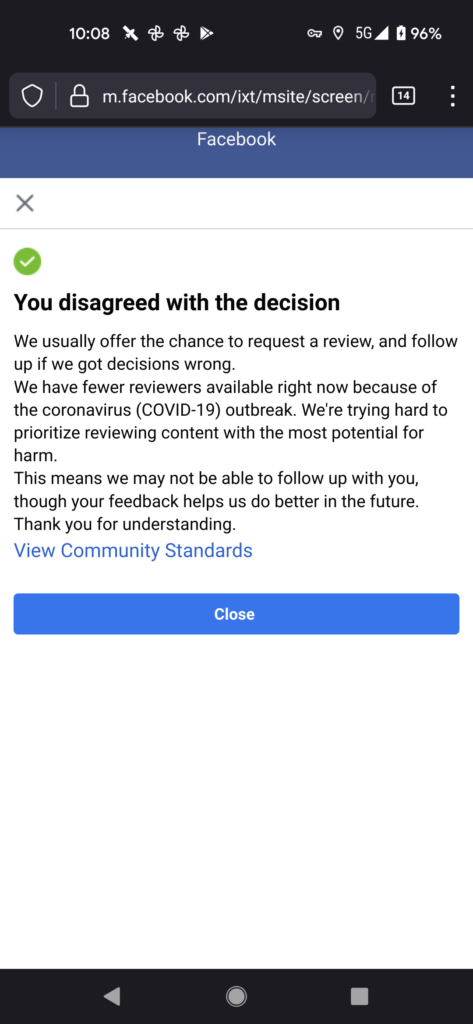
John Goerzen: Facebook Is Censoring People For Mentioning Open-Source Social Network Mastodon

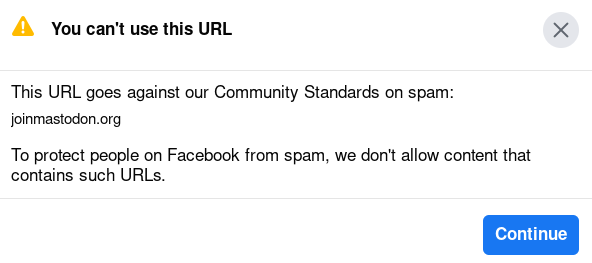
Update: Facebook has reversed itself over this censorship, but I maintain that whether the censorship was algorithmic or human, it was intentional either way. Details in my new post. Last November, I made a brief post to Facebook about Mastodon. Mastodon is an open-source and open social network, which is decentralized and all about user control instead of corporate control. I ve blogged about Mastodon and the dangers of Facebook before, but rarely mentioned Mastodon on Facebook itself. Today, I received this notice that Facebook had censored my post about Mastodon: Facebook censoring a post Wonder with me for a second what this one-off post I composed myself might have done to trip Facebook s filter . and it is probably obvious that what tripped the filter was the mention of an open source competitor, even though Facebook is much more enormous than Mastodon. I have been a member of Facebook for many years, and this is the one and only time anything like that has happened. Why they decided today to take down that post I have no idea. In case you wondered about their sincerity towards stamping out misinformation which, on the rare occasions they do something about, they deprioritize rather than remove as they did here this probably answers your question. Or, are they sincere about thinking they re such a force for good by connecting the world s people? Well, only so long as the world s people don t say nice things about alternatives to Facebook, I guess. Well, you might be wondering, Why not appeal, since they obviously made a mistake? Because, of course, you can t: Indeed I did tick a box that said I disagreed, but there was no place to ask why or to question their action. So what would cause a non-controversial post from a long-time Facebook member that has never had anything like this happen, to disappear? Greed. Also fear. Maybe I d feel sorry for them if they weren t acting like a bully. Edit: There are reports from several others on Mastodon of the same happening this week. I am trying to gather more information. It sounds like it may be happening on Twitter as well. Edit 2: And here are some other reports from both Facebook and Twitter. Definitely not just me. Edit 3: While trying to reply to someone on Facebook, that was trying to defend Facebook, I mentioned joinmastodon.org and got this: Anyone else seeing it? Edit 4: It is far more than just me, clearly. More reports are out there; for instance, this one and that one.
9 September 2021

Bits from Debian: DebConf21 online closes

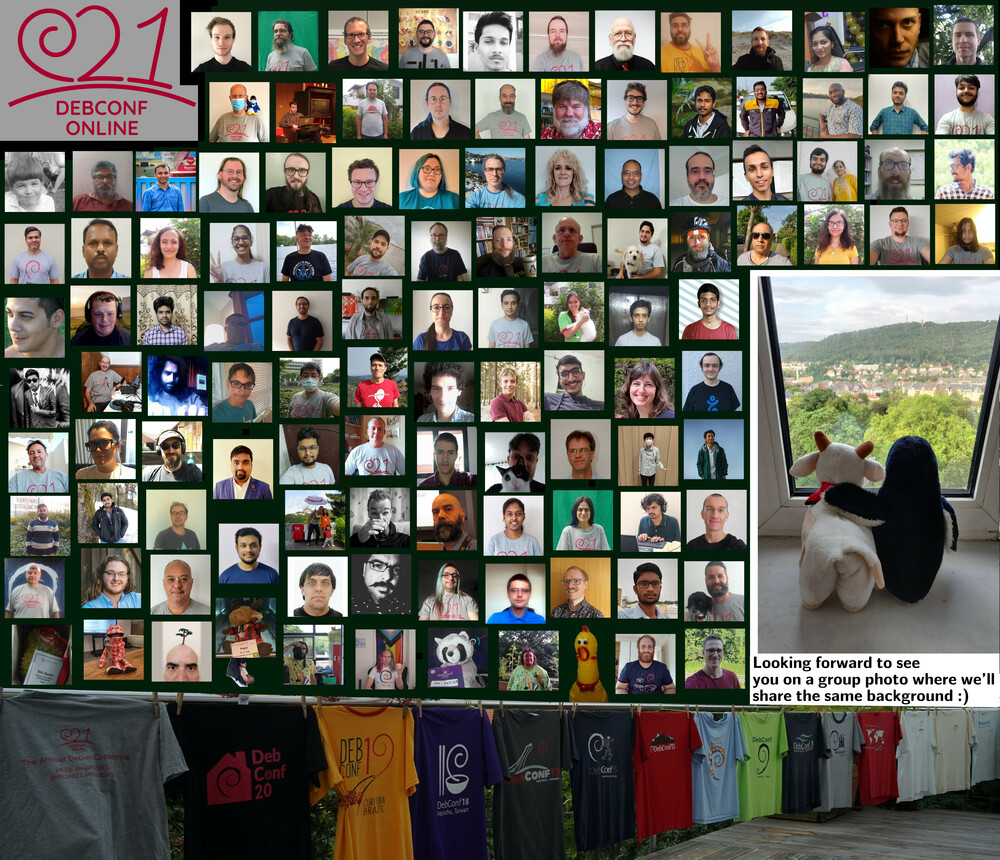
DebConf21 group photo - click to enlarge On Saturday 28 August 2021, the annual Debian Developers and Contributors Conference came to a close. DebConf21 has been held online for the second time, due to the coronavirus (COVID-19) disease pandemic. All of the sessions have been streamed, with a variety of ways of participating: via IRC messaging, online collaborative text documents, and video conferencing meeting rooms. With 740 registered attendees from more than 15 different countries and a total of over 70 event talks, discussion sessions, Birds of a Feather (BoF) gatherings and other activities, DebConf21 was a large success. The setup made for former online events involving Jitsi, OBS, Voctomix, SReview, nginx, Etherpad, a web-based frontend for voctomix has been improved and used for DebConf21 successfully. All components of the video infrastructure are free software, and configured through the Video Team's public ansible repository. The DebConf21 schedule included a wide variety of events, grouped in several tracks: The talks have been streamed using two rooms, and several of these activities have been held in different languages: Telugu, Portuguese, Malayalam, Kannada, Hindi, Marathi and English, allowing a more diverse audience to enjoy and participate. Between talks, the video stream has been showing the usual sponsors on the loop, but also some additional clips including photos from previous DebConfs, fun facts about Debian and short shout-out videos sent by attendees to communicate with their Debian friends. The Debian publicity team did the usual live coverage to encourage participation with micronews announcing the different events. The DebConf team also provided several mobile options to follow the schedule. For those who were not able to participate, most of the talks and sessions are already available through the Debian meetings archive website, and the remaining ones will appear in the following days. The DebConf21 website will remain active for archival purposes and will continue to offer links to the presentations and videos of talks and events. Next year, DebConf22 is planned to be held in Prizren, Kosovo, in July 2022. DebConf is committed to a safe and welcome environment for all participants. During the conference, several teams (Front Desk, Welcome team and Community team) have been available to help so participants get their best experience in the conference, and find solutions to any issue that may arise. See the web page about the Code of Conduct in DebConf21 website for more details on this. Debian thanks the commitment of numerous sponsors to support DebConf21, particularly our Platinum Sponsors: Lenovo, Infomaniak, Roche, Amazon Web Services (AWS) and Google. About Debian The Debian Project was founded in 1993 by Ian Murdock to be a truly free community project. Since then the project has grown to be one of the largest and most influential open source projects. Thousands of volunteers from all over the world work together to create and maintain Debian software. Available in 70 languages, and supporting a huge range of computer types, Debian calls itself the universal operating system. About DebConf DebConf is the Debian Project's developer conference. In addition to a full schedule of technical, social and policy talks, DebConf provides an opportunity for developers, contributors and other interested people to meet in person and work together more closely. It has taken place annually since 2000 in locations as varied as Scotland, Argentina, and Bosnia and Herzegovina. More information about DebConf is available from https://debconf.org/. About Lenovo As a global technology leader manufacturing a wide portfolio of connected products, including smartphones, tablets, PCs and workstations as well as AR/VR devices, smart home/office and data center solutions, Lenovo understands how critical open systems and platforms are to a connected world. About Infomaniak Infomaniak is Switzerland's largest web-hosting company, also offering backup and storage services, solutions for event organizers, live-streaming and video on demand services. It wholly owns its datacenters and all elements critical to the functioning of the services and products provided by the company (both software and hardware). About Roche Roche is a major international pharmaceutical provider and research company dedicated to personalized healthcare. More than 100.000 employees worldwide work towards solving some of the greatest challenges for humanity using science and technology. Roche is strongly involved in publicly funded collaborative research projects with other industrial and academic partners and have supported DebConf since 2017. About Amazon Web Services (AWS) Amazon Web Services (AWS) is one of the world's most comprehensive and broadly adopted cloud platform, offering over 175 fully featured services from data centers globally (in 77 Availability Zones within 24 geographic regions). AWS customers include the fastest-growing startups, largest enterprises and leading government agencies. About Google Google is one of the largest technology companies in the world, providing a wide range of Internet-related services and products such as online advertising technologies, search, cloud computing, software, and hardware. Google has been supporting Debian by sponsoring DebConf for more than ten years, and is also a Debian partner sponsoring parts of Salsa's continuous integration infrastructure within Google Cloud Platform. Contact Information For further information, please visit the DebConf21 web page at https://debconf21.debconf.org/ or send mail to press@debian.org.

7 September 2021

Joachim Breitner: A Candid explainer: Opt is special

This is the third post in a series about the interface description language Candid.

The record extension problem Initially, the upgrade rules of Candid were a straight-forward application of the canonical subtyping rules. This worked and was sound, but it forbid one very commonly requested use case: Extending records in argument position. The subtyping rule for records say that
   record   old_field : nat; new_field : int  
<: record   old_field : nat  
or, in words, that subtypes can have more field than supertypes. This makes intuitive sense: A user of a such a record value that only expects old_field to be there is not bothered if suddenly a new_field appears. But a user who expects new_field to be there is thrown off if it suddenly isn t anymore. Therefore it is ok to extend the records returned by a service with new fields, but not to extend the record in your methods s argument types. But users want to extend their record types over time, also in argument position! In fact, they often want to extend them in both positions. Consider a service with the following interface, where the CUser record appears both in argument and result position:
type CUser = record   login : text; name : text  ;
service C :  
  register_user : (CUser) -> ();
  get_user_data : (text) -> (CUser);
 
It seems quite natural to want to extend the record with a new field (say, the age of the user). But simply changing the definition of CUser to
type CUser = record   login : text; name : text; age : nat  
is not ok, because now register_user requires the age field, but old clients don t provide it. So how can we allow developers to make changes like this (because they really really want that), while keeping the soundness guarantees made by Candid (because we really really want that)? This question has bothered us for over two years, and we even created a meta issue that records the dozen approached we considered, discussed and eventually ditched.

Dynamic subtyping checks in opt I will spare you the history lesson, though, and explain the solution we eventually came up with. In the example above it seems unreasonable to let the developer add a field age of type nat. Since there may be old clients around, the service unavoidably has to deal with records that don t have an age field. If the code expects an age value, what should it do in that case? But one can argue that changing the record type to
type CUser = record   login : text; name : text; age : opt nat  
could work: If the age field is present, use the value. If the field is absent, inject a null value during decoding. In the first-order case, this rather obvious solution would work just fine, and we d be done. But Candid aims to solve the higher order case, and I said things get tricky here, didn t I? Consider another, independent service D with the following interface:
type DUser = record   login : text; name : text  ;
service D :  
  on_user_added : (func (DUser) -> ()) -> ()
 
This service has a method that takes a method reference, presumably with the intention of calling it whenever a new user was added to service D. And because the types line up nicely, we can compose these two services, by once calling D.on_user_added(C.register_user), so that from now on D calls C.register_user( ). These kind of service mesh-ups are central to the vision of the Internet Computer! But what happens if the services now evolve their types in different ways, e.g. towards
type CUser = record   login : text; name : text; age : opt nat  
and
type DUser = record   login : text; name : text; age : opt variant   under_age; adult  
Individually, these are type changes that we want to allow. But now the call from D to C may transmit a value of record ; age = opt variant under_age when C expects a natural number! This is precisely what we want to prevent by introducing types, and it seems we have lost soundness. The best solution we could find is to make the opt type somewhat special, and apply these extra rules when decoding at an expected type of opt t.
  • If this was a record field, and the provided record value doesn t even have a field of that name, don t fail but instead treat this as null. This handles the first-order example above.
  • If there is a value, look at its type (which, in Candid, is part of the message).
    • If it is opt t' and t' <: t, then decode as normal.
    • If it is opt t' but t' <: t does not hold, then treat that as null. This should only happen in these relatively obscure higher-order cases where services evolved differently and incompatibly, and makes sure that the calls that worked before the upgrades will continue to work afterwards. It is not advisable to actually use that rule when changing your service s interface. Tools that assist the developer with an upgrade check should prevent or warn about the use of this rule.
  • Not strictly required here, but since we are making opt special anyways: If its type t' is not of the form opt , pretend it was opt t', and also pretend that the given value was wrapped in opt. This allows services to make record field in arguments that were required in the old version optional in a new version, e.g. as a way to deprecated them. So it is mildly useful, although I can report that it makes the meta-theory and implementation rather complex, in particular together with equirecursion and beasts like type O = opt O. See this discussion for a glimpse of that.
In the above I stress that we look at the type of the provided value, and not just the value. For example, if the sender sends the value opt vec at type opt vec nat, and the recipient expects opt vec bool, then this will decode as null, even though one could argue that the value opt vec could easily be understood at type opt vec bool. We initially had that, but then noticed that this still breaks soundness when there are references inside, and we have to do a full subtyping check in the decoder. This is very unfortunate, because it makes writing a Candid decoder a noticeably harder task that requires complicated graph algorithms with memoization (which I must admit Motoko has not implemented yet), but it s the least bad solution we could find so far.

Isn t that just dynamic typing? You might have noticed that with these rules, t <: opt t' holds for all types t and t'. In other words, every opt is a top type (like reserved), thus all optional types are equivalent. One could argue that we are throwing all of the benefits of static typing over board this way. But it s not quite as bad: It s true that decoding Candid values now involves a dynamic check inserting null values in certain situations, but as long as everyone plays by the rules (i.e. upgrades their services according to the Candid safe upgrade rules, and heeds the warning alluded to above), these certain situations will only happen in the obscurest of cases. It is, by the way, not material to this solution that the special subtyping behavior is applied to the opt type, and a neighboring point in the design space would be a dedicated upgraded t type constructor. That would allow developers to use the canonical opt type with the usual subtyping rules and communicate their intent ( clients should consider this field optional vs. old clients don t know about this field, but new clients should use it ) more cleanly at the expense of having more non-canonical types in the type system. To see why it is convenient if Candid has mostly just the normal types, read the next post, which will describe how Candid can be integrated into a host language.

Martin-&#201;ric Racine: sudo apt-get update && sudo apt-get dist-upgrade

Debian 11 (codename Bullseye) was recently released. This was the smoothest upgrade I've experienced in some 20 years as a Debian user. In my haste, I completely forgot to first upgrade dpkg and apt, doing a straight dist-upgrade. Nonetheless, everything worked out of the box. No unresolved dependency cycles. Via my last-mile Gigabit connection, it took about 5 minutes to upgrade and reboot. Congratulations to everyone who made this possible! Since the upgrade, only a handful of bugs were found. I filed bug reports. Over these past few days, maintainers have started responding. In once particular case, my report exposed a CVE caused by copy-pasted code between two similar packages. The source package fixed their code to something more secure a few years ago, while the destination package missed it. The situation has been brought to Debian's security team's attention and should be fixed over the next few days. Afterthoughts Having recently experienced hard-disk problems on my main desktop, upgrading to Bullseye made me revisit a few issues. One of these was the possibility of transiting to BTRFS. Last time I investigated the possibility was back when Ubuntu briefly switched their default filesystem to BRTFS. Back then, my feeling was that BRTFS wasn't ready for mainstream. For instance, the utility to convert an EXT2/3/4 partition to BTRFS corrupted the end of the partition. No thanks. However, in recent years, many large-scale online services have migrated to BRTFS and seem to be extremely happy with the result. Additionally, Linux kernel 5 added useful features such as background defragmentation. This got me pondering whether now would be a good time to migrate to BRTFS. Sadly it seems that the stock kernel shipping with Bullseye doesn't have any of these advanced features enabled in its configuration. Oh well. Geode The only point that has become problematic is my Geode hosts. For one things, upstream Rust maintainers have decided to ignore the fact that i686 is a specification and arbitrarily added compiler flags for more recent x86-32 CPUs to their i686 target. While Debian Rust maintainers have purposely downgraded the target, RustC still produces binaries that the Geode LX (essentially an i686 without PAE) cannot process. This affects fairly basic packages such as librsvg, which breaks SVG image support for a number of dependencies. Additionally, there's been persistent problems with systemd crashing on my Geode hosts whenever daemon-reload is issued. Then, a few days ago, problems started occurring with C++ binaries, because GCC-11 upstream enabled flags for more recent CPUs in their default i686 target. While I realize that SSE and similar recent CPU features produce better binaries, I cannot help but feel that treating CPU targets as anything else than a specification is a mistake. i686 is a specification. It is not a generic equivalent to x86-32.
Russell Coker: Oracle Cloud Free Tier

It seems that every cloud service of note has a free tier nowadays and the Oracle Cloud is the latest that I ve discovered (thanks to r/homelab which I highly recommend reading). Here s Oracle s summary of what they offer for free [1]. Oracle s always free tier (where presumable always is defined as until we change our contract ) currently offers ARM64 VMs to a total capacity of 4 CPU cores, 24G of RAM, and 200G of storage with a default VM size of 1/4 that (1 CPU core and 6G of RAM). It also includes 2 AMD64 VMs that each have 1G of RAM, but a 64bit VM with 1G of RAM isn t that useful nowadays. Web Interface The first thing to note is that the management interface is a massive pain to use. When a login times out for security reasons it redirects to a web page that gives a 404 error, maybe the redirection works OK if you are using it when it times out, but if you go off and spend an hour doing something else you will return to a 404 page. A web interface should never refer you to a page with a 404. There doesn t seem to be a way of bookmarking the commonly used links (as AWS does) and the set of links on the left depend on the section you are in with no obvious way of going between sections. Sometimes I got stuck in a set of pages about authentication controls (the identity cloud ) and there seems to be no link I could click on to get me back to cloud computing, I had to go to a bookmarked link for the main cloud login page. A web interface should never force the user to type in the main URL or go to a bookmark, you should be able to navigate from every page to every other page in a logical manner. An advanced user might have their own bookmarks in their browser to suit their workflow. But a beginner should be able to go to anywhere without breaking the session. Some parts of the interface appear to be copied from AWS, but unfortunately not the good parts. The way AWS manages IP access control is not easy to manage and it s not clear why packets are dropped, Oracle copies all this. On the upside Oracle has some good Datadog style analytics so for a new deployment you can debug IP access control by seeing records of rejected packets. Just to make it extra annoying when you create a rule with multiple ports specified the web interface will expand it out to multiple rules for one port each, having ports 80 and 443 on separate lines doesn t make things easier. Also it forces you to have IPv4 and IPv6 as separate rules, so if you want HTTP and HTTPS on both IPv4 and IPv6 (a common requirement) then you need 4 separate rules. One final annoying thing is that the web interface doesn t make your previous settings a default. As I ve created many ARM images and haven t created a single AMD image it should know that the probability that I want to create an AMD image is very low and stop defaulting to that. Recovery When trying a new system you will inevitably break things and have to recover things. The way to recover from a configuration error that prevents your VM from booting and getting to a state of allowing a login is to go to stop the VM, then go to the Boot volume section under Resources and use the settings button to detach the boot volume. Then you go to another VM (which must be running), go to the Attached block volumes menu and attach it as Paravirtualised (not iSCSI and not default which will probably be iSCSI). After some time the block device will appear and you can mount it and do stuff to it. Then after umounting it you detach it from the recovery VM and attach it again to the original VM (where it will still have an entry in the Boot volume section) and boot the original VM. As an aside it s really annoying that you can t attach a volume to a VM that isn t running. My first attempt at image recovery started with making a snapshot of the Boot volume, this didn t work well because the image uses EFI and therefore GPT and because the snapshot was larger than the original block device (which incidentally was the default size). I admit that I might have made a mistake making the snapshot, but if so it shouldn t be so easy to do. With GPT if you have a larger block device then partitioning tools complain about the backup partition table not being found, and they complain even more if you try to go back to the smaller size later on. Generally GPT partition tables are a bad idea for VMs, when I run the host I don t use partition tables, I have a separate block device for each filesystem or swap space. Snapshots aren t needed for recovery, they don t seem to work very well, and if it s possible to attach a snapshot to a VM in place of it s original Boot volume I haven t figured out how to do it. Console Connection If you boot Oracle Linux a derivative of RHEL that has SE Linux enabled in enforcing mode (yay) then you can go to the Console connection . The console is a Javascript console which allows you to login on a virtual serial console on device /dev/ttyAMA0. It tells you to type help but that isn t accepted, you have a straight Linux console login prompt. If you boot Ubuntu then you don t get a working serial console, it tells you to type help for help but doesn t respond to that. It seems that the Oracle Linux kernel 5.4.17-2102.204.4.4.el7uek.aarch64 is compiled with support for /dev/ttyAMA0 (the default ARM serial device) while the kernel 5.11.0-1016-oracle compiled by Oracle for their Ubuntu VMs doesn t have it. Performance I haven t done any detailed tests of VM performance. As a quick test I used zstd to compress a 154MB file, on my home workstation (E5-2620 v4 @ 2.10GHz) it took 11.3 seconds of CPU time to compress with zstd -9 and 7.2s to decompress. On the Oracle cloud it took 7.2s and 5.4s. So it seems that for some single core operations the ARM CPU used by the Oracle cloud is about 30% to 50% faster than a E5-2620 v4 (a slightly out of date server processor that uses DDR4 RAM). If you ran all the free resources in a single VM that would make a respectable build server. If you want to contribute to free software development and only have a laptop with 4G of RAM then an ARM build/test server with 24G of RAM and 4 cores would be very useful. Ubuntu Configuration The advantage of using EFI is that you can manage the kernel from within the VM. The default Oracle kernel for Ubuntu has a lot of modules included and is compiled with a lot of security options including SE Linux. Competitors https://aws.amazon.com/free AWS offers 750 hours (just over 31 days) per month of free usage of a t2.micro or t3.micro EC2 instance (which means 1GB of RAM). But that only lasts for 12 months and it s still only 1GB of RAM. AWS has some other things that could be useful like 1 million free Lambda requests per month. If you want to run your personal web site on Lambda you shouldn t hit that limit. They also apparently have some good offers for students. https://cloud.google.com/free The Google Cloud Project (GCP) offers $300 of credit. https://cloud.google.com/free/docs/gcp-free-tier#free-tier-usage-limits GCP also has ongoing free tier usage for some services. Some of them are pretty much unlimited use (50GB of storage for Cloud Source Repositories is a heap of source code). But for VMs you get the equivalent of 1*e2-micro instance running 24*7. A e2-micro has 1G of RAM. You also only get 30G of storage and 1GB of outbound data. It s clearly not as generous an offer as Oracle, but Oracle is the underdog so they have to try harder. https://azure.microsoft.com/en-us/free/ Azure appears to be much the same as AWS, free Linux VM for a year and then other less popular services free forever (or until they change the contract). https://www.ibm.com/cloud/free The IBM cloud free tier is the least generous offer, a VM is only free for 30 days. But what they offer for 30 days is pretty decent. If you want to try the IBM cloud and see if it can do what your company needs then this will do well. If you want to have free hosting for your hobby stuff then it s no good. Oracle seems like the most generous offer if you want to do stuff, but also one of the least valuable if you want to learn things that will help you at a job interview. For job interviews AWS seems the most useful and then GCP and Azure vying for second place.

6 September 2021

Jelmer Vernooij: Web Hooks for the Janitor

The Debian Janitor is an automated system that commits fixes for (minor) issues in Debian packages that can be fixed by software. It gradually started proposing merges in early December. The first set of changes sent out ran lintian-brush on sid packages maintained in Git. This post is part of a series about the progress of the Janitor. As covered in my post from last week, the Janitor now regularly tries to import new upstream git snapshots or upstream releases into packages in Sid.

Moving parts There are about 30,000 packages in sid, and it usually takes a couple of weeks for the janitor to cycle through all of them. Generally speaking, there are up to three moving targets for each package:
  • The packaging repository; vcswatch regularly scans this for changes, and notifies the janitor when a repository has changed. For salsa repositories it is instantly notified through a web hook
  • The upstream release tarballs; the QA watch service regularly polls these, and the janitor scans for changes in the UDD tables with watch data (used for fresh-releases)
  • The upstream repository; there is no service in Debian that watches this at the moment (used for fresh-snapshots)
When the janitor notices that one of these three targets has changed, it prioritizes processing of a package - this means that a push to a packaging repository on salsa usually leads to a build being kicked off within 10 minutes. New upstream releases are usually noticed by QA watch within a day or so and then lead to a build. Now commits in upstream repositories don t get noticed today. Note that there are no guarantees; the scheduler tries to be clever and not e.g. rebuild the same package over and over again if it s constantly changing and takes a long time to build. Packages without priority are processed with a scoring system that takes into account perceived value (based on e.g. popcon), cost (based on wall-time duration of previous builds) and likelihood of success (whether recent builds were successful, and how frequently the repositories involved change).
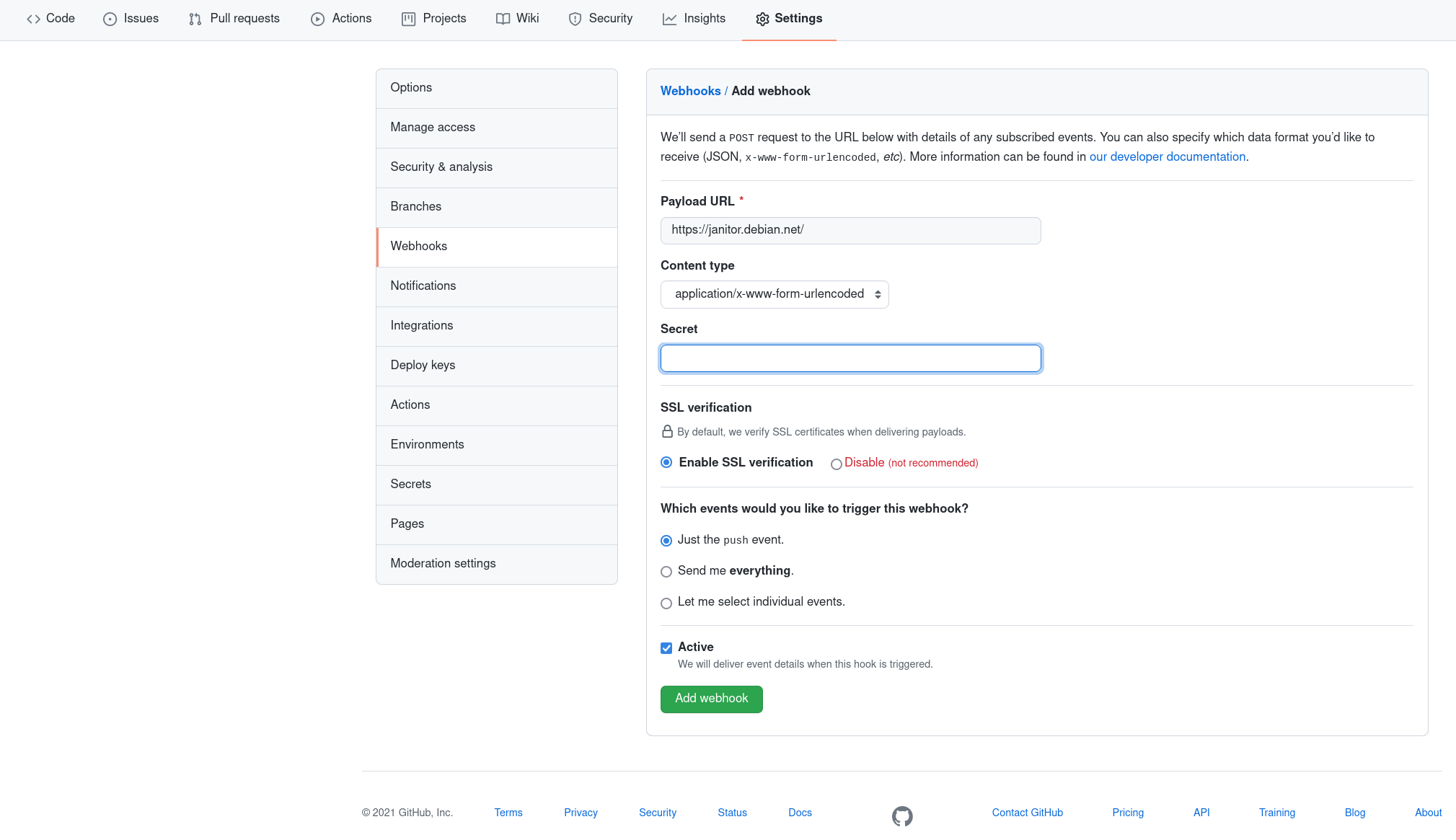
webhooks for upstream repositories At the moment there is no service in Debian (yet - perhaps this is something that vcswatch or a sibling service could also do?) that scans upstream repositories for changes. However, if you maintain an upstream package, you can use a webhook to notify the janitor that commits have been made to your repository, and it will create a new package in fresh-snapshots. Webhooks from the following hosting site software are currently supported: You can simply use the URL https://janitor.debian.net/ as the target for hooks. There is no need to specify a secret, and the hook can either use a JSON or form encoding payload. The endpoint should tell you whether it understood a webhook request, and whether it took any action. It s fine to submit webhooks for repositories that the janitor does not (yet) know about.
GitHub For GitHub, you can do so in the Webhooks section of the Settings tab. Fill the form as shown below and click on Add webhook:
GitLab On GitLab instances, you can find the Webhooks tab under the Settings menu for each repository (under the gear symbol). Fill the form in as shown below and click Add Webhook:
Launchpad For Launchpad, go to the repository (for Git) web view and click Manage Webhooks. From there, you can add a new webhook; fill the form in as shown below and click Add Webhook:

Vincent Bernat: Switching to the i3 window manager

I have been using the awesome window manager for 10 years. It is a tiling window manager, configurable and extendable with the Lua language. Using a general-purpose programming language to configure every aspect is a double-edged sword. Due to laziness and the apparent difficulty of adapting my configuration about 3000 lines to newer releases, I was stuck with the 3.4 version, whose last release is from 2013. It was time for a rewrite. Instead, I have switched to the i3 window manager, lured by the possibility to migrate to Wayland and Sway later with minimal pain. Using an embedded interpreter for configuration is not as important to me as it was in the past: it brings both complexity and brittleness.
i3 dual screen setup
Dual screen desktop running i3, Emacs, some terminals, including a Quake console, Firefox, Polybar as the status bar, and Dunst as the notification daemon.
The window manager is only one part of a desktop environment. There are several options for the other components. I am also introducing them in this post.

i3: the window manager i3 aims to be a minimal tiling window manager. Its documentation can be read from top to bottom in less than an hour. i3 organize windows in a tree. Each non-leaf node contains one or several windows and has an orientation and a layout. This information arbitrates the window positions. i3 features three layouts: split, stacking, and tabbed. They are demonstrated in the below screenshot:
Example of layouts
Demonstration of the layouts available in i3. The main container is split horizontally. The first child is split vertically. The second one is tabbed. The last one is stacking.
Tree representation of the previous screenshot
Tree representation of the previous screenshot.
Most of the other tiling window managers, including the awesome window manager, use predefined layouts. They usually feature a large area for the main window and another area divided among the remaining windows. These layouts can be tuned a bit, but you mostly stick to a couple of them. When a new window is added, the behavior is quite predictable. Moreover, you can cycle through the various windows without thinking too much as they are ordered. i3 is more flexible with its ability to build any layout on the fly, it can feel quite overwhelming as you need to visualize the tree in your head. At first, it is not unusual to find yourself with a complex tree with many useless nested containers. Moreover, you have to navigate windows using directions. It takes some time to get used to. I set up a split layout for Emacs and a few terminals, but most of the other workspaces are using a tabbed layout. I don t use the stacking layout. You can find many scripts trying to emulate other tiling window managers but I did try to get my setup pristine of these tentatives and get a chance to familiarize myself. i3 can also save and restore layouts, which is quite a powerful feature. My configuration is quite similar to the default one and has less than 200 lines.

i3 companion: the missing bits i3 philosophy is to keep a minimal core and let the user implements missing features using the IPC protocol:
Do not add further complexity when it can be avoided. We are generally happy with the feature set of i3 and instead focus on fixing bugs and maintaining it for stability. New features will therefore only be considered if the benefit outweighs the additional complexity, and we encourage users to implement features using the IPC whenever possible. Introduction to the i3 window manager
While this is not as powerful as an embedded language, it is enough for many cases. Moreover, as high-level features may be opinionated, delegating them to small, loosely coupled pieces of code keeps them more maintainable. Libraries exist for this purpose in several languages. Users have published many scripts to extend i3: automatic layout and window promotion to mimic the behavior of other tiling window managers, window swallowing to put a new app on top of the terminal launching it, and cycling between windows with Alt+Tab. Instead of maintaining a script for each feature, I have centralized everything into a single Python process, i3-companion using asyncio and the i3ipc-python library. Each feature is self-contained into a function. It implements the following components:
make a workspace exclusive to an application
When a workspace contains Emacs or Firefox, I would like other applications to move to another workspace, except for the terminal which is allowed to intrude into any workspace. The workspace_exclusive() function monitors new windows and moves them if needed to an empty workspace or to one with the same application already running.
implement a Quake console
The quake_console() function implements a drop-down console available from any workspace. It can be toggled with Mod+ . This is implemented as a scratchpad window.
back and forth workspace switching on the same output
With the workspace back_and_forth command, we can ask i3 to switch to the previous workspace. However, this feature is not restricted to the current output. I prefer to have one keybinding to switch to the workspace on the next output and one keybinding to switch to the previous workspace on the same output. This behavior is implemented in the previous_workspace() function by keeping a per-output history of the focused workspaces.
create a new empty workspace or move a window to an empty workspace
To create a new empty workspace or move a window to an empty workspace, you have to locate a free slot and use workspace number 4 or move container to workspace number 4. The new_workspace() function finds a free number and use it as the target workspace.
restart some services on output change
When adding or removing an output, some actions need to be executed: refresh the wallpaper, restart some components unable to adapt their configuration on their own, etc. i3 triggers an event for this purpose. The output_update() function also takes an extra step to coalesce multiple consecutive events and to check if there is a real change with the low-level library xcffib.
I will detail the other features as this post goes on. On the technical side, each function is decorated with the events it should react to:
@on(CommandEvent("previous-workspace"), I3Event.WORKSPACE_FOCUS)
async def previous_workspace(i3, event):
    """Go to previous workspace on the same output."""
The CommandEvent() event class is my way to send a command to the companion, using either i3-msg -t send_tick or binding a key to a nop command. The latter is used to avoid spawning a shell and a i3-msg process just to send a message. The companion listens to binding events and checks if this is a nop command.
bindsym $mod+Tab nop "previous-workspace"
There are other decorators to avoid code duplication: @debounce() to coalesce multiple consecutive calls, @static() to define a static variable, and @retry() to retry a function on failure. The whole script is a bit more than 1000 lines. I think this is worth a read as I am quite happy with the result.

dunst: the notification daemon Unlike the awesome window manager, i3 does not come with a built-in notification system. Dunst is a lightweight notification daemon. I am running a modified version with HiDPI support for X11 and recursive icon lookup. The i3 companion has a helper function, notify(), to send notifications using DBus. container_info() and workspace_info() uses it to display information about the container or the tree for a workspace.
Notification showing i3 tree for a workspace
Notification showing i3 s tree for a workspace

polybar: the status bar i3 bundles i3bar, a versatile status bar, but I have opted for Polybar. A wrapper script runs one instance for each monitor. The first module is the built-in support for i3 workspaces. To not have to remember which application is running in a workspace, the i3 companion renames workspaces to include an icon for each application. This is done in the workspace_rename() function. The icons are from the Font Awesome project. I maintain a mapping between applications and icons. This is a bit cumbersome but it looks great.
i3 workspaces in Polybar
For CPU, memory, brightness, battery, disk, and audio volume, I am relying on the built-in modules. Polybar s wrapper script generates the list of filesystems to monitor and they get only displayed when available space is low. The battery widget turns red and blinks slowly when running out of power. Check my Polybar configuration for more details.
Various modules for Polybar
Polybar displaying various information: CPU usage, memory usage, screen brightness, battery status, Bluetooth status (with a connected headset), network status (connected to a wireless network and to a VPN), notification status, and speaker volume.
For Bluetooh, network, and notification statuses, I am using Polybar s ipc module: the next version of Polybar can receive an arbitrary text on an IPC socket. The module is defined with a single hook to be executed at the start to restore the latest status.
[module/network]
type = custom/ipc
hook-0 = cat $XDG_RUNTIME_DIR/i3/network.txt 2> /dev/null
initial = 1
It can be updated with polybar-msg action "#network.send.XXXX". In the i3 companion, the @polybar() decorator takes the string returned by a function and pushes the update through the IPC socket. The i3 companion reacts to DBus signals to update the Bluetooth and network icons. The @on() decorator accepts a DBusSignal() object:
@on(
    StartEvent,
    DBusSignal(
        path="/org/bluez",
        interface="org.freedesktop.DBus.Properties",
        member="PropertiesChanged",
        signature="sa sv as",
        onlyif=lambda args: (
            args[0] == "org.bluez.Device1"
            and "Connected" in args[1]
            or args[0] == "org.bluez.Adapter1"
            and "Powered" in args[1]
        ),
    ),
)
@retry(2)
@debounce(0.2)
@polybar("bluetooth")
async def bluetooth_status(i3, event, *args):
    """Update bluetooth status for Polybar."""
The middle of the bar is occupied by the date and a weather forecast. The latest also uses the IPC mechanism, but the source is a Python script triggered by a timer.
Date and weather in Polybar
Current date and weather forecast for the day in Polybar. The data is retrieved with the OpenWeather API.
I don t use the system tray integrated with Polybar. The embedded icons usually look horrible and they all behave differently. A few years back, Gnome has removed the system tray. Most of the problems are fixed by the DBus-based Status Notifier Item protocol also known as Application Indicators or Ayatana Indicators for GNOME. However, Polybar does not support this protocol. In the i3 companion, The implementation of Bluetooth and network icons, including displaying notifications on change, takes about 200 lines. I got to learn a bit about how DBus works and I get exactly the info I want.

picom: the compositor I like having slightly transparent backgrounds for terminals and to reduce the opacity of unfocused windows. This requires a compositor.1 picom is a lightweight compositor. It works well for me, but it may need some tweaking depending on your graphic card.2 Unlike the awesome window manager, i3 does not handle transparency, so the compositor needs to decide by itself the opacity of each window. Check my configuration for details.

systemd: the service manager I use systemd to start i3 and the various services around it. My xsession script only sets some environment variables and lets systemd handles everything else. Have a look at this article from Micha G ral for the rationale. Notably, each component can be easily restarted and their logs are not mangled inside the ~/.xsession-errors file.3 I am using a two-stage setup: i3.service depends on xsession.target to start services before i3:
[Unit]
Description=X session
BindsTo=graphical-session.target
Wants=autorandr.service
Wants=dunst.socket
Wants=inputplug.service
Wants=picom.service
Wants=pulseaudio.socket
Wants=policykit-agent.service
Wants=redshift.service
Wants=spotify-clean.timer
Wants=ssh-agent.service
Wants=xiccd.service
Wants=xsettingsd.service
Wants=xss-lock.service
Then, i3 executes the second stage by invoking the i3-session.target:
[Unit]
Description=i3 session
BindsTo=graphical-session.target
Wants=wallpaper.service
Wants=wallpaper.timer
Wants=polybar-weather.service
Wants=polybar-weather.timer
Wants=polybar.service
Wants=i3-companion.service
Wants=misc-x.service
Have a look on my configuration files for more details.

rofi: the application launcher Rofi is an application launcher. Its appearance can be customized through a CSS-like language and it comes with several themes. Have a look at my configuration for mine.
Rofi as an application launcher
It can also act as a generic menu application. I have a script to control a media player and another one to select the wifi network. It is quite a flexible application.
Rofi as a wifi network selector
Rofi to select a wireless network

xss-lock and i3lock: the screen locker i3lock is a simple screen locker. xss-lock invokes it reliably on inactivity or before a system suspend. For inactivity, it uses the XScreenSaver events. The delay is configured using the xset s command. The locker can be invoked immediately with xset s activate. X11 applications know how to prevent the screen saver from running. I have also developed a small dimmer application that is executed 20 seconds before the locker to give me a chance to move the mouse if I am not away.4 Have a look at my configuration script.
Demonstration of xss-lock, xss-dimmer and i3lock with a 4 speedup.

The remaining components
  • autorandr is a tool to detect the connected display, match them against a set of profiles, and configure them with xrandr.
  • inputplug executes a script for each new mouse and keyboard plugged. This is quite useful to load the appropriate the keyboard map. See my configuration.
  • xsettingsd provides settings to X11 applications, not unlike xrdb but it notifies applications for changes. The main use is to configure the Gtk and DPI settings. See my article on HiDPI support on Linux with X11.
  • Redshift adjusts the color temperature of the screen according to the time of day.
  • maim is a utility to take screenshots. I use Prt Scn to trigger a screenshot of a window or a specific area and Mod+Prt Scn to capture the whole desktop to a file. Check the helper script for details.
  • I have a collection of wallpapers I rotate every hour. A script selects them using advanced machine learning algorithms and stitches them together on multi-screen setups. The selected wallpaper is reused by i3lock.

  1. Apart from the eye candy, a compositor also helps to get tear-free video playbacks.
  2. My configuration works with both Haswell (2014) and Whiskey Lake (2018) Intel GPUs. It also works with AMD GPU based on the Polaris chipset (2017).
  3. You cannot manage two different displays this way e.g. :0 and :1. In the first implementation, I did try to parametrize each service with the associated display, but this is useless: there is only one DBus user session and many services rely on it. For example, you cannot run two notification daemons.
  4. I have only discovered later that XSecureLock ships such a dimmer with a similar implementation. But mine has a cool countdown!

5 September 2021

Antoine Beaupr : Automating major Debian upgrades

It's major upgrade time again! The Debian project just published the Debian 11 "bullseye" release, and it's pretty awesome! This makes me realized that I have never written here about my peculiar upgrade process, and figured it was worth bringing that up to a wider audience. My upgrade process also has a notable changes section which includes major version changes (e.g. Inkscape 1.0!), new packages (e.g. podman!) and important behavior changes (e.g. driverless scanning and printing!). I'm particularly interested to hear about any significant change I might have missed. If you know of a cool new package that shipped with bullseye and that I forgot, do let me know! But that's for the cool new stuff. We need to talk about the problems with Debian major upgrades.

Background I have been maintaining detailed upgrade guides, on my wiki, starting with the jessie release, but I have actually written such guides for Koumbit.org as far back as Debian squeeze in 2011 (another worker wrote the older Debian lenny upgrade guide in 2009). Koumbit, since then, has kept maintaining those guides all the way to the latest bullseye upgrade, through 7 major releases! Over the years, those guides evolved from a quick "cheat-sheet" format copied from the release notes into a more or less "scripted" form that I currently use. Each guide has a procedure made of a few steps that can be basically copy-pasted to batch-upgrade a host (or multiple hosts in parallel) as quickly as possible. There is also the predict-os script which allows you to keep track of progress of the upgrades in a Puppet cluster.

Limitations of the official procedure In comparison with my procedure, the official upgrade guide is mostly designed to upgrade a single machine, typically a workstation, with a rather slow and exhaustive process. The PDF version of the upgrade guide is 14 pages long! This, obviously, does not work when you have tens or hundreds of machines to upgrade. Debian upgrades are notorious for being extremely reliable, but we have a lot of packages, and there are always corner cases where the upgrade will just fail because of a bug specific to your environment. Those will only be fixed after some back and forth in the community (and that's assuming users report those bugs, which is not always the case). There's no obvious way to deploy "hot fixes" in this context, at least not without fixing the package and publishing it on an unofficial Debian archive while the official ones catch up. This is slow and difficult. Or some packages require manual labor. Examples of this are the PostgreSQL or Ganeti packages which require you to upgrade your clusters by hand, while the old and new packages live side by side. Debian packages bring you far in the upgrade process, but sometimes not all the way. Which means every Debian install needs to be manually upgraded and inspected when a new release comes out. That's slow and error prone and we can do better.

How to automate major upgrades I have a proposal to automate this. It's been mostly dormant in the Debian wiki, for 5 years now. Fundamentally, this is a hard problem: Debian gets installed in so many different environments, from workstations to physical servers to virtual machines, embedded systems and so on, that it's extremely hard to come up with a "one size fits all" system. The (manual) procedure I'm using is mostly targeting servers, but I'm also using it on workstations. And I'll note that it's specific to my home setup: I have a different procedure at work, although it has a lot of common code. To automate this, I would factor out that common code with hooks where you could easily inject special code like "you need to upgrade ferm first", "you need an extra reboot here", or "this is how you finish the PostgreSQL upgrade". With Debian getting closer to a 2 year release cycle, with the previous release being supported basically only one year after the new stable comes out, I feel more and more strongly that this needs better automation. So I'm thinking that I should write a prototype for this. Ubuntu has do-release-upgrade that is too Ubuntu-specific to be reused. An attempt at collaborating on this has been mostly met with silence from Ubuntu's side as well. I'm thinking that using something like Fabric, Mitogen, or Transilience: anything that will allow me to write simple, portable Python code that can run transparently on a local machine (for single systems upgrades, possibly with a GUI frontend) to remote servers (for large clusters of servers, maybe with canaries and grouping using Cumin). I'll note that Koumbit started experimenting with Puppet Bolt in the bullseye upgrade process, but that feels too site-specific to be useful more broadly.

Trade-offs I am not sure where this stands in the XKCD time trade-off evaluation, because the table doesn't actually cover the time frequency of Debian release (which is basically "biennial") and the amount of time the upgrade would take across a cluster (which varies a lot, but that I estimate to be between one to 6 hours per machine). Assuming I have 80 machines to upgrade, that is 80 to 480 hours (between ~3 to 20 days) of work! It's unclear how much work such an automated system would shave off, however. Assuming things are an order of magnitude faster (say I upgrade 10 machines at a time), I would shave off between 3 and 18 days of work, which implies I might allow myself to spend a minimum of 5 days working on such a project.

The other option: never upgrade Before people mention those: I am aware of containers, Kubernetes, and other deployment mechanisms. Indeed, those may be a long-term solution, we currently can't afford to migrate everything over to containers right now: that is a huge migration and a total paradigm shift. At that point, whatever is left might not even be Debian in the first place. And besides, if you run Kubernetes, you still need to run some OS underneath and upgrade that, so that problem never completely disappears. Still, maybe that's the final answer: never upgrade. For some stateless machines like DNS replicas or load balancers, that might make a lot of sense as there's no or little data to carry to the new host. But this implies a seamless and fast provisioning process, and we don't have that either: at my work, installing a machine takes about as long as upgrading it, and that's after a significant amount of work automating that process, partly writing my own Debian installer with Fabric (!).

What is your process? I'm curious to hear what people think of those ideas. It strikes me as really odd that no one has really tackled that problem yet, considering how many clusters of Debian machines are out there. Surely people are upgrading those, and not following that slow step by step guide, right? I suspect everyone is doing the same thing: we all have our little copy-paste script we batch onto multiple machines, sometimes in parallel. That is what the Debian.org sysadmins are doing as well. There must be a better way. What is yours?

My upgrades so far So far, I have upgraded 2 out of my 3 home machines running buster -- others have been installed directly in bullseye -- with only my main, old, messy server left. Upgrades have been pretty painless so far (see another report, for example), much better than the previous buster upgrade. Obviously, for me personal use, automating this is pointless. Work-side, however, is another story: we have over 80 boxes to upgrade there and that will take a while. The last stretch to buster cycle took about two years to complete, so we might be done by the time the next release (12, "bookworm") is released, but that's actually a full year after "buster" becomes EOL, so it's actually too late... At least I fixed the installers so that new the machines we create all ship with bullseye, so we stopped accumulating new buster hosts...
Thanks to lelutin and pabs for reviewing a draft of this post.

Reproducible Builds: Reproducible Builds in August 2021

Welcome to the latest report from the Reproducible Builds project. In this post, we round up the important things that happened in the world of reproducible builds in August 2021. As always, if you are interested in contributing to the project, please visit the Contribute page on our website.
There were a large number of talks related to reproducible builds at DebConf21 this year, the 21st annual conference of the Debian Linux distribution (full schedule):
PackagingCon (@PackagingCon) is new conference for developers of package management software as well as their related communities and stakeholders. The virtual event, which is scheduled to take place on the 9th and 10th November 2021, has a mission is to bring different ecosystems together: from Python s pip to Rust s cargo to Julia s Pkg, from Debian apt over Nix to conda and mamba, and from vcpkg to Spack we hope to have many different approaches to package management at the conference . A number of people from reproducible builds community are planning on attending this new conference, and some may even present. Tickets start at $20 USD.
As reported in our May report, the president of the United States signed an executive order outlining policies aimed to improve the cybersecurity in the US. The executive order comes after a number of highly-publicised security problems such as a ransomware attack that affected an oil pipeline between Texas and New York and the SolarWinds hack that affected a large number of US federal agencies. As a followup this month, however, a detailed fact sheet was released announcing a number large-scale initiatives and that will undoubtedly be related to software supply chain security and, as a result, reproducible builds.
Lastly, We ran another productive meeting on IRC in August (original announcement) which ran for just short of two hours. A full set of notes from the meeting is available.

Software development kpcyrd announced an interesting new project this month called I probably didn t backdoor this which is an attempt to be:
a practical attempt at shipping a program and having reasonably solid evidence there s probably no backdoor. All source code is annotated and there are instructions explaining how to use reproducible builds to rebuild the artifacts distributed in this repository from source. The idea is shifting the burden of proof from you need to prove there s a backdoor to we need to prove there s probably no backdoor . This repository is less about code (we re going to try to keep code at a minimum actually) and instead contains technical writing that explains why these controls are effective and how to verify them. You are very welcome to adopt the techniques used here in your projects. ( )
As the project s README goes on the mention: the techniques used to rebuild the binary artifacts are only possible because the builds for this project are reproducible . This was also announced on our mailing list this month in a thread titled i-probably-didnt-backdoor-this: Reproducible Builds for upstreams. kpcyrd also wrote a detailed blog post about the problems surrounding Linux distributions (such as Alpine and Arch Linux) that distribute compiled Python bytecode in the form of .pyc files generated during the build process.

diffoscope diffoscope is our in-depth and content-aware diff utility. Not only can it locate and diagnose reproducibility issues, it can provide human-readable diffs from many kinds of binary formats. This month, Chris Lamb made a number of changes, including releasing version 180), version 181) and version 182) as well as the following changes:
  • New features:
    • Add support for extracting the signing block from Android APKs. [ ]
    • If we specify a suffix for a temporary file or directory within the code, ensure it starts with an underscore (ie. _ ) to make the generated filenames more human-readable. [ ]
    • Don t include short GCC lines that differ on a single prefix byte either. These are distracting, not very useful and are simply the strings(1) command s idea of the build ID, which is displayed elsewhere in the diff. [ ][ ]
    • Don t include specific .debug-like lines in the ELF-related output, as it is invariably a duplicate of the debug ID that exists better in the readelf(1) differences for this file. [ ]
  • Bug fixes:
    • Add a special case to SquashFS image extraction to not fail if we aren t the superuser. [ ]
    • Only use java -jar /path/to/apksigner.jar if we have an apksigner.jar as newer versions of apksigner in Debian use a shell wrapper script which will be rejected if passed directly to the JVM. [ ]
    • Reduce the maximum line length for calculating Wagner-Fischer, improving the speed of output generation a lot. [ ]
    • Don t require apksigner in order to compare .apk files using apktool. [ ]
    • Update calls (and tests) for the new version of odt2txt. [ ]
  • Output improvements:
    • Mention in the output if the apksigner tool is missing. [ ]
    • Profile diffoscope.diff.linediff and specialize. [ ][ ]
  • Logging improvements:
    • Format debug-level messages related to ELF sections using the diffoscope.utils.format_class. [ ]
    • Print the size of generated reports in the logs (if possible). [ ]
    • Include profiling information in --debug output if --profile is not set. [ ]
  • Codebase improvements:
    • Clarify a comment about the HUGE_TOOLS Python dictionary. [ ]
    • We can pass -f to apktool to avoid creating a strangely-named subdirectory. [ ]
    • Drop an unused File import. [ ]
    • Update the supported & minimum version of Black. [ ]
    • We don t use the logging variable in a specific place, so alias it to an underscore (ie. _ ) instead. [ ]
    • Update some various copyright years. [ ]
    • Clarify a comment. [ ]
  • Test improvements:
    • Update a test to check specific contents of SquashFS listings, otherwise it fails depending on the test systems user ID to username passwd(5) mapping. [ ]
    • Assign seen and expected values to local variables to improve contextual information in failed tests. [ ]
    • Don t print an orphan newline when the source code formatting test passes. [ ]

In addition Santiago Torres Arias added support for Squashfs version 4.5 [ ] and Felix C. Stegerman suggested a number of small improvements to the output of the new APK signing block [ ]. Lastly, Chris Lamb uploaded python-libarchive-c version 3.1-1 to Debian experimental for the new 3.x branch python-libarchive-c is used by diffoscope.

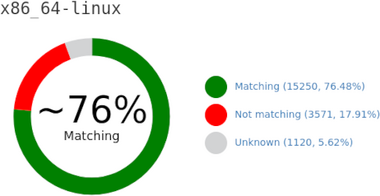
Distribution work In Debian, 68 reviews of packages were added, 33 were updated and 10 were removed this month, adding to our knowledge about identified issues. Two new issue types have been identified too: nondeterministic_ordering_in_todo_items_collected_by_doxygen and kodi_package_captures_build_path_in_source_filename_hash. kpcyrd published another monthly report on their work on reproducible builds within the Alpine and Arch Linux distributions, specifically mentioning rebuilderd, one of the components powering reproducible.archlinux.org. The report also touches on binary transparency, an important component for supply chain security. The @GuixHPC account on Twitter posted an infographic on what fraction of GNU Guix packages are bit-for-bit reproducible: Finally, Bernhard M. Wiedemann posted his monthly reproducible builds status report for openSUSE.

Upstream patches The Reproducible Builds project detects, dissects and attempts to fix as many currently-unreproducible packages as possible. We endeavour to send all of our patches upstream where appropriate. This month, we wrote a large number of such patches, including: Elsewhere, it was discovered that when supporting various new language features and APIs for Android apps, the resulting APK files that are generated now vary wildly from build to build (example diffoscope output). Happily, it appears that a patch has been committed to the relevant source tree. This was also discussed on our mailing list this month in a thread titled Android desugaring and reproducible builds started by Marcus Hoffmann.

Website and documentation There were quite a few changes to the Reproducible Builds website and documentation this month, including:
  • Felix C. Stegerman:
    • Update the website self-build process to not use the buster-backports suite now that Debian Bullseye is the stable release. [ ]
  • Holger Levsen:
    • Add a new page documenting various package rebuilder solutions. [ ]
    • Add some historical talks and slides from DebConf20. [ ][ ]
    • Various improvements to the history page. [ ][ ][ ]
    • Rename the Comparison protocol documentation category to Verification . [ ]
    • Update links to F-Droid documentation. [ ]
  • Ian Muchina:
    • Increase the font size of titles and de-emphasize event details on the talk page. [ ]
    • Rename the README file to README.md to improve the user experience when browsing the Git repository in a web browser. [ ]
  • Mattia Rizzolo:
    • Drop a position:fixed CSS statement that is negatively affecting with some width settings. [ ]
    • Fix the sizing of the elements inside the side navigation bar. [ ]
    • Show gold level sponsors and above in the sidebar. [ ]
    • Updated the documentation within reprotest to mention how ldconfig conflicts with the kernel variation. [ ]
  • Roland Clobus:
    • Added a ticket number for the issue with the live Cinnamon image and diffoscope. [ ]

Testing framework The Reproducible Builds project runs a testing framework at tests.reproducible-builds.org, to check packages and other artifacts for reproducibility. This month, the following changes were made:
  • Holger Levsen:
    • Debian-related changes:
      • Make a large number of changes to support the new Debian bookworm release, including adding it to the dashboard [ ], start scheduling tests [ ], adding suitable Apache redirects [ ] etc. [ ][ ][ ][ ][ ]
      • Make the first build use LANG=C.UTF-8 to match the official Debian build servers. [ ]
      • Only test Debian Live images once a week. [ ]
      • Upgrade all nodes to use Debian Bullseye [ ] [ ]
      • Update README documentation for the Debian Bullseye release. [ ]
    • Other changes:
      • Only include rsync output if the $DEBUG variable is enabled. [ ]
      • Don t try to install mock, a tool used to build Fedora packages some time ago. [ ]
      • Drop an unused function. [ ]
      • Various documentation improvements. [ ][ ]
      • Improve the node health check to detect zombie jobs. [ ]
  • Jessica Clarke (FreeBSD-related changes):
    • Update the location and branch name for the main FreeBSD Git repository. [ ]
    • Correctly ignore the source tarball when comparing build results. [ ]
    • Drop an outdated version number from the documentation. [ ]
  • Mattia Rizzolo:
    • Block F-Droid jobs from running whilst the setup is running. [ ]
    • Enable debugging for the rsync job related to Debian Live images. [ ]
    • Pass BUILD_TAG and BUILD_URL environment for the Debian Live jobs. [ ]
    • Refactor the master_wrapper script to use a Bash array for the parameters. [ ]
    • Prefer YAML s safe_load() function over the unsafe variant. [ ]
    • Use the correct variable in the Apache config to match possible existing files on disk. [ ]
    • Stop issuing HTTP 301 redirects for things that not actually permanent. [ ]
  • Roland Clobus (Debian live image generation):
    • Increase the diffoscope timeout from 120 to 240 minutes; the Cinnamon image should now be able to finish. [ ]
    • Use the new snapshot service. [ ]
    • Make a number of improvements to artifact handling, such as moving the artifacts to the Jenkins host [ ] and correctly cleaning them up at the right time. [ ][ ][ ]
    • Where possible, link to the Jenkins build URL that created the artifacts. [ ][ ]
    • Only allow only one job to run at the same time. [ ]
  • Vagrant Cascadian:
    • Temporarily disable armhf nodes for DebConf21. [ ][ ]

Lastly, if you are interested in contributing to the Reproducible Builds project, please visit the Contribute page on our website. You can get in touch with us via:

2 September 2021

Eddy Petri&#537;or: Stretch to Buster upgrade issues: "Grub error: symbol grub_is_lockdown not found", missing RTL8111/8168/8411 Ethernet driver and RTL8821CE Wireless adapter on Linux Kernel 5.10 (and 4.19)

I have been Debian Stretch running on my HP Pavilion 14-ce0000nq laptop since buying it back in April 2019, just before my presence at Oxidizeconf where I presented "How to Rust When Standards Are Defined in C".Debian Buster (aka Debian 10) was released about 4 months later and I've been postponing the upgrade as my free time isn't what it used to be. I also tend to wait for the first or even second update of the release to avoid any sharp edges.As this laptop has a Realtek 8821CE wireless card that wasn't officially supported in the Linux kernel, I had to use an out-of-tree hacked driver to have the wireless work on Stretch kernels such as 4.19, it didn't even got along with DKMS, so all compilations and installations of it, I did them manually. More reason to wait for a newer release that would contain a driver inside the official kernel.I was waiting for the inevitable and dreading the wireless issues, but since mid-august Bullseye became stable, turning Stretch into oldoldstable, I decided that I had to do the upgrade, at least to buster.The Grub error and the fix

Everything went quite smooth, except that after the reboot, the laptop failed to boot with this Grub error:

error: symbol grub_is_lockdown not found
I looked for a solution and it seemed everyone was stuck or the solution was unclear.There is even a bug report in Debian about this error, bug #984760.
Adding to the pile of confusion my own confused solution: I tried supergrubdisk2/rescatux, it didn't work for me, it might have been a combination of me using LVM and grub-efi-amd64. I also tried to boot in rescue mode the Buster first DVD (to avoid the need for network), I was able to enter the partition, mount the EFI partition, too, but since I didn't want to mess the setup even more or depend on an external USB stick, I didn't know where should I try to write the Grub EFI config - the root partition is on an NVME storage.When buying the laptop it had FreeDOS installed on it and some HP rescue app, which I did not wipe when installing Debian. I even forgot where or how was the EFI installed on the disk and EFI, even if it should be more reliable and simpler, I never got the hang of it.
In the end, I realized that I could via BIOS actually select manually which EFI executable should be booted into, so I was able to boot with some manual intervention during boot into the regular system.I tried regenerating the grub configuration, installing it and also tried restoring the default proper boot sequence (and I even installed refind in the system during my fumbling), but I think somewhere between grub-efi-amd64 reconfiguration and its reinstallation I managed to do the right thing, as the default boot screen is the Grub one now.Hints for anyone reading this in the hope to fix the same issue, hopefully it will make things better, not worse (see the text below):1) regenerate the grub config:
update-grub2
2) reinstall grub-efi-amd64 and make Debian the default
dpkg-reconfigure -plow grub-efi-amd64
When reinstalling grub-efi-amd64 onto the disk, I think the scariest questions were to these:

Force extra installation to the EFI removable media path?

Some EFI-based systems are buggy and do not handle new bootloaders correctly. If you force an extra installation of GRUB to the EFI removable media path, this should ensure that this system will boot Debian correctly despite such a problem. However, it may remove the ability to boot any other operating systems that also depend on this path. If so, you will need to make sure that GRUB is configured successfully to be able to boot any other OS installations correctly.

and
Update NVRAM variables to automatically boot into Debian?

GRUB can configure your platform's NVRAM variables so that it boots into Debian automatically when powered on. However, you may prefer to disable this behavior and avoid changes to your boot configuration. For example, if your NVRAM variables have been set up such that your system contacts a PXE server on every boot, this would preserve that behavior.

I think the first can be safely answered "No" if you don't plan on booting via a removable USB stick, while the second is the one that does the restoring.The second question is probably safe if you don't use PXE boot or other boot method, at least that's what I understand. But if you do, I suspect by installing refind, by playing with the multiple efi* named packages and tools, you can restore that, or it might be that your BIOS allows that directly.
I just did a walk through of these 2 steps again on my laptop and answered "No" to the removable media question as it leads to errors when the media was not inserted (in my case the internal SD card reader), and "Yes" to making Debian the default.It seems that for me this broke the FreeDOS and HP utilities boot entries from Grub, but I still can boot via the BIOS options and my goal was to have Debian boot correctly by default.
Fixing the missing RTL811/8168/8411 Ethernet card issue
As a side note for people with computers having Realtek RTL8111/8168/8411 Gigabit Ethernet Controller and upgrading to Buster or switching to a newer kernel, please note that you might end up having the unpleasant surprise even your Ethernet card to disappear because the r8169 driver is not loader by default.I had to add it to /etc/modules so is loaded by default:
eddy@aptonia:/ $ cat /etc/modules
# /etc/modules: kernel modules to load at boot time.
#
# This file contains the names of kernel modules that should be loaded
# at boot time, one per line. Lines beginning with "#" are ignored.
r8169

The 5.10 compatible driver for RTL8821CE wireless adapterAfter the upgrade to Buster, the oldstable version of the kernel, 4.19, the hacked version of the driver I've been using on Stretch on 4.9 kernels was no longer compatible - failed to compile due to missing symbols.The fix for me was to switch to the DKMS compatible driver from https://github.com/tomaspinho/rtl8821ce, as this seems to work for both 4.19 and 5.10 kernels (installed from backports).
I installed it via a modification of the manual install method only for the 4.19 and 5.10 kernels, leaving the legacy 4.9 kernels working with the hacked driver. You can do the same if instead of running the provided script, you do its steps manually and you install only for the kernel versions you want, instead of the default to install for all:I looked inside the dkms-install.sh script to do the required steps:Copy the driver, add it to the dkms set of known drivers:
DRV_NAME=rtl8821ce
DRV_VERSION=v5.5.2_34066.20200325

cp -r . /usr/src/$ DRV_NAME -$ DRV_VERSION

dkms add -m $ DRV_NAME -v $ DRV_VERSION
But you just build and install them only for the select kernel versions of your choice:
dkms build -m $ DRV_NAME -v $ DRV_VERSION -k 5.10.0-0.bpo.8-amd64
dkms install -m $ DRV_NAME -v $ DRV_VERSION -k 5.10.0-0.bpo.8-amd64
Or, without the variables:
dkms build rtl8821ce/v5.5.2_34066.20200325 -k 4.19.0-17-amd64
dkms install rtl8821ce/v5.5.2_34066.20200325 -k 4.19.0-17-amd64
dkms status should confirm everything is in place and I think you need to update grub2 again after this.
Please note this driver is no longer maintained and the 5.10 tree should support the RTL8821CE wireless card with the rtw88 driver from the kernel, but for me it did not. I'll probably try this at a later time, or after I upgrade to the current Debian stable, Bullseye.

30 August 2021

Joachim Breitner: A Candid explainer: Safe higher-order upgrades

This is the second post in a series about the interface description language Candid.

Safe upgrades A central idea behind Candid is that services evolve over time, and so also their interfaces evolve. As they do, it is desirable to keep the interface usable by clients who have not been updated. In particular on a blockchainy platform like the Internet Computer, where some programs are immutable and cannot be changed to accommodate changes in the interface of the services they use, this is of importance. Therefore, Candid defines which changes to an interface are guaranteed to be backward compatible. Of course it s compatible to add new methods to a service, but some changes to a method signature can also be ok. For example, changing
service A1 :  
  get_value : (variant   current; previous : nat  )
    -> (record   value : int; last_change : nat  )
 
to
service A2 :  
  get_value : (variant   current; previous : nat; default  )
    -> (record   value : int; last_change : nat; committed : bool  )
 
is fine: It doesn t matter that clients that still use the old interface don t know about the new constructor of the argument variant. And the extra field in the result record will silently be ignored by old clients. In the Candid spec, this relation is written as A2 <: A1 (note the order!), and the formal footing this builds on is subtyping. We thus say that it is safe to upgrade a service to a subtype , and that A2 s interface is a subtype of A1 s. In small examples, I often use nat and int, because every nat is also a int, but some int values are not not nat values, namely the negative ones. We say nat is a subtype of int, nat <: int. So a function that in the first returns a int can in the new version return a nat without breaking old clients. But the other direction doesn t work: If the old version s method had a return type of nat, then changing that to int would be a breaking change, as old clients would not be prepared to handle negative numbers. Note that arguments of function types follow different rules. In fact, the rules are simply turned around, and in argument position (also called negative position ), we can evolve the interface to accept supertypes. Concretely, a function that originally expected an nat can be changed to expect an int, but the other direction doesn t work, because there might still be old clients around that send negative numbers. This reversing-of-the-rules is called contravariance. The vision is that the developer s tooling will warn the developer before they upgrade the code of a running service to a type that is not a subtype of the old interface. Let me stress, though, that all this is about not breaking existing clients that use the old interface. It does not mean that a client developer who fetches the new interface for your service won t have to change their code to make his programs compile again.

Higher order composition So far, we considered the simple case of one service with a bunch of clients, i.e. the first order situation. Things get much more interesting if we have multiple services that are composed, and that pass around references to each other, and we still want everything to be nicely typed and never fail even as we upgrade services. Therefore, Candid s type system can express that a service s method expects or a returns a reference to another service or method, and the type that this service or method should have. For example
service B :   add_listener : (text, func (int) -> ()) -> ()  
says that the service with interface B has a method called add_listener which takes two arguments, a plain value of type text and a reference to a function that itself expects a int-typed argument. The contravariance of the subtyping rules explained above also applies to the types of these function reference. And because the int in the above type is on the left of two function arrows, the subtyping rule direction flips twice, and it is therefore safe to upgrade the service to accept the following interface:
service B :   add_listener : (text, func (nat) -> ()) -> ()  

Soundness theorem and Coq proof The combination of these higher order features and the safe upgrade mechanism is maybe the unique selling point of Candid, but also what made its design quite tricky sometimes. And although the conventional subtyping rules work well, we wanted to do some less conventional things (more on that below), and more than once thought we had a good solution, only to notice that it did not hold water in complicated higher-order cases. But what does it mean to hold water? I felt the need to precisely define a soundness criteria for higher order interface description languages, which you can find in the document An IDL Soundness Proposition. This is a general framework which you can instantiate with your concrete IDL language and rules, and then it tells you what you have to prove to consider your language to be sound. Intuitively, it simulates all possible ways in which services can be defined and upgraded, and in which they can pass around references to each other, and the soundness property is that then that for all messages sent between services, they can always be understood. The document also shows, in general, that any system that builds on canonical subtyping in sound, as expected. That is still a generic theorem that you can instantiate with a concrete system, but now there is less to do. Because these proofs can get tricky in corner cases, it is valuable to mechanize them in an interactive theorem prover and have the computer check the proofs. So I have created a Coq formalization that defines the soundness criteria, including the reduction to canonical subtyping. It also defines MiniCandid, a greatly simplified variant of Candid, proves various properties about it (transitivity etc.) and finally instantiates the soundness theorem. I am particularly fond of the use of coinduction to model the equirecursive types, and the use of named cases, as we know them from Isabelle, to make the proofs a bit more readable and maintainable. I am less fond of how much work it seems to be to extend MiniCandid with more of Candid s types. Already adding vec was more work than it s worth it, and I defensively blame Coq s not-so-great support for nested recursion. The soundness relies on subtyping, and that is all fine and well as long as we stick to canonical rules. Unfortunately, practical considerations force us to deviate from these a bit, as we see in the next post of this series.

Andrew Cater: Oh, my goodness, where's the fantastic barbeque [OMGWTFBBQ 2021]

I'm guessing the last glasses will be through the dishwasher (again) and Pepper the dog can settle down without having to cope with so many people.For those who don't know - Steve and his wife Jo (Sledge and Randombird) hold a barbeque in their garden every August Bank Holiday weekend [UK Bank Holiday on the last Monday in August]. The barbeque is not small - it's the dominating feature in the suburban garden, brick built, with a dedication stone, lights, electricity. The garden is small, generally made smaller by forty or so Debian friends and allies standing and sitting around. People are talking, arguing, hugging people they've not seen for (literal) years and putting the world to rights. This is Debian central point - with large quantities of meat and salads, an amount of beer/alcohol and "Cambridge gin" and general goodwill. This year was more than usually atmospheric because for some of us it was the first time with a large group of people in a while. Side conversations abound: for me it was learning something about the high energy particle physics community, how to precision build helicopters, fly quadcopters and precision 3D print anything, the maths of Isy counting crochet stitches to sew together randomly sized squares ... and, of course, obligatory things like how random is random and what's good enough entropy. And a few sessions of the game of our leader.
This is also a place for stuff to get done: I was unashamedly using this to upgrade the storage in my laptop while there were sensible engineers around. A corner of the table, a RattusRattus and it was quickly sorted - then a discussion around the internals of Thinkpads as he took his apart. Then getting a full install - Gb Ethernet to the Debian mirror in the cupboard six feet away is faster bandwidth than a jumbo jet full of tapes. Then getting mail to work again - it's handy when the mailserver owner is next to you, having come in from the garden to help, and finally IRC. And not just me: "You need a GPG key signed - there's three DPLs here, there's a release manager - but you've just missed one of the DAMs." plus an in-depth GPG how-to session on the other side of the table.I was the luckiest one with the most comfortable bed in the house overnight but I couldn't stay for last night. Thanks once again to all involved but especially Steve and Jo who do this for the love of it, and the fun, and the community and the family. Oh, and thanks to Lenovo - not just for being a platinum sponsor of Debconf but also for providing the official laptop of this and most Debian occasions

25 August 2021

Bits from Debian: DebConf21 welcomes its sponsors!

DebConf21 logo DebConf21 is taking place online, from 24 August to 28 August 2021. It is the 22nd Debian conference, and organizers and participants are working hard together at creating interesting and fruitful events. We would like to warmly welcome the 19 sponsors of DebConf21, and introduce them to you. We have five Platinum sponsors. Our first Platinum sponsor is Lenovo. As a global technology leader manufacturing a wide portfolio of connected products, including smartphones, tablets, PCs and workstations as well as AR/VR devices, smart home/office and data center solutions, Lenovo understands how critical open systems and platforms are to a connected world. Our next Platinum sponsor is Infomaniak. Infomaniak is Switzerland's largest web-hosting company, also offering backup and storage services, solutions for event organizers, live-streaming and video on demand services. It wholly owns its datacenters and all elements critical to the functioning of the services and products provided by the company (both software and hardware). Roche is our third Platinum sponsor. Roche is a major international pharmaceutical provider and research company dedicated to personalized healthcare. More than 100,000 employees worldwide work towards solving some of the greatest challenges for humanity using science and technology. Roche is strongly involved in publicly funded collaborative research projects with other industrial and academic partners and has supported DebConf since 2017. Amazon Web Services (AWS) is our fourth Platinum sponsor. Amazon Web Services is one of the world's most comprehensive and broadly adopted cloud platform, offering over 175 fully featured services from data centers globally (in 77 Availability Zones within 24 geographic regions). AWS customers include the fastest-growing startups, largest enterprises and leading government agencies. Google is our fifth Platinum sponsor. Google is one of the largest technology companies in the world, providing a wide range of Internet-related services and products such as online advertising technologies, search, cloud computing, software, and hardware. Google has been supporting Debian by sponsoring DebConf for more than ten years, and is also a Debian partner sponsoring parts of Salsa's continuous integration infrastructure within Google Cloud Platform. Our Gold sponsor is the Matanel Foundation. The Matanel Foundation operates in Israel, as its first concern is to preserve the cohesion of a society and a nation plagued by divisions. The Matanel Foundation also works in Europe, in Africa and in South America. Our Silver sponsors are: arm: the World s Best SoC Design Portfolio, Arm powered solutions have been supporting innovation for more than 30 years and are deployed in over 160 billion chips to date, Hudson-Trading, a company researching and developing automated trading algorithms using advanced mathematical techniques, Ubuntu the Operating System delivered by Canonical, Globo, the largest media conglomerate in Brazil, founded in Rio de Janeiro in 1925 and distributing high-quality content across multiple platforms, Two Sigma, rigorous inquiry, data analysis, and invention to help solve the toughest challenges across financial services and GitLab, an open source end-to-end software development platform with built-in version control, issue tracking, code review, CI/CD, and more. Bronze sponsors: Univention, Gandi.net, daskeyboard, InterFace AG and credativ. And finally, our Supporter level sponsor, ISG.EE. Thanks to all our sponsors for their support! Their contributions make it possible for a large number of Debian contributors from all over the globe to work together, help and learn from each other in DebConf21. Participating in DebConf21 online The 22nd Debian Conference is being held online, due to COVID-19, from August 24 to 28, 2021. Talks, discussions, panels and other activities run from 12:00 to 02:00 UTC. Visit the DebConf21 website at https://debconf21.debconf.org to learn about the complete schedule, watch the live streaming and join the different communication channels for participating in the conference.

23 August 2021

Bits from Debian: Lenovo, Infomaniak, Roche, Amazon Web Services (AWS) and Google, Platinum Sponsors of DebConf21

We are very pleased to announce that Lenovo, Infomaniak, Roche, Amazon Web Services (AWS) and Google, have committed to supporting DebConf21 as Platinum sponsors. lenovologo As a global technology leader manufacturing a wide portfolio of connected products, including smartphones, tablets, PCs and workstations as well as AR/VR devices, smart home/office and data center solutions, Lenovo understands how critical open systems and platforms are to a connected world. infomaniaklogo Infomaniak is Switzerland's largest web-hosting company, also offering backup and storage services, solutions for event organizers, live-streaming and video on demand services. It wholly owns its datacenters and all elements critical to the functioning of the services and products provided by the company (both software and hardware). rochelogo Roche Roche is a major international pharmaceutical provider and research company dedicated to personalized healthcare. More than 100.000 employees worldwide work towards solving some of the greatest challenges for humanity using science and technology. Roche is strongly involved in publicly funded collaborative research projects with other industrial and academic partners and have supported DebConf since 2017. AWSlogo Amazon Web Services (AWS) is one of the world's most comprehensive and broadly adopted cloud platform, offering over 175 fully featured services from data centers globally (in 77 Availability Zones within 24 geographic regions). AWS customers include the fastest-growing startups, largest enterprises and leading government agencies. Googlelogo Google is one of the largest technology companies in the world, providing a wide range of Internet-related services and products such as online advertising technologies, search, cloud computing, software, and hardware. Google has been supporting Debian by sponsoring DebConf for more than ten years, and is also a Debian partner sponsoring parts of Salsa's continuous integration infrastructure within Google Cloud Platform. With these commitments as Platinum Sponsors, Lenovo, Infomaniak, Roche, Amazon Web Services and Google are contributing to make possible our annual conference, and directly supporting the progress of Debian and Free Software, helping to strengthen the community that continues to collaborate on Debian projects throughout the rest of the year. Thank you very much for your support of DebConf21! Participating in DebConf21 online The 22nd Debian Conference is being held Online, due to COVID-19, from August 22nd to 28th, 2021. There are 8 days of activities, running from 10:00 to 01:00 UTC. Visit the DebConf21 website at https://debconf21.debconf.org to learn about the complete schedule, watch the live streaming and join the different communication channels for participating in the conference.

Pavit Kaur: GSoC 2021: Final Evaluation

Project: Incremental Improvements to Debian s CI platform
Project Link: https://summerofcode.withgoogle.com/projects/#6433686825730048
Code Repository: https://salsa.debian.org/ci-team/debci
Mentors: Antonio Terceiro and Paul Gevers

About the Project Debian Continuous Integration is Debian s CI platform. It runs tests on the packages published in the Debian archive, and today is used to control migration of packages from unstable, Debian s development area, to testing, the area of the archive where the next Debian release is being prepared. This makes it a crucial part of Debian s infrastructure. The web platform shows the results of all the tests executed. Debian CI provides developers both API and a GUI Self-Service section to request tests for the packages and get information on test history. This project involves implementing incremental improvements to the platform, making it easier to use and maintain.

Deliverables of the project:
  • Migrating Logins to Salsa
  • Adding support for testing security uploads and Debian LTS

Work done

Migrating Logins to Salsa
  • Originally, Debian CI used Debian SSO client certificates for logging in, but since that was deprecated logins are migrated to Salsa, Debian s Gitlab instance and this is implemented with the help of OmniAuth, the ruby authentication framework.
  • Another thing fixed as part of this task was that there exists a limitation in the existing database structure, where usernames were directly stored as the test requestor field, so that relationship was normalized with a proper foreign key to the users table.
Merge Requests:
Adding support for testing security uploads and Debian LTS In this task, work was done to enable private tests in Debian CI for adding support for testing security uploads and Debian LTS. It includes tasks from adding the private field in the API and Self-Service section in requesting tests to adding an option to publish them when ready through both interfaces. Merge Requests:
Others I worked on some issues to add usability improvements for the web interface:

Learning Takeaways I learned a lot throughout the entire journey. Some of the things to mention are:
  • Writing tests: I learned about using Rspec for writing tests in ruby and understood how writing tests is an integral part of coding any project.
  • Using good coding practices: By my merge requests reviews done by my mentor Antonio, I came to know about good coding practices which help in keeping the code both clean and concise.

Acknowledgement I owe huge thanks to my mentors Antonio Terceiro and Paul Gevers for their constant support and guidance throughout the entire duration. It is for them that I was able to get started with the code-base of the project in the first place. And while working on the project, they were extremely responsive to all my queries. My merge requests were all thoroughly reviewed which enables me to learn more and work more efficiently. It was a complete pleasure interacting with them on weekly meet calls. To sum up, my GSoC journey was awesome and I had a fun and productive summer with Debian

What s next? As part of a continuation of my project task Adding support for testing security uploads and Debian LTS, I would be working on Debian CI to facilitate the process of connecting the embargoed archive. It s the end of my GSoC journey but certainly not the end of my journey with Debian or Open-Source. I plan to stay an active contributor to Debian and get involve with more Open Source projects as well

Extras The link to my Salsa Profile for all my work activities can be found here.
To know more about my journey, my other GSoC blog posts can be found below:

21 August 2021

Pavit Kaur: GSoC: Second Phase of Coding Period

Hello there. So here we are near the end of GSoC 2021 and with that, I am sharing details of the work I completed in the second phase of the coding period. coding-period-2 Continuing with details of the task I left on

Task: Adding support for testing security uploads and Debian LTS
  • The extra-apt-sources parameter is added to both API and Self-Service section for the test request object and the part which took some time was deciding on its validation since if you ever deal with apt sources, you would know that there exist a lot of combinations of a valid apt source and in the end, the decision was taken to just add the minimal checks.
  • Since, we have enough setup to request private tests, it made sense to have a way of looking them up in the Self-Service section. So a new column is added to the test records in Job-History marking the visibility of a test (private or public) and a new filter to filter out records based on the visibility.
  • The option to retry tests is also added in Self-Service in the Job-History section so that private tests can also be retried. As earlier, this option was only available in Package History pages but those pages do not show the private tests.
  • The next thing in the list was to publish these test results of private tests at some point. For the API section, a new endpoint is added to accept a string of run_ids which is ready to be published, and for the Self-Service , in the Job-History page a Publish button is added to be clicked after check boxing the required tests.
This ends the list of my planned work for the project.

Some more interesting stuff As we got some more time for the coding period to end, my mentor Antonio Terceiro suggested that I could pick any issue from the opened issues list to work on so I picked up the one to add a user menu for the Self-Service section and completed that. Antonio also gave me insights into Debian Packaging and even let me try packaging a newer upstream version of the package itamae which is one of the packages maintained by him. I also worked on creating a video about my GSoC project for DebConf21 and this was truly the hardest thing to do. From setting up everything to final editing, it took me about 2 days to create something sane to submit. Now, I am excited about DebConf21 That concludes my work in the second phase of the coding period and next, I will be sharing my Final Evaluation Submission real soon. Stay tuned!

19 August 2021

Russ Allbery: Review: The Past is Red

Review: The Past is Red, by Catherynne M. Valente
Publisher: Tordotcom
Copyright: 2021
ISBN: 1-250-30112-2
Format: Kindle
Pages: 151
Tetley is nineteen and is the most hated person in Garbagetown. That's kind of horrible, but life is otherwise great. As she puts it:
I'm awfully lucky when you think about it. Garbagetown is the most wonderful place anybody has ever lived in the history of the world, even if you count the Pyramids and New York City and Camelot. I have Grape Crush and Big Bargains and my hibiscus flower, and I can fish like I've got bait for a heart so I hardly ever go hungry, and once I found a ruby ring and a New Mexico license plate inside a bluefin tuna. Everyone says they only hate me because I annihilated hope and butchered our future, but I know better, and anyway, it's a lie. Some people are just born to be despised. The Loathing of Tetley began small and grew bigger and bigger, like the Thames, until it swallowed me whole.
Garbagetown is a giant floating pile of garbage in the middle of the ocean, and it is, so far as anyone knows, the only "land" left in the world. Global warming has flooded everything until the remaining Fuckwits (as their future descendants call everyone who was alive at the time) took to the Misery Boats and searched hopelessly for land. Eventually they realized they could live on top of the now-massive Pacific Garbage Patch and began the Great Sorting, which is fifty years into Tetley's past. All of the types of garbage were moved into their own areas, allowing small micronations of scavengers to form and giving each area its own character.
Candle Hole is the most beautiful place in Garbagetown, which is the most beautiful place in the world. All of the stubs of candles the Fuckwits threw out piled up into hills and mountains and caverns and dells, votive candles and taper candles and tea lights and birthday candles and big fat colorful pillar candles, stacked and somewhat melted into a great crumbling gorgeous warren of wicks and wax. All the houses are cozy little honeycombs melted into hillside, with smooth round windows and low golden ceilings. At night, from far away, Candle Hole looks like a firefly palace. When the wind blows, it smells like cinnamon, and freesia, and cranberries, and lavender, and Fresh Linen Scent, and New Car Smell.
Two things should be obvious from this introduction. First, do not read this book looking for an accurate, technical projection of our environmental future. Or, for that matter, physical realism of any kind. That's not the book that Valente is writing and you'll just frustrate yourself. This is science fiction as concretized metaphor rather than prediction or scientific exploration. We Fuckwits have drowned the world with our greed and left our descendants living in piles of our garbage; you have to suspend disbelief and go with the premise. The second thing is that either you will like Tetley's storytelling style or you will not like this book. I find Valente very hit-and-miss, but this time it worked for me. The language is a bit less over-the-top than Space Opera, and it fits Tetley's insistent, aggressive optimism so well that it carries much of the weight of characterization. Mileage will definitely vary; this is probably a love-it-or-hate-it book. The Past is Red is divided into two parts. The first part is the short story "The Future is Blue," previously published in Clarkesworld and in Valente's short story collection of the same name. It tells the story of Tetley's early life, how she got her name, and how she became the most hated person in Garbagetown. The second part is much longer and features an older, quieter, more thoughtful, and somewhat more cynical Tetley, more life philosophy, and a bit of more-traditional puzzle science fiction. It lacks some of the bubbly energy of "The Future is Blue" but also features less violence and abuse. The overall work is a long novella or very short novel. This book has a lot of feelings about the environment, capitalism, greed, and the desire to let other people solve your problems for you, and it is not subtle about any of them. It's satisfying in the way that a good rant is satisfying, not in the way that a coherent political strategy is satisfying. What saves it from being too didactic or self-righteous is Tetley, who is happy to record her own emotions and her moments of wonder and is mostly uninterested in telling other people what to do. The setting sounds darkly depressing, and there are moments where it feels that way in the book, but the core of the story and of Tetley's life philosophy is a type of personal resilience: find the things that make you happy, put one foot in front of the other, and enjoy the world for what it is rather than what it could be or what other people want to convince you it might be. It's also surprisingly funny, particularly if you see the humor in bizarrely-specific piles of the detritus of civilization. The one place where I will argue with Valente a bit is that The Past is Red thoroughly embraces an environmental philosophy of personal responsibility. The devastating critique aimed at the Fuckwits is universal and undistinguished except slightly by class. Tetley and the other inhabitants of Garbagetown make no distinction between types of Fuckits or attempt to apportion blame in any way more granular than entire generations and eras. This is probably realistic. I understand why, by Tetley's time, no one is interested in the fine points of history. But the story was written today, for readers in our time, and this type of responsibility collapse is intentionally and carefully constructed by the largest polluters and the people with the most power. Collective and undifferentiated responsibility means that we're using up our energy fretting about whether we took two showers, which partly deflects attention from the companies, industries, and individuals that are directly responsible for the vast majority of environmental damage. We don't live in a world full of fuckwits; we live in a world run by fuckwits and full of the demoralized, harried, conned, manipulated, overwhelmed, and apathetic, which is a small but important difference. This book is not the right venue to explore that difference, but I wish the vitriol had not been applied quite so indiscriminately. The rest, though, worked for me. Valente tends to describe things by piling clauses on top of adjectives, which objectively isn't the best writing but it fits everything about Tetley's personality so well that I think this is the book where it works. I found her strange mix of optimism, practicality, and unbreakable inner ethics oddly endearing. "The Future is Blue" is available for free on-line, so if in doubt, read some or all of it, and that should tell you whether you're interested in the expansion. I'm glad I picked it up. Content warning for physical and sexual abuse of the first-person protagonist, mostly in the first section. Rating: 7 out of 10

Next.

Previous.