Search Results: "sten"

8 November 2011

Jan Hauke Rahm: On GNOME 3

Since there have been a few blog posts about GNOME 3 already, I m sure you don t mind me adding one. I m one of those who don t do any work, just lurk around and wait for stuff to be fixed or working in the first place. I also don t like compiling GNOME myself. I barely touched the already packaged stuff in the repository of our Debian GNOME packaging team. But I run unstable plus stuff from experimental. I ll thus have a bit of a different experience with GNOME 3 than current testing users who at least in parts don t seem to like what they re getting. That being said I love it. No, I don t mind running network manager on my systems, I even have it on my netbook (Atom processor). I used wicd for a long time because network manager really got nothing done back in the days (half a year ago or what :)). Nowadays, since version 0.9, it works fine for me. No fiddling around with config files, perfect integration in the desktop, and LAN and WLAN Just Work [tm]. No, I don t like if some weird dependencies dictate what tools to use. I usually used pidgin for messaging, for instance. Now I m using empathy, simply because it s best integrated in GNOME. And no, I won t switch from mutt to evolution. :-P And there are more such cases. Also, these weird accessibility tools that are stuck in the gnome-shell top panel , I don t need them. Still there. (There s an extension to remove it, by the way.) Also, I must say, GNOME 3.2 is a lot better than 3.0 already. And I think 3.4 might do the final trick for me. Fact is, with GNOME 3 I have a much cleaner desktop, there is more room for windows (which is nice on a netbook display), there are web apps which I already use a lot, and it has a professional, not too playful look (i.e. a few effects, clear and consistent theming, no bubbling windows). And the new notification stuff is just awesome, especially with the empathy integration. Oh, and too many mouse click to access an application? 1) Put your most used apps in the favorites bar (or whatever it is called); it s just one click then. 2) Press your meta-key (that way our name for the windows key, or was that the ESC key? Whatever, press your windows key), type in the first two or three letters of your application, and hit enter; you don t need a mouse at all. There. It had to be said. :)

7 November 2011

Wouter Verhelst: git-annex awesomeness

So a few days ago, there was this:
21:24 < wouter> hum.
21:24 < wouter> Anyone know of a tool to manage scanned documents?
21:25 < wouter> the idea being that I can tell this tool "here's a bunch of newly-scanned documents", and it will upload them to a server
21:25 < wouter> and it should allow me to easily find a specific file later on
21:25 < wouter> and I'd also like version control there
21:26 < wouter> and I do _not_ want to download the entire repository of scanned documents on my laptop (that's why I have a server)
21:26 < wouter> and perhaps I'd also like a pony to go with that.
21:29 < wouter> oh, yes, and I do _not_ want a webbrowser as the primary interface (that might be okay to look things up, but not to store stuff)
The answer, as it turned out, was git-annex: a tool to manage files with git, without checking them into git. What, I hear you say? Yes, that sounds a little weird, doesn't it? Perhaps it's easiest to explain with a little example.
$ git annex add 2011-11-07-belgacom.pdf
$ ls -l 2011-11-07-belgacom.pdf
lrwxrwxrwx 1 wouter wouter 191 nov  7 14:46 2011-11-07-belgacom.pdf ->
../.git/annex/objects/xx/3F/SHA256-s1537334--c44e1a057e247bfe7c196ac146c8a0ca32096c0b10df6c18fd3f1c2e99ecddbf/SHA256-s1537334--c44e1a057e247bfe7c196ac146c8a0ca32096c0b10df6c18fd3f1c2e99ecddbf
The file is now known to git-annex, and I can have it do all kinds of useful things with it now:
$ git annex drop 2011-11-07-belgacom.pdf
drop 2011-11-07-belgacom.pdf (unsafe)
  Could only verify the existence of 0 out of 1 necessary copies
  No other repository is known to contain the file.
  (Use --force to override this check, or adjust annex.numcopies.)
failed
git-annex: drop: 1 failed
Oops, we hadn't copied it to anywhere else yet. We don't want to lose our data!
$ git annex move --to server 2011-11-07-belgacom.pdf
move 2011-11-07-belgacom.pdf (checking server...) (to server...)
SHA256-s1537334--c44e1a057e247bfe7c196ac146c8a0ca32096c0b10df6c18fd3f1c2e99ecddbf
     1537334 100%    9.22MB/s    0:00:00 (xfer#1, to-check=0/1)
sent 30 bytes  received 1537668 bytes  1025132.00 bytes/sec
total size is 1537334  speedup is 1.00
ok
$
What just happened? git-annex copied the file to a git remote called "server", and then dropped it from my local copy. It's no longer here! The symlink in my local directory is now a dead link; I can not open it anymore. But, no worries! If we ever need it again, it's just a single command away.
$ git annex get 2011-11-07-belgacom.pdf
get 2011-11-07-belgacom.pdf (from server...) 
SHA256-s1537334--c44e1a057e247bfe7c196ac146c8a0ca32096c0b10df6c18fd3f1c2e99ecddbf
     1537334 100%    9.58MB/s    0:00:00 (xfer#1, to-check=0/1)
sent 30 bytes  received 1537668 bytes  3075396.00 bytes/sec
total size is 1537334  speedup is 1.00
ok
This allows me to save space on my local laptop while not having to care where the files are -- they're just there. And it gets more awesome if you know that git-annex can store multiple copies of each file (so you have automatic distributed backups, as with regular git), where you can enforce the minimum number of copies. Also, git-annex supports multiple backends -- you can store your data in Amazon S3, or on an encrypted USB drive, or whatever, and have git-annex manage it transparently for you. I said this already on IRC, but: Joey, I owe you beer.

5 November 2011

Christian Perrier: People behind Debian: Rapha l Hertzog, dpkg maintainer, book author

It's about time that Rapha l is interviewed in the "People behind Debian" series he initiated on his blog. Indeed, when he interviews people, Rapha l asks about other people they could suggest for next interviews. So, during mine, I suggested him to be a next "victim". As he couldn't interview himself, I volunteered for this. As you'll see below, Rapha l (who's a friend of mine as I'm a friend of his) likes to speak and that shows in the length of his answers :-) but you always know more about Debian when reading his blog posts, books, mails, etc. I personnally think that he is among the best promoters of the project for years and it was a pleasure for me to conduct this interview. My questions are in bold, the rest is by Rapha l. Who are you? Hi, Rapha l Hertzog, I'm a 32 years old French Debian developer who is married and who has a 2-year old son. I'm running my own company (Freexian) since 2005, I started it 3 years after the end of my computer science studies. I'm also a very proud author of the Cahier de l'Admin Debian, a French book about Debian. You often wrote about your attempts to make your living partly, if not completely, out of your Debian work. Can you describe the way you're trying to do this? My first try has been with Freexian. I always advertised this company as being specialized in Debian GNU/Linux. While Freexian is successful enough to provide me a decent income, I'm not really satisfied with the result because very few of my contracts are about improving Debian. I use Debian daily for the benefit of my customers, writing new customer specific (embedded) software, deploying a service on Debian servers, etc. But except for the occasional bugfix, all this work does not improve Debian (the only exception has been the dpkg multiarch implementation work sponsored by Linaro). The positive side is that I don't need to fill my entire schedule to earn enough money to live. So I'm regularly taking some days off work to be able to contribute to Debian. This is a freedom that I enjoy... My French book has also been a bestseller and depending on the years the royalties represented between 1 and 2 months of supplementary time that I can spend on Debian (that is between 2000 and 4000 EUR of income). Now since last year, I decided to actively work towards my goal of making a living out of my Debian work. I want to build on what has been most successful for me up to now, that is my book. My strategy has been to build an audience around my blog: with a direct contact with my readers I have the opportunity to sell e-books, and without any intermediary taking the biggest part of the price, I don't need a very large audience to be successful. I have also been experiencing micro-donations with Flattr, people who are enjoying my articles on my blog can use it to give a few cents for each article they find useful. With a large enough userbase, this could fund free documentation and would avoid the need for commercial e-books but we're not there currently and I don't know if it will ever reach the critical mass. Last but not least, I'm soliciting donations for my Debian work on the sidebar of my blog, and I have the chance to a have a few (regular) donators. You're a proud father since last year. How do you manage your commitment to the project with your family life? There are few things that I put above Debian in my life, but my family certainly is. I try to handle most of my Debian duties during work hours so that I can spend time with my family on evenings and during week-ends but in truth I never really disconnect from Debian. It happens quite often that I say to my wife I'll come in a few minutes, let me finish this and then I end up responding to a Debian mail, or an IRC query and take 30 minutes instead of the 5 expected ones. I try hard to avoid this but it's difficult. Luckily for me, my wife is very supportive of my Debian involvement and knows me well... By the way my wife is using Debian on her computer, and my son has already played with DoudouLinux (a Debian derivative!). Have you already been accused of self-promotion in your writings? If that would ever happen, what would you answer to that? Yes, more than once. I am proud of what I do for Debian, I enjoy sharing the result of my work. Because of this, some people believe that I'm selfish and egocentric. And this has somewhat increased since I have been soliciting donations: for me it's important to be transparent towards donators so that they see what I really do for Debian. But some people have the feeling that I'm getting undeserved attention and that I bring everything towards my own person. On the other side, as an author, I'm a public figure who is definitely seeking some attention... I don't have any miraculous answer, we are a large and diverse community, it's next to impossible to please everybody. I listen to all the concerns that people bring forward, I take them into account as much as possible, in particular when I believe they are reasonable/well justified, or when they come from people that I highly respect. But sometimes I have to plainly ignore them too... in particular when they are trying to impose their own political view on a topic that's not directly related to the only value that we all share: the social contract. Contributing to Debian is a challenge, we all have to make efforts to put aside our differences and to concentrate on the work that brings us closer to the best free software operating system ever built. You recently launched a campaign to free out the soon-to-be-published "Debian Administrator Handbook", an English version of your well-known book about Debian in French. Can you tell us more about this project? My French book has been very successful at helping people to get started with Debian, and like I already explained, it was also effective to fund a part of my Debian work. So I wanted to make it available world-wide by publishing an English translation of it. I tried to find an English-speaking editor willing to take on the challenge but I found none interested. Not put off by a setback, Roland (my co-author) and I decided to negotiate with our French editor Eyrolles to recuperate the necessary rights to translate the book into English. Handling everything ourselves represents a lot of work, but it also means that we have the freedom required to decide of the license of the resulting book. We would love to see it under a license compatible with the Debian Free Software Guidelines. But at the same time we firmly believe that we deserve a reasonable monetary compensation for the work on the book, so we conditioned its liberation to a predefined amount of money (25 K ) in what we call the "liberation fund". And since we wanted to be sure that we would have the required means to complete the translation, we used a crowfunding platform to seek support of people interested by the book. With such a platform you're only debited if the minimal requested amount is reached. Anyone can participate, pre-order the book and/or put some money in the liberation fund. As of today, we already reached the minimal funding goal (15 K ) so the book translation will happen. But the liberation target has not yet been reached so we don't know yet if the book will be free from the start... you can follow the progress right on the fundraising page or on the website dedicated to the book. PS: If you want to contribute to this project and also make a donation to Debian at the same time, you should check out this page. You're one of the main developers of dpkg, a critical tool for Debian systems. Can you tell us more about the current development challenges it is facing? What will be the new dpkg features for wheezy? The current challenges are not really technical. dpkg is a relatively mature piece of software and it will continue to work for the foreseeable future without needing much maintenance work. The real challenge is trying to setup a healthy developement community around it so that we can keep tackling new interesting problems (there are many listed in the roadmap and in the 225 wishlist bugs). There is a real problem of leadership and communication in the current team. We used to be three, and we're only two nowadays. Guillem is the legitimate leader since he's involved in dpkg's developement since early 2006 while I joined only in late 2007. But in the last 4 years, we did not manage to recruit anyone else on the team. Some persons tried to contribute significant new features (like Sean Finney with a rework of the way we handle configuration files) but they gave up frustrated after a while because we did not manage to review their work (and discuss the design) in any reasonable timeframe. Another famous case is Ian Jackson with his trigger work. His work got merged, but so late that in the mean time he blew up while trying to hijack the maintenance of dpkg. For a long time I was concentrating my work on the Perl part of dpkg (aka dpkg-dev mainly), so I did not feel qualified to review and merge work related to the C part and I was just a worried observator of this situation. I tried to improve it by setting up some basic review infrastructure, it should have brought some lisibility to the status of each change left to be reviewed... but it has not been used and it changed nothing. Over the years, I became much more interested in the C part. My first big contribution in C has been the rewrite of update-alternatives (from Perl to C). I made other small changes in between, but at the start of this year I had this great opportunity to work on the multiarch implementation (FYI, multiarch is the possibility to mix packages from several architectures on a single system). This really forced me to jump into the C codebase and learn a lot about how dpkg is implemented. Thanks to this I have been able to tackle other small projects (like the improved triggers). This would be all great if my multiarch work was already merged, but it's not. It's a large work, I do not mind waiting a bit in particular since Guillem is a highly skilled C programmer. His sharp analysis of new designs are invaluable, when he reviews code he always finds something to improve. I learnt a lot just by reviewing the code he wrote over the years. That said I have been waiting since April without almost no updates from him. With the release team asking us to hurry up, the situation is getting somewhat strained as I really want to see multiarch in Wheezy and I do not really want to short-circuit Guillem. Hum, I may have drifted a bit from your original question... what great new features can people expect? Well multiarch is supposed to be the big new feature, apart from that there aren't many things that matter to the end users. But there are already quite a few changes that are of interest to package maintainers (like hardened build flags, source package improvements, improved triggers, ). What's the biggest problem of Debian? Manicheism and a tendency to quickly polarize the discussions. In reality, there are very few situations where everything is all good or all bad. Ever since I have read The 7 Habits of Highly Effective People I try hard to put into practice the habits of interdependence . Instead of having only my point of view in mind, I try to understand the motivations from the other party ( Seek First to Understand, Then to be Understood ) in order to be able to put forward solutions acceptable to both parties ( Think Win-Win ). I highly recommend this book to anyone. And I invite everybody to at least try to follow those simple advices. Is there someone in Debian you admire for their contributions? There are many and I can't give an exhaustive list... here are some that I would like to highlight (in no particular order): Most of those people are working on improving Debian's infrastructure so that we can all be more effective and do an even better work. This kind of work is not always very visible but it's crucial to Debian's future. Thank you to Rapha l for the time spent answering my questions. I hope you enjoyed reading his answers as I did. And, anyway, it was fun to just play the game "the other way".

28 October 2011

Lars Wirzenius: On the future of Linux distributions

Executive summary Debian should consider: Introduction I've taken a job with Codethink, as part of a team to develop a new embedded Linux system, called Baserock. Baserock is not a distribution as such, but deals with many of the same issues. I thought it might be interesting to write out my new thoughts related to this, since they might be useful for proper distributions to think about too. I'll hasten to add that many of these thoughts are not originally mine. I shamelessly adopt any idea that I think is good. The core ideas for Baserock come from Rob Taylor, Daniel Silverstone, and Paul Sherwood, my colleagues and bosses at Codethink. At the recent GNOME Summit in Montreal, I was greatly influenced by Colin Walters. This is also not an advertisment for Baserock, but since my of my current thinking come from that project, I'll discuss things in the context of Baserock. Finally, I'm writing this to express my personal opinion and thoughts. I'm not speaking for anyone else, least of all Codethink. On the package abstraction Baserock abandons the idea of packages for all individual programs. In the early 1990s, when Linux was new, and the number of packages in a distribution could be counted on two hands in binary, packages were a great idea. It was feasible to know at least something about every piece of software, and pick the exact set of software to install on a machine. It is still feasible to do so, but only in quite restricted circumstances. For example, picking the packages to install a DNS server, or an NFS server, or a mail server, by hand, without using meta packages or tasks (in Debian terminology), is still quite possible. On embedded devices, there's also usually only a handful of programs installed, and the people doing the install can be expected to understand all of them and decide which ones to install on each specific device. However, those are the exceptions, and they're getting rarer. For most people, manually picking software to install is much too tedious. In Debian, we've realised this a great many years ago, and developed meta packages (whose only purpose is to depend on other packages) and tasks (solves the same problem, but differently). These make it possible for a user to say "I want to have the GNOME desktop environment", and not have to worry about finding every piece that belongs in GNOME, and install that separately. For much of the past decade, computers have had sufficient hard disk space that it is no longer necessary to be quite so picky about what to install. A new cheap laptop will now typically come with at least 250 gigabytes of disk space. An expensive one, with an SSD drive, will have at least 128 gigabytes. A fairly complete desktop install uses less than ten gigabytes, so there's rarely a need to pick and choose between the various components. From a usability point of view, choosing from a list of a dozen or two options is much easier than from a list of thirty five thousand (the number of Debian packages as I write this). This is one reason why Baserock won't be using the traditional package abstraction. Instead, we'll collect programs into larger collections, called strata, which form some kind of logical or functional whole. So there'll be one stratum for the core userland software: init, shell, libc, perhaps a bit more. There'll be another for a development environment, one for a desktop environment, etc. Another, equally important reason, to move beyond packages is the problems caused by the combinatorial explosion of packages and versions. Colin Walters talks about this very well. When every system has a fairly unique set of packages, and versions of them, it becomes much harder to ensure that software works well for everyone, that upgrades work well, and that any problems get solved. When the number of possible package combinations is small, getting the interactions between various packages right is easier, QA has a much easier time to test all upgrade paths, and manual test coverage improves a lot when everyone is testing the same versions. Even debugging gets easier, when everyone can easily run the same versions. Grouping software into bigger collections does reduce flexibility of what gets installed. In some cases this is important: very constrainted embedded devices, for example, still need to be very picky about what software gets installed. However, even for them, the price of flash storage is low enough that it might not matter too much, anymore. The benefit of a simpler overall system may well outweigh the benefit of fine-grained software choice. Everything in git In Baserock, we'll be building everything from source in git. It will not be possible to build anything, unless the source is committed. This will allow us to track, for each binary blob we produce, the precise sources that were used to bulid it. We will also try to achieve something a bit more ambitious: anything that affects any bit in the final system image can be traced to files committed to git. This means tracking also all configuration settings for the build, and the whole build environment, in git. This is important for us so that we can reproduce an image used in the field. When a customer is deploying a specific image, and needs it to be changed, we want to be able to make the change with the minimal changes compared to the previous version of the image. This requires that we can re-create the original image, from source, bit for bit, so that when we make the actual change, only the changes we need to make affect the image. We will make it easy to branch and merge not just individual projects, but the whole system. This will make it easy to do large changes to the system, such as transitioning to a new version of GNOME, or the toolchain. Currently, in Debian, such large changes need to be serialised, so that they do not affect each other. It is easy, for example, for a GNOME transition to be broken by a toolchain transition. Branching and merging has long been considered the best available solution for concurrent development within a project. With Baserock, we want to have that for the whole system. Our build servers will be able to build images for each branch, without requiring massive hardware investment: any software that is shared between branches only gets built once. Launchpad PPAs and similar solutions provide many of the benefits of branching and merging on the system level. However, they're much more work than "git checkout -b gnome-3.4-transition". I believe that the git based approach will make concurrent development much more efficient. Ask me in a year if I was right. Git, git, and only git There are a lot of version control systems in active use. For the sake of simplicity, we'll use only git. When an upstream project uses something else, we'll import their code into git. Luckily, there are tools for that. The import and updates to it will be fully automatic, of course. Git is not my favorite version control system, but it's clearly the winner. Everything else will eventually fade away into obscurity. Or that's what we think. If it turns out that we're wrong about that, we'll switch to something else. However, we do not intend to have to deal with more than one at a time. Life's too short to use all possible tools at the same time. Tracking upstreams closely We will track upstream version control repositories, and we will have an automatic mechanism of building our binaries directly from git. This will, we hope, make it easy to follow closely upstream development, so that when, say, GNOME developers make commits, we want to be able to generate a new system image which includes those changes the same day, if not within minutes, rather than waiting days or weeks or months. This kind of closeness is greatly enhanced by having everything in version control. When upstream commits changes to their version control system, we'll mirror them automatically, and this then triggers a new system image build. When upstream makes changes that do not work, we can easily create a branch from any earlier commit, and build images off that branch. This will, we hope, also make it simpler to make changes, and give them back to upstream. Whenever we change anything, it'll be done in a branch, and we'll have system images available to test the change. So not only will upstream be able to easily get the change from our git repository, they'll also be easily verify, on a running system, that the change fixes the problem. Automatic testing, maybe even test driven development We will be automatically building system images from git commits for Baserock. This will potentially result in a very large number of images. We can't possibly test all of them manually, so we will implement some kind of automatic testing. The details of that are still under discussion. I hope to be able to start adding some test driven development to Baserock systems. In other words, when we are requested to make changes to the system, I want the specification to be provided as executable tests. This will probably be impossible in real life, but I can hope. I've talked about doing the same thing for Debian, but it's much harder to push through such changes in an established, large project. Solving the install, upgrade, and downgrade problems All mainstream Linux distributions are based on packages, and they all, pretty much, do installations and upgrades by unpacking packages onto a running system, and then maybe running some scripts from the packages. This works well for a completely idle system, but not so well on systems that are in active use. Colin Walters again talks about this. For installation of new software, the problem is that someone or something may invoke it before it is fully configured by the package's maintainer script. For example, a web application might unpack in such a way that the web server notices it, and a web browser may request the web app to run before it is configured to connect to the right database. Or a GUI program may unpack a .desktop file before the executable or its data files are unpacked, and a user may notice the program in their menu and start it, resulting in an error. Upgrades suffer from additonal problems. Software that gets upgraded may be running during the upgrade. Should the package manager replace the software's data files with new versions, which may be in a format that the old program does not understand? Or install new plugins that will cause the old version of the program to segfault? If the package manager does that, users may experience turbulence without having put on their seat belts. If it doesn't do that, it can't install the package, or it needs to wait, perhaps for a very long time, for a safe time to do the upgrade. These problems have usually been either ignored, or solved by using package specific hacks. For example, plugins might be stored in a directory that embeds the program's version number, ensuring that the old version won't see the new plugins. Some people would like to apply installs and upgrades only at shutdown or bootup, but that has other problems. None of the hacks solve the downgrade problem. The package managers can replace a package with an older version, and often this works well. However, in many cases, any package maintainer scripts won't be able to deal with downgrades. For example, they might convert data files to a new format or name or location upon upgrades, but won't try to undo that if the package gets downgraded. Given the combinatorial explosion of package versions, it's perhaps just as well that they don't try. For Baserock, we absolutely need to have downgrades. We need to be able to go back to a previous version of the system if an upgrade fails. Traditionally, this has been done by providing a "factory reset", where the current version of the system gets replaced with whatever version was installed in the factory. We want that, but we also want to be able to choose other versions, not just the factory one. If a device is running version X, and upgrades to X+1, but that version turns out to be a dud, we want to be able to go back to X, rather than all the way back to the factory version. The approach we'll be taking with Baserock relies on btrfs and subvolumes and snapshots. Each version of the system will be installed in a separate subvolume, which gets cloned from the previous version, using copy-on-write to conserve space. We'll make the bootloader be able to choose a version of the system to boot, and (waving hands here) add some logic to be able to automatically revert to the previous version when necessary. We expect this to work better and more reliably than the current package based one. Making choices Debian is pretty bad at making choices. Almost always, when faced with a need to choose between alternative solutions for the same problem, we choose all of them. For example, we support pretty much every init implementation, various implementations of /bin/sh, and we even have at least three entirely different kernels. Sometimes this is non-choice is a good thing. Our users may need features that only one of the kernels support, for example. And we certainly need to be able to provide both mysql and postresql, since various software we want to provide to our uses needs one and won't work with the other. At other times, the inability to choose causes trouble. Do we really need to support more than one implemenation of /bin/sh? By supporting both dash and bash for that, we double the load on testing and QA, and introduce yet another variable to deal with into any debugging situation involving shell scripts. Especially for core components of the system, it makes sense to limit the flexibility of users to pick and choose. Combinatorial explosion d j vu. Every binary choice doubles the number of possible combinations that need to be tested and supported and checked during debugging. Flexibility begets complexity, complexity begets problems. This is less of a problem at upper levels of the software stack. At the very top level, it doesn't really matter if there are many choices. If a user can freely choose between vi and Emacs, and this does not add complexity at the system level, since nothing else is affected by that choice. However, if we were to add a choice between glibc, eglibc, and uClibc for the system C library, then everything else in the system needs to be tested three times rather than once. Reducing the friction coefficient for system development Currently, a Debian developer takes upstream code, adds packaging, perhaps adds some patches (using one of several methods), builds a binary package, tests it, uploads it, and waits for the build daemons and the package archive and user-testers to report any problems. That's quite a number of steps to go through for the simple act of adding a new program to Debian, or updating it to a new version. Some of it can be automated, but there's still hoops to jump through. Friction does not prevent you from getting stuff done, but the more friction there is, the more energy you have to spend to get it done. Friction slows down the crucial hack-build-test cycle of software development, and that hurts productivity a lot. Every time a developer has to jump through any hoops, or wait for anything, he slows down. It is, of course, not just a matter of the number of steps. Debian requires a source package to be uploaded with the binary package. Many, if not most, packages in Debian are maintained using version control systems. Having to generate a source package and then wait for it to be uploaded is unnecessary work. The build daemon could get the source from version control directly. With signed commits, this is as safe as uploading a tarball. The above examples are specific to maintaining a single package. The friction that really hurts Debian is the friction of making large-scale changes, or changes that affect many packages. I've already mention the difficulty of making large transitions above. Another case is making policy changes, and then implementing them. An excellent example of that is in Debian is the policy change to use /usr/share/doc for documentation, instead of /usr/doc. This took us many years to do. We are, I think, perhaps a little better at such things now, but even so, it is something that should not take more than a few days to implement, rather than half a decade. On the future of distributions Occasionally, people say things like "distributions are not needed", or that "distributions are an unnecessary buffer between upstream developers and users". Some even claim that there should only be one distribution. I disagree. A common view of a Linux distribution is that it takes some source provided by upstream, compiles that, adds an installer, and gives all of that to the users. This view is too simplistic. The important part of developing a distribution is choosing the upstream projects and their versions wisely, and then integrating them into a whole system that works well. The integration part is particularly important. Many upstreams are not even aware of each other, nor should they need to be, even if their software may need to interact with each other. For example, not every developer of HTTP servers should need to be aware of every web application, or vice versa. (It they had to be, it'd be a combinatorial explosion that'd ruin everything, again.) Instead, someone needs to set a policy of how web apps and web servers interface, what their common interface is, and what files should be put where, for web apps to work out of the box, with minimal fuss for the users. That's part of the integration work that goes into a Linux distribution. For Debian, such decisions are recorded in the Policy Manual and its various sub-policies. Further, distributions provide quality assurance, particularly at the system level. It's not realistic to expect most upstream projects to do that. It's a whole different skillset and approach that is needed to develop a system, rather than just a single component. Distributions also provide user support, security support, longer term support than many upstreams, and port software to a much wider range of architectures and platforms than most upstreams actively care about, have access to, or even know about. In some cases, these are things that can and should be done in collaboration with upstreams; if nothing else, portability fixes should be given back to upstreams. So I do think distributions have a bright future, but the way they're working will need to change.

Matthew Palmer: rsync for LVM-managed block devices

If you ve ever had to migrate a service to a new machine, you ve probably found rsync to be a godsend. It s ability to pre-sync most data while the service is still running, then perform the much quicker sync the new changes action after the service has been taken down is fantastic. For a long time, I ve wanted a similar tool for block devices. I ve managed ridiculous numbers of VMs in my time, almost all stored in LVM logical volumes, and migrating them between machines is a downtime hassle. You need to shutdown the VM, do a massive dd netcat, and then bring the machine back up. For a large disk, even over a fast local network, this can be quite an extended period of downtime. The naive implementation of a tool that was capable of doing a block-device rsync would be to checksum the contents of the device, possibly in blocks, and transfer only the blocks that have changed. Unfortunately, as network speeds approach disk I/O speeds, this becomes a pointless operation. Scanning 200GB of data and checksumming it still takes a fair amount of time in fact, it s often nearly as quick to just send all the data as it is to checksum it and then send the differences.1 No, a different approach is needed for block devices. We need something that keeps track of the blocks on disk that have changed since our initial sync, so that we can just transfer those changed blocks. As it turns out, keeping track of changed blocks is exactly what LVM snapshots do. They actually keep a copy of what was in the blocks before it changed, but we re not interested in that so much. No, what we want is the list of changed blocks, which is stored in a hash table on disk. All that was missing was a tool that read this hash table to get the list of blocks that had changed, then sent them over a network to another program that was listening for the changes and could write them into the right places on the destination. That tool now exists, and is called lvmsync. It is a slightly crufty chunk of ruby that, when given a local LV and a remote machine and block device, reads the snapshot metadata and transfers the changed blocks over an SSH connection it sets up. Be warned: at present, it s a pretty raw piece of code. It does nothing but the send updated blocks over the network , so you have to deal with the snapshot creation, initial sync, and so on. As time goes on, I m hoping to polish it and turn it into something Very Awesome. Patches Accepted , as the saying goes.
  1. rsync avoids a full-disk checksum because it cheats and uses file metadata (the last-modified time, or mtime of a file) to choose which files can be ignored. No such metadata is available for block devices (in the general case).

24 October 2011

Thorsten Glaser: benz wedding, fun before

My dear MirBSD co-developer Benny did not only get his Doctor title but also recently married. There will be another post detailing this, including better photos of the two Doctors and the cake (with a D mon she made herself) on the wlog, but this is some fun beforehand: No GPL cars! Apparently, it is forbidden in France to drive GPL cars. (Without safety valve but you have to admit the picture was fun. And we were like since the thing actually meant is LPG in German. Just like UTC is CUT (Coordinated Universal Time) in English, TUC (Temps Universel Coordonn ) in French )

Colin Watson: Quality in Ubuntu 12.04 LTS

As is natural for an LTS cycle, lots of people are thinking and talking about work focused on quality rather than features. With Canonical extending LTS support to five years on the desktop for 12.04, much of this is quite rightly focused on the desktop. I'm really not a desktop hacker in any way, shape, or form, though. I spent my first few years in Ubuntu working mainly on the installer - I still do, although I do some other things now too - and I used to say only half-jokingly that my job was done once X started. Of course there are plenty of bugs I can fix, but I wanted to see if I could do something with a bit more structure, so I got to thinking about projects we could work on at the foundations level that would make a big difference. Image build pipeline One difficulty we have is that quite a few of our bugs - especially installer bugs, although this goes for some other things too - are only really caught when people are doing coordinated image testing just before a milestone release. Now, it takes a while to do all the builds and then it takes a while to test them. The excellent work of the QA team has meant that testing is much quicker now than it used to be, and a certain amount of smoke-testing is automated (particularly for server images). On the other hand, the build phase has only got longer as we've added more flavours and architectures, particularly as some parts of the process are still serialised per architecture or subarchitecture so ARM builds in particular take a very long time indeed. Exact timings are a bit difficult to get for various reasons, but I think the minimum time between a developer uploading a fix and us having a full set of candidate images on all architectures including that fix is currently somewhere north of eight hours, and that's with people cutting corners and pulling strings which is a suboptimal thing to have to do around release time. This obviously makes us reluctant to respin for anything short of showstopper bugs. If we could get things down to something closer to two hours, respins would be a much less horrible proposition and so we might be able to fix a few bugs that are serious but not showstoppers, not to mention that the release team would feel less burned out. We discussed this problem at the release sprint, and came up with a laundry list of improvements; I've scheduled this for discussion at UDS in case we can think of any more. Please come along if you're interested! One thing in particular that I'm working on is refactoring Germinate, a tool which dates right back to our first meeting before Ubuntu was even called Ubuntu and whose job is to expand dependencies starting from our lists of "seed" packages; we use this, among other things, to generate Task fields in the archive and to decide which packages to copy into our images. This was acceptably quick in 2004, but now that we run it forty times (eight flavours multiplied by five architectures) at the end of every publisher run it's actually become rather a serious performance problem: cron.germinate takes about ten minutes, which is over a third of the typical publisher runtime. It parses Packages files eight times as often as it needs to, Sources files forty times as often as it needs to, and recalculates the dependency tree of the base system five times as often as it needs to. I am confident that we can significantly reduce the runtime here, and I think there's some hope that we might be able to move the publisher back to a 30-minute cycle, which would increase the velocity of Ubuntu development in general. Maintaining the development release Our release cycle always starts with syncing and merging packages from Debian unstable (or testing in the case of LTS cycles). The vast majority of packages in Ubuntu arrive this way, and generally speaking if we didn't do this we would fall behind in ways that would be difficult to recover from later. However, this does mean that we get a "big bang" of changes at the start of the cycle, and it takes a while for the archive to be usable again. Furthermore, even once we've taken care of this, we have a long-established rhythm where the first part of the cycle is mainly about feature development and the second part of the cycle is mainly about stabilisation. As a result, we've got used to the archive being fairly broken for the first few months, and we even tell people that they shouldn't expect things to work reliably until somewhere approaching beta. This makes some kind of sense from the inside. But how are you supposed to do feature development that relies on other things in the development release? In the first few years of Ubuntu, this question didn't matter very much. Nearly all the people doing serious feature development were themselves serious Ubuntu developers; they were capable of fixing problems in the development release as they went along, and while it got in their way a little bit it wasn't all that big a deal. Now, though, we have people focusing on things like Unity development, and we shouldn't assume that just because somebody is (say) an OpenGL expert or a window management expert that they should be able to recover from arbitrary failures in development release upgrades. One of the best things we could do to help the 12.04 desktop be more stable is to have the entire system be less unstable as we go along, so that developers further up the stack don't have to be distracted by things wobbling underneath them. Plus, it's just good software engineering to keep the basics working as you go along: it should always build, it should always install, it should always upgrade. Ubuntu is too big to do something like having everyone stop any time the build breaks, the way you might do in a smaller project, but we shouldn't let things slide for months either. I've been talking to Rick Spencer and the other Ubuntu engineering leads at Canonical about this. Canonical has a system of "rotations", where you can go off to another team for a while if you're in need of a change or want to branch out a bit; so I proposed that we allow our engineers to spend a month or two at a time on what I'm calling the +1 Maintenance Team, whose job is simply to keep the development release buildable, installable, and upgradeable at all times. Rick has been very receptive to this, and we're going to be running this as a trial throughout the 12.04 cycle, with probably about three people at a time. As well as being professional archive gardeners, these people will also work on developing infrastructure to help us keep better track of what we need to do. For instance, we could deploy better tools from Debian QA to help us track uninstallable packages, or we could enhance some of our many existing reports to have bug links and/or comment facilities, or we could spruce up the weather report; there are lots of things we could do to make our own lives easier. By 12.04, I would like, in no particular order: Of course, this overlaps to a certain extent with the kinds of things that the MOTU team have been doing for years, not to mention with what all developers should be doing to keep their own houses in reasonable order, and I'd like us to work together on this; we're trying to provide some extra hands here to make Ubuntu better for everyone, not take over! I would love this to be an opportunity to re-energise MOTU and bring some new people on board. I've registered a couple of blueprints (priorities, infrastructure) for discussion at UDS. These are deliberately open-ended skeleton sessions, and I'll try to make sure they're scheduled fairly early in the week, so that we have time for break-out sessions later on. If you're interested, please come along and give your feedback!

Dirk Eddelbuettel: Kurt Elling and the Kl vers Big Band at the Green Mill

Twenty-four hours ago I was in heaven. Or to more properly recapitulate and situate this, fourty-eight hours ago I was in hell. Now this requires some context. Earlier in the year, I had tweeted briefly about a Kurt Elling live concert still streaming on NPR, and truth be told, I have listened to Kurt Elling a whole lot ever since. The most recent album The Gate is fantastic, the Grammy-winner Dedicated to You (which retakes the very famous Coltrane/Hartman album) is beyond words, and The Messenger is worth it just for 'Nature Boy' and the funkiest-ever 'April in Paris'. I also saw him as part of a larger and otherwise rather neat tour. But I needed to see the man himself. So following what one can see from his touring calendar, I jotted down two October dates. Kurt Elling at the Green Mill. Fine. That was earlier in the summer. Summer has a tendency of evaporating quickly, so here we were in October. And getting going late on Friday, so by the time we got the Green Mill, a long line had formed and we ended up paying tribute to the line for fourty-five minutes with nothing to show. Sad. Home we went, and no live music. But somehow we mustered the energy to go again last night and thought we were early, arriving about 20 minutes before the show was to start. Ha! Others had appeared at 3pm, by 5pm all seats were gone. We were literally the last ones the get in after a short spell in a shorter line, and standing room-only it was. Oh, but what a treat we got. The set for these two days was Kurt Elling with the fourteen piece Kl vers Big Band from Denmark. They played for three marvellous sets, and well over four hours (with two 25 minute breaks). Pieces often alternated between big band arrangements and smaller pieces by Elling's standard rhythm band, and covered standards as well as Elling's catalogue. As I mentioned earlier on a short post (with pictures) on Google+, it is essentially impossible to not fall for Elling's stage presence when being so close to the stage. The man is just that good. Elling and the Kl vers Big Band will now play for six nights at Birdland in New York followed by a night each in Washington, DC, and Boston. If you're around, do yourself a favour and go out to see them.

23 October 2011

Uwe Hermann: The TrekStor eBook Reader 3.0 (EBR30-a), review and dissection

The TrekStor eBook Reader 3.0, front
The TrekStor eBook Reader 3.0, front on There a many, many, e-book reader devices available these days, and they're quickly becoming pretty affordable. The currently cheapest device in Germany (that I know of) is the TrekStor eBook Reader 3.0, model number EBR30-a, at 59.- Euros via Weltbild or Hugendubel. The device has an 800x480 7" TFT (yep, no e-ink), 2100mAh battery, it can display PDFs, EPUB, and TXT files (and Adobe DRM crap, which I don't really care about), it has an accelerometer which allows for landscape/portrait switching, it can play MP3, OGG, WAV, and WMA audio files (headphone jack), it can display pictures (BMP, GIF, JPG, even PNG, though that's not mentioned in the vendor's specs), and it has 2GB internal storage for books/music/pictures. Uploading of (non-DRM) content is done by a simple file copy, it enumerates as a standard USB mass storage device with FAT filesystem. It's a relatively nice reader for the price, I've read a few PDFs (datasheets, presentations) on it in the subway/train while listening to music from the device and it's quite OK for my purposes. So much for the review part. However, I didn't really buy it for reading books on it, I was more interested in taking it apart, of course ;-) My hope was that it would turn out to be a really cheap device running Linux/U-Boot which would be perfect for playing around with embedded Linux stuff. Unfortunately, I wasn't so lucky (it seems). The TrekStor eBook Reader 3.0, opened I've posted a few photos of the device and its hardware components on my flickr account and over at randomprojects.org, together with all the information I was able to find out so far. Here's a quick summary: The TrekStor eBook Reader 3.0, CPU There are public datasheets for most of the hardware components (see randomprojects.org for links), but unfortunately the most important one (for the CPU) is not yet found/identified. I was told that the CPU/SoC is probably based on an ARM9 (ARM926EJ-S) core and the firmware running on it seems to be some uCos-based RTOS (not Linux, unfortunately). So far I was not able to find out the vendor name or website of the "FI E200" CPU/SoC (let alone any datasheets), any hints would be highly appreciated. I checked arm.com: Processor Licensees, but the only two companies whose name starts with "F" having licensed an ARM9 core are Fujitsu and Freescale, which doesn't fit, I think? I could (and probably will) check the PCB for RX/TX lines on an UART and/or JTAG pads (none are obviously labelled), and given that it's and ARM9 core there is a good chance that OpenOCD can be used and that a standard cross-gcc for ARM will work. However, that is all pretty pointless until it's clear which SoC exactly is used, and thus whether there is already Linux and/or U-Boot support for it and/or whether datasheets are available so that the respective code could be written. Without datasheets, this is going to be a pretty painful experience, not really worth investing much time, IMHO. If anyone knows more about the vendor/device and respective datasheets, please let me know. Thanks!

Luca Falavigna: Stats, more stats and, guess what? Even more stats!

We all love stats, don t we? So, here we go! Let s start with a graph: NEW graph It shows the number of packages in the NEW queue since last year. You can see a big drop during April 2011, and a reasonably low rate during the last six months. You could think fellow Debian Developers stopped to upload NEW packages. Sorry, you re wrong! :) Since Squeeze release, 3.832 .changes files with NEW components were processed by dak, with an average of 14,85 NEW packages per day. On the FTP Team side, we had 3.732 accepts (14,47 per day), 339 rejects (1,31 per day) and 178 comments to maintainers (0,69 per day).
Who were the most prolific maintainers who got a NEW processing? Here is our special top ten:
  1. Debian Haskell Group (362 packages)
  2. Debian Perl Group (343 packages)
  3. Debian Java Maintainers (161 packages)
  4. Debian Ruby Extras Maintainers (124 packages)
  5. Debian Multimedia Maintainers (100 packages)
  6. Debian Fonts Task Force (96 packages)
  7. Debian Med Packaging Team (79 packages)
  8. Debian Install System Team (61 packages)
  9. Debian Javascript Maintainers (54 packages)
  10. Debian Python Modules Team (50 packages)
That s bad packaging teams cannot bake cookies!
Let s do the same with Changed By, this time:
  1. Ben Hutchings (159 packages)
  2. Joachim Breitner (138 packages)
  3. Clint Adams (134 packages)
  4. Jonas Smedegaard (124 packages)
  5. TANIGUCHI Takaki (97 packages)
  6. Nicholas Bamber (61 packages)
  7. Alessio Treglia (60 packages)
  8. maximilian attems (54 packages)
  9. David Paleino (51 packages)
  10. Torsten Werner (45 packages)
Much better now go and heat up your ovens, we know who you are ;)
Another nice aspect to look at is the speed of NEW processing. Some maintainers were very happy for a fast NEW processing, someone even complained for having been too quick! :) So, let s find out which upload was the quickest ever. Try to gamble a bit before reading the answer, to see whether you are near to the real value ;) Alessio Treglia, you probably already know, because your gwc_0.21.16~dfsg-1 upload has been processed in 41 seconds (yes, forty-one seconds!). Here s an excerpt from ftp-master log to certify it:
20110516120252 process-upload dak Processing changes file gwc_0.21.16~dfsg-1_amd64.changes
20110516120258 process-upload dak Moving to new gwc_0.21.16~dfsg-1_amd64.changes
20110516120339 process-new tolimar NEW ACCEPT: gwc_0.21.16~dfsg-1_amd64.changes
Alex was the super-fast FTP Team member behind the quickest accept, do you want to beat him? Join FTP Team ;)

22 October 2011

Adnan Hodzic: My DebConf11 summary and its after effects

Even though some three months have passed since DebConf11 has successfully ended, I still wanted to give you just a glimpse on how some parts were played through the eyes of a lunatic (read: organizer). Of course, blog post can t come close near of explaining anything but at least it should give some insight and hopefully some pointers to the future DebConf organizers. If you don t feel like reading this much text you can listen to last episode of This Week In Debian podcast and after it just head to Beginning of the end part. DebConf11 First of all I d like to apologize if I offended or hurt anyone in this whole process as it wasn t my intention and during DebConf organization this is nothing irregular, for you to get hurt or you hurting somebody else. One thing that got stuck with me this whole time is when Mart n Ferrari approached me after I did bid proposal of Bosnia/Herzegovina for DebConf11 back on DebConf9 and told me you have no idea what you just got yourself into I played cool and said something along the line of coure I do and boy did I lie. During DebConf organization you re bound to make some of your decisions instantaneously in which you ll lose something, the most you can do is assess what s the thing you can cut the cord on, even though if that thing or a person for that matter might have meant something to you. You ll lose things, relationships, friendships, contacts at the times sense of humor and maybe even common logic. Some of it comes back to you, some the very next day and for some it may take longer. Some of it was lost irreversibly, but even in that case it wasn t lost and could even be traced to some other cause. One thing that I m thankful for is that I didn t lose, not lose but even get distanced from those close to me, and that I didn t lose guy who was with me in this from very first day, my right hand, my partner in crime Velimir ( aroundthfur ). It s not even losing I m talking about here, because even by losing you re gaining something and this is part of your everyday life, it s just that your life frame kinda gets stuck on fast forward button. So once the ride s over you may feel bit dizzy asking yourself what just happened. During this time I was also contacted by Google recruiter regrading software engineer internship but to make a long story short I didn t make it due to my heavy involvement and my lack of time (read: fail). But I don t find this as losing either, first time I was contacted by them, next time they ll be contacted by me maybe even for different position this time (project manager? Big Smile. Even this DebConf wasn t our first bid we lost DebConf7 bid to Edinburgh, but it is perseverance that got us here. The moral I m trying to tell here is if you have a goal never back down from it. What I found to be our biggest problem and what I personally found as most painstaking in all of this was having and reporting to so many different sides and different groups while trying to keep them in same communication channel. Even my right hand (Velimir) was apart from me (Vienna), then place where two of us are coming from is not the place where DebConf is getting organized in. As in the end we ended up having all the parties separated and pulling to their own side, from Government of Republika Srpska to NGO to Debian to local team and to those who remained as undeclared . Option of cutting the cord in this case was missing as these were the components that DebCon11 was made of. Of course this meant you ll be missing workforce and there were days you d wake up driving >= 200 km/h (literally) with one hand on the wheel, other on the phone and your other right hand (Velimir) holding your RedBull. But you wouldn t do this just because you had to and there was no one else to do it, you d do it because you re responsible for the sake of the project and won t be just sitting there because by some unwritten hierarchy rules you re supposed to sit and supervise things. I d advise you do the same thing when you see there s no one else to do something, even if it means making coffee for one of the teams. I m not trying to scare you away from organizing your own DebConf, on the contrary after all I ve been through in past two years if someone asked me would I do it if I knew it was like this, without a doubt my answer would still be fsck yea . All the previous DebConf organizers told me about all of this, but why didn t I give up? For the same reason you won t give up and for the same reason why we believe in the same goal. If anything this is one of the stories you ll want to tell your kids about so When I was your age I used to sleep naked in the snow would turn to When I was your age I organized DebConf11 in Maybe this blog post wasn t even necessary and some things weren t supposed to be said, I guess sometimes I just can t shut up Smile For those who were on DebConf11 I hope you enjoyed and had a great time, otherwise I m saying all of this in vein. As organizer all you see is problems and you miss most of the confrence, but by what I know there are 11 candidate bids for DebConf13 and for me hearing that tells me the results of our efforts. DebConf11 after effects I could write a whole novel about this, but to keep it as short as possible, for last two years as a side project I was working on an idea of Government or some of its institutions migrating to Linux. At first I was somewhat loud about it, then after Microsoft heard about it and after they tried stopping the idea by trying to scare me by trying to interfere with my private life; as that didn t work its lobbyist came even near of obstructing the whole conference within the Government. For the sake of the conference, I convinced the Government that by supporting DebConf it doesn t mean they need to move to Linux and publicly stopped talking about it. I also convinced them that our only goal was to have successful conference and promote alternative options and open ideas. I wasn t lying as I saw this as new opportunity of them concluding on their own why they should or shouldn t not move, the better conference was the more chances of success we had. That s why I tried pushing as many representatives from various companies as in this case we would use reverse psychology where basically no one or few know what Linux or Debian for that matter is, but everybody knows who Google is, so if you have participants from i.e: Google or Austrian E-Health care system talking about how they are using your technology is better way to explain what s it all about really. Eventually Microsoft even had their first ever conference in Bosnia/Herzegovina and you wanna take a wild guess where it was held? Smile In the end we had a great conference, after the conference we were the ones that were approached by some big local companies interested in future co-operation and in the end a meeting with Mark Shuttleworth and President along with the core of Government was scheduled. Topic? Migration to Linux. For me personally this meeting went better then I could possibly even picture it, many topics were discussed and basically it was up to us/me to make a draft of the project plan and submit request for proposal to the Government. There was still some lobbying but it seemed as it all disappeared, runway was clear and open for the lift off. Necessary contacts with potential future partners were made and before any meetings were scheduled I announced I ll be taking a short break. I missed this years vacation, for matter of a fact I missed going to a vacation for last two years. I decided going to Dubrovnik for few days, just to recollect my thoughts, recompile my kernel and switch to lower gear as I was stuck in 6th gear for way too long. Beginning of the end Being on this vacation , even if it was only for few days this gave me an opportunity to look at it all from a different prospective, different angle and that s when it came to me. I realized that even before I was finished with one project without even realizing I was already involved with another one, one that would take much more time and one that might leave me wondering ~5 years later with question what if? After all if get involved with something I m not going to back out, it s either failure is not an option or I won t start doing it at all. Even if it brought me everything I wanted, how would you know if that s what you wanted if you haven t thought about it first? Having DebConf for the first time in this region already showed some (positive) results, but for seeing the actual results it may take a bit longer. We sowed the seeds now the best thing we can do is leave them as it is and see if anything grows out. Of course I could lean over them and protect them from any natural or any other type of hazards, this would also mean when I m not around it wouldn t know how to protect itself on its own. Besides all, interfering with natures way of doing things is rarely a good option. I consider myself to still be relatively young and threatening my well being over safe keeping some seeds and watching over if they grow into something or not doesn t really seem that attractive to me. Maybe one day I ll decide to leave the land, maybe I won t even get to see if anything grows out after all. Maybe some day someone will find this fruit, recognize its worth and claim it as it s own, maybe over time everybody forgets everything and even that this land once was a fertile ground. Maybe, maybe not. I m still a student, I was supposed to graduate last year but I took less classes last year so I wouldn t snap under all the pressure. That s why this year I have less classes and am supposed to graduate in May, that s less then a year until then and I just want to devote some time to myself, figure out what I want with me life, learn the things I want to learn, do the things I want to do. I want to turn back to working on Eclipse, I have some good plans for Eclipse and Android developers, lately I ve been slacking off way too much but I think I have a good excuse Smile In the end, all I know is that I still want to change the world, whether it s doing that inside of Google or in my own company, or some third place; or I ll just be laughing at this statement only time will show. I m hoping that now with all of this out of me I can finally finish the DebConf11 chapter of my life.

14 October 2011

John Goerzen: Greece part 2: History (and sauntering up to guys with machine guns)

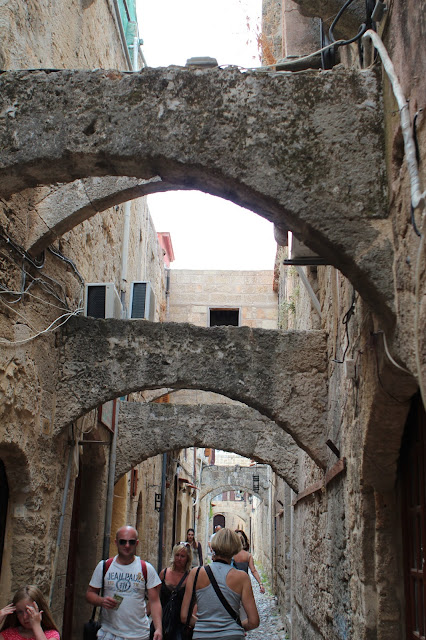
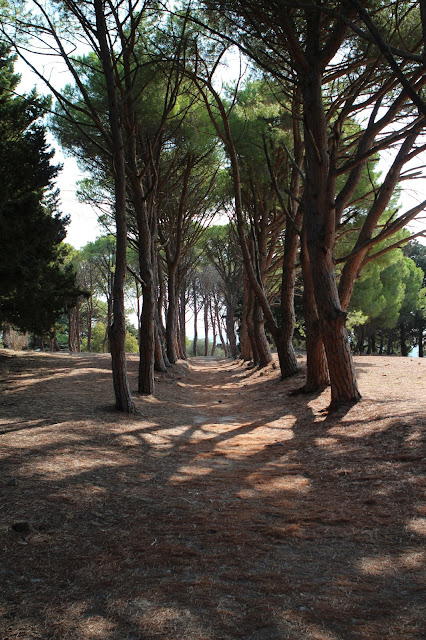
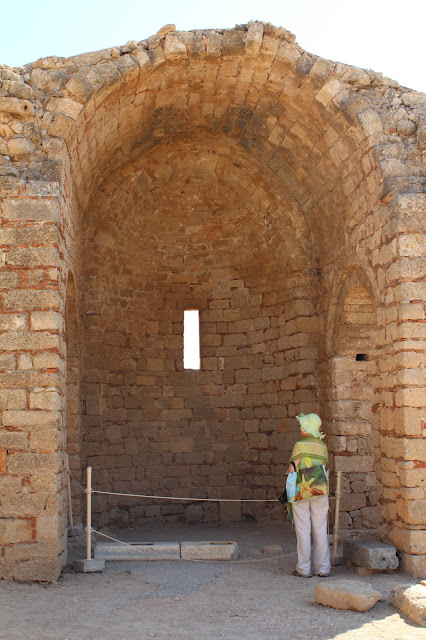
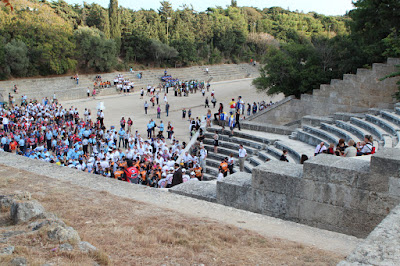
Terah and I went to the Greek island Rhodes recently. This is the second in a series about it. I am one to enjoy history. There is something deeply, well, connecting, about standing in an old place. There is a timeless quality to it a feeling of being connected to so many people of the past, and yet still being connected to change, visible in things such as weathering of stones. To gaze at pottery that s 300 years old, walk past 700-year-old walls, or pass through what remains of the grand portico of an ancient temple to Athena stirs a feeling I can barely explain, of timelessness. Although Rhodes doesn t have the famous Greek sites such as the Parthenon or Delphi, I can t help but wonder why the Rhodes sites aren t better known. They were incredible and it is hard to condense all that we saw into a short blog post. I have to start with the medieval Rhodes Old Town. We got off the bus a few blocks from it one bright morning, and our first task was to find a gate across the moat. Oh yes, A GATE ACROSS THE MOAT. It s a dry moat, and that bridge off in the distance is the gate we were headed to. Outside of the outer wall is a nice quiet walking area. The moat and walls completely surround Old Town and, for the most part, date back about 500 years. The round stones you see on that picture, we were told, were likely surplus from catapults and other projectile weapons. Cross one line of walls and you come to another, with original canons still present. The Knights Hospitaller of St. John, which held Rhodes for a few centuries until the Ottomans captured it, sure knew how to build to impress. The gate we happened to use was Amboise, the Grand Master s Gate. Right there is the stunningly rebuilt landmark Palace of the Grand Master. It is absolutely impossible for any photograph to begin to do this building justice. Between its imported Greek and Roman floors, to the grand nature of everything in it, and the archaeological museum in one corner, it was a fitting start to a visit to Old Town. Here s one of the main staircases. Just near the Palace is quiet courtyard with an old door. Pass through that door and suddenly you re in the midst of the busy Old Town. And among the landmarks in Old Town, the most prominent is Ippoton, the Avenue of the Knights. Along this avenue are the buildings built by the various nationalities of knights, many of which are historical sites in their own. Taken together, it is quite clear why Rhodes is said to be one of the world s best-preserved medieval cities. Down at the other end of Ippoton is the Knights Hospital, which is now part of the archaeological museum. Step off the Avenue a few blocks and you get to some quieter narrow streets just as old, in many cases. On Sunday morning, we were able to visit Mount Filerimos. In contrast to the busy Rhodes, Filerimos had an air of quiet and still to it. It was the site of a monastery, two historic churches, and a landmark Italian cross on the mountaintop. We arrived, and begin our visit with a walk up the quiet stone path. When we got to the top, we walked past this peaceful church. As we walked past the outside, we heard the beautiful music of chant from indoors. We got to step in and listen to mass for a few minutes. In typical fashion, directly in front of the church are two much older sites: one, the ruins of a temple to Athena, and the other a 4th-century Christian bapistery. Rhodes is a popular tourist destination, and of course we saw plenty of popular sites (such as the grandmaster s palace). Filerimos had a few tourists too, but not as many. I frequently like to operate on the plan of going wherever all the tourists aren t. And so, on Filerimos, that meant seeing what was behind the monastery. It started with this peaceful tree-lined path. And the deserted, but intentionally open, gate led to the remains of a Byzantine fortress, which had been a staging area for both the Knights and the Ottomans before their campaigns to capture Rhodes. It also provided incredible views of the surrounding countryside. The first historic site we had visited on our trip was the Acropolis of Lindos, parts of which are 2300 years old. Here s a view of the mountain from the rooftop of the Kalypso, our favorite restaurant in Lindos. The columns of the temple to Athena Lindia are visible, and of course so are the walls. The road up to the acropolis is accessible only on foot or by donkey. It is apparently the only road that has ever been used to get to the acropolis. Here is the partially-restored grand portico to the temple. There s an old Christian church (4th century, if memory serves) at the Acropolis too. The Acropolis makes some pretty good use of natural defenses too. Here s a view from one level of it. There s a manmade wall up there at the very top. And, of course, the beautiful Aegean always in the background. There are lots of cats on Rhodes. Here is a kitten napping at the top of the Lindos Acropolis: Lindos itself is a beautiful town. Here s one of the quieter streets: Notice the pebble steps leading into the houses those intricate pieces of artwork are all over. This post won t be complete without the story of our visit to the Acropolis of Rhodes. We walked there from Old Town. At the Acropolis, there are the remains of a temple to Apollo, an ancient theater, and an ancient stadium where qualifying matches for the Olympics were held. As we got closer to the area, we were repeatedly passed by people dressed in uniforms of various types. And as we got there, we joined a stream of people entering the area. The ancient stadium had apparently thousands of people in it, country names were being read off over the loudspeakers, policemen wielding machine guns were standing by, and we had absolutely no idea what was going on. At this point, you can appreciate the difference between Terah and me. Terah thought that we have no idea what is happening, she was tired from the walk, and so thought we should just leave. I thought that we have no idea what is happening, which is a great reason to stay. So Terah opted to sit and read a bit under some trees while I explored. Here s a view of the stadium as it was emptying out, seen from the theater: I explored the temple and theater, and eventually we were ready to head back. We knew there was a bus back to the New Market (from where we could get a bus back to our hotel), but didn t know where the bus stop was. The obvious place to ask were the policemen, which I thought I would do. Terah thought she would just stay sitting under the trees, on the grounds that the policemen nearest us were all carrying machine guns and perhaps wouldn t like to be disturbed. This led to my cryptic tweet:
Only ONE of us is the kind of person that goes up to guys with machine guns to ask what s happening. Me to Terah today
They told me that it was the preparations for the opening ceremony for a global shooting contest, and also gave me directions to the bus stop.

13 October 2011

Sven Mueller: Strange MySQL (5.0) issue with authentication

Dear Lazyweb . I ran into a very strange issue with MySQL authentication. The initial situation is as follows:

Two MySQL servers, let s name them a0.my.do.main and a1.my.do.main. Their my.cnf configuration is identical except for the server_id (equals 1 on a0 and 2 on a1).
Since I wanted to set up a master< ->master replication, I created a user repl@%.my.do.main on a0, then shut down the mysql server on both hosts, copied over the mysql database on the filesystem layer (i.e. rsync of the data directory), then started mysql on both hosts again. So far, so good, both servers came up nicely, and local (unix socket) login as a root user worked fine as expected. However: Logging in via TCP socket only works from a1 (to both a0 and a1). Logging in via TCP socket from a0 doesn t work to either host. I also created a test user sven @ %.my.do.main (I also tried with @ % ) which has all privileges.
Here is what the commands output:

sven@a0 ~ > mysql -u sven -ptestpass -h a0.my.do.main
ERROR 1045 (28000): Access denied for user 'sven'@'a0.my.do.main' (using password: YES)
sven@a0 ~ > mysql -u sven -ptestpass -h a1.my.do.main
ERROR 1045 (28000): Access denied for user 'sven'@'a0.my.do.main' (using password: YES)
sven@a1 ~ > mysql -u sven -ptestpass -h a0.my.do.main
Welcome to the MySQL monitor. Commands end with ; or \g.
Your MySQL connection id is 32
Server version: 5.0.77-log Source distribution Type 'help;' or '\h' for help. Type '\c' to clear the buffer. mysql> Bye
sven@a1 ~ > mysql -u sven -ptestpass -h a1.my.do.main
Welcome to the MySQL monitor. Commands end with ; or \g.
Your MySQL connection id is 24
Server version: 5.0.77-log Source distribution Type 'help;' or '\h' for help. Type '\c' to clear the buffer.
mysql>
All packages on both machines are up to date (CentOS5 with all updates available). The server variables shown with show variables also seem identical (except for the hostname and the server id). Besides, it looks more like a client problem to me than a server problem. Last datapoint: If I define the mysql user sven with an explicit host (a0.my.do.main and a1.my.do.main) instead of a wildcard, everything works nicely, from and to both hosts. So, dear lazyweb: Does anyone have an idea what might be causing this issue? Update: Due to some comments, let me add a few points of information:
  1. flush hosts doesn t help. Host resolution looks OK, according to documentation, the hostname in the error message is what the server things is right, not what the client specified, and that documentation seems to be consistent with my experiences.
  2. The db and user tables look as expected. And I m quite sure they are not the issue here, as I can connect from other hosts that match the host pattern.
  3. There is no ~/.my.cnf on either host
  4. Copying the database files on the filesystem layer is one of the documented ways of initializing the database on the slave for replication. Anyway, I had the same issue when trying to set up the database on the slave by loading a dump.
  5. DNS looks fine, both forward and reverse mappings, both servers use the same DNS server.
  6. IPv6 is not involved, it is disabled on these servers
Thanks for the hint at serverfault.com, I will try that if I don t get sufficient info here. Update 2 Another strange data point:
When I disable the (non-privileged) anonymous access user in the mysql.user table (i.e. drop the rows with user= "), everything works as expected from both servers. However, why does it work from one host (client) to both DBs if the anonymous access is allowed (with no privileges except for being able to see that the test and mysql databases exist), but not from the other host (client)? It really looks like an issue on the client side, but I still don t get what exactly goes wrong.

11 October 2011

Josselin Mouette: A message to liberals

This morning, when turning on TV, my ears have been yet another time hurt by the stupidity of a self-appointed economist, trying to intoxicate people with his fantasies about economy being able to regulate itself. Seriously. All neoliberals, please shut the fuck up. Now. The world has been running out of your ideas for more than 30 years. We lowered salaries and taxes, making the world run through credit. We gave everything to those who were already born with everything. Economy was almost brought to the verge of implosion thanks to your crazy ideas. For 4 years since the subprimes crisis, you psychopaths have kept on explaining it happened because we have not listened to you enough, and that the solution is to lower salaries even more. A quick look at the situation in Greece and UK should be enough to understand where this is going. It is time for something new. So shut up now, and let others fix the mess you have left behind.

10 October 2011

Vincent Bernat: SSL termination: stunnel, nginx & stud, round 2

A month ago, I published an article on the compared performances of stunnel, nginx and stud as SSL terminators. The conclusion was to use stud on a 64-bit system, with session caching and AES. stunnel was unable to scale properly and nginx exhibited important latency issues. I got constructive comments on many aspects. Therefore, here is the second round. The protagonists are the same but both the conditions and the conclusions have changed a bit.

Benchmarks The hardware platform remains unchanged: We focus on the following environment:
  • Ubuntu Lucid, featuring a patched version of OpenSSL 0.9.8k with AES-NI builtin and enabled by default
  • 2.6.39 kernel (250 HZ)
  • 64-bit
  • 1 core for HAProxy, 2 cores for network cards1, 4 cores for SSL, 1 core for the system
  • system limit of 100,000 file descriptors per process
On the SSL side, the main components are:
  • 2048-bit certificates
  • AES128-SHA cipher suite
  • 8 HTTP/1.0 requests per client
  • HTTP response payload of 1024 bytes
If you are interested in different conditions (32-bit, number of cores, 1024-bit certificates, proportion of session reuses), have a look at the previous article whose results on the matter are still valid. I only consider 2048-bit certificates because most certificates issued today are 2048-bit. In SP800-57, NIST advises that 1024-bit RSA keys will no longer be viable after 2010 and advises moving to 2048-bit RSA keys:
If information is initially signed in 2009 and needs to remain secure for a maximum of ten years (i.e., from 2009 to 2019), a 1024-bit RSA key would not provide sufficient protection between 2011 and 2019 and, therefore, it is not recommended that 1024-bit RSA be used in this case.
And the protagonists are: UPDATED: Configuration of nginx has been updated to switch to off both multi_accept and accept_mutex thanks to the feedback of Maxim Dounin on latency issues that were present in the previous article (and still present in the early version of this article). HAProxy (configuration) is used for stunnel and stud to add load-balancing. For each test, we want to maximize the number of HTTP transactions per second (TPS) while minimizing latency and unsucessful transactions. The maximum number of allowed failed transactions is set at 1 transaction out of 1000. The maximum allowed average latency is 100 ms2.

Control case Below is the first comparison between stud, nginx and stunnel on plain Ubuntu Lucid. Like in previous benchs, stunnel is not able to scale, with a maximum of 400 TPS. However, early latency issues of nginx has been solved, thanks to the change in configuration. stud and nginx gets similar performance but, as you can see on the bottom plot (whose scale is logarithmic) stud starts with an initial latency of 40 ms. This is pretty annoying. I have tried some micro optimization to solve this issue but without luck. If latency matters for you, stick with stunnel or nginx (or find where the problem lies in stud). UPDATED: After reporting this issue, a fix has been commited. The culprit was Nagle s algorithm which improves bandwidth at the expense of latency. With the fix, performances are mostly the same but there is no latency penalty any more. stud, nginx, stunnel on Ubuntu Lucid

OpenSSL 1.0.0e When I published the first round of benchmarks, Micha Trojnara was dubious about the bad results of stunnel. He told me on Twitter:
I solved it! You compiled stunnel against a 4 years old OpenSSL with MT-unsafe SSL_accept. Upgrade OpenSSL and rebuild stunnel. This bug was fixed in OpenSSL 1.0.0b. I implemented a (slow) workaround, so stunnel doesn t crash with earlier versions of OpenSSL.
Therefore, I backported Ubuntu Oneiric OpenSSL 1.0.0e to Ubuntu Lucid3 and, as you can see yourself on the plot below, there is a huge performance boost for stunnel: about 400%! stud features a slight improvement too (about 8%) but still starts with a latency of 40 ms while nginx does not improve. stud, nginx, stunnel with OpenSSL 1.0.0e

Intel Accelerator Engine Most Linux distributions are still using OpenSSL 0.9.8. For example, Debian Squeeze ships with OpenSSL 0.9.8o, Ubuntu Lucid with 0.9.8k and RHEL 5.7 with 0.9.8e. Therefore, they are not eligible to recent performance improvements. To solve this, Intel released Intel Accelerator Engine, which also brings, among other things, AES-NI support:
This is essentially a collection of assembler modules from development OpenSSL branch, packed together as a standalone engine. Standalone means that it can be compiled outside OpenSSL source tree without patching the latter. Idea is to provide a way to utilize new code in already released OpenSSL versions constrained by support and release policies limiting their evolvement to genuine bug fixes.
Alas, in my tests, there was no improvement compared to OpenSSL 1.0.0e (already patched with AES-NI support). stunnel comes with out-of-the-box support for additional engines. Just add something like this to your stunnel.conf:
engine=dynamic
engineCtrl=SO_PATH:/WOO/intel-accel-1.4/libintel-accel.so
engineCtrl=ID:intel-accel
engineCtrl=LIST_ADD:1
engineCtrl=LOAD
engineCtrl=INIT
For stud, you should grab support for engine selection from GitHub and for nginx, just specify the engine with ssl_engine.

Intel Performance Primitives In his great article Accelerated SSL , Simon Kuhn shows huge performance improvements by using Intel s IPP library, a library aimed at leveraging power of multi-core processors and including some cryptographic primitives and a patch to make use of them in OpenSSL. Unfortunately, this library is not free, not even as in free beer . The patch provided by Intel only applies on OpenSSL 0.9.8j. Simon updated it for OpenSSL 1.0.0d. It also applies with a slight modification to OpenSSL 1.0.0e. Look at Simon s article for instructions on how to compile OpenSSL with IPP. Simon measured 220% improvement on RSA 1024-bit private key operations by using this library. Unfortunately, we don t get such a performance burst with stud which exhibits a 15% improvement (but remember that private key operations only happen once every 8 transactions thanks to session reuse). Worst, with stunnel, performances are reduced by one third and nginx just segfaults. I think such a library is risky to use in production. stud and stunnel with IPP

Hyperthreading During the previous tests, only half the capacity of each core were used. For stud, adding more workers per core only slightly improves this situation (less than 10% with 4 workers per core). Therefore, I thought using hyperthreading could rectify the situation here. In this case, stud, stunnel and nginx are allocated 8 virtual cores instead of 4. stud only got a small improvement of 5%, nginx a moderate improvement of 11% while stunnel got a significant improvement of 26%. stud, stunnel and nginx with hyperthreading

Conclusion Here is a quick recap of the maximum TPS reached on each tests (while keeping average response time below 100 ms). All tests were run on 4 physical cores with 2048-bit certificates, AES128-SHA cipher suite. Each client makes 8 HTTP requests and reuse the first SSL session.
Context nginx 1.1.4 stunnel 4.44 stud @e207dbc5a3
OpenSSL 0.9.8k 1489 TPS 400 TPS 1492 TPS
OpenSSL 1.0.0e 1501 TPS 1561 TPS 1609 TPS
OpenSSL 1.0.0e + IPP - 1101 TPS 1857 TPS
OpenSSL 1.0.0e + HT 1718 TPS 1973 TPS 1694 TPS
I also would like to stress that below 1500 TPS, stunnel adds an overhead of a few milliseconds while stud adds 40 milliseconds. With OpenSSL 1.0.0e and hyperthreading enabled, stunnel has both good performance and low latency on low loads to moderate loads. You may just want to limit the number of allowed connections to avoid collapsing on high loads. While in the previous round, stud was the champion and stunnel lagged behind, the situation is now reversed : stunnel is on top! UPDATED: As said earlier, the latency issue with stud has been solved. Performances remain mostly the same.

  1. HAProxy and network cards don t need dedicated core for this kind of load. However, if you also want to handle non SSL traffic, those dedicated cores can get busy.
  2. The real condition is more complex. Each point is considered valid if the corresponding average latency is less than 100 ms or if the average on the next 8 points is less than 100 ms. Temporary latency bursts are therefore allowed. We are not so forgiveful with failed transactions.
  3. This is pretty straighforward: I just dropped multiarch support. I chose to use Ubuntu version of OpenSSL instead of upstream because there are some interesting patches, like automatic support of AES-NI.

9 October 2011

Axel Beckert: Git Snapshot of GNU Screen in Debian Experimental

I just uploaded a snapshot of GNU Screen to Debian Experimental. The package (4.1.0~20110819git450e8f3-1) is based on upstream s HEAD whose most recent commit currently dates to the 19th of August 2011. While the upload fixes tons of bugs which accumulated over the past two years in Debian s, Ubuntu s and upstream s bug tracker, I don t yet regard it as suitable for the next stable release (and hence for Debian Unstable) since there s one not so nice issue about it: Nevertheless it fixes a lot of open issues (of which the oldest is a wishlist bug report dating back to 1998 :-) and I didn t want to withhold it from the rest of the Debian community so I uploaded it to Debian Experimental. Issues closed in Debian ExperimentalIssues which will be closed in UbuntuPlease test the version from Experimental If you are affected by one of the issues mentioned above, please try the version from Debian Experimental and check if they re resolved for you, too. Thanks to all who contributed! A lot of the fixes have been made or applied upstream by Sadrul Habib Chowdhury who also industriously tagged Debian bug reports as fixed-upstream . Thanks! Thanks also to Brian P Kroth who gave the initial spark to this upload by packaging Fedora 15 s git snapshot for Debian and filing bug although the upload is based on the current HEAD version of GNU Screen as this fixes some more important issues than the snapshot Fedora 15 includes. That way also two patches from Fedora/RedHat s screen package are included in this upload. (Co-) Maintainer wanted! Oh, and if you care about the state of GNU Screen in Debian, I d really appreciate if you d join in and contribute to our collab-maint git repository there are still a lot of issues unresolved and I know that I won t be able to fix all of them myself. And since Hessophanes unfortunately currently has not enough time for the package, we definitely need more people maintaining this package. P.S. Yes, I know about tmux and tried to get some of my setups working with it, too. But I still prefer screen over tmux. :-)

7 October 2011

Matt Zimmerman: Ada Lovelace Day 2011: Dr. Marian C. Diamond

For Ada Lovelace Day this year, I want to share my appreciation for Dr. Marian C. Diamond. In years past, I ve saluted women in the field of computing, which is my field as well. Dr. Diamond, however, is a biologist. Her research includes neuroanatomy, environment, immune functions, and hormones. In particular, she is interested in studying the effects of the external environment, aging, and immune responses on the cerebral neocortex. She has, in her words, had a love affair with the brain for about 70 years. I know very little about biology. The content and methods of her research are, frankly, beyond me, though some of her results have garnered popular attention. She has inspired me by demonstrating that rare combination of gifts: a deep understanding of a technical subject, and the ability to explain it to other people in an accessible way. In her interviews, articles and lectures, many of which are available online, Dr. Diamond displays these gifts in abundance. Her skill and enthusiasm for both learning and teaching is unmistakable. After applying her gifts in the classroom for many years, digital distribution has now enabled many more people to see and hear her, through millions of YouTube views. In 1960, she became the first female graduate student in UC Berkeley s anatomy department, and was apparently given the job of sewing a cover for a magnifying machine. I can only imagine the persistence required to continue from there to become a recognized leader in her field. She has gone on to help many other students along their way, and was named an unsung, everyday hero for the support she provided to students outside of the classroom or lab. As if that weren t enough, she has also traveled to Cambodia to apply her expertise in helping children injured by land mines. She still teaches today, just across the bay from where I write this, and will turn 85 next month.

6 October 2011

Thorsten Glaser: eMail

Would MTAs please stop sending hi-bit7 messages to other MTAs which do not advertise 8BITMIME! Recode it to QP or BASE64, damnit! The receiving MTA is entitled to strip the set bit7, which kinda makes things hard to read (while I know how to deal with blvde Stra_e, the advent of UTF-8 makes that blC6de StraC?e, introduces C0 control characters and makes typographic quotation marks into NUL-containing octet sequences (as their UTF-8 representation contains 0x80 octets) which let every sensible MDA terminate the line there). I even filed in the Debian BTS against the BTS (might be Drexim's fault, though). Would MUAs please default to Quoted-Printable! And mail hosters should use the same server when retrying delivery, to benefit greylisting. Or at least publish a list of outgoing IPv4 addresses they use for sending. Or use IPv6. Oh, and STARTTLS, while we are on my wishlist. It's a sad day when the percentage of correctly encoded eMail messages in my INBOX is smaller than that of my Spambox...

Colin Watson: Top ideas on Ubuntu Brainstorm (August 2011)

The Ubuntu Technical Board conducts a regular review of the most popular Ubuntu Brainstorm ideas (previous reviews conducted by Matt Zimmerman and Martin Pitt). This time it was my turn. Apologies for the late arrival of this review. Contact lens in the Unity Dash (#27584) Unity supports Lenses, which provide a consistent way for users to quickly search for information via the Dash. Current lenses include Applications, Files, and Music, but a number of people have asked for contacts to be accessible using the same interface. While Canonical's DX team isn't currently working on this for Ubuntu 11.10 or 12.04, we'd love somebody who's interested in this to get involved. Allison Randal explains how to get started, including some skeleton example code and several useful links. Displaying Ubuntu version information (#27460) Several people have asked for it to be more obvious what Ubuntu version they're running, as well as other general information about their system. John Lea, user experience architect on the Unity team, responds that in Ubuntu 11.10 the new LightDM greeter shows the Ubuntu version number, making that basic information very easily visible. For more detail, System Settings -> System Info provides a simple summary. Volume adjustments for headphone use (#27275) People often find that they need to adjust their sound volume when plugging in or removing headphones. It seems as though the computer ought to be able to remember this kind of thing and do it automatically; after all, a major goal of Ubuntu is to make the desktop Just Work. David Henningson, a member of Canonical's OEM Services group and an Ubuntu audio developer, responds on his blog with a summary of how PulseAudio jack detection has improved matters in Ubuntu 11.10, and what's left to do:
The good news: in the upcoming Ubuntu Oneiric (11.10), this is actually working. The bad news: it isn't working for everyone.
Making it easier to find software to handle a file (#28148) Ubuntu is not always as helpful as it could be when you don't have the right software installed to handle a particular file. Michael Vogt, one of the developers of the Ubuntu Software Center, responded to this. It seems that most of the pieces to make this work nicely are in place, but there are a few more bits of glue required:
Thanks a lot for this suggestion. I like the idea and it's something that software-center itself supports now. In the coming version 5.0 we will offer to "sort by top-rated" (based on the ratings&reviews data). It's also possible to search for an application based on its mime data. To search for a mime-type, you can enter "mime:text/html" or "mime:audio/ogg" into the search field. What is needed however is better integration into the file manager nautilus. I will make sure this gets attention at the next developer meeting and filed bug #860536 about it. In nautilus, there is now a button called "Find applications online" available as an option when opening an unknown file or when the user selects "open with...other application" in the context menu. But that will not use the data from software-center.
Show pop-up alert on low battery (#28037) Some users have reported on Brainstorm that they are not alerted frequently enough when their laptop's battery is low, as they clearly ought to be. This is an odd one, because there are already several power alert levels and this has been working well for us for some time. Nevertheless, enough people have voted for this idea that there must be something behind it, perhaps a bug that only affects certain systems. Martin Pitt, technical lead of the Ubuntu desktop team, has responded directly to the Brainstorm idea with a description of the current system and how to file a bug when it does not work as intended.

3 October 2011

Timo Jyrinki: From MeeGo to Tizen, Debian, ...?

The MeeGo community is frustrated with the news of the MeeGo brand being abandoned. Some are understandably angry or otherwise not happy about how Linux Foundation, Intel handled the Tizen announcement and community in general - or more like how they didn't handle it at all.Last week Openmind 2011 happened to be arranged in Tampere on the very same day as Tizen announcement came alive. It was good in the way that it lead to the fact that Nomovok's CEO Pasi Nieminen was able to initiate the "Reigniting MeeGo" session not just by talking vague things about future, but actually about the process which led to Tizen and the unfortunately brief initial PR about it. Pasi is intense on emphasizing the quality and role of Qt in Tizen as well, even though officially Tizen is all about HTML5 and apparently from Samsung's part at least EFL is provided as a native toolkit. However, the promise of Tizen compared to MeeGo is reportedly that the toolkit is not specified in compliancy documents, so HTML5 with WAC is the main/only "3rd party apps" layer whereas others can be offered case-by-case. This means that unlike before, the underlying system can be built on top of practically any distribution (theoretically) and using whatever toolkits and other techniques wanted. Obviously the "Nordic System Integrators" are probably all very keen of using Qt to produce more of Nokia N9 quality user experiences in various products.

Taking the corporate hat off, I as a community member am also puzzled. The only reason I was not completely blown by the news was that I didn't yet manage to get involved in MeeGo community on a daily basis, since I'm involved with a dozen communities already. Instead I've been more like scratching the surface with MeeGo Network Finland meetings, IRC activity, OBS usage for building a few apps for MeeGo Harmattan and MeeGo proper etc. But I can somewhat understand how people like Jarkko Moilanen from meego-fi feel. They have given a _lot_ to the MeeGo community and brand, all taken away without hearing or pre-notice.

So where to now for MeeGo community? Tizen is one obvious choice. However, for all the talks that even I started this post with, Tizen is still vaporware today, and the dislike of how community is being treated might make it easy to consider other options. Also, if Tizen's reference implementation has lesser meaning, it might also mean less to actually be "in" the Tizen community than in MeeGo. I met Jos Poortvliet at Openmind, and he invited people to openSUSE. There is a lot of common ground with MeeGo and openSUSE - strong OBS usage, RPM packaging, community side focused on KDE and therefore Qt.

I would like to now point similarly to Debian! If one is tired about corporate interests and not listening to community, there is no match for Debian's 15+ years history, purely volunteer based, trust based organization, and first of all scope. While openSUSE has traditionally focused on desktop (even though like Jos pointed out they are open to all new contributions and projects), Debian has always had the "universal" scope, ie. no boundaries besides producing free software operating system for various purposes. There are over 10 architectures maintained at the moment, including the ARM (different ports for ARMv4 and hard-float ARMv7) and x86 from MeeGo world. There are even alternative kernels to Linux, mainly the GNU/kFreeBSD port. There are multiple relevant plans and projects like the Smartphones wiki area, most noticeably Debian on Neo FreeRunner. I have run Debian on my primary mobile phone for over 2.5 years, although now in the recent months I've had dual-SIM in my Nokia N950 as well (Debian not yet running on Nokia N950 or Nokia N9 - but it can and will be done!).

What Debian may lack in both good and bad is corporate funding, if you don't count the still quite respectful contributions from Ubuntu to Debian (it's in Ubuntu's interests to contribute as much possible back to Debian, so that the delta remains small). For each and every aspect, it needs a volunteer - there are a thousand volunteer Debian Developers, and at least a double of that of people without the official DD status but who still maintain a package or two among the 25000+ packages in Debian. That means also that one my find it more lucrative to join a project that has paid people to do some of the "boring parts", more of fancy web tools, including for bug handling and build systems like the OBS (which I do love by the way). On the other hand, there is no other project in my opinion where what you do really matters as much.

To find out more about Debian from MeeGo perspective, please see the recent mailing list post Mobile UXes - From the DebConf11 BoF to the stars where I wrote most of the MeeGo (CE) part when I was asked to and known of my MeeGo involvement.

Last but not certainly least, there is the Mer project - originally "maemo reconstructed", ie. making Nokia's "not really distro" into a real distro by filling in the void places. Now it's obviously MeeGo reconstructed, and they aim to be the MeeGo they always wanted MeeGo to be! Read the post for details from Carsten Munk and other key Mer people. They share the love for Qt, and want the core to be as lean as possible. They also aim to incorporate the most community like aspect from MeeGo - MeeGo CE - as the reference vendor in Mer. They also aim to be Tizen compliant - and when Tizen comes alive, I wouldn't see why the Tizen reference implementation couldn't be used for saving resources. Maybe Nomovok and/or others could offer the Qt maintaining part.

So, it might be that Tizen itself is enough for most people's needs. The key point however in this post is not to fall in agony if one corporate based project takes big turns - it has happened before, it will happen in the future. There are always enough political and business reasons from some points of view to do Big Changes. But the wider community is out there, always, and it's bigger than you think. You should consider where you want to contribute by asking yourself why you are/were part of for example the MeeGo community. Aaron Seigo from KDE asked us all this question in the Openmind MeeGo Reignited session, and I think it's good to repeat.

Next.

Previous.