Search Results: "rra"

5 October 2009

Christian Perrier: 42195 K lschmeter done!

Here we are back from our german week-end... The major event of this week-end was running the K ln Cologne marathon. Why Cologne? Mostly because my marathon Debian friends Ralf Treinen and No l K the ran it last year and enjoyed it. So, when we ran the Paris marathon together back in April, we decided to run either Berlin or Cologne later on. I finally settled for Cologne because this is closer from Paris and the date was more convenient. That was great also for No l, who lives close to K ln, so of course he planned that race in his (busy) schedule. Unfortunately, Ralf got tendinite problems since last Spring and could not join us. We really hope this will be temporary and we will enjoy running together in the future. So, I spent most of the week-end both visiting Cologne with Elizabeth...and running these 42,195 km. That was great, really. Even if there were much more Germans than in Debian, they were really as friendly and welcoming as Debian Germans are...:-). The race happens in Cologne center city and is well arranged for followers to be able to see runners several times, as the track comes back in the city center several times....with a memorable finish through the cathedral place, then central pedestrian streets and the bridge over the Rhein river (well, climbling it at km.42 is a small PITA, but still..). Animation nearly all along the streets with many K ln inhabitants and tourists encouraging the runners and shouting and applausing and playing percussions, and.... My own race was really as I planned to do it. I targeted 4h exactly (Paris was 4h10) and thus tried to keep a pace of 5'41"/km....which I nearly respected. I had a small alert around km13-15 when my legs where kind of heavy....and I was already imagining a terrible second part for the race. Finally, seeing Elizabeth encouraging me at km.19 in the middle of a big crowd, then passing through Friesen Platz in a great noise and with huge encouragements, just made it. I then completed the first half in 1h59'20", which was just fine. I slightly slowed down between km. 24 and 28, mostly because I was trusting my GPS watch to keep the pace...while it is indeed a bit inaccurate (its kilometers are about 950m long). So, when I realized that I was about 1-2 mins late at km. 30, I decided to accelerate a little and thus target 5'30"/km on the watch...which I could sustain up to km.38. I was fearing cramps and a very hard finish, just as it happened to me in Paris...but finally could finish in a quite good shape and keeping my pace. My final time is officially 4h00'47". So, I missed my target by very few seconds but I am really very happy with the result and the way I finished. Recovering in the hotel's sauna was amazing, after this, and I could then remember all the great moments of that race by viewing Elizabeth's pictures (soon online on my gallery, promise made). And, finally, today, we had another day off to drive back home and continue recovering....and register for Paris Marathon on April 11th 2010..:-)... Hopefully, No l (who did an amazing 3h15) will convince self that he should come with his running friends. So, dear readers, if you reached that part of my blog...I'm afraid you will again read about marathon stories from me.... As everybody was telling me: once you start, you never want to stop..:)

3 October 2009

Martin Meredith: Geeky Lights

I m an avid reader, and normally curl up in bed at the end of a long day with a book. However, since I ve been in my current flat, I ve had a bit of a problem, as I don t like to leave a light on while I m sleeping. So, seeing as my bed is at the opposite end of the room than my light switch, and I also tend to sleep on the side furthest from the light switch, my night-time habit would be something like this:- Not exactly good when you ve had a hard days work, and just want to curl up and read a book until you fall asleep. On Wednesday however, I stumbled across a range of products on the net, and ordered a remote control light switch, and also a remote to go with it. My bedtime arrangements are now:- A lot more easier! Have been playing with the remote from my office, and I think that if I were to order more switches, I d be able to turn on/off all the lights in my flat from my desk. Another neat feature about these lights? They can be programmed to use any button on any remote control! Oh, and also, The Birmingham Jam is going pretty well!

2 October 2009

Barry Hawkins: Just When a Wizard Would Have Been Most Useful: Coaching versus Contracting

Then they stopped, and Thorin muttered something about supper, and where shall we get a dry patch to sleep on? Not until then did they notice Gandalf was missing. So far he had come all the way with them, never saying if he was in the adventure or merely keeping them company for a while. He had eaten most, talked most, and laughed most. But now he simply was not there at all! Just when a wizard would have been most useful, too, groaned Dori and Nori (who shared the hobbit s views about regular meals, plenty and often).

- J.R.R. Tokien, The Hobbit

I am very fond of the works of J.R.R. Tolkien; it would not surprise me to find that many of you recognize these words from the second chapter of The Hobbit titled Roast Mutton . It occurred to me recently that there are parallels between Gandalf s role in The Hobbit and that of an Agile coach. Now, before my fellow Tolkien enthusiasts leap on their keyboards, bear with me on this. Know that I am not saying an Agile coach is on par with a wizard (OK, with one of the Istari sent by the Valar, but let s table that so as not to scare off the normal folk, alright?); that should be enough to calm you down. In the excerpt from The Hobbit at the top of the page, Bilbo and the dwarves have run into their first predicament. Note that it s not a particularly difficult situation; they just need to find shelter and partake of some food. Fire would be nice, too, if it could be managed. (Mind you, it s the first day of their journey; they set off mere hours ago fully provisioned and riding on ponies.) It isn t very long before the fledgling group finds itself not only without shelter and food, but in the hands of three rather nasty trolls who are deciding how best to eat the entire group. Gandalf returns once things have gotten out of control, and with some subtle adjustments to the situation, the crisis is averted. Could Gandalf have come back sooner and spared them this entire experience? Perhaps, but in their struggle a few key things happened. First, the group had to work out how to assess tasks at hand and appropriately delegate. To their credit, that effort was partially successful. The most skilled firestarters were assigned to that task, one of the keen-eyed dwarves was assigned to be the lookout. Second, they gathered some field experience that led to the establishment of improved practices, i.e. don t leave the ponies laden with packs when you make camp, particularly if it s all your food. (They lost most of their food that night when the pony carrying it bolted and ran straight into a nearby river later that night.) Third, Bilbo Baggins was called upon to perform his first task as burglar, albeit a fool s errand that landed them in the troll predicament. While Bilbo was wildly under-equipped for his job, he managed to work through it. That experience began a developmental journey that would prepare him for the great things that would be expected of him later on. This was not Gandalf s first adventure, nor was it the first group of people he needed to equip and challenge in order to develop them to a point that they could accomplish their goal. At this point, he s been in Middle-Earth just shy of 2,000 years. He would have been more than capable of walking them through their entire journey, but to what end? Agile coaching is a discipline that aims to help teams develop their own use of methodologies like Scrum and cross-methodology practices like testing, user stories, etc. This means equipping teams with just enough information to strike out on their own for a bit, then letting them run with it rather than dazzle them with one s own mastery so as to appear like the indispensable demigod. Until people struggle with the terse maxims of Agile Software Development, they cannot internalize them. And when the wizard is always around, why bother struggling? One of my greatest frustrations as an Agile coach is how few companies are willing to take a coaching approach with their Agile adoption. They want you to come in and be the demigod as a full-time contractor. Sure, there are fiscal, political, and seemingly practical reasons that they will cite; I chalk most of them up to being excuses for a lack of willingness to embrace what it would take to face the hard task of nurturing what you have. It s seemingly easier to just throw more money at more bodies and hope that somehow things will all work out, and surely if you can stumble upon some superstar to wrangle the mess, you ll eventually be able to browbeat them into becoming a full-time employee. Don t get me wrong; in some ways, I benefit from this dysfunction. From a selfish business standpoint, having a single full-time client is certainly easier than juggling multiple concurrent clients and their schedules. As far as actually accomplishing the aim of my business, however, I think it hinders the mission. One of my aims in working with companies is to be a coach despite being brought in as a contractor. It s certainly possible, though it is more challenging. There s not that natural separation of the coach from the team that forces them to take up the mantle on their own. Few things in my work are more rewarding than having a developer come to me and say, I wasn t really sure this Agile stuff could work, but now, after going through all this, I wouldn t want to go back to the old way of doing things. Much later in the journey of the hobbit and his dwarf companions, Bilbo is again called upon for a challenging task. His response makes me think Gandalf s approach has worked:
Perhaps I have begun to trust my luck more than I used to in the old days he meant last spring before he left his own house, but it seemed centuries ago but anyway I think I will go and have a peep at once and get it over. Now who is coming with me?

- J.R.R. Tokien, The Hobbit

Here s hoping more people will be willing to embrace the challenging, messy, and altogether beneficial task of equipping teams and allowing them to struggle when necessary, even if it means the occasional scuffle with trolls.

26 September 2009

Pablo Lorenzzoni: Ruby versus Python

This is not another rant to praise one in spite of the other (an everybody knows I love Ruby, so it would not be impartial), but sometimes people seems to live in another world and do things for the wrong reasons. I just read this blog post by Kanwei Li in which he gives 2 or 3 reasons he ditched Ruby in favor of Python. First of all, both are great languages and, although I favor Ruby, I use Python for some projects and they are not all that different. Of course, everyone is free to choose which language one favors, but Kanwei seems to be ditching Ruby out of not knowing much about it, or out of preferring one style over the other His first reason is that in Python white spaces matter. I used to think this is just a matter of style, but every now and then mandatory alignment hurts me (just try to put together a code generator and you ll notice it). Although my code is always correctly aligned, I like that it s done so because I want it that way, and not because some language demands it. Rants and more rants have been written about Python s mandatory alignment (or other languages lack of it), and I am not going through all of it Just I don t think it s a good reason to ditch Ruby After, he makes a big deal out of Ruby s ternary if. As written by him, he prefers

#python
if len(a) > 0:
        v = a[0]
        a = a[1:]
else:
        v = None
over Ruby s ternary if

#ruby
v = a.empty? ? a.shift : nil
Hey! Come on Ruby s ternary if is not mandatory It was copied from C just as a syntax sugar. You can do without it, just as in Python:

#ruby
if ! a.empty?
    v = a.shift
else
    v = nil
end
Better yet! you can use if s return as v value:

#ruby
v = if ! a.empty?
    a.shift
else
    nil
end
How beautiful is that! Python lacked ternary if for a long time, and when it finally acquired one via PEP 308 its syntax was made different from every other language! Although I don t think that is a problem, some people might think it would be better not reinventing the wheel. Next, Kanwei goes over a famous problem of Ruby: the lack of a sum method for Array. I admit it s strange, but that is completely coherent: Ruby s Arrays are ordered collection of objects and not mathematical arrays. How do you sum objects that are not numbers? Many different people will have many different answers to that, so Ruby leaves this decision for the programmer and provides basic methods to deal with collections of anything (that can be used to apply sum to numbers, if wished). So, in Ruby you have to use Array#inject to perform a sum:

[1,2,3].inject(0)    sum, value  sum + value  
Array#inject (actually Enumerable#inject) was borrowed from Smalltalk and allows you to loop through an array, building up an accumulator value as you go. When it s done, the final value of this accumulator is returned. Very useful for combining array elements, whether by summing them, building up a pretty display string, whatever. In the example above, I am initializing the accumulator with 0. If you use Array to mathematical operations and you want your arrays to work that way, you can always add a sum method to Array class:

class Array
    def sum
        self.inject(0)  sum, value  sum + value 
    end
end
Maybe it would be better if you just use Arrays as containers (as it was intended to) and implement that sum inside your own class I completely agree with Reg Braithwaite here. Kanwei also mention Python is faster than Ruby. That is true, but was more true some time ago. First of all, Python is older and has had more time to improve its speed. Ruby, ITOH, just now acquired a good VM and improvements to it finally can run parallel to improvements in the language itself, so I am expecting this to be less true every release. Python is already not getting much faster between releases, unlike Ruby (the differences between 1.8.7 and 1.9.1 are really impressive!). IMHO this is not a good reason to choose one instead of the other: if you really need speed, go for C :-) Now this is something I find interesting Kanwei has mentioned: Python is more production ready . He argues that Google is using it, so it must be good. Well I cannot argue against that: Google is really using Python. But IBM, Oracle, EA, Cisco, Siemens, etc are using Ruby so that is just a matter of preferring one or another company. Both are production ready I agree, though, that Ruby 1.9.1 has many differences from 1.8.7, and that that may be seen as some inconsistency, but Python also has changed a lot since its 2.0 version, for that matter. And the changes to Ruby brought many benefits I think they worth it. At last, Kanwei compares Python and Ruby docstrings. Here I also have to agree with him: Ruby docstrings sucks. Actually that s why everybody uses rdoc instead (and that is much more powerful than Python s docstrings). Again, I don t think that is reason enough to ditch Ruby (actually, the existence of rdoc, rubygems & friends should bring people to Ruby instead), but that is a matter of personal taste. Surely, Kanwei s reasons were easy to argue against. There are areas were Python shines much more than Ruby (and vice-versa), but those Kanwei mentioned are not among them. I think both languages are powerful enough, and both are way better than Perl or PHP, so either one you choose would be fine. Better if you don t have to choose and use both ;). If you have to, ITOH, pay more attention on how you feel while coding in each one, and not to some cheap reasons such as above. If you are a programmer, what matters most is that you ll spend a lot of time coding with any given language let that be something pleasant then.

23 September 2009

Jon Dowland: win7 window management

Since I've started today writing about UI issues, I might as well continue. I stumbled across a satirical review of Windows7 on kuro5hin (who knew kuro5hin was still being updated?) which highlighted one or two new window management features:
You can drag a window to the top to maximize it, which is surprisingly useful. Dragging it to the side maximizes it to use half the screen, which is great for two Explorer windows for moving stuff around.
I've always found old-windows' right-click-on-taskbar menu items for auto-arranging windows very useful and wished that stock GNOME was as useable (you can get a bit closer with Devil's Pie. I might still one day resurrect my own window manager idea). This is probably no more discoverable than the old way, but useful none-the-less.

16 September 2009

Steve McIntyre: Helsinki in the autumn

I arranged a weekend trip for me and Jo at short notice when other plans for the weekend didn't happen. And I'm glad I did, we both had an excellent time! :-) We met up with Lars and Soile for dinner at their place on Saturday when we arrived, and they were great hosts. We hit the sauna then went back to our hotel, tired from the travel but happy. I had promised Jo that we would find some reindeer for her, so on Sunday we went overboard. First of all, a trip to the natural history museum in the middle of Helsinki where we got to see models of reindeer and reindeer skeletons (amongst other things!)... Bones... Then we went to the Zetor Tractor Bar for lunch, including (of course!) reindeer to eat. Then on to the zoo to see various animals including big cats and ... reindeer! *grin* We headed back to the centre of Helsinki and met up with a bunch of the locals for drinks and some dinner. It was excellent to meet up with these folks; I'd not met some of them in a couple of years! Droidy after a few drinks Finally, last thing that night, I surprised Jo with a trip to the Ice Bar in the middle of the city. She had no idea where we were going, and when we got there the look on her face was wonderful! Brrrr.... We both loved the trip, and we'll have to go back again soon.

15 September 2009

Robert Collins: 16 Aug 2009


Hudson seemed quite nice when I was looking at how drizzle use it. I proposed it to the squid project to replace a collection of cron scripts and we re now in the final stages of deployment: Hudson is running, doing test builds. We are now polishing the deployment, tweaking where and how often reports are made, and adding more coverage to the build farm. I thought I d post a few observations about the friction involved in getting it up and running. Understand that I think its a lovely product these blemishes are really quite minor. Installation of the master machine on Ubuntu add an apt repository, apt-get update, apt-get install. Installation of the master machine on CentOS 5.2 (Now 5.3): make a user by hand, download a .war file, create an init.d script by copy-and-adjusting an example off the web. Plenty of room to improve here. Installing slave machines: make a user by hand, add an rc.local entry to run java on slave.jar as that new user. This could be more polished Installing a FreeBSD 6.4 slave: manually download various java sources to my laptop, scp them up to the FreeBSD machine, build *java* overnight, then make a user, add an rc.local entry etc. _Painful_. The next thing we noticed was that the model in Hudson doesn t really expose platforms but we want to test on a broad array of architectures, vendors and releases. i386-Ubuntu-intrepid building doesn t imply that i386-Debian-lenny will build. We started putting in tags on the slaves that will let us say this build is for amd64-CentOS-5.2 , so that if we have multiple machines for a platform, we ll have some redundancy, and so that its easy to get a sense of whats failing. This had some trouble its very manual, and as its manually entered data it can get out of date quite easily. So in the weekend I set out make a plugin, and ran into some yak shaving. Hudson plugins use maven2 to build and deploy. So I added the maven2 plugin to my eclipse (after updating eclipse to get the shiniest bzr-eclipse), and found the first bug issue 1580 maven2 and teamplugins in eclipse 3.5 don t play all that nice. Push. Removing bzr-eclipse temporarily allowed eclipse s maven plugin to work, but for some reason many dependencies were not found, and various discussions found on the net suggest manually adding them to the CLASSPATH for the project but not how to identify which ones they were. Pop. So, I switched to netbeans a 200MB download, as Ubuntu only has 6.5 in the archive. netbeans has the ability to treat a maven2 project as a directly editable project. I have to say that it works beautifully. Push. I made a new plugin, looked around for an appropriate interface, (DynamicLabellers, designed for exactly our intended use). Sadly, in my test environment, it didn t work the master didn t call into the plugin at all, and no node labels were attached. Push. Grab the source for hudson itself, find the trick-for-newcomers here do a full build outside netbeans, in netbeans open main/war as a project, and main/core as well, not just the top level pom.xml. To run, with main/war selected in the project list hit the debug button. However changes made to the main/core sources are not deployed until you build them (F11) the debug environment looks nearly identical to a real environment. Pop. There is a buglet in DynamicLabeller support in Hudson, where inconsistent code between general slave support and the master node Hudson.java causes different behaviour with dynamic labels. Specifically the master node will never get dynamic labels. So I fixed this, cleaned up the code to remove the duplication as much as possible (there are comments in the code base that different synchronisation styles are needed for some reason) and submitted upstream. Pop. I ll make the plugin for squid pretty some evening this week, and we should be able to start asking for volunteers for the squid build farm. Yay!

13 September 2009

Brett Parker: Random Storage Idea...

So, I was reading some random mumblings on the interwebs, and the pigeon with USB stick being a quicker method of data transfer in SA than their intertubes... then there was a thread on a mailing list discussing this, and someone mentioned using stacks of microSD cards... so then my brain decided to launch itself orthogonally, as it often does. What we end up with is wondering just how much storage you could fit in to the space a 3.5" drive would normally take - not taking in to account any method of attaching it at this point. So, a 3.5" drive is approx 102mmx147mmx26mm, a microSD card is 11mmx15mmx1mm, so, assuming that we're just lying them side by side, and not optimising the way they're stored at all, you can fit (with space round the sides) 9*9*26 = 2106 microSD cards in the area of a 3.5" drive. Assuming that each of those is 16G that's just shy of 33.7TB of storage! So, that set me thinking a bit further... I reckon that in that space you could do a 6*6 grid of cards with room for connectors, and just about get it to 10 high...so, that's 360 microSD cards, and probably enough room for some control gear (haven't worked out quite what we'd use for that), I then went in to wondering if we could then create a small embedded system to talk to those 360 microSD cards, if we did that then you could potentially do RAID0 across the "platters" with RAID6 on each platter. Now, to my poor head that meant that there should be 340*16G of available storage, which is 5.44TB... of course, that involves somehow interfacing the 360 microSD cards... I'm thinking that it might be possible with some form of embedded system... Unfortunately, it appears that to actually build this with consumer components... and without including the interface gear which I haven't even begun to work out yet... we're talking around about 26 per microSD card, so, erm, 9360... but I still think it'd be a really neat project... now, if someone can arrange for me to win the lottery, have lots of spare time, and some more brain power... :) Oh dear... my brain appears to have ticked further through, and I've realised that with spacing between each microSD card, you could, in theory, easily fit 400 of them upended in the space available. Erm. Of course, this still doesn't answer the "how the hell do you then get them all to talk in any sane manner" question... but I'm sure that will work out in my head sometime...

10 September 2009

Martín Ferrari: Regex backreferences

Matt, not only Perl can do it, but is part of the standard POSIX extended regexes (see regex(7)). Here I check for 7-letters palindromes:
perl -lne '/^(.)(.)(.).\3\2\1$/ and print' /usr/share/dict/words
grep '^\(.\)\(.\)\(.\).\3\2\1$' /usr/share/dict/words
Tags: Planet Debian, programming

9 September 2009

Matthew Palmer: Water Tanks, Reliability, and Redundancy

Water supply, in the developed world, is one of those things you just pretty much take for granted. You turn on the tap, and clean, cool, refreshing water comes out. Similarly, when I go to a fire in my shiny fire truck, no matter what time of the day or night, I expect to able to hook up to a hydrant and have a strong, steady supply of water available. This level of reliability is something that we in the IT industry can typically only dream of. Practically 100% reliability over a period of decades, without constant maintenance and tweaking? Not a hope. To even get close to that, we need clusters of fully-redundant servers, fancy database replication techniques, and probably something totally out of left-field like Erlang's ability to reload code on the fly. But how do the water utilities do it? Clusters of fully-redundant high-capacity pumps, fancy pipe re-routing techniques? Or something totally out of left-field like a big water tank and gravity? Where I live, we've got the latter. Thinking about how it probably operates and is managed, I'm blown away by the sheer simplicity and robustness of the whole design, and how it can handle all manner of failures. First off, consider how few components have to be working in order for the water supply to continue for a while after some sort of catastrophic failure. We need: Note that this list of elements doesn't include any moving parts, or even guaranteed continuous water supply from a dam or other huge supply store. You can lose your feed pump(s), supply lines, or anything else that's on the supply side of the water tank for some period of time and nobody on the consumption side will know or care. Need more resilience to supply-side failure? Just build a bigger tank. This blows my mind, it really does. Need to do pump maintenance? No problem, just make sure that the tank is large enough to service demand over the period of the "outage", and go for it. Can't find a pump supplier to give you a restoration SLA of less than a week? Just make sure you've got a water tank that'll provide for a week's consumption. Basically, any supply-side reliability problem can be solved with "build a bigger tank", and while there's a limit to how big we can make tanks, I'll bet we know a lot more about building huge water tanks to withstand some freaky failure conditions than we do about building pumps that won't fail for 100 years. If you do need more capacity than a single tank can provide, just parallelise -- horizontal scaling of the water supply. Woohoo! Your big water tank also provides cost savings in your other equipment. If you had to pressurise a water supply using pumps, not only would you need your redundant array of very expensive pumps (Hmm, RAVEP-5 sounds like a Doctor Who villain), but those pumps would need to be able to provide your peak consumption flow (toilet breaks during the Super Bowl, probably). I'd imagine that could get mighty expensive, and without providing much benefit for 99% of the time. I see this capacity problem at work all the time. Customers who have the occasional massive traffic spikes need to massively over-provision their average utilisation to successfully service that 1% of the time that they're doing heavy traffic. Yes, I know, cloud computing, horizontal scaling, capacity on demand, yadda yadda yadda. It's not a panacea, and the number of apps that are designed to properly scale horizontally over a large range of traffic volumes is miniscule. My general point, though, is that it when you've got a variable load, it costs a whole lot more to provision systems to supply peak demand than to provision systems that can deal with average demand. A suitably large water tank means you can easily deploy a much smaller capacity feed pump. All you have to do is make sure that when demand exceeds supply, you've got enough water in your tank to cover the difference between the demand and supply over that period. When your peak capacity increases, and is starting to strain your infrastructure, you've got a choice, too: you can upgrade the pump or increase your storage capacity, whichever is cheaper / easier / quicker / provides better kickbacks / whatever. This is all well and good, you say, but computer systems aren't water supplies. There's a lot more moving parts, inputs, and outputs, and those all have to be handled. This is quite true. Water-powered computers are not in high demand. However, I think we could produce some much more reliable systems if we looked for ways we could simplify capacity and redundancy issues, water supply style, instead of layering more and more cruft into our solutions.
Ironically, just after I started writing this post (and this gives you an idea of how long it's been sitting in my drafts folder), I saw an article in the RISKS digest about a water supply problem in Santa Cruz, caused by a power outage killing the refill pump for an extended period and resulting in the storage tank running dry. Hey, I never said that it was a foolproof system -- especially when you've got failures of imagination that result in the system that tells people that there's no power relying on the power source it's monitoring being up in order to be able to tell people that there's no power...

7 September 2009

Gunnar Wolf: Google having gender issues related to old-agers?

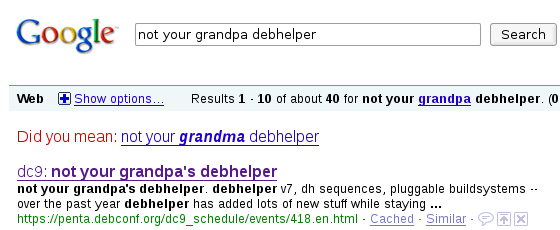
I am updating an old package's packaging style to take advantage of the new DebHelper 7 goodities. So far, I have been quite successful, but I hit a problem And before bugging on IRC, I decided to check with Joey Hess' presentation at DebConf9, Not your grandpa's debhelper. Of course, not remembering the URL, it was the most natural thing to ask Google: Did you mean... Not your grandma's Debhelper  WTF! Of course, putting this thingy aside, the right answer was the first hit. However, what is the first hit for the Grandma version? Quite dangerous: A post in Ubuntuforums for which the Google excrept reads: this tool can obviously eat your cat, poison your grandma, create an earthquake or do any other unexpected harm, so I don't provide any warranty whatsoever. I sincerely prefer joeyh's version.
Eugene V. Lyubimkin: I became DD.

That are only 3 simple words, but their value is hard to underrate. It's very important milestone in my Debian work.

The achievement might not be possible, if there wasn't the help of:
- Vincent Bernat, who thoroughly corrected my first packaging and sponsored my first (and not only) package;
- Dmitry E. Oboukhov, who uploaded many packages for me and also gave some useful advices;
- Roger Leigh, who spent not one day to improve my packaging skills, and also advocated my NM application;
- Enrico Zini, who was my NM Application Manager.
Thank you!

Thanks to people who built my NM procession chain up to creating the account: Bernd Zeimetz (FD), Christoph Berg (DAM), Peter Palfrader (account creation).

5 September 2009

Neil Williams: po4a and translating manpages

po4a creates the meta files needed to generate the manpages but the actual generation process is a little awkward and tends to become heavily customised.

For emdebian-rootfs, I've now received the Portuguese translation and I've been improving the genmanpages script. It's now more general and easier to configure for different source packages. There remain a few hidden assumptions which I hope to fix in future.

#!/bin/sh
set -e

# Copyright (C) 2006-2009 Neil Williams
#
# This program is free software; you can redistribute it and/or modify
# it under the terms of the GNU General Public License as published by
# the Free Software Foundation; either version 3 of the License, or
# (at your option) any later version.
#
# This program is distributed in the hope that it will be useful,
# but WITHOUT ANY WARRANTY; without even the implied warranty of
# MERCHANTABILITY or FITNESS FOR A PARTICULAR PURPOSE. See the
# GNU General Public License for more details.
#
# You should have received a copy of the GNU General Public License
# along with this program. If not, see .

# name and location of the config file
# relative to the top level source directory of the translations
# i.e. the directory containing ./po/
CONFIG="doc/po4a.config"
# POTFILE path
POTFILE="po/emdebian-rootfs.pot"
# the binary packages that will contain generated manpages
BINARIES="emdebian-rootfs multistrap"
# the binary packages with manpages in Section 3.
HASMAN3="emdebian-rootfs"
# the binary packages using DocBook XML & xsltproc
XMLPACKAGES="emdebian-rootfs"
# the DocBook XML files (TODO: let this take paths)
XMLFILE="emdebian-rootfs.1.xml"
# the XSL file to use for Docbook XSL
XSLFILE="http://docbook.sourceforge.net/release/xsl/current/manpages/docbook.xsl"
# the POD files (TODO: let this take paths)
PODFILE="em_multistrap"
# the binary packages using POD
PODPACKAGES="multistrap"

# remember to add something to the clean:: rule in debian/rules
# to remove each binary package sub-directory.
# $(RM) -r doc/emdebian-rootfs doc/multistrap

# below this point, no changes should be needed.

wrap_langs ()
if [ -z "$LANGS" ]; then
echo "$1 $2" >> $CONFIG
else
echo "$1 $2 $3" >> $CONFIG
fi


if [ -f po4a.config ]; then
cd ../
fi
if [ -f ../po4a.config ]; then
cd ../../
fi

# calculate the langs, automatically.
LANGS= ls po/*.po 2>/dev/null true
if [ ! -z "$LANGS" ]; then
LANGS= ls po/*.po sed -e 's/.*\/\(.*\)\.po/\1 /' true
fi
if [ ! -z "$LANGS" ]; then
# LANGS should not include the specification, just the root.
LANGS= echo $LANGS sed -e 's/_.*//'
LANGS= echo $LANGS sed -e 's/@.*//'
LANGS= echo $LANGS sed -e 's/\+.*//'
echo "[po4a_langs] $LANGS" > $CONFIG
else
echo > $CONFIG
fi
wrap_langs "[po4a_paths]" "$POTFILE" "\$lang:po/\$lang.po"

for d in $BINARIES; do
for l in $LANGS; do
mkdir -p doc/$d/man/$l/man1/
if [ "$d" = "$HASMAN3" ]; then
mkdir -p doc/$d/man/$l/man3/
fi
done
mkdir -p doc/$d/man/man1/
if [ "$d" = "$HASMAN3" ]; then
mkdir -p doc/$d/man/man3/
fi
mkdir -p doc/pod/$l/
done
mkdir -p doc/html/

for file in ls doc/xml/*.xml ; do
xmllint --format "$file" --output "$file"
LOCAL= basename $file
wrap_langs "[type:docbook]" "$file" "\$lang:doc/xml/\$lang/$LOCAL"
done
# oops, this needs to be configurable
for file in em_multistrap; do
wrap_langs "[type: pod]" "$file" "\$lang:doc/pod/\$lang/$file"
done

# use -k to create all XML even if untranslated or the XSL breaks the build.
po4a -k 0 $CONFIG

for d in $BINARIES; do
for P in $XMLPACKAGES; do
for X in $XMLFILE; do
XML_CATALOG_FILES="/etc/xml/catalog" \
xsltproc -o doc/man/ --nonet $XSLFILE doc/xml/$X
done
if [ "$d" = "$HASMAN3" ]; then
mv doc/man/*.3 doc/$P/man/man3/
fi
mv doc/man/*.1 doc/$P/man/man1/
done
for POD in $PODPACKAGES; do
pod2man $PODFILE > doc/$POD/man/man1/$PODFILE.1
done
for l in $LANGS; do
for P in $XMLPACKAGES; do
for X in $XMLFILE; do
XML_CATALOG_FILES="/etc/xml/catalog" \
xsltproc -o doc/man/ --nonet $XSLFILE doc/xml/$l/$X
done
if [ "$d" = "$HASMAN3" ]; then
mv doc/man/*.3 doc/$P/man/$l/man3/
fi
mv doc/man/*.1 doc/$P/man/$l/man1/
done
for POD in $PODPACKAGES; do
pod2man doc/pod/$l/$PODFILE > doc/$POD/man/$l/man1/$PODFILE.1
done
done
done
for l in $LANGS; do
rm -rf doc/xml/$l
done
rm -rf doc/pod/

# the rest is specific to emdebian-rootfs - ignore.

# HTML versions, not packaged.
xsltproc -o doc/html/ --nonet \
http://docbook.sourceforge.net/release/xsl/current/html/chunk.xsl \
doc/xml/emdebian-rootfs.1.xml

for i in ls doc/html/*.html ; do
iconv -t utf-8 -f iso8859-1 $i > doc/html/tmp
sed < doc/html/tmp > $i -e 's:charset=ISO-8859-1:charset=UTF-8:'
done
rm -f doc/html/tmp


OK, more to be done here but it has a basic idea. The generated files are separated out into directories determined by the binary package name into which the manpages will be installed.

This gives a .install line something like:
doc/emdebian-rootfs/man/* ./usr/share/man/

This is important because it reduces the number of changes needed to add a new translation - in effect, only the $lang.po file itself.

It should at least give some ideas of what can be done.

3 September 2009

Miriam Ruiz: New cutie in Debian: Zaz

Zaz ( Zaz ain t Z*** ) is nice action puzzle game, similar to Zuma, in which you have to get rid of all the balls that roll around the screen through some given paths by rearranging their order in the chain. The balls explode and dissapear when three or more of the same color get in contact. The whole game is controlled through the mouse device.
Through the game some special balls appear, with a tiny symbol over them, that makes your life easier by doing thinks like make all the balls step back a bit, making them move more slowly, stopping them for a while or giving you a ray to help you point your device and get and drop the balls where you want. You lose a life when the balls reach their destination hole, so be quick! The game currently has 10 different levels, but will probably have more in the future, and needs a 3D accelerator for decent gameplay. Zaz has just entered Debian repositories. If you like arcade puzzles, you should definitely give it a try. If you use Ubuntu Jaunty, you can also find it in my PPA. The original game included CC-by-sa-nc 3.0 music from Nine Inch Nails, which had to be removed for the game to go into Debian Main. The game has already been translated to Polish and Spanish, probably other translations will follow in the future, but it is not really text-based at all, so that shouldn t really be a problem for anyone.

1 September 2009

Russell Coker: The Streisand Effect and Chinese Barratry

Bruce Everiss has received two threatening letters from a NSW law firm representing the Chinese game company Evony. Here is the latest where they whinge about his publication of their first letter [1] (NB if threaten to sue a blogger you have to expect your letter to be published, it s not discourteous it s just the way things work). Here is the first letter from the law firm [2] Bruce has illustrated the post with one of the advertising pictures that Evony uses (apparently ripped from a lingerie catalog). I ve seen some of the Evony adverts on my blog, the ones with a provocatively dressed woman (lingerie advert?) and the title Come Play, my Lord . Ken has an amusing and insightful post on the issue [3] which also makes some amusing jokes about the Australian legal system. Bruce s blog has some good insights into the gaming industry and culture, I ve added his blog to my feed. It seems that Bruce will gain a lot of readers due to these legal threats, while Evony seems unlikely to gain anything other than bad PR.

31 August 2009

Rapha&#235;l Hertzog: Interdependence in Debian, how to suffer less from it

Listening to Martin Krafft s talk at Debconf (related to his PhD) shed some new light on the idea that I expressed last year I wanted that each maintainer regularly answers a questionnaire so that he has to ask himself whether he does a good enough job with his packages. When thinking of this idea, I only saw the QA side of ensuring good maintenance on all packages, however I believe that the root problem lies further and this project would not be enough: we are interdependent but we are not equipped to deal with this reality. Martin s only merit has been to mention that we are interdependent, but it s worth analyzing a bit. Our organization is centered around individuals acting as package maintainers, and in theory each package maintainer can work on his corner and all goes well. We know that this model doesn t hold any more: transitions to testing require coordination of uploads and timely fixes of RC bugs, keeping up with the work frequently requires several volunteers that have to coordinate, etc. More and more of the work requires a level of availability that a single individual can t offer, yet in our day-to-day work we mainly interact with individuals. Wouldn t it be better if we could immediately know what we can expect from any Debian developer: All this information should be shared by all Debian maintainers (some of it is already available but either not publicly or not in any machine-parseable way) and we should actively use it. Here are some examples of use: for each RC bug report, you could look up if at least one maintainer is available and you could ping him explicitly if needed. When you plan an NMU, you could look up if the maintainer is likely to respond in the next day or not, and possibly adjust the number of days spent in the DELAYED queue. When organizing a large-scale transition, you could extract a list of packages whose maintainers are not available and arrange immediate NMUs. Furthermore there are many cases where the project s usual expectation exceed what the maintainer is ready to do. Documenting what part of the job is done (or not) by the maintainer makes it clear for volunteers whether their help is needed and whether they could/would be a better maintainer for a given package. Designing solutions to all these problems is going to be the scope of the DEP2 that I reserved some time ago. It s likely to be some sort of dedicated web interface. I would welcome supplementary drivers for this DEP, so if you re interested, get in touch with me. Partagez cet article / Share This

5 June 2009

Cristian Mauricio Porras Duarte: Aptitude History Tracking progress report, Week 2


The first important task when one wants to carry out a historical study of the behavior of a system is to determine what information you want to store and how this is going to be saved, thinking of providing an easy way to access information when needed. In our case, we need to store the information of the packages status and the actions that have been made to them. For now I have confronted the aptitude state and the dpkg state. We use the state of dpkg to see the changes that other applications (Apt, Synaptic, Adept, etc..) can perform on the packets.
To see the changes we rely on the pkgstates file (which contains some information about the last state that was seen by aptitude) and the routine build_selection_list, comparing what is in the apt cache and what is stored in pkgstates. So the first task was to create routines to save in each member of the history the information that can be collected from pkgstates and the cache, which really is not much. This process is accompanied by the function to write in the text log and the binary database. I believe that work it s around 70-75%, missing optimization and definitions of some values.
I have been working this week on the aptitude state , creating a vector of entries which is storing the information collected from the state s changes through the functions cleanup_after_change, apply_solution and build_selection_list from aptitudeDepCache, calling on the last function to the routine that writes the whole vector of changes made so far in the text log and the database, I think this work is located at 50%. Plan for next weeks For the dpkg state, optimize the functions and add to the info of each package the date when it changed. Maybe based on /var/log/dpkg.log For the Aptitude state, finishing collecting the information about changes. For example the dep that trigger a change, groups of packets that share the same reason of change. Look at other relevant information that could be included for the trace of each package. Change the structure of the database to include information that is missing.
Open a separate branch in the repository of aptitude, looking for a more fluid feedback.
Pd. Hello Planet Debian!

4 June 2009

Sam Hartman: Kerberos 1.7

MIT Kerberos 1.7 is released. I think this release really takes MIT Kerberos forward both for end sites and for system integrators. There are a lot of code quality improvements and bug fixes. For sites, this release allows changes to flow from one KDC to another on an ongoing basis rather than waiting for periodic refreshes. In addition, the domain-realm referral project allows information mapping hosts to domains to be configured in one place rather than on each client. I already wrote about Active Directory enhancements. Painless Security was also involved in a project to secure Kerberos against offline dictionary attacks. I m very happy that this project made the 1.7 release. To be truly useful, it will require integration from OS vendors into PAM modules and the like. I ll discuss my plans for doing that in Debian in a future post. Despite a lot of new features, initial signs are that 1.7 is going to be a relatively stable release. It has been in Debian unstable for over a month and at this point is working quite well.

29 May 2009

Erich Schubert: Java hacks: Generics and toArray

Arrays and Generics in Java do not mix very well. In order to create an array, you need to know the object class the array is supposed to store.Arrays in Java are special: they can efficiently store primitive data types. The expected difference in efficiency between byte[] and Byte[] is pretty big (of course some good VM might optimize) for obvious reasons (think of: references, garbage collection, pointer sizes, ...).This is probably why you need to know the type before creating an array (because an array of primitive types such as byte will be different from one that stores objects of some kind).In particular, the following Java code
  String[] foo = (String[]) new Object[0];
results in a run time error ("[Ljava.lang.Object; cannot be cast to [Ljava.lang.String;"). But it gets more confusing when you introduce generics:
public static <T> T[] test()  
  T[] te = (T[]) new Object[0];
  System.err.println(te.length);
  return te;
 String[] foobar = test();
will print "0", then throw the same run time error in the foobar line.What happens here is that in the test() method, T actually is replaced with "Object" at compile time. Thus the array type works just fine, and so does the call to te.length. Upon returning, it is then cast into a String[] array and fails.Now here comes a crazy Java hack:
public static <T> T[] test(T... ts)  
  T[] te = (T[]) java.lang.reflect.Array.
      newInstance(ts.getClass().getComponentType(), 0);
  System.err.println(te.length);
  return te;
 String[] foobar = test();
The exception is gone, foobar is of the proper type now!A result of discovering this hack are these two methods:
public static <T> T[] newArrayOfNull(int len, T... ts)  
  // Varargs hack!
  return (T[]) java.lang.reflect.Array.
      newInstance(ts.getClass().getComponentType(), len);
 public static <T> T[] toArray(Collection<T> coll, T... ts)  
  // Varargs hack!
  return coll.toArray(ts);
 
Notice how elegant the last method looks - and it finally allows you to do toArray(collection) instead of collection.toArray(new WhateverClassTheCollectionHas[0]).Note that this is still a hack, and may or may not work with all Java compilers, JREs and/or Java versions.Update: Note that this 'hack' is also not transitive. The context calling toArray needs to know the object type at compile time. So it doesn't save you much more than writing "new KnownClass[0]" etc.Update: So I'm actually not using this - it's just a hack, and often quite hackish. The problem is that when you call e.g. toArray in an Generics context, it will actually create an array of "Object", so it makes much more sense to verbosely specify the class you want to use for the arrays (and get some reliability in use back).

21 May 2009

Jon Dowland: weird referrals from planet debian

Whenever I write a log post that gets published at Planet Debian, shortly afterwards I get various hits for the URL of the log post with either "_hide" or "_show" suffixed. Looking at the p.d.o source, this is due to document.write( "<a href="#" id="http://jmtd.net/log/six_silicates/_hide"... I'm not sure why google is treating the id attribute of an anchor as something worth crawling. Is this a google bug? Does anyone else experience this? Does anyone have any idea how we might get it to stop (whilst still indexing real pages, of course :))?

Next.

Previous.


