Search Results: "bod"

2 April 2014

Francesca Ciceri: On translations

"Take, for example, the opening to Eleanor Catton's The Luminaries: 'The twelve men congragated in the smoking room of the Crown Hotel gave the impression of a party accidentally met.' This is emphatically not the same as starting a novel with 'So there they were: a dozen men in the Crown Hotel, all together in the smoking-lounge, looking like they'd only met there by chance.' Yes, the explicit narrative data conveyed in the two are the same, but just as you wouldn't be happy with your publisher simply producing a sort of casual paraphrase of your writing and publishing that under your name, so your foreign-language publishers are hiring people to write exactly the same book as the one you've written. (Except for all the words, obviously.) Sound difficult? The reality is harder still. Every language is different. There's no single word in one language that maps perfectly onto a word in another - not one. And every language has things it can do, and things it can't."
[...]
"Once the contract is signed, the translator takes a deep breath and dives in. Their job is two-fold, and simple: they read you, then they write you.
They read you with more care than anybody else will, more demandigly, more inquiringly. Yes, your editor might take a moment to consider your punctuation if it doesn't work and needs rethinking, but translators have to think hard about it even - or especially - if it does."
A beautiful piece on translators: "The curious condition of being a translator" by Daniel Hahn via Paula G es on GV-Authors mailing list.

1 April 2014

Russell Coker: Comparing Telcos Again

Late last year I compared the prices of mobile providers after Aldi started getting greedy [1]. Now Aldi have dramatically changed their offerings [2] so at least some of the phones I manage have to be switched to another provider. There are three types of use that are of interest to me. One is for significant use, that means hours of calls per month, lots of SMS, and at least 2G of data transfer. Another is for very light use, maybe a few minutes of calls per month where the aim is to have the lowest annual price for an almost unused phone. The third is somewhere in between and being able to easily switch between plans for moderate and significant use is a major benefit. Firstly please note that I have no plans to try and compare all telcos, I ll only compare ones that seem to have good offers. Ones with excessive penalty clauses or other potential traps are excluded. Sensible Plans The following table has the minimum costs for plans where the amount paid counts as credit for calls and data, this makes it easy to compare those plans.
Plan Cost per min or SMS Data Minimum cost
AmaySIM As You Go [3] $0.12 $0.05/meg, $19.90 for 2.5G in 30 days, $99.90 for 10G in 365days $10 per 90 days
AmaySIM Flexi [4] $0.09 500M included, free calls to other AmaySIM users, $19.90 for 2.5G in 30 days, $99.90 for 10G in 365days $19.90 per 30 days
Aldi pre-paid [5] $0.12 $0.05/meg, $30 for 3G in 30 days $15 per 365 days
Amaysim has a $39.90 Unlimited plan which doesn t have any specific limits on the number of calls and SMS (unlike Aldi Unlimited ) [6], that plan also offers 4G of data per month. The only down-side is that changing between plans is difficult enough to discourage people from doing so, but if you use your phone a lot every month then this would be OK. AmaySIM uses the Optus network. Lebara has a $29.90 National Unlimited plan that offers unlimited calls and SMS and 2G of data [7]. The Lebara web site doesn t seem to include details such as how long pre-paid credit lasts, the lack of such detail doesn t give me confidence in their service. Lebara uses the Vodafone network which used to have significant problems, hopefully they fixed it. My lack of confidence in the Vodafone network and in Lebara s operations makes me inclined to avoid them. Obscure Plans Telechoice has a $28 per month i28 plan that offers unlimited SMS, $650 of calls (which can be international) at a rate of over $1 per minute, unlimited SMS, unlimited calls to other Telechoice customers, and 2G of data [8]. According to the Whirlpool forum they use the Telstra network although the TeleChoice web site doesn t state this (one of many failings of a horrible site). The TeleChoice Global Liberty Starter plan costs $20 per month and includes unlimited calls to other TeleChoice customers, unlimited SMS, $500 of calls at a rate of over $1 per minute, and 1G of data [9]. Which One to Choose For my relatives who only rarely use their phones the best options are the AmaySIM As You Go [3] plan which costs $40 per 360 days and the Aldi prepaid which costs $15 per year. Those relatives are already on Aldi and it seems that the best option for them is to keep using it. My wife typically uses slightly less than 1G of data per month and makes about 25 minutes of calls and SMS. For her use the best option is the AmaySIM As You Go [3] plan which will cost her about $4 in calls per month and $99.90 for 10G of data which will last 10 months. That will average out to about $13 per month. It could end up being a bit less because the 10G of data that can be used in a year gives an incentive to reduce data use while previously with Aldi she had no reason to use less than 2G of data per month. Her average cost will be $11.30 per month if she can make 10G of data last a year. The TeleChoice Global Liberty Starter [9] plan is also appealing, but it is a little more expensive at $20 per month, it would be good value for someone who averages more than 83 minutes per month and also uses almost 1G of data. Some of my relatives use significantly less than 1G of data per month. For someone who uses less than 166MB of billable data per month then the Aldi pre-paid rate of $0.05 per meg [5] is the best, but with a modern phone that does so many things in the background and a plan that rounds up data use it seems almost impossible to be billed for less than 300MB/month. Even when you tell the phone not to use any mobile data some phones still do, on a Nexus 4 and a Nexus 5 I ve found that the only way to prevent being billed for 3G data transfer is to delete the APN from the phone s configuration. So it seems that the AmaySIM As You Go [3] plan with a 10G annual data pack is the best option. One of my relatives needs less than 1G of data per month and not many calls, but needs to be on the Telstra network because their holiday home is out of range of Optus. For them the TeleChoice Global Liberty Starter [9] plan seems best. I have been averaging a bit less than 2G of data transfer per month. If I use the AmaySIM As You Go [3] plan with the 10G data packs then I would probably average about $18 worth of data per month. If I could keep my average number of phone calls below $10 (83 minutes) then that would be the cheapest option. However I sometimes spend longer than that on the phone (one client with a difficult problem can involve an hour on the phone). So the TeleChoice i28 plan looks like the best option for me, it gives $650 of calls at a rate of $0.97 per minute + $0.40 connection (that s $58.60 for a hour long call I can do 11 of those calls in a month) and 2G of data. The Telstra coverage is an advantage for TeleChoice, I can run my phone as a Wifi access point so my wife can use the Internet when we are out of Optus range. Please let me know if there are any good Australian telcos you think I ve missed or if there are any problems with the above telcos that I m not aware of.

Russ Allbery: Review: Asimov's, September 2011

Review: Asimov's Science Fiction, September 2011
Editor: Sheila Williams
Issue: Volume 35, No. 9
ISSN: 1065-2698
Pages: 112
Due to various other life priorities, it's been quite a while since I read this magazine. Let's see if I can remember the contents well enough to review it properly. The editorial this issue was about the Readers' Awards. Vaguely interesting, but Williams didn't have much to add beyond announcing the winners. I'm very happy to see Rusch's "Becoming One with the Ghosts" win best novella, though. The Silverberg column was more interesting: some musings and pop history about the Japanese convention of a retired emperor and how that fit into national politics. Di Filippo's book review column is all about short story collections, continuing the trend of Di Filippo mostly being interested in things I don't care about. "The Observation Post" by Allen M. Steele: A bit of alternate history set during the Cuban Missile Crisis, but with airships. The protagonist was a radioman aboard a blimp that was patrolling the ocean for Russian vessels sailing to Cuba. A storm forces them down on an island, resulting in an encounter with some claimed tourists who may be Russian spies. The SFnal twist is unlikely to come as much surprise to an experienced reader, and the barb at the end of the story suffers from the same problem. I appreciate the ethical dilemma, but I've also seen it in lots of stories and have a hard time getting fully invested in another version of it. But the story is otherwise competently written. (6) "D.O.C.S." by Neal Barrett, Jr.: Everyone has an author or two that they just don't get. Barrett is one of mine, although this story is a bit less surreal than most of his. I'm fairly sure it's an odd twist on the "death panel" conspiracy theory given a fantastic twist, but it's not entirely forthright about what's going on. Possibly of more interest to those who like Barrett better. (5) "Danilo" by Carol Emshwiller: Emshwiller's stories are always distinctive and not quite like anyone else's, involving odd outsiders and their attempts to make sense of their world. This one involves, as is common, an out-of-the-way village. Lewella claims that she's going to be married to a stranger from the north. No one believes her, although they give her bridal gifts anyway, and then one day she takes her gifts and leaves. The protagonist follows her, to look after her. The rest of the story walks the boundary that Emshwiller often walks, leaving the reader unsure whether the characters are in touch with some deeper reality or insane and suffering, but the ending is even more ambiguous than normal and, at least for me, entirely unsatisfying. (4) "Shadow Angel" by Erick Melton: This is another retread of an old SF idea. This time, it's that piloting through hyperspace involves alternate modes of consciousness and has profound effects on the pilot. The risk of this sort of story is that it turns hallucinatory and a bit incoherent, and I think that happened here. I like the world-building; the glimmers of future politics and trade and the way he weaves alternate timelines into the story caught my interest. But the story wasn't quite coherent enough (although part of this may be reviewing it quite some time after I originally read it). Promising, but not clear, and without quite enough agency for the protagonist. (6) "The Odor of Sanctity" by Ian Creasey: I found this story more memorable. The conceit is that a future society has developed technology that allows the capture and replay of scents, which has created a huge market for special scent experiences and the triggering of memories. The story is set in the Philippines and revolves around a Catholic priest who takes the mission to the poor seriously. He's dying, and several people wonder if it is possible to capture the mythical odor of scantity: the sweet scent said to follow the death of a saint rather than the normal odor of human death. Creasey handles this idea well, blending postulated future technology, the practical and cynical world of the poor streets, and a balance between mystical belief and practical skepticism. Nothing in the story is that surprising, but I was happy with the eventual resolution. (7) "Grandma Said" by R. Neube: This story's protagonist is a cleanser on a frontier planet made extremely dangerous by a virulent alien fungus. It is almost always fatal and very difficult to eradicate. Vic's job is to completely sanitize anything that had been in contact with a victim and maintain the other rules of strict quarantine required to keep the fungal infection from spreading uncontrolled. Nuebe weaves world-building together with Vic's background and adds a twist in the form of deeply unhealthy responses to the constant stress of living near death. Well told, if a bit disturbing. (7) "Stalker" by Robert Reed: Reed has a knack for fascinating and disturbing stories, and this is an excellent example of the type. The protagonist is a manufactured companion who is completely devoted to its owner. Their commercial name is Adorers, but everyone calls them Stalkers. In this case, the protagonist's owner is a serial rapist and murderer; given that, and given how good Reed is at writing these sorts of stories, you can probably imagine how chilling it is. As usual, there is a sharp barb in the ending, and not the one I was expecting. Good if you can handle the graphic violence and disturbing subject material. (7) "Burning Bibles" by Alan Wall: This is an interesting twist on the spy thriller. A three-letter agency in charge of investigating possible terrorist plots becomes suspicious after a warehouse of Bibles burns in mysterious circumstances. The agent they send in is a deaf-mute with special powers of intuition. This prompted some eye-rolling, and there's a lot of magic disability powers here to annoy, but it's played mostly straight after that introduction. The rest is a fairly conventional spy story, despite special empathic powers, but it's one I enjoyed and thought was fairly well-written. (7) Rating: 6 out of 10

31 March 2014

Martín Ferrari: Fun with Linux telephony

Continuing with my tendency to vent about stuff, today I want to talk about telephony. Since a few years ago, I need to use different VoIP providers to keep in touch with friends and family, in different parts of the world. So, I have a DID in Argentina (bought trough the excellent DIDWW), and another one in Ireland (which came for free when I was using BlueFace for call termination). I also have a service to handle outbound calls (FlowRoute), but it is not necessarily the only one I use, as cost and quality of Internet calls vary wildly. I have also used several Betamax providers, the aforementioned BlueFace, tried Netelip, etc. This results in having soft-phones installed in my mobile devices and laptop, and a hardware SIP phone that I carry around; all of them having configurations for at least 3 different providers. This does not lead to hilarity. In light of this, it's been a long time since I want to set up my own SIP router to be able to handle all of this, and be able to register to a single SIP proxy that will handle all the complexity. Last Friday, the Irish DID decided to stop working. It turns out, that since I don't have my own setup, I was using that provider as a kind of hub, with their provided voicemail, and terminating the Argentinian DID there. So the damage was big. This made me spend way too many hours during the weekend trying to set up some SIP solution. And I am not pleased.

Asterisk First, I went with the old and known Asterisk. The default installation in Debian puts 95 configuration files in /etc/asterisk, which you are supposed to review and adjust. Yes, you've read correctly: ninety-five different configuration files. None of them having anything close to a sensible explanation of their syntax or function. Also, not a remote hint of consistency. I could not find any configuration helper in the Debian archive, just hundreds of PHP-based projects scattered around the web. All the started guides I've found only guided you for the most basic tasks, but did not give you a way to have a functioning system. Needless to say, after a short time I grew tired of this, and decided to try something else.

Way too many options After this, I have spent an inordinate amount of hours, just trying to comprehend the difference between the gazillion different VoIP systems out there, I am still struggling to see that. Even if I understand that X is not a PBX, I don't exactly need a PBX, and most products deliver at least some of the features I need. It seems none of them makes a good job of just explaining what you can or can't do with their software. Documentation is awful in all the projects I researched. When it is there at all, it is incomplete, maybe super detailed at points, but in most cases, there is just no big picture view of the system to just start understanding how things work, and how to find your way. Sadly, not even the distros seems to be able to put a list of "recommended VoIP software for different needs".

Yate Finally, I've found YATE (Yet Another Telephony Engine). It seemed promising: not too bloated, fairly extensible, and scriptable in a few languages! Sadly, after many hours, it turned out to be a fiasco. The documentation seems decent, until you realise there are many key details left out. Basic information about how a call is handled cannot be found anywhere. Using the scripting power, I was able to find out at least the variables that were available, but that was not enough. I found a mailing list (with the worst archive reader I've seen in ages), where people made the very same questions I have, and nobody has replied. In years. So here I am, stuck with not being able to tell if a call is coming from a random host on the internet, or one of my DIDs, or one of the authenticated clients. I guess I will have to start from scratch with Yet Another (Another) Telephony Engine.

Russ Allbery: Review: Sundiver

Review: Sundiver, by David Brin
Series: Uplift #1
Publisher: Bantam
Copyright: February 1980
Printing: September 1995
ISBN: 0-553-26982-8
Format: Mass market
Pages: 340
Sundiver is the first book of Brin's Uplift series, which I think it's fair to say are the books that made his reputation as an author. It's less well-known than the later sequels Startide Rising and The Uplift War for reasons that I'll get into in a moment. This was a re-read; I've read the first Uplift series before (and Startide Rising separately before that), but not in many years, and I wanted to re-read them and review them. I haven't finished doing that yet, several months after I re-read Sundiver, largely because this book wasn't as enjoyable as I remembered. The Uplift series is set in a heavily populated galaxy with a multitude of alien races. It follows the SF alien life pattern where the galaxy was well-populated and fully developed long before humans discovered it. The Earth is a relatively obscure backwater, and humans are expected to adopt to and follow the rules and restrictions that the other races had long-since established. This primarily means a complex and very formal system of caste and patronage: species brought to sapience by the technology of their patrons are expected to serve their patron races for millennia, and one's status in the galaxy is determined by the length of those patronage chains and the number of species one has fostered in turn. As is typical for stories of this sort, humans break the rules in unexpected ways. They have no known patrons, having apparently evolved sapience entirely on their own (although the galactic races are quite dubious of this theory). And they have uplifted two species to sapience (chimpanzees and dolphins) before their discovery by the rest of galactic civilization, although in fairly primitive ways and not properly by galactic standards. Set against this background, Sundiver is a science fiction puzzle story of a fairly old style. The protagonist, Jacob Demwa, is a scientific investigator who retired after a tragedy that killed his love. He's recruited out of that retirement and into this plot by an alien who is sympathetic to humans. A human exploration mission into the chromosphere of the Sun, treated as ridiculous by most of the galactics since the shared Library Institute certainly contains more information about stars than human technology could possibly uncover, has found strange and apparently sapient creatures living there: flocks of cattle-like creatures that are apparently being herded. There is no reference to such star-dwellers in the Library, which raises the possibility that humans have discovered something novel. That would be quite a coup against the galactics. But after the destruction of one of the solar exploration ships, it starts looking like these creatures are hostile. Jacob reminded me of a mix between a Larry Niven short story protagonist, working through the practical impact of a physics puzzle, and Isaac Asimov's Elijah Baley. What exactly is going on, both scientifically and politically, remains unclear for nearly the entire book. Both Jacob and the reader are constantly forming and then discarding hypotheses as events overtake them. The stakes are more interesting than a lot of science fiction novels: rather than survival or war, the stakes are prestige, influence, and status, with subtle but possibly vital effects on what position humans will take among the other species of the galaxy. All this sounds promising, and is why I remembered this book fondly. Unfortunately, re-reading it was a disappointing experience on several fronts. First, the characterization varies between trite and stereotyped. The aliens suffer from the standard alien characterization problem: each of them is an exemplar of their species, and all of the aliens feel like archetypes. While there are some twists in the inter-alien politics, one never gets a sense of the aliens as varied and complex societies in their own right. The humans are more varied, but that primarily means varieties of irritating. The worst is Peter LaRoque, a journalist who is set up as a villain of the story, and who is such an unremitting and over-the-top stereotype of everything possibly bad about journalists (and French people) that every scene containing him felt like someone scraping fingernails on a chalkboard. The other characters are a bit better, but not by much. Jacob himself has a bizarre, semi-mystical psychological problem from trauma that seems to give his amoral subconscious a life of its own. Brin appears to be setting this up to have major plot significance, but it never made any sense to me, didn't matter much in the end, and seems to mostly be an excuse for Jacob's hypercompetence. Sundiver's treatment of female characters also annoyed me enough to be worth a mention. The primary female character, Helene, is clearly intended to be a strong character with her own agency (she's both station commander and a starship captain), and Brin makes a lot of the humans switching to different words than male and female as a sign of a more egalitarian future. But this all feels skin-deep. The inevitable romance is all about Helene's attractiveness and ability to listen to Jacob, her logic is described as unscientific, and I got more and more annoyed by her portrayal as the book went along. She's not entirely without agency in the story, but she's much closer to a damsel in distress than the independent character Brin appeared to be trying for. It's hard to shake the feeling that she's being persistently belittled by the story. But this is a scientific puzzle story more than a mystery; characterization would be nice, but isn't strictly required. On re-read, the part of Sundiver that annoyed me the most was how much of a letdown the plot resolution was. I'm going to avoid any specific spoilers here, but I found the ending of both quite disappointing and a sign of the major problem with this series as a whole. The setup over-promises and Brin fails to deliver, a pattern that will repeat itself in this series. We get tantalizing hints of a new solar species, of revelations about the past of humanity, of deep galactic politics, and of vast knowledge contained in the Library that humans don't yet have access to. We get superficial archetypes for characters, politics that seem more like the bickering of children, plot twists that persistently take the story in more mundane and less interesting directions, and a sense of wonder, or lack thereof, that feels more like a Scooby Doo story than what I expect from science fiction. Some of the plot twists are unexpected and almost add some interest to the story, but don't make enough sense in the context of the story to be satisfying. And, of course, there's an climactic action sequence involving physical combat, as is required of all good Star Trek (original series) episodes. (I was waiting for Jacob's shirt to fall off.) The problem I have always had with Brin as a writer is that his ideas are far better than his ability to write characters and plots. In the hands of a better author, the Uplift universe background has so much potential. And I think Brin is a better author a few years later; my recollection is that both Startide Rising and The Uplift War do a better job of delivering on their promises. But Sundiver is deservedly forgettable. The good ideas rarely go anywhere beyond the obvious, the characters are irritating and often don't make sense, and the story is disappointing. I can't say I'm sorry to have read it, since my memory edited it down into a much better story, but I can only recommend it as background for later, better books. Rating: 4 out of 10

28 March 2014

Dirk Eddelbuettel: Upcoming Rcpp talks and workshops

A number of talks about Rcpp are scheduled over the next couple of months: So the month of June is still pretty open. If someone wants me to talk somewhere else, preferably on a Saturday, feel free to get in touch.

This post by Dirk Eddelbuettel originated on his Thinking inside the box blog. Please report excessive re-aggregation in third-party for-profit settings.

25 March 2014

Francesca Ciceri: A crafty roundup: projects from the last months

A quick roundup of things I made during the last months, following tutorials here and there. finished projects for babies 1: a soft bunny more or less based on this one 2: skelly man! You can find pattern and instructions on Chez Beeper Bebe's blog 3: bibs: the embroidered one is based on this pattern by Charlotte Lyons on SouleMama's blog, the other re-uses the same pattern but add a bird applique instead. finished projects for women 1, 4: my first try with the beautiful Weekender Bag ended with something else entirely: apparently, where euclidean geometry principles apply, cutting a piece of fabric 10 cm smaller will result in a bag 10 cm smaller!
Go figure! Fhtang! I'm happy anyway with the final result, but it resembles more a tote bag than a weekender one. I then made also a successful Weekender, but haven't taken a pic yet. If you try that pattern, you may find this blogpost helpful. 2: This is my try at copycatting this model without a pattern and didn't end very well.
However, a couple lessons learned: 3: Blouse with knit-stretchy stuff! (You love me when I speak technical, don't you?)
I did that without pattern, mostly using a similar top I have as inspiration/guide

24 March 2014

Steve Kemp: New GPG-key

I've now generated a new GPG-key for myself:
$ gpg --fingerprint 229A4066
pub   4096R/0C626242 2014-03-24
      Key fingerprint = D516 C42B 1D0E 3F85 4CAB  9723 1909 D408 0C62 6242
uid                  Steve Kemp (Edinburgh, Scotland) <steve@steve.org.uk>
sub   4096R/229A4066 2014-03-24
The key can be found online via mit.edu : 0x1909D4080C626242 This has been signed with my old key:
pub   1024D/CD4C0D9D 2002-05-29
      Key fingerprint = DB1F F3FB 1D08 FC01 ED22  2243 C0CF C6B3 CD4C 0D9D
uid                  Steve Kemp <steve@steve.org.uk>
sub   2048g/AC995563 2002-05-29
If there is anybody who has signed my old key who wishes to sign my new one then please feel free to get in touch to arrange it.

20 March 2014

Laura Arjona: Hello, world! I m a Debian contributor

My blog is included now in Planet Debian, so this post is to say hello :) And what can be better to explain who I am, that saying that I am a Debian Contributor? What does Debian Contributor mean? There are lots of tasks that people accomplish to make Debian better, and Debian Contributor is a new hat to credit any participation in the Debian Project, of any kind (even if the contributor is not a full-member of Debian). The idea was started and promoted by Enrico Zini. In less than one year, a website with a list of Debian Contributors, data source schemes and much more pieces have been designed. The site is working, and evolving, according to a roadmap. There are some working data sources already, some other proof of concept , pending to adopt or refine. There are much more kind of contributions that still have no data source created. Everybody can help on that! An example: my contributions I m listed now as wiki editor (at least, I edit once a month when doing my spam fighting tasks), website committer (I upload translations to the Spanish part of the website), and publicity (I ve sent some news to Debian Project News from time to time). Having your name in a list may seem a small thing, but happiness is made of small things!! The website committers data source is one of the proof of concepts and it s not being updated recently. I hope that somebody in the www team takes care of that oh wait, I m part of the www team I m part of the Spam Fighting Force too, but the data source tracks the spam reports reviewers, and I don t do that, I only report spam. That s why I m not there (yet). I m also a translator, member of the Spanish team. Translators are already credited in the translation coordination pages (for example this one), but we want to include them in the main list of Debian Contributors too. That means modifying the bot that tracks the mailing lists. I have joined the i18n team and I hope I can understand how it works and try to propose the required changes. If in the meanwhile, other person comes with the solution, the better! I have given a talk (and two lightning talks) in the last MiniDebConf Barcelona 2014. Most of the speakers in Debian events are available via the Debconf website, for example: http://penta.debconf.org/dc13_schedule/speakers.en.html I m sure a data source can be created somehow! More examples of data sources As I said, these are only examples (it s not about crediting my contributions, but everybody s). So if you explore the already managed data sources, you can find the Debian Sysadmin and Security teams, package maintainers, package uploaders to FTP sites, committers to several source code repositories of Debian-related software, people helping mentoring other people in Debian, people helping in the New Member process, people subtitling talks But we need more!! Please have a look at DcSiteDevel where you can learn how to create a data source and the tools for extracting information in an easy way. If each Debian Team cares of their own data source (which allows to credit their members) it is a sustainable way and also improves those Team s visibility (and new contributions, probably!). Identity management The last updates to Debian Contributors project are about identity management. Right now the site only shows data of contributors having a @debian.org account or an account in Alioth (the Debian software forge, used for many subprojects). It also uses the email field to merge contributions made in areas where you login with other kind of user (e.g. the wiki). This is a great step towards crediting people that are not full Debian members (yet), if they want their names to appear in the Debian Contributors list (they can opt-out too, or show/hide each contribution separately). So, what next? There is a Roadmap and a TODO list. But nobody as individual can know all the roles and actual work in the Debian project. It s better that each team cares about how to send their contribution info to the site. There are some mining tools available to extract for example names of committers in source code repositories, or senders in mailing lists. Not much code is required. Please think about it and join the wave of making Debian diversity skills more visible!
Filed under: Interesting sites, My experiences and opinion, Uncategorized Tagged: Communities, Contributing to libre software, data mining, Debian, Developer motivations, English, libre software, Project Management, statistics, translations

Daniel Pocock: xTuple consults community on best license options

xTuple, the makers of PostBooks, the compelling PostgreSQL-based accounting and CRM suite have started a discussion about how to move to a more recognised license. It is really good to see a company dealing with these issues in an open manner and engaging the community for feedback. For those who are familiar with these issues or have practical experience of how businesses have been successful with GPL and other free licenses, please share your comments on John's blog. Some of the reasons why companies need to think about licensing issues like this:
  • They not only want to be open source, they also want to engage the community through Github, hoping to make it easier for developer collaboration. A familiar license makes this easier.
  • They want to extend the product more rapidly by using other open source libraries and need to maintain compatibility of licenses. Using a less well known license can make this more awkward. In the case of xTuple, they are now using a number of libraries and frameworks to support their powerful new web front end.
  • Having a recognised and respected license like GPL can also be a factor in other initiatives like crowd funding.

18 March 2014

Enrico Zini: on-responsibilities

On responsibilities I feel like in my Debian projects I have two roles: the person with the responsibility of making the project happen, and the person who does the work to make it happen. As the person responsible for the project, I need to keep track of vision, goals, milestones, status. To make announcements, find contributors, motivate them, deal with users and bug reports, maintain documentation, digest feedback. As the person who does the work to make it happen, I need quiet time, I need to study technology, design code, write unit tests, merge patches, code, code, code, ask around about deployment information, more code. I have a hard time doing both things at the same time: the first engages my social skills and extroversion, requires low-latency interaction, and acting when outside things happen. The second engages my technical skills and introversion, requires quiet uninterrupted periods of flow, and acting when inspiration strikes. I never managed to make good use of "gift bugs" or "minions": I often found the phrase "it's easier for me to do than to explain it" sadly relevant. Now I understand that it's not because of the objective difficulty of explaining or doing things, nor about the value of doing or of involving people. It's about switching from one kind of workflow to another. If I rephrase that as "it's easier for me to stay in flux and fix it, than to switch my entire attitude to ask for help". Of course this does not scale: we've all been saying it since I can remember. Looking at the situation from the point of view of those two roles, however, I now wonder if those two roles shouldn't really require two people. In other worlds they are: the project managers, taking responsibility for making the project happen, and the software designers, artists, and all other kind of artisans doing the work to make it happen. Of course I don't want the kind of project manager that shifts responsibilities to artisans, does nothing and takes the credit for the project: not in paid work, not in Debian. Project management is something else. I would be interested instead in having the kind of project manager that takes responsibility for the project, checks how the artisans are doing and communicates what is happening to the rest of the world, deals with the community, motivates more people to help, test, try, use, give feedback on things as they happen. A project manager / community manager. So that while I'm flux there is someone who tags bugs as "gift", mentors people to find code and documentation, and remembers to write an announcement if I implemented three cool things in a row and I'm already busy working on the fourth. So that I don't write cool ideas in my todo list where nobody can read them, but I can share them to a mailing list where someone picks up a relevant one and finds someone to make it happen while I'm busy refactoring old code that only I can understand. So that if I say "sorry, paid work calls, I won't be able to work on this project for a month", I'll be able to completely forget about that project for a whole month, without leaving the community out there to die. That's an interesting job for non-uploading DDs: please take over my projects. Let's share a vision, and team up to make it happen. Give me the freedom of being the craftsman I enjoy being, and take away from me those responsibilities that I've never asked for. The worst project managers are those that never asked to be one, but were promoted to it. Let's not repeat that mistake in Debian. A good part of the credits for this post go to Francesca Ciceri, for the discussions we had on our way back from MiniDebConf Barcelona 2014. P.S. I'm seeing how a non-uploading DD could be in the Maintainer field for one or more packages, with uploading DDs being, well, uploaders. Food for thought.

Elena 'valhalla' Grandi: back from the Barcelona minidebconf

I'm back home from the MiniDebConf Barcelona 2014 (and I've had a full night of uninterrupted sleep! :) ), so it's time to thank everybody who were there (both in person and via IRC) and especially the organizers who did a great job at creating a welcoming environment and a smooth experience for all of us.

It was my first @Debian community experience (although I had already met a few of the members in various occasions) and it made me glad of my decision to start contributing to the project. (I realize that I've probably met a sanitized and newbie-friendlier version of the community, but it's also made up of people who are working to improve the not-so-friendly parts.)

It was also my first time speaking to an international audience; I believe it went overall well: I'm happy with what I said and how, not so much with what I forgot to say (e.g. mentioning testing and other non-packaging skills in my answer to Enrico's question "what skills are needed in the 3dprinter team", or actually showing the last slide with reference urls at least this one will be available as soon as I'll send the slides to be uploaded to the site).

Random mentions:

We had free software, and also free beer, from one of the sponsors (I didn't catch which one), but the venue had to remain beer free, which encourages bad puns of the kind I love :)

Contrary to what some people was fearing, the cake was real and not a lie! (also, it tasted like banana bread with chestnut flour).

Video team duty is fun and something I'll do again (and try to use in our local community what I learn in the process), but I don't think I'll let the Galadriel in my mind bully me into subtitling stuff, sorry.

To ease worries of package mistreatment, the cows in the arriero slides looked more like they were moving between pastures in transhumance rather than being led to be slaughtered.

There are curves in B ziers, France (and also bad coffee and great pastries: definitely a better place_with_geek_name to have breakfast than Perl, Germany)!

The stickers with "May I sign your PGP keys" were a nice idea, although they didn't work as well as they could (possibly because there was little time and lots of things to do). I did manage to reduce my dependency on Enrico's key to find trustpaths, however, which is nice :)

I like the idea to draw a pentacle on the floor, and forcing speakers to remain inside, as suggested by a meeting of videoteaming italian cabal members.

Lots of other things I'm forgetting to mention, but now it's time to stop writing this and start work on my todolist where a few things received a priority bump during the conf. :)

Andrew Pollock: [life] Day 49, Kindergarten, general exhaustion, a new car radio and a body corporate AGM

I was pretty exhausted after yesterday's sustained activities. By the time I'd blogged, done some photo management, gone to yoga class, made dinner and called my girlfriend, it was late, and I'd gotten to that tired point where I couldn't be bothered getting off the couch, so I ended up having a self-inflicted late night. This morning I tried to go for a run, but I died at the 2km mark, half way up Hawthorne Road, so I walked for the remainder of my 5km circuit. I'm going to say it was a combination of tiredness, insufficient hydration, the heat, and my head space. I got home from my "run", and had a shower and cleaned up the kitchen a bit and decided I'd rather get out of the house than work on my taxes, so I headed over to Moorooka to talk to the folks at Northfield about a new car radio. I've been wanting to get a better radio for the car for a while. The factory one has no line in, so I can't play anything off my phone through the car speakers. I've been wanting one that can do Bluetooth and play USB media. That way I can stick all of Zoe's CDs onto a USB stick and give her (and me) more variety than the current 3 track CD from dentist that she's favouring, and with Bluetooth I can listen to Pandora without needing a cable. I got to Northfield, and was pleased that they could do something within the budget I was looking at, and bought the DEH-X6650BT, which they were able to install for me on the spot. They said it'd take an hour and half, so I went for a walk down the road to Moorooka's main street to kill some time. I ended up having lunch at a little Ethiopian cafe where I swear the lady didn't understand English. Moorooka's quite nice and ethnic. After lunch I walked back, with the intention of reading the manual while I waited, and was pleasantly surprised to find they'd already finished the installation. When the guy was walking me through how to use it, I was really pleasantly surprised to discover that it also included Bluetooth hands free for my phone, with a little microphone glued to the top of my windscreen. That really made my day. I don't have to faff around with my little Bluetooth earpiece in the car any more. Then I discovered it had built-in Pandora support. So I'm really happy with this purchase, and really glad I didn't have to make a second trip to get it installed. I scouted around for a small USB thumb drive on the way home, and copied all Zoe's music off my laptop when I got home. By this stage, it was too late to bike to Kindergarten, and I wasn't really feeling like it anyway, because it was too hot, and I wanted to show Zoe the new radio anyway. It was a good call, because Zoe was fast asleep, and didn't take very kindly to being woken up. It took about 20 minutes to get her calm enough to get her back to the car. We got home, and we chilled out on the couch and watched a bunch of Youtube videos on the TV from when she was in the US, and then I showed her some Winter Olympics figure skating and speed skating, and then she watched a bit of DVD while I cleaned up the living room. Sarah picked up Zoe, and then I hosted our Body Corporate's annual general meeting.

17 March 2014

Daniel Pocock: Hangouts Outage? Try WebRTC and JitMeet

With Hangouts being offline right now, it might be a good opportunity to catch up on some of the exciting, free and open alternatives:

16 March 2014

Russell Coker: BTRFS Status March 2014

I m currently using BTRFS on most systems that I can access easily. It s not nearly reliable enough that I want to install it on a server in another country or an embedded device that s only accessible via 3G, but for systems where I can access the console it s not doing too badly. Balancing and Space Allocation # btrfs filesystem df /
Data, single: total=103.97GiB, used=85.91GiB
System, DUP: total=32.00MiB, used=20.00KiB
Metadata, DUP: total=1.78GiB, used=1.31GiB
# df -h /
Filesystem Size Used Avail Use% Mounted on
/dev/disk/by-uuid/ac696117-473c-4945-a71e-917e09c6503c 108G 89G 19G 84% /
Currently there are still situations where it can run out of space and deadlock on freeing space. The above shows the output of the btrfs df command and the regular df command, I have about 106G of disk space used by data and metadata in BTRFS while df shows that the entire filesystem (IE the block device) is 108G. So if I use another 2G of data or metadata then the system is at risk of deadlocking. To avoid that happening I have to run btrfs balance start / to start a balance which defragments the space use and frees some blocks. Currently there is a bug in BTRFS (present in all Debian/Unstable kernels) which prevents a balance operation from completing when systemd is used in a default configuration (there s something about the way systemd accesses it s journal files that triggers a BTRFS bug). This is really inconvenient, particularly given that there s probably a strong correlation between people who use experimental filesystems and people who use experimental init programs. When you get to the stage of the filesystem being deadlocked you can sometimes recover by removing snapshots and sometimes by adding a new device to the filesystem (even a USB flash drive will do). But I once had a filesystem get into a state where there wasn t enough space to balance, add a device, or remove a snapshot so I had to do a backup/format/restore. Quota Groups Last time I asked the developers (a few weeks ago) they told me that quota groups aren t ready to use. They also said that they know about enough bugs that there s no benefit in testing that feature. Even people who want to report bugs in BTRFS shouldn t use quotas. Kernel Panics with Kmail I ve had three systems develop filesystem corruption on files related to Kmail (the email program from KDE). I suspect that Kmail is triggering a bug in BTRFS. On all three systems the filesystem developed corruption that persisted across a reboot. One of the three systems was fixed by deleting the file for the Outbox, the others are waiting for kernel 3.14 which is supposed to fix the bug that causes kernel panics when accessing the corrupted files in question. I don t know whether kernel 3.14 will fix the bug that caused the corruption in the first place. Conclusion As I don t use quotas BTRFS is working well for me on systems that have plenty of storage space and don t run Kmail. There are some systems running systemd where I plan to upgrade the kernel before all the filesystem space is allocated. One of my systems is currently running SysVinit so I can balance the filesystem. Apart from these issues BTRFS is working reasonably well for me. I haven t yet had it s filesystem checksums correct corrupted data from disk in any situation other than tests (I have had ZFS correct such an error, so hardware I use does benefit from this). I have restored data from BTRFS snapshots on many occasions, so that feature has been a major benefit for me. When I had a system with faulty RAM the internal checks in BTRFS alerted me to the problem and I didn t lose any data, the filesystem became read-only and I was able to copy everything off even though it was too corrupted for writes.

12 March 2014

John Goerzen: Agile Is Dead (Long Live Agility)

In an intriguing post, PragDave laments how empty the word agile has become. To paraphrase, I might say he s put words to a nagging feeling I ve had: that there are entire books about agile, conferences about agile, hallway conversations I ve heard about whether somebody is doing this-or-that agile practice correctly. Which, when it comes down to it, means that they re not being agile. If process and tools, even if they re labeled as agile processes and tools, are king, then we ve simply replaced one productivity-impairing dictator with another. And he makes this bold statement:
Here is how to do something in an agile fashion: What to do:
  • Find out where you are
  • Take a small step towards your goal
  • Adjust your understanding based on what you learned
  • Repeat
How to do it: When faced with two or more alternatives that deliver roughly the same value, take the path that makes future change easier. Those four lines and one practice encompass everything there is to know about effective software development.
He goes on to dive into that a bit, of course, but I think this man has a rare gift of expressing something complicated so succinctly. I am inclined to believe he is right.

11 March 2014

Ian Wienand: Tenvis IP391W meta-page

Recently I purchased a Tenvis IP391W-HD camera. I would be unlikely to recommend it. The price is certainly right and the picture quality is quite good. The Android and iPhone apps do work to watch the stream live. However, the interface is terrible and almost useless without Internet Explorer. There is a RTSP stream (rtsp://admin:password@ip) which VLC can seem to handle, but not mplayer. The recording format (.h264) is not viewable by VLC or mplayer and all I could find is a Windows .exe to convert them to an .avi. The motion detection gets troubled by the dark. It would really only be useful for something permanently well-lit. It did send me emails via gmail. I have got it recording to a NFS server, but I don't have a lot of confidence in the reliability of it. I think I have it configured to record in 3600-second blocks (given the interface, it's hard to tell if I've set it up to the network, or to the internal flash, etc), but it seems to intersperse 60 minute recordings with random small recordings. Given the whole idea of a security camera is to record the unexpected, you want a lot of confidence you're actually recording, which you don't get with this. You can see below it recorded 3 hour blocks, then started going a little crazy...
-rw-r--r-- 1 nobody nogroup  69M Mar 11 01:25 0-003035.v264
-rw-r--r-- 1 nobody nogroup  69M Mar 11 02:25 0-013049.v264
-rw-r--r-- 1 nobody nogroup  69M Mar 11 03:26 0-023103.v264
-rw-r--r-- 1 nobody nogroup 5.9M Mar 11 03:31 0-033117.v264
-rw-r--r-- 1 nobody nogroup 1.5M Mar 11 03:40 0-034350.v264
-rw-r--r-- 1 nobody nogroup  17M Mar 11 04:02 0-035259.v264
-rw-r--r-- 1 nobody nogroup 306K Mar 11 04:10 0-041548.v264
-rw-r--r-- 1 nobody nogroup 4.9M Mar 11 04:23 0-042457.v264
There is a support forum, where I found the following files scattered in various posts. From what I can tell, they are the latest as of this writing. I can confirm they work with my IP391W-HD, which the system tells me is GM8126 hardware and came with firmware 1.2.8.3.
  • 1.3.3.3.pk2 - firmware (b56f211a569fb03a37d13b706c660dcb)
  • web.pk2 - a UI update that includes dropbox support. This is really for the model that has pan and tilt, so those buttons don't work. (0e42e42bd6f8034e87dcd443dcc3594d)
  • V264ToAVIen.exe - converts the output to an AVI file that mplayer will play (with some complaints) (9c5a858aa454fed4a0186cf244c0d234)
www.modern.ie offers free limited-time Windows VM's which will work to upload this firmware. Just make sure you use a bridged network in the VM; I'm guessing the firmware ActiveX control tells the camera to TFTP the data from it, which doesn't work via NAT. Somewhat worryingly, you can telnet to it and get a login prompt (TASTECH login). So it has a built-in backdoor you can't disable. There have been some efforts to hack the device. leecher@dose.0wnz.at did an excellent job reverse engineering the .pk2 format and writing tenvis_pack.c (no license, I'm generously assuming public domain). I used this to recreate the firmware above with a telnet daemon listening with a shell on port 2525 (no password, just telnet to it)
It's interesting to poke around, but it seems like the whole thing is really driven by a binary called ipc8126
/ # ipc8126 --help
*** TAS-Tech IPCAM/DVS
*** Version: 1.3.3.3
*** Release date: 2013-08-05 15:48:32
In general, I'd say hackability is quite low. Warning : any of the above might turn your camera into a paperweight. It worked for me, but that's all I can say...

10 March 2014

Jaldhar Vyas: 7DRL 2014/Procedural Death Jam

Each year the 7DRL competion gives me an opportunity to abandon developing a roguelike game part way through. This year I am going to strive mightily to actually complete a playable game though owing to family commitments I have already gotten off to a rocky start which does not bode well. But enough negativity... So this year 7DRL coincides with the first ever Procedural Death Jam. This is a similar type of thing except the genre is Procedural Death Labyrinth. Procedural Death Labyrinths are a subset of Roguelikes (or is it the other way round?) If you have taken advantage of the wonderful offer Valve has given to Debian developers, you can find a number of examples of Procedural Death Labyrinths on Steam. The most important part of any software development project is of course choosing a cool name. My game is called "The Girl Who Played With The Dragons Nest" (Can you guess what I've been reading?) It is written in C++ with the Curses toolkit. It will of course be open source. I intend to blog my progress here if you care to follow along.

8 March 2014

Lisandro Dami&aacute;n Nicanor P&eacute;rez Meyer: Does your app use Qt4? You better start porting it to Qt5

As you might know, Qt 4 is now in bug-fixes-only maintenance mode. This means that only bug fixes are allowed to be pushed to Qt 4's repository, but no new features.
On the other hand, Qt 5 is already here. Porting existing apps from Qt 4 to Qt 5 is actually easier than it was to port Qt 3 stuff to Qt 4. Take a look at this Qt project's wiki page for more info. Also pay attention at the links at the bottom of it under "Recommended Reading".

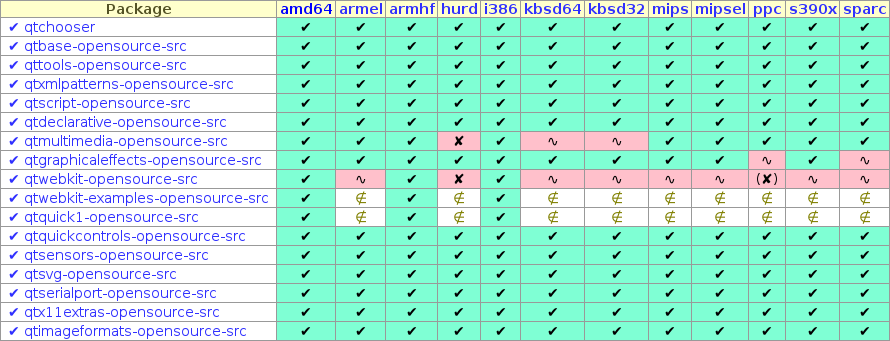
Some time ago I blogged about the 5.2.0 status in Debian experimental. We currently have it in testing with a much better status:


And we also have 5.2.1 in experimental with an even better status:

Note: qttools is FTBFS in armhf just because of some symbols changes, it will be fixed on the next upload.
Don't be afraid of getting it from experimental! Take a look at this blog post to know how to compile with Qt 5 in Debian.

BonusI have also uploaded Qt Creator built against Qt 5 to experimental. I plan to push it to unstable with Qt 5.2.1.

5 March 2014

Steve Kemp: Replacing ugly things would save the world many hours

There are some tools that we use daily, whether we realize it or not, that are unduly ugly. Over time you learn to use them and you forget just how hard they are to learn, and you take it for granted. Today I had to guide somebody through using procmail, and I'd forgotten how annoying it is. In brief I use procmail in three ways, each of which I had to document: There are some projects that are too entrenched to ever be replaced ("make", I'm looking at you), but procmail? I reckon there's a chance a replacement would be useful, quickly. Then again, maybe I'm biased.

Next.

Previous.


