Search Results: "az"

25 April 2013

Julien Danjou: OpenStack Design Summit Havana, from a Ceilometer point of view

Last week was the OpenStack Design Summit in Portland, OR where we, developers, discussed and designed the new OpenStack release (Havana) coming up. The summit has been wonderful. It was my first OpenStack design summit -- even more as a PTL -- and bumping into various people I've never met so far and worked with online only was a real pleasure! <figure> <figcaption>Me and Nick ready to talk about Ceilometer new features.</figcaption> </figure> Nick Barcet from eNovance, our dear previous Ceilometer PTL, and myself, talked about Ceilometer and presented the work that bas been done for Grizzly, with some previews of what we'll like to see done for its Havana release. You can take a look at the slides if you're curious. Design sessions Ceilometer had his design sessions during the last days of the summit. We noted a lot of things and commented during the sessions in our Etherpads instances. The first session was a description of Ceilometer core architecture for interested people, and was a wonderful success considering that the room was packed. Our Doug Hellmann did a wonderful job introducing people to Ceilometer and answering question. <figure> <figcaption>Doug explaining Ceilometer architecture.</figcaption> </figure> The next session was about getting feedbacks from our users. We had a lot of surprise to discover wonderful real use-cases and deployments, like the CERN using Ceilometer and generating 2 GB of data per day! The following sessions ran on Thursday and were much more about new features discussion. A lot ot already existing blueprints were discussed and quickly validated during the first morning session. Then, Sandy Walsh introduced the architecture they use inside StackTach, so we can start thinking about getting things from it into Ceilometer. API improvements were discussed without surprises and with a good consensus on what needs to be done. The four following sessions that occupied a lot of the days were related to alarming. All were lead by Eoghan Glynn, from RedHat, who did an amazing job presenting the possible architectures with theirs pros and cons. Actually, all we had to do was to nod to his designs and acknowledge the plan on how to build this. That last two sessions were about discussing advanced models for billing where we got some interesting feedback from Daniel Dyer from HP, and then were a quick follow-up of the StackTach presentation from the morning session. Havana roadmap The list of blueprints targetting Havana is available and should be finished by next week. If you want to propose blueprints, you're free to do so and inform us about it so we can validate it. The same applies if you wish to implement one of them! API extension I do think the API version 2 is going to be heavily extended during this release cycle. We need more feature, like the group-by functionnality. Healthnmon In parallel of the design sessions, discussions took place in the unconference room with the Healthnmon developers to figure out a plan in order to merge some of their efforts into Ceilometer. They should provide a component to help Ceilometer supports more hypervisors than it currently does. Alarming Alarming is definitely going to be the next big project for Ceilometer. Today, Eoghan and I started building blueprints on alarming, centralized in a general blueprint. We know this is going to happen for real and very soon, thanks to the engagements of eNovance and RedHat who are commiting resources to this amazing project!

24 April 2013

Joachim Breitner: The carbondioxide footprint of Debian's Haskell packages

By now, Debian ships quite a lot of Haskell packages (~600). Because of GHC's ABI volatility, whenever we upload a new version of a library, we have to rebuild all libraries that depend on that. In particular, if we upload a new version of the compiler itself, we have to rebuild all Haskell library packages. So we have to rebuild stuff a lot. Luckily, Debian has a decent autobuilding setup so that I just need to tell it what to rebuild, and the rest happens automatically (including figuring out the actual order to build things).
I was curious how much we use the buildd system compared to other packages, and also how long the builders are busy building Haskell packages. All the data is in a postgresql database on buildd.debian.org, so with some python and javascript code, I can visualize this. The graphs show the number of all uploads by autobuilder on the amd64 architecture, with haskell uploads specially marked, and the second graph does the same for the build time. You can select time ranges and get aggregate statistics for that time span. During the last four days a complete rebuild was happening, due to the upload of GHC 7.6.3. During these 2 days and 18 hours building 537 packages took 48 hours of build time and produced 15kg of CO2. That is 94% of all uploads and 91% the total build time. The numbers are lower for the whole of last year: 52% of uploads, 31% of build time and 57kg of CO2. (The CO2 numbers are very rough estimates.)
Note that amd64 is a bit special, as most packages are uploaded on this architecture by the developers, so no automatic builds are happening. On other architectures have, every upload of a (arch:any) package is built, so the share of Haskell packages will be lower. Unfortunately, at the moment the database does not provide me with a table across all architectures (and I was too lazy to make it configurable yet).

22 April 2013

Dmitrijs Ledkovs: abi-compliance-checker & dh / cdbs integration

dh-autoreconf is an amazing addon for running autoreconf, I just love it.
abi-compliance-checker is an amazing tool for tracking API/ABI.
Wouldn't it be great to glue abi-compliance-checker into dh / cdbs packaging?!
abi-compliance-checker (1.98.8-1~exp1) experimental; urgency=low
.
* New upstream release
* Add dh_acc to generate and compare library dumps at build time,
together with addons for dh(7) and cdbs.
* Bump standards version, bump debhelper to 9, use 3.0 (quilt) format,
update Vcs-Svn field to canonical form, remove obsolete
DM-Upload-Allowed.
* Apply a patch to allow suffixes on a-c-c abi dumps.
Horay! So how does one use it?

  • build-depend on dh-acc
  • In your debian/rules
    • call dh_acc somewhere appropriate
    • dh $@ --with acc
    • include /usr/share/cdbs/1/rules/acc.mk
  • In your debian/libpackage-dev.acc
    • Write a abi-compliance-checker descriptor (no need to include version)
  • Build your package
  • Copy the generated /usr/lib/$(multiarch)/dh-acc/*.abi.tar.gz as ./debian/lib-package-dev.abi.tar.gz.ARCH
  • Now at each build ABI/API checks will be executed and compat reports will be generated
An example xml descriptor for libapt-pkg-dev is:
<?xml version="1.0" encoding="utf-8"?>
<descriptor>
<headers>
./build/include/apt-pkg/
</headers>
<libs>
./build/bin/
</libs>
<skip_types>
SubstVar
</skip_types>
</descriptor>
I wonder if things can be improved, for example:
  • For trivial packages, don't require .acc at all & simply point abi-compiance-checker at ./debian/tmp/
  • I think logs currently pollute the unpacked source package
  • Multiple "base" ABI need checking. E.g. given versions A, B, C one can introduce a new symbol in B and drop it in C. Both B & C are compatible with A, but C is not compatible with B, thus an API/ABI break got introduced into the distribution if all A,B,C were ever published in the archive.
  • Maybe run these as DEP-8 autopkgtests as well?
On a wider scope of things abi-compliance-checker allows to create "system" abi dumps & also check applications for ABI/API compliance. For example, one could scan deb packages to see if they are still compatible between major Debian Releases for some known install type (e.g. a default full Gnome Desktop), or we could scan proprietary packages to see if they are compatible (e.g. games delivered via Steam by Valve to multiple Ubuntu releases), and we can continuously monitor OS ABI to make sure we don't unknowingly break it with security and bugfix updates.

Please, play around with dh-acc and let me know what you think =)

20 April 2013

Paul Tagliamonte: Fixing the theme situation in Jessie

Hello, World, As many of you know, I fell into helping get the artwork for Wheezy into place. While I don t want to do this (in the long run), I feel the urge to get it into shape for Jessie. I d like to do a small request for methods to improve the theme packaging. I ve posted a suggestion, but I never really got happy with it. The problem is basically the deb makes no sense because making thee deb make sense would result in insanity ;) stuff like proper dependencies to allow the Plymouth theme to work can t be done, since it d require a dep on Plymouth, which means it requires all installs with desktop-base to have it installed. Thanks, lazyblog!

19 April 2013

Richard Hartmann: Release Critical Bug report for Week 16

Seems I was off by two weeks. Week 18, it is/should be. Yay. The UDD bugs interface currently knows about the following release critical bugs: How do we compare to the Squeeze release cycle?
Week Squeeze Wheezy Diff
43 284 (213+71) 468 (332+136) +184 (+119/+65)
44 261 (201+60) 408 (265+143) +147 (+64/+83)
45 261 (205+56) 425 (291+134) +164 (+86/+78)
46 271 (200+71) 401 (258+143) +130 (+58/+72)
47 283 (209+74) 366 (221+145) +83 (+12/+71)
48 256 (177+79) 378 (230+148) +122 (+53/+69)
49 256 (180+76) 360 (216+155) +104 (+36/+79)
50 204 (148+56) 339 (195+144) +135 (+47/+90)
51 178 (124+54) 323 (190+133) +145 (+66/+79)
52 115 (78+37) 289 (190+99) +174 (+112/+62)
1 93 (60+33) 287 (171+116) +194 (+111/+83)
2 82 (46+36) 271 (162+109) +189 (+116/+73)
3 25 (15+10) 249 (165+84) +224 (+150/+74)
4 14 (8+6) 244 (176+68) +230 (+168/+62)
5 2 (0+2) 224 (132+92) +222 (+132/+90)
6 release! 212 (129+83) +212 (+129/+83)
7 release+1 194 (128+66) +194 (+128/+66)
8 release+2 206 (144+62) +206 (+144/+62)
9 release+3 174 (105+69) +174 (+105/+69)
10 release+4 120 (72+48) +120 (+72/+48)
11 release+5 115 (74+41) +115 (+74/+41)
12 release+6 93 (47+46) +93 (+47/+46)
13 release+7 50 (24+26) +50 (+24/+26)
14 release+8 51 (32+19) +51 (+32/+19)
15 release+9 39 (32+7) +39 (+32/+7)
16 release+10 20 (12+8) +20 (+12/+8)
17 release+11
18 release+12
Graphical overview of bug stats thanks to azhag:

Rog rio Brito: Some recent Debian activities

I have been occasionally working on some Debian-related tasks. Chrony One of those was to get chrony is a slightly better shape, by using, at least, a patch system (indeed, I "modernized" its packaging with the format "3.0 (quilt)"), put it in a git repository and would like to receive some comments on what I have so far. The bug Debian bug #694690 contains a very brief description of my intentions and of the problems that I see in the current package. IMVHO, it is a very nice NTP client and server and it could even be used as the default for Debian, once it gets in shape. There is at least another high-profile distribution, namely Fedora, that switched to chrony as its default NTP software. We can certainly take a look at what they are doing and join forces here. MongoDB Another package where I spent some time was with mongodb: MongoDB is a tricky package that is only built for 2 arches: amd64 and i386. The version in unstable for i386 was 2.0.x (roughly the same as for wheezy), which the version in unstable for amd64 was 2.4.1, which has many features that 2.0 lacks. The packaging of it is a bit tricky, since the source tree has bazillion embedded/convenience libraries (e.g., Google's v8, Mozilla's spidermonkey, BOOST, Google's Snappy, PCRE 3 etc.). Up to version 2.4.1-2, it used all these convenience copies, which is of course, a problem for a distribution like Debian. I changed part of the build process to use the libraries that we already have in Debian and, as Antonin Kral uploaded this newer version, unsurprisingly the binary packages are smaller (especially if you take into account that a handful of the libraries may already be installed on the system). A few hours later, Antonin uploaded a new upstream version, which means that we now have better MongoDB packages to play with. I am, in fact, really playing with MongoDB as my first NoSQL database, since 10gen is giving an introductory course on how it works and my motivation was to get what we have in Debian in shape for the course. You can say that I am a firm believer of the "eat your own dogfood" principle. Regarding MongoDB only being built for i386 and amd64, the BTS has a patch to enable building for kFreeBSD, but the patch is for the 2.0 series and the code has changed so drastically in relation to the 2.4 series that there is no hope of it applying. It would be super nice to have MongoDB working on kFreeBSD and on HURD also, though. nocache There is a very nice command line program called nocache that was packaged by Dmitry Smirnov (and just approved by the FTP masters!) whose packaging I briefly reviewed per Dmitry's request and this is an amazing utility whose purpose is to bypass/minimize file system caching for a program. This is especially useful when you are making backups (reading lots of files that would, otherwise, fill the filesystem cache, even if they are not used frequently) or if you are just streaming one file (possibly larger than the system's RAM) to another computer and you have no need to use the file immediately after that. It performs its job by using the LD_PRELOAD mechanism and using posix_fadvise's flag POSIX_FADV_DONTNEED for the files that will be touched. Post note Oh, just one aside: for the readers of Debian Planet and other aggregation services which are not Debian Developers/Maintainers, I contributed to these packages without being the maintainer of them, just scratching some itches and contributing back what I produced.

Gunnar Wolf: Ten years already!

(actually, please set your calendars to the day before yesterday I had a mental tab on this, but it seems watching mental tabs is a low-priority task for brain.sched) Ten years ago today, I got that long awaited mail telling me I had passed all of the needed hurdles and was accepted as a Debian Developer. We were at the first third of a very long release cycle, and the general spirit of the project was clearly younger both as in "things moved easier" and "we were much more immature" Try to follow the mailing list discussions we had back then, and even with all the vitriol that's every now and then spilled on debian-whatever@lists.debian.org, it's clear we have more experience working together. And yes, the main change that ten years bring to a group of people is social. I was at DebConf in Oslo when the now-historic presentation that prompted the birth of the Debian-Women group was given Surely, Debian (and Free Software) still is by far predominantly male and white But I fel it's no longer a hostile group, much to the contrary. Over the years, I was first active (as was the norm by then) as a "solo" maintainer. When Joachim Breitner started the pkg-perl group in 2004, I joined, and was part of the group while an important part of my work was based in Perl. I joined pkg-ruby-extras, and slowly migrated my technical work from one to the other. For several years, I also maintained the Cherokee webserver. I started getting involved in DebConf organization in 2005, and (except for 2008, as I took a vacation from many topics due to personal issues). Back in 2009, I became an official delegate! I joined Jonathan McDowell handling keyring maintenance. One year later, another delegation: With Moray Allan and Holger Levsen, the three of us became the DebConf chairs. This last couple of months, I have been quite inactive in most of my Debian work. I took up teaching at the univerity, and have been devoting what amounts to basically a full time job to prepare material. I expect (hope!) this craze to reach back a "workable" level by late May, when the course finishes, and I can retake some of my usual Debian tasks. Anyway 10 years. Wow. This project is one of the longest commitments in my life. I am still very happy I joined, it still thrills me to say I am part fo this great project, it still makes me proud to be accepted as a peer by so many highly skilled and intelligent people But, as I have repeatedly stated, I see Debian more as a social project (with a technological product) than as a technical one. And as such, I am really happy to have made so many good, close friends in this project, to have the opportunity to work and exchange points of view about anything, and have this large, highly disfunctional but very closely regarded family of friends. So, guys, see you this August in Switzerland. I will be among the group celebrating we have been there for half of the project's history!

Gunnar Wolf: Of European descent

A colleague of mine at Facultad de Ingenier a pointed me to a note published in the Faculty's gazette about a short cycle of talks we had on April 4th, trying to get life and interest back in the once-active LIDSOL (Laboratorio de Investigaci n y Desarrollo en Software Libre, Free Software Research and Development Laboratory), which nowadays lies mostly dormant. Good thing the official communication channels got notice of this! Only I am not sure if they can properly produce Spanish (as this feels more like an English redaction). Quoting only the first lines of the paragraph that referes to me:
La ltima conferencia fue presentada por Gunnar Wolf, que aunque su nombre nos hiciera pensar en una nacionalidad europea, l es nacido en tierras mexicanas pero con descendencias h ngaras, austriacas y polacas.
Which translates to:
The last talk was presented by Gunnar Wolf, that although he has a name that makes us think about an European nationality, he was born in Mexican soil, but with Hungarian, Austriac and Polish descent.
As far as I can tell (and I am almost sure I know all of the story At least on that regard), I have no descent yet. Not Hungarian, Austriac, Polish, nor of any nationality. (nitpickers: Yes, similar words are often used. In Spanish, it would be correct to say de ascendencia h ngara, austriaca y polaca, and in my attempt towards English translation, it would be of Hungarian, Austriac and Polish descent).

18 April 2013

Hideki Yamane: Grand Unification Debian study Meeting 2013 (Japan)

We Debian JP folks are please to announce Debian event named "Grand Unification Debian study Meeting 2013" will be held in Japan, 29th June (oh, don't ask/blame me for its name, it was decided by others, not me... ;-)

And we're in CfP and negotiating with potential sponsors now, and some companies and media have already ACKed as below.


  • WindowsAzure (Platinum sponsor, yes "Microsoft supports Debian event" :-)
  • Plathome (Gold sponsor, they're also DebConf13 sponsor!)
  • TOP STUDIO (Gold sponsor, thanks to Kenshi Muto :)
  • Serverworks (Gold sponsor, AWS vendor)
If you're in Japan or near here at that time, please come and enjoy this event (and please comment if you have any question).

17 April 2013

John Goerzen: Amazement

One of the benefits of working from home is that I have a great view of Kansas from my desk. While I work, I have seen sunrises, snowfall, birds, rain, ice, and all sorts of wildlife. I heard this verse of Home on the Range the other day, which reminded me of this:
How often at night when the heavens are bright
With the light from the glittering stars
Have I stood here amazed and asked as I gazed
If their glory exceeds that of ours.
One time, I asked Jacob if I should wake him up at night to see the stars. He said an excited yes! So when it was dark outside, I woke him up, carried him outside, and held him while he looked up. He said a long, breathy Wooooow! Then he went back to bed, curled up with his butterfly, and fell asleep smiling. Every so often, we repeat this little routine. There are many opportunities in life to just stand somewhere and be amazed. You don t have to be in Kansas. Children know this. The rest of us just have to notice.

Joey Hess: Template Haskell on impossible architectures

Imagine you had an excellent successful Kickstarter campaign, and during it a lot of people asked for an Android port to be made of the software. Which is written in Haskell. No problem, you'd think -- the user interface can be written as a local webapp, which will be nicely platform agnostic and so make it easy to port. Also, it's easy to promise a lot of stuff during a Kickstarter campaign. Keeps the graph going up. What could go wrong? So, rather later you realize there is no Haskell compiler for Android. At all. But surely there will be eventually. And so you go off and build the webapp. Since Yesod seems to be the pinnacle of type-safe Haskell web frameworks, you use it. Hmm, there's this Template Haskell stuff that it uses a lot, but it only makes compiles a little slow, and the result is cool, so why not. Then, about half-way through the project, it seems time to get around to this Android port. And, amazingly, a Haskell compiler for Android has appeared in the meantime. Like the Haskell community has your back. (Which they generally seem to.) It's early days and rough, lots of libraries need to be hacked to work, but it only takes around 2 weeks to get a port of your program that basically works. But, no webapp. Cause nobody seems to know how to make a cross-compiling Haskell compiler do Template Haskell. (Even building a fully native compiler on Android doesn't do the trick. Perhaps you missed something though.) At this point you can give up and write a separate Android UI (perhaps using these new Android JNI bindings for Haskell that have also appeared in the meantime). Or you can procrastinate for a while, and mull it over; consider rewriting the webapp to not use Yesod but some other framework that doesn't need Template Haskell. Eventually you might think this: If I run ghc -ddump-splices when I'm building my Yesod code, I can see all the thousands of lines of delicious machine generated Haskell code. I just have to paste that in, in place of the Template Haskell that generated it, and I'll get a program I can build on Android! What could go wrong? And you even try it, and yeah, it seems to work. For small amounts of code that you paste in and carefully modify and get working. Not a whole big, constantly improving webapp where every single line of html gets converted to types and lambdas that are somehow screamingly fast. So then, let's automate this pasting. And so the EvilSplicer is born! That's a fairly general-purpose Template Haskell splicer. First do a native build with -ddump-splices output redirected to a log file. Run the EvilSplicer to fix up the code. Then run an Android cross-compile. But oh, the caveats. There are so many ways this can go wrong.. Anyway, if you struggle with it, or pay me vast quantities of money, your program will, eventually, link. And that's all I can promise for now.
PS, I hope nobody will ever find this blog post useful in their work. PPS, Also, if you let this put you off Haskell in any way .. well, don't. You just might want to wait a year or so before doing Haskell on Android.

16 April 2013

Aigars Mahinovs: na 6 internets

na ir slavena ne tikai ar savu akmens m ri valsts zieme os, bat ar ar Di o nas Ugunsm ri apk rt visam s valsts Internetam, kas blo visu p c k rtas un iebremzina visu p r jo. Man pirm person g saskarsme ar o pakalpojumu notika jau anhajas lidost , kad tri vien izr d j s, ka valst blo ts ir ne tikai Facebook, bet ar Twitter, kas iev rojami apgr tin ja manas iesp jas tri un viegli apzi ot visus, ka es esmu v l joproj m esmu dz vs un vesels. P c p ris eksperimentiem izr d j s, ka, lai ar no telefona nav pieejama Google+ m jas lapa un nav lejupl d jama Google+ (un WhatsApp) programma uz Android, tom r, ja t s jau ir telefon , ie abi servisi turpina no telefona str d t. T p c es s ku rakst t ce ojuma piez mes Google+ un da as dienas p c ce ojuma s kuma man pat izdev s nokonfigur t If This Then That servisu, lai tas pa em manus Google+ ierakstus un uztaisa no tiem Twitter ierakstus (kas jau t l k pa citiem kan liem izplat s uz Facebook un Draugiem un ar par d s k ned as kopsavilkums aj blog ). Google+ ir savi plusi, bet ar savi m nusi. Galvenais m nuss, ko es aj ce ojum paman ju ir tas, ka Google+ Android aplik cij nav iesp jams sagatavot vair kus ierakstu melnrakstus (v lams katru ar savu geolok ciju) bez Interneta var rakst t tikai vienu ierakstu un t ieraksta GPS koordin tes b s t s kur viet p c tam Internets par d sies. Es jau uzrakst ju Googlei par o probl mu. Galvenais pluss Google plusam (no pun intended) ir Instant Upload ja bild t fotogr fijas ar Android telefonu, s fotogr fijas autom tiski tiks aug upiel d tas un par d sies jaun ieraksta izveides interfeis , kur t s var pievienot ierakstam ar vienu klik i bez jebk das gaid anas. Diem l tas nestr d ar norm laj m kamer m. Pagaid m ;) Ta u es neb tu sts datori is, ja es nepam in tu uzlaust vai apiet o nelielo nas probl mu, ne? ;) Visvienk r akais veids k apiet nas Lielo Ugunsm ru ir izmantot jebk du VPN, kas at auj ne tikai piek t VPN t kla resursiem, bet ar at auj laist visu trafiku caur o VPN savienojumu. dus VPN piesl gumus var nopirkt, vai (ja ir Linux serveris vai routeris rpus nas) izveidot pa am. Man gad jum tas bija ar vienu klik i iesl gts OpenVPN uz Fonera routera, kas st v man s m j s. Diem l na ir sav da. Blo to lapu, portu un protokolu saraksts main s gan da dos rajonos, gan ar atkar b no t vai Internets ir mob lais vai wifi vai ar piesl gumu, gan ar vienk r i no dienas dien . Liel da gad jumu blo to lietu sarakst iekr t ar VPN savienojumi. Bie i vien ar priv tie. Man kaut k ne iet, ka mana m jas IP adrese ir nas ugunsm ra sarakstos, ta u da reiz ar tam VPN pievienoties es nevar ju. Un t d s situ cij s, lai apskat tu k du YouTube video, atliek tikai viens, eni ls risin jums sshuttle! is eni lais r ks izveido ko l dz gu VPN savienojumam caur parasto SSH portu un protokolu. Uz lok l s ma nas ir nepiecie ams Python un root ties bas, bet uz servera ir vajadz gas tikai ties bas palaist Python programmas. sshuttle pats aizs ta sevi uz serveri un palai s tur, pat ie ifr un p rs ta visus savienojumus un ar DNS piepras jumus, ja vi am to paprasa. Var p rs t t konkr tus t klus vai visu trafiku. Un trums man pieredz tas ir bija pat tr ks par parasto VPN. Kopum Interneta blok de un t visp r gais l nums ir viens oti spec gs m nuss nai. Aizskrienot mazliet uz priek u st st jum pateik u, ka Hong Kong das probl mas nav tur Internets ir lielisks! L k t ds t zeris san ca :)

Stefano Zacchiroli: bits from the DPL for March-April 2013

Dear Project Members,
   "Now that I have your attention, I would like to make the following
delegations:"

... nah, scrap that. In my last day in office I first of all owe you a report of DPL activities for the last reporting period of this term, i.e. March 8th until today. Here it is! Highlights Talks Over the past month or so I've attended and spoken on behalf of Debian in the following occasions: Assets I've approved the budget for the following forthcoming sprints: Also, we've bought a 3-year warranty pack for the disk array that powers ftp-master.d.o (~900 USD). On the income side, Brian Gupta has started an interesting matching fund experiment, in order to raise funds for the forthcoming DebConf13. The matching fund will be open until April 30th, so your help in spreading news would be welcome. Many thanks to Brian for the idea and to his company, Brandorr Group, for funding it. DPL helpers Three more DPL helpers IRC meetings have been held; minutes are available at the usual place. Legal Spring Cleaning I've finally cleaned up the pile of pending legal matters (but I'm sure new ones will show up for the delight of the next DPL :-P) Once again, I'd like to thank SFLC for the pro bono and very high quality legal advice they keep on offering to Debian. Miscellaneous
Now, before I get sentimental, let me thank Gergely, Lucas, and Moray for running in the recently concluded DPL election. Only thinking of running and then go through a campaign denote a very high commitment to the Project; we should all be thankful to them. Then I'd like to congratulate Lucas for his election. I've known him for a long time, and I can testify about his clear vision of the role Debian has to play in Free Software and on what Debian needs to improve to do so. Best wishes for the term ahead, Lucas! Finally, I'd like to thank you all for the support you've shown me over the past 3 years. Serving as DPL is a great honor, but also a very demanding job. Thank to you all, and to how cool Debian is, it has been for me an incredibly rewarding experience. I had no idea what I were doing when I embarked on this adventure, but in hindsight I don't regret any of it. See you around, as I don't plan to be anywhere far away from Debian anytime soon. Cheers.
PS the day-to-day activity logs for March and April 2013 are available at the usual place master:/srv/leader/news/bits-from-the-DPL.txt.20130 3,4

Michal &#268;iha&#345;: phpMyAdmin translations status

phpMyAdmin 4.0-rc2 is out and if your want to have your language in final release, it's last moment to start working on translation. So let's look at which translations are at 100% right now (new ones are bold): Almost complete: As you can see, there is still lot of languages missing, this might be your opportunity to contribute to phpMyAdmin. Also you are welcome to translate phpMyAdmin 4.0 using translation server. If your language is already fully translated and you want to help as well, you can translate our documentation as well.

Filed under: English Phpmyadmin 0 comments Flattr this!

14 April 2013

Richard Hartmann: Release Critical Bug report for Week 15

This week: Monday 47, Tuesday 47, Wednesday 41, Thursday 39, Friday 37 Addendum: the bug count was at 37 around Friday noon and that's what I am tracking with the short stats above. The UDD bugs interface currently knows about the following release critical bugs: How do we compare to the Squeeze release cycle?
Week Squeeze Wheezy Diff
43 284 (213+71) 468 (332+136) +184 (+119/+65)
44 261 (201+60) 408 (265+143) +147 (+64/+83)
45 261 (205+56) 425 (291+134) +164 (+86/+78)
46 271 (200+71) 401 (258+143) +130 (+58/+72)
47 283 (209+74) 366 (221+145) +83 (+12/+71)
48 256 (177+79) 378 (230+148) +122 (+53/+69)
49 256 (180+76) 360 (216+155) +104 (+36/+79)
50 204 (148+56) 339 (195+144) +135 (+47/+90)
51 178 (124+54) 323 (190+133) +145 (+66/+79)
52 115 (78+37) 289 (190+99) +174 (+112/+62)
1 93 (60+33) 287 (171+116) +194 (+111/+83)
2 82 (46+36) 271 (162+109) +189 (+116/+73)
3 25 (15+10) 249 (165+84) +224 (+150/+74)
4 14 (8+6) 244 (176+68) +230 (+168/+62)
5 2 (0+2) 224 (132+92) +222 (+132/+90)
6 release! 212 (129+83) +212 (+129/+83)
7 release+1 194 (128+66) +194 (+128/+66)
8 release+2 206 (144+62) +206 (+144/+62)
9 release+3 174 (105+69) +174 (+105/+69)
10 release+4 120 (72+48) +120 (+72/+48)
11 release+5 115 (74+41) +115 (+74/+41)
12 release+6 93 (47+46) +93 (+47/+46)
13 release+7 50 (24+26) +50 (+24/+26)
14 release+8 51 (32+19) +51 (+32/+19)
15 release+9 39 (32+7) +39 (+32/+7)
16 release+10
17 release+11
18 release+12
Graphical overview of bug stats thanks to azhag:

11 April 2013

Russ Allbery: Review: Familiar

Review: Familiar, by J. Robert Lennon
Publisher: Greywolf
Copyright: 2012
ISBN: 1-55597-535-6
Format: Hardcover
Pages: 205
This is the first book of an experiment. I'm fairly well-read in science fiction and fantasy and increasingly well-read in non-fiction of interest (although there's always far more of that than I'll get to in a lifetime), but woefully unfamiliar with what's called "mainstream" literature. Under the principal that things people are excited about are probably exciting, I've wanted to read more and understand the appeal. Powell's, which I like to support anyway, has a very nice (albeit somewhat expensive) book club called Indiespensable, which sends its subscribers very nice editions of new works that Powell's thinks are interesting, with a special focus on independent publishers. So I signed up and hope to stick with it for at least a year. (The trick will be fitting these books in amongst my regular reading.) Familiar is the first feature selection I received. Elisa Brown is a mother with a dead son and a living one, a failing marriage, an affair, and a life that is, in short, falling apart. Then, while driving back from her annual pilgrimage from her son's grave, the world seems to twist and change. She finds herself dressed for business, wearing a nametag and apparently coming back from a work-related convention, driving a car that's entirely unfamiliar to her. When she gets home, everything else has changed too: her marriage seems to be on firmer ground, but based on rules she doesn't understand. She has a different job, different clothes, a different body in some subtle ways. And both of her sons are alive. I'm going to have to have a long argument with myself about where to (meaninglessly) categorize this on my review site, since in construction it is an alternate reality story and therefore a standard SF trope. Any SF reader is going to immediately assume Elisa has somehow been transported into an alternate reality with a key divergence point from her own. But that's not Lennon's focus. He stays ambiguous on the question of whether this is really happening or whether Elisa had some sort of nervous breakdown, and while some amount of investigation of the situation does take place, it's the sort of investigation that an average person with no access to special resources or scientific knowledge and a completely unbelievable story would be able to do: Internet conspiracy chatrooms and some rather dodgy characters. The focus is instead on Elisa's reaction to the situation, her choices about how to treat this new life, and on how she processes her complex emotions about her family and herself. I had profoundly mixed feelings about this book when I finished it, and revisiting it to review it, I still do. The writing is excellent: spare, evocative, and enjoyable to read. Lennon has a knack for subjective description of emotion and physical experience. The reader feels Elisa's deep discomfort with her changed body and her changed car, her swings between closed-off emotions and sudden emotional connection with a specific situation, and her struggle with the baffling question of how to come to terms with a whole new life. The part of the book from about the middle to nearly the end is excellent. Video games make an appearance and are handled surprisingly well. And when Elisa starts being blunt with people, I found myself both liking her and caring about what happens to her. On the other hand, Familiar also has some serious problems, and one of the biggest is the reaction I feared I'd have to mainstream literature: until Elisa started opening up and taking action, I found it extremely difficult to care about anyone in this book. They're all so profoundly petty, so closed off and engrossed in what seem like depressing and utterly boring lives. I'm sure that some of this is intentional and is there to lay the groundwork for Elisa's own self-discovery, but even towards the end of that self-discovery, everything here is so relentlessly middle-class suburbia that I felt stifled just reading about it. I think it's telling that no one in this book ever seems to have any substantial problem with money, or even with work. Elisa walks into a job that she's never done before and within a few weeks is doing it so well that she can take large amounts of time to wander around for plot purposes. This is a book about highly privileged people being miserable in a bubble. While those people certainly do exist, and I can believe that they act like this, I'm not sure how much I want to read about them. Thankfully, the plot does lead Elisa to poke some holes in that bubble, if never get out of it entirely. This is also another one of those stories in which every character has massive communication problems. Now, this deserves some caveats: Elisa's communication problems with her husband are part of the problem that starts the book and are clearly intentional, as are her communication difficulties with her children. And she's not really close enough to anyone to confide in them. But even with those caveats, no one in this book really talks to anyone else. It's amazing that anyone forms any connections at all, given how many walls and barriers they have around themselves. As someone with a bit of a thing for communication, this drove me nuts to read about, particularly in the first half of the book. But the worst problem is that Lennon completely blows the ending. And by that I don't just mean that I disliked the ending. I mean the ending is so unbelievable and so contrary to the entire rest of the book, at least the way I was reading and understanding it, that I think Familiar is a much better novel if you just remove the final scene entirely. It was such a bizarre and unnecessary twist that I found it infuriating. I don't want to spoil an ending, even a bad ending, so I'll only say this: it felt to me like Lennon just wasn't comfortable with his setting and plot driver and couldn't leave it alone. I think an experienced SF author wouldn't have made this mistake. There were two obvious possible conclusions to draw from the setting, plus a few interesting combinations, and I think someone comfortable with this sort of alternate reality story would have taken one of those options, any of which would have been a reasonable dismount for the plot. Alternately, they could have left it entirely ambiguous to the end and explored why the explanation may not actually matter. But Lennon seemed to me to have a tin ear for plausibility and for the normal flow of this sort of story and seems to have taken it as license for arbitrary events, thus completely violating the internal consistency and emergent rules that he'd spent the rest of the book building. I've mostly talked about my reactions to the characters and the writing and have not said much about the plot. That's somewhat intentional, since figuring out where the story will go is one of the best parts of this book. It's surprisingly tense and well-crafted for not having that much inherent dramatic tension. The excellent writing kept me reading through the first part, when I hated everyone in the story, and then Elisa started taking responsibility for her own life and actions and I started really enjoying the book while being constantly surprised. I think it's the sort of story that's best to take without too much foreknowledge of where it's going. I'm going to call this first experiment a qualfied success. Familiar was certainly interesting to read, and quite different from what I normally read despite the SF premise. If it weren't for the ending, I'd be recommending it to other people. Rating: 6 out of 10

9 April 2013

Bits from Debian: Call for participants in Debian for the Google Summer of Code

The Google Summer of Code is a program that allows post-secondary students aged 18 and older to earn a stipend writing code for Free and Open Source Software projects during the summer. For the eighth time, Debian has just been accepted as a mentoring organization for this year's program. If you're an eligible student, now is the time to take a look at our project ideas list, engage with the mentors for the projects you find interesting, and start working on your application!
Please read the FAQ and the Program Timeline on Google's website. If you are interested, we encourage you to come and chat with us on irc (#debian-soc on irc.oftc.net), or to send an email to the SoC coordination mailing-list. Most of the GSoC related information in Debian can be found on our wiki pages, but feel free to ask us directly on irc or via email. We're looking forward to work with amazing students again this summer!

Russ Allbery: Review: Judge Sn Goes Golfing

Review: Judge Sn Goes Golfing, by John Scalzi
Artist: Gahan Wilson
Publisher: Subterranean
Copyright: 2009
Printing: 2012
ISBN: 1-59606-479-X
Format: Kindle
Pages: 32
As you may have guessed, this is yet another short story by Scalzi that was rolled into the Subterranean Scalzi Super Bundle. This one is a bit longer than the ones I've previously reviewed, and is also illustrationed. Unlike some of the others, it's not available on-line for free... as a written work at least. There's an abridged audio version available for free from Subterranean Press's web site, though. Like the other stories I've reviewed so far, it's humor, but I think it's a bit more successful and substantial than the previous short stories. Judge Bufan Nigun Sn is an extremely foul-tempered alien judge who loves to golf, despite being terrible at it. He's a sort of circuit court judge for a larger galactic civilization, of which Earth is now part. (There's a smattering of background world-building, but it's not the core of the story.) Golf is his passion, in several senses of the word: his habit of getting into nasty fights with his fellow players and otherwise making public and occasionally injurious scenes has gotten him banned from every course in the Washington DC area, both public and private. Except, that is, for Dulles Woods, a dire, badly-maintained course designed via nepotism and theft whose business model is primarily based on letting the people banned from every other course golf there. And charging them extra to let caddies accompany them. The plot of this story is about a particular game of golf, dramatically foreshadowed by the opening sentence. But the story is really about Judge Sn's relationship to golfing and to the notorious Dulles Woods. It's one of the better jobs I've seen of writing a thoroughly unlikable person into a gloriously foul-tempered charm. It's also a story about a golf course and golfer who thoroughly deserve each other, and about how it feels to suddenly have something go right after grinding out hours and hours of work on a hobby that is supposed to be fun but manages to fall into some horribly compelling middle ground between enjoyment and rage-inducing frustration. Speaking as someone who is known to grind out video game completions while swearing at the television, I can sympathize. I got thoroughly hooked by Scalzi's descriptions of Judge Sn's mental state and enjoyed this story far more than I expected to. Sadly, when the plot does finally arrive, I thought it was a letdown. Scalzi throws in a highly improbable coincidence to create action, and while that's a legitimate plot technique (particularly in humor), it works best when the author goes back afterwards and fills in the back story of the coincidence. Pratchett does this extremely well. Scalzi, alas, doesn't really bother, and while suspension of disbelief isn't as relevant for this sort of story, I thought it was a missed opportunity. The ending seemed to be missing some sort of punch or background twist. That said, I really liked the character study and I think the story is well worth the 99 cents it's still selling for on the Kindle (and quite possibly other platforms; I haven't checked). If buying short stories on the Kindle is something you want to do, I recommend this one to your attention. Rating: 7 out of 10

8 April 2013

Matthias Klumpp: Tanglu status report

Hello everyone! I am very excited to report about the awesome progress we made with Tanglu, the new Debian-based Linux-Distribution. :) First of all, some off-topic info: I don t feel comfortable with posting too much Tanglu stuff to Planet-KDE, as this is often not KDE-related. So, in future Planet-KDE won t get Tanglu information, unless it is KDE-related ;-) You might want to take a look at Planet-Tanglu for (much) more information. So, what happened during the last weeks? Because I haven t had lectures, I nearly worked full-time on Tanglu, setting up most of the infrastructure we need. (this will change with the next week, where I have lectures again, and I also have work to do on other projects, not just Tanglu ^^) Also, we already have an awesome community of translators, designers and developers. Thanks to them, the Tanglu-Website is now translated to 6 languages, more are in the pipeline and will be merged later. Also, a new website based on the Django framework is in progress. The Logo-Contest We ve run a logo-contest, to find a new and official Tanglu logo, as the previous logo draft was too close to the Debian logo (I asked the trademark people at Debian). More than 30 valid votes (you had to be subscribed to a Tanglu Mailinglist) were received for 7 logo proposals, and we now have a final logo: Tanglu Logo (Text) I like it very much :) Fun with dak I decided to use dak, the Debian Archive Kit, to handle the Tanglu archive. Choosing dak over smaller and easy-to-use solutions had multiple reasons, the main reason is that dak is way more flexible than the smaller solution (like reprepro or min-dak) and able to handle the large archive of Tanglu. Also, dak is lightning fast. And I would have been involved with dak sooner or later anyway, because I will implement the DEP-11 extension to the Debian Archive later (making the archive application-friendly). duckWorking with dak is not exactly fun. The documentation is not that awesome, and dak contains many hardcoded stuff for Debian, e.g. it often expects the unstable suite to be present. Also, running dak on Debian Wheezy turned out to be a problem, as the Python module apt_pkg changed the API and dak naturally had problems with that. But with the great help of some Debian ftpmasters (many thanks to that!), dak is now working for Tanglu, managing the whole archive. There are still some quirks which need to be fixed, but the archive is in an usable state, accepting and integrating packages. The work on dak is also great for Debian: I resolved many issues with non-Debian dak installations, and made many parts of dak Wheezy-proof. Also, I added a few functions which might also be useful for Debian itself. All patches have of course been submitted to upstream-dak. ;-) Wanna-build and buildds GearThis is also nearly finished :) Wanna-build, the software which manages all buildds for an archive, is a bit complicated to use. I still have some issues with it, but it does it s job so far. (need to talk to the Debian wanna-build admins for help, e.g. wanna-build seems to be unable to handle arch:all-only packages, also, build logs are only submitted in parts) The status of Tanglu builds can be viewed at the provisoric Buildd-Status pages. Setting up a working buildd is also a tricky thing, it involves patching sbuild to escape bug #696841 and applying various workarounds to make the buildd work and upload packages correctly. I will write instructions how to set-up and maintain a buildd soon. At time, we have only one i386 buildd up and running, but more servers (in numbers: 3) are prepared and need to be turned into buildds. After working on Wanna-build and dak, I fully understand why Canonical developed Launchpad and it s Soyuz module for Ubuntu. But I think we might be able to achieve something similar, using just the tools Debian already uses (maybe a little less confortable than LP, but setting up an own LP instance would have been much more trouble). Debian archive import The import of packages from the Debian archive has finished. Importing the archive resulted in many issues and some odd findings (I didn t know that there are packages in the archive which didn t receive an upload since 2004!), but it has finally finished, and the archive is in a consistent state at time. To have a continuous package import from Debian while a distribution is in development, we need some changes to wanna-build, which will hopefully be possible. Online package search The Online-Package-Search is (after resolving many issues, who expected that? :P ) up and running. You can search for any package there. Some issues are remaining, e.g. the file-contents-listing doesn t work, and changelog support is broken, but the basic functionality is there. Tanglu Bugtracker We now also have a bugtracker which is based on the Trac software. The Tanglu-Bugtracker is automatically synced with the Tanglu archive, meaning that you find all packages in Trac to report bugs against them. The dak will automatically update new packages every day. Trac still needs a few confort-adjustments, e.g. submitting replies via email or tracking package versions. Tanglu base system tanglu-platform-smallThe Tanglu metapackages have been published in a first alpha version. We will support GNOME-3 and KDE4, as long as this is possible (= enough people working on the packaging). The Tanglu packages will also depend on systemd, which we will need in GNOME anyway, and which also allows some great new features in KDE. Side-effect of using systemd is at least for the start that Tanglu boots a bit slow, because we haven t done any systemd adjustments, and because systemd is very old. We will have to wait for the systemd and udev maintainers to merge the packages and release a new version first, before this will improve. (I don t want to do this downstream in Tanglu, because I don t know the plans for that at Debian (I only know the information Tollef Fog Heen & Co. provided at FOSDEM)) The community The community really surprised me! We got an incredible amount of great feedback on Tanglu, and most of the people liked the idea of Tanglu. I think we are one of the less-flamed new distributions ever started ;-) . Also, without the very active community, kickstarting Tanglu would not have been possible. My guess was that we might be able to have something running next year. Now, with the community help, I see a chance for a release in October :) The only thing people complained about was the name of the distribution. And to be really honest, I am not too happy with the name. But finding a name was an incredibe difficult process (finding something all parties liked), and Tanglu was a good compromise. Tanglu has absolutely no meaning, it was taken because it sounded interesting. The name was created by combining the Brazilian Tangerine (Clementine) and the German Iglu (igloo). I also dont think the name matters that much, and I am more interested in the system itself than the name of it. Also, companies produce a lot of incredibly weird names, Tanglu is relatively harmless compared to that ;-) . In general, thanks to everyone participating in Tanglu! You are driving the project forward! The first (planned) release I hereby announce the name of the first Tanglu release, 1.1 Aequorea Victoria . It is Daniel s fault that Tanglu releases will be named after jellyfishes, you can ask him why if you want ;-) I picked Aequorea, because this kind of jellyfish was particularly important for research in molecular biology. The GFP protein, a green fluorescent protein (=GFP), caused a small revolution in science and resulted in a Nobel Prize in 2008 for the researchers involved in GFP research (for the interested people: You can tag proteins with GFP and determine their position using light microscopy. GFP also made many other fancy new lab methods possible). Because Tanglu itself is more or less experimental at time, I found the connection to research just right for the very first release. We don t have a time yet when this version will be officially released, but I expect it to be in October, if the development speed increases a little and more developers get interested and work on it. Project Policy We will need to formalize the Tanglu project policy soon, both the technical and the social policies. In general, regarding free software and technical aspects, we strictly adhere to the Dbian Free Software Guidelines, the Debian Social Contract and the Debian Policy. Some extra stuff will be written later, please be patient! Tanglu OIN membership I was approached by the Open Invention Network, to join it as member. In general, I don t have objections to do that, because it will benefit Tanglu. However, the OIN has a very tolerant public stance on software patents, which I don t like that much. Debian did not join the OIN for this reason. For Tanglu, I think we could still join the OIN without someone thinking that we support the stance on software patents. Joining would simply be pragmatic: We support the OIN as a way to protect the Linux ecosystem from software patents, even if we don t like the stance on software patents and see it differently. Because this affects the whole Tanglu project, I don t want to decide this alone, but get some feedback from the Tanglu community before making a decision. Can I install Tanglu now? Yes and no. We don t provide installation images yet, so trying Tanglu is a difficult task (you need to install Debian and then upgrade it to Tanglu) if you want to experiment with it, I recomment trying Tanglu in a VM. I want to help! Great, then please catch one of us on IRC or subscribe to the mailinglists. The best thing is not to ask for work, but suggest something you want to do, others will then tell you if that is possible and maybe help with the task. Packages can for now only be uploaded by Debian Developers, Ubuntu Developers or Debian Maintainers who contacted me directly and whose keys have been verified. This will be changed later, but at the current state of the Tanglu archive (= less safety checks for packages), I only want people to upload stuff who definitely have the knowledge to create sane packages (you can also proove that otherwise, of course). We will later establish a new-member process. If you want to provide a Tanglu archive mirror, we would be very happy, so that the main server doesn t have to carry all the load. If you have experience in creating Linux Live-CDs or have worked with the Ubiquity installer, helping with these parts would be awesome! Unfortunately, we cannot reuse parts of Linux Mint Debian, because many of their packages don t build from source and are repackaged binaries, which is a no-go for the Tanglu main archive. Sneak peek And here is a screenshot of the very first Tanglu installation (currently more Debian than Tanglu):



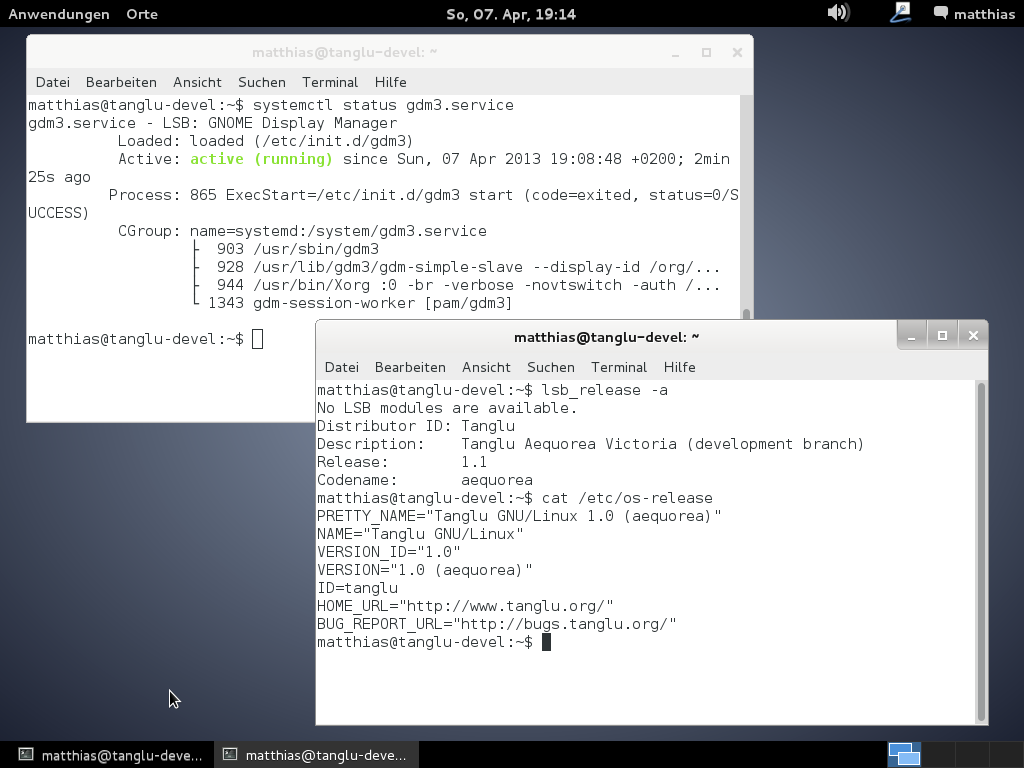
tanglu_sneak-peek_screenshot Something else I am involved in Debian for a very long time now, first as Debian Maintainer and then as Debian Developer and I never thought much about the work the Debian system administrators do. I didn t know how dak worked or how Wanna-build handles the buildds and what exactly the ftpmasters have to do. By not knowing, I mean I knew the very basic theory and what these people do. But this is something different than experiencing how much work setting up and maintaining the infrastructure is and what an awesome job the people do for Debian, keeping it all up and running and secure! Kudos for that, to all people maintaining Debian infrastructure! You rock! (And I will never ever complain about slow buildds or packages which stay in NEW for too long ;-) )

5 April 2013

Richard Hartmann: Release Critical Bug report for Week 14

Over the week, around noon CEST, we had: The UDD bugs interface currently knows about the following release critical bugs: How do we compare to the Squeeze release cycle?
Week Squeeze Wheezy Diff
43 284 (213+71) 468 (332+136) +184 (+119/+65)
44 261 (201+60) 408 (265+143) +147 (+64/+83)
45 261 (205+56) 425 (291+134) +164 (+86/+78)
46 271 (200+71) 401 (258+143) +130 (+58/+72)
47 283 (209+74) 366 (221+145) +83 (+12/+71)
48 256 (177+79) 378 (230+148) +122 (+53/+69)
49 256 (180+76) 360 (216+155) +104 (+36/+79)
50 204 (148+56) 339 (195+144) +135 (+47/+90)
51 178 (124+54) 323 (190+133) +145 (+66/+79)
52 115 (78+37) 289 (190+99) +174 (+112/+62)
1 93 (60+33) 287 (171+116) +194 (+111/+83)
2 82 (46+36) 271 (162+109) +189 (+116/+73)
3 25 (15+10) 249 (165+84) +224 (+150/+74)
4 14 (8+6) 244 (176+68) +230 (+168/+62)
5 2 (0+2) 224 (132+92) +222 (+132/+90)
6 release! 212 (129+83) +212 (+129/+83)
7 release+1 194 (128+66) +194 (+128/+66)
8 release+2 206 (144+62) +206 (+144/+62)
9 release+3 174 (105+69) +174 (+105/+69)
10 release+4 120 (72+48) +120 (+72/+48)
11 release+5 115 (74+41) +115 (+74/+41)
12 release+6 93 (47+46) +93 (+47/+46)
13 release+7 50 (24+26) +50 (+24/+26)
14 release+8 51 (32+19) +51 (+32/+19)
15 release+9
16 release+10
17 release+11
18 release+12
Graphical overview of bug stats thanks to azhag:

Next.

Previous.