Search Results: "agi"

4 March 2016

Antonio Terceiro: Debian Ruby Sprint 2016 - day 4: Steady Progress, Deferred Spring Cleaning, and Capital Sins

As the day 4 of the Debian Ruby team sprint in Curitiba unfolded, we have now fixed a total of more than 70 build failure bugs, managed to almost finish the Ruby 2.3 transition to be good to migrate into testing, and bootstrapped some documentation that will help new contributors get up to speed with Ruby packaging faster. We have also requested the removal of several packages that are either severely outdated, abandoned upstream, beyond repair, utterly wrong, or in some cases, all of the above. The full list of work items finished yesterday is: We also managed to flirt with 2 capital sins. For those who care about these things, which I don t (but I still care about you), I guess 2 out of 7 still means we are good? :-) I few people that I will not name complained that they hadn t had enough steak on the previous night, so we set out to visit a traditional all-you-can-eat Brazilian steakhouse ( churrascaria ). I made a reservation at Jardins Grill and there you have gluttony. I am pretty sure that not enough steak wasn t an issue last night. You can see how happy, despite being full to almost the point of being sick, everyone was. A disjunct set of people, who I will also not name, were very disappointed to find out that the ruby-tinder package has absolutely nothing to do with Tinder but were still very active on the later. Maybe Friday night we will have to split the group into a lust-free family party and a Tinder party.

Mike Gabriel: My FLOSS activities in February 2016

February 2016 has been a very active month regarding me contributing to the FLOSS world. Honouring my Sponsors I am happy to share that this month's FLOSS work has been sponsored by various sponsors. Thanks to all people and companies sponsoring my work on FLOSS projects. This month's MATE uploads to Debian With regards to the Beta 1 Freeze date of Ubuntu 16.04 LTS (18th Feb 2016), Martin Wimpress, Vangelis Mouhtsis and I performed quite some work on Debian MATE. Uploads to Debian unstable: The Debian MATE Packaging Team also took over maintenance of the GTK-2+ legacy package libwnck [13]. The first upload introducing some major changes and package clean-ups caused a slight wave [14] because of a missing dependency in libwnck-dev (that fell victim to some clean-ups in debian/control). Those issues have been addressed immediately and have now been settled. The main reason for working on a legacy package like libwnck was the need for having gir1.2-wnck-1.0 (back) in Debian. The new MATE dock applet requires the libwnck GIR package to be present at runtime. One of the novelties in Ubuntu MATE 16.04 LTS will be the option to adapt the look and feel of the MATE desktop to how a Unity-based desktop looks like. Martin Wimpress is giving intense work to providing a dock applet and topmenu support as one alternative among the various Ubuntu MATE desktop experiences provided. The alternative desktop layouts can be configured with the MATE Tweak tool. Work on RDP related packages Work on FreeRDP 1.1 as currently in Debian I finally managed to give some priority (and thus time) to fixing various issues in the freerdp package in Debian [15]. Many people had provided patches and solutions to open issues and I tried to honour as many of those, as possible. Please note that I had to disable the GStreamer support in FreeRDP for the recent uploads, as the currently used Git snapshot of FreeRDP only supports GStreamer 0.10's API whereas the security team is in the process of having gstreamer0.10-* packages removed from the Debian stretch/unstable archives. Work on FreeRDP 2.0, coming to Debian soon Furthermore, Bernhard Miklautz is currently working on a freerdp2 package, which will bring the latest Git snapshot of FreeRDP upstream into Debian (and also re-introduce GStreamer support, based on GStreamer 1.0). Bernhard invested a lot of time on pushing the current HEAD of FreeRDP upstream [16] towards a FreeRDP 2.x version. Starting with FreeRDP 2.x it will be possible to install different FreeRDP versions on one system without file naming conflicts. For March 2016, I have doing the final freerdp2 reviewing on my todo list (possibly together with H ctor Or n Mart nez who is highly interested in the RDP backend support in Wayland/Weston), so that we can provide first uploads to Debian experimental sometime the coming month. The packaging progress is continuously discussed on the #freerdp channel on Freenode and can also be viewed on Github [17]. Review of revised XRDP package Recently, Dominik George from Teckids e.V. [18] contacted me about reviewing their effort of updating the Debian package xrdp, which currently is in ITA state [19]. Feedback has been provided and I am waiting for a ping from his side so that I can take some (ideally) final looks at the package and sponsor the upload. Work on Debian Edu related packages This month, I spent a couple of hours of work on several Debian Edu related tasks, some of them induced by problems at local school sites we support. Work on Debian LTS My 8h-portion of work for the Debian LTS Project, I performed at the very end of February. With the Debian squeeze LTS EOL date on 29th February, I saw to finalizing my personal open todos regarding Debian squeeze LTS, which basically was getting two CVE issues fixed in the lxc package [26]. The rest of the work hours has been spent on helping out the Security Team of Debian with open CVE issues in Debian wheezy packages: The gosa .debdiff has been approved by a member of the Security Team, the upload will happen today. With my LTS frontdesk hat on (during week 9 / 2016) I also spent some time providing help regarding SVN checkout problems and raised a couple of questions on how to coordinate the work phase between the Debian squeeze LTS EOL and the official launch of the Debian wheezy LTS project phase [27]. Work on nx-libs At the end of February, I finally managed to propose a way of dropping the libNX_Xrender.so bundled library from the nx-libs code base. I filed a PR [28] against nx-libs that proposes its removal and provides a patch for using X.Org's libXrender.so version. As a preview for nx-libs work in March 2016... I have started with removing the complete libNX_X11.so library from nx-libs and using X.Org's X11 client library. This will introduce a code removal of around 160.000 lines of code to nx-libs. More to come on this later... light+love,
Mike [1] http://ubuntu-mate.org/
[2] https://www.freexian.com/
[3] http://www.qindel.com/ [4] (caja)
https://lists.debian.org/debian-devel-changes/2016/02/msg00468.html
https://lists.debian.org/debian-devel-changes/2016/02/msg02080.html
https://lists.debian.org/debian-devel-changes/2016/02/msg02086.html
https://lists.debian.org/debian-devel-changes/2016/02/msg02183.html [5] (mate-menu)
https://lists.debian.org/debian-devel-changes/2016/02/msg00469.html [6] (mate-panel)
https://lists.debian.org/debian-devel-changes/2016/02/msg01900.html [7] (mate-dock-applet)
https://lists.debian.org/debian-devel-changes/2016/02/msg01935.html
https://lists.debian.org/debian-devel-changes/2016/02/msg02481.html
https://lists.debian.org/debian-devel-changes/2016/02/msg03097.html [8] (mate-polkit)
https://lists.debian.org/debian-devel-changes/2016/02/msg01936.html
https://lists.debian.org/debian-devel-changes/2016/02/msg02395.html [9] (eom)
https://lists.debian.org/debian-devel-changes/2016/02/msg02073.html [10] (pluma)
https://lists.debian.org/debian-devel-changes/2016/02/msg02128.html [11] (topmenu-gtk)
https://lists.debian.org/debian-devel-changes/2016/02/msg02399.html
https://lists.debian.org/debian-devel-changes/2016/02/msg02501.html [12] (mate-tweak)
https://lists.debian.org/debian-devel-changes/2016/02/msg03086.html [13] (libwnck)
https://lists.debian.org/debian-devel-changes/2016/02/msg01248.html
https://lists.debian.org/debian-devel-changes/2016/02/msg01404.html
https://lists.debian.org/debian-devel-changes/2016/02/msg01825.html [14] https://bugs.debian.org/cgi-bin/bugreport.cgi?bug=814585
https://bugs.debian.org/cgi-bin/bugreport.cgi?bug=814588
https://bugs.debian.org/cgi-bin/bugreport.cgi?bug=814697 [15] (freerdp)
https://lists.debian.org/debian-devel-changes/2016/02/msg02487.html
https://lists.debian.org/debian-devel-changes/2016/02/msg02630.html [16] https://github.com/FreeRDP/FreeRDP
[17] https://github.com/bmiklautz/debian-freerdp2 [18] https://www.teckids.org/ [19] https://bugs.debian.org/cgi-bin/bugreport.cgi?bug=719624 [20] (gosa)
https://lists.debian.org/debian-devel-changes/2016/02/msg01554.html
https://lists.debian.org/debian-devel-changes/2016/02/msg01954.html [21] https://sunweavers.net/blog/node/34 [22] (ldap2zone)
https://lists.debian.org/debian-devel-changes/2016/02/msg01966.html
https://lists.debian.org/debian-devel-changes/2016/02/msg01967.html [23] (shutdown-at-night)
https://lists.debian.org/debian-devel-changes/2016/02/msg03605.html [24] (italc)
https://lists.debian.org/debian-devel-changes/2016/02/msg01944.html [25] https://bugs.debian.org/cgi-bin/bugreport.cgi?bug=815948 [26] (lxc, Debian squeeze LTS)
https://lists.debian.org/debian-lts-changes/2016/02/msg00037.html [27] https://lists.debian.org/debian-lts/2016/02/msg00155.html
(The thread continues in March 2016) [28] https://github.com/ArcticaProject/nx-libs/pull/93

3 March 2016

Arturo Borrero Gonz lez: Current status of iptables & nftables in Debian


I would like to give an overview of what is the current status of iptables & nftables in Debian.
Some information contained in this article is not new, this post is about what happened to iptables & nftables in the last 3 months, focusing on the integration with Debian.
versionsBy the time of this article, upstream versions are:
Debian testing (stretch) contains updated versions of all of them:
  • iptables 1.6.0-2
  • nftables 0.5+snapshot20151106-1
  • libnftnl 1.0.5+snapshot20151106-1
The snapshot versioning thing in nftables and libnftnl is the result of packaging a few commits ahead of last upstream release to workaround some nasty bugs.
the iptables-compat stuff
The iptables 1.6.0 release contains a new set of tools called 'compat'. These tools uses the same syntax of iptables,ip6tables,arptables,ebtables but internally read/write data to the nf_tables kernel subsystem.
You can find these compat tools in a binary pacakge: 'iptables-nftables-compat'.

That is one of the approaches available to help admins migrate from iptables to nftables.

Other approach is textual translations. In this case, the admin calls the translation utility using iptables syntax to get the same rule written in native nft syntax.
However, this approach is a work in progress and Debian lacks of this functionality right now . I hope next upstream release of iptables will include some of this.
iptables maintenance
In Debian bug #805018, I contacted former maintainer Laurence J. Lane about the 1.6.0 upstream release and the need to pay attention to such a big release.
Unfortunately, it seems Laurence got his key expired, and he can no longer maintain any package until a new key is in place. Hope we can see him back soon.

So, I took over the maintenance of iptables, with the help of Ana Guerrero, which has been reviewing my work and sponsoring the uploads. Thanks Ana!

As part of this new maintenance, I cleaned up a bit the iptables bug tracker. I closed some very old bugs (see for example #295567 and #118187) which are no longer useful.
ready for stable?
With the stretch freeze coming by the end of 2016, I want to be sure that the main Netfilter packages are in shape for a Debian stable release.
I won't let packages migrate to stable if there is no extensive testing. It should be clear that packages are ready for Debian stable for me to let them go stable.

My concerns regarding nftables & iptables in stable are different actually:
  • iptables: piece of software too widespread. I don't want to break any system with the 1.6.0 migration.
  • nftables: the 0.5 release is old already with regards to the upstream development.
So please, let me know any feedback you may have :-)

Tianon Gravi: Docker on VULTR + IPv6

I ve been using VULTR for a little while now and have been generally very pleased (especially with the very recent facelift the management portal received). I don t want to waste too much time talking about it, but the killer feature for me (over some of their competitors like DigitalOcean) is that I can provide a raw ISO and provision my VM directly using it as I would any local VM (which also means that once my VM is up and working, I get to use the OS s standard kernel, which is especially important for using Debian Unstable well). Anyhow, already too much about that let s get to the cool stuff. Getting right down to the beef, let s assume I ve got a VULTR instance already created, my OS is already installed and working, I ve enabled IPv6 within VULTR, ensured that my VM is able to ping6 google.com (to verify at least basic routability), and have Docker version 1.10.2 installed. For the sake of demonstration, we ll assume that VULTR has assigned my IPv6 as follows: (available under the VM details via Settings > IPv6) (The astute reader may recognize RFC3849 here. ) The relevant documentation which helped me get to the working state outlined below is in the IPv6 with Docker section. The first step I took was creating a systemd drop-in file so that I could modify the daemon startup parameters (to include --ipv6 and --fixed-cidr-v6):
# /etc/systemd/system/docker.service.d/ipv6.conf
[Service]
ExecStart=
ExecStart=/usr/bin/docker daemon -H fd:// --ipv6 --fixed-cidr-v6 2001:db8::/80
I chose to use just /80 for Docker any other reasonable prefix (assuming it is routed to your host / host network) should also work; the documentation I linked above has an example using a /125, for example. With this half in place, I can systemctl daemon-reload and systemctl restart docker.service, and when I start a container it will be automatically assigned an IPv6 address from within that prefix. Excellent. An important caveat to note is that this will break discovery on our host due to Docker enabling forwarding for us, so (assuming your internet-facing interface is named ens3 for the sake of illustration; it might just as easily be eth0, eth1, enps3, lan0, wlan0, etc) I had to sysctl net.ipv6.conf.ens3.accept_ra=2, and I added it to /etc/sysctl.d/docker-ipv6.conf for good measure (so that I don t lose it after I reboot). The second half of our IPv6 to containers problem is routing. The nitty-gritty details of this are discussed in the Using NDP proxying section of the documentation, but the gist is that my containers have IPv6 addresses, but the outside world doesn t have a route that leads to them, and that we need to tell the kernel to respond to solicitations for our container s IPv6 addresses appropriately. The kernel has a mechanism for doing so (via ip -6 neigh ...), but it is limited to individual addresses and is thus not especially great for having a solution that works magically without further manual labor per-container. This is where ndppd (also packaged for Debian as ndppd) came in.
# /etc/ndppd.conf
proxy ens3  
	rule 2001:db8::/80  
	 
 
After getting this configuration in place and restarting ndppd (systemctl restart ndppd), magic happened. My containers could ping6 google.com, and my other IPv6 hosts could ping6 the IPv6 addresses of my individual containers! You ve probably noted that this configuration isn t exactly secure, since it means that each of my individual containers has a publicly routable IPv6 address, but for this specific use case, I m OK with that! Update (2015-03-09): thanks to for correcting my systemd drop-in file usage!

Ben Hutchings: Debian LTS work, February 2016

February marked the end of Debian 6.0 "squeeze" LTS, though there was some initial confusion (partly my fault) over which day of month it should end. I carried over 10 hours from January and was assigned another 11.25 hours of work by Freexian's Debian LTS initiative. I worked a total of 14 hours. I started the month with "the final" update to the linux-2.6 kernel package (DLA-412-1), fixing 5 CVEs and incorporating upstream stable update 2.6.32.70. After it was agreed that support would continue to the end of the month, I made one more update on the last day (DLA-439-1), fixing 4 CVEs, a regression, and some issues I had found lacking CVEs (one is now CVE-2012-6701). I helped to edit the end-of-life announcement for Squeeze LTS. I spent a fairly quiet week in the front desk, triaging new issues for squeeze. As I've volunteered to handle embargoed issues, I prepared security updates to libssh and libssh2 and issued them minutes after the public disclosure of the similarly disastrous CVE-2016-0739 and CVE-2016-0787 issues.

29 February 2016

Chris Lamb: Free software activities in February 2016

Here is my monthly update covering a large part of what I have been doing in the free software world (previously):
Debian
  • Updated travis.debian.net a hosted script to easily test and build Debian packages on the Travis CI continuous integration platform to support:
    • Automatic bumping of the version number in debian/changelog based on TRAVIS_BUILD_NUMBER. (#14)
    • Security repositories. Thanks to Stefan Jenkner for the initial pull request. These are additionally now enabled by default. (#15)
    • The backports repositories. (#13)
  • Applied #812830 and #812830 from James Clark to the Debian Archive Kit to improve the interface of various webpages it generates.
  • Updated the SSL certificate for try.diffoscope.org, a hosted version of the diffoscope in-depth and content-aware diff utility. Thanks to Bytemark for sponsoring the hardware.
  • Worked on my slides for Reproducible Builds - fulfilling the original promise of free software, to be presented at FOSSASIA '16.
My work in the Reproducible Builds project was also covered in more depth in Lunar's weekly reports (#40, #41, #42, #43)
LTS

This month I have been paid to work 18 hours on Debian Long Term Support (LTS). In that time I did the following:
  • "Frontdesk" duty for the week of 22nd 28th, triaging CVEs, etc.
  • Proofread announcements, etc. for the upcoming migration to wheezy-lts.
  • Issued DLA 417-1 for xdelta3 to fix a buffer overflow that allowed arbitrary code execution from input files.
  • Issued DLA 420-1 for libmatroska, correcting a heap information leak.
  • Issued DLA 428-1 for websvn fixing a cross-site scripting vulnerability.
  • Issued DLA 429-1 for pixman fixing a buffer overflow issue.
  • Issued DLA 430-1 & DLA 431-1 for libfcgi and libfcgi-perl respectfully, fixing a remote denial-of-service (DoS) vulnerability.

Uploads
  • redis (2:3.0.7-2) Correcting my SOURCE_DATE_EPOCH reproducibility patch as the conditional was accidentally inverted. Thanks to Reiner Herrmann (deki).
  • disque (1.0~rc1-5) Making the parallel SOURCE_DATE_EPOCH patch change and additionally tidying the packaging after introducing procps as a build-dependency.


RC bugs


I also filed 137 FTBFS bugs against aac-tactics, angular.js, astyle, bcftools, blacs-mpi, bogofilter, boxes, caldav-tester, ccdproc, ckeditor, coq-float, cqrlog, dasher, django-recurrence, dspdfviewer, eclipse-egit, ess, etcd, felix-latin, fio, flexml, funny-manpages, gap-atlasrep, garmin-plugin, gitlab, gnome-mines, graphicsmagick, haskell-nettle, healpy, hg-git, hunspell, hwloc, ijs, ipset, janest-core-extended, jpathwatch, kcompletion, kcompletion, keyrings.alt, kodi-pvr-hts, kodi-pvr-vdr-vnsi, libcommons-compress-java, libgnome2-wnck-perl, libkate, liblrdf, libm4ri, libnet-server-mail-perl, libsis-jhdf5-java, libspectre, libteam, libwnck, libwnckmm, libxkbcommon, lombok, lombok-patcher, mako, maven-dependency-analyzer, mopidy-mpris, mricron, multcomp, netty-3.9, numexpr, ocaml-textutils, openimageio, openttd-openmsx, osmcoastline, osmium-tool, php-guzzle, php-net-smartirc, plexus-component-metadata, polari, profitbricks-client, pyentropy, pynn, pyorbital, pypuppetdb, python-aioeventlet, python-certifi, python-hglib, python-kdcproxy, python-matplotlib-venn, python-mne, python-mpop, python-multipletau, python-pbh5tools, python-positional, python-pydot-ng, python-pysam, python-snuggs, python-tasklib, r-cran-arm, r-cran-httpuv, r-cran-tm, rjava, ros-geometry-experimental, ros-image-common, ros-pluginlib, ros-ros-comm, rows, rr, ruby-albino, ruby-awesome-print, ruby-default-value-for, ruby-fast-gettext, ruby-github-linguist, ruby-gruff, ruby-hipchat, ruby-omniauth-crowd, ruby-packetfu, ruby-termios, ruby-thinking-sphinx, ruby-tinder, ruby-versionomy, ruby-zentest, sbsigntool, scikit-learn, scolasync, sdl-image1.2, signon-ui, sisu-guice, sofa-framework, spykeutils, ssreflect, sunpy, tomcat-maven-plugin, topmenu-gtk, trocla, trocla, tzdata, verbiste, wcsaxes, whitedune, wikidiff2, wmaker, xmlbeans, xserver-xorg-input-aiptek & zeroc-icee-java.

FTP Team

As a Debian FTP assistant I ACCEPTed 107 packages: androguard, android-platform-dalvik, android-platform-development, android-platform-frameworks-base, android-platform-frameworks-native, android-platform-libnativehelper, android-platform-system-core, android-platform-system-extras, android-platform-tools-base, android-sdk-meta, apktool, armci-mpi, assertj-core, bart, bind9, caja, caldav-tester, clamav, class.js, diamond, diffoscope, django-webpack-loader, djangocms-admin-style, dnsvi, esptool, fuel-astute, gcc-6-cross, gcc-6-cross-ports, gdal, giella-core, gnupg, golang-github-go-ini-ini, golang-github-tarm-serial, gplaycli, gradle-jflex-plugin, haskell-mountpoints, haskell-simple, hurd, iceweasel, insubstantial, intellij-annotations, jetty9, juce, keyrings.alt, leptonlib, libclamunrar, libdate-pregnancy-perl, libgpg-error, libhtml5parser-java, libica, libvoikko, linux, llvm-toolchain-3.8, lombok-patcher, mate-dock-applet, mate-polkit, mono-reference-assemblies, mxt-app, node-abab, node-array-equal, node-array-flatten, node-array-unique, node-bufferjs, node-cors, node-deep-extend, node-original, node-setimmediate, node-simplesmtp, node-uglify-save-license, node-unpipe, oar, openjdk-8, openjdk-9, pg8000, phantomjs, php-defaults, php-random-compat, php-symfony-polyfill, pnetcdf, postgresql-debversion, pulseaudio-dlna, pyconfigure, pyomo, pysatellites, python-fuelclient, python-m3u8, python-pbh5tools, python-qtpy, python-shellescape, python-tunigo, pyutilib, qhull, r-cran-rjsonio, r-cran-tm, reapr, ruby-fog-dynect, scummvm-tools, symfony, talloc, tesseract, twextpy, unattended-upgrades, uwsgi, vim-command-t, win-iconv, xkcdpass & xserver-xorg-video-ast. I additionally REJECTed 4 packages.

Antonio Terceiro: Debian Ruby Sprint 2016 - day 1

This year s Debian Ruby team sprint started today here at Curitiba. Everyone arrived fine, and we started working at the meeting room we have booked for the week at Curitiba campus of the Federal Technical University of Paran . The room is at the Department of Business and Community Relations , what makes a lot of sense! :-) The day started with a quick setup, with a simple 8-port switch, and a couple of power strips. It tooks us a few minutes to figure what was blocked or not on the corporate network, and almost everyone who needs connections that are usually blocked in such environments already had their VPN setups so we were able to get started right after that. We are taking notes live on mozilla s piblic etherpad site Today we accomplished quite a lot:

24 February 2016

Michal Čihař: Introducing motranslator

Since several years ago we've been using php-gettext in phpMyAdmin, but it's about time to change it. The change will not be that big, we're just moving to own fork of that library :-). You probably ask why to fork? You will probably guess it easily, but to name some reasons: So I've taken existing php-gettext codebase and turned that into motranslator and now 0.1 release of it is out. The recommended way to install it is from Packagist and it has no additional dependencies. What changes you can expect? First of all it supports all current PHP versions. It also performs way better - in my tests loading of mo file is 4-5 times faster and memory consumption went down about 10 percent. You can additionally use object API instead of traditional function based. On the other side some features we don't need were removed - there is no support for using native Gettext, it doesn't do any encoding conversion (assuming that UTF-8 is on both sides these days) and it doesn't support delayed loading of messages. The last change means that it's not suitable for applications with huge MO files. Any feedback is welcome, the code is still fresh and probably needs some polishing.

Filed under: English phpMyAdmin 0 comments

Norbert Preining: Switching from iOS to Android

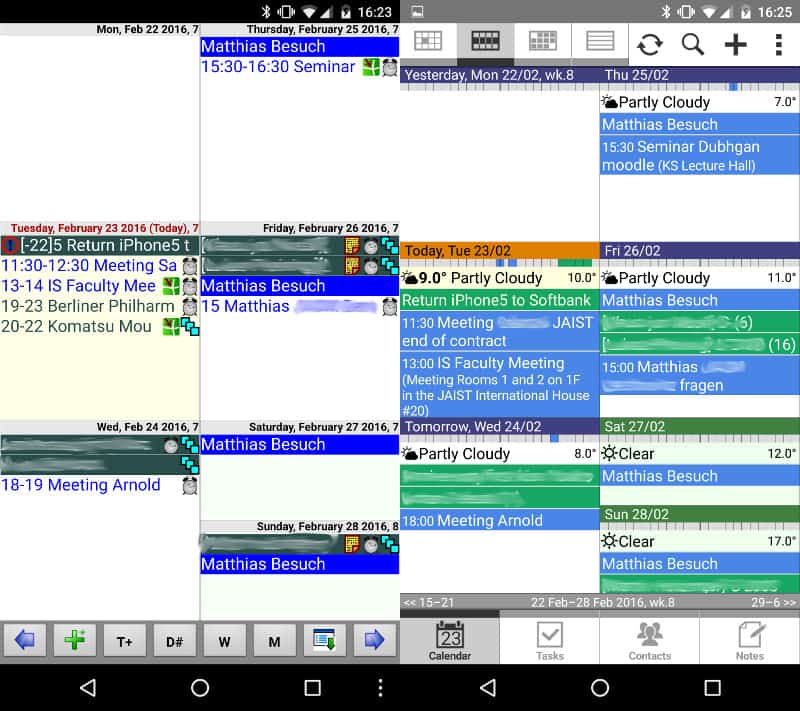
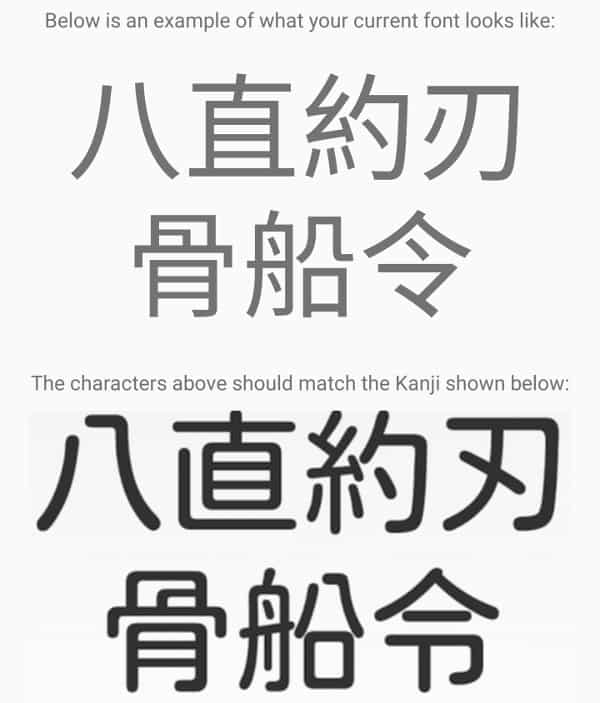
This article starts a series of blogs on my ventures into Android land after having used iOS devices for 6 years. I have never been a strong believer in the Apple ecosystem, and my trials to convince myself to MacBooks and MacPros always ended with installing Linux on them, so I guess I wasn t really the ideal target for iOS. Thus, my iOS devices were also permanently in jailbroken state, otherwise I would feel amputated. But as much as I disliked the lock-in and closed environment of the iOS world, it was from the user perspective surprisingly well done and smooth. So it was with a certain level of tension when I finally switched to Linux^WAndroid. android-ios If you don t want to read on, here the preliminary conclusion: Why didn t I do it earlier! But before we go into details, let me start with my background: History of my devices Originally I was a big opponent of smart phones and preferred the Unix-way, one device for one thing. So I had a normal phone and (various) Palm devices (Tungsten X, Tungsten C, and above all my beloved Handera TRGpro). I loved the Palm world and considered it superior to the then smart phone world, until I came to Japan, where the challenge of a proper input method for Japanese and proper Japanese support posed a big hurdle. The Palm devices had a stick and written input fields, but Japanese input was practically impossible and a huge pain. Searching for a word in Japanese was more hurdle then looking it up in a printed dictionary. In addition, I needed a phone in Japan, so I plunged into the smart phone world and got myself a iPhone (3g). What a world did open for me: easy typing of Japanese, dictionaries, on-the-fly translation, woooow! And above all, I discovered my most beloved and till now one of my most important programs: Flashcards Deluxe. Thanks, and I have to say to 80% thanks to this program my Japanese learning speed has accelerated considerably. There is nothing more important for me than getting drilled in a systematic way. But I derail, anyway, having Flashcard Deluxe on the iPhone within rather short time I had about 10000 or more flashcards created, and moving on to a different architecture (Android) was for quite some time practically impossible without loosing years of statistics and learning, so I renewed my contract after 2 years together with a iPhone 4s. Another two years passed, and these years brought an Android version of Flashcards Deluxe, as well as Dropbox syncing, so I had no excuse anymore to remain in iOS land, wouldn t it be for an iPhone 5s that was passed to me near the end of my forth year, so I again extended the contract for two years. Finally, after 6 years of iPhone devices, this January I finally decided it is time to switch to Android. After lots of thinking, comparing, and requesting advice from good friends with more experience in the smart phone market I went for a Google Nexus 6p. Google Nexus 6p I will not repeat the specs of this phone as they are widely available on the net. My original plan was a Samsung S6, but after consultation with an expert I decided for an original Google phone for better security support. That left me with the option between a Nexus 5x and 6p, and due to prize differences (prizes of mobiles are ridiculously strange in Japan) I went for the 6p instead of the 5x. One point that made the decision for this slight too big device easy was the fact that it uses a great AMOLED display. Moving the data Since I was using Google Calendar and Google Contacts already on the iPhone, moving to the Android phone was far less a hassle than I thought. My contacts and events showed up without a hiccup. Most of the usual apps are nowadays available on both iOS and Android, so the most difficult thing was remembering all the passwords to log into the applications again (SNS like G+, FB, Twitter etc). The same is more or less true for messengers of all kinds (Line, WhatsApp, Threema, etc), but here one is advised to check with the respective web site first to make sure one does not loose all of the important data. Line for example is a stupid ***** that deletes all previous chats on the old phone and does not make them available on the new one. WhatsApp can be converted with a special conversion program. Threema, too allows for transfer of ids. Move of applications After that came the hunt for replacement applications for those that are not available as is on Android: Mail At first like probably everyone I used the shipped GMail program. It might be good for Google Mail accounts, but for anything else it is just a real pain. Thus, I have searched a bit and finally settled (for now) for K-9 Mail: it is open source, open development, feature rich, and more a hackers type email program, perfectly suited to me. There is a commercial variant called K@-Mail that says that it improves the user interface and some usability items as well as features, but I didn t see much of an advantage over the original version (which is completely free) and in fact some of my accounts didn t work at all. So I remain with K9 Mail and I think this is a good decision. Calendar Managing Calendars is one of the most important task for me. I have been a fervent supporter of DateBk4, DateBk 5, and DateBk 6 on the original Palm series, and when I left the Palm World it was with great pain that I had to loose DateBk. Not only because it was a simply fantastic calendar program that allowed me to keep track of all my climbing routes, festivities, in a much more advanced way than any other Calendering application, but also because the programmer of the DateBk series is running the Dewar Wildlife Trust, a Gorilla rescue group and a lot of the money he makes from the app sales is going to rescue Gorillas. With the switch to iOS this option was gone, and I first used the built-in calendar application (which is so weak) and later and for long time Pocket Informant Pro. This is a very good program and probably the only one that can compete with DateBk with respect to functionality and usefulness. During the time of me being locked in in iOS I realized that the world has moved on and a new version of DateBk series for Java was developed, called Pimlical. First only available on Windows, it became later available also on Android and Linux, too. The following screen shot puts Pimlical on the left, and Pocket Informant on the right. I will write a more detailed comparison in future, in short: PInformant is more streamlined and polished, Pimlical has more configuration option. Practically everything can be adjusted to one s need, and in addition there is also a Desktop application that sync either with Google and the phone, or only with the phone if you want to live off the grid. pimlical-pinformant So nowadays on Android I have both Pocket Informant Pro as well as Pimlical, but after a short time I have now switched practically exclusively to Pimlical. Notes Here there is pain HUGE PAIN!!! iOS has an excellent applications for notes, called simply Notebooks. This little pearl was my work horse for everything (more or less) memorable. From poems and song texts to bus time tables, from PDF to GIFs, from MarkDown to HTML, everything could be saved into Notebooks, displayed, edited, ordered. And above all it had automatic background sync with Dropbox. So I could drop new files into the respective sub-folder of my Dropbox folder and could be sure I have the files available on my phone when I leave for a trip. And there is a huge bag of features that I haven t even tapped into! Android is unfortunately not on the list of supported architectures of Notebooks. So I searched far and wide, and without any success. There are all kind of notes, flash colors, overly simple, fast and slow, stylish and plain, but none of them did even provide half of the features of Notebooks. None, not even half. I still hope I might find the ultimate notes application, or even better would be an Android version of the original Notebooks application (but this is not high on the developers todo list), but for now I am in despair The Rest As I said, most apps are nowadays available on both platforms, so there is not much more to do than download the respective Android app and log in again. That worked very nice across practically all apps. Things I don t like (i.e., which are broken!) on Android Although a very convenient system and perfectly made to fit my taste, there are some things that are a huge pain (and a big shame on Google to not being able to fix that for long time!): Japanese fonts when the device is in English interface language In case you are a foreigner living in Japan and want your Android phone in English, but still read emails, news, etc in Japanese, then Android provides you with the worst, namely Chinese fonts: chinese-japanese-mix This is a well known problem and I have blogged about fixing the very same problem on Linux (Debian), and the solution is a simple reshuffling in the fontconfig configuration files. There is even an application for it in the Google store, Kanji Fix, but it needs a rooted device (which I haven t done till now my failure!). I can only hope that Google fixes this completely stupid problem in a future version. The Me problem Another of these beasty problems: The Android Contacts application has an entry for Me , which unfortunately, no idea why, cannot be linked with my normal me in the list of contacts. There are reports all over the Internet, strange suggestions, and no real solution. Again, a simple thing that should work but doesn t. Invisible Images folder in MTP mode A more annoying problem is that the camera folder under Photos does not show up when connecting the device in MTP mode to my computer, and as consequence me being unable to copy photos from the device to my computer. The solution I am using at the moment is moving the photos with a file manager to a new folder which is visible during MTP communcation, and copy the photos from there. But this, too, should be something trivial, but alas, despite a lot of posts on the internet I couldn t find a proper solution. Google Music As written somewhere else, Google Music has switched from 5 star system to up/down system, which is a huge pain and PITA. Things I do like (or I discovered) on Android There are some things I haven t been used/tried on iOS they might be possible which I really like: Yubikey Neo support I will write about this in a different blog, but nowadays I have my GPG keys on an hardware token (Yubikey Neo) and the application OpenKeychain on Android works nicely with both K9 Mail and via NFC with my Yubikey. That is a great tool! Bluetooth streaming Bluetooth on iOS devices was always a bit broken for me, so connecting my phone to my old car radio I needed radio transmitter that was connected to the cable port of the iPhone. With Android I use a Bluetooth Radio device (receives data via bluetooth, and sends music out via radio waves for a car stereo to receive them). Now if my monthly data limit wouldn t be that low  Debian on Android Yes, you can have a full Debian system running in your terminal on Android. There are several applications providing this feature, and I am rather surprised how smooth it works. Conclusion My preliminary conclusion is that the switch to Android at this time was perfectly timed, and from the technological side I should have done much earlier. In future blogs I will discuss particular instances of this transition in more details. If you have any suggestion for me, in particular for a good notes taking application, please let me know!
23 February 2016

Michal Čihař: Weekly phpMyAdmin contributions 2016-W07

As the flow of incoming bugs for upcoming 4.6.0 has slowed down a bit it was more time for code cleanups and related tasks. But it's also time where potential Google Summer of Code students come to our organization and want to get involved. On the cleanup side the biggest was change to remove embedded PHP libraries which are available on Packagist from our Git and use Composer to manage the dependencies. This change will happen in 4.7.0, so it's still some time ahead, but it's already in our master branch. There still some third party libraries which we use and can not be installed using Composer, so we keep these for now. Besides the usual bug fixing stuff, I've noticed that we lack issues which can be easily understood and fixed by potential Google Summer of Code. We require them to get involved before the program starts, so that we can see they are capable of useful contributions and also to see how they behave if asked for patch improvements. To fix this deficit we're prepared few small cleanup or refactoring tasks, where the students can show their skills. All handled issues:

Filed under: English phpMyAdmin 2 comments

21 February 2016

Lunar: Reproducible builds: week 43 in Stretch cycle

What happened in the reproducible builds effort between February 14th and February 20th 2016:

Toolchain fixes Yaroslav Halchenko uploaded cython/0.23.4+git4-g7eed8d8-1 which makes its output deterministic. Original patch by Chris Lamb. Didier Raboud uploaded pyppd/1.0.2-3 to experimental which now serialize PPD deterministically. Lunar submitted two patches for lcms to add a way for clients to set the creation date/time in profile headers and initialize all bytes when writing named colors.

Packages fixed The following packages have become reproducible due to changes in their build dependencies: dbconfig-common, dctrl-tools, dvdwizard, ekg2, expeyes, galternatives, gpodder, icewm, latex-mk, libiio, lives, navit, po4a, tasksel, tilda, vdr-plugin-infosatepg, xaos. The following packages became reproducible after getting fixed: Some uploads fixed some reproducibility issues, but not all of them: Unknown status:
  • tomcat7/7.0.68-1 by Emmanuel Bourg (test suite fails in test environment).
Patches submitted which have not made their way to the archive yet:
  • #814840 on tor by Petter Reinholdtsen: use the UTC timezone when calling asciidoc.
  • #815082 on arachne-pnr by Dhole: use the C locale to format the changelog date.
  • #815192 on manpages-de by Reiner Herrmann: tell grep to always treat the input as text so that it works with non-UTF-8 locales.
  • #815193 on razorqt by Reiner Herrmann: tell grep to always treat the input as text so that it works with non-UTF-8 locales.
  • #815250 on jacal by Reiner Herrmann: use the C locale to format the build date.
  • #815252 on colord by Lunar: remove extra timestamps when generating CMF and spectra and implement support for SOURCE_DATE_EPOCH.

reproducible.debian.net Two new package sets have been added: freedombox and freedombox_build-depends. (h01ger)

diffoscope development diffoscope version 49 was released on February 17th. It continues to improve handling of debug symbols for ELF files. Their content will now be compared separately to make them more readable. The search for matching debug packages is more efficient by looking only for .deb files in the same parent directory. Alongside more bug fixes, support for ICC profiles has been added, and libarchive is now also used to read metadata for ar archives.

strip-nondeterminism development Reiner Herrmann added support to normalize Gettext .mo files.

Package reviews 170 reviews have been removed, 172 added and 54 updated in the previous week. 34 new FTBFS bugs have been opened by Chris Lamb, h01ger and Reiner Herrmann. New issues added this week: lxqt_translate_desktop_binary_file_matched_under_certain_locales, timestamps_in_manpages_generated_by_autogen. Improvements to the prebuilder script: avoid ccache, skip disorderfs hook if device nodes cannot be created, compatibility with grsec trusted path execution (Reiner Herrmann), code cleanup (Esa Peuha).

Misc. Steven Chamberlain highlighted reproducibility problems due to differences in how Linux and FreeBSD handle permissions for symlinks. Some possible ways forward have been discussed on the reproducible-builds mailing list. Bernhard M. Wiedemann reported on some reproducibility tests made on OpenSuse mentioning the growing support for SOURCE_DATE_EPOCH. If you are eligible for Outreachy or Google Summer of Code, consider spending the summer working on reproducible builds!

Mario Lang: Generating C++ from a DTD with Jinja2 and lxml

I recently stumbled across an XML format specified in a DTD that I wanted to work with from within C++. The XML format is document centric, which is a bit of a pain with existing data binding compilers according to my limited experience. So to learn something new, and to keep control over generated code, I started to investigate what it would take to write my own little custom data binding compiler.
Writing a program that writes a program It turns out that there are two very helpful libraries in Python which can really make your life a lot easier:
To keep my life simple, I am focusing on generating accessors for XML attributes only for now. I leave it up to the library client to figure out how to deal with child elements.
A highly simplified DOM Inspired by the hybrid example from libstudxml, we define a simple base class that can store raw XML elements.
class element  
public:
  using attributes_type = std::map<xml::qname, std::string>;
  using elements_type = std::vector<std::shared_ptr<element>>;
  element(const xml::qname& name) : tag_name_(name)  
  virtual ~element() = default;
  xml::qname const& tag_name() const   return tag_name_;  
  attributes_type const& attributes() const   return attributes_;  
  attributes_type&       attributes()         return attributes_;  
  std::string const& text() const   return text_;  
  void text(std::string const& text)   text_ = text;  
  elements_type const& elements() const  return elements_; 
  elements_type&       elements()         return elements_;  
  element(xml::parser&, bool start_end = true);
  void serialize (xml::serializer&, bool start_end = true) const;
  template<typename T> static std::shared_ptr<element> create(xml::parser& p)  
    return std::make_shared<T>(p, false);
   
private:
  xml::qname tag_name_;
  attributes_type attributes_;
  std::string text_;           // Simple content only.
  elements_type elements_;     // Complex content only.
 ;
For each element name in the DTD, we're going to define a class that inherits from the element class, implementing special methods to make attribute access easier. The element(xml::parser&) constructor is going to create the corresponding class whenever it sees a certain element name. This calls for some sort of factory:
class factory  
public:
  static std::shared_ptr<element> make(xml::parser& p);
protected:
  struct element_info  
    xml::content content_type;
    std::shared_ptr<element> (*construct)(xml::parser&);
   ;
  using map_type = std::map<xml::qname, element_info>;
  static map_type *get_map()  
    if (!map) map = new map_type;
    return map;
   
private:
  static map_type *map;
 ;
template<typename T>
struct register_element : factory  
  register_element(xml::qname const& name, xml::content const& content)  
    get_map()->insert( name, element_info content, &element::create<T> );
   
 ;
shared_ptr<element> factory::make(xml::parser& p)  
  auto name = p.qname();
  auto iter = get_map()->find(name);
  if (iter == get_map()->end())  
    // No subclass found, so store plain data so we do not loose on roundtrip.
    return std::make_shared<element>(p, false);
   
  auto const& element = iter->second;
  p.content(element.content_type);
  return element.create(p);
 
The header template Now that we have our required infrastructure, we can finally start writing Jinja2 templates to generate classes for all elements in our DTD:
 %- for elem in dtd.iterelements() % 
   %- if elem.name in forwards_for % 
     %- for forward in forwards_for[elem.name] % 
class  forward ;
     %- endfor % 
   %- endif % 
class  elem.name  : public dom::element  
  static register_element< elem.name > factory_registration;
public:
   elem.name (xml::parser& p, bool start_end = true) : dom::element(p, start_end)  
   
   %- for attr in elem.iterattributes() % 
     %- if attr is required_string_attribute % 
  std::string  attr.name () const;
  void  attr.name (std::string const&);
     %- elif attr is implied_string_attribute % 
  optional<std::string>  attr.name () const;
  void  attr.name (optional<std::string>);
     # more branches to go here # 
     %- endif % 
   %- endfor % 
 ;
 %- endfor % 
required_string_attribute and implied_string_attribute are so-called Jinja2 tests. They are a nice way to isolate predicates such that the Jinja2 templates can stay relatively free of complicated expressions:
templates.tests['required_string_attribute'] = lambda a: \
  a.type in ['id', 'cdata', 'idref'] and a.default == 'required'
templates.tests['implied_string_attribute'] = lambda a: \
  a.type in ['id', 'cdata', 'idref'] and a.default == 'implied'
That is nice, but we have only seen C++ header declarations so far. Lets have a look into the implementation of some of our attribute accessors.
Enum conversion One interesting aspect of DTD based code generation is the fact that attributes can have enumerations specified. Assume that we have some extra data-structure in Python which helps us to define a nice name for each individual enumeration attribute. Then, a part of the Jinja2 template to generate the implementation for an enumeration attribute looks like:
     %- elif attr is known_enumeration_attribute % 
       %- set enum = enumerations[tuple(attr.values())]['name'] % 
       %- if attr.default == 'required' % 
 enum   elem.name :: attr.name () const  
  auto iter = attributes().find(qname " attr.name " );
  if (iter != attributes().end())  
         %- for value in attr.values() % 
     % if not loop.first % else  % else %       % endif -% 
    if (iter->second == " value ") return  enum :: value   mangle ;
         %- endfor % 
    throw illegal_enumeration ;
   
  throw missing_attribute ;
 
void  elem.name :: attr.name ( enum  value)  
  static qname const attr " attr.name " ;
  switch (value)  
         %- for value in attr.values() % 
  case  enum :: value   mangle :
    attributes()[attr] = " value ";
    break;
         %- endfor % 
  default:
    throw illegal_enumeration ;
   
 
       %- elif attr.default == 'implied' % 
 # similar implementation using boost::optional # 
       %- endif % 
     %- endif % 
Putting it all together The header for the library is generated like this:
from jinja2 import DictLoader, Environment
from lxml.etree import DTD
LIBRARY_HEADER = """
 # Our template code # 
"""
bmml = DTD('bmml.dtd')
templates = Environment(loader=DictLoader(globals()))
templates.filters['mangle'] = lambda ident: \
   '8th_or_128th': 'eighth_or_128th',
   '256th': 'twohundredfiftysixth',
   'continue': 'continue_'
   .get(ident, ident)
def template(name):
  return templates.get_template(name)
def hpp():
  print(template('LIBRARY_HEADER').render(
     'dtd': bmml,
     'enumerations': enumerations,
     'forwards_for':  'ornament': ['ornament_type'],
                      'score': ['score_data', 'score_header'] 
     ))
With all of this in place, we can have a look at a small use case for our library.
Printing document content I haven't really explained anything about the document format we're working with until now. Braille Music Markup Language is an XML based plain text markup language. Its purpose is to be able to enhance plain braille music scores with usually hard-to-calcuate meta information. Almost all element text content is supposed to be printed as-is to reconstruct the original plain text. So we could at least define one very basic operation in our library: printing the plain text content of an element. I found an XML stylesheet that is supposed to convert BMML documents to HTML. This stylesheet apparently has a bug, insofar as it forgets to treat the rest_data element in the same way as it already treats the note_data element. note to self, I wish I would've done a code review before the EU-project that developed BMML was finished. It looks like resurrecting maintainance is one of the things I might be able to look into in a meeting in Pisa in the first three days of March this year. If we keep this in mind, we can easily reimplement what the stylesheet does in idiomatic C++:
template<typename T>
typename std::enable_if<std::is_base_of<element, T>::value, std::ostream&>::type
operator<<(std::ostream &out, std::shared_ptr<T> elem)  
  if (!std::dynamic_pointer_cast<note_data>(elem) &&
      !std::dynamic_pointer_cast<rest_data>(elem) &&
      !std::dynamic_pointer_cast<score_header>(elem))
   
    auto const& text = elem->text();
    if (text.empty()) for (auto child : *elem) out << child; else out << text;
   
  return out;
 
The use of std::enable_if is necessary here so that operator<< is defined on the element class and all of its subclasses. Without the std::enable_if magic, client code would be forced to manually make sure it is passing std::shared_ptr<element> each time it wants to use the operatr<< on any of our specially defined subclasses. Now we can easily print BMML documents and get their actual plain text representation.
#include <fstream>
#include <iostream>
#include <xml/parser>
#include <xml/serializer>
#include "bmml.hxx"
using namespace std;
using namespace xml;
int main (int argc, char *argv[])  
  if (argc < 2)  
    cerr << "usage: " << argv[0] << " [<filename.bmml>...]" << endl;
    return EXIT_FAILURE;
   
  try  
    for (int i = 1; i < argc; ++i)  
      ifstream ifs argv[i] ;
      if (ifs.good())  
        parser p ifs, argv[i] ;
        p.next_expect(parser::start_element, "score", content::complex);
        cout << make_shared<bmml::score>(p, false) << endl;
        p.next_expect(parser::end_element, "score");
        else  
        cerr << "Unable to open '" << argv[i] << "'." << endl;
        return EXIT_FAILURE;
       
     
    catch (xml::exception const& e)  
    cerr << e.what() << endl;
    return EXIT_FAILURE;
   
 
That's it for now. The full source for the actual library which inspired this posting can be found on github in my bmmlcxx project. If you have an comments or questions, send me mail. If you like bmmlcxx, don't forget to star it :-).

19 February 2016

Petter Reinholdtsen: Creating, updating and checking debian/copyright semi-automatically

Making packages for Debian requires quite a lot of attention to details. And one of the details is the content of the debian/copyright file, which should list all relevant licenses used by the code in the package in question, preferably in machine readable DEP5 format. For large packages with lots of contributors it is hard to write and update this file manually, and if you get some detail wrong, the package is normally rejected by the ftpmasters. So getting it right the first time around get the package into Debian faster, and save both you and the ftpmasters some work.. Today, while trying to figure out what was wrong with the zfsonlinux copyright file, I decided to spend some time on figuring out the options for doing this job automatically, or at least semi-automatically. Lucikly, there are at least two tools available for generating the file based on the code in the source package, debmake and cme. I'm not sure which one of them came first, but both seem to be able to create a sensible draft file. As far as I can tell, none of them can be trusted to get the result just right, so the content need to be polished a bit before the file is OK to upload. I found the debmake option in a blog posts from 2014. To generate using debmake, use the -cc option:
debmake -cc > debian/copyright
Note there are some problems with python and non-ASCII names, so this might not be the best option. The cme option is based on a config parsing library, and I found this approach in a blog post from 2015. To generate using cme, use the 'update dpkg-copyright' option:
cme update dpkg-copyright
This will create or update debian/copyright. The cme tool seem to handle UTF-8 names better than debmake. When the copyright file is created, I would also like some help to check if the file is correct. For this I found two good options, debmake -k and license-reconcile. The former seem to focus on license types and file matching, and is able to detect ineffective blocks in the copyright file. The latter reports missing copyright holders and years, but was confused by inconsistent license names (like CDDL vs. CDDL-1.0). I suspect it is good to use both and fix all issues reported by them before uploading. But I do not know if the tools and the ftpmasters agree on what is important to fix in a copyright file, so the package might still be rejected. The devscripts tool licensecheck deserve mentioning. It will read through the source and try to find all copyright statements. It is not comparing the result to the content of debian/copyright, but can be useful when verifying the content of the copyright file. Are you aware of better tools in Debian to create and update debian/copyright file. Please let me know, or blog about it on planet.debian.org. As usual, if you use Bitcoin and want to show your support of my activities, please send Bitcoin donations to my address 15oWEoG9dUPovwmUL9KWAnYRtNJEkP1u1b. Update 2016-02-20: I got a tip from Mike Gabriel on how to use licensecheck and cdbs to create a draft copyright file
licensecheck --copyright -r  find * -type f    \
  /usr/lib/cdbs/licensecheck2dep5 > debian/copyright.auto
He mentioned that he normally check the generated file into the version control system to make it easier to discover license and copyright changes in the upstream source. I will try to do the same with my packages in the future. Update 2016-02-21: The cme author recommended against using -quiet for new users, so I removed it from the proposed command line.

18 February 2016

Stein Magnus Jodal: A guide to poor API management

This is the story of libspotify, as experienced by a Spotify customer and libspotify developer for six years.

Step 1: Support your API for years Since April 2009, libspotify has been a mostly nice although proprietary C library for integrating with the Spotify music streaming service, providing both music metadata and full playback capabilities. Language wrappers have been written for a plenitude of programming languages (including my own pyspotify). libspotify is integrated into numerous open source projects (including my own Mopidy), networked AV receivers, and rumour has it: even cars. In addition to being closed source, there was another catch: in order to use it, you need the Spotify premium subscription. Speaking from my own experience supporting a project integrating with Spotify for the last six years: lots of end users upgraded to premium in order to use the projects built on top of libspotify.

Step 2: Stop accepting bug reports and stop releasing updates In May 2012, Spotify released libspotify 12.1.51 for all supported architectures, which now even included Android. After months of endless requests from the quickly growing hoards of Raspberry Pi users, Spotify released libspotify 12.1.103 for hardfloat armv6 on January 22 2013. The release included minor API additions, like the addition of explicit lyrics and means for accepting Spotify s Terms of Service. The additions in 12.1.103 never reached the other supported architectures and 12.1.51 remains the last release for those. There was no clear communication about this being the end of libspotify, releases have just ceased. libspotify has not been mentioned in a single developer blog post or developer email newsletter since. That s now more than three years ago.

Step 3: Create new APIs Over the next couple of years Spotify released a new Web API and iOS and Android SDKs. Through their developer blog, they communicated quite a bit both about these and about the deprecation of the apps inside the Spotify desktop client. Here are some pieces from their developer blog to illustrate: The Web API grew steadily, as documented by the Web APIs changelog. Over time, its feature list improved, supporting anonymous endpoints for generic music metadata as well as OAuth protected endpoints for managing your own music collection and playlists. The only major part missing that prevented developers replacing libspotify was music playback, as the Web API only provides 30 second previews. From what I recall of 2014 IRC discussions with Spotify employees, they had built a new much smaller library for streaming music. The iOS and Android SDKs were simply platform specific wrappers around this new playback library and the new Web API. My impression is that, after a number of beta releases, the iOS and Android SDKs seamlessly replaced libspotify on those platforms. The plan was apparently to release the new playback library for desktop too, so that it, in combination with the Web API, could replace libspotify there as well. That was all back in 2014.

Step 4: Deprecate old APIs At some point, Spotify deprecated their old web API, the Metadata API. There was no blog post about it and it was not mentioned in any Spotify Developer News email I ve received in recent years. I guess they only published this fact as a note on the Metadata API web page; it is therefore hard to track down exactly when it was deprecated and how the deprecation was communicated. Anyway, it was deprecated, and the natural upgrade path was to the new Web API. Spotify even has a migration guide mapping the concepts of the Metadata API to the new Web API. All good. In May 2015, after 28 months without a single release or any news, libspotify is officially deprecated. The communication channel of choice? A note on the libspotify web page. No post on the developer blog. No Spotify Developer News email. To be able to use libspotify, all developers have registered and requested a personal application key. To my knowledge, none of these registered library users were notified directly.

Step 5: Shut down an old API On January 20 2016 Spotify end-of-lifed their Metadata API. I don t know if this date was communicated on the Metadata API web page well in advance of this shutdown. There s no blog post on the topic. There s no news email. There s no tweet from @SpotifyPlatform or @SpotifyStatus. I can t find anything except users commenting on various Spotify documentation pages that the text is outdated because the API is no longer merely deprecated, but entirely shut down. Hopefully they did publish the shutdown date ahead of time. It had a full replacement API and a migration guide. Fair and square. Nothing much to complain about here. It s time to get porting your code to the Web API! But frankly, I don t really care about this Metadata API because I don t use the Metadata API, do I?

Step 6: Break your API without warning February 3 2016, Mopidy users start reporting General transient error when searching Spotify. This is a libspotify error message known as SP_ERROR_OTHER_TRANSIENT with error code 16. This error usually means that there is some unspecified issue with the Spotify service. We ve actually seen it before and like its name suggests, it is indeed transient and soon goes away. According to a series of tweets between my fellow Mopidy developer Nick Steel and @SpotifyCares it appears that the libspotify search functionality was backed by the Metadata API s search functionality. Who knew? I m not aware of any relation between these APIs ever being mentioned publicly. No libspotify user could possibly have known that the Metadata API shutdown would affect them. Let s summarize: libspotify hasn t had any releases for three years and it was officially deprecated in May last year. But, there have been no warnings about any shutdown. The libspotify project is likely no longer staffed at all. Did someone just forget that libspotify depended on the Metadata API they were shutting down? Many newer networked AV receivers use the Spotify Connect libraries that are exclusive to Spotify s commercial partners. But some receivers probably still use libspotify. If so, did Spotify just break hardware sold with Spotify support as a major feature? Something that people are paying a monthly fee to use? It seems they did! In the Spotify Community forums there are numerous reports of broken devices and software that all have two things in common: the date the problem started occurring, and that search is the only feature that is broken. Surely, Spotify will quickly explain themselves and fix this?

Step 7: Stay quiet Since the API shutdown, Spotify has been very quiet. No posts on the developer blog. No email newsletter. No tweets from @SpotifyPlatform since December 1 last year. Some users at The Spotify Community forum are quoting responses from Spotify. Most responses seem to link to the Metadata API migration docs and state that application developers must migrate. In other cases the responses point the finger at the commercial partner which only adds to the confusion. Some of these devices may use the Metadata API directly, and in those cases the application maintainers are probably to blame. However, I m quite certain that the libspotify search issue is responsible for a fair share of these complaints. libspotify, in contrast to the Metadata API, has never been officially shut down. The responsibility for any breakage caused by libspotify is Spotify s alone.

What I want from Spotify
  1. Apologize to your paying customers and supporters.
  2. Get substantially better at communicating deprecations and shutdowns. We want all news, not just good news.
  3. Give us a new supported C library for audio playback. Now! Not later this year. I ve heard that promise for three consecutive years now. We can live with pre-release software quality initially. Getting the library out sooner rather than later shows us that there is a road ahead for all the projects that stream music from Spotify. Let us get started making new language wrappers.
  4. Release Spotify Connect specifications and libraries. We want to make music players that can be controlled by the Spotify mobile app. We want to make music controllers that can play music on all the Spotify Connect software and hardware players we ve invested in. You ve created this technology, now let us use it.
Thanks to Nick Steel for reviewing this blog post.

17 February 2016

Riku Voipio: Ancient Linux swag

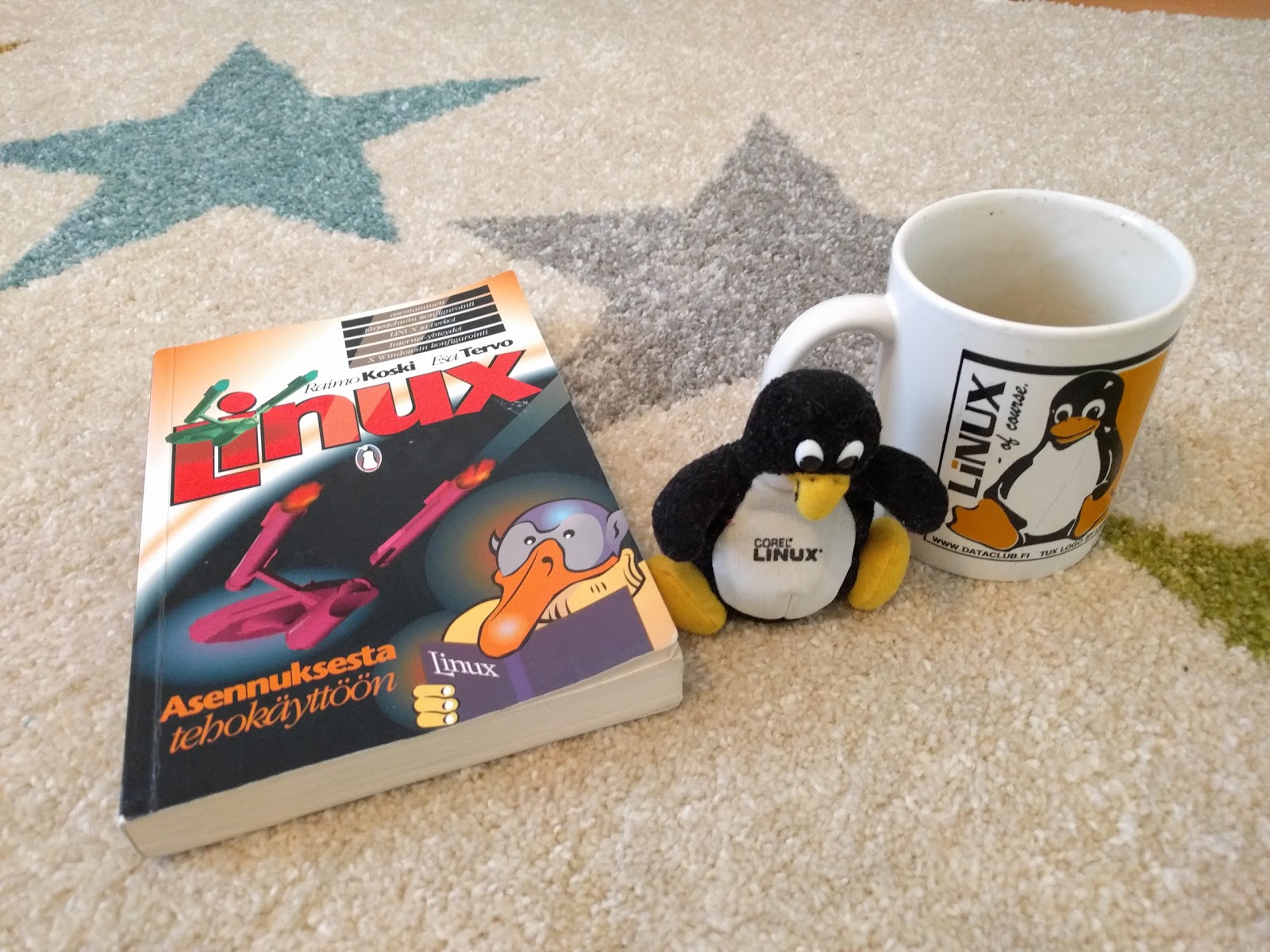
Since I've now been using Linux for 20 years, I've dug up some artifacts from the early journey.
  1. First the book, from late 1995. This from before Tux, so the penguin in the cover is just a co-incidence. The book came with a slackware 3.0 CD, which was my entrance to Linux. Today, almost all of the book is outdated - slackware and lilo install? printing with lpr? mtools and dosemu? ftp, telnet with SLIP dialup? Manually configuring XFree86 and fvwm? How I miss those times!* The only parts of the book are still valid are: shell and vi guides. I didn't read latter, and instead imported my favorite editor from dos FTE.
  2. Fast forward some years, into my first programming job. Ready to advertise the Linux revolution, I bought the mug on right. Nobody else would have a Tux mug, so nobody would accidentally take my mug from the office dishwasher. That only worked for my first work place (a huge and nationally hated IT consultant house). The next workplace, a mobile gaming startup (in 2001, I was there before it was trendy!) - and there was already plenty of Linux mugs when I joined...
  3. While today it may be hard to imagine, those days using Microsoft office tools was mandatory. That leads to the third memorabilia in the picture. Wordperfect for Linux existed for a brief while, and in the box (can you imagine, software came in physical boxes?) came a Tux plush.
* Wait no, I don't miss those times at all

15 February 2016

Julien Danjou: Timeseries storage and data compression

The first major version of the scalable timeserie database I work on, Gnocchi was a released a few months ago. In this first iteration, it took a rather naive approach to data storage. We had little ideas about if and how our distributed back-ends were going to be heavily used, so we stuck to the code of the first proof-of-concept written a couple of years ago. Recently we got more feedbacks from our users, ran a few benchmarks. That gave us enough feedback to start investigating in improving our storage strategy. Data split Up to Gnocchi 1.3, all data for a single metric are stored in a single gigantic file per aggregation method (min, max, average ). This means that the file can grow to several megabytes in size, which make it slow to manipulate. For the next version of Gnocchi, our first work has been to rework that storage and split the data into smaller parts. Gnocchi Carbonara archives split The diagram above shows how data are organized inside Gnocchi. Until version 1.3, there would have been only one file for each aggregation methods. In the upcoming 2.0 version, Gnocchi will split all these data into smaller parts, where each data split is stored in a file/object. This allows to manipulate smaller pieces of data and to increase the parallelism of the CRUD operations on the back-end leading to large speed improvement. In order to split timeseries into several chunks, Gnocchi defines a maximum number of N points to keep per chunk, to limit their maximum size. It then defines a hash function that produces a non-unique key for any timestamp. It makes it easy to find in which chunk any timestamp should be stored or retrieved. Data compression Up to Gnocchi 1.3, the data stored for each metric is simply serialized using msgpack, a fast and small serialization format. Though, this format does not provide any compression. That means that storing data points needs 8 bytes for a timestamp (64 bits timestamp with nanosecond precision) and 8 bytes for a value (64 bits double-precision floating-point), plus some overhead (extra information and msgpack itself). After looking around on how to compress all these measures, I stumbled upon a paper from some Facebook engineers called about Gorilla, their in-memory timeserie database, entitled "Gorilla: A Fast, Scalable, In-Memory Time Series Database". For reference, part of this encoding is also used by InfluxDB in its new storage engine. The first technique I implemented is easy enough, and it's inspired from delta-of-delta encoding. Instead of storing each timestamp for each data point, and since all the data points are aggregated on a regular interval, we transpose points to be the time difference divided by the interval. For example, the suite of timestamps timestamps = [41230, 41235, 41240, 41250, 41255] is encoded into timestamps = [41230, 1, 1, 2, 1], interval = 5. This allows regular compression algorithms to reduce the size of the integer list using run-length encoding. To actually compress the values, I tried two different algorithms: I then benchmarked these solutions: Gnocchi Carbonara compression speed The XOR algorithm implemented in Python is pretty slow, compared to LZ4. Truth is that python-lz4 is fully implemented in C, which makes it fast. I've profiled my XOR implementation in Python, to discover that one operation took 20 % of the time: count_lead_and_trail_zeroes, which is in charge of counting the number of leading and trailing zeroes in a binary number. Gnocchi Carbonara compression XOR profiling I tried 2 Python implementations of the same algorithm (and submitted them to my friend and Python developer Victor Stinner by the way). The first version using string search with .index() is 10 faster than the second one that only do integer computation. Ah, Python As Victor explained, each Python operation is slow and there's a lot in the second version, whereas .index() is implemented in C and really well optimized and only needs 2 Python operations. Finally, I ended up optimizing that code by leveraging cffi to use directly ffsll() and flsll(). That decreased the run-time of count_lead_and_trail_zeroes by 45 %, making the entire XOR compression code speed increased by a small 7 %. This is not enough to catch up with LZ4 speed. At this stage, the only solution to achieve a high-speed would probably to go with a full C implementation. Gnocchi Carbonara compression size Considering the compression ratio of the different algorithms, they are pretty much identical. The worst case scenario (random values) for LZ4 compress down to 9 bytes per data point, whereas XOR can go down to 7.38 bytes per data point. In general XOR encoding beats LZ4 by 15 %, except for cases where all values are 0 or 1. However, LZ4 is faster than XOR by a factor of 4 -70 depending on cases. That means that we'll use LZ4 for data compression in Gnocchi 2.0. It's possible that we could achieve as fast compression/decompression algorithm, but I don't think it's worth the effort right now it'd represent a lot of code to write and to maintain.

14 February 2016

Elena 'valhalla' Grandi: Happy #ilovefs

Happy #ilovefs

Happy I love Free Software Day https://fsfe.org/campaigns/ilovefs/2016/!

Immagine/fotohttp://ilovefs.org

My life has been full of Free Software for more than 15 years and listing all the software and projects I've used or interacted with would take a long post (and I would be sure to forget someone), so if you are reading this and are involved in Free Software: thank you! I may have used your work in the past, I may be using it some time in the future, or I may never use it personally, but you are making the world I live in a better place anyway.

Special thanks go to the local LUGs, where I've met my SO and to the @Debian project, where I've met a few people I can call friends.

@LIFO @Gruppo Linux Como #ilovefs

10 February 2016

Guido G nther: Debian Fun in January 2016

Debian LTS January was the ninth month I contributed to Debian LTS under the Freexian umbrella. In total I spent 13 hours working on: There was no progress on using the same nss in all suites. This will continue in February as does the Squeeze-lts Wheezy forward porting. Other Debian stuff

9 February 2016

Mike Gabriel: R sum of our Edu Workshop in Kiel (26th - 29th January)

In the last week of January, the project IT-Zukunft Schule (Logo EDV-Systeme GmbH and DAS-NETZWERKTEAM) had visitors from Norway: Klaus Ade Johnstad and Linnea Skogtvedt from LinuxAvdelingen [1] came by for exchanging insights, knowledge, technology, stories regarding IT services at school in Norway and Nothern Germany. This was our schedule... Tuesday Wednesday Thursday read more

Next.

Previous.