Search Results: "ads"

10 January 2023

Daniel Lange: Happy tenth birthday, dear Thunar bug

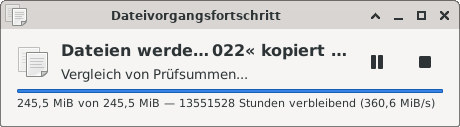
Thunar, the Xfce4 file manager, has a bug that it underflows the time remaining for a file copy since ten years now (bugzilla, gitlab). Happy birthday!

Dirk Eddelbuettel: RcppTOML 0.2.0: TOML 1.0.0 rewrite with toml++

A few years since the last release in late 2020, the RcppTOML package is now back with a new and shiny CRAN release 0.2.0. It is now based on the wonderful toml++ C++17 library by Mark Gillard and gets us (at long last!) full TOML v1.0.0 compliance for use with R. TOML is a file format that is most suitable for configurations, as it is meant to be edited by humans but read by computers. It emphasizes strong readability for humans while at the same time supporting strong typing as well as immediate and clear error reports. On small typos you get parse errors, rather than silently corrupted garbage. Much preferable to any and all of XML, JSON or YAML though sadly these may be too ubiquitous now. TOML is frequently being used with the projects such as the Hugo static blog compiler, or the Cargo system of Crates (aka packages ) for the Rust language. This package is a rewrite of the internals interfacing the library, and updates the package to using toml++ and C++17. The R interface is unchanged, and a full run of reverse dependencies passed. This involved finding one sole test failure which turned to have been driven by a non-conforming TOML input file which Jianfeng Li kindly fixed at the source making his (extensive) set of tests in package configr pass too. The actual rewrite was mostly done in a one-off repo RcppTomlPlusPlus which can now be considered frozen. The short summary of changes follows.

Changes in version 0.2.0 (2023-01-10)
  • Rewritten in C++17 using toml++ for TOML v1.0.0 compliance
  • Unchanged interface from R, unchanged (and expanded tests)
  • Several small continuous integration upgrades since last release

Courtesy of my CRANberries, there is a diffstat report for this release. More information is on the RcppTOML page page. Please use the GitHub issue tracker for issues and bugreports. If you like this or other open-source work I do, you can sponsor me at GitHub.

This post by Dirk Eddelbuettel originated on his Thinking inside the box blog. Please report excessive re-aggregation in third-party for-profit settings.

Matthew Garrett: Integrating Linux with Okta Device Trust

I've written about bearer tokens and how much pain they cause me before, but sadly wishing for a better world doesn't make it happen so I'm making do with what's available. Okta has a feature called Device Trust which allows to you configure access control policies that prevent people obtaining tokens unless they're using a trusted device. This doesn't actually bind the tokens to the hardware in any way, so if a device is compromised or if a user is untrustworthy this doesn't prevent the token ending up on an unmonitored system with no security policies. But it's an incremental improvement, other than the fact that for desktop it's only supported on Windows and MacOS, which really doesn't line up well with my interests.

Obviously there's nothing fundamentally magic about these platforms, so it seemed fairly likely that it would be possible to make this work elsewhere. I spent a while staring at the implementation using Charles Proxy and the Chrome developer tools network tab and had worked out a lot, and then Okta published a paper describing a lot of what I'd just laboriously figured out. But it did also help clear up some points of confusion and clarified some design choices. I'm not going to give a full description of the details (with luck there'll be code shared for that before too long), but here's an outline of how all of this works. Also, to be clear, I'm only going to talk about the desktop support here - mobile is a bunch of related but distinct things that I haven't looked at in detail yet.

Okta's Device Trust (as officially supported) relies on Okta Verify, a local agent. When initially installed, Verify authenticates as the user, obtains a token with a scope that allows it to manage devices, and then registers the user's computer as an additional MFA factor. This involves it generating a JWT that embeds a number of custom claims about the device and its state, including things like the serial number. This JWT is signed with a locally generated (and hardware-backed, using a TPM or Secure Enclave) key, which allows Okta to determine that any future updates from a device claiming the same identity are genuinely from the same device (you could construct an update with a spoofed serial number, but you can't copy the key out of a TPM so you can't sign it appropriately). This is sufficient to get a device registered with Okta, at which point it can be used with Fastpass, Okta's hardware-backed MFA mechanism.

As outlined in the aforementioned deep dive paper, Fastpass is implemented via multiple mechanisms. I'm going to focus on the loopback one, since it's the one that has the strongest security properties. In this mode, Verify listens on one of a list of 10 or so ports on localhost. When you hit the Okta signin widget, choosing Fastpass triggers the widget into hitting each of these ports in turn until it finds one that speaks Fastpass and then submits a challenge to it (along with the URL that's making the request). Verify then constructs a response that includes the challenge and signs it with the hardware-backed key, along with information about whether this was done automatically or whether it included forcing the user to prove their presence. Verify then submits this back to Okta, and if that checks out Okta completes the authentication.

Doing this via loopback from the browser has a bunch of nice properties, primarily around the browser providing information about which site triggered the request. This means the Verify agent can make a decision about whether to submit something there (ie, if a fake login widget requests your creds, the agent will ignore it), and also allows the issued token to be cross-checked against the site that requested it (eg, if g1thub.com requests a token that's valid for github.com, that's a red flag). It's not quite at the same level as a hardware WebAuthn token, but it has many of the anti-phishing properties.

But none of this actually validates the device identity! The entire registration process is up to the client, and clients are in a position to lie. Someone could simply reimplement Verify to lie about, say, a device serial number when registering, and there'd be no proof to the contrary. Thankfully there's another level to this to provide stronger assurances. Okta allows you to provide a CA root[1]. When Okta issues a Fastpass challenge to a device the challenge includes a list of the trusted CAs. If a client has a certificate that chains back to that, it can embed an additional JWT in the auth JWT, this one containing the certificate and signed with the certificate's private key. This binds the CA-issued identity to the Fastpass validation, and causes the device to start appearing as "Managed" in the Okta device management UI. At that point you can configure policy to restrict various apps to managed devices, ensuring that users are only able to get tokens if they're using a device you've previously issued a certificate to.

I've managed to get Linux tooling working with this, though there's still a few drawbacks. The main issue is that the API only allows you to register devices that declare themselves as Windows or MacOS, followed by the login system sniffing browser user agent and only offering Fastpass if you're on one of the officially supported platforms. This can be worked around with an extension that spoofs user agent specifically on the login page, but that's still going to result in devices being logged as a non-Linux OS which makes interpreting the logs more difficult. There's also no ability to choose which bits of device state you log: there's a couple of existing integrations, and otherwise a fixed set of parameters that are reported. It'd be lovely to be able to log arbitrary material and make policy decisions based on that.

This also doesn't help with ChromeOS. There's no real way to automatically launch something that's bound to localhost (you could probably make this work using Crostini but there's no way to launch a Crostini app at login), and access to hardware-backed keys is kind of a complicated topic in ChromeOS for privacy reasons. I haven't tried this yet, but I think using an enterprise force-installed extension and the chrome.enterprise.platformKeys API to obtain a device identity cert and then intercepting requests to the appropriate port range on localhost ought to be enough to do that? But I've literally never written any Javascript so I don't know. Okta supports falling back from the loopback protocol to calling a custom URI scheme, but once you allow that you're also losing a bunch of the phishing protection, so I'd prefer not to take that approach.

Like I said, none of this prevents exfiltration of bearer tokens once they've been issued, and there's still a lot of ecosystem work to do there. But ensuring that tokens can't be issued to unmanaged machines in the first place is still a step forwards, and with luck we'll be able to make use of this on Linux systems without relying on proprietary client-side tooling.

(Time taken to code this implementation: about two days, and under 1000 lines of new code. Time taken to figure out what the fuck to write: rather a lot longer)

[1] There's also support for having Okta issue certificates, but then you're kind of back to the "How do I know this is my device" situation

comment count unavailable comments

9 January 2023

Junichi Uekawa: Uploaded Debian packages, since a long time.

Uploaded Debian packages, since a long time. enumn and remain are rust packages, and needed for crosvm. Working slowly through the dependency chain.

Gunnar Wolf: Back to Xochicalco

In Mexico, we have the great luck to live among vestiges of long-gone cultures, some that were conquered and in some way got adapted and survived into our modern, mostly-West-Europan-derived society, and some that thrived but disappeared many more centuries ago. And although not everybody feels the same way, in my family we have always enjoyed visiting archaeological sites when I was a child and today. Some of the regulars that follow this blog (or its syndicators) will remember Xochicalco, as it was the destination we chose for the daytrip back in the day, in DebConf6 (May 2006). This weekend, my mother suggested us to go there, as being Winter, the weather is quite pleasant we were at about 25 C, and by the hottest months of the year it can easily reach 10 more; the place lacks shadows, like most archaeological sites, and it does get quite tiring nevertheless! Xochicalco is quite unique among our archaeological sites, as it was built as a conference city: people came from cultures spanning all of Mesoamerica to debate and homogeneize the calendars used in the region. The first photo I shared here is by the Quetzalc atl temple, where each of the four sides shows people from different cultures (the styles in which they are depicted follow their local self-representations), encodes equivalent dates in the different calendaric systems, and are located along representationsof the God of knowledge, the feathered serpent, Quetzalc atl. It was a very nice day out. And, of course, it brought back memories of my favorite conference visiting the site of a very important conference

8 January 2023

Dirk Eddelbuettel: spdl 0.0.4 on CRAN: Adding Stopwatch

Another quick update to the still new-ish package spdl is now om CRAN, and in Debian. The key focus of spdl is a offering the same interface from both R and C++ for logging by relying on spdlog via my RcppSpdlog package. This release add support for the stopwatch() facility. One can now instantiate such an object, and referencing it in a log message shows the elapsed time. No more, no less, and it works the same way in R and C++. The short NEWS entry follows.

Changes in spdl version 0.0.4 (2023-01-08)
  • Add support for stopwatch

Courtesy of my CRANberries, there is also a diffstat report. More detailed information is on the spdl page. If you like this or other open-source work I do, you can sponsor me at GitHub.

This post by Dirk Eddelbuettel originated on his Thinking inside the box blog. Please report excessive re-aggregation in third-party for-profit settings.

Dirk Eddelbuettel: RVowpalWabbit 0.0.18: Maintenance

A new maintenance release, now at version 0.0.18, of the RVowpalWabbit package arrived on CRAN. It improves several sprintf() calls by changing them to snprintf() (though there is a remaining one creeping in from a linked-to library). As noted before, there is a newer package rvw based on the excellent GSoC 2018 and beyond work by Ivan Pavlov (mentored by James and myself) so if you are into VowpalWabbit from R go check it out. CRANberries provides a summary of changes to the previous version. More information is on the RVowpalWabbit page. Issues and bugreports should go to the GitHub issue tracker. If you like this or other open-source work I do, you can now sponsor me at GitHub.

This post by Dirk Eddelbuettel originated on his Thinking inside the box blog. Please report excessive re-aggregation in third-party for-profit settings.

Charles Plessy: Could somebody patch Firefox to display Markdown files?

When Firefox receives a file with media type text/markdown, it prompts the user to download it, while other browsers display it as plain text. In the ticket 1319262, it is proposed to display Markdown files by default, but there needs a patch

7 January 2023

Dirk Eddelbuettel: RcppSpdlog 0.0.12 on CRAN: Added Stopwatch

Version 0.0.12 of RcppSpdlog is now on CRAN and in Debian. RcppSpdlog bundles spdlog, a wonderful header-only C++ logging library with all the bells and whistles you would want that was written by Gabi Melman, and also includes fmt by Victor Zverovich. This release adds support for the stopwatch object, a simple container around a std::chrono object. It makes (simple) time measurements of routines and code segments trivially easy. Instantiate a stopwatch object, and formatting it in a logging string displays elapsed time. And given that the whole mojo of RcppSpdlog (and its sibbling package spdl) is to make use easy in both R and C++ we can do this nicely and consistently in both languages. The vignette has an added section with a concrete example. The NEWS entry for this release follows.

Changes in RcppSpdlog version 0.0.12 (2023-01-07)
  • Addeed support for 'stopwatch' object allowing for simple timing (from both C++ and R) via the logging framework.
  • The spdlog logging pattern is documented via a reference.

Courtesy of my CRANberries, there is also a diffstat report. More detailed information is on the RcppSpdlog page, or the package documention site. If you like this or other open-source work I do, you can sponsor me at GitHub.

This post by Dirk Eddelbuettel originated on his Thinking inside the box blog. Please report excessive re-aggregation in third-party for-profit settings.

Reproducible Builds: Reproducible Builds in December 2022

Welcome to the December 2022 report from the Reproducible Builds project.
We are extremely pleased to announce that the dates for the Reproducible Builds Summit in 2023 have been announced in 2022 already: We plan to spend three days continuing to the grow of the Reproducible Builds effort. As in previous events, the exact content of the meeting will be shaped by the participants. And, as mentioned in Holger Levsen s post to our mailing list, the dates have been booked and confirmed with the venue, so if you are considering attending, please reserve these dates in your calendar today.
R my Gr nblatt, an associate professor in the T l com Sud-Paris engineering school wrote up his pain points of using Nix and NixOS. Although some of the points do not touch on reproducible builds, R my touches on problems he has encountered with the different kinds of reproducibility that these distributions appear to promise including configuration files affecting the behaviour of systems, the fragility of upstream sources as well as the conventional idea of binary reproducibility.
Morten Linderud reported that he is quietly optimistic that if Go programming language resolves all of its issues with reproducible builds (tracking issue) then the Go binaries distributed from Google and by Arch Linux may be bit-for-bit identical. It s just a bit early to sorta figure out what roadblocks there are. [But] Go bootstraps itself every build, so in theory I think it should be possible.
On December 15th, Holger Levsen published an in-depth interview he performed with David A. Wheeler on supply-chain security and reproducible builds, but it also touches on the biggest challenges in computing as well. This is part of a larger series of posts featuring the projects, companies and individuals who support the Reproducible Builds project. Other instalments include an article featuring the Civil Infrastructure Platform project and followed this up with a post about the Ford Foundation as well as a recent ones about ARDC, the Google Open Source Security Team (GOSST), Jan Nieuwenhuizen on Bootstrappable Builds, GNU Mes and GNU Guix and Hans-Christoph Steiner of the F-Droid project.
A number of changes were made to the Reproducible Builds website and documentation this month, including FC Stegerman adding an F-Droid/apksigcopier example to our embedded signatures page [ ], Holger Levsen making a large number of changes related to the 2022 summit in Venice as well as 2023 s summit in Hamburg [ ][ ][ ][ ] and Simon Butler updated our publications page [ ][ ].
On our mailing list this month, James Addison asked a question about whether there has been any effort to trace the files used by a build system in order to identify the corresponding build-dependency packages. [ ] In addition, Bernhard M. Wiedemann then posed a thought-provoking question asking How to talk to skeptics? , which was occasioned by a colleague who had published a blog post in May 2021 skeptical of reproducible builds. The thread generated a number of replies.

Android news obfusk (FC Stegerman) performed a thought-provoking review of tools designed to determine the difference between two different .apk files shipped by a number of free-software instant messenger applications. These scripts are often necessary in the Android/APK ecosystem due to these files containing embedded signatures so the conventional bit-for-bit comparison cannot be used. After detailing a litany of issues with these tools, they come to the conclusion that:
It s quite possible these messengers actually have reproducible builds, but the verification scripts they use don t actually allow us to verify whether they do.
This reflects the consensus view within the Reproducible Builds project: pursuing a situation in language or package ecosystems where binaries are bit-for-bit identical (over requiring a bespoke ecosystem-specific tool) is not a luxury demanded by purist engineers, but rather the only practical way to demonstrate reproducibility. obfusk also announced the first release of their own set of tools on our mailing list. Related to this, obfusk also posted to an issue filed against Mastodon regarding the difficulties of creating bit-by-bit identical APKs, especially with respect to copying v2/v3 APK signatures created by different tools; they also reported that some APK ordering differences were not caused by building on macOS after all, but by using Android Studio [ ] and that F-Droid added 16 more apps published with Reproducible Builds in December.

Debian As mentioned in last months report, Vagrant Cascadian has been organising a series of online sprints in order to clear the huge backlog of reproducible builds patches submitted by performing NMUs (Non-Maintainer Uploads). During December, meetings were held on the 1st, 8th, 15th, 22nd and 29th, resulting in a large number of uploads and bugs being addressed: The next sprint is due to take place this coming Tuesday, January 10th at 16:00 UTC.

Upstream patches The Reproducible Builds project attempts to fix as many currently-unreproducible packages as possible. This month, we wrote a large number of such patches, including:

Testing framework The Reproducible Builds project operates a comprehensive testing framework at tests.reproducible-builds.org in order to check packages and other artifacts for reproducibility. In October, the following changes were made by Holger Levsen:
  • The osuosl167 machine is no longer a openqa-worker node anymore. [ ][ ]
  • Detect problems with APT repository signatures [ ] and update a repository signing key [ ].
  • reproducible Debian builtin-pho: improve job output. [ ]
  • Only install the foot-terminfo package on Debian systems. [ ]
In addition, Mattia Rizzolo added support for the version of diffoscope in Debian stretch which doesn t support the --timeout flag. [ ][ ]

diffoscope diffoscope is our in-depth and content-aware diff utility. Not only can it locate and diagnose reproducibility issues, it can provide human-readable diffs from many kinds of binary formats. This month, Chris Lamb made the following changes to diffoscope, including preparing and uploading versions 228, 229 and 230 to Debian:
  • Fix compatibility with file(1) version 5.43, with thanks to Christoph Biedl. [ ]
  • Skip the test_html.py::test_diff test if html2text is not installed. (#1026034)
  • Update copyright years. [ ]
In addition, Jelle van der Waa added support for Berkeley DB version 6. [ ] Orthogonal to this, Holger Levsen bumped the Debian Standards-Version on all of our packages, including diffoscope [ ], strip-nondeterminism [ ], disorderfs [ ] and reprotest [ ].
If you are interested in contributing to the Reproducible Builds project, please visit our Contribute page on our website. You can get in touch with us via:

Jonathan Carter: What are the most important improvements that Debian need to make?

What are the most important improvements that Debian need to make? I decided to see what all the fuss is about and asked ChatGPT that exact question. It s response:

The list of potential improvements for Debian that I provided is based on my understanding of the challenges and opportunities that software projects like Debian typically face, as well as my understanding of the goals and values of the Debian project. It is not based on any specific information about the current priorities or needs of the Debian project or community. There are many areas where the Debian project could make improvements, and the most important ones will depend on the priorities and needs of the project and its community. Some potential areas for improvement could include:
  1. Improving the user experience: Debian is known for its stability and security, but it is not always the easiest distribution to use, especially for new users. Improving the user experience and making Debian more accessible to a wider audience could be an important goal.
  2. Keeping up with the rapid pace of change in the software ecosystem: With over 50,000 packages, Debian is a large distribution, and it can be difficult to keep up with the constant stream of updates and new software being released. Developing tools and processes to help manage this complexity and ensure that new packages are tested and integrated smoothly could be an important focus.
  3. Maintaining the stability and security of the distribution: Ensuring that Debian remains a stable and secure platform is a top priority for the project. This includes testing new packages thoroughly before they are included in the distribution, responding quickly to security vulnerabilities, and investing in infrastructure and processes to support these efforts.
  4. Ensuring the long-term sustainability of the project: Debian is a volunteer-driven project, and it can be challenging to attract and retain contributors over the long term. Developing strategies to support and encourage participation and collaboration within the community could be an important focus.
  5. Enhancing the tools and infrastructure that support the project: The Debian project relies on a wide range of tools and infrastructure to support its development and distribution efforts. Improving and modernizing these resources could help to make the project more efficient and effective.
I find that to be a great response, and I m curious where it came from, so I asked How did you come to that conclusion? , it replied:
The list of potential improvements for Debian that I provided is based on my understanding of the challenges and opportunities that software projects like Debian typically face, as well as my understanding of the goals and values of the Debian project. It is not based on any specific information about the current priorities or needs of the Debian project or community.
Well, one thing is for sure, the IRC chat bots of the future are going to be much more complex than the ones I grew up with :-)

Matthew Garrett: Asking ChatGPT to write my security-sensitive code for me

I have a patchset that makes it safe to use hibernation under Linux even in a secure boot world but it relies on preventing userland from using one of the TPM PCRs[1] that would otherwise be available to it. TPM 2 devices support emulating PCRs in NVRAM, which would obviously be beneficial in not taking away a scare resource, but the docs suggest there's no way to tie a key generation to an NVRAM value which makes this more complicated.

So, why not ask a computer to do this for me? I asked ChatGPT to write me some code that would bind a TPM key to an NVRAM value. After a couple of false starts it told me:To bind an encryption key to the value of a TPM NV index, you can use the TPM2_NV_DefineSpace command to define an NV index with the TPMA_NV_BIND attribute. Woo! That sounds perfect. Only one problem - I can't actually find the TPMA_NV_BIND attribute defined anywhere in the spec. Well, ask the AI again.

Here is the definition of TPMA_NV_BIND from the TPM 2.0 specification:
TPMA_NV_BIND (BIT 17) If SET, the contents of the NV Index are bound to the platform hierarchy.


Ok, that sounds convincing. Where is it in the spec?

The definition of TPMA_NV_BIND is on page 126 of the TPM 2.0 specification, in section 9.7.1 "TPMA_NV".

Huh. Nope. Page 126 says nothing about this. Section 9.7.1 says nothing about this. The TPMA_NV bits are actually described on page 168 of volume 2 of the spec, in section 13.4. Bit 17 is TPMA_NV_OWNERREAD. TPMA_NV_BIND does not appear in the spec anywhere. I told the AI that.

I apologize for the error in my previous response. You are correct that the TPMA_NV_BIND attribute does not appear in the TPM 2.0 specification.

To bind an encryption key to the value of a TPM NV index, you can use the TPM2_NV_DefineSpace command with the TPMA_NV_BIND attribute.


I'm not afraid of being unemployed in the near future.

[1] "Platform Configuration Registers" - a modern TPM has 24 of these. When something security sensitive happens, you generate a hash of that event and pass it to the TPM. The TPM appends that to an existing PCR value and then hashes that concatenated value and sets the PCR to that. This means the PCR value depends not only on the values provided, but also the order they're provided in. Various TPM operations can be made conditional on the PCR values meeting specific criteria.

comment count unavailable comments

6 January 2023

Jonathan McDowell: Finally making use of bpftrace

I am old enough to remember when BPF meant the traditional Berkeley Packet Filter, and was confined to filtering network packets. It s grown into much, much, more as eBPF and getting familiar with it so that I can add it to the suite of tips and tricks I can call upon has been on my to-do list for a while. To this end I was lucky enough to attend a live walk through of bpftrace last year. bpftrace is a high level tool that allows the easy creation and execution of eBPF tracers under Linux. Recently I ve been working on updating the RetroArch packages in Debian and as I was doing so I realised there was a need to update the quite outdated retroarch-assets package, which contains various icons and images used for the user interface. I wanted to try and re-generate as many of the artefacts as I could, to ensure the proper source was available. However it wasn t always clear which files were actually needed and which were either source or legacy. So I wanted to trace file opens by retroarch and see when it was failing to find files. Traditionally this is something I d have used strace for, but it seemed like a great opportunity to try out bpftrace. It turns out bpftrace ships with an example, opensnoop.bt which provided details of hooking the open syscall entry + exit and providing details of all files opened on the system. I only wanted to track opens by the retroarch binary that failed, so I made a couple of modifications:
retro-failed-open-snoop.bt
#!/usr/bin/env bpftrace
/*
 * retro-failed-open-snoop - snoop failed opens by RetroArch
 *
 * Based on:
 * opensnoop	Trace open() syscalls.
 *		For Linux, uses bpftrace and eBPF.
 *
 * Copyright 2018 Netflix, Inc.
 * Licensed under the Apache License, Version 2.0 (the "License")
 *
 * 08-Sep-2018	Brendan Gregg	Created this.
 */
BEGIN
 
	printf("Tracing open syscalls... Hit Ctrl-C to end.\n");
	printf("%-6s %-16s %3s %s\n", "PID", "COMM", "ERR", "PATH");
 
tracepoint:syscalls:sys_enter_open,
tracepoint:syscalls:sys_enter_openat
 
	@filename[tid] = args->filename;
 
tracepoint:syscalls:sys_exit_open,
tracepoint:syscalls:sys_exit_openat
/@filename[tid]/
 
	$ret = args->ret;
	$errno = $ret > 0 ? 0 : - $ret;
	if (($ret <= 0) && (strncmp("retroarch", comm, 9) == 0) )  
		printf("%-6d %-16s %3d %s\n", pid, comm, $errno,
		    str(@filename[tid]));
	 
	delete(@filename[tid]);
 
END
 
	clear(@filename);
 
I had to install bpftrace (apt install bpftrace) and then I ran bpftrace -o retro.log retro-failed-open-snoop.bt as root and fired up retroarch as a normal user.
bpftrace failed open log for retroarch
Attaching 6 probes...
Tracing open syscalls... Hit Ctrl-C to end.
PID    COMM             ERR PATH
3394   retroarch          2 /usr/lib/x86_64-linux-gnu/pulseaudio/glibc-hwcaps/x86-64-v2/lib
3394   retroarch          2 /usr/lib/x86_64-linux-gnu/pulseaudio/tls/x86_64/x86_64/libpulse
3394   retroarch          2 /usr/lib/x86_64-linux-gnu/pulseaudio/tls/x86_64/libpulsecommon-
3394   retroarch          2 /usr/lib/x86_64-linux-gnu/pulseaudio/tls/libpulsecommon-16.1.so
3394   retroarch          2 /usr/lib/x86_64-linux-gnu/pulseaudio/x86_64/x86_64/libpulsecomm
3394   retroarch          2 /usr/lib/x86_64-linux-gnu/pulseaudio/x86_64/libpulsecommon-16.1
3394   retroarch          2 /etc/gcrypt/hwf.deny
3394   retroarch          2 /lib/x86_64-linux-gnu/glibc-hwcaps/x86-64-v2/libgamemode.so.0
3394   retroarch          2 /lib/x86_64-linux-gnu/tls/x86_64/x86_64/libgamemode.so.0
3394   retroarch          2 /lib/x86_64-linux-gnu/tls/x86_64/libgamemode.so.0
3394   retroarch          2 /lib/x86_64-linux-gnu/tls/libgamemode.so.0
3394   retroarch          2 /lib/x86_64-linux-gnu/x86_64/x86_64/libgamemode.so.0
3394   retroarch          2 /lib/x86_64-linux-gnu/x86_64/libgamemode.so.0
3394   retroarch          2 /lib/x86_64-linux-gnu/libgamemode.so.0
3394   retroarch          2 /usr/lib/x86_64-linux-gnu/glibc-hwcaps/x86-64-v2/libgamemode.so
3394   retroarch          2 /usr/lib/x86_64-linux-gnu/tls/x86_64/x86_64/libgamemode.so.0
3394   retroarch          2 /usr/lib/x86_64-linux-gnu/tls/x86_64/libgamemode.so.0
3394   retroarch          2 /usr/lib/x86_64-linux-gnu/tls/libgamemode.so.0
3394   retroarch          2 /usr/lib/x86_64-linux-gnu/x86_64/x86_64/libgamemode.so.0
3394   retroarch          2 /usr/lib/x86_64-linux-gnu/x86_64/libgamemode.so.0
3394   retroarch          2 /usr/lib/x86_64-linux-gnu/libgamemode.so.0
3394   retroarch          2 /lib/glibc-hwcaps/x86-64-v2/libgamemode.so.0
3394   retroarch          2 /lib/tls/x86_64/x86_64/libgamemode.so.0
3394   retroarch          2 /lib/tls/x86_64/libgamemode.so.0
3394   retroarch          2 /lib/tls/libgamemode.so.0
3394   retroarch          2 /lib/x86_64/x86_64/libgamemode.so.0
3394   retroarch          2 /lib/x86_64/libgamemode.so.0
3394   retroarch          2 /lib/libgamemode.so.0
3394   retroarch          2 /usr/lib/glibc-hwcaps/x86-64-v2/libgamemode.so.0
3394   retroarch          2 /usr/lib/tls/x86_64/x86_64/libgamemode.so.0
3394   retroarch          2 /usr/lib/tls/x86_64/libgamemode.so.0
3394   retroarch          2 /usr/lib/tls/libgamemode.so.0
3394   retroarch          2 /usr/lib/x86_64/x86_64/libgamemode.so.0
3394   retroarch          2 /usr/lib/x86_64/libgamemode.so.0
3394   retroarch          2 /usr/lib/libgamemode.so.0
3394   retroarch          2 /lib/x86_64-linux-gnu/libgamemode.so
3394   retroarch          2 /usr/lib/x86_64-linux-gnu/libgamemode.so
3394   retroarch          2 /lib/libgamemode.so
3394   retroarch          2 /usr/lib/libgamemode.so
3394   retroarch          2 /lib/x86_64-linux-gnu/libdecor-0.so
3394   retroarch          2 /usr/lib/x86_64-linux-gnu/libdecor-0.so
3394   retroarch          2 /lib/libdecor-0.so
3394   retroarch          2 /usr/lib/libdecor-0.so
3394   retroarch          2 /etc/drirc
3394   retroarch          2 /home/noodles/.drirc
3394   retroarch          2 /etc/drirc
3394   retroarch          2 /home/noodles/.drirc
3394   retroarch          2 /usr/lib/x86_64-linux-gnu/dri/tls/iris_dri.so
3394   retroarch          2 /lib/x86_64-linux-gnu/../lib/glibc-hwcaps/x86-64-v2/libedit.so.
3394   retroarch          2 /lib/x86_64-linux-gnu/../lib/tls/x86_64/x86_64/libedit.so.2
3394   retroarch          2 /lib/x86_64-linux-gnu/../lib/tls/x86_64/libedit.so.2
3394   retroarch          2 /lib/x86_64-linux-gnu/../lib/tls/libedit.so.2
3394   retroarch          2 /lib/x86_64-linux-gnu/../lib/x86_64/x86_64/libedit.so.2
3394   retroarch          2 /lib/x86_64-linux-gnu/../lib/x86_64/libedit.so.2
3394   retroarch          2 /lib/x86_64-linux-gnu/../lib/libedit.so.2
3394   retroarch          2 /etc/drirc
3394   retroarch          2 /home/noodles/.drirc
3394   retroarch          2 /etc/drirc
3394   retroarch          2 /home/noodles/.drirc
3394   retroarch          2 /etc/drirc
3394   retroarch          2 /home/noodles/.drirc
3394   retroarch          2 /home/noodles/.Xdefaults-udon
3394   retroarch          2 /home/noodles/.icons/default/cursors/00000000000000000000000000
3394   retroarch          2 /home/noodles/.icons/default/index.theme
3394   retroarch          2 /usr/share/icons/default/cursors/000000000000000000000000000000
3394   retroarch          2 /usr/share/pixmaps/default/cursors/0000000000000000000000000000
3394   retroarch          2 /home/noodles/.icons/Adwaita/cursors/00000000000000000000000000
3394   retroarch          2 /home/noodles/.icons/Adwaita/index.theme
3394   retroarch          2 /usr/share/icons/Adwaita/cursors/000000000000000000000000000000
3394   retroarch          2 /usr/share/pixmaps/Adwaita/cursors/0000000000000000000000000000
3394   retroarch          2 /home/noodles/.icons/hicolor/cursors/00000000000000000000000000
3394   retroarch          2 /home/noodles/.icons/hicolor/index.theme
3394   retroarch          2 /usr/share/icons/hicolor/cursors/000000000000000000000000000000
3394   retroarch          2 /usr/share/pixmaps/hicolor/cursors/0000000000000000000000000000
3394   retroarch          2 /usr/share/pixmaps/hicolor/index.theme
3394   retroarch          2 /home/noodles/.XCompose
3394   retroarch          2 /home/noodles/.icons/default/cursors/00000000000000000000000000
3394   retroarch          2 /home/noodles/.icons/default/index.theme
3394   retroarch          2 /usr/share/icons/default/cursors/000000000000000000000000000000
3394   retroarch          2 /usr/share/pixmaps/default/cursors/0000000000000000000000000000
3394   retroarch          2 /home/noodles/.icons/Adwaita/cursors/00000000000000000000000000
3394   retroarch          2 /home/noodles/.icons/Adwaita/index.theme
3394   retroarch          2 /usr/share/icons/Adwaita/cursors/000000000000000000000000000000
3394   retroarch          2 /usr/share/pixmaps/Adwaita/cursors/0000000000000000000000000000
3394   retroarch          2 /home/noodles/.icons/hicolor/cursors/00000000000000000000000000
3394   retroarch          2 /home/noodles/.icons/hicolor/index.theme
3394   retroarch          2 /usr/share/icons/hicolor/cursors/000000000000000000000000000000
3394   retroarch          2 /usr/share/pixmaps/hicolor/cursors/0000000000000000000000000000
3394   retroarch          2 /usr/share/pixmaps/hicolor/index.theme
3394   retroarch          2 /usr/share/libretro/assets/xmb/monochrome/png/disc.png
3394   retroarch          2 /usr/share/libretro/assets/xmb/monochrome/sounds
3394   retroarch          2 /usr/share/libretro/assets/sounds
3394   retroarch          2 /sys/class/power_supply/ACAD
3394   retroarch          2 /usr/share/libretro/assets/xmb/monochrome/png/disc.png
3394   retroarch          2 /usr/share/libretro/assets/ozone/sounds
3394   retroarch          2 /usr/share/libretro/assets/sounds
This was incredibly useful - the only theme image I was missing is disc.png from XMB Monochrome (which fails to have SVG source). I also discovered the runtime optional loading of GameMode. This is available in Debian so it was a simple matter to add libgamemode0 to the binary package Recommends. So, a very basic example of using bpftrace, but a remarkably useful intro to it from my point of view!

5 January 2023

Kentaro Hayashi: Rebuild mozc with Mozc UT Dictionary

When rebuilding mozc with Mozc UT Dictionary, it may be better to build in docker container because you don't want install unused IM development packages. In beforehand, download latest Mozc UT dictionary here. osdn.net In a debian/sid container, you need to do it:
# apt install -y devscripts
# (enable deb-src, modify /etc/apt/sources.list.d/debian.sources)
# apt source mozc
# cat mozcdic-ut-20221230/mozcdic-ut-20221230.txt >> mozc-2.28.4715.102+dfsg/src/data/dictionary_oss/dictionary00.txt 
# cd mozc-2.28.4715.102+dfsg/
# (edit debian/changelog such as 2.28.4715.102+dfsg-2.2.1 )
# debuild -us -uc -nc
After that, you can install
% sudo apt install ./emacs-mozc_2.28.4715.102+dfsg-2.2.1_amd64.deb ./emacs-mozc-bin_2.28.4715.102+dfsg-2.2.1_amd64.deb ./fcitx-mozc-data_2.28.4715.102+dfsg-2.2.1_all.deb ./fcitx5-mozc_2.28.4715.102+dfsg-2.2.1_amd64.deb ./ibus-mozc_2.28.4715.102+dfsg-2.2.1_amd64.deb ./mozc-data_2.28.4715.102+dfsg-2.2.1_all.deb ./mozc-server_2.28.4715.102+dfsg-2.2.1_amd64.deb ./mozc-utils-gui_2.28.4715.102+dfsg-2.2.1_amd64.deb
Then, you can use own build binaries.
% dpkg -l  \grep mozc
ii  emacs-mozc                               2.28.4715.102+dfsg-2.2.1               amd64        Mozc for Emacs
ii  emacs-mozc-bin                           2.28.4715.102+dfsg-2.2.1               amd64        Helper module for emacs-mozc
ii  fcitx-mozc-data                          2.28.4715.102+dfsg-2.2.1               all          Mozc input method - data files for fcitx
ii  fcitx5-mozc:amd64                        2.28.4715.102+dfsg-2.2.1               amd64        Mozc engine for fcitx5 - Client of the Mozc input method
ii  ibus-mozc                                2.28.4715.102+dfsg-2.2.1               amd64        Mozc engine for IBus - Client of the Mozc input method
ii  mozc-data                                2.28.4715.102+dfsg-2.2.1               all          Mozc input method - data files
ii  mozc-server                              2.28.4715.102+dfsg-2.2.1               amd64        Server of the Mozc input method
ii  mozc-utils-gui                           2.28.4715.102+dfsg-2.2.1               amd64        GUI utilities of the Mozc input method

Matthew Garrett: Changing firmware config that doesn't want to be changed

Update: There's actually a more detailed writeup of this here that I somehow missed. Original entry follows:

Today I had to deal with a system that had an irritating restriction - a firmware configuration option I really wanted to be able to change appeared as a greyed out entry in the configuration menu. Some emails revealed that this was a deliberate choice on the part of the system vendor, so that seemed to be that. Thankfully in this case there was a way around that.

One of the things UEFI introduced was a mechanism to generically describe firmware configuration options, called Visual Forms Representation (or VFR). At the most straightforward level, this lets you define a set of forms containing questions, with each question associated with a value in a variable. Questions can be made dependent upon the answers to other questions, so you can have options that appear or disappear based on how other questions were answered. An example in this language might be something like:
CheckBox Prompt: "Console Redirection", Help: "Console Redirection Enable or Disable.", QuestionFlags: 0x10, QuestionId: 53, VarStoreId: 1, VarStoreOffset: 0x39, Flags: 0x0
In which question 53 asks whether console redirection should be enabled or disabled. Other questions can then rely on the answer to question 53 to influence whether or not they're relevant (eg, if console redirection is disabled, there's no point in asking which port it should be redirected to). As a checkbox, if it's set then the value will be set to 1, and 0 otherwise. But where's that stored? Earlier we have another declaration:
VarStore GUID: EC87D643-EBA4-4BB5-A1E5-3F3E36B20DA9, VarStoreId: 1, Size: 0xF4, Name: "Setup"
A UEFI variable called "Setup" and with GUID EC87D643-EBA4-4BB5-A1E5-3F3E36B20DA9 is declared as VarStoreId 1 (matching the declaration in the question) and is 0xf4 bytes long. The question indicates that the offset for that variable is 0x39. Rewriting Setup-EC87D643-EBA4-4BB5-A1E5-3F3E36B20DA9 with a modified value in offset 0x39 will allow direct manipulation of the config option.

But how do we get this data in the first place? VFR isn't built into the firmware directly - instead it's turned into something called Intermediate Forms Representation, or IFR. UEFI firmware images are typically in a standardised format, and you can use UEFITool to extract individual components from that firmware. If you use UEFITool to search for "Setup" there's a good chance you'll be able to find the component that implements the setup UI. Running IFRExtractor-RS against it will then pull out any IFR data it finds, and decompile that into something resembling the original VFR. And now you have the list of variables and offsets and the configuration associated with them, even if your firmware has chosen to hide those options from you.

Given that a bunch of these config values may be security relevant, this seems a little concerning - what stops an attacker who has access to the OS from simply modifying these variables directly? UEFI avoids this by having two separate stages of boot, one where the full firmware ("Boot Services") is available, and one where only a subset ("Runtime Services") is available. The transition is triggered by the OS calling ExitBootServices, indicating the handoff from the firmware owning the hardware to the OS owning the hardware. This is also considered a security boundary - before ExitBootServices everything running has been subject to any secure boot restrictions, and afterwards applications can do whatever they want. UEFI variables can be flagged as being visible in both Boot and Runtime Services, or can be flagged as Boot Services only. As long as all the security critical variables are Boot Services only, an attacker should never be able to run untrusted code that could alter them.

In my case, the firmware option I wanted to alter had been enclosed in "GrayOutIf True" blocks. But the questions were still defined and the code that acted on those options was still present, so simply modifying the variables while still inside Boot Services gave me what I wanted. Note that this isn't a given! The presence of configuration options in the IFR data doesn't mean that anything will later actually read and make use of that variable - a vendor may have flagged options as unavailable and then removed the code, but never actually removed the config data. And also please do note that the reason stuff was removed may have been that it doesn't actually work, and altering any of these variables risks bricking your hardware in a way that's extremely difficult to recover. And there's also no requirement that vendors use IFR to describe their configuration, so you may not get any help here anyway.

In summary: if you do this you may break your computer. If you don't break your computer, it might not work anyway. I'm not going to help you try to break your computer. And I didn't come up with any of this, I just didn't find it all written down in one place while I was researching it.

comment count unavailable comments

4 January 2023

Junichi Uekawa: debcargo rust repository and some observations.

debcargo rust repository and some observations. It's been about a week since I first started looking at Debian rust packages and adding some packages in preparation for crosvm. Some things that don't work quite well right now yet. My local branches disappeared. I don't have access and everything is through a merge request, presumably that is not a generally supported workflow and the team members are using branches to manage pending works. ./release.sh is optimized for updates and for new packages, they only build source packages and then I need to rebuild a binary-full package for the NEW queue. Maybe I will figure out. I haven't quite gotten the right IRC client. I was using the web UI but that seemed to disconnect without any warnings, and didn't tell me even when it is disconnected, it just can't post more messages and doesn't receive messages. That's not very useful. I started using Emacs IRC (rcirc) client. Not sure how useful that is.

3 January 2023

Paul Wise: FLOSS Activities December 2022

Focus This month I didn't have any particular focus. I just worked on issues in my info bubble.

Changes

Issues

Review

Administration
  • Debian BTS: unarchive/reopen/triage bugs for reintroduced packages: gnome-shell-extension-no-annoyance
  • Debian servers: contact mail server blocking a Debian MX
  • Debian wiki: unblock IP addresses, approve accounts

Communication
  • Respond to queries from Debian users and contributors on the mailing lists and IRC

Sponsors The azure-functions-devops-build work was sponsored. All other work was done on a volunteer basis.

Jonathan Dowland: Tex Shinobi first impressions

Happy New Year!
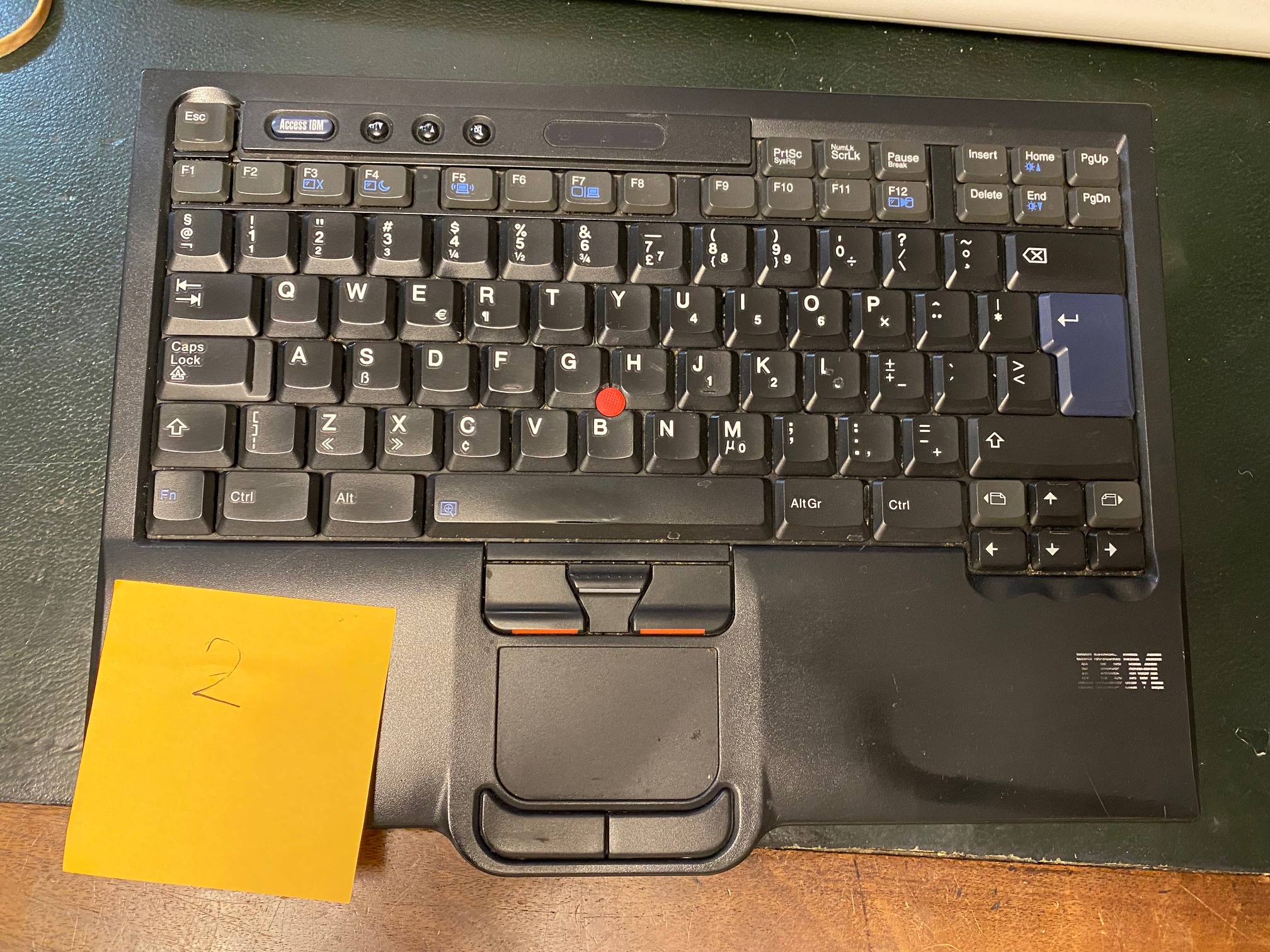
Older IBM Ultranav keyboard Older IBM Ultranav keyboard
For the last 13 years I've been using standalone versions of the Lenovo (formerly IBM) Thinkpad keyboard design with integrated trackpoint as my main computer input devices. My latest ("ThinkPad TrackPoint Keyboard II") was starting to fail so I decided to look into alternatives for a replacement. The sticking point was I really like the trackpoint as a mouse replacement, and very few other manufacturers offer that. I've thus far managed to avoid the money pit that are mechanical keyboards. I can see the attraction: in the 90s I used an IBM Model M PS/2 keyboard as my daily driver until one tea spillage too many finally killed it. A friend kindly gifted me another Model M more recently, but the buckled-spring technology it uses is too loud for use in a public office, and the resistance too strong for my modern fingers. The latter could perhaps be fixed with training. But still: no trackpoint. (less importantly, no Windows keys.) In anticipation of possibly getting a mechanical keyboard, I bought a passive 12 key "tester": 12 keyboard switches of different variants inside a perspex frame. This gives you a rough idea of the feel of each switch type, to try and narrow down what your personal preference might be. At the beginning I imagined I'd like something clicky and stiff, like the buckled springs (and the Cherry MX Green was closest to that), but I was gravitating more towards the more common MX Red (popular with gamers) and MX Brown (popular with typists).
Modern lenovo and sacrificial mech Modern lenovo and sacrificial mech
I wasn't totally sure yet so I decided to buy a sacrificial mechanical keyboard to test a switch type properly. I managed to find a second-hand one for 20 with brown switches. It was a bad layout (ANSI) which detracted from its use but was a useful exercise: I decided I didn't really like the Browns that much! It seems 13 years with scissor switches have softened me up so that I want very little resistance on my keys. So. most likely, MX Reds. Tex Shinobi
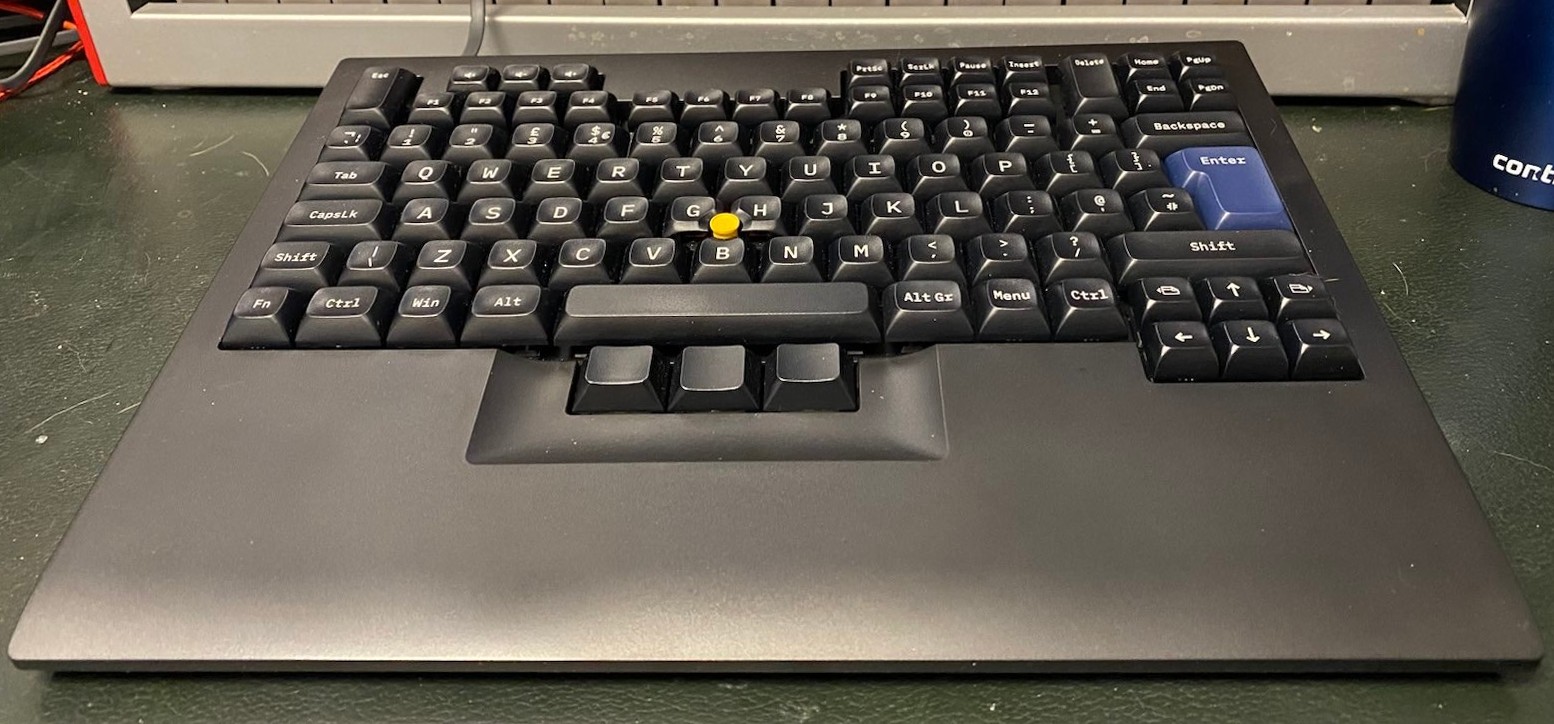
Shinobi, complete with cat hair Shinobi, complete with cat hair
A small Taiwanese company, Tex, produce a series of mechanical keyboards very openly inspired by the IBM/Lenovo trackpoint models that I've been using for so long, complete with trackpoints. I'd been eyeing up their Tex Yoda II keyboard for some time, which looks great, very minimalistic, but in practise I do use the keys it omits, and it's pricey. I decided to take the plunge and buy a more key-ful and reasonably priced Tex Shinobi ISO/UK layout, and I opted for Cherry MX Silent Red switches. Silent to give me the option of using in the Newcastle office, but also to reduce the risk of waking up the kids at home. The Silent Reds are a bit "squishier" than raw Reds which is a shame, but not enough of an obstacle to typing rapidly. The keyboard shape and layout is a close clone of the old IBM Ultranav keyboards I used to use so I was at home on it straight away. The real unknown quantity to me was how well the trackpoint works. I'd read mixed responses, but it's not clear that the people reviewing it were very familiar with the Lenovo ones. I am pleased to report that it's indistinguishable to the Lenovo one to me (and I used that a lot). The keyboard came in a funky replica Thinkpad box and with some keycap and trackpoint pointer options. I opted for a yellow "hat" shaped trackpoint cover (to appease my yellow-obsessed youngest daughter) and the blue IBM-style Enter keycap. Future I don't need any more keyboards! Unless I break this one. But in writing this I did notice that they are taking pre-orders on a new model Shura which seems to be halfway between the Yoda II and Shinobi. I imported the Shinobi from Tex direct (incurring the corresponding duty cost) but next time I might look for a UK distributor such as https://www.keyboardco.com/.

2 January 2023

Gunnar Wolf: Refueling the blog

So, it s this weird time of year where we make a balance and share with the world some ideas about the future. And yes, it s time to take care of this blog, as its activity has dropped once again. So maybe it d be nice to start this post by checking how much have I blogged over the years: (yes, this is an old blog) So yes, there is a clear downwards trend towards the last few years. And it does make sense, all in all: Not only have I managed to keep myself busier than before, but Blogging is a social endeavor. And as people have moved over to the different flavors of social networks, there is somewhat less fueling us to share our thoughts and experiences in this fashion. So this connects me to my first point: Staring at Noodles Emptiness, I got to a campaign to Bring Back Blogging. I stand by all of what they suggest: Blogs are a great invention, they allow the sharing of a great insight into a person s mind, ideas and worldview (and even more so if, like mine, it shows already a window of almost two decades of life! This year my blog will be old enough to vote!), they are completely decentralized, and can be easily grouped according to each readers preferences via the RSS format. Anyway I do want to write a post summing up 2022, as well as sharing some hopes and projects I have for 2023. But I don t want to make it too long to read. So That shall be the blog post for today! (post caption image by Walt Stoneburner on Flickr; CC BY 2.0)

Ben Hutchings: Debian LTS work, December 2022

In December I was assigned 15 hours by Freexian's Debian LTS initiative and carried over 9 hours from November. I worked all of those hours. I merged the latest bullseye point release into the linux-5.10 package, uploaded that, and issued DLA-3244-1. I also updated the linux (4.19) package to the latest stable and and stable-rt versions, uploaded it, and issued DLA-3245-1.

Next.

Previous.