Search Results: "nic"

2 November 2020

Joerg Jaspert: Debian NEW Queue, Rust packaging

Debian NEW Queue So for some reason I got myself motivated again to deal with some packages in Debians NEW Queue. We had 420 source packages waiting for some kind of processing when I started, now we are down to something around 10. (Silly, people keep uploading stuff ) That s not entirely my own work, others from the team have been active too, but for those few days I went through a lot of stuff waiting. And must say it still feels mostly like it did when I somehow stopped doing much in NEW. Except - well, I feel that maintainers are much better in preparing their packages, especially that dreaded task of getting the copyright file written seems to be one that is handled much better. Now, thats not supported by any real numbers, just a feeling, but a good one, I think.

Rust Dealing with NEW meant I got in contact with one part that currently generates some friction between the FTP Team and one group of package maintainers - the Rust team. Note: this is, of course, entirely written from my point of view. Though with the intention of presenting it as objective as possible. Also, I know what rust is, and have tried a Hello world in it, but that s about my deep knowledge of it

The problem Libraries in rust are bundled/shipped/whatever in something called crates, and you manage what your stuff needs and provides with a tool called cargo. A library (one per crate) can provide multiple features, say a TLS lib can link against gnutls or openssl or some other random implementation. Such features may even be combinable in various different ways, so one can have a high number of possible feature combinations for one crate. There is a tool called debcargo which helps creating a Debian package out of a crate. And that tool generates so-called feature-packages, one per feature / combination thereof. Those feature packages are empty packages, only containing a symlink for their /usr/share/doc/ directory, so their size is smaller than the metadata they will produce. Inside the archive and the files generated by it, stuff that every user everywhere has to download and their apt has to process. Additionally, any change of those feature sets means one round through NEW, which is also not ideal. So, naturally, the FTP Team dislikes those empty feature packages. Really, a lot. There appears to be a different way. Not having the feature packages, but putting all the combinations into a Provides header. That sometimes works, but has two problems:
  • It can generate really long Provides: lines. I mean, REALLY REALLY REALLY long. Somewhat around 250kb is the current record. Thats long enough that a tool (not dak itself) broke on it. Sure, that tool needs to be fixed, but still, that s not nice. Currently preferred from us, though.
  • Some of the features may need different dependencies (say, gnutls vs openssl), should those conflict with each other, you can not combine them into one package.

Solutions Currently we do not have a good one. The rust maintainers and the ftp team are talking, exploring various ideas, we will see what will come out.

Devel archive / Component One of the possible solutions for the feature package problem would be something that another set of packages could also make good use of, I think. The introduction of a new archive or component, meant only for packages that are needed to build something, but where users are discouraged from ever using them. What? Well, take golang as an example. While we have a load of golang-something packages in Debian, and they are used for building applications written in go - none of those golang-something are meant to be installed by users. If you use the language and develop in it, the go get way is the one you are expected to use. So having an archive (or maybe component like main or contrib) that, by default, won t be activated for users, but only for things like buildds or archive rebuilds, will make one problem (hated metadata bloat) be evaluated wildly different. It may also allow a more relaxed processing of binary-NEW (easier additions of new feature packages).

But but but Yes, it is not the most perfect solution. Without taking much energy to think about, it requires
  • an adjustment in how main is handled. Right now we have the golden rule that main is self contained, that is, things in it may not need anything outside it for building or running. That would need to be adjusted for building. (Go as well as currently rust are always building static binaries, so no library dependencies there).
  • It would need handling for the release, that is, the release team would need to deal with that archive/component too. We haven t, yet, talked to them (still, slowly, discussing inside FTP Team). So, no idea how many rusty knives they want to sink into our nice bodies for that idea

Final Well, it is still very much open. Had an IRC meeting with the rust people, will have another end of November, it will slowly go forward. And maybe someone comes up with an entire new idea that we all love. Don t know, time will tell.

Vincent Bernat: My collection of vintage PC cards

Recently, I have been gathering some old hardware at my parents house, notably PC extension cards, as they don t take much room and can be converted to a nice display item. Unfortunately, I was not very concerned about keeping stuff around. Compared to all the hardware I have acquired over the years, only a few pieces remain.

Tseng Labs ET4000AX (1989) This SVGA graphics card was installed into a PC powered by a 386SX CPU running at 16 MHz. This was a good card at the time as it was pretty fast. It didn t feature 2D acceleration, unlike the later ET4000/W32. This version only features 512 KB of RAM. It can display 1024 768 images with 16 colors or 800 600 with 256 colors. It was also compatible with CGA, EGA, VGA, MDA, and Hercules modes. No contemporary games were using the SVGA modes but the higher resolutions were useful with Windows 3. This card was manufactured directly by Tseng Labs.
Carte Tseng Labs ET4000AX ISA au-dessus de la bo te "Plan te Aventure"
Tseng Labs ET4000 AX ISA card

AdLib clone (1992) My first sound card was an AdLib. My parents bought it in Canada during the summer holidays in 1992. It uses a Yamaha OPL2 chip to produce sound via FM synthesis. The first game I have tried is Indiana Jones and the Last Crusade. I think I gave this AdLib to a friend once I upgraded my PC with a Sound Blaster Pro 2. Recently, I needed one for a side project, but they are rare and expensive on eBay. Someone mentioned a cheap clone on Vogons, so I bought it. It was sold by Sun Moon Star in 1992 and shipped with a CD-ROM of Doom shareware.
AdLib clone on top of "Alone in the Dark" box
AdLib clone ISA card by Sun Moon Star
On this topic, take a look at OPL2LPT: an AdLib sound card for the parallel port and OPL2 Audio Board: an AdLib sound card for Arduino .

Sound Blaster Pro 2 (1992) Later, I switched the AdLib sound card with a Sound Blaster Pro 2. It features an OPL3 chip and was also able to output digital samples. At the time, this was a welcome addition, but not as important as the FM synthesis introduced earlier by the AdLib.
Sound Blaster Pro 2 on top of "Day of the Tentacle" box
Sound Blaster Pro 2 ISA card

Promise EIDE 2300 Plus (1995) I bought this card mostly for the serial port. I was using a 486DX2 running at 66 MHz with a Creatix LC 288 FC external modem. The serial port was driven by an 8250 UART with no buffer. Thanks to Terminate, I was able to connect to BBSes with DOS, but this was not possible with Windows 3 or OS/2. I needed one of these fancy new cards with a 16550 UART, featuring a 16-byte buffer. At the time, this was quite difficult to find in France. During a holiday trip, I convinced my parent to make a short detour from Los Angeles to San Diego to buy this Promise EIDE 2300 Plus controller card at a shop I located through an advertisement in a local magazine! The card also features an EIDE controller with multi-word DMA mode 2 support. In contrast with the older PIO modes, the CPU didn t have to copy data from disk to memory.
Promise EIDE 2300 Plus next to an OS/2 Warp CD
Promise EIDE 2300 Plus VLB card

3dfx Voodoo2 Magic 3D II (1998) The 3dfx Voodoo2 was one of the first add-in graphics cards implementing hardware acceleration of 3D graphics. I bought it from a friend along with his Pentium II box in 1999. It was a big evolutionary step in PC gaming, as games became more beautiful and fluid. A traditional video controller was still required for 2D. A pass-through VGA cable daisy-chained the video controller to the Voodoo, which was itself connected to the monitor.
3dfx Voodoo 2 Magic 3D II on top of "Jedi Knight: Dark Forces II" box
3dfx Voodoo2 Magic 3D II PCI card

3Com 3C905C-TX-M Tornado (1999) In the early 2000s, in college, the Internet connection on the campus was provided by a student association through a 100 Mbps Ethernet cable. If you wanted to reach the maximum speed, the 3Com 3C905C-TX-M PCI network adapter, nicknamed Tornado , was the card you needed. We would buy it second-hand by the dozen and sell them to other students for around 30 .
3COM 3C905C-TX-M on top of "Red Alert" box
3Com 3C905C-TX-M PCI card

Sandro Knau : Bugzilla integration for KDE Project API

The KDE Bugzilla handles a lot of projects and they often match with the repo name, but not always. For instance we have ancient products and components at Bugzilla, as projects have a lifecycle from playground into Release Service, or Frameworks, sometimes with a change of name. So you may end up searching Bugzilla quite awhile for the correct product and component to be able to confirm or create bug reports against an application. Let's have a look at KPeople, and see why the situation is complicated. You find two products in KDE Bugzilla: kpeople (the repository's name) and on the other hand Frameworks have the scheme of a "frameworks-" prefix: frameworks-kpeople. From the data displayed even I as a developer am unable to tell which is the correct product to add new bug reports. Both have bug reports this year that got fixed and the number of bug reports is too low to get a clear picture of which to choose. This is not only a problem of KDE; it is a general problem in different communities that it is hard for newcomers to find the correct place to search and add new bug reports. That's why Debian added the bug report information for every package. This should help users to search the upstream bug reports or create new ones (Bug-Submit and Bug-Database): https://wiki.debian.org/UpstreamMetadata#Fields While I was collecting this information for Frameworks and KDE PIM, I wondered why KDE does not have links between each project and Bugzilla. After some searching and discussions it became obvious, that KDE does not have this information that can be processed. Okay let's fix this. The obvious place to reach this information is the Project API available under https://projects.kde.org/api/. To reach this goal I began adding Bugzilla information to the data source of the Project API named Git Repo Metadata. Then a merge request later the Project API is able to generate the links to Bugzilla invent:sysadmin/projects-api!2. Where you should search for bugs in kontact? Go to https://projects.kde.org/api/v1/identifier/kontact: After implementing the needed bits I found out that Nicolas Alvarez had the same idea, to store Bugzilla information in Git Repo Metadata invent:sysadmin/repo-metadata@085d878ea. Fortunately I can say that since June the information are used by Project API. So now, back to my task to add upstream metadata to Debian packages. After I filled the needed information to Repo Metadata I created a script to update the links in Debian salsa:qt-kde-team/pkg-kde-dev-scripts/function_collection/functions_plasma.py:addMissingBugMetadatafields. This should hopefully help to always point to the correct Bugzilla links in future. A random list came to my mind of places that may benefit from the Bugzilla information in Git Metadata Repository: The truth is, that Nicolas is right that adding the Bugzilla links are a manual task. But on the other hand, let's add this information once at one place and than we can use it at several places. Please help adding this information; it is simple a yaml file. If you see the data missing example commit and create a merge request. Or you can also give me the data and I'll add it.

1 November 2020

Vincent Bernat: Running Isso on NixOS in a Docker container

This short article documents how I run Isso, the commenting system used by this blog, inside a Docker container on NixOS, a Linux distribution built on top of Nix. Nix is a declarative package manager for Linux and other Unix systems.
While NixOS 20.09 includes a derivation for Isso, it is unfortunately broken and relies on Python 2. As I am also using a fork of Isso, I have built my own derivation, heavily inspired by the one in master:1
issoPackage = with pkgs.python3Packages; buildPythonPackage rec  
  pname = "isso";
  version = "custom";
  src = pkgs.fetchFromGitHub  
    # Use my fork
    owner = "vincentbernat";
    repo = pname;
    rev = "vbe/master";
    sha256 = "0vkkvjcvcjcdzdj73qig32hqgjly8n3ln2djzmhshc04i6g9z07j";
   ;
  propagatedBuildInputs = [
    itsdangerous
    jinja2
    misaka
    html5lib
    werkzeug
    bleach
    flask-caching
  ];
  buildInputs = [
    cffi
  ];
  checkInputs = [ nose ];
  checkPhase = ''
    $ python.interpreter  setup.py nosetests
  '';
 ;
I want to run Isso through Gunicorn. To this effect, I build a Python environment combining Isso and Gunicorn. Then, I can invoke the latter with "$ issoEnv /bin/gunicorn", like with a virtual environment.
issoEnv = pkgs.python3.buildEnv.override  
    extraLibs = [
      issoPackage
      pkgs.python3Packages.gunicorn
      pkgs.python3Packages.gevent
    ];
 ;
Before building a Docker image, I also need to specify the Isso configuration file for Isso:
issoConfig = pkgs.writeText "isso.conf" ''
  [general]
  dbpath = /db/comments.db
  host =
    https://vincent.bernat.ch
    http://localhost:8080
  notify = smtp
  [ ]
'';
NixOS comes with a convenient tool to build a Docker image without a Dockerfile:
issoDockerImage = pkgs.dockerTools.buildImage  
  name = "isso";
  tag = "latest";
  extraCommands = ''
    mkdir -p db
  '';
  config =  
    Cmd = [ "$ issoEnv /bin/gunicorn"
            "--name" "isso"
            "--bind" "0.0.0.0:$ port "
            "--worker-class" "gevent"
            "--workers" "2"
            "--worker-tmp-dir" "/dev/shm"
            "--preload"
            "isso.run"
          ];
    Env = [
      "ISSO_SETTINGS=$ issoConfig "
      "SSL_CERT_FILE=$ pkgs.cacert /etc/ssl/certs/ca-bundle.crt"
    ];
   ;
 ;
Because we refer to the issoEnv derivation in config.Cmd, the whole derivation, including Isso and Gunicorn, is copied inside the Docker image. The same applies for issoConfig, the configuration file we created earlier, and pkgs.cacert, the derivation containing trusted root certificates. The resulting image is 171 MB once installed, which is comparable to the Debian Buster image generated by the official Dockerfile. NixOS features an abstraction to run Docker containers. It is not currently documented in NixOS manual but you can look at the source code of the module for the available options. I choose to use Podman instead of Docker as the backend because it does not require running an additional daemon.
virtualisation.oci-containers =  
  backend = "podman";
  containers =  
    isso =  
      image = "isso";
      imageFile = issoDockerImage;
      ports = ["127.0.0.1:$ port :$ port "];
      volumes = [
        "/var/db/isso:/db"
      ];
     ;
   ;
 ;
A systemd unit file is automatically created to run and supervise the container:
$ systemctl status podman-isso.service
  podman-isso.service
     Loaded: loaded (/nix/store/a66gzqqwcdzbh99sz8zz5l5xl8r8ag7w-unit->
     Active: active (running) since Sun 2020-11-01 16:04:16 UTC; 4min 44s ago
    Process: 14564 ExecStartPre=/nix/store/95zfn4vg4867gzxz1gw7nxayqcl>
   Main PID: 14697 (podman)
         IP: 0B in, 0B out
      Tasks: 10 (limit: 2313)
     Memory: 221.3M
        CPU: 10.058s
     CGroup: /system.slice/podman-isso.service
              14697 /nix/store/pn52xgn1wb2vr2kirq3xj8ij0rys35mf-podma>
              14802 /nix/store/7vsba54k6ag4cfsfp95rvjzqf6rab865-conmo>
nov. 01 16:04:17 web03 podman[14697]: container init (image=localhost/isso:latest)
nov. 01 16:04:17 web03 podman[14697]: container start (image=localhost/isso:latest)
nov. 01 16:04:17 web03 podman[14697]: container attach (image=localhost/isso:latest)
nov. 01 16:04:19 web03 conmon[14802]: INFO: connected to SMTP server
nov. 01 16:04:19 web03 conmon[14802]: INFO: connected to https://vincent.bernat.ch
nov. 01 16:04:19 web03 conmon[14802]: [INFO] Starting gunicorn 20.0.4
nov. 01 16:04:19 web03 conmon[14802]: [INFO] Listening at: http://0.0.0.0:8080 (1)
nov. 01 16:04:19 web03 conmon[14802]: [INFO] Using worker: gevent
nov. 01 16:04:19 web03 conmon[14802]: [INFO] Booting worker with pid: 8
nov. 01 16:04:19 web03 conmon[14802]: [INFO] Booting worker with pid: 9
As the last step, we configure Nginx to forward requests for comments.luffy.cx to the container. NixOS provides a simple integration to grab a Let s Encrypt certificate.
services.nginx.virtualHosts."comments.luffy.cx" =  
  root = "/data/webserver/comments.luffy.cx";
  enableACME = true;
  forceSSL = true;
  extraConfig = ''
    access_log /var/log/nginx/comments.luffy.cx.log anonymous;
  '';
  locations."/" =  
    proxyPass = "http://127.0.0.1:$ port ";
    extraConfig = ''
      proxy_set_header X-Forwarded-For $proxy_add_x_forwarded_for;
      proxy_set_header Host $host;
      proxy_set_header X-Forwarded-Proto $scheme;
      proxy_hide_header Set-Cookie;
      proxy_hide_header X-Set-Cookie;
      proxy_ignore_headers Set-Cookie;
    '';
   ;
 ;
security.acme.certs."comments.luffy.cx" =  
  email = lib.concatStringsSep "@" [ "letsencrypt" "vincent.bernat.ch" ];
 ;

While I still struggle with Nix and NixOS, I am convinced this is how declarative infrastructure should be done. I like how in one single file, I can define the derivation to build Isso, the configuration, the Docker image, the container definition, and the Nginx configuration. The Nix language is used both for building packages and for managing configurations. Moreover, the Docker image is updated automatically like a regular NixOS host. This solves an issue plaguing the Docker ecosystem: no more stale images! My next step would be to combine this approach with Nomad, a simple orchestrator to deploy and manage containers.

  1. There is a subtle difference: I am using buildPythonPackage instead of buildPythonApplication. This is important for the next step. I didn t investigate if an application can be converted to a package easily.

Paul Wise: FLOSS Activities October 2020

Focus This month I didn't have any particular focus. I just worked on issues in my info bubble.

Changes

Issues

Review
  • Spam: reported 2 Debian bug reports and 147 Debian mailing list posts
  • Patches: merged libicns patches
  • Debian packages: sponsored iotop-c
  • Debian wiki: RecentChanges for the month
  • Debian screenshots:

Administration
  • Debian: get us removed from an RBL
  • Debian wiki: reset email addresses, approve accounts

Communication

Sponsors The pytest-rerunfailures/pyemd/morfessor work was sponsored by my employer. All other work was done on a volunteer basis.

Junichi Uekawa: I'm playing more computer games recently.

I'm playing more computer games recently. Splatoon2, Ring Fit Adventure, Fit Boxing, and NieR Automata.

29 October 2020

Ulrike Uhlig: Better handling emergencies

We all know these situations when we receive an email asking Can you check the design of X, I need a reply by tonight. Or an instant message: My website went down, can you check? Another email: I canceled a plan at the hosting company, can you restore my website as fast as possible? A phone call: The TLS certificate didn t get updated, and now we can t access service Y. Yet another email: Our super important medical advice website is suddenly being censored in country Z, can you help? Everyone knows those messages that have URGENT in capital letters in the email subject. It might be that some of them really are urgent. Others are the written signs of someone having a hard time properly planning their own work and passing their delays on to someone who comes later in the creation or production chain. And others again come from people who are overworked and try to delegate some of their tasks to a friendly soul who is likely to help.

How emergencies create more emergencies In the past, my first reflex when I received an urgent request was to start rushing into solutions. This happened partly out of empathy, partly because I like to be challenged into solving problems, and I m fairly good at that. This has proven to be unsustainable, and here is why.

Emergencies create unplanned work The first issue is that emergencies create a lot of unplanned work. Which in turn means not getting other, scheduled, things done. This can create a backlog, end up in working late, or working on weekends.

Emergencies can create a permanent state of exception Unplanned work can also create a lot of frustration, out of the feeling of not getting the things done that one planned to do. We might even get a feeling of being nonautonomous (in German I would say fremdbestimmt, which roughly translates to being directed by others ). On the long term, this can generate unsustainable situations: higher work loads, and burnout. When working in a team of several people, A might have to take over the work of B because B has not enough capacities. Then A gets overloaded in turn, and C and D have to take over A s work. Suddenly the team is stuck in a permanent state of exception. This state of exception will produce more backlog. The team might start to deprioritize social issues over getting technical things done. They might not be able to recruit new people anymore because they have no capacity left to onboard newcomers.

One emergency can result in a variety of emergencies for many people The second issue produced by urgent requests is that if I cannot solve the initial emergency by myself, I might try to involve colleagues, other people who are skilled in the area, or people who work in another relevant organization to help with this. Suddenly, the initial emergency has become my emergency as well as the emergency of a whole bunch of other people.

A sidenote about working with friends This might be less of an issue in a classical work setup than in a situation in which a bunch of freelancers work together, or in setups in which work and friendships are intertwined. This is a problem, because the boundaries between friend and worker role, and the expectations that go along with these roles, can get easily confused. If a colleague asks me to help with task X, I might say no; if a friend asks, I might be less likely to say no.

What I learnt about handling emergencies I came up with some guidelines that help me to better handle emergencies.

Plan for unplanned work It doesn t matter and it doesn t help to distinguish if urgent requests are legitimate or if they come from people who have not done their homework on time. What matters is to make one s weekly todo list sustainable. After reading Making work visible by Domenica de Grandis, I understood the need to add free slots for unplanned work into one s weekly schedule. Slots for unplanned work can take up to 25% of the total work time!

Take time to make plans Now that there are some free slots to handle emergencies, one can take some time to think when an urgent request comes in. A German saying proposes to wait and have some tea ( abwarten und Tee trinken ). I think this is actually really good advice, and works for any non-obvious problem. Sit down and let the situation sink in. Have a tea, take a shower, go for a walk. It s never that urgent. Really, never. If possible, one can talk about the issue with another person, rubberduck style. Then one can make a plan on how to address the emergency properly, it could be that the solution is easier than at first thought.

Affirming boundaries: Saying no Is the emergency that I m asked to solve really my problem? Or is someone trying to involve me because they know I m likely to help? Take a deep breath and think about it. No? It s not my job, not my role? I have no time for this right now? I don t want to do it? Maybe I m not even paid for it? A colleague is pushing my boundaries to get some task on their own todo list done? Then I might want to say no. I can t help with this. or I can help you in two weeks. I don t need to give a reason. No. is a sentence. And: Saying no doesn t make me an arse.

Affirming boundaries: Clearly defining one s role Clearly defining one s role is something that is often overlooked. In many discussions I have with friends it appears that this is a major cause of overwork and underpayment. Lots of people are skilled, intelligent, and curious, and easily get challenged into putting on their super hero dress. But they re certainly not the only person that can help even if an urgent request makes them think that at first. To clearly define our role, we need to make clear which part of the job is our work, and which part needs to be done by other people. We should stop trying to accomodate people and their requests to the detriment of our own sanity. You re a language interpreter and are being asked to mediate a bi-lingual conflict between the people you are interpreting for? It s not your job. You re the graphic designer for a poster, but the text you ve been given is not good enough? Send back a recommendation to change the text; don t do these changes yourself: it s not your job. But you can and want to do this yourself and it would make your client s life easier? Then ask them to get paid for the extra time, and make sure to renegotiate your deadline!

Affirming boundaries: Defining expectations Along with our role, we need to define expectations: in which timeframe am I willing to do the job? Under which contract, which agreement, which conditions? For which payment? People who work in a salary office job generally do have a work contract in which their role and the expectations that come with this role are clearly defined. Nevertheless, I hear from friends that their superiors regularly try to make them do tasks that are not part of their role definition. So, here too, role and expectations sometimes need to be renegotiated, and the boundaries of these roles need to be clearly affirmed.

Random conclusive thoughts If you ve read until here, you might have experienced similar things. Or, on the contrary, maybe you re already good at communicating your boundaries and people around you have learnt to respect them? Congratulations. In any case, for improving one s own approach to such requests, it can be useful to find out which inner dynamics are at play when we interact with other people. Additionally, it can be useful to understand the differences between Asker and Guesser culture:
when an Asker meets a Guesser, unpleasantness results. An Asker won t think it s rude to request two weeks in your spare room, but a Guess culture person will hear it as presumptuous and resent the agony involved in saying no. Your boss, asking for a project to be finished early, may be an overdemanding boor or just an Asker, who s assuming you might decline. If you re a Guesser, you ll hear it as an expectation.
Askers should also be aware that there might be Guessers in their team. It can help to define clear guidelines about making requests (when do I expect an answer, under which budget/contract/responsibility does the request fall, what other task can be put aside to handle the urgent task?) Last, but not least, Making work visible has a lot of other proposals on how to visibilize and then deal with unplanned work.

28 October 2020

Daniel Lange: Git shared hosting quirk

Show https://github.com/torvalds/linux/blob/b4061a10fc29010a610ff2b5b20160d7335e69bf/drivers/hid/hid-samsung.c#L113-L118 to a friend. Oops 'eh? Yep, Linux has been backdoored. Well, or not. Konstantin Ryabitsev explains it nicely in a cgit mailing list email:
It is common for git hosting environments to configure all forks of the same repo to use an "object storage" repository. For example, this is what allows git.kernel.org's 600+ forks of linux.git to take up only 10GB on disk as opposed to 800GB. One of the side-effects of this setup is that any object in the shared repository can be accessed from any of the forks, which periodically confuses people into believing that something terrible has happened.
The hack was discussed on Github in Dec 2018 when it was discovered. I forgot about it again but Konstantin's mail brought the memory back and I think it deserves more attention. I'm sure putting some illegal content into a fork and sending a made up "blob" URL to law enforcement would go quite far. Good luck explaining the issue. "Yes this is my repo" but "no, no that's not my data" ... "yes, it is my repo but not my data" ... "no we don't want that data either, really" ... "but, but there is nothing we can do, we host on github...1". Update 05.11.20 Nate Friedman (CEO of Github) promises
[..] we are going to make it much more obvious when you're viewing an orphaned commit.
For context: The source code of Github (the product) had been leaked as a commit to Github's own DMCA repository. The repository has turned into a playground since Github took down the hosting for youtube-dl as the result of a DMCA complaint. 14.11.20 Seems Github now adds a warning to commits that are not in a reachable branch Github commit warning message

  1. Actually there is something you can do. Making a repo private takes it out of the shared "object storage". You can make it public again afterwards. Seems to work at least for now.

26 October 2020

Marco d'Itri: RPKI validation with FORT Validator

This article documents how to install FORT Validator (an RPKI relying party software which also implements the RPKI to Router protocol in a single daemon) on Debian 10 to provide RPKI validation to routers. If you are using testing or unstable then you can just skip the part about apt pinnings. The packages in bullseye (Debian testing) can be installed as is on Debian stable with no need to rebuild them, by configuring an appropriate pinning for apt:
cat <<END > /etc/apt/sources.list.d/bullseye.list
deb http://deb.debian.org/debian/ bullseye main
END
cat <<END > /etc/apt/preferences.d/pin-rpki
# by default do not install anything from bullseye
Package: *
Pin: release bullseye
Pin-Priority: 100
Package: fort-validator rpki-trust-anchors
Pin: release bullseye
Pin-Priority: 990
END
apt update
Before starting, make sure that curl (or wget) and the web PKI certificates are installed:
apt install curl ca-certificates
If you already know about the legal issues related to the ARIN TAL then you may instruct the package to automatically install it. If you skip this step then you will be asked at installation time about it, either way is fine.
echo 'rpki-trust-anchors rpki-trust-anchors/get_arin_tal boolean true' \
    debconf-set-selections
Install the package as usual:
apt install fort-validator
You may also install rpki-client and gortr on Debian 10, or maybe cfrpki and gortr. I have also tried packaging Routinator 3000 for Debian, but this effort is currently on hold because the Rust ecosystem is broken and hostile to the good packaging practices of Linux distributions.

24 October 2020

Dirk Eddelbuettel: digest 0.6.27: Build fix

Exactly one week after the previous release 0.6.26 of digest, a minor cleanup release 0.6.27 just arrived on CRAN and will go to Debian shortly. digest creates hash digests of arbitrary R objects (using the md5, sha-1, sha-256, sha-512, crc32, xxhash32, xxhash64, murmur32, spookyhash, and blake3 algorithms) permitting easy comparison of R language objects. It is a fairly widely-used package (currently listed at one million monthly downloads, 282 direct reverse dependencies and 8068 indirect reverse dependencies, or just under half of CRAN) as many tasks may involve caching of objects for which it provides convenient general-purpose hash key generation. Release 0.6.26 brought support for the (nice, even cryptographic) blake3 hash algorithm. In the interest of broader buildability we had already (with a sad face) disabled a few very hardware-specific implementation aspects using intrinsic ops. But to our chagrin, we left one #error define that raised its head on everybody s favourite CRAN build platform. Darn. So 0.6.27 cleans that up and also removes the check and #error as all the actual code was already commented out. If you read this and tears start running down your cheeks, then by all means come and help us bring blake3 to its full (hardware-accelerated) potential. This (probably) only needs a little bit of patient work with the build options and configurations. You know where to find us My CRANberries provides the usual summary of changes to the previous version. For questions or comments use the issue tracker off the GitHub repo. If you like this or other open-source work I do, you can now sponsor me at GitHub. For the first year, GitHub will match your contributions.

This post by Dirk Eddelbuettel originated on his Thinking inside the box blog. Please report excessive re-aggregation in third-party for-profit settings.

23 October 2020

Molly de Blanc: Endorsements

Transparency is essential to trusting a technology. Through transparency we can understand what we re using and build trust. When we know what is actually going on, what processes are occurring and how it is made, we are able to decide whether interacting with it is something we actually want, and we re able to trust it and use it with confidence. This transparency could mean many things, though it most frequently refers to the technology itself: the code or, in the case of hardware, the designs. We could also apply it to the overall architecture of a system. We could think about the decision making, practices, and policies of whomever is designing and/or making the technology. These are all valuable in some of the same ways, including that they allow us to make a conscious choice about what we are supporting. When we choose to use a piece of technology, we are supporting those who produce it. This could be because we are directly paying for it, however our support is not limited to direct financial contributions. In some cases this is because of things hidden within a technology: tracking mechanisms or backdoors that could allow companies or governments access to what we re doing. When creating different types of files on a computer, these files can contain metadata that says what software was used to make it. This is an implicit endorsement, and you can also explicitly endorse a technology by talking about that or how you use it. In this, you have a right (not just a duty) to be aware of what you re supporting. This includes, for example, organizational practices and whether a given company relies on abusive labor policies, indentured servitude, or slave labor.
Endorsements inspire others to choose a piece of technology. Most of my technology is something I investigate purely for functionality, and the pieces I investigate are based on what people I know use. The people I trust in these cases are more inclined than most to do this kind of research, to perform technical interrogations, and to be aware of what producers of technology are up to. This is how technology spreads and becomes common or the standard choice. In one sense, we all have the responsibility (one I am shirking) to investigate our technologies before we choose them. However, we must acknowledge that not everyone has the resources for this the time, the skills, the knowledge, and therein endorsements become even more important to recognize. Those producing a technology have the responsibility of making all of these angles something one could investigate. Understanding cannot only be the realm of experts. It should not require an extensive background in research and investigative journalism to find out whether a company punishes employees who try to unionize or pay non-living wages. Instead, these must be easy activities to carry out. It should be standard for a company (or other technology producer) to be open and share with people using their technology what makes them function. It should be considered shameful and shady to not do so. Not only does this empower those making choices about what technologies to use, but it empowers others down the line, who rely on those choices. It also respects the people involved in the processes of making these technologies. By acknowledging their role in bringing our tools to life, we are respecting their labor. By holding companies accountable for their practices and policies, we are respecting their lives.

21 October 2020

Reproducible Builds: Supporter spotlight: Civil Infrastructure Platform

The Reproducible Builds project depends on our many projects, supporters and sponsors. We rely on their financial support, but they are also valued ambassadors who spread the word about the Reproducible Builds project and the work that we do. This is the first installment in a series featuring the projects, companies and individuals who support the Reproducible Builds project. If you are a supporter of the Reproducible Builds project (of whatever size) and would like to be featured here, please let get in touch with us at contact@reproducible-builds.org. However, we are kicking off this series by featuring Urs Gleim and Yoshi Kobayashi of the Civil Infrastructure Platform (CIP) project.
Chris Lamb: Hi Urs and Yoshi, great to meet you. How might you relate the importance of the Civil Infrastructure Platform to a user who is non-technical? A: The Civil Infrastructure Platform (CIP) project is focused on establishing an open source base layer of industrial-grade software that acts as building blocks in civil infrastructure projects. End-users of this critical code include systems for electric power generation and energy distribution, oil and gas, water and wastewater, healthcare, communications, transportation, and community management. These systems deliver essential services, provide shelter, and support social interactions and economic development. They are society s lifelines, and CIP aims to contribute to and support these important pillars of modern society.
Chris: We have entered an age where our civilisations have become reliant on technology to keep us alive. Does the CIP believe that the software that underlies our own safety (and the safety of our loved ones) receives enough scrutiny today? A: For companies developing systems running our infrastructure and keeping our factories working, it is part of their business to ensure the availability, uptime, and security of these very systems. However, software complexity continues to increase, and the efforts spent on those systems is now exploding. What is missing is a common way of achieving this through refining the same tools, and cooperating on the hardening and maintenance of standard components such as the Linux operating system.
Chris: How does the Reproducible Builds effort help the Civil Infrastructure Platform achieve its goals? A: Reproducibility helps a great deal in software maintenance. We have a number of use-cases that should have long-term support of more than 10 years. During this period, we encounter issues that need to be fixed in the original source code. But before we make changes to the source code, we need to check whether it is actually the original source code or not. If we can reproduce exactly the same binary from the source code even after 10 years, we can start to invest time and energy into making these fixes.
Chris: Can you give us a brief history of the Civil Infrastructure Platform? Are there any specific success stories that the CIP is particularly proud of? A: The CIP Project formed in 2016 as a project hosted by Linux Foundation. It was launched out of necessity to establish an open source framework and the subsequent software foundation delivers services for civil infrastructure and economic development on a global scale. Some key milestones we have achieved as a project include our collaboration with Debian, where we are helping with the Debian Long Term Support (LTS) initiative, which aims to extend the lifetime of all Debian stable releases to at least 5 years. This is critical because most control systems for transportation, power plants, healthcare and telecommunications run on Debian-based embedded systems. In addition, CIP is focused on IEC 62443, a standards-based approach to counter security vulnerabilities in industrial automation and control systems. Our belief is that this work will help mitigate the risk of cyber attacks, but in order to deal with evolving attacks of this kind, all of the layers that make up these complex systems (such as system services and component functions, in addition to the countless operational layers) must be kept secure. For this reason, the IEC 62443 series is attracting attention as the de facto cyber-security standard.
Chris: The Civil Infrastructure Platform project comprises a number of project members from different industries, with stakeholders across multiple countries and continents. How does working together with a broad group of interests help in your effectiveness and efficiency? A: Although the members have different products, they share the requirements and issues when developing sustainable products. In the end, we are driven by common goals. For the project members, working internationally is simply daily business. We see this as an advantage over regional or efforts that focus on narrower domains or markets.
Chris: The Civil Infrastructure Platform supports a number of other existing projects and initiatives in the open source world too. How much do you feel being a part of the broader free software community helps you achieve your aims? A: Collaboration with other projects is an essential part of how CIP operates we want to enable commonly-used software components. It would not make sense to re-invent solutions that are already established and widely used in product development. To this end, we have an upstream first policy which means that, if existing projects need to be modified to our needs or are already working on issues that we also need, we work directly with them.
Chris: Open source software in desktop or user-facing contexts receives a significant amount of publicity in the media. However, how do you see the future of free software from an industrial-oriented context? A: Open source software has already become an essential part of the industry and civil infrastructure, and the importance of open source software there is still increasing. Without open source software, we cannot achieve, run and maintain future complex systems, such as smart cities and other key pieces of civil infrastructure.
Chris: If someone wanted to know more about the Civil Infrastructure Platform (or even to get involved) where should they go to look? A: We have many avenues to participate and learn more! We have a website, a wiki and you can even follow us on Twitter.

For more about the Reproducible Builds project, please see our website at reproducible-builds.org. If you are interested in ensuring the ongoing security of the software that underpins our civilisation and wish to sponsor the Reproducible Builds project, please reach out to the project by emailing contact@reproducible-builds.org.

20 October 2020

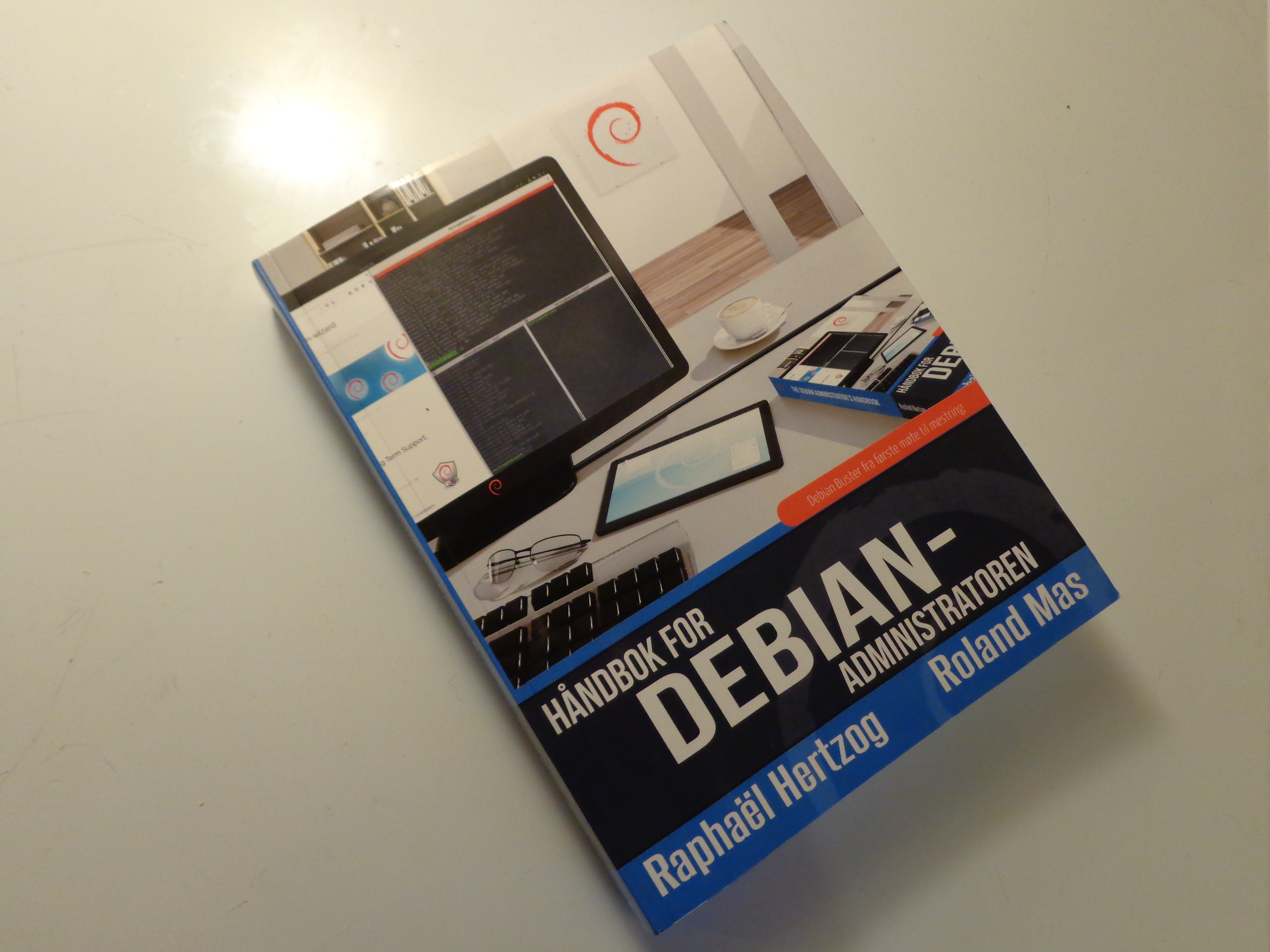
Petter Reinholdtsen: Buster based Bokm l edition of Debian Administrator's Handbook

I am happy to report that we finally made it! Norwegian Bokm l became the first translation published on paper of the new Buster based edition of "The Debian Administrator's Handbook". The print proof reading copy arrived some days ago, and it looked good, so now the book is approved for general distribution. This updated paperback edition is available from lulu.com. The book is also available for download in electronic form as PDF, EPUB and Mobipocket, and can also be read online. I am very happy to wrap up this Creative Common licensed project, which concludes several months of work by several volunteers. The number of Linux related books published in Norwegian are few, and I really hope this one will gain many readers, as it is packed with deep knowledge on Linux and the Debian ecosystem. The book will be available for various Internet book stores like Amazon and Barnes & Noble soon, but I recommend buying "H ndbok for Debian-administratoren" directly from the source at Lulu. As usual, if you use Bitcoin and want to show your support of my activities, please send Bitcoin donations to my address 15oWEoG9dUPovwmUL9KWAnYRtNJEkP1u1b.

Steve Kemp: Offsite-monitoring, from my desktop.

For the past few years I've had a bunch of virtual machines hosting websites, services, and servers. Of course I want them to be available - especially since I charge people money to access at some of them (for example my dns-hosting service) - and that means I want to know when they're not. The way I've gone about this is to have a bunch of machines running stuff, and then dedicate an entirely separate machine solely for monitoring and alerting. Sure you can run local monitoring, testing that services are available, the root-disk isn't full, and that kind of thing. But only by testing externally can you see if the machine is actually available to end-users, customers, or friends.
A local-agent might decide "I'm fine", but if the hosting-company goes dark due to a fibre cut you're screwed.
I've been hosting my services with Hetzner (cloud) recently, and their service is generally pretty good. Unfortunately I've started to see an increasing number of false-alarms. I'd have a server in Germany, with the monitoring machine in Helsinki (coincidentally where I live!). For the past month I've started to get pinged with a failure every three/four days on average, "service down - dns failed", or "service down - timeout". When the notice would wake me up I'd go check and it would be fine, it was a very transient failure. To be honest the reason for this is my monitoring is just too damn aggressive, I like to be alerted immediately in case something is wrong. That means if a single test fails I get an alert, as rather than only if a test failed for something more reasonable like three+ consecutive failures. I'm experimenting with monitoring in a less aggressive fashion, from my home desktop. Since my monitoring tool is a single self-contained golang binary, and it is already packaged as a docker-based container deployment was trivial. I did a little work writing an agent to receive failure-notices, and ping me via telegram - instead of the previous approach where I had an online status-page which I could view via my mobile, and alerts via pushover. So far it looks good. I've tweaked the monitoring to setup a timeout of 15 seconds, instead of 5, and I've configured it to only alert me if there is an outage which lasts for >= 2 consecutive failures. I guess the TLDR is I now do offsite monitoring .. from my house, rather than from a different region. The only real reason to write this post was mostly to say that the process of writing a trivial "notify me" gateway to interface with telegram was nice and straightforward, and to remind myself that transient failures are way more common than we expect. I'll leave things alone for a moment, but it was a fun experiment. I'll keep the two systems in parallel for a while, but I guess I can already predict the outcome:

19 October 2020

Russell Coker: Video Decoding

I ve had a saga of getting 4K monitors to work well. My latest issue has been video playing, the dreaded mplayer error about the system being too slow. My previous post about 4K was about using DisplayPort to get more than 30Hz scan rate at 4K [1]. I now have a nice 60Hz scan rate which makes WW2 documentaries display nicely among other things. But when running a 4K monitor on a 3.3GHz i5-2500 quad-core CPU I can t get a FullHD video to display properly. Part of the process of decoding the video and scaling it to 4K resolution is too slow, so action scenes in movies lag. When running a 2560*1440 monitor on a 2.4GHz E5-2440 hex-core CPU with the mplayer option -lavdopts threads=3 everything is great (but it fails if mplayer is run with no parameters). In doing tests with apparent performance it seemed that the E5-2440 CPU gains more from the threaded mplayer code than the i5-2500, maybe the E5-2440 is more designed for server use (it s in a Dell PowerEdge T320 while the i5-2500 is in a random white-box system) or maybe it s just because it s newer. I haven t tested whether the i5-2500 system could perform adequately at 2560*1440 resolution. The E5-2440 system has an ATI HD 6570 video card which is old, slow, and only does PCIe 2.1 which gives 5GT/s or 8GB/s. The i5-2500 system has a newer ATI video card that is capable of PCIe 3.0, but lspci -vv as root says LnkCap: Port #0, Speed 8GT/s, Width x16 and LnkSta: Speed 5GT/s (downgraded), Width x16 (ok) . So for reasons unknown to me the system with a faster PCIe 3.0 video card is being downgraded to PCIe 2.1 speed. A quick check of the web site for my local computer store shows that all ATI video cards costing less than $300 have PCI3 3.0 interfaces and the sole ATI card with PCIe 4.0 (which gives double the PCIe speed if the motherboard supports it) costs almost $500. I m not inclined to spend $500 on a new video card and then a greater amount of money on a motherboard supporting PCIe 4.0 and CPU and RAM to go in it. According to my calculations 3840*2160 resolution at 24bpp (probably 32bpp data transfers) at 30 frames/sec means 3840*2160*4*30/1024/1024=950MB/s. PCIe 2.1 can do 8GB/s so that probably isn t a significant problem. I d been planning on buying a new video card for the E5-2440 system, but due to some combination of having a better CPU and lower screen resolution it is working well for video playing so I can save my money. As an aside the T320 is a server class system that had been running for years in a corporate DC. When I replaced the high speed SAS disks with SSDs SATA disks it became quiet enough for a home workstation. It works very well at that task but the BIOS is quite determined to keep the motherboard video running due to the remote console support. So swapping monitors around was more pain than I felt like going through, I just got it working and left it. I ordered a special GPU power cable but found that the older video card that doesn t need an extra power cable performs adequately before the cable arrived. Here is a table comparing the systems.
2560*1440 works well 3840*2160 goes slow
System Dell PowerEdge T320 White Box PC from rubbish
CPU 2.4GHz E5-2440 3.3GHz i5-2500
Video Card ATI Radeon HD 6570 ATI Radeon R7 260X
PCIe Speed PCIe 2.1 8GB/s PCIe 3.0 downgraded to PCIe 2.1 8GB/s
Conclusion The ATI Radeon HD 6570 video card is one that I had previously tested and found inadequate for 4K support, I can t remember if it didn t work at that resolution or didn t support more than 30Hz scan rate. If the 2560*1440 monitor dies then it wouldn t make sense to buy anything less than a 4K monitor to replace it which means that I d need to get a new video card to match. But for the moment 2560*1440 is working well enough so I won t upgrade it any time soon. I ve already got the special power cable (specified as being for a Dell PowerEdge R610 for anyone else who wants to buy one) so it will be easy to install a powerful video card in a hurry.

Louis-Philippe V ronneau: Musings on long-term software support and economic incentives

Although I still read a lot, during my college sophomore years my reading habits shifted from novels to more academic works. Indeed, reading dry textbooks and economic papers for classes often kept me from reading anything else substantial. Nowadays, I tend to binge read novels: I won't touch a book for months on end, and suddenly, I'll read 10 novels back to back1. At the start of a novel binge, I always follow the same ritual: I take out my e-reader from its storage box, marvel at the fact the battery is still pretty full, turn on the WiFi and check if there are OS updates. And I have to admit, Kobo Inc. (now Rakuten Kobo) has done a stellar job of keeping my e-reader up to date. I've owned this model (a Kobo Aura 1st generation) for 7 years now and I'm still running the latest version of Kobo's Linux-based OS. Having recently had trouble updating my Nexus 5 (also manufactured 7 years ago) to Android 102, I asked myself:
Why is my e-reader still getting regular OS updates, while Google stopped issuing security patches for my smartphone four years ago?
To try to answer this, let us turn to economic incentives theory. Although not the be-all and end-all some think it is3, incentives theory is not a bad tool to analyse this particular problem. Executives at Google most likely followed a very business-centric logic when they decided to drop support for the Nexus 5. Likewise, Rakuten Kobo's decision to continue updating older devices certainly had very little to do with ethics or loyalty to their user base. So, what are the incentives that keep Kobo updating devices and why are they different than smartphone manufacturers'? A portrait of the current long-term software support offerings for smartphones and e-readers Before delving deeper in economic theory, let's talk data. I'll be focusing on 2 brands of e-readers, Amazon's Kindle and Rakuten's Kobo. Although the e-reader market is highly segmented and differs a lot based on geography, Amazon was in 2015 the clear worldwide leader with 53% of the worldwide e-reader sales, followed by Rakuten Kobo at 13%4. On the smartphone side, I'll be differentiating between Apple's iPhones and Android devices, taking Google as the barometer for that ecosystem. As mentioned below, Google is sadly the leader in long-term Android software support. Rakuten Kobo According to their website and to this Wikipedia table, the only e-readers Kobo has deprecated are the original Kobo eReader and the Kobo WiFi N289, both released in 2010. This makes their oldest still supported device the Kobo Touch, released in 2011. In my book, that's a pretty good track record. Long-term software support does not seem to be advertised or to be a clear selling point in their marketing. Amazon According to their website, Amazon has dropped support for all 8 devices produced before the Kindle Paperwhite 2nd generation, first sold in 2013. To put things in perspective, the first Kindle came out in 2007, 3 years before Kobo started selling devices. Like Rakuten Kobo, Amazon does not make promises of long-term software support as part of their marketing. Apple Apple has a very clear software support policy for all their devices:
Owners of iPhone, iPad, iPod or Mac products may obtain a service and parts from Apple or Apple service providers for five years after the product is no longer sold or longer, where required by law.
This means in the worst-case scenario of buying an iPhone model just as it is discontinued, one would get a minimum of 5 years of software support. Android Google's policy for their Android devices is to provide software support for 3 years after the launch date. If you buy a Pixel device just before the new one launches, you could theoretically only get 2 years of support. In 2018, Google decided OEMs would have to provide security updates for at least 2 years after launch, threatening not to license Google Apps and the Play Store if they didn't comply. A question of cost structure From the previous section, we can conclude that in general, e-readers seem to be supported longer than smartphones, and that Apple does a better job than Android OEMs, providing support for about twice as long. Even Fairphone, who's entire business is to build phones designed to last and to be repaired was not able to keep the Fairphone 1 (2013) updated for more than a couple years and seems to be struggling to keep the Fairphone 2 (2015) running an up to date version of Android. Anyone who has ever worked in IT will tell you: maintaining software over time is hard work and hard work by specialised workers is expensive. Most commercial electronic devices are sold and developed by for-profit enterprises and software support all comes down to a question of cost structure. If companies like Google or Fairphone are to be expected to provide long-term support for the devices they manufacture, they have to be able to fund their work somehow. In a perfect world, people would be paying for the cost of said long-term support, as it would likely be cheaper then buying new devices every few years and would certainly be better for the planet. Problem is, manufacturers aren't making them pay for it. Economists call this type of problem externalities: things that should be part of the cost of a good, but aren't for one a reason or another. A classic example of an externality is pollution. Clearly pollution is bad and leads to horrendous consequences, like climate change. Sane people agree we should drastically cut our greenhouse gas emissions, and yet, we aren't. Neo-classical economic theory argues the way to fix externalities like pollution is to internalise these costs, in other words, to make people pay for the "real price" of the goods they buy. In the case of climate change and pollution, neo-classical economic theory is plain wrong (spoiler alert: it often is), but this is where band-aids like the carbon tax comes from. Still, coming back to long-term software support, let's see what would happen if we were to try to internalise software maintenance costs. We can do this multiple ways. 1 - Include the price of software maintenance in the cost of the device This is the choice Fairphone makes. This might somewhat work out for them since they are a very small company, but it cannot scale for the following reasons:
  1. This strategy relies on you giving your money to an enterprise now, and trusting them to "Do the right thing" years later. As the years go by, they will eventually look at their books, see how much ongoing maintenance is costing them, drop support for the device, apologise and move on. That is to say, enterprises have a clear economic incentive to promise long-term support and not deliver. One could argue a company's reputation would suffer from this kind of behaviour. Maybe sometime it does, but most often people forget. Political promises are a great example of this.
  2. Enterprises go bankrupt all the time. Even if company X promises 15 years of software support for their devices, if they cease to exist, your device will stop getting updates. The internet is full of stories of IoT devices getting bricked when the parent company goes bankrupt and their servers disappear. This is related to point number 1: to some degree, you have a disincentive to pay for long-term support in advance, as the future is uncertain and there are chances you won't get the support you paid for.
  3. Selling your devices at a higher price to cover maintenance costs does not necessarily mean you will make more money overall raising more money to fund maintenance costs being the goal here. To a certain point, smartphone models are substitute goods and prices higher than market prices will tend to drive consumers to buy cheaper ones. There is thus a disincentive to include the price of software maintenance in the cost of the device.
  4. People tend to be bad at rationalising the total cost of ownership over a long period of time. Economists call this phenomenon hyperbolic discounting. In our case, it means people are far more likely to buy a 500$ phone each 3 years than a 1000$ phone each 10 years. Again, this means OEMs have a clear disincentive to include the price of long-term software maintenance in their devices.
Clearly, life is more complex than how I portrayed it: enterprises are not perfect rational agents, altruism exists, not all enterprises aim solely for profit maximisation, etc. Still, in a capitalist economy, enterprises wanting to charge for software maintenance upfront have to overcome these hurdles one way or another if they want to avoid failing. 2 - The subscription model Another way companies can try to internalise support costs is to rely on a subscription-based revenue model. This has multiple advantages over the previous option, mainly:
  1. It does not affect the initial purchase price of the device, making it easier to sell them at a competitive price.
  2. It provides a stable source of income, something that is very valuable to enterprises, as it reduces overall risks. This in return creates an incentive to continue providing software support as long as people are paying.
If this model is so interesting from an economic incentives point of view, why isn't any smartphone manufacturer offering that kind of program? The answer is, they are, but not explicitly5. Apple and Google can fund part of their smartphone software support via the 30% cut they take out of their respective app stores. A report from Sensor Tower shows that in 2019, Apple made an estimated US$ 16 billion from the App Store, while Google raked in US$ 9 billion from the Google Play Store. Although the Fortune 500 ranking tells us this respectively is "only" 5.6% and 6.5% of their gross annual revenue for 2019, the profit margins in this category are certainly higher than any of their other products. This means Google and Apple have an important incentive to keep your device updated for some time: if your device works well and is updated, you are more likely to keep buying apps from their store. When software support for a device stops, there is a risk paying customers will buy a competitor device and leave their ecosystem. This also explains why OEMs who don't own app stores tend not to provide software support for very long periods of time. Most of them only make money when you buy a new phone. Providing long-term software support thus becomes a disincentive, as it directly reduces their sale revenues. Same goes for Kindles and Kobos: the longer your device works, the more money they make with their electronic book stores. In my opinion, it's likely Amazon and Rakuten Kobo produce quarterly cost-benefit reports to decide when to drop support for older devices, based on ongoing support costs and the recurring revenues these devices bring in. Rakuten Kobo is also in a more precarious situation than Amazon is: considering Amazon's very important market share, if your device stops getting new updates, there is a greater chance people will replace their old Kobo with a Kindle. Again, they have an important economic incentive to keep devices running as long as they are profitable. Can Free Software fix this? Yes and no. Free Software certainly isn't a magic wand one can wave to make everything better, but does provide major advantages in terms of security, user freedom and sometimes costs. The last piece of the puzzle explaining why Rakuten Kobo's software support is better than Google's is technological choices. Smartphones are incredibly complex devices and have become the main computing platform of many. Similar to the web, there is a race for features and complexity that tends to create bloat and make older devices slow and painful to use. On the other hand, e-readers are simpler devices built for a single task: display electronic books. Control over the platform is also a key aspect of the cost structure of providing software updates. Whereas Apple controls both the software and hardware side of iPhones, Android is a sad mess of drivers and SoCs, all providing different levels of support over time6. If you take a look at the platforms the Kindle and Kobo are built on, you'll quickly see they both use Freescale I.MX SoCs. These processors are well known for their excellent upstream support in the Linux kernel and their relative longevity, chips being produced for either 10 or 15 years. This in turn makes updates much easier and less expensive to provide. So clearly, open architectures, free drivers and open hardware helps tremendously, but aren't enough on their own. One of the lessons we must learn from the (amazing) LineageOS project is how lack of funding hurts everyone. If there is no one to do the volunteer work required to maintain a version of LOS for your device, it won't be supported. Worse, when purchasing a new device, users cannot know in advance how many years of LOS support they will get. This makes buying new devices a frustrating hit-and-miss experience. If you are lucky, you will get many years of support. Otherwise, you risk your device becoming an expensive insecure paperweight. So how do we fix this? Anyone with a brain understands throwing away perfectly good devices each 2 years is not sustainable. Government regulations enforcing a minimum support life would be a step in the right direction, but at the end of the day, Capitalism is to blame. Like the aforementioned carbon tax, band-aid solutions can make things somewhat better, but won't fix our current economic system's underlying problems. For now though, I'll leave fixing the problem of Capitalism to someone else.

  1. My most recent novel binge has been focused on re-reading the Dune franchise. I first read the 6 novels written by Frank Herbert when I was 13 years old and only had vague and pleasant memories of his work. Great stuff.
  2. I'm back on LineageOS! Nice folks released an unofficial LOS 17.1 port for the Nexus 5 last January and have kept it updated since then. If you are to use it, I would also recommend updating TWRP to this version specifically patched for the Nexus 5.
  3. Very few serious economists actually believe neo-classical rational agent theory is a satisfactory explanation of human behavior. In my opinion, it's merely a (mostly flawed) lens to try to interpret certain behaviors, a tool amongst others that needs to be used carefully, preferably as part of a pluralism of approaches.
  4. Good data on the e-reader market is hard to come by and is mainly produced by specialised market research companies selling their findings at very high prices. Those particular statistics come from a MarketWatch analysis.
  5. If they were to tell people: You need to pay us 5$/month if you want to receive software updates, I'm sure most people would not pay. Would you?
  6. Coming back to Fairphones, if they had so much problems providing an Android 9 build for the Fairphone 2, it's because Qualcomm never provided Android 7+ support for the Snapdragon 801 SoC it uses.

18 October 2020

Iustin Pop: Serendipity

To start off, let me say it again: I hate light pollution. I really, really hate it. I love the night sky where you look up and see thousands of stars, and constellations besides Ursa Major. As somebody said once, You haven t lived until you ve seen your shadow by the light of the Milky Way . But, ahem, I live in a large city, and despite my attempts using star trackers, special filters, etc. you simply can t escape it. So, whenever we go on vacation in the mountains, I m trying to think if I can do a bit of astro-photography (not that I m good at it). Which bring me to our recent vacation up in the mountains. I was looking forward to it, until in the week before, when the weather prognosis was switching between snow, rain and overcast for the entire week. No actual day or night with clear skies, so I didn t take a tripod, I didn t take a wide lens, and put night photography out of my mind. Vacation itself was good, especially the quietness of the place, so I usually went to be early-ish and didn t look outside. The weather was as forecasted - no new snow (but there was enough up in the mountains), but heavy clouds all the time, and the sun only showed itself for a few minutes at a time. One night I was up a bit longer than usual, working on the laptop and being very annoyed by a buzzing sound. At first I thought maybe I was imagining it, but from time to time it was stopping briefly, so it was a real noise; I started hunting for the source. Not my laptop, not the fridge, not the TV but it was getting stronger near the window. I open the door to the balcony, and bam! Very loud noise, from the hotel nearby, where at midnight the pool was being cleaned. I look at the people doing the work, trying to estimate how long it ll be until they finish, but it was looking like a long time. Fortunately with the door closed the noise was not bad enough to impact my sleep, so I debate getting angry or just resigned, and since it was late, I just sigh, roll my eyes not metaphorically, but actually roll my eyes and look up, and I can t believe my eyes. Completely clear sky, no trace of clouds anywhere, and stars. Lots of starts. I sit there, looking at the sky and enjoying the view, and I think to myself that it won t look that nice on the camera, for sure. Especially without a real trip, and without a fast lens. Nevertheless, I grab my camera and just for kicks take one handheld picture. To my surprise (and almost disbelief), blurry pixels aside, the photo does look like what I was seeing, so I grab my tiny tripod that I carried along, and (with only a 24-70 zoom lens), grab a photo. And another, and another and then I realise that if I can make the composition work, and find a good shutter speed, this can turn out a good picture. I didn t have a remote release, the tripod was not very stable and it cannot point the camera upwards (it s basically an emergency tripod), so it was quite sub-optimal; still, I try multiple shots (different compositions, different shutter speeds); they look on the camera screen and on the phone pretty good, so just for safety I take a few more, and, very happy, go to bed. Coming back from vacation, on the large monitor, it turns out that the first 28 out of the 30 pictures were either blurry or not well focused (as I was focusing manually), and the 29th was almost OK but still not very good. Only the last, the really last picture, was technically good and also composition-wise OK. Luck? Foresight? Don t know, but it was worth deleting 28 pictures to get this one. One of my best night shots, despite being so unprepared
Stars! Lots of stars! And mountains Stars! Lots of stars! And mountains
Of course, compared to other people s pictures, this is not special. But for me, it will be a keepsake of how a real night sky should look like. If you want to zoom in, higher resolution on flickr. Technically, the challenges for the picture were two-fold: Next time when travelling by car, I ll surely take a proper tripod Until next time, clear and dark skies

17 October 2020

Dirk Eddelbuettel: digest 0.6.26: Blake3 and Tuning

And a new version of digest is now on CRAN will go to Debian shortly. digest creates hash digests of arbitrary R objects (using the md5, sha-1, sha-256, sha-512, crc32, xxhash32, xxhash64, murmur32, spookyhash, and blake3 algorithms) permitting easy comparison of R language objects. It is a fairly widely-used package (currently listed at 896k monthly downloads, 279 direct reverse dependencies and 8057 indirect reverse dependencies, or just under half of CRAN) as many tasks may involve caching of objects for which it provides convenient general-purpose hash key generation. This release brings two nice contributed updates. Dirk Schumacher added support for blake3 (though we could probably push this a little harder for performance, help welcome). Winston Chang benchmarked and tuned some of the key base R parts of the package. Last but not least I flipped the vignette to the lovely minidown, updated the Travis CI setup using bspm (as previously blogged about in r4 #30), and added a package website using Matertial for MkDocs. My CRANberries provides the usual summary of changes to the previous version. For questions or comments use the issue tracker off the GitHub repo. If you like this or other open-source work I do, you can now sponsor me at GitHub. For the first year, GitHub will match your contributions.

This post by Dirk Eddelbuettel originated on his Thinking inside the box blog. Please report excessive re-aggregation in third-party for-profit settings.

Junichi Uekawa: Troubleshooting your audio input.

Troubleshooting your audio input. When doing video conferencing sometimes I hear the remote end not doing very well. Especially when your friend tells you he bought a new mic and it didn't sound well, they might be using the wrong configuration on the OS and using the other mic, or they might have a constant noise source in the room that affects the video conferencing noise cancelling algorithms. Yes, noise cancelling algorithms aren't perfect because detecting what is noise is heuristic and better to have low level of noise. Here is the app. I have a video to demonstrate.

16 October 2020

Yves-Alexis Perez: iOS 14 USB tethering broken on Linux: looking for documentation and contact at Apple

It's a bit of a long shot, but maybe someone on Planet Debian or elsewhere can help us reach the right people at Apple. Starting with iOS 14, something apparently changed on the way USB tethering (also called Personal Hotspot) is set up, which broke it for people using Linux. The driver in use is ipheth, developped in 2009 and included in the Linux kernel in 2010. The kernel driver negotiates over USB with the iOS device in order to setup the link. The protocol used by both parties to communicate don't really seemed documented publicly, and it seems the protocol has evolved over time and iOS versions, and the Linux driver hasn't been kept up to date. On macOS and Windows the driver apparently comes with iTunes, and Apple engineers obviously know how to communicate with iOS devices, so iOS 14 is supported just fine. There's an open bug on libimobildevice (the set of userlands tools used to communicate with iOS devices, although the update should be done in the kernel), with some debugging and communication logs between Windows and an iOS device, but so far no real progress has been done. The link is enabled, the host gets an IP from the device, can ping the device IP and can even resolve name using the device DNS resolver, but IP forwarding seems disabled, no packet goes farther than the device itself. That means a lot of people upgrading to iOS 14 will suddenly lose USB tethering. While Wi-Fi and Bluetooth connection sharing still works, it's still suboptimal, so it'd be nice to fix the kernel driver and support the latest protocol used in iOS 14. If someone knows the right contact (or the right way to contact them) at Apple so we can have access to some kind of documentation on the protocol and the state machine to use, please reach us (either to the libimobile device bug or to my email address below). Thanks!

Next.

Previous.