Search Results: "nate"

10 February 2017

Jonas Meurer: debian lts report 2017.01

Debian LTS report for January 2017 January 2017 was my fifth month as a Debian LTS team member. I was allocated 12 hours and had 6,75 hours left over from December 2016. This makes a total of 18,75 hours. Unfortunately I found less time than expected to work on Debian LTS in January. In total, I spent 9 hours on the following security updates:

Dirk Eddelbuettel: anytime 0.2.1

An updated anytime package arrived at CRAN yesterday. This is release number nine, and the first with a little gap to the prior release on Christmas Eve as the features are stabilizing, as is the implementation. anytime is a very focused package aiming to do just one thing really well: to convert anything in integer, numeric, character, factor, ordered, ... format to either POSIXct or Date objects -- and to do so without requiring a format string. See the anytime page, or the GitHub README.md for a few examples. This releases addresses two small things related to the anydate() and utcdate() conversion (see below) and adds one nice new format, besides some internal changes detailed below:
R> library(anytime)
R> anytime("Thu Sep 01 10:11:12 CDT 2016")
[1] "2016-09-01 10:11:12 CDT"
R> anytime("Thu Sep 01 10:11:12.123456 CDT 2016") # with frac. seconds
[1] "2016-09-01 10:11:12.123456 CDT"
R> 
Of course, all commands are also fully vectorised. See the anytime page, or the GitHub README.md for more examples.

Changes in anytime version 0.2.1 (2017-02-09)
  • The new DatetimeVector class from Rcpp is now used, and proper versioned Depends: have been added (#43)
  • The anydate and utcdate functions convert again from factor and ordered (#46 closing #44)
  • A format similar to RFC 28122 but with additonal timezone text can now be parsed (#48 closing #47)
  • Conversion from POSIXt to Date now also respect the timezone (#50 closing #49)
  • The internal .onLoad functions was updated
  • The Travis setup uses https to fetch the run script

Courtesy of CRANberries, there is a comparison to the previous release. More information is on the anytime page. For questions or comments use the issue tracker off the GitHub repo.

This post by Dirk Eddelbuettel originated on his Thinking inside the box blog. Please report excessive re-aggregation in third-party for-profit settings.

9 February 2017

Charles Plessy: Beware of libinput 1.6.0-1

Since I updated this evening, touch to click with my touchpad is almost totally broken. Fortunately, a correction is pending. update: To reinstall packages version 1.5.5-4 solves the problem in the meantime.

Sven Hoexter: Limit host access based on LDAP groupOfUniqueNames with sssd

For CentOS 4 to CentOS 6 we used pam_ldap to restrict host access to machines, based on groupOfUniqueNames listed in an openldap. With RHEL/CentOS 6 RedHat already deprecated pam_ldap and highly recommended to use sssd instead, and with RHEL/CentOS 7 they finally removed pam_ldap from the distribution. Since pam_ldap supported groupOfUniqueNames to restrict logins a bigger collection of groupOfUniqueNames were created to restrict access to all kind of groups/projects and so on. But sssd is in general only able to filter based on an "ldap_access_filter" or use the host attribute via "ldap_user_authorized_host". That does not allow the use of "groupOfUniqueNames". So to allow a smoth migration I had to configure sssd in some way to still support groupOfUniqueNames. The configuration I ended up with looks like this:
[domain/hostacl]
autofs_provider = none 
ldap_schema = rfc2307bis
# to work properly we've to keep the search_base at the highest level
ldap_search_base = ou=foo,ou=people,o=myorg
ldap_default_bind_dn = cn=ro,ou=ldapaccounts,ou=foo,ou=people,o=myorg
ldap_default_authtok = foobar
id_provider = ldap
auth_provider = ldap
chpass_provider = none
ldap_uri = ldaps://ldapserver:636
ldap_id_use_start_tls = false
cache_credentials = false
ldap_tls_cacertdir = /etc/pki/tls/certs
ldap_tls_cacert = /etc/pki/tls/certs/ca-bundle.crt
ldap_tls_reqcert = allow
ldap_group_object_class = groupOfUniqueNames
ldap_group_member = uniqueMember
access_provider = simple
simple_allow_groups = fraappmgmtt
[sssd]
domains = hostacl
services = nss, pam
config_file_version = 2
Important side note: With current sssd versions you're more or less forced to use ldaps with a validating CA chain, though hostnames are not required to match the CN/SAN so far. Relevant are: In practise what we do is match the member of the groupOfUniqueNames to the sssd internal group representation. The best explanation about the several possible object classes in LDAP for group representation I've found so far is unfortunately in a german blog post. Another explanation is in the LDAP wiki. In short: within a groupOfUniqueNames you'll find a full DN, while in a posixGroup you usually find login names. Different kind of object class requires a different handling. Next step would be to move auth and nss functionality to sssd as well.

Dirk Eddelbuettel: RcppArmadillo 0.7.700.0.0

armadillo image Time for another update of RcppArmadillo with a new release 0.7.700.0.0 based on a fresh Armadillo 7.700.0. Following my full reverse-dependency check of 318 package (commit of log here), CRAN took another day to check again. Armadillo is a powerful and expressive C++ template library for linear algebra aiming towards a good balance between speed and ease of use with a syntax deliberately close to a Matlab. RcppArmadillo integrates this library with the R environment and language--and is widely used by (currently) 318 other packages on CRAN -- an increase of 20 just since the last CRAN release of 0.7.600.1.0 in December! Changes in this release relative to the previous CRAN release are as follows:

Changes in RcppArmadillo version 0.7.700.0.0 (2017-02-07)
  • Upgraded to Armadillo release 7.700.0 ("Rogue State")
    • added polyfit() and polyval()
    • added second form of log_det() to directly return the result as a complex number
    • added range() to statistics functions
    • expanded trimatu()/trimatl() and symmatu()/symmatl() to handle sparse matrice

Changes in RcppArmadillo version 0.7.600.2.0 (2017-01-05)
  • Upgraded to Armadillo release 7.600.2 (Coup d'Etat Deluxe)
    • Bug fix to memory allocation for fields

Courtesy of CRANberries, there is a diffstat report. More detailed information is on the RcppArmadillo page. Questions, comments etc should go to the rcpp-devel mailing list off the R-Forge page.

This post by Dirk Eddelbuettel originated on his Thinking inside the box blog. Please report excessive re-aggregation in third-party for-profit settings.

Steve Kemp: Old packages are interesting.

Recently Vincent Bernat wrote about writing his own simple terminal, using vte. That was a fun read, as the sample code built really easily and was functional. At the end of his post he said :
evilvte is quite customizable and can be lightweight. Consider it as a first alternative. Honestly, I don t remember why I didn t pick it.
That set me off looking at evilvte, and it was one of those rare projects which seems to be pretty stable, and also hasn't changed in any recent release of Debian GNU/Linux: I wonder if it would be possible to easily generate a list of packages which have the same revision in multiple distributions? Anyway I had a look at the source, and unfortunately spotted that it didn't entirely handle clicking on hyperlinks terribly well. Clicking on a link would pretty much run:
 firefox '%s'
That meant there was an obvious security problem. It is a great terminal though, and it just goes to show how short, simple, and readable such things can be. I enjoyed looking at the source, and furthermore enjoyed using it. Unfortunately due to a dependency issue it looks like this package will be removed from stretch.

8 February 2017

Steve Kemp: Old packages are interesting.

Recently Vincent Bernat wrote about writing his own simple terminal, using vte. That was a fun read, as the sample code built really easily and was functional. At the end of his post he said :
evilvte is quite customizable and can be lightweight. Consider it as a first alternative. Honestly, I don t remember why I didn t pick it.
That set me off looking at evilvte, and it was one of those rare projects which seems to be pretty stable, and also hasn't changed in any recent release of Debian GNU/Linux: I wonder if it would be possible to easily generate a list of packages which have the same revision in multiple distributions? Anyway I had a look at the source, and unfortunately spotted that it didn't entirely handle clicking on hyperlinks terribly well. Clicking on a link would pretty much run:
 firefox '%s'
That meant there was an obvious security problem. It is a great terminal though, and it just goes to show how short, simple, and readable such things can be. I enjoyed looking at the source, and furthermore enjoyed using it. Unfortunately due to a dependency issue it looks like this package will be removed from stretch.

Antoine Beaupr : Reliably generating good passwords

Passwords are used everywhere in our modern life. Between your email account and your bank card, a lot of critical security infrastructure relies on "something you know", a password. Yet there is little standard documentation on how to generate good passwords. There are some interesting possibilities for doing so; this article will look at what makes a good password and some tools that can be used to generate them. There is growing concern that our dependence on passwords poses a fundamental security flaw. For example, passwords rely on humans, who can be coerced to reveal secret information. Furthermore, passwords are "replayable": if your password is revealed or stolen, anyone can impersonate you to get access to your most critical assets. Therefore, major organizations are trying to move away from single password authentication. Google, for example, is enforcing two factor authentication for its employees and is considering abandoning passwords on phones as well, although we have yet to see that controversial change implemented. Yet passwords are still here and are likely to stick around for a long time until we figure out a better alternative. Note that in this article I use the word "password" instead of "PIN" or "passphrase", which all roughly mean the same thing: a small piece of text that users provide to prove their identity.

What makes a good password? A "good password" may mean different things to different people. I will assert that a good password has the following properties:
  • high entropy: hard to guess for machines
  • transferable: easy to communicate for humans or transfer across various protocols for computers
  • memorable: easy to remember for humans
High entropy means that the password should be unpredictable to an attacker, for all practical purposes. It is tempting (and not uncommon) to choose a password based on something else that you know, but unfortunately those choices are likely to be guessable, no matter how "secret" you believe it is. Yes, with enough effort, an attacker can figure out your birthday, the name of your first lover, your mother's maiden name, where you were last summer, or other secrets people think they have. The only solution here is to use a password randomly generated with enough randomness or "entropy" that brute-forcing the password will be practically infeasible. Considering that a modern off-the-shelf graphics card can guess millions of passwords per second using freely available software like hashcat, the typical requirement of "8 characters" is not considered enough anymore. With proper hardware, a powerful rig can crack such passwords offline within about a day. Even though a recent US National Institute of Standards and Technology (NIST) draft still recommends a minimum of eight characters, we now more often hear recommendations of twelve characters or fourteen characters. A password should also be easily "transferable". Some characters, like & or !, have special meaning on the web or the shell and can wreak havoc when transferred. Certain software also has policies of refusing (or requiring!) some special characters exactly for that reason. Weird characters also make it harder for humans to communicate passwords across voice channels or different cultural backgrounds. In a more extreme example, the popular Signal software even resorted to using only digits to transfer key fingerprints. They outlined that numbers are "easy to localize" (as opposed to words, which are language-specific) and "visually distinct". But the critical piece is the "memorable" part: it is trivial to generate a random string of characters, but those passwords are hard for humans to remember. As xkcd noted, "through 20 years of effort, we've successfully trained everyone to use passwords that are hard for human to remember but easy for computers to guess". It explains how a series of words is a better password than a single word with some characters replaced. Obviously, you should not need to remember all passwords. Indeed, you may store some in password managers (which we'll look at in another article) or write them down in your wallet. In those cases, what you need is not a password, but something I would rather call a "token", or, as Debian Developer Daniel Kahn Gillmor (dkg) said in a private email, a "high entropy, compact, and transferable string". Certain APIs are specifically crafted to use tokens. OAuth, for example, generates "access tokens" that are random strings that give access to services. But in our discussion, we'll use the term "token" in a broader sense. Notice how we removed the "memorable" property and added the "compact" one: we want to efficiently convert the most entropy into the shortest password possible, to work around possibly limiting password policies. For example, some bank cards only allow 5-digit security PINs and most web sites have an upper limit in the password length. The "compact" property applies less to "passwords" than tokens, because I assume that you will only use a password in select places: your password manager, SSH and OpenPGP keys, your computer login, and encryption keys. Everything else should be in a password manager. Those tools are generally under your control and should allow large enough passwords that the compact property is not particularly important.

Generating secure passwords We'll look now at how to generate a strong, transferable, and memorable password. These are most likely the passwords you will deal with most of the time, as security tokens used in other settings should actually never show up on screen: they should be copy-pasted or automatically typed in forms. The password generators described here are all operated from the command line. Password managers often have embedded password generators, but usually don't provide an easy way to generate a password for the vault itself. The previously mentioned xkcd cartoon is probably a common cultural reference in the security crowd and I often use it to explain how to choose a good passphrase. It turns out that someone actually implemented xkcd author Randall Munroe's suggestion into a program called xkcdpass:
    $ xkcdpass
    estop mixing edelweiss conduct rejoin flexitime
In verbose mode, it will show the actual entropy of the generated passphrase:
    $ xkcdpass -V
    The supplied word list is located at /usr/lib/python3/dist-packages/xkcdpass/static/default.txt.
    Your word list contains 38271 words, or 2^15.22 words.
    A 6 word password from this list will have roughly 91 (15.22 * 6) bits of entropy,
    assuming truly random word selection.
    estop mixing edelweiss conduct rejoin flexitime
Note that the above password has 91 bits of entropy, which is about what a fifteen-character password would have, if chosen at random from uppercase, lowercase, digits, and ten symbols:
    log2((26 + 26 + 10 + 10)^15) = approx. 92.548875
It's also interesting to note that this is closer to the entropy of a fifteen-letter base64 encoded password: since each character is six bits, you end up with 90 bits of entropy. xkcdpass is scriptable and easy to use. You can also customize the word list, separators, and so on with different command-line options. By default, xkcdpass uses the 2 of 12 word list from 12 dicts, which is not specifically geared toward password generation but has been curated for "common words" and words of different sizes. Another option is the diceware system. Diceware works by having a word list in which you look up words based on dice rolls. For example, rolling the five dice "1 4 2 1 4" would give the word "bilge". By rolling those dice five times, you generate a five word password that is both memorable and random. Since paper and dice do not seem to be popular anymore, someone wrote that as an actual program, aptly called diceware. It works in a similar fashion, except that passwords are not space separated by default:
    $ diceware
    AbateStripDummy16thThanBrock
Diceware can obviously change the output to look similar to xkcdpass, but can also accept actual dice rolls for those who do not trust their computer's entropy source:
    $ diceware -d ' ' -r realdice -w en_orig
    Please roll 5 dice (or a single dice 5 times).
    What number shows dice number 1? 4
    What number shows dice number 2? 2
    What number shows dice number 3? 6
    [...]
    Aspire O's Ester Court Born Pk
The diceware software ships with a few word lists, and the default list has been deliberately created for generating passwords. It is derived from the standard diceware list with additions from the SecureDrop project. Diceware ships with the EFF word list that has words chosen for better recognition, but it is not enabled by default, even though diceware recommends using it when generating passwords with dice. That is because the EFF list was added later on. The project is currently considering making the EFF list be the default. One disadvantage of diceware is that it doesn't actually show how much entropy the generated password has those interested need to compute it for themselves. The actual number depends on the word list: the default word list has 13 bits of entropy per word (since it is exactly 8192 words long), which means the default 6 word passwords have 78 bits of entropy:
    log2(8192) * 6 = 78
Both of these programs are rather new, having, for example, entered Debian only after the last stable release, so they may not be directly available for your distribution. The manual diceware method, of course, only needs a set of dice and a word list, so that is much more portable, and both the diceware and xkcdpass programs can be installed through pip. However, if this is all too complicated, you can take a look at Openwall's passwdqc, which is older and more widely available. It generates more memorable passphrases while at the same time allowing for better control over the level of entropy:
    $ pwqgen
    vest5Lyric8wake
    $ pwqgen random=78
    Theme9accord=milan8ninety9few
For some reason, passwdqc restricts the entropy of passwords between the bounds of 24 and 85 bits. That tool is also much less customizable than the other two: what you see here is pretty much what you get. The 4096-word list is also hardcoded in the C source code; it comes from a Usenet sci.crypt posting from 1997. A key feature of xkcdpass and diceware is that you can craft your own word list, which can make dictionary-based attacks harder. Indeed, with such word-based password generators, the only viable way to crack those passwords is to use dictionary attacks, because the password is so long that character-based exhaustive searches are not workable, since they would take centuries to complete. Changing from the default dictionary therefore brings some advantage against attackers. This may be yet another "security through obscurity" procedure, however: a naive approach may be to use a dictionary localized to your native language (for example, in my case, French), but that would deter only an attacker that doesn't do basic research about you, so that advantage is quickly lost to determined attackers. One should also note that the entropy of the password doesn't depend on which word list is chosen, only its length. Furthermore, a larger dictionary only expands the search space logarithmically; in other words, doubling the word-list length only adds a single bit of entropy. It is actually much better to add a word to your password than words to the word list that generates it.

Generating security tokens As mentioned before, most password managers feature a way to generate strong security tokens, with different policies (symbols or not, length, etc). In general, you should use your password manager's password-generation functionality to generate tokens for sites you visit. But how are those functionalities implemented and what can you do if your password manager (for example, Firefox's master password feature) does not actually generate passwords for you? pass, the standard UNIX password manager, delegates this task to the widely known pwgen program. It turns out that pwgen has a pretty bad track record for security issues, especially in the default "phoneme" mode, which generates non-uniformly distributed passwords. While pass uses the more "secure" -s mode, I figured it was worth removing that option to discourage the use of pwgen in the default mode. I made a trivial patch to pass so that it generates passwords correctly on its own. The gory details are in this email. It turns out that there are lots of ways to skin this particular cat. I was suggesting the following pipeline to generate the password:
    head -c $entropy /dev/random   base64   tr -d '\n='
The above command reads a certain number of bytes from the kernel (head -c $entropy /dev/random) encodes that using the base64 algorithm and strips out the trailing equal sign and newlines (for large passwords). This is what Gillmor described as a "high-entropy compact printable/transferable string". The priority, in this case, is to have a token that is as compact as possible with the given entropy, while at the same time using a character set that should cause as little trouble as possible on sites that restrict the characters you can use. Gillmor is a co-maintainer of the Assword password manager, which chose base64 because it is widely available and understood and only takes up 33% more space than the original 8-bit binary encoding. After a lengthy discussion, the pass maintainer, Jason A. Donenfeld, chose the following pipeline:
    read -r -n $length pass < <(LC_ALL=C tr -dc "$characters" < /dev/urandom)
The above is similar, except it uses tr to directly to read characters from the kernel, and selects a certain set of characters ($characters) that is defined earlier as consisting of [:alnum:] for letters and digits and [:graph:] for symbols, depending on the user's configuration. Then the read command extracts the chosen number of characters from the output and stores the result in the pass variable. A participant on the mailing list, Brian Candler, has argued that this wastes entropy as the use of tr discards bits from /dev/urandom with little gain in entropy when compared to base64. But in the end, the maintainer argued that reading "reading from /dev/urandom has no [effect] on /proc/sys/kernel/random/entropy_avail on Linux" and dismissed the objection. Another password manager, KeePass uses its own routines to generate tokens, but the procedure is the same: read from the kernel's entropy source (and user-generated sources in case of KeePass) and transform that data into a transferable string.

Conclusion While there are many aspects to password management, we have focused on different techniques for users and developers to generate secure but also usable passwords. Generating a strong yet memorable password is not a trivial problem as the security vulnerabilities of the pwgen software showed. Furthermore, left to their own devices, users will generate passwords that can be easily guessed by a skilled attacker, especially if they can profile the user. It is therefore essential we provide easy tools for users to generate strong passwords and encourage them to store secure tokens in password managers.
Note: this article first appeared in the Linux Weekly News.

6 February 2017

Wouter Verhelst: FOSDEM 2017 is finished...

... but that doesn't mean the work is over. One big job that needs to happen after the conference is to review and release the video recordings that were made. With several hundreds of videos to be checked and only a handful of people with the ability to do so, review was a massive job that for the past three editions took several months; e.g., in 2016 the last video work was done in July, when the preparation of the 2017 edition had already started. Obviously this is suboptimal, and therefore another solution was required. After working on it for quite a while (in my spare time), I came up with SReview, a video review and transcoding system written in Perl. An obvious question that could be asked is why I wrote yet another system, though, and did not use something that already existed. The short answer to that is "because what's there did not exactly do what I wanted to". The somewhat longer answer also involves the fact that I felt like writing something from scratch. The full story, however, is this: there isn't very much out there, and what does exist is flawed in some ways. I am aware of three other review systems that are or were used by other conferences:
  1. A bunch of shell scripts that were written by the DebConf video team and hooked into the penta database. Nobody but DebConf ever used it. It allowed review via an NFS share and a webinterface, and required people to watch .dv files directly from the filesystem in a media player. For this and other reasons, it could only ever be used from the conference itself. If nothing else, that final limitation made it impossible for FOSDEM to use it, but even if that wasn't the case it was still too basic to ever be useful for a conference the size of FOSDEM.
  2. A review system used by the CCC "voc" team. I've never actually seen it in use, but I've heard people describe it. It involves a complicated setup of Samba servers, short MPEG transport stream segments, a FUSE filesystem, and kdenlive, which took someone several days to set up as an experiment back at DebConf15. Critically, important parts of it are also not licensed as free software, which to me rules it out for a tool in support of FOSDEM. Even if that wasn't the case, however, I'm still not sure it would be ideal; this system requires intimate knowledge of how it works from its user, which makes it harder for us to crowdsource the review to the speaker, as I had planned to.
  3. Veyepar. This one gets many things right, and we used it for video review at DebConf from DebConf14 onwards, as well as FOSDEM 2014 (but not 2015 or 2016). Unfortunately, it also gets many things wrong. Most of these can be traced back to the fact that Carl, as he freely admits, is not a programmer; he's more of a sysadmin type who also manages to cobble together a few scripts now and then. Some of the things it gets wrong are minor issues that would theoretically be fixable with a minimal amount of effort; others would be more involved. It is also severely underdocumented, and so as a result it is rather tedious for someone not very familiar with the system to be able to use it. On a more personal note, veyepar is also written in the wrong language, so while I might have spent some time improving it, I ended up starting from scratch.
Something all these systems have in common is that they try to avoid postprocessing as much as possible. This only makes sense; if you have to deal with loads and loads of video recordings, having to do too much postprocessing only ensures that it won't get done... Despite the issues that I have with it, I still think that veyepar is a great system, and am not ashamed to say that SReview borrows many ideas and concepts from it. However, it does things differently in some areas, too:
  1. A major focus has been on making the review form be as easy to use as possible. While there is still room for improvement (and help would certainly be welcome in that area from someone with more experience in UI design than me), I think the SReview review form is much easier to use than the veyepar one (which has so many options that it's pretty hard to understand sometimes).
  2. SReview assumes that as soon as there are recordings in a given room sufficient to fill all the time that a particular event in that room was scheduled for, the whole event is available. It will then generate a first rough cut, and send a notification to the speaker in question, as well as the people who organized the devroom. The reviewer will then almost certainly be required to request a second (and possibly third or fourth) cut, but I think the advantage of that is that it makes the review workflow be more intuitive and easier to understand.
  3. Where veyepar requires one or more instances of per-state scripts to be running (which will then each be polling the database and just start a transcode or cut or whatever script as needed), SReview uses a single "dispatch" script, which needs to be run once for the whole system (if using an external scheduler) or once per core that may be used (if not using an external scheduler), and which does all the database polling required. The use of an external scheduler seemed more appropriate, given that things like gridengine exist; gridengine is a job scheduler which allows one to submit a job to be ran on any node in a cluster, along with the resources that this particular job requires, and which will then either find an appropriate node to run the job on, or will put the job in a "pending" state until the required resources can be found. This allows me to more easily add extra encoding capacity when required, and allows me to also do things like allocate less resources to a particular part of the whole system, even while jobs are already running, without necessarily needing to abort jobs that might be using those resources.
The system seems to be working fine, although there's certainly still room for improvement. I'm thinking of using it for DebConf17 too, and will therefore probably work on improving it during DebCamp. Additionally, the experience of using it for FOSDEM 2017 has given me ideas of where to improve it further, so it can be used more easily by different parties, too. Some of these have been filed as issues against a "1.0" milestone on github, but others are only newly formed in my gray matter and will need some thinking through before they can be properly implemented. Certainly, it looks like this will be something that'll give me quite some fun developing further. In the mean time, if you're interested in the state of a particular video of FOSDEM 2017, have a look at the video overview page, which lists all talks along with their review/transcode status. Also, if you were a speaker or devroom organizer at FOSDEM 2017, please check your mailbox and review your talk! With your help, we should hopefully be able to release all our videos by the end of the week. Update (2017-02-06 17:18): clarified my position on the qualities of some of the other systems after feedback from people who were a bit disappointed by my description of them... and which was fair enough. Apologies. Update (2017-02-08 16:26): Fixes to the c3voc stuff after feedback from them.

5 February 2017

Iustin Pop: Short rant/review of La La Land

Warning: Spoilers below. Rant below. Much angry, MANY ALL-CAPS. You've been warned! So, today we went to see "La La Land", because I've heard good things about it, and because I do enjoy good musicals. And because of this, I wrote this post, instead of what I originally had in mind (related to kernel configuration). Was it a good movie? Definitely yes. Was it a good musical? So and so. Did I like the ending? HELL NO, over and over NO. The movie itself was much better than I expected. I don't read plot details in advance nor real reviews, so I expected more of a musical, and less of a good plot. But the movie had a very good plot. Two young people, striving to fulfil their artistic dreams, fall in love, and they fight through-sometimes helping, sometimes hindering each other until, finally, each gets their own breakthrough, etc. The choice of actress was spot on halfway through the movie, I was thinking that I can't imagine the same plot played by a different actress. Of course many other actresses could have played the part, but Emma Stone played so well, I have trouble seeing the same character with the same always half-happy, half-sad attitude. The choice of actor was I think OK at first I was in doubt, but he played also well. Or maybe it was just that I couldn't identify with him at first. Not that I identify well with artists in general The dance scenes were OK, and the singing good, but as I said, the musical part was secondary to the actual struggles of the characters. The movie itself was, technically, very well done; a lot of filming was in bars/clubs/locations with difficult lighting, and the shooting was very good. They also had a scene on a pier, looking towards the ocean and the setting sun, and the characters walking towards the beach so heavily back-lighted, and I kept thinking "If I get only one shot this perfectly exposed and colour correct(ed), I'm happy". So high notes here. Back to the plot. The story of how she and him fought their own struggles was very nicely told. Tick-tack, up and down (hope and rejection), leaning on the other to get morale back, is a captivating story. The cliff-hanger at the pre-end with her career, the going back home, the last minute save, all very well told. So at this stage, I would have given the movie a 9/10. And I was happy. Then we have the usual "one character has to go away to a far away country for a long time", except in this case it was just 4 months. And they have the usual discussion "what do we do with our relation, where do we take it", and she says "I will always love you", to which he replies "And I will too" (or equivalent). In my mind, this means they'll have to survive during the break, they'll have to also survive through his touring months/years, but in the end love will be stronger. Because this is what the movie told us until now, that she made it because of him, and he made it because of her. Neither of them would have been this strong without the other (he wouldn't have picked up the invitation from his old pal, she wouldn't have gone to the final audition request nor write the play which got her the audition/recognition). Estimated movie ending: awesome. And then something happens. The timeline jumps 5 years in the future (as expected), and she is famous, married (WITH SOMEONE ELSE) and happy mother of a 3-year old. Through fate, she and her husband enter the club of Sebastian (as he also fulfilled his dream), she and Sebastian see each other, he plays their song, during which we're served a re-run of the movie but in stupid "everything goes well" style (all bad events eliminated), in which it is she and Sebastian who enter the club (which belongs now to somebody else), and then we're back in real time, song ends, she and her husband leave, but before that she and Sebastian exchange one last smile, THE END. And I'm sitting there, not believing my eyes. WHAT THE? So I get home, not write this post for four hours to calm down, but I can't. Because this doesn't make sense. AT ALL. What does the internet say? Quoting from this CNN article, written exactly today. The director says:
"That ending was there from the get-go," [director Damien Chazelle] told CNN in a recent interview. "I think I just have a thing about love stories where the lovers don't wind up together at the end; I find it very romantic."
Huh, excuse me?
"I think there's a reason why most of the greatest love stories in history don't end with happily ever after," Chazelle said. "To me, if you're telling a story about love, love has to be bigger than the characters." Chazelle sees Mia and Sebastian's love as a "third character" and something that "lives on." "[The ending gives] you that sense that even if the relationship itself might be over in practical terms, the love is not over," he said. "The love lasts, and I think that's just a beautiful kind of thing."
OH FOR THE LOVE OF. This is a wishy-washy explanation that tries to approach the thing from the artistic side. No, this is bullshit, because of multiple things. Let me try to roll back and explain what I think was the intention.
  1. An earlier fight between Mia and Sebastian points to the fact that they're both very dedicated to their careers, and this means it's hard for them to stay together if they both chase their dream. He has to be on tour, and she has to rehearse for her play, so they won't see each other for at least two weeks (in this instance). Later, she calls him and leaves a message that she hasn't seen him in a while (complex scene which ends in another fight, which is very well done). So we see the conflict that seems to say "You can't have a relation of equals; one party has to give up their dream". While this might be partially true in the real world, I don't go to movies to see the real world.
  2. After the year-long window into their life, I can't think that either Sebastian or Mia can be really successful without the other; because they are so alike, so passionate about their dreams, that a normal person wouldn't be able to understand and push the other when they need. However, the ending show both Mia and Sebastian quite successful, so one has to wonder: did they make it alone? Sebastian seems so (we don't see a partner for him), Mia unclear, likely not. How did Sebastian get through? What did Mia find in her husband?
  3. This is very one-sided, since I'm a man, so bear with me: Sebastian helped Mia through her tough time. Once she got the breakthrough (and they split), she found somebody else, and I have to wonder in what circumstances they met. In the sense that maybe her husband only knew "successful Mia" and not "struggling/aspiring Mia". Her husband seems completely oblivious to all the eye contact between Mia and Sebastian in the club, seems to know Sebastian/about Sebastian not. How deep is their relation?
  4. This is still one sided, sorry. When they break up (before Mia leaves for Paris), Sebastian asks "so where do we go from here?". Mia says "Nowhere". He asks once more, she rejects him again. So after one year of mad love and cries and happy moments, he gives up over two sentences? He's been following his dream (proper Jazz) in spite of all downturns in life until then, but he gives up on his real love over this? It doesn't make sense; trying to identify my self with the character, I can't reconcile this scene at all, unless he didn't really love her.
So no, I don't see them ending apart as romantic. I see it as the director is saying "You can't have both love and your [career] dreams. Choose either.", and he gives the "love" fake ending in the mini-re-roll of the movie, and the "career" wrong ending in the actual ending. And worse, he does it by negating significant parts of the character development done until now. Moreover, this conclusion is wrong. Wrong because this is a movie, and if movies don't manage to make you dream that you can achieve all, if movies tell you "choose either", then all is lost. Their love is not a separate character; them struggling to find each other in the successful phase of their life, learning to adapt to the new "he" and "she", would be the third thing. As it was shown, their love is simply a young love, that can't really survive the changes in life; they each said "I'll love you forever", but with this ending it sounds more "I'll cherish the memory of young you forever". Or differently said, it sounded like a cheap excuse to use when ending their relationship, in order to not negate the relationship itself. My version of the movie is another half hour long. It explains how Sebastian get over the "only jazz is pure old jazz" and manages to build a successful business around his old-style-but-modern jazz, instead of the pop-style jazz of the touring band (while thinking about her). It explains how Mia becomes a successful actress and gets over her first/second movies (while thinking about him), because one movie doesn't make one really successful (that reminds me: 3 year old child after 5 year forward-jump? when/how did her career go?). Hell, make it even more bitter show how their correspondence starts strong but becomes more and more sporadic over time, dying after the first 2 years. Show how both of them try other relations, and not find the same spark that they had before. And then, after they have matured, they meet again. And, just like the first time, they fall for each other, once again. She for his music, him for her passion for acting/for acting itself. She finds that him naming his club after her suggestion is oh-so-grown-up-and-sweet, he is happy that she finally grew into what he saw in her from the beginning. And he sings their song once more. But no. I'm not an artist, so I can only get the "die hope die die die love because I can" version. I still recommend the movie, but not the "after 5 years" scenes. Also, I didn't get time to bike today nor yesterday, so all you really get here is an ANGRY RANT. Because while I drink the coffee black and the tea without sugar, I like my happy endings, DAMN IT.

Dirk Eddelbuettel: random 0.2.6

A pure maintenance release of the random package for truly (hardware-based) random numbers as provided by random.org is now on CRAN. As requested by CRAN, we made running tests optional. Not running tests is clearly one way of not getting (spurious, networking-related) failures ... Courtesy of CRANberries comes a diffstat report for this release. Current and previous releases are available here as well as on CRAN.

This post by Dirk Eddelbuettel originated on his Thinking inside the box blog. Please report excessive re-aggregation in third-party for-profit settings.

Vincent Bernat: A Makefile for your Go project

My most loathed feature of Go is the mandatory use of GOPATH: I do not want to put my own code next to its dependencies. Hopefully, this issue is slowly starting to be accepted by the main authors. In the meantime, you can workaround this problem with more opinionated tools (like gb) or by crafting your own Makefile. For the later, you can have a look at Filippo Valsorda s example or my own take which I describe in more details here. This is not meant to be an universal Makefile but a relatively short one with some batteries included. It comes with a simple Hello World! application.

Project structure For a standalone project, vendoring is a must-have1 as you cannot rely on your dependencies to not introduce backward-incompatible changes. Some packages are using versioned URLs but most of them aren t. There is currently no standard tool to handle vendoring. My personal take is to vendor all dependencies with Glide. It is a good practice to split an application into different packages while the main one stay fairly small. In the hellogopher example, the CLI is handled in the cmd package while the application logic for printing greetings is in the hello package:
.
  cmd/
    hello.go
    root.go
    version.go
  glide.lock (generated)
  glide.yaml
  vendor/ (dependencies will go there)
  hello/
    root.go
    root_test.go
  main.go
  Makefile
  README.md

Down the rabbit hole Let s take a look at the various features of the Makefile.

GOPATH handling Since all dependencies are vendored, only our own project needs to be in the GOPATH:
PACKAGE  = hellogopher
GOPATH   = $(CURDIR)/.gopath
BASE     = $(GOPATH)/src/$(PACKAGE)
$(BASE):
    @mkdir -p $(dir $@)
    @ln -sf $(CURDIR) $@
The base import path is hellogopher, not github.com/vincentbernat/hellogopher: this shortens imports and makes them easily distinguishable from imports of dependency packages. However, your application won t be go get-able. This is a personal choice and can be adjusted with the $(PACKAGE) variable. We just create a symlink from .gopath/src/hellogopher to our root directory. The GOPATH environment variable is automatically exported to the shell commands of the recipes. Any tool should work fine after changing the current directory to $(BASE). For example, this snippet builds the executable:
.PHONY: all
all:   $(BASE)
    cd $(BASE) && $(GO) build -o bin/$(PACKAGE) main.go

Vendoring dependencies Glide is a bit like Ruby s Bundler. In glide.yaml, you specify what packages you need and the constraints you want on them. Glide computes a glide.lock file containing the exact versions for each dependencies (including recursive dependencies) and download them in the vendor/ folder. I choose to check into the VCS both glide.yaml and glide.lock files. It s also possible to only check in the first one or to also check in the vendor/ directory. A work-in-progress is currently ongoing to provide a standard dependency management tool with a similar workflow. We define two rules2:
GLIDE = glide
glide.lock: glide.yaml   $(BASE)
    cd $(BASE) && $(GLIDE) update
    @touch $@
vendor: glide.lock   $(BASE)
    cd $(BASE) && $(GLIDE) --quiet install
    @ln -sf . vendor/src
    @touch $@
We use a variable to invoke glide. This enables a user to easily override it (for example, with make GLIDE=$GOPATH/bin/glide).

Using third-party tools Most projects need some third-party tools. We can either expect them to be already installed or compile them in our private GOPATH. For example, here is the lint rule:
BIN    = $(GOPATH)/bin
GOLINT = $(BIN)/golint
$(BIN)/golint:   $(BASE) #  
    go get github.com/golang/lint/golint
.PHONY: lint
lint: vendor   $(BASE) $(GOLINT) #  
    @cd $(BASE) && ret=0 && for pkg in $(PKGS); do \
        test -z "$$($(GOLINT) $$pkg   tee /dev/stderr)"   ret=1 ; \
     done ; exit $$ret
As for glide, we let the user a chance to override which golint executable to use. By default, it uses a private copy. But a user can use its own copy with make GOLINT=/usr/bin/golint. In , we have the recipe to build the private copy. We simply issue go get3 to download and build golint. In , the lint rule executes golint on each package contained in the $(PKGS) variable. We ll explain this variable in the next section.

Working with non-vendored packages only Some commands need to be provided with a list of packages. Because we use a vendor/ directory, the shortcut ./... is not what we expect as we don t want to run tests on our dependencies4. Therefore, we compose a list of packages we care about:
PKGS = $(or $(PKG), $(shell cd $(BASE) && \
    env GOPATH=$(GOPATH) $(GO) list ./...   grep -v "^$(PACKAGE)/vendor/"))
If the user has provided the $(PKG) variable, we use it. For example, if they want to lint only the cmd package, they can invoke make lint PKG=hellogopher/cmd which is more intuitive than specifying PKGS. Otherwise, we just execute go list ./... but we remove anything from the vendor directory.

Tests Here are some rules to run tests:
TIMEOUT = 20
TEST_TARGETS := test-default test-bench test-short test-verbose test-race
.PHONY: $(TEST_TARGETS) check test tests
test-bench:   ARGS=-run=__absolutelynothing__ -bench=.
test-short:   ARGS=-short
test-verbose: ARGS=-v
test-race:    ARGS=-race
$(TEST_TARGETS): test
check test tests: fmt lint vendor   $(BASE)
    @cd $(BASE) && $(GO) test -timeout $(TIMEOUT)s $(ARGS) $(PKGS)
A user can invoke tests in different ways:
  • make test runs all tests;
  • make test TIMEOUT=10 runs all tests with a timeout of 10 seconds;
  • make test PKG=hellogopher/cmd only runs tests for the cmd package;
  • make test ARGS="-v -short" runs tests with the specified arguments;
  • make test-race runs tests with race detector enabled.

Tests coverage go test includes a test coverage tool. Unfortunately, it only handles one package at a time and you have to explicitely list the packages to be instrumented, otherwise the instrumentation is limited to the currently tested package. If you provide too many packages, the compilation time will skyrocket. Moreover, if you want an output compatible with Jenkins, you ll need some additional tools.
COVERAGE_MODE    = atomic
COVERAGE_PROFILE = $(COVERAGE_DIR)/profile.out
COVERAGE_XML     = $(COVERAGE_DIR)/coverage.xml
COVERAGE_HTML    = $(COVERAGE_DIR)/index.html
.PHONY: test-coverage test-coverage-tools
test-coverage-tools:   $(GOCOVMERGE) $(GOCOV) $(GOCOVXML) #  
test-coverage: COVERAGE_DIR := $(CURDIR)/test/coverage.$(shell date -Iseconds)
test-coverage: fmt lint vendor test-coverage-tools   $(BASE)
    @mkdir -p $(COVERAGE_DIR)/coverage
    @cd $(BASE) && for pkg in $(PKGS); do \ #  
        $(GO) test \
            -coverpkg=$$($(GO) list -f '  join .Deps "\n"  ' $$pkg   \
                    grep '^$(PACKAGE)/'   grep -v '^$(PACKAGE)/vendor/'   \
                    tr '\n' ',')$$pkg \
            -covermode=$(COVERAGE_MODE) \
            -coverprofile="$(COVERAGE_DIR)/coverage/ echo $$pkg   tr "/" "-" .cover" $$pkg ;\
     done
    @$(GOCOVMERGE) $(COVERAGE_DIR)/coverage/*.cover > $(COVERAGE_PROFILE)
    @$(GO) tool cover -html=$(COVERAGE_PROFILE) -o $(COVERAGE_HTML)
    @$(GOCOV) convert $(COVERAGE_PROFILE)   $(GOCOVXML) > $(COVERAGE_XML)
First, we define some variables to let the user override them. We also require the following tools (in ):
  • gocovmerge merges profiles from different runs into a single one;
  • gocov-xml converts a coverage profile to the Cobertura format;
  • gocov is needed to convert a coverage profile to a format handled by gocov-xml.
The rules to build those tools are similar to the rule for golint described a few sections ago. In , for each package to test, we run go test with the -coverprofile argument. We also explicitely provide the list of packages to instrument to -coverpkg by using go list to get a list of dependencies for the tested package and keeping only our owns.

Final result While the main goal of using a Makefile was to work around GOPATH, it s also a good place to hide the complexity of some operations, notably around test coverage. The excerpts provided in this post are a bit simplified. Have a look at the final result for more perks!

  1. In Go, vendoring is about both bundling and dependency management. As the Go ecosystem matures, the bundling part (fixed snapshots of dependencies) may become optional but the vendor/ directory may stay for dependency management (retrieval of the latest versions of dependencies matching a set of constraints).
  2. If you don t want to automatically update glide.lock when a change is detected in glide.yaml, rename the target to deps-update and make it a phony target.
  3. There is some irony for bad mouthing go get and then immediately use it because it is convenient.
  4. I think ./... should not include the vendor/ directory by default. Dependencies should be trusted to have run their own tests in the environment they expect them to succeed. Unfortunately, this is unlikely to change.

4 February 2017

Dirk Eddelbuettel: RcppCCTZ 0.2.1

A new minor version 0.2.1, of RcppCCTZ is now on CRAN. It corrects a possible shortcoming and rounding in the conversion from internal representation (in C++11 using int64_t) to the two double values for seconds and nanoseconds handed to R. Two other minor changes are also summarized below. RcppCCTZ uses Rcpp to bring CCTZ to R. CCTZ is a C++ library for translating between absolute and civil times using the rules of a time zone. In fact, it is two libraries. One for dealing with civil time: human-readable dates and times, and one for converting between between absolute and civil times via time zones. The RcppCCTZ page has a few usage examples and details. The changes in this version are summarized here:

Changes in version 0.2.1 (2017-02-04)
  • Conversion from timepoint to two double values now rounds correctly (#14 closing #12, with thanks to Leonardo)
  • The Description was expanded to stress the need for a modern C++11 compiler; g++-4.8 (as on 'trusty' eg in Travis CI) works
  • Travis CI is now driven via run.sh from our fork

We also have a diff to the previous version thanks to CRANberries. More details are at the RcppCCTZ page; code, issue tickets etc at the GitHub repository.

This post by Dirk Eddelbuettel originated on his Thinking inside the box blog. Please report excessive re-aggregation in third-party for-profit settings.

Dirk Eddelbuettel: nanotime 0.1.1

A new version of the nanotime package for working with nanosecond timestamps is now on CRAN. nanotime uses the RcppCCTZ package for (efficient) high(er) resolution time parsing and formatting, and the bit64 package for the actual integer64 arithmetic. This release adds an improved default display format always showing nine digits of fractional seconds. It also changes the print() method to call format() first, and we started to provide some better default Ops methods. These fixes were suggested by Matt Dowle. We also corrected a small issue which could lead to precision loss in formatting as pointed out by Leonardo Silvestri.

Changes in version 0.1.1 (2017-02-04)
  • The default display format now always shows nine digits (#10 closing #9)
  • The default print method was updated to use formated output, and a new new converter as.integer64 was added
  • Several 'Ops' method are now explicitly defined allowing casting of results (rather than falling back on bit64 behaviour)
  • The format routine is now more careful about not loosing precision (#13 closing #12)

We also have a diff to the previous version thanks to CRANberries. More details and examples are at the nanotime page; code, issue tickets etc at the GitHub repository.

This post by Dirk Eddelbuettel originated on his Thinking inside the box blog. Please report excessive re-aggregation in third-party for-profit settings.

Thorsten Alteholz: My Debian Activities in January 2017

FTP assistant This month I only marked 146 packages for accept and rejected 25 packages. I only sent 3 emails to maintainers asking questions. Nevertheless I could pass a big mark. All in all I accepted more than 10000 packages now! Debian LTS This was my thirty-first month that I did some work for the Debian LTS initiative, started by Raphael Hertzog at Freexian. This month my all in all workload has been 12.75h. During that time I did uploads of Unfortunately the upload of jasper had to be postponed, as there is no upstream fix for most of the open CVEs yet.
I also suggested to mark th slum-llnl CVE as , as the patch would be too invasive. Further I did another week of frontdesk work. Last but not least I took care of about 140 items of the TODO list[1]. Ok, it was not that much work, but the enormous number is impressing :-). I also had a look at [2] and filed bugs against two packages. Within hours the maintainers responded to that bugs, clarified everything to mark the CVEs as not-affected and nobody has to care about them anymore. This is a good example of how the knowledge of the maintainer can help the security teams! So, if you have some time left, have a look at [3] and take care of something. [1] https://security-tracker.debian.org/tracker/status/todo
[2] https://security-tracker.debian.org/tracker/status/unreported
[3] https://security-tracker.debian.org/tracker Other stuff This month I sponsored a new round of sidedoor and printrun. After advocating Dara Adib to become Debian Maintainer, I hope my activities as sponsor can be reduced again :-). Further I uploaded another version of setserial, but as you can see in #850762 it does not seem to satisfy everybody. I also uploaded new upstream versions of duktape and pipexec. As I didn t do any DOPOM in December I adopted two packages in January: pescetti and salliere. I dedicate those uploads to my aunt Birgit, who was a passionate bridge player. You will never be forgotten.

Niels Thykier: The stretch freeze is coming

The soft freeze has been on going for almost a month now and the full stretch freeze will start tomorrow night (UTC). It has definitely been visible in the number of unblock requests that we have received so far. Fortunately, we are no where near the rate of the jessie freeze. At the moment, all unblock requests are waiting for the submitter (either for a clarification or an upload). Looking at stretch at a glance (items are in no particular order): Secure boot support Currently, we are blocked on two items: After they are done, we are missing a handful of uploads to provide a signed bootloader etc. plus d-i and some infrastructure bits need to be updated. At the moment, we are waiting for a handful of key people/organisations to move on their part. As such, there is not a lot you can do to assist here (unless you are already involved in the work).
On the flip side, if both of these items are resolved soon, there is a good chance that we can support secure boot in stretch.See bug#820036 and blockers for more information on the remaining items. Where can you help with the release? At the moment, the best you can do is to: Release Critical Bug report The UDD bugs interface currently knows about the following release critical bugs:
Filed under: Debian, Release-Team

3 February 2017

Dirk Eddelbuettel: RPushbullet 0.3.0

RPpushbullet demo A major new update of the RPushbullet package is now on CRAN. RPushbullet interfacing the neat Pushbullet service for inter-device messaging, communication, and more. It lets you easily send alerts like the one to the to your browser, phone, tablet, ... -- or all at once. This release owes a lot to Seth Wenchel who was instrumental in driving several key refactorings. We now use the curl package instead of relying on system() calls to the binary. We also switched from RJSONIO to jsonlite. A new helper function to create the required resourcefile was added, and several other changes were made as detailed below in the extract from the NEWS.Rd file.

Changes in version 0.3.0 (2017-02-03)
  • The curl binary use was replaced by use of the curl package; several new helper functions added (PRs #30, #36 by Seth closing #29)
  • Use of RJSONIO was replaced by use of jsonlite (PR #32 by Seth closing #31)
  • A new function pbSetup was added to aid creating the resource file (PRs #34, #37 by Seth and Dirk)
  • The package intialization was refactored so that non-loading calls such as RPushbullet::pbPost(...) now work (#33 closing #26)
  • The test suite was updated and extended
  • The Travis script was updated use run.sh
  • DESCRIPTION, README.md and other files were updated for current R CMD check standards
  • Deprecated parts such as 'type=address' were removed, and the documentation was updated accordingly.
  • Coverage support was added (in a 'on-demand' setting as automated runs would need a Pushbullet API token)

Courtesy of CRANberries, there is also a diffstat report for this release. More details about the package are at the RPushbullet webpage and the RPushbullet GitHub repo.

This post by Dirk Eddelbuettel originated on his Thinking inside the box blog. Please report excessive re-aggregation in third-party for-profit settings.

Petter Reinholdtsen: A day in court challenging seizure of popcorn-time.no for #domstolkontroll

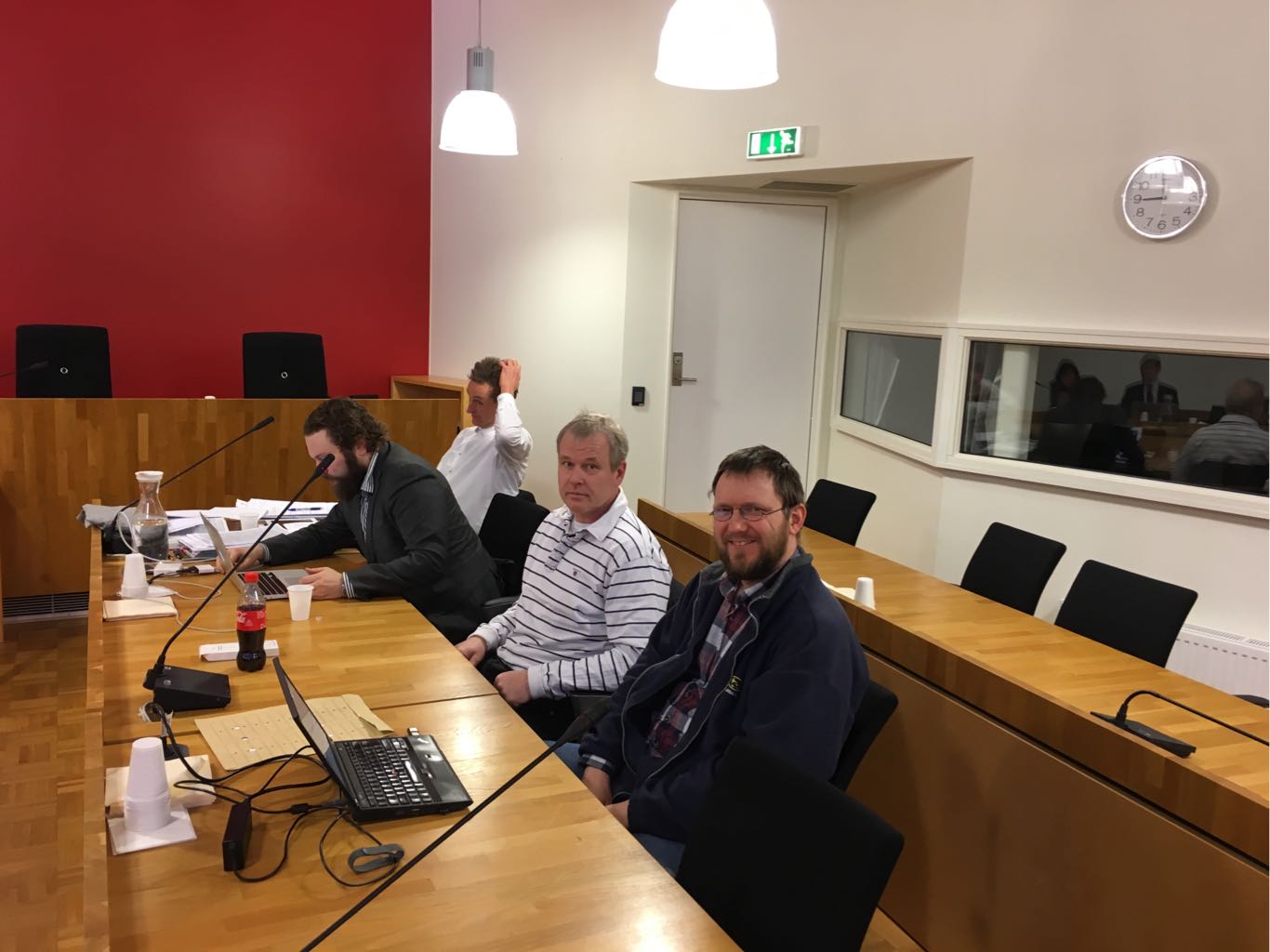
On Wednesday, I spent the entire day in court in Follo Tingrett representing the member association NUUG, alongside the member association EFN and the DNS registrar IMC, challenging the seizure of the DNS name popcorn-time.no. It was interesting to sit in a court of law for the first time in my life. Our team can be seen in the picture above: attorney Ola Tellesb , EFN board member Tom Fredrik Blenning, IMC CEO Morten Emil Eriksen and NUUG board member Petter Reinholdtsen. The case at hand is that the Norwegian National Authority for Investigation and Prosecution of Economic and Environmental Crime (aka kokrim) decided on their own, to seize a DNS domain early last year, without following the official policy of the Norwegian DNS authority which require a court decision. The web site in question was a site covering Popcorn Time. And Popcorn Time is the name of a technology with both legal and illegal applications. Popcorn Time is a client combining searching a Bittorrent directory available on the Internet with downloading/distribute content via Bittorrent and playing the downloaded content on screen. It can be used illegally if it is used to distribute content against the will of the right holder, but it can also be used legally to play a lot of content, for example the millions of movies available from the Internet Archive or the collection available from Vodo. We created a video demonstrating legally use of Popcorn Time and played it in Court. It can of course be downloaded using Bittorrent. I did not quite know what to expect from a day in court. The government held on to their version of the story and we held on to ours, and I hope the judge is able to make sense of it all. We will know in two weeks time. Unfortunately I do not have high hopes, as the Government have the upper hand here with more knowledge about the case, better training in handling criminal law and in general higher standing in the courts than fairly unknown DNS registrar and member associations. It is expensive to be right also in Norway. So far the case have cost more than NOK 70 000,-. To help fund the case, NUUG and EFN have asked for donations, and managed to collect around NOK 25 000,- so far. Given the presentation from the Government, I expect the government to appeal if the case go our way. And if the case do not go our way, I hope we have enough funding to appeal. From the other side came two people from kokrim. On the benches, appearing to be part of the group from the government were two people from the Simonsen Vogt Wiik lawyer office, and three others I am not quite sure who was. kokrim had proposed to present two witnesses from The Motion Picture Association, but this was rejected because they did not speak Norwegian and it was a bit late to bring in a translator, but perhaps the two from MPA were present anyway. All seven appeared to know each other. Good to see the case is take seriously. If you, like me, believe the courts should be involved before a DNS domain is hijacked by the government, or you believe the Popcorn Time technology have a lot of useful and legal applications, I suggest you too donate to the NUUG defense fund. Both Bitcoin and bank transfer are available. If NUUG get more than we need for the legal action (very unlikely), the rest will be spend promoting free software, open standards and unix-like operating systems in Norway, so no matter what happens the money will be put to good use. If you want to lean more about the case, I recommend you check out the blog posts from NUUG covering the case. They cover the legal arguments on both sides.

2 February 2017

Urvika Gola: Outreachy- Week 6 & 7 Progress

Working with Date, Calendar, SimpleDateFormat in Android. As I mentioned In my last blog, I would talk about how I used Calendar and Date classes for the user to designate silent mode by setting time constraints and weekdays, in Lumicall. Date class to used to interpret dates as year, month, day, hour, minute, and second values. I had to compare whether the current time falls between Start Time and End Time specified by the user. So that, silent mode can be enabled within that time frame. I used Calendar Class to get the current hour in 24-Hour format and minute.

 Calendar now = Calendar.getInstance();
 int hour = now.get(Calendar.HOUR_OF_DAY);  
 int minute = now.get(Calendar.MINUTE);
Now, Since the user enters the Time in EditText Widgets, the values were retrieved as strings.
String hhStart, mmStart, hhEnd, mmEnd store these values from Edit text widgets.
To interpret these strings as a representation of a date and time, we need to parse it A Date class object s format looks like-
unnamed
Since, I was only interested in fetching the HH:MM values, i.e the fourth field in the format, To set and compare only the HH:MM values, Android provides lovely, SimpleDateFormat class to access the particular value we want in the Date object.
To access the year, use letter Y
To access the time zone, use letter z
To access the Hour and minute, we use letter H and m.
SimpleDateFormat simpleDateFormat= new SimpleDateFormat( HH:mm , Locale.ENGLISH);
Date currentTime = parseDate(hour + ":" + minute)
Date timeCompareOne = parseDate(hhStart + : +mmStart);  
Date timeCompareTwo = parseDate(hhEnd + : +mmEnd);

Rest everything in the date object are values set by default. Eg, Year 1970. Which we din t set / access , hence did not change. To check if the start time is before the current time. And the endtime is after the current time,
if(timeCompareOne.before(currentTime) && timeCompareTwo.after(currentTime))
 
Switch on the silent mode;
 
Added a try catch block to handle the exception which will arise if the SimpleDateFormat.parse method is unable to parse the given Java String.
public Date parseDate(String date)  
  
try 
   
return inputParser.parse(date);
  
catch (java.text.ParseException e)  
   
return new Date(0);  
   
 
Comparing Time? Done!
Now to check whether the selected weekday in the checkboxes matches the current week day,
Calendar calendar = Calendar.getInstance(); 
int day = calendar.get(Calendar.DAY_OF_WEEK); 
If it s sunday, value returned by calendar.get(Calendar.DAY_OF_WEEK) is 1, if monday, 2 and so on..
Weekdays compared too!  Thanks for reading,
U

1 February 2017

Russ Allbery: Review: A Closed and Common Orbit

Review: A Closed and Common Orbit, by Becky Chambers
Series: Wayfarers #2
Publisher: Harper Voyager
Copyright: October 2016
ISBN: 0-06-256942-2
Format: Kindle
Pages: 384
A Closed and Common Orbit has two threads, one that takes place twenty years in the past and one that happens simultaneously with the very end of The Long Way to a Small, Angry Planet. That second part is the motivating plot thread, but it's unfortunately impossible to talk about in any depth without seriously spoiling the previous book. You could otherwise read them out of order, but I think the previous book is too good to spoil, so you want to carefully avoid reading any descriptions of this book until after you've read The Long Way to a Small, Angry Planet. Per my normal review policy, I'm going to try to avoid spoilers, but just about everything about half of this book would give away spoilers if you're paying attention. So you may want to just go read the other book before reading this review. (It's excellent!) The part that I can safely say is that half this book is about Pepper, her partner Blue, Pepper's store and Blue's art, and her attempt to help a friend find a place and a sense of identity that she'd never asked for or expected, while keeping a very dangerous secret. That friend starts somewhat passive, but one of the things I liked the most about this story is that Pepper is neither always right in her advice nor always wrong. Sidra is wrong about some of the limitations that she thinks she has and some of the things she thinks she wants, but she's also right about other things where Pepper is wrong. She has a complicated, careful, and courageous journey. The best part of this book for me, though, was the other half, told in alternating chapters with Sidra's story. This is Pepper's own backstory, which is rather awful (although Chambers does avoid being too graphic about the most horrible parts), but is also an amazing story of someone finding her own power, her own skills, and her own identity. And building a relationship that's something quite special. At first, this seems only vaguely related to Sidra's story and the other half of the book, but they both come together in a way that's both heartbreaking and wonderful. I found this story particularly wonderful because one of my favorite SF tropes is sentient computers or sentient ships, which play a significant role in Pepper's backstory. And one of my favorite characters to read about is the technician who can cobble together fixes to things and who is always finding something to repair. Pepper is a delight, her story explains so much about how she became the person she is (and adds so much emotional heft to it), and she has a relentless, practical determination that I loved reading about. A Closed and Common Orbit doesn't have the sprawling cast of The Long Way to a Small, Angry Planet. The story is tightly focused on five characters. I think I liked that even better than the previous book, even when I was finding Sidra a bit too passive and not as interesting. Chambers's characters have so much depth, thoughtfulness, and basic decency, while still being uniquely themselves, that I feel like I could read about them for months and keep uncovering new, interesting facets. I particularly loved the occasional excerpts from the chat system where Pepper hangs out (and would have loved about three times more of them). Speaking as someone who spends a lot of time in chat, Chambers got the tone just about perfect. Just about the only complaint I have about this book is that I thought the ending was too abrupt. It's so important, the climax of Pepper's story and a hugely significant piece of character development, and I wanted more than the short scene and aftermath we got. I really wanted to spend some time feeling with the characters, savoring the emotional release. Another three or four pages would have been greatly appreciated. The Long Way to a Small, Angry Planet was a happy surprise in 2015. A Closed and Common Orbit is fully as good, if not better. If you liked the previous book, you will definitely want to read this. I pre-ordered it and then read it within months after it was released, something that I almost never do. I can hardly wait to read whatever Chambers writes next. Rating: 9 out of 10

Next.

Previous.