Search Results: "mak"

6 December 2021

Paul Tagliamonte: Proxying Ethernet Frames to PACKRAT (Part 5/5)

This post is part of a series called "PACKRAT". If this is the first post you've found, it'd be worth reading the intro post first and then looking over all posts in the series.
In the last post, we left off at being able to send and recieve PACKRAT frames to and from devices. Since we can transport IPv4 packets over the network, let s go ahead and see if we can read/write Ethernet frames from a Linux network interface, and on the backend, read and write PACKRAT frames over the air. This has the benifit of continuing to allow Linux userspace tools to work (like cURL, as we ll try!), which means we don t have to do a lot of work to implement higher level protocols or tactics to get a connection established over the link. Given that this post is less RF and more Linuxy, I m going to include more code snippits than in prior posts, and those snippits are closer to runable Go, but still not complete examples. There s also a lot of different ways to do this, I ve just picked the easiest one for me to implement and debug given my existing tooling for you, you may find another approach easier to implement! Again, deviation here is very welcome, and since this segment is the least RF centric post in the series, the pace and tone is going to feel different. If you feel lost here, that s OK. This isn t the most important part of the series, and is mostly here to give a concrete ending to the story arc. Any way you want to finish your own journy is the best way for you to finish it!

Implement Ethernet conversion code This assumes an importable package with a Frame struct, which we can use to convert a Frame to/from Ethernet. Given that the PACKRAT frame has a field that Ethernet doesn t (namely, Callsign), that will need to be explicitly passed in when turning an Ethernet frame into a PACKRAT Frame.
...
// ToPackrat will create a packrat frame from an Ethernet frame.
func ToPackrat(callsign [8]byte, frame *ethernet.Frame) (*packrat.Frame, error)  
var frameType packrat.FrameType
switch frame.EtherType  
case ethernet.EtherTypeIPv4:
frameType = packrat.FrameTypeIPv4
default:
return nil, fmt.Errorf("ethernet: unsupported ethernet type %x", frame.EtherType)
 
return &packrat.Frame 
Destination: frame.Destination,
Source: frame.Source,
Type: frameType,
Callsign: callsign,
Payload: frame.Payload,
 , nil
 
// FromPackrat will create an Ethernet frame from a Packrat frame.
func FromPackrat(frame *packrat.Frame) (*ethernet.Frame, error)  
var etherType ethernet.EtherType
switch frame.Type  
case packrat.FrameTypeRaw:
return nil, fmt.Errorf("ethernet: unsupported packrat type 'raw'")
case packrat.FrameTypeIPv4:
etherType = ethernet.EtherTypeIPv4
default:
return nil, fmt.Errorf("ethernet: unknown packrat type %x", frame.Type)
 
// We lose the Callsign here, which is sad.
 return &ethernet.Frame 
Destination: frame.Destination,
Source: frame.Source,
EtherType: etherType,
Payload: frame.Payload,
 , nil
 
Our helpers, ToPackrat and FromPackrat can now be used to transmorgify PACKRAT into Ethernet, or Ethernet into PACKRAT. Let s put them into use!

Implement a TAP interface On Linux, the networking stack can be exposed to userland using TUN or TAP interfaces. TUN devices allow a userspace program to read and write data at the Layer 3 / IP layer. TAP devices allow a userspace program to read and write data at the Layer 2 Data Link / Ethernet layer. Writing data at Layer 2 is what we want to do, since we re looking to transform our Layer 2 into Ethernet s Layer 2 Frames. Our first job here is to create the actual TAP interface, set the MAC address, and set the IP range to our pre-coordinated IP range.
...
import (
"net"
"github.com/mdlayher/ethernet"
"github.com/songgao/water"
"github.com/vishvananda/netlink"
)
...
config := water.Config DeviceType: water.TAP 
config.Name = "rat0"
iface, err := water.New(config)
...
netIface, err := netlink.LinkByName("rat0")
...
// Pick a range here that works for you!
 //
 // For my local network, I'm using some IPs
 // that AMPR (ampr.org) was nice enough to
 // allocate to me for ham radio use. Thanks,
 // AMPR!
 //
 // Let's just use 10.* here, though.
 //
 ip, cidr, err := net.ParseCIDR("10.0.0.1/24")
...
cidr.IP = ip
err = netlink.AddrAdd(netIface, &netlink.Addr 
IPNet: cidr,
Peer: cidr,
 )
...
// Add all our neighbors to the ARP table
 for _, neighbor := range neighbors  
netlink.NeighAdd(&netlink.Neigh 
LinkIndex: netIface.Attrs().Index,
Type: netlink.FAMILY_V4,
State: netlink.NUD_PERMANENT,
IP: neighbor.IP,
HardwareAddr: neighbor.MAC,
 )
 
// Pick a MAC that is globally unique here, this is
 // just used as an example!
 addr, err := net.ParseMAC("FA:DE:DC:AB:LE:01")
...
netlink.LinkSetHardwareAddr(netIface, addr)
...
err = netlink.LinkSetUp(netIface)
var frame = &ethernet.Frame 
var buf = make([]byte, 1500)
for  
n, err := iface.Read(buf)
...
err = frame.UnmarshalBinary(buf[:n])
...
// process frame here (to come)
  
...
Now that our network stack can resolve an IP to a MAC Address (via ip neigh according to our pre-defined neighbors), and send that IP packet to our daemon, it s now on us to send IPv4 data over the airwaves. Here, we re going to take packets coming in from our TAP interface, and marshal the Ethernet frame into a PACKRAT Frame and transmit it. As with the rest of the RF code, we ll leave that up to the implementer, of course, using what was built during Part 2: Transmitting BPSK symbols and Part 4: Framing data.
...
for  
// continued from above

n, err := iface.Read(buf)
...
err = frame.UnmarshalBinary(buf[:n])
...
switch frame.EtherType  
case 0x0800:
// ipv4 packet
 pack, err := ToPackrat(
// Add my callsign to all Frames, for now
 [8]byte 'K', '3', 'X', 'E', 'C' ,
frame,
)
...
err = transmitPacket(pack)
...
 
 
...
Now that we have transmitting covered, let s go ahead and handle the recieve path here. We re going to listen on frequency using the code built in Part 3: Receiving BPSK symbols and Part 4: Framing data. The Frames we decode from the airwaves are expected to come back from the call packratReader.Next in the code below, and the exact way that works is up to the implementer.
...
for  
// pull the next packrat frame from
 // the symbol stream as we did in the
 // last post
 packet, err := packratReader.Next()
...
// check for CRC errors and drop invalid
 // packets
 err = packet.Check()
...
if bytes.Equal(packet.Source, addr)  
// if we've heard ourself transmitting
 // let's avoid looping back
 continue
 
// create an ethernet frame
 frame, err := FromPackrat(packet)
...
buf, err := frame.MarshalBinary()
...
// and inject it into the tap
 err = iface.Write(buf)
...
 
...
Phew. Right. Now we should be able to listen for PACKRAT frames on the air and inject them into our TAP interface.

Putting it all Together After all this work weeks of work! we can finally get around to putting some real packets over the air. For me, this was an incredibly satisfying milestone, and tied together months of learning! I was able to start up a UDP server on a remote machine with an RTL-SDR dongle attached to it, listening on the TAP interface s host IP with my defined MAC address, and send UDP packets to that server via PACKRAT using my laptop, /dev/udp and an Ettus B210, sending packets into the TAP interface. Now that UDP was working, I was able to get TCP to work using two PlutoSDRs, which allowed me to run the cURL command I pasted in the first post (both simultaneously listen and transmit on behalf of my TAP interface). It s my hope that someone out there will be inspired to implement their own Layer 1 and Layer 2 as a learning exercise, and gets the same sense of gratification that I did! If you re reading this, and at a point where you ve been able to send IP traffic over your own Layer 1 / Layer 2, please get in touch! I d be thrilled to hear all about it. I d love to link to any posts or examples you publish here!

Dirk Eddelbuettel: tidyCpp 0.0.6 on CRAN: Package Maintenance

Another small release of the tidyCpp package arrived on CRAN this morning. The packages offers a clean C++ layer (as well as one small C++ helper class) on top of the C API for R which aims to make use of this robust (if awkward) C API a little easier and more consistent. See the vignette for motivating examples. This release makes a tiny code change, remove a YAML file for the disgraced former continuous integration service we shall not name (yet that we all used to use). And just like digest five days ago, drat four days ago, littler three days ago, RcppAPT two days ago, and RcppSpdlog yesterday, we converted the vignettes from using the minidown package to the (fairly new) simplermarkdown package which is so much more appropriate for our use of the minimal water.css style. The NEWS entry follows.

Changes in tidyCpp version 0.0.6 (2021-12-06)
  • Assign nullptr in dtor for Protect class
  • Switch vignette engine to simplermarkdown

Thanks to my CRANberries, there is also a diffstat report for this release. For questions, suggestions, or issues please use the issue tracker at the GitHub repo. If you like this or other open-source work I do, you can now sponsor me at GitHub.

This post by Dirk Eddelbuettel originated on his Thinking inside the box blog. Please report excessive re-aggregation in third-party for-profit settings.

5 December 2021

Reproducible Builds: Reproducible Builds in November 2021

Welcome to the November 2021 report from the Reproducible Builds project. As a quick recap, whilst anyone may inspect the source code of free software for malicious flaws, almost all software is distributed to end users as pre-compiled binaries. The motivation behind the reproducible builds effort is therefore to ensure no flaws have been introduced during this compilation process by promising identical results are always generated from a given source, thus allowing multiple third-parties to come to a consensus on whether a build was compromised. If you are interested in contributing to our project, please visit our Contribute page on our website.
On November 6th, Vagrant Cascadian presented at this year s edition of the SeaGL conference, giving a talk titled Debugging Reproducible Builds One Day at a Time:
I ll explore how I go about identifying issues to work on, learn more about the specific issues, recreate the problem locally, isolate the potential causes, dissect the problem into identifiable parts, and adapt the packaging and/or source code to fix the issues.
A video recording of the talk is available on archive.org.
Fedora Magazine published a post written by Zbigniew J drzejewski-Szmek about how to Use Diffoscope in packager workflows, specifically around ensuring that new versions of a package do not introduce breaking changes:
In the role of a packager, updating packages is a recurring task. For some projects, a packager is involved in upstream maintenance, or well written release notes make it easy to figure out what changed between the releases. This isn t always the case, for instance with some small project maintained by one or two people somewhere on GitHub, and it can be useful to verify what exactly changed. Diffoscope can help determine the changes between package releases. [ ]

kpcyrd announced the release of rebuilderd version 0.16.3 on our mailing list this month, adding support for builds to generate multiple artifacts at once.
Lastly, we held another IRC meeting on November 30th. As mentioned in previous reports, due to the global events throughout 2020 etc. there will be no in-person summit event this year.

diffoscope diffoscope is our in-depth and content-aware diff utility. Not only can it locate and diagnose reproducibility issues, it can provide human-readable diffs from many kinds of binary formats. This month, Chris Lamb made the following changes, including preparing and uploading versions 190, 191, 192, 193 and 194 to Debian:
  • New features:
    • Continue loading a .changes file even if the referenced files do not exist, but include a comment in the returned diff. [ ]
    • Log the reason if we cannot load a Debian .changes file. [ ]
  • Bug fixes:
    • Detect XML files as XML files if file(1) claims if they are XML files or if they are named .xml. (#999438)
    • Don t duplicate file lists at each directory level. (#989192)
    • Don t raise a traceback when comparing nested directories with non-directories. [ ]
    • Re-enable test_android_manifest. [ ]
    • Don t reject Debian .changes files if they contain non-printable characters. [ ]
  • Codebase improvements:
    • Avoid aliasing variables if we aren t going to use them. [ ]
    • Use isinstance over type. [ ]
    • Drop a number of unused imports. [ ]
    • Update a bunch of %-style string interpolations into f-strings or str.format. [ ]
    • When pretty-printing JSON, mark the difference as being reformatted, additionally avoiding including the full path. [ ]
    • Import itertools top-level module directly. [ ]
Chris Lamb also made an update to the command-line client to trydiffoscope, a web-based version of the diffoscope in-depth and content-aware diff utility, specifically only waiting for 2 minutes for try.diffoscope.org to respond in tests. (#998360) In addition Brandon Maier corrected an issue where parts of large diffs were missing from the output [ ], Zbigniew J drzejewski-Szmek fixed some logic in the assert_diff_startswith method [ ] and Mattia Rizzolo updated the packaging metadata to denote that we support both Python 3.9 and 3.10 [ ] as well as a number of warning-related changes[ ][ ]. Vagrant Cascadian also updated the diffoscope package in GNU Guix [ ][ ].

Distribution work In Debian, Roland Clobus updated the wiki page documenting Debian reproducible Live images to mention some new bug reports and also posted an in-depth status update to our mailing list. In addition, 90 reviews of Debian packages were added, 18 were updated and 23 were removed this month adding to our knowledge about identified issues. Chris Lamb identified a new toolchain issue, absolute_path_in_cmake_file_generated_by_meson.
Work has begun on classifying reproducibility issues in packages within the Arch Linux distribution. Similar to the analogous effort within Debian (outlined above), package information is listed in a human-readable packages.yml YAML file and a sibling README.md file shows how to classify packages too. Finally, Bernhard M. Wiedemann posted his monthly reproducible builds status report for openSUSE and Vagrant Cascadian updated a link on our website to link to the GNU Guix reproducibility testing overview [ ].

Software development The Reproducible Builds project detects, dissects and attempts to fix as many currently-unreproducible packages as possible. We endeavour to send all of our patches upstream where appropriate. This month, we wrote a large number of such patches, including: Elsewhere, in software development, Jonas Witschel updated strip-nondeterminism, our tool to remove specific non-deterministic results from a completed build so that it did not fail on JAR archives containing invalid members with a .jar extension [ ]. This change was later uploaded to Debian by Chris Lamb. reprotest is the Reproducible Build s project end-user tool to build the same source code twice in widely different environments and checking whether the binaries produced by the builds have any differences. This month, Mattia Rizzolo overhauled the Debian packaging [ ][ ][ ] and fixed a bug surrounding suffixes in the Debian package version [ ], whilst Stefano Rivera fixed an issue where the package tests were broken after the removal of diffoscope from the package s strict dependencies [ ].

Testing framework The Reproducible Builds project runs a testing framework at tests.reproducible-builds.org, to check packages and other artifacts for reproducibility. This month, the following changes were made:
  • Holger Levsen:
    • Document the progress in setting up snapshot.reproducible-builds.org. [ ]
    • Add the packages required for debian-snapshot. [ ]
    • Make the dstat package available on all Debian based systems. [ ]
    • Mark virt32b-armhf and virt64b-armhf as down. [ ]
  • Jochen Sprickerhof:
    • Add SSH authentication key and enable access to the osuosl168-amd64 node. [ ][ ]
  • Mattia Rizzolo:
    • Revert reproducible Debian: mark virt(32 64)b-armhf as down - restored. [ ]
  • Roland Clobus (Debian live image generation):
    • Rename sid internally to unstable until an issue in the snapshot system is resolved. [ ]
    • Extend testing to include Debian bookworm too.. [ ]
    • Automatically create the Jenkins view to display jobs related to building the Live images. [ ]
  • Vagrant Cascadian:
    • Add a Debian package set group for the packages and tools maintained by the Reproducible Builds maintainers themselves. [ ]


If you are interested in contributing to the Reproducible Builds project, please visit our Contribute page on our website. However, you can get in touch with us via:

Paul Tagliamonte: Framing data (Part 4/5)

This post is part of a series called "PACKRAT". If this is the first post you've found, it'd be worth reading the intro post first and then looking over all posts in the series.
In the last post, we we were able to build a functioning Layer 1 PHY where we can encode symbols to transmit, and receive symbols on the other end, we re now at the point where we can encode and decode those symbols as bits and frame blocks of data, marking them with a Sender and a Destination for routing to the right host(s). This is a Layer 2 scheme in the OSI model, which is otherwise known as the Data Link Layer. You re using one to view this website right now I m willing to bet your data is going through an Ethernet layer 2 as well as WiFi or maybe a cellular data protocol like 5G or LTE. Given that this entire exercise is hard enough without designing a complex Layer 2 scheme, I opted for simplicity in the hopes this would free me from the complexity and research that has gone into this field for the last 50 years. I settled on stealing a few ideas from Ethernet Frames namely, the use of MAC addresses to identify parties, and the EtherType field to indicate the Payload type. I also stole the idea of using a CRC at the end of the Frame to check for corruption, as well as the specific CRC method (crc32 using 0xedb88320 as the polynomial). Lastly, I added a callsign field to make life easier on ham radio frequencies if I was ever to seriously attempt to use a variant of this protocol over the air with multiple users. However, given this scheme is not a commonly used scheme, it s best practice to use a nearby radio to identify your transmissions on the same frequency while testing or use a Faraday box to test without transmitting over the airwaves. I added the callsign field in an effort to lean into the spirit of the Part 97 regulations, even if I relied on a phone emission to identify the Frames. As an aside, I asked the ARRL for input here, and their stance to me over email was I d be OK according to the regs if I were to stick to UHF and put my callsign into the BPSK stream using a widely understood encoding (even with no knowledge of PACKRAT, the callsign is ASCII over BPSK and should be easily demodulatable for followup with me). Even with all this, I opted to use FM phone to transmit my callsign when I was active on the air (specifically, using an SDR and a small bash script to automate transmission while I watched for interference or other band users). Right, back to the Frame:
sync
dest
source
callsign
type
payload
crc
With all that done, I put that layout into a struct, so that we can marshal and unmarshal bytes to and from our Frame objects, and work with it in software.
type FrameType [2]byte
type Frame struct  
Destination net.HardwareAddr
Source net.HardwareAddr
Callsign [8]byte
Type FrameType
Payload []byte
CRC uint32
 

Time to pick some consts I picked a unique and distinctive sync sequence, which the sender will transmit before the Frame, while the receiver listens for that sequence to know when it s in byte alignment with the symbol stream. My sync sequence is [3]byte 'U', 'f', '~' which works out to be a very pleasant bit sequence of 01010101 01100110 01111110. It s important to have soothing preambles for your Frames. We need all the good energy we can get at this point.
var (
FrameStart = [3]byte 'U', 'f', '~' 
FrameMaxPayloadSize = 1500
)
Next, I defined some FrameType values for the type field, which I can use to determine what is done with that data next, something Ethernet was originally missing, but has since grown to depend on (who needs Length anyway? Not me. See below!)
FrameType Description Bytes
Raw Bytes in the Payload field are opaque and not to be parsed. [2]byte 0x00, 0x01
IPv4 Bytes in the Payload field are an IPv4 packet. [2]byte 0x00, 0x02
And finally, I decided on a maximum length of the Payload, and decided on limiting it to 1500 bytes to align with the MTU of Ethernet.
var (
FrameTypeRaw = FrameType 0, 1 
FrameTypeIPv4 = FrameType 0, 2 
)
Given we know how we re going to marshal and unmarshal binary data to and from Frames, we can now move on to looking through the bit stream for our Frames.

Why is there no Length field? I was initially a bit surprised that Ethernet Frames didn t have a Length field in use, but the more I thought about it, the more it seemed like a big ole' failure mode without a good implementation outcome. Either the Length is right (resulting in no action and used bits on every packet) or the Length is not the length of the Payload and the driver needs to determine what to do with the packet does it try and trim the overlong payload and ignore the rest? What if both the end of the read bytes and the end of the subset of the packet denoted by Length have a valid CRC? Which is used? Will everyone agree? What if Length is longer than the Payload but the CRC is good where we detected a lost carrer? I decided on simplicity. The end of a Frame is denoted by the loss of the BPSK carrier when the signal is no longer being transmitted (or more correctly, when the signal is no longer received), we know we ve hit the end of a packet. Missing a single symbol will result in the Frame being finalized. This can cause some degree of corruption, but it s also a lot easier than doing tricks like bit stuffing to create an end of symbol stream delimiter.

Finding the Frame start in a Symbol Stream First thing we need to do is find our sync bit pattern in the symbols we re receiving from our BPSK demodulator. There s some smart ways to do this, but given that I m not much of a smart man, I again decided to go for simple instead. Given our incoming vector of symbols (which are still float values) prepend one at a time to a vector of floats that is the same length as the sync phrase, and compare against the sync phrase, to determine if we re in sync with the byte boundary within the symbol stream. The only trick here is that because we re using BPSK to modulate and demodulate the data, post phaselock we can be 180 degrees out of alignment (such that a +1 is demodulated as -1, or vice versa). To deal with that, I check against both the sync phrase as well as the inverse of the sync phrase (both [1, -1, 1] as well as [-1, 1, -1]) where if the inverse sync is matched, all symbols to follow will be inverted as well. This effectively turns our symbols back into bits, even if we re flipped out of phase. Other techniques like NRZI will represent a 0 or 1 by a change in phase state which is great, but can often cascade into long runs of bit errors, and is generally more complex to implement. That representation isn t ambiguous, given you look for a phase change, not the absolute phase value, which is incredibly compelling. Here s a notional example of how I ve been thinking about the phrase sliding window and how I ve been thinking of the checks. Each row is a new symbol taken from the BPSK receiver, and pushed to the head of the sliding window, moving all symbols back in the vector by one.
 var (
sync = []float  ...  
buf = make([]float, len(sync))
incomingSymbols = []float  ...  
)
for _, el := range incomingSymbols  
copy(buf, buf[1:])
buf[len(buf)-1] = el
if compare(sync, buf)  
// we're synced!
 break
 
 
Given the pseudocode above, let s step through what the checks would be doing at each step:
Buffer Sync Inverse Sync
[ ]float 0, ,0 [ ]float -1, ,-1 [ ]float 1, ,1
[ ]float 0, ,1 [ ]float -1, ,-1 [ ]float 1, ,1
[more bits in] [ ]float -1, ,-1 [ ]float 1, ,1
[ ]float 1, ,1 [ ]float -1, ,-1 [ ]float 1, ,1
After this notional set of comparisons, we know that at the last step, we are now aligned to the frame and byte boundary the next symbol / bit will be the MSB of the 0th Frame byte. Additionally, we know we re also 180 degrees out of phase, so we need to flip the symbol s sign to get the bit. From this point on we can consume 8 bits at a time, and re-assemble the byte stream. I don t know what this technique is called or even if this is used in real grown-up implementations, but it s been working for my toy implementation.

Next Steps Now that we can read/write Frames to and from PACKRAT, the next steps here are going to be implementing code to encode and decode Ethernet traffic into PACKRAT, coming next in Part 5!

4 December 2021

Paul Tagliamonte: Receiving BPSK symbols (Part 3/5)

This post is part of a series called "PACKRAT". If this is the first post you've found, it'd be worth reading the intro post first and then looking over all posts in the series.
In the last post, we worked through how to generate a BPSK signal, and hopefully transmit it using one of our SDRs. Let s take that and move on to Receiving BPSK and turning that back into symbols! Demodulating BPSK data is a bit more tricky than transmitting BPSK data, mostly due to tedious facts of life such as space, time, and hardware built with compromises because not doing that makes the problem impossible. Unfortunately, it s now our job to work within our imperfect world to recover perfect data. We need to handle the addition of noise, differences in frequency, clock synchronization and interference in order to recover our information. This makes life a lot harder than when we transmit information, and as a result, a lot more complex.

Coarse Sync Our starting point for this section will be working from a capture of a number of generated PACKRAT packets as heard by a PlutoSDR at (xz compressed interleaved int16, 2,621,440 samples per second) Every SDR has its own oscillator, which eventually controls a number of different components of an SDR, such as the IF (if it s a superheterodyne architecture) and the sampling rate. Drift in oscillators lead to drifts in frequency such that what one SDR may think is 100MHz may be 100.01MHz for another radio. Even if the radios were perfectly in sync, other artifacts such as doppler time dilation due to motion can cause the frequency to appear higher or lower in frequency than it was transmitted. All this is a long way of saying, we need to determine when we see a strong signal that s close-ish to our tuned frequency, and take steps to roughly correct it to our center frequency (in the order of 100s of Hz to kHz) in order to acquire a phase lock on the signal to attempt to decode information contained within. The easiest way of detecting the loudest signal of interest is to use an FFT. Getting into how FFTs work is out of scope of this post, so if this is the first time you re seeing mention of an FFT, it may be a good place to take a quick break to learn a bit about the time domain (which is what the IQ data we ve been working with so far is), frequency domain, and how the FFT and iFFT operations can convert between them. Lastly, because FFTs average power over the window, swapping phases such that the transmitted wave has the same number of in-phase and inverted-phase symbols the power would wind up averaging to zero. This is not helpful, so I took a tip from Dr. Marc Lichtman s PySDR project and used complex squaring to drive our BPSK signal into a single detectable carrier by squaring the IQ data. Because points are on the unit circle and at tau/2 (specifically, tau/(2^1) for BPSK, 2^2 for QPSK) angles, and given that squaring has the effect of doubling the angle, and angles are all mod tau, this will drive our wave comprised of two opposite phases back into a continuous wave effectively removing our BPSK modulation, making it much easier to detect in the frequency domain. Thanks to Tom Bereknyei for helping me with that!
...
var iq []complex 
var freq []complex 
for i := range iq  
iq[i] = iq[i] * iq[i]
 
// perform an fft, computing the frequency
 // domain vector in  freq  given the iq data
 // contained in  iq .
 fft(iq, freq)
// get the array index of the max value in the
 // freq array given the magnitude value of the
 // complex numbers.
 var binIdx = max(abs(freq))
...
Now, most FFT operations will lay the frequency domain data out a bit differently than you may expect (as a human), which is that the 0th element of the FFT is 0Hz, not the most negative number (like in a waterfall). Generally speaking, zero first is the most common frequency domain layout (and generally speaking the most safe assumption if there s no other documentation on fft layout). Negative first is usually used when the FFT is being rendered for human consumption such as a waterfall plot. Given that we now know which FFT bin (which is to say, which index into the FFT array) contains the strongest signal, we ll go ahead and figure out what frequency that bin relates to. In the time domain, each complex number is the next time instant. In the frequency domain, each bin is a discrete frequency or more specifically a frequency range. The bandwidth of the bin is a function of the sampling rate and number of time domain samples used to do the FFT operation. As you increase the amount of time used to preform the FFT, the more precise the FFT measurement of frequency can be, but it will cover the same bandwidth, as defined by the sampling rate.
...
var sampleRate = 2,621,440
// bandwidth is the range of frequencies
 // contained inside a single FFT bin,
 // measured in Hz.
 var bandwidth = sampleRate/len(freq)
...
Now that we know we have a zero-first layout and the bin bandwidth, we can compute what our frequency offset is in Hz.
...
// binIdx is the index into the freq slice
 // containing the frequency domain data.
 var binIdx = 0
// binFreq is the frequency of the bin
 // denoted by binIdx
 var binFreq = 0
if binIdx > len(freq)/2  
// This branch covers the case where the bin
 // is past the middle point - which is to say,
 // if this is a negative frequency.
 binFreq = bandwidth * (binIdx - len(freq))
  else  
// This branch covers the case where the bin
 // is in the first half of the frequency array,
 // which is to say - if this frequency is
 // a positive frequency.
 binFreq = bandwidth * binIdx
 
...
However, sice we squared the IQ data, we re off in frequency by twice the actual frequency if we are reading 12kHz, the bin is actually 6kHz. We need to adjust for that before continuing with processing.
...
var binFreq = 0
...
// [compute the binFreq as above]
 ...
// Adjust for the squaring of our IQ data
 binFreq = binFreq / 2
...
Finally, we need to shift the frequency by the inverse of the binFreq by generating a carrier wave at a specific frequency and rotating every sample by our carrier wave so that a wave at the same frequency will slow down (or stand still!) as it approaches 0Hz relative to the carrier wave.
 var tau = pi * 2
// ts tracks where in time we are (basically: phase)
 var ts float
// inc is the amount we step forward in time (seconds)
 // each sample.
 var inc float = (1 / sampleRate)
// amount to shift frequencies, in Hz,
 // in this case, shift +12 kHz to 0Hz
 var shift = -12,000
for i := range iq  
ts += inc
if ts > tau  
// not actually needed, but keeps ts within
 // 0 to 2*pi (since it is modulus 2*pi anyway)
 ts -= tau
 
// Here, we're going to create a carrier wave
 // at the provided frequency (in this case,
 // -12kHz)
 cwIq = complex(cos(tau*shift*ts), sin(tau*shift*ts))
iq[i] = iq[i] * cwIq
 
Now we ve got the strong signal we ve observed (which may or may not be our BPSK modulated signal!) close enough to 0Hz that we ought to be able to Phase Lock the signal in order to begin demodulating the signal.

Filter After we re roughly in the neighborhood of a few kHz, we can now take some steps to cut out any high frequency components (both positive high frequencies and negative high frequencies). The normal way to do this would be to do an FFT, apply the filter in the frequency domain, and then do an iFFT to turn it back into time series data. This will work in loads of cases, but I ve found it to be incredibly tricky to get right when doing PSK. As such, I ve opted to do this the old fashioned way in the time domain. I ve again opted to go simple rather than correct, and haven t used nearly any of the advanced level trickery I ve come across for fear of using it wrong. As a result, our process here is going to be generating a sinc filter by computing a number of taps, and applying that in the time domain directly on the IQ stream.
// Generate sinc taps

func sinc(x float) float  
if x == 0  
return 1
 
var v = pi * x
return sin(v) / v
 
...
var dst []float
var length = float(len(dst))
if int(length)%2 == 0  
length++
 
for j := range dst  
i := float(j)
dst[j] = sinc(2 * cutoff * (i - (length-1)/2))
 
...
then we apply it in the time domain
...
// Apply sinc taps to an IQ stream

var iq []complex
// taps as created in  dst  above
 var taps []float
var delay = make([]complex, len(taps))
for i := range iq  
// let's shift the next sample into
 // the delay buffer
 copy(delay[1:], delay)
delay[0] = iq[i]
var phasor complex
for j := range delay  
// for each sample in the buffer, let's
 // weight them by the tap values, and
 // create a new complex number based on
 // filtering the real and imag values.
 phasor += complex(
taps[j] * real(delay[j]),
taps[j] * imag(delay[j]),
)
 
// now that we've run this sample
 // through the filter, we can go ahead
 // and scale it back (since we multiply
 // above) and drop it back into the iq
 // buffer.
 iq[i] = complex(
real(phasor) / len(taps),
imag(phasor) / len(taps),
)
 
...
After running IQ samples through the taps and back out, we ll have a signal that s been filtered to the shape of our designed Sinc filter which will cut out captured high frequency components (both positive and negative). Astute observers will note that we re using the real (float) valued taps on both the real and imaginary values independently. I m sure there s a way to apply taps using complex numbers, but it was a bit confusing to work through without being positive of the outcome. I may revisit this in the future!

Downsample Now, post-filter, we ve got a lot of extra RF bandwidth being represented in our IQ stream at our high sample rate All the high frequency values are now filtered out, which means we can reduce our sampling rate without losing much information at all. We can either do nothing about it and process at the fairly high sample rate we re capturing at, or we can drop the sample rate down and help reduce the volume of numbers coming our way. There s two big ways of doing this; either you can take every Nth sample (e.g., take every other sample to half the sample rate, or take every 10th to decimate the sample stream to a 10th of what it originally was) which is the easiest to implement (and easy on the CPU too), or to average a number of samples to create a new sample. A nice bonus to averaging samples is that you can trade-off some CPU time for a higher effective number of bits (ENOB) in your IQ stream, which helps reduce noise, among other things. Some hardware does exactly this (called Oversampling ), and like many things, it has some pros and some cons. I ve opted to treat our IQ stream like an oversampled IQ stream and average samples to get a marginal bump in ENOB. Taking a group of 4 samples and averaging them results in a bit of added precision. That means that a stream of IQ data at 8 ENOB can be bumped to 9 ENOB of precision after the process of oversampling and averaging. That resulting stream will be at 1/4 of the sample rate, and this process can be repeated 4 samples can again be taken for a bit of added precision; which is going to be 1/4 of the sample rate (again), or 1/16 of the original sample rate. If we again take a group of 4 samples, we ll wind up with another bit and a sample rate that s 1/64 of the original sample rate.

Phase Lock Our starting point for this section is the same capture as above, but post-coarse sync, filtering downsampling (xz compressed interleaved float32, 163,840 samples per second) The PLL in PACKRAT was one of the parts I spent the most time stuck on. There s no shortage of discussions of how hardware PLLs work, or even a few software PLLs, but very little by way of how to apply them and/or troubleshoot them. After getting frustrated trying to follow the well worn path, I decided to cut my own way through the bush using what I had learned about the concept, and hope that it works well enough to continue on. PLLs, in concept are fairly simple you generate a carrier wave at a frequency, compare the real-world SDR IQ sample to where your carrier wave is in phase, and use the difference between the local wave and the observed wave to adjust the frequency and phase of your carrier wave. Eventually, if all goes well, that delta is driven as small as possible, and your carrier wave can be used as a reference clock to determine if the observed signal changes in frequency or phase. In reality, tuning PLLs is a total pain, and basically no one outlines how to apply them to BPSK signals in a descriptive way. I ve had to steal an approach I ve seen in hardware to implement my software PLL, with any hope it s close enough that this isn t a hazard to learners. The concept is to generate the carrier wave (as above) and store some rolling averages to tune the carrier wave over time. I use two constants, alpha and beta (which appear to be traditional PLL variable names for this function) which control how quickly the frequency and phase is changed according to observed mismatches. Alpha is set fairly high, which means discrepancies between our carrier and observed data are quickly applied to the phase, and a lower constant for Beta, which will take long-term errors and attempt to use that to match frequency. This is all well and good. Getting to this point isn t all that obscure, but the trouble comes when processing a BPSK signal. Phase changes kick the PLL out of alignment and it tends to require some time to get back into phase lock, when we really shouldn t even be loosing it in the first place. My attempt is to generate two predicted samples, one for each phase of our BPSK signal. The delta is compared, and the lower error of the two is used to adjust the PLL, but the carrier wave itself is used to rotate the sample.
 var alpha = 0.1
var beta = (alpha * alpha) / 2
var phase = 0.0
var frequency = 0.0
...
for i := range iq  
predicted = complex(cos(phase), sin(phase))
sample = iq[i] * conj(predicted)
delta = phase(sample)
predicted2 = complex(cos(phase+pi), sin(phase+pi))
sample2 = iq[i] * conj(predicted2)
delta2 = phase(sample2)
if abs(delta2) < abs(delta)  
// note that we do not update 'sample'.
 delta = delta2
 
phase += alpha * delta
frequency += beta * delta
// adjust the iq sample to the PLL rotated
 // sample.
 iq[i] = sample
 
...
If all goes well, this loop has the effect of driving a BPSK signal s imaginary values to 0, and the real value between +1 and -1.

Average Idle / Carrier Detect Our starting point for this section is the same capture as above, but post-PLL (xz compressed interleaved float32, 163,840 samples per second) When we start out, we have IQ samples that have been mostly driven to an imaginary component of 0 and real value range between +1 and -1 for each symbol period. Our goal now is to determine if we re receiving a signal, and if so, determine if it s +1 or -1. This is a deceptively hard problem given it spans a lot of other similarly entertaining hard problems. I ve opted to not solve the hard problems involved and hope that in practice my very haphazard implementation works well enough. This turns out to be both good (not solving a problem is a great way to not spend time on it) and bad (turns out it does materially impact performance). This segment is the one I plan on revisiting, first. Expect more here at some point! Given that I want to be able to encapsulate three states in the output from this section (our Symbols are no carrier detected ( 0 ), real value 1 ( 1 ) or real value -1 ("-1")), which means spending cycles to determine what the baseline noise is to try and identify when a signal breaks through the noise becomes incredibly important.
var idleThreshold
var thresholdFactor = 10
...
// sigThreshold is used to determine if the symbol
 // is -1, +1 or 0. It's 1.3 times the idle signal
 // threshold.
 var sigThreshold = (idleThreshold * 0.3) + idleThreshold
// iq contains a single symbol's worth of IQ samples.
 // clock alignment isn't really considered; so we'll
 // get a bad packet if we have a symbol transition
 // in the middle of this buffer. No attempt is made
 // to correct for this yet.
 var iq []complex
// avg is used to average a chunk of samples in the
 // symbol buffer.
 var avg float
var mid = len(iq) / 2
// midNum is used to determine how many symbols to
 // average at the middle of the symbol.
 var midNum = len(iq) / 50
for j := mid; j < mid+midNum; j++  
avg += real(iq[j])
 
avg /= midNum
var symbol float
switch  
case avg > sigThreshold:
symbol = 1
case avg < -sigThreshold:
symbol = -1
default:
symbol = 0
// update the idleThreshold using the thresholdFactor
 // to average the idleThreshold over more samples to
 // get a better idea of average noise.
 idleThreshold = (
(idleThreshold*(thresholdFactor-1) + symbol) \
/ thresholdFactor
)
 
// write symbol to output somewhere
...

Next Steps Now that we have a stream of values that are either +1, -1 or 0, we can frame / unframe the data contained in the stream, and decode Packets contained inside, coming next in Part 4!

3 December 2021

Paul Tagliamonte: Transmitting BPSK symbols (Part 2/5)

This post is part of a series called "PACKRAT". If this is the first post you've found, it'd be worth reading the intro post first and then looking over all posts in the series.
In the last post, we worked through what IQ is, and different formats that it may be sent or received in. Let s take that and move on to Transmitting BPSK using IQ data! When we transmit and receive information through RF using an SDR, data is traditionally encoded into a stream of symbols which are then used by a program to modulate the IQ stream, and sent over the airwaves. PACKRAT uses BPSK to encode Symbols through RF. BPSK is the act of modulating the phase of a sine wave to carry information. The transmitted wave swaps between two states in order to convey a 0 or a 1. Our symbols modulate the transmitted sine wave s phase, so that it moves between in-phase with the SDR s transmitter and 180 degrees (or radians) out of phase with the SDR s transmitter. The difference between a Bit and a Symbol in PACKRAT is not incredibly meaningful, and I ll often find myself slipping up when talking about them. I ve done my best to try and use the right word at the right stage, but it s not as obvious where the line between bit and symbol is at least not as obvious as it would be with QPSK or QAM. The biggest difference is that there are three meaningful states for PACKRAT over BPSK - a 1 (for In phase ), -1 (for 180 degrees out of phase ) and 0 (for no carrier ). For my implementation, a stream of all zeros will not transmit data over the airwaves, a stream of all 1s will transmit all 1 bits over the airwaves, and a stream of all -1s will transmit all 0 bits over the airwaves. We re not going to cover turning a byte (or bit) into a symbol yet I m going to write more about that in a later section. So for now, let s just worry about symbols in, and symbols out.

Transmitting a Sine wave at 0Hz If we go back to thinking about IQ data as a precisely timed measurements of energy over time at some particular specific frequency, we can consider what a sine wave will look like in IQ. Before we dive into antennas and RF, let s go to something a bit more visual. For the first example, you can see an example of a camera who s frame rate (or Sampling Rate!) matches the exact number of rotations per second (or Frequency!) of the propeller and it appears to stand exactly still. Every time the Camera takes a frame, it s catching the propeller in the exact same place in space, even though it s made a complete rotation. The second example is very similar, it s a light strobing (in this case, our sampling rate, since the darkness is ignored by our brains) at the same rate (frequency) as water dropping from a faucet and the video creator is even nice enough to change the sampling frequency to have the droplets move both forward and backward (positive and negative frequency) in comparison to the faucet. IQ works the same way. If we catch something in perfect frequency alignment with our radio, we ll wind up with readings that are the same for the entire stream of data. This means we can transmit a sine wave by setting all of the IQ samples in our buffer to 1+0i, which will transmit a pure sine wave at exactly the center frequency of the radio.
 var sine []complex 
for i := range sine  
sine[i] = complex(1.0, 0.0)
 
Alternatively, we can transmit a Sine wave (but with the opposite phase) by flipping the real value from 1 to -1. The same Sine wave is transmitted on the same Frequency, except when the wave goes high in the example above, the wave will go low in the example below.
 var sine []complex 
for i := range sine  
sine[i] = complex(-1.0, 0.0)
 
In fact, we can make a carrier wave at any phase angle and amplitude by using a bit of trig.
 // angle is in radians - here we have
 // 1.5 Pi (3 Tau) or 270 degrees.
 var angle = pi * 1.5
// amplitude controls the transmitted
 // strength of the carrier wave.
 var amplitude = 1.0
// output buffer as above
 var sine []complex 
for i := range sine  
sine[i] = complex(
amplitude*cos(angle),
amplitude*sin(angle),
)
 
The amplitude of the transmitted wave is the absolute value of the IQ sample (sometimes called magnitude), and the phase can be computed as the angle (or argument). The amplitude remains constant (at 1) in both cases. Remember back to the airplane propeller or water droplets we re controlling where we re observing the sine wave. It looks like a consistent value to us, but in reality it s being transmitted as a pure carrier wave at the provided frequency. Changing the angle of the number we re transmitting will control where in the sine wave cycle we re observing it at.

Generating BPSK modulated IQ data Modulating our carrier wave with our symbols is fairly straightforward to do we can multiply the symbol by 1 to get the real value to be used in the IQ stream. Or, more simply - we can just use the symbol directly in the constructed IQ data.
 var sampleRate = 2,621,440
var baudRate = 1024
// This represents the number of IQ samples
 // required to send a single symbol at the
 // provided baud and sample rate. I picked
 // two numbers in order to avoid half samples.
 // We will transmit each symbol in blocks of
 // this size.
 var samplesPerSymbol = sampleRate / baudRate
var samples = make([]complex, samplesPerSymbol)
// symbol is one of 1, -1 or 0.
 for each symbol in symbols  
for i := range samples  
samples[i] = complex(symbol, 0)
 
// write the samples out to an output file
 // or radio.
 write(samples)
 
If you want to check against a baseline capture, here s 10 example packets at 204800 samples per second.

Next Steps Now that we can transmit data, we ll start working on a receive path in Part 3, in order to check our work when transmitting the packets, as well as being able to hear packets we transmit from afar, coming up next in Part 3!!

Evgeni Golov: Dependency confusion in the Ansible Galaxy CLI

I hope you enjoyed my last post about Ansible Galaxy Namespaces. In there I noted that I originally looked for something completely different and the namespace takeover was rather accidental. Well, originally I was looking at how the different Ansible content hosting services and their client (ansible-galaxy) behave in regard to clashes in naming of the hosted content. "Ansible content hosting services"?! There are currently three main ways for users to obtain Ansible content:
  • Ansible Galaxy - the original, community oriented, free hosting platform
  • Automation Hub - the place for Red Hat certified and supported content, available only with a Red Hat subscription, hosted by Red Hat
  • Ansible Automation Platform - the on-premise version of Automation Hub, syncs content from there and allows customers to upload own content
Now the question I was curious about was: how would the tooling behave if different sources would offer identically named content? This was inspired by Alex Birsan: Dependency Confusion: How I Hacked Into Apple, Microsoft and Dozens of Other Companies and zofrex: Bundler is Still Vulnerable to Dependency Confusion Attacks (CVE - 2020 - 36327), who showed that the tooling for Python, Node.js and Ruby can be tricked into fetching content from "the wrong source", thus allowing an attacker to inject malicious code into a deployment. For the rest of this article, it's not important that there are different implementations of the hosting services, only that users can configure and use multiple sources at the same time. The problem is that, if the user configures their server_list to contain multiple Galaxy-compatible servers, like Ansible Galaxy and Automation Hub, and then asks to install a collection, the Ansible Galaxy CLI will ask every server in the list, until one returns a successful result. The exact order seems to differ between versions, but this doesn't really matter for the issue at hand. Imagine someone wants to install the redhat.satellite collection from Automation Hub (using ansible-galaxy collection install redhat.satellite). Now if their configuration defines Galaxy as the first, and Automation Hub as the second server, Galaxy is always asked whether it has redhat.satellite and only if the answer is negative, Automation Hub is asked. Today there is no redhat namespace on Galaxy, but there is a redhat user on GitHub, so The canonical answer to this issue is to use a requirements.yml file and setting the source parameter. This parameter allows you to express "regardless which sources are configured, please fetch this collection from here". That's is nice, but I think this not being the default syntax (contrary to what e.g. Bundler does) is a bad approach. Users might overlook the security implications, as the shorter syntax without the source just "magically" works. However, I think this is not even the main problem here. The documentation says: Once a collection is found, any of its requirements are only searched within the same Galaxy instance as the parent collection. The install process will not search for a collection requirement in a different Galaxy instance. But as it turns out, the source behavior was changed and now only applies to the exact collection it is set for, not for any dependencies this collection might have. For the sake of the example, imagine two collections: evgeni.test1 and evgeni.test2, where test2 declares a dependency on test1 in its galaxy.yml. Actually, no need to imagine, both collections are available in version 1.0.0 from galaxy.ansible.com and test1 version 2.0.0 is available from galaxy-dev.ansible.com. Now, given our recent reading of the docs, we craft the following requirements.yml:
collections:
- name: evgeni.test2
  version: '*'
  source: https://galaxy.ansible.com
In a perfect world, following the documentation, this would mean that both collections are fetched from galaxy.ansible.com, right? However, this is not what ansible-galaxy does. It will fetch evgeni.test2 from the specified source, determine it has a dependency on evgeni.test1 and fetch that from the "first" available source from the configuration. Take for example the following ansible.cfg:
[galaxy]
server_list = test_galaxy, release_galaxy, test_galaxy
[galaxy_server.release_galaxy]
url=https://galaxy.ansible.com/
[galaxy_server.test_galaxy]
url=https://galaxy-dev.ansible.com/
And try to install collections, using the above requirements.yml:
% ansible-galaxy collection install -r requirements.yml -vvv                 
ansible-galaxy 2.9.27
  config file = /home/evgeni/Devel/ansible-wtf/collections/ansible.cfg
  configured module search path = ['/home/evgeni/.ansible/plugins/modules', '/usr/share/ansible/plugins/modules']
  ansible python module location = /usr/lib/python3.10/site-packages/ansible
  executable location = /usr/bin/ansible-galaxy
  python version = 3.10.0 (default, Oct  4 2021, 00:00:00) [GCC 11.2.1 20210728 (Red Hat 11.2.1-1)]
Using /home/evgeni/Devel/ansible-wtf/collections/ansible.cfg as config file
Reading requirement file at '/home/evgeni/Devel/ansible-wtf/collections/requirements.yml'
Found installed collection theforeman.foreman:3.0.0 at '/home/evgeni/.ansible/collections/ansible_collections/theforeman/foreman'
Process install dependency map
Processing requirement collection 'evgeni.test2'
Collection 'evgeni.test2' obtained from server explicit_requirement_evgeni.test2 https://galaxy.ansible.com/api/
Opened /home/evgeni/.ansible/galaxy_token
Processing requirement collection 'evgeni.test1' - as dependency of evgeni.test2
Collection 'evgeni.test1' obtained from server test_galaxy https://galaxy-dev.ansible.com/api
Starting collection install process
Installing 'evgeni.test2:1.0.0' to '/home/evgeni/.ansible/collections/ansible_collections/evgeni/test2'
Downloading https://galaxy.ansible.com/download/evgeni-test2-1.0.0.tar.gz to /home/evgeni/.ansible/tmp/ansible-local-133/tmp9uqyjgki
Installing 'evgeni.test1:2.0.0' to '/home/evgeni/.ansible/collections/ansible_collections/evgeni/test1'
Downloading https://galaxy-dev.ansible.com/download/evgeni-test1-2.0.0.tar.gz to /home/evgeni/.ansible/tmp/ansible-local-133/tmp9uqyjgki
As you can see, evgeni.test1 is fetched from galaxy-dev.ansible.com, instead of galaxy.ansible.com. Now, if those servers instead would be Galaxy and Automation Hub, and somebody managed to snag the redhat namespace on Galaxy, I would be now getting the wrong stuff Another problematic setup would be with Galaxy and on-prem Ansible Automation Platform, as you can have any namespace on the later and these most certainly can clash with namespaces on public Galaxy. I have reported this behavior to Ansible Security on 2021-08-26, giving a 90 days disclosure deadline, which expired on 2021-11-24. So far, the response was that this is working as designed, to allow cross-source dependencies (e.g. a private collection referring to one on Galaxy) and there is an issue to update the docs to match the code. If users want to explicitly pin sources, they are supposed to name all dependencies and their sources in requirements.yml. Alternatively they obviously can configure only one source in the configuration and always mirror all dependencies. I am not happy with this and I think this is terrible UX, explicitly inviting people to make mistakes.

2 December 2021

Jonathan McDowell: Building a desktop to improve my work/life balance

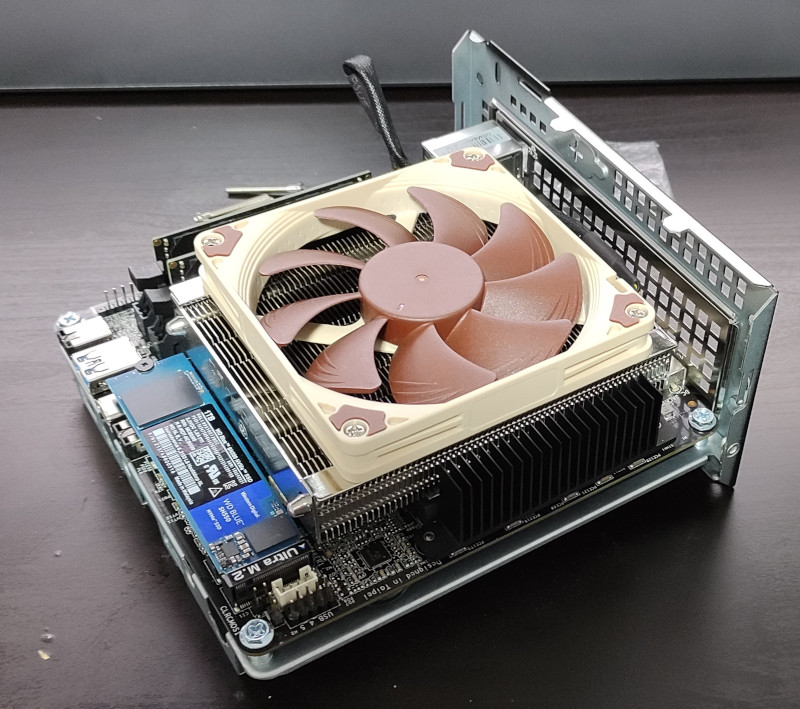
ASRock DeskMini X300 It s been over 20 months since the first COVID lockdown kicked in here in Northern Ireland and I started working from home. Even when the strict lockdown was lifted the advice here has continued to be If you can work from home you should work from home . I ve been into the office here and there (for new starts given you need to hand over a laptop and sort out some login details it s generally easier to do so in person, and I ve had a couple of whiteboard sessions that needed the high bandwidth face to face communication), but day to day is all from home. Early on I commented that work had taken over my study. This has largely continued to be true. I set my work laptop on the stand on a Monday morning and it sits there until Friday evening, when it gets switched for the personal laptop. I have a lovely LG 34UM88 21:9 Ultrawide monitor, and my laptops are small and light so I much prefer to use them docked. Also my general working pattern is to have a lot of external connections up and running (build machine, test devices, log host) which means a suspend/resume cycle disrupts things. So I like to minimise moving things about. I spent a little bit of time trying to find a dual laptop stand so I could have both machines setup and switch between them easily, but I didn t find anything that didn t seem to be geared up for DJs with a mixer + laptop combo taking up quite a bit of desk space rather than stacking laptops vertically. Eventually I realised that the right move was probably a desktop machine. Now, I haven t had a desktop machine since before I moved to the US, realising at the time that having everything on my laptop was much more convenient. I decided I didn t want something too big and noisy. Cheap GPUs seem hard to get hold of these days - I m not a gamer so all I need is something that can drive a ~ 4K monitor reliably enough. Looking around the AMD Ryzen 7 5700G seemed to be a decent CPU with one of the better integrated GPUs. I spent some time looking for a reasonable Mini-ITX case + motherboard and then I happened upon the ASRock DeskMini X300. This turns out to be perfect; I ve no need for a PCIe slot or anything more than an m.2 SSD. I paired it with a Noctua NH-L9a-AM4 heatsink + fan (same as I use in the house server), 32GB DDR4 and a 1TB WD SN550 NVMe SSD. Total cost just under 650 inc VAT + delivery (and that s a story for another post). A desktop solves the problem of fitting both machines on the desk at once, but there s still the question of smoothly switching between them. I read Evgeni Golov s article on a simple KVM switch for 30. My monitor has multiple inputs, so that s sorted. I did have a cheap USB2 switch (all I need for the keyboard/trackball) but it turned out to be pretty unreliable at the host detecting the USB change. I bought a UGREEN USB 3.0 Sharing Switch Box instead and it s turned out to be pretty reliable. The problem is that the LG 32UM88 turns out to have a poor DDC implementation, so while I can flip the keyboard easily with the UGREEN box I also have to manually select the monitor input. Which is a bit annoying, but not terrible. The important question is whether this has helped. I built all this at the end of October, so I ve had a month to play with it. Turns out I should have done it at some point last year. At the end of the day instead of either sitting at work for a bit longer, or completely avoiding the study, I m able to lock the work machine and flick to my personal setup. Even sitting in the same seat that disconnect , and the knowledge I won t see work Slack messages or emails come in and feeling I should respond, really helps. It also means I have access to my personal setup during the week without incurring a hit at the start of the working day when I have to set things up again. So it s much easier to just dip in to some personal tech stuff in the evening than it was previously. Also from the point of view I don t need to setup the personal config, I can pick up where I left off. All of which is really nice. It s also got me thinking about other minor improvements I should make to my home working environment to try and improve things. One obvious thing now the winter is here again is to improve my lighting; I have a good overhead LED panel but it s terribly positioned for video calls, being just behind me. So I think I m looking some sort of strip light I can have behind the large monitor to give a decent degree of backlight (possibly bouncing off the white wall). Lots of cheap options I m not convinced about, and I ve had a few ridiculously priced options from photographer friends; suggestions welcome.

Paul Tagliamonte: Processing IQ data formats (Part 1/5)

This post is part of a series called "PACKRAT". If this is the first post you've found, it'd be worth reading the intro post first and then looking over all posts in the series.
When working with SDRs, information about the signals your radio is receiving are communicated by streams of IQ data. IQ is short for In-phase and Quadrature , which means 90 degrees out of phase. Values in the IQ stream are complex numbers, so converting them to a native complex type in your language helps greatly when processing the IQ data for meaning. I won t get too deep into what IQ is or why complex numbers (mostly since I don t think I fully understand it well enough to explain it yet), but here s some basics in case this is your first interaction with IQ data before going off and reading more.
Before we get started at any point, if you feel lost in this post, it's OK to take a break to do a bit of learning elsewhere in the internet. I'm still new to this, so I'm sure my overview in one paragraph here won't help clarify things too much. This took me months to sort out on my own. It's not you, really! I particularly enjoyed reading visual-dsp.switchb.org when it came to learning about how IQ represents signals, and Software-Defined Radio for Engineers for a more general reference.
Each value in the stream is taken at a precisely spaced sampling interval (called the sampling rate of the radio). Jitter in that sampling interval, or a drift in the requested and actual sampling rate (usually represented in PPM, or parts per million how many samples out of one million are missing) can cause errors in frequency. In the case of a PPM error, one radio may think it s 100.1MHz and the other may think it s 100.2MHz, and jitter will result in added noise in the resulting stream. A single IQ sample is both the real and imaginary values, together. The complex number (both parts) is the sample. The number of samples per second is the number of real and imaginary value pairs per second. Each sample is reading the electrical energy coming off the antenna at that exact time instant. We re looking to see how that goes up and down over time to determine what frequencies we re observing around us. If the IQ stream is only real-valued measures (e.g., float values rather than complex values reading voltage from a wire), you can still send and receive signals, but those signals will be mirrored across your 0Hz boundary. That means if you re tuned to 100MHz, and you have a nearby transmitter at 99.9MHz, you d see it at 100.1MHz. If you want to get an intuitive understanding of this concept before getting into the heavy math, a good place to start is looking at how Quadrature encoders work. Using complex numbers means we can see up in frequency as well as down in frequency, and understand that those are different signals. The reason why we need negative frequencies is that our 0Hz is the center of our SDR s tuned frequency, not actually at 0Hz in nature. Generally speaking, it s doing loads in hardware (and firmware!) to mix the raw RF signals with a local oscillator to a frequency that can be sampled at the requested rate (fundamentally the same concept as a superheterodyne receiver), so a frequency of -10MHz means that signal is 10 MHz below the center of our SDR s tuned frequency. The sampling rate dictates the amount of frequency representable in the data stream. You ll sometimes see this called the Nyquist frequency. The Nyquist Frequency is one half of the sampling rate. Intuitively, if you think about the amount of bandwidth observable as being 1:1 with the sampling rate of the stream, and the middle of your bandwidth is 0 Hz, you would only have enough space to go up in frequency for half of your bandwidth or half of your sampling rate. Same for going down in frequency.

Float 32 / Complex 64 IQ samples that are being processed by software are commonly processed as an interleaved pair of 32 bit floating point numbers, or a 64 bit complex number. The first float32 is the real value, and the second is the imaginary value.
I#0
Q#0
I#1
Q#1
I#2
Q#2
The complex number 1+1i is represented as 1.0 1.0 and the complex number -1-1i is represented as -1.0 -1.0. Unless otherwise specified, all the IQ samples and pseudocode to follow assumes interleaved float32 IQ data streams. Example interleaved float32 file (10Hz Wave at 1024 Samples per Second)

RTL-SDR IQ samples from the RTL-SDR are encoded as a stream of interleaved unsigned 8 bit integers (uint8 or u8). The first sample is the real (in-phase or I) value, and the second is the imaginary (quadrature or Q) value. Together each pair of values makes up a complex number at a specific time instant.
I#0
Q#0
I#1
Q#1
I#2
Q#2
The complex number 1+1i is represented as 0xFF 0xFF and the complex number -1-1i is represented as 0x00 0x00. The complex number 0+0i is not easily representable since half of 0xFF is 127.5.
Complex Number Representation
1+1i []uint8 0xFF, 0xFF
-1+1i []uint8 0x00, 0xFF
-1-1i []uint8 0x00, 0x00
0+0i []uint8 0x80, 0x80 or []uint8 0x7F, 0x7F
And finally, here s some pseudocode to convert an rtl-sdr style IQ sample to a floating point complex number:
...
in = []uint8 0x7F, 0x7F 
real = (float(iq[0])-127.5)/127.5
imag = (float(iq[1])-127.5)/127.5
out = complex(real, imag)
....
Example interleaved uint8 file (10Hz Wave at 1024 Samples per Second)

HackRF IQ samples from the HackRF are encoded as a stream of interleaved signed 8 bit integers (int8 or i8). The first sample is the real (in-phase or I) value, and the second is the imaginary (quadrature or Q) value. Together each pair of values makes up a complex number at a specific time instant.
I#0
Q#0
I#1
Q#1
I#2
Q#2
Formats that use signed integers do have one quirk due to two s complement, which is that the smallest negative number representable s absolute value is one more than the largest positive number. int8 values can range between -128 to 127, which means there s bit of ambiguity in how +1, 0 and -1 are represented. Either you can create perfectly symmetric ranges of values between +1 and -1, but 0 is not representable, have more possible values in the negative range, or allow values above (or just below) the maximum in the range to be allowed. Within my implementation, my approach has been to scale based on the max integer value of the type, so the lowest possible signed value is actually slightly smaller than -1. Generally, if your code is seeing values that low the difference in step between -1 and slightly less than -1 isn t very significant, even with only 8 bits. Just a curiosity to be aware of.
Complex Number Representation
1+1i []int8 127, 127
-1+1i []int8 -128, 127
-1-1i []int8 -128, -128
0+0i []int8 0, 0
And finally, here s some pseudocode to convert a hackrf style IQ sample to a floating point complex number:
...
in = []int8 -5, 112 
real = (float(in[0]))/127
imag = (float(in[1]))/127
out = complex(real, imag)
....
Example interleaved int8 file (10Hz Wave at 1024 Samples per Second)

PlutoSDR IQ samples from the PlutoSDR are encoded as a stream of interleaved signed 16 bit integers (int16 or i16). The first sample is the real (in-phase or I) value, and the second is the imaginary (quadrature or Q) value. Together each pair of values makes up a complex number at a specific time instant. Almost no SDRs capture at a 16 bit depth natively, often you ll see 12 bit integers (as is the case with the PlutoSDR) being sent around as 16 bit integers. This leads to the next possible question, which is are values LSB or MSB aligned? The PlutoSDR sends data LSB aligned (which is to say, the largest real or imaginary value in the stream will not exceed 4095), but expects data being transmitted to be MSB aligned (which is to say the lowest set bit possible is the 5th bit in the number, or values can only be set in increments of 16). As a result, the quirk observed with the HackRF (that the range of values between 0 and -1 is different than the range of values between 0 and +1) does not impact us so long as we do not use the whole 16 bit range.
Complex Number Representation
1+1i []int16 32767, 32767
-1+1i []int16 -32768, 32767
-1-1i []int16 -32768, -32768
0+0i []int16 0, 0
And finally, here s some pseudocode to convert a PlutoSDR style IQ sample to a floating point complex number, including moving the sample from LSB to MSB aligned:
...
in = []int16 -15072, 496 
// shift left 4 bits (16 bits - 12 bits = 4 bits)
 // to move from LSB aligned to MSB aligned.
 in[0] = in[0] << 4
in[1] = in[1] << 4
real = (float(in[0]))/32767
imag = (float(in[1]))/32767
out = complex(real, imag)
....
Example interleaved i16 file (10Hz Wave at 1024 Samples per Second)

Next Steps Now that we can read (and write!) IQ data, we can get started first on the transmitter, which we can (in turn) use to test receiving our own BPSK signal, coming next in Part 2!

1 December 2021

Utkarsh Gupta: FOSS Activites in December 2021

Here s my (twenty-sixth) monthly but brief update about the activities I ve done in the F/L/OSS world.

Debian
This was my 35th month of actively contributing to Debian. I became a DM in late March 2019 and a DD on Christmas 19! \o/ Just churning through the backlog again this month. Ugh. Anyway, I did the following stuff in Debian:

Uploads and bug fixes:
  • rails (2:6.1.4.1+dfsg-3) - No-change rebuild for unstable.

Other $things:
  • Mentoring for newcomers.
  • Moderation of -project mailing list.

Ubuntu
This was my 10th month of actively contributing to Ubuntu. Now that I ve joined Canonical to work on Ubuntu full-time, there s a bunch of things I do! \o/ I mostly worked on different things, I guess. I was too lazy to maintain a list of things I worked on so there s no concrete list atm. Maybe I ll get back to this section later or will start to list stuff from next year onward, as I was doing before. :D

Debian (E)LTS
Debian Long Term Support (LTS) is a project to extend the lifetime of all Debian stable releases to (at least) 5 years. Debian LTS is not handled by the Debian security team, but by a separate group of volunteers and companies interested in making it a success. And Debian Extended LTS (ELTS) is its sister project, extending support to the Jessie release (+2 years after LTS support). This was my twenty-sixth month as a Debian LTS and seventeenth month as a Debian ELTS paid contributor.
I was assigned 30.00 hours for LTS and 45.00 hours for ELTS and worked on the following things:

LTS CVE Fixes and Announcements:
  • Issued DLA 2813-1, fixing CVE-2021-33829 and CVE-2021-37695, for ckeditor.
    For Debian 9 stretch, these problems have been fixed in version 4.5.7+dfsg-2+deb9u1.
  • Issued DLA 2817-1, fixing CVE-2021-23214 and CVE-2021-23222, for postgresql-9.6.
    For Debian 9 stretch, these problems have been fixed in version 9.6.24-0+deb9u1.
  • Issued DLA 2836-1, fixing CVE-2021-43527, for nss.
    For Debian 9 stretch, these problems have been fixed in version 2:3.26.2-1.1+deb9u3.
  • Started working on src:samba for CVE-2020-25717 to CVE-2020-25722 and CVE-2021-23192 for jessie and stretch, both.
    The version difference b/w the suites are a bit too much for the patch(es) to be easily backported. I ve talked to Anton to work something out. \o/
  • Found the problem w/ libjdom1-java. Will have to roll the regression upload.
    I ve prepared the patch but needs some testing to be finally rolled out. Same for jessie.
  • Started working on libgit2.

ELTS CVE Fixes and Announcements:

Other (E)LTS Work:
  • Front-desk duty from 29-11 to 05-12 for both LTS and ELTS.
  • Triaged udisk2, wordpress, samba, gmp, nss, ntfs-3g, and openssh.
  • Auto EOL ed dwarfutils, radare2, mongodb, linux for jessie.
  • As FD, did a deep dive into the no-pu-update issue. Will write to list shortly.
  • Attended monthly Debian LTS meeting.
  • Answered questions (& discussions) on IRC (#debian-lts and #debian-elts).
  • General and other discussions on LTS private and public mailing list.

Debian LTS Survey I ve spent 3 hours on the LTS survey on the following bits:
  • Talking to Laura to revive the old a/c on survey.d.net.
  • Setting up stuff there.
  • Discussing the survey questions and other bits w/ Jeremiah.
  • Partly reviewing the questions of the survey.
  • Doing a walkthru of the LimeSurvey instance we have to make sure there are no changes .

Until next time.
:wq for today.

Russ Allbery: Review: A World Without Email

Review: A World Without Email, by Cal Newport
Publisher: Portfolio/Penguin
Copyright: 2021
ISBN: 0-525-53657-4
Format: Kindle
Pages: 264
A World Without Email is the latest book by computer science professor and productivity writer Cal Newport. After a detour to comment on the drawbacks of social media in Digital Minimalism, Newport is back to writing about focus and concentration in the vein of Deep Work. This time, though, the topic is workplace structure and collaborative process rather than personal decisions. This book is a bit hard for me to review because I spoiled myself for the contents by listening to a lot of Newport's podcast, where he covers the same material. I therefore didn't enjoy it as much as I otherwise would have because the ideas were familiar. I recommend the book over the podcast, though; it's tighter, more coherent, and more comprehensive. The core contention of this book is that knowledge work (roughly, jobs where one spends significant time working on a computer processing information) has stumbled into a superficially tempting but inefficient and psychologically harmful structure that Newport calls the hyperactive hive mind. This way of organizing work is a local maxima: it feels productive, it's flexible and very easy to deploy, and most minor changes away from it make overall productivity worse. However, the incentive structure is all wrong. It prioritizes quick responses and coordination overhead over deep thinking and difficult accomplishments. The characteristic property of the hyperactive hive mind is free-flowing, unstructured communication between co-workers. If you need something from someone else, you ask them for it and they send it to you. The "email" in the title is not intended literally; Slack and related instant messaging apps are even more deeply entrenched in the hyperactive hive mind than email is. The key property of this workflow is that most collaborative work is done by contacting other people directly via ad hoc, unstructured messages. Newport's argument is that this workflow has multiple serious problems, not the least of which is that it makes us miserable. If you have read his previous work, you will correctly expect this to tie into his concept of deep work. Ad hoc, unstructured communication creates a constant barrage of unimportant small tasks and interrupts, most of which require several asynchronous exchanges before your brain can stop tracking the task. This creates constant context-shifting, loss of focus and competence, and background stress from ever-growing email inboxes, unread message notifications, and the semi-frantic feeling that you're forgetting something you need to do. This is not an original observation, of course. Many authors have suggested individual ways to improve this workflow: rules about how often to check one's email, filtering approaches, task managers, and other personal systems. Newport's argument is that none of these individual approaches can address the problem due to social effects. It's all well and good to say that you should unplug from distractions and ignore requests while you concentrate, but everyone else's workflow assumes that their co-workers are responsive to ad hoc requests. Ignoring this social contract makes the job of everyone still stuck in the hyperactive hive mind harder. They won't appreciate that, and your brain will not be able to relax knowing that you're not meeting your colleagues' expectations. In Newport's analysis, the necessary solution is a comprehensive redesign of how we do knowledge work, akin to the redesign of factory work that came with the assembly line. It's a collective problem that requires a collective solution. In other industries, organizing work for efficiency and quality is central to the job of management, but in knowledge work (for good historical reasons) employees are mostly left to organize their work on their own. That self-organization has produced a system that doesn't require centralized coordination or decisions and provides a lot of superficial flexibility, but which may be significantly inferior to a system designed for how people think and work. Even if you find this convincing (and I think Newport makes a good case), there are reasons to be suspicious of corporations trying to make people more productive. The assembly line made manufacturing much more efficient, but it also increased the misery of workers so much that Henry Ford had to offer substantial raises to retain workers. As one of Newport's knowledge workers, I'm not enthused about that happening to my job. Newport recognizes this and tries to address it by drawing a distinction between the workflow (how information moves between workers) and the work itself (how individual workers solve problems in their area of expertise). He argues that companies need to redesign the former, but should leave the latter to each worker. It's a nice idea, and it will probably work in industries like tech with substantial labor bargaining power. I'm more cynical about other industries. The second half of the book is Newport's specific principles and recommendations for designing better workflows that don't rely on unstructured email. Some of this will be familiar (and underwhelming) to anyone who works in tech; Newport recommends ticket systems and thinks agile, scrum, and kanban are pointed in the right direction. But there are some other good ideas in here, such as embracing specialization. Newport argues (with some evidence) that the drastic reduction in secretarial jobs, on the grounds that workers with computers can do the same work themselves, was a mistake. Even with new automation, this approach increased the range of tasks required in every other job. Not only was this a drain on the time of other workers, it caused more context switching, which made everyone less efficient and undermined work quality. He argues for reversing that trend: where the work cannot be automated, hire more support workers and more specialized workers in general, stop expecting everyone to be their own generalist admin, and empower support workers to create better systems rather than using the hyperactive hive mind model to answer requests. There's more here, ranging from specifics of how to develop a structured process for a type of work to the importance of enabling sustained concentration on a task. It's a less immediately actionable book than Newport's previous writing, but I welcome the partial shift in focus to more systemic issues. Newport continues to be relentlessly apolitical, but here it feels less like he's eliding important analysis and more like he thinks the interests of workers and good employers are both served by the approach he's advocating. I will warn that Newport leans heavily on evolutionary psychology in his argument that the hyperactive hive mind is bad for us. I think he has some good arguments about the anxiety that comes with not responding to requests from others, but I'm not sure intrusive experiments on spectacularly-unusual remnant hunter-gatherer groups, who are treated like experimental animals, are the best way of making that case. I realize this isn't Newport's research, but I think he could have made his point with more directly relevant experiments. He also continues his obsession with the superiority of in-person conversation over written communication, and while he has a few good arguments, he has a tendency to turn them into sweeping generalizations that are directly contradicted by, well, my entire life. It would be nice if he were more willing to acknowledge that it's possible to express deep emotional nuance and complex social signaling in writing; it simply requires a level of practice and familiarity (and shared vocabulary) that's often missing from the workplace. I was muttering a lot near the start of this book, but thankfully those sections are short, and I think the rest of his argument sits on a stronger foundation. I hope Newport continues moving in the direction of more systemic analysis. If you enjoyed Deep Work, you will probably find A World Without Email interesting. If you're new to Newport, this is not a bad place to start, particularly if you have influence on how communication is organized in your workplace. Those who work in tech will find some bits of this less interesting, but Newport approaches the topic from a different angle than most agile books and covers a broader range if ideas. Recommended if you like reading this sort of thing. Rating: 7 out of 10

30 November 2021

Russell Coker: Links November 2021

The Guardian has an amusing article by Sophie Elmhirst about Libertarians buying a cruise ship to make a seasteading project off the coast of Panama [1]. It turns out that you need permits etc to do this and maintaining a ship is expensive. Also you wouldn t want to mine cryptocurrency in a ship cabin as most cabins are small and don t have enough airconditioning to remain pleasant if you dump 1kW or more into the air. NPR has an interesting article about the reaction of the NRA to the Columbine shootings [2]. Seems that some NRA person isn t a total asshole and is sharing their private information, maybe they are dying and are worried about going to hell. David Brin wrote an insightful blog post about the singleton hypothesis where he covers some of the evidence of autocratic societies failing [3]. I think he makes a convincing point about a single centralised government for human society not being viable. But something like the EU on a world wide scale could work well. Ken Shirriff wrote an interesting blog post about reverse engineering the Yamaha DX7 synthesiser [4]. The New York Times has an interesting article about a Baboon troop that became less aggressive after the alpha males all died at once from tuberculosis [5]. They established a new more peaceful culture that has outlived the beta males who avoided tuberculosis. The Guardian has an interesting article about how sequencing the genomes of the entire population can save healthcare costs while improving the health of the population [6]. This is somthing wealthy countries should offer for free to the world population. At a bit under $1000 per test that s only about $7 trillion to test everyone, and of course the price should drop significantly if there were billions of tests being done. The Strategy Bridge has an interesting article about SciFi books that have useful portrayals of military strategy [7]. The co-author is Major General Mick Ryan of the Australian Army which is noteworthy as Major General is the second highest rank in use by the Australian Army at this time. Vice has an interesting article about the co-evolution of penises and vaginas and how a lot of that evolution is based on avoiding impregnation from rape [8]. Cory Doctorow wrote an insightful Medium article about the way that governments could force interoperability through purchasing power [9]. Cory Doctorow wrote an insightful article for Locus Magazine about imagining life after capitalism and how capitalism might be replaced [10]. We need a Star Trek future! Arstechnica has an informative article about new developmenet in the rowhammer category of security attacks on DRAM [11]. It seems that DDR4 with ECC is the best current mitigation technique and that DDR3 with ECC is harder to attack than non-ECC RAM. So the thing to do is use ECC on all workstations and avoid doing security critical things on laptops because they can t juse ECC RAM.

Russell Coker: Your Device Has Been Improved

I ve just started a Samsung tablet downloading a 770MB update, the description says:
Technically I have no doubt that both those claims are true and accurate. But according to common understanding of the English language I think they are both misleading. By stability improved they mean fixed some bugs that made it unstable and no technical person would imagine that after a certain number of such updates the number of bugs will ever reach zero and the tablet will be perfectly reliable. In fact if you should consider yourself lucky if they fix more bugs than they add. It s not THAT uncommon for phones and tablets to be bricked (rendered unusable by software) by an update. In the past I got a Huawei Mate9 as a warranty replacement for a Nexus 6P because an update caused so many Nexus 6P phones to fail that they couldn t be replaced with an identical phone [1]. By security improved they usually mean fixed some security flaws that were recently discovered to make it almost as secure as it was designed to be . Note that I deliberately say almost as secure because it s sometimes impossible to fix a security flaw without making significant changes to interfaces which requires more work than desired for an old product and also gives a higher probability of things going wrong. So it s sometimes better to aim for almost as secure or alternatively just as secure but with some features disabled. Device manufacturers (and most companies in the Android space make the same claims while having the exact same bugs to deal with, Samsung is no different from the others in this regards) are not making devices more secure or more reliable than when they were initially released. They are aiming to make them almost as secure and reliable as when they were released. They don t have much incentive to try too hard in this regard, Samsung won t suffer if I decide my old tablet isn t reliable enough and buy a new one, which will almost certainly be from Samsung because they make nice tablets. As a thought experiment, consider if car repairers did the same thing. Getting us to service your car will improve fuel efficiency , great how much more efficient will it be than when I purchased it? As another thought experiment, consider if car companies stopped providing parts for car repair a few years after releasing a new model. This is effectively what phone and tablet manufacturers have been doing all along, software updates for stability and security are to devices what changing oil etc is for cars.

29 November 2021

Dima Kogan: GL_image_display

I just spent an unspeakable number of days typing to produce something that sounds very un-impressive: an FLTK widget that can display an image. The docs and code live here. The big difference from the usual image-drawing widget is that this one uses OpenGL internally, so after the initial image load, the common operations (drawing, redrawing, panning and zooming) are very fast. I have high-resolution images in my projects, and this will make my tools much nicer. Three separate interfaces are available: The FLTK widgets have built-in interactive panning/zooming, and the library can draw line overlays. So nice applications can be built quickly. I already added some early disabled-by-default support into the mrcal-stereo tool to visualize the rectification and report sensitivities:
widget.png
Nice!

Russ Allbery: Fall haul

It's been a while since I've posted one of these, and I also may have had a few moments of deciding to support authors by buying their books even if I'm not going to get a chance to read them soon. There's also a bit of work reading in here. Ryka Aoki Light from Uncommon Stars (sff)
Frederick R. Chromey To Measure the Sky (non-fiction)
Neil Gaiman, et al. Sandman: Overture (graphic novel)
Alix E. Harrow A Spindle Splintered (sff)
Jordan Ifueko Raybearer (sff)
Jordan Ifueko Redemptor (sff)
T. Kingfisher Paladin's Hope (sff)
TJ Klune Under the Whispering Door (sff)
Kiese Laymon How to Slowly Kill Yourself and Others in America (non-fiction)
Yuna Lee Fox You (romance)
Tim Mak Misfire (non-fiction)
Naomi Novik The Last Graduate (sff)
Shelley Parker-Chan She Who Became the Sun (sff)
Gareth L. Powell Embers of War (sff)
Justin Richer & Antonio Sanso OAuth 2 in Action (non-fiction)
Dean Spade Mutual Aid (non-fiction)
Lana Swartz New Money (non-fiction)
Adam Tooze Shutdown (non-fiction)
Bill Watterson The Essential Calvin and Hobbes (strip collection)
Bill Willingham, et al. Fables: Storybook Love (graphic novel)
David Wong Real-World Cryptography (non-fiction)
Neon Yang The Black Tides of Heaven (sff)
Neon Yang The Red Threads of Fortune (sff)
Neon Yang The Descent of Monsters (sff)
Neon Yang The Ascent to Godhood (sff)
Xiran Jay Zhao Iron Widow (sff)

28 November 2021

Russ Allbery: Review: Soul Music

Review: Soul Music, by Terry Pratchett
Series: Discworld #16
Publisher: Harper
Copyright: January 1995
Printing: November 2013
ISBN: 0-06-223741-1
Format: Mass market
Pages: 420
Soul Music is the sixteenth Discworld novel and something of a plot sequel to Reaper Man (although more of a sequel to the earlier Mort). I would not start reading the Discworld books here. Susan is a student in the Quirm College for Young Ladies with an uncanny habit of turning invisible. Well, not invisible exactly; rather, people tend to forget that she's there, even when they're in the middle of talking to her. It's disconcerting for the teachers, but convenient when one is uninterested in Literature and would rather read a book.
She listened with half an ear to what the rest of the class was doing. It was a poem about daffodils. Apparently the poet had liked them very much. Susan was quite stoic about this. It was a free country. People could like daffodils if they wanted to. They just should not, in Susan's very definite opinion, be allowed to take up more than a page to say so. She got on with her education. In her opinion, school kept on trying to interfere with it. Around her, the poet's vision was being taken apart with inexpert tools.
Susan's determinedly practical education is interrupted by the Death of Rats, with the help of a talking raven and Binky the horse, and without a lot of help from Susan, who is decidedly uninterested in being the sort of girl who goes on adventures. Adventures have a different opinion, since Susan's grandfather is Death. And Death has wandered off again. Meanwhile, the bard Imp y Celyn, after an enormous row with his father, has gone to Ankh-Morpork. This is not going well; among other things, the Guild of Musicians and their monopoly and membership dues came as a surprise. But he does meet a dwarf and a troll in the waiting room of the Guild, and then buys an unusual music instrument in the sort of mysterious shop that everyone knows has been in that location forever, but which no one has seen before. I'm not sure there is such a thing as a bad Discworld novel, but there is such a thing as an average Discworld novel. At least for me, Soul Music is one of those. There are some humorous bits, a few good jokes, one great character, and some nice bits of philosophy, but I found the plot forgettable and occasionally annoying. Susan is great. Imp is... not, which is made worse by the fact the reader is eventually expected to believe Susan cares enough about Imp to drive the plot. Discworld has always been a mix of parody and Pratchett's own original creation, and I have always liked the original creation substantially more than the parody. Soul Music is a parody of rock music, complete with Cut-Me-Own-Throat Dibbler as an unethical music promoter. The troll Imp meets makes music by beating rocks together, so they decide to call their genre "music with rocks in it." The magical instrument Imp buys has twelve strings and a solid body. Imp y Celyn means "bud of the holly." You know, like Buddy Holly. Get it? Pratchett's reference density is often on the edge of overwhelming the book, but for some reason the parody references in this one felt unusually forced and obvious to me. I did laugh occasionally, but by the end of the story the rock music plot had worn out its welcome. This is not helped by the ending being a mostly incoherent muddle of another parody (admittedly featuring an excellent motorcycle scene). Unlike Moving Pictures, which is a similar parody of Hollywood, Pratchett didn't seem to have much insightful to say about music. Maybe this will be more your thing if you like constant Blues Brothers references. Susan, on the other hand, is wonderful, and for me is the reason to read this book. She is a delightfully atypical protagonist, and her interactions with the teachers and other students at the girl's school are thoroughly enjoyable. I would have happily read a whole book about her, and more broadly about Death and his family and new-found curiosity about the world. The Death of Rats was also fun, although more so in combination with the raven to translate. I wish this part of her story had a more coherent ending, but I'm looking forward to seeing her in future books. Despite my complaints, the parody part of this book wasn't bad. It just wasn't as good as the rest of the book. I wanted a better platform for Susan's introduction than a lot of music and band references. If you really like Pratchett's parodies, your mileage may vary. For me, this book was fun but forgettable. Followed, in publication order, by Interesting Times. The next Death book is Hogfather. Rating: 7 out of 10

25 November 2021

Mike Gabriel: Touching Firefox on Linux

More as a reminder to myself, but possibly also helpful to other people who want to use Firefox on a tablet running Debian... Without the below adjustment, finger gestures in Firefox running on a tablet result in image moving, text highlighting, etc. (operations related to copy+paste). Not the intuitively expected behaviour... If you use e.g. GNOME on Wayland for your tablet and want to enable touch functionalities in Firefox, then switch the whole browser to native Wayland rendering. This line in ~/.profile seems to help:
export MOZ_ENABLE_WAYLAND=1
If you use a desktop environment running on top of X.Org, then make sure you have added the following line to ~/.profile:
export MOZ_USE_XINPUT2=1
Logout/login again and Firefox should be scrollable with 2-finger movements up and down, zooming in and out also works then. light+love
Mike (aka sunweaver at debian.org)

21 November 2021

Julian Andres Klode: APT Z3 Solver Basics

Z3 is a theorem prover developed at Microsoft research and available as a dynamically linked C++ library in Debian-based distributions. While the library is a whopping 16 MB, and the solver is a tad slow, it s permissive licensing, and number of tactics offered give it a huge potential for use in solving dependencies in a wide variety of applications. Z3 does not need normalized formulas, but offers higher level abstractions like atmost and atleast and implies, that we will make use of together with boolean variables to translate the dependency problem to a form Z3 understands. In this post, we ll see how we can apply Z3 to the dependency resolution in APT. We ll only discuss the basics here, a future post will explore optimization criteria and recommends.

Translating the universe APT s package universe consists of 3 relevant things: packages (the tuple of name and architecture), versions (basically a .deb), and dependencies between versions. While we could translate our entire universe to Z3 problems, we instead will construct a root set from packages that were manually installed and versions marked for installation, and then build the transitive root set from it by translating all versions reachable from the root set. For each package P in the transitive root set, we create a boolean literal P. We then translate each version P1, P2, and so on. Translating a version means building a boolean literal for it, e.g. P1, and then translating the dependencies as shown below. We now need to create two more clauses to satisfy the basic requirements for debs:
  1. If a version is installed, the package is installed; and vice versa. We can encode this requirement for P above as P == atleast( P1,P2 , 1).
  2. There can only be one version installed. We add an additional constraint of the form atmost( P1,P2 , 1).
We also encode the requirements of the operation.
  1. For each package P that is manually installed, add a constraint P.
  2. For each version V that is marked for install, add a constraint V.
  3. For each package P that is marked for removal, add a constraint !P.

Dependencies Packages in APT have dependencies of two basic forms: Depends and Conflicts, as well as variations like Breaks (identical to Conflicts in solving terms), and Recommends (soft Depends) - we ll ignore those for now. We ll discuss Conflicts in the next section. Let s take a basic dependency list: A Depends: X Y, Z. To represent that dependency, we expand each name to a list of versions that can satisfy the dependency, for example X1 X2 Y1, Z1. Translating this dependency list to our Z3 solver, we create boolean variables X1,X2,Y1,Z1 and define two rules:
  1. A implies atleast( X1,X2,Y1 , 1)
  2. A implies atleast( Z1 , 1)
If there actually was nothing that satisfied the Z requirement, we d have added a rule not A. It would be possible to simply not tell Z3 about the version at all as an optimization, but that adds more complexity, and the not A constraint should not cause too many problems.

Conflicts Conflicts cannot have or in them. A dependency B Conflicts: X, Y means that only one of B, X, and Y can be installed. We can directly encode this in Z3 by using the constraint atmost( B,X,Y , 1). This is an optimized encoding of the constraint: We could have encoded each conflict in the form !B or !X, !B or !X, and so on. Usually this leads to worse performance as it introduces additional clauses.

Complete example Let s assume we start with an empty install and want to install the package a below.
Package: a
Version: 1
Depends: c   b
Package: b
Version: 1
Package: b
Version: 2
Conflicts: x
Package: d
Version: 1
Package: x
Version: 1
The translation in Z3 rules looks like this:
  1. Package rules for a:
    1. a == atleast( a1 , 1) - package is installed iff one version is
    2. atmost( a1 , 1) - only one version may be installed
    3. a a must be installed
  2. Dependency rules for a
    1. implies(a1, atleast( b2, b1 , 1)) the translated dependency above. note that c is gone, it s not reachable.
  3. Package rules for b:
    1. b == atleast( b1,b2 , 1) - package is installed iff one version is
    2. atmost( b1, b2 , 1) - only one version may be installed
  4. Dependencies for b (= 2):
    1. atmost( b2, x1 , 1) - the conflicts between x and b = 2 above
  5. Package rules for x:
    1. x == atleast( x1 , 1) - package is installed iff one version is
    2. atmost( x1 , 1) - only one version may be installed
The package d is not translated, as it is not reachable from the root set a1 , the transitive root set is a1,b1,b2,x1 .

Next iteration: Optimization We have now constructed the basic set of rules that allows us to solve solve our dependency problems (equivalent to SAT), however it might lead to suboptimal solutions where it removes automatically installed packages, or installs more packages than necessary, to name a few examples. In our next iteration, we have to look at introducing optimization; for example, have the minimum number of removals, the minimal number of changed packages, or satisfy as many recommends as possible. We will also look at the upgrade problem (upgrade as many packages as possible), the autoremove problem (remove as many automatically installed packages as possible).

Antoine Beaupr : mbsync vs OfflineIMAP

After recovering from my latest email crash (previously, previously), I had to figure out which tool I should be using. I had many options but I figured I would start with a popular one (mbsync). But I also evaluated OfflineIMAP which was resurrected from the Python 2 apocalypse, and because I had used it before, for a long time. Read on for the details.

Benchmark setup All programs were tested against a Dovecot 1:2.3.13+dfsg1-2 server, running Debian bullseye. The client is a Purism 13v4 laptop with a Samsung SSD 970 EVO 1TB NVMe drive. The server is a custom build with a AMD Ryzen 5 2600 CPU, and a RAID-1 array made of two NVMe drives (Intel SSDPEKNW010T8 and WDC WDS100T2B0C). The mail spool I am testing against has almost 400k messages and takes 13GB of disk space:
$ notmuch count --exclude=false
372758
$ du -sh --exclude xapian Maildir
13G Maildir
The baseline we are comparing against is SMD (syncmaildir) which performs the sync in about 7-8 seconds locally (3.5 seconds for each push/pull command) and about 10-12 seconds remotely. Anything close to that or better is good enough. I do not have recent numbers for a SMD full sync baseline, but the setup documentation mentions 20 minutes for a full sync. That was a few years ago, and the spool has obviously grown since then, so that is not a reliable baseline. A baseline for a full sync might be also set with rsync, which copies files at nearly 40MB/s, or 317Mb/s!
anarcat@angela:tmp(main)$ time rsync -a --info=progress2 --exclude xapian  shell.anarc.at:Maildir/ Maildir/
 12,647,814,731 100%   37.85MB/s    0:05:18 (xfr#394981, to-chk=0/395815)    
72.38user 106.10system 5:19.59elapsed 55%CPU (0avgtext+0avgdata 15988maxresident)k
8816inputs+26305112outputs (0major+50953minor)pagefaults 0swaps
That is 5 minutes to transfer the entire spool. Incremental syncs are obviously pretty fast too:
anarcat@angela:tmp(main)$ time rsync -a --info=progress2 --exclude xapian  shell.anarc.at:Maildir/ Maildir/
              0   0%    0.00kB/s    0:00:00 (xfr#0, to-chk=0/395815)    
1.42user 0.81system 0:03.31elapsed 67%CPU (0avgtext+0avgdata 14100maxresident)k
120inputs+0outputs (3major+12709minor)pagefaults 0swaps
As an extra curiosity, here's the performance with tar, pretty similar with rsync, minus incremental which I cannot be bothered to figure out right now:
anarcat@angela:tmp(main)$ time ssh shell.anarc.at tar --exclude xapian -cf - Maildir/   pv -s 13G   tar xf - 
56.68user 58.86system 5:17.08elapsed 36%CPU (0avgtext+0avgdata 8764maxresident)k
0inputs+0outputs (0major+7266minor)pagefaults 0swaps
12,1GiO 0:05:17 [39,0MiB/s] [===================================================================> ] 92%
Interesting that rsync manages to almost beat a plain tar on file transfer, I'm actually surprised by how well it performs here, considering there are many little files to transfer. (But then again, this maybe is exactly where rsync shines: while tar needs to glue all those little files together, rsync can just directly talk to the other side and tell it to do live changes. Something to look at in another article maybe?) Since both ends are NVMe drives, those should easily saturate a gigabit link. And in fact, a backup of the server mail spool achieves much faster transfer rate on disks:
anarcat@marcos:~$ tar fc - Maildir   pv -s 13G > Maildir.tar
15,0GiO 0:01:57 [ 131MiB/s] [===================================] 115%
That's 131Mibyyte per second, vastly faster than the gigabit link. The client has similar performance:
anarcat@angela:~(main)$ tar fc - Maildir   pv -s 17G > Maildir.tar
16,2GiO 0:02:22 [ 116MiB/s] [==================================] 95%
So those disks should be able to saturate a gigabit link, and they are not the bottleneck on fast links. Which begs the question of what is blocking performance of a similar transfer over the gigabit link, but that's another question altogether, because no sync program ever reaches the above performance anyways. Finally, note that when I migrated to SMD, I wrote a small performance comparison that could be interesting here. It show SMD to be faster than OfflineIMAP, but not as much as we see here. In fact, it looks like OfflineIMAP slowed down significantly since then (May 2018), but this could be due to my larger mail spool as well.

mbsync The isync (AKA mbsync) project is written in C and supports syncing Maildir and IMAP folders, with possibly multiple replicas. I haven't tested this but I suspect it might be possible to sync between two IMAP servers as well. It supports partial mirorrs, message flags, full folder support, and "trash" functionality.

Complex configuration file I started with this .mbsyncrc configuration file:
SyncState *
Sync New ReNew Flags
IMAPAccount anarcat
Host imap.anarc.at
User anarcat
PassCmd "pass imap.anarc.at"
SSLType IMAPS
CertificateFile /etc/ssl/certs/ca-certificates.crt
IMAPStore anarcat-remote
Account anarcat
MaildirStore anarcat-local
# Maildir/top/sub/sub
#SubFolders Verbatim
# Maildir/.top.sub.sub
SubFolders Maildir++
# Maildir/top/.sub/.sub
# SubFolders legacy
# The trailing "/" is important
#Path ~/Maildir-mbsync/
Inbox ~/Maildir-mbsync/
Channel anarcat
# AKA Far, convert when all clients are 1.4+
Master :anarcat-remote:
# AKA Near
Slave :anarcat-local:
# Exclude everything under the internal [Gmail] folder, except the interesting folders
#Patterns * ![Gmail]* "[Gmail]/Sent Mail" "[Gmail]/Starred" "[Gmail]/All Mail"
# Or include everything
Patterns *
# Automatically create missing mailboxes, both locally and on the server
#Create Both
Create slave
# Sync the movement of messages between folders and deletions, add after making sure the sync works
#Expunge Both
Long gone are the days where I would spend a long time reading a manual page to figure out the meaning of every option. If that's your thing, you might like this one. But I'm more of a "EXAMPLES section" kind of person now, and I somehow couldn't find a sample file on the website. I started from the Arch wiki one but it's actually not great because it's made for Gmail (which is not a usual Dovecot server). So a sample config file in the manpage would be a great addition. Thankfully, the Debian packages ships one in /usr/share/doc/isync/examples/mbsyncrc.sample but I only found that after I wrote my configuration. It was still useful and I recommend people take a look if they want to understand the syntax. Also, that syntax is a little overly complicated. For example, Far needs colons, like:
Far :anarcat-remote:
Why? That seems just too complicated. I also found that sections are not clearly identified: IMAPAccount and Channel mark section beginnings, for example, which is not at all obvious until you learn about mbsync's internals. There are also weird ordering issues: the SyncState option needs to be before IMAPAccount, presumably because it's global. Using a more standard format like .INI or TOML could improve that situation.

Stellar performance A transfer of the entire mail spool takes 56 minutes and 6 seconds, which is impressive. It's not quite "line rate": the resulting mail spool was 12GB (which is a problem, see below), which turns out to be about 29Mbit/s and therefore not maxing the gigabit link, and an order of magnitude slower than rsync. The incremental runs are roughly 2 seconds, which is even more impressive, as that's actually faster than rsync:
===> multitime results
1: mbsync -a
            Mean        Std.Dev.    Min         Median      Max
real        2.015       0.052       1.930       2.029       2.105       
user        0.660       0.040       0.592       0.661       0.722       
sys         0.338       0.033       0.268       0.341       0.387    
Those tests were performed with isync 1.3.0-2.2 on Debian bullseye. Tests with a newer isync release originally failed because of a corrupted message that triggered bug 999804 (see below). Running 1.4.3 under valgrind works around the bug, but adds a 50% performance cost, the full sync running in 1h35m. Once the upstream patch is applied, performance with 1.4.3 is fairly similar, considering that the new sync included the register folder with 4000 messages:
120.74user 213.19system 59:47.69elapsed 9%CPU (0avgtext+0avgdata 105420maxresident)k
29128inputs+28284376outputs (0major+45711minor)pagefaults 0swaps
That is ~13GB in ~60 minutes, which gives us 28.3Mbps. Incrementals are also pretty similar to 1.3.x, again considering the double-connect cost:
===> multitime results
1: mbsync -a
            Mean        Std.Dev.    Min         Median      Max
real        2.500       0.087       2.340       2.491       2.629       
user        0.718       0.037       0.679       0.711       0.793       
sys         0.322       0.024       0.284       0.320       0.365
Those tests were all done on a Gigabit link, but what happens on a slower link? My server uplink is slow: 25 Mbps down, 6 Mbps up. There mbsync is worse than the SMD baseline:
===> multitime results
1: mbsync -a
Mean        Std.Dev.    Min         Median      Max
real        31.531      0.724       30.764      31.271      33.100      
user        1.858       0.125       1.721       1.818       2.131       
sys         0.610       0.063       0.506       0.600       0.695       
That's 30 seconds for a sync, which is an order of magnitude slower than SMD.

Great user interface Compared to OfflineIMAP and (ahem) SMD, the mbsync UI is kind of neat:
anarcat@angela:~(main)$ mbsync -a
Notice: Master/Slave are deprecated; use Far/Near instead.
C: 1/2  B: 204/205  F: +0/0 *0/0 #0/0  N: +1/200 *0/0 #0/0
(Note that nice switch away from slavery-related terms too.) The display is minimal, and yet informative. It's not obvious what does mean at first glance, but the manpage is useful at least for clarifying that:
This represents the cumulative progress over channels, boxes, and messages affected on the far and near side, respectively. The message counts represent added messages, messages with updated flags, and trashed messages, respectively. No attempt is made to calculate the totals in advance, so they grow over time as more information is gathered. (Emphasis mine).
In other words:
  • C 2/2: channels done/total (2 done out of 2)
  • B 204/205: mailboxes done/total (204 out of 205)
  • F: changes on the far side
  • N: +10/200 *0/0 #0/0: changes on the "near" side:
    • +10/200: 10 out of 200 messages downloaded
    • *0/0: no flag changed
    • #0/0: no message deleted
You get used to it, in a good way. It does not, unfortunately, show up when you run it in systemd, which is a bit annoying as I like to see a summary mail traffic in the logs.

Interoperability issue In my notmuch setup, I have bound key S to "mark spam", which basically assigns the tag spam to the message and removes a bunch of others. Then I have a notmuch-purge script which moves that message to the spam folder, for training purposes. It basically does this:
notmuch search --output=files --format=text0 "$search_spam" \
      xargs -r -0 mv -t "$HOME/Maildir/$ PREFIX junk/cur/"
This method, which worked fine in SMD (and also OfflineIMAP) created this error on sync:
Maildir error: duplicate UID 37578.
And indeed, there are now two messages with that UID in the mailbox:
anarcat@angela:~(main)$ find Maildir/.junk/ -name '*U=37578*'
Maildir/.junk/cur/1637427889.134334_2.angela,U=37578:2,S
Maildir/.junk/cur/1637348602.2492889_221804.angela,U=37578:2,S
This is actually a known limitation or, as mbsync(1) calls it, a "RECOMMENDATION":
When using the more efficient default UID mapping scheme, it is important that the MUA renames files when moving them between Maildir fold ers. Mutt always does that, while mu4e needs to be configured to do it:
(setq mu4e-change-filenames-when-moving t)
So it seems I would need to fix my script. It's unclear how the paths should be renamed, which is unfortunate, because I would need to change my script to adapt to mbsync, but I can't tell how just from reading the above. (A manual fix is actually to rename the file to remove the U= field: mbsync will generate a new one and then sync correctly.) Fortunately, someone else already fixed that issue: afew, a notmuch tagging script (much puns, such hurt), has a move mode that can rename files correctly, specifically designed to deal with mbsync. I had already been told about afew, but it's one more reason to standardize my notmuch hooks on that project, it looks like. Update: I have tried to use afew and found it has significant performance issues. It also has a completely different paradigm to what I am used to: it assumes all incoming mail has a new and lays its own tags on top of that (inbox, sent, etc). It can only move files from one folder at a time (see this bug) which breaks my spam training workflow. In general, I sync my tags into folders (e.g. ham, spam, sent) and message flags (e.g. inbox is F, unread is "not S", etc), and afew is not well suited for this (although there are hacks that try to fix this). I have worked hard to make my tagging scripts idempotent, and it's something afew doesn't currently have. Still, it would be better to have that code in Python than bash, so maybe I should consider my options here.

Stability issues The newer release in Debian bookworm (currently at 1.4.3) has stability issues on full sync. I filed bug 999804 in Debian about this, which lead to a thread on the upstream mailing list. I have found at least three distinct crashes that could be double-free bugs "which might be exploitable in the worst case", not a reassuring prospect. The thing is: mbsync is really fast, but the downside of that is that it's written in C, and with that comes a whole set of security issues. The Debian security tracker has only three CVEs on isync, but the above issues show there could be many more. Reading the source code certainly did not make me very comfortable with trusting it with untrusted data. I considered sandboxing it with systemd (below) but having systemd run as a --user process makes that difficult. I also considered using an apparmor profile but that is not trivial because we need to allow SSH and only some parts of it... Thankfully, upstream has been diligent at addressing the issues I have found. They provided a patch within a few days which did fix the sync issues. Update: upstream actually took the issue very seriously. They not only got CVE-2021-44143 assigned for my bug report, they also audited the code and found several more issues collectively identified as CVE-2021-3657, which actually also affect 1.3 (ie. Debian 11/bullseye/stable). Somehow my corpus doesn't trigger that issue, but it was still considered serious enough to warrant a CVE. So one the one hand: excellent response from upstream; but on the other hand: how many more of those could there be in there?

Automation with systemd The Arch wiki has instructions on how to setup mbsync as a systemd service. It suggests using the --verbose (-V) flag which is a little intense here, as it outputs 1444 lines of messages. I have used the following .service file:
[Unit]
Description=Mailbox synchronization service
ConditionHost=!marcos
Wants=network-online.target
After=network-online.target
Before=notmuch-new.service
[Service]
Type=oneshot
ExecStart=/usr/bin/mbsync -a
Nice=10
IOSchedulingClass=idle
NoNewPrivileges=true
[Install]
WantedBy=default.target
And the following .timer:
[Unit]
Description=Mailbox synchronization timer
ConditionHost=!marcos
[Timer]
OnBootSec=2m
OnUnitActiveSec=5m
Unit=mbsync.service
[Install]
WantedBy=timers.target
Note that we trigger notmuch through systemd, with the Before and also by adding mbsync.service to the notmuch-new.service file:
[Unit]
Description=notmuch new
After=mbsync.service
[Service]
Type=oneshot
Nice=10
ExecStart=/usr/bin/notmuch new
[Install]
WantedBy=mbsync.service
An improvement over polling repeatedly with a .timer would be to wake up only on IMAP notify, but neither imapnotify nor goimapnotify seem to be packaged in Debian. It would also not cover for the "sent folder" use case, where we need to wake up on local changes.

Password-less setup The sample file suggests this should work:
IMAPStore remote
Tunnel "ssh -q host.remote.com /usr/sbin/imapd"
Add BatchMode, restrict to IdentitiesOnly, provide a password-less key just for this, add compression (-C), find the Dovecot imap binary, and you get this:
IMAPAccount anarcat-tunnel
Tunnel "ssh -o BatchMode=yes -o IdentitiesOnly=yes -i ~/.ssh/id_ed25519_mbsync -o HostKeyAlias=shell.anarc.at -C anarcat@imap.anarc.at /usr/lib/dovecot/imap"
And it actually seems to work:
$ mbsync -a
Notice: Master/Slave are deprecated; use Far/Near instead.
C: 0/2  B: 0/1  F: +0/0 *0/0 #0/0  N: +0/0 *0/0 #0/0imap(anarcat): Error: net_connect_unix(/run/dovecot/stats-writer) failed: Permission denied
C: 2/2  B: 205/205  F: +0/0 *0/0 #0/0  N: +1/1 *3/3 #0/0imap(anarcat)<1611280><90uUOuyElmEQlhgAFjQyWQ>: Info: Logged out in=10808 out=15396642 deleted=0 expunged=0 trashed=0 hdr_count=0 hdr_bytes=0 body_count=1 body_bytes=8087
It's a bit noisy, however. dovecot/imap doesn't have a "usage" to speak of, but even the source code doesn't hint at a way to disable that Error message, so that's unfortunate. That socket is owned by root:dovecot so presumably Dovecot runs the imap process as $user:dovecot, which we can't do here. Oh well? Interestingly, the SSH setup is not faster than IMAP. With IMAP:
===> multitime results
1: mbsync -a
            Mean        Std.Dev.    Min         Median      Max
real        2.367       0.065       2.220       2.376       2.458       
user        0.793       0.047       0.731       0.776       0.871       
sys         0.426       0.040       0.364       0.434       0.476
With SSH:
===> multitime results
1: mbsync -a
            Mean        Std.Dev.    Min         Median      Max
real        2.515       0.088       2.274       2.532       2.594       
user        0.753       0.043       0.645       0.766       0.804       
sys         0.328       0.045       0.212       0.340       0.393
Basically: 200ms slower. Tolerable.

Migrating from SMD The above was how I migrated to mbsync on my first workstation. The work on the second one was more streamlined, especially since the corruption on mailboxes was fixed:
  1. install isync, with the patch:
    dpkg -i isync_1.4.3-1.1~_amd64.deb
    
  2. copy all files over from previous workstation to avoid a full resync (optional):
    rsync -a --info=progress2 angela:Maildir/ Maildir-mbsync/
    
  3. rename all files to match new hostname (optional):
    find Maildir-mbsync/ -type f -name '*.angela,*' -print0    rename -0 's/\.angela,/\.curie,/'
    
  4. trash the notmuch database (optional):
    rm -rf Maildir-mbsync/.notmuch/xapian/
    
  5. disable all smd and notmuch services:
    systemctl --user --now disable smd-pull.service smd-pull.timer smd-push.service smd-push.timer notmuch-new.service notmuch-new.timer
    
  6. do one last sync with smd:
    smd-pull --show-tags ; smd-push --show-tags ; notmuch new ; notmuch-sync-flagged -v
    
  7. backup notmuch on the client and server:
    notmuch dump   pv > notmuch.dump
    
  8. backup the maildir on the client and server:
    cp -al Maildir Maildir-bak
    
  9. create the SSH key:
    ssh-keygen -t ed25519 -f .ssh/id_ed25519_mbsync
    cat .ssh/id_ed25519_mbsync.pub
    
  10. add to .ssh/authorized_keys on the server, like this: command="/usr/lib/dovecot/imap",restrict ssh-ed25519 AAAAC...
  11. move old files aside, if present:
    mv Maildir Maildir-smd
    
  12. move new files in place (CRITICAL SECTION BEGINS!):
    mv Maildir-mbsync Maildir
    
  13. run a test sync, only pulling changes: mbsync --create-near --remove-none --expunge-none --noop anarcat-register
  14. if that works well, try with all mailboxes: mbsync --create-near --remove-none --expunge-none --noop -a
  15. if that works well, try again with a full sync: mbsync register mbsync -a
  16. reindex and restore the notmuch database, this should take ~25 minutes:
    notmuch new
    pv notmuch.dump   notmuch restore
    
  17. enable the systemd services and retire the smd-* services: systemctl --user enable mbsync.timer notmuch-new.service systemctl --user start mbsync.timer rm ~/.config/systemd/user/smd* systemctl daemon-reload
During the migration, notmuch helpfully told me the full list of those lost messages:
[...]
Warning: cannot apply tags to missing message: CAN6gO7_QgCaiDFvpG3AXHi6fW12qaN286+2a7ERQ2CQtzjSEPw@mail.gmail.com
Warning: cannot apply tags to missing message: CAPTU9Wmp0yAmaxO+qo8CegzRQZhCP853TWQ_Ne-YF94MDUZ+Dw@mail.gmail.com
Warning: cannot apply tags to missing message: F5086003-2917-4659-B7D2-66C62FCD4128@gmail.com
[...]
Warning: cannot apply tags to missing message: mailman.2.1316793601.53477.sage-members@mailman.sage.org
Warning: cannot apply tags to missing message: mailman.7.1317646801.26891.outages-discussion@outages.org
Warning: cannot apply tags to missing message: notmuch-sha1-000458df6e48d4857187a000d643ac971deeef47
Warning: cannot apply tags to missing message: notmuch-sha1-0079d8e0c3340e6f88c66f4c49fca758ea71d06d
Warning: cannot apply tags to missing message: notmuch-sha1-0194baa4cfb6d39bc9e4d8c049adaccaa777467d
Warning: cannot apply tags to missing message: notmuch-sha1-02aede494fc3f9e9f060cfd7c044d6d724ad287c
Warning: cannot apply tags to missing message: notmuch-sha1-06606c625d3b3445420e737afd9a245ae66e5562
Warning: cannot apply tags to missing message: notmuch-sha1-0747b020f7551415b9bf5059c58e0a637ba53b13
[...]
As detailed in the crash report, all of those were actually innocuous and could be ignored. Also note that we completely trash the notmuch database because it's actually faster to reindex from scratch than let notmuch slowly figure out that all mails are new and all the old mails are gone. The fresh indexing took:
nov 19 15:08:54 angela notmuch[2521117]: Processed 384679 total files in 23m 41s (270 files/sec.).
nov 19 15:08:54 angela notmuch[2521117]: Added 372610 new messages to the database.
While a reindexing on top of an existing database was going twice as slow, at about 120 files/sec.

Current config file Putting it all together, I ended up with the following configuration file:
SyncState *
Sync All
# IMAP side, AKA "Far"
IMAPAccount anarcat-imap
Host imap.anarc.at
User anarcat
PassCmd "pass imap.anarc.at"
SSLType IMAPS
CertificateFile /etc/ssl/certs/ca-certificates.crt
IMAPAccount anarcat-tunnel
Tunnel "ssh -o BatchMode=yes -o IdentitiesOnly=yes -i ~/.ssh/id_ed25519_mbsync -o HostKeyAlias=shell.anarc.at -C anarcat@imap.anarc.at /usr/lib/dovecot/imap"
IMAPStore anarcat-remote
Account anarcat-tunnel
# Maildir side, AKA "Near"
MaildirStore anarcat-local
# Maildir/top/sub/sub
#SubFolders Verbatim
# Maildir/.top.sub.sub
SubFolders Maildir++
# Maildir/top/.sub/.sub
# SubFolders legacy
# The trailing "/" is important
#Path ~/Maildir-mbsync/
Inbox ~/Maildir/
# what binds Maildir and IMAP
Channel anarcat
Far :anarcat-remote:
Near :anarcat-local:
# Exclude everything under the internal [Gmail] folder, except the interesting folders
#Patterns * ![Gmail]* "[Gmail]/Sent Mail" "[Gmail]/Starred" "[Gmail]/All Mail"
# Or include everything
#Patterns *
Patterns * !register  !.register
# Automatically create missing mailboxes, both locally and on the server
Create Both
#Create Near
# Sync the movement of messages between folders and deletions, add after making sure the sync works
Expunge Both
# Propagate mailbox deletion
Remove both
IMAPAccount anarcat-register-imap
Host imap.anarc.at
User register
PassCmd "pass imap.anarc.at-register"
SSLType IMAPS
CertificateFile /etc/ssl/certs/ca-certificates.crt
IMAPAccount anarcat-register-tunnel
Tunnel "ssh -o BatchMode=yes -o IdentitiesOnly=yes -i ~/.ssh/id_ed25519_mbsync -o HostKeyAlias=shell.anarc.at -C register@imap.anarc.at /usr/lib/dovecot/imap"
IMAPStore anarcat-register-remote
Account anarcat-register-tunnel
MaildirStore anarcat-register-local
SubFolders Maildir++
Inbox ~/Maildir/.register/
Channel anarcat-register
Far :anarcat-register-remote:
Near :anarcat-register-local:
Create Both
Expunge Both
Remove both
Note that it may be out of sync with my live (and private) configuration file, as I do not publish my "dotfiles" repository publicly for security reasons.

OfflineIMAP I've used OfflineIMAP for a long time before switching to SMD. I don't exactly remember why or when I started using it, but I do remember it became painfully slow as I started using notmuch, and would sometimes crash mysteriously. It's been a while, so my memory is hazy on that. It also kind of died in a fire when Python 2 stop being maintained. The main author moved on to a different project, imapfw which could serve as a framework to build IMAP clients, but never seemed to implement all of the OfflineIMAP features and certainly not configuration file compatibility. Thankfully, a new team of volunteers ported OfflineIMAP to Python 3 and we can now test that new version to see if it is an improvement over mbsync.

Crash on full sync The first thing that happened on a full sync is this crash:
Copy message from RemoteAnarcat:junk:
 ERROR: Copying message 30624 [acc: Anarcat]
  decoding with 'X-EUC-TW' codec failed (AttributeError: 'memoryview' object has no attribute 'decode')
Thread 'Copy message from RemoteAnarcat:junk' terminated with exception:
Traceback (most recent call last):
  File "/usr/share/offlineimap3/offlineimap/imaputil.py", line 406, in utf7m_decode
    for c in binary.decode():
AttributeError: 'memoryview' object has no attribute 'decode'
The above exception was the direct cause of the following exception:
Traceback (most recent call last):
  File "/usr/share/offlineimap3/offlineimap/threadutil.py", line 146, in run
    Thread.run(self)
  File "/usr/lib/python3.9/threading.py", line 892, in run
    self._target(*self._args, **self._kwargs)
  File "/usr/share/offlineimap3/offlineimap/folder/Base.py", line 802, in copymessageto
    message = self.getmessage(uid)
  File "/usr/share/offlineimap3/offlineimap/folder/IMAP.py", line 342, in getmessage
    data = self._fetch_from_imap(str(uid), self.retrycount)
  File "/usr/share/offlineimap3/offlineimap/folder/IMAP.py", line 908, in _fetch_from_imap
    ndata1 = self.parser['8bit-RFC'].parsebytes(data[0][1])
  File "/usr/lib/python3.9/email/parser.py", line 123, in parsebytes
    return self.parser.parsestr(text, headersonly)
  File "/usr/lib/python3.9/email/parser.py", line 67, in parsestr
    return self.parse(StringIO(text), headersonly=headersonly)
  File "/usr/lib/python3.9/email/parser.py", line 56, in parse
    feedparser.feed(data)
  File "/usr/lib/python3.9/email/feedparser.py", line 176, in feed
    self._call_parse()
  File "/usr/lib/python3.9/email/feedparser.py", line 180, in _call_parse
    self._parse()
  File "/usr/lib/python3.9/email/feedparser.py", line 385, in _parsegen
    for retval in self._parsegen():
  File "/usr/lib/python3.9/email/feedparser.py", line 298, in _parsegen
    for retval in self._parsegen():
  File "/usr/lib/python3.9/email/feedparser.py", line 385, in _parsegen
    for retval in self._parsegen():
  File "/usr/lib/python3.9/email/feedparser.py", line 256, in _parsegen
    if self._cur.get_content_type() == 'message/delivery-status':
  File "/usr/lib/python3.9/email/message.py", line 578, in get_content_type
    value = self.get('content-type', missing)
  File "/usr/lib/python3.9/email/message.py", line 471, in get
    return self.policy.header_fetch_parse(k, v)
  File "/usr/lib/python3.9/email/policy.py", line 163, in header_fetch_parse
    return self.header_factory(name, value)
  File "/usr/lib/python3.9/email/headerregistry.py", line 601, in __call__
    return self[name](name, value)
  File "/usr/lib/python3.9/email/headerregistry.py", line 196, in __new__
    cls.parse(value, kwds)
  File "/usr/lib/python3.9/email/headerregistry.py", line 445, in parse
    kwds['parse_tree'] = parse_tree = cls.value_parser(value)
  File "/usr/lib/python3.9/email/_header_value_parser.py", line 2675, in parse_content_type_header
    ctype.append(parse_mime_parameters(value[1:]))
  File "/usr/lib/python3.9/email/_header_value_parser.py", line 2569, in parse_mime_parameters
    token, value = get_parameter(value)
  File "/usr/lib/python3.9/email/_header_value_parser.py", line 2492, in get_parameter
    token, value = get_value(value)
  File "/usr/lib/python3.9/email/_header_value_parser.py", line 2403, in get_value
    token, value = get_quoted_string(value)
  File "/usr/lib/python3.9/email/_header_value_parser.py", line 1294, in get_quoted_string
    token, value = get_bare_quoted_string(value)
  File "/usr/lib/python3.9/email/_header_value_parser.py", line 1223, in get_bare_quoted_string
    token, value = get_encoded_word(value)
  File "/usr/lib/python3.9/email/_header_value_parser.py", line 1064, in get_encoded_word
    text, charset, lang, defects = _ew.decode('=?' + tok + '?=')
  File "/usr/lib/python3.9/email/_encoded_words.py", line 181, in decode
    string = bstring.decode(charset)
AttributeError: decoding with 'X-EUC-TW' codec failed (AttributeError: 'memoryview' object has no attribute 'decode')
Last 1 debug messages logged for Copy message from RemoteAnarcat:junk prior to exception:
thread: Register new thread 'Copy message from RemoteAnarcat:junk' (account 'Anarcat')
ERROR: Exceptions occurred during the run!
ERROR: Copying message 30624 [acc: Anarcat]
  decoding with 'X-EUC-TW' codec failed (AttributeError: 'memoryview' object has no attribute 'decode')
Traceback:
  File "/usr/share/offlineimap3/offlineimap/folder/Base.py", line 802, in copymessageto
    message = self.getmessage(uid)
  File "/usr/share/offlineimap3/offlineimap/folder/IMAP.py", line 342, in getmessage
    data = self._fetch_from_imap(str(uid), self.retrycount)
  File "/usr/share/offlineimap3/offlineimap/folder/IMAP.py", line 908, in _fetch_from_imap
    ndata1 = self.parser['8bit-RFC'].parsebytes(data[0][1])
  File "/usr/lib/python3.9/email/parser.py", line 123, in parsebytes
    return self.parser.parsestr(text, headersonly)
  File "/usr/lib/python3.9/email/parser.py", line 67, in parsestr
    return self.parse(StringIO(text), headersonly=headersonly)
  File "/usr/lib/python3.9/email/parser.py", line 56, in parse
    feedparser.feed(data)
  File "/usr/lib/python3.9/email/feedparser.py", line 176, in feed
    self._call_parse()
  File "/usr/lib/python3.9/email/feedparser.py", line 180, in _call_parse
    self._parse()
  File "/usr/lib/python3.9/email/feedparser.py", line 385, in _parsegen
    for retval in self._parsegen():
  File "/usr/lib/python3.9/email/feedparser.py", line 298, in _parsegen
    for retval in self._parsegen():
  File "/usr/lib/python3.9/email/feedparser.py", line 385, in _parsegen
    for retval in self._parsegen():
  File "/usr/lib/python3.9/email/feedparser.py", line 256, in _parsegen
    if self._cur.get_content_type() == 'message/delivery-status':
  File "/usr/lib/python3.9/email/message.py", line 578, in get_content_type
    value = self.get('content-type', missing)
  File "/usr/lib/python3.9/email/message.py", line 471, in get
    return self.policy.header_fetch_parse(k, v)
  File "/usr/lib/python3.9/email/policy.py", line 163, in header_fetch_parse
    return self.header_factory(name, value)
  File "/usr/lib/python3.9/email/headerregistry.py", line 601, in __call__
    return self[name](name, value)
  File "/usr/lib/python3.9/email/headerregistry.py", line 196, in __new__
    cls.parse(value, kwds)
  File "/usr/lib/python3.9/email/headerregistry.py", line 445, in parse
    kwds['parse_tree'] = parse_tree = cls.value_parser(value)
  File "/usr/lib/python3.9/email/_header_value_parser.py", line 2675, in parse_content_type_header
    ctype.append(parse_mime_parameters(value[1:]))
  File "/usr/lib/python3.9/email/_header_value_parser.py", line 2569, in parse_mime_parameters
    token, value = get_parameter(value)
  File "/usr/lib/python3.9/email/_header_value_parser.py", line 2492, in get_parameter
    token, value = get_value(value)
  File "/usr/lib/python3.9/email/_header_value_parser.py", line 2403, in get_value
    token, value = get_quoted_string(value)
  File "/usr/lib/python3.9/email/_header_value_parser.py", line 1294, in get_quoted_string
    token, value = get_bare_quoted_string(value)
  File "/usr/lib/python3.9/email/_header_value_parser.py", line 1223, in get_bare_quoted_string
    token, value = get_encoded_word(value)
  File "/usr/lib/python3.9/email/_header_value_parser.py", line 1064, in get_encoded_word
    text, charset, lang, defects = _ew.decode('=?' + tok + '?=')
  File "/usr/lib/python3.9/email/_encoded_words.py", line 181, in decode
    string = bstring.decode(charset)
Folder junk [acc: Anarcat]:
 Copy message UID 30626 (29008/49310) RemoteAnarcat:junk -> LocalAnarcat:junk
Command exited with non-zero status 100
5252.91user 535.86system 3:21:00elapsed 47%CPU (0avgtext+0avgdata 846304maxresident)k
96344inputs+26563792outputs (1189major+2155815minor)pagefaults 0swaps
That only transferred about 8GB of mail, which gives us a transfer rate of 5.3Mbit/s, more than 5 times slower than mbsync. This bug is possibly limited to the bullseye version of offlineimap3 (the lovely 0.0~git20210225.1e7ef9e+dfsg-4), while the current sid version (the equally gorgeous 0.0~git20211018.e64c254+dfsg-1) seems unaffected.

Tolerable performance The new release still crashes, except it does so at the very end, which is an improvement, since the mails do get transferred:
 *** Finished account 'Anarcat' in 511:12
ERROR: Exceptions occurred during the run!
ERROR: Exception parsing message with ID (<20190619152034.BFB8810E07A@marcos.anarc.at>) from imaplib (response type: bytes).
 AttributeError: decoding with 'X-EUC-TW' codec failed (AttributeError: 'memoryview' object has no attribute 'decode')
Traceback:
  File "/usr/share/offlineimap3/offlineimap/folder/Base.py", line 810, in copymessageto
    message = self.getmessage(uid)
  File "/usr/share/offlineimap3/offlineimap/folder/IMAP.py", line 343, in getmessage
    data = self._fetch_from_imap(str(uid), self.retrycount)
  File "/usr/share/offlineimap3/offlineimap/folder/IMAP.py", line 910, in _fetch_from_imap
    raise OfflineImapError(
ERROR: Exception parsing message with ID (<40A270DB.9090609@alternatives.ca>) from imaplib (response type: bytes).
 AttributeError: decoding with 'x-mac-roman' codec failed (AttributeError: 'memoryview' object has no attribute 'decode')
Traceback:
  File "/usr/share/offlineimap3/offlineimap/folder/Base.py", line 810, in copymessageto
    message = self.getmessage(uid)
  File "/usr/share/offlineimap3/offlineimap/folder/IMAP.py", line 343, in getmessage
    data = self._fetch_from_imap(str(uid), self.retrycount)
  File "/usr/share/offlineimap3/offlineimap/folder/IMAP.py", line 910, in _fetch_from_imap
    raise OfflineImapError(
ERROR: IMAP server 'RemoteAnarcat' does not have a message with UID '32686'
Traceback:
  File "/usr/share/offlineimap3/offlineimap/folder/Base.py", line 810, in copymessageto
    message = self.getmessage(uid)
  File "/usr/share/offlineimap3/offlineimap/folder/IMAP.py", line 343, in getmessage
    data = self._fetch_from_imap(str(uid), self.retrycount)
  File "/usr/share/offlineimap3/offlineimap/folder/IMAP.py", line 889, in _fetch_from_imap
    raise OfflineImapError(reason, severity)
Command exited with non-zero status 1
8273.52user 983.80system 8:31:12elapsed 30%CPU (0avgtext+0avgdata 841936maxresident)k
56376inputs+43247608outputs (811major+4972914minor)pagefaults 0swaps
"offlineimap  -o " took 8 hours 31 mins 15 secs
This is 8h31m for transferring 12G, which is around 3.1Mbit/s. That is nine times slower than mbsync, almost an order of magnitude! Now that we have a full sync, we can test incremental synchronization. That is also much slower:
===> multitime results
1: sh -c "offlineimap -o   true"
            Mean        Std.Dev.    Min         Median      Max
real        24.639      0.513       23.946      24.526      25.708      
user        23.912      0.473       23.404      23.795      24.947      
sys         1.743       0.105       1.607       1.729       2.002
That is also an order of magnitude slower than mbsync, and significantly slower than what you'd expect from a sync process. ~30 seconds is long enough to make me impatient and distracted; 3 seconds, less so: I can wait and see the results almost immediately.

Integrity check That said: this is still on a gigabit link. It's technically possible that OfflineIMAP performs better than mbsync over a slow link, but I Haven't tested that theory. The OfflineIMAP mail spool is missing quite a few messages as well:
anarcat@angela:~(main)$ find Maildir-offlineimap -type f -type f -a \! -name '.*'   wc -l 
381463
anarcat@angela:~(main)$ find Maildir -type f -type f -a \! -name '.*'   wc -l 
385247
... although that's probably all either new messages or the register folder, so OfflineIMAP might actually be in a better position there. But digging in more, it seems like the actual per-folder diff is fairly similar to mbsync: a few messages missing here and there. Considering OfflineIMAP's instability and poor performance, I have not looked any deeper in those discrepancies.

Other projects to evaluate Those are all the options I have considered, in alphabetical order
  • doveadm-sync: requires dovecot on both ends, can tunnel over SSH, may have performance issues in incremental sync, written in C
  • fdm: fetchmail replacement, IMAP/POP3/stdin/Maildir/mbox,NNTP support, SOCKS support (for Tor), complex rules for delivering to specific mailboxes, adding headers, piping to commands, etc. discarded because no (real) support for keeping mail on the server, and written in C
  • getmail: fetchmail replacement, IMAP/POP3 support, supports incremental runs, classification rules, Python
  • interimap: syncs two IMAP servers, apparently faster than doveadm and offlineimap, but requires running an IMAP server locally, Perl
  • isync/mbsync: TLS client certs and SSH tunnels, fast, incremental, IMAP/POP/Maildir support, multiple mailbox, trash and recursion support, and generally has good words from multiple Debian and notmuch people (Arch tutorial), written in C, review above
  • mail-sync: notify support, happens over any piped transport (e.g. ssh), diff/patch system, requires binary on both ends, mentions UUCP in the manpage, mentions rsmtp which is a nice name for rsendmail. not evaluated because it seems awfully complex to setup, Haskell
  • nncp: treat the local spool as another mail server, not really compatible with my "multiple clients" setup, Golang
  • offlineimap3: requires IMAP, used the py2 version in the past, might just still work, first sync painful (IIRC), ways to tunnel over SSH, review above, Python
Most projects were not evaluated due to lack of time.

Conclusion I'm now using mbsync to sync my mail. I'm a little disappointed by the synchronisation times over the slow link, but I guess that's on par for the course if we use IMAP. We are bound by the network speed much more than with custom protocols. I'm also worried about the C implementation and the crashes I have witnessed, but I am encouraged by the fast upstream response. Time will tell if I will stick with that setup. I'm certainly curious about the promises of interimap and mail-sync, but I have ran out of time on this project.

Antoine Beaupr : The last syncmaildir crash

My syncmaildir (SMD) setup failed me one too many times (previously, previously). In an attempt to migrate to an alternative mail synchronization tool, I looked into using my IMAP server again, and found out my mail spool was in a pretty bad shape. I'm comparing mbsync and offlineimap in the next post but this post talks about how I recovered the mail spool so that tools like those could correctly synchronise the mail spool again.

The latest crash On Monday, SMD just started failing with this error:
nov 15 16:12:19 angela systemd[2305]: Starting pull emails with syncmaildir...
nov 15 16:12:22 angela systemd[2305]: smd-pull.service: Succeeded.
nov 15 16:12:22 angela systemd[2305]: Finished pull emails with syncmaildir.
nov 15 16:14:08 angela systemd[2305]: Starting pull emails with syncmaildir...
nov 15 16:14:11 angela systemd[2305]: smd-pull.service: Main process exited, code=exited, status=1/FAILURE
nov 15 16:14:11 angela systemd[2305]: smd-pull.service: Failed with result 'exit-code'.
nov 15 16:14:11 angela systemd[2305]: Failed to start pull emails with syncmaildir.
nov 15 16:16:14 angela systemd[2305]: Starting pull emails with syncmaildir...
nov 15 16:16:17 angela smd-pull[27178]: smd-client: ERROR: Network error.
nov 15 16:16:17 angela smd-pull[27178]: smd-client: ERROR: Unable to get any data from the other endpoint.
nov 15 16:16:17 angela smd-pull[27178]: smd-client: ERROR: This problem may be transient, please retry.
nov 15 16:16:17 angela smd-pull[27178]: smd-client: ERROR: Hint: did you correctly setup the SERVERNAME variable
nov 15 16:16:17 angela smd-pull[27178]: smd-client: ERROR: on your client? Did you add an entry for it in your ssh
nov 15 16:16:17 angela smd-pull[27178]: smd-client: ERROR: configuration file?
nov 15 16:16:17 angela smd-pull[27178]: smd-client: ERROR: Network error
nov 15 16:16:17 angela smd-pull[27188]: register: smd-client@localhost: TAGS: error::context(handshake) probable-cause(network) human-intervention(avoidable) suggested-actions(retry)
nov 15 16:16:17 angela systemd[2305]: smd-pull.service: Main process exited, code=exited, status=1/FAILURE
nov 15 16:16:17 angela systemd[2305]: smd-pull.service: Failed with result 'exit-code'.
nov 15 16:16:17 angela systemd[2305]: Failed to start pull emails with syncmaildir.
What is frustrating is that there's actually no network error here. Running the command by hand I did see a different message, but now I have lost it in my backlog. It had something to do with a filename being too long, and I gave up debugging after a while. This happened suddenly too, which added to the confusion. In a fit of rage I started this blog post and experimenting with alternatives, which led me down a lot of rabbit holes. Reviewing my previous mail crash documentation, it seems most solutions involve talking to an IMAP server, so I figured I would just do that. Wanting to try something new, i gave isync (AKA mbsync) a try. Oh dear, I did not expect how much trouble just talking to my IMAP server would be, which wasn't not isync's fault, for what that's worth. It was the primary tool I used to debug things, and served me well in that regard.

Mailbox corruption The first thing I found out is that certain messages in the IMAP spool were corrupted. mbsync would stop on a FETCH command and Dovecot would give me those errors on the server side.

"wrong W value"
nov 16 15:31:27 marcos dovecot[3621800]: imap(anarcat)<3630489><wAmSzO3QZtfAqAB1>: Error: Mailbox junk: Maildir filename has wrong W value, renamed the file from /home/anarcat/Maildir/.junk/cur/1454623938.M101164P22216.marcos,S=2495,W=2578:2,S to /home/anarcat/Maildir/.junk/cur/1454623938.M101164P22216.marcos,S=2495:2,S
nov 16 15:31:27 marcos dovecot[3621800]: imap(anarcat)<3630489><wAmSzO3QZtfAqAB1>: Error: Mailbox junk: Deleting corrupted cache record uid=1582: UID 1582: Broken virtual size in mailbox junk: read(/home/anarcat/Maildir/.junk/cur/1454623938.M101164P22216.marcos,S=2495,W=2578:2,S): FETCH BODY[] got too little data: 2540 vs 2578
At least this first error was automatically healed by Dovecot (by renaming the file without the W= flag). The problem is that the FETCH command fails and mbsync exits noisily. So you need to constantly restart mbsync with a silly command like:
while ! mbsync -a; do sleep 1; done

"cached message size larger than expected"
nov 16 13:53:08 marcos dovecot[3520770]: imap(anarcat)<3594402><M5JHb+zQ3NLAqAB1>: Error: Mailbox Sent: UID=19288: read(/home/anarcat/Maildir/.Sent/cur/1224790447.M898726P9811V000000000000FE06I00794FB1_0.marvin,S=2588:2,S) failed: Cached message size larger than expected (2588 > 2482, box=Sent, UID=19288) (read reason=mail stream)
nov 16 13:53:08 marcos dovecot[3520770]: imap(anarcat)<3594402><M5JHb+zQ3NLAqAB1>: Error: Mailbox Sent: Deleting corrupted cache record uid=19288: UID 19288: Broken physical size in mailbox Sent: read(/home/anarcat/Maildir/.Sent/cur/1224790447.M898726P9811V000000000000FE06I00794FB1_0.marvin,S=2588:2,S) failed: Cached message size larger than expected (2588 > 2482, box=Sent, UID=19288)
nov 16 13:53:08 marcos dovecot[3520770]: imap(anarcat)<3594402><M5JHb+zQ3NLAqAB1>: Error: Mailbox Sent: UID=19288: read(/home/anarcat/Maildir/.Sent/cur/1224790447.M898726P9811V000000000000FE06I00794FB1_0.marvin,S=2588:2,S) failed: Cached message size larger than expected (2588 > 2482, box=Sent, UID=19288) (read reason=)
nov 16 13:53:08 marcos dovecot[3520770]: imap-login: Panic: epoll_ctl(del, 7) failed: Bad file descriptor
This second problem is much harder to fix, because dovecot does not recover automatically. This is Dovecot complaining that the cached size (the S= field, but also present in Dovecot's metadata files) doesn't match the file size. I wonder if at least some of those messages were corrupted in the OfflineIMAP to syncmaildir migration because part of that procedure is to run the strip_header script to remove content from the emails. That could easily have broken things since the files do not also get renamed.

Workaround So I read a lot of the Dovecot documentation on the maildir format, and wrote an extensive fix script for those two errors. The script worked and mbsync was able to sync the entire mail spool. And no, rebuilding the index files didn't work. Also tried doveadm force-resync -u anarcat which didn't do anything. In the end I also had to do this, because the wrong cache values were also stored elsewhere.
service dovecot stop ; find -name 'dovecot*' -delete; service dovecot start
This would have totally broken any existing clients, but thankfully I'm starting from scratch (except maybe webmail, but I'm hoping it will self-heal as well, assuming it only has a cache and not a full replica of the mail spool).

Incoherence between Maildir and IMAP Unfortunately, the first mbsync was incomplete as it was missing about 15,000 mails:
anarcat@angela:~(main)$ find Maildir -type f -type f -a \! -name '.*'   wc -l 
384836
anarcat@angela:~(main)$ find Maildir-mbsync/ -type f -a \! -name '.*'   wc -l 
369221
As it turns out, mbsync was not at fault here either: this was yet more mail spool corruption. It's actually 26 folders (out of 205) with inconsistent sizes, which can be found with:
for folder in * .[^.]* ; do 
  printf "%s\t%d\n" $folder $(find "$folder" -type f -a \! -name '.*'   wc -l );
done
The special \! -name '.*' bit is to ignore the mbsync metadata, which creates .uidvalidity and .mbsyncstate in every folder. That ignores about 200 files but since they are spread around all folders, which was making it impossible to review where the problem was. Here is what the diff looks like:
--- Maildir-list    2021-11-17 20:42:36.504246752 -0500
+++ Maildir-mbsync-list 2021-11-17 20:18:07.731806601 -0500
@@ -6,16 +6,15 @@
[...]
 .Archives  1
 .Archives.2010 3553
-.Archives.2011 3583
-.Archives.2012 12593
+.Archives.2011 3582
+.Archives.2012 620
 .Archives.2013 8576
 .Archives.2014 11057
-.Archives.2015 8173
+.Archives.2015 8165
 .Archives.2016 54
 .band  34
 .bitbuck   1
@@ -38,13 +37,12 @@
 .couchsurfers  2
-cur    11285
+cur    11280
 .current   130
 .cv    2
 .debbug    262
-.debian    37544
-drafts 1
-.Drafts    4
+.debian    37533
+.Drafts    2
 .drone 241
 .drupal    188
 .drupal-devel  303
[...]

Misfiled messages It's a bit all over the place, but we can already notice some huge differences between mailboxes, for example in the Archives folders. As it turns out, at least 12,000 of those missing mails were actually misfiled: instead of being in the Maildir/.Archives.2012/cur/ folder, they were directly in Maildir/.Archives.2012/. This is something that doesn't matter for SMD (and possibly for notmuch? it does matter, notmuch suddenly found 12,000 new mails) but that definitely matters to Dovecot and therefore mbsync... After moving those files around, we still have 4,000 message missing:
anarcat@angela:~(main)$ find Maildir-mbsync/  -type f -a \! -name '.*'   wc -l 
381196
anarcat@angela:~(main)$ find Maildir/  -type f -a \! -name '.*'   wc -l 
385053
The problem is that those 4,000 missing mails are harder to track. Take, for example, .Archives.2011, which has a single message missing, out of 3,582. And the files are not identical: the checksums don't match after going through the IMAP transport, so we can't use a tool like hashdeep to compare the trees and find why any single file is missing.

"register" folder One big chunk of the 4,000, however, is a special folder called register in my spool, which I am syncing separately (see Securing registration email for details on that setup). That actually covers 3,700 of those messages, so I actually have a more modest 300 messages to figure out, after (easily!) configuring mbsync to sync that folder separately:
 @@ -30,9 +33,29 @@ Slave :anarcat-local:
  # Exclude everything under the internal [Gmail] folder, except the interesting folders
  #Patterns * ![Gmail]* "[Gmail]/Sent Mail" "[Gmail]/Starred" "[Gmail]/All Mail"
  # Or include everything
 -Patterns *
 +#Patterns *
 +Patterns * !register  !.register
  # Automatically create missing mailboxes, both locally and on the server
  #Create Both
  Create slave
  # Sync the movement of messages between folders and deletions, add after making sure the sync works
  #Expunge Both
 +
 +IMAPAccount anarcat-register
 +Host imap.anarc.at
 +User register
 +PassCmd "pass imap.anarc.at-register"
 +SSLType IMAPS
 +CertificateFile /etc/ssl/certs/ca-certificates.crt
 +
 +IMAPStore anarcat-register-remote
 +Account anarcat-register
 +
 +MaildirStore anarcat-register-local
 +SubFolders Maildir++
 +Inbox ~/Maildir-mbsync/.register/
 +
 +Channel anarcat-register
 +Master :anarcat-register-remote:
 +Slave :anarcat-register-local:
 +Create slave

"tmp" folders and empty messages After syncing the "register" messages, I end up with the measly little 160 emails out of sync:
anarcat@angela:~(main)$ find Maildir-mbsync/  -type f -a \! -name '.*'   wc -l 
384900
anarcat@angela:~(main)$ find Maildir/  -type f -a \! -name '.*'   wc -l 
385059
Argh. After more digging, I have found 131 mails in the tmp/ directories of the client's mail spool. Mysterious! On the server side, it's even more files, and not the same ones. Possible that those were mails that were left there during a failed delivery of some sort, during a power failure or some sort of crash? Who knows. It could be another race condition in SMD if it runs while mail is being delivered in tmp/... The first thing to do with those is to cleanup a bunch of empty files (21 on angela):
find .[^.]*/tmp -type f -empty -delete
As it turns out, they are all duplicates, in the sense that notmuch can easily find a copy of files with the same message ID in its database. In other words, this hairy command returns nothing
find .[^.]*/tmp -type f   while read path; do
  msgid=$(grep -m 1  -i ^message-id "$path"   sed 's/Message-ID: //i;s/[<>]//g');
  if notmuch count --exclude=false  "id:$msgid"   grep -q 0; then
    echo "$path <$msgid> not in notmuch" ;
  fi;
done
... which is good. Or, to put it another way, this is safe:
find .[^.]*/tmp -type f -delete
Poof! 314 mails cleaned on the server side. Interestingly, SMD doesn't pick up on those changes at all and still sees files in tmp/ directories on the client side, so we need to operate the same twisted logic there.

notmuch to the rescue again After cleaning that on the client, we get:
anarcat@angela:~(main)$ find Maildir/  -type f -a \! -name '.*'   wc -l 
384928
anarcat@angela:~(main)$ find Maildir-mbsync/  -type f -a \! -name '.*'   wc -l 
384901
Ha! 27 mails difference. Those are the really sticky, unclear ones. I was hoping a full sync might clear that up, but after deleting the entire directory and starting from scratch, I end up with:
anarcat@angela:~(main)$ find Maildir -type f -type f -a \! -name '.*'   wc -l 
385034
anarcat@angela:~(main)$ find Maildir-mbsync -type f -type f -a \! -name '.*'   wc -l 
384993
That is: even more messages missing (now 37). Sigh. Thankfully, this is something notmuch can help with: it can index all files by Message-ID (which I learned is case-insensitive, yay) and tell us which messages don't make it through. Considering the corruption I found in the mail spool, I wouldn't be the least surprised those messages are just skipped by the IMAP server. Unfortunately, there's nothing on the Dovecot server logs that would explain the discrepancy. Here again, notmuch comes to the rescue. We can list all message IDs to figure out that discrepancy:
notmuch search --exclude=false --output=messages '*'   pv -s 18M   sort > Maildir-msgids
notmuch --config=.notmuch-config-mbsync search --exclude=false --output=messages '*'   pv -s 18M   sort > Maildir-mbsync-msgids
And then we can see how many messages notmuch thinks are missing:
$ wc -l *msgids
372723 Maildir-mbsync-msgids
372752 Maildir-msgids
That's 29 messages. Oddly, it doesn't exactly match the find output:
anarcat@angela:~(main)$ find Maildir-mbsync -type f -type f -a \! -name '.*'   wc -l 
385204
anarcat@angela:~(main)$ find Maildir -type f -type f -a \! -name '.*'   wc -l 
385241
That is 10 more messages. Ugh. But actually, I know what those are: more misfiled messages (in a .folder/draft/ directory, bizarrely, so the totals actually match. In the notmuch output, there's a lot of stuff like this:
id:notmuch-sha1-fb880d673e24f5dae71b6b4d825d4a0d5d01cde4
Those are messages without a valid Message-ID. Notmuch (presumably) constructs one based on the file's checksum. Because the files differ between the IMAP server and the local mail spool (which is unfortunate, but possibly inevitable), those do not match. There are exactly the same number of those on both sides, so I'll go ahead and assume those are all accounted for. What remains is:
anarcat@angela:~(main)$ diff -u Maildir-mbsync-msgids Maildir-msgids    grep '^\-[^-]'   grep -v sha1   wc -l 
2
anarcat@angela:~(main)$ diff -u Maildir-mbsync-msgids Maildir-msgids    grep '^\+[^+]'   grep -v sha1   wc -l 
21
anarcat@angela:~(main)$ 
ie. 21 missing from mbsync, and, surprisingly, 2 missing from the original mail spool. Further inspection also showed they were all messages with some sort of "corruption": no body and only headers. I am not sure that is a legal email format in the first place. Since they were mostly spam or administrative emails ("You have been unsubscribed from mailing list..."), it seems fairly harmless to ignore those.

Conclusion As we'll see in the next article, SMD has stellar performance. But that comes at a huge cost: it accesses the mail storage directly. This can (and has) created significant problems on the mail server. It's unclear exactly why those things happen, but Dovecot expects a particular storage format on its file, and it seems unwise to bypass that. In the future, I'll try to remember to avoid that, especially since mechanisms like SMD require special server access (SSH) which, in the long term, I am not sure I want to maintain or expect. In other words, just talking with an IMAP server opens up a lot more possibilities of hosting than setting up a custom synchronisation protocol over SSH. It's also safer and more reliable, as we have seen. Thankfully, I've been able to recover from all the errors I could find, but it could have gone differently and it would have been possible for SMD to permanently corrupt significant part of my mail archives. In the end, however, the last drop was just another weird bug which, ironically, SMD mysteriously recovered from on its own while I was writing this documentation and migrating away from it. In any case, I recommend SMD users start looking for alternatives. The project has been archived upstream, and the Debian package has been orphaned. I have seen significant mail box corruption, including entire mail spool destruction, mostly due to incorrect locking code. I have filed a release-critical bug in Debian to make sure it doesn't ship with Debian bookworm. Alternatives like mbsync provide fast and reliable transport, including over SSH. See the next article for further discussion of the alternatives.

Next.

Previous.