Search Results: "bab"

10 March 2015

Joey Hess: 7drl 2015 day 4 coding through exhaustion

Slow start today; I was pretty exhausted after yesterday and last night's work. Somehow though, I got past the burn and made major progress today. All the complex movement of both the player and the scroll is finished now, and all that remains is to write interesting spells, and a system for learning spells, and to balance out the game difficulty.
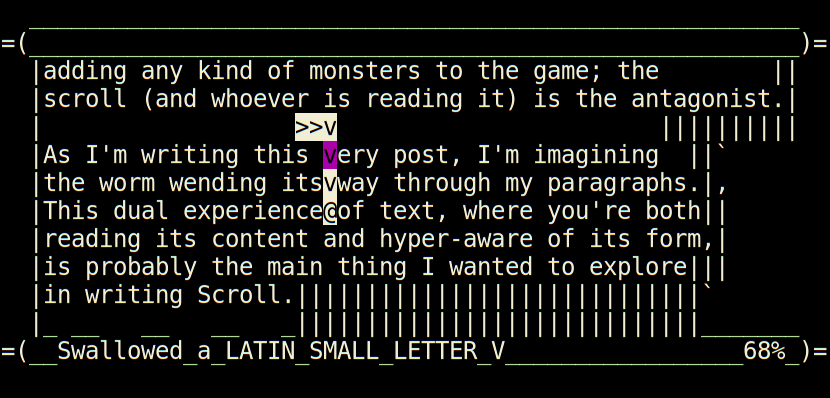
I haven't quite said what Scroll is about yet, let's fix that: In Scroll, you're a bookworm that's stuck on a scroll. You have to dodge between words and use spells to make your way down the page as the scroll is read. Go too slow and you'll get wound up in the scroll and crushed. The character is multiple chars in size (size is the worm's only stat), and the worm interacts with the scroll in lots of ways, like swallowing letters, or diving through a hole to the other side of the scroll. While it can swallow some letters, if it gets too full, it can't move forward anymore, so letters are mostly consumed to be used as spell components. I think that I will manage to get away without adding any kind of monsters to the game; the scroll (and whoever is reading it) is the antagonist. As I'm writing this very post, I'm imagining the worm wending its way through my paragraphs. This dual experience of text, where you're both reading its content and hyper-aware of its form, is probably the main thing I wanted to explore in writing Scroll. As to the text that fills the scroll, it's broadly procedurally generated, in what I hope are unusual and repeatedly surprising (and amusing) ways. I'm not showing any screenshots of the real text, because I don't want to give that surprise away. But, the other thing about Scroll is that it's scroll, a completely usable (if rather difficult..) Unix pager!

Holger Levsen: 20150310-lts-february-2015

My LTS February In February I didn't get much LTS work done, as other projects grabbed my attention. I started working on #761859 but that took a lot more time than initially thought, as the database design has been bended several times to make it fit for some new usecases. For example, "end-of-life" information is saved in the urgency field, making this one of several reasons why a bug can have different urgencies in different releases (despite that a CVE always only has one urgency). There are more oddities in the code base which was written with the (now long gone) assumption to be a tracker for security issues in testing. Constantly adding more requirements and use cases didn't really help to make it more maintainable. I'm glad that at least since yesterday https://security-tracker.debian.org/tracker/data/json provides valid JSON, though probably still a bit of finetuning is needed before I'll consider the output stable and close the bug. In related news I've filed #780201: "new codename needed for oldstable (due to squeeze-lts) when stable becomes oldstable" today as else the security tracker will cease to work for squeeze LTS once we release jessie. And that would spoil that day a bit...

7 March 2015

Joey Hess: 7drl 2015 day 1 groundwork

Scroll is a roguelike, with a twist, which I won't reveal until I've finished building it. I'll just say: A playable roguelike pun, set in a filesystem near you. I'm creating Scroll as part of the 7DRL Challange. If all goes well, I'll have a usable roguelike game finished in 7 days. This is my first time developing a roguelike, and my first time writing a game in Haskell, and my first time writing a game to a time limit. Wow!
First, some groundwork. I'm writing Scroll in Haskell, so let's get the core data types and monads and IO squared away. Then I can spend days 2-7 writing entirely pure functional code, in the Haskell happy place. To represent the current level, I'm using a Vector of Vectors of Chars. Actually, MVectors, which can be mutated safely by pure code running inside the ST monad, so it's fast and easy to read or write any particular location on the level.
-- Writes a Char to a position in the world.
writeWorld :: Pos -> Char -> M ()
writeWorld (x, y) c = modWorld $ \yv -> do
    xv <- V.read yv y
    V.write xv x c
showPlayer :: M ()
showPlayer = writeWorld (5,8) '@'
(I wish these Vectors had their size as part of their types. There are vector libraries on hackage that do, but not the standard vector library, which has mutable vectors. As it is, if I try to access outside the bounds of the world, it'll crash at runtime.) Since the game will need some other state, I'm using the state monad. The overall monad stack is type M = StateT S (ST RealWorld). (It could be forall s. StateT S (ST s), but I had some trouble getting that to type check, so I fixed s to RealWorld, which is ok since it'll be run using stToIO. Next, a concept of time, and the main event loop. I decided to use a continutation passing style, so the main loop takes the current continuation, and runs it to get a snapshot of the state to display, and a new continutation. The advantage of using continuations this way is that all the game logic can be handled in the pure code. I should probably be using the Cont monad in my monad stack, but I've not learned it and lack time. For now I'm handling the continuations by hand, which seems ok.
updateWorld :: Step
updateWorld (Just 'Q') = do
        addMessage "Are you sure you want to quit? [yn]"
        next $ \i -> case i of
                Just 'y' -> quit
                _ -> continue
updateWorld input = do
        addMessage ("pressed " ++ show input)
        continue
Finally, I wrote some ncurses display code, which is almost working.
Start time: After midnight last night. Will end by midnight next Friday. Lines of code written today: 368 Craziest type signature today: writeS :: forall a. ((Vec2 a -> ST RealWorld ()) -> M ()) -> Pos -> a -> M ()
By the way, there's a whole LambdaHack library for Haskell, targeted at just this kind of roguelike construction. It looks excellent. I'm not using it for two reasons:
  1. Scroll is going to be unusual in a lot of ways, and LambdaHack probably makes some assumptions that don't fit.
  2. mainSer :: (MonadAtomic m, MonadServerReadRequest m) => [String] -> COps -> (m () -> IO ()) -> (COps -> DebugModeCli -> ((FactionId -> ChanServer ResponseUI RequestUI -> IO ()) -> (FactionId -> ChanServer ResponseAI RequestAI -> IO ()) -> IO ()) -> IO ()) -> IO ()
    That's a lot of stuff to figure out! I only have a week, so it's probably easier to build my own framework, and this gives me an opportunity to learn more generally useful stuff, like how to use mutable Vectors.

6 March 2015

Eddy Petri&#537;or: Occasional Rsnapshot v1.3.1

I was writing in the previous post about Occasional Rsnapshot and how I ended up writing it.

Just before releasing v1.2.1 I realized it would make sense Semantic Versioning which, in just a few words means:
Given a version number MAJOR.MINOR.PATCH, increment the:
MAJOR version when you make incompatible API changes,
MINOR version when you add functionality in a backwards-compatible manner, and
PATCH version when you make backwards-compatible bug fixes.
I just released Occasional Rsnapshot v1.3.1 which mainly fixed issue 4:
When deciding to do a backup for interval INT, there should be a check that the oldest snapshot in INT-1 interval is older than the threshold for the INT interval. Otherwise the INT interval will be populated with backups more frequent than desired and it is possible older backups in INT interval to completely lost.
The condition should be:
ts(oldest(INT-1)) - ts(newest(INT)) >= threshold(INT)
For example:
  • if weekly.0 is from 15th of February and daily.6 is from 17th of February, weekly should not be triggered, but
  • if weekly.0 is from 15th of February and daily.6 is from 23rd of February, weekly shall be triggered
This extra check should probably added in can_backup_interval.
It was a small bug, but it might have lead to losing important older backups because newer and more frequent backups would be pushed from hourly, interval by interval up to the yearly interval, in spite of the fact that the distance between backups wouldn't have been respecting the upper interval minimum distance in time.

There was also a small syntax bugfix, but functionally nothing has changed because bash was doing the right thing even with that small error.

If you have started using Occasional Rsnapshot, you definitely want now Occasional Rsnapshot v1.3.1. If you haven't started and you don't have backups, please start doing backups, and while you're at it, you might want to try Occasional Rsnapshot (with Rsnapshot).

5 March 2015

Ian Wienand: Acurite 02032CAUDI Weather Station

I found an Acurite Weather Center 02032CAUDI at Costco for $99, which seemed like a pretty good deal. It includes the "colour" display panel and a 5-in-1 remote sensor that includes temperature, wind-speed and direction, humidity and rain gauge. The colour in the diplay is really just a fancy background sticker with the usual calculator-style liquid-crystal display in front. It does seem that for whatever reason the viewing angle is extremely limited; even off centre a little and it becomes very dim. It has an inbuilt backlight that is quite bright; it is either off or on (3-levels) or in "auto" mode, which dims it to the lowest level at certain hours. Hacking in a proximity sensor might be a fun project. The UI is OK; it shows indoor and outdoor temperature/humidity, wind-speed/rain and with is able to show you highs and lows with a bit of scrolling. I was mostly interested in its USB output features. After a bit of fiddling I can confirm I've got it connected up to Meteobridge that is running on a Dlink DIR-505 and reporting to Weather Underground. One caveat is that you do need to plug the weather-station into a powered USB hub, rather than directly into the DIR-505; I believe because the DIR-505 can only talk directly to USB2.0 devices and not older 1.5 devices like the weather station. Another small issue is that the Meteobridge license is 65 which is not insignificant. Of course with some effort you can roll-your-own such as described in this series which is fun if you're looking for a project. Luckily I had a mounting place that backed onto my small server cupboard, so I could easily run the cables through the wall to power and the DIR-505. Without this the cables might end up a bit of a mess. Combined with the fairly limited viewing angle afforded, finding somewhere practical to put the indoor unit might be one of the hardest problems. Mounting the outdoor unit was fine, but mine is a little close to the roof-line so I'm not sure the wind-speed and direction are as accurate as if it were completely free-standing (I think official directions for wind-speed are something like free-standing 10m in the air). It needs to face north; both for the wind-direction and so the included solar-panel that draws air into the temp/humidity sensor is running as much as possible (it works without this, but it's more accurate with the fan). One thing is that it needs to mounted fairly level for the rain-gauge; it includes a small bubble-level on the top to confirm this. Firstly you'll probably find that most mount points you thought were straight actually aren't! Since the bubble is on the top, if you want to actually see it you need to be above it (obviously) which may not be possible if you're standing on a ladder and mounting it over your head. This may be a situation that inspires a very legitimate use of a selfie-stick. It's a fun little device and fairly hackable for an overall reasonable price; I recommend.

4 March 2015

Zlatan Todori : Interviews with FLOSS developers: Paul Wise

After starting with Joey Hess, we continue with Paul Wise. What makes his star to shine are many things such as being a DSA (Debian System Administrator), a helpful hand on mailings list, encouraging people to join Debian teams but most of all - he has encyclopedia knowledge on Debian as a whole which he gladly shares with anyone who asks (very fast response on IRC channels). It is almost impossible for any single person to count all Debian teams, work and places - to know most of those things, you can image the vast knowledge which Paul has. The legend says that his brain has better and faster search engine algorithm on Debian related queries than all other engines combined. So lets see what he has to share with world. me: Who are you? pabs: Paul Wise (pabs) and I have to say that I'm no-where near as knowledgeable as your intro suggests. me: How did you start programming? pabs: Messing around with fractals and graphics things in MS BASIC. me: How would you now advise others to start programming? pabs: Pick an issue in a tool you use, investigate how the tool works and how you can change it, fix that and contribute the change back to the project that created that tool. In the process you will learn skills, interact with the community and contribute to the project. me: Setup of your development machine? pabs: Lenovo Thinkpad with external monitor, Debian testing and some tweaks me What is your preferable language (for hacking)? Why? How do you compare it to other languages? pabs: I currently prefer Python for its readability. It still has some rough edges though the documentation covers them fairly well. I generally pick up new languages when working on projects written in them. Haskell is next on the horizon due to Nikki and the Robots. me: Describe your current most memorable situation as software developer/hacker? pabs: I had a great time creating fractals in BASIC, learning about the Mandelbrot set, L-systems and more. My days and nights of hacking on frhed (a GPLed hex editor for Windows) to help me cheat at Civilisation were pretty memorable. frhed led to my work on reverse engineering the CHM file format (a documentation format for Windows programs). A stand-out moment during my time with Debian was hacking on the derivates census patch generation code during the Debian UK BBQ weekend, surrounded by geeks playing Portal, cooking things, hacking on Debian and generally having a good time (thanks Steve!). me: Some memorable moments from Debian conferences? pabs: There are so many; meeting Debian folks, playing Mao once and then never again, late night games of werewolf, both delectably delicious and hideously disgusting cheeses, fried insects, day trips to beautiful landscapes, inspiring keynotes, exciting BoFs, secret IRC channels for planning surprise birthday parties, blue hair, wet air, blocks of fried cheese, a vast quantity of icecream, pants, geeks in the surf, volcanoes, hiking, a wonderful view, a uni-cycling stormtrooper & more. me: How do you see future of Debian development? pabs: I hope we will continue to exist and uphold our principles for the foreseeable future. I don't have any crystal balls though. me: You recently became member of Debian DSA - what is that like, what roles do you have and what tasks are in front of DSA? pabs: We wrote a bit of text about that for DPN recently. me: You have large knowledge on Debian and you share it with anyone who wants to know more. What motivates you to do so? pabs: I want the operating system I personally rely on to exist into the future, helping folks work on and join Debian can help with that. me: Why should developers and users join Debian community? What makes Debian a great and happy place? pabs: Every Debian contributor has different reasons for joining the community. Personally the Social Contract, the DFSG and the spirit and culture behind them are the main reason to be involved. I also like our many efforts towards technical excellence and correctness. Of course I've made a number of good friends over the years, especially as a result of attending DebConf every year since 2007. me: You are member of Debian publicity team which writes Debian news - do you need more people to join that team and how can they start? pabs: Since there is an infinite amount of work to do, pretty much every part of Debian always needs help, that includes the publicity team. We published a post about ways to help here. me: If someone wants to contribute to Debian in terms of packaging, can they do it anonymously (for example over Tor network, does Debian have .onion address)? pabs: Due to Debian's penchant for transparency it is harder but there are definitely package maintainers who have built up a reputation for good work under a pseudonym over the years and become Debian contributors as a result. I'm not aware of completely anonymous package maintainers but there are definitely people who file bugs using one-off pseudonyms, which is almost the same thing as anonymously. There are definitely Debian contributors and members who use Tor while contributing to Debian. In fact, as Debian is very highly dependent on OpenPGP and the best practices for OpenPGP include refreshing your keyring slowly over Tor, so probably quite a number of Debian contributors use Tor. As far as I know Debian itself does not run any Tor relays or onion services. me: What are places that non-packaging developers and people could join and help spread Debian even more? pabs: There are many ways to help Debian, including non-technical ones. Unfortunately our web page about helping Debian isn't quite up-to-date with all of them but a few more are to volunteer at DebConf, helo with artwork requests, speak about Debian at events or even come up with ideas for projects. Whatever skills you have, Debian can probably make use of them. If you aren't sure where to start, jump on the debian-mentors mailing list or IRC channel and we can probably guide you to the right place within Debian. Don't worry about not being skilled enough, everyone starts somewhere. me: How do you see Debian will manage webapps? pabs: Personally I prefer locally installed software, standard data formats and standard data transfer protocols to the wild webapps world but I understand they are becoming very popular to produce and use due to the ubiquity of the web browser platform. Antonio Terceiro is mentoring a project for this year's newcomer mentorship programs (outreachy/gsoc) that aims to improve support for installing web apps on Debian installations. I hope it succeeds as it could help make Debian more popular on servers and home servers in particular. me: How would you advise Debian (and other FLOSS users) to setup their machine in terms of security and anonymity? pabs: All technology has upsides and downsides. I would advise anyone to analyse their situation and protect themselves accordingly. For example if you have a bad memory, full disk encryption, which is based on pass-phrases might lead to data loss and physical security might be a better choice for protecting your data. The right choices around technology are very much a personal thing. me: Is it better to setup xmonad (because it is Haskell based WM) with small dependency chain or GNOME (because it is getting sandboxed apps) in term of security and privacy implications? pabs: Again, the right choices around technology are very much a personal thing. Due to the design of X11, both of these are approximately equivalent from a window-manager security properties point of view, that is to say, pretty bad. Wayland is one of the possible X11 successors and offers much better security properties. GNOME folks are working on switching to Wayland. Ultimately though it comes down to how each person uses their window manager and which software they run under it. me: Should Debian join Tor project as distro that installs Tor relays by default - should it offer that as option in installer in Debian 9? pabs: Running a Tor relay requires a reasonably fast and reliable Internet connection and should be a conscious decision on behalf of the sysadmin for a computer so Debian probably shouldn't install them by default. If tasksel gets support for installing tasks from Debian Pure Blends, then we could add a Tor relay task to the Debian Sanctuary Pure Blend. me: Have you ever considered joining initiatives such as FreedomBox? pabs: I was quite moved by Eben Moglen's talk at DebConf10 in New York and the resulting BoF. It seemed like a very ambitious project but I didn't really have the knowledge, skills or time to contribute yet. me: Are you a gamer? Valve Steam games are offered for free to Debian Developers - do you use steam and play Valve games? Your thoughts on Steam and non-free Linux gaming? pabs: I play computer games occasionally, all from Debian main or ones that I'm packaging. 0ad is my current go-to for a bit of gaming. I don't have any experience with Steam or non-free games on Linux. me: Is there something you would change in FLOSS ecosystem? pabs: Various folks have highlighted new and ongoing challenges for the FLOSS ecosystem in various places in recent years. Something that I would like to highlight that does not get talked about enough is the choices we make around our digital artefacts. This is the discussion around "preferred form for modification" or "source". The "source" for a particular digital artefact is a deliberate choice on behalf of the authors. Often generated files are distributed alongside the "source" without any instructions for reproducing the generated files from the "source". It sometimes happens that FLOSS contributors forget to distriute what they have chosen as "source", instead just distributing the generated files. This is a fairly well known issue but still happens. What isn't thought about quite as much is that the choice of "source" has consequences for future development possibilities of that "source". Some forms of "source" are more expressive than others, can be modified in a wider variety of ways and are better choices in general. Sometimes the consequences of choosing less expressive forms are mild and other times they are quite important. I hope more people will start to think about these choices. Some examples where, in my opinion, various people could have made better choices are listed in the mail I sent to the games team list last year. Another thing I would like to highlight is the work that organisations like Software Freedom Conservancy and Software in the Public Interest do to protect, defend, promote and support FLOSS projects. It is very important work that needs our interest and support. me: Can FLOSS world create great alternatives to Viber, Dropbox, WhatsUp, Facebook, Skype and other non-free services? pabs: I think that the FLOSS world has already created alternatives to all of those. The success of non-free services doesn't take these alternatives away but it does mean some of them are less useful because some of them are the kind of tools that become more useful with a larger amount of people using them. I don't know what it would take for the FLOSS alternatives to achieve similar success as network effects are hard to overcome. Hopefully mako is right and the network effects are overrated. me: Your thoughts and compare Cloud, IaaS, PaaS, SaaSS? To what should the FLOSS world pay more attention and energy? pabs: Initially I dismissed these as buzzwords and a threat to Free Software. These days I view them as potential opportunities for Free Software. Cloud-related technologies such as OpenStack and virtual machines can make private compute farm hardware more flexible and useful to their owners. IaaS providers can be used to run Debian more simply and cheaply and therefore bring Debian to more people than possible with hardware. PaaS providers can be used to run Free Software services. SaaSS can be based entirely on Free Software and respect users. Of course, just like running Free Software on hardware (proprietary or libre), cloud technology, IaaS, PaaS and SaaSS all come with downsides. The FLOSS world should aim to inform users of our software of these downsides. For example, the Debian installer could note that it is running on Intel CPUs with a proprietary BIOS and various proprietary software running, that it is running on a mobile phone with a locked bootloader, that it is running in a Xen VM on machines owned by Amazon. Free Software services could note they are running on Google App Engine etc. Free Software web browsers, chat clients etc could note when they are connecting to proprietary network services. All these notes could inform users about the downsides present in the particular situation encountered. There is also much work to be done making it easier to run Free Software on top of or use Free Software to connect to all manner of platforms from lowRISC to UEFI to VMware to Google App Engine to GitHub to Facebook. The more places Free Software can reach, the more people will be exposed to the philosophy behind it and the more potential there is for folks to join the community. While co-option of the FLOSS world is a dangerous certainty, co-option of proprietary platforms might be able to expand the reach of the philosophy behind Free Software. me: Your thoughts on Purism (the open hardware laptop initiative that got recently funded on CrowdSupply)? pabs: I don't know enough about that to comment but personally I am more interested in a laptop based on a libre CPU architecture. The RISC-V ISA and the lowRISC project seems to be one of the more promising possibilities at this point in time. me: Did you watch Citizenfour - comments on it? pabs: I've seen the trailer and look forward to watching it at some point, I read there might be a screening at DebConf15.

1 March 2015

Robert Edmonds: Converting to --upstream-vcs-tag

Recently, the Google protobuf developers announced a migration of their project's source code from an svn repository to a git repository. Up until this point, the Debian protobuf package repository had only tracked upstream development by embedding upstream release tarballs using gbp import-orig with pristine-tar. It would be nice to smoothly migrate the packaging repository to additionally make use of the --upstream-vcs-tag option to gbp import-orig, the advantages of which have been well described by Russ Allbery. This turned out to be harder than expected, so for reference I documented the steps I took below. Note that this packaging repository uses the default gbp import-orig repository layout, where upstream sources are placed on a branch named upstream, and the Debian branch is named master. Add an upstream remote configured to track the upstream repository's master branch and tags.
$ git remote add --tags --track master upstream https://github.com/google/protobuf.git
The upstream remote shouldn't be confused with our upstream branch. Note that git-remotes are local to the repository, so the upstream remote should probably be documented in the debian/README.source file. Fetch the upstream branch and tags.
$ git fetch upstream
warning: no common commits
remote: Counting objects: 5210, done.
remote: Compressing objects: 100% (861/861), done.
remote: Total 5210 (delta 3869), reused 5194 (delta 3855)
Receiving objects: 100% (5210/5210), 3.57 MiB   1.43 MiB/s, done.
Resolving deltas: 100% (3869/3869), done.
From https://github.com/google/protobuf
 * [new branch]      master     -> upstream/master
 * [new tag]         v2.6.0     -> v2.6.0
$
We now have a git-remote upstream, a remote-tracking branch upstream/master which corresponds to the master branch that upstream makes releases from, and a release tag v2.6.0. Note that the remote-tracking branch upstream/master shouldn't be confused with our master branch. Up until this point, our upstream branch has been synthetically generated by importing upstream's release tarballs with gbp import-orig. We need to merge this synthetic history with upstream/master. Unfortunately, I couldn't find a way to do this without using a temporary branch.
$ git checkout -b tmp upstream/master
Branch tmp set up to track remote branch master from upstream.
Switched to a new branch 'tmp'
$ git merge -s ours -m \
  "Merge the original 'upstream' branch with upstream's new master branch" upstream
Merge made by the 'ours' strategy.
$ git checkout upstream
Switched to branch 'upstream'
Your branch is up-to-date with 'origin/upstream'.
$ git merge --ff-only tmp
Updating 7ed940b..9ba221e
Fast-forward
 CHANGES.txt                                                          49 +-
 COPYING.txt => LICENSE                                                0
 Makefile.am                                                          64 +-
 Makefile.in                                                        1041 --
 README.txt => README.md                                              49 +-
[...many more lines...]
$ git branch -D tmp
Deleted branch tmp (was 5f18f02).
$
There are now an additional 400 or so commits on our upstream branch, corresponding to the new git repository history published by upstream. Import the 2.6.0 release tarball against the upstream v2.6.0 tag, using the --upstream-vcs-tag option.
$ git checkout master
Switched to branch 'master'
Your branch is up-to-date with 'origin/master'.
$ gbp import-orig -u 2.6.0 --upstream-vcs-tag=v2.6.0 ~/debian/tarballs/protobuf_2.6.0.orig.tar.gz
gbp:info: Importing '/home/edmonds/debian/tarballs/protobuf_2.6.0.orig.tar.gz' to branch 'upstream'...
gbp:info: Source package is protobuf
gbp:info: Upstream version is 2.6.0
pristine-tar: committed protobuf_2.6.0.orig.tar.gz.delta to branch pristine-tar
gbp:info: Merging to 'master'
gbp:info: Successfully imported version 2.6.0 of /home/edmonds/debian/tarballs/protobuf_2.6.0.orig.tar.gz
$
The upstream branch now contains a mixture of the original series of release tarball content imported by plain gbp import-orig and the upstream/master branch as published by upstream. Updating the Debian packaging repository when new upstream releases occur only requires a git fetch to pull down upstream's updated git history and release tag and using the --upstream-vcs-tag option when importing the release tarball with gbp import-orig.

28 February 2015

Zlatan Todori : Interviews with FLOSS developers: Joey Hess

Edit: Now translated to Chinese. Thanks zhang wei! There is really hardly a better way to open a series of interviewing with developers behind Free Libre Open Source Software project, then with incredible mind such as Joey Hess. To write his contributions to Free software ecosystem, especially in Debian, would be a book by itself. His impact exceeds even his projects - people literally follow his blog posts to see what he is doing and how is he living. A hacker from cabin. If you really need to have a picture of true hacker, then Joey is the one. As this isn't a book I will just mention few projects that he has been behind - git-annex, ikiwiki, etckeeper, debian installer, parts of dpkg, debhelper, devscripts, taskel. So without further waiting here it is. Picture of Joey Hess me: Who are you? joeyh: I'm Joey -- https://joeyh.name/ me: How did you start programming? joeyh: Atari 130XE which came with BASIC and a boring word processor and not much else. No other friends had one, so the only way to get software was to type in demo programs from manual and then begin to change and write my own. So, the easy way to learn. Also some Logo in school. me: How would you now advise others to start programming? joeyh: Difficult question, it seems much harder to get an intimate understanding of things than when I started, and much harder to be motivated to program when there's so much stuff easily available. Maybe simple bare-metal systems like Arduino coupled with real-world interaction are the answer. I've recently been mentoring my nephew who is learning python and Python the Hard Way has gotten him far impressively fast. me: Setup of your development machine? joeyh: Lenovo laptop de-spywared with Debian unstable, xmonad, xfce, vim. me: Your thoughts on Purism (the open hardware laptop initiative that got recently funded on CrowdSupply)? joeyh: I don't know much about that one, but it seems that consumer level hardware has gotten so low quality, and so closed and untrustworthy that it makes sense to either build alternatives that are open, or pick out, as a community, the stuff we can adapt to our needs and concentrate on it. Several projects are trying, I hope they succeed. me: How do you see future of Debian development? joeyh: Well, I've mostly stopped worrying about it. If you look back at my presentations at the past 2 or 3 DebConfs, you'll find my best thoughts on the matter. me: You retired as Debian developer - do you intend sometime soon to come back and/or do you plan to join some other communities? joeyh: It would be glorious to come back, wouldn't it? But I don't think I will. Can't step in the same river twice, and all. Instead, Debian will probably have to put up with me as an annoying upstream author who doesn't ship tarballs, but does ship debian/ directories, and as a bug reporter who enjoys reporting amusing bugs like -0 NaN. I seem to have more time to spend in other online communities since I left Debian, but in a more diffuse way. Maybe that's just what it's like, to be involved in Free Software but not in the embrace of a big project like Debian. me: Some memorable moments from Debian conferences? joeyh: There are so many! Picnicing on berries and tamales at the Portland farmer's market right outside the venue; rainbows and bonfire in Switzerland after crazy busy days; impromptu pipe organ repair in a weird night venue in Edinburgh; walking through Porto Alegre at night with Ian Murdock and how humble he was about what he'd started; hacking all night in Spain; failing to sleep through midnight sun and incessent partying Finland; hanging out in the hotel lobby in Atlanta where we designed Build-Depends. me: Are you a gamer? Valve Steam games are offered for free to Debian Developers - do you use steam and play Valve games? joeyh: I've played through Half Life and Portal, but nethack has claimed more of my time. I mostly enjoy short, indie games, or games that tell us something new about the medium of games, A recent favorite was A Dark Room. But really, I have more pure fun playing real world Tabletop games with friends, like Carcassanne Discovery and Hive. In March, I am going to try to write a roguelike game in one week, in Haskell, for the Seven Day Roguelike Challenge and I'll be blogging about my progress daily. me: You are nowdays a Haskell hacker (git-annex) - what would you like to say about this language and how does it compare to Python, C, JavaScript, Ruby and Perl? joeyh: Not just git-annex; all my current projects are written in Haskell. I think it's amazing how much we expect programmers to keep in their heads while writing code. Is that buffer going to overflow? Is changing the value of that global variable going to break some other part of the code? Is that input sanitized yet? Did that interface change? Haskell solves some of these outright, but more, it makes you start noticing this kind of pervasive issue, and it provides ways to completely eliminate a class of problems from your code. For example http://joeyh.name/blog/entry/making_propellor_safer_with_GADTs_and_type_families/. The class of bugs I avoided there had never affected my code even once, but it was still worth preventing that whole class of bugs, so I don't have to worry about them ever again. me: Would you suggest Haskell as first language to learn especially for those that have an itch for mathematics? joeyh: I think that can work well. Or it can go other the way -- I had an affinity to mathematics when I was young, but it got knocked out of me in the way that happens to many people, and languages like perl and C don't do much to make you want to learn more about higher-order math. I've been picking up a bit more here and there via Haskell. me: How do you compare your productivity in Haskell compared to your Perl days? joeyh: It's very different; I'm a very different programmer now. I probably would bang out quick hacks more quickly when I was writing Perl. But, they tended to stay quick hacks. Now, I might take a little longer to get there, but the code seems a lot more solid, while also being more malleable to turn into larger or different programs. I'm also a lot more drawn toward writing software libraries. me: Can you describe your philosophy of life (you live in cabin, in forest, using a lot of solar power - many people are intrigued (including myself) what drives you towards that kind of life and how does it impact your overall quality of life and happiness. Looking the todays modern predator capitalistic society, in which you could easily earn more then $10.000 a month, you seem to be an anarchist and very humble human)? joeyh: I want to build worthwhile things that might last. Which is super hard in the world of software, both because it's hard to think far ahead at all, and because most jobs don't emphasize that kind of real value. I've been lucky and bootstrapped up to a point where I've been able to work full time on free software for years, and I'm willing to forgo a lot to continue that. Living in the woods without modern conveniences is great, because it's quiet and you can think as much as you like; the internet is just as close as it is anywhere else (maybe a bit slower); and when you've spent too much time quietly thinking you'll need to go chop wood, or haul water, or jump in the river to cool off, depending on the season. (Humble? Like most programmers, I am internally a flaming tower of ego...)
Vote on Hacker News

Gunnar Wolf: Welcome to the world, little ones!

Welcome to the world, little ones!
Welcome little babies! Yesterday night, we entered the hospital. Nervous, heavy, and... Well, would we ever be ready? As ready as we could. A couple of hours later, Alan and Elena Wolf Daichman became individuals on their own right. As is often the case in the case of twins, they were brought to this world after a relatively short preparation (34 weeks, that's about 7.5 months). At 1.820 and 1.980Kg, they are considerably smaller than either of the parents... But we will be working on that! Regina is recovering from the operation, the babies are under observation. As far as we were told, they seem to be quite healthy, with just minor issues to work on during neonatal care. We are waiting for our doctors to come today and allow us to spend time with them. And as for us... It's a shocking change to finally see the so long expected babies. We are very very very happy... And the new reality is hard to grasp, to even begin understanding :) PS- Many people have told me that my blog often errors out under load. I expect it to happen today :) So, if you cannot do it here, there are many other ways to contact us. Use them! :)

26 February 2015

Michael Banck: 26 Feb 2015

My recent Debian LTS activities

Over the past months, my employer credativ has sponsored some of my work time to keep PostgreSQL updated for squeeze-lts. Version 8.4 of PostgreSQL was declared end-of-life by the upstream PostgreSQL Global Development Group (PGDG) last summer, around the same time official squeeze support ended and squeeze-lts took over. Together with my colleagues Christoph Berg (who is on the PostgreSQL package maintainer team) and Bernd Helmle, we continued backpatching changes to 8.4. We tried our best to continue the PGDG backpatching policy and looked only at commits at the oldest still maintained branch, REL9_0_STABLE.

Our work is publicly available as a separate REL8_4_LTS branch on Github. The first release (called 8.4.22lts1) happened this month mostly coinciding with the official 9.0, 9.1, 9.2, 9.3 and 9.4 point releases. Christoph Berg has uploaded the postgresql-8.4 Debian package for squeeze-lts and release tarballs can be found on Github here (scroll down past the release notes for the tarballs).

We intend to keep the 8.4 branch updated on a best-effort community basis for the squeeze-lts lifetime. If you have not yet updated from 8.4 to a more recent version of PostgreSQL, you probably should. But if you are stuck on squeeze, you should use our LTS packages. If you have any questions or comments concerning PostgreSQL for squeeze-lts, contact me.

22 February 2015

Rog rio Brito: User-Agent strings and privacy

I just had my hands on some mobile devices (a Samsung's Galaxy Tab S 8.4", an Apple's iPad mini 3, and my no-name tablet that runs Android). I got curious to see how the different browsers identify themselves to the world via their User agent strings and I must say that each browser's string reveals a lot about both the browser makers and their philosophies regarding user privacy. Here is a simple table that I compiled with the information that I collected (sorry if it gets too wide):
Device Browser User-Agent String
Samsung Galaxy Tab S Firefox 35.0 Mozilla/5.0 (Android; Tablet; rv:35.0) Gecko/35.0 Firefox/35.0
Samsung Galaxy Tab S Firefox 35.0.1 Mozilla/5.0 (Android; Tablet; rv:35.0.1) Gecko/35.0.1 Firefox/35.0.1
Samsung Galaxy Tab S Android's 4.4.2 stock browser Mozilla/5.0 (Linux; Android 4.4.2; en-gb; SAMSUNG SM-T700 Build/KOT49H) AppleWebKit/537.36 (KHTML, like Gecko) Version/1.5 Chrome/28.0.1500.94 Safari/537.36
Samsung Galaxy Tab S Updated Chrome Mozilla/5.0 (Linux; Android 4.4.2; SM-T700 Build/KOT49H) AppleWebKit/537.36 (KHTML, like Gecko) Chrome/40.0.2214.109 Safari/537.36
Vanilla tablet Android's 4.1.1 stock browser Mozilla/5.0 (Linux; U; Android 4.1.1; en-us; TB1010 Build/JRO03H) AppleWebKit/534.30 (KHTML, like Gecko) Version/4.0 Safari/534.30
Vanilla tablet Firefox 35.0.1 Mozilla/5.0 (Android; Tablet; rv:35.0.1) Gecko/35.0.1 Firefox/35.0.1
iPad Safari's from iOS 8.1.3 Mozilla/5.0 (iPad; CPU OS 8_1_3 like Mac OS X) AppleWebKit/600.1.4 (KHTML, like Gecko) Version/8.0 Mobile/12B466 Safari/600.1.4
Notebook Debian's Iceweasel 35.0.1 Mozilla/5.0 (X11; Linux x86_64; rv:35.0) Gecko/20100101 Firefox/35.0 Iceweasel/35.0.1
So, briefly looking at the table above, you can tell that the stock Android browser reveals quite a bit of information: the model of the device (e.g., SAMSUNG SM-T700 or TB1010) and even the build number (e.g., Build/KOT49H or Build/JRO03H)! This is super handy for malicious websites and I would say that it leaks a lot of possibly undesired information. The iPad is similar, with Safari revealing the version of the iOS that it is running. It doesn't reveal, though, the language that the user is using via the UA string (it probably does via other HTTP fields). Chrome is similar to the stock Android browser here, but, at least, it doesn't reveal the language of the user. It does reveal the version of Android, including the patch-level (that's a bit too much, IMVHO). I would say that the winner respecting privacy of the users among the browsers that I tested is Firefox: it conveys just the bare minimum, not differentiating from a high-end tablet (Samsung's Galaxy Tab S with 8 cores) and a vanilla tablet (with 2 cores). Like Chrome, Firefox still reveals a bit too much in the form of the patch-level. It should be sufficient to say that it is version 35.0 even if the user has 35.0.1 installed. The bonus points with Firefox is that it is also available on F-Droid, in two versions: as Firefox itself and as Fennec.

Hideki Yamane: New laptop ThinkPad E450

I've got a new laptop, Lenovo ThinkPad E450.

  • CPU: Intel Core i5 (upgraded)
  • Mem: 8GB (upgraded, one empty slot, can up to 16GB)
  • HDD: 500GB
  • LCD: FHD (1920x1080, upgraded)
  • wifi: 802.11ac (upgraded, Intel 7265 BT ACBGN)
nice, it was less than $600 $500.


Well, probably you know about Superfish issue with Lenovo Laptop, but it didn't affect to me because first thing when I got it is replacing HDD with another empty one, and did fresh install Debian Jessie (of course).

20 February 2015

Rhonda D'Vine: Queer-Positive Songs

Just recently I stumbled upon one of these songs again and thought to myself: Are there more out there? With these songs I mean songs that could from its lyrics be considered queer-positive. Lyrics that cointain parts that speak about queer topics. To get you an idea of what I mean here are three songs as examples: Do you have further examples for me? I know that I already mentioned another one in my blog entry about Garbage for a start. I am aware that there probably are dedicated bands that out of their own history do a lot songs in that direction, but I also want to hear about songs in which it is only mentioned in a side note and not made the central topic of the whole song, making it an absolutely normal random by-note. Like always, enjoy and I'm looking forward to your suggestions!

/music permanent link Comments: 17 Flattr this

19 February 2015

Niels Thykier: Partial rewrite of lintian s reporting setup

I had the mixed pleasure of doing a partial rewrite of lintian s reporting framework. It started as a problem with generating the graphs, which turned out to be not enough memory . On the plus side, I am actually quite pleased with the end result. I managed to scope-creep myself quite a bit and I ended up getting rid of a lot of old issues. The major changes in summary: There are also some nice minor features : As you can probably tell, I am quite pleased with the end result. The reporting framework lacks behind in development, since it just sits there and takes care of itself . Also with the complete lack of testing, it also suffers from the if it is not broken, then do not fix it paradigm (because we will not notice if we broke until it is too late). Of course, I managed to break the setup a couple of times in the process. However, a bonus feature of the reporting setup is that if you break it, it simply leaves an outdated report on the website. Anyway, enjoy. :)
Filed under: Debian, Lintian

17 February 2015

Lucas Nussbaum: Some email organization tips and tricks

I d like to share a few tips that were useful to strengthen my personal email organization. Most of what follows is probably not very new nor special, but hey, let s document it anyway. Many people have an inbox folder that just grow over time. It s actually similar to a twitter or RSS feed (except they probably agree that they are supposed to read more of their email feed ). When I send an email to them, it sometimes happen that they don t notice it, if the email arrives at a bad time. Of course, as long as they don t receive too many emails, and there aren t too many people relying on them, it might just work. But from time to time, it s super-painful for those interacting with them, when they miss an email and they need to be pinged again. So let s try not to be like them. :-) Tip #1: do Inbox Zero (or your own variant of it) Inbox Zero is an email management methodology inspired from David Allen s Getting Things Done book. It s best described in this video. The idea is to turn one s Inbox into an area that is only temporary storage, where every email will get processed at some point. Processing can mean deleting an email, archiving it, doing the action described in the email (and replying to it), etc. Put differently, it basically means implementing the Getting Things Done workflow on one s email. Tip #1.1: archive everything One of the time-consuming decisions in the original GTD workflow is to decide whether something should be eliminated (deleted) or stored for reference. Given that disk space is quite cheap, it s much easier to never decide about that, and just archive everything (by duplicating the email to an archive folder when it is received). To retrieve archived emails when needed, I then use notmuch within mutt to easily search through recent (< 2 year) archives. I use archivemail to archive older email in compressed mboxes from time to time, and grepmail to search through those mboxes when needed. I don t archive most Debian mailing lists though, as they are easy to fetch from master.d.o with the following script:
#!/bin/sh
rsync -vP master.debian.org:~debian/*/*$1/*$1.$ 2:-$(date +%Y%m) * .
Then I can fetch a specific list archive with getlist devel 201502, or a set of archives with e.g. getlist devel 2014, or the current month with e.g. getlist devel. Note that to use grepmail on XZ-compressed archives, you need libmail-mbox-messageparser-perl version 1.5002-3 (only in unstable I was using a locally-patched version for ages, but finally made a patch last week, which Gregor kindly uploaded). Tip #1.2: split your inbox (Yes, this one looks obvious but I m always surprised at how many people don t do that.) Like me, you probably receive various kinds of emails: Splitting those into separate folders has several advantages: I ve seen some people splitting their inbox into too many folders. There s not much point in having a per-sender folder organization (unless there s really a recurring flow of emails from a specific person), as it increases the risk of missing an email. I use procmail to organize my email into folders. I know that there are several more modern alternatives, but I haven t looked at them since procmail does the job for me. Resulting organization I use one folder for my day-job email, one for my DPL email, one for all other email directed or Cced to me. Then, I have a few folders for automated notifications of stuff. My Debian mailing list folders are auto-managed by procmail s $MATCH:
:0:
 * ^X-Mailing-List: <.*@lists\.debian\.org>
 * ^X-Mailing-List: <debian-\/[^@]*
 .ml.debian.$MATCH/
Some other mailing lists are in they separate folders, and there s a catch-all folder for the remaining ones. Ah, and since I use feed2imap, I have folders for the RSS/Atom feeds I follow. I have two different commands to start mutt. One only shows a restricted number of (important) folders. The other one shows the full list of (non-empty) folders. This is a good trick to avoid spending time reading email when I am supposed to do something more important. :) As for many people probably, my own organization is loosely based on GTD and Inbox Zero. It sometimes happen that some emails stay in my Inbox for several days or weeks, but I very rarely have more than 20 or 30 emails in one of my main inbox folders. I also do reviews of the whole content of my main inbox folders once or twice a week, to ensure that I did not miss an email that could be acted on quickly. A last trick is that I have a special folder replies, where procmail copies emails that are replies to a mail I sent, but which do not Cc me. That s useful to work-around Debian s no Cc on reply to mailing list posts policy. I receive email using offlineimap (over SSH to my mail server), and send it using nullmailer (through a SSH tunnel). The main advantage of offlineimap over using IMAP directly in mutt is that using IMAP to a remote server feels much more sluggish. Another advantage is that I only need SSH access to get my full email setup to work. Tip #2: tracking sent emails Two recurring needs I had was: I developed a short script to address that. It scans the content of my Sent maildir and my archive maildirs, and, for each email address I use, displays (see example output in README) the list of emails sent with this address (one email per line). It also detects if an email was replied to ( R column after the date), and abbreviates common parts in email addresses (debian-project@lists.debian.org becomes d-project@l.d.o). It also generates a temporary maildir with symlinks to all emails, so that I can just open the maildir if needed.

16 February 2015

Julien Danjou: Hacking Python AST: checking methods declaration

A few months ago, I wrote the definitive guide about Python method declaration, which had quite a good success. I still fight every day in OpenStack to have the developers declare their methods correctly in the patches they submit. Automation plan The thing is, I really dislike doing the same things over and over again. Furthermore, I'm not perfect either, and I miss a lot of these kind of problems in the reviews I made. So I decided to replace me by a program a more scalable and less error-prone version of my brain. In OpenStack, we rely on flake8 to do static analysis of our Python code in order to spot common programming mistakes. But we are really pedantic, so we wrote some extra hacking rules that we enforce on our code. To that end, we wrote a flake8 extension called hacking. I really like these rules, I even recommend to apply them in your own project. Though I might be biased or victim of Stockholm syndrome. Your call. Anyway, it's pretty clear that I need to add a check for method declaration in hacking. Let's write a flake8 extension! Typical error The typical error I spot is the following:
class Foo(object):
# self is not used, the method does not need
# to be bound, it should be declared static
def bar(self, a, b, c):
return a + b - c

That would be the correct version:
class Foo(object):
@staticmethod
def bar(a, b, c):
return a + b - c

This kind of mistake is not a show-stopper. It's just not optimized. Why you have to manually declare static or class methods might be a language issue, but I don't want to debate about Python misfeatures or design flaws. Strategy We could probably use some big magical regular expression to catch this problem. flake8 is based on the pep8 tool, which can do a line by line analysis of the code. But this method would make it very hard and error prone to detect this pattern. Though it's also possible to do an AST based analysis on on a per-file basis with pep8. So that's the method I pick as it's the most solid. AST analysis I won't dive deeply into Python AST and how it works. You can find plenty of sources on the Internet, and I even talk about it a bit in my book The Hacker's Guide to Python. To check correctly if all the methods in a Python file are correctly declared, we need to do the following: Flake8 plugin In order to register a new plugin in flake8 via hacking, we just need to add an entry in setup.cfg:
[entry_points]
flake8.extension =
[ ]
H904 = hacking.checks.other:StaticmethodChecker
H905 = hacking.checks.other:StaticmethodChecker

We register 2 hacking codes here. As you will notice later, we are actually going to add an extra check in our code for the same price. Stay tuned. The next step is to write the actual plugin. Since we are using an AST based check, the plugin needs to be a class following a certain signature:
@core.flake8ext
class StaticmethodChecker(object):
def __init__(self, tree, filename):
self.tree = tree

def run(self):
pass

So far, so good and pretty easy. We store the tree locally, then we just need to use it in run() and yield the problem we discover following pep8 expected signature, which is a tuple of (lineno, col_offset, error_string, code). This AST is made for walking The ast module provides the walk function, that allow to iterate easily on a tree. We'll use that to run through the AST. First, let's write a loop that ignores the statement that are not class definition.
@core.flake8ext
class StaticmethodChecker(object):
def __init__(self, tree, filename):
self.tree = tree

def run(self):
for stmt in ast.walk(self.tree):
# Ignore non-class
if not isinstance(stmt, ast.ClassDef):
continue

We still don't check for anything, but we know how to ignore statement that are not class definitions. The next step need to be to ignore what is not function definition. We just iterate over the attributes of the class definition.
for stmt in ast.walk(self.tree):
# Ignore non-class
if not isinstance(stmt, ast.ClassDef):
continue
# If it's a class, iterate over its body member to find methods
for body_item in stmt.body:
# Not a method, skip
if not isinstance(body_item, ast.FunctionDef):
continue

We're all set for checking the method, which is body_item. First, we need to check if it's already declared as static. If so, we don't have to do any further check and we can bail out.
for stmt in ast.walk(self.tree):
# Ignore non-class
if not isinstance(stmt, ast.ClassDef):
continue
# If it's a class, iterate over its body member to find methods
for body_item in stmt.body:
# Not a method, skip
if not isinstance(body_item, ast.FunctionDef):
continue
# Check that it has a decorator
for decorator in body_item.decorator_list:
if (isinstance(decorator, ast.Name)
and decorator.id == 'staticmethod'):
# It's a static function, it's OK
break
else:
# Function is not static, we do nothing for now
pass

Note that we use the special for/else form of Python, where the else is evaluated unless we used break to exit the for loop.
for stmt in ast.walk(self.tree):
# Ignore non-class
if not isinstance(stmt, ast.ClassDef):
continue
# If it's a class, iterate over its body member to find methods
for body_item in stmt.body:
# Not a method, skip
if not isinstance(body_item, ast.FunctionDef):
continue
# Check that it has a decorator
for decorator in body_item.decorator_list:
if (isinstance(decorator, ast.Name)
and decorator.id == 'staticmethod'):
# It's a static function, it's OK
break
else:
try:
first_arg = body_item.args.args[0]
except IndexError:
yield (
body_item.lineno,
body_item.col_offset,
"H905: method misses first argument",
"H905",
)
# Check next method
continue

We finally added some check! We grab the first argument from the method signature. Unless it fails, and in that case, we know there's a problem: you can't have a bound method without the self argument, therefore we raise the H905 code to signal a method that misses its first argument. Now you know why we registered this second pep8 code along with H904 in setup.cfg. We have here a good opportunity to kill two birds with one stone. The next step is to check if that first argument is used in the code of the method.
for stmt in ast.walk(self.tree):
# Ignore non-class
if not isinstance(stmt, ast.ClassDef):
continue
# If it's a class, iterate over its body member to find methods
for body_item in stmt.body:
# Not a method, skip
if not isinstance(body_item, ast.FunctionDef):
continue
# Check that it has a decorator
for decorator in body_item.decorator_list:
if (isinstance(decorator, ast.Name)
and decorator.id == 'staticmethod'):
# It's a static function, it's OK
break
else:
try:
first_arg = body_item.args.args[0]
except IndexError:
yield (
body_item.lineno,
body_item.col_offset,
"H905: method misses first argument",
"H905",
)
# Check next method
continue
for func_stmt in ast.walk(body_item):
if six.PY3:
if (isinstance(func_stmt, ast.Name)
and first_arg.arg == func_stmt.id):
# The first argument is used, it's OK
break
else:
if (func_stmt != first_arg
and isinstance(func_stmt, ast.Name)
and func_stmt.id == first_arg.id):
# The first argument is used, it's OK
break
else:
yield (
body_item.lineno,
body_item.col_offset,
"H904: method should be declared static",
"H904",
)

To that end, we iterate using ast.walk again and we look for the use of the same variable named (usually self, but if could be anything, like cls for @classmethod) in the body of the function. If not found, we finally yield the H904 error code. Otherwise, we're good. Conclusion I've submitted this patch to hacking, and, finger crossed, it might be merged one day. If it's not I'll create a new Python package with that check for flake8. The actual submitted code is a bit more complex to take into account the use of abc module and include some tests. As you may have notice, the code walks over the module AST definition several times. There might be a couple of optimization to browse the AST in only one pass, but I'm not sure it's worth it considering the actual usage of the tool. I'll let that as an exercise for the reader interested in contributing to OpenStack. Happy hacking!
The Hacker's Guide to Python
A book I wrote talking about designing Python applications, state of the art, advice to apply when building your application, various Python tips, etc. Interested? Check it out.

15 February 2015

Antonio Terceiro: rmail: reviving upstream maintaince

It is always fun to write new stuff, and be able to show off that shiny new piece of code that just come out of your brilliance and/or restless effort. But the world does not spin based just on shiny things; for free software to continue making the world work, we also need the dusty, and maybe and little rusty, things that keep our systems together. Someone needs to make sure the rust does not take over, and that these venerable but useful pieces of code keep it together as the ecosystem around them evolves. As you know, Someone is probably the busiest person there is, so often you will have to take Someone s job for yourself. rmail is a Ruby library able to parse, modify, and generate MIME mail messages. While handling transitions of Ruby interpreters in Debian, it was one of the packages we always had to fix for new Ruby versions, to the point where the Debian package has accumulated quite a few patches. The situation became ridiculous. It was considered to maybe drop it from the Debian archive, but dropping it would mean either also dropping feed2imap and sup or porting both to other mail library. Since doing this type of port is always painful, I decided instead to do something about the sorry state in which rmail was on the upstream side. The reasons why it was not properly maintained upstream does not matter: people lose interest, move on to other projects, are not active users anymore; that is normal in free software projects, and instead of blaming upstream maintainers in any way we need to thank them for writing us free software in the first place, and step up to fix the stuff we use. I got in touch with the people listed as owner for the package on rubygems.org, and got owner permission, which means I can now publish new versions myself. With that, I cloned the repository where the original author had imported the latest code uploaded to rubygems and had started to receive contributions, but that repository was inactive for more than one year. It had already got some contributions from the sup developers which never made it in a new rmail release, so the sup people started using their own fork called rmail-sup . Already in my repository, I have imported all the patches that still made sense from the Debian repository, did a bunch of updates, mainly to modernize the build system, and did a 1.1.0 release to rubygems.org. This release is pretty much compatible with 1.0.0, but since I did not test it with Ruby versions older than than one in my work laptop (2.1.5), I bumped the minor version number as warning to prospective users still on older Ruby versions. In this release, the test suite passes 100% clean, what always gives my mind a lot of comfort:

$ rake
/usr/bin/ruby2.1 -I"lib:." -I"/usr/lib/ruby/vendor_ruby" "/usr/lib/ruby/vendor_ruby/rake/rake_test_loader.rb" "test/test*.rb"
Loaded suite /usr/lib/ruby/vendor_ruby/rake/rake_test_loader
Started
...............................................................................
...............................................................................
........
Finished in 2.096916712 seconds.
166 tests, 24213 assertions, 0 failures, 0 errors, 0 pendings, 0 omissions, 0 notifications
100% passed
79.16 tests/s, 11546.95 assertions/s

And in the new release I have just uploaded to the Debian experimental suite (1.1.0-1), I was able to drop all of the patches and just use the upstream source as is. So that s it: if you use rmail for anything, consider testing version 1.1.0-1 from Debian experimental, or 1.1.0 from rubygems.org if you into that, and report any bugs to the [github repository](https://github.com/terceiro/rmail). My only commitment for now is keep it working, but if you want to add new features I will definitively review and merge them.

Sergio Talens-Oliag: Retooling

I haven't blogged for a long time, but I've decided that I'm going to try to write again, at least about technical stuff. My plan was to blog about the projects I've been working on lately, the main one being the setup of the latest version of Kolab with the systems we already have at work, but I'll do that on the next days. Today I'm just going to make a list of the tools I use on a daily basis and my plans to start using additional ones in the near future. Shells, Terminals and Text Editors I do almost all my work on Z Shell sessions running inside tmux; for terminal emulation I use gnome-terminal on X, VX ConnectBot on Android systems and iTerm2 on Mac OS X. For text editing I've been using Vim for a long time (even on Mobile devices) and while I'm aware I don't know half of the things it can do, what I know is good enough for my day to day needs. In the past I also used Emacs as a programming editor and my main tool to write HTML, SGML and XML, but since I haven't really needed an IDE for a long time and I mainly use Lightweight Markup Languages I haven't used it for a long time (I briefly tried to use Org mode, but for some reason I ended up leaving it). Documentation formats and tools Since a long time ago I've been an advocate of Lightweight Markup Languages; I started to use LaTeX and Lout, then moved to SGML/XML formats (LinuxDoc and DocBook) and finally moved to plain text based formats. I started using Wiki formats (parsewiki) and soon moved to reStructuredText; I also use other markup languages like Markdown (for this blog, aka ikiwiki) and tried MultiMarkdown to replace reStructuredText for general use, but as I never liked Markdown syntax I didn't liked an extended version of it. While I've been using ReStructuredText for a long time, I recently found Asciidoctor and the Asciidoc format and I guess I'll be using it instead of rst whenever I can (I still need to try the slide backends and conversions to ODT, but if that works I guess I'll write all my new documents using Asciidoc). Programming languages I'm not a developer, but I read and patch a lot of free software code written on a lot of different programming languages (I wouldn't be able to write whole programs on most of them, but thanks to Stack Overflow I'm usually able to fix what I need). Anyway, I'm able to program in some languages; I write a lot of shell scripts and I go for Python and C when I need something more complicated. On the near future I plan to read about javascript programming and nodejs (I'll probably need it at work) and I already started looking at Haskell (I guess it was time to learn about functional programming and after reading about it, it looks like haskell is the way to go for me). Version Control For a long time I've been a Subversion user, at least for my own projects, but seems that everything has moved to git now and I finally started to use it (I even opened a github account) and plan to move all my personal subversion repositories at home and at work to git, including the move of all my debian packages from svn-buildpackage to git-buildpackage. Further Reading With the previous plans in mind, I've started reading a couple of interesting books: Now I just need to get enough time to finish reading them ... ;)

Matthew Palmer: The Vicious Circle of Documentation

Ever worked at a company (or on a codebase, or whatever) where it seemed like, no matter what the question was, the answer was written down somewhere you could easily find it? Most people haven t, sadly, but they do exist, and I can assure you that it is an absolute pleasure. On the other hand, practically everyone has experienced completely undocumented systems and processes, where knowledge is shared by word-of-mouth, or lost every time someone quits. Why are there so many more undocumented systems than documented ones out there, and how can we cause more well-documented systems to exist? The answer isn t people are lazy , and the solution is simple though not easy.

Why Johnny Doesn t Read When someone needs to know something, they might go look for some documentation, or they might ask someone else or just guess wildly. The behaviour look for documentation is often reinforced negatively, by the result documentation doesn t exist . At the same time, the behaviours ask someone and guess wildly are positively reinforced, by the results I get my question answered and/or at least I can get on with my work . Over time, people optimise their behaviour by skipping the look for documentation step, and just go straight to asking other people (or guessing wildly).

Why Johnny Doesn t Write When someone writes documentation, they re hoping that people will read it and not have to ask them questions in order to be productive and do the right thing. Hence, the behaviour write documentation is negatively reinforced by the results I still get asked questions , and nobody does things the right way around here, dammit! Worse, though, is that there is very little positive reinforcement for the author: when someone does read the docs, and thus doesn t ask a question, the author almost certainly doesn t know they dodged a bullet. Similarly, when someone does things the right way, it s unlikely that anyone will notice. It s only the mistakes that catch the attention. Given that the experience of writing documentation tends to skew towards the negative, it s not surprising that eventually, the time spent writing documentation is reallocated to other, more utility-producing activities.

Death Spiral The combination of these two situations is self-reinforcing. While a suitably motivated reader might start by strictly looking for documentation, or an author initially be enthused to always fully documenting their work, over time the reflex will be for readers to just go ask someone, because there s never any documentation! , and for authors to not write documentation because nobody bothers to read what I write anyway! . It is important to recognise that this iterative feedback loop is the natural state of the reader/author ecosystem, resulting in something akin to thermodynamic entropy. To avoid the system descending into chaos, energy needs to be constantly applied to keep the system in order.

The Solution Effective methods for avoiding the vicious circle can be derived from the things that cause it. Change the forces that apply themselves to readers and authors, and they will behave differently. On the reader s side, the most effective way to encourage people to read documentation is for it to consistently exist. This means that those in control of a project or system mustn t consider something done until the documentation is in a good state. Patches shouldn t be landed, and releases shouldn t be made, unless the documentation is altered to match the functional changes being made. Yes, this requires discipline, which is just a form of energy application to prevent entropic decay. Writing documentation should be an explicit and well-understood part of somebody s job description. Whoever is responsible for documentation needs to be given the time to do it properly. Writing well takes time and mental energy, and that time needs to be factored into the plans. Never forget that skimping on documentation, like short-changing QA or customer support, is a false economy that will cost more in the long term than it saves in the short term. Even if the documentation exists, though, some people are going to tend towards asking people rather than consulting the documentation. This isn t a moral failing on their part, but only happens when they believe that asking someone is more beneficial to them than going to the documentation. To change the behaviour, you need to change the belief. You could change the belief by increasing the cost of asking. You could fire (or hellban) anyone who ever asks a question that is answered in the documentation. But you shouldn t. You could yell RTFM! at everyone who asks a question. Thankfully that s one acronym that s falling out of favour. Alternately, you can reduce the cost of getting the answer from the documentation. Possibly the largest single productivity boost for programmers, for example, has been the existence of Google. Whatever your problem, there s a pretty good chance that a search or two will find a solution. For your private documentation, you probably don t have the power of Google available, but decent full-text search systems are available. Use them. Finally, authors would benefit from more positive reinforcement. If you find good documentation, let the author know! It requires a lot of effort (comparatively) to look up an author s contact details and send them a nice e-mail. The like button is a more low-energy way of achieving a similar outcome you click the button, and the author gets a warm, fuzzy feeling. If your internal documentation system doesn t have some way to close the loop and let readers easily give authors a bit of kudos, fix it so it does. Heck, even if authors just know that a page they wrote was loaded N times in the past week, that s better than the current situation, in which deafening silence persists, punctuated by the occasional plaintive cry of Hey, do you know how to ? . Do you have any other ideas for how to encourage readers to read, and for authors to write?

10 February 2015

Enrico Zini: systemd-default-rescue

seat-inspect Four months ago I wrote this somewhere:
Seeing a DD saying "this new dbus stuff scares me" would make most debian users scared. Seeing a DD who has an idea of what is going on, and who can explain it, would be an interesting and exciting experience. So, let's be exemplary, competent and patient. Or at least, competent. Some may like or not like the changes, but do we all understand what is going on? Will we all be able to support our friends and customers running jessie? I confess that although I understand the need for it, I don't feel competent enough to support systemd-based machines right now. So, are we maybe in need of help, cheat sheets, arsenals of one-liners, diagnostic tools? Maybe a round of posts on -planet like "one debian package a day" but with new features that jessie will have, and how to understand them and take advantage of them?
That was four months ago. In the meantime, I did some work, and it got better for me. Yesterday, however, I've seen an experienced Linux person frustrated because the shutdown function of the desktop was doing nothing whatsoever. Today I found John Goerzen's post on planet. I felt like some more diagnostic tools were needed, so I spent the day making seat-inspect. seat-inspect tries to make the status of the login/seat system visible, to help with understanding and troubleshooting. The intent of running the code is to have an overview of the system status, both to see what the new facilities are about, and to figure out if there is something out of place. The intent of reading the code is to have an idea of how to use these facilities: the code has been written to be straightforward and is annotated with relevant bits from the logind API documentation. seat-inspect is not a finished tool, but a starting point. I put it on github hoping that people will fork it and add their own extra sanity checks and warnings, so that it can grow into a standard thing to run if a system acts weird. As it is now, it should be able to issue warnings if some bits are missing for network-manager or shutdown functions to work correctly. I haven't really tested that, though, because I don't have a system at hand where they are currently not working fine. Another nice thing of it is that when running seat-inspect -v you get a dump of what logind/consolekit think about your system. I found it an interesting way to explore the new functionalities that we recently grew. The same can be done, and in more details, with loginctl calls, but I lacked a summary. After writing this I feel a bit more competent, probably enough to sit at somebody's computer and poke into loginctl bits. I highly recommend the experience.

Next.

Previous.