Search Results: "az"

17 May 2013

Hideki Yamane: add epub support to developers reference

I've added epub support to Debian developers reference 3.4.10 (see /usr/share/doc/developers-reference*/*.epub), so you can read it with your favorite ebook reader like kindle, sony reader or something that NetBSD folks uses for porting ;-)

16 May 2013

Russ Allbery: Review: Asimov's, July 2011

Review: Asimov's Science Fiction, July 2011
Editor: Sheila Williams
Issue: Volume 35, No. 7
ISSN: 1065-2698
Pages: 112
Williams's editorial is a mildly interesting piece about story titles. Silverberg's column is a more interesting (and rather convincing) rebuttal of the joke that fiction authors are "professional liars," combined with an examination of a fake and fantastic 14th travelogue that (at least in Silverberg's telling) was widely believed at the time. The precis of Silverberg's argument is that lying requires an intent to deceive, which is a property of deceptive memoir writers but not of fiction authors. Di Filippo's review column, as usual, is devoted almost entirely to esoterica, although I was moderately interested to hear of Stableford's continued work on translating early French SF. None of it seems compelling enough to go buy, but good translations of early works seem like a good thing to have in the world. "Day 29" by Chris Beckett: The conceit of this novelette is an interstellar travel system akin to a transporter that allows near-instantaneous travel between worlds. The drawback is that all memories from somewhere between 40 and 29 days before transit up until transit are wiped. The progatonist is a data analyst who is about to travel, and therefore by agency rule is required to stop doing work on day 40 before transmission since he can't be held legally liable for anything he has no recollection of doing. (I would like to say that I find this implausible, since one could always keep records, but it's exactly the sort of ass-covering regulation that a human resources department would come up with.) The premise is quite interesting: what do you do during that period that you're going to forget? Beckett wisely mixes Stephen's current waiting period on the colony world with his diary of his original waiting period on Earth the first time he went through the transmission process, and the latter adds greatly to the reader's appreciation of the weirdness of the forgotten interval. Unfortunately, this is a story more about psychological exploration than about plot, and Stephen just isn't very interesting. The telepathic but possibly nonsentient aliens add weirdness but not much else, and the ending of the story provided little sense of closure or conclusion for me. A good idea, but not the execution I wanted. (5) "Pug" by Theodora Goss: Since I grew up with a pug, I have a soft spot for a story featuring one; sadly, though, this story has insufficient pug in it. This is a quiet fantasy (Asimov's calls it SF, presumably on the basis of parallel worlds and a hypothesized scientific explanation, but it reads like fantasy to me) featuring Victorian girls, including one with a bad heart. They discover a hidden door to other versions of their world and do some minor exploration. There's little or nothing in the way of plot; the story is more of an attempt to capture a mood. It's mildly diverting, but I wish it had gone somewhere more substantial. (5) "Dunyon" by Kristine Kathryn Rusch: A Rusch story is often the highlight of an issue, and this is no exception. The protagonist is the owner of a bar in a space station that's become a combination of a refugee camp and a slum. War and chaos have created desperate people, most of whom are attempting to find some way to resources and get out of the bottom of society. The story is about a rumor: a mythical system named Dunyon that's safe and far away. And it's about how people react to that rumor. There's nothing particularly surprising about the direction the story goes (it's fairly short), but Rusch is always a good storyteller. (7) "The Music of the Sphere" by Norman Spinrad: I've had mixed feelings about Spinrad's fiction (and some of his essays), but I liked this story, despite its implausibility. It's set in the near future, featuring an expert in cetaceans and dolphin perception and a composer obsessed with both loud music and classical musical style. Just from that description, you can probably predict much of the story, but I thought it had some neat ideas about dolphins, whales, and alternate perception and aesthetics. (Note: neat, not necessarily biologically plausible.) Enjoyable. (6) "Bring on the Rain" by Josh Roseman: In a change of pace from the rest of the issue, this is a post-apocalyptic story of caravans of wheeled ships traversing a scorched and ruined landscape in search of weather systems and rain. The feel is of an inverted Waterworld, but with more emphasis on military tactics and cooperating fleets. The transposition of fleet maneuvers to huge ground vehicles adds some extra fun. The plot has little to do with the background and is a fairly stock military adventure scenario, but it's reasonably well-told. The story feels like an excerpt from a larger military-SF-inspired adventure, but the length keeps the quantity of tactics and maneuvering below the threshold where I would get bored. (6) "Twelvers" by Leah Cypess: This is a sharp and occasionally mean story of adolescent cruelty and alienation. Darla is a "twelver," a child who was carried an extra three months in the womb using newly-invented medical technology because of a belief in the advantages this would bring in later life. Unfortunately for all those who used this technique, what it also brought was a preternatural calm and an unusual reaction to emotions. Darla finds it almost impossible to get upset at anything, and that, of course, prompts the cruelty and abuse of other children. Most of the story is a description of that abuse, leading up to Darla stumbling into a nasty solution to her immediate problem. It's all very believable (well, apart from the motivating biology), but I didn't enjoy reading about it, and I'm certainly not convinced that the ending will lead to anything good. (5) "The Messenger" by Bruce McAllister: This is a very short time travel story, where time travel is used to try to unwind old family pain. This world follows the unalterable history model: no changes to the past are possible, and anything you do in the past has already happened. The mechanics are mostly avoided. Instead, McAllister concentrates on his mother, his father, and their complex relationship. I would have needed a bit more background on the characters to care enough about them for the story to be fully effective, but while the heartstring-pulling is kind of obvious, it's still a solid story. (6) "The Copenhagen Interpretation" by Paul Cornell: This is the most ingenious of the stories in this issue. It's set in a future world that extends what seemed to me to be pre-World-War-I great power politics, although there may be a hint of the Cold War. Great nations have reached a careful balance of power, and spies and secret services work to sustain that balance. The progatonist is one of those agents, making use of advanced technology like space folds in the service of a cause that he doesn't entirely believe in. Cornell mixes in mental conditioning, artificial people, space travel, and even aliens (maybe) in a taut thriller plot that, for me, gained a great deal from the unexplained strangeness of its background. If you like diving into the deep end and following a fast-moving plot against a background of strangeness, this is the sort of SF you'll enjoy. (7) Rating: 6 out of 10

15 May 2013

Daniel Kahn Gillmor: OpenPGP User ID Comments considered harmful

Most OpenPGP User IDs look like this:
Jane Q. Public <jane@example.org>
This is clean, clear, and unambiguous. However, some tools (gpg, enigmail among others) ask the user to provide a "Comment:" field when they are choosing a new User ID (e.g. when making a new key). These UI prompts are evil. The savvy user knows to avoid entering anything in this field, so that they can end up with a User ID like the one above. The user who provides something here (perhaps even something inconsequential like "I like strawberries", due to not being sure what should go in this little box) will instead end up with a User ID like:
Jane Q. Public (I like strawberries) <jane@example.org>
This is bad. This means that Jane is asking the people who certify her key+userid to certify whether she actually likes strawberries (how could they know? what if she changes her mind? should they revoke their certifications?) and anywhere that she is referred to by name will include this mention of strawberries. This is not Jane's identity, and it doesn't belong in an OpenPGP User ID packet. Furthermore, since User IDs are atomic, if Jane wants to change the comment field (but leave her name and e-mail address the same), she will instead need to create a new User ID, publish it, get everyone who has certified her old key+userid to certify the key+newuserid, and then revoke the old one. It is difficult already to help people understand and participate in the certification network that forms that backbone of OpenPGP's so-called "web of trust". These bogus comment fields make an already-difficult task harder. And all because of strawberries! Tools like enigmail and gpg should not expose the "Comment:" field to users who are generating keys or choosing new User IDs. If they feel it absolutely must be present for some weird corner case that 0.1% of their users will have, they could require that the user enters some sort of "expert mode" before prompting the user to do something that is likely to be a mistake. There is almost no legitimate reason for anyone to use this field. Let's go through some examples of this people use, taken from some examples i have lying around (identifying marks have been changed to protect the innocent who were duped by this bad UI choice, but you can probably find them on the public keyserver network if you want to hunt around):
domain repetition
John Q. Public (Debian) <johnqpublic@debian.org>
We know you're with debian already from the @debian.org address. If this is in contrast to your other address (johnqpublic@example.org) so that people know where to send you debian-related e-mail, this is still not necessary. Lest you think i'm just calling out debian developers, people with @ubuntu.com addresses and (Ubuntu) comments (as well as @example.edu addresses and (Example University) comments and @example.com addresses and (Example Corp) comments) are out there too.
nicknames already evident
John Q. Public (Johnny) <johnqpublic@example.net>
John Q. Public (wackydude) <wackydude@example.net>
Again, the information these comments are providing offers no clear disambiguation from the info already contained in the name and e-mail address, and just muddies the water about what the people who certify this identity should actually be trying to verify before they make their certification.
"Work"
John Q. Public (Work) <johnqpublic@example.com>
if John's correspondents know that he works for Example Corp, then "Work" isn't helpful to them, because they already know this as the address that they're writing to him with. If they don't know that, then they probably aren't writing to him at work, so they don't need this comment either. The same problem appears (for example) with literal comments of (School) next to their @example.edu address.
This is my nth try at this crazy system!
John Q. Public (This is my second key) <johnqpublic@example.com>
John Q. Public (This is my primary key) <johnqpublic@example.com>
John Q. Public (No wait really use this one) <johnqpublic@example.com>
OpenPGP is confusing, and it can be tricky to get it right. We all know :) This is still not part of John's identity. If you want to designate a key as your preferred key, keep it up-to-date, get people to certify it, and revoke or expire your old keys. People who care can look at the timestamps on your keys and tell which ones are the most recent ones. You do have a revocation certificate for your key handy just in case you lose it, right?
Don't use this key
John Q. Public (Old key, do not use) <johnqpublic@example.com>
John Q. Public (Please only use this through September 2004) <johnqpublic@example.com>
This kind of sentiment is better expressed by revoking the key in question or setting an expiration time on the key or User ID self-sig directly. This sentiment is not part of John's identity, and shouldn't be included as though it were.
"none"
John Q. Public (none) <johnqpublic@example.com>
sigh. This is clearly someone getting mixed up by the UI.
I use strong crypto!
John Q. Public (3092 bits of RSA) <johnqpublic@example.com>
This comment refers to the strength of the key material, or the algorithms preferred by the user. Since the User ID is associated with the key material already, people who care about this information can get it from the key directly. This is also not part of the user's actual identity.
"no comment"
John Q. Public (no comment) <johnqpublic@example.com>
This is actually not uncommon (some keyservers reply "too many matches!"). It shows that the user is witty and can think on their feet (at least once), but it is still not part of the user's identity.
But wait (i hear you say)! I have a special case that actually is a legitimate use of the comment field that cannot be expressed in OpenPGP in any other way! I'm sure that such cases exist. I've even seen one or two of them. The fact that one or two cases exist does not excuse the fact that that overwhelming majority of these comments in OpenPGP User IDs are a mistake, caused only by bad UI design that prompts people to put something (anything!) in the empty box (or on the command prompt, depending on your preference). And this mistake is one of the thousand papercuts that inhibits the robust growth of the OpenPGP certification network that some people call the "web of trust". Let's avoid them so we can focus on the other 999 papercuts. Please don't use comments in your OpenPGP User ID. And if you make a user interface for OpenPGP that prompts the user to decide on a new User ID, please don't include a prompt for "Comment" unless the user has already certified that they are really and truly a special special snowflake. Thanks!Tags: openpgp, ui

10 May 2013

Richard Hartmann: Release Critical Bug report for Week 19

Still not sure what to do with this whole thing, but preserving the sharp increase in RC bug count for posterity can't hurt either way. Not sure if it's sad that so many issues may have been overlooked, if this means that Debian is very much alive, either. The UDD bugs interface currently knows about the following release critical bugs: How do we compare to the Squeeze release cycle?
Week Squeeze Wheezy Diff
43 284 (213+71) 468 (332+136) +184 (+119/+65)
44 261 (201+60) 408 (265+143) +147 (+64/+83)
45 261 (205+56) 425 (291+134) +164 (+86/+78)
46 271 (200+71) 401 (258+143) +130 (+58/+72)
47 283 (209+74) 366 (221+145) +83 (+12/+71)
48 256 (177+79) 378 (230+148) +122 (+53/+69)
49 256 (180+76) 360 (216+155) +104 (+36/+79)
50 204 (148+56) 339 (195+144) +135 (+47/+90)
51 178 (124+54) 323 (190+133) +145 (+66/+79)
52 115 (78+37) 289 (190+99) +174 (+112/+62)
1 93 (60+33) 287 (171+116) +194 (+111/+83)
2 82 (46+36) 271 (162+109) +189 (+116/+73)
3 25 (15+10) 249 (165+84) +224 (+150/+74)
4 14 (8+6) 244 (176+68) +230 (+168/+62)
5 2 (0+2) 224 (132+92) +222 (+132/+90)
6 release! 212 (129+83) +212 (+129/+83)
7 release+1 194 (128+66) +194 (+128/+66)
8 release+2 206 (144+62) +206 (+144/+62)
9 release+3 174 (105+69) +174 (+105/+69)
10 release+4 120 (72+48) +120 (+72/+48)
11 release+5 115 (74+41) +115 (+74/+41)
12 release+6 93 (47+46) +93 (+47/+46)
13 release+7 50 (24+26) +50 (+24/+26)
14 release+8 51 (32+19) +51 (+32/+19)
15 release+9 39 (32+7) +39 (+32/+7)
16 release+10 20 (12+8) +20 (+12/+8)
17 release+11 24 (19+5) +24 (+19/+5)
18 release+12 2 (2+0) +2 (+2/+0)
Graphical overview of bug stats thanks to azhag:

7 May 2013

Hideki Yamane: meet to openSUSE folks (OBS dojo)

4th May, I went to Shimokitazawa (Tokyo) to participate to OBS dojo by openSUSE developer. OBS, Open Build Service (formerly known as openSUSE Build Service) is kind a buildd in Debian but anyone can use it with signup to its site. <a href="http://www.slideshare.net/ftake">@ftake</a> explains it with his slide.

And, osc package/command is like pbuilder, download dependency packages from Internet and build package in chroot (or lxc container, KVM, Xen). (disadvantage: osc is not usable if build.opensuse.org is not fine state e.g. overload. It's rare but it happened ;)

I want to learn something this OBS and osc.


6 May 2013

Sylvestre Ledru: Follow up on Debian & Clang

A week after the Euro LLVM conference, I am glad to share the results I presented and discussed during the event. 1) Parallel building infrastructure using clang instead of gcc Based on the work that Alexander Pashaliyski and I did during the GSoC 2012, we are now able to automatically rebuild each package uploaded in Unstable transparently. Results are published here:
http://buildd-clang.debian.net/
This provides a quick and easy way to any Debian contributors or upstream packaged in Debian to check how the package behaves with clang.
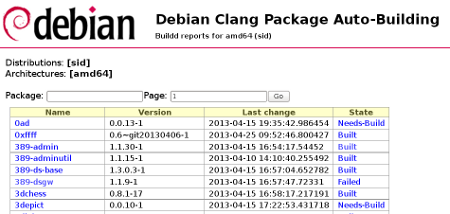
For Debian Developer and maintainer, a per maintainer view is also provided. This will list all packages maintained by a Debian packager. My page as example Here is an example of the list of package:
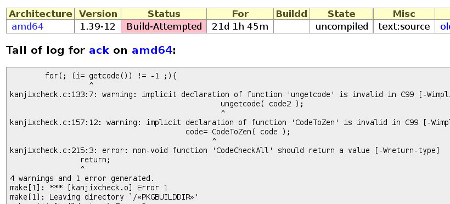
And an example of package failing:
At time of writing, most of the packages in unstable have been rebuilt (16 % are remaining). However, due to resource constraints, only amd64 packages are built. Contact me if you have resources to share for other architectures. Thanks to Paul Wise, the PTS (Debian package tracking system) proposes a link to the clang build logs (failing or not). A repository will be automatically updated with the results of these builds (once I find the time to get into buildd). 2) clang-built repository
Thanks to the Amazon Cloud, with our new DPL (Debian Project Leader), Lucas Nussbaum, we rebuilt unstable last April and published it at the following address:
deb http://clang.debian.net/repository-2013-04-07/ unstable-clang main
This allows some cool stuff like:
$ echo "deb http://clang.debian.net/repository-2013-04-07/ unstable-clang main">>/etc/apt/sources.list
$ apt-get update
$ apt-get install coreutils/unstable-clang
$ ls
$ awk
Note that this repository was only one-shoot and does not get updated. Quality of the binary produced (performance and size) can be tested thanks to this repository. Feedbacks are welcome!

5 May 2013

Michael Banck: 5 May 2013

Debian 7.0 "wheezy" has been released this weekend!

Quite a few new Debichem packages are now available in a stable Debian release for the first time:

3 May 2013

Richard Hartmann: Release Critical Bug report for Week 18

Releezy Tomorrow morning at around 0900 UTC, a lot of very dedicated people will start working on the actual release of Debian 7.0 (wheezy). A huge thank you to everyone who worked on getting Debian to this point. I for one welcome our new penguin overlord! Housekeeping These will obviously be the last rc bug stats in this release cycle. I am still unsure what to do with this particular series until the next freeze and feedback would be appreciated. Possible approaches are continuing as is, putting this into its own specific feed, decreasing the frequency to once a month, or to simply stop until jessie is frozen. An ikiwiki poll may be overkill. Or not. Remaining bugs As of right now, there are two bugs open: Both relate to weird behaviour by apt when upgrading from squeeze to wheezy. These bugs will not be truly closed, but merely ignored, for wheezy's release. If you happen to encounter the message above, it's best to consult the release notes for possible workarounds. Stats The UDD bugs interface currently knows about the following release critical bugs: How do we compare to the Squeeze release cycle?
Week Squeeze Wheezy Diff
43 284 (213+71) 468 (332+136) +184 (+119/+65)
44 261 (201+60) 408 (265+143) +147 (+64/+83)
45 261 (205+56) 425 (291+134) +164 (+86/+78)
46 271 (200+71) 401 (258+143) +130 (+58/+72)
47 283 (209+74) 366 (221+145) +83 (+12/+71)
48 256 (177+79) 378 (230+148) +122 (+53/+69)
49 256 (180+76) 360 (216+155) +104 (+36/+79)
50 204 (148+56) 339 (195+144) +135 (+47/+90)
51 178 (124+54) 323 (190+133) +145 (+66/+79)
52 115 (78+37) 289 (190+99) +174 (+112/+62)
1 93 (60+33) 287 (171+116) +194 (+111/+83)
2 82 (46+36) 271 (162+109) +189 (+116/+73)
3 25 (15+10) 249 (165+84) +224 (+150/+74)
4 14 (8+6) 244 (176+68) +230 (+168/+62)
5 2 (0+2) 224 (132+92) +222 (+132/+90)
6 release! 212 (129+83) +212 (+129/+83)
7 release+1 194 (128+66) +194 (+128/+66)
8 release+2 206 (144+62) +206 (+144/+62)
9 release+3 174 (105+69) +174 (+105/+69)
10 release+4 120 (72+48) +120 (+72/+48)
11 release+5 115 (74+41) +115 (+74/+41)
12 release+6 93 (47+46) +93 (+47/+46)
13 release+7 50 (24+26) +50 (+24/+26)
14 release+8 51 (32+19) +51 (+32/+19)
15 release+9 39 (32+7) +39 (+32/+7)
16 release+10 20 (12+8) +20 (+12/+8)
17 release+11 24 (19+5) +24 (+19/+5)
18 release+12 2 (2+0) +2 (+2/+0)
Graphical overview of bug stats thanks to azhag:

1 May 2013

Russ Allbery: Review: Questions for a Soldier

Review: Questions for a Soldier, by John Scalzi
Publisher: Subterranean
Copyright: 2005
Printing: 2012
ISBN: 1-59606-468-4
Format: Kindle
Pages: 28
Yet another short story from the Subterranean Scalzi Super Bundle collection, which is padding out my numbers this year since I don't seem to be writing as many reviews. Unlike some of the others, this one is fairly hard to come by if you didn't buy the original chapbook or the issue of Subterranean Magazine that included it. But don't worry, you're not really missing anything. Questions for a Soldier is really a short story, and slight even for that. It's a pendant to Old Man's War, a close-up of one stop in a good will tour that John Perry, the protagonist of that novel, does during it. In universe, it's basically a propaganda piece for the Colonial Defense Force that fleshes out some more of the background, mainly from the CDF side, of Scalzi's future universe. What Scalzi is doing here is mildly interesting: he's trying to capture the style of this sort of public affairs, feel-good speaking engagement but balance that against his portrayal of Perry as an honest straight shooter. Perry does a lot of the careful presentation of both sides that one would expect from someone who knows he's standing up to represent one side of an issue but doesn't want to make the propaganda too obvious. As a portrayal of a political speech of the subgenre "trying not to act like a politician," I think Scalzi successfully captures the tone. That's probably also why I found it vaguely annoying, since I think such speeches are a classic form of manipulation. Take someone (who may even honestly be a person of good will), put them up in front of a crowd, don't tell them what they have to say but make sure they're representing something that they're at least somewhat proud of, and let social pressure and expectations take care of the rest. The person will come across as honest and open (since they consider themselves to be), they don't actually know anything damaging, and they'll want to present their side in a good light. Humans are wonderful at rationalizations. The audience comes away feeling like the people they may be politically opposed to are human, and good people, and they can't be doing anything that upsetting since that fellow was a nice, upstanding person who told some great war stories and was clearly putting themselves in danger to protect the rest of us. It blunts political outrage and anger, justified or not, with a bit of "we're all on the same side and we're all good people" emotional camaraderie without any danger of any real revelations, uncomfortable information, or dangerous theories being expressed. Scalzi does a good job holding up a mirror here, and he also gives Perry the opportunity to make the solid (if quite predictable and dangerously incomplete) case for a professional military (and a completely cliched case for world, or galactic, peace). It all sounds quite believable because Perry obviously believes it. (That does not mean that Scalzi believes it; he's writing a character in a time, place, and role when the character believed those things.) But, at the end, it's a bit of political fluff that isn't really a story (no plot) and adds little to the larger series in which it was embedded. The later novels in the Old Man's War series raise the questions asked here in a much more forceful and direct way, in ways that produce at least a few answers. The general style is the sort of speech that you could find almost anywhere in US politics. If you have the collection anyway, it's mildly interesting to take apart what Scalzi is portraying here and think about it a bit, but it's completely missable. Rating: 5 out of 10

29 April 2013

Thomas Goirand: Jenkins: building debian packages after a git push (my 2cents of a howto)

The below is written in the hope it will be helpful for my fellow DDs. Why using build after push ? Simple answer: to save time, to always use a clean build environment, to automate more tests. Real answer: because you are lazy, and tired of always having to type these build commands, and that watching the IRC channel is more fun than watching the build process. Other less important answers: building takes some CPU time, and makes your computer run slower for other tasks. It is really nice that building doesn t consume CPU cycles on your workstation/laptop, and that a server does the work, not disturbing you while you are working. It is also super nice that it can maintain a Debian repository for you after a successful build, available for everyone to use and test, which would be harder to achieve on your work machine (which may be behind a router doing NAT, or even sometimes turned off, etc.). It s also kind of fun to have an IRC robot telling everyone when a build is successful, so that you don t have to tell them, they can see it and start testing your work. Install a SID box that can build with cowbuilder
Install Jenkins WARNING: Probably, before really installing, you should read what s bellow (eg: Securing Jenkins). Simply apt-get install jenkins from experimental (the SID version has some security issues, and has been removed from Wheezy, on a request of the maintainer). Normally, after installing jenkins, you can access it through:
http://<ip-of-your-server>:8080/
There is no auth by default, so anyone will be able to access your jenkins web GUI and start any script under the jenkins user (sic!). Jenkins auth
Before doing anything else, you have to enable Jenkins auth, otherwise, you have everything accessible from the outside, meaning that more or less, anyone browsing your jenkins server could be allowed to run any command. It might sound simple, but in fact, Jenkins auth is tricky to activate, and it is very easy to get yourself locked out, with no working web access. So here s the steps: 1. Click on Manage Jenkins then on Configure system 2. Check the enable security checkbox 3. Under security realm select Jenkins s own user database and leave allow users to sign up . Important: leave Anyone can do anything for the moment (otherwise, you will lock yourself out). 5. At the bottom of the screen, click on the SAVE button. 6. On the top right, click to login / create an account. Create yourself an account, and stay logged in. 7. Once logged-in, go back again in the Manage Jenkins -> Configure system , under security. 8. Switch to Project based matrix authentication strategy . Under User/group to add , enter the new login you ve just created, and click on Add . 9. Select absolutely all checkboxes for that user, so that you make yourself an administrator. 10. For the Anonymous user, for Job, check Read, Build and Workspace. For Overall select Read. 11. At the bottom of the screen, hit save again. Now, anonymous (eg: not logged-in) users should be able to see all projects, and be able to click on the build now button. Note that if you lock yourself out, the way to fix is to turn off Jenkins, edit config.xml, remove the useSecurity thing, and all what is in authorizationStragegy and securityRealm , then restart Jenkins. I had to do that multiple times until I had it right (as it isn t really obvious you got to leave Jenkins completely insecure when creating a new user). Securing Jenkins: Proxy Jenkins through apache to use it over SSL
When doing a quick $search-engine search, you will see lots of tutorials to use apache as a proxy, which seems to be the standard way to run Jenkins. Add the following to /etc/apache2/sites-available/default-ssl:
ProxyPass / http://localhost:8080/
ProxyPassReverse / http://localhost:8080/
ProxyRequests Off
Then perform the following commands on the shell:
htpasswd -c /etc/apache2/jenkins_htpasswd <your-jenkins-username>
a2enmod proxy
a2enmod proxy_http
a2enmod ssl
a2ensite default-ssl
a2dissite default
apache2ctl restart
Then disable access to the port 8080 of jenkins from outside:
iptables -I INPUT -d <ip-of-your-server> -p tcp --dport 8080 -j REJECT
Of course, this doesn t mean you shouldn t take the steps to activate Jenkins own authentication, which is disabled by default (sic!). Build a script to build packages in a cowbuilder I thought it was hard. In fact it was not. All together, this was kind of fun to hack. Yes hack. What I did yet another kind of 10km ugly shell script. The way to use it is simply: build-openstack-pkg <package-name>. On my build server, I have put that script in /usr/bin, so that it is accessible from the default path.Ugly, but it does the job! Jenkins build script for openstack At the end of the script, scan_repo() generates the necessary files for a Debian repository to work under /home/ftp. I use pure-ftpd to serve it. /home/ftp must be owned by jenkins:jenkins so that the build script can copy packages in it. This build script is by no mean state of the art, and in fact, it s quite hack-ish (so I m not particularly proud of it, but it does its job ). If I am showing it in this blog post, it is just to show an example of what can be done. It is left as an exercise to the reader to create another build script adapted to its own needs, and write something cleaner and more modular. Dependency building Let s say that you are using the Built-Using: field, and that package B needs to be built if package A changes. Well, Jenkins can be configured to do that. Simply edit the configuration of project B (you will find it, it s easy ). My use case: In my case, for building Glance, Heat, Keystone, Nova, Quantum, Cinder and Ceilometer, which are all components of Openstack, I have written a small (about 500 lines) library of shell functions, and an also small (90 lines) Makefile, which are packaged in openstack-pkg-tools (so Nova, Glance, etc. all build-depends on openstack-pkg-tools). The shell functions are included in each maintainer scripts (debian/*.config and debian/*.postinst mainly) to avoid having some pre-depends that would break debconf flow. The Makefile of openstack-pkg-tools is included in debian/rules of each packages. In such a case, trying to manage the build process by hand is boring and time consuming (spending your time watching the build process of package A, so that you can manually start the build of package B, then wait again ). But it is also error prone: it is easy to do a mistakes in the build order, you can forget to dpkg -i the new version of package A, etc. But that s not it. Probably at some point, you will want Jenkins to rebuild everything. Well, that s easy to do. Simply create a dummy project, and have other project to build after that one. The build steps could simply be: echo Dummy project as a shell script (I m not even sure that s needed ). Configuring git to start a build on each push In Jenkins, pass your mouse over the Build now URL. Well, we just need to wget that URL in your Alioth repository. A small drawing is better than long explanation:
for i in  ls /git/openstack  ; do
    echo "wget -q --no-check-certificate \
    https://<ip-of-your-server>/job/$ PROJ_NAME /build?delay=0sec \
    -O /dev/null" >/git/openstack/$ i /hooks/post-receive \
        && chmod 0770 /git/openstack/$ i /hooks/post-receive;
done
The chmod 0770 is necessary if you don t want every Alioth users to have access to your Jenkins server web interface and see an eventual htpassword protection that you can add to your jenkins box (I m not covering that, but it is fairly easy to add such protection). Note that all of the members of your Alioth group will then have access to this post-receive hook, containing the password of your htaccess, so you must trust everyone in your Alioth group to not do nasty things with your Jenkins. Bonus point: IRC robot If you would like to see the result of your build published on IRC, Jenkins can do that. Click on Manage Jenkins , then on Manage Plugins . Then click on available and check the box in front of IRC plugin . Go at the bottom of the screen and click on Add . Then check the box to restart Jenkins automatically. Once it is restarted, go again under Manage jenkins then Configure system . Select the IRC Notification and configure it to join the network and the channel you want. Click on Advanced to select the IRC nick name of your bot, and make sure you change the port (by default jenkins has 194, when IRC normally uses 6667). Be patient when waiting for the IRC robot to connect / disconnect, this can take some time. Now, for each jenkins Job, you can tick the IRC Notification option. Doing piuparts after build One nice thing with automated builds, is that most of the time, you don t need to wait starring at them. So you can add as many tests as you want, the Jenkins IRC robot will anyway let you know sooner or later the result of your build. So adding piuparts tests in the build script seems the correct thing to do. Though that is still on my todo, so maybe that will be for my next blog post.

Wouter Verhelst: New in Wheezy: PMW

One of the things I do with computers is "do stuff with music". I'm not a professional musician by any means, but I do sometimes have a need for some software to do some music editing. In the past, that meant using GNU LilyPond; and while that's certainly an interesting piece of software, it has some idiosyncracies that have made me dislike it in the past. So when I learned about PMW, written by Philip Hazel (of PCRE and Exim fame) I was intrigued. PMW has several advantages over lilypond, in my opinion. To name but two: its syntax is less silly, and it takes far less time to convert something from source to graphic, to the extent that I've considered creating an editor which would update the result after every keystroke, something that just isn't possible with lilypond. The decision to upload pmw into Debian was just a no-brainer, and it's saved me some time since, already. Enjoy!

28 April 2013

Mart&iacute;n Ferrari: Moving my stuff away from home

TL;DR version: I want to get rid of the small server running at home, I tell you here about the service I've chosen, and why I like it. In following posts, I'll explain how did I set it up remotely. Disclaimer: I am in now way affiliated with the companies I mention here (except for Picasa, as I am a Google employee), and don't get any bonuses for this post. I am only sharing this because I think it might be useful information for other people.
Being a frequent migrant means possessions are a burden. In my previous place of residence (in France), I originally intended to only stay for 6 months, and so I arrived with just a couple of suitcases, and in the end that was enough for me to live for almost 2 years. The last time, on the other hand, I was removing my stuff completely from Argentina. I emptied my house, gave away some stuff, send some boxes to my parents' place, and carried the rest with me. That was a lot of stuff, but since the company was paying for the relocation, it was not much of a problem. Later I realised my mistake, and knowing that my time in Ireland is limited, I started to try and get rid of stuff I don't need. I know I will just sell or give away much of my stuff when I finally leave, but there are some things that are not so easy to part with. The main one being my home server, which hosts this website, my VCS repositories, pictures, and many other things I need to have on the net. This all used to be located in a home-made PC tucked in a data centre, co-located by a friendly company. But that computer died almost 2 years ago, and so canterville became abhean, and my stuff started being hosted with my aDSL connection. It worked well for some time, but now I realised I had to revert that change. With this in mind I set off to find a cheap place to host my stuff. I had a few requirements: I don't have that many photos, nor they are too big, but these requirements made it clear that most VPS offerings were not going to work for me. For some reason I fail to understand, local storage in VPS offerings is usually prohibitively expensive. This is OK for most use cases, but not for mine. A friend of mine, with a similar use case, is a happy VPS customer. He told me his trick: he only hosts in the server low-quality versions of the pictures, and keeps the originals (and back-ups) at home. This was a great idea, but with two fatal flaws: I want to only carry around a laptop and one or two external hard drives; and I want to have back-ups that are not physically with me. I was starting to think about hosting my files in Amazon s3 or something like that, since most dedicated servers are way too expensive. But then I heard about two French companies offering dirt-cheap servers: OVH and Online.net. Both of them offered small servers for about 12 a month, cheaper than most VPS offerings! Online seems to mainly cater to the French market, and for some silly reason, they charge a 50 set-up fee to customers outside of France. OVH, on the other hand, has many local branches, including an Irish one, so I went with them. The offering is a low-cost line called Kimsufi, and the smallest one is still very decent for a personal server: Once I had paid the fee for one month, it took a while for it to be activated (their payment system is pretty bad), but it finally was enabled about 24h later. Then the real fun started. On one hand, I was happy to see a wide selections of operating systems to choose from, including Debian stable and testing, and a web console with many functionalities, including some basic monitoring; but on the other hand, I realised that the installed image was not pristine, the online docs are not very good, and the web application is a bit buggy and really awkward to navigate. Having sub-par docs is not something I would usually care much about, but it made it a bit more difficult to me to understand some of the very cool functionalities their system offers (more on that in a bit), and more importantly, it made it clear to me that I won't trust their image: the procedures detailed there were not exactly best-practices, and they allow themselves to log-in as root into my server. I want to describe here what I think are their most interesting features, that made it possible to me to do risky operations, like encrypting the root partition, and setting up a firewall; and being able to fix problems that would usually require physical access. These are found in their web console: a hardware reset, and configurable netboot support with many offered images, including a rescue image based on Ubuntu and one that serves as a virtual KVM. (It is surprising that these servers don't have a serial console, but at least the kernel does not detect any). With these in hand, I didn't have to fear being locked out of my server for ever. Just set up a netboot image and hard-reboot the machine! Also, it made it very simple to install my system from scratch with debootstrap. The virtual KVM is a very interesting trick. It is a netboot image that runs some tests, and fires up a web browser. You get an email with the URL and a password to access it, and then you open a page that offers you what is basically a Qemu connected to a VNC server which will boot from your real hard drive. It is super slow, but that allows you to get console access to your server, which can be very handy to debug booting problems, unless it is some issue with the real hardware. It also offers the possibility of downloading an ISO image off the network and booting that, so it can be used to run a stock installer CD too. In another post I'll describe how I reinstalled my server remotely, and some of the pitfalls that I've encountered in the process.

Christian Perrier: [life] Running update: January-April...and more.

It seems that I didn't send any update to my international friends for quite a while, at least when it comes at my running activities. So, in short, I ran A LOT during the first months of April 2013. I mean it. As of now (April 28th), I cumulated 1424 kilometers, with a peak in March up to 375 kilometers. So, that's an average 12 kilometers per day. How did I achieve this? Among many other things, by doing part of my commute to work by running, which means 14 kilometers in one day, with a backpack containing everything needed to be dressed "normally" while working, plus my laptop, my rain jacket, etc....so up to 4 kilograms on my shoulders. And, yes, I can use a shower at work and I don't stink all day long! This alone already makes a fairly good training. Of course, all alone, it wouldn't be really funny, so I, of course, add some runs during the week-end, mostly trail running, enjoying the nature around our place. Official races have been mostly trail races during these months. The only road race has been an half-marathon in Bullion, back in February (4th year in a row I'm running this one, which is traditionnaly the "resume road races" competition in the area). I completed it in 1h39, quite close to my PB, even if....that was meant to be a training only. In February, still as a preparation race for Paris Ecotrail, I ran a 20km trail in Auffargis (a neat small village in the neighbourhood of our place), again completing it with great success, with a big negative split (for non hard-core runners, a negative split happens when one runs the second half of a race faster than the first one). All this was in preparation for Paris Ecotrail race, my second time on this 80km race that ends up at Eiffel Tower. Last year, being my first attempt on such distance,, I completed it in 11 hours 5 minutes. To make it short, this year, I finished 579th out of more than 2000 runners, in 9h36. That was indeed a really great result, in line with my 8h15 time back in November for the 70km "Le Puy-Firminy" night race. Moreover, I could indeed recover very quickly : the race was run on a Saturday and I resumed my "commute runs" on Wednesday. The next target were two trail races in April : I originally planned a 44km race on April 21st and finally ended up adding to it a 35km trail race on April 7th (the day of Paris Marathon), only 3 weeks after Ecotrail..:-) And I completed both these with a huge success. Indeed my best trail races ever, again with two negative splits and also a very good place. Indeed, I now usually complete races close to the very first women...:-). So, on April 7th, the trail du Josas (35km, 800m positive climb... which means about the equivalent of a marathon) was completed in 3h40....and last Sunday, the trail des Lavoirs (44km, 1100m positive climb) was completed in 4h40, with the last 2 kilometers being run above 13km/h. Describing how one can feel when "flying" in the very last kilometers of such a long run is just....impossible. Great, great, great memories. Then, during the week following the trail des Lavoirs, I ran 101km in 6 days, confirming that recovery is perfect. So, definitely, I am stunned by what I could achieve during these months, without injury, without big pain. Just good training and good results, without suffering and a giant pleasure. Yes, running is definitely a drug and I'm deeply addicted. Well, the result is, in short, that I feel good and well, so I think I won't stop soon...:-) Next challenge : Mont-Blanc marathon, in Chamonix : 42.195km....and 2500meters positive climb, with 1500 meters negative. Start in Chamonix at 1050m high and end at Planpraz (2050m), facing the Mont-Blanc, with a maximum altitude of 2267m during the race. Quite an interesting "marathon", isn't it? That will be my first race in real mountains...and, I guess not the last one. Target time: 6 hours. Secret wish: 5h30. During summer, I will mostly be preparing for the second part of the year....but I'll certainly enjoy the neighbourhood of Vaumarcus, Switzerland, where I'll attend DebConf. Challenge : combine running, hacking, cheese eating and fit all this in 24 hours every day. For the end of the year, challenges should peak between October and December: So, well, see you soon on this blog for another update after Mont-Blanc marathon. Let's hope I'll give you good news.

26 April 2013

Thorsten Glaser: mksh R45 released

The MirBSD Korn Shell R45 has been released today, and R44 has been named the new stable/bugfix-only series. (That s version 45.1, not 0.45, dear Homebrew/MacOSX packagers.) Packagers rejoice: the -DMKSH_GCC55009 dance is no longer needed, and even the run-time check for integer division is gone. Why? Because I realised one cannot use signed integers in C, at all, and rewrote the mksh(1) arithmetics code to use unsigned integers only. Special thanks to the people from musl libc and, to some lesser amount, Natureshadow for providing me with ideas what algorithms to replace some functionality with (signed shell arithmetic is, of course, still usable, it is just emulated using unsigned C integers now).

The following entertainment

	tg@blau:~ $ echo foo >/bar\ baz
	/bin/mksh: can't create /bar baz: Permission denied
	1 tg@blau:~ $ doch
	tg@blau:~ $ cat /bar\ baz
	foo
 

was provided by Tonnerre Lombard; like Swedish, German has got a number of words that cannot be expressed in English so I feel not up to the task of explaining this to people who don t know the German word doch , just rest assured it calls the last input line (be careful, this is literally a line, so don t use backslash-newline sequences) using sudo(8).

Richard Hartmann: Release Critical Bug report for Week 17

The UDD bugs interface currently knows about the following release critical bugs: How do we compare to the Squeeze release cycle?
Week Squeeze Wheezy Diff
43 284 (213+71) 468 (332+136) +184 (+119/+65)
44 261 (201+60) 408 (265+143) +147 (+64/+83)
45 261 (205+56) 425 (291+134) +164 (+86/+78)
46 271 (200+71) 401 (258+143) +130 (+58/+72)
47 283 (209+74) 366 (221+145) +83 (+12/+71)
48 256 (177+79) 378 (230+148) +122 (+53/+69)
49 256 (180+76) 360 (216+155) +104 (+36/+79)
50 204 (148+56) 339 (195+144) +135 (+47/+90)
51 178 (124+54) 323 (190+133) +145 (+66/+79)
52 115 (78+37) 289 (190+99) +174 (+112/+62)
1 93 (60+33) 287 (171+116) +194 (+111/+83)
2 82 (46+36) 271 (162+109) +189 (+116/+73)
3 25 (15+10) 249 (165+84) +224 (+150/+74)
4 14 (8+6) 244 (176+68) +230 (+168/+62)
5 2 (0+2) 224 (132+92) +222 (+132/+90)
6 release! 212 (129+83) +212 (+129/+83)
7 release+1 194 (128+66) +194 (+128/+66)
8 release+2 206 (144+62) +206 (+144/+62)
9 release+3 174 (105+69) +174 (+105/+69)
10 release+4 120 (72+48) +120 (+72/+48)
11 release+5 115 (74+41) +115 (+74/+41)
12 release+6 93 (47+46) +93 (+47/+46)
13 release+7 50 (24+26) +50 (+24/+26)
14 release+8 51 (32+19) +51 (+32/+19)
15 release+9 39 (32+7) +39 (+32/+7)
16 release+10 20 (12+8) +20 (+12/+8)
17 release+11 24 (19+5) +24 (+19/+5)
18 release+12
Graphical overview of bug stats thanks to azhag:

Vincent Sanders: When you make something, cleaning it out of structural debris is one of the most vital things you do.

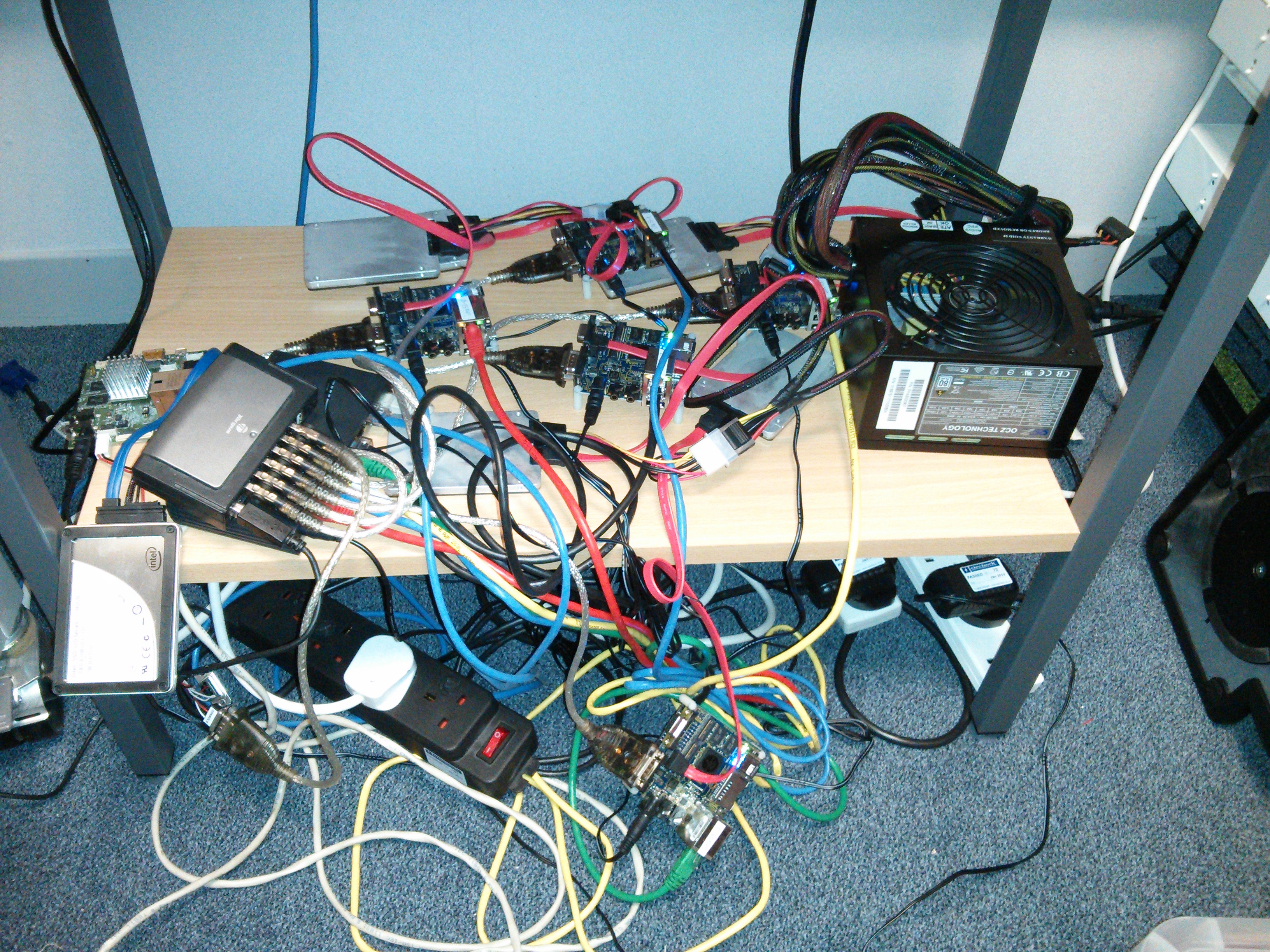
Collabora recently had a problem with a project's ARM build farm. In a nice change of pace it was not that the kernel was crashing, nor indeed any of the software or hardware.
The ProblemInstead our problem was our build farm could best be described as "a pile of stuff" and we wanted to add more systems to it and have switched power control for automated testing.

Which is kinda where the Christopher Alexander quote comes into this. I suggested that I might be able to come up with a better, or at least cleaner, solution.
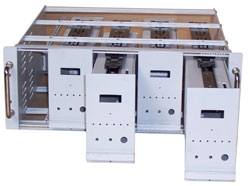
The IdeaA subrack with sub modulesPrevious experience had exposed me to the idea of using 19 inch subracks for mounting circuits inside submodules.

I originally envisaged the dev boards individually mounted inside these boxes. However preliminary investigation revealed that the enclosures were both expensive and used a lot of space which would greatly increase the rack space required to house these systems.

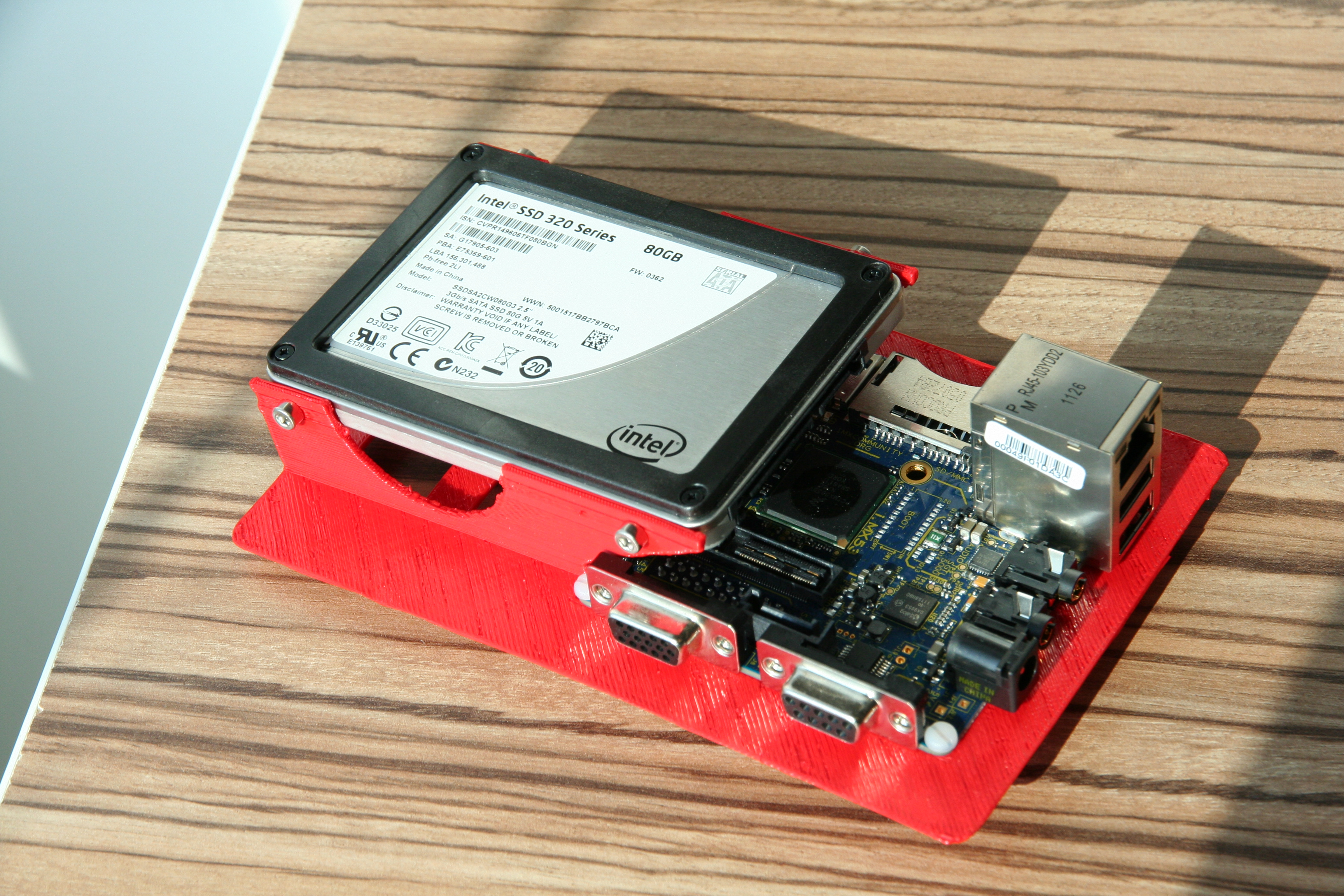
imx53 QSB eurocard carrier
I decided to instead look at eurocard type subracks with carriers for the systems. Using my 3D printer I came up with a carrier design for the imx53 QSB and printed it. I used the basic eurocard size of 100mm x 160mm which would allow the cards to be used within a 3U subrack.

Once assembled it became apparent that each carrier would be able to share resources like power supply, ethernet port and serial console via USB just as the existing setup did and that these would need to be housed within the subrack.
The Prototype
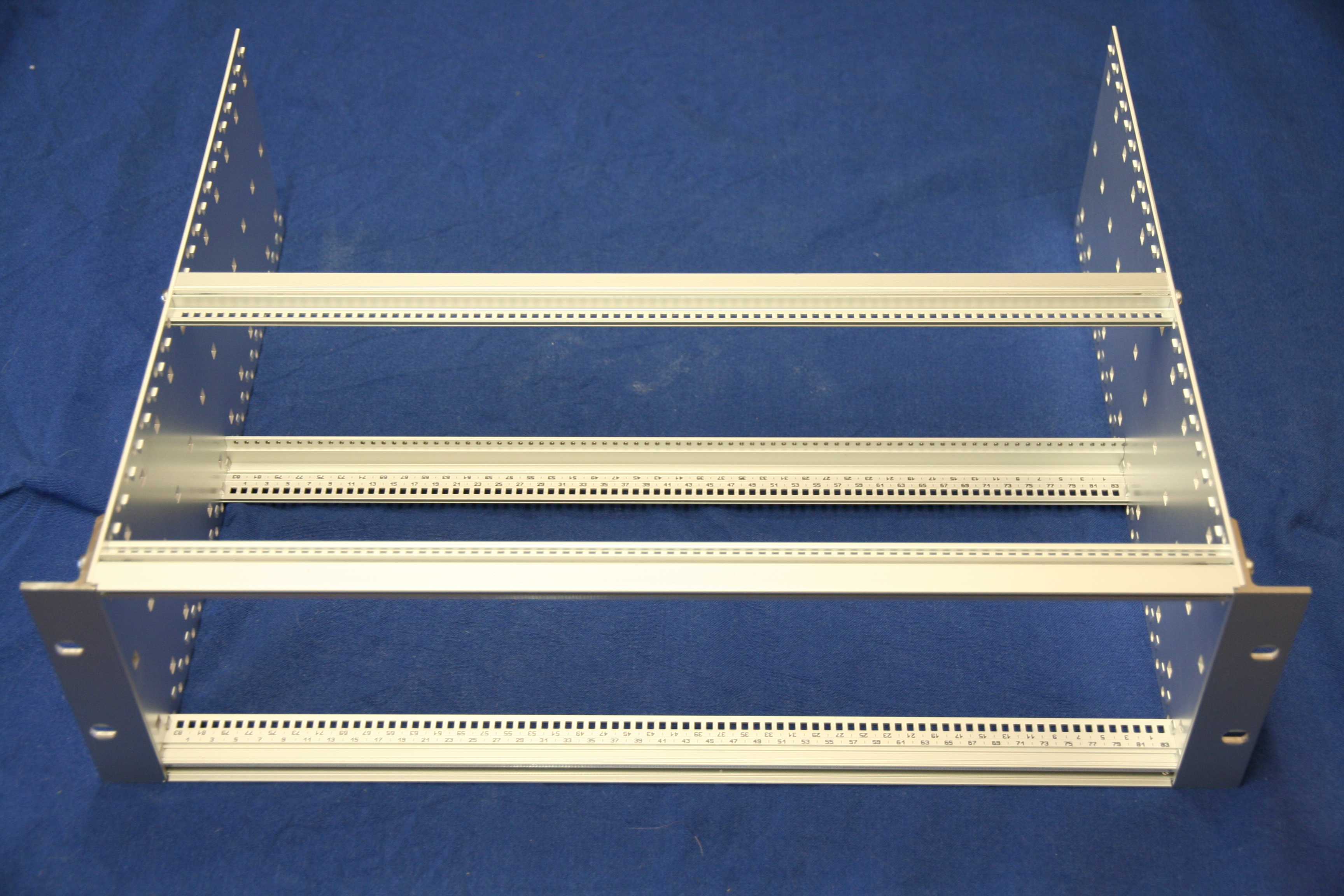
The carrier prototype was enough to get enough interest to allow me to move on to the next phase of the project. I purchased a Schroff 24563-194 subrack kit and three packs of guide rails from Farnell and assembled it.

Initially I had envisaged acquiring additional horizontal rails from Schroff which would enable constructing an area suitable for mounting the shared components behind the card area.
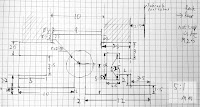
Rear profile for Schroff subrackUnfortunately Schroff have no suitable horizontal profiles in their catalog and are another of those companies who seem to not want to actually sell products to end users but rather deal with wholesalers who do not have their entire product range!

Printed rear profile for Schroff subrack
Undaunted by this I created my own horizontal rail profile and 3D printed some lengths. The profile is designed to allow a 3mm thick rear cover sheet attached with M2.5 mounting bolts and fit rack sides in the same way the other profiles do.

At this point I should introduce some information on how these subracks are dimensioned. A standard 19 inch rack (as defined in IEC 60297) has a width of 17.75 inches(450.85mm) between the vertical posts. The height is measured in U (1.75 inches)

A subrack must obviously fit in the horizontal gap while providing as much internal space as possible. A subrack is generally either 3 or 6 U high. The width within a subrack is defined in units called HP (Horizontal Pitch) which are 0.2 inches(5.08 mm) and subracks like the Schroff generally list 84 usable HP.

However we must be careful (or actually just learn from me stuffing this up ;-) as the usable HP is not the same thing as the actual length of the horizontal rails! The enclosures actually leave and additional 0.1 inch at either end giving a total internal width of 85HP (17 inches, 431.8 mm) which leaves 0.75 inches for the subrack sides and some clearance.

The Schroff subrack allows eurocards to be slotted into rails where the card centre line is on HP boundaries, hence we describe the width of a card in the slot in terms of HP
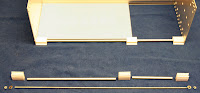
I cannot manufacture aluminium extrusions (I know it is a personal failing) nor produce more than 100 mm long length of the plastic profile on my printer.

Even if full lengths are purchased from a commercial service (120 euros for a pair including tax and shipping) the plastic does not have sufficient mechanical strength.

The solution I came up with was somewhat innovative, as an alternative a M5 bolt into a thread in the aluminium extrusion I used a 444mm long length of 4mm threaded rod with nuts at either end. This arrangement puts the extrusion under compression and gives it a great deal of additional mechanical strength as the steel threaded rod is very strong.

Additionally to avoid having to print enough extrusion for the entire length I used some 6mm aluminium tube as a spacer between 6HP(30.48mm) wide sections of the printed extrusion.

It was intended to use a standard modular PC power supply which is 150mm wide which is pretty close to 30HP (6 inches) so it was decided to have a 6HP section of rail at that point to allow a rear mounting plate for the PSU to be attached.

This gives 6HP of profile, 21HP(106.68mm) of tube spacer, 6HP of profile, 46HP(233.68 mm) of tube spacer and a final 6HP profile summing to our total of 85HP. Of course this would be unnecessary if a full continuous 85HP rail had been purchased, but 6 of 6 HP long profile is only 51 euro a saving of 70 euro.

To provide a flat area on which to mount the power switching, Ethernet switch and USB hubs I ordered a 170 x 431 mm sheet of 3mm thick aluminium from inspiredsteel who, while being an ebay company, were fast, cheap and the cutting was accurate.

Do be sure to mention you would prefer it if any error made the sheet smaller rather than larger or it might not fit, for me though they were accurate to the tenth of a mm! If you would prefer the rear section of the rack to be enclosed when you are finished, buy a second sheet for the top. For my prototype I only purchased a 170 x 280mm sheet as I was unsure if I wanted a surface under the PSU (you do, buy the longer sheet)
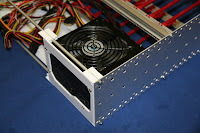
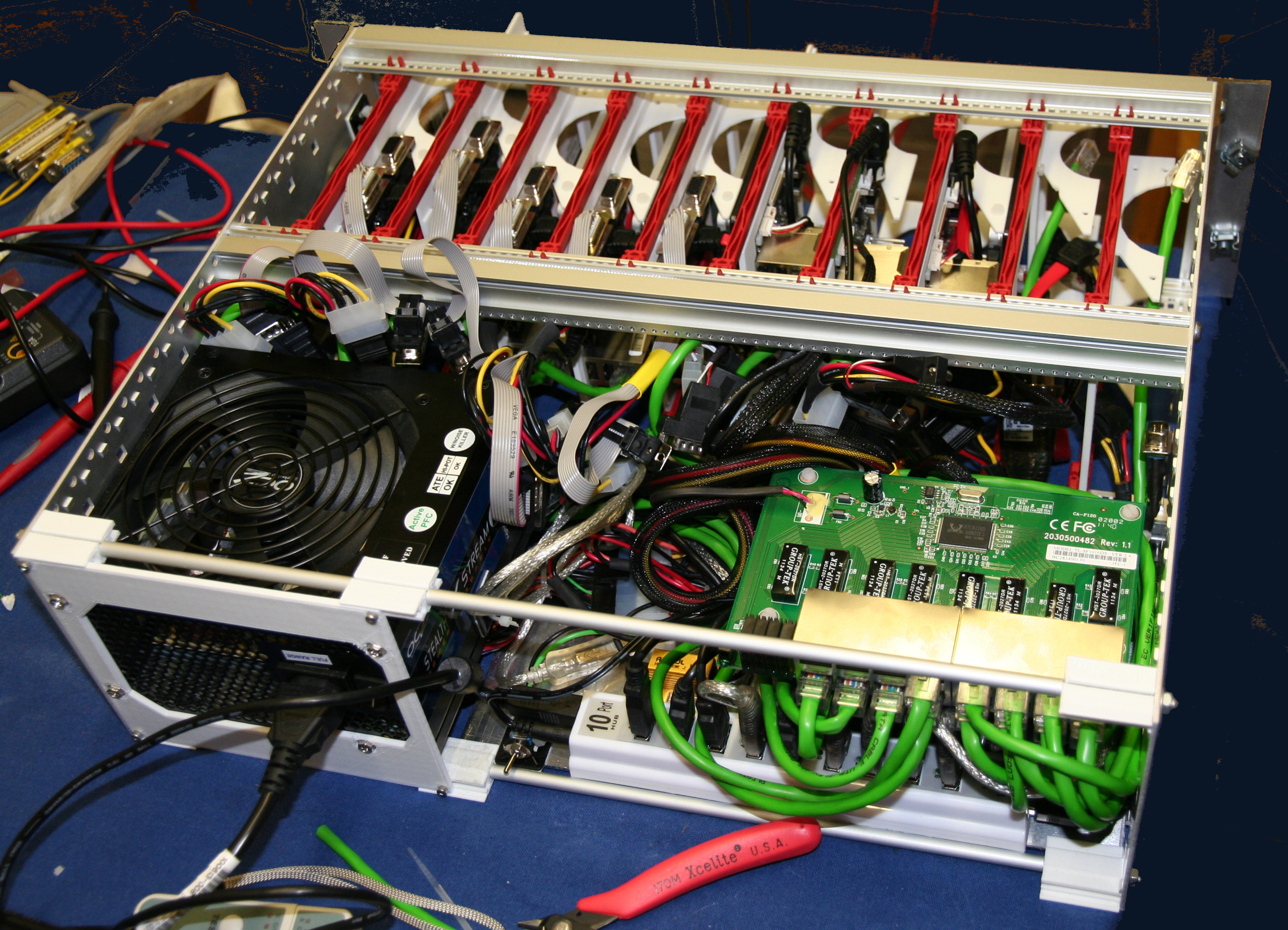
PC power supply mounted to back plateMounting the PSU was a simple case of constructing a 3 mm thick plate with the correct cutouts and mounting holes for an ATX supply. Although the images show the PSU mounted on the left hand side of the rack this was later reversed to improve cable management.

The subrack needed to provide Ethernet switch ports to all the systems. A TP-Link TL-SF1016DS 16-Port 10/100Mbps Switch was acquired and the switch board removed from its enclosure. The switch selected has an easily removed board and is powered by a single 3.3V input which is readily available from the ATX PSU.

Attention now returned to the eurocard carriers for the systems, the boards to be housed were iMX53 QSB and iMX6 SABRE Lite and a Raspberry Pi control system to act as USB serial console etc.

The carriers for both main boards needed to be 8HP wide, comprised of:
Although only 38 mm this is 7.5HP and fractions of an HP are not possible with the selected subrack.

With 8HP wide modules this would allow for ten slots, within the 84 usable HP, and an eleventh 4HP wide in which the Raspberry Pi system fits.
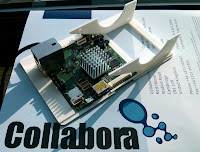
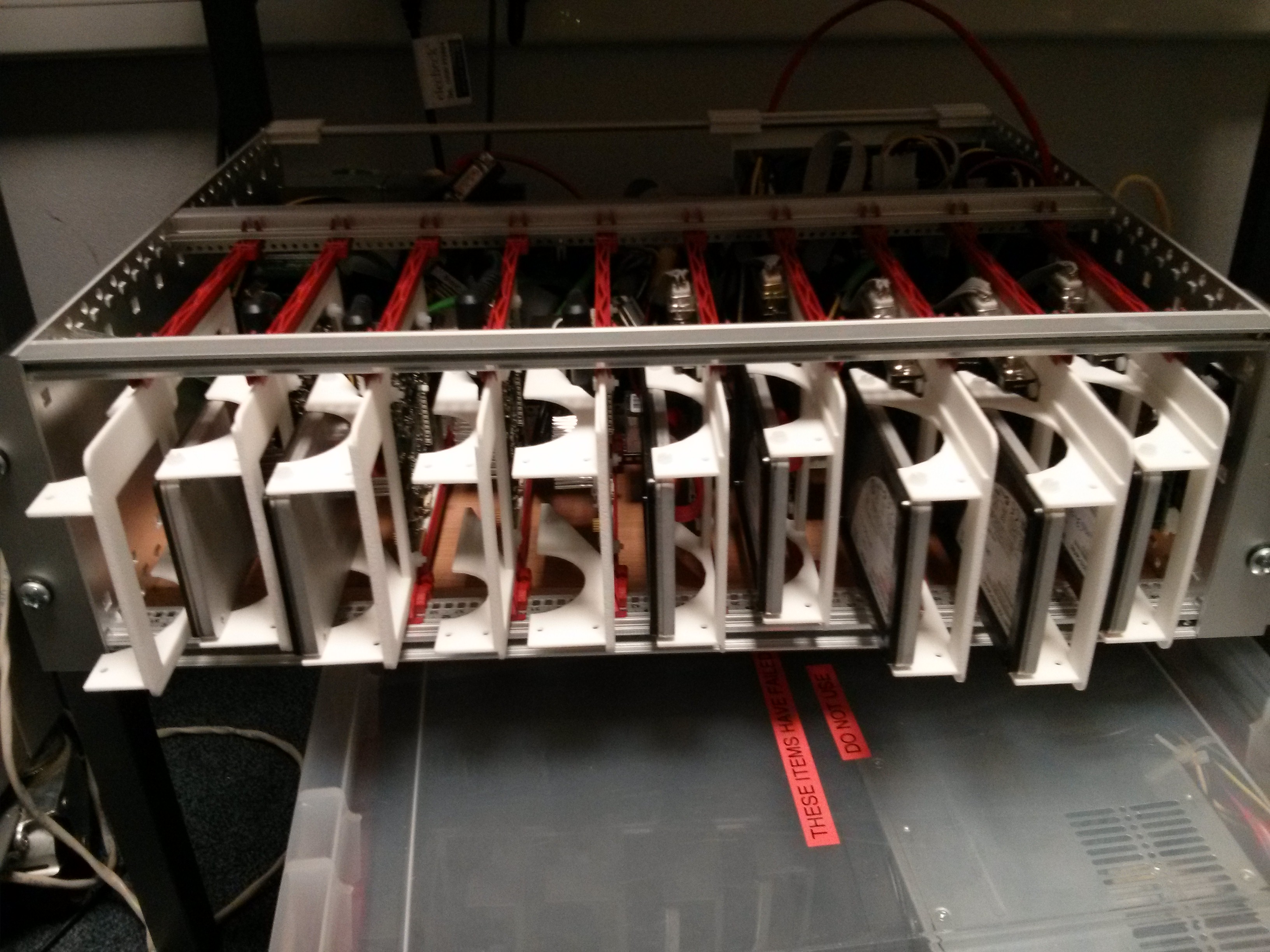
iMX6 SABRE Lite eurocard carrierCarrier designs for both the i.MX53 QSB and the i.MX6 SABRE Lite boards were created and fabricated at a professional 3D print shop which gave a high quality finish product and removed the perceived risk of relying on a personal 3D printer for a quantity of parts.

This resulted in changes in the design to remove as much material as possible as commercial 3D services charge by the cubic cm. This Design For Manufacture (DFM) step removed almost 50% from the price of the initial design.

i.MX53 QSB carriers with wiring loom
The i.MX6 design underwent a second iteration to allow for the heatsink to be mounted and not mechanically interfere with the hard drive (although the prototype carrier has been used successfully for a system that does not require a hard drive). The lesson learned here is to be aware that an design iteration or two is likely and that it is not without cost.

The initial installation was to have six i.MX53 and two i.MX6 this later changed to a five/four split, however the carrier solution allows for almost any combination, the only caveat (discovered later) is the imx53 carriers should be to the right hand side with the small 4HP gap at that end as they have a JTAG connector underneath the board which otherwise foul the hard drive of the next carrier.

Racked cards showing unwanted cable tails
A wiring loom was constructed for each board giving them a connector tail long enough to allow them to be removed. This was the wrong approach! if you implement this design (or when I do it again) the connector tails on the wiring loom should present all the connections to the rear at the same depth as the Ethernet connection.

The rack cables themselves should be long enough to allow the slides to be removed but importantly it is not desirable to have the trailing cable on the cards. I guess the original eurocard designers figured this out as they designed the cards around the standard fixed DIN connectors at the back of the card slots.

USB relay board with wiring loom attached
We will now briefly examine a misjudgement that caused the initially deployed solution to be reimplemented. As the design was going to use USB serial converters to access the serial console a USB connected relay board was selected to switch the power to each slot. I had previously used serial controlled relay boards with a USB serial convertor however these were no longer available.

Initial deployment with USB controlled relay board
All the available USB relay boards were HID controlled, this did not initially seem to be an issue and Linux software was written to provide a reasonable interface. However it soon became apparent that the firmware on the purchased board was very buggy and crashed the host computer's USB stack multiple times.

Deployed solutionOnce it became apparent that the USB controlled power board was not viable a new design was conceived. As the Ethernet switch had ports available Ethernet controlled relay boards were acquired.

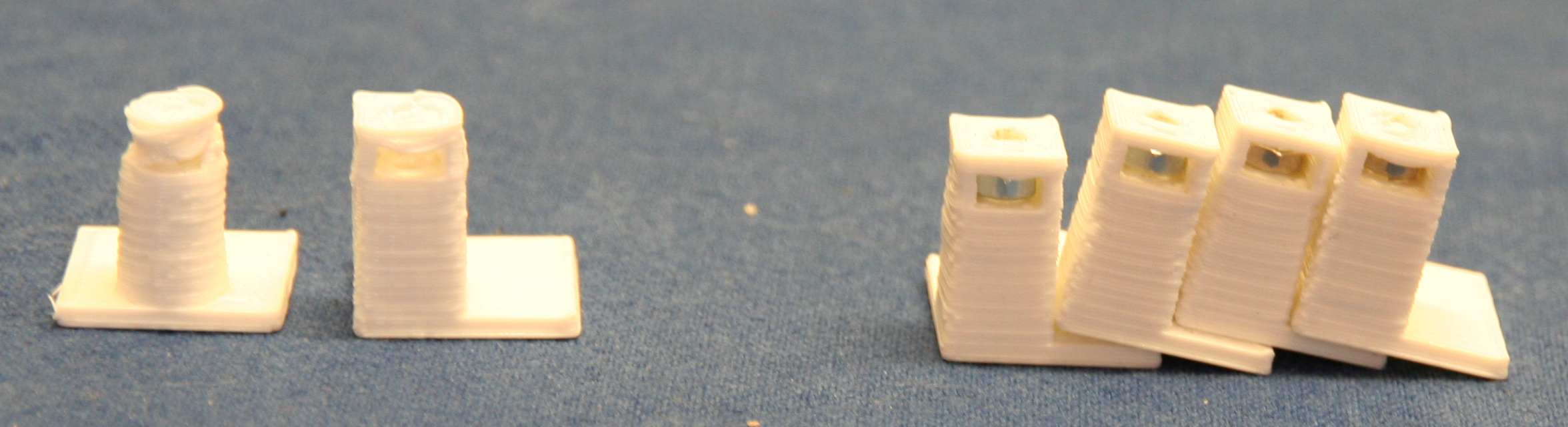
Evolution of 3mm PCB pillars
It did prove necessary to design and print some PCB support posts with M3 nut traps to allow the relay boards to be easily mounted using double sided adhesive pads.

By stacking the relay boards face to face and the Ethernet switch on top separated using nylon spacers it was possible to reduce the cable clutter and provide adequate cable routing space.

A busbar for Ground (black) and unswitched 12V (yellow) was constructed from two lengths of 5A chock block.

An issue with power supply stability was noted so a load resistor was added to the 12V supply and an adhesive thermal pad used to attach it to the aluminium base plate.

Completed redesign
It was most fortunate that the ethernet switch mounting holes lined up very well with the relay board mounting holes allowing for a neat stack.

This second edition is the one currently in use, it has proved reliable in operation and has been successfully updated with additional carriers.

The outstanding issues are mainly centered around the Raspberry Pi control board:
  • Needs its carrier fitting. It is currently just stuck to the subrack end plate.
  • Needs its Ethernet cable replacing. The existing one has developed a fault post installation.
  • Needs the USB hub supply separating from the device cable. The current arrangement lets the hub power the Pi which means you cannot power cycle it.
  • Connect its switched supply separately to the USB hub/devices.
Shopping listThe final bill of materials (excluding labour and workshop costs) which might be useful to anyone hoping to build their own version.

Prices are in GBP currency converted where appropriate and include tax at 20% and delivery to Cambridge UK and were correct as of April 2013.

The purchasing was not optimised and for example around 20GBP could be saved just by ordering all the shapeways parts in one order.
Base subrack
ItemSupplierQuantityLine Price
Schroff 24563-194 subrack kitFarnell141.28
Schroff 24560-351 guide railsFarnell313.65
Schroff rack rear horizontal railShapeways2100.00
1000mm length of 4mm threaded rodB and Q11.48
170mm x 431mm x 3mm Aluminium sheetinspired steel240.00
PSU mounting plateShapeways135.42
PCB standoffShapeways422.30
160mm Deep Modular PC supplyCCL155.76
TP-Link TL-SF1016DS 16-Port 10/100Mbps-SwitchCCL123.77
8 Channel 16A Relay Board Controlled Via EthernetRapid2126.00
Raspberry PiFarnell126.48
USB Serial convertersCCL1037.40
10 port strip style USB HUBEbay17.00
Parts for custom Ethernet cablesRS1326.00
Parts for custom molex power cables (salvaged from scrap ATX PSU)Workshop1111.00
33R 10W wirewound resistor for dummy loadRS11.26
24pin ATX female connector pre-wiredMaplin12.99
Akasa double sided thermal padMaplin15.00
Small cable tie basesMaplin16.49
Miscellaneous cable, connectors, nylon standoffs, solder, heatshrink, zip ties, nuts, washers etc. Workshop120.00
Total for subrack603.28

The carriers are similarly not optimally priced as over five GBP each can be saved by combining shipping on orders alone. Also the SSD drive selection was made some time ago and a newer model may be more suitable.
i.MX53 QSB carrier
ItemSupplierQuantityLine Price
i.MX53 QSBFarnell1105.52
Intel 320 SSD 80GCCL1111.83
Carrier boardShapeways130.00
combined sata data and power (15 to 20cm version)EBay15.00
Low profile right angle 5.5mm x 2.1mm barrel jackEBay10.25
Parts for 9pin serial cable extensionRS15.00
Miscellaneous solder, heatshrink, nylon nuts, bolts and washersWorkshop15.00
Total for carrier262.60

i.MX6 SABRE Lite carrier
ItemSupplierQuantityLine Price
i.MX6 SABRE LiteFarnell1128.06
Intel 320 SSD 80GCCL1111.83
Carrier boardShapeways135.00
combined sata data and power (15 to 20cm version)EBay15.00
Low profile right angle 5.5mm x 2.1mm barrel jackEBay10.25
Parts for 9pin serial cable modificationRS12.00
Miscellaneous solder, heatshrink, nylon nuts, bolts and washersWorkshop15.00
Total for carrier287.14
ConclusionThe solution works and in a 3U high 355mm deep subrack ten ARM development boards can be racked complete with local ethernet switching, power control and serial consoles.

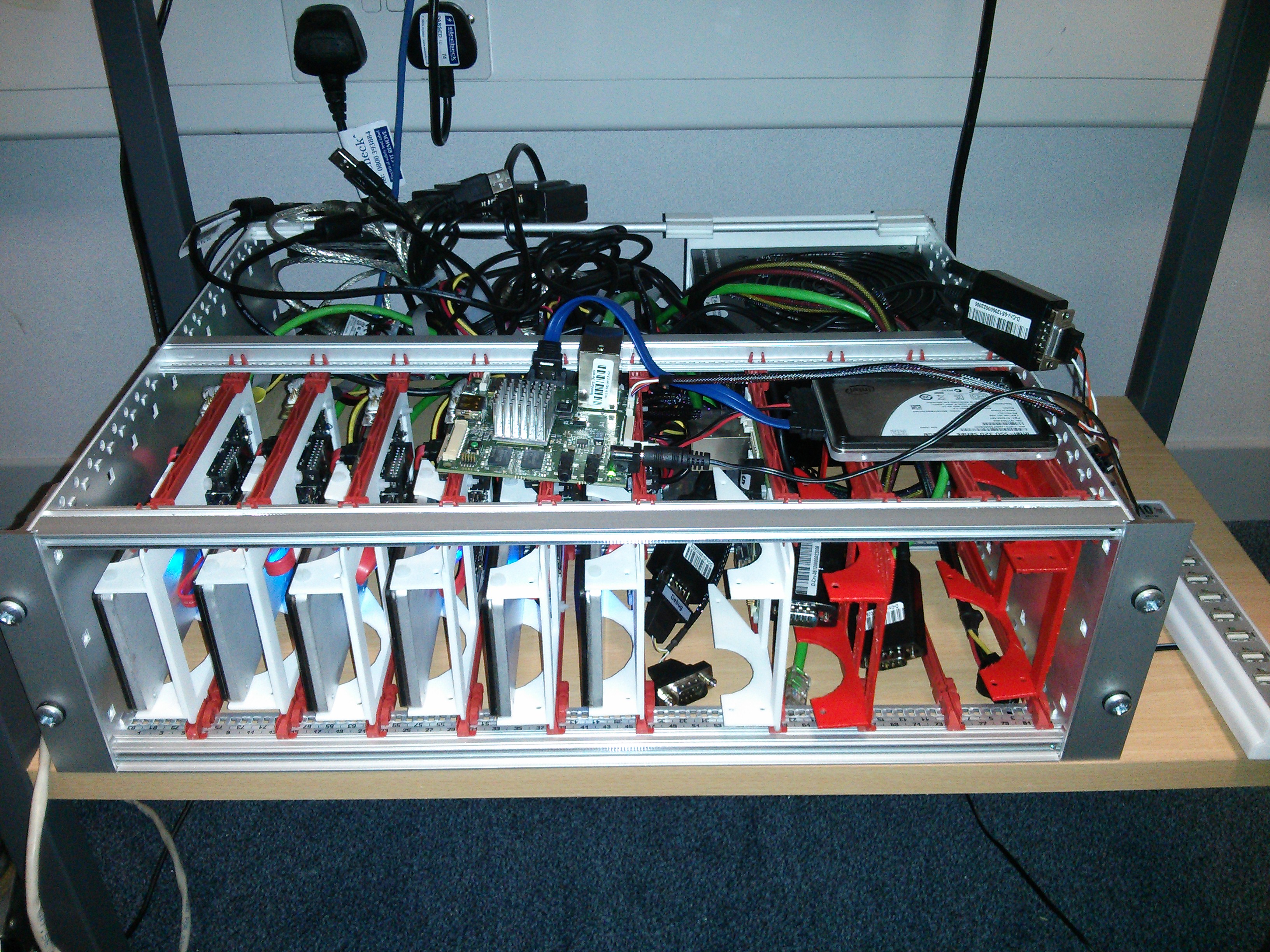
Deployed system in situ configured as a build and test farm
The solution is neat and provides flexibility, density and reproducibility the "pile of stuff" solution failed to do.

For current prototype with nine filled slots the total cost was around 3000GBP or around 330GBP per slot which indicates a 100GBP per slot overhead over the "pile of stuff" solution. These figures omit the costs of the engineer and workshop time, which are estimated at an additional 1500GBP. Therefore a completed rack, fully filled with i.MX6 carriers costs around 5000GBP

Density could be increased if boards with lower height requirements were used however above twelve units there issues with Ethernet switch, power switch and USB port availability become a factor. For Example the 16 port Ethernet switch requires a port for uplink, one for each relay board and one for the console server which leaves only 12 ports for systems.

Addressing the outstanding issues would result in a much more user friendly solution. As the existing unit is in full time use and downtime is not easily scheduled for all ten systems, the issues are not likely to be fixed on the prototype and would have to be solved on a new build.

The solution is probably not suitable for turning into a product but that was not really the original aim. A commercial ARM blade server using this format would almost certainly use standard DIN connectors and a custom PCB design rather than adapting existing boards.

Francesca Ciceri: And the winner is...

I totally forgot it, but as the DPL elections are now done, we have a winner for the #DPL game. Of the (more or less) fifteen persons who participated to the game (thank you!), only four received points for having at least one of their Fantastic Four running for DPL: As Lucas is now the new DPL, our one and only winner of the DPL game is... ... Mehdi Dogguy! Congrats!

Petter Reinholdtsen: First alpha release of Debian Edu / Skolelinux based on Debian Wheezy

The Debian Edu / Skolelinux project is still going strong and made its first Wheezy based release today. This is the release announcement: New features for Debian Edu ~7.0.0 alpha0 released 2013-04-26 This is the release notes for for Debian Edu / Skolelinux ~7.0.0 edu alpha0, based on Debian with codename "Wheezy". About Debian Edu and Skolelinux Debian Edu, also known as Skolelinux, is a Linux distribution based on Debian providing an out-of-the box environment of a completely configured school network. Immediatly after installation a school server running all services needed for a school network is set up just waiting for users and machines being added via GOsa , a comfortable Web-UI. A netbooting environment is prepared using PXE, so after initial installation of the main server from CD, DVD or USB stick all other machines can be installed via the network. This is the first test release based on Wheezy (which currently is not released yet). Basically this is an updated and slightly improved version compared to the Squeeze release. Software updates Documentation LDAP related changes Other changes Regressions No updated artwork Where to get it To download the multiarch netinstall CD release you can use The MD5SUM of this image is: c5e773ddafdaa4f48c409c682f598b6c The SHA1SUM of this image is: 25934fabb9b7d20235499a0a51f08ce6c54215f2 How to report bugs http://wiki.debian.org/DebianEdu/HowTo/ReportBugs

Next.

Previous.