Search Results: "ana"

16 May 2020

Norbert Preining: Upgrading AMD Radeon 5700 to 5700 XT via BIOS

Having recently switched from NVIDIA to AMD graphic cards, in particular a RX 5700, I found out that I can get myself a free upgrade to the RX 5700 XT variant without paying one Yen, by simply flashing a compatible 5700 XT BIOS onto the 5700 card. Not that this is something new, a detailed explanation can be found here.
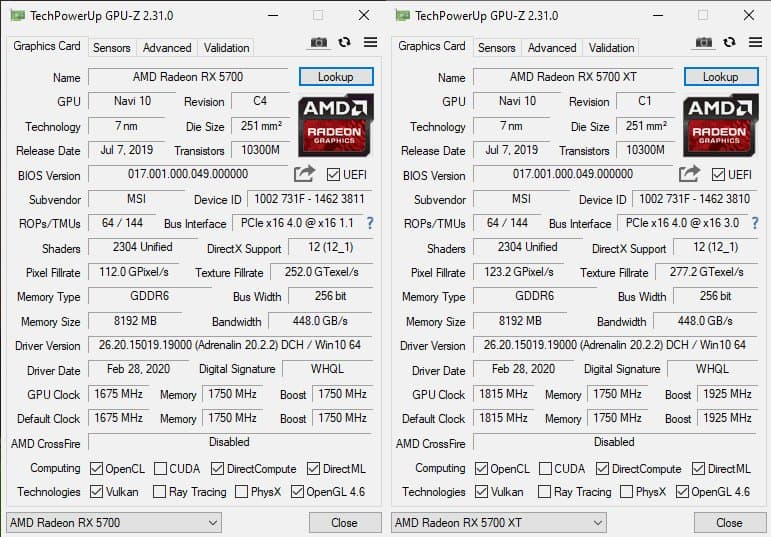
The same article also gives a detailed technical explanation on the difference between the two cards. The 5700 variant has less stream processors (2304 against 2560 in the XT variant), and lower power limits and clock speeds. Other than this they are based on the exact same chip layout (Navi 10), and with the same amount and type of memory 8 GB GDDR6. Flashing the XT BIOS onto the plain 5700 will not changes the number of stream processors, but power limits and clock speeds are raised to the same level of the 5700 XT, providing approximately a 7% gain without any over-clocking and over-powering, and potentially more by raising voltage etc. Detailed numbers can be found in the linked article above. The first step in this free upgrade is to identify ones own card correctly, best with device id and subsystem id, and then find the correct BIOS. Lots of BIOS dumps are provided in the BIOS database (link already restricting to 5700 XT BIOS). I used CPU-Z (Windows program) to determine this items, see image on the right (click to enlarge). In my case I got 1002 731F - 1462 3811 for the complete device id. The card is a MSI RX 5700 8 GB Mech OC, so I found the following alternative BIOS for MSI RX 5700 XT 8 GB Mech OC. Unfortunately, it seems that MSI is distinguishing 5700 and 5700 XT by their device id, because the XT variant gives 1002 731F - 1462 3810 for the complete device id, meaning that the last digit is 1 off compared to mine (3811 versus 3810). And indeed, trying to flash this video BIOS the normal way (using the Windows version ended in a warning that the subsystem id is different. A bit of search led to a thread in the TechPowerup Fora and this post explaining how to force the flashing in this case. Disclaimer: The following might brick your graphic card, you are doing this on your own risk! Necessary software: I did all the flashing and checking under Windows, but only because I realized too late that there is a fully uptodate flashing program for Linux that exhibits the same functionality. Also, I didn t know how to get the device id since the current AMD ROCm tools seem not to provide this data. If you are lucky and the device ids for your card are the same for both 5700 and 5700 XT variants, then you can use the graphical client (amdvbflashWin.exe), but if there is a difference, the command line is necessary. After unpacking the AMD Flash program and getting the correct BIOS rom file, the steps taken on Windows are (the very same steps can be taken on Linux): This should succeed in both cases. After that shutdown and restart your computer and you should be greeted with a RT 5700 XT card, without twisting a single screw. Starting Windows for the first time gave some flickering, because the driver for the new card was installed. On Linux the system auto-detects the card and everything works out of the box. Very smooth. Finally, a word of warning: Don t do these kind of things if you are not ready to pay the prize of a bricked GPU card in case something goes wrong! Everything is on your own risk! Let me close with a before/after image, most of the fields are identical, but the default/gpu clocks both at normal as well as boost levels see a considerable improvement

Michael Stapelberg: a new distri linux (fast package management) release

I just released a new version of distri. The focus of this release lies on: See the release notes for more details. The distri research linux distribution project was started in 2019 to research whether a few architectural changes could enable drastically faster package management. While the package managers in common Linux distributions (e.g. apt, dnf, ) top out at data rates of only a few MB/s, distri effortlessly saturates 1 Gbit, 10 Gbit and even 40 Gbit connections, resulting in fast installation and update speeds.

Lucas Kanashiro: Quarantine times

After quite some time without publishing anything here, I decided to share the latest events. It is a hard time for most of us but with all this time at home, one can also do great things. I would like to start with the wonderful idea the Debian Brasil community had! Why not create an online Debian related conference to keep people s minds busy and also share knowledge? After brainstorming, we came up with our online conference called #FiqueEmCasaUseDebian (in English it would be #StayHomeUseDebian). It started on May 3rd and will last until May 30th (yes, one month)! Every weekday, we have one online talk at night and on every Saturday, a Debian packaging workshop. The feedback so far has been awesome and the Brazilian Debian community is reaching out to more people than usual at our regular conferences (as you might have imagined, Brazil is huge and it is hard to bring people at the same place). At the end of the month, we will have the first MiniDebConf online and I hope it will be as successful as our experience here in Brazil. Another thing that deserves a highlight is the fact that I became an Ubuntu Core Developer this month; yay! After 9 months of working almost daily on the Ubuntu Server, I was able to get my upload rights to the Ubuntu archive. I was tired of asking for sponsorship, and probably my peers were tired of me too. I could spend more time here complaining about the Brazilian government but I think it isn t worth it. Let s try to do something useful instead!

15 May 2020

Dirk Eddelbuettel: Let s celebrate Anna!

Today is graduation at Washington University, and just like many other places, the ceremonies are a lot more virtual and surreal that in other years. For Anna today marks the graduation from Biomedical Engineering with a BSc. The McKelvey School of Engineering put a Zoom meeting together yesterday which was nice, and there is something more virtual here. Hopefully a real-life commencenment can take place in a year the May 30, 2021, date has been set. The university also sent out a little commencement site/video which was cute. But at end of the day online-only still falls short of the real deal as we all know too well by now. During those years, just about the only thing really I ever tweeted about appears to be soccer related. As it should because ball is life, as we all know. Here is one from 1 1/2 years ago when her Club Team three-peated in their NIRSA division: And that opens what may be the best venue for mocking Anna: this year, which her a senior and co-captain, the team actually managed to loose a league game (a shocking first in these years) and to drop the final. I presume they anticipated that all we would all talk about around now is The Last Dance and three-peats, and left it at that. Probably wise. Now just this week, and hence days before graduating with her B.Sc., also marks the first time Anna was addressed as Dr Eddelbuettel. A little prematurely I may say, but not too shabby to be in print already! But on the topic of gratulations and what comes next, this tweet was very sweet: As was this, which marked another impressive score: So big thanks from all of us to WashU for being such a superb environment for Anna for those four years, and especially everybody at the Pappu Lab for giving Anna a home and base to start a research career. And deepest and most sincere congratulations to Anna before the next adventure starts .

11 May 2020

Markus Koschany: My Free Software Activities in April 2020

Welcome to gambaru.de. Here is my monthly report (+ the first week in May) that covers what I have been doing for Debian. If you re interested in Java, Games and LTS topics, this might be interesting for you. Debian Games
Playonlinux
Debian Java Misc Debian LTS This was my 50. month as a paid contributor and I have been paid to work 11,5 hours on Debian LTS, a project started by Rapha l Hertzog. In that time I did the following: ELTS Extended Long Term Support (ELTS) is a project led by Freexian to further extend the lifetime of Debian releases. It is not an official Debian project but all Debian users benefit from it without cost. The current ELTS release is Debian 7 Wheezy . This was my 23. month and I have been paid to work 2 hours on ELTS. Thanks for reading and see you next time.

Julien Danjou: Interview: The Performance of Python

Interview: The Performance of PythonEarlier this year, I was supposed to participate to dotPy, a one-day Python conference happening in Paris. This event has unfortunately been cancelled due to the COVID-19 pandemic.Both Victor Stinner and me were supposed to attend that event. Victor had prepared a presentation about Python performances, while I was planning on talking about profiling.Rather than being completely discouraged, Victor and I sat down (remotely) with Anne Laure from Behind the Code (a blog ran by Welcome to the Jungle, the organizers of the dotPy conference).We discuss Python performance, profiling, speed, projects, problems, analysis, optimization and the GIL.You can read the interview here.
Interview: The Performance of Python

Gunnar Wolf: Certified printer fumes

After losing a fair bit of hair due to quality and reliability issues with our home laser multifunctional (Brother DCP1600-series, which we bought after checking it was meant to work on Linux And it does, but with a very buggy, proprietary driver Besides being the printer itself of quite low quality), we decided it was time to survey the market again, and get a color inkjet printer. I was not very much an enthusiast of the idea, until I found all of the major manufacturers now offer refillable ink tanks instead of the darn expensive cartridges of past decades. Lets see how it goes! Of course, with over 20 years of training, I did my homework. I was about to buy an Epson printer, but decided for an HP Ink Tank 410 Wireless printer. The day it arrived, not wanting to fuss around too much to get to see the results, I connected it to my computer using the USB cable. Everything ran smoothly and happily! No driver hunting needed, print quality is superb I hope, years from now, we stay with this impression. Next day, I tried to print over WiFi. Of course, it requires configuration. And, of course, configuration strongly wants you to do it from a Windows or MacOS machine which I don t have. OK, fall back to Android For which an app download is required (and does not thrill me, but what can I say. Oh and the app needs location services to even run. Why Maybe because it interacts with the wireless network in WiFi Direct, non-authenticated way?) Anyway, things seem to work. But they don t My computers can identify and connect with the printer from CUPS, but nothing ever comes out. Printer paused, they say. Entering the printer s web interface is somewhat ambiguous Following the old HP practices, I tried http://192.168.1.75:9100/ (no point in hiding my internal IP), and got a partial webpage sometimes (and nothing at all othertimes). Seeing the printer got detected over ipps://, my immediate reaction was to try pointing the browser to port 631. Seems to work! Got some odd messages But it seems I ll soon debug the issue away. I am not a familiar meddler in the dark lands of cups, our faithful print server, but I had to remember my toolkit..
# cupsenable HP_Ink_Tank_Wireless_410_series_C37468_ --release
Sucess in enabling, but self-auto-disabled right away lpstat -t was not more generous, reporting only it was still paused. Some hours later (mix in attending kids and whatnot), I finally remember to try cupsctl --debug-logging, and magically, /var/log/cups/error_log turns from being quiet to being quite chatty. And, of course, my first print job starts being processed:
D [10/May/2020:23:07:20 -0500] Report: jobs-active=1
(...)
D [10/May/2020:23:07:25 -0500] [Job 174] Start rendering...
(...)
D [10/May/2020:23:07:25 -0500] [Job 174] STATE: -connecting-to-device
(...)
Everything looks fine and dandy so far! But, hey, given nothing came out of the printer keep reading one more second of logs (a couple dozen lines)
D [10/May/2020:23:07:26 -0500] [Job 174] Connection is encrypted.
D [10/May/2020:23:07:26 -0500] [Job 174] Credentials are expired (Credentials have expired.)
D [10/May/2020:23:07:26 -0500] [Job 174] Printer credentials: HPC37468 / Thu, 01 Jan 1970 00:00:00 GMT / 28A59EF511A480A34798B6712DEEAE74
D [10/May/2020:23:07:26 -0500] [Job 174] No stored credentials.
D [10/May/2020:23:07:26 -0500] [Job 174] update_reasons(attr=0(), s=\"-cups-pki-invalid,cups-pki-changed,cups-pki-expired,cups-pki-unknown\")
D [10/May/2020:23:07:26 -0500] [Job 174] STATE: -cups-pki-expired
(...)
D [10/May/2020:23:08:00 -0500] [Job 174] envp[16]="CUPS_ENCRYPTION=IfRequested"
(...)
D [10/May/2020:23:08:00 -0500] [Job 174] envp[27]="PRINTER_STATE_REASONS=cups-pki-expired"
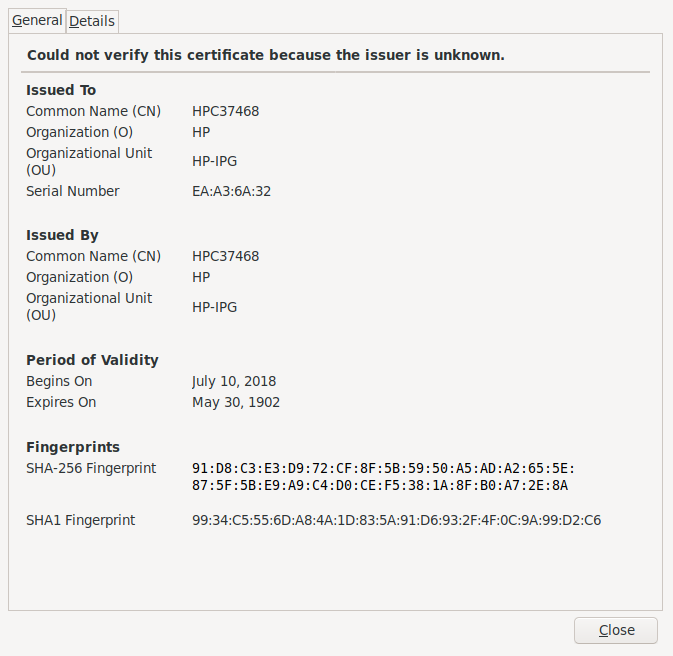
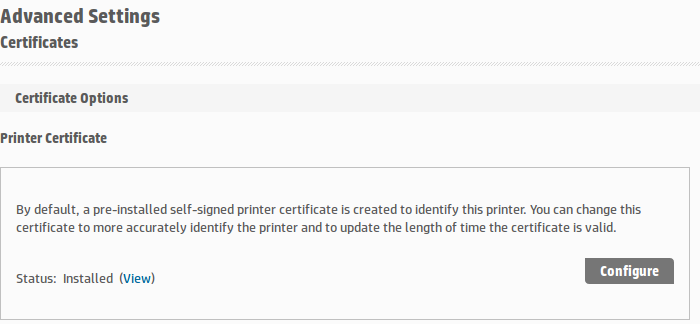
My first stabs were attempts to get CUPS not to care about expired certificates, but it seems to have been hidden or removed from its usual place. Anyway, I was already frustrated. WTF Well, yes, turns out that from the Web interface, I paid some attention to this the first time around, but let it pass (speaks wonders about my security practices!): Way, way, way too expired cert So, the self-signed certificate the printer issued at itself expired 116 years before even being issued. (is this maybe a Y2k38 bug? Sounds like it!) Interesting thing, my CUPS log mentions the printer credentials to expire at the beginning of the Unix Epoch (01 Jan 1970 00:00:00 GMT). OK, lets clickety-click away on the Web interface Didn t take me long to get to Network Advanced settings Certificates: Can manage certs! However, clicking on Configure leads me to the not very reassuring Way, way, way too expired cert I don t remember what I did for the next couple of minutes. Kept fuming Until I parsed again the output of lpstat -t, and found that:
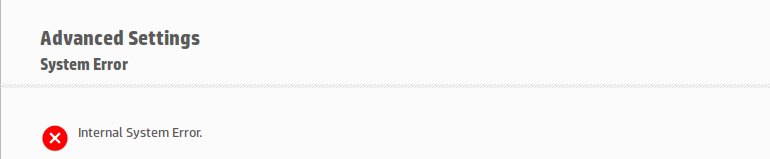
# lpstat -t
(...)
device for HP_Ink_Tank_Wireless_410_series_C37468_: ipps://HPF43909C37468.local:443/ipp/print
(...)
Hmmmm CUPS is connecting using good ol port 443, as if it were a Web thingy What if I do the same? Now we are talking! Click on New self-signed certificate , click on Next, a couple of reloads And a very nice color print came out of the printer, yay! Now, it still baffles me (of course I checked!): The self-signed certificate is now said to come from Issuer : CN=HPC37468, L=Vancouver, ST=Washington, C=US, O=HP,OU=HP-IPG, alright not that it matters (I can import a more meaningful one if I really feel like it), but, why is it Issued On: 2019-06-14 and set to Expires On: 2029-06-11? Anyway, print quality is quite nice. I hope to keep the printer long enough to rant at the certificate being expired in the future!

Comments Jeff Epler (Adafruit) 2020-05-11 20:39:17 -0500 why is it Issued On: 2019-06-14 and set to Expires On: 2029-06-11? Because it s 3650 days Gunnar Wolf 2020-05-11 20:39:17 -0500 Nice catch! Thanks for doing the head-scratching for me

10 May 2020

Russell Coker: IT Asset Management

In my last full-time position I managed the asset tracking database for my employer. It was one of those things that someone needed to do, and it seemed that only way that someone wouldn t equate to no-one was for me to do it which was ok. We used Snipe IT [1] to track the assets. I don t have enough experience with asset tracking to say that Snipe is better or worse than average, but it basically did the job. Asset serial numbers are stored, you can have asset types that allow you to just add one more of the particular item, purchase dates are stored which makes warranty tracking easier, and every asset is associated with a person or listed as available. While I can t say that Snipe IT is better than other products I can say that it will do the job reasonably well. One problem that I didn t discover until way too late was the fact that the finance people weren t tracking serial numbers and that some assets in the database had the same asset IDs as the finance department and some had different ones. The best advice I can give to anyone who gets involved with asset tracking is to immediately chat to finance about how they track things, you need to know if the same asset IDs are used and if serial numbers are tracked by finance. I was pleased to discover that my colleagues were all honourable people as there was no apparent evaporation of valuable assets even though there was little ability to discover who might have been the last person to use some of the assets. One problem that I ve seen at many places is treating small items like keyboards and mice as assets . I think that anything that is worth less than 1 hour s pay at the minimum wage (the price of a typical PC keyboard or mouse) isn t worth tracking, treat it as a disposable item. If you hire a programmer who requests an unusually expensive keyboard or mouse (as some do) it still won t be a lot of money when compared to their salary. Some of the older keyboards and mice that companies have are nasty, months of people eating lunch over them leaves them greasy and sticky. I think that the best thing to do with the keyboards and mice is to give them away when people leave and when new people join the company buy new hardware for them. If a company can t spend $25 on a new keyboard and mouse for each new employee then they either have a massive problem of staff turnover or a lack of priority on morale.

Russ Allbery: Review: Golden Gates

Review: Golden Gates, by Conor Dougherty
Publisher: Penguin
Copyright: 2020
ISBN: 0-525-56022-X
Format: Kindle
Pages: 249
This review, for reasons that will hopefully become clear later, starts with a personal digression. I have been interested in political theory my entire life. That sounds like something admirable, or at least neutral. It's not. "Interested" means that I have opinions that are generally stronger than my depth of knowledge warrants. "Interested" means that I like thinking about and casting judgment on how politics should be done without doing the work of politics myself. And "political theory" is different than politics in important ways, not the least of which is that political actions have rarely been a direct danger to me or my family. I have the luxury of arguing about politics as a theory. In short, I'm at high risk of being one of those people who has an opinion about everything and shares it on Twitter. I'm still in the process (to be honest, near the beginning of the process) of making something useful out of that interest. I've had some success when I become enough a part of a community that I can do some of the political work, understand the arguments at a level deeper than theory, and have to deal with the consequences of my own opinions. But those communities have been on-line and relatively low stakes. For the big political problems, the ones that involve governments and taxes and laws, those that decide who gets medical treatment and income support and who doesn't, to ever improve, more people like me need to learn enough about the practical details that we can do the real work of fixing them, rather than only making our native (and generally privileged) communities better for ourselves. I haven't found my path helping with that work yet. But I do have a concrete, challenging, local political question that makes me coldly furious: housing policy. Hence this book. Golden Gates is about housing policy in the notoriously underbuilt and therefore incredibly expensive San Francisco Bay Area, where I live. I wanted to deepen that emotional reaction to the failures of housing policy with facts and analysis. Golden Gates does provide some of that. But this also turns out to be a book about the translation of political theory into practice, about the messiness and conflict that results, and about the difficult process of measuring success. It's also a book about how substantial agreement on the basics of necessary political change can still founder on the shoals of prioritization, tribalism, and people who are interested in political theory. In short, it's a book about the difficulty of changing the world instead of arguing about how to change it. This is not a direct analysis of housing policy, although Dougherty provides the basics as background. Rather, it's the story of the political fight over housing told primarily through two lenses: Sonja Trauss, founder of BARF (the Bay Area Renters' Federation); and a Redwood City apartment complex, the people who fought its rent increases, and the nun who eventually purchased it. Around that framework, Dougherty writes about the Howard Jarvis Taxpayers Association and the history of California's Proposition 13, a fight over a development in Lafayette, the logistics challenge of constructing sufficient housing even when approved, and the political career of Scott Wiener, the hated opponent of every city fighting for the continued ability to arbitrarily veto any new housing. One of the things Golden Gates helped clarify for me is that there are three core interest groups that have to be part of any discussion of Bay Area housing: homeowners who want to limit or eliminate local change, renters who are vulnerable to gentrification and redevelopment, and the people who want to live in that area and can't (which includes people who want to move there, but more sympathetically includes all the people who work there but can't afford to live locally, such as teachers, day care workers, food service workers, and, well, just about anyone who doesn't work in tech). (As with any political classification, statements about collectives may not apply to individuals; there are numerous people who appear to fall into one group but who vote in alignment with another.) Dougherty makes it clear that housing policy is intractable in part because the policies that most clearly help one of those three groups hurt the other two. As advertised by the subtitle, Dougherty's focus is on the fight for more housing. Those who already own homes whose values have been inflated by artificial scarcity, or who want to preserve such stratified living conditions as low-density, large-lot single-family dwellings within short mass-transit commute of one of the densest cities in the United States, don't get a lot of sympathy or focus here except as opponents. I understand this choice; I also don't have much sympathy. But I do wish that Dougherty had spent more time discussing the unsustainable promise that California has implicitly made to homeowners: housing may be impossibly expensive, but if you can manage to reach that pinnacle of financial success, the ongoing value of your home is guaranteed. He does mention this in passing, but I don't think he puts enough emphasis on the impact that a single huge, illiquid investment that is heavily encouraged by government policy has on people's attitude towards anything that jeopardizes that investment. The bulk of this book focuses on the two factions trying to make housing cheaper: Sonja Trauss and others who are pushing for construction of more housing, and tenant groups trying to manage the price of existing housing for those who have to rent. The tragedy of Bay Area housing is that even the faintest connection of housing to the economic principle of supply and demand implies that the long-term goals of those two groups align. Building more housing will decrease the cost of housing, at least if you build enough of it over a long enough period of time. But in the short term, particularly given the amount of Bay Area land pre-emptively excluded from housing by environmental protection and the actions of the existing homeowners, building more housing usually means tearing down cheap lower-density housing and replacing it with expensive higher-density housing. And that destroys people's lives. I'll admit my natural sympathy is with Trauss on pure economic grounds. There simply aren't enough places to live in the Bay Area, and the number of people in the area will not decrease. To the marginal extent that growth even slows, that's another tale of misery involving "super commutes" of over 90 minutes each way. But the most affecting part of this book was the detailed look at what redevelopment looks like for the people who thought they had housing, and how it disrupts and destroys existing communities. It's impossible to read those stories and not be moved. But it's equally impossible to not be moved by the stories of people who live in their cars during the week, going home only on weekends because they have to live too far away from their jobs to commute. This is exactly the kind of politics that I lose when I take a superficial interest in political theory. Even when I feel confident in a guiding principle, the hard part of real-world politics is bringing real people with you in the implementation and mitigating the damage that any choice of implementation will cause. There are a lot of details, and those details matter. Without the right balance between addressing a long-term deficit and providing short-term protection and relief, an attempt to alleviate unsustainable long-term misery creates more short-term misery for those least able to afford it. And while I personally may have less sympathy for the relatively well-off who have clawed their way into their own mortgage, being cavalier with their goals and their financial needs is both poor ethics and poor politics. Mobilizing political opponents who have resources and vote locally isn't a winning strategy. Dougherty is a reporter, not a housing or public policy expert, so Golden Gates poses problems and tells stories rather than describes solutions. This book didn't lead me to a brilliant plan for fixing the Bay Area housing crunch, or hand me a roadmap for how to get effectively involved in local politics. What it did do is tell stories about what political approaches have worked, how they've worked, what change they've created, and the limitations of that change. Solving political problems is work. That work requires understanding people and balancing concerns, which in turn requires a lot of empathy, a lot of communication, and sometimes finding a way to make unlikely allies. I'm not sure how broad the appeal of this book will be outside of those who live in the region. Some aspects of the fight for housing generalize, but the Bay Area (and I suspect every region) has properties specific to it or to the state of California. It has also reached an extreme of housing shortage that is rivaled in the United States only by New York City, which changes the nature of the solutions. But if you want to seriously engage with Bay Area housing policy, knowing the background explained here is nearly mandatory. There are some flaws I wish Dougherty would have talked more about traffic and transit policy, although I realize that could be another book but this is an important story told well. If this somewhat narrow topic is within your interests, highly recommended. Rating: 8 out of 10

9 May 2020

Thorsten Alteholz: My Debian Activities in April 2020

FTP master This month I accepted 384 packages and rejected 47. The overall number of packages that got accepted was 457. Debian LTS This was my seventieth month that I did some work for the Debian LTS initiative, started by Raphael Hertzog at Freexian. This month my all in all workload has been 28.75h. During that time I did LTS uploads of: As there have been lots of no-dsa-CVEs I continued my work on wireshark. Last but not least I did some days of frontdesk duties. Debian ELTS This month was the twenty second ELTS month. During my small allocated time I only uploaded: I also did some days of frontdesk duties. Other stuff Unfortunately this month again strange things happened outside Debian and I only got some stuff done. I improved packaging of I sponsored uploads of I uploaded the new package On my Go challenge I uploaded:
golang-github-facebookgo-subset, golang-github-facebookgo-ensure, golang-github-shurcool-gopherjslib, golang-github-grafana-grafana-plugin-model, golang-github-crewjam-httperr, golang-github-hashicorp-terraform-svchost, golang-github-neelance-sourcemap, golang-github-neelance-astrewrite, golang-github-kisielk-gotool, golang-github-gopherjs-gopherjs, golang-github-yvasiyarov-newrelic-platform-go, golang-github-rhnvrm-simples3, golang-github-robfig-go-cache, golang-github-xorcare-pointer, golang-github-goburrow-serial

8 May 2020

Petter Reinholdtsen: Jami as a Zoom client, a trick for password protected rooms...

Half a year ago, I wrote about the Jami communication client, capable of peer-to-peer encrypted communication. It handle both messages, audio and video. It uses distributed hash tables instead of central infrastructure to connect its users to each other, which in my book is a plus. I mentioned briefly that it could also work as a SIP client, which came in handy when the higher educational sector in Norway started to promote Zoom as its video conferencing solution. I am reluctant to use the official Zoom client software, due to their copyright license clauses prohibiting users to reverse engineer (for example to check the security) and benchmark it, and thus prefer to connect to Zoom meetings with free software clients. Jami worked OK as a SIP client to Zoom as long as there was no password set on the room. The Jami daemon leak memory like crazy (approximately 1 GiB a minute) when I am connected to the video conference, so I had to restart the client every 7-10 minutes, which is not a great. I tried to get other SIP Linux clients to work without success, so I decided I would have to live with this wart until someone managed to fix the leak in the dring code base. But another problem showed up once the rooms were password protected. I could not get my dial tone signaling through from Jami to Zoom, and dial tone signaling is used to enter the password when connecting to Zoom. I tried a lot of different permutations with my Jami and Asterisk setup to try to figure out why the signaling did not get through, only to finally discover that the fundamental problem seem to be that Zoom is simply not able to receive dial tone signaling when connecting via SIP. There seem to be nothing wrong with the Jami and Asterisk end, it is simply broken in the Zoom end. I got help from a very skilled VoIP engineer figuring out this last part. And being a very skilled engineer, he was also able to locate a solution for me. Or to be exact, a workaround that solve my initial problem of connecting to password protected Zoom rooms using Jami. So, how do you do this, I am sure you are wondering by now. The trick is already documented from Zoom, and it is to modify the SIP address to include the room password. What is most surprising about this is that the automatically generated email from Zoom with instructions on how to connect via SIP do not mention this. The SIP address to use normally consist of the room ID (a number), an @ character and the IP address of the Zoom SIP gateway. But Zoom understand a lot more than just the room ID in front of the at sign. The format is "[Meeting ID].[Password].[Layout].[Host Key]", and you can hear see how you can both enter password, control the layout (full screen, active presence and gallery) and specify the host key to start the meeting. The full SIP address entered into Jami to provide the password will then look like this (all using made up numbers):
sip:657837644.522827@192.168.169.170
Now if only jami would reduce its memory usage, I could even recommend this setup to others. :) As usual, if you use Bitcoin and want to show your support of my activities, please send Bitcoin donations to my address 15oWEoG9dUPovwmUL9KWAnYRtNJEkP1u1b.

5 May 2020

Jonathan Dowland: Introducing Red Hat UBI OpenJDK runtime images

At Red Hat we've just shipped Universal Base Image (UBI) build images for OpenJDK. Download them with your favourite container manager, e.g.:
podman pull registry.access.redhat.com/ubi8/openjdk-8
podman pull registry.access.redhat.com/ubi8/openjdk-11
UBI, announced a year ago, is an initiative where you can obtain, share and build upon official Red Hat container images without needing a Red Hat subscription. Unlike something like CentOS, they aren't modified in any way (e.g. to remove branding), they're exactly the same base images that Red Hat products are built upon, composed entirely of Open Source software. Your precise rights are covered in the EULA. I work on the Red Hat OpenJDK container images, which are designed primarily for use with OpenShift. We've been based upon the RHEL base images since inception. Although our containers are open source (of course), we haven't been able to distribute the binary images more widely than to Red Hat customers, until now. These are based upon the "minimal" flavour base image and add an OpenJDK runtime and development packages (either JDK8 or JDK11, as per the image name) as well as Maven and OpenShift integration scripts that allow the image to be used with Source To Image. If you give these a try, please let us know what you think! Comment here, on twitter, or file Issues or Pull Requests in the GitHub project.

3 May 2020

Iain R. Learmonth: Hetzner Dedicated Server Reverse DNS + Ansible

Continuing on the path towards all my stuff being managed by Ansible, I ve figured out a method of managing the reverse DNS entries for subnets on the Hetzner Dedicated Server. There s a bunch of Ansible modules for handling Hetzner Cloud, but these servers are managed in Robot which the Cloud API doesn t cover. Instead, you need to use the Robot Webservice. Ansible does have a module for doing pretty arbitrary things with web APIs though, so using that I ve got the following playbook figured out to keep the reverse DNS entries in sync:
---
- hosts:
  - vmhost_vm1
  gather_facts: False
  tasks:
  - name: import hetzner webservice credentials
    include_vars:
      file: "hetzner_ws.yml"
  - name: set rdns for hetzner hosts
    block:
    - name: get current rdns entry
      uri:
        user: "  hetzner_ws_user  "
        password: "  hetzner_ws_password  "
        url: "https://robot-ws.your-server.de/rdns/  vmip4  "
        status_code: [200, 404]
      register: rdns_result
    - name: update incorrect rdns entry
      uri:
        user: "  hetzner_ws_user  "
        password: "  hetzner_ws_password  "
        url: "https://robot-ws.your-server.de/rdns/  vmip4  "
        method: "POST"
        body_format: form-urlencoded
        body:
          ptr: "  inventory_hostname  "
        status_code: [200, 201]
      when: '"rdns" not in rdns_result.json or inventory_hostname != rdns_result.json.rdns.ptr'
      changed_when: True
    delegate_to: localhost
The host groups this runs on are currently hardcoded as the VMs that live in the Hetzner Dedicated Server. A future iteration of this might use some inventory plugin to look up the subnets that are managed on Hetzner and create a group for all of those. Right now it won t be setting the reverse DNS for the router interface on that subnet, and won t automatically include new server s subnets. Gathering facts is disabled because all of these run locally. There is at least one VM running on this server that I can t log in to because I host it for someone else, so running locally is a necessity. The webservice credentials are stored in an Ansible Vault encrypted YAML file and loaded explicitly. An important note: the webservice username and password is not the same as your regular Robot username and password. You need to create a webservice user in Robot under Settings; Webservice and app settings . If you attempt to authenticate with an incorrect username and password 3 times in a row, your IP address will be blocked for 10 minutes. There are 6 hosts in this group, so I did this a few times before I realised there was a different user account I needed to create. I d suggest limiting to a single host while you re testing to get the authentication figured out. The actual calls to the webservice take place in a block just to avoid having to specify the delegate_to: localhost twice. The first step looks up the current PTR record, and accepts success if it gives either a 200 or 404 status code (it will be 404 if there is no existing pointer record). The result of this is used to conditionally create/update the PTR record in the next task. If nothing needs to be done, nothing will be changed and the second task will be skipped. If a change is needed, the second step is successful if either the PTR record is updated (status 200) or created (status 201). This was actually a lot easier than I thought it would be, and the uri module looks to be really flexible, so I bet there are other things that I could easily integrate into my Ansible playbooks.

Evgeni Golov: Remote management for OpenWRT devices without opening inbound connections

Everyone is working from home these days and needs a decent Internet connection. That's especially true if you need to do video calls and the room you want to do them has the worst WiFi coverage of the whole flat. Well, that's exactly what happened to my parents in law. When they moved in, we knew that at some point we'll have to fix the WiFi - the ISP provided DSL/router/WiFi combo would not cut it, especially not with the shape of the flat and the elevator shaft in the middle of it: the flat is essentially a big C around said shaft. But it was good enough for email, so we postponed that. Until now. The flat has wired Ethernet, but the users MacBook Air does not. That would have been too easy, right? So let's add another access point and hope the situation improves. Luckily I still had a TP-Link Archer C7 AC1750 in a drawer, which I could quickly flash with a fresh OpenWRT release, disable DHCPd and configure the same SSID and keys as the main/old WiFi. But I didn't know which channels would be best in the destination environment. Under normal circumstances, I'd just take the AP, drive to my parents in law and finish the configuration there. Nope, not gonna happen these days. So my plan was to finish configuration here, put the AP in a box and on the porch where someone can pick it up. But this would leave me without a way to further configure the device once it has been deployed - I was not particularly interested in trying to get port forwarding configured via phone and I was pretty sure UPnP was disabled in the ISP router. Installing a Tor hidden service for SSH was one possibility, setting up a VPN and making the AP a client another. Well, or just creating a reverse tunnel with SSH! sshtunnel Creating a tunnel with OpenSSH is easy: ssh -R127.0.0.1:2222:127.0.0.1:22 server.example.com will forward localhost:2222 on server.example.com to port 22 of the machine the SSH connection originated from. But what happens if the connection dies? Adding a while true; do ; done around it might help, but I would really like not to reinvent the wheel here! Thankfully, somebody already invented that particular wheel and OpenWRT comes with a sshtunnel package that takes care of setting up and keeping up such tunnels and documentation how to do so. Just install the sshtunnel package, edit /etc/config/sshtunnel to contain a server stanza with hostname, port and username and a tunnelR stanza referring said server plus the local and remote sides of the tunnel and you're good to go.
config server home
  option user     user
  option hostname server.example.com
  option port     22
config tunnelR local_ssh
  option server         home
  option remoteaddress  127.0.0.1
  option remoteport     2222
  option localaddress   127.0.0.1
  option localport      22
The only caveat is that sshtunnel needs the OpenSSH client binary (and the package correctly depends on it) and OpenWRT does not ship the ssh-keygen tool from OpenSSH but only the equivalent for Dropbear. As OpenSSH can't read Dropbear keys (and vice versa) you'll have to generate the key somewhere else and deploy it to the OpenWRT box and the target system. Oh, and OpenWRT defaults to enabling password login via SSH, so please disable that if you expose the box to the Internet in any way! Using the tunnel After configuring and starting the service, you'll see the OpenWRT system logging in to the configured remote and opening the tunnel. For some reason that connection would not show up in the output of w -- probably because there was no shell started or something, but logs show it clearly. Now it's just a matter of connecting to the newly open port and you're in. As the port is bound to 127.0.0.1, the connection is only possible from server.example.com or using it as a jump host via OpenSSH's ProxyJump option: ssh -J server.example.com -p 2222 root@localhost. Additionally, you can forward a local port over the tunneled connection to create a tunnel for the OpenWRT webinterface: ssh -J server.example.com -p 2222 -L8080:localhost:80 root@localhost. Yes, that's a tunnel inside a tunnel, and all the network engineers will go brrr, but it works and you can access LuCi on http://localhost:8080 just fine. If you don't want to type that every time, create an entry in your .ssh/config:
Host openwrt
  ProxyJump server.example.com
  HostName localhost
  Port 2222
  User root
  LocalForward 8080 localhost:80
And we're done. Enjoy easy access to the newly deployed box and carry on.

2 May 2020

Jonathan Carter: Free Software Activities for 2020-04

Debian project leader This month contained the first week and a half or so of my term as Debian Project Leader. So far my focus has been getting up to speed and keeping the gears turning with day to day DPL tasks. The updates listed here will also be available on the DPL blog, where I aim to make more frequent updates. During May, Debian Brazil will host Debian talks throughout the month which they will stream to their YouTube channel. You can find the schedule in this git repository, most of the talks will be in Portuguese, but on the 4th of May at 21:00 UTC, I ll be covering some Debian project topics for an hour or so and take some questions if there s time left. 2020-04-19: Handover session with Sam, our outgoing DPL. We covered a lot of questions I had and main areas that the DPL works in. Thanks to Sam for having taken the time to do this. 2020-04-21: First day of term! Thank you to everybody who showed support and have offered to help! 2020-04-21: Request feedback from the trademark team on an ongoing trademark dispute. 2020-04-21: Join the GNOME Advisory Board as a representative from Debian. 2020-04-21: Reply on an ongoing community conflict issue. 2020-04-21: Update Debian project summary for SPI annual report. 2020-04-21: Received a great e-mail introduction from Debian France and followed up on that. 2020-04-21: Posted Bits from the new DPL to debian-devel-announce. 2020-04-22: Became Debian s OSI Affilliate representative. 2020-04-22: Reply to a bunch of media inquiries for interviews, will do them later when initial priorities are on track. 2020-04-23: Resign as Debian FTP team trainee and mailing list moderator. In both these areas there are enough people taking care of it and I intend to maximise available time for DPL and technical areas in the project. 2020-04-25: Review outgoing mail for trademark team. 2020-04-25: Answer some questions in preparation for DAM/Front Desk delegation updates. 2020-04-26: Initiated wiki documentation for delegation updates process. 2020-04-27: Update delegation for the Debian Front Desk team. 2020-04-29: Schedule video call with Debian treasurer team. 2020-04-29: OSI affiliate call. Learned about some Open Source projects including OpenDev, OpenSourceMatters, FOSS Responders and Democracy Labs.

Debian Social Work on the Debian Social project is progressing, we plan to start a separate blog syndicated to Planet Debian that contains progress and status updates. I ve been terrible at tracking the work we ve been doing on this, so for now, here are some micro updates:

MiniDebConf Online In the DebConf video team, we ve been wondering whether we have all the tools required to successfully host a DebConf (or even a mini DebConf) entirely online. There s really just one way to know for sure, so we re going to host MiniDebConf Online from 28 May to 31 May. The first two days will be an online MiniDebCamp, where we can try to hold online spints, meetings and general chit-chat. The last two days will be for talks and lightnight talks, with BoFs likely to take place throughout the 4 days (this will probably be decided once we have a content team). Announcements should go out within the next week, in the meantime, save the dates.

Debian package uploads 2020-04-07: Upload package flask-autoindex (0.6.6-1) to Debian unstable. 2020-04-07: Upload package gamemode (1.5.1-1) to Debian unstable. 2020-04-08: Accept MR#2 for live-tasks (add usbutils to live-task-standard). 2020-04-08: Upload package live-tasks (11.0.2) to Debian unstable (Closes: #955526, #944578, #942837, #942834). 2020-04-08: Close live-config bug #655198 (Only affects squeeze which is no longer supported). 2020-04-08: Upload package live-config (11.0.1) to Debian unstable. 2020-04-08: Upload package calamares (3.2.22-1) to Debian unstable. 2020-04-15: Upload package xabacus (8.2.6-1) to Debian unstable. 2020-04-16: Merge MR#1 for gnome-shell-extension-dashtodock (new upstream release). 2020-04-16: Upload package gnome-shell-extension-dashtodock (67+git20200225-1) to Debian unstable. 2020-04-16: Merge MR#1 for gnome-shell-extension-hard-disk-led (fix some lintian issues). 2020-04-16: Merge MR#1 for gnome-shell-extension-system-monitor (fix some lintian issues). 2020-04-17: Upload package calamares (3.2.23-1) to Debian unstable. 2020-04-17: Upload package catimg (2.6.0-1) to Debian unstable (Closes: #956150). 2020-04-17: Upload package fabulous (0.3.0+dfsg1-7) to Debian unstable (Closes: #952242). 2020-04-17: Upload package gnome-shell-extension-system-monitor (38+git20200414-32cc79e-1) to Debian unstable (Closes: #956656, #956171). 2020-04-17: Upload package gnome-shell-extension-arc-menu (45-1) to Debian unstable (Closes: #956168). 2020-04-18: Upload package toot (0.26.0-1) to Debian unstable. 2020-04-23: Update packaging for gnome-shell-extension-tilix-shortcut, upstream section needs some additional work before release is possible. 2020-04-23: Upload package xabacus (8.2.7-1) to Debian unstable. 2020-04-27: Upload package gnome-shell-extension-dash-to-panel (37-1) to Debian unstable (Closes: #956162, #954978). 2020-04-27: Upload package gnome-shell-extension-dash-to-panel (37-2) to Debian unstable. 2020-04-27: Upload package gnome-shell-extension-dashtodock (68-1) to Debian unstable. 2020-04-30: Merge MR#8 for gamemode (add symbol files) (Closes: #952425). 2020-04-30: Merge MR#9 for gamemode (reduce number of -dev packages generated). 2020-04-30: Merge MR#10 for gamemode (deal better with upgrades on a buggy version). 2020-04-30: Manually merge changes from MR#11 for gamemode (packaging fixes). 2020-04-30: Upload package gamemode (1.5.1-2) to Debian unstable.

1 May 2020

Paul Wise: FLOSS Activities April 2020

Changes

Issues

Review

Administration
  • myrepos: fix the forum
  • Debian: restart non-responsive tor daemon, restart processes due to OOM, apply debian.net changes for DD with expired key
  • Debian wiki: approve accounts
  • Debian QA services: deploy changes, auto-disable oldoldstable pockets

Communication

Sponsors The purple-discord work was sponsored by my employer. All other work was done on a volunteer basis.

30 April 2020

Chris Lamb: Free software activities in April 2020

Here is my monthly update covering what I have been doing in the free software world during April 2020 (previous month's report). Looking it over prior to publishing, I am surprised how much I got done this month I felt that I was not only failing to do all the extra things I had planned, but I was doing far less than normal. But let us go easy on ourselves; nobody is nailing this. In addition, I did more hacking on the Lintian static analysis tool for Debian packages:
Reproducible builds One of the original promises of open source software is that distributed peer review and transparency of process results in enhanced end-user security. However, whilst anyone may inspect the source code of free and open source software for malicious flaws, almost all software today is distributed as pre-compiled binaries. This allows nefarious third-parties to compromise systems by injecting malicious code into ostensibly secure software during the various compilation and distribution processes. The motivation behind the Reproducible Builds effort is to ensure no flaws have been introduced during this compilation process by promising identical results are always generated from a given source, thus allowing multiple third-parties to come to a consensus on whether a build was compromised. The initiative is proud to be a member project of the Software Freedom Conservancy, a not-for-profit 501(c)(3) charity focused on ethical technology and user freedom. Conservancy acts as a corporate umbrella allowing projects to operate as non-profit initiatives without managing their own corporate structure. If you like the work of the Conservancy or the Reproducible Builds project, please consider becoming an official supporter. Elsewhere in our tooling, I made the following changes to diffoscope, our in-depth and content-aware diff utility that can locate and diagnose reproducibility issues, including preparing and uploading versions 139, 140, 141 and 142 to Debian: Lastly, I made a large number of changes to our website and documentation in the following categories:
Debian LTS This month I have contributed 18 hours to Debian Long Term Support (LTS) and 7 hours on its sister Extended LTS project. You can find out more about the project via the following video:
Debian I only filed three bugs in April, including one against snapshot.debian.org to report that a Content-Type HTTP header is missing when downloading .deb files (#956471) and to report build failures in the macs & ruby-enumerable-statistics packages:

29 April 2020

Petter Reinholdtsen: GnuCOBOL, a free platform to learn and use COBOL - nice free software

The curiosity got the better of me when Slashdot reported that New Jersey was desperately looking for COBOL programmers, and a few days later it was reported that IBM tried to locate COBOL programmers. I thus decided to have a look at free software alternatives to learn COBOL, and had the pleasure to find GnuCOBOL was already in Debian. It used to be called Open Cobol, and is a "compiler" transforming COBOL code to C or C++ before giving it to GCC or Visual Studio to build binaries. I managed to get in touch with upstream, and was impressed with the quick response, and also was happy to see a new Debian maintainer taking over when the original one recently asked to be replaced. A new Debian upload was done as recently as yesterday. Using the Debian package, I was able to follow a simple COBOL introduction and make and run simple COBOL programs. It was fun to learn a new programming language. If you want to test for yourself, the GnuCOBOL Wikipedia page have a few simple examples to get you startet. As I do not have much experience with COBOL, I do not know how standard compliant it is, but it claim to pass most tests from COBOL test suite, which sound good to me. It is nice to know it is possible to learn COBOL using software without any usage restrictions, and I am very happy such nice free software project as this is available. If you as me is curious about COBOL, check it out. As usual, if you use Bitcoin and want to show your support of my activities, please send Bitcoin donations to my address 15oWEoG9dUPovwmUL9KWAnYRtNJEkP1u1b.

28 April 2020

Steve Kemp: I'm a contractor, available for work

For the foreseeable future I'm working for myself, as a contractor, here in sunny Helsinki, Finland. My existing contract only requires me to work 1.5-2.0 days a week, meaning my week looks something like this: It does mean that I'm available for work Wednesday-Friday though, in the event I can find projects to work upon, or companies who would be willing to accept my invoices. I think of myself as a sysadmin, but I know all about pipelines, automation, system administration, and coding in C, C++, Perl, Ruby, Golang, Lua, etc. On the off-chance anybody reading this has a need for small projects, services, daemons, or APIs to be implemented then don't hesitate to get in touch. I did manage to fill a few days over the past few weeks completing an online course from Helsinki Open University, Devops with Docker, it is possible I'll find some more courses to complete in the future. (There is an upcoming course Devops with Kubernetes which I'll definitely complete.)

Antoine Beaupr : Drowned my camera: dealing with liquid spills in electronics

Folks who acutely dig into this website might know that I have been taking more pictures recently, as I got a new camera since January 2018: a beautiful Fujifilm X-T2 that I really like. Recently, I went out on a photo shoot in the rain. It was intermittent, light rain when I left so I figured the "weather proofing" (dpreview.com calls this "environmentally sealed") would keep the camera secure. After an hour of walking outside, however, rain intensified and I was just quickly becoming more and more soaked. Still trusting the camera would function, I carried on. But after about 90 minutes of dutiful work, the camera just turned off and wouldn't power back on. It had drowned. I couldn't believe it; "but this is supposed to be waterproof! This can't be happening!", I thought. I tried swapping out the battery for a fresh one, which was probably a bad idea (even if I was smart enough to do this under cover): still no luck, yet I could still not believe it was dead, so I figured I would look at it later when I was home. I still eventually removed the battery after a while, remembering that it mattered. Turns out the camera was really dead. Even at home, it wouldn't power up, even with fresh batteries. After closer inspection, the camera was as soaked as I was...
Two Sandisk memory cards with water droplets on them ...even the SD cards were wet!
I was filled with despair! My precious camera! I had been waiting for litterally decades to find the right digital camera that was as close to the good old film cameras I was used to. I was even working on black and white "film" to get back to basics, which turned into a project to witness the impact of the coronavirus on city life! All that was lost, or at least stopped: amazingly, the SD cards were just absolutely fine and survived the flooding without problem.
A one-way sign broken, fallen on the side in a gray cityscape The last photo my camera took before it died
A good photographer friend told me that this was actually fairly common: "if you shoot outside, get used to this, it will happen". So I tried "the rice trick": plunge your camera in a pile of rice and let it rest there for a long time. It didn't work so well: I didn't have a big enough container to hold the camera and the rice. I was also worried about rice particles inserting themselves into the camera holes, as I had opened all the ports to let it dry. I could also not keep myself from inserting a battery and trying it out again: amazingly, it powered up, only once, and died again. After shopping in desperation for dessicators (who would have thought you should keep those little bags from the stuff you order online!), I ended up buying silica gel dehumidifier from Lee Valley (13$, the small one!) which comes in a neat little metal box. But that never arrived in time so I had to find another solution. My partner threw the idea out in jest, but the actual solution worked, and it was surprisingly simple!
My camera and lens drying in a food dehydrator, at 30 C with 22 hours left Tada! Turns out you can dehydrate hardware too!
We have a food dehydrator at home (a Sedna Express if you really want to know) since we do a lot of backpacking and canot-camping, but I never thought I would put electronics in there. Turns out a food dehydrator is perfect: it has a per degree temperature control that can go very low and a timer. I set it to 30 C for 24 hours. (I originally set it to 40 C but it smelled like plastic after a while so my partner turned it off thinking it was melting the camera.) And now the camera is back! I was so happy! There is probably some permanent damage to the delicate circuitry in the camera. And I will probably not go back out in heavy rain again with the camera, or at least not without a rainjacket (35$USD at B&H) on the camera. And I am now in a position to tell other people what to do if they suffer the same fate...

Tips for dealing with electronic liquid damage So, lessons learned...
  1. when you have a liquid spill over your electronics: IMMEDIATELY REMOVE ALL ELECTRIC POWER, including the battery! (this is another reason why all batteries should be removable)
  2. if the spill is "sticky" (e.g. coffee, beer, maple syrup, etc) or "salty", do try to wash it with water, yet without flooding it any further (delicate balance, I know) some devices are especially well adapted to this: I have washed a keyboard with a shower head and drowned the thing completely, it worked fine after drying.
  3. do NOT power it back on until you are certain the equipment is dry
  4. let the electronics device dry for 24 to 48 hours with all ports open in a humidity-absorbing environment: a bag of rice works, but a food dehydrator is best. make sure the rice doesn't get stuck inside the machine: use a small mesh bag if necessary
  5. once you are confident the device has dried, fiddle with the controls and see if water comes out: it might not have dried because it was stuck inside a button or dial. if dry, try powering it back on and watch the symptoms. if it's still weird, try drying it for another day.
  6. if you get tired of waiting and the machine doesn't come back up, you will have to send it to the repair shop or open it up yourself to see if there is soldering damage you can fix.
I hope it might help careless people who dropped their coffee or ran out in the rain, believing the hype of waterproof cameras. Amateur tip: waterproof cameras are not waterproof...

Next.

Previous.